Research on Key Factors and Effective Pathways for Luban Workshop’s Growth into a Prominent International Vocational Education Cooperation Brand: An Examination Based on Structuration Theory
-
Lan Wang
Lan Wang (1989–), Ph.D, female, from Cangzhou, Hebei, Deputy Director and Associate Researcher of the Research Office, Tianjin Academy of Educational Sciences. Research interests: vocational-education policy, internationalisation of vocational education, and educational economics and management.


Abstract
The Luban Workshop represents a quintessential model of China’s international vocational education cooperation. From the perspective of structuration theory, this study conducts an in-depth analysis of the key elements underpinning the high-quality development of Luban Workshops globally and explores effective pathways for international vocational education collaboration through this initiative. The findings hold significant implications for strengthening China’s proactive stance in opening-up and advancing higher-quality global engagement. The research identifies three critical success factors for Luban Workshop to be a distinguished international vocational education brand: institutional development, resource allocation, and multi-actor participation. Regarding institutional frameworks, Luban Workshops have established comprehensive formal systems alongside effective informal mechanisms. In terms of resource development, human capital, information networks, cultural assets, and technological resources collectively form the essential foundation for their high-quality operation. The ecosystem features diverse stakeholders, including sovereign states, administrative bodies, coordination agencies, participating institutions, multinational and local enterprises, and civil society actors who constitute the core collaborative network driving the workshops’ development. These elements collectively represent actionable pathways for cultivating globally recognized vocational education partnerships.
1 Introduction
The contemporary world is undergoing transformative changes unseen in a century, as human society rapidly enters a complex phase characterized by “new globalization” and “deep globalization”, marked by profound adjustments to international systems and orders ([Spring 1940 2022]). The compounding effects of global challenges present new obstacles to the development of vocational education worldwide. Many nations are collaborating to establish common rules, expand cooperative scopes, and enhance vocational education quality, seeking to explore effective new models for international vocational education cooperation. China’s vocational education has entered a new developmental stage, where achieving higher standards of opening-up carries significant global and epochal value. Historically, Chinese vocational education has maintained an international perspective and open approach, actively supporting the Belt and Road Initiative and participating in global vocational education governance. Building upon China’s comparative advantages in vocational education, it continues to broaden the scope, expand the domains, and deepen the levels of opening-up, consistently forging new prospects for high-standard international collaboration in vocational education. Simultaneously, China’s international vocational education cooperation is undergoing profound transformations. The country’s participation in global vocational education governance faces a series of challenges and issues that demand exploration of new pathways and breakthroughs.
The Luban Workshop, named after the legendary Chinese craftsman Lu Ban as an embodiment of exceptional craftsmanship, represents an innovative model of international cooperation jointly established by Chinese and foreign educational institutions, research organizations, enterprises, and social organizations. It delivers overseas vocational education programs and training while sharing China’s exemplary vocational education achievements (Yan and Lan 2023). As a crucial breakthrough in China’s deep engagement with global vocational education governance, the Luban Workshop operates under the guidance of the Global Development Initiative. By disseminating China’s modern vocational education accomplishments, it has created a distinctive international cooperation model with Chinese characteristics. Through this initiative, China’s vocational education sector illuminates the path of skill development for global youth while contributing high-quality technical talent to partner countries’ development and prosperity. This raises two pivotal questions: How has the Luban Workshop evolved into a renowned international vocational education brand? And how has it become a new highlight of China’s profound participation in global vocational education governance? Addressing the two questions requires thorough analysis of the critical factors underlying the high-quality development of Luban Workshops worldwide and exploration of effective pathways for international vocational education cooperation through this model. Such examination aims to provide valuable insights for advancing international vocational education collaboration and high-standard opening-up initiatives.
After nine years of steady development, the Luban Workshop initiative has gradually matured. Since the establishment of the first overseas project in Thailand in 2016, China has successfully implemented 34 Luban Workshops across 30 countries spanning Asia, Africa, and Europe. Practice has demonstrated that the Luban Workshop represents a significant innovation in promoting international vocational education cooperation, serving as a landmark achievement in advancing national modern vocational education reform, responding to the Belt and Road Initiative, and supporting Chinese enterprises’ global development. However, theoretical research on Luban Workshops remains in its preliminary exploration stage with relatively limited academic output, warranting focused attention. Scholars including Lyu Jingquan have conducted valuable research into the fundamental concepts of Luban Workshops, proposing that they represent physical collaborative institutions established overseas to deliver academic education and vocational training. These workshops are comprehensively supported by China’s vocational education achievements and comparative advantages, employing the Engineering Practice Innovation Project (EPIP) as their teaching methodology. They operate according to internationally recognized professional teaching standards, utilize high-quality competition equipment from skills tournaments as primary instructional tools, and are safeguarded by essential components including teacher training programs and the development of teaching materials and resources (Jingquan 2024). From the perspective of international discourse power, scholars including Mi Jing have explored pathways for enhancing Chinese vocational education’s global influence through Luban Workshops (Jing and Heng’an 2023; Lan 2025). Building upon this foundation, scholars such as Wang Lan and Yang Yan have examined the relationship between Luban Workshops and global vocational education governance, advancing the perspective that “Luban Workshops serve as crucial channels for China’s participation in global vocational education governance”. Their research posits that through strategies including standardized vocational education exports, provision of premium skills competition equipment with resource guarantees, and partner countries’ educational certification under quality assurance frameworks, Luban Workshops are evolving into important vehicles through which China advances a China-led global system for vocational education governance (Yan and Lan 2021; Lan 2024). Current research has made progress regarding fundamental theoretical issues such as the conceptual foundations of Luban Workshops. In contrast, studies investigating the critical factors and effective pathways for their high-quality development remain relatively scarce, creating an urgent need to establish a theoretical research framework for international vocational education cooperation centred on Luban Workshops, with dedicated exploration of key elements and implementation strategies for their global advancement. Against this backdrop, the present study employs structuration theory to conduct in-depth analysis of critical success factors for Luban Workshops’ high-quality global development and explore effective international cooperation pathways. This investigation holds significant importance for maintaining China’s proactive stance in opening-up and promoting higher-standard global engagement.
2 Structuration Theory and its Relevance to This Study
2.1 The Conceptual Foundations of Structuration Theory
Structuration theory, proposed by renowned British sociologist Anthony Giddens in his seminal work The Constitution of Society: Outline of the Theory of Structuration, primarily examines the constraining effects of structure and the reciprocal agency of actors. Within this framework, structure consists of rules and resources, which exert dual influences of both constraint and enablement. Giddens emphasizes that the constitution processes of actors and structure do not represent two independent sets of phenomena (i.e., a form of dualism), but rather manifest a duality ([Giddens 1984 2016]; Yunpeng 2005). Building upon this foundation, Chinese scholars such as Huang Yating have advanced the theoretical discourse by incorporating the principle of “structure-agency” duality and the two-dimensional composition of structure (rules and resources). They propose that “rules-resources-actors” constitute the three critical dimensions of structuration theory (Yating and Zihan 2024).
2.2 Applicability of Structuration Theory to Analyzing High-Quality Development of Global Luban Workshops
In the context of international vocational education cooperation, the high-quality development of global Luban Workshops represents a dynamic process of active interaction and coordinated advancement between structure and actors. Essentially constrained by structural rules including global industrial transformation and upgrading, evolving labor market demands worldwide, and complex international situations, this process involves multiple stakeholders from sovereign states, administrative authorities, coordinating agencies, participating educational institutions, multinational corporations, local enterprises to other social actors in jointly providing resources and distributing benefits through Luban Workshop-based vocational education cooperation. This collaborative endeavor both adapts to the world order and reciprocally influences global rule transformations. Examining the high-quality development of global Luban Workshops requires dual focus on both the macro-level impact of overarching structures and the operational strategies of participating organizations from an actor-oriented perspective. The structural influence manifests itself primarily in two aspects: the formulation and implementation of rules, and the development and optimization of resources. International vocational education cooperation through Luban Workshops ultimately emerges from the interplay of three key elements: rules, resources, and actors. Consequently, the three-dimensional framework of “rules-resources-actors” proposed by structuration theory proves particularly relevant for probing the fundamental nature of Luban Workshops’ global development. This theoretical perspective offers appropriate analytical tools for identifying the critical elements and effective pathways of Luban Workshop-based international vocational education cooperation. Guided by structuration theory, our study investigates the essential factors in Luban Workshops’ high-quality development through these three dimensions, aiming to comprehensively understand effective approaches for international vocational education collaboration via this innovative model.
3 Regulatory Frameworks for High-Quality Development of Global Luban Workshops
Rules exhibit two dimensions: one concerns the constitution of meaning, the other the regulation of diverse forms of conduct, embracing both formal institutions and informal conventions ([Giddens 1984 2016]). In Institutions, Institutional Change and Economic Performance, Nobel laureate in economics Douglass North observes that institutions comprise formal rules, informal constraints, and the characteristics of their enforcement; formal rules encompass political and judicial regulations, economic rules, and contracts, whereas informal constraints encompass codes of conduct, behavioural norms, and customary practices ([Douglass North 1990 2014]). Within international vocational education cooperation built upon the Luban Workshops, rules play a pivotal role. Treating institutions as a factor of production, the high-quality construction and development of the global Luban Workshops are marked by pronounced institutional intensity; systematic institutional arrangements are indispensable for the smooth implementation of this form of cooperation.
3.1 Comprehensive Formal Systems: The Binding Constraints for Luban Workshop Development
After nine years of construction and development, the Luban Workshops have established a relatively comprehensive body of formal institutions. Classified by the authority that promulgates them, these formal institutions derive mainly from four sources.
First, a series of regulations has been initiated and formulated by administrative departments. In international vocational education cooperation based on the Luban Workshops, policy-making, norm-setting, and coordination constitute the three principal functions of administrative bodies. On this basis, these departments have led the drafting of systematic rules to safeguard the high-quality construction and development of the Luban Workshops. At the national level, China’s Education Modernization 2035 calls for encouraging qualified vocational colleges to establish Luban Workshops overseas (Xinhua 2019); “The Opinions on Promoting the High-Quality Development of Modern Vocational Education” urges vocational education to “go global”, thereby serving international industrial capacity cooperation, supporting vocational schools in following Chinese enterprises abroad, refining the construction standards for Luban Workshops, and expanding their educational connotations (Xinhua 2021); and “The Action Plan for Enhancing the Quality and Excellence of Vocational Education (2020–2023)” stresses strengthening collaboration between vocational schools and overseas Chinese-funded enterprises, supports vocational schools in operating abroad, and fosters a group of Luban Workshops (Ministry of Education 2020). These regulations provide top-level design that enables the high-quality construction of Luban Workshops to proceed with rules to follow and standards to observe, offering overall guidance for their strategic layout and sustainable development. At the local level, Tianjin Municipality pioneered the overseas pilot establishment of Luban Workshops, setting an exemplary benchmark. The regulations it has enacted and implemented, such as “Eight Measures for Expanding, Strengthening, and Upgrading Vocational Education” and “Pilot Plan for Establishing Luban Workshops Overseas by Tianjin Vocational Colleges”, have provided crucial support for the high-quality construction and development of the Luban Workshops.
Within the corpus of formal regulations issued by administrative departments, the pedagogical model of EPIP has become the cornerstone of Luban Workshop construction and has been effectively embedded in the talent cultivation processes of Luban Workshops worldwide, constituting a paradigmatic formal institution. The EPIP model takes authentic engineering projects as its orientation, practice and application as its driver, and the cultivation of innovation capacity as its objective, integrating these elements under the overarching logic of project-based practice to create a new pathway for nurturing high-calibre technical and skilled personnel (Jingquan and Lanping 2021). Confronted with the deepening of the new wave of scientific and technological revolution and industrial transformation, the EPIP model follows the laws of engineering development and trains students through engineering-project methodologies; it is a quintessential example of “learning by doing” that effectively promotes interaction between education and industry amid global industrial upgrading (Qiu and Yuwei 2018). Engineering-orientation, practicality, innovation, and project-based learning constitute both the core connotations and the direct expressions of the EPIP model. “Tianjin Education Modernization for the 14th Five-Year Plan Period (2021–2025)” stipulates the formulation of norms and standards for Luban Workshop construction and the promotion of the EPIP model (Tianjin Municipal Education Commission & Tianjin Municipal Development and Reform Commission 2021). “Opinions of the Ministry of Education and the Tianjin Municipal People’s Government on Deepening the Integration of Industry, Education and City to Build a Benchmark for Innovative Development of Vocational Education in the New Era” emphasize joint appreciation and sharing of Luban Workshop experience and achievements, the refinement of construction norms and standards, and the promotion of the EPIP model (Tianjin Municipal People’s Government 2021a). “The Implementation Plan of the Ministry of Education and the Tianjin Municipal People’s Government on Exploring a New Model for Modern Vocational Education System Reform” mandates the implementation of the EPIP model, the perfection of the intellectual property system, and the joint development of high-quality professional, curricular, and teaching-equipment standards by participating institutions, local partner enterprises, and Chinese enterprises operating abroad, all under the Luban Workshop brand trademark (Tianjin Municipal People’s Government 2021b). These top-level designs provide crucial guidance and robust support for applying the EPIP model in the high-quality construction of Luban Workshops.
Second, the Luban Workshop Construction Alliance has formulated a suite of institutions. The Luban Workshop Construction Alliance (hereafter “the Alliance”) was initiated by the China Education Association for International Exchange as a nationwide, non-profit cooperative body voluntarily formed by Chinese colleges, enterprises, research institutes, and social organisations. It assumes responsibility for project construction, capacity building, and quality assurance for the Luban Workshops. The Alliance, a critical platform for exchange and mutual learning, has been provided for its members, and it has played a pivotal role in forging shared understanding and consensus, thereby furnishing essential safeguards for the high-quality construction and development of the Luban Workshops. As of March 2025, the Alliance comprises 323 members with 258 full members (200 from higher-education institutions, 54 from enterprises and industry associations, and 4 from research institutes) and 65 observer members from higher-education institutions. In the course of Luban Workshop development, the Alliance has led the drafting of such instruments as “Construction Regulations for Luban Workshops” (hereafter “the Regulations”) and “Working Procedures of the Luban Workshop Construction Alliance” (hereafter “the Procedures”). The Regulations specify the conditions for project initiation, the project construction sequence, the rights and obligations of participating entities, and the operational management system for the projects, while the Procedures prescribe the Alliance’s positioning, membership composition and admission criteria, and organizational structure, thereby enabling the Luban Workshops to achieve joint formulation of standards, joint management of processes, joint sharing of outcomes, and joint assumption of risks, and thus ensuring standardized management and coordinated governance.
Third, the Luban Workshop Research and Promotion Centre has developed a set of formal institutions. To promote the high-quality construction and development of Luban Workshops, the Centre actively participates in and conscientiously serves the Belt and Road Initiative, centring its efforts on the evolving needs of the Luban Workshop brand and advancing theoretical research and practical exploration in tandem, thereby furnishing high-level, systematic scholarly outputs that offer theoretical guidance and policy counsel for the sustainable, high-quality development of the Luban Workshops. The instruments formulated by the Centre chiefly include management regulations for Luban Workshop research projects, information-reporting protocols, quality-assessment schemes, and annual-report procedures. These institutions, operating at the levels of both theoretical inquiry and publicity promotion, effectively advance the high-quality construction and sustainable development of the Luban Workshops.
Fourth, the participating institutions themselves have enacted a suite of complementary rules. Colleges and universities are the core actors in the high-quality construction and development of Luban Workshops. In order to ensure their effective operation, each institution, in accordance with the distinctive strengths and specific conditions of its Luban Workshop, has established a series of supporting regulations that chiefly encompass project-responsibility systems, joint-meeting mechanisms, and financial-supervision protocols. For example, before any Luban Workshop officially commences operation, the participating institution is required to complete “Luban Workshop Construction Project Task Plan” and “Luban Workshop Implementation Plan”, and to sign “Memorandum of Cooperation on Luban Workshop Construction” and “Luban Workshop Construction Contract”. These instruments effectively facilitate the implementation and day-to-day operation of individual Luban Workshop projects, enabling each project to take root and flourish in its partner country.
3.2 Effective Informal Institutions: The Flexible Complements to Luban Workshop Development
Formal and informal institutions are interdependent and mutually reinforcing. Formal institutions draw legitimacy from informal ones, while informal institutions acquire coercive backing through formal arrangements. During the construction of Luban Workshops, whenever formal institutions fail to cover the concrete details of project development, informal institutions can flexibly resolve the attendant problems. To enhance the efficacy of formal rules, the Luban Workshops have therefore cultivated a set of effective informal institutions, which are manifested chiefly in the codification of principles and the elaboration of standards. In this way, it supplies tacit yet binding provisions for the high-quality construction and development of Luban Workshops worldwide.
First, the five fundamental principles provide clear directions and basic norms for the high-quality construction and development of Luban Workshops worldwide. Global Luban Workshops operate in accordance with the five principles of equality and mutual benefit, adaptation to local conditions, integration of industry and education, priority on quality, and joint construction and shared benefits (Jingquan 2024, 127). Equality and mutual benefit require that partners enjoy equal status and equal rules in co-establishing a Luban Workshop, share benefits, and pursue common development by jointly designing and implementing project plans. Adaptation to local conditions demands full consideration of the partner country’s natural environment, social context, economic level, cultural background, and other factors so that each Luban Workshop displays distinctive national characteristics. Integration of industry and education signifies the “five-sector linkage” among industry, sector, enterprise, occupation, and specialty and the “five-party collaboration” among government, industry, enterprise, school, and research institute, thereby promoting deep integration between industry and education; through multi-stakeholder cooperation in talent cultivation and educational practice, educational resources are aligned with industrial needs, and the educational chain, talent chain, industrial chain, and innovation chain are organically connected. Prioritizing quality means selecting, as initial partners, vocational colleges that possess high-quality specialties, curricula, teaching materials, teaching staff, and facilities that demonstrate a high level of internationalization, so as to guarantee the high-quality, brand-oriented construction of Luban Workshops. Joint construction and shared benefits require all participating parties to leverage their respective strengths, engage in collective participation and joint construction, contribute to the fullest extent of their capabilities and expertise, and share achievements for the benefit of all. Guided by the five fundamental principles, Luban Workshop construction must be led by advanced teaching models with Chinese characteristics, grounded in internationalized professional teaching standards aligned with cutting-edge technologies, supported by teaching equipment benchmarked against the World Vocational College Skills Competition, supplied with three-dimensional teaching resources that integrate traditional print media and information technologies, and underpinned by standardized overseas teacher training. All safeguard the high-quality construction and development of Luban Workshops worldwide.
Second, standard-setting constitutes a core component of the Luban Workshops’ informal institutions. Research indicates that standards, serving as the technical foundation of economic and social activity, the most critical discursive system in international competition, and a universal language worldwide, play an irreplaceable role in lowering trade costs, spurring technological innovation, and enhancing mutual trust and communication (Shuping 2015). Those who set standards can, for a given period, steer the direction of relevant technologies and market innovation, thereby exerting broad leadership in international markets. This is decisive for a nation’s capacity to capture value in global markets (Xingquan and Hao 2022). In the high-quality construction and development of the global Luban Workshops, Chinese and foreign institutions have jointly developed and established internationally influential professional teaching standards for Luban Workshops. As of March 2025, all cooperative specialties under the Luban Workshops have been incorporated into the national education systems of partner countries. More than 20 internationalized professional teaching standards have received evaluation and accreditation from partner nations, including – among others – mechatronics and robotics, CNC technology, new-energy vehicles, Internet-of-Things application technology, high-speed-trainset maintenance technology, and high-speed-rail signal automatic control in the Thailand Luban Workshop; railway engineering technology, railway transport operation management, logistics management, and international business in the Djibouti Luban Workshop; cloud-computing technology application in the Kenya Luban Workshop; mechatronics and communication engineering in the Cambodia Luban Workshop; and ferrous metallurgy technology and mechatronics technology in the Uganda Luban Workshop.
4 Resource Foundations for High-Quality Development of Global Luban Workshops
Resources are the medium and carrier through which rules operate, furnishing actors with the enabling capacity for agency. The decisive factor in the high-quality construction and development of global Luban Workshops lies in the integrated orchestration of diverse resources, thereby converting international vocational education cooperation into a developmental advantage capable of transcending the structural constraints imposed by rules. Drawing upon the construction practices of Luban Workshops, human, informational, cultural, and technological resources are mobilised in concert to sustain and advance the high-quality construction and development of Luban Workshops worldwide.
4.1 Human Resources for Luban Workshops
In the global construction of Luban Workshops, diversified human resources constitute the foremost support for high-quality project development. First, students and front-line teachers are the most critical human assets. For student cultivation, it lies at the heart of the Luban Workshops, whose core objective is to cultivate high-calibre technical and skilled personnel for partner countries, thereby fostering their socioeconomic development and industrial transformation and upgrading. Over nine years of construction and development, Luban Workshops have established a vocational education talent cultivation system that spans secondary vocational schools, higher vocational colleges, and undergraduate programmes, integrating both degree education and skills training. Data shows that in 2020 the Workshops trained 633 local international-degree students. The figure rose to 3,276 in 2021 and reached 10,760 in 2022. By the end of 2023, Luban Workshops had produced approximately 17,600 local international-degree students and provided about 95,400 person-times of vocational training for enterprises and the wider community, effectively meeting local firms’ urgent demand for high-calibre technical and skilled talent in shortage specialities (Yan and Lan 2024). For teacher training, cultivating local faculty for partner countries constitutes the most distinctive feature that sets Luban Workshops apart from other international educational cooperation projects. Taking full account of the high human costs, living conditions, and personal-safety issues involved in delegating Chinese teachers abroad, Luban Workshops have implemented comprehensive teacher-training and overseas-study programmes to secure the necessary and sufficient supply of qualified educators. By December 2023, approximately 3,300 foreign professional teachers had received training either in China or in their home countries, and the total duration of the specialized training and enterprise-based practical courses they delivered had reached 248,000 h, thereby ensuring a high-calibre teaching force (Yan and Lan 2024).
Second, human resources such as designers, managers, and researchers have also played a vital role in Luban Workshop construction. Designers serve as the “first engineers” who translate the project from concept into reality. Their formulation of the Workshop’s founding vision, objectives, connotations, and principles lays the essential groundwork for its successful establishment. Managers function as the strategic nexus of project construction: through overall planning they design the project layout, through project governance they safeguard construction quality, and through institutional design they propel the sustainable and high-quality development of the project. Researchers leverage their professional expertise to conduct specialized investigations and provide evidence-based counsel on theoretical research, standard-setting, quality assessment, and publicity for the Luban Workshops, thereby effectively raising the scientific standards of project construction.
4.2 Information Resources for Luban Workshops
The information resources of Luban Workshops are epitomized by the digital teaching assets generated throughout project construction. Educational digitalization has become a crucial lever for China to open new tracks and forge new advantages in educational development (Xinhua 2023). Against the backdrop of rapidly advancing digital-intelligent technologies, the flexibility, convenience, personalization, cost-effectiveness, and broad reach of online learning have made resource sharing via modern information technology a key pathway for international vocational education cooperation to transcend temporal and spatial constraints. In pursuing high-quality construction and development worldwide, Luban Workshops place strong emphasis on creating and expanding digital teaching resources. In collaboration with partner countries, China has co-developed a suite of high-quality digital assets, such as courseware, videos, software, while leveraging cloud classrooms to achieve synchronous and equivalent delivery of overseas and domestic courses, thereby safeguarding the teaching quality of Luban Workshops. Data shows that global Luban Workshops possessed 531 digital courseware packages in 2020, 2,155 in 2021, and 3,551 in 2022. By the end of 2023, the digital teaching resources had grown to approximately 6,500 PowerPoint presentations, 55,000 min of video material, and 1,000 test-bank items. While enhancing the digital literacy of both teachers and students, these resources also meet the diverse instructional needs of educators and learners across different countries and regions. The five countries that have developed the largest volume of digital teaching resources are Egypt, Madagascar, Kenya, Thailand, and Mali. Empirical evidence shows that high-quality digital resources have furnished strong guarantees for Luban Workshops to accommodate the diverse learning needs of different learner groups in partner countries, while also creating greater scope in both service coverage and delivery modes for the Workshops (Yan and Lan 2024, 10).
4.3 Cultural Resources for Luban Workshops
Culture is a complex whole comprising knowledge, belief, art, morals, law, custom, and any other capabilities and habits acquired by members of society (Cohendet and Meyer-Krahmer 2001). In Culture’s Consequences: Comparing Values, Behaviors, Institutions and Organizations Across Nations, Dutch scholar Geert Hofstede defines culture as the collective programming of the mind that distinguishes the members of one group or category of people from another; this programming encompasses thinking, feeling, and acting, thereby giving rise to beliefs, attitudes, and skills (Hofstede and Lisheng 2008). The high-quality construction and development of global Luban Workshops involve the synergistic advancement of multiple cultures and, consequently, draw on a rich reservoir of cultural resources (Lan 2023). The interaction of diverse cultures is itself an important outcome of these high-quality efforts. As a global initiative for economic cooperation and cultural exchange, the Belt and Road Initiative has been steadily advanced and thus engaged numerous countries along its routes. Distributed across different geographic regions, these countries possess distinct historical backgrounds, religious beliefs, social customs, and models of economic development, exhibiting extensive diversity in national and industrial cultures (Baocun et al. 2022). This diversity is both the richest dimension of the Belt and Road Initiative and a source of challenges for cross-cultural collaboration. Cognizant of the value inherent in such plural cultural resources, China and its partner countries have actively leveraged the dividends arising from cultural distance (Chongzeng 2020) to build a cultural community, thereby effectively fostering exchange and integration among different cultures within the high-quality construction and development of global Luban Workshops. Moreover, the professional ethos embodied by Lu Ban, which features industriousness, ingenuity, and the relentless pursuit of excellence, has been woven into the high-quality construction and development of the global Luban Workshops, serving to cultivate a new generation of highly skilled technical personnel endowed with the spirit of craftsmanship. Celebrated as the “progenitor of all craftsmen”, Lu Ban epitomizes the very spirit and culture that every worker needs for professional growth. By transmitting this ethos to partner countries, the Workshops help them nurture an expanding cohort of high-calibre technical and skilled talent who carries forward the craftsman’s spirit.
4.4 Technological Resources for Luban Workshops
In the high-quality construction and development of global Luban Workshops, China’s technological resource advantages stand out. At present, China’s rapid technological advances have laid a crucial foundation for the high-quality construction and development of Luban Workshops worldwide. Experience shows that China’s 5G communications technology leads the world, with the largest number of base stations and the most extensive network coverage, propelling advances in fields such as the Internet of Things and intelligent transportation. China’s high-speed railways, in both operating mileage and speed, likewise rank at the global forefront, becoming emblematic of “China speed”. In artificial intelligence and big data, China has achieved notable advances in image recognition, speech recognition, and data analytics, now widely deployed in finance, healthcare, and security. In renewable-energy technologies, the scale of solar- and wind-power generation continues to expand, while China’s output and sales of new-energy vehicles have ranked first worldwide for consecutive years. These accomplishments underscore the nation’s vast potential and formidable strength in scientific and technological innovation (CCTV.com 2024). Within the high-quality construction and development of global Luban Workshops, practical-training equipment epitomizes the concentrated application of China’s advanced technologies. Data reveals that the number of teaching-equipment sets grew from 2,589 in 2020 to 9,535 in 2023, a 268 percent increase over three years. The number of work stations rose from 1,439 to 4,433 over the same period, a 208 percent increase. These resources meet the foundational laboratory and practical-training requirements for both degree programmes and vocational training (Yan and Lan 2024).
5 Key Actors in High-Quality Development of Global Luban Workshops
Actors are agents endowed with transformative capacity ([Giddens 1984 2016]). Viewed through the practical trajectory of high-quality construction and development of global Luban Workshops, diverse agents, including sovereign states, administrative departments, deliberative-coordination bodies, participating institutions, transnational and local enterprises, and other social forces, can be regarded collectively as actors. Constituting the core stakeholders within the Luban Workshop community of interests, these actors together form a community of shared destiny that advances high-quality construction and sustainable development of the global project.
5.1 Sovereign States
In global educational governance, sovereign states are always indispensable actors (Jin and Huan 2020). They formulate and implement education policies, participate in international organizations and multilateral cooperation, coordinate and integrate domestic resources, and mobilize diverse social forces to engage in educational affairs. By doing so, they ensure the effective execution of global educational governance measures. With the distributed establishment of Luban Workshops across Belt and Road cooperation partners, the global layout of the project has steadily improved, now spanning Europe, Asia, and Africa. As of March 2025, China has jointly established 34 Luban Workshops with 30 countries – Thailand (two projects), the United Kingdom, India, Indonesia (two projects), Pakistan, Cambodia, Portugal, Djibouti, Kenya (two projects), South Africa, Mali, Nigeria, Egypt (two projects), Côte d’Ivoire, Uganda, Madagascar, Ethiopia, Bulgaria, Morocco, Benin, Gabon, Rwanda, Serbia, Tajikistan, Russia, Kazakhstan, Uzbekistan, Laos, Tanzania, and Kyrgyzstan. The trend in the number of partner countries over the years is shown in Figure 1. From the inception of each Luban Workshop to its quality evaluation, these countries have sustained active communication and exchange with China, laying a vital foundation for the high-quality construction and development of the Workshops.
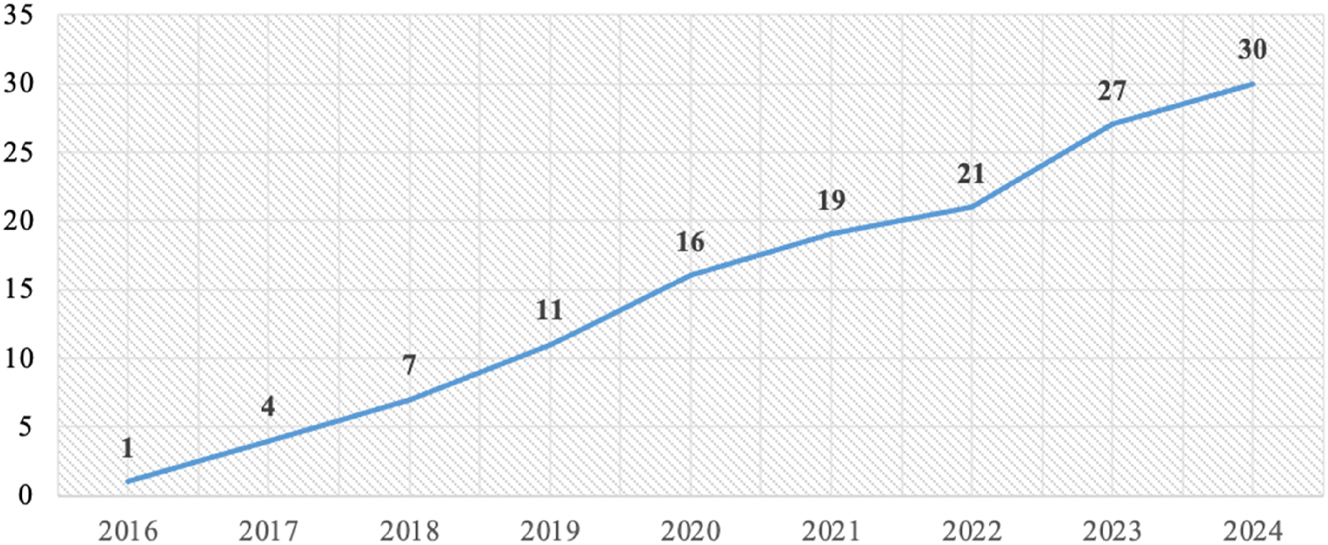
Number of partner countries of Luban Workshops, 2016–2024.
5.2 Administrative Authorities
In the high-quality construction and development of global Luban Workshops, administrative authorities are the most empowered participants, charged with policy formulation, norm setting, and coordination. First, the Ministry of Foreign Affairs, the Ministry of Education, the National Development and Reform Commission, and the China International Development Cooperation Agency jointly steer the Workshops, ensuring their forward-looking orientation. At the local level, education, finance, and foreign-affairs departments provide concrete guidance. Second, these authorities regulate the conduct of all actors and continuously strengthen institutional safeguards for quality development. Both nationally and locally, they have enacted and implemented a series of regulations governing scale, structure, and quality, thereby securing robust support for the Workshops. Finally, administrative authorities effectively harmonize the diverse stakeholders, aligning their interests and enabling deep integration of high-quality resources, which in turn exerts a positive influence on international vocational education cooperation within the Luban Workshop framework.
5.3 Coordinating Agencies
To vigorously advance the high-quality construction and sustainable development of Luban Workshops and to enhance the international influence of vocational education, China has established a comprehensive set of deliberative and coordinating agencies. Among them, the Luban Workshop Research and Dissemination Centre, inaugurated on 10 January 2018 and located within the Tianjin Academy of Educational Sciences, plays an irreplaceable role. The Centre operates on a “1 + 5 + N” model. That is, the Tianjin Academy of Educational Sciences serves as the lead organization (“1”); Tianjin Vocational Institute, Tianjin University of Technology and Education, Tianjin Light Industry Vocational Technical College, Tianjin Bohai Vocational Technical College, and Tianjin Railway Technical College form the core support (“5”); and a broad array of participating units, research institutes, and other stakeholders (“N”) are mobilized for joint undertakings. Its principal responsibilities encompass policy and theoretical research, teacher training and resource development, intellectual property protection, project management and quality assessment, as well as academic exchange and publicity, thereby providing theoretical guidance and coordination for the high-quality construction and development of Luban Workshops worldwide.
5.4 Participating Educational Institutions
Institutions of higher and vocational education are the primary loci for cultivating technical and skilled personnel. In China, more than 70 percent of newly recruited front-line workers in modern manufacturing, strategic emerging industries, and modern services come from vocational colleges, making these institutions the main arena for nurturing master craftsmen, highly skilled artisans, and advanced technical talent (China Education Online 2024). Within the high-quality construction and development of global Luban Workshops, participating colleges and universities have become the pivotal agents driving international cooperation in vocational education. From project application to contract signing, from preliminary site visits to mid-term exchanges, from process monitoring to final self-evaluation, and from specialty design to instructional planning, every phase is jointly executed by Chinese and foreign partner institutions. Empirical evidence shows that Chinese institutions have steadily consolidated their leadership role, serving as the critical nexus for the smooth operation of Luban Workshops. They coordinate construction progress with administrative authorities, align on implementation issues with deliberative-coordination agencies, and synchronize practical activities with foreign partner institutions, thereby forming a vertically integrated and horizontally linked operational system for the Luban Workshops.
5.5 Multinational Corporations and Local Enterprises
Enterprises serve as key agents in the cultivation of technical and skilled personnel, so transnational corporations and local firms are pivotal participants in the global construction of Luban Workshops. Characterised by deep international integration of industry and education, Luban Workshops have drawn these corporations and local enterprises into every dimension of their high-quality development. In technology support and equipment provision, the intensive involvement of transnational and local companies furnishes Luban Workshops with cutting-edge technologies and devices, ensuring that practical training bases meet world-class standards. In curriculum development and instructional resources, such enterprises collaborate with Chinese and foreign partner institutions to devise internationalized professional teaching standards and course materials, guaranteeing that content is tightly aligned with actual industry needs. In talent cultivation and employment, corporations and local firms engage deeply in the training process, offering local students internships and job placements that markedly shorten graduates’ on-boarding period. Over nine years of construction and development, global Luban Workshops have already supplied a substantial cohort of high-calibre technical and skilled personnel to overseas Chinese enterprises such as China Civil Engineering Construction Corporation and China-Africa TEDA Investment Company, as well as to local companies abroad, including Portugal’s Hovione Farma Ciência and Setúbal-based LAUAK Aircraft Structures.
5.6 Other Social Actors
Other social actors, most prominently industry associations, are likewise engaged in Luban Workshop construction. The China Education Association for International Exchange (CEAIE), a nationwide body dedicated to non-governmental educational cooperation and exchange, leverages its strengths as a social organization to participate actively in the global education cooperation network, build platforms for China-foreign educational dialogue, and carry out extensive, distinctive, and substantive non-governmental international education activities that support China’s wider opening of education to the world. Luban Workshops constitute a flagship initiative of CEAIE. In the high-quality construction and development of global Luban Workshops, CEAIE has served as both bridge and bond in organizing, coordinating, standardizing, and guiding international exchange. And also from a professional and sectoral perspective, it advances the key achievements of China’s vocational education reform and development that emerge from the Luban Workshop model, thereby making a constructive contribution to the high-quality construction and development of Luban Workshops worldwide.
6 Conclusions
After nine years of construction and development, Luban Workshops have become an internationally renowned brand for people-to-people exchanges between China and the world, and a golden calling card for international cooperation in vocational education. A thorough analysis of the key elements underpinning their high-quality construction and development, together with an exploration of effective pathways for international vocational education cooperation based on the Luban Workshop model, is therefore essential for seizing the initiative in opening-up and for advancing a higher-level “going global” strategy. Guided by the three core dimensions of structuration theory – rules, resources, and actors – this study offers an in-depth investigation of the critical components and effective pathways that ensure the high-quality construction and development of Luban Workshops.
The study finds that institution-building, resource-building, and the active engagement of multiple actors are the three decisive factors in the rise of Luban Workshops as a prominent brand of international vocational education cooperation. The Workshops have achieved this renown because they have realized decisive breakthroughs and forged viable pathways in precisely these three areas of institutions, resources, and actors. In institution-building, Luban Workshops have established a relatively comprehensive system of formal rules and a correspondingly effective set of informal norms. In resource-building, a coordinated array of human, informational, cultural, and technological resources provides crucial support for high-quality development. And actors which encompass sovereign states, administrative authorities, deliberative-coordination agencies, participating colleges and universities, transnational and local enterprises, and other social forces actively engage as core stakeholders within a community of shared interests. Together, these elements constitute the proven pathways that have enabled Luban Workshops to emerge as a renowned brand of international vocational education cooperation.
Constrained by limited capacity and time, this study inevitably exhibits shortcomings that merit attention in future research. Exploring effective pathways for international vocational education cooperation through Luban Workshops will require a broader perspective and a richer investigation of participating actors. International cooperation in vocational education is a process of co-governance among multiple actors whose modes of involvement differ in emphasis. Moreover, the Belt and Road Initiative and global governance are undergoing profound change. Consequently, it is necessary to unearth additional, easily overlooked participants. Future studies should move beyond the present delineation of basic responsibilities and identify hitherto neglected yet increasingly significant actors, such as international organisations and mass media, so as to enlist them in vocational education cooperation centred on Luban Workshops and thereby advance good governance in global vocational education.
Funding source: National Social Science Fund of China
Award Identifier / Grant number: 21CGL042
About the author
Lan Wang (1989–), Ph.D, female, from Cangzhou, Hebei, Deputy Director and Associate Researcher of the Research Office, Tianjin Academy of Educational Sciences. Research interests: vocational-education policy, internationalisation of vocational education, and educational economics and management.
-
Research ethics: Not applicable.
-
Informed consent: Not applicable.
-
Author contributions: The author has accepted responsibility for the entire content of this manuscript and approved its submission.
-
Use of Large Language Models, AI and Machine Learning Tools: None declared.
-
Conflict of interest: The author states no conflict of interest.
-
Research funding: This research is supported by the National Social Science Fund of China (Youth Project), “Advancing China’s Leadership in Global Vocational-Education Governance through Luban Workshops under the Dual-Circulation Paradigm” (Grant No. 21CGL042; Principal Investigator: Lan Wang).
-
Data availability: Not applicable.
References
Baocun, Liu, Hu Rui, Zhang Wei, Zhang Mengqi, Duan Shifei, Qie Haixia, Sun Yan, et al.. 2022. Research on the Strategy and Mechanisms for Expanding Educational Openness Under the Belt and Road Initiative.Suche in Google Scholar
CCTV.com. 2024. Developing New-Quality Productive Forces: the General Secretary Emphasizes ‘Domestic–International’ Linkage. https://dangjian.gmw.cn/2024-03/15/content_37206197.htm (accessed April 6, 2025).Suche in Google Scholar
China Education Online. 2024. Ministry of Education: China Has Established the World’s Largest Vocational Education System. https://www.eol.cn/news/yaowen/202411/t20241114_2641668.shtml (accessed April 6, 2025).Suche in Google Scholar
Chongzeng, Bi. 2020. “Cultural Distance, Mindfulness, and Cultural Confidence.” Journal of Southwest University (Social Sciences Edition) (6): 122–9.Suche in Google Scholar
Cohendet, Patrick, and Frieder Meyer-Krahmer. 2001. “The Theoretical and Policy Implications of Knowledge Codification.” Research Policy 30 (9): 1563–91. https://doi.org/10.1016/s0048-7333(01)00168-8.Suche in Google Scholar
Douglass North. [1990] 2014. Institutions, Institutional Change and Economic Performance. Translated by Hang Xing. Shanghai: Truth & Wisdom Press, SDX Joint Publishing Company, Shanghai People’s Publishing House.Suche in Google Scholar
Giddens, Anthony. [1984] 2016. The Constitution of Society: Outline of the Theory of Structuration. Translated by Li Kang and Li Meng. Beijing: China Renmin University Press.Suche in Google Scholar
Hofstede, Geert, and Xu Lisheng. 2008. Culture’s Consequences: Comparing Values, Behaviors, Institutions and Organizations Across Nations. Shanghai: Shanghai Foreign Language Education Press.Suche in Google Scholar
Jin, Sun, and Yan Huan. 2020. “Global Educational Governance: Concepts, Actors, and Mechanisms.” Comparative Education Review (2): 39–47.Suche in Google Scholar
Jing, Mi, and Wang Heng’an. 2023. “The Historical Evolution and Contemporary Trends of China’s International Discursive Power in Vocational Education.” Modern Education Management (1): 99–107.Suche in Google Scholar
Jingquan, Lv. 2024. Luban Workshop Analysis. Beijing: China Railway Publishing House Co., Ltd..Suche in Google Scholar
Jingquan, Lv, and Yu Lanping. 2021. “The Core Connotations of the engineering-practice-innovation-project (EPIP) Model.” Journal of Tianjin Vocational Institutes (6): 3–7.Suche in Google Scholar
Lan, Wang. 2023. “Knowledge Spillovers in International Vocational Education Cooperation: Drivers, Pathways, and Effects.” Fudan Education Forum (6): 113–20.Suche in Google Scholar
Lan, Wang. 2024. “A Governance-Mechanism Complex for Global Vocational Education Based on Luban Workshops: Connotation, Dimensions, and Pathways.” Vocational Education Forum (11): 121–8.Suche in Google Scholar
Lan, Wang. 2025. “China’s International Discursive Power in Global Vocational Education Governance: a Case Study of Worldwide Luban Workshops.” Research in Educational Development (3): 26–36.Suche in Google Scholar
Ministry of Education. 2020. Notice of the Ministry of Education and Eight Other Departments on the Issuance of the Action Plan for Improving and Strengthening Vocational Education (2020–2023). http://www.moe.gov.cn/srcsite/A07/zcs_zhgg/202009/t20200929_492299.html (accessed April 6, 2025).Suche in Google Scholar
Qiu, Wang, and Dai Yuwei. 2018. “Internationalisation of Vocational Education: Alignment, Sharing, and Going Global.” Chinese Vocational and Technical Education 16: 50–6.Suche in Google Scholar
Shuping, Zhi. 2015. “Enhancing Chinese Standards to Foster Global Connectivity.” China Daily: 13.Suche in Google Scholar
Spring, Joel. [1940] 2022. Introduction to Globalization and Education. Translated by Yang Qiguang et al. Shanghai: Shanghai Jiao Tong University Press.Suche in Google Scholar
Tianjin Municipal Education Commission and Tianjin Municipal Development and Reform Commission. 2021. Notice of the Tianjin Municipal Education Commission and the Tianjin Municipal Development and Reform Commission on Issuing the Tianjin Education Modernization 14th Five-Year Plan. https://jy.tj.gov.cn/ZWGK_52172/zcwj/sjwwj/202108/t20210819_5539309.html (accessed April 6, 2025).Suche in Google Scholar
Tianjin Municipal People’s Government. 2021a. Opinions of the Ministry of Education and the Tianjin Municipal People’s Government on Deepening the Integration of Industry, Education, and the City to Create a Benchmark for Innovative Development of Vocational Education in the New Era. https://www.tj.gov.cn/zwgk/szfwj/tjsrmzf/202112/t20211231_5768417.html (accessed April 6, 2025).Suche in Google Scholar
Tianjin Municipal People’s Government. 2021b. Notice of the Ministry of Education and the Tianjin Municipal People’s Government on Issuing the Implementation Plan for Exploring New Models of Modern Vocational Education System Reform. https://www.tj.gov.cn/zwgk/szfwj/tjsrmzf/202305/t20230531_6255951.html (accessed April 6, 2025).Suche in Google Scholar
Xingquan, Gu, and Wei Hao. 2022. “Factors Influencing the Enhancement of International Discursive Power in Standardization: a Multi-case Exploration Based on Grounded Theory.” Social Scientist (5): 80–7.Suche in Google Scholar
Xinhua. 2019. The CPC Central Committee and the State Council Issue China Education Modernization 2035. https://www.gov.cn/zhengce/2019-02/23/content_5367987.htm (accessed April 6, 2025).Suche in Google Scholar
Xinhua. 2021. General Office of the CPC Central Committee and the State Council Issue Opinions on Promoting High-Quality Development of Modern Vocational Education. https://www.gov.cn/zhengce/2021-10/12/content_5642120.htm?eqid=8b09d51700128111000000026459ab0e (accessed April 6, 2025).Suche in Google Scholar
Xinhua. 2023. Xi Jinping’s Remark at the Fifth Collective Study Session of the Political Bureau of the CPC Central Committee that We Must Accelerate the Building of a Strong Education Sector to Provide Solid Support for the Great Rejuvenation of the Chinese Nation. https://www.gov.cn/yaowen/liebiao/202305/content_6883632.htm (accessed April 6, 2025).Suche in Google Scholar
Yan, Yang, and Wang Lan. 2021. “Research on the International Brand Building of China’s ‘Going Global’ TVET Project: Luban Workshops.” Chinese Vocational and Technical Education 12: 124–7.Suche in Google Scholar
Yan, Yang, and Wang Lan. 2023. Luban Workshop Construction and Development Report 2022. Tianjin: Tianjin People’s Publishing House.Suche in Google Scholar
Yan, Yang, and Wang Lan. 2024. Luban Workshop Construction and Development Report 2023. Tianjin: Tianjin People’s Publishing House.Suche in Google Scholar
Yating, Huang, and Liu Zihan. 2024. “Motivations, Strategies, and Outcomes of World-Class Universities in Promoting Graduate Employment: an Examination Based on the Structuration Theory.” Foreign Education Research (11): 93–110.Suche in Google Scholar
Yunpeng, Zhang. 2005. “An Inquiry into Giddens’s Structuration Theory.” Social Science Front (4): 274–7.Suche in Google Scholar
© 2025 the author(s), published by De Gruyter, Berlin/Boston
This work is licensed under the Creative Commons Attribution 4.0 International License.
