Exclamation, intensity, and emotive assertion
-
 and
and

Abstract
In this paper, we present a novel analysis of exclamations as assertions equivalent to particular uses of declarative sentences with emotive verbs. Focusing on wh-exclamatives and declarative exclamations, we offer a wide range of arguments for why they are both assertive. We further argue that like emotive verbs, exclamations convey a presupposition not of factivity but of subjective veridicality anchored to the speaker, and assert the emotion (of surprise, amazement, or a negative emotion). Our analysis proposes a syntax-semantics for exclamations without a speech act operator, and exclamativity surfaces as an attitude rather than a speech act. This seems to be well motivated by the Greek, German as well as English facts we examine in the paper. Illocutionary operator approaches cannot capture the facts discussed here, and they also fail to determine precisely what the exclamative force might be.
1 Introduction
There is a long-standing tradition in linguistic theory postulating that a speech act (Searle 1969) is represented syntactically by prefixing a proposition with an illocutionary force operator (see Searle and Vanderveken 1985; Zaefferer 2001 for two prominent accounts of speech act representation). In more recent work at the syntax-semantics interface, the classic performative hypothesis (Lewis 1970; Ross 1970) has been revived by works that are concerned with the syntactic representation of the speaker-addressee relation and its consequences for postulating an articulated speech act layer (e.g., Haegeman 2014; Krifka 2015, 2023; Portner et al. 2019; Speas and Tenny 2003; Wiltschko 2021: Ch. 2; and many others).
When we think, for example, of the contrast between assertions and questions, it is generally acknowledged that the two differ in ‘illocutionary force’ as well as syntactic structure, therefore clause type. To be sure, ‘non-canonical’ interactions with other components of grammar can yield ‘mixed’ clause types (e.g., declaratives with rising intonation and their interpretation as ‘declarative questions’). However, most formal analyses assume a logical language that reflects the differences between canonical types, and designated speech act operators such as ‘ASSERT’ and ‘?’ (Krifka 2015) serve to reflect the distinct illocutionary forces. Merchant (2010) argues that a sentence is a tuple <P,S,M,CSA>, where P is the phonological representation, S the syntactic, M the semantic representation, and CSA is the ‘speech act content’.
1.1 Illocutionary force and exclamation
Assertion, question, and command have been well described as speech acts characterized by a mapping between P, S, M, and CSA. When we consider exclamations the issues become: Are exclamations distinct in semantic and syntactic type from assertions? Do exclamations have distinct illocutionary force from assertions like questions or commands are argued to have?[1] If so, what kind of illocutionary force is an exclamation? In order to answer these questions, one must bear in mind that, unlike interrogatives or imperatives, exclamative clause types such as How fast he ran! are often analyzed analogously to other clause types and even to non-clausal items that are claimed to express the same illocutionary force.
Following most of the literature, we use the term ‘exclamation’ (and not ‘exclamative’) to refer to the illocutionary component that is assumed to be the common property of those constructions. We thus use the terms ‘exclamation’ versus ‘exclamative’ analogous to terms such as ‘assertion’ (which is the speech act) versus declarative (which is the clause type). Let us be more specific about this distinction because throughout the paper it will be crucial to understand what we mean by ‘speech act’ and ‘illocutionary component’ in the context of our discussion.
There are a variety of syntactic forms and lexical items that are often compared to exclamatives such as How fast he ran!. Prominent examples are exclamations with interjections such as Wow! and declaratives like Boy, it is raining! or I am so disgusted by your behavior! known as sentence exclamations (Rett 2011) or declarative exclamations (Repp 2020). Given this variety of forms that can be used for performing a so-called exclamation speech act, Zanuttini and Portner (2003) have proposed an important distinction between ‘illocutionary force’ and ‘sentential force’. The latter term is adopted from Chierchia and McConnell-Ginet (1990), and it is also referred to as ‘illocutionary mood’ (Murray 2010; Rett 2021a, 2021b). Zanuttini and Portner (2003) explain the distinction as follows. Building on the central role of the speaker’s intention in Searle’s (1969) speech act theory, they point out that there is a type of force that is conventionally associated with a particular sentence’s form and another type of force that crucially involves pragmatic inferencing about the speaker’s intention. To see this, let us look at some of their examples (Zanuttini and Portner 2003: 40–41):
| Could you come in at 9:00? |
| a. | He’s so cute! |
| b. | Isn’t he the cutest thing! |
| c. | How cute he is! |
Given the relevant speaker’s intention, the sentence in (1) is interpreted as performing the speech act of ordering, but the form in (1) is conventionally associated with the force of asking. In other words, the illocutionary force in many cases is not equivalent to the sentential force. Zanuttini and Portner (2003) now apply this fundamental fact to the domain of exclamatives. The examples in (2) indicate that both declaratives (2a) and interrogatives (2b) can be used with a speaker’s intention that parallels the one in exclamatives like (2c). In other words, while (2a) and (2b) differ in their sentential force – (2a) is conventionally associated with an assertion and (2b) with a question – they both share with (2c) a meaning component that most of the literature, including Zanuttini and Portner (2003), would call ‘force of exclaiming’ or ‘exclamation’, referring to illocutionary force (e.g., König and Siemund 2007; Repp 2020; Rett 2011; Sæbø 2010; and many others).[2]
In our paper, we would like to try a new and different path. We will argue that there is no illocutionary force of exclamation in the first place – and this goes against almost all the previous accounts. If we assume that there is no such thing as the illocutionary force of exclamation, then there can also be no conventional association between the (non-existing) force and a specific syntactic structure (like in accounts that propose a dedicated sentential force aka illocutionary mood for exclamatives; see citations below). Since we deny the existence of a relevant illocutionary force, our approach also goes against accounts such as Zanuttini and Portner’s (2003) analysis, which claims that the concept of sentential force must be qualified when applied to the exclamative clause type because there is no force-indicating element that is present in all and only exclamatives. Again, although this account concurs with our skepticism against a dedicated sentential force for exclamatives, their approach still presupposes that the illocutionary force of exclaiming exists – and this is what we challenge in this paper.
While the sentential force hypothesis is only advocated by some of the works on exclamatives (most of them more syntax-centered approaches; e.g., Delfitto and Fiorin 2014; Munaro and Obenauer 1999), the illocutionary force hypothesis (IFH) that there is something like the exclamation speech act is shared by almost all of the existing approaches. To our mind, the most articulated and clearest version of the IFH has been formulated by Rett (2011), whose main point is to characterize ‘exclamation’ as “a speech act with a unique illocutionary force” (Rett 2011: 439). That is, when we consider various linguistic forms such as in (2) above (incl. their relevant intonation patterns) and how they convey expressive meaning, Rett’s (2011: 413) driving hypothesis is that “a characterization of exclamation as an independent speech act best captures this relationship.” We will discuss in more detail below how the IFH is formulated in several approaches by means of a dedicated illocutionary operator.
1.2 The proposal in a nutshell: emotive assertion
Before we briefly sketch the basic idea of our proposal, we would like to start with a few remarks on what an assertion is understood to be in current frameworks following Grice’s (1975) seminal work. Assertion is typically associated with veridicality commitment of the speaker towards the truth of propositional content being asserted. In Grice’s theory, the Quality maxim requires that the speaker asserts what they believe or know to be true, and what they have (some) evidence for. Giannakidou and Mari (2021) have formulated the Veridicality Principle of assertion to capture precisely the need for commitment to truth as a sincerity condition on assertion: one asserts cooperatively (i.e., without intent to deceive) what one believes or knows through evidence to be true. At the same time, commitment to truth has been defined as a gradual notion in Giannakidou and Mari (2018, 2021); see also Liu (2021) for characterizing veridical commitment elastic. The key factor is what kind of evidence one has, or whether they are considering objective or subjective factors (see discussion in Giannakidou and Mari 2021). Similarly, assertions have been thought of as ‘expressed beliefs’ versus ‘(public) commitments to the truth’ (cf. MacFarlane 2011 for discussion, and for more recent views for the latter position Geurts 2019; Krifka 2023; Shapiro 2020).[3]
Given this general background, we will propose that the classic exclamation cases How fast he ran! and He was so fast! are in fact a specific kind of assertion, one that asserts emotion, is veridically committed to the truth of the sentence, and presupposes intensity.[4] From this particular nature of what we call ‘emotive assertions’, the semantic properties of at least wh-exclamatives (How fast he ran!) and declarative exclamations (He was so fast!) will be shown to follow. Our paper spells out such a proposal by building on the analysis of emotive verbs proposed by Giannakidou and Mari (2021), and takes a fresh look at uses of wh-based exclamatives and declarative exclamations as emotive assertions equivalent semantically to sentences with emotive predicates (be surprised, happy, amazed, disgusted, etc.).
Our approach directly challenges previous accounts which claim that exclamatives lack asserted content. The only content allowed in those analyses is a factivity presupposition (relying on earlier discussions in Abels 2010; Grimshaw 1979; Zanuttini and Portner 2003); and some argue that there is expressive content (which is also not asserted). Consider the following wh-exclamative and its contents at the descriptive and expressive level (‘expressive’ understood as a subtype of ‘CIE’ content, according to Gutzmann 2021; McCready 2010):
| How fast Eliud Kipchoge was! | |
| descriptive content/presupposition: | ‘Eliud Kipchoge was very fast.’ |
| expressive content/not-at-issue: | ‘Speaker is amazed/surprised that Eliud Kipchoge was so fast.’ |
In our paper, we challenge the position that wh-exclamatives lack assertive content, and claim that what is labelled expressive content above is actually what the wh-exclamatives assert. We will argue, based on data from Greek and German, that wh-exclamatives are used to perform emotive assertions akin to assertions of declarative sentences containing emotive predicates such as be amazed, be surprised in the present tense (4), and have very similar truth conditions and presuppositions:
| I am amazed at how extremely fast Eliud Kipchoge was. |
Our claim is that (3) and (4) are identical in terms of what they assert and presuppose, and we will group them together under the label ‘emotive assertions’. They both assert that the speaker has the emotion of amazement towards the believed proposition that ‘Eliud Kipchoge was extremely fast’, and presuppose that the speaker has the belief that Eliud Kipchoge was extremely fast. Our analysis relies on new data from Greek and German and shows that acknowledging the assertive content of wh-exclamatives as well as the different nature of their presupposition are long overdue.
The paper is structured as follows. In Section 2, we address two central data points that have traditionally played a significant role in the discussion of whether wh-exclamatives, but also exclamatives more generally (e.g., inversion exclamatives Does he run fast!), feature assertive content. These data points concern two questions: (i) Can the descriptive content of exclamatives be denied? and (ii) Can exclamatives be used as answers to information-seeking questions? Our answer to both questions will be ‘yes’, in contrast to previous claims. Section 3 then turns to the syntax-semantics interface in more detail and discusses Greek data illustrating a similarity between wh-exclamatives and complements of emotive predicates in that both appear with the Greek complementizer pu. After illustrating the relevant distributions, we will argue for an analysis that exclamative sentences are equivalents to declarative assertions containing an emotive verb and its complement with an extreme degree. We will rely on Giannakidou and Mari’s (2021) recent analysis of emotive verbs. In Section 4, we will focus on data from German that further support the parallel between emotive verbs and exclamative sentences as emotive assertions, taking into account exclamative forms that appear with the German complementizer dass. In particular, we will demonstrate that the only complementizer German uses in exclamatives is the complementizer that is the typical element in non-interrogative contexts. Crucially, the assertive character of these exclamatives is not only signaled by its choice of the complementizer dass, but also by the distribution of exclamative modal particles, which shows that exclamatives share mood features with assertive declarative clauses. Section 5 summarizes and concludes the paper.
2 Wh-exclamatives and declarative exclamations have assertive content
Exclamatives are often considered structures that are associated with a dedicated illocutionary operator, which instantiates the exclamation speech act. Prominent examples in semantics are Rett’s (2011) ‘E-FORCE’ and Grosz’s (2012) EX operators. In the syntactic literature, so-called ‘cartographic’ approaches, which represent illocutionary components as left-peripheral syntactic projections (Rizzi 1997, 2014), have postulated a separate functional projection for exclamatives (e.g., Munaro and Obenauer’s 1999 ‘ExclCP’).
Let us first illustrate this general idea by sketching very briefly the two semantic approaches by Rett (2011) and Grosz (2012) because those two approaches most explicitly postulate a dedicated illocutionary operator for exclamations, and can thus illustrate the general thinking of the IFH in the context of our discussion. Crucially, both approaches build their proposals on a distinction between descriptive content on the one hand and expressive content on the other (both Grosz 2012 and Rett 2011 explicitly refer to the original discussion and concepts in Kratzer 1999; Potts 2005, 2007).[5] This dichotomy between descriptive and expressive content is an aspect of those two approaches that we think also lies at the core of many other prominent accounts, some of which we will discuss further below. For instance, Zanuttini and Portner’s (2003) claim that the descriptive content of exclamatives (i.e., their proposition, see details below) can be characterized as a factivity presupposition (and not as assertive content). Their account is based on a general view according to which there is a “difference in force between exclamatives and declaratives like It is surprising that …, which assert closely related content” (Zanuttini and Portner 2003: 56) – and this view implies that exclamatives are somehow ‘special’ because their main illocutionary point is not the assertion of descriptive content.
This general thinking is articulated in Rett’s (2011) and Grosz’s (2012) approaches, which is why we briefly sketch them in the following section.[6] Based on this discussion, we will then address two empirical data points that are often cited in favor of such exclamation-force approaches, which distinguish between declarative exclamations on the one hand and exclamatives, on the other hand, by claiming that they have different semantic and pragmatic properties (Sections 2.2 and 2.3).
2.1 The exclamation operator
As already mentioned in Section 1 above, one of the most articulated and clearest versions of the IFH has been formulated by Rett (2011), whose main point is to characterize ‘exclamation’ as “a speech act with a unique illocutionary force” (Rett 2011: 439). Rett’s (2011) illocutionary account is motivated by the intuition that, at the level of illocutionary force, there is no difference between exclamatives (e.g., How fast he is!) and declarative exclamations (e.g., He is so fast!). This is an intuition that we share.
However, while Rett’s (2011) consequence is to postulate an additional operator that can capture the similarities between those different utterance types, our claim will be that we can account for the relevant similarities without adding a force operator, and instead manage with the illocutionary force of assertion that we must postulate in our syntax-semantics anyway. In (5), we see Rett’s (2011: 429) formulation of her illocutionary operator E-FORCE, which is based on Kratzer’s (1999) account of German modal particles as expressive items.
| E-Force(p), uttered by s C , is appropriate in a context C if p is salient and true in w C . When appropriate, E-Force(p) counts as an expression that s C had not expected that p. |
The modeling of the illocutionary force of exclamations in (5) includes a speaker in a Context (s C ) and a world of utterance (w C ), and the force of an exclamation amounts to expressing that some proposition p was not expected by the speaker s C .
The main point of Rett’s analysis now is that the input for the E-FORCE operator is different in exclamatives (How fast he is!) and declarative exclamations (He is so fast!). In other words, exclamatives and declarative exclamations differ in their content. Let us first look at Rett’s (2011: 430) analysis of declarative exclamations like in (6):
| (Wow,) John won the race! | |
| a. | p = λw.won w (john, ιx[race w (x)]) |
| b. | E-Force(p), uttered by s C , is appropriate in a context C if p is salient and true in w C . When appropriate, E-Force(p) counts as an expression that s C had not expected that p. |
(6) illustrates that exclamations such as John won the race! denote propositions (6a), and the interaction of the illocutionary operator and p is thus straightforward (6b)/(5). When we now turn to exclamatives, Rett’s (2011) claim is that they denote degrees, not propositions (for reasons discussed in Rett 2008 and in Section 3 below). Accordingly, she proposes the following modeling where we look at a two-step analysis containing a proposition with an unbound variable (7b), which is then bound via existential closure in (7c) so that the proposition D(d′) can function as the input to the illocutionary operator (Rett 2011: 431):
| How tall John is! | |
| a. | λd.tall(john,d) |
| b. | tall(john,d′) |
| c. | E-Force(p) counts as an expression that ∃d′ such that s C had not expected that D(d′). |
As mentioned above, we share with Rett (2011) the goal to provide a unified analysis for cases such as (6) and (7). However, we will argue that both (6) and (7) can be analyzed as assertions at the level of illocutionary force, and so we don’t need any additional operator such as E-FORCE in (5) above. More specifically, regardless of the question of force, the distinctive feature of all the different forms of exclamations is that they convey an intensity of emotion (see Section 3.2 below). Assertions, crucially, can also convey such emotion, and in this case we are looking at declarative exclamations such as (6) above. The declarative exclamations are typically marked by interjections and an exclamation mark in written form – Wow, that was an amazing meal! – or a simple addition of so: He runs so fast! The literature, including Rett’s (2011) account sketched above, typically dissociates wh-exclamatives from those declarative cases, but we will show that there is no good argument for doing so. If the two behave in a similar manner with respect to tests of content (see Sections 2.2 and 2.3 below), and declarative exclamations are assertions, then wh-exclamatives are used to perform assertions too. But before we discuss the details of our criticism in the following sections, let us have a brief look at another IFH-based approach, which tries to unify optatives and exclamatives and, in this context, puts an emphasis on the non-truth-conditionality of exclamatives. As a consequence, similarly to Rett (2011), this account distinguishes exclamatives from declarative exclamations by denying the assertive character of exclamatives.
Like Rett (2011), Grosz’s (2012) account is an IFH-based approach that provides a unified illocutionary operator (his ‘EX’) for what he calls ‘expressive utterances’ (Grosz 2012: Section 3.13), including both optatives and exclamatives. Note that for Grosz (2012: 2), “optative utterances are a variant of exclamative utterances,” and he makes very clear that his analysis of optative constructions holds for any kind of exclamatives as well (see Grosz 2012: 127–134 on the various types of exclamatives that his analysis is intended to capture).
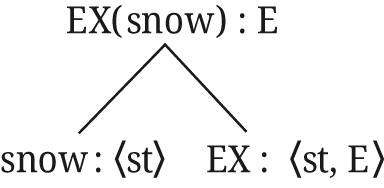
More specifically, if we apply his analysis to exclamatives, EX combines with a truth-conditional expression of type <s,t> (i.e., a truth-conditional argument of propositional type) and maps this proposition onto felicity conditions that detail the speaker’s attitude towards the proposition. Crucially, the resulting denotation is not truth-conditional, but, according to Grosz, ‘felicity-conditional’. In particular, he claims that application of EX to a proposition yields a one-dimensional meaning of type E (defined as the type of expressive meaning). Consider the following example and the representation in (8′); see Grosz (2012: 118):
| Boy, is it snowing! |
|
Grosz claims that EX removes its propositional complement from the level of descriptive at-issue meaning, and shifts it to the level of expressive meaning. He therefore rejects a multidimensional analysis according to which the operator EX passes the descriptive content unchanged – that is, it is at-issue and it can be asserted or questioned. However, its context of interpretation is altered by the content of the operator. So, in contrast to the representation for exclamatives illustrated in (8), the result would be the following two-dimensional semantic object (Grosz 2012: 118):
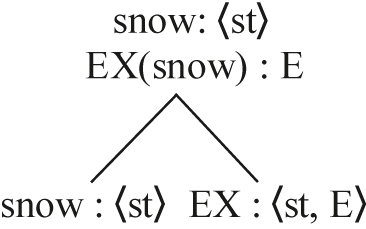
|
To us, it is not clear empirically that exclamative utterances lack assertive meaning instantiating a different illocutionary force, which Grosz (2012) represents by the illocutionary operator EX and Rett (2011) by E-FORCE. In the literature, we find two central data points that are cited in favor of the claim that exclamatives lack assertive force: (i) the descriptive content of exclamatives is said to not be (directly) deniable; and (ii) exclamatives, unlike declaratives, have been claimed to not be used as answers to information-seeking questions. Let us now examine these data.
2.2 The descriptive content of all exclamations can be denied
According to Rett (2011: 413), “[t]he utterance of a sentence exclamation counts as an assertion of the denoted p.” The literature supports this claim by highlighting that the descriptive content of sentence exclamations can be ‘denied’, whereas the descriptive content of wh-exclamatives cannot be denied – an indication that the descriptive content is not asserted (see Brandner 2010: 91; d’Avis 2016: 170–171 for a variety of examples and relevant judgments). To illustrate, let us focus on English and Rett’s (2011: 414) version of the relevant pattern in this language:
| A: | (Wow,) John bakes delicious desserts! |
| B: | No (he doesn’t), these are store-bought. John’s actually a terrible cook. |
| A: | (My,) What delicious desserts John bakes! |
| B: | ? No (he doesn’t), these are store-bought. John’s actually a terrible cook. |
| B′: | Not really; these are store-bought. John’s actually a terrible cook. |
Wh-exclamatives, as can be seen in (11B′), can indeed be denied by phrases like not really etc. (see Rett 2008: 199–200). The question is: why is no excluded (11B)? Denials such as no have also been discussed in terms of external negation, and they are known to be anaphoric responses to the previous utterance (Giannakidou 1997, 1998; Giannakidou and Stavrou 2009; Horn 2001). Those expressions can be used to deny various aspects of the utterance including what is asserted (in which case we talk about denial proper) but also what is presupposed or implicated in which case the negation is metalinguistic (on denying presupposed content in general, see Beaver and Denlinger 2020). In (10) and (11) what is denied is the descriptive content that John bakes delicious desserts.
In what follows, we would like to challenge the ill-formedness of no reported by Rett (2008, 2011) for English, and by Brandner (2010), d’Avis (2016), and others for other languages than English. English speakers we consulted find no trouble responding no to this sentence (see also Zanuttini and Portner 2003: 47/(18)) – so the judgments in (11) are quite subtle, to say the least. When we look at one of our own native languages, Greek, our introspective judgment clearly is that the descriptive content of both types of sentences can be routinely denied by the negative particles Oxi/Ba/A, ba:
| A: | Po po, | o | Janis | ftiaxni | nostima | glyka! |
| wow | the | John | makes | delicious | sweets | |
| ‘Wow, John bakes delicious desserts!’ | ||||||
| B: | Oxi/Ba/A, ba! Ta agorase apo to zaxaroplasteio. | |||||
| ‘No/Nah! These are store-bought.’ | ||||||
| B′: | Oxi/Ba/A, ba! Dhen mou aresoun. | |||||
| ‘No/Nah! I don’t like them.’ | ||||||
| A: | Ti | nostima | glyka | pu | ftiaxni | o | Janis! |
| what | delicious | sweets | that | bakes | the | John | |
| ‘What delicious desserts John bakes!’ | |||||||
| B: | Oxi/Ba/ A, ba! Ta agorase apo to zaxaroplasteio. | ||||||
| ‘No/Nah! These are store-bought.’ | |||||||
| B′: | Oxi/Ba/A, ba! Dhen mou aresoun. | ||||||
| ‘No/Nah! I don’t like them.’ | |||||||
Oxi is the nο that is called sometimes external or responsive negation (Giannakidou 1998; Horn 2001). The other more colloquial markers are likewise denying the previous content, and we translated them above with the English nah. Like oxi ‘no’ these can be responses to yes/no questions as in A: Did you see Janis? B: Oxi, Ba, den ton idha ‘No/Nah, I didn’t see him’; they can also be used in negative responses to imperatives such as Open the door! Νο/Nah, I won’t do it. More detailed comparisons have not been done in the literature, and it would be useful to know more – yet for the purposes of our paper their alignment with respect to exclamatives will suffice.
We discuss the form of Greek wh-exclamatives in more detail in Section 3 below where we note that ‘how-much’ poso is a marked alternative. At this first encounter suffice it to note that: (i) the Greek wh-exclamative appears as a what- and not as a how-exclamative, unlike English, (ii) the what-exclamative contains the complementizer pu suggesting some sort of embedding (which we come back to), (iii) the descriptive content of both types can be denied with a number of negators that include the external particle oxi ‘no’ but also the rejection particle (a) ba. These (more colloquial and quite common) markers can also be used to deny the content of regular declarative assertions (i.e., declaratives that do not express any surprise or amazement like in (12) above):
| A: | O | Janis | ftiaxni | nostima | glyka. |
| the | John | makes | delicious | sweets | |
| ‘John bakes delicious desserts.’ | |||||
| B: | Oxi/Ba/ A, ba! Ta agorazi. | ||||
| ‘No/Nah! He buys them.’ | |||||
| B′: | Oxi/Ba/A, ba! Dhen mou aresoun. | ||||
| ‘No/Nah! I don’t like them.’ | |||||
The denial of the descriptive content of the previous assertion is indistinguishable from the denial of the descriptive content of an exclamative. And, we repeat, the English translations contain equally flawless denials. Hence, when we understand the issue to be about denial and not narrow denial (which is strictly speaking negating the proposition by n’t/dhen which differ morphologically from no/oxi), the idea that the descriptive content of exclamatives cannot be denied is simply a non-starter. Given the Greek data and the weakness of the original English contrast, it seems quite reasonable to conclude that declarative exclamations and wh-exclamatives are more similar than different.
Castroviejo Miró (2008a) offers a similar discussion to ours. Consider her examples (15):
| a. | A: | How tall Bill is! |
| b. | B1: | # That’s not true, you are not emotional. |
| c. | B2: | Come on, he’s not that tall. |
Castroviejo Miró claims that “(15b) is impossible, because the speaker’s emotional state cannot be denied, but a sentence like (15c) is acceptable and felicitous in this dialogue because what is being denied is not the speaker’s attitude but rather the sentence that one can infer when interpreting a wh-exclamative, i.e., that Bill is very tall. We cannot reply by denying that the speaker believes it, but we can deny the believed content.” These are observations that we share.
Importantly, recent experimental work also challenges the presumed judgment difference between declarative exclamations and wh-exclamatives indicating that judgments in (11B) above may not stand up to empirical scrutiny that measures the acceptability of relevant patterns. In particular, Villalba (2017) argued based on two experiments that the descriptive content of exclamatives is semantically ‘at-issue content’, therefore amenable to denial in a discourse. This recent research on Spanish and Catalan exclamatives is further supported by a large-scale acceptability study (n = 112) by Trotzke (2019) on German exclamatives where he demonstrates that there is no difference between wh-exclamatives and other forms of exclamations (notably declarative exclamations) when testing the felicity of different denial strategies like the ones introduced above in (10) and (11).
More specifically, participants in this study had to rate the acceptability of Speaker B’s denials on a scale ranging from 1 (= very bad) to 6 (= very good). Crucially, all judgments of exclamation items were at ceiling (ranging from 5.2 to 5.7) and thus in accordance with filler items presenting perfect mini-dialogues (e.g., wh-question + corresponding declarative answer); see Trotzke (2019) for full set of German items and detailed statistics.[7] Table 1 summarizes some of the results relevant in our context.
Summary of some ratings from Trotzke (2019).
| Exclamation type | Strong denial (e.g., No! … German: Nein! …) | Weak denial (e.g., Not really,… That’s not quite true …; German: Nicht wirklich, … Das stimmt nicht ganz …) |
|---|---|---|
| Declarative | 5.55 | 5.70 |
| wh-exclamative | 5.28 | 5.46 |
As Table 1 shows, both utterance forms allow denial, and prefer the subtle strategy labelled as weak denial (e.g., not really etc.). This indicates that the descriptive content is indeed in a way backgrounded in exclamatives like (11). Crucially, this backgrounding seems to be the same in declarative exclamations (10) signaled by the overall preference for subtle denial (‘weak denial’) in this study. We also hasten to add that all judgments of exclamation items (i.e., for both ‘strong denial’ and ‘weak denial’) were at ceiling of the provided scale (ranging from 5.2 to 5.7) and thus in accordance with filler items that were expected to receive very good judgments (e.g., assertions like Linda has a smart son, followed by a denial such as No, that’s not right; see Trotzke 2019: 530–531 and his Data Appendix for details).
Note that although Trotzke’s (2019) study on German exclamatives differs from Villalba’s (2017) study on Romance (both in the choice of materials and in the methodology used), the two experimental studies taken together support our intuition about the Greek and the English data: the descriptive content of exclamatives can indeed be denied – suggesting that exclamatives feature assertive force. In other words, the denial strategies possible with exclamatives and declaratives look more similar than expected under a hypothesis where exclamatives lack assertive force. The denials appear to target the same descriptive content in both cases.
Additionally, why should we postulate a factivity presupposition to account for the descriptive content of exclamatives like, for example, Zanuttini and Portner (2003) do? Since no one to date has proposed that we need factivity presuppositions to account for the descriptive contribution of declarative exclamations like (10), such an approach would also be on the wrong track. Let us now strengthen the empirical claim that exclamatives do not differ much from declarative exclamations by looking at how both can be used as answers to information-seeking questions, the second central data point often cited in favor of distinguishing between the two.
2.3 Exclamatives can be used as answers to information-seeking questions
In this section, we examine the felicity of answers in certain dialogue sequences involving exclamatives. We think of ‘answer’ as encompassing direct answers to information-seeking questions but also other answering strategies via more indirect moves in a dialogue (e.g., by means of pragmatic inferencing/implicatures; see de Marneffe and Tonhauser 2019; Holtgraves 1998; Walker et al. 2011). This will become clear in a moment.
Grimshaw (1979: 321) famously argued that exclamatives are always infelicitous as answers to questions. Here is her prominent example:
| A: | How tall is John? |
| B: | # How tall John is! |
| B′: | John is extremely tall. |
The wh-exclamative presumably conveys the same descriptive content as the declarative assertion in (16B′). Yet, the argument goes, declaratives are felicitous answers, but an exclamative is not; hence the exclamative lacks assertive content. Following Grimshaw (1979), Zanuttini and Portner (2003) and many others claimed that the only descriptive content of exclamatives is a factivity presupposition, and a presupposition cannot serve as an answer providing new information.
It is important to note that claims such as Grimshaw’s based on (16) are (again) focused on the syntactic form of a wh-exclamative, and not on exclamation speech acts more generally. As we pointed out in Sections 2.1 and 2.2, there is no difference in content between an exclamative like How tall John is! (16B) and a declarative of the form John is so tall! (16′B′) – which is, by the way, also an imperfect answer:
| A: | How tall is John? |
| B: | # How tall John is! |
| B′: | # John is so tall! |
If we only take Grimshaw’s (1979) account, then we would expect that the declarative form in (16′B′), even when used as an exclamation, should be fine. But then it’s not clear why the exclamative in (16B) should be ruled out, given that both the exclamative and the declarative exclamation can express the same kind of emotion towards the very same content.[8]
Importantly, we will argue, the ability to answer a question is not necessarily evidence for assertive force or lack thereof. Many questions, for example, can be answered by other questions, often rhetorical:
| A: | Who came to the party? |
| B: | Who didn’t? (Intended to convey: Everyone did). |
Being an answer to a question and being an assertion are not the same thing, and Grimshaw’s initial argument needs to be seen in this light. One could argue, of course, as Sadock (1971), Han (2002), and Giannakidou and Mari (2024) do, that rhetorical questions like (17B) are equivalent to assertions semantically, or that the uses of cases like (17B) count as (indirect) assertions (Meibauer 1986). In this case, the clause type (interrogative) does not determine the semantic value or discourse function. And if that is the case, then the distinct clause type of exclamative does not necessitate a distinct semantic or pragmatic type either.
Secondly, while the previous literature has mainly focused on the type of answers, we would like to explore the type of questions instead. When we do that, we find that exclamatives can indeed be used to answer information-seeking questions as long as they do not yield a mismatch at the level of information structure. Look at the following patterns:
| A: | How fast was Eliud Kipchoge? |
| B: | Eliud Kipchoge was [very]F fast. |
| B′: | # [How fast Eliud Kipchoge was!]F |
| B″: | # [Eliud Kipchoge war‘was’ aberPART auchPART schnell‘fast’!]F |
The declarative (18B) is a perfect answer to a narrow-focus question (18A). (18B′) is odd as already pointed out in the literature. Crucially, (18B″) – a German declarative featuring the exclamative particles aber auch – is as bad as (18B′), although the syntax is clearly ‘assertive’ (more on these particles in Section 4). However, (18B″), due to the use of those exclamative particles (and the corresponding exclamative intonation), is interpreted as an exclamation with declarative syntax (hence as a declarative exclamation, see our discussion in Sections 2.1 and 2.2 above). As we have already indicated above, the literature on German exclamations points out that such declarative exclamations do perform assertions (e.g., Brandner 2010; d’Avis 2016). Observe a relevant example and judgments by d’Avis (2016: 171):
| A: | DER | ist | aber | blöd! |
| this.one | is | part | dumb | |
| B: | Nein (das ist er nicht). / ‘No (he is not).’ | |||
| C: | # Augenblick, der ist doch gar nicht blöd. / ‘Wait a moment, he is not dumb.’ | |||
According to d’Avis (2016), (19) illustrates that the proposition of (19A) is asserted because non-acceptance can be communicated by means of a simple no (19B), and other strategies that would indicate that the proposition is presupposed are not possible (19C). Since the declarative option in (18B″) above is as bad as the exclamative in (18B′), we can thus say that the infelicity of (18B′) does not, again, prove non-assertiveness. Instead, it might be due to the nature of the question. (18A) asks directly what the degree of fastness was. But if, as we are suggesting, the speaker’s belief of the extreme degree of fastness is presupposed (see Section 3), then offering a wh-exclamative to this type of question is infelicitous.
Contrast the above with the following examples, where the question is not directly about the degree of fastness:
| A: | Tell me, how did Eliud Kipchoge do in the race? |
| B: | [He was very fast.]F |
| B′: | My god! [How fast he was!]F |
| B″: | My god! [Der’this-one’ war’was’ aberPART auchPART schnell’fast’!]F |
When the information-structural context is changed to a broad-focus question, we see a clear improvement of both the exclamative (20B′) and the declarative exclamation (20B″). We claim that (20B) is also fine in such a context because it no longer expresses narrow focus as in (18B), but instead it can also be interpreted as an all-focus declarative.[9]
In a similar vein, consider again the following scenario, where the answerer is already in a heightened emotional state:
| Context: I consider Trump to be a liar, but unfortunately people believe him. After watching one of his rallies, my friend asks and I respond as follows: |
| Q: Why don’t you say anything? |
| A: How ecstatic Trump’s crowd was! |
| B: How manipulative Trump was! |
In this context, the exclamative is a fine answer. Once the context is a bit richer about the emotional state, an answer with an exclamative is acceptable. We believe that the reason why the original Grimshaw example was incongruent was because of the presuppositional load of emotive assertions (as we will show soon) can get in the way. Note that in the original sequence an emotive assertion is also odd:
| A: | How tall is John? |
| B: | # I am amazed that John is extremely tall. |
| B′: | John is extremely tall. |
According to the account by Simons (2007), the embedded clause in (22B) does not have ‘main point status’, and thus it cannot answer the question in (22A). Crucially, in our approach we concur with Simons (2007: 1036) that “different utterances of the same sentence can have different main points.” Have a look at the sentence in (22B) in a different discourse environment:
| A: | Tell me, what is the most striking feature about John? |
| B: | I am amazed that John is extremely tall. |
Once we change the context, the embedded clause can have main point status, perform an assertion, and answer the information-seeking question in (23A); see also Urmson (1952) and Hooper (1975) on syntactically embedded complements that are used as assertions.
In sum, the patterns above suggest that the second major data point in the literature intended to show that exclamatives lack assertive content is questionable: exclamatives can indeed be used as answers to information-seeking questions provided that they occur in a relevant information-structural and discourse environment.
Since there is no other substantial argument for a difference between declarative exclamations and exclamatives, we will move on to our proposal, which is that exclamations as a class (wh- and declarative ones) indeed convey descriptive content and are emotive assertions of intensity.
3 Greek exclamatives and emotive pu
In this section, we present new data from Greek exclamative structures suggesting an affinity of exclamatives to emotive assertions such as I am amazed/surprised that Bill bakes delicious desserts, I am amazed at how delicious the desserts Bill bakes are. Based on the empirical parallels, we extend the category of emotive assertion to include both wh-exclamatives and declarative exclamations, and propose a syntax that captures that.
Before we dive into the details of our approach and the relevant data from Greek, we would like to point out that our main goal in this paper is not to highlight cross-linguistic differences between various ways of how languages express exclamations.[10] Quite the contrary. We discuss the Greek patterns (and later in Section 4 data from German) because we think that the morphosyntax of exclamations in those languages overtly instantiates relevant features of exclamations that, according to our approach, tell us something about the domain of exclamations more generally and across languages. In other words, what we propose in the following sections can also be applied to other languages, most notably to English, as this language – and the associated arguments and literature – were at the center of Sections 1 and 2. Our core claim is that wh-exclamatives are emotive assertions akin to assertions of declarative sentences containing emotive predicates such as be surprised etc. and have very similar truth conditions and presuppositions.
For English, such an approach has been discussed as well (already in Grimshaw 1979). However, one of the main arguments against an analysis of English exclamatives that assimilates matrix configurations and embeddings under predicates such as be surprised is that there seem to be more options for the wh-element in embedded configurations than for the corresponding matrix versions (see Lahiri 2000: 361–362; Rett 2008: 191–192). Look at the following examples from Lahiri (2000: 361):
| a. | It is surprising who came to the party. |
| b. | * Who came to the party! |
For Rett (2008), the ungrammaticality of (24b) is evidence for the degree restriction that she claims holds for English exclamatives. According to Rett, only a restricted class of wh-elements – namely those that express degree readings – can occur in English matrix exclamatives. We will come back to this restriction in more detail in Section 3.4, but for now we would like to point out that this argument against an analysis of exclamatives akin to configurations with emotive predicates does not really convince us because we actually do observe non-degree configurations such as (24a) above where there is no embedding under predicates such as be surprised:
| Look who came to the party! |
Crucially, (25) performs an exclamation speech act (i.e, ‘the speaker is surprised about who came to the party’), but the exclamation interpretation is not due to the embedding non-emotive predicate to look, but rather a cumulative effect of the initial look and the following non-degree wh-configuration.[11] This is reminiscent of the strong preference for initial interjections in English inversion exclamatives (McCawley 1973; [33a]), which are totally fine without such introducing elements in languages like German and Dutch (e.g., Brandner 2010).
| Boy, is syntax easy! |
All in all, while we of course acknowledge the rich typology and fascinating morphosyntactic variation of exclamations across languages, we do not think that this formal variation necessarily corresponds to a semantic variation. Exclamations, we claim, in potentially any language, can be analyzed as emotive assertions, and we see no reason not to extend the account sketched next for Greek and German to English, since the language-specific arguments against it (see (24) above) turn out to be weak as soon as the discussion takes into account richer contexts and data. Let us now turn to exclamatives in Greek and what they can teach us about the semantics of exclamations more generally.
3.1 Greek exclamatives: what and the complementizer pu
There is not much discussion of exclamatives in the Greek literature, and our goal in this paper is to document the core patterns. Recall our earlier presentation of the Greek data. We noted that (i) in Greek wh-exclamatives appear with what and not with how (unlike English), and (ii) the what-exclamative contains the complementizer pu, suggesting some sort of embedding:
| Ti | nostima | glyka | (pu) | ftiaxni | o | Janis! |
| what | delicious | sweets | that | makes | the | John |
| ‘What delicious desserts John bakes!’ | ||||||
| Ti | grigora | pu/*oti/*na | etrekse | o | Kipchoge! |
| what | fast | that | run.3sg | the | Kipchoge |
| ‘How fast Kipchoge ran!’ | |||||
In employing the complementizer pu, Greek exclamatives look like complements of emotive verbs, which famously in the Greek literature select this complementizer. Pu is optional, but strongly preferred. In order to appreciate the significance of pu, we must consider that Greek has four complementizers: oti/pos (indicative), na (subjunctive), and pu which is the emotive indicative (see Giannakidou 2016; Roussou 2020). Of these, only pu appears after verbs of emotion:
| I | Ariadne | thavmase | pu/*oti/*na | o | Kipchoge | etrekse | toso | grigora. |
| the | Ariadne | was.amazed | that | the | Kipchoge | run.3sg | so | fast |
| ‘Ariadne was amazed that Kipchoge ran that fast.’ | ||||||||
| O | Nicholas | nomizi | oti/*pu | efije | i | Ariadne. |
| the | Nicholas | thinks.3sg | that.ind | left.3sg | the | Ariadne |
| ‘Nicholas thinks that Ariadne left.’ | ||||||
| Thelo | na/*pu | kerdisi | o | Janis. |
| want.1sg | subj | win.3sg | the | John |
| ‘I want for John to win.’ | ||||
Giannakidou (2009, 2016) and Giannakidou and Mari (2021) offer extensive discussion of Greek mood patterns. The key piece is the use of the emotive pu in the exclamative. Also important is the use of what instead of English how. What plus ADJ is not an otherwise attested combination in Greek, and is certainly not the way to form a degree question. As we can see below, the degree question requires, like in English, a how wh-phrase, specifically poso ‘how much’:
| Poso/*Ti | grigora | etrekse | o | Kipchoge? |
| how/what | fast | run.3sg | the | Kipchoge |
| ‘How fast did Kipchoge run?’ | ||||
| Poso/*Ti | psilos | ine | o | Andreas? |
| how/what | tall | is | the | Andreas |
| ‘How tall is Andreas?’ | ||||
Greek wh-exclamatives are thus distinguished from interrogative degree structures in Greek, and as we argue later, the what-ADJ combination can be thought of as a realization of an abstract extreme degree morpheme akin to so. In further support of this, consider that neutral degree how-much questions are incompatible with pu:
| * Poso | psilos | pu | ine | o | Andreas?12 |
| how | tall | pu | is | the | Andreas |
| ‘How tall is Andreas?’ | |||||
- 12
The subjunctive na is licensed in questions (Giannakidou 2016; Giannakidou and Mari to appear; Rouchota 1994), and when it is added it contributes what Giannakidou and Giannakidou and Mari call reflective flavor: ‘Poso psilos na ine o Andreas?’ translates as How tall might Andreas be? A modal analysis is proposed for these structures, which is not relevant here. It is also important to note that, unlike pu, na is also used in main clauses, as in questions here and imperatives.
For completeness, we should mention that the degree wh-word can be used in an exclamative, but the structure is marked, and some speakers have difficulty with it:
| ?Poso | psilos | ine | o | Andreas! | [marked exclamative] |
| how | tall | is | the | Andreas | |
| ‘How tall Andreas is!’ | |||||
This is a marked way to form an exclamative, the default being the what/pu variant.[13] What is central in this data is that (a) the use of pu makes Greek exclamatives look like embedded clauses, specifically on a par with complements of emotive verbs whose complements are introduced by pu, and (b) the use of ti ‘what’ plus adjective to indicate the high degree. Let us consider now the properties of emotive verbs.
3.2 Emotive verbs: subjective veridicality presupposition and emotive assertion
Contrary to what is often claimed in the literature, emotive verbs do not have a factivity presupposition. Huddleston and Pullum (2002), Egré (2008), Giannakidou (2016), and Giannakidou and Mari (2021) point out a number of examples illustrating this point:
| Falsely believing that he had inflicted a fatal wound, Oedipus regretted killing the stranger on the road to Thebes. |
Huddleston and Pullum (2002) claim that, in this sentence, that Oedipus inflicted a fatal wound is not only not presupposed, but also it is not entailed. Here is another example (Egré 2008: 102):
| John wrongly believes that Mary got married, and he regrets that she is no longer unmarried. |
Giannakidou (2016) summarizes that one can have an emotive attitude towards something that one believes to be true, but may not actually be true. Following Huddleston and Pullum (2002) and Egré (2008), Giannakidou argues that the subject must be veridically committed to the complement clause, i.e., John believes that something happened (a believed fact) and then regrets it. In other words, emotive verbs need not be veridical in the objective sense (as know is) – but in the subjective sense of conveying doxastic commitment of the subject to the truth of the complement. Giannakidou and Mari (2021) adopt this position too.
Giannakidou continues that some emotive verbs, in addition, have a contrary presupposition (an idea that goes back to Baker 1970 who proposed it for all emotives). We call this presupposition here counterexpectation:
| Counterexpectation presupposition of contrary emotives (building on Giannakidou 2016): |
| ⟦i is surprised that p⟧ is defined if only if: i believed that ¬p, at a time t′ immediately preceding tu and extending to tu (where tu is the utterance time). |
Counterexpectation can be thought of also as a form of ‘opinionatedness’. We constrain the t′ to be a time immediately preceding tu and extending through tu in order to avoid the possibility that expectations might change between t′ and tu.[14] The presence of counterexpectation is the reason why the sentence below is odd:
| Ariadne is surprised that Nicholas participated in the marathon, #and she always thought that he would do it. |
In other words, emotive predicates with counterexpectation such as be surprised, be amazed are defined based on the individual anchor i’s beliefs at the time of utterance or right before it and carry a presupposition of disbelief.[15] I am amazed at, and surprised by something only if I expected it not to be the case. When the complement concerns a degree, counterexpectation is responsible for producing intensity:
| Ariadne is surprised at how tall Nicholas is, #and she always thought that he is extremely tall. |
In (40), the use of surprise and how tall drives the intensity of the statement: the extreme degree was contrary to what was expected based on Ariadne’s beliefs of how tall Nicholas was. Interestingly, how tall gets interpreted as extremely tall in this context, despite the fact that it lacks an apparent degree modifier – a point to which we return. In any case, it is the combination of the contrary emotive attitude be surprised with the extreme SO degree, as we will argue in 3.4, that produces an intensity of emotion otherwise not attested with emotives as a class: John is amazed that Mary is here is emotive but not intense.[16]
We will lay out now the latest version of the theory of Giannakidou and Mari (2021) (GM) for emotive verbs that we will adopt. Emotive predicates (like glad, sad, happy, surprised, etc.), according to GM, express the emotion of the subject of the main clause they occur in. Emotions are attitudes (or, psychological states) towards actual, believed, or potential facts (as with fear). Emotive attitudes are gradable: one can be very sad, a little bit sad, terribly sad – or, on the other hand, not sad at all, or only a little bit sad. It is therefore no accident that emotional attitudes often employ adjectives that are gradable and scalar.
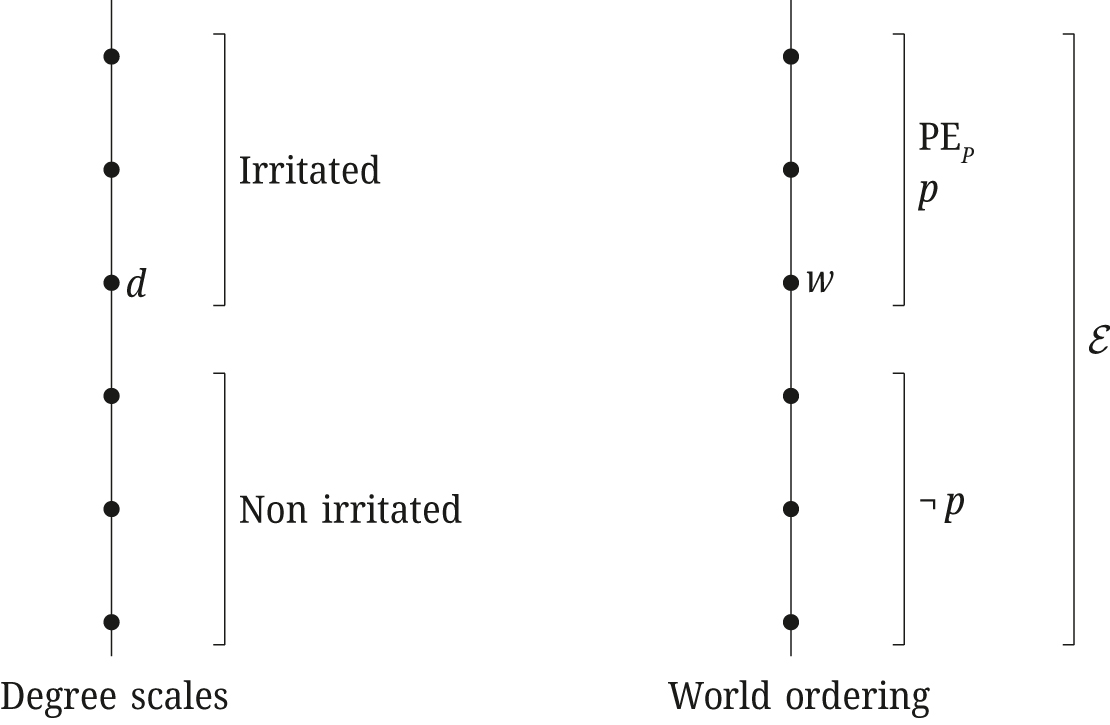
GM propose a mapping from degrees of emotions to worlds, which we illustrate with their example, irritated. The scalar predicate establishes a threshold d, above which one is irritated and below which one is not. With emotive attitudes, the relevant world space for assertion is an emotive set of worlds which GM call the emotive modal space Ɛ. It must be noted that in the GM theory, attitudes and modals quantify over a set of worlds the nature of which is determined by the predicate (e.g. epistemic, doxastic, memory, perception, desire, or, as in this case, an emotive set). These sets correspond to worlds compatible with the subject’s knowledge, beliefs, memory, emotions etc., as pretty much in the classical Hintikka-based possible world analysis of attitudes, but as GM suggest, one can view these world sets as Kratzerian modal bases (see GM 2021 chapters 2 and 3 for discussion and relevant references).
Let us summarize the GM analysis. The emotive mapping partitions the emotive space Ɛ into worlds above the threshold in which i has the emotion and those in which she does not. This partition is driven by the threshold d. Note (see Figure in (41)) that in the worlds in which i has the emotion, p is true. In other words, Ɛ is a set of worlds ordered by the emotion (sentiment) S, and the set of worlds is partitioned into two equivalence classes of worlds. One is the set of worlds in which the attitude holder has the emotion and p is true. The other one is the set of worlds in which the attitude holder does not have the emotion and p is false. This partitioning allows us to define Positive-Extent-worlds (PE) for p (the complement proposition):
|
| PE P = {w∈ ƐP: the emotive modal space Ɛ, where the propositions in P are true in w} |
Here, the set P is the singleton set {p}. So PEP contains all the worlds in which p is true. In PEP i has sentiment S. The semantics proposed here may remind the reader of the Best ordering used for modals (Portner 2009); we are dealing indeed with a similar ordering function, only for GM, the ordering source for emotion merely contains p.
We summarize here the truth conditions for emotive verbs:
| Semantics of emotives (Giannakidou and Mari 2021): | |
| (i) | ⟦i V-emotive p⟧w,Dox(i), Ɛ is defined iff |
| a. | Dox(i) contains only p worlds (subjective veridicality) |
| b. | Ɛ is nonveridical and contains p and ¬p worlds (emotive nonveridicality). |
| c. | If defined: ∀w′∈ PE Ɛ p(w′) (assertion of emotion) |
The indices correspond to the following. Dox(i) is the set of doxastic alternatives, i.e., belief worlds, of the individual anchor i, which is the subject of the clause, bearing the emotion (the experiencer of the emotion). Dox(i) is veridical, i.e., entails p since all worlds in it are p worlds. This is the subjective presupposition of belief of p. Ɛ is the emotion space, which is partitioned into a positive (PE) and a negative extent. The emotive assertion conveys that in all worlds consistent with the emotion of the subject i, p is true. In addition, what we called contrary emotives have the counterexpectation, or disbelief, or opinionatedness that we mentioned earlier, they are therefore more ‘intense’. Intensity will be augmented, as we will argue in 3.4, by the SO extreme degree.
All in all, we argue that wh-exclamatives and declarative exclamations have the assertion and presuppositions conveyed by sentences with emotive verbs with counterexpectation. The individual anchor with all exclamation cases is the speaker. Syntactically, we posit a higher emotive V for the syntactic form of wh-exclamatives, and we proceed now to show how this works at the syntax-semantics interface.
3.3 The syntax and semantics of emotive assertions I: emotive V
In this section, based on the above analysis we argue that exclamatives, such as (43), are emotive assertions akin to assertions containing the predicates be amazed, be surprised in present tense and overtly in (44):
| How fast Eliud Kipchoge was! |
| I am amazed at how fast Eliud Kipchoge was. |
We claim that these sentences are identical in terms of what they assert and what they presuppose, and we will therefore group them together under the label ‘emotive assertions’. They both assert that the speaker has the emotion of amazement towards the believed proposition ‘Eliud Kipchoge was extremely fast’, and presuppose that the speaker has this very belief.
Let us begin our analysis by pointing out that our idea of treating the sentences above as one single phenomenon is not uncommon in the linguistic literature – quite the contrary, in fact. It is reminiscent of the phenomenon of ‘insubordinate clauses’, where embedded clause structures are used as root clauses (see, e.g., D’Hertefelt 2018; Evans 2007; and Section 4 below for more references). For many of those insubordinate cases (e.g., English wish-clauses: If only Kipchoge participated in the race!), grammar reference books characterize them as incomplete clauses where a matrix frame is omitted (Huddleston and Pullum 2002: Ch. 10; Quirk et al. 1985). In our analysis, we adopt this general explanation and explore how it can be formally spelled out at the syntax-semantics interface, and which conclusions can be drawn from such an approach for the illocutionary or not status of exclamations.
To begin with, note again that the empirical basis of our proposal is that (i) exclamatives in general feature assertive content (Section 2) and that (ii) the distribution of the Greek complementizer pu makes Greek exclamatives look like complements of matrix clauses containing emotive verbs (Section 3.1). Based on those observations, we therefore submit that the wh-exclamative is the complement of a silent declarative main clause containing an emotive predicate (45), and that this declarative, at the level of illocutionary force, is nothing more than an assertion. As a first step, let us thus sketch our claim as follows:
| [NULL-CP … V-emotive [CP [C pu … ]]] |
(45) illustrates that the embedding predicate of the silent matrix clause involved in the interpretation of the exclamative must be emotive (‘V-emotive’) because otherwise the predicate would not select the complementizer pu instead of other C elements in the inventory of Greek (Section 3.1 above). Plus, the predicate must also be emotive because the exclamative features a corresponding interpretation (the paraphrase of its most prominent reading being ‘Speaker is amazed at p’). Importantly, the emotive component of exclamatives in our analysis is not a part of its illocutionary force; rather, it is part of the proposition. To see this, compare our approach to the famous ‘performative hypothesis’ by Ross (1970), which is also postulating a silent main clause. Look at the following two examples (see Ross 1970: 222–223, 250):
| a. | Prices slumped. |
| b. | I tell you that prices slumped. |
Ross (1970: 223) claims that sentences like (46a) “must be analyzed as being implicit performatives, and must be derived from deep structures containing an explicitly represented performative main verb.” In other words, the sentence (46a) involves a syntactic deep structure that contains two clauses (47b), and (47a) is derived from (47b) via transformational rules, which we cannot discuss in detail here.
| a. | [S Prices slumped.] |
| b. | [S I tell you [S (that) prices slumped.]] |
Our idea of a silent matrix clause is very similar, but it crucially differs from Ross’s account because we are not deriving a speech act (aka the illocutionary force) from a silent main clause. Instead, we postulate a null element to represent parts of the propositional content of exclamatives that we think are implicitly understood, but not phonetically spelled out in exclamatives. Note, again, that we claim that (43) and (44) are identical in terms of what they assert and what they presuppose, and that both are ‘emotive assertions’. A performative analysis à la Ross (1970) for those cases would therefore look like (48), where the deep structure illustrates that the whole utterance is interpreted as an assertion:
| [S I assert that [S I am amazed at how fast Eliud Kipchoge was!]] |
Our approach in (45) differs from (48) and is not performative. Rather, (45) says that the Greek exclamative (49) is a fragment of the declarative version in (50):
| Ti | grigora | pu | etrekse | o | Kipchoge! |
| what | fast | that.pu | run.3sg | the | Kipchoge |
| ‘How fast Kipchoge ran!’ | |||||
| Meno | ekpliktos | pu | o | Kipchoge | etrekse | toso | grigora! |
| stay | surprised | that.pu | the | Kipchoge | run.3sg | so | fast |
| ‘I am surprised/amazed that Kipchoge ran so fast.’ | |||||||
The content of the missing emotive verb is one that includes a counterexpectation, as we mentioned earlier, and it can be positive (as we are discussing here) or negative (as in I am bothered by what I perceive as Kipchoge running extremely fast).
Nevertheless, both the exclamative in (49) and the declarative in (50) are assertions, with emotive matrix verbs specifying the emotion based on counterexpectation. This type of assertion, which we call ‘emotive assertion’ functions pragmatically like any other type of assertion. That is, we can apply the following speech act paraphrase of an assertion from Truckenbrodt (2006: 264–265) to both (49) and (50) above (S = speaker; A = addressee):
| Speech act paraphrase/emotive assertions (49) and (50): |
| ‘S wants from A that it is common ground that S is surprised/amazed that Kipchoge ran so fast; and that S is surprised at a time t′ immediately preceding tu and extending to tu (where tu is the utterance time).’ |
According to Truckenbrodt, the major speech acts – assertions and questions – always have the common ground as the ‘epistemic desideratum’, which he articulates by means of the epistemic meaning component ‘it is common ground that/whether …’[17] Another key feature of this account of speech acts is that Truckenbrodt (2006: 263–264) conceptualizes “all sentential speech acts as volitional on the part of the speaker […] S wants something, wishes for something, invites A to do something etc.” The speech act paraphrase in (51) articulates this concept for our cases of emotive assertions which work just like any other cases of assertions.
Given the two examples in (49) and (50), two remaining issues regarding our structure in (45) arise:
How can the different word orders in the Greek exclamative (49) and the Greek declarative (50) be accounted for?
How should we account for the fact that exclamatives are always interpreted as conveying the surprise of the speaker (and not that of any other subject)?
Let us start with the second question. Exclamatives are always anchored to the speaker, and it is thus no surprise that the sentiment conveyed belongs to the speaker. According to our approach, this can be accounted for by saying that exclamatives appear to be first person emotive assertions, and the omission of the higher verb becomes akin to the omissions found in the performance of other first person assertions where we observe first person doxastics, e.g., John is a good student is equivalent to I think/believe John is a good student.
Conceptually, the necessity of speaker orientation can also be understood to follow from general assumptions about pragmatic inferencing and origo. If we formalize [±speaker orientation] as the more general feature [±origo],[18] there is only one option each for [+origo] (I, here, now), but more options for [−origo] (2nd person, 3rd person; anywhere else than here; past, future). Based on Gricean Manner and Quantity reasoning, the hearer interprets the unspecified structure (45′a) as the simplest unmarked [+origo], which means that the subject of the matrix clause containing the emotive predicate V-emotive is pragmatically derived as being the speaker (and the whole event as taking place in the here and now, which is true of the exclamative). We can thus revise our representation as follows, where [+origo] stands for ‘speaker, here, and now’:
| a. [NULL-CP … [vP XP-subject [±origo] V-emotive [CP [C pu … ]]]] |
| => pragmatic inferencing |
| b. [NULL-CP … [vP XP-subject [+origo] V-emotive [CP [C pu … ]]]] |
Let us now turn to the other issue mentioned above: How can the different word orders we see in (49) and (50) be derived syntactically? Note again that despite lacking an apparent degree modifier, both relevant phrases in the two examples (i.e., ti grigora and toso grigora) get interpreted as ‘extremely fast’, yielding the respective intensities of the utterances. In this respect, the two phrases are interpreted in the same way (see Section 3.4 below for more details on this degree interpretation). However, while toso grigora can stay in situ (52a), ti grigora has to move to the left periphery of the CP headed by the complementizer pu (49), otherwise the sentence becomes ungrammatical, see (52b). Why is that so?
| O | Kipchoge | etrekse | toso | grigora! |
| the | Kipchoge | run.3sg | so | fast |
| ‘(Wow!) Kipchoge ran so fast! (It’s faster than anyone had expected!)’ | ||||
| * O | Kipchoge | etrekse | ti | grigora. |
| the | Kipchoge | run.3sg | what | fast |
| (intended: same as (52a)) | ||||
To understand this pattern, it is also important to see that in the version with toso grigora the syntactic structure is in fact ambiguous between an emotive reading (that carries the negative expectation presupposition; see Section 3.2) and a non-emotive reading illustrated in (52′a):
| O | Kipchoge | etrekse | toso | grigora. |
| the | Kipchoge | run.3sg | so | fast |
| ‘(Oh well,) Kipchoge ran so fast. (It’s not surprising at all that he is the winner again.)’ | ||||
The two readings are disambiguated by different intonation and pragmatic context,[19] and the syntactic configuration as such does not provide any cue for the relevant interpretation. This is completely different in the case of ti grigora: here, the word order in (52b) is not possible, and the only grammatical version in (49) obligatorily results in an emotive interpretation which carries the negative expectation presupposition.
This data pattern is reminiscent of other emotive syntactic constructions where the movement of a phrase to the left periphery is likewise obligatory. A case in point is the English phrase wh-the-hell. In particular, as first noted by Lasnik and Saito (1984), English appears to disallow a wh-word with the hell to remain in situ (e.g., *Who is in love with who the hell?; see also Pesetsky 1987). Den Dikken and Giannakidou (2002) have shown that the grammatical version where wh-the-hell moves to the left periphery (e.g., What the hell is he doing?) carries a presupposition of negative attitude and can thus be considered emotive.
The same also holds for many more cases where the wh-element has a degree reading similar to our Greek case ti (‘what’) in ti grigora (‘what fast’). For example, the phrase [how cool] in (53) must move to the left periphery when expressing the degree reading (53a), but it is ungrammatical in situ (53b) – in contrast to the non-degree reading, which is fine in both (53c) and (53d); see Trotzke (2020) and Nye (2009):
| a. | How cool is that! | [emotive reading] |
| b. | * That’s how cool! | [intended: emotive reading] |
| c. | How cool is that? | [question reading] |
| d. | That’s how cool? | [echo-question reading] |
Given these similarities, in what follows we adopt a syntactic analysis that has already been used for emotive syntactic constructions like the ones illustrated above. In particular, Bayer and Trotzke (2015) and Bayer and Dasgupta (2016) have proposed a syntactic agreement mechanism for what they call ‘emphatic fronting’ and ‘emphatic topicalization’, respectively. Our Greek case of obligatory movement of ti grigora combined with the presence of the complementizer pu is a particularly striking case in this context because of the overt (and likewise obligatory) complementizer pu, which we know is emotive (see Section 3.1). Let us now turn to our analysis in more detail.
According to Chomsky’s (2000, 2001) so-called ‘probe-goal agreement’ mechanism, a probe with an unvalued (uninterpretable) feature uF scans its locally accessible c-command domain for a category with a matching (interpretable) feature iF that values uF (and thus causes its deletion). According to Chomsky (2001: 5), “[t]he natural principle is that the uninterpretable features, and only these, enter the derivation without values, and are distinguished from interpretable features by virtue of this property.” Given this conceptual background, we notice a problem, however. We would have to postulate an emotive feature in C0 (associated with pu) that probes the degree phrase [ti grigora]. This emotive feature, by virtue of its unvalued status, would have to be uninterpretable, according to Chomsky’s (2001) valuation/interpretation biconditional:

|
However, note that the emotive interpretation of pu is independent of the degree expression; pu can also appear without the expression of extreme degree – the only licensing condition being that pu is embedded by an emotive predicate in the matrix clause. In other words, the degree phrase contributes to the emotive interpretation (adding intensity; see Section 3.4 below), but it does not constitute emotivity. Accordingly, we need a theory that, in addition to (55a), allows configurations where the licensing direction is turned around as in (55b).
| a. | X | Y | b. | X | Y |
| uF | iF | iF | uF |
In accordance with recent approaches by Bayer and Trotzke (2015), Bayer and Dasgupta (2016), and Trotzke (2017a), we therefore adopt the feature-sharing version of Agree formulated by Pesetsky and Torrego (2007: 268):
| Agree: feature-sharing version | |
| a. | An unvalued feature F (a probe) on a head H at syntactic location α (Fα) scans its c-command domain for another instance of F (a goal) at location β (Fβ) with which to agree. |
| b. | Replace Fα with Fβ, so that the same feature is present in both locations. |
Importantly, the approach to probe-goal agreement as feature sharing by Pesetsky and Torrego (2007) dissociates agreement from interpretability. It allows an interpretable feature to probe an uninterpretable matching feature (adopting a notational convention, in (57b, c) agreement is expressed by an arbitrary value that fills the empty slot in [ ]).
| [NULL-CP … [CP [C’ pu [… [XP ti grigora] …]]]] == AGREE ===> |
| iEmotive[ ] uEmotive[ ] |
| [NULL-CP … [CP [C’ pu [… [XP ti grigora] …]]]] == MOVE ===> |
| iEmotive[4] uEmotive[4] |
| [NULL-CP … [CP [XP ti grigora] [C’ pu [… |
| iEmotive[4] uEmotive[4] |
(57) illustrates that the degree phrase [ti grigora] becomes part of the emotive interpretation of the utterance via agreement, and this agreement triggers movement of the degree phrase to the specifier of emotive pu.
One question that could be raised in the context of our analysis in (57) is why we still need the matrix NULL-CP structure containing the V-emotive that selects the emotive complementizer pu in our syntax for the Greek exclamative. Note that the literature on emphatic fronting and topicalization cited above deals with movement types that can be characterized as main clause phenomena. In other words, we could just as well claim, as one could argue, that the emotivity is not encoded in a still higher matrix structure by the null V-emotive, but rather by the complementizer pu (and thus in the C0 position) alone. Under this hypothesis, we would no longer propose that the Greek exclamative formed with ti grigora is an embedded structure (where pu is selected by a matrix V-emotive); rather, Greek exclamatives like (49) would be main clauses, involving the agreement and movement illustrated in (57), but crucially without the higher NULL-CP. Such an approach would in fact be in line with approaches to the syntax of exclamatives where their emotive component is represented in the form of an exclamation operator in the Force domain of the matrix CP (see Munaro and Obenauer 1999 for a cartographic account and Section 2.1 above for the general approach).
There are two major arguments against such an objection to our analysis. First, the core of our argumentation in this paper is that exclamatives are fully identical to assertions like (58) in terms of what they assert and what they presuppose, hence our analysis and the notion of ‘emotive assertion’ in Section 3.2 above.
| Meno | ekpliktos | pu | o | Kipchoge | etrekse | toso | grigora. |
| stay | surprised | that.pu | the | Kipchoge | run.3sg | so | fast |
| ‘I am surprised/amazed that Kipchoge ran so fast.’ | |||||||
The empirical base for those who claim that assertions and exclamatives are not identical in their semantics/pragmatics has been discussed in Sections 2.2 and 2.3, and we hope to have shown convincingly that this empirical base is shaky at best. If it is thus the case that the assertion in (58) and the corresponding exclamative in (49) are mere versions of each other, we would like to represent this fact by means of a common syntax – and this is exactly what we are proposing above with our claim that exclamatives are embedded (signaled in Greek by the obligatory overt complementizer) under an assertive V-emotive.
The second argument in favor of our approach and against a main clause analysis concerns the observation that exclamatives behave fundamentally differently from other syntactic configurations that look like embedded structures, but are in fact ‘insubordinated’ main clause uses of embedded syntax. In order to show that, we will turn to German data in Section 4 below because German is particularly rich in its inventory of embedded clause structures used as main clauses (e.g., Truckenbrodt 2013).
For now, we conclude that our syntactic analysis above can account for the different word order we have seen in the Greek exclamative with ti grigora, while at the same time representing the fact that the exclamative is identical in meaning to the corresponding declarative emotive assertion where an emotive predicate selects the complementizer pu and embeds a proposition that is, again, identical to the proposition conveyed by the exclamative. We now turn to a further similarity between exclamatives and their declarative counterparts and focus on their common degree interpretation.
3.4 The syntax and semantics of emotive assertions II: SO-degree
The pu-complement in the declarative contains toso grigora ‘that fast’, which gets interpreted as ‘extremely fast’. Ti grigora ‘what fast’ seems to be interpreted the same way. But toso grigora and ti grigora do not contain overt degree morphology. Where does the extreme degree come from? The same question arises with the wh-exclamative strategy in general, since in all languages that have it, a wh-word is used receiving a high degree meaning.
The existence of degree is so central to the content of the wh-exclamative that Rett (2011) posits a Degree Restriction which says that only wh-phrases which can receive degree readings are acceptable in wh-exclamatives. For instance, who and where are excluded: *Where Eliud ran the race! *Who Eliud beat at the race![20] In our case of the Greek exclamative with ti (grigora) ‘what (fast)’, ti receives degree meaning – and this degree use of wh morphology, we will argue, is a realization of an abstract extreme degree morpheme that we will call SO-degree. John ran so fast! has precisely this intense degree interpretation, and also lacks an apparent degree modifier such as very, extremely and the like (for a detailed discussion of such extreme degrees, see Morzycki 2012). Here we will propose the following:
| ⟦SO Adjective⟧ = the property of the Adjective defined to an extreme degree by the speaker. |
The concept of ‘extreme’ in degree, we believe, has an objective basis and is not purely subjective: a temperature of 25 C is not extremely hot, though it might be perceived as such by someone with sensitivity to heat. It is not decisive for our discussion to establish the precise nature of extreme degree, and the relatively uncontroversial assumption that it relies on both fact and some subjective factors will suffice. Importantly, just like the emotion itself, the extreme degree will be also anchored to the speaker, the extremity of degree will always be defined subjectively by him or her. Notice that even in embeddings the actual so morpheme can be defined with respect to the speaker: Ariadne thinks that Nicholas is so smart! conveys the speaker’s attitude of extreme smartness (as well as Ariadne’s in a different interpretation). The unembedded so, of course, is anchored to the speaker only: Nicholas is so smart!
Is there a relation between the intense degree and the surprise reading that seems to characterize exclamatives? We have hinted at that question already. With contrary emotives that carry a presupposition of counterexpectation, the counter effect can be about what is perceived as fact in the complement or, in case the complement contains an extreme degree, it can be disbelief towards the extremity of the degree.
| Counterexpectation presupposition without degree: |
| ⟦Speaker s is surprised that p⟧ is defined if only if: s believed that ¬p, at a time t′ immediately preceding tu and extending to tu (where tu is the utterance time). |
| Counterexpectation presupposition with SO-degree: |
| ⟦Speaker s is surprised that p⟧ is defined if only if: s believed that p(d′) and d′<SO-degree, at a time t′ immediately preceding tu and extending to tu (where tu is the utterance time). |
The current analysis does not reduce the exclamative effect to the intense degree alone, but to the counterexpectation when combined with an extreme degree; we wanted to clarify this point here.
The exclamative thus, in addition to counterexpectation, has the following meaning components, on a par with emotive verbs; the relevant anchor is always the speaker s, and Ɛ is the emotive space contributed by the null predicate (‘V-emotive’ in our syntactic analysis above) be surprised/amazed:
| ⟦Ti grigora pu etrekse o Kipchoge!⟧w,Dox(s), Ɛ is defined iff | |
| a. | Dox(s) contains only worlds where Kipchoge runs SO-fast (subjective veridicality) |
| b. | The emotion space Ɛ is nonveridical and contains p and ¬p worlds (nonveridicality of emotion). |
| c. | If defined: ∀w′ ∈ PE Ɛ : Kipchoge ran SO-fast in w′ (assertion of emotion) |
This analysis derives the meaning of the wh-exclamative without positing an exclamation or expressivity operator (see Section 2.1), and captures its affinity with the emotive predicate (Section 3.2), while also allowing a very intuitive capturing of the degree generalization. As we mentioned earlier, emotive verbs can take less intense complements, i.e., lacking the SO-degree; they are thus neutral in intensity. Emotive verbs as a class, as we said earlier, are also not all contrary (recall our earlier discussion in Section 3.2, and Giannakidou and Mari 2021). The difference, therefore, between a regular emotive assertion and the wh-exclamative is that the latter always expresses a counterexpectation, and we can think of this as intense emotivity. We believe that such intense emotivity lies at the foundation not just of exclamatives, but of the broader phenomenon of mirativity or emphasis (Trotzke 2017a).
Crucially, intensification in exclamatives is always part of the content since it is due to the emotive assertion hence it patterns with other forms of ‘emphasis for intensity’ at the propositional level (see Beltrama and Trotzke 2019 for several lexical and syntactic strategies).[21] In other words, intensification does not derive from an illocutionary operator, but from the emotive assertion plus extreme degree if the degree is available. According to our analysis in (62), it is now easy to see that the declarative exclamation can receive exactly the same treatment:
| ⟦O Kipchoge etrekse toso grigora! ‘Kipchoge ran so fast!’⟧w,Dox(s), Ɛ is defined iff | |
| a. | Dox(s) contains only worlds where Kipchoge runs SO-fast (subjective veridicality): the speaker believes that Kipchoge ran SO-fast |
| b. | The emotive base Ɛ is nonveridical and contains p and ¬p worlds. |
| c. | If defined: ∀w′∈ PE Ɛ : Kipchoge ran SO-fast in w′ (assertion of emotion) |
Hence, there is no difference in meaning between the declarative exclamation and the wh-exclamative – as we have been arguing with regards to denial strategies and answers to wh-questions (Sections 2.2 and 2.3). Both feature embedding under a covert contrary emotive predicate be surprised/amazed, and a SO-degree morpheme (though a declarative emotive may lack it, e.g., It’s snowing in Barcelona!). The realization of the extreme degree can be so or a wh-morpheme, but also interjections such as wow or boy as in Wow, he ran fast!, and Boy, it rained! where it is understood that he ran fast and that it rained a lot. In cases where the degree SO is absent such as It’s snowing in Barcelona! there is mere expression of intensity due to the counterexpectation of the null emotive verb.
Our analysis, by not appealing to illocutionary operators, argues that what has traditionally been called ‘exclamation’ is not a speech act, but rather an attitude that is part of a speech act (in our cases: assertion), and this seems to be well motivated by the facts we examined in the preceding discussion. The illocutionary operator approaches will have difficulties capturing the similarities between emotive attitudes and exclamatives we pointed out and, most importantly, they could not establish exactly what the exclamative illocutionary force might be.
What could it be? It is very hard to offer an answer because exclaiming seems to cut across clause types, including declaratives (including SO-assertions). More examples that might fall into one class with exclamatives semantically include metalinguistic comparatives (64a), questions (64b), and imperatives (64c):
| a. | I’d rather die than marry him! (Giannakidou and Yoon 2011) |
| b. | John will come to the party?! (Really?) |
| c. | Open the door, damn it! |
Given this variation, it seems implausible to say that the force claimed for exclamatives is a specific, distinct speech act. Rather, the common semantic feature of all those examples is an attitude of emotion, and while these are not wh-exclamatives, they arguably fall under the category of exclamatives in that they are emotive utterances with counterexpectation. We think this broadening of perspective offers a promising basis for understanding the representation of emotion in language, including a number of phenomena that fall under the rubric of ‘mirativity’ involving certain lexical and/or morphological markers (DeLancey 1997; Peterson 2010) or syntactic strategies of ‘mirative fronting’ (Cruschina and Bianchi 2021; Trotzke 2017b). As for the respective syntactic expressions, the central idea of our analysis of the exclamative cases has been that they are embedded structures, but of course the function of emotivity in non-assertions like the above sentences will require some more research – a task that we leave for future research.
In the following final section, we present data from another language that further support our central idea that uses of exclamatives are in fact assertions. In particular, we turn to German because this language is particularly rich in exclamative forms as well (see d’Avis 2016). What is more, German, in its inventory of exclamatives, often uses syntactic configurations that have been termed ‘insubordinates’ in the literature. In the following section, and based on our analysis above, we will claim that these syntactic structures (at least in the domain of exclamatives) are not ‘insubordinated’ at all: they can be characterized as emotive assertions and are thus embedded under a null predicate ‘V-emotive’, just like we have argued for the Greek data above.
4 German exclamatives as subordinated structures
In this section, we focus on a phenomenon that has been termed ‘insubordination’ by Evans (2007) in a cross-linguistic perspective: the use of embedded clause structures as root clauses (see also D’Hertefelt 2018 for recent typological work). German is particularly rich in these constructions, which have been discussed in terms of ‘independently used verb-final clauses’, so-called ‘solitaires’ (Schwabe 2006, 2007), and ‘V-final root clauses’ (Truckenbrodt 2006). In this context, a prominent case is dependent clauses that take on an emotive interpretation as soon as they are used in root contexts: so-called that-exclamatives.
4.1 Germanic insubordination
Let us consider an example. As soon as the following German embedded clause introduced by dass (‘that’) in (65a) is used as a root clause, it takes on an emotive meaning and is interpreted as an exclamative (65b). We abstract away from prosodic differences here; see Truckenbrodt (2013) for the relevant intonational patterns.
| Ich | weiß, | [dass | der | schön | singen | kann]. |
| I | know | that | this.one | beautiful | sing | can |
| ‘I know that he can sing beautifully.’ | ||||||
| Dass | der | schön | singen | kann! |
| that | this.one | beautiful | sing | can |
| ‘How surprising that he can sing beautifully!’ | ||||
This pattern can also be found in further Germanic languages. Consider examples from Dutch (66a) and Swedish (66b); see Bennis (1998) and Delsing (2010):
| Dat | hij | die | boeken | kan | lezen! | [Dutch] |
| that | he | those | books | can | read | |
| ‘Wow, he can read those books!’ | ||||||
| Att | du | hann | till | mötet! | [Swedish] |
| that | you | reached | to | meeting.def | |
| ‘What a surprise that you reached the meeting!’ | |||||
These cases are interesting and relevant in the context of the Greek data that employ a complementizer (pu) we discussed earlier. On a par with Greek, this type of complementizer exclamative – at least in Dutch and German – features a word order that is typical of embedded configurations in those languages (i.e., SOV). In what follows, we will focus on German to illustrate this data point. Before we discuss the details, let us highlight that the German data in particular dovetail nicely with our analysis proposed above, where exclamatives are embedded under a null V-emotive, and further support the idea that exclamatives are in fact performing assertions. Specifically, German features many cases where embedded syntax is used as a main clause, and it is easy to see how those cases differ from the exclamatives, where we have been claiming throughout the paper that they are not main clauses, but rather embedded structures under a null V-emotive (see Section 3.3).
To illustrate this point, let us briefly look at the case of so-called verb-final ob-interrogatives in German. The complementizer ob (‘whether’) in German is used for embedded questions, but can also head an independent main clause, expressing a special question-interpretation (see Zimmermann 2013 for details). The crucial point in our context is that the variants in (67a) and (67b) cannot be used in the same pragmatic context, indicating that the ob-interrogative in (67b) cannot be treated as an elliptic version of the structure in (67a); example and judgment taken from Sode and Truckenbrodt (2018: 123–124) and Truckenbrodt (2013: 235):
| A: | Warum versuchst du, den Stein zu heben? | ||||||||
| ‘Why are you trying to lift the stone?’ | |||||||||
| B: | a. | Ich | will | wissen/frage | mich, | ob | ich | das | schaffe. |
| I | want | know/ask | myself | whether | I | that | manage | ||
| b. | ≠ # Ob | ich | das | schaffe? | |||||
| whether | I | that | manage | ||||||
Now recall what we have already illustrated in Section 2.3 in great detail: exclamatives can in fact be used as answers to questions in a dialogue, in contrast to what the previous literature has claimed. Observe the following pattern, where we see that both the declarative assertion (68a) and the exclamative (68b) can be used for answering the question in (68):
| A: | Wie denkst du über Eliud im Olympia-Marathon? | ||||||||
| ‘How do you think about Eliud in the Olympic Marathon?’ | |||||||||
| B: | a. | Ich | bin | überrascht, | dass | er | so | schnell | war! |
| I | am | surprised | that | he | so | fast | was | ||
| b. | Dass | er | so | schnell | war! | ||||
| that | he | so | fast | was | |||||
The felicity of German that-exclamatives as answers to questions more generally has recently also been confirmed experimentally by Trotzke and Villalba (2020) who additionally show that this pattern also holds for Catalan, another language that features that-exclamatives (see also Trotzke and Villalba 2021). The contrast to the infelicity observed for the ‘insubordinated’ ob-interrogative in (67) is sharp, and (68) suggests that the two dass-configurations in (68a) and (68b), in contrast to the two interrogative variants in (67), are indeed felicitous in the same pragmatic context. This supports our central claim that (68b) is an elliptical version of the structure in (68a) – in contrast to ‘insubordinated’ cases like German ob-interrogatives, which indeed instantiate main clauses.
We are aware that our approach to analyze exclamatives like (68b) as elliptical versions of emotive matrix predicates is of course not uncontroversial, although very natural and obvious in our view. Particularly in the theoretical literature on German syntax, we find some arguments against it, based on prominent assumptions in the literature on the syntax of ellipsis in general (see Merchant 2001, 2019 for overviews). In what follows, we briefly sketch a core argument against analyzing cases like (68b) as matrix clause deletions, and we highlight why we think this argument does not rule out the approach advocated in our paper.[22]
The argument has been formulated by Grosz (2012: 96–103) for verb-final optatives in German, which have also been claimed to be elliptical versions of matrix configurations, in this case featuring wish-predicates. This argument might also be applied to our German dass-exclamatives such as (68b) above. In a nutshell, the argument is that because-clauses can take wide scope and modify a matrix structure in discourses like (69), while because-clauses cannot take scope over a null predicate in cases such as (70):
| A: | Was | hat | Dich | so | erstaunt? | |||||
| what | has | you | so | amazed | ||||||
| ‘What is it that has amazed you so much?’ | ||||||||||
| B: | Dass | Eliud | eine | Pause | gemacht | hat, | weil | er | arbeitssüchtig | ist. |
| that | Eliud | a | break | made | has | because | he | workaholic | is | |
| ‘… that Eliud took a break because he is a workaholic.’ | ||||||||||
| because he is a workaholic > [B is amazed that Eliud took a break] | ||||||||||
| Dass | Eliud | eine | Pause | gemacht | hat (# | weil | er | arbeitssüchtig | ist)! |
| that | Eliud | a | break | made | has | because | he | workaholic | is |
| *because he is a workaholic > [Speaker is amazed that Eliud took a break] | |||||||||
According to Grosz (2012), this shows that any analysis of (70) cannot contain an emotive null-predicate because otherwise it would be possible for the adverbial clause to take scope over that predicate. We disagree with this conclusion because we do not think that the patterns in (69) and (70) can be explained on purely syntactic grounds. It is rather uncontroversial in the literature on ellipsis – and especially so in the literature on VP-ellipsis – that discourse structure, and not only syntactic (identity) conditions, play a dominant role in the acceptability and the typology of ellipsis, maybe more than commonly assumed (see Frazier and Clifton 2005, 2006 for seminal work).
Given this perspective, it is clear for us why (70), in contrast to (69), is not possible: In (69), B’s amazement is discourse-given because Speaker A presupposes that amazement and explicitly asks about the reason for it. This is different in (70). Here, the speaker’s amazement is not given, but asserted, according to our analysis, via the underlying syntactic structure. In fact, this is the reason why exclamatives like (70) can be uttered out-of-the-blue, while other complement uses of dass-clauses in German like in (69) cannot be uttered without discourse-given material. Note also that in our analysis, we are not claiming that the syntax of the null predicate does specify any discourse-related projections such as Topic or Focus, see our syntax in Section 3.3 above.
After clarifying this point and having pointed out why German dass-exclamatives, in contrast to other insubordinated structures (see (67) above), are embedded under a null V-emotive as well, let us now discuss German exclamatives in more detail and thereby provide some more evidence from German that exclamatives are indeed assertive.
4.2 German exclamatives: embedding, assertiveness, and particle distribution
Note first that unambiguous exclamatives in German are always verb-final and thus feature embedded word order. This holds for that-exclamatives (71a) and wh-exclamatives alike (71b):
| Dass | der | schön | singen | kann! | [only exclamation] |
| that | this.one | beautiful | sing | can | |
| ‘How surprising that he can sing beautifully!’ | |||||
| Wie | schnell | der | laufen | kann! | [only exclamation] |
| how | fast | this.one | run | can | |
| ‘How fast he can run!’ | |||||
It has often been pointed out in the literature that the term ‘exclamative’ in German is intended to cover many more configurations (e.g., wh-V2- or V1-exclamatives); see d’Avis (2016) for a recent overview. However, an example like (72) is structurally ambiguous between a question and an exclamation reading (the same holds for V1-exclamatives, modulo intonational differences due to word order). This is why German makes heavy use of so-called modal particles (also called ‘discourse particles’; more on this below), which clearly disambiguate between the exclamation (73a) and the question (73b) reading:
| Wie | schnell | ist | der | [question or exclamation] | |
| how | fast | is | this.one | is |
| Wie | schnell | ist | der | aber | auch | [only exclamation] | |
| how | fast | is | this.one | part | part | is | |
| ‘How fast he is!’ | |||||||
| Wie | schnell | ist | der | denn/wohl | [only question] | |
| how | fast | is | this.one | part part | is | |
| ‘How fast is he (I’m wondering)?’ | ||||||
Again, it is important to note in this context that German features a clear distribution of modal particles across different sentence types (see Thurmair 2013 for a comprehensive overview and relevant tables summarizing the distribution). For instance, particles like denn in (73b) can only occur in questions, not in exclamations.[23] On the other hand, aber auch can only occur in exclamations, not in questions. Of course, not only modal particles, but also intonational means help to disambiguate between the two readings (for V1-exclamatives in this context, see Brandner 2010), and it has recently been shown which prosodic features exactly are involved in distinguishing between V2 wh-questions and V2 wh-exclamatives in German (Repp 2015, 2020).[24] Be that as it may, we highlight again here that the only syntactic configurations that unambiguously express the exclamation reading are the verb-final structures in (71) above – and this corresponds to the embedded word order, as already mentioned.
When we now turn to the choice of complementizers, we observe that the case of dass-exclamatives is the only version where German uses a complementizer in exclamatives. Crucial for our claim that exclamatives are emotive assertions and, syntactically, the complement of assertive clauses is the fact that in German the complementizer dass (‘that’) is the typical complementizer that is selected by verbs in non-interrogative contexts (74a), and it is also fine with emotive predicates (74b), as already seen in (68a) above. However, it is completely ungrammatical in interrogative contexts (74c):
| Andreas | glaubt, | dass | Eliud | eine | Pause | gemacht | hat. |
| Andreas | believes | that | Eliud | a | break | made | has |
| ‘Andreas believes that Eliud took a break.’ | |||||||
| Andreas | ist | erstaunt, | dass | Eliud | eine | Pause | gemacht | hat. |
| Andreas | is | amazed | that | Eliud | a | break | made | has |
| ‘Andreas is amazed that Eliud took a break.’ | ||||||||
| * Andreas | möchte | wissen, | dass | Eliud | eine | Pause | gemacht | hat. |
| Andreas | wants | to.know | that | Eliud | a | break | made | has |
Accordingly, the only case in German where we find a realization of the C position in exclamatives suggests that this position can only be filled by an element that is known for occurring only in non-interrogative contexts. Other C choices like interrogative ob already introduced in (67) above are not available both with emotive predicates (75a) and in exclamatives (75b):
| * Andreas | ist | erstaunt, | ob | Eliud | eine | Pause | gemacht | hat. |
| Andreas | is | amazed | whether | Eliud | a | break | made | has |
| # Ob | Eliud | eine | Pause | gemacht | hat! | (only: deliberative question) |
| whether | Eliud | a | break | made | has |
The German facts support our analysis for the Greek exclamatives in Section 3 above in two crucial ways: (i) unambiguous exclamatives in German always feature embedded (i.e., verb-final) word order and (ii) the predicate that embeds the exclamative must indeed be an emotive (and cannot be an interrogative) predicate because otherwise the choice of dass (‘that’) remains unaccounted for. The German data thus complement the Greek data in a very nice and compelling way: while Greek demonstrates the necessity for postulating a higher emotive predicate ‘V-emotive’ for selecting the emotive complementizer pu in exclamatives, the German observations about the complementizer dass in exclamatives further support the analysis that the higher emotive predicate indeed is assertive because dass can only appear with non-interrogative complements. Crucially, recall that Greek pu cannot appear in interrogative contexts either; cf. example (34) above, repeated here for convenience, and the corresponding embedded structure (76b):
| * Poso | psilos | pu | ine | o | Andreas? |
| how | tall | pu | is | the | Andreas |
| ‘How tall is Andreas?’ | |||||
| * O | Janis | theli | na | kseri | pu | efije | o | Andreas. |
| the | John | wants | subj | know.3sg | pu | left.3sg | the | Andreas |
| ‘(Intended: ‘John wants to know whether Andreas left.’) | ||||||||
In sum, Greek morphosyntax distinguishes between non-interrogative and interrogative complementizers, but then further distinguishes between emotive and non-emotive non-interrogative complementizers. German only makes the former distinction, but taking both data sets into account supports an analysis where exclamatives are a combination of being non-interrogative – in our analysis: assertive – and emotive at the same time.
Let us end this final section with a further observation about German exclamatives that indicates that exclamatives indeed must be assertive by looking at how exclamatives in German make use of modal particles – functional elements of the clause that are known to depend on relevant force/sentence-mood features. As already mentioned above, see (73), otherwise identical structures like (77) can be disambiguated by modal particles in German:
| Wie | schnell | ist | der | aber | auch | [only exclamation] | |
| how | fast | is | this.one | part | part | is | |
| ‘How fast he is!’ | |||||||
| Wie | schnell | ist | der | denn/wohl | [only question] | |
| how | fast | is | this.one | part part | is | |
| ‘How fast is he (I’m wondering)?’ | ||||||
Crucially now, the same exclamation particles can not only also occur in dass-exclamatives (78a) (as could maybe be expected), but also in declaratives (78b), turning the declarative into a declarative exclamation:
| Dass | Eliud | aber | auch | so | schnell | ist! |
| that | Eliud | part | part | so | fast | is |
| ‘How surprising that Eliud is so fast!’ | ||||||
| Eliud | ist | aber | auch | schnell! |
| Eliud | is | part | part | fast |
| ‘Wow! Eliud is so fast!’ | ||||
Note that these particles are completely ungrammatical in questions:
| * Was | hat | Eliud | aber | auch | gemacht? |
| what | has | Eliud | part | part | made |
| ‘What has Eliud done?’ | |||||
As already discussed in Section 2, the literature generally postulated that declarative exclamations like (78b) feature assertive force. Accordingly, an approach that suggests itself here is that particles of the type illustrated above are fine in wh-exclamatives (77a) and that-exclamatives (78a) too because the exclamatives fall into one natural class with the declarative (78b): all of these utterances are ‘emotive assertions’. The distribution of German particles is just an expected reflex following from this assumption. All of this is in line with our general approach (see above) where exclamative sentences are equivalents to an assertive declarative containing an emotive verb and its complement. With these final thoughts in mind, let us now turn to our general conclusion.
5 Conclusion
We proposed here a new theory of exclamation as emotive assertion, specifically a manifestation of a (contrary) emotive attitude towards an extreme degree which we called SO-degree. We suggested a syntax-semantics of exclamations that relies on a number of parallelisms between the complements of emotive verbs and exclamative sentences – and which explains their intensity and assertive content while also capturing Rett’s (2011) degree generalization by reframing it within an assertion analysis. Evidence for our analysis was provided by the Greek, German, and English facts we examined in the paper demonstrating structural similarities between complements of emotive verbs, wh-exclamatives, that-exclamatives, and declarative exclamations. The difference, ultimately, between a regular emotive assertion and the exclamative one is that the latter always expresses a contrary emotive stance towards a proposition that contains an extreme degree while assertions with emotive verbs can be neutral in intensity.
It appeared that it makes little sense to talk about exclamation as a speech act; rather, we argued, exclamation is an emotive attitude. The speech act approaches will have difficulty capturing the structural and semantic similarities we presented here (word order, distribution of functional elements like complementizers and particles) – and, equally importantly, it remains illusive what the illocutionary force ‘exclamation’ might be. We saw that exclamation characterizes assertions, but also questions and imperatives; it is therefore not a distinct speech act. The framework we proposed here can be extended to capture a number of phenomena that fall under the category of exclamation, including ‘mirative’ structures which seem to contain the contrary counterexpectation presupposition. We hope that future research will undertake the task of exploring these predictions.
Acknowledgments
We thank audiences at the University of Chicago, UAB Barcelona, and ZAS Berlin for helpful comments and discussion, especially Elena Castroviejo, Jessica Rett, and Xavier Villalba. Last but not least, we thank the reviewers and Hans-Martin Gärtner for extremely valuable feedback.
-
Research funding: We gratefully acknowledge financial support from the German Research Foundation (DFG) for the project “The syntax-emotion interface: A new approach to exclamatives” (German Excellence Initiative, University of Konstanz/Grant no. 82967618).
References
Abels, Klaus. 2010. Factivity in exclamatives is a presupposition. Studia Linguistica 64. 141–157. https://doi.org/10.1111/j.1467-9582.2010.01164.x.Search in Google Scholar
Baker, Carl Lee. 1970. Double negatives. Linguistic Inquiry 1. 169–186. https://doi.org/10.1080/08351816909389104.Search in Google Scholar
Bayer, Josef & Probal Dasgupta. 2016. Emphatic topicalization and the structure of the left periphery: Evidence from German and Bangla. Syntax 19. 309–353. https://doi.org/10.1111/synt.12125.Search in Google Scholar
Bayer, Josef & Andreas Trotzke. 2015. The derivation and interpretation of left peripheral discourse particles. In Josef Bayer, Roland Hinterhölzl & Andreas Trotzke (eds.), Discourse-oriented syntax, 13–40. Amsterdam: John Benjamins.10.1075/la.226.02baySearch in Google Scholar
Beaver, David & Kristin Denlinger. 2020. Negation and presupposition. In Viviane Déprez & Maria Teresa Espinal (eds.), The Oxford handbook of negation, 369–390. Oxford: Oxford University Press.10.1093/oxfordhb/9780198830528.013.22Search in Google Scholar
Beltrama, Andrea & Andreas Trotzke. 2019. Conveying emphasis for intensity: Lexical and syntactic strategies. Language and Linguistics Compass 13. e12343. https://doi.org/10.1111/lnc3.12343.Search in Google Scholar
Bennis, Hans. 1998. Exclamatives. Linguistics in the Netherlands 15. 27–40.10.1075/avt.15.05benSearch in Google Scholar
Bianchi, Valentina, Giuliano Bocci & Silvio Cruschina. 2016. Focus fronting, unexpectedness, and evaluative implicatures. Semantics and Pragmatics 9(3). 1–54. https://doi.org/10.3765/sp.9.3.Search in Google Scholar
Brandner, Ellen. 2010. On the syntax of verb-initial exclamatives. Studia Linguistica 64. 81–115. https://doi.org/10.1111/j.1467-9582.2010.01167.x.Search in Google Scholar
Castroviejo Miró, Elena. 2008a. An expressive answer: Some considerations on the semantics and pragmatics of wh-exclamatives. CLS 44. 3–17.Search in Google Scholar
Castroviejo Miró, Elena. 2008b. Deconstructing exclamations. Catalan Journal of Linguistics 7. 41–90. https://doi.org/10.5565/rev/catjl.132.Search in Google Scholar
Chernilovskaya, Anna. 2014. Exclamativity in discourse: Exploring the exclamative speech act from a discourse perspective. Utrecht: Utrecht University PhD thesis.Search in Google Scholar
Chernilovskaya, Anna, Cleo Condoravdi & Sven Lauer. 2012. On the discourse effects of wh-exclamatives. WCCFL 30. 109–119.Search in Google Scholar
Chierchia, Gennaro & Sally McConnell-Ginet. 1990. Meaning and grammar: An introduction to semantics. Cambridge, MA: MIT Press.Search in Google Scholar
Chomsky, Noam. 2000. Minimalist inquiries: The framework. In Roger Martin, David Michaels & Juan Uriagereka (eds.), Step by step: Essays on minimalist syntax in honor of Howard Lasnik, 89–155. Cambridge, MA: MIT Press.Search in Google Scholar
Chomsky, Noam. 2001. Derivation by phase. In Michael Kenstowicz (ed.), Ken Hale: A life in language, 1–52. Cambridge, MA: MIT Press.10.7551/mitpress/4056.003.0004Search in Google Scholar
Cruschina, Silvio & Valentina Bianchi. 2021. Mirative implicatures at the syntax-semantics interface. In Andreas Trotzke & Xavier Villalba (eds.), Expressive meaning across linguistic levels and frameworks, 86–107. Oxford: Oxford University Press.10.1093/oso/9780198871217.003.0005Search in Google Scholar
d’Avis, Franz. 2002. On the interpretation of wh-clauses in exclamative environments. Theoretical Linguistics 28. 5–31. https://doi.org/10.1515/thli.2002.28.1.5.Search in Google Scholar
d’Avis, Franz. 2016. Different languages – different sentence types? On exclamative sentences. Language and Linguistics Compass 10. 159–175. https://doi.org/10.1111/lnc3.12181.Search in Google Scholar
Degen, Judith, Andreas Trotzke, Gregory Scontras, Eva Wittenberg & Noah D. Goodman. 2019. Definitely, maybe: A new experimental paradigm for investigating the pragmatics of evidential devices across languages. Journal of Pragmatics 140. 33–48. https://doi.org/10.1016/j.pragma.2018.11.015.Search in Google Scholar
DeLancey, Scott. 1997. Mirativity: The grammatical marking of unexpected information. Linguistic Typology 1. 33–52. https://doi.org/10.1515/lity.1997.1.1.33.Search in Google Scholar
Delfitto, Denis & Gaetano Fiorin. 2014. Exclamatives: Issues of syntax logical form and interpretation. Lingua 152. 1–20. https://doi.org/10.1016/j.lingua.2014.09.003.Search in Google Scholar
Delsing, Lars-Olof. 2010. Exclamatives in Scandinavian. Studia Linguistica 64. 16–36. https://doi.org/10.1111/j.1467-9582.2010.01168.x.Search in Google Scholar
de Marneffe, Marie-Catherine & Judith Tonhauser. 2019. Inferring meaning from indirect answers to polar questions: The contribution of the rise-fall-rise contour. In Malte Zimmermann, Klaus von Heusinger & Edgar Onea (eds.), Questions in discourse, 132–163. Leiden: Brill.10.1163/9789004378322_006Search in Google Scholar
den Dikken, Marcel & Anastasia Giannakidou. 2002. From hell to polarity: ‘Aggressively non-d-linked’ wh-phrases as polarity items. Linguistic Inquiry 33. 31–61. https://doi.org/10.1162/002438902317382170.Search in Google Scholar
D’Hertefelt, Sarah. 2018. Insubordination in Germanic: A typology of complement and conditional constructions. Berlin: Mouton de Gruyter.10.1515/9783110548686Search in Google Scholar
Egré, Paul. 2008. Question-embedding and factivity. Grazer Philosophische Studien 77. 85–125. https://doi.org/10.1163/18756735-90000845.Search in Google Scholar
Evans, Nicholas. 2007. Insubordination and its uses. In Irina Nikolaeva (ed.), Finiteness: Theoretical and empirical foundations, 366–431. Oxford: Oxford University Press.10.1093/oso/9780199213733.003.0011Search in Google Scholar
Farkas, Donka F. & Kim B. Bruce. 2010. On reacting to assertions and polar questions. Journal of Semantics 27. 81–118. https://doi.org/10.1093/jos/ffp010.Search in Google Scholar
Farkas, Donka F. & Floris Roelofsen. 2017. Division of labor in the interpretation of declaratives and interrogatives. Journal of Semantics 34. 237–289.10.1093/jos/ffw012Search in Google Scholar
Frazier, Lyn & Charles Clifton Jr. 2005. The syntax-discourse divide: Processing ellipsis. Syntax 8. 121–174. https://doi.org/10.1111/j.1467-9612.2005.00077.x.Search in Google Scholar
Frazier, Lyn & Charles Clifton Jr. 2006. Ellipsis and discourse coherence. Linguistics and Philosophy 29. 315–346. https://doi.org/10.1007/s10988-006-0002-3.Search in Google Scholar
Geurts, Bart. 2019. Communication as commitment sharing: Speech acts, implicatures, common ground. Theoretical Linguistics 45. 1–30. https://doi.org/10.1515/tl-2019-0001.Search in Google Scholar
Giannakidou, Anastasia. 1997. The landscape of polarity items. Groningen: University of Groningen PhD thesis.Search in Google Scholar
Giannakidou, Anastasia. 1998. Polarity sensitivity as (non)veridical dependency. Amsterdam: John Benjamins.10.1075/la.23Search in Google Scholar
Giannakidou, Anastasia. 2009. The dependency of the subjunctive revisited: Temporal semantics and polarity. Lingua 120. 1883–1908. https://doi.org/10.1016/j.lingua.2008.11.007.Search in Google Scholar
Giannakidou, Anastasia. 2013. Inquisitive assertions and nonveridicality. In Maria Aloni, Michael Franke & Floris Roelofsen (eds.), The dynamic, inquisitive, and visionary life of φ, Question-φ, and Might-φ: A festschrift for Jeroen Groenendijk, Martin Stokhof and Frank Veltman, 115–126. Amsterdam: University of Amsterdam.Search in Google Scholar
Giannakidou, Anastasia. 2016. Evaluative subjunctive and nonveridicality. In Joanna Błaszczak, Anastasia Giannakidou, Dorota Klimek-Jankowska & Krzysztof Migdalski (eds.), Mood, aspect, modality revisited: New answers to old questions, 177–217. Chicago, IL: University of Chicago Press.10.7208/chicago/9780226363660.003.0005Search in Google Scholar
Giannakidou, Anastasia & Alda Mari. 2016. Epistemic future and epistemic must: Nonveridicality, evidence, and partial knowledge. In Joanna Błaszczak, Anastasia Giannakidou, Dorota Klimek-Jankowska & Krzysztof Migdalski (eds.), Mood, aspect, modality revisited: New answers to old questions, 75–124. Chicago, IL: University of Chicago Press.10.7208/chicago/9780226363660.003.0003Search in Google Scholar
Giannakidou, Anastasia & Alda Mari. 2018. A unified analysis of the future as epistemic modality: The view from Greek and Italian. Natural Language & Linguistic Theory 36. 85–129. https://doi.org/10.1007/s11049-017-9366-z.Search in Google Scholar
Giannakidou, Anastasia & Alda Mari. 2021. Truth and veridicality in grammar and thought: Mood, modality, and propositional attitudes. Chicago, IL: University of Chicago Press.10.7208/chicago/9780226763484.001.0001Search in Google Scholar
Giannakidou, Anastasia & Alda Mari. 2019. Bias and modality in questions. Ms: University of Chicago and Institut Jean Nicod, École Normale Supérieure Paris.Search in Google Scholar
Giannakidou, Anastasia & Alda Mari. 2024. Modalization and bias in questions. Available at: https://home.uchicago.edu/giannaki/pubs/modalquestions.pdf.Search in Google Scholar
Giannakidou, Anastasia & Alda Mari. to appear. Modal sentences. Cambridge: Cambridge University Press.Search in Google Scholar
Giannakidou, Anastasia & Melita Stavrou. 2009. On metalinguistic comparatives and negation in Greek. MIT Working Papers in Linguistics 57. 57–74.Search in Google Scholar
Giannakidou, Anastasia & Suwon Yoon. 2011. The subjective mode of comparison: Metalinguistic comparatives in Greek and Korean. Natural Language & Linguistic Theory 29. 621–655. https://doi.org/10.1007/s11049-011-9133-5.Search in Google Scholar
González López, Laura & Andreas Trotzke. 2021. ¡Mira! The grammar-attention interface in the Spanish left periphery. The Linguistic Review 38. 5–31. https://doi.org/10.1515/tlr-2021-2057.Search in Google Scholar
Grice, Herbert Paul. 1975. Logic and conversation. In Peter Cole & Jerry Morgan (eds.), Speech acts, 41–58. New York: Academic Press.10.1163/9789004368811_003Search in Google Scholar
Grimshaw, Jane. 1979. Complement selection and the lexicon. Linguistic Inquiry 10. 279–326.Search in Google Scholar
Grosz, Patrick G. 2012. On the grammar of optative constructions. Amsterdam: John Benjamins.10.1075/la.193Search in Google Scholar
Gutiérrez-Rexach, Javier. 1996. The semantics of exclamatives. In Edward Garrett & Felicia Lee (eds.), Syntax at sunset: UCLA working papers in linguistics, 146–162. Los Angeles, CA: UCLA.Search in Google Scholar
Gutiérrez-Rexach, Javier. 2001. Spanish exclamatives and the interpretation of the left periphery. In Johan Rooryck, Yves de Hulst & Jan Schroten (eds.), Romance languages and linguistic theory 1999, 167–194. Amsterdam: John Benjamins.10.1075/cilt.221.07gutSearch in Google Scholar
Gutzmann, Daniel. 2021. Dimensions of meaning. In Daniel Gutzmann, Lisa Matthewson, Cécile Meier, Hotze Rullmann & Thomas E. Zimmermann (eds.), The Wiley Blackwell Companion to semantics. Oxford: Wiley Blackwell.10.1002/9781118788516Search in Google Scholar
Haegeman, Liliane. 2014. West Flemish verb-based discourse markers and the articulation of the speech act layer. Studia Linguistica 68. 116–139. https://doi.org/10.1111/stul.12023.Search in Google Scholar
Han, Chung-Hye. 2002. Interpreting interrogatives as rhetorical questions. Lingua 112. 201–229. https://doi.org/10.1016/s0024-3841(01)00044-4.Search in Google Scholar
Hawthorne, John, Daniel Rothschild & Levi Spectre. 2016. Belief is weak. Philosophical Studies 173. 1393–1404. https://doi.org/10.1007/s11098-015-0553-7.Search in Google Scholar
Holtgraves, Thomas. 1998. Interpreting indirect replies. Cognitive Psychology 37. 1–27. https://doi.org/10.1006/cogp.1998.0689.Search in Google Scholar
Hooper, Joan B. 1975. On assertive predicates. In John P. Kimball (ed.), Syntax and semantics, vol. 4, 91–124. New York: Academic Press.10.1163/9789004368828_005Search in Google Scholar
Horn, Laurence R. 2001. Flaubert triggers, squatitive negation, and other quirks of grammar. In Jack Hoeksema, Hotze Rullmann, Victor Sánchez-Valencia & Ton van der Wouden (eds.), Perspectives on negation and polarity items, 173–200. Amsterdam: John Benjamins.10.1075/la.40.08horSearch in Google Scholar
Huddleston, Rodney & Geoffrey K. Pullum. 2002. The Cambridge grammar of the English language. Cambridge: Cambridge University Press.10.1017/9781316423530Search in Google Scholar
Karttunen, Lauri. 1972. Possible and must. In Syntax and semantics, vol. 1, 1–20. Leiden: Brill.10.1163/9789004372986_002Search in Google Scholar
Kaufmann, Magdalena. 2012. Interpreting imperatives. Dordrecht: Springer.10.1007/978-94-007-2269-9Search in Google Scholar
König, Ekkehard & Peter Siemund. 2007. Speech act distinctions in grammar. In Timothy Shopen (ed.), Language typology and syntactic description, 276–324. Cambridge: Cambridge University Press.10.1017/CBO9780511619427.005Search in Google Scholar
Kratzer, Angelika. 1999. Beyond ouch and oops: How descriptive and expressive meaning interact. In Cornell Conference on Theories of Context Dependency. Available at: https://www.semanticsarchive.net/Archive/WEwNGUyO/Beyond%20%22Ouch%22%20and%20%22Oops%22.pdf.Search in Google Scholar
Krifka, Manfred. 2015. Bias in commitment space semantics: Declarative questions, negated questions, and question tags. SALT 25. 328–345. https://doi.org/10.3765/salt.v25i0.3078.Search in Google Scholar
Krifka, Manfred. 2023. Layers of assertive clauses: Propositions, judgements, commitments, acts. In Jutta Hartmann & Angelika Wöllstein (eds.), Propositionale Argumente im Sprachvergleich: Theorie und Empirie, 115–181. Tübingen: Narr.Search in Google Scholar
Lahiri, Utpal. 2000. Lexical selection and quantificational variability in embedded interrogatives. Linguistics and Philosophy 23. 325–389. https://doi.org/10.1023/a:1005522702169.10.1023/A:1005522702169Search in Google Scholar
Lasnik, Howard & Mamoru Saito. 1984. On the nature of proper government. Linguistic Inquiry 15. 235–289.Search in Google Scholar
Lewis, David. 1970. General semantics. Synthese 22. 18–67. https://doi.org/10.1007/bf00413598.Search in Google Scholar
Liu, Mingya. 2021. Processing non-at-issue meanings of conditional connectives: The wenn/falls contrast in German. Frontiers in Psychology 12. 629177. https://doi.org/10.3389/fpsyg.2021.629177.Search in Google Scholar
MacFarlane, John. 2011. What is assertion? In Jessica Brown & Herman Cappelen (eds.), Assertion: New philosophical essays, 79–96. Oxford: Oxford University Press.10.1093/acprof:oso/9780199573004.003.0004Search in Google Scholar
McCawley, Noriko. 1973. Boy! Is syntax easy. CLS 9. 369–377.Search in Google Scholar
McCready, Elin. 2010. Varieties of conventional implicature. Semantics and Pragmatics 3(8). 1–57. https://doi.org/10.3765/sp.3.8.Search in Google Scholar
Meibauer, Jörg. 1986. Rhetorische Fragen. Tübingen: Niemeyer.10.1515/9783111352572Search in Google Scholar
Merchant, Jason. 2001. The syntax of silence: Sluicing, Islands, and the theory of ellipsis. Oxford: Oxford University Press.10.1093/oso/9780199243730.001.0001Search in Google Scholar
Merchant, Jason. 2010. Three kinds of ellipsis. In François Recanati, Isidora Stojanovic & Neftali Villanueva (eds.), Context-dependence, perspective, and relativity, 141–192. Berlin: Mouton de Gruyter.Search in Google Scholar
Merchant, Jason. 2019. Ellipsis: A survey of analytical approaches. In Jeroen van Craenenbroeck & Tanja Temmermann (eds.), The Oxford handbook of ellipsis, 19–45. Oxford: Oxford University Press.10.1093/oxfordhb/9780198712398.013.2Search in Google Scholar
Michaelis, Laura A. & Knud Lambrecht. 1996. Toward a construction-based theory of language function: The case of nominal extraposition. Language 72. 215–247. https://doi.org/10.2307/416650.Search in Google Scholar
Morzycki, Marcin. 2012. Adjectival extremeness: Degree modification and contextually restricted scales. Natural Language & Linguistic Theory 30. 567–609. https://doi.org/10.1007/s11049-011-9162-0.Search in Google Scholar
Munaro, Nicola & Hans-Georg Obenauer. 1999. On underspecified wh-elements in pseudo-interrogatives. University of Venice Working Papers in Linguistics 9. 181–253.Search in Google Scholar
Murray, Sarah E. 2010. Evidentiality and the structure of speech acts. New Brunswick: Rutgers University PhD thesis.Search in Google Scholar
Nouwen, Rick & Anna Chernilovskaya. 2015. Two types of wh-exclamatives. Linguistic Variation 15. 201–224. https://doi.org/10.1075/lv.15.2.03nou.Search in Google Scholar
Nye, Rachel. 2009. How pseudo-questions and the interpretation of wh-clauses in English. Essex: University of Essex MA thesis.Search in Google Scholar
Pesetsky, David. 1987. Wh-in-situ: Movement and unselective binding. In Eric J. Reuland & Alice G. B. Ter Meulen (eds.), The representation of (in)definiteness, 98–129. Cambridge, MA: MIT Press.Search in Google Scholar
Pesetsky, David & Esther Torrego. 2007. The syntax of valuation and the interpretability of features. In Simin Karimi, Vida Samiian & Wendy K. Wilkins (eds.), Phrasal and clausal architecture: Syntactic derivation and interpretation, 262–294. Amsterdam: John Benjamins.10.1075/la.101.14pesSearch in Google Scholar
Peterson, Tyler. 2010. Examining the mirative and nonliteral uses of evidentials. University of British Columbia Working Papers in Linguistics 28. 129–159.Search in Google Scholar
Portner, Paul. 2009. Modality. Oxford: Oxford University Press.10.1093/oso/9780199292424.001.0001Search in Google Scholar
Portner, Paul, Miok Pak & Raffaella Zanuttini. 2019. The speaker-addressee relation at the syntax-semantics interface. Language 95. 1–36. https://doi.org/10.1353/lan.2019.0008.Search in Google Scholar
Postma, Gertjan. 1996. The nature of quantification of high-degree: Very, many, and the exclamative. Linguistics in the Netherlands 13. 207–220. https://doi.org/10.1075/avt.13.20pos.Search in Google Scholar
Potts, Christopher. 2005. The logic of conventional implicatures. Oxford: Oxford University Press.10.1093/acprof:oso/9780199273829.001.0001Search in Google Scholar
Potts, Christopher. 2007. The expressive dimension. Theoretical Linguistics 33. 165–198. https://doi.org/10.1515/tl.2007.011.Search in Google Scholar
Quirk, Randolph, Sidney Greenbaum, Geoffrey Leech & Jan Svartnik. 1985. A comprehensive grammar of the English language, 3rd edn. London: Longman.Search in Google Scholar
Repp, Sophie. 2015. On the acoustics of wh-exclamatives and wh-interrogatives: Effects of information structure and sex of speaker. In The Scottish Consortium for ICPhS 2015 (ed.), Proceedings of the 18th International Congress of Phonetic Sciences, Article 319, 1–5. Glasgow, UK: The University of Glasgow.Search in Google Scholar
Repp, Sophie. 2020. The prosody of wh-exclamatives and wh-questions in German: Speech act differences, information structure, and sex of speaker. Language and Speech 63. 306–361. https://doi.org/10.1177/0023830919846147.Search in Google Scholar
Rett, Jessica. 2008. Degree modification in natural language. New Brunswick: Rutgers University PhD thesis.Search in Google Scholar
Rett, Jessica. 2011. Exclamatives, degrees and speech acts. Linguistics and Philosophy 34. 411–442. https://doi.org/10.1007/s10988-011-9103-8.Search in Google Scholar
Rett, Jessica. 2021a. The semantics of emotive markers and other illocutionary content. Journal of Semantics 38. 305–340. https://doi.org/10.1093/jos/ffab005.Search in Google Scholar
Rett, Jessica. 2021b. A comparison of expressives and miratives. In Andreas Trotzke & Xavier Villalba (eds.), Expressive meaning across linguistic levels and frameworks, 191–215. Oxford: Oxford University Press.10.1093/oso/9780198871217.003.0010Search in Google Scholar
Rett, Jessica & Beth Sturman. 2021. Prosodically marked mirativity. WCCFL 37. 1–20.Search in Google Scholar
Rizzi, Luigi. 1997. The fine structure of the left periphery. In Liliane Haegeman (ed.), Elements of grammar: Handbook in generative syntax, 281–337. Dordrecht: Kluwer.10.1007/978-94-011-5420-8_7Search in Google Scholar
Rizzi, Luigi. 2014. Syntactic cartography and the syntacticisation of scope-discourse semantics. In Anne Reboul (ed.), Mind, values, and metaphysics, 517–533. Dordrecht: Springer.10.1007/978-3-319-05146-8_30Search in Google Scholar
Ross, John R. 1970. On declarative sentences. In Roderick A. Jacobs & Peter S. Rosenbaum (eds.), Readings in English transformational grammar, 222–272. Waltham, MA: Ginn & Co.Search in Google Scholar
Rouchota, Villy. 1994. On indefinite descriptions. Journal of Linguistics 30. 441–475. https://doi.org/10.1017/s0022226700016716.Search in Google Scholar
Roussou, Anna. 2020. Complement clauses: Case and argumenthood. In Ludovico Franco & Paolo Lorusso (eds.), Linguistic variation: Structure and interpretation, 609–632. Berlin: Mouton de Gruyter.10.1515/9781501505201-030Search in Google Scholar
Sæbø, Kjell Johan. 2010. On the semantics of ‘embedded exclamatives’. Studia Linguistica 64. 116–140. https://doi.org/10.1111/j.1467-9582.2010.01165.x.Search in Google Scholar
Sadock, Jerrold. 1971. Queclaratives. CLS 7. 223–231.Search in Google Scholar
Schwabe, Kerstin. 2006. Elliptical dass-clauses in German. In Valéria Molnar & Susanne Winkler (eds.), The architecture of focus, 429–458. Berlin: Mouton de Gruyter.10.1515/9783110922011.429Search in Google Scholar
Schwabe, Kerstin. 2007. Semantic properties of German solitaires. Journal of Germanic Linguistics and Semiotic Analysis 12. 233–254.Search in Google Scholar
Searle, John R. 1969. Speech acts: An essay in the philosophy of language. Cambridge: Cambridge University Press.10.1017/CBO9781139173438Search in Google Scholar
Searle, John R. & Daniel Vanderveken. 1985. Foundations of illocutionary logic. Cambridge: Cambridge University Press.10.1007/1-4020-3167-X_5Search in Google Scholar
Shapiro, Lionel. 2020. Commitment accounts of assertion. In Sanford Goldberg (ed.), Oxford handbook of assertion, 73–97. Oxford: Oxford University Press.10.1093/oxfordhb/9780190675233.013.3Search in Google Scholar
Simons, Mandy. 2007. Observations on embedding verbs, evidentiality, and presupposition. Lingua 117. 1034–1056. https://doi.org/10.1016/j.lingua.2006.05.006.Search in Google Scholar
Sode, Frank & Hubert Truckenbrodt. 2018. Verb position, verbal mood, and root phenomena in German. Linguistische Berichte Sonderheft 25. 91–135.Search in Google Scholar
Speas, Peggy & Carol Tenny. 2003. Configurational properties of point of view roles. In Anna Maria Di Sciullo (ed.), Asymmetries in grammar, 315–345. Amsterdam: John Benjamins.10.1075/la.57.15speSearch in Google Scholar
Thurmair, Maria. 2013. Satztyp und Modalpatikeln. In Jörg Meibauer, Markus Steinbach & Hans Altmann (eds.), Satztypen des Deutschen, 627–651. Berlin: Mouton de Gruyter.10.1515/9783110224832.627Search in Google Scholar
Trotzke, Andreas. 2017a. The grammar of emphasis: From information structure to the expressive dimension. Berlin: Mouton de Gruyter.10.1515/9781501505881Search in Google Scholar
Trotzke, Andreas. 2017b. Mirative fronting in German: Experimental evidence. Review of Cognitive Linguistics 15. 460–488. https://doi.org/10.1075/rcl.15.2.07tro.Search in Google Scholar
Trotzke, Andreas. 2019. Approaching the pragmatics of exclamations experimentally. CLS 54. 527–540.Search in Google Scholar
Trotzke, Andreas. 2020. How cool is that! A new ‘construction’ and its theoretical challenges. The Journal of Comparative Germanic Linguistics 23. 327–365. https://doi.org/10.1007/s10828-020-09120-2.Search in Google Scholar
Trotzke, Andreas. 2023. Non-canonical questions. Oxford: Oxford University Press.10.1093/oso/9780192872289.001.0001Search in Google Scholar
Trotzke, Andreas & Xavier Villalba. 2020. Exclamatives as responses at the syntax-pragmatics interface. Journal of Pragmatics 168. 139–171. https://doi.org/10.1016/j.pragma.2020.06.012.Search in Google Scholar
Trotzke, Andreas & Xavier Villalba. 2021. Expressive insubordination: A cross-linguistic study on that-exclamatives. In Andreas Trotzke & Xavier Villalba (eds.), Expressive meaning across linguistic levels and frameworks, 108–120. Oxford: Oxford University Press.10.1093/oso/9780198871217.003.0006Search in Google Scholar
Truckenbrodt, Hubert. 2006. On the semantic motivation of syntactic verb movement to C in German. Theoretical Linguistics 32. 257–306. https://doi.org/10.1515/tl.2006.018.Search in Google Scholar
Truckenbrodt, Hubert. 2013. Satztyp, Prosodie und Intonation. In Jörg Meibauer, Markus Steinbach & Hans Altmann (eds.), Satztypen des Deutschen, 570–601. Berlin: Mouton de Gruyter.10.1515/9783110224832.570Search in Google Scholar
Truckenbrodt, Hubert. 2019. Co-anchoring with the matrix clause: French verbal mood and German V2. Sinn und Bedeutung 23(2). 391–408.Search in Google Scholar
Urmson, James O. 1952. Parenthetical verbs. Mind 61. 480–496.10.1093/mind/LXI.244.480Search in Google Scholar
Villalba, Xavier. 2017. Non-asserted material in Spanish degree exclamatives: An experimental study on extreme degree. In Ignacio Bosque (ed.), Advances in the analysis of Spanish exclamatives, 139–158. Columbus, OH: Ohio State University Press.Search in Google Scholar
Walker, Traci, Paul Drew & John Local. 2011. Responding indirectly. Journal of Pragmatics 43. 2434–2451. https://doi.org/10.1016/j.pragma.2011.02.012.Search in Google Scholar
Wiltschko, Martina. 2021. The grammar of interactional language. Cambridge: Cambridge University Press.10.1017/9781108693707Search in Google Scholar
Zaefferer, Dietmar. 2001. Deconstructing a classical classification: A typological look at Searle’s concept of illocution type. Revue Internationale de Philosophie 216. 209–225. https://doi.org/10.3917/rip.216.0209.Search in Google Scholar
Zanuttini, Raffaella & Paul Portner. 2003. Exclamative clauses: At the syntax-semantics interface. Language 79. 39–81. https://doi.org/10.1353/lan.2003.0105.Search in Google Scholar
Zimmermann, Malte. 2013. Ob-VL-interrogativsatz. In Jörg Meibauer, Markus Steinbach & Hans Altmann (eds.), Satztypen des Deutschen, 84–104. Berlin: Mouton de Gruyter.10.1515/9783110224832.84Search in Google Scholar
© 2024 the author(s), published by De Gruyter, Berlin/Boston
This work is licensed under the Creative Commons Attribution 4.0 International License.
Articles in the same Issue
- Frontmatter
- Target Article: Andreas Trotzke and Anastasia Giannakidou; Issue Editor: Hans-Martin Gärtner
- Exclamation, intensity, and emotive assertion
- Comments
- Empirical and theoretical arguments against equating exclamatives and emotive assertions
- Exclamations as emotive assertions: more questions (than answers)
- In defense of exclamatory force
- Exclamation, epistemic assertion and interlocutor’s subjectivity
- Challenging exclamations!
- Exclamatives, try to be a bit more assertive!
- Not all exclamatives behave the same
- Reply
- The landscape of exclamations: brief musings on emotive language
Articles in the same Issue
- Frontmatter
- Target Article: Andreas Trotzke and Anastasia Giannakidou; Issue Editor: Hans-Martin Gärtner
- Exclamation, intensity, and emotive assertion
- Comments
- Empirical and theoretical arguments against equating exclamatives and emotive assertions
- Exclamations as emotive assertions: more questions (than answers)
- In defense of exclamatory force
- Exclamation, epistemic assertion and interlocutor’s subjectivity
- Challenging exclamations!
- Exclamatives, try to be a bit more assertive!
- Not all exclamatives behave the same
- Reply
- The landscape of exclamations: brief musings on emotive language
