The Selection of Litigation against Government Agencies: Evidence from China
-
 und
und

Abstract
We test the relevance of the selection theory of litigation in a contemporary, civil law setting, using Chinese judicial data that span 25 years regarding lawsuits against government agencies. Civil law systems may be characterized by lower costs of litigation and lower rates of settlement than the U.S. legal system, and therefore the presence of selection effects cannot be assumed. We show that selection effects are indeed manifest in Chinese administrative litigation, and suggest that this may be explained by hidden or intangible litigation costs. Our test for selection effects builds on the approach of previous U.S. studies and potentially allows the identification of selection effects to help improve inferences from decided cases. Finally, we examine patterns of settlement and plaintiff wins in pre-litigation administrative appeals in China, and do not find sufficient evidence for selection effects in this process. This could potentially be explained if most appellants pursuing administrative appeals do not intend to litigate.
Acknowledgement
We are grateful to anonymous referees, Professors Donald Clarke and J. J. Prescott, audiences at Zhejiang University Guanghua School of Law, the American Law and Economic Association Annual Meeting (2016) and the Canadian Law and Economics Association Annual Meeting (2016), and especially the Editor in Chief of the Review of Law and Economics (Professor Christoph Engel) for helpful comments. All errors remain our own.
Appendix
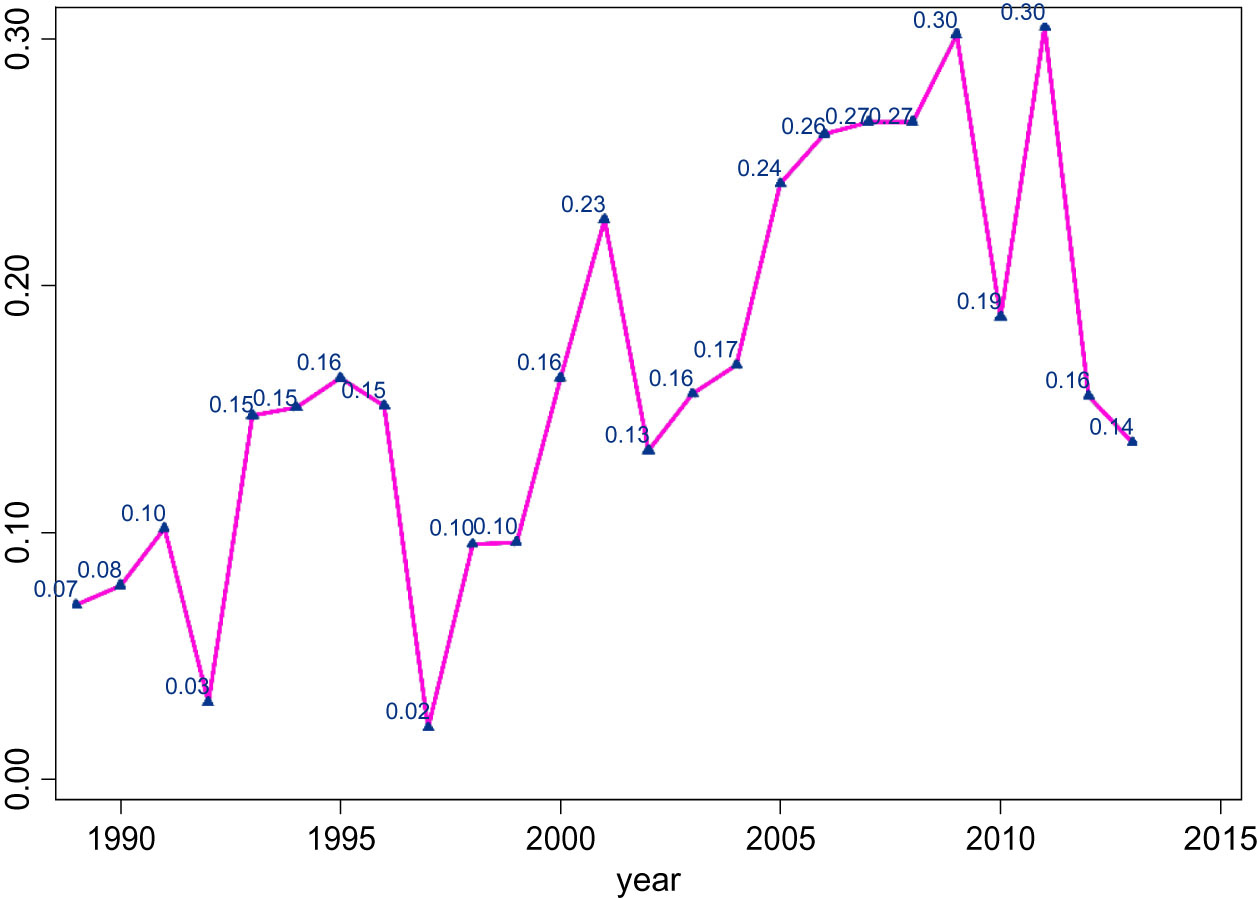
The ratio of disposition “Other” over total concluded cases.
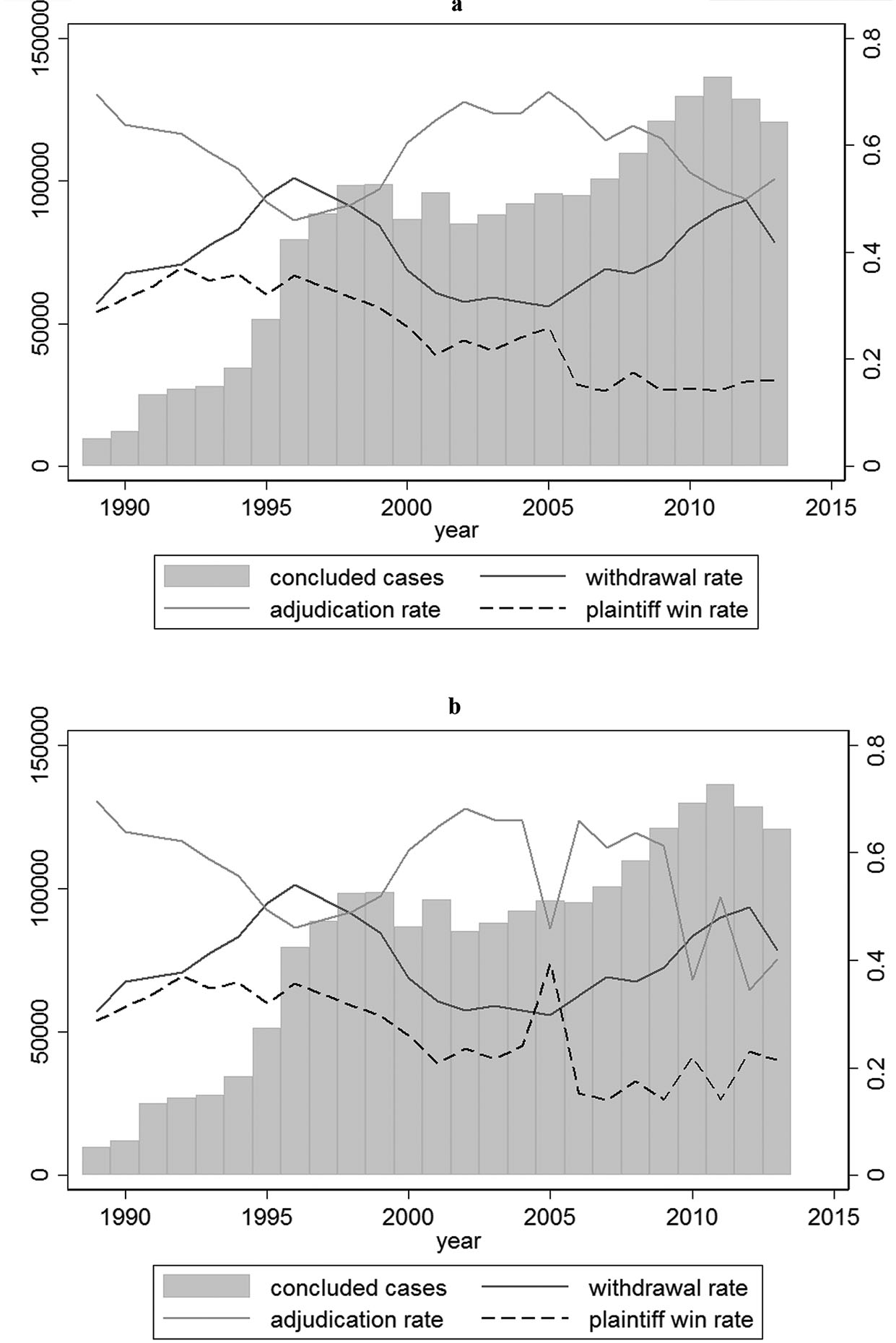
Evolution of Chinese administrative litigation: Aggregate patterns (Including Other).
Evolution of Chinese administrative litigation: Aggregate patterns (Excluding Other for Select Years).
Correlation between adjudication and Plaintiff Win Rates: Cases including other, 1989–2013 (OLS with Fixed Effects).
| (1) | |
|---|---|
| D.V.=Plaintiff Win Rate | Fixed Effects |
| Adjudication rate | −0.068 |
| (0.044) | |
| Constant | 0.323*** |
| (0.041) | |
| Observations | 233 |
| R-squared | 0.828 |
| Case FE | yes |
| Year FE | yes |
Standard errors in parentheses.
p<0.01,
p<0.05,
p<0.1.
Correlation between adjudication and Plaintiff Win Rates: Cases excluding other for select years, 1989–2013 (OLS with Fixed Effects).
| (1) | |
|---|---|
| D.V.=Plaintiff Win Rate | Fixed Effects |
| Adjudication rate | −0.110** |
| (0.046) | |
| Constant | 0.351*** |
| (0.044) | |
| Observations | 233 |
| R-squared | 0.792 |
| Case FE | yes |
| Year FE | yes |
Standard errors in parentheses.
p<0.01,
p<0.05,
p<0.1.
Correlation between adjudication and Plaintiff Win Rates cross-agencies: Cases including other, 1989–2013 (OLS with Fixed Effects).
| (1) | (2) | (3) | (4) | (5) | (6) | (7) | (8) | (9) | (10) | (11) | |
|---|---|---|---|---|---|---|---|---|---|---|---|
| D.V.=Plaintiff Win Rate | family planning | industry and commerce | labor and social security | land | other | public health | public security | tax | township government | transportation | urban construction |
| Adjudication Rate | −0.205*** | −0.211 | 0.193 | 0.156 | −0.298*** | 0.025 | −0.414*** | −0.272*** | −0.115 | −0.032 | −0.127 |
| (0.040) | (0.188) | (0.336) | (0.197) | (0.086) | (0.301) | (0.125) | (0.085) | (0.160) | (0.103) | (0.135) | |
| Year Counter | −0.021*** | −0.012*** | −0.013 | −0.008*** | −0.011*** | −0.014*** | −0.011*** | −0.006** | −0.005 | −0.009* | −0.005** |
| (0.002) | (0.002) | (0.011) | (0.001) | (0.001) | (0.003) | (0.001) | (0.003) | (0.006) | (0.005) | (0.002) | |
| Constant | 0.590*** | 0.522*** | 0.326 | 0.311** | 0.543*** | 0.354** | 0.612*** | 0.378*** | 0.425** | 0.344** | 0.394*** |
| (0.052) | (0.124) | (0.424) | (0.134) | (0.054) | (0.147) | (0.070) | (0.062) | (0.185) | (0.119) | (0.065) | |
| Observations | 13 | 20 | 12 | 24 | 24 | 18 | 24 | 16 | 12 | 18 | 20 |
| R-squared | 0.892 | 0.767 | 0.723 | 0.722 | 0.900 | 0.645 | 0.840 | 0.586 | 0.081 | 0.267 | 0.430 |
Robust standard errors in parentheses.
***p<0.01, **p<0.05, *p<0.1.
Note: Agencies of agriculture, culture, environment, forestry and technology supervision are excluded due to data scarcity (n<10).
Correlation between adjudication and Plaintiff Win Rates cross-agencies: Cases excluding other for select years, 1989–2013 (OLS with Fixed Effects).
| (1) | (2) | (3) | (4) | (5) | (6) | (7) | (8) | (9) | (10) | (11) | |
|---|---|---|---|---|---|---|---|---|---|---|---|
| D.V.=Plaintiff Win Rate | family planning | industry and commerce | labor and social security | Land | other | public health | public security | tax | township government | transportation | urban construction |
| Adjudication Rate | −0.409*** | −0.333** | −0.410** | −0.268*** | −0.401*** | −0.307* | −0.457*** | −0.288*** | −0.372* | −0.143 | −0.402*** |
| (0.077) | (0.124) | (0.148) | (0.094) | (0.077) | (0.157) | (0.108) | (0.077) | (0.199) | (0.129) | (0.110) | |
| Year Counter | −0.028*** | −0.012*** | −0.027*** | −0.008*** | −0.011*** | −0.011*** | −0.011*** | −0.006* | −0.010 | −0.008 | −0.004** |
| (0.005) | (0.002) | (0.006) | (0.001) | (0.001) | (0.003) | (0.001) | (0.003) | (0.008) | (0.005) | (0.002) | |
| Constant | 0.843*** | 0.593*** | 0.989*** | 0.589*** | 0.602*** | 0.515*** | 0.642*** | 0.381*** | 0.672** | 0.393** | 0.547*** |
| (0.132) | (0.092) | (0.192) | (0.071) | (0.052) | (0.094) | (0.061) | (0.062) | (0.253) | (0.135) | (0.073) | |
| Observations | 13 | 20 | 12 | 24 | 24 | 18 | 24 | 16 | 12 | 18 | 20 |
| R-squared | 0.822 | 0.699 | 0.709 | 0.473 | 0.864 | 0.502 | 0.831 | 0.596 | 0.275 | 0.177 | 0.414 |
Robust standard errors in parenthese.s
***p<0.01, **p<0.05, *p<0.1.
Note: Agencies of agriculture, culture, environment, forestry and technology supervision are excluded due to data scarcity (n<10).
ANOVA Analysis I (Including Other)
Finally, we perform an ANOVA test on plaintiff win rate and adjudication rate, respectively when we construct two variables by including others. The results show that the means in both the plaintiff win rate and adjudication rate are not equal (p=0.000). However, because we can reject the hypothesis of equal variance for both rates (p=0.002 for the plaintiff win rate, and p=0.000 for the adjudication rate), which violates the equal-variance assumption of ANOVA, we are cautious about the findings.
ANOVA Analysis II (Excluding Other for Select Years)
We also perform an ANOVA test on plaintiff win rate and adjudication rate, respectively when we construct two variables by excluding others for select years. The results show that the means in both the plaintiff win rate and adjudication rate are not equal (p=0.000). However, because we can reject the hypothesis of equal variance for both rates (p=0.005 for the plaintiff win rate, and p=0.000 for the adjudication rate), which violates the equal-variance assumption of ANOVA, we are cautious about the findings.
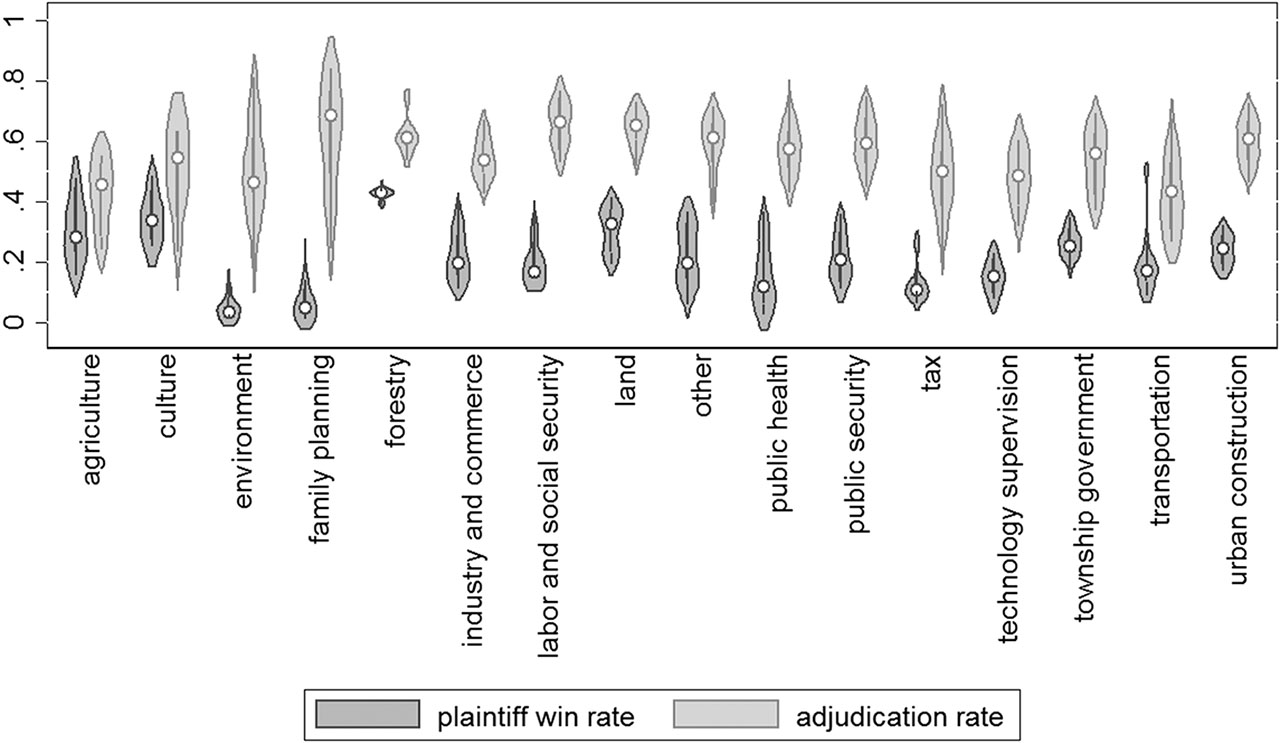
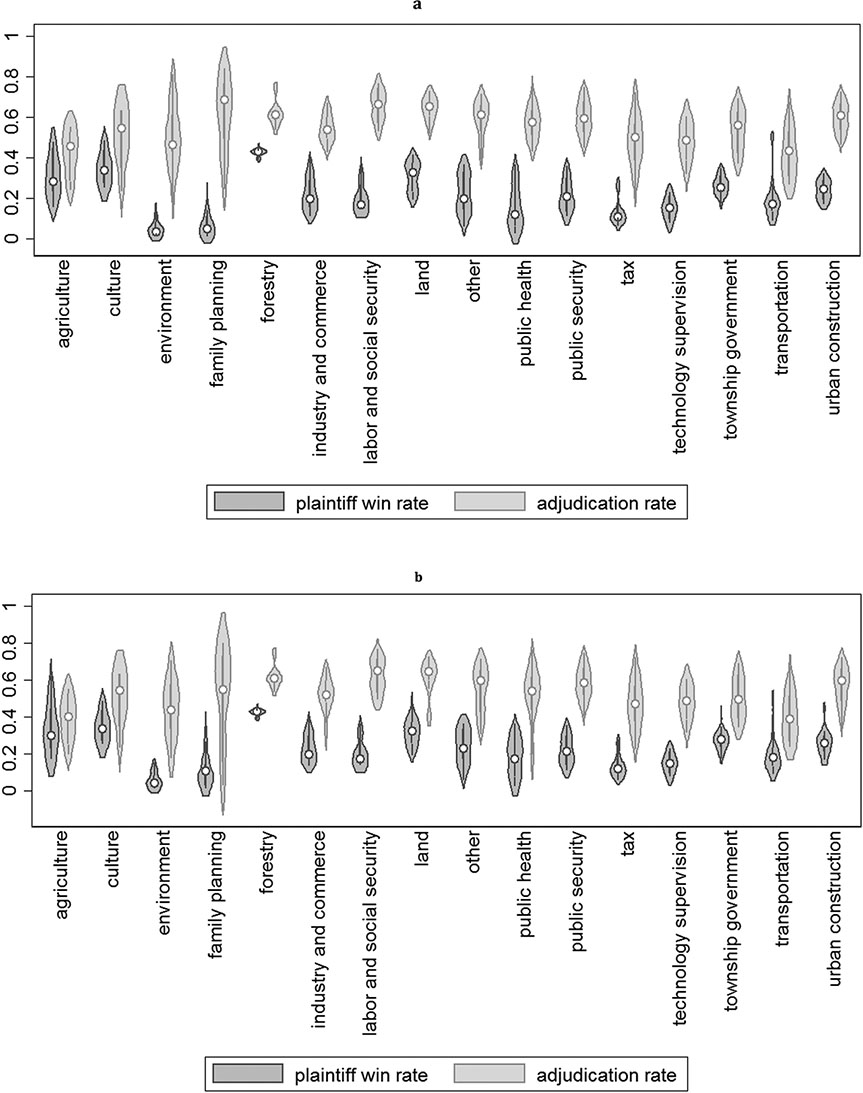
Violin plot of plaintiff win rate and adjudication rate (Including Other).
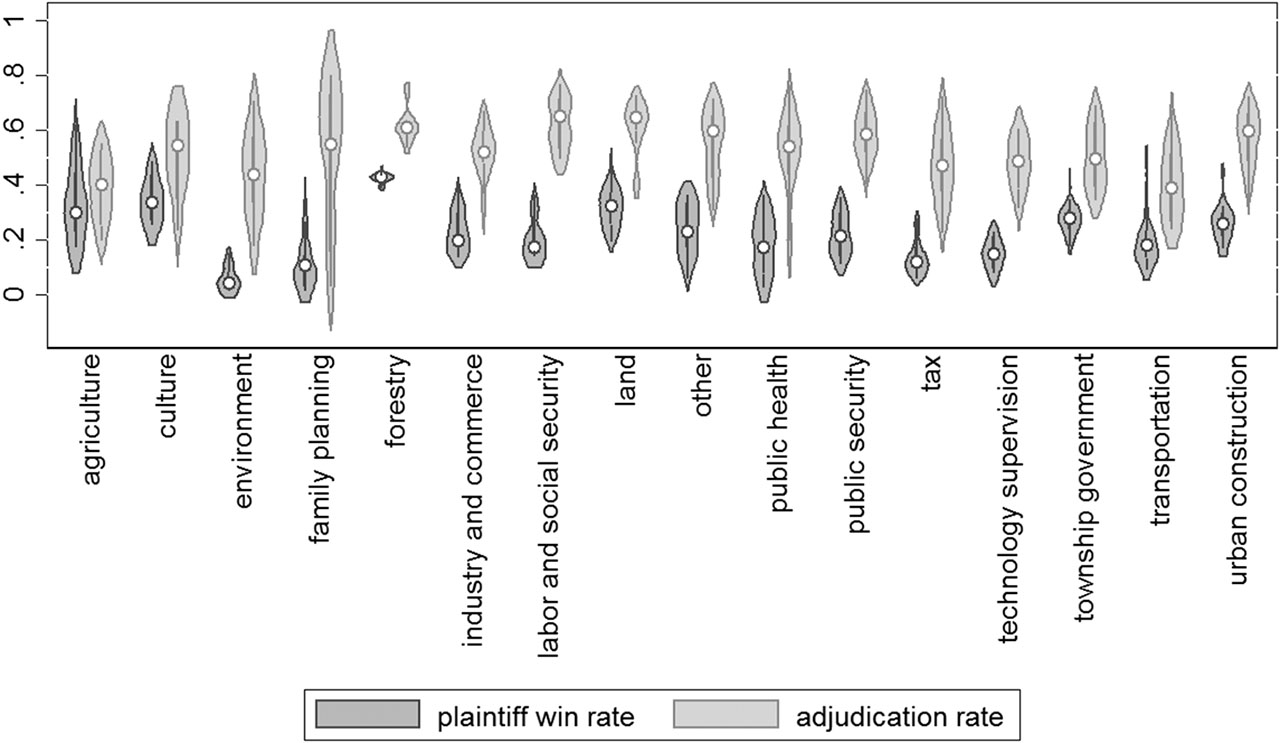
Violin plot of plaintiff win rate and adjudication rate (Excluding Other for Select Years).
References
Bøhren, Ø., and N.E. Krosvik. 2013. “The Economics of Minority Freezeouts: Evidence from the Courtroom,” 36 International Review of Law and Economics 48–58.10.1016/j.irle.2013.04.007Suche in Google Scholar
Clarke, D., et al. 2008. “The Role of Law in China’s Economic Development,” in T. Rawski and L. Brandt, eds. China’s Great Economic Transformation. Cambridge, UK: Cambridge University Press.Suche in Google Scholar
De Figueiredo, J.M. 2005. “Strategic Plaintiffs and Ideological Judges in Telecommunications Litigation,” 21 Journal of Law, Economics, and Organization 501–523.10.1093/jleo/ewi013Suche in Google Scholar
Doriat-Duban, M. 2001. “Alternative Dispute Resolution in the French Legal System: An Empirical Study,” in B. Deffains and T. Kirat, eds. Law and Economics in Civil Law Countries. Amsterdam: JAI.Suche in Google Scholar
Eisenberg, T., and H. Farber. 1997. “The Litigious Plaintiff Hypothesis,” 28 The RAND Journal of Economics S92-S112.10.2307/3087457Suche in Google Scholar
He, H. 2012. “Kundun De Xingzheng Susong [The Wearied State of Administrative Litigation],” 81 Huadong Zhengfa Daxue Xuebao [Journal of the East China University of Political Science and Law] 86–96.Suche in Google Scholar
He, X. 2014. “Administrative Reconsideration’s Erosion of Administrative Litigation in China,” 2 The Chinese Journal of Comparative Law 252–270.10.1093/cjcl/cxu008Suche in Google Scholar
Huang, K.C. 2008. “How Legal Representation Affects Case Outcomes: An Empirical Perspective from Taiwan,” 5 Journal of Empirical Legal Studies 197–238.10.1111/j.1740-1461.2008.00123.xSuche in Google Scholar
Hylton, K.N., and H. Lin. 2012. “Trial Selection Theory and Evidence,” in G. De Geest, ed. Encyclopedia of Law and Economics, 2nd ed. Vol. 8. Northampton, MA: Edward Elgar.Suche in Google Scholar
Kessler, D., T. Meites, and G. Miller. 1996. “Explaining Deviations from the Fifty-Percent Rule: A Multimodal Approach to the Selection of Cases for Litigation,” 25 The Journal of Legal Studies 233–259.10.1086/467977Suche in Google Scholar
Klerman, D. 2012. “The Selection of 13th-Century Disputes for Litigation,” 9(2) Journal of Empirical Legal Studies 320–346.10.1111/j.1740-1461.2012.01255.xSuche in Google Scholar
Klerman, D., and Y.-H.A. Lee. 2014. “Inferences from Litigated Cases,” 43 The Journal of Legal Studies 209–248.10.1086/678236Suche in Google Scholar
Kornhauser, L.A. 2012. “Judicial Organization and Administration,” in G. De Geest, ed. Encyclopedia of Law and Economics, 2nd ed. Vol. 8. Northampton, MA: Edward Elgar.Suche in Google Scholar
Lederman, L. 1999. “Which Cases Go to Trial?: An Empirical Study of Predictors of Failure to Settle,” 49 Case Western Reserve Law Review 315–358.10.2139/ssrn.163568Suche in Google Scholar
Liebman, B.J. 2007. “China’s Courts: Restricted Reform,” 191 China Quarterly 620–638.10.4324/9781315091976-8Suche in Google Scholar
Liu, Z. 2015. “2014 Nian Quanguo Fayuan Shenli Xingzheng he Guopei Anjian Qingkuang Fenxi [An Analysis of the Administrative Litigation and National Compensation Cases in Chinese Courts for 2014],” Renmin Fayuan Bao [People’s Court Daily], May 21, 2015, at 5.Suche in Google Scholar
Peerenboom, R. 2002. China’s Long March Towards Rule of Law. Cambridge, UK: Cambridge University Press.10.1017/CBO9780511493737Suche in Google Scholar
Pei, M. 1997. “Citizens V. Mandarins: Administrative Litigation in China,” 152 China Quarterly 832–862.10.1017/S0305741000047573Suche in Google Scholar
Peyer, S. 2012. “Private Antitrust Litigation in Germany from 2005 to 2007: Empirical Evidence,” 8 Journal of Competition Law & Economics 331–359.10.1093/joclec/nhs011Suche in Google Scholar
Potter, P. 1994. “The Administrative Litigation Law of the PRC: Judicial Review and Bureaucratic Reform,” in P. Potter, ed. Domestic Law Reforms in Post-Mao China. Armonk, NY: M.E. Sharpe.Suche in Google Scholar
Priest, G.L., and B. Klein. 1984. “The Selection of Disputes for Litigation,” 13 The Journal of Legal Studies 1–55.10.1086/467732Suche in Google Scholar
Ramseyer, J.M., and E.B. Rasmusen. 1999. “Why the Japanese Taxpayer Always Loses,” 72 Southern California Law Review 571–595.10.2139/ssrn.170710Suche in Google Scholar
Siegelman, P., and J.J. Donohue, III. 1995. “The Selection of Employment Discrimination Disputes for Litigation: Using Business Cycle Effects to Test the Priest/Klein Hypothesis,” 24 The Journal of Legal Studies 427–462.10.1086/467964Suche in Google Scholar
Siegelman, P., and J. Waldfogel. 1999. “Toward a Taxonomy of Disputes: New Evidence through the Prism of the Priest/Klein Model,” 28 The Journal of Legal Studies 101–130.10.1086/468047Suche in Google Scholar
Waldfogel, J. 1995. “The Selection Hypothesis and the Relationship between Trial and Plaintiff Victory,” 103 Journal of Political Economy 229–260.10.1086/261982Suche in Google Scholar
Waldfogel, J. 1998a. “Reconciling Asymmetric Information and Divergent Expectations Theories of Litigation,” 41 Journal of Law and Economics 451–476.10.1086/467397Suche in Google Scholar
Waldfogel, J. 1998b. “The Selection of Cases for Trial,” in P. Newman, ed. The New Palgrave Dictionary of Economics and the Law. London, UK: Macmillan Reference Limited.Suche in Google Scholar
© 2017 Walter de Gruyter GmbH, Berlin/Boston
Artikel in diesem Heft
- Anti-Crime Laws and Retail Prices
- Recognition of Non-Controlling Interest in Consolidated Financial Statements Based on Property Rights
- Judicial Behavior and Devolution at the Privy Council
- Quality of Outsourced Services, Opportunism and Contract Design
- Skill-Biased Technological Change, Earnings of Unskilled Workers, and Crime
- The Selection of Litigation against Government Agencies: Evidence from China
Artikel in diesem Heft
- Anti-Crime Laws and Retail Prices
- Recognition of Non-Controlling Interest in Consolidated Financial Statements Based on Property Rights
- Judicial Behavior and Devolution at the Privy Council
- Quality of Outsourced Services, Opportunism and Contract Design
- Skill-Biased Technological Change, Earnings of Unskilled Workers, and Crime
- The Selection of Litigation against Government Agencies: Evidence from China
