An event integration approach to the family of Chinese instrumental constructions
-
Cuiying Zhang
Cuiying Zhang (Ph.D. 2024, Beihang University) is a lecturer at Henan University and a visiting scholar at KU Leuven. Her research interests include Cognitive Semantics, Construction Grammar and grammaticalization.
 and
Fuyin Thomas Li
and
Fuyin Thomas Li
Fuyin Thomas Li (Ph.D. 2003, the Chinese University of Hong Kong) is Professor of linguistics at Beihang University. His research interests include event representations, semantic typology, causation and causatives, and Talmyan schematic systems. He is the founding editor-in-chief of the journal
Cognitive Semantics . Research portal:http://shi.buaa.edu.cn/lifuyin/en/index.htm .

Abstract
This study contributes to the similarities and differences of the constructions in the family of Chinese instrumental constructions. It is found that all instrumental constructions conceptually are composed of the instrument-manipulation event, the act-on event and a semantic relation (facilitating or causative) between them and syntactically represented by one clause, while with different patterns of event integration, all instrumental constructions form a continuum in terms of degrees of event integration and Chinese tends to use more compactly integrated instrumental constructions. Theoretically, this study supplements the event integration from 4 aspects: (1) Event integration can be either single-chained or double-chained; (2) Besides explicit argument integration, implicix`t argument integration is also a hub of event integration; (3) Event integration involves not only explicit events but also implicit events; (4) The mismatch between predicates and arguments is essentially one of the linguistic representations of event integration.
1 Introduction
The instrument has long been a focus in linguistic literature (Fillmore 1968, Schlesinger 1979, Koenig et al. 2008, Rissman and Rawlins 2017, among others). In Case Grammar, the “instrumental” is proposed to conceptually refer to “the case of the inanimate force or object causally involved in the action or state identified by the verb” (Fillmore 1968: 24). According to Dowty (1991), the instrument is described as a participant that has an equal amount of proto-agent and proto-patient properties, which captures the nature that the instrument is both acted upon by a manipulator and acting on another participant itself (Hooste 2018: 2, Næss 2007: 90). Besides the thematic relations, the instrument is also a hotly discussed topic in linguistic typology. Specifically, the instrument is closely associated with other semantic categories, such as comitative, manner, material (Haspelmath 2003; Narrog and Ito 2007; Schlesinger 1979; Stolz 1996, 2001) and thus the instrumental marking is cross-linguistically multifunctional.
When we move from the instrument or intrstrumental itself to a larger linguistic context representations, it is found that instrumental elements are actually situated in some fixed syntactic patterns, which conform with the definition of construction, “form-meaning pairs” (Goldberg 1995) or “learned pairings of form with semantic or discourse function” (Goldberg 2006). Therefore, these fixed syntactic patterns with elements expressing the instrument concept can be collectively referred to as instrumental constructions, which share “important properties but differing in certain specifics, including their degree of productivity” (Goldberg and Jackendoff 2004), and thus actually form the family of instrumental constructions. In English, semantic contributions of with and use to the instrumental constructions have been widely discussed (Lakoff 1968; Rissman and Rawlins 2017). For example, in (1a-b), with and use are semantic operators used to introduce instrumental components, respectively. Whereas, there are also other instrumental constructions where the instrumental components serve as subjects or objects directly without any markers. For example, the instrumental component hammer in (2a-b) serves as the subject and the object, respectively.
| Seymour sliced the salami with a knife. (Lakoff 1968) |
| Seymour used a knife to slice the salami. (ibid.) |
| The hammer hit the glass. (Langacker 1991: 216) |
| Floyd hit the hammer against the glass. (ibid.) |
Likewise, there also exist such fixed syntactic patterns in Chinese where the instrumental components can be introduced by prepositions 用 yòng, 拿 ná, 以 yǐ, etc., or act as subjects or objects directly, and thus form the well-known marked instrumental constructions (Shi 1995; Wu 1996), instrument-subject constructions (Chen 2003; Wang 1984) and instrument-object constructions (Ding 1961: 37; Lv 1979: 72), respectively, as shown in (3a-c):
| 我 | 用 | 这 | 把 | 刀 | 切 | 肉。(Wu 1996) |
| wǒ | yòng | zhè | bǎ | dāo | qiē | ròu |
| I | YONG | this | CL | knife | cut | meat. |
| ‘I cut meat with this knife’. | ||||||
| 那 | 台 | 缝纫机 | 做 | 了 | 三 | 百 | 套 | 衣服 | 了。(Wang 1984) |
| nà | tái | féngrènjī | zuò | le | sān | bǎi | tào | yīfú | le |
| that CL sewing machine make LE three hundred CL clothes LE. | |||||||||
| ‘That sewing machine has made three hundred suits of clothes’. | |||||||||
| 吃 | 大 | 碗。(Shao 2015) |
| chī | dà | wǎn |
| eat | big | bowl. |
| ‘Eat with a big bowl’. | ||
Example (3a) demonstrates a situation where the instrument 刀 dāo ‘knife’ is introduced by prepositional marker 用 yòng. Examples (3b) and (3c) show cases where there are no instrumental markers, and the difference between them lies in that the instrument 缝纫机 féngrènjī ‘sewing machine’ in (3b) functions as the subject, while the instrument 大碗 dà wǎn ‘big bowl’ in (3c) serves as the object.
By combing the studies on Chinese instrumental constructions, we can easily come to the three-way classification. However, as pointed out by reviewers, there may exist other instrumental constructions, for example, the topic instrumental construction, see (4a), where 这把刀 zhè bǎ dāo ‘this knife’ is moved to the initial position and serves as a topic. However, the present study focuses solely on the three widely accepted Chinese instrumental constructions mentioned above, namely those involving instruments as arguments, while excluding other peripheral variants, say the topic instrumental construction, see (4a), instruments as verbal classifiers, see (4b) and instruments as noun quantifiers, see (4c). Such variants deserve attention in future studies.
| 这 | 把 | 刀 | 我 | 用 | 来 | 切 | 肉 | 了。(from PSiCL reviewer 1) |
| zhè | bǎ | dāo | wǒ | yòng | lái | qiè | ròu | le. |
| ZHE | CL | knief | I | YONG | come | cut | meat | LE. |
| ‘This knife, I used it to cut meat.’ | ||||||||
| 另 | 一 | 名 | 歹徒 | 朝 | 他 | 背部 | 猛 | 刺 | |||
| lìng | yī | míng | dǎitú | cháo | tā | bèibù | měng | cì | |||
| Another | one | CL | gangster | towards | him | back | fiercely | stab | |||
| 了 | 一 | 刀。(from PSiCL reviewer 2) | |||||||||
| le | yī | dāo. | |||||||||
| LE | one | CL. | |||||||||
| ‘Another gangster stabbed him in the back.’ | |||||||||||
| 奶奶 | 舀 | 了 | 一 | 瓢 | 水。(from PSiCL reviewer 2) |
| nǎinǎi | yǎo | le | yī | piáo | shuǐ |
| Grandma | scoop | LE | one | CL | water. |
| ‘Grandma scooped a ladle of water.’ | |||||
Another issue that needs to be clarified is the definition of instrumental constructions. Previous studies have taken the three-way classification of instrumental constructions for granted without explaining why. There is no dispute that the marked instrumental constructions are members of the family of Chinese instrumental construction because they semantically include the instrumental markers. More explanation is needed for the other two types of instrumental constructions. Despite the fact that both of the instrument-subject construction and the instrument-object construction belong to SVO constructions, they should not simply be treated as regular SVO constructions. For one thing, in addition to the agent-patient relation in SVO constructions, both of them semantically display instrumental features and thus should be categorized into the family of Chinese instrumental constructions. For another, not all sentences with the instrument NP in the subject or object slots can be categorized as instrumental constructions, see (5a-b). 石头 shítou ‘stone’ only serves as a subject in (5a), whereas it functions as a subject in (5b). But both of them can not be intepreted as the instrumental components and thus examples (5a-b) cannot be categorized into instrumental constructions. This manifests that the instrument-subject construction and the instrument-object construction are different from common SVO constructions and thus should be treated as independent constructions, i.e., the instrumental constructions.
| 垒 | 猪圈 | 的 | 石头 | 也 | 能 | 变成 | 几 | 千 | |||||
| lěi | zhūjuàn | de | shítou | yě | néng | biànchéng | jǐ | qiān | |||||
| build | pigsty | DE | stones | also | can | turn-into | sevel | thousand | |||||
| 元 | 一 | 吨 | 的 | 宝贝! (CCL1) | |||||||||
| yuán | yī | dūn | de | bǎobèi ! | |||||||||
| YUAN | one | CL | DE | treasure. | |||||||||
| ‘The stones in the pigsty can also be turned into treasures worth thousands of yuan per ton!’ | |||||||||||||
- 1
The CCL Corpus (Center for Chinese Linguistics Corpus, Peking University) is freely available online (http://ccl.pku.edu.cn:8080/ccl_corpus/). It subsumes two subcorpora – the Classical Chinese corpus and the Modern Chinese corpus. The former covers the period from the Zhou dynasty to the early years of the Republican era (the 1920s) with 163,662,943 characters, and the latter comprises modern Chinese (1930s-1949) and contemporary Chinese (1949-present) with 509,913,589 characters.
| 箭头 | 射 | 入 | 了 | 石头 | 之 | 中。(CCL) |
| jiàntóu | shè | rù | le | shítou | zhī | zhōng. |
| arrowhead | shoot | into | LE | stone | ZHI | in. |
| ‘The arrowhead shot into the stone.’ | ||||||
By examining examples in previous literature further, we propose that all instrumental constructions must contain instrumental components which explicitly or implicitly involve the whole “Agent-Instrument-Patient” event sequence, see Figure 1 (Langacker 1991: 217) and thus imply the existence of the instrument-manipulation event and the act-on event.[2] The instrument-manipulation event refers to the manipulation of an agent on an instrument, while the act-on event refers to a case where an action is performed by an agent or a secondary agent, i.e. instrument, on or in a patient. “Explicitly” means that the event in question is denoted by predicate elements. Take (3a) for example, 我 wǒ ‘I’ denotes the agent, 刀 dāo ‘knife’ the instrument, and 肉 ròu ‘meat’ the patient. The instrument-manipulation event describes a scenario where “an instrument is manipulated by an agent”, and it is exemplified by 我用这把刀 wǒ yòng zhè bǎ dāo ‘I used this knife’, while the act-on event denotes another scenario where an instrument (also referred to as a secondary agent) or agent acts on another entity, and it is instantiated by 这把刀切肉 zhè bǎ dāo qiē ròu ‘this knife cut meat’. “Implicitly” means that the event is implied rather than directly designated by predicate elements. Take (3b) for example, 缝纫机 féngrènjī ‘sewing machine’ is realized as the instrument, while 衣服 yīfú ‘clothes’ as the patient. There is no explicit agent in (3b). However, based on the encyclopedia knowledge, the sewing machine is operated by an agent, because it cannot begin to work spontaneously. In view of the missing of agent in (3b), only the act-on event is explicitly representted, and the instrument-manipulation event is implicitly contained. Generally, these instrumental constructions in (3) are syntactically represented by single clauses, but they are semantically composed of two events. All of these indicates that the semantic concept of Chinese instrumental events basically accords with the theoretical assumption of “event integration”. According to Talmy (2000), event integration refers to a linguistic phenomenon that two events tend to be integrated together and represented by one clause, for example:

The instrumental action chain (cf. Langacker 1991: 217).
| The police hunted the fugitive down. (Talmy 2000: 214) |
The word down in (6) indicates that the police fulfilled their intention of capturing the fugitive, which was the purpose of their engaging in the hunting activity. Therefore, (6) includes a hunting event and an event of realization, thus embodying the concept of event integration.
Thus far, we have roughly illustrated our research objects, redefined why or how they can be considered as instrumental constructions, and briefly introduced event integration instrumental constructions involved. Actually, the three-way classification is only based on syntax without considering any semantic factors, and thus cannot reflect the differences within a particular type of instrumental constructions or between different instrumental constructions. In addition, previous studies mainly focus on a certain type of instrumental constructions, namely instrument-subject constructions (Niu 2008; Xu 2003; Zhang 2020), instrument-object constructions (Xie and Qiao 2009; Zhu 1982: 110), or marked instrumental constructions (Chen 2001, 2007). To the best of our knowledge, studies concerning the whole family of Chinese instrumental constructions to explore how different Chinese instrumental constructions are structured and what are the differences and similarities among them, have not been conducted so far.
Based on the analyses above, situated in the framework of event integration, this study aims to devote to the family of Chinese instrumental constructions. Specifically speaking, the similarities and differences different Chinese instrumental constructions display during the process of event integration will be intensively explored. Meanwhile, we also try to explore whether this study can theoretically contribute to event integration. In what follows, Section 2 is devoted to introducing the classification of the research objects so as to ascertain the research objects in a fine-grained way. Section 3 introduces the event integration, and further puts forward some new principles suitable for the analysis of Chinese instrumental constructions. Meanwhile, the similarities between Chinese instrumental constructions are generalized as well. Section 4 explores the differences between Chinese instrumental constructions in the degree of event integration. Section 5 discusses implications of Chinese instrumental constructions on event integration. Section 6 concludes the study and points out the future directions.
2 Classification of Chinese instrumental constructions
As the names suggest, the widely accepted three-way classification of Chinese instrumental constructions including marked instrumental constructions, instrument-subject constructions and instrument-object constructions, is classified based on syntax, that is, whether the instrumental component is introduced by a marker or not, and if not, whether it serves as a subject or an object. Such classification embodies its inherent limitations. Specifically, the classification does not take the semantic parameter into consideration and thus is challenged in some cases, as shown in (7):
| 我 | 用 | 这 | 把 | 刀 | 切 | 肉。(Wu 1996) |
| wǒ | yòng | zhè | bǎ | dāo | qiē | ròu |
| I | YONG | this | CL | knife | cut | meat. |
| ‘I cut meat with this knife’. | ||||||
| 这 | 把 | 刀 | 切 | 肉。 |
| zhè | bǎ | dāo | qiē | ròu |
| this | CL | knife | cut | meat. |
| ‘I cut meat with this knife’. | ||||
| 我 | 用 | 筷子 | 吃 | 饭。(BCC3) |
| wǒ | yòng | kuàizi | chī | fàn |
| I | YONG | chopstick | eat | meal |
| ‘I have a meal with chopsticks’. | ||||
- 3
The BCC corpus established by Beijing Language and Culture University, is the largest full-text retrieval online corpus for Chinese at present (http://bcc.blcu.edu.cn/).
| 筷子 | 吃 | 饭。 |
| kuàizi | chī | fàn |
| chopstick | eat | meal |
| * ‘Chopsticks have a meal’.4 | ||
- 4
* means that the sentence is ungrammatical.
Although examples (7a-b) belong to 用 yòng instrumental constructions, (7a) can be shifted to an instrument-subject construction, i.e. (7a′), but there is no corresponding (7b′) for (7b). Taking both syntactic and semantic factors into account, Zhang and Li (2022b) innovatively propose an eight-way classification of Chinese instrumental constructions.
Essentially, the instrumental component plays a different semantic role in (7a) and (7b), respectively. Koenig et al. (2008) address the relation between instrumental component and causation: when the instrumental component bears a causative meaning, the instrument is intermediary; meanwhile, the instrumental component may not display the causative meaning, but only express a helping or facilitating meaning. Thus, instruments can be divided into intermediary type and facilitating[5] type. In (7a), the instrument 刀 dāo ‘knife’ has a direct causative effect on the object 肉 ròu ‘meat’. However, the instrument 筷子 kuàizi ‘chopsticks’ in (7b) has no similar function to 饭 fàn ‘meal’, but only facilitates the occurrence of the eating event. In view of this, this study introduces the causative parameter, and divides the instruments in the instrumental constructions into the intermediary type and the facilitating type. Therefore, the three-way classification can be extended to 6 types correspondingly. However, based on the data from the previous literature and the BCC corpus, Zhang and Li (2022b) also find that besides the 6 types of instrumental constructions mentioned above, there are another two types of instrumental constructions, as shown in (8):
| 课文 | 用 | 油墨 | 印 | 在 | 很 | 粗糙 | 的 | 纸 | 上。(BCC) |
| kèwén | yòng | yóumò | yìn | zài | hěn | cūcāo | de | zhǐ | shàng. |
| text | YONG | ink | at | very | rough | DE | paper | up. | |
| ‘The text was inked on rough paper’. | |||||||||
| 刺刀 | 捅 | 弯 | 了。(Xu 2015) |
| cìdāo | tǒng | wān | le. |
| bayonet | stab | bent | LE. |
| ‘The bayonet bent with the cause of stabbing’. | |||
According to the previous syntactic classification, there is a preposition 用 yòng in (8a), so it belongs to “marked instrumental construction”. However, unlike other marked instrumental constructions, the subject in (8a) is the patient rather than the agent, so this study calls it “patient-oriented marked instrumental construction”. The instrumental component 刺刀 cìdāo ‘bayonet’ in (8b) is the subject, and thus this construction falls into the instrument-subject construction. However, unlike other instrument-subject constructions, there is no patient object after the predicate in (8b). The reason is that the construction has already had a patient, namely the instrumental subject, thus referred to as “the patient-oriented instrument-subject construction”.[6] All of the eight types of Chinese instrumental constructions and corresponding examples are detailed in Table 1.
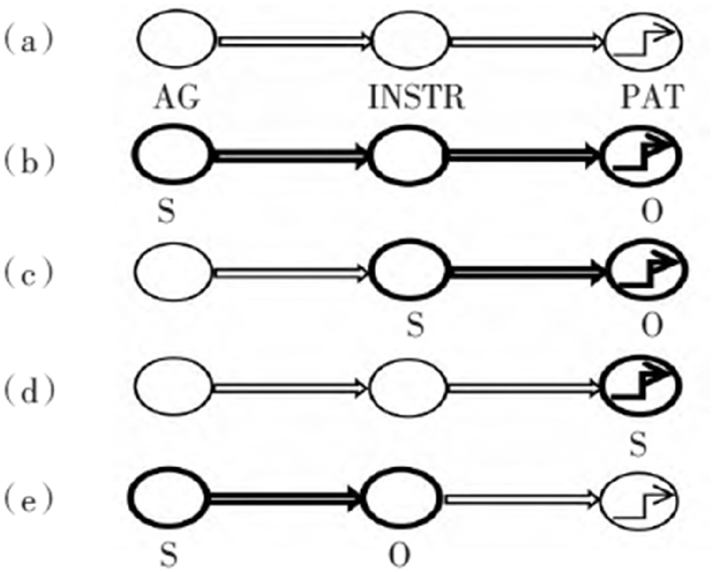
The instrumental action chain and its different profile schemas (cf. Langacker 1991: 217).
Classification of Chinese instrumental constructions.
| Types of constructions | Examples | ||||||||||
|---|---|---|---|---|---|---|---|---|---|---|---|
| Intermediary Marked Instrumental Construction | 我 | 用 | 这 | 把 | 刀 | 切 | 肉。 | (Wu 1996) | |||
| wǒ | yòng | zhè | bǎ | dāo | qiē | ròu | |||||
| I | YONG | this | CL | knife | cut | meat | |||||
| ‘I cut meat with this knife’. | |||||||||||
| Facilitating Marked Instrumental Construction | 我 | 用 | 筷子 | 吃饭。 | (BCC) | ||||||
| wǒ | yòng | kuàizi | chī fàn | ||||||||
| I | YONG | chopsticks | eat meal | ||||||||
| ‘I eat with chopsticks’. | |||||||||||
| Patient-Oriented Marked Instrumental Construction | 课文 | 用 | 油墨 | 印 | 在 | 很 | 粗糙 | 的 | 纸上 | (BCC) | |
| kèwén | yòng | yóumò | yìn | zài | hěn | cūcāo | de | zhǐshàng | |||
| text | YONG | ink | at | very | rough | DE | paper on | ||||
| ‘The text was inked on rough paper.’ | |||||||||||
| Intrmediary Instrument-Subject Construction | 那 | 台 | 缝纫机 | 做 | 了 | 三 | 百 | 套 | 衣服 | 了。 | (Wang 1984) |
| nà | tái | féngrènjī | zuò | le | sān | bǎi | tào | yīfú | le | ||
| that | CL | sewing machine | make | LE | three | hundred | CL | clothes | LE | ||
| ‘That sewing machine has made three hundred suits of clothes.’ | |||||||||||
| Facilitating Instrument-Subject Construction | 大 | 碗 | 喝 | 酒。 | (BCC) | ||||||
| dà | wǎn | hē | jiǔ | ||||||||
| big | bowl | drink | wine | ||||||||
| ‘Drink wine with a big bowl.’ | |||||||||||
| Patient-Oriented Instrument-Subject Construction | 刺刀 | 捅 | 弯 | 了。 | (Xu 2015) | |||||||
| cìdāo | tǒng | wān | le | |||||||||
| bayonet | stab | bent | LE | |||||||||
| ‘The bayonet bent with the cause of stabbing.’ | ||||||||||||
| Intermediary Instrument-Object Construction | 耶尔马兹 | 在 | 我 | 背 | 后 | 捅 | 刀子。 | (BCC) | |||
| Yé-ěr-mǎ-zī | zài | wǒ | bèi | hòu | tǒng | dāozi. | |||||
| Yilmaz | at | me | back | behind | stab | knife. | |||||
| ‘Yilmaz stabbed me in the back.’ | |||||||||||
| Facilitating Instrument-Object Construction | 我 | 吃 | 大 | 碗。 | (BCC) | ||||||
| wǒ | chī | dà | wǎn | ||||||||
| I | eat | big | bowl. | ||||||||
| ‘I eat with a big bowl.’ | |||||||||||
-
In Table 1, patient-oriented marked instrumental construction and patient-oriented instrument-subject construction are marked with Patient-oriented. In fact, given the fact that Chinese instrumental constructions tend to conform with “agent-instrument-patient” sequence, the subject is usually agent or the secondary agent, i.e. instrument in default in other 6 types of instrumental constructions. This is an explanation of the naming of instrumental constructions. That is, other 6 types of instrumental constructions are agent-oriented in default.
The eight-way classification of Chinese instrumental constructions is not only reasonable but also holds significant typological importance compared with the instrumental action chain proposed by Langacker (1991: 217). According to Langacker, the agent, instrument and patient depicted in Figure 1 form a sequenced instrumental action chain with Instrument as the intemediary role in terms of the energy transfer, repeated as (a) in Figure 2. Schemas (b-d) profile different portions of the instrumental action chain and they can be instantiated by example (9a-d), respectively.
| Floyd broke the glass (with the hammer). / Floyd hit the glass (with the hammer). |
| The hammer (easily) broke the glass. / The hammer hit the glass. |
| The glass (easily) broke. |
| Floyd hit the hammer against the glass. (Langacker 1991: 216) |
Example (9c) actually does not imply the existence or involvement of an instrument. More importantly, Figure 1 indicates that the patient is supposed to experience the change of state. However, Table 1 innovatively reveals that the change of state may occur in the instrument rather than the patient, as indicated by the Patient-oriented Instrument-Subject Construction in Chinese. Therefore, this study based on the eight-way classification has a typological significance as well. Therefore, this study takes all these eight types of instrumental constructions proposed by Zhang and Li (2022b) as the Chinese family of instrumental constructions, namely the research objects of this study.
3 Event integration
3.1 Introduction to event integration
Event integration formulated by Leonard Talmy, focuses on the configuration of event complex. Put concretely, Talmy (2000: 213) argues that single complex can be conceptualized as single fused events represented by single clauses, but can also be reconceptualized into two simple events and the relation between them. That is, two or more events can be conceptualized as an analytical event complex, or as a comprehensive unitary event, where the latter embodies the concept of event integration, resulting in the formation of macro-events. In spite of the existence of alternatives of macro-events, Talmy (2000: 216) also states that “a crosslinguistic comparison strongly suggests that there is a fundamental and recurrent category of complex event that is prone to conceptual integration and representation by a single clause, a type here termed a macro-event”. That is, macro-events are generally preferred in concrete language expressions. Based on this cognitive principle and large cross-language linguistic data, Talmy puts forward five types of macro-event: motion event, event of temporal contouring, event of state change, event of action correlating, and event of realization and adopts event integration to analyze macro-events.[7] Although event integration is to a great extent to be understood at the conceptual level, it is closely related to linguistic representations, syntactically and semantically. Li (2020) further proposes that macro-events require three conditions:
Condition 1:
There must be two events.
Condition 2:
There must be a semantic relation between the two events.
Based on the given information, it can be concluded that event integration involves cognitive processes as well as semantic and syntactic representations. Specifically, Condition 1 operates at the conceptual level, Condition 2 at the semantic level, and Condition 3 at the syntactic level. Therefore, event integration reflects the combination of cognitive and linguistic factors, thus displaying a strong explanatory power.
In contrast to Talmyan synchronic perspective, Li (2018, 2019) innovatively moves to a diachronic perspective and explores the event integration of Chinese verb-directional complement construction corresponding to Talmyan 5 types of macro-events to a great extent. Situated in a dynamic view of language change, Li (2020) puts forward the macro-event hypothesis that macro-event can function as a parameter of language typology. However, event integration is actually not and should not be limited to Talmyan five types of macro-event. It can also be used to explain the clause union (Givón 2001; Li and Li 2020; Zhang and Li 2022a; ) and the degree of event integration (Bohnemeyer et al. 2007, 2011; Bohnemeyer and Van Valin 2017). Specifically, Givón (2001) extends the research horizon of event integration to the clause level, and further proposes three dimensions of event integration: “referential integration”, “temporal integration” and “spatial integration”. Among them, “referential integration” involves such a case that “the more two events share their referents, the more likely they are to be construed as a single event” (Givón 2001: 50). “Temporal integration” refers to the co-temporality, while “spatial integration” the direct contact (Givón 2001: 44). That is, if two events tend to be overlapped in time and involve direct contacts between arguments, they are more easily integrated into one single clause. Although the term “macro-event” is coined in Talmy (1991, 2000) and applied to lexicalization of events, Bohnemeyer and his colleages examine the degree of event integration – “the tightness of packaging of subevents in the construction” and thus propose “macro-event property” (MEP) – “a construction has the MEP if it packages event representations such that temporal operators necessarily have scope over all subevents” (Bohnemeyer et al. 2007: 497). Bohnemeyer et al. (2011) put forward three variables to measure the semantic compactness of causative – “Mediation”, “Contact” and “Force dynamics”, when investigating another macro-event - the causative construction in Ewe, Japanese, Lao, and Yukatek Maya. “Mediation” refers to the number and type of links. In the causal chain, four links are involved at most, i.e. causer, causee, instrument and affectee, all of which can jointly describe a case where a causer effects a change on an affectee via a causee and with the help of some instrument. “Contact” refers to the spatio-temporal contiguity or gaps of the various events. “Force dynamics” is definitely involved in the causal chain because causation is conceptualized as a special type of interaction of (mechanical or metaphorical) forces.
To recap briefly, event integration can be summarized by the following four points: (1) Event integration involves “semantic bond between the two events” and “syntactic integration of the two clauses into a single though complex clause” (Givón 2001: 40), which means that event integration exhibits the isomorphism between semantic integration and syntactic integration; (2) Event integration could be studied from either synchronic or diachronic perspectives; (3) Syntactically, macro-events display macro-event property and show tighter syntactic event integration; (4) Semantically, the degree of event integration involves different parameters, but the previous research categories are limited either to a certain semantic category, like causation, or to a certain syntactic structure, like verbal complementation. However, despite many achievements mentioned above, there is still much room for research on the semantic and syntactic paths for us to explore.
3.2 Instrumental macro-events and the degree of event integration
In terms of Chinese instrumental constructions, all of the eight types can be categorized as the macro-events and exhibit the family resemblance. Specifically, all of them conceptually involve two events, namely the instrument-manipulation event and the act-on event, but are syntactically represented in a single clause, which means that Chinese instrument constructions are macro-events and can be called instrumental macro-events. Centering on the semantic research path zooming in on instrumental category, the present study aims to focus on the degree of event integration of Chinese instrumental constructions. In what follows, what we need to do is check whether the parameters involved in event integration in previous studies are applicable or not here:
Argument integration, same as “referential integration” (Givón 2001) and “mediation” (Bohnemeyer et al. 2011). Arguments are important components of clauses or constructions, and it is usually impossible not to talk argument integration when discussing event integration. Givón (2001: 50) argues that the more references shared between two events, the more likely they are to be interpreted as a single event, that is, the closer the event integration is. However, the prototypical instrumental constructions involve the “Agent-Instrument-Patient” event sequence, where there always exists one argument integration, the agent or the instrument. Therefore, we must admit that counting the number of argument integration is not applicable here when we zoom in on the degree of event integration.
Spatial integration and temporal integration (Givón 2001), same as “contact” (Bohnemeyer et al. 2011). The “instrument-manipulation event” and the “act-on event” in the instrumental constructions essentially display the simultaneity and the same spatiality, so the temporal integration and the spatial integration are not distinguishable here.
Force Dynamics (Bohnemeyer et al. 2011). It refers to the force confrontation modes between causers and causees, namely, causing, permitting and stopping. Given that instruments could cause or facilitate the occurrence of the “act-on event”, there surely exists force dynamics in instrumental constructions. But these two parameters have been included in the classification of instrumental constructions. Therefore, it is not improper to select force dynamics as a parameter to measure the semantic compactness of Chinese instrumental constructions.
The analysis above demonstrates that Chinese instrumental constructions definitely involve argument integration and spatial integration between sub-events, direct contact between arguments, and force dynamics inside sub-events. But when it comes to the degree of event integration in Chinese instrumental constructions, these parameters functioning well in previous literature are not applicable. All of these indicates that Chinese instrumental constructions show its unique features and some innovative parameter is necessary to be put forward.
3.3 Our proposals: the explicit event, the implicit event and “E/TER”
In view of the observation on members of Chinese instrumental construction family, the present study figures out that inverting unmarked instrumental constructions to marked instrumental construction involves complementing not only arguments, but also the relation between arguments. That is, the inversion between Chinese instrumental constructions concerns the reconfiguration of explicit events and implicit events, as shown in (10):
| 我 | 吃 | 大 | 碗。(BCC) |
| wǒ | chī | dà | wǎn |
| I | eat | big | bowl. |
| ‘I eat with a big bowl’. | |||
| 我 | 用 | 大 | 碗 | 吃 | 饭。(revised from 10a) |
| wǒ | yòng | dà | wǎn | chī | fàn |
| I | YONG | big | bowls | eat | meals. |
| ‘I eat with big bowls’. | |||||
(10a) exemplifies an instrument-object construction, where the act-on event denoted by 吃 chī ‘eat’ is profiled while the instrument-manipulation event implied by the relation between 我 wǒ ‘I’ and 大碗 dà wǎn ‘big bowl’, is backgrounded. In view of the lack of the patient object, the instrumental element 大碗 dà wǎn ‘big bowl’ occupies the slot of patient object in (10a). Conversed from (10a), (10b) with the instrumental marker 用 yòng is a marked instructional construction, which complements the patient object 饭 fàn ‘meal’ and thus profiles both the instrument-manipulated event and the act-on event. To summarize, we found that (10a) includes a profiled or explicit event and a backgrounded or implicit event, while (10b) includes two profiled or explicit events. The explicit event is defined as an event profiled by the predicate element, while the implicit event refers to the event implied by arguments or relations between arguments. Generally, examples (10a-b) collectively display how the configuration between explicit events and implicit events contributes to the formation of different instrumental constructions.
In addition to the explicit event and the implicit event, this study further introduces a third concept, the total event, which is the sum of the explicit event and the implicit event. Based on these three concepts, this study proposes two principles for measuring the degree of event integration:
Principle 1:
Given the fact that all instrumental constructions are syntactically represented by single clauses, the more the number of the total events is, the tighter the degree of event integration is.
Principle 2:
For the case where the number of the total events is the same, we propose another new term – “Explicit/Total Event Ratio” (hereafter, E/TER), namely the ratio of the number of explicit events to the total number of events. For one thing, compared with the explicit event, the implicit event needs to mobilize more cognitive ability of language users for its construal and thus is more tightly woven into the instrumental construction. For another, the higher the “E/TER” is, the more analyzable the instrumental construction is. That is, “E/TER” is inversely proportional to the degree of event integration. Therefore, we can generalize that the smaller the value of “E/TER”, the higher the degree of event integration.
This section introduces event integration, illustrates the similarities between Chinese instrumental constructions under the framework of event integration, and proposes two principle to explore the differences between Chinese instrumental constructions, namely the degree of event integration. More exploration on the differences between Chinese instrumental constructions, namely the degree of event integration, will be made in Section 4.
4 Degree of event integration of Chinese instrumental constructions
The similarities between Chinese instrumental constructions lies in that all of them embody the features of macro-events and can be called the instrumental macro-events, based on which, this section tends to explore the differences between Chinese instrumental constructions from the degree of event integration.
Instrumental constructions are overt linguistic representations of Agent-Instrument-Patient event sequence (cf. e.g. Langacker 1991: 217). Conceptually, the “Agent-Instrument-Patient” event sequence could offer 3 arguments, namely the total number of arguments, but the number of arguments appearing in concrete instrumental constructions may be 3 or less than 3. The marked instrumental constructions involve 3 arguments and profile the whole sequence, while other unmarked instrumental constructions involve 1 or 2 arguments and only designate part of it. However, in terms of the events integrated in all instrumental constructions, in addition to the instrument-manipulation event and the act-on event, some instrumental constructions contain a resultative event as well. This phenomenon that an action may cause a result, conforms with concrete scenarios in the physical world, and Langacker (1991: 217) also introduces the potential result caused by an action when describing the “Agent-Instrument-Patient” event sequence. Therefore, it is a natural and reasonable fact that some instrumental constructions can include a resultative event. Table 2 exemplifies the eight types of Chinese instrumental constructions as well as shows the distributions of the explicit event, the total event and E/TER within them. Meanwhile, in the column of examples, we also illustrate whether a predicate component denoting a resultative event can be added:
“E/TER” of Chinese instrumental constructions.
| Construction types | Explicit event | Total event | E/TER | Examples | ||||||||||
|---|---|---|---|---|---|---|---|---|---|---|---|---|---|---|
| Intermediary Marked Instrumental Construction | 2 (+1) | 2 (+1) | 100% | 我 | 用 | 这 | 把 | 刀 | 切 | 肉。 | (Wu 1996) <切碎 qiē suì ‘cut-broken’> | |||
| wǒ | yòng | zhè | bǎ | dāo | qiē | ròu | ||||||||
| I | use | this | CL | knife | cut | meat | ||||||||
| ‘I cut meat with this knife’. | ||||||||||||||
| Facilitating Marked Instrumental Construction | 2 (+1) | 2 (+1) | 100% | 我 | 用 | 筷子 | 吃 | 饭。 | (BCC) <吃完 chī wán ‘eat-finish’> | |||||
| wǒ | yòng | kuàizi | chī | fàn | ||||||||||
| I | use | chopsticks | eat | meal | ||||||||||
| I eat with chopsticks. | ||||||||||||||
| Patient-Oriented Marked Instrumental Construction | 2 | 3 | 66.7% | 课文 | 用 | 油墨 | 印 | 在 | 很 | 粗糙 | 的 | 纸 | 上。 | (BCC) |
| kèwén | yòng | yóumò | yìn | zài | hěn | cūcāo | de | zhǐ | shàng | |||||
| text | use | ink | at | very | rough | DE | paper | on | ||||||
| The text was inked on rough paper. | ||||||||||||||
| Intermediary Instrument-Subject Construction | 1 (+1) | 2 (+1) | 50% (66.7%) | 那 | 台 | 缝纫机 | 做 | 了 | 三 | 百 | 套 | 衣服 | 了。 | (Wang 1984) <做坏zuò huài ‘make-ruined’> |
| nà | tái | féngrènjī | zuò | le | sān | bǎi | tào | yīfú | le | |||||
| that | CL | sewing-machine | make | LE | three | hundred | CL | clothes | LE | |||||
| That sewing machine has made three hundred suits of clothes. | ||||||||||||||
| Facilitating Instrument-Subject Construction | 1 | 2 | 50% | 大 | 碗 | 喝 | 酒。 | (BCC) | |||||
| dà | wǎn | hē | jiǔ | ||||||||||
| big | bowl | drink | wine | ||||||||||
| Drink wine with a big bowl. | |||||||||||||
| Patient-Oriented Instrument-Subject Construction | 2 | 3 | 66.7% | 刺刀 | 捅 | 弯 | 了。 | (Xu 2015) | |||||
| cìdāo | tǒng | wān | le | ||||||||||
| bayonet | stab | bent | LE | ||||||||||
| The bayonet bent with the cause of stabbing. | |||||||||||||
| Intermediary Instrument-Object Construction | 1 | 2 | 50% | 耶尔马兹 | 在 | 我 | 背 | 后 | 捅 | 刀子。 | (BCC) | ||
| Yé-ěr-mǎ-zī | zài | wǒ | bèi | hòu | tǒng | dāozi | |||||||
| Yilmaz | at | me | back | behind | stab | knife | |||||||
| Yilmaz stabbed me in the back. | |||||||||||||
| Facilitating Instrument-Object Construction | 1 | 2 | 50% | 我 | 吃 | 大 | 碗。 | (BCC) | |||||
| wǒ | chī | dà | wǎn | ||||||||||
| I | eat | big | bowl | ||||||||||
| I eat with a big bowl. | |||||||||||||
-
Here it means that when 切qiē ‘cut’ is displaced by 切 碎qiē suì ‘cut-broken’, the sentence is also grammatical. But the resultative complement 碎suì ‘broken’ profiles a resultative event, which can be added to prior instrumental construction so as to increase the number of total event from 2 to 3. Therefore, in terms of whether there is a resultative event or not, the number of total events the intermediary marked instrumental construction designates could be 2 or 3. It is the same situation in the facilitating marked instrumental construction and the intermediary instrument-subject construction in Table 2. In fact, as one reviewer suggested, the resultative event in instrumental constructions is not only expressed by verb-complement construction, and it can also be represented by a result verb. For example, in消防员 用 水 灭 火 xiāofángyuán yòng shuǐ miè huǒ ‘Firefighters use water to extinguish fires’, 灭 miè ‘extinguish’ is a result verb, which designates both an act-on event (water acts on fire) and a resultative event (fire is extinguished). The examples of 8 types of instrumental constructions are certainly not limited to those in Table 2. However, in view of the limited length of the paper, we only list some classical examples that can reinforce the impression of a reclassification of instrumental constructions and also help us to clearly elaborate our findings. In future research, a quantitative study can be carried out to test or complement the findings of this study.
In what follows we will elaborate on Table 2 by showing how the explicit event and the implicit event are integrated into different instrumental constructions, how the total event and E/TER are calculated, and why some instrumental constructions can potentially contain a resultative event while others cannot.
The intermediary marked instrumental construction includes two certain explicit events, that is, an instrument-manipulation event denoted by 用 yòng (我用这把刀 wǒ yòng zhè bǎ dāo ‘I use this knife’) and act-on event denoted by 切 qiē ‘cut’ (这把刀切肉 zhè bǎ dāo qiē ròu ‘this knife cuts meat’), and potentially one explicit event that represents the possible result of the patient as 碎 suì ‘broken’ in 切碎 qiē suì ‘cut-broken’. Specifically, when the predicate contains the result complements, there is an explicit resultative event denoted by 碎 suì ‘minced’ (肉碎了 ròu suì le ‘meat is minced’). In terms of whether the resultative event is syntactically expressed or not, the number of total events in the intermediary marked instrumental construction is 2 or 3. Therefore, the “E/TER” is 100 %.
The facilitating marked instrumental construction also includes two certain explicit events, namely, instrument-manipulation event designated by 用 yòng (我用筷子 wǒ yòng kuàizi ‘I use chopsticks’) and act-on event designated by 吃 chī ‘eat’ (我吃饭 wǒ chī fàn ‘I eat meals’), and potentially one explicit event that represents the possible outcome beared by the patient, i.e. 完 wán ‘finish’ (饭吃完了 fàn chī wán le ‘meals are finished’). The number of total events in facilitating marked instrumental construction is either 2 or 3, and all involved events will be explicitly expressed. Therefore, the “E/TER” is 100 %.
The patient-oriented marked instrumental construction includes two explicit events, namely 油墨印课文yóumò yìn kèwén ‘printing ink is used to print texts’ and 课文被印在很粗糙的纸上 kèwén bèi yìn zài hěn cūcāo de zhǐ shàng ‘texts are printed on coarse paper’, where the former is an action-on event denoted by 印 yìn ‘print’ and expressing the relation between instrument and patient, while the latter is a resultative event denoted by 在 zài ‘at’ and undertaken by the patient. Besides the 2 events mentioned above, another is an implied instrument-manipulation event (某人/机器操控油墨 mǒurén/jīqì cāokòng yóumò ‘someone/some machine manipulates printing ink’) because 油墨 yóumò ‘ink’ cannot perform the printing action itself without the involvement of any other forces. Therefore, the number of total events in this construction is 3 and the “E/TER” of patient-oriented marked instrumental construction is 66.7 %.
The intermediary instrument-subject construction includes one explicit event, i.e. the act-on event designated by 做 zuò ‘make’ (那台缝纫机做了三百套衣服了 nà tái féngrènjī zuò le sān bǎi tào yīfú le ‘that sewing machine has made three hundred suits of clothes’). When the predicate 做 zuò ‘make’ is followed by a resultative complement 坏‘ruined’, this construction can also contain another explicit event (衣服做坏了 yīfú zuò huài le ‘the clothes are ruined during the process of making’), namely the resultative event. Meanwhile, there also exists an implicit event, namely the instrument-manipulated event indicating that someone manipulates or starts that sewing machine, because 缝纫机 féngrènjī ‘sewing machine’ cannot start itself going. Therefore, the number of total events is 2 or 3 which corresponds to 1 or 2 explicit events repectively, and the “E/TER” of intermediary instrument-subject construction is 50 % or 66.7 % correspondingly.
The facilitating instrument-subject construction includes one explicit event and one implicit event. The former is an act-on event denoted by 喝 hē ‘drink’ (喝酒 hē jiǔ ‘drink wine’), while the latter is an implicit instrument-manipulation event implied by the relation between a potential agent and 大碗 dà wǎn ‘big bowl’ (某人用大碗 mǒu rén yòng dà wǎn ‘someone uses the big bowl’) because it is someone rather than a big bowl that performs the action of drinking wine. Therefore, the “E/TER” of facilitating instrument-subject construction is 50 %.
The patient-oriented instrument-subject construction includes two explicit events, namely an act-on event designated by 捅 tǒng ‘stab’ (刺刀捅 cìdāo tǒng ‘The bayonet stabbed’) and a resultative event designated by 弯 wān ‘bent’ (刺刀弯了 cìdāo wān le ‘The bayonet bent’), and one implicit event, namely the instrument-manipulated event (某人用刺刀 mǒurén yòng cìdāo ‘someone used the bayonet’). Therefore, the “E/TER” of patient-oriented instrument-subject construction is 66.7 %.
The intermediary instrument-object construction includes one explicit act-on event denoted by 捅 tǒng ‘stab’ (刀子捅 dāozi tǒng ‘the knife stabbed something’) and one implicit instrument-manipulated event (耶尔马兹用刀子 yé-ěr-mǎ-zī yòng dāozi ‘Yilmaz used the knife’) implying that 刀子 dāozi ‘knife’ is manipulated by the agent 耶尔马兹 yé-ěr-mǎ-zī. Therefore, the “E/TER” of intermediary instrument-object construction is 50 %.
The facilitating instrument-object construction involves one explicit act-on event denoted by 吃chī ‘eat’ (我吃某物 wǒ chī mǒuwù ‘I eat something’) and one implicit instrument-manipulated event implied by the relation between 我 wǒ ‘I’ and 大碗 dà wǎn ‘big bowl’(我用大碗 wǒ yòng dà wǎn ‘I used a big bowl’). Therefore, the “E/TER” of facilitating instrument-object constructions is 50 %.
Note that the intermediary marked instrumental construction, the facilitating marked instrumental construction, and the intermediary instrument-subject construction can include a resultative component because all three of them have an agent or secondary agent that can act on a patient and thus cause a resultative to the patient. Whereas, the facilitating instrument-subject construction, and the facilitating instrument-subject construction and the intermediary instrument-subject construction are usually idioms. Take 大碗喝酒 dà wǎn hē jiǔ ‘drink wine with a big bowl’ for example, it describes a recurring scenario and thus is conventionalized as an idiom to express the bold and forthright character or action. It is true that it may be grammatical in some concrete senario, but it is an accidental example and strictly limited to the context. A search in the Modern Chinese corpus of CCL corpus with “大碗喝$2酒” as a query retrived 417 items, all of which are directly followed by nouns rather than resultative complements.[8] Therefore, such cases are not within our scope of consideration. By analogy with the “Unique Path (UP) Constraint” (Goldberg 1995: 82), a physical argument X cannot be predicated to move to two different locations at the same time, we conclude that it is impossible to have two results on the same patient in one clause. Both patient-oriented instrument-subject construction and patient-oriented marked instrumental construction have already had a result, they cannot include another resultative complement.
On the basis of two principles proposed in Section 3, the distinction in the degree of event integration of Chinese instrumental constructions is arrived at. Based on principle 1 that the more events if a construction includes, the higher the degree of event integration is, we arrived a continuum of three gradients, as shown in Table 3. It shows that among eight types of instrumental constructions, some integrate two events, some three events, and some two or three events. Furthermore, when two instrumental constructions include the same number of total events, we turn to “E/TER”. That is, the smaller the value of “E/TER”, the higher the degree of event integration. Therefore, according to the values of “E/TER” in Table 2, we can sequence instrumental constructions in every gradient, as demonstrated in Table 3.
Sequence of the degree of event integration in every gradient.
| Gradients | Types of event | Sequence of the degree of event integration in every gradient |
|---|---|---|
| The first gradient | 3 events | Patient-oriented marked instrumental construction = patient-oriented instrument-subject construction |
| The second gradient | 3/2 events | Intermediary instrument-subject construction > intermediary marked instrumental construction = facilitating marked instrumental construction |
| The third gradient | 2 events | Facilitating instrument-subject construction = intermediary instrument-object construction = facilitating instrument-object construction |
Essentially, the degree of event integration means the degree of synthesis. Chinese instrumental construction reflects the process that two or three events with semantic relations between them can merge into a complex event and be syntactically represented by a clause. We have discussed what kinds of events can be integrated together in Chinese instrumental constructions, and now we move on to the semantic relations between events. Specifically, the semantic relation between events can be divided into three types: (1) When the instrument is intermediary, it can form both the “instrument-manipulation event” with the agent and the “act-on event” with the patient, where the causative relation between the two events is the semantic foundation of event integration. (2) When the instrument is facilitating, it can form the “instrument-manipulation event” with the agent, and the agent and the patient form the “act-on event”. In such a case, the semantic relation between events is embodied in the facilitating of the former to the latter. (3) Chinese instrumental constructions may also concern the “resultative event”, like the patient-oriented instrument-subject construction. Therefore, the third relation between events is causation, which exists between the “act-on event” and the “resultative event” and it is the instrument or patient that undertakes the result. To summarize, the “instrument-manipulation event” can cause or facilitate the “act-on event” and the “act-on event” can cause a “resultative event”.
A closer look at Table 3 suggests that marked instrumental constructions are distributed over the first two gradients with patient-oriented marked instrumental construction in the first gradient and intermediary marked instrumental construction and facilitating marked instrumental construction in the second gradient. Two instrument-object constructions only appear in the third gradient, and instrument-subject constructions are scattered over all three gradients with patient-oriented instrument-subject construction in the first gradient, intermediary instrument-subject construction in the second gradient and facilitating instrument-subject construction in the third gradient. By corresponding the distributions of instrumental constructions in gradients and the continuum of the degree of event integration of three gradients, as shown in Figure 3, we proposed that the event integration compactness of eight types of Chinese instrumental constructions can be generally reduced to Figure 4.
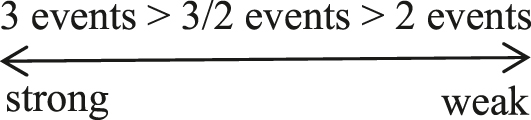
The continuum of degree of event integration of three gradients.
Figure 4 shows that the marked instrumental construction, the instrument-subject construction and the instrument-object construction generally form a continuum of degree of event integration with an increasing trend from left to right. The previous research on these three types of instrumental constructions displays that the decrease in productivity from left to right: the most productive one is the marked instrumental constructions, which can be used for most instrumental expressions, and many unmarked instrumental constructions can be converted into marked instrumental constructions. The productivity of the instrument-subject constructions ranks second, among which the intermediary instrument-subject constructions highlight the agentivity of instruments, while the patient-oriented instrument-subject constructions highlights the patientivity of instruments. And the facilitating instrumental constructions profiling the facilitating function of instruments to the event is quite idiomatic, so its productivity is weak. Instrument-object constructions are mostly idiomatic expressions, for example, 捅刀子 tǒng dāozi ‘stabbing with a knife’ is acceptable, but 捅棍子 tǒng gùnzi ‘stabbing with a stick’ is not. Essentially, the productivity of constructions is based on language use, and its high productivity is a manifestation of its high frequency of use.

The general continuum of degree of event integration.
Furthermore, this study proposes that the degree of event integration is proportional to the productivity of instrumental constructions, which is in line with the view that “there is a fundamental and recurrent category of complex event that is prone to conceptual integration and representation by a single clause, a type here termed a macro-event” (Talmy 2000: 216). By corresponding the high productivity and frequency of uses of marked instrumental constructions to the high degree of event integration of them, we conclude that Chinese tends to use more compact instrumental construction. This finding accords with Li (2020)’s view that Chinese belong to the macro-event language. That is, despite the fact that all eight types of instrumental constructions fall into macro-events, the more compactly integrated ones are preferred.
5 Implications of Chinese instrumental constructions on event integration
Conceptually, event integration is a cognitive process. It is under the operation of event integration that instrument-manipulation event and act-on event are integrated together so as to form Chinese instrumental constructions. Meanwhile, this process also is accompanied by some syntactic and semantic conditions because it is impossible to integrate any events together. It is therefore reasonable to say that event integration can be interpreted at the conceptual, syntactic and semantic levels. This study starts with the event integration and explores the degree of event integration of Chinese instrumental constructions macroscopically. This section moves on to the microscopic parts of event integration, such as the argument integration and predicates and so on. It’s found that this study displays implications on event integration from the following 4 aspects.
5.1 Single-chain integration or double-chain integration
This study proposes that the types of instruments determine the types of event integration. If the instrument is facilitating, the shared argument is agent and the type of event integration is double-chain integration (Agent-Instrument; Agent-Patient) with agent as the energy source. If the instrument is intermediary, the shared argument is instrument and the type of event integration is single-chain integration (Agent-Instrument-Patient) with instrument as the intermediary of energy transmission. Essentially, different types of event integration depend on the way in which the instrument intervenes in the act-on event, or the specific function of the instrument (causing or facilitating). The distinction between types of event integration also demonstrates the need to differentiate the functions of instruments in instrumental constructions.
5.2 Implicit argument integration
Previous studies have discussed that the argument integration between events promotes the integration of events. Many studies, like Talmyan macro-events (2000), the verbal complement in English clause (Givón 2001), the exploration of causative construction in Bohnemeyer et al. 2011, and the exploration of Chinese verb-complement construction in Li (2018, 2019), reflect the integration of explicit arguments. However, this study reveals that besides explicit argument integration, there is also implicit argument integration. Taking 大碗吃饭 dà wǎn chī fàn ‘eat with big bowls’ as an example, this construction reflects the integration of two events: 某人用大碗 mǒurén yòng dà wǎn ‘somebody uses big bowls’ and 某人吃饭 mǒurén chī fàn ‘somebody eats meals’, and the semantic relation between the two events lies in the facilitation of the former to the latter. The implicit argument 某人 mǒurén ‘somebody’ plays an important role in the integration of two sub-events. Essentially, when interpreting this kind of constructions, language users need more subjective construal to supplement missing elements when interpreting such constructions. The proposal of implicit argument integration enriches the present types of event integration and extends the research scope of event integration.
5.3 Implicit event in event integration
Previous studies on event integration focus on explicit events. The present study proposes the “E/TER” concept in Section 3. This concept itself identifies the existence of implicit events. In terms of the family of Chinese instrumental constructions, the intermediary/facilitating marked instrumental constructions display the integration of explicit events, while the event integration in other six types of instrumental constructions shows the integration of implicit events and explicit events, where the existence of implicit events is essentially caused by the absence of some arguments. Compared with previous macro-event studies, the other six instrumental constructions in this study belong to extended macro-events. Regarding of the types of event integration, this study broadens the previous research scope. This study further advocates that the follow-up research should be rooted into the concept of event integration and consider the conceptual level of language representation, not just the explicit language representation.
5.4 Mismatch between arguments and predicate
Essentially, the mismatch between predicates and arguments in Chinese instrumental constructions provides conditions for language users to supplement logical arguments. The facilitating instrument-subject construction and instrument-object construction in this study both involve the mismatch of arguments and predicates. Take 我吃大碗 wǒ chī dà wǎn ‘I eat with a big bowl’ as an example. The predicate 吃 chī ‘eat’ and 大 碗 dà wǎn ‘big bowls’ are mismatched because I cannot eat a big bowl. When a language user interprets this example, he or she will complement the appropriate missing argument and missing predicate, thus restoring two events: 我吃饭 wǒ chī fàn ‘I eat meals’ and 我用大碗 wǒ yòng dà wǎn ‘I use big bowls’. The semantic relation between them is that the former, i.e. the act-on event, is facilitated by the latter, i.e. the instrument-manipulation event. As a matter of fact, the essence of mismatch is caused by the absence of arguments predicates involved, so predicates have to deal with mismatched arguments in syntax. However, semantically, the arguments related to predicates have not changed all through. That’s why language users can interpret this kind of examples successfully. Essentially, “mismatch” is one of the linguistic representations of event integration.
6 Conclusions
Under the framework of event integration, this study devotes to the family of Chinese instrumental construction and examines the similarities and differences among different instrumental constructions. Conversely, the study on the family of Chinese instrumental construction also contributes theoretically to the event integration theory.
Concretely, all constructions in the family of Chinese instrumental construction share similarities but also exhibit differences. In terms of similarities, all of them conceptually includes two events at least, i.e. the instrument-manipulation event and the act-on event with a semantic relation (facilitating or causative) between them, but syntactically are represented by one clause. Based on these similarities, we propose that all Chinese instrumental constructions fall into macro-events and can be explained by event integration. In terms of the differences, it is found that all Chinese instrumental constructions form a continuum of degree of event integration (see Figure 3 and Table 3). By corresponding the productivity and frequency of uses of instrumental constructions to the degree of event integration of them, we conclude that despite the fact that all eight types of instrumental constructions fall into macro-events, the more compactly integrated ones are preferred.
Theoretically, this study makes significant advances in event integration. Firstly, we propose a series of new concepts, such as the instrument-manipulation event versus the act-on event, the explicit event versus the implicit event, the “E/TER”, so as to give a unified description of Chinese instrumental constructions. Secondly, it is found that all Chinese instrumental constructions meet three conditions of macro-events, thus suggesting that the research scope of macro-events can be extended to the instrumental constructions. Thirdly, in view of the pecularity of instrumental constructions, we innovatively propose two principles to examine the degree of event integration, which can offer references for studies on instrumental constructions in other languages. Fourthly, the study on the family of Chinese of instrumental constructions also contributes to the process of event integration in four ways: 1) Event integration can be divided into the single-chain integration and the double-chain integration. 2) Besides explicit argument integration, the implicit argument integration is also a hub of event integration. 3) Event integration involves not only explicit events but also implicit events. 4) The mismatch between arguments and predicate is essentially one of the linguistic representations of event integration.
In conclusion, the definition of instrumental constructions and the concept of instrumental macro-events are clearly put forward in this study, which makes advances in the research of Chinese instrumental constructions. It is also the first attempt to clarify the similarities and differences among constructions in the family of Chinese instrumental constructions from the perspective of event integration. More importantly, this study theoretically supplements the integration types and parameters of event integration and extends the research scope and explanatory power of event integration. However, it is only the first attempt to combine Chinese instrumental construction with event integration and thus more detailed studies on this combination can be carried out in the future. For one thing, this study is only a qualitative analysis, so future studies can be corpus-based with more data so as to test and supplement findings in the present study. For another, this study only zooms in on eight types of instrumental constructions, but more peripherial instrumental constructions or the constructions related to instrumental constructions, for example, the topic instrumental construction mentioned in Section 1, can be studied so as to sketch the family of instrumental constructions and its surroundings.
Funding source: The Diachronic Evolution and Typological Study of Contracted Constructions in English and Chinese
Award Identifier / Grant number: 24AYY017
About the authors
Cuiying Zhang (Ph.D. 2024, Beihang University) is a lecturer at Henan University and a visiting scholar at KU Leuven. Her research interests include Cognitive Semantics, Construction Grammar and grammaticalization.
Fuyin Thomas Li (Ph.D. 2003, the Chinese University of Hong Kong) is Professor of linguistics at Beihang University. His research interests include event representations, semantic typology, causation and causatives, and Talmyan schematic systems. He is the founding editor-in-chief of the journal Cognitive Semantics. Research portal: http://shi.buaa.edu.cn/lifuyin/en/index.htm.
-
Research funding: This work is supported by the National Social Science Foundation project titled “The Diachronic Evolution and Typological Study of Contracted Constructions in English and Chinese” (Grant Number: 24AYY017, PI: Baoyi Niu).
Abbreviations
CL classifier
DE attributive article, “的” (de)
E/TER Explicit/Total Event Ratio
LE perfective aspect, “了” (le)
YONG instrumental marker, “用” (yòng)
ZHE progressive marker, “着” (zhe)
References
Bohnemeyer, Jürgen, Nicholas J. Enfield, James Essegbey, Iraide Ibarretxe-Antuñano, Sotaro Kita, Friederike Lüpke & Felix K. Ameka. 2007. Principles of event segmentation in language: The case of motion events. Language 83(3). 495–532. https://doi.org/10.1353/lan.2007.0116.Search in Google Scholar
Bohnemeyer, Jürgen, N. J. Enfield, James Essegbey & Sotaro Kita. 2011. The macro-event property: The segmentation of causal chains. In Eric Pederson & Jürgen Bohnemeyer (eds.), Event Representation in Language and cognition, 43–67. Cambridge: Cambridge University Press.10.1017/CBO9780511782039.003Search in Google Scholar
Bohnemeyer, Jürgen & Robert D. Van ValinJr. 2017. The macro-event property and the layered structure of the clause. Studies in Language 41(1). 142–197. https://doi.org/10.1075/sl.41.1.05van.Search in Google Scholar
Chen, Changlai. 2001. Gongju zhuyu he gongju binyu yiyi [A different discussion on subject of instrument and object of instrument]. Shijie hanyu jiaoxue(1). 65–73.Search in Google Scholar
Chen, Changlai. 2003. Xiandai Hanyu Yuyi Pingmian Wenti Yanjiu [A Study on the Semantics of Modern Chinese]. Shanghai: Xuelin Publishing House.Search in Google Scholar
Chen, Zongju. 2007. Jieci yong yinjin gongju zhuangyu de liang Zhong fangshi [Two ways of how the prepositional function of yong is drawn into instrumental phrase]. Journal of Anhui Agricultural University(3). 100–102.Search in Google Scholar
Ding, Shengshu. 1961. Xiandai hanyu yufa jianghua [Modern Chinese Grammar]. Beijing: The Commercial Press.Search in Google Scholar
Dowty, David R. 1991. Thematic proto-roles and argument selection. Language 67(3). 547–619. https://doi.org/10.1353/lan.1991.0021.Search in Google Scholar
Fillmore, Charles. J. 1968. The case for case. In E. Bach & R. T. Harms (eds.), Universals in linguistic theory, 1–88. Austin: The University of Texas at Austin.Search in Google Scholar
Givón, Talmy. 2001. Syntax: An introduction, vol. 2. Amsterdam/Philadelphia: John Benjamins Publishing Company.Search in Google Scholar
Goldberg, Adele. E. & R. Jackendoff. 2004. The English resultative as a family of constructions. Language 80(3). 532–568. https://doi.org/10.1353/lan.2004.0129.Search in Google Scholar
Goldberg, Adele. E. 1995. Constructions: A construction grammar approach to argument structure. Chicago/London: The University of Chicago Press.Search in Google Scholar
Goldberg, Adele. E. 2006. Constructions at work: The nature of generalization in language. Oxford: Oxford University Press.10.1093/acprof:oso/9780199268511.001.0001Search in Google Scholar
Haspelmath, Martin. 2003. The geometry of grammatical meaning: Semantic maps and cross-linguistic comparison. In Michael. Tomasello (ed.) The new psychology of language, vol. 2, 211–243. New York: Lawrence Erlbaum Associates Publishers.Search in Google Scholar
Koenig, Jean-Pierre, Gail Mauner, Breton Bienvenue & Kathy Conklin. 2008. What with? The anatomy of a (Proto)-role. Journal of Semantics 25(2). 175–220. https://doi.org/10.1093/jos/ffm013.Search in Google Scholar
Lakoff, George. 1968. Instrumental adverbs and the concept of deep structure. Foundations of Language 4(1). 4–29.Search in Google Scholar
Langacker, Ronald W. 1991. Concept, image and symbol: The cognitive basis of grammar. Berlin/New York: Mouton de Gruyter.Search in Google Scholar
Li, Thomas Fuyin. 2018. Extending the Talmyan typology: A case study of the macro-event as event integration and grammaticalization in Mandarin. Cognitive Linguistics 29(3). 585–621. https://doi.org/10.1515/cog-2016-0050.Search in Google Scholar
Li, Thomas Fuyin. 2019. Evolutionary order of macro-events in Mandarin. Review of Cognitive Linguistics 17(1). 155–186. https://doi.org/10.1075/rcl.00030.li.Search in Google Scholar
Li, Thomas Fuyin. 2020. Hongshijian jiashuo jiqi zai hanyu zhong de shizheng yanjiu [Macro-event Hypothesis and its empirical studies in Mandarin]. Foreign Language Teaching and Research 52(3). 349–360+479–480.Search in Google Scholar
Li, Jinmei. & Fuyin Li. 2020. Shijian ronghe lilun shijiao xia chushi yinguo guanxi yu chixu yinguo guanxi de yuyan biaozheng [Linguistic representation of onset causation and extended causation in Mandarin from the perspective of event integration]. Journal of PLA University of Foreign Languages 43(1). 109–117.Search in Google Scholar
Lv, Shuxiang. 1979. Hanyu Yufa Fenxi Wenti [Analysis of Chinese Grammar]. Beijing: The Commercial Press.Search in Google Scholar
Næss, Åshild. 2007. Prototypical transitivity. Amsterdam/Philadelphia: John Benjamins Publishing Company.10.1075/tsl.72Search in Google Scholar
Narrog, Heiko. & Shinya. Ito. 2007. Re-constructing semantic maps: The comitative-instrumental area. STUF - Language Typology and Universals 60(4). 273–292. https://doi.org/10.1524/stuf.2007.60.4.273.Search in Google Scholar
Niu, Baoyi. 2008. Yinghanyu gongju zhuyuju de xiangzheng guanxi. [A study of the symbolic relation of instrument-subject sentence in English and Chinese]. Waiyu jiaoxue(1). 1–7.Search in Google Scholar
Rissman, Lilia & Kyle Rawlins. 2017. Ingredients of instrumental meaning. Journal of Semantics 34(3). 507–537. https://doi.org/10.1093/jos/ffx003.Search in Google Scholar
Schlesinger, Itzchak M. 1979. Cognitive structures and semantic deep structures: The case of instrumental. Journal of Linguistics 15(2). 307–324. https://doi.org/10.1017/s0022226700016418.Search in Google Scholar
Shao, Chenxin. 2015. Hanyu gongju binyu de cifanchou jiqi xingcheng jizhi – Cong ‘chi da wan’ de zai kaocha shuoqi. [On the semantic subcategories and forming mechanism of instrumental object in Mandarin Chinese: A revisit of “chi da wan”]. Yuyan kexue(6). 579–588.Search in Google Scholar
Shi, Yuzhi. 1995. Shijian de yiweixing dui jieci yansheng de yingxiang [The influence of temporal dimension on derivation of prepositions]. Zhongguo yuwen(1). 1–10.Search in Google Scholar
Stolz, Thomas. 1996. Some instruments are really good companions – some are not. On syncretism and the typology of instrumentals and comitatives. Theoretical Linguistics 23(1/2). 113–200. https://doi.org/10.1515/thli.1997.23.1-2.113.Search in Google Scholar
Stolz, Thomas. 2001. Comitatives vs. Instrumentals vs. Agents. In Walter Bisang (ed.), Aspects of typology and universals, 153–174. Berlin: Akademie-Verlag.Search in Google Scholar
Talmy, Leonard. 1991. Path to realization: A typology of event conflation. Berkeley Linguistics Society 17. 480–519. https://doi.org/10.3765/bls.v17i0.1620.Search in Google Scholar
Talmy, Leonard. 2000. Toward a cognitive semantics. Volume II: Typology and process in concept structuring. Cambridge, MA: The MIT Press.10.7551/mitpress/6848.001.0001Search in Google Scholar
Van Hooste, Koen. 2018. Instruments and related concepts at the syntax-semantics interface. Düsseldorf: Düsseldorf university press.Search in Google Scholar
Wang, Shugui. 1984. Gongju zhuyuju [Instrumental-subject sentence] Yuyanxue Luncong (di shisan ji) [Collections of Linguistic Essays], vol. 13. Beijing: The Commercial Press.Search in Google Scholar
Wu, Jiguang. 1996. Gongju chengfen he zhuwei weiyu ju [Instrumental components and subject-predicate predicate sentences]. Hanyu xuexi(3). 20–23.Search in Google Scholar
Xie, Xiaoming & Dongrui Qiao. 2009. Gongju binyu de jianding moshi jiqi dianxingxing [On the identifying of object of instrument and typicalness]. Hanyu xuexi(2). 12–16.Search in Google Scholar
Xu, Honghua. 2015. Hanyu gongju shoushi zhuyuju yanjiu [A study on Chinese instrument-patient-subject sentence]. Qiusuo(8). 178–182.Search in Google Scholar
Xu, Mofan. 2003. Xiandai Hanyu Gongju Fanchou De Renzhi Yanjiu [A Cognitive Study on Instrument category in Modern Chinese]. Shanghai: East China Normal University. Ph.D. dissertation.Search in Google Scholar
Zhang, Cuiying & Fuyin Li. 2022a. Xiandai hanyu “jianyushi” de shijian ronghe yanjiu [An event integration approach to the pivotal construction in Modern Chinese]. Linguistic Research(1). 118–129.Search in Google Scholar
Zhang, Cuiying & Fuyin Li. 2022b. Hanyu gongju goushi de jufa yuyi guanlian: Jiyu xingweilian de renzhi tanxi [The syntax-semantics linking in Chinese instrumental constructions: A cognitive exploration based on action chain]. TCSOL Studies(4). 7–16.Search in Google Scholar
Zhang, Fan. 2020. Dongci qian yu gongju xiangguan de silei mingcixing chengfen. [Four Kinds of Instrumental Pre-verb Noun Phrase in Chinese]. Hanyu xuexi(2). 104–112.Search in Google Scholar
Zhu, Dexi. 1982. Yufa Jiangyi [Grammar Notes]. Beijing: The Commercial Press.Search in Google Scholar
© 2025 the author(s), published by De Gruyter, Berlin/Boston
This work is licensed under the Creative Commons Attribution 4.0 International License.
Articles in the same Issue
- Frontmatter
- Research Articles
- A network analysis of the semantic evolution of ‘fruit’ and ‘stone’ in Tibeto-Burman languages
- Verb-noun compounds versus synthetic compounds in English, German and Italian
- Investigating foreign language anxiety of Chinese Dongxiang ethnic group: a language conflict perspective
- An event integration approach to the family of Chinese instrumental constructions
Articles in the same Issue
- Frontmatter
- Research Articles
- A network analysis of the semantic evolution of ‘fruit’ and ‘stone’ in Tibeto-Burman languages
- Verb-noun compounds versus synthetic compounds in English, German and Italian
- Investigating foreign language anxiety of Chinese Dongxiang ethnic group: a language conflict perspective
- An event integration approach to the family of Chinese instrumental constructions
