Croatian (mor)phonotactic word-medial consonant clusters in the early lexicon
-
Maja Kelić
 ,
Ana Matić Škorić
,
Ana Matić Škorić
 and
Marijan Palmović
and
Marijan Palmović

Abstract
This study investigates the emergence of (mor)phonological consonant clusters in L1 acquisition. Following the Strong Morphonotactic Hypothesis (SMH), distribution and preferability of word-medial consonant clusters in the corpus of three children acquiring Croatian were explored. VCCV and VCCCV clusters were extracted from the Croatian Corpus of Child Language. Subsequently, all word-medial clusters were tagged as exclusively phonotactic, exclusively morphonotactic, and ones that occurred in both contexts. The results partially corroborated SMH, strengthening the premise that morphological richness of a language moderates the interaction between morphology and phonology in early language acquisition. The data showed a clear predominance of morphonotactic clusters in one out of three subcorpus. Developmentally, an increase in all three cluster types was observed and generally all clusters were predominantly less preferred. Early emerging phonotactic clusters appeared to be mostly preferred, while the first morphonotactic clusters comprised less preferred combinations, with a gradual increase in preferability. Individual differences in cluster distribution and preferability blurred the role of the importance of morphonotactic information in L1 acquisition, suggesting that children employ different paths to acquire a language, but also suggesting that further exploration of this hypothesis in different languages and using different approaches is needed.
Funding source: This study was carried out within the international project “Crosslinguistic project on pre- and protomorphology in language acquisition” (PI professor Wolfgang U. Dressler, University of Vienna, Austrian Academy of Sciences)
-
Research funding: This study was carried out within the international project “Crosslinguistic project on pre- and protomorphology in language acquisition” (PI professor Wolfgang U. Dressler, University of Vienna, Austrian Academy of Sciences).
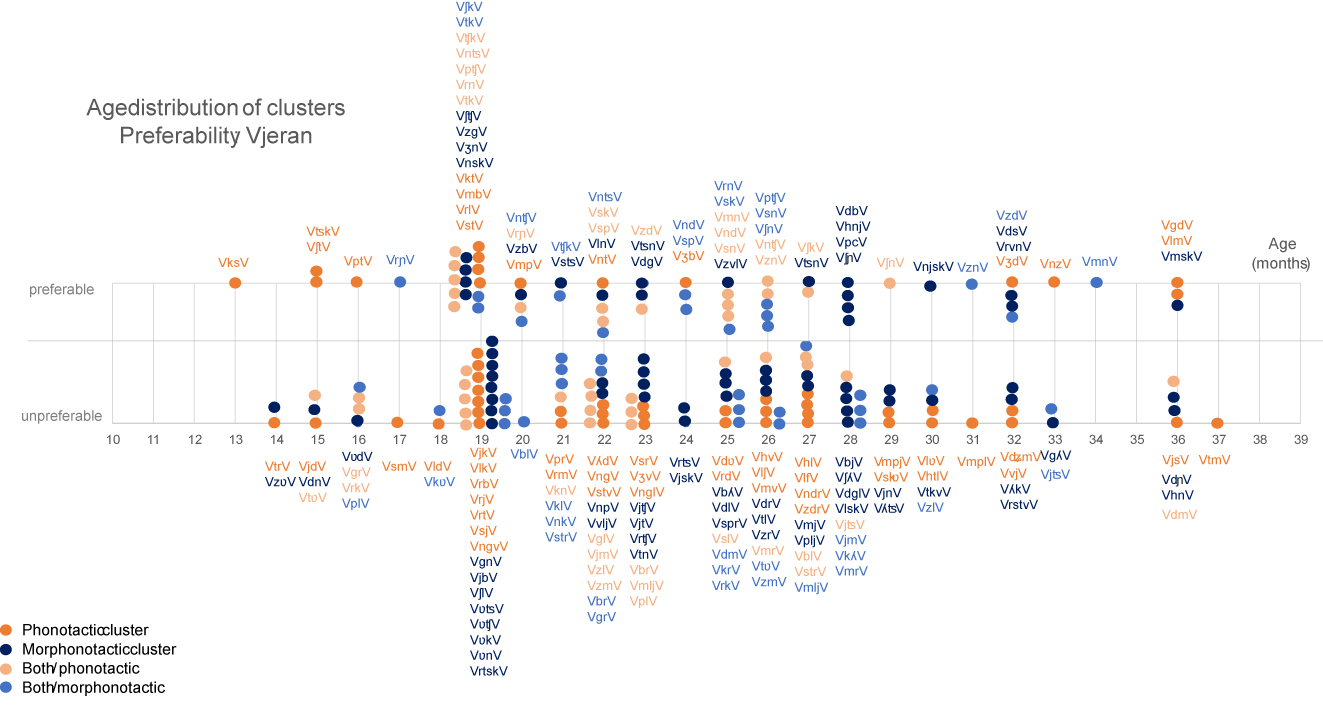
Graphical representation of the distribution of all clusters according to the age of their appearance in the subcorpora of three children (ANT, VJE, MAR).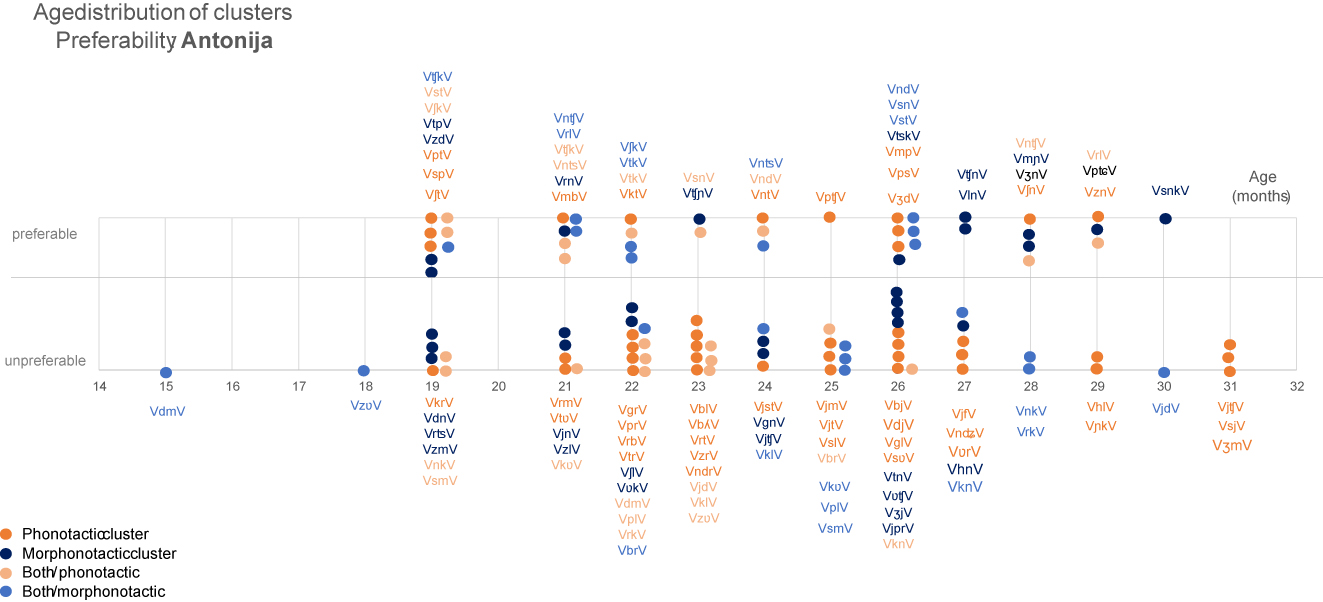
References
Dressler, Wolfgang U. 1984. Explaining natural phonology. In Phonology yearbook, vol. 1, 29–51. Cambridge, UK: Cambridge University Press.10.1017/S0952675700000282Search in Google Scholar
Dressler, Wolfgang U. 1985a. Morphonology: The dynamics of derivation. Ann Arbor: Karoma.Search in Google Scholar
Dressler, Wolfgang U. 1985b. On the predictiveness of natural morphology. Journal of Linguistics 21(2). 321–337. https://doi.org/10.1017/s002222670001029x.Search in Google Scholar
Dressler, Wolfgang U. & Katarzyna Dziubalska-Kołaczyk. 2006. Proposing mophonotactics. Rivista di Linguistica 18(2). 249–266.Search in Google Scholar
Dressler, Wolfgang U., Katarzyna Dziubalska-Kołaczyk & Lina Pestal. 2010. Change and variation in morphonotactics. Folia Linguistica Historica 31. 51–67. https://doi.org/10.1515/flih.2010.003.Search in Google Scholar
Dressler, Wolfgang U., Miroslava Hliničanová, Matej Ďurčo, Karlheinz Mörth & Katharina Korecky-Kröll. 2015. Phonotactic vs. morphonotactic obstruent clusters in Slovak and German. Italian Journal of Linguistics 27(1). 45–59.Search in Google Scholar
Dressler, Wolfgang U., Alona Kononenko, Sabine Sommer-Lolei, Katharina Korecky-Kröll, Paulina Zydorowicz & Laura Kamandulytė-Merfeldienė. 2019. Morphological richness, transparency and the evolution of morphonotactic patterns. Folia Linguistica Historica 40(1). 85–106. https://doi.org/10.1515/flih-2019-0005.Search in Google Scholar
Matthew S. Dryer & Martin Haspelmath (eds.). 2013 The world atlas of language structures online. Leipzig: Max Planck Institute for Evolutionary Anthropology. http://wals.info (accessed 24 October 2021).Search in Google Scholar
Dziubalska-Kołaczyk, Katarzyna. 2002. Beats-and-binding phonology. Frankfurt/Main: Peter Lang.Search in Google Scholar
Dziubalska-Kołaczyk, Katarzyna. 2009. NP extension: B&B phonotactics. Poznań Studies in Contemporary Linguistics 45(1). 55–71. https://doi.org/10.2478/v10010-009-0011-9.Search in Google Scholar
Dziubalska-Kołaczyk, Katarzyna. 2014. Explaining phonotactics using NAD. Language Sciences 46. 6–17. https://doi.org/10.1016/j.langsci.2014.06.003.Search in Google Scholar
Dziubalska-Kołaczyk, Katarzyna, Dawid Pietrala & Grzegorz Aperliński. 2014. The NAD phonotactic calculator – an online tool to calculate cluster preference in English, Polish and other languages. http://wa.amu.edu.pl/nadcalc/ (accessed 14 July 2022).Search in Google Scholar
Dziubalska-Kołaczyk, Katarzyna. 2019. On the structure, survival and change of consonant clusters. Folia Linguistica 53(s40–s1). 107–127. https://doi.org/10.1515/flih-2019-0006.Search in Google Scholar
Gershkoff-Stowe, Lisa. 2002. Object naming, vocabulary growth, and the development of word retrieval abilities. Journal of Memory and Language 46(4). 665–687. https://doi.org/10.1006/jmla.2001.2830.Search in Google Scholar
Hoff, Erika & Letitia Naigles. 2002. How children use input to acquire a lexicon. Child Development 73(2). 418–433. https://doi.org/10.1111/1467-8624.00415.Search in Google Scholar
Jelaska, Zrinka. 2004. Fonološki opisi hrvatskoga jezika: Glasovi, slogovi, naglasci [Phonological descriptions of the Croatian language: Sounds, syllables, accents]. Zagreb: Hrvatska sveučilišna naklada.Search in Google Scholar
Kamandulytė, Laura. 2006. The acquisition of morphonotactics in Lithuanian. Wiener Linguistische Gazette 73. 88–96.Search in Google Scholar
Kamandulyte-Merfeldiene, Laura. 2015. Morphonotactics in L1 acquisition of Lithuanian: TD vs. SLI. Eesti Rakenduslingvistika Ühingu aastaraamat 11. 95–109. https://doi.org/10.5128/erya11.06.Search in Google Scholar
Kelić, Maja & Wolfgang U. Dressler. 2019. The development of morphonotactic and phonotactic word–initial consonant clusters in Croatian first–language acquisition. Suvremena lingvistika 45(88). 179–200.Search in Google Scholar
Korecky-Kröll, Katharina, Wolfgang U. Dressler, Eva M. Freiberger, Eva Reinisch, Karlheinz Mörth & Gary Libben. 2014. Morphonotactic and phonotactic processing in German-speaking adults. Language Sciences 46. 48–58. https://doi.org/10.1016/j.langsci.2014.06.006.Search in Google Scholar
Kovačević, Melita. 2002. Croatian corpus of child language, CHILDES. Online published corpus. http://childes.psy.cmu.edu/data/Slavic (accessed 1 April 2021).Search in Google Scholar
Maddieson, Ian. 2013. Syllable structure. In Matthew S. Dryer & Martin Haspelmath (eds.), The world atlas of language structures online. Leipzig: Max Planck Institute for Evolutionary Anthropology. http://wals.info/chapter/3 (accessed 20 October 2021).Search in Google Scholar
Meštrović, Ana, Sanda Martinčić-Ipšić & Mihaela Matešić. 2015. Postupak automatskoga slogovanja temeljem načela najvećega pristupa i statistika slogova za hrvatski jezik [Syllabification based on maximal onset principle for Croatian]. Govor 32(1). 3–34.Search in Google Scholar
Sommer-Lolei, Sabine, Katharina Korecky-Kröll, Markus Christiner & Wolfgang U. Dressler. 2021. Acquisition and processing of (mor)phonotactic consonant clusters in German. In Wolfgang U. Dressler, Basilio Calderone, Sabine Sommer-Lolei & Katharina Korecky-Kröll (eds.), Experimental and acquisitional approaches to morphonotactics, 77–100. Vienna: Austrian Academy of Sciences Press.Search in Google Scholar
Storkel, Holly L. 2009. Developmental differences in the effects of phonological, lexical and semantic variables on word learning by infants. Journal of Child Language 36(2). 291–321. https://doi.org/10.1017/S030500090800891X.Search in Google Scholar
Škarić, Ivo. 1991. Fonetika hrvatskoga književnog jezika. [The phonetics of Croatian]. Povijesni pregled, glasovi i oblici hrvatskoga književnog jezika: Nacrt za gramatiku. [Historical overview, sounds and forms of the Croatian literal language: Scheme for the grammar], 61–379. Zagreb: HAZU and Globus.Search in Google Scholar
Xanthos, Aris, Sabine Laaha, Steven Gillis, Ursula Stephany, Ayhan Aksu-Koç, Anastasia Christofidou, Natalia Gagarina, Gordana Hržica, Nihan F. Ketreu, Marianne Kilani-Schoch, Katharina Korecky-Kröll, Melita Kovačević, Klaus Laalo, Marijan Palmović, Barbara Pfeiler, Maria. D. Voeikova & Wolfgang U. Dressler. 2011. On the role of morphological richness in the early development of noun and verb inflection. First Language 31(4). 461–479. https://doi.org/10.1177/0142723711409976.Search in Google Scholar
Zydorowicz, Paulina. 2010. Consonant clusters across morpheme boundaries: Polish morphonotactic inventory and its acquisition. Poznań Studies in Contemporary Linguistics 46. 565–588. https://doi.org/10.2478/v10010-010-0028-0.Search in Google Scholar
Zydorowicz, Paulina. 2019. Polish (mor)phonotactics in first language acquisition, connected speech and cluster processing. Poznań: Adam Mickiewicz University Press.Search in Google Scholar
Zydorowicz, Paulina, Paula Orzechowska, Michał Jankowski, Katarzyna Dziubalska-Kołaczyk, Piotr Wierzchoń & Dawid Pietrala. 2015. Phonotactics and morphonotactics of Polish and English. Theory, description, tools and applications. Poznań: Adam Mickiewicz University Press.Search in Google Scholar
© 2022 Walter de Gruyter GmbH, Berlin/Boston
Articles in the same Issue
- Frontmatter
- Research Articles
- Production of vowel reduction by Jordanian–Arabic speakers of English: an acoustic study
- The linguistic realization of focus in Uyghur: can the two focusing strategies be used interchangeably?
- Thematic role mappings in metaphor variation: contrasting English bake and Spanish hornear
- A probability distribution of dependencies in interlanguage
- Croatian (mor)phonotactic word-medial consonant clusters in the early lexicon
- The impact of gestural representation of metaphor schema on metaphor comprehension
- Licensing Case-mismatches and dependent plural markers in Korean left-node-raising
- Mandarin Chinese peer advice online: a study of gender disparity
- The pragmatics of ‘it is well’ in Nigerian English
- Active verbs with inanimate, text-denoting subjects in Polish and English abstracts of research articles in linguistics
- Book Reviews
- Book review. Melissa Yoong. 2020. Professional discourses, gender and identity in women’s media. Springer Nature Switzerland. 149pp. 49.99€, ISBN 978-3-030-55543-6.
- The status, roles, and dynamics of Englishes in Asia
Articles in the same Issue
- Frontmatter
- Research Articles
- Production of vowel reduction by Jordanian–Arabic speakers of English: an acoustic study
- The linguistic realization of focus in Uyghur: can the two focusing strategies be used interchangeably?
- Thematic role mappings in metaphor variation: contrasting English bake and Spanish hornear
- A probability distribution of dependencies in interlanguage
- Croatian (mor)phonotactic word-medial consonant clusters in the early lexicon
- The impact of gestural representation of metaphor schema on metaphor comprehension
- Licensing Case-mismatches and dependent plural markers in Korean left-node-raising
- Mandarin Chinese peer advice online: a study of gender disparity
- The pragmatics of ‘it is well’ in Nigerian English
- Active verbs with inanimate, text-denoting subjects in Polish and English abstracts of research articles in linguistics
- Book Reviews
- Book review. Melissa Yoong. 2020. Professional discourses, gender and identity in women’s media. Springer Nature Switzerland. 149pp. 49.99€, ISBN 978-3-030-55543-6.
- The status, roles, and dynamics of Englishes in Asia
