Conduct politeness versus etiquette politeness: a terminological distinction
-
Andreas H. Jucker
Andreas H. Jucker is Professor emeritus of English Linguistics at the University of Zurich. His current research interests include historical pragmatics, politeness theory, speech act theory, and the history of English. His recent book publications include
Politeness in the History of English. From the Middle Ages to the Present-day (Cambridge University Press, 2020).The Pragmatics of Fiction. Literature, Stage and Screen Discourse (co-authored with Miriam Locher; Edinburgh University Press, 2021),Pragmatics of Space (co-edited with Heiko Hausendorf; De Gruyter, 2022) andMultimodal Im/politeness. Signed, Spoken, Written (co-edited with Iris Hübscher and Lucien Brown; Benjamins, 2023). He is President of the European Society for the Study of English and Co-Editor-in-Chief of theJournal of Pragmatics .


Abstract
This paper argues for a distinction between “conduct politeness” and “etiquette politeness”, where the former refers to the propriety of what people do and the latter to the decorum of how people do things. In everyday discourse, the distinction is often fuzzy, but as a second order distinction the terminology provides a useful analytical tool. In the history of politeness in English, a bifurcation into the two types of politeness can be observed in the eighteenth century, and today the distinction provides additional conceptual clarity of the changing theoretical focus during the three waves of politeness theory. After a review of the historical link between morals and manners, a brief case study focuses on their separation in the eighteenth century. A final discussion applies the distinction to the paradox that politeness is often seen as a positive thing that, unfortunately, is on the decline and as a negative thing because it is insincere, superficial and hypocritical.
1 Introduction
In the everyday discourse about politeness, people sometimes talk about what you should do, and sometimes they talk about how you should do whatever you do. The advice might be that you should be humble, help and support other people, tell the truth, and so on. Or the advice might be that you should use indirect formulations when making a request, that you should hold your knife and fork in a certain way when eating, or that you should avoid swearwords when talking to your superiors. Terkourafi (2011: 164) in her exploration of politeness advice from ancient antiquity to the present day has this distinction in mind when she talks about “underlying morality” on the one hand and “externally appropriate behaviour” on the other. In her paper, she also uses the terms “propriety” versus “decorum” or “morals” versus “manners” to capture the same distinction. The distinction is not always clearcut, and in everyday discourse the two aspects are often merged, or perhaps even intentionally confused. If your table manners are bad, you must be a bad person, to exaggerate a little. But the distinction helps to understand why politeness often has bad press. Politeness can be seen as potentially deceptive, as a pleasing surface that hides a darker intent, as doing something in a way that is misleading about what is actually being done, and it can also be seen as a way of demonstrating your social class affiliation (Mills 2017).
Jucker and Landert (2023: 124), in the context of a diachronic investigation of im/politeness in American and British movies, introduced the term “conduct politeness” to refer to the politeness of what people do and the term “etiquette politeness” for the politeness of how they do things. As I shall explain in more detail in Section 3, the terminology derives from a terminological distinction used by Paternoster (2022, 2023 in her exploration of courtesy manuals, conduct manuals and etiquette manuals in Europe from the Renaissance period to today. In this classification, conduct manuals have a moralising focus and are concerned with elementary civility whilst etiquette manuals, which developed much later, are concerned with social conventions. Moral implications are backgrounded or entirely absent. In the following, I shall discuss the theoretical underpinnings of this terminological distinction, and I shall provide some evidence to show how the distinction helps to explain the development in the latter half of the eighteenth century in England, when the earlier concern for honour and morality changed into a greater concern for manners. Politeness turned from what was largely a matter of conduct politeness into etiquette politeness (Fitzmaurice 1998, 2010; Jucker 2020a, 2020b).
In this paper, I use the terms “conduct politeness” and “etiquette politeness” as second-order concepts. They are used as technical terms with an analytical purpose, and as such, they may deviate from first-order uses of these terms (see Section 2 for a more detailed discussion). In everyday discourse, people often talk about etiquette, for instance, to refer not only to how things are done but also to what should be done or not done.
2 The concept of politeness
The concept of “politeness” has always been very fuzzy not only in its everyday use but also in the way it is used in politeness studies. Originally, some problems were caused by the fact that everyday uses and scholarly definitions were confused. Definitions given by the early politeness scholars (Brown and Levinson 1987; Lakoff 1975; Leech 1983) were criticised or rejected, for instance, because they seemed to deviate from the critics’ everyday use of the word. Watts et al. (1992), therefore, introduced a distinction between first-order politeness and second-order politeness (politeness1 and politeness2) (see also Eelen 2001; Kasper 2003; Watts 2003: 4; Terkourafi 2011; Jucker 2020a; and for a recent critical discussion Culpeper and Haugh 2021). First-order politeness refers to the everyday use of the term and reflects the fuzzy and ambiguous way in which different people use this particular word of the English language while second-order politeness refers to a technical term used for analytical purposes. As a technical term, it is as precise and well defined as a particular researcher can make it, but such definitions are always likely to deviate to some extent at least from other definitions and from the fuzzy denotation the term has in everyday usage. Therefore, some researchers argue for a need for politeness studies to focus solely on politeness1 (e.g., Kasper 2003: 2; Watts 2003: 9) while others take the view that both perspectives are useful, i.e., the study of how people talk about politeness and related phenomena (politeness1) and the use of well-defined technical terms to explore specific sets of linguistic data from a well-defined perspective (politeness2) (e.g., Jucker 2020a: 18; Locher and Larina 2019: 875).
In the course of time, the dichotomy between first-order and second-order concepts has been extended to additional dimensions (see Culpeper and Haugh 2021 for a discussion). Apart from the distinction between the everyday non-academic and the academic use of the term, it was also applied to the distinction between people’s understanding of what they do themselves and what they observe in others, and it was extended to emic (i.e., culture-internal) understandings and etic (i.e., culture-external) understandings of politeness. Based on these extensions, the distinction has become increasingly problematic because the different dimensions capture rather different aspects of the term politeness.
Terkourafi (2011), for instance, points out that politeness1 is normative. It is used by the more powerful upper classes to regulate appropriate behaviour. Politeness2 in contrast is descriptive. She goes on to argue that “prescriptive norms historically follow and reflect descriptive ones, while at the same time constraining future practices and so feeding back into the descriptive norms that gave rise to them in the first place”, and, therefore, politeness1 and politeness2 “cannot be kept apart in principle, because they are intertwined from the outset” (Terkourafi 2011: 176, emphasis original). The problem with this argumentation lies in the equation of politeness1 with prescriptive rules and politeness2 with descriptive ones. This equation is deceptive. It is, of course, correct that the prescriptive norms imposed by the more powerful social classes in the form of conduct manuals or etiquette books are based on everyday notions of politeness (i.e., politeness1), but politeness vocabulary in everyday language can be used both to describe and to prescribe polite behaviour. It seems highly unlikely that conduct manuals or etiquette books, whether old or new, are based on academic treatises and their analytical tools. They are not based on academically defined descriptive concepts of politeness (i.e., politeness2) but on everyday descriptions of politeness (i.e., politeness1). Authors of conduct manuals or etiquette books base their prescriptions on their own (descriptive) experience. They observe their own behaviour, the behaviour of people of their own social class or from an earlier generation, and take this as a yardstick for their prescriptions. Both the descriptions and the prescriptions are part of politeness1, the everyday notion of what is – or should be – polite.
More recently, House and Kádár (2023) have also argued for a reassessment of the first-order second-order distinction. They acknowledge that their analytical tools in the investigation of antagonistic talk between an animal rights protester and the organisers of a children’s party includes “speech act labels created by the researchers, rather than folk-theoretical and other metapragmatic evaluative constructs used by the participants themselves” (House and Kádár 2023: 147), but somehow they assume that their use of these tools in the interpretation of what the interactants do turns them into first-order concepts. This seems rather counterintuitive. Second-order analytical tools remain second-order tools whether they are used for philosophical purposes in a Searlian line of research or whether they are used for a careful empirical study of the minutiae of a conversational exchange.
It is for this reason that I prefer to keep the distinction clearcut and to reduce it to the original distinction between the everyday concept and the technical term. A first-order perspective is important if we want to understand the way in which a particular culture talks about appropriate behaviour, what kind of terms are used for the purpose, how different lexical items are assessed and evaluated, and how these terms are used by the dominating social class for ideological purposes. This is particularly useful for historical periods of a specific language (see Jucker 2020a). A second-order perspective with well-defined concepts, on the other hand, allows a more focused analysis of specific aspects of how people behave in certain situations. Terms that are not in general usage (e.g., rapport management or relational work) are particularly useful in this respect because they reduce the danger of being confused with first order concepts and their denotation. Thus, both perspectives are needed for a fuller picture. They are complementary, but they should not be merged (pace Terkourafi 2011) or confused (pace House and Kádár 2023).
The distinction between conduct politeness and etiquette politeness has a different quality. In the way they are used here they are clearly second-order concepts. They are meant as analytical tools to distinguish between the politeness of what people do and the politeness of how people do them, and they are useful to the extent that they provide additional insights into the patterns in the data. In particular, I shall use the distinction for a better understanding of how politeness developed in the eighteenth century in England, and why politeness today often has such bad press.
The terms “conduct” and “etiquette” as second-order concepts share the fate of all technical terms that also exist as normal words in the everyday language, where they are usually relatively fuzzy and subject to change from one speaker to the next. As an everyday term, “conduct” is relatively neutral. It refers to the manner in which a person behaves. This can be good or bad. The Oxford English Dictionary defines the relevant sense as follows: “Manner of conducting oneself or one’s life; behaviour; usually with more or less reference to its moral quality (good or bad)” (OED, conduct, n.1, sense 8.a.). The Corpus of Contemporary American English (COCA) lists among the top twenty-five adjectival collocates the following relevant examples: disorderly, ethical, moral, inappropriate, improper, proper and unethical. Some of these adjectives are part of legal terms, e.g., “disorderly conduct” or “inappropriate conduct”. They describe specific crimes in many jurisdictions, in the United States of America and elsewhere. The other terms picked out from the list of top adjectival collocates appear to refer to everyday evaluations of the term, as for instance in the extracts (1) and (2).
| This is not the way to behave, this is not ethical conduct or behavior. (COCA, 1995, SPOK: CNN_News) |
| Most Americans can agree that that is disgusting and is not proper conduct for any person, much less one of our elected officials. (COCA, 2007, SPOK: NPR_TellMore)[1] |
The extracts given in COCA are generally not long enough to allow a thorough analysis of the behaviour that is commented upon. The quotations given here are even shorter, but it seems likely that the references are not just to the outward appearances, the how of the activities, but to the activities themselves, the what, itself. This is confirmed by an Internet search for the original texts in which these extracts first appeared. In the case of extract (1), it is the lead prosecutor in the O. J. Simpson murder case, Marcia Clark, who comments on the behaviour of the defence counsel, Johnnie Cochran, and his tactics. In the case of extract (2), the topic of discussion focuses on an incident in 2007 in which a US Senator for the State of Idaho was “arrested for lewd conduct in a men’s restroom, where he was accused of soliciting a male undercover police officer for sexual activity.”[2] In both cases, the speakers are clearly more concerned with what somebody did rather than how they did it, and the conduct is evaluated negatively. Impressionistically these examples seem to be representative for most of the retrieved hits.
The term “etiquette” in its first-order use is different. It includes positive and socially accepted forms of behaviour in its definition. The definition of the relevant sense of etiquette in the Oxford English Dictionary states: “The customary code of polite behaviour in society; good manners” (OED, etiquette, n., sense 1.b.).
Extracts (3) to (5) are taken from the section of spoken language of the Corpus of Contemporary American English.
| But first of all, what are the proper rules of etiquette? What should you bring? How much should you spend? And if you’re going to somebody’s house for dinner, is it appropriate just to bring a bottle of wine or should you branch out? (COCA, 2003, SPOK: NBC_Today) |
| “The Japanese obsess over etiquette, manners, and appearances a lot more than Americans do,” he said. (COCA, 2017, SPOK CBS) |
| Sure. It’s also an issue for businesses. I mean, increasingly, if you call a customer service line for, say, your bank, they have your phone number in the system and they have caller ID. So before you say a word, they know it’s you calling. And they face a customer service dilemma. Do they immediately say, “Hello, Mr. Conan, how may I help you?” Most companies have found that when they do that, it’s sort of off-putting and it sort of starts the conversation off on the wrong note. So there’s definitely an etiquette issue here. (COCA, 2003, SPOK: NPR_TalkNation) |
All these extracts demonstrate the use of the term “etiquette” as a non-academic everyday term in its first-order perspective, and it is these everyday uses that are captured in the dictionary definition quoted above. In these cases, it is not always clear whether the etiquette refers to what is to be done or how things are to be done. Extract (3) talks about the etiquette of visiting somebody. In this case, rules of etiquette may well comment both on what you should do, e.g., bring a gift for your host, and how you should do this, e.g., at what point and how you should present your gift, but the distinction is not clearcut. Extract (4) is an illustration that etiquette, for this speaker at least, belongs to the same category as manners and appearances, i.e., to the visible surface of things. And extract (5) talks about an everyday situation in which a telephone operator has to decide how to address a caller whose name they already know. Here it is clearly the form that counts in this situation.
This brief excursus into the use of the terms “conduct” and “etiquette” as first-order concepts has shown that on this level the how and the what cannot easily be disentangled. The terms are regularly used to describe what people do or should do and also how they should do whatever they do. However, in the remainder of this paper, both terms are going to be used as second-order concepts with a clearcut, albeit somewhat artificial, boundary between them. Conduct politeness refers to the appropriateness of the actions themselves, i.e., whether you should bring a gift for your host or, in terms of speech act theory, whether it is o.k. to perform a certain face-threatening act. Etiquette politeness, on the other hand, refers to the appropriateness of how the actions are performed, i.e., how you present your gift to the host or how you perform the face-threatening act.
This distinction provides more analytical clarity, e.g., when we look at the object of study across the history of politeness studies. Grainger (2011) and Culpeper (2011) describe this history in terms of three waves (see also Culpeper and Hardaker 2017; Jucker 2020a). The first wave was constituted by the early politeness studies by Lakoff (1975), Leech (1983) and in particular Brown and Levinson (1978, 1987. It focused on the speakers and the strategies they chose to carry out specific face-threatening acts, for instance. Thus, they were mostly concerned with etiquette politeness (except in Brown and Levinson’s 1987: 60 politeness strategy number 5, “Don’t do the FTA”, for instance).
The second wave was inaugurated by a sense of dissatisfaction with the first wave (e.g., Eelen 2001; Locher and Watts 2005; Watts 2003). It changed the focus to first-order politeness study, i.e., to politeness1, and thus to the discourse on politeness and impoliteness. With this shift of focus, the descriptions of polite or impolite behaviour lost their focus on etiquette politeness. The everyday discourse on polite behaviour regularly shifts between descriptions of what people should or should not do and how they should or should not do it, and this is then reflected in the politeness analytical work of the second wave. Spencer-Oatey (2005: 97) conceptualises politeness as involving “subjective judgements about the social appropriateness of verbal and non-verbal behaviour”. This broad definition clearly includes appropriateness judgements both on what people do and how people do it. Within this tradition of politeness studies, therefore, it makes little sense to distinguish between conduct politeness and etiquette politeness (Locher personal communication).
The third wave of politeness theory is more difficult to characterise. To some extent, it consists of a consolidation between the first wave and the second wave. During the first wave, linguistic expressions were often assigned specific politeness values. During the second wave such inherent politeness values were put into question. Politeness was seen as the result of discursive negotiations between speaker and addressee. The third wave reconciles these perspectives by allowing for some default values that may be re-negotiated in discourse. Culpeper and Hardaker (2017: 210) propose “conventionalised expressions or routinised formulae” as a solution. Specific expressions have inherent meanings, but these meanings are not entirely stable. They can be re-negotiated. With this move, the focus shifts back to etiquette politeness because it looks at linguistic expressions with default values.
3 The historical link between manners and morals
It appears that people have always been concerned with the politeness of specific actions and the politeness of how they are carried out. In her overview of writings on politeness from antiquity to the present day, Terkourafi (2011: 164) uses a range of different terms to refer to this distinction. As pointed out above, she talks about the “underlying morality” on the one hand and the “externally appropriate behaviour” on the other. But she also uses the terms “morals” and “manners” (2011: 165), and “morality” and “propriety” or “decorum” (2011: 167) to refer to the same distinction.
The two aspects are often seen as inextricably linked, but sometimes one side of the dichotomy is seen as more basic than the other. If you are a good person, your manners will inevitably be polished. Or in reverse, if you strive for good manners, you will become a better person (see Figure 1).
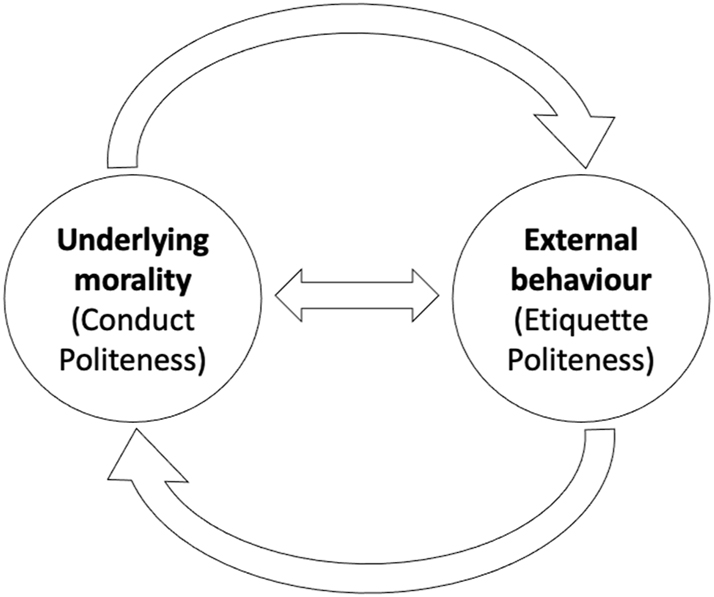
Link between underlying morality and external behaviour.
Terkourafi (2011: 163) traces different understandings of what people considered to be polite (i.e., politeness1) in didactic and prescriptive texts from around the world and from antiquity to the present day. She starts her explorations with The Instruction of Ptahhotep, a text of the Old Kingdom of ancient Egypt. It already includes advice to be humble, moderate and honest (conduct politeness in my terminology) and instructions about table manners (etiquette politeness). Another source quoted by her is the Indian Manava Dharma Shastra (‘The Laws of Manu’) with rules for the proper conduct for each caste, for instance about speaking, eating or personal hygiene. “Upholding these prescribed norms made one a virtuous person” (Terkourafi 2011: 164).
In the classical Arabic literature, the term adab, variously translated as ‘good breeding’, ‘manners’, ‘culture’, ‘refinement’ or ‘belles lettres’ (Terkourafi 2011: 164, quoting Kilpatrick 1998: 54) played a key role. The meaning of the term shifted over time. While in pre-Islamic times it described behaviour that conformed to tribal social norms, it later came to be used for cultivated behaviour that differed from these earlier norms. In both cases, though, there is an intimate link between morality and propriety. And again, good manners will inevitably lead to a cultivated inner self.
In Cicero’s De Officiis, the underlying morality appears to take precedence. Terkourafi quotes a passage from Book 1.
We have next to discuss the one remaining division of moral rectitude. That is the one in which we find considerateness and self-control, which give, as it were, a sort of polish to life […]. Under this head is further included what, in Latin, may be called decorum (‘propriety’); for in Greek it is called πρέπου (‘befitting’). Such is its essential nature, that it is inseparable from moral goodness; for what is proper is morally right, and what is morally right is proper. The nature of the difference between morality and propriety can be more easily felt than expressed. For whatever propriety may be, it is manifested only when there is pre-existing moral rectitude [Terkourafi’s emphasis]. (Cicero, De Officiis I, 93–4; quoted by Terkourafi 2011: 167)
In this quotation, decorum or propriety, i.e., the outward behaviour, is considered to be inseparable from moral goodness, and propriety is only possible on the basis of a pre-existing morality.
On the basis of such developments, Terkourafi argues that we need to “rethink the separation of manners from morals that pervades contemporary Western ideas about etiquette” (2011: 166). The separation of manners and morals should not be taken for granted. It is a part of specific social and historical situations, and, in fact, she dates the separation within Western cultures to a very specific period.
It is, then, to this transitional period between the late Middle Ages and Early Modernity, and to the attendant competition for power between the monastic and courtly spheres, that the beginnings of a separation between manners and underlying morality in Western thought should most likely be sought. From then on, the two would be treated increasingly as separate, occasionally even antithetical, notions. (Terkourafi 2011: 169)
As I shall argue in Section 4 and as I have argued before, in England, this separation happened in the second half of the eighteenth century (Jucker 2020a: chapter 8 and 188–189).
Paternoster (2023: Chapter 2) provides a careful distinction of the subgenres of advice literature on good manners: courtesy books, conduct books and etiquette books. They differ in terms of their target audiences and their treatment of moral values, and they came into prominence at different times in the history of European cultures. In this classification, courtesy books deal with the behaviour of the ideal courtier, and this behaviour is set in relation to religious and moral values. The genre is generally associated with the Renaissance courts in the sixteenth century, and a particularly good example is Baldassare Castiglione’s book, Il libro del cortegiano ‘The Book of the Courtier’, published in 1528 and soon translated into many different European languages.
Conduct books are similar to courtesy books. They also emerge during the Renaissance period and like the courtesy books their advice is set in relation to religious and moral values, but they address a socially broader audience including townspeople and even servants. They were often written for a school environment and deal with elementary rules of behaviour and civility for children. Paternoster (2022: 38–39) mentions Erasmus’ De Civilitate Morum Puerilium (1530) and Giovanni Della Casa’s Galateo ovvero de’ costume (1558) as particularly good examples with a pan-European impact (see Culpeper 2017 on the reception of the Giovanni Della Casa’s Galateo in England).
Etiquette books, according to Paternoster’s distinction, appear only three hundred years later in the nineteenth century. They codify the social manners of the upper class and are targeted at the upper-middle class, who had the means to imitate their superiors in an endeavour for upward social mobility. “In a nutshell, etiquette books help upper middle-class readers, who have financial means but no refined manners, to gain access to aristocratic circles, who use the intricacy of etiquette to try and keep the latter out” (Paternoster 2022: 45).
The terminological distinction between conduct politeness and etiquette politeness proposed in this paper is based on Paternoster’s definition of the respective subgenres of advice literature on good manners. As pointed out above, the terms are here used as second-order concepts to capture the distinction between politeness based on underlying morality (conduct politeness) and the politeness of the external behaviour, which can be – but need not be – deceptive about the underlying motives (etiquette politeness).
4 The separation of manners and morals in the eighteenth century
In the eighteenth century, there is a growing range of evidence that the link between the politeness of underlying morality, i.e., conduct politeness, and the politeness of external behaviour, i.e., etiquette politeness, was increasingly questioned or was broken entirely. Evidence can be found in the discourse on politeness published throughout the century. It is particularly the writings of Philip Dormer Stanhope, 4th Earl of Chesterfield which are often quoted as spearheading such a separation (see Fitzmaurice 2010: 99; Paternoster 2022: 36 and sources quoted there). In my previous research (in particular, Jucker 2020a, 2020b), I have added supporting evidence in the form of the development of politeness vocabulary in the eighteenth century and in the form of qualitative differences in the discourse on politeness in relevant plays of the period. After a brief summary of the evidence presented in these earlier publications, I am going to add a new case study with additional evidence drawn from a new source of epistolary novels of the long eighteenth century.
Scholars of eighteenth-century politeness, often distinguish between two modes of politeness, the Spectator mode, and the Shaftesbury mode (see, for instance, Langford 2002: 312; Fitzmaurice 2010, 2016). The Spectator mode, corresponding largely to conduct politeness, was associated with the Spectator periodical published by Richard Steele and Joseph Addison, who advocated “politeness as a conversational behaviour in which the participants wear their learning, their manners and their taste graciously and civilly” (Fitzmaurice 2010: 96) and who strongly opposed superficiality and decorum without sincerity or honesty. This mode was not restricted to aristocratic circles. It described a way of behaviour and a way of living for all social classes.
The appeal of the politeness thus paraded, described, characterised, applauded but rarely very precisely defined was its enabling capacity, permitting people who lacked the traditional components of social status – inherited rank, formal education and a place in the political hierarchy – to achieve it by adopting a looser, supposedly more ‘natural’ code of behaviour. (Langford 2002: 312)
The second mode, named after Anthony Ashley-Cooper, third Earl of Shaftesbury (1671–1713) is concerned with the behaviour of a more gentlemanly audience and with a show of manners and civility, and thus corresponds largely to etiquette politeness. It described a code of behaviour for the elite, who used it as an ideology to distinguish between themselves and lower social classes.
Indeed, by the late eighteenth century politeness as an instrument of social warfare rather than a tool of benevolent intercourse was close to superseding earlier usages, as the unashamed snobbery and exclusiveness of portions of the aristocratic elite set an example which petty imitators further down the scale could mimic. (Langford 2002: 315)
This type of politeness is particularly well described in the writings of Philip Dormer Stanhope, 4th Earl of Chesterfield (1694–1773), who is best known for his Letters to His Son on the Art of Becoming a Man of the World and a Gentleman (1774). The Letters were published after his death by the widow of the recipient of these letters, his illegitimate son, Philip Stanhope. The letters themselves were written over a period of more than 30 years and end with the son’s death in 1768. The letters deal with a broad range of topics including the politics of the day, with which Chesterfield as a statesman and politician was intimately familiar (he first served as a member of the House of Commons and later as a member of the House of Lords). But the Letters to His Son are best known for their advice on how to behave. Chesterfield was particularly concerned that his son should appear in the best possible light in spite of his illegitimate background. In two letters written in 1749, when his son was seventeen and had already moved to the Continent, for instance, he provides the following advice.
You must always expect to hear, more or less, from me, upon that important subject of manners, graces, address, and that undefinable “je ne sais quoi” that ever pleases. I have reason to believe that you want nothing else; but I have reason to fear too, that you want those: and that want will keep you poor in the midst of all the plenty of knowledge which you may have treasured up. (Letter LXXXVII, London, October 24, O. S. 1749 [O. S. = Old Style, i.e., the Julian Calendar still used in England in contrast to the Gregorian Calendar used on the Continent])
A man of sense, therefore, carefully attends to the local manners of the respective places where he is, and takes for his models those persons whom he observes to be at the head of fashion and good-breeding. He watches how they address themselves to their superiors, how they accost their equals, and how they treat their inferiors; and lets none of those little niceties escape him which are to good-breeding what the last delicate and masterly touches are to a good picture; and of which the vulgar have no notion, but by which good judges distinguish the master. He attends even to their air, dress, and motions, and imitates them, liberally, and not servilely; he copies, but does not mimic. These personal graces are of very great consequence. (Letter LXXXIX, London, November 14, O. S. 1749)
The keywords both in these extracts and in the entire letter collection are manners, good-breeding and graces. What is important is the outward appearance of behaviour, which brings a disjunction of external behaviour from the underlying morality if it benefits the speaker (Fitzmaurice 2010: 99). At this point, the link between conduct politeness and etiquette politeness as represented in Figure 1 above becomes severed. Manners and morals are separated, and politeness can be used for deceptive purposes. It becomes the proverbial velvet glove that hides an iron fist (Bayraktaroğlu and Sifianou 2012), or in the words of Sell (2000: 2016), “So how, if at all, do people think about politeness today? Perhaps as the velvet glove to hide an iron fist. Or as a social lubricant, cheaper and less nocuous than alcohol, but, like free booze, still useful to the corps diplomatique”. Not surprisingly, Chesterfield’s Letters were heavily criticised at the time for their lack of morality and for their hypocrisy (see, for instance, Morgan 1994: 11; Davidson 2004: 48).
Supporting evidence for this concern for manners and different types of politeness in the eighteenth century comes from the development of politeness vocabulary. Taavitsainen and Jucker (2020: 9) explored two corpora, the Early English Books Online (EEBO) and the Corpus of Late Modern English Texts (CLMET3.0) to trace the frequency of the term manners from the late fifteenth to the early twentieth century (Figure 2).

Frequency of the term manners in EEBO (1470–1699; blue) and CLMET3.0 (1700–1924; red) per million words (Taavitsainen and Jucker 2020: 9).
They point out in a footnote that the merging of two corpora, that might have been compiled on the basis of different sampling principles, may be problematic, but the similarity of the figures at the point of contact appears to justify the procedure in this particular case. In this figure, the rise of the frequency of the term manners in the eighteenth century and in particular the noticeable peak in the last quarter of this century is very obvious.
Several researchers have traced the development of an entire set of politeness vocabulary in the history of English (Jucker 2020a: 139; Jucker et al. 2008; Nevala and Sairio 2017: 116; Nevalainen and Tissari 2010: 139). The evidence drawn from a variety of different sources shows that there was a sharp increase of politeness vocabulary, in particular the terms politeness, courtesy, civility and their derivatives, during the eighteenth century. It seems clear that in the writings of the time, the discourse on such concepts increased in importance. Politeness, manners and how to behave in general became a critical topic to write and talk about.
The development of specific politeness vocabulary can also be shown in the narrow genre of epistolary novels. In order to investigate the metalanguage of conduct in the long eighteen-century, Vogt (2022) compiled a corpus of 28 epistolary novels written by British authors and originally published between 1680 and 1820, which she called Corpus of Long Eighteenth-Century Epistolary Novels (EPICOL18).[3] The corpus amounts to roughly four million words. It has been carefully cleaned (removal of metadata and replacement of problematic characters) and normalized in its orthography to simplify corpus searches. For the purpose of Figure 3, I have split the corpus into three subcorpora on the basis of the publication dates of the 28 novels (1684–1730; 1730–1770; 1770–1818). The distribution across these periods is not even. The middle period, which includes three very substantial novels by Samuel Richardson, comprises about 2.5 million words. The early period is the smallest with only half a million words while the late period comprises about one million words.

Politeness vocabulary in EPICOL18 (figures for politeness, courtesy and civility include related adjectives and adverbs).
Figure 3 shows that three of the four terms show a very substantial increase across the three periods of EPICOL18. In the novels of the late seventeenth century and the early decades of the eighteenth century, all sets of words had frequencies of less than half an instance per 10,000 words. By the end of the century these frequencies, with the exception of courtesy, have at least quadrupled. The development of the term courtesy deviates from the other three terms.[4] Extracts (6) to (11) provide some illustrative examples of how these words were used.
| but it was rough and unpolished; nothing of that Politeness which renders a Man agreeable in Conversation. (1693_Trotter_OlindasAdventures) |
| how kind and civil Mr. Longman our steward is; vastly courteous, indeed, on all occasions! (1740_Richardson_Pamela) |
| But if politeness, if civility, be not due to that character, and to my sex, justice is. (1747_Richardson_Clarissa) |
| At fifteen or sixteen, she affected, both in dress and manners, to ape such of the quality as were most apish. (1747_Richardson_Clarissa) |
| I returned his civilities with the same politeness, and was carried to a very good-looking house on the side. (1778_Cavendish_TheSylph) |
| Helen has lived much in the world, and has polished manners. But the heart the heart is superior to politeness; (1806_Edgeworth_Leonora) |
It is perhaps worth mentioning that Chesterfield’s Letters to His Son show frequencies of these terms that are much higher than the frequencies attested in the fictional letters of EPICOL18. Chesterfield’s non-fictional letters were originally written in the middle period of EPICOL18 (between 1746 and 1768) and published as Letters to His Son shortly after the end of this period (i.e., in 1774) (Figure 4).

Politeness vocabulary in Chesterfield’s Letters in comparison to EPICOL18-mid (1730–1770) (figures for politeness, courtesy and civility include related adjectives and adverbs).
The differences are quite striking, except for courtesy which shows roughly the same frequency in both Chesterfield’s Letters and in EPICOL18-mid. Civility is about three times as frequent, politeness about six times, and manners almost 14 times. These frequencies support the impression shared by both contemporary and modern readers that Chesterfield’s Letters show an unusual concern for appearances and polite behaviour. In fact, the Letters also show a considerable frequency of the term graces. With 5.34 instances per 10,000 words, it is considerably more frequent than politeness and civility and shows about half the frequency of manners. The corresponding figures in EPICOL18 are much smaller with frequencies well below 0.5 instances per 10,000 words for all three periods. Extracts (12) to (14) provide illustrative examples of how Chesterfield used these terms in his instructions to his son.
| Remember always, what I have told you a thousand times, that all the talents in the world will want all their lustre, and some part of their use too, if they are not adorned with that easy good-breeding, that engaging manner, and those graces, which seduce and prepossess people in your favor at first sight. (Letter XXIII, London, December 29, O. S. 1747) |
| You want but two things, which do not want conjuration, but only care, to acquire: eloquence and manners; that is, the graces of speech, and the graces of behavior. You may have them; they are as much in your power as powdering your hair is. (Letter XCIX, London, December 26, O. S. 1749) |
| This was to put you in the way, and the only way of acquiring those manners, that address, and those graces, which exclusively distinguish people of fashion; and without which all moral virtues, and all acquired learning, are of no sort of use in the courts and ‘le beau monde’ (Letter CLXVII, London, May 27, O. S. 1752) |
It appears that such passages are more frequent in the early years of Chesterfield’s correspondence to his son, and it stands to reason that Chesterfield’s focus in the early letters was on the education of his son, who at the age of 14, when the letter collection started, had already moved to the Continent. In the later years, the Letters increasingly relate to the politics of the day, to the inclement weather and the deteriorating health of both father and son.
In this section, I have reviewed and presented a range of evidence on the very remarkable development of relevant politeness vocabulary, in particular politeness, courtesy, civility and their derivatives as well as manners. There is an overall increase of these terms that attests to their cultural relevance. Authors found it increasingly important and relevant to write about issues of appropriate behaviour. Previous research by cultural historians also pointed to a bifurcation of two modes of politeness in the eighteenth century, the Spectator mode and the Shaftesbury mode. Chesterfield’s Letters to His Son published in 1773 epitomises the Shaftesbury mode and illustrates how etiquette politeness dissociated itself from conduct politeness. At this point, politeness took on a new quality and could now also be used for deceptive means, as a velvet glove to hide an iron fist.
5 Present-day
Today, politeness in English is sometimes seen as a positive thing that is regrettably on the decline and sometimes as insincere and hypocritical, a superficial veneer that hides darker motives, a dissimulation of true feelings. This second aspect is included in the words of sociologist Kate Fox:
English rules of politeness are undeniably rather complex, and, in their tortuous attempts to deny or disguise the realities of status differences, clearly hypocritical. But then, surely all politeness is a form of hypocrisy (…) Our politenesses are all sham, pretence, dissimulation – an artificial veneer of harmony and parity masking quite different social realities. (Fox 2004: 97)
This is a description of etiquette politeness, the politeness of external behaviour. It is the velvet glove that hides an iron fist, but it is also the politeness of mitigating a possible face threat in the sense of Brown and Levinson (1978, 1987 and the way it has been seen by generations of politeness scholars. Etiquette politeness can thus be seen as deceptive because it hides the underlying motivations or as a pleasing surface that makes our everyday interactions more harmonious in that they preserve the face wants of both the speaker and the addressee.
Pinto (2011) investigated this apparent discrepancy between positive and negative evaluations of politeness. He used elicitation experiments to obtain evaluations of some of the typical politeness phrases used in the context of service encounters in a grocery store in the United States and found that some of the typical phrases used by the cashier at the check-out line (Greeting: Hi, how are you today?; Question: Did you find everything you were looking for?; Farewell: Have a good afternoon!) were rated to be polite irrespective of whether they were sincere or not. One informant seemed to have a particularly cynical view of that and commented, “Politeness is all about being insincere. You don’t say what you think because it is rude./Being polite is almost always insincere” (Pinto 2011: 227). As a result, Pinto proposes a distinction of sincerity into a sincerity that reflects the speaker’s true feelings and a sincerity that reflects the speaker’s concern for rapport. Thus, speakers can be sincerely insincere if their (insincere) behaviour shows a genuine concern for the addressee and a wish to make him or her feel good and comfortable.
Based on these observations, it is clear that etiquette politeness can be seen as good or bad. It can hide a darker truth, or it can make the realities of life a little more harmonious and palatable. So, what exactly are social commentators referring to when they talk about a decline of politeness? Lakoff (2003, 2005, in two papers published some twenty years ago, refers to the widespread public worrying about the growing “incivility” or “coarsening” of political and other public discourse. As examples, she cites the increasing use of vulgar language in public places, the use of oppositional language in order to polarize (agonism), the uncontrolled display of hostility as in road rage, air rage and other “rages”, emotionally explosive and vitriolic language in places of high gravitas, e.g., in parliamentary proceedings, sexual coarseness in public contexts, e.g., sexually explicit language on network television, the violence in the media and negative political advertising, to mention just a few. It is important to stress that she describes the public discourse on these developments, not the developments themselves, and she points out that such complaints are not new. She suggests that part of this development might be explained by new groups of people gaining access to public discourse, “a lot of what passes for bad behaviour may simply be non-middle-class behaviour” (Lakoff 2003: 42).
In a more recent paper, Jucker and Landert (2023) assess the empirical evidence for the common stereotype that politeness standards have fallen in recent years. They make use of a set of tools that have been developed in the context of variational and historical pragmatics to compare levels of politeness across different varieties of English (Culpeper and Demmen 2011; Culpeper and Gillings 2018; Jucker 2020a: chapter 9; Haugh and Schneider 2012; Murphy and De Felice 2018). Following a third-wave politeness approach, they identify a range of expressions with relatively clear default politeness or impoliteness values. As data, they use the Movie Corpus, which contains almost 200 million words taken from subtitles of movies released between the 1930s and the 2010s. The results are not clear-cut. Some of the diagnostics with polite default values, e.g., the adverb please and title nouns, such as Sir, Madam, Dr, Mr, and Mrs, show decreasing frequency values both in the US/Canada section and in the UK/Ireland section of the Movie Corpus whilst others, e.g., the non-imposition phrases could you and can you with a collocating adverb please have increased over the nine decades of the corpus (Jucker and Landert 2023: 130–136). The diagnostics with impolite default values, a range of swearwords, on the other hand, have generally increased very considerably over the last five decades. Here the interpretation of the developments is complicated because of the legal restrictions on swearwords in the early decades of the corpus (see Jucker and Landert 2023: 137 for details).
Jucker and Landert (2023) stress that these developments cannot be generalised easily beyond their origin in fictional and performed interaction, and they must be seen as developments of etiquette politeness. They concern the external behaviour rather than the underlying morality, and therefore they say very little, if anything, about the development of conduct politeness. Moreover, it seems clear that their default politeness or impoliteness values do not stay constant over time. In fact, it seems plausible to assume that swearwords, such as fuck, fucking and shit, which have shown the most remarkable increase over the last five decades, seem to have lost at least some of their offensive value in synch with their increase in frequency. Their use became acceptable in more and more contexts, and this may even explain some of the negative comments by cultural commentators and other critics because for them, these expressions may still have the old values whilst the younger generation, who first may have used these expressions to provoke find them increasingly devalued of their impoliteness potential and, therefore, useful in a larger range of social situations (but see for instance O’Driscoll 2020 for a description of developments in the opposite direction, in which certain words, references and even whole predications have become increasingly taboo, that is, their offensive value has increased).
6 Conclusions
In this paper, I have argued that some dichotomies in politeness research should not be discarded too easily. We might quite possibly lose some analytical precision in the process. As I have shown in Section 2, the distinction between first-order concepts and second-order concepts appears to have been burdened with a range of additional dimensions in addition to the original distinction between a technical term used by a researcher for analytical purposes and an everyday concept used by ordinary language users in their everyday interactions. With these additional dimensions, the distinction has become unwieldy and, in fact, unsustainable. But without them, it is a very basic and very important distinction. It helps us to realise that our tools of the trade regularly differ in the details of their denomination from their homonymic equivalents in everyday discourse. If this distinction is obscured, there is the real danger that we get back to the disagreements in the early days of politeness theory when (second-order) concepts were regularly criticised or rejected because they did not correspond closely enough to (first-order) intuitions about their everyday uses.
In the context of this paper, the distinction between first-order concepts and second-order concepts was particularly important because the proposed distinction between conduct politeness and etiquette politeness is clearly a second-order distinction. The concepts “conduct” and “etiquette” share a good deal of overlap in their everyday uses. They can refer both to what people should or should not do and to how they do it. In the (second-order) definitions given here (based on Paternoster’s 2022 categorisation of advice literature on good manners), they are clearly distinct. Conduct politeness refers to the underlying morality of what is being done whilst etiquette politeness refers to the external behaviour, i.e., how things are being done. The justification of these terms does not lie in the extent to which they correspond to their everyday equivalents, but in their usefulness for analytical purposes.
In Sections 3 and 4, I used these conceptual tools to trace the bifurcation of the politeness discourse in the history of English, and in particular in the eighteenth century. It turns out that it is in this century that writers started to propagate etiquette politeness for its own sake, and this can be seen as the origin of the widespread criticism of politeness as insincere. Etiquette politeness can serve as an appropriate range of behaviours that provides access to the desired levels of society or as the velvet glove that hides an iron fist and a polished surface that hides a darker intent. In this sense, Brown and Levinson’s (1978, 1987 politeness strategies must also be seen as forms of etiquette politeness. They are used to redress face threats, i.e., as ways of preserving the face wants of both the speaker and the addressee in the context of their everyday interactions.
The terminological distinction between conduct politeness and etiquette politeness helps the analyst to disentangle the complexities of the widespread claims about the continuing decrease of politeness from one generation to the next. From a linguistic point of view, the question can be tackled, if at all, only on the level of etiquette politeness. The historical sociolinguist or pragmaticist can explore the changing forms of external behaviour over time with little or no access to the underlying morality of these behaviours. But from this perspective, it turns out – as Section 5 has shown – that the observable changes do not show a “more” or “less” but merely a “different from what it used to be”. This helps to explain why every generation of speakers appears to lament the decline of politeness because the younger generations no longer use the forms that they used when they were young themselves.
About the author
Andreas H. Jucker is Professor emeritus of English Linguistics at the University of Zurich. His current research interests include historical pragmatics, politeness theory, speech act theory, and the history of English. His recent book publications include Politeness in the History of English. From the Middle Ages to the Present-day (Cambridge University Press, 2020). The Pragmatics of Fiction. Literature, Stage and Screen Discourse (co-authored with Miriam Locher; Edinburgh University Press, 2021), Pragmatics of Space (co-edited with Heiko Hausendorf; De Gruyter, 2022) and Multimodal Im/politeness. Signed, Spoken, Written (co-edited with Iris Hübscher and Lucien Brown; Benjamins, 2023). He is President of the European Society for the Study of English and Co-Editor-in-Chief of the Journal of Pragmatics.
Acknowledgments
My thanks go to Marina Terkourafi, who inspired me to work out the terminological distinction presented in this paper in some more detail, to Miriam Locher and Gudrun Held, who provided very valuable feedback on an earlier version of this manuscript in spite of the fact that they remained unconvinced of the usefulness of the distinction, and to Jim O’Driscoll, who encouraged me to keep it anyway.
Dictionary
Oxford English Dictionary, https://www.oed.com.Search in Google Scholar
Corpora and primary sources
Chesterfield, Philip Dormer Stanhope, Earl of. 2004. The PG Edition of Chesterfield’s Letters to His Son. Project Gutenberg EBook.Search in Google Scholar
Davies, Mark. 2008-. The Corpus of Contemporary American English (COCA). Available at: www.english-corpora.org/coca/.Search in Google Scholar
Davies, Mark. 2017. Early English Books Online Corpus (EEBO). Available at: https://www.english-corpora.org/eebo/.Search in Google Scholar
Davies, Mark. 2019. The Movie Corpus. Available at: https://www.english-corpora.org/movies.Search in Google Scholar
De Smet, Hendrik, Hans-Jürgen Diller and Jukka Tyrkkö 2011. The Corpus of Late Modern English Texts (CLMET3.0). https://perswww.kuleuven.be/∼u0044428/clmet3_0.htm.Search in Google Scholar
Vogt, Yvonne Corinna. 2022. Corpus of Long Eighteenth-Century Epistolary Novels (EPICOL18).Search in Google Scholar
References
Bayraktaroğlu, Arin & Maria Sifianou. 2012. The iron fist in a velvet glove: How politeness can contribute to impoliteness. Journal of Politeness Research 8(2). 143–160. https://doi.org/10.1515/pr-2012-0009.Search in Google Scholar
Brown, Penelope & Stephen C. Levinson. 1978. Universals in language usage: Politeness phenomena. In Esther N. Goody (ed.), Questions and politeness: Strategies in social interaction, 56–310. Cambridge: Cambridge University Press.Search in Google Scholar
Brown, Penelope & Stephen C. Levinson. 1987. Politeness: Some universals in language usage. (Studies in Interactional Sociolinguistics 4). Cambridge: Cambridge University Press.10.1017/CBO9780511813085Search in Google Scholar
Culpeper, Jonathan. 2011. Politeness and impoliteness. In Gisle Andersen & Karin Aijmer (eds.), Pragmatics of society. (Handbooks of Pragmatics 5), 393–438. Berlin: de Gruyter.10.1515/9783110214420.393Search in Google Scholar
Culpeper, Jonathan. 2017. The influence of Italian manners on politeness in England, 1550–1620. Journal of Historical Pragmatics 18(2). 195–213. https://doi.org/10.1075/jhp.00002.cul.Search in Google Scholar
Culpeper, Jonathan & Jane Demmen. 2011. Nineteenth-century English politeness. Negative politeness, conventional indirect requests and the rise of the individual self. Journal of Historical Pragmatics 12(1–2). 49–81. https://doi.org/10.1075/jhp.12.1-2.03cul.Search in Google Scholar
Culpeper, Jonathan & Mathew Gillings. 2018. Politeness variation in England: A north-south divide? In Vaclav Brezina, Robbie Love & Karin Aijmer (eds.), Corpus approaches to contemporary British speech. sociolinguistic studies of the spoken BNC2014, 33–59. New York: Routledge.10.4324/9781315268323-5Search in Google Scholar
Culpeper, Jonathan & Claire Hardaker. 2017. Impoliteness. In Jonathan Culpeper, Michael Haugh & Dániel Kádár (eds.), The Palgrave handbook of linguistic (im)politeness, 199–225. London: Palgrave.10.1057/978-1-137-37508-7_9Search in Google Scholar
Culpeper, Jonathan & Michael Haugh. 2021. (Im)politeness and sociopragmatics. In Michael Haugh, Dániel Z. Kádár & Marina Terkourafi (eds.), The Cambridge handbook of sociopragmatics, 315–339. Cambridge: Cambridge University Press.10.1017/9781108954105.018Search in Google Scholar
Davidson, Jenny. 2004. Hypocrisy and the politics of politeness. Manners and morals from Locke to Austen. Cambridge: Cambridge University Press.10.1017/CBO9780511484179Search in Google Scholar
Eelen, Gino. 2001. A critique of politeness theories. (Encounters 1). Manchester: St. Jerome.Search in Google Scholar
Fitzmaurice, Susan. 1998. The commerce of language in the pursuit of politeness in eighteenth-century England. English Studies 79(4). 309–328. https://doi.org/10.1080/00138389808599136.Search in Google Scholar
Fitzmaurice, Susan. 2010. Changes in the meaning of politeness in eighteenth-century England: Discourse analysis and historical evidence. In Jonathan Culpeper & Daniel Z. Kadar (eds.), Historical (im)politeness, 87–115. Bern: Peter Lang.Search in Google Scholar
Fitzmaurice, Susan. 2016. Sincerity and the moral reanalysis of politeness in late modern English: Semantic change and contingent polysemy. In Don Chapman, Colette Moore & Miranda Wilcox (eds.), Generalizing vs. particularizing methodologies in historical linguistic analysis. (TiEL 94), 173–201. Berlin: Mouton de Gruyter.10.1515/9783110494235-009Search in Google Scholar
Fox, Kate. 2004. Watching the English. The hidden rules of English behaviour. London: Hodder & Stoughton.Search in Google Scholar
Grainger, Karen. 2011. ‘First order’ and ‘second order’ politeness: Institutional and intercultural contexts. In Linguistic Politeness Research Group (ed.), Discursive approaches to politeness. (Mouton Series in Pragmatics 8), 167–188. Berlin: De Gruyter Mouton.10.1515/9783110238679.167Search in Google Scholar
Haugh, Michael & Klaus P. Schneider. 2012. Im/politeness across Englishes. Journal of Pragmatics, Im/politeness across Englishes 44(9). 1017–1021. https://doi.org/10.1016/j.pragma.2012.05.010.Search in Google Scholar
House, Juliane & Dániel Z. Kádár. 2023. A new critique of the binary first- and second-order distinction in politeness research. Journal of Pragmatics 213. 145–158. https://doi.org/10.1016/j.pragma.2023.06.001.Search in Google Scholar
Jucker, Andreas H. 2020a. Politeness in the history of English. From the Middle Ages to the present day. Cambridge: Cambridge University Press.10.1017/9781108589147Search in Google Scholar
Jucker, Andreas H. 2020b. The discourse of manners and politeness in Restoration and eighteenth-century drama. In Andreas H. Jucker & Irma Taavitsainen (eds.), Manners, norms and transgressions in the history of English. Literary and linguistic approaches. (Pragmatics & Beyond New Series 312), 101–120. Amsterdam: John Benjamins.10.1075/pbns.312.05jucSearch in Google Scholar
Jucker, Andreas H. & Daniela Landert. 2023. The diachrony of im/politeness in American and British movies (1930–2019). Journal of Pragmatics 209. 123–141. https://doi.org/10.1016/j.pragma.2023.02.020.Search in Google Scholar
Jucker, Andreas H, Gerold Schneider, Irma Taavitsainen & Barb Breustedt. 2008. Fishing for compliments: Precision and recall in corpus-linguistic compliment research. In Andreas H. Jucker & Irma Taavitsainen (eds.), Speech acts in the history of English. (Pragmatics & Beyond New Series 176), 273–294. Amsterdam/Philadelphia: John Benjamins.10.1075/pbns.176.15jucSearch in Google Scholar
Kasper, Gabriele. 2003. Politeness. In Jef Verschueren, Jan-Ola Östman, Jan Blommaert & Chris Bulcaen (eds.), Handbook of pragmatics, 1–20. Amsterdam: Benjamins.Search in Google Scholar
Kilpatrick, Hilary. 1998. Adab. In Julie Scott Meisami & Paul Starkey (eds.), The Routledge encyclopedia of Arabic literature, 54–56. London: Routledge.Search in Google Scholar
Lakoff, Robin. 1975. Language and woman’s place. New York: Harper & Row.Search in Google Scholar
Lakoff, Robin Tolmach. 2003. The new incivility: Threat or promise? In Jean Aitchison & Diana M. Lewis (eds.), New media language, 36–44. London: Routledge.Search in Google Scholar
Lakoff, Robin T. 2005. Civility and its discontents: Or, getting in your face. In Robin T. Lakoff & Sachiko Ide (eds.), Broadening the horizon of linguistic politeness. (Pragmatics & Beyond New Series 139), 23–43. Amsterdam/Philadelphia: John Benjamins.10.1075/pbns.139.05lakSearch in Google Scholar
Langford, Paul. 2002. The uses of eighteenth-century politeness. Transactions of the Royal Historical Society 12. 311–331. https://doi.org/10.1017/s0080440102000129.Search in Google Scholar
Leech, Geoffrey N. 1983. Principles of pragmatics. London: Longman.Search in Google Scholar
Locher, Miriam A. & Tatiana V. Larina. 2019. Introduction to politeness and impoliteness research in global contexts. Russian Journal of Linguistics 23(4). 873–903. https://doi.org/10.22363/2687-0088-2019-23-4-873-903.Search in Google Scholar
Locher, Miriam A. & Richard J. Watts. 2005. Politeness theory and relational work. Journal of Politeness Research 1. 9–33. https://doi.org/10.1515/jplr.2005.1.1.9.Search in Google Scholar
Mills, Sara. 2017. English politeness and class. Cambridge: Cambridge University Press.10.1017/9781316336922Search in Google Scholar
Morgan, Marjorie. 1994. Manners, morals and class in England, 1774–1858. (Studies in Modern History). Basingstoke: Palgrave.10.1057/9780230379541Search in Google Scholar
Murphy, M. Lynne & Rachele De Felice. 2018. Routine politeness in American and British English requests: Use and non-use of please. Journal of Politeness Research 15(1). 77–100. https://doi.org/10.1515/pr-2016-0027.Search in Google Scholar
Nevala, Minna & Anni Sairio. 2017. Discord in eighteenth-century genteel correspondence. In Tanja Säily, Arja Nurmi, Minna Palander-Collin & Anita Auer (eds.), Exploring future paths for historical sociolinguistics. (Advances in Historical Sociolinguistics 7), 109–127. Amsterdam: John Benjamins.10.1075/ahs.7.05nevSearch in Google Scholar
Nevalainen, Terttu & Heli Tissari. 2010. Contextualising eighteenth-century politeness: Social distinction and metaphorical levelling. In Raymond Hickey (ed.), Eighteenth-century English: Ideology and change. (Studies in English Language), 133–158. Cambridge: Cambridge University Press.10.1017/CBO9780511781643.009Search in Google Scholar
O’Driscoll, Jim. 2020. Offensive language. Taboo, offence and social control. London: Bloomsbury.10.5040/9781350169708Search in Google Scholar
Paternoster, Annick. 2022. Historical etiquette. Etiquette books in nineteenth-century Western cultures. Cham: Palgrave-Macmillan.10.1007/978-3-031-07578-0Search in Google Scholar
Paternoster, Annick. 2023. The codification of nineteenth-century etiquette: On politeness, morality, rituals and discernment. Journal of Historical Pragmatics 24(1). 160–178. https://doi.org/10.1075/jhp.00069.pat.Search in Google Scholar
Pinto, Derrin. 2011. Are Americans insincere? Interactional style and politeness in everyday America. Journal of Politeness Research 7. 215–238. https://doi.org/10.1515/jplr.2011.011.Search in Google Scholar
Sell, Roger D. 2000. Literature as communication. (Pragmatics & Beyond New Series 78). Amsterdam/Philadelphia: John Benjamins.10.1075/pbns.78Search in Google Scholar
Spencer-Oatey, Helen. 2005. (Im)politeness, face and perceptions of rapport: Unpackaging their bases and interrelationships. Journal of Politeness Research. Language, Behaviour, Culture 1(1). 95–119. https://doi.org/10.1515/jplr.2005.1.1.95.Search in Google Scholar
Taavitsainen, Irma & Andreas H. Jucker. 2020. Manners, norms and transgressions: Introduction. In Andreas H. Jucker & Irma Taavitsainen (eds.), Manners, norms and transgressions in the history of English. Literary and linguistic approaches. (Pragmatics & Beyond New Series 312), 1–23. Amsterdam/Philadelphia: John Benjamins.10.1075/pbns.312.01taaSearch in Google Scholar
Terkourafi, Marina. 2011. From Politeness1 to Politeness2: Tracking norms of im/politeness across time and space. Journal of Politeness Research 7. 159–185. https://doi.org/10.1515/jplr.2011.009.Search in Google Scholar
Vogt, Yvonne Corinna. 2022. The metalanguage of conduct: A corpus-linguistic approach to lexico-grammatical patterns of evaluative adjectives in 18th-century epistolary fiction. University of Zurich Master’s thesis.Search in Google Scholar
Watts, Richard J. 2003. Politeness (Key Topics in Sociolinguistics). Cambridge: Cambridge University Press.Search in Google Scholar
Watts, Richard J., Sachiko Ide & Konrad Ehlich. 1992. Introduction. In Richard J. Watts, Sachiko Ide & Konrad Ehlich (eds.), Politeness in language. Studies in its history, theory and practice, 1–17. Berlin: Mouton de Gruyter.10.1515/9783110886542Search in Google Scholar
© 2023 the author(s), published by De Gruyter, Berlin/Boston
This work is licensed under the Creative Commons Attribution 4.0 International License.
Articles in the same Issue
- Frontmatter
- Editorial
- 20 years (further) on: whither politeness studies now? Opening up the binaries
- Research Articles
- Dangerous politeness? Understandings of politeness in the COVID-19 era and beyond
- The Italian Bella Figura – a challenge for politeness theories
- Discernment2 and Discernment1: does historical politeness need another binary?
- Conduct politeness versus etiquette politeness: a terminological distinction
- Reconfiguring the strategic/non-strategic binary in im/politeness research
- Im/politeness research – what it says on the tin? (Not quite)
- Theorizing impoliteness: a Levinasian perspective
- The complexity of non-seriousness: a case study of a (mock?) mock impolite utterance
- (Im)politeness as object, (im)politeness as perspective
Articles in the same Issue
- Frontmatter
- Editorial
- 20 years (further) on: whither politeness studies now? Opening up the binaries
- Research Articles
- Dangerous politeness? Understandings of politeness in the COVID-19 era and beyond
- The Italian Bella Figura – a challenge for politeness theories
- Discernment2 and Discernment1: does historical politeness need another binary?
- Conduct politeness versus etiquette politeness: a terminological distinction
- Reconfiguring the strategic/non-strategic binary in im/politeness research
- Im/politeness research – what it says on the tin? (Not quite)
- Theorizing impoliteness: a Levinasian perspective
- The complexity of non-seriousness: a case study of a (mock?) mock impolite utterance
- (Im)politeness as object, (im)politeness as perspective
