Contemporary Art in the Aftermath of Legal Positivism: The ‘Other’ Contract Art as Material Jurisprudence
-
Connal Parsley
Connal Parsley is Reader (Associate Professor) in Law at Kent Law School (UK), Deputy Director of Kent’s Centre for Critical Thought, and a UKRI Future Leaders Fellow. Connal’s work is associated with the critical cultural legal studies movement. His publications span legal theory, political philosophy, cultural studies and creative practice. He is the English translator of several works by contemporary Italian scholars, including Giorgio Agamben and Roberto Esposito. Connal co-founded the AHRC-funded ‘Law and the Human’ network, which examines how contemporary life impacts paradigms of humanity underlying Western legal systems. His current work expands the sources and methodologies through which legal processes of decision-making and evaluation are normatively grounded in the public law context, in order to find new ways to confront the incompatibility between algorithmic technologies and the rule of law. He is particularly interested in the potential of creative and prefigurative research methods to identify the emergent normative principles of evolving techno-social ecologies.


Abstract
A growing movement in contemporary art takes legal forms and materials as its subject matter. In this article, I argue that a key strand of this ‘legal turn’ should be historicised in two entwined ways. It can be seen as an extension and re-formalisation of some central concerns of late twentieth-century contemporary art; namely relational and participatory aesthetics, and the dematerialisation of the art object. But the artworks considered here can also be analysed as a fragmentary site of ‘juristic subjectivity’ in the aftermath of legal positivism. According to Carl Schmitt, the positivisation that took hold in the nineteenth century exiled the jurist from their role in formally elaborating the substantive law created by social praxis—turning the jurist into a “mere scholar” in relation to law. In this sense, the separation of juristic thought from law is the aftermath of this destructive event. Yet the etymology of aftermath also links it to a secondary growth that re-emerges after a mowing or harvest. Similarly, the ‘contract artists’ analysed here evidence a ‘regrowth’ of juristic thought that relies precisely on its position outside of law ‘properly so-called’, and inside the conditions of contemporary artistic production and consumption. Analysing contract artworks by artists Adrian Piper and A Constructed World, this article suggests that they differ markedly from the contract art, usually connected to the Siegelaub-Projansky agreement, that has received the majority of academic attention. Whereas that so-called “legal moment in artistic production” prioritises the author function, the abstraction of value, and the commodification of social relations, through the above double historicization I will argue that this ‘other’ contract art repurposes legal forms to institute a lived experience of juristic social relations, presenting a new kind of material jurisprudence.
1 Introduction
There is a now an established practice in contemporary art of taking law, legal materials, legality or transgression of the law as central to the meaning or matter of artworks.[1] Prominent examples have become the subject of academic commentary. William E. Jones’ film Tearoom (2006) re-presented ‘as found’ 56 min of covert police footage of a wide variety of men entering a public restroom. The affective-aesthetic charge of the film derives from the fact that the footage had been made and used by a police department to convict those who appear in it of sodomy.[2] Mark Wallinger’s State Britain (2007) meticulously reconstructed a protest that had fallen foul of the UK’s Serious Organised Crime and Police Act 2005 (which banned unauthorised demonstrations within 1 km of Parliament Square in London), resulting in its forcible removal. But the installation at Tate Britain—materially identical down to the individual placards, tarpaulins, and all—also partially fell within the 1-km exclusion zone, brilliantly forcing a range of questions about material, meaning and intention; art, social convention and institutions; transgression, situation, and law enforcement.[3] Law, in these works, is more than a collateral of social, political and aesthetic enquiry. Exponents like Carey Young—whose practice explores a wide spectrum of conceptual, jurisdictional and material-aesthetic legal questions within contemporary art’s gestural vocabulary – attest that law as law is what is (also) in issue.[4]
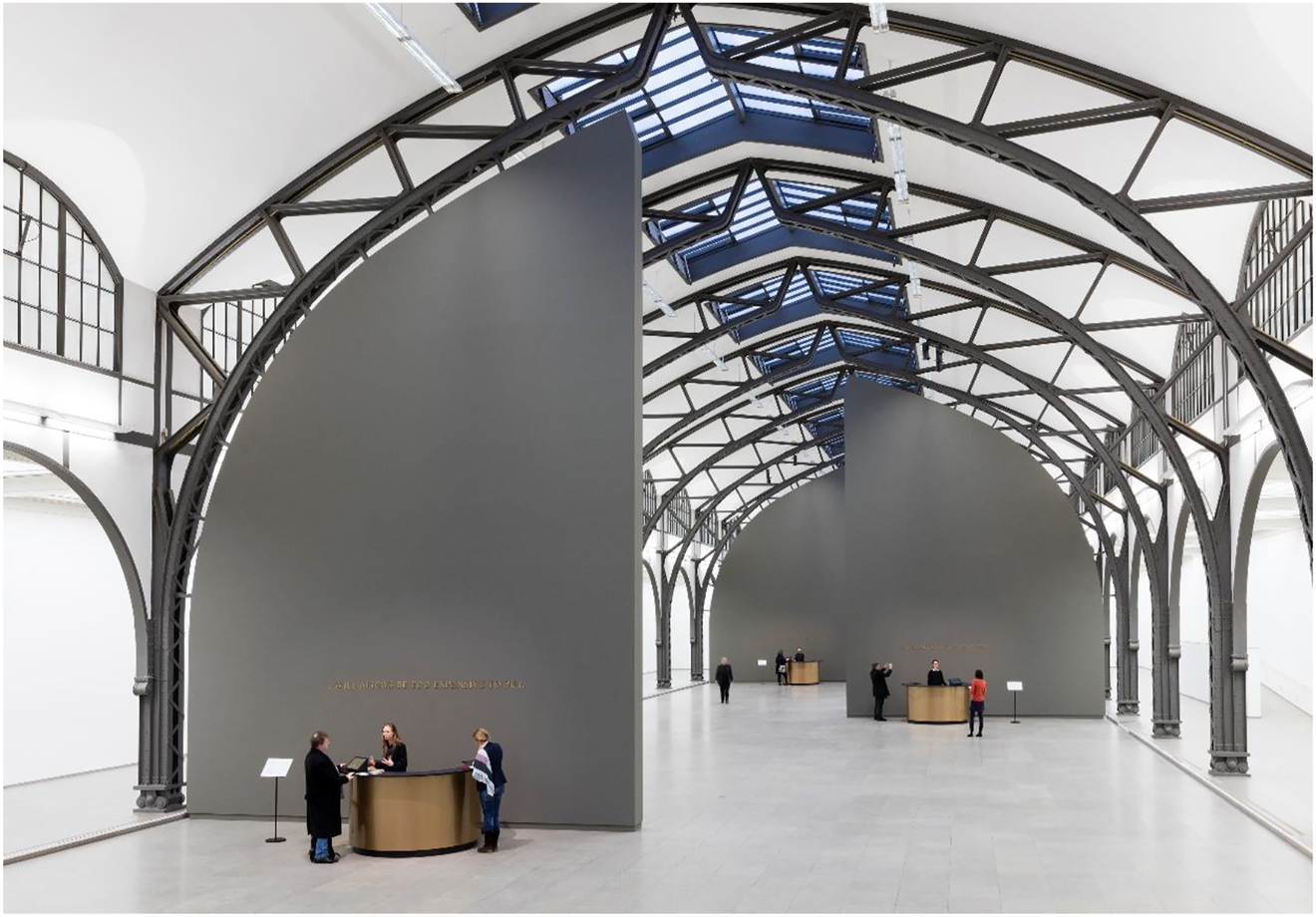
Adrian Piper, The Probable Trust Registry: The Rules of the Game #1–3, 2013. Installation + Participatory Group Performance: three embossed gold vinyl wall texts on 70% grey walls; three circular gold reception desks, each 72 “Ø × 42” (182,88 cm × 106,68 cm); contracts; signatories’ contact data registry; three administrators; self-selected members of the public. Collection Staatliche Museen zu Berlin, Nationalgalerie. © Adrian Piper Research Archive (APRA) Foundation Berlin. Photo credit: David von Becker.
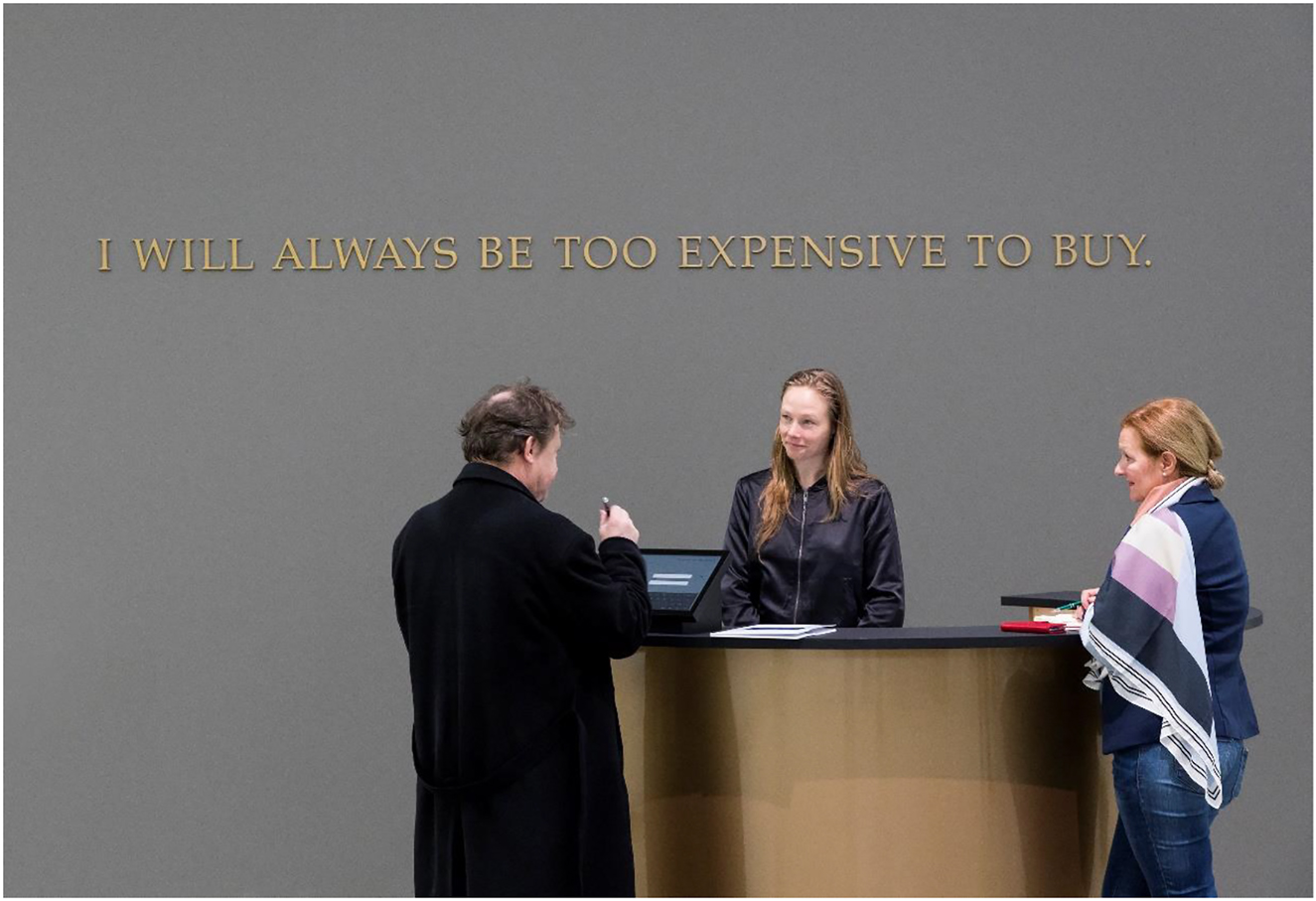
Adrian Piper, The Probable Trust Registry: The Rules of the Game #1–3, 2013. Installation + Participatory Group Performance: three embossed gold vinyl wall texts on 70% grey walls; three circular gold reception desks, each 72 “Ø × 42” (182,88 cm × 106,68 cm); contracts; signatories’ contact data registry; three administrators; self-selected members of the public. Detail: The Rules of the Game #1. Collection Staatliche Museen zu Berlin, Nationalgalerie. © Adrian Piper Research Archive (APRA) Foundation Berlin. Photo credit: David von Becker.

The Social Contract, Hong Kong, 2013.

The Social Contract, document, Hong Kong, 2013.
In this article, I will push on the question of what kind of knowledge of law might be created by such art practices. I will focus on two specific artworks that I suggest present as a unique kind of ‘material jurisprudence.’ The first section introduces the two artworks that are the subject of this chapter: Adrian Piper’s The Probable Trust Registry: The Rules of the Game #1–3 (2013–2017),[5] and The Social Contract (2007, 2009, 2013) by A Constructed World (ACW). I suggest these works belong within a broader practice of ‘art/law’ and should be understood in relation to both art history and the tradition of critical legal knowledges. In section two, I describe the orthodox approach to contract-based artworks, centred on the Siegelaub-Projansky ‘Artist’s Contract,’ which focuses on contracts for sale of the artwork itself. This focus has meant that key general problematics in art/law—such as the political texture of contemporary art’s dematerialisation of the artwork—have been understood mostly in terms of capitalism and commodification. Further, it has foregrounded the ambivalent assertion/subversion of three key terms (the author, the artwork, and value) that are the ground on which that dematerialisation-commodification plays out, at the expense of alternative themes. By contrast, in section three, I argue that a second crop of contract artworks can be identified. These use the form of the contract to dematerialise the artwork in a different direction: towards themes of the self, the social bond, and the question of trust. I further suggest that while the orthodox contract artworks rely on a vertiginous complicity with the commodification they purport to critique, ‘second legal moment’ works do the opposite: they offer the viewer a concrete experience of their own subjectivity in a tenuous bond relation, precisely via an experience of the folding of artwork and legal form. In section four, I characterise the framing of this experience as a kind of ‘material jurisprudence’: a device that makes trans-subjective conditions liveable, resulting in a knowledge of legal form and juridical relations that is directly experienced. As I go on to argue, this art capitalises on both contemporary art’s position and viewing conditions, and the post-positivist historical location of the ‘thought of law’ outside of law itself. Concluding, I argue that although attending to Piper and ACW’s work in the terms offered here would enrich an art historical account of why artists have turned to contract as an organising or productive device, they should also be situated within the ‘aftermath of legal positivism.’ The material knowledges of law catalysed by these artworks, I suggest, ought to be seen as continuous with contemporary understandings of post-positive jurisprudence, which already dwells, constitutively, ‘without law.’
2 Convergences
Lucy Finchett-Maddock recently proposed “convergence” – between art and law, between critical and formal modalities, and between matter and audience – as itself a medium of “art/law”, and situated this medium within a broader slate of contemporary social, epistemological and ontological changes.[6] Consider Cameron Rowland, whose exhibitions D37[7] and 3 & 4 Will. IV c. 73[8] present material objects, institutional artefacts, and legal documents and instruments that are inseparable from both the situated conditions under which they are viewed and the legal conditions under which they are made. Rowland’s work is remarkable for its attention to the role of legal doctrine and practice in shaping and maintaining a racialised contemporary ‘everyday’ reality—in a way that directly implicates the political economy of the contemporary art institutions where it is shown. His practice emblematises a convergence of critical legal thinking with artistic practice, such that the significance of his artworks ought to be mapped in equal relation to both fields. Rowland’s use of legal materials sharpens his contribution to the “anti-aesthetic”, the “frontiers of institutional critique, the interrogation of the economic-political history of […] exhibiting institutions,” and the “reworking of the politics-art nexus.”[9] Yet it is also in conversation with critical legal, political and race scholars “such as Brenna Bhandar, Cheryl Harris, Saidiya Hartman, K-Sue Park, and Robert Westley,”[10] and can be read as a continuation of these intellectual and political projects by ‘material’ means. Rowland expertly draws conceptual, political and historical analysis down into a concrete situation via material objects, and artistic and legal forms. His careful research and its narration, which might not be out of place in an academic journal, are leveraged into an embodied experience via their location within the norms of contemporary art’s display, consumption and spectatorship—so that it is the viewer who, together with Rowland, ultimately cannot help but make the connections that ‘are’ the work.
Albeit with important differences, this kind of convergence and displacement onto the material-experiential register characterises two recent contract artworks: Adrian Piper’s The Probable Trust Registry, and A Constructed World’s The Social Contract. Both installations work with the legal form of the contract, in order to catalyse deeper reflections on intra- and inter-subjectivity and political community, and the institutional conditions of contemporary art. In The Probable Trust Registry (Figures 1 and 2), a gallery is “transformed into three corporate reception environments […]. Each reception area is fully staffed by a volunteer administrator who helps to execute personal declaration contracts to a self-selecting public.”[11] Entering the gallery, the viewer can choose whether or not to approach a desk, whether to have a conversation and if so of what kind, and whether or not to sign a declaration consisting of one of three statements:
I will always be too expensive to buy
I will always mean what I say
I will always do what I say I am going to do
If they choose to make such a declaration, the visitor/participant is provided with a copy. The performance instructions for The Probable Trust Registry, which the artist requests are posted publicly, do not refer to contracts but more precisely to “Personal Declarations” and their “Signatories.”[12] And yet, the press release and commentary on this work have parsed these declarations as “contracts”.[13] The reason for this is that participants are also promised a volume containing the declaration of everyone else who made the same commitment. With consent, those who made the same commitment are able to contact each other via the “Gallery or Exhibiting Collector”. As a result, commentator Chloë Bass has written, “Piper binds us together quite literally, between book covers, but also in time: anyone who breaks their promise to the agreement is somehow beholden not only to him or herself but also to the other people who have sworn to uphold it.”[14]
The Social Contract (Figures 3 and 4) is a work by A Constructed World, artists Jacqueline Riva and Geoff Lowe. A 2013 press release explains:
The Social Contract invites the audience to sign a legally-binding Participation and Confidentiality Agreement in order to enter the exhibition space. In doing so, the viewer becomes part of a temporary community of silent participants for a set period of days, agreeing not to disclose what they have seen.[15]
As Riva stated in an interview, it is this contract (which was drawn up with the assistance of a practising lawyer), and not whatever is seen in the room in the gallery, if anything, that “is the artwork.”[16] Differently from The Probable Trust Registry, the signatories to this contract are not allowed to talk about it—even with each other. In fact, they do not even know who the others are (unless, obviously, they happened to sign their contracts in the same place at the same time). Yet there are more fundamental similarities. This paragraph from the documentation of ACW’s work could as easily apply to Piper’s:
The Social Contract is a participatory work that requires the audience to take into account their own honesty and authenticity, soliciting questions about integrity, transparency, responsibility and the consequences of transgressing accepted conventions. It is a work made by those who come to see the exhibition, implying that the viewer make some awareness of their own production and the possibility of changing the relation between the subject and speech.[17]
Similarly to Piper, Riva and Lowe elaborate that “[i]t is up to each member of the audience to decide and measure his or her own honesty and authenticity with regard to this event and exhibition. The real work will continue on, even in indecision, and is performed by those who came to look.”[18]
3 Contract Art and the “Legal Moment in Artistic Production”
The legal form of the contract has been among the most important topics in art-law discourse. Although the above works are qualitatively distinct from the predominant drift of contract art and art criticism—and so call for a different kind of analysis—these studies provide a rich starting point for understanding how the turn to law makes sense within existing historical trajectories in contemporary art since the 1990s. According to such commentary, contract art has provided a vehicle for the intensification of key aspects of the conceptual and contemporary art traditions. Lawyer and author Daniel McClean announced the “‘legal moment’ in artistic production” in 2010,[19] analysing the growing number of contemporary artworks in which contracts are intrinsic to the work. A prominent example is Andrea Fraser’s Untitled (2003). Fraser contracted with a collector for the rumoured sum of $20,000 that she would have sex with him in a hotel, and the resulting documentation—which, it was stipulated, had to be “tasteful”—would become a limited-edition work. What is striking about Untitled is not only that “Fraser brutally links (female) prostitution and art-making with (male) power and art collecting,”[20] as McClean makes clear; it is also the folding of the contract for sale into the process of making the work which inverts the temporality of process, the resulting artwork, and a subsequent sale. The content of the artwork is the process of negotiation and exchange (and the conditions that make it possible), and the instrument that structures, effects and, in a legal sense, defines it. The work uses contemporary art vocabularies to present structural ambivalences: between an artwork that, on the one hand, commodifies a female body and artist’s persona, and, on the other, functions as art only because the persona of the artist is understood as specifically ‘valuable.’[21] Equally, we might say that the work both critically highlights the gendered economic conditions that enable the artwork (and indeed artistic production more generally), and also, more simply, exploits them.
How central is the use of contracts to the exploration of these ambivalences? Similar ironies are a legacy of self-reflexive post-conceptual and post-autonomous art generally. Take the exploitation of labour in the work of Santiago Sierra, or the films of Dutch artist Renzo Martens, which restage “the terms and conditions of [their] own existence,”[22] in order to perform their critique. What is different in contract art is the way legal forms are reinhabited via their merging with artistic ones. Fraser’s Untitled, like all the artworks McClean addresses, can be located as post-cursors to The Artist’s Contract, a pivotal document in contemporary art history and the art-law field.[23] Known in full as The Artist’s Reserved Rights Transfer and Sale Agreement, the Artist’s Contract was created in 1971 by Seth Siegelaub, a well-known curator, dealer and publisher of conceptual art, and lawyer Robert Projansky. Their aim was to “remedy some generally acknowledged inequities in the art world, particularly artists’ lack of control over the use of their work and participation in its economics after they no longer own it.”[24] They offered a form agreement for use and adaptation by artists when they sell work, which was to be ratified via a chain of covenants by all subsequent purchasers, thus keeping it current and binding. The form contained clauses that stipulated artists should be compensated when their work is re-sold (if it has appreciated in value), that artists should be able to control the public exhibition of the work even after sale, and they should be consulted about repairs to the work if they become necessary.
The contract was not widely used, perhaps because it was so unpopular with collectors. Yet it was nonetheless influential. Taken up by several prominent artists, it governs the fate of many specific artworks, and has facilitated a nuanced discourse of the ambivalence characterising “the capitalist relations underpinning the production and distribution of art,”[25] often understood as intrinsic to contemporary art as such.[26] It enabled the staging of debates about art’s value, how it is made, and by whom; further pushed the boundaries of the post-conceptual artwork in relation to economies of value in interaction with different kinds of agency; and rephrased the problems of neo-institutional critique. Yet on the other hand, it has furthered the commodification of dematerialised artworks, and re-embedded the primacy of the authorial hand – and brand – in contemporary art.
I suggest that what unites post-Siegelaub/Projansky artworks is that the contract in issue is always referable to a relation between the artwork and its sale. To take a well-known example of how that contract comes to re-frame the work, Joan Kee and others have written about Felix Gonzalez-Torres’ “certificates of authenticity,” which often interacted directly but in imprecise terms with the life of his works after sale. These assured a work’s value as a genuine Gonzales-Torres, and contained clauses about where and how it can be exhibited, what kinds of materials can be used, and so on. They also required a buyer or exhibitor to participate to a surprising degree in decisions about the work’s integrity.[27] In cases like this, the contract becomes like a heuristic lens for the work, not only regulating it after sale, but allowing us to learn what the artist thinks are its central qualities by noticing what terms are key to its contract of sale, and what it asks collectors and exhibitors to bring to the exchange. Many such contracts also require a notice to be affixed to the work, thus literally appending the legal relations to the artistic form. Radicalising this intrusion of legal relations into the work, we have pieces like Fraser’s which folds the artwork into its sale, or similarly, the infamous Superflex work Corruption Contract (2009),[28] which explored and deconstructed the form of contract by requiring the “buyer” of the contract/work to “engage in a list of corrupt activities, including bribery and extortion.”[29]
Through this frame, to create, critique, or historically situate a contract artwork—but also, to adequately address broader themes in art historical discourse like the ‘dematerialisation’ of the artwork—is about exploring a trinity of ambivalent terms: author (as agency, as creative vision, as brand, as source of value), work (as authentic, as object or process, as meaning, as catalyst, as ‘culture’, as critical intervention), and value (as commodity, as discursive problem, as historical condition etc.). The more acutely the work presents the central ambivalence, the more notable it seems. This perhaps explains the success of Jill Magid’s celebrated Auto Portrait Pending (2005),[30] in which the artist created a contract with a US-based company to transform her cremated remains into a one-carat diamond. A second contract would transfer her author-property, artist-artwork, subject-body, commentary-commodity, diamond-self to an as yet unknown future buyer, in a form that collapses poietic invention into legal bond. If you consider that Magid did not invent the idea nor the process of creating a gem stone from the ashes of a cremated person (Life Gem[31] was already a successful commercial enterprise), then it really is the contracts, and the art-objectification of the relations they create (and their documentation, display, and so on), that enables Magid’s work to produce such a highly concentrated and valuable mediation of the conceptual trinity that defines this field.
A final example of the imperative to intensify this ambivalence will allow us to compare these works with those by Piper and ACW. In Tino Sehgal’s 2012 Turbine Hall show at the Tate, 70 paid “interpreters” mingled with crowds, asked “unsettling questions” or engaged in “brief, improvised conversation,” then moved on.[32] There was no press release, and Sehgal as usual forbade documentation of any kind, so there is no visual record of the work. In fact, there was never really anything to see, only a minimally participatory exchange taking place within an art gallery, and later, perhaps a memory. Yet incredibly, Sehgal does sell his works. Even there, no documentation is permitted. In a rigorously oral version of the Siegelaub/Projansky contract, Sehgal converses with a buyer in the presence of a notary, setting out stipulations including:
[T]he installation of the work only by someone whom Sehgal himself has trained and authorised;
a minimum payment to the “interpreters” enacting the piece;
the presentation of the work as if it were a long-term art exhibition, rather than a short-term theatrical event;
that it is not photographed;
and that if the buyer resells, the same oral contract is used.[33]
Reportedly, up to £100,000 has changed hands for Sehgal’s work, on the basis of an oral discussion and a handshake. Clearly, on some level Sehgal’s work does involve trust. It is a trust, however, that feels much more like a dare. Audiences, collectors, and Sehgal himself go along with this speculative enterprise, gathering these slight experiences under the institutional aegis of ‘art’ and the brand name ‘Tino Sehgal.’ This is possible because of Sehgal’s authorial visibility, significance and capital—his status as “the art world’s foremost maestro of the immaterial”[34]—which accrue precisely from the extremism of his dematerialisation and the gall of his conviction. For McClean, “legal moment” artworks tell us something about law, because they “operate on the borders of legal intelligibility, playfully destabilising the order and rationality of the contractual form whilst retaining its performative shell.”[35] Sehgal’s work does that. But in my view, these works, just as is said of legal critique and critique in general, also presuppose, reproduce and intensify their object, performing the very thing they set out to critique. In Sehgal’s case, much is made, in the commentary, of the way the dematerialisation of the art object and the priority on performance articulates—apparently—with a critique of materiality and what is “considered valuable”, and a priority on people, or sociality.[36] Yet contract-based performative artworks in this vein are poignant and acute—superlative, unique, historically novel, and saleable—to precisely the degree that they actively intensify the protean, intangible cultural capitalism without which they could not function.[37]
4 For a Second “Legal Moment in Artistic Production”
To my knowledge, neither Piper’s The Probable Trust Registry nor ACW’s The Social Contract has been included in any analysis of the use of contracts in contemporary art. They could have been: Adrian Piper in particular is a notable exponent of the Siegelaub/Projansky agreement; her customised version can be found on her website.[38] ACW’s practice has since deepend its exploration of the form of the contract, addressing the audience-collector-coproducer role directly in Collector Agreement (2020).[39] Further, both address similar issues regarding the dematerialisation of the artwork, its dissolution into structural or viewing conditions, and the work’s ‘afterlife’ beyond exhibition – for example, Piper’s documentation features a prominent declaration that “the destiny and interpretations of the work are part of the work.”[40] Both use the form of the contract as a central mechanism for the generation of the work, in a way that plays deliberately at undermining the space and time of the exhibition as the work’s locus, and more broadly, its nature and value.
However, I would suggest that these works are qualitatively distinct, for a simple reason: the contract in issue is not that for the sale of the work, but between artist (or art) and its audience. The protension of the work is not into future ownership and authorial brand value, but into the intersubjective conditions of its viewers. This simple difference implies the need for an almost entirely distinct conceptual palette, that begins with the participatory art tradition. While this, too, intensifies and builds on post-conceptual art’s dematerialisation of the artwork, it has tended to do so in order to place the accent on relations between the self, the social bond, and the question of trust—themes that were particularly important in a range of work from the 1970s and 1980s, including some well-known works by Marina Abramovic, such as Rhythm 0 (1974). Recently, contemporary artists like Clare Twomey have explored these themes within the context of a commodity and display culture, by focusing on the qualitative texture of the ‘exchange’ that takes place between artist, art-viewer, and a broader social life that includes art institutions. In 2013’s Exchange, Twomey showed 1000 cups with “individual positive actions for society” inscribed on them.[41] Each day of the exhibition, 10 people were invited to choose and keep a cup – in exchange for completing the particular good deed.
The adoption of the form of contract in Piper’s and ACW’s work, however, is distinct. In these works, there is no ‘object’, but a ‘syncretic’ form: the content of the contract is the artwork, and the content of the artwork is the contract. That form is animated by the subjective experience of its relational conditions. This permits both artists to use the contract form to explore a new register for ‘participation,’ and a sharpening of other central themes—not of author, work and value, but equally pervasive themes of self, bond and trust. As in other contract art, the work exploits both ideal legal forms and the contingent, material encounters and opportunities in which it becomes enmeshed, such as the reduction of an affect or intention to writing, or to being bound between a common cover. This is, in fact, what enables the work’s central mechanism to function: the play between and beyond the subject as its essential, contingent condition. In The Probable Trust Registry, the substitution of contract for declaration is a kind of parapraxis, or Freudian slip. Piper shows how a self-possessed self-affirmation in fact points toward an elusive trans-individual condition of trust and trustworthiness: our own, but also those of others.
Material form is central to this process: it is only once it is on the record, in the register, that our trust is put to the test, becoming not more certain or guaranteed but only probable.[42] The register is external evidence of what will later look like what we wanted our innermost self to have been; a standard that the subject must now always risk not being able to meet. This register, then, is less a memorandum or settled record, and more a document of the juridical subject’s ever-spectral risk. In getting at what lies beyond the document in the artwork, it ‘documents’ as art-work the dual faultline within the subject, passing both between its ideal form and its own behaviour, and between the subject and the texture of its political community. Similarly, The Social Contract, like post-Siegelaub artworks, frames a commentary on the socially constructed nature of art, its meaning and value, and the ideational content at its centre. But alongside the work of artistic production that renders its surrounding conditions visible, here the folding of the contract into the artwork also points out the unrepresentable conditions of trust and integrity. These cannot really be secured and reduced to a form, but are staged and made present through the form (which is, in turn, without that trust and investment, just so much material—a dead letter).
These works signal a ‘second legal moment’ in contract-based artistic production. We could say that they configure key elements—dematerialisation, participation, trust, and contract—in such a way as to invert the paradox at the heart of Sehgal’s work, discussed above. As in Sehgal’s work, there are not really spectators as such. But that is not because the work is so thoroughly insubstantial. It is because once a ‘viewer’ realises what the work is, they are immediately and intimately captured as a participant by its premise. Whatever the response—contracting or not, betraying the secret, keeping the faith, forgetting about the work—there will have been a substantive position taken by the trans- and inter-subjective self that is already the substance of the work, and that is the work working. The addition of the formal conceit of the contract has a recursive and redoubling effect, so that the form of the artwork is the contract and vice-versa, and the subject matter of the contract is the very relation that it enables: not the work of art. Here there is a different paradox, and a different purity, from that of Sehgal: an artwork that is a contract of relation that is empty, except for its form of relation.
The legal form of the contract, then, is deployed in order to enable this operation, intensifying the core tenet of what Nicolas Bourriaud made famous under the term ‘relational aesthetics’ by literally formalising it. In relational aesthetics, the artwork “creates a social environment in which people come together to participate in a shared activity.”[43] For this reason, these works’ use of legal form moves them into a distinct realm. In post-Siegelaub works, the contract is reduced to its thinnest and most minimal condition, becoming the trivial principle that ‘anything can be the subject of a contract’: a sex act and its documentation, promising to sell the cremated artist’s ashes as a diamond, or people talking in a crowd. We are invited, repeatedly, to marvel at modulations of this same fact. In Piper’s and A Constructed World’s works, conversely, the form of the contract is led back to the thickness and quality of the subjectivity it requires in order to exist. It asks each participant to reflect on whether such a quality exists in them, and draws attention to the simplicity and vulnerability of that quality’s conditions of existence. The decision lies with them, and that decision is the artwork. As such, their use of legal form not only extends contract art, introducing a new priority for form in relational aesthetics. It also uses the ambivalent conditions of contemporary art towards a knowledge, or more precisely an experience, of legal form.
5 Material Jurisprudence in the Convergence of Artistic and Legal Form
Much is said today about artworks borrowing legal material, and what that contributes to art and art history. But the question of what these practices borrow from contemporary art to contribute to legal knowledge—or more accurately ‘knowledge of law’—has not been a central question. This is in a sense surprising, given the priority given to artistic research and knowledge-production today. Henk Slager has remarked that “thinking in terms of creation, creative capacity, studio, and talent is no longer accentuated. […] Topical visual art […] should most of all be ‘research-based’”.[44] This begs the question: “what form of research could the domain of visual art produce?”[45] The (current) openness of this question is attested by the plurality and diversity of identifiable answers—from Paul Carter’s “material thinking,”[46] to Mieke Bal’s artmaking as “cultural analysis,”[47] or Graham Willat’s social and political action.[48] What unites these accounts of art practice as research is the notion, to borrow from Bourriaud again, that “the role of artworks is no longer to form imaginary and utopian realities, but to actually be ways of living and models of action within the existing real, [at] whatever scale chosen by the artist.”[49]
This work with the ‘existing real’ is key to understanding the use of contracts by ‘second legal moment’ artists who extend the relational aesthetics paradigm. Whereas ‘legal moment’ works aim at critique yet arrive at complicity, these works highlight how the existing real of forms and processes interact with relations.[50] Just as a dispute or case frames a problem and so makes it thinkable and actionable through legal processes, so these works are devices that use legal form to frame and dramatize relations, thus making them liveable—in the sense of being able to be experienced rather than simply thought, theorised or imagined. These contracts may not be ‘real’ contracts in the sense of being legally enforceable, but the experience of trust in relation that they enable is. As such, these explorations of the form of the contract harbour a potential knowledge that is not ‘theoretical’ and does not ‘represent’ a model or ideal, but is itself already a kind of living: an event in which artistic and legal form are collapsed into a lived experience.
This category of ‘experience’ is a convergence point for the contemporary ‘double historicisation’—in art-history and the history of jurisprudential thought—that I suggest is important here. In 1934, it was precisely via the notion of an aesthetic experience, continuous with “normal processes of living,”[51] that John Dewey similarly took aim at schisms between ideal and matter, and the fine arts and daily life. While it is more usually artistic ‘form’ that converges with life,[52] the adoption of the form of the contract—or rather the formal syncretism between art work and contract as described in the previous section—adds something important. These works abstract the form of the contract from any functional setting, localised iteration, financial consideration or specific ends, and exploit the institutional, industrial and ontological conditions of contemporary art in order to reframe a new self-referential experience. What The Probable Trust Registry and The Social Contract offer to the subject as subject is an experience of the convergence of form and matter, and artwork and participant, in the convergence of art and contract. The form of the contract always comes to matter in a strange way; being animated and co-constituted by its contextual instantiation, paradoxically becoming, for an instant, a form that is also nothing other than its content. Within any process of adjudication, the ‘real-life’ agreement is the contract, and vice-versa. But here, that embodied contract is also or only the ‘art’, so that contemporary art institutions and conditions, and the modes in which these are experienced, become the contract’s context and its content. In this sense, these works offer a kind of knowledge of law by exploiting the ‘contemporary’ conditions of both artistic and legal forms.[53]
This priority for experience finds its foothold in legal scholarship via Franz Kafka. In Kafka, the literary register is deployed to produce a knowledge of law grounded above all in a particular subjective experience of law—not in membership of a particular hermeneutic community or analysis of legal structure, reason, sources, methods, and so on. The Trial’s narrative is constructed almost exclusively through the perception of the protagonist, K[54]—and when K comes to speak critically of “the process” to the Priest, he justifies his comments by saying, “Well, it’s just my own experience.”[55] There are two central features of this subjective, experiential knowledge. The first is that like these contract artworks, it folds together material form, juridical content and subjective experience. Ed Mussawir highlights this, in drawing attention to how K’s experience is commingled with process “experienced only in the guise of some res, neither subject nor object […] qualified purely juridically.”[56] This condition is both what K experiences, and made possible by the kind of experience we understand K to have. In this Kafkan sense, the individual’s experience of the law is not some external reflection on law, but an intrinsic part of its successful operation. By speaking directly to the role of this subjective experience in the efficacy of the legal instrument, although they do not address the central Kafkan question of legal judgment, Piper’s and ACW’s artworks can be said to leverage the contemporary insistence on art-as-experience to offer a kind of alternative ‘Kafkan jurisprudence’ of legal form.
The second important feature of this jurisprudence is its ambivalent positioning as knowledge in relation to its object. On the one hand, it is an intimate knowledge of law and its efficacy. But it is in no sense a legal knowledge. As a concrete lived experience, this subjective knowledge cannot be understood as ‘external’ to its object—unlike, say, knowledge envisaged by the scientific method. Yet it could never be invoked as an epistemologically authoritative part of a legal process, for example. Although the knowledge in question in these contract artworks is clearly of a limited kind, this positionality of experiential knowledge of law has been recognised by some of the most persuasive critical reflections on law in late modernity. William Conklin recently invoked Derrida’s treatment of Kafka precisely to underline the problematic nature of the boundary of legal knowledge. As Conklin recounts, legal knowledge-signification occurs only within the boundary of the law, but the boundary itself is neither legal nor illegal, and it cannot appear or be signified within law.[57] This contingent threshold of legality has been a major topos in contemporary legal studies, and it has led many theorists to focus on documenting how legality is produced in particular settings, from early critical legal studies through to today’s materiality and media approaches. A completely different kind of enquiry opens up, however, if we prioritise the Kafkan register of experience. In the parable “Before the Law,” the boundary, which is by definition ‘unwritten’, consists precisely in severing legal language from the experienced past of the man from the country who seeks entrance to the law. Mussawir similarly notes that the regular structure of right depends on a fictional temporality divorced from any subjective experience.[58] Although this severing from experience cannot be signified in law, according to Derrida’s well-known claims in “The Force of Law,” it can be approached precisely through a concrete experience of the boundary between law and non-law. Indeed, for Derrida it is the experience of this fundamental aporia that creates the possibility of justice.[59] In this sense, experience becomes a central analytical category through which the functioning of legal discourse in late modernity is diagnosed, and its potential reframed.
6 In the Aftermath of Legal Positivism
Piper’s and ACW’s contract artworks might be located, in an art-historical register, as research-based work that leverages the conditions of contemporary art towards a subjective aesthetic (and material) experience of legal form. But just as the discipline of art history can situate these individual works of art in relation to conceptual, cultural, aesthetic, structural, and political dimensions understood as the “defining contours of a distinct period,”[60] so too should it be possible to locate their knowledge of law—experiential boundary knowledge—in relation to the historical position of jurisprudence ‘after’ the advent of legal positivism. Specifically, my suggestion is that the separation of juristic thought from law is the aftermath of positivism as a destructive event. Yet the etymology of the word aftermath also links it to a secondary regrowth after a mowing or harvest. In this sense, I contend that the contract artworks analysed here can be understood as a particular kind of ‘regrowth’ of juristic thought. In the space remaining, I will suggest some coordinates for this historicization.
According to Carl Schmitt, the positivisation of law that took hold in the nineteenth century not only changed the sources and authority of law, splitting legality from legitimacy; it also had the effect of changing the position of juristic thinking. Specifically, the jurist had hitherto been “the organ that formally elaborates the new substantive law created by social praxis,” ensuring that such a law had an “immediate political significance.”[61] The jurist’s work held social praxis into a concrete public order, by folding craft and matter together with concept and reason, thus constituting the “material […] significance of law,”[62] and it was this material folding-praxis that distinguished the jurist from the theologian or philosopher. By contrast, positivisation turns all subjective thought of law, including by the legislator, into something that is not itself the law, but about law: scholarship.[63] The jurist becomes merely a neutral interpreter of an existing norm, losing its role as an “independent third force” between the directive and the one who issues it, which now takes on an administrative flavour as a mere “directive”,[64] “mere technique”,[65] the “mere craft” of lawmaking,[66] and “untrammelled technicism”.[67]
Schmitt’s intention was not only to mark the plight and function of jurisprudence, but also—more problematically—to lament the loss of a concrete people belonging to “a true common law”:[68] the Roman law tradition and the jus publicum europaeum. Even without sharing that lament, Schmitt’s account usefully describes a key historical condition: after positivism, law, ‘people’ and juristic thought are disaggregated, meaning that knowledge of law is constitutively exiled from law, and from its specific purchase on normative action. The Anglophone legal theory of the 1980s and 1990s was acutely aware of this fact. Pierre Schlag’s case in point, “Normative and Nowhere to Go,” argued that even or especially the most norm-focused legal theory is separated from both legal and social efficacy by an unbridgeable gap. Schlag diagnoses normative legal thought as limited by “an utterly unbelievable re-presentation of the field it claims to describe and regulate. […] It systematically reinscribes its own aesthetic—its own fantastic understanding of the political and moral scene.”[69] It is not only this camp of legal scholarship that became merely ‘theoretical’. The “decapitation of legal theory”[70] once described by Margaret Davies, conversely, saw the proliferation of critical approaches valorising the position of their experience “outside law” (deliberately stretching the boundary of the “legal” in legal theory). All across the legal academy, juristic thinking became known as “legal theory,”[71] and the law itself became its principal object—rather than juristic social relations, normatively grounded ideal-material political orders, and so on. This is arguably the most powerful strand of the positivist hangover: legal theory is not only understood as external to law, but as an inherently concerned with defining law’s conceptual nature and specific function (whether inflected normatively or critically). Even anti-positivist movements, from legal realism to resurgent natural law approaches (which were mostly premised on rejecting legal formalism) seemed to be taken as adding something to that positivist agenda.
More recently, the search has been launched for the nature of juristic thought today, in the guise of the more comprehensive and plural category of “contemporary legal thought.”[72] Recent compendia reveal that some of its key coordinates resonate with the analytical devices I have used here: for example, a turn to experience,[73] the phenomenological experience of the jurist (Desautels-Stein and Kennedy),[74] the jurist’s “loss of faith,”[75] the turn to collaboration, the impossibility of critique from outside, the need to work “with and within” existing templates (Annelise Riles),[76] post-critical pragmatism and decision experienced as “legal necessity,”[77] and experimentalist “performance-based” approaches (William Simon).[78] Although I do not suggest The Probable Trust Registry and The Social Contract are examples of this legal thought—which the editors understand as the latent principle of coherence guiding the resolution of contemporary legal problems—these common coordinates nonetheless point to a set of conditions against which they become increasingly legible. These can be read together with Finchett-Maddock’s synthesis of themes in “art/law”; for example, the merging of theory and practice, (im)material aesthetic practice as a legal and political synthesis, and playing informally with forms, audience and practice.[79]
Rather than add to these important diagnoses, my aim here has been to offer a reading of two concrete examples in order to draw out ‘casuistically’ their particular value and strategy as artworks, and to argue for their non-trivial connection to other knowledges of law in the post-positive ‘contemporary’ condition. In light of these historical coordinates, they have three defining contributions. First, these artworks present a non-legal experiential knowledge of the form of the contract that is not destined to become law, but is at the same time not ‘theoretical’ or ‘critical’ with respect to law. It is an immediate experience of the juridical texture of the self and the conditions that pertain to a ‘way of living,’ made possible by the deterritorialization of a legal form in a contemporary art context. They renounce this ‘external’ role of legal theory in relation to law, deny the autonomy of law as the site for engineering social conditions of trust,[80] and overcome the need to ‘represent’ either law or social relations. In this sense, they answer Anne Bottomley and Nathan Moore’s call for legal scholarship to attend to “the crafting of diagrams and exploring the potential of the artisan.”[81] Second, they equally renounce the ‘internal’ role for juristic thought of folding idea and matter into a concrete social order. For Schmitt, the jurist is exiled from law, but is paradoxically also the “last refuge of [a] law”[82] that has evolved beyond recognition. This resonates with the approach of Shaun McVeigh, who recuperates the jurist’s concrete task of “establishing patterns of law and lawful relations” through the conduct of their (equally deterritorialised) office—but not necessarily or exclusively within what Duncan Kennedy termed legal modes of reasoning, arguments, forms, or structures.[83] Piper and ACW, then, add something by more fully exploiting this location ‘without law’ as a site for experiencing legal form (albeit at the cost of any role in legal ordering or reasoning). Third, as a specific kind of materialisation, these works present a distinct kind of material jurisprudence. Although they work with the immanent ontologies presumed by today’s ‘legal materialities,’ they sidestep theoretical concerns with the production of ‘legality,’ or the explanation of legal categories and knowledges as objects.[84] Equally, they eschew the invention of a systematic jurisprudence beginning with “soil, earth and dirt.”[85] In their limited way, these artworks present a unique strand of the juristic thought diffracted by advent of positivism, through a unique use of the conditions bequeathed by contemporary art in its aftermath.
About the author
Connal Parsley is Reader (Associate Professor) in Law at Kent Law School (UK), Deputy Director of Kent’s Centre for Critical Thought, and a UKRI Future Leaders Fellow. Connal’s work is associated with the critical cultural legal studies movement. His publications span legal theory, political philosophy, cultural studies and creative practice. He is the English translator of several works by contemporary Italian scholars, including Giorgio Agamben and Roberto Esposito. Connal co-founded the AHRC-funded ‘Law and the Human’ network, which examines how contemporary life impacts paradigms of humanity underlying Western legal systems. His current work expands the sources and methodologies through which legal processes of decision-making and evaluation are normatively grounded in the public law context, in order to find new ways to confront the incompatibility between algorithmic technologies and the rule of law. He is particularly interested in the potential of creative and prefigurative research methods to identify the emergent normative principles of evolving techno-social ecologies.
© 2022 the author(s), published by De Gruyter, Berlin/Boston
This work is licensed under the Creative Commons Attribution 4.0 International License.
Artikel in diesem Heft
- Frontmatter
- Foreword: Law and Art in the Aftermath
- The Right(s) to Remain: Art, Asylum and Political Representation in Australia
- Dis-Affective Justice in Abderrahmane Sissako’s Bamako (2006)
- Contemporary Art in the Aftermath of Legal Positivism: The ‘Other’ Contract Art as Material Jurisprudence
- ‘NO GO’: Artists, Trespass and the Aftermath of Occupation
- Research
- Dystopian Images of Law and Visual Performances of Identity in Suzanne Collins’ The Hunger Games
- Books, Broadcasters and the BBC: The Conversations Among British Modern Literature, Media and the Law
- Falling Man and the Aesthetics of Terrorism
- Book Reviews
- Shulamit Almog: The Origins of Law in Homer
- Kieran Tranter: Living in Technical Legality: Science Fiction and Law as Technology
Artikel in diesem Heft
- Frontmatter
- Foreword: Law and Art in the Aftermath
- The Right(s) to Remain: Art, Asylum and Political Representation in Australia
- Dis-Affective Justice in Abderrahmane Sissako’s Bamako (2006)
- Contemporary Art in the Aftermath of Legal Positivism: The ‘Other’ Contract Art as Material Jurisprudence
- ‘NO GO’: Artists, Trespass and the Aftermath of Occupation
- Research
- Dystopian Images of Law and Visual Performances of Identity in Suzanne Collins’ The Hunger Games
- Books, Broadcasters and the BBC: The Conversations Among British Modern Literature, Media and the Law
- Falling Man and the Aesthetics of Terrorism
- Book Reviews
- Shulamit Almog: The Origins of Law in Homer
- Kieran Tranter: Living in Technical Legality: Science Fiction and Law as Technology
