Reflections on the Preservation of Tunisian Cultural Heritage in a Post-crisis Context: Between Digitalization and Innovative Promotional Techniques
-
Karim Ben Yahia

 und
Fedia Bouslama
und
Fedia Bouslama

Abstract
The revival of the value of cultural heritage is imperative for the conservation of this asset. An anchoring between past and present is essential for any nation concerned with preserving this rich heritage, and protecting it from deperdition. A new conceptualization of the preservation of Tunisian cultural heritage in a post-crisis context integrates the role of the state as well as the private sector/NGOs and international institutions to conserve and subsequently promote this heritage. This approach tends to revive certain components of cultural heritage and to revitalize the economic sphere that revolves around it. This research focuses on the integration of digitalization and innovative techniques in order to preserve or even promote Tunisia’s cultural heritage. Qualitative research, through the combination of in-depth interviews and focus groups, was carried out with the governmental sector, private/NGOs, and foreign institutions whose aim is to promote this heritage. The combination of the results of these sectors tends to provide a pragmatic picture of the current post-crisis situation in addition to important managerial contributions. An analysis of the qualitative corpus via T-LAB Plus 2022 made it possible to identify the technologies most mentioned by the respondents.
Appendix A: Description of the Profile of Interviewees
| Participant | Position | Company | Sector |
|---|---|---|---|
| P1 | General Director of Heritage | Ministry of Culture | Governmental |
| P2 | Director of the Department of Architecture and Urban Planning | National Heritage Institute | Governmental |
| P3 | Manager | Agency for Heritage Development and Cultural Promotion | Governmental |
| P4 | Technical manager | Expertise France | Foreign institution |
| P5 | Technical expert | German Agency for International Cooperation GIZ | Foreign institution private |
| P6 | CEO | DCX (Digital Cultural Xperience) | |
| P7 | President of an association | Walks of solidarity | NGO |
| P8 | Active Member | Association for the Safeguarding of the Medina of Tunis | NGO |
| P9 | Manager | Animed | Private |
| P10 | Active member | Association for the safeguard of the is – land of Djerba – ASSIDJE | NGO |
| P11 | Active member | Tunisian Association for the Promotion and Safeguarding of Trades and Artisan Heritage | NGO |
| P12 | President of an association | Tunisian Heritage and Environment Association | NGO |
Appendix B: Description of the Profile of the Focus Group Respondents
| Focus group 1 | Focus group 2 | ||
|---|---|---|---|
| Respondent | Sector | Respondent | Sector |
| R1 | Private | R10 | NGO |
| R2 | Private | R11 | NGO |
| R3 | Private | R12 | NGO |
| R4 | Private | R13 | NGO |
| R5 | Private | R14 | NGO |
| R6 | Private | R15 | NGO |
| R7 | Private | R16 | NGO |
| R8 | Private | R17 | NGO |
| R9 | Private | R18 | NGO |
| R19 | NGO | ||
Appendix C: Some Achievements to Enhance the Tunisian Cultural Heritage
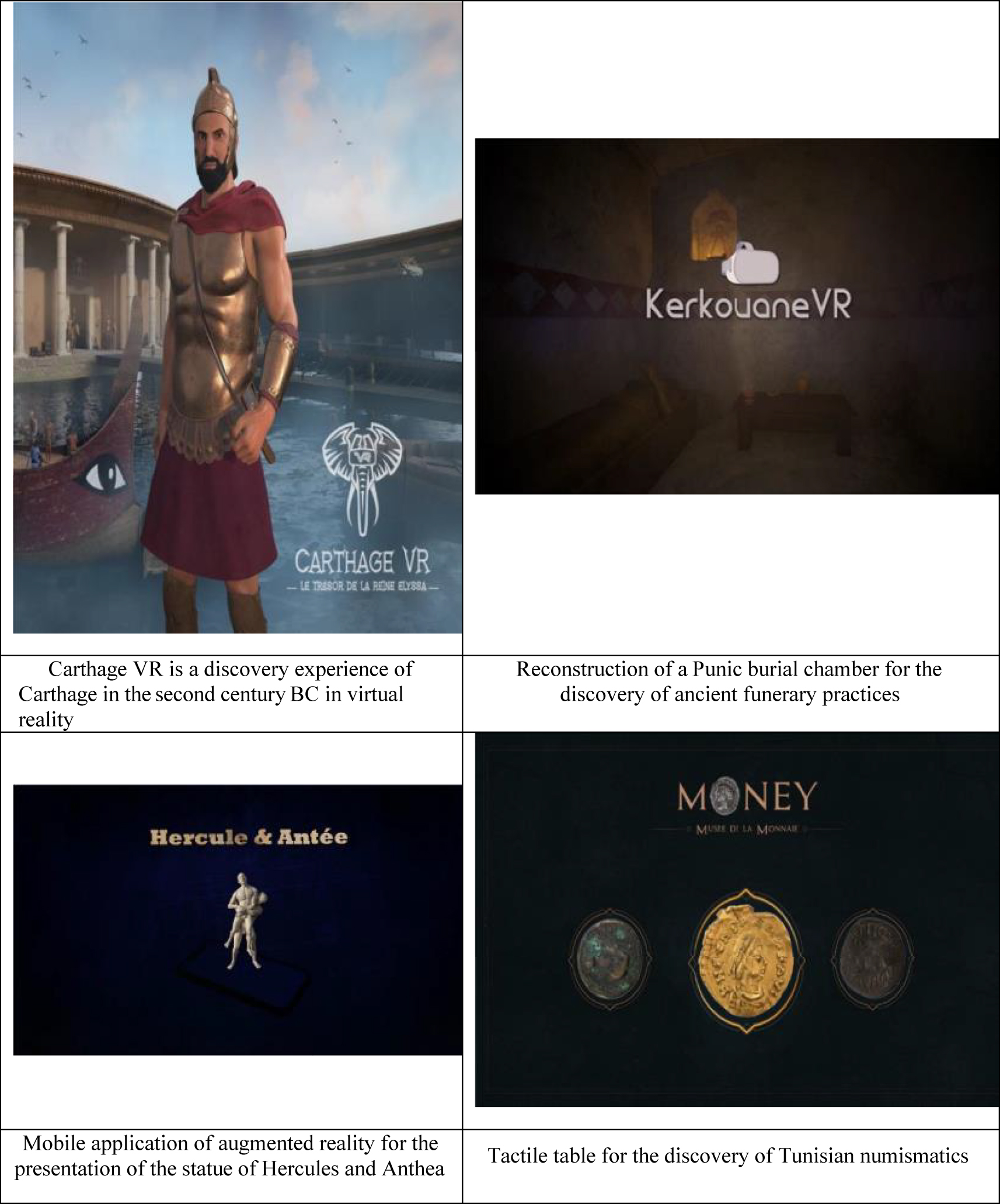
|
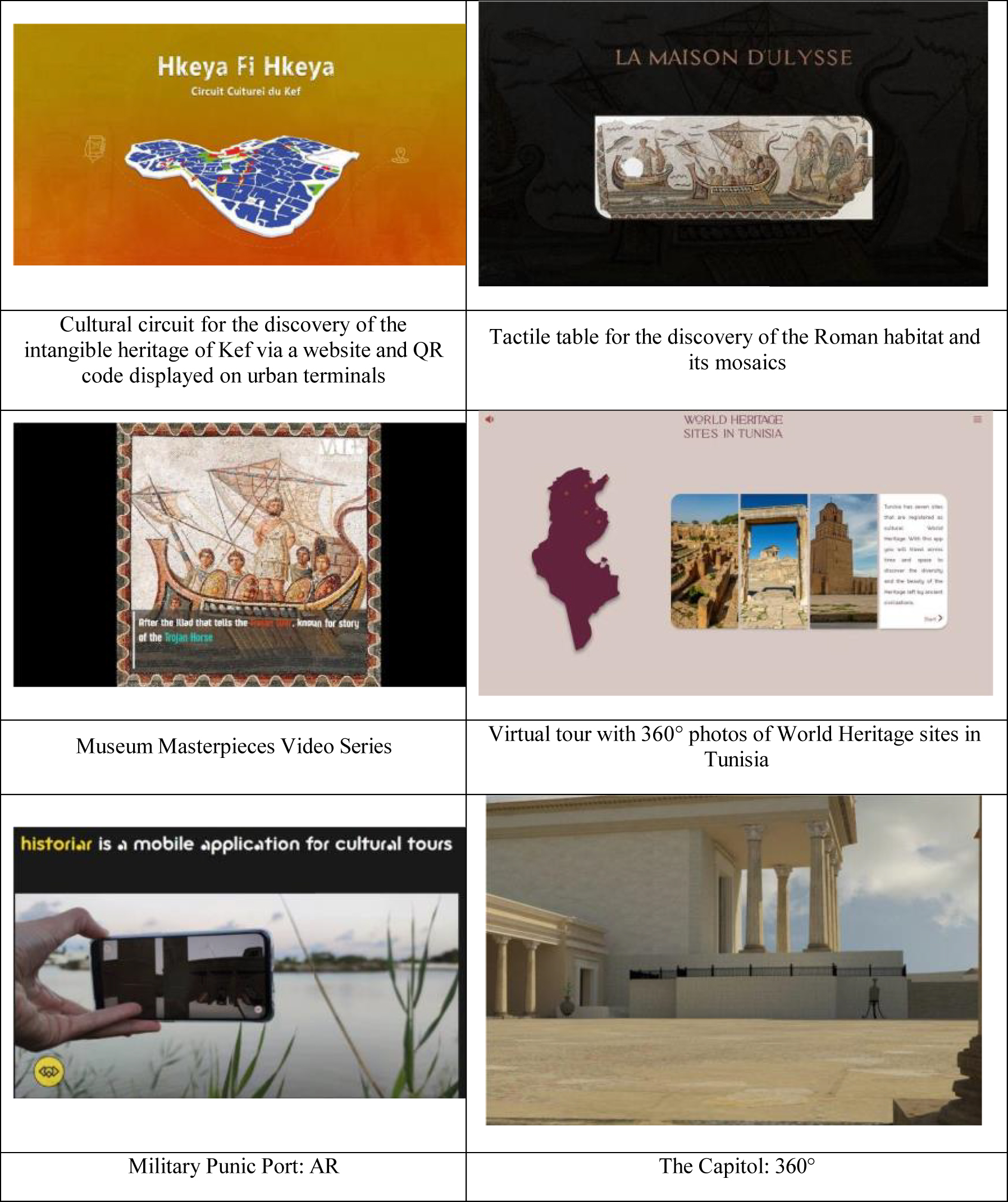
|
References
Alsubaie, M. A. 2022. “Distance Education and the Social Literacy of Elementary School Students during the Covid-19 Pandemic.” Heliyon 8: 7. https://doi.org/10.1016/j.heliyon.2022.e09811.Suche in Google Scholar
Badia, F., E. Borin, and F. Donato. 2015. “How the Financial Crisis Affected Models of Public-Private Partnership in the Cultural Sector: Empirical Evidence From France, Germany and Italy.” In AIMAC Conference.Suche in Google Scholar
Baglioni, M., G. Poggi, D. Chelazzi, and P. Baglioni. 2021. “Advanced Materials in Cultural Heritage Conservation.” Molecules 26: 3967. https://doi.org/10.3390/molecules26133967.Suche in Google Scholar
Bekele, M. K., R. Pierdicca, E. Frontoni, E. S. Malinverni, and J. Gain. 2018. “A Survey of Augmented, Virtual, and Mixed Reality for Cultural Heritage.” Journal on Computing and Cultural Heritage 11 (2): 1–36. https://doi.org/10.1145/3145534.Suche in Google Scholar
Bozorgi, K., and Z. Lischer-Katz. 2020. “Using 3D/VR for Research and Cultural Heritage Preservation: Project Update on the Virtual Ganjali Khan Project.” Preservation, Digital Technology & Culture 49 (2): 45–57. https://doi.org/10.1515/pdtc-2020-0017.Suche in Google Scholar
Cheng, Z., and X. Chen. 2022. “The Effect of Tourism Experience on Tourists’ Environmentally Responsible Behavior at Cultural Heritage Sites: The Mediating Role of Cultural Attachment.” Sustainability 14: 565. https://doi.org/10.3390/su14010565.Suche in Google Scholar
Crowley, K., R. Jackson, S. O’Connell, D. Karunarthna, E. Anantasari, A. Retnowati, and D. Niemand. 2022. “Cultural Heritage and Risk Assessments: Gaps, Challenges, and Future Research Directions for the Inclusion of Heritage Within Climate Change Adaptation and Disaster Management.” Climate Resilience and Sustainability 1 (3): 45. https://doi.org/10.1002/cli2.45.Suche in Google Scholar
Diker, H. F., and M. Esmer. 2021. “Preliminary Evaluation of the Terrestrial Laser Scanning Survey of the Subterranean Structures at Hagia Sophia.” Preservation, Digital Technology & Culture 50 (2): 65–84. https://doi.org/10.1515/pdtc-2021-0014.Suche in Google Scholar
El Khadrawy, R. K., A. A. Attia, and R. Rashed. 2022. “Partnerships for Sustainable Tourism Development in the Cultural Heritage Sites.” In Conservation of Architectural Heritage, edited by V. Antonella, H. Bougdah, N. Akagawa, and N. Cavalagli, 57–69. Switzerland: Advances in Science, Technology & Innovation. Springer.10.1007/978-3-030-74482-3_5Suche in Google Scholar
European Commission. 2018. Innovation in Cultural Heritage – For an Integrated European Research Policy. Luxembourg: Publications Office.Suche in Google Scholar
Garcia, B. A. 2021. “Integrating Culture in Post-crisis Urban Recovery: Reflections on the Power of Cultural Heritage to Deal With Crisis.” International Journal of Disaster Risk Reduction 60: 102277. https://doi.org/10.1016/j.ijdrr.2021.102277.Suche in Google Scholar
Georganas, I. 2013. “The Effects of the Economic Crisis on Greek Heritage: A View From the Private Cultural Sector.” Journal of Eastern Mediterranean Archaeology and Heritage Studies 1 (3): 242–5. https://doi.org/10.5325/jeasmedarcherstu.1.3.0242.Suche in Google Scholar
Gireesh Kumar, T. K. 2022. “Preserving the Distributed Fragments of Cultural Heritage: Need for Building a Sustainable Information System in India.” Preservation, Digital Technology & Culture 51 (2): 51–61. https://doi.org/10.1515/pdtc-2021-0029.Suche in Google Scholar
Hamed, N. A., M. Belal, and M. Raafat. 2022. “Building Virtual Environment for Safeguarding Archeological Ruins Case Study—El-Sheikh Ibada (Antinoopolis).” In Conservation of Architectural Heritage, edited by V. Antonella, H. Bougdah, N. Akagawa, and N. Cavalagli, 489–500. Switzerland: Springer.10.1007/978-3-030-74482-3_36Suche in Google Scholar
Holton, J. A. 2010. “The Coding Process and its Challenges.” The Grounded Theory Review 9 (1): 21–40.Suche in Google Scholar
Holtorf, C. 2015. “Averting Loss Aversion in Cultural Heritage.” International Journal of Heritage Studies 21 (4): 405–21. https://doi.org/10.1080/13527258.2014.938766.Suche in Google Scholar
Kazlauskaitė, R. 2022. “Embodying Ressentimentful Victimhood: Virtual Reality Re-enactment of the Warsaw Uprising in the Second World War Museum in Gdańsk.” International Journal of Heritage Studies 28 (6): 699–713. https://doi.org/10.1080/13527258.2022.2064897.Suche in Google Scholar
Lawler, J. 2022. “Jonathan Lawler of Libraries, Archives, and Museums: An Introduction to Cultural Heritage Institutions Through the Ages.” Preservation, Digital Technology & Culture 51 (1): 33–4. https://doi.org/10.1515/pdtc-2022-0003.Suche in Google Scholar
Leschko, G. D. M., and N. A. Kortabarria. 2022. “Cultural Heritage and Sustainable Development.” In European Cities in the Process of Constructing and Transmitting European Cultural Heritage, edited by E. M. Mach, and P. Kubicki. Kraków: Księgarnia Akademicka Publishing.10.12797/9788381386708.08Suche in Google Scholar
Li, D. R. 2008. “The Application of Virtual Reality Technology in Cultural Heritage Conservation.” Journal of Yunnan Normal University 4: 1–7.Suche in Google Scholar
Mercado, G. F. 2022. “The Safeguarding of the Pirekua, the Traditional Song of the P’urhépecha, Michoacan, Mexico: Between Institutional and Community Practices.” International Journal of Heritage Studies 28 (5): 609–21. https://doi.org/10.1080/13527258.2022.2042716.Suche in Google Scholar
Ocón, D. 2021. “Digitalising Endangered Cultural Heritage in Southeast Asian Cities: Preserving or Replacing?” International Journal of Heritage Studies 27 (10): 975–90. https://doi.org/10.1080/13527258.2021.1883711.Suche in Google Scholar
Palcák, M., P. Kudela, M. Fandáková, and J. Kordek. 2022. “Utilization of 3D Digital Technologies in the Documentation of Cultural Heritage: A Case Study of the Kunerad Mansion (Slovakia).” Applied Sciences 12: 4376–400. https://doi.org/10.3390/app12094376.Suche in Google Scholar
Panzera, E. 2022. “Cultural Heritage and Territorial Identity: Synergies and Development Impact on European Regions.” In Advances in Spatial Science. Switzerland: Springer.10.1007/978-3-030-94468-1Suche in Google Scholar
Patra, I., U. Reddy, N. Vijayalakshmi, and L. K. Pallathadka. 2022. “Role of Art Conservation Science in the Study of Tangible Cultural.” Journal of Positive School Psychology 6 (3): 3134–9.Suche in Google Scholar
Pieraccini, M., G. Guidi, and C. Atzeni. 2001. “3D Digitizing of Cultural Heritage.” Journal of Cultural Heritage 2 (1): 63–70. https://doi.org/10.1016/s1296-2074(01)01108-6.Suche in Google Scholar
Poulopoulos, V., and M. Wallace. 2022. “Digital Technologies and the Role of Data in Cultural Heritage: The Past, the Present, and the Future.” Big Data and Cognitive Computer 6 (3): 73–92. https://doi.org/10.3390/bdcc6030073.Suche in Google Scholar
Ramazanova, M., C. Lopes, H. Helena Albuquerque, I. V. De Freitas, J. Quintela, and P. Remelgado. 2022. “Preserving Ritual Food as Intangible Cultural Heritage through Digitization: The Case of Portugal.” In Proceedings of the 5th International Conference on Tourism Research, Portugal, 1st ed., Vol. 15, 342–51.10.34190/ictr.15.1.243Suche in Google Scholar
Rauscher, M., and A. Humpe. 2022. “Traveling the Past: Raising Awareness of Cultural Heritage through Virtual Reality.” Journal of Promotion Management 28 (2): 128–43. https://doi.org/10.1080/10496491.2021.1987958.Suche in Google Scholar
Smith, T. A., R. A. Dunkley, and S. Jones. 2022. “Storying Wild Landscapes: Multimodal Interactions With Digital App-Based Heritage.” International Journal of Heritage Studies 28 (7): 803–19. https://doi.org/10.1080/13527258.2022.2086154.Suche in Google Scholar
Sullivan, A. M. 2016. “Cultural Heritage & New Media: A Future for the Past.” The John Marshall Review of Intellectual Property Law 15 (3): 604–46.Suche in Google Scholar
UNESCO Institute for Statistics. 2003. The Convention for the Safeguarding of the Intangible Cultural Heritage.Suche in Google Scholar
UNESCO Institute for Statistics. 2009. UNESCO Framework for Cultural Statistics.Suche in Google Scholar
Vacchio, E. D., and F. Bifulco. 2022. “Blockchain in Cultural Heritage: Insights From Literature Review.” Sustainability 14: 2324–37. https://doi.org/10.3390/su14042324.Suche in Google Scholar
Zeiler, X., and S. Thomas. 2021. “The Relevance of Researching Video Games and Cultural Heritage.” International Journal of Heritage Studies 27 (3): 265–7. https://doi.org/10.1080/13527258.2020.1762705.Suche in Google Scholar
Zhou, Y., J. Sun, and Y. Huang. 2019. “The Digital Preservation of Intangible Cultural Heritage in China: A Survey.” Preservation, Digital Technology & Culture 48 (2): 95–103. https://doi.org/10.1515/pdtc-2019-0004.Suche in Google Scholar
© 2023 Walter de Gruyter GmbH, Berlin/Boston
Artikel in diesem Heft
- Frontmatter
- Editorial
- New Pace on an Established Route
- Articles
- On-Site Preservation Through Participatory Method in the Development of Digital Museum
- Reflections on the Preservation of Tunisian Cultural Heritage in a Post-crisis Context: Between Digitalization and Innovative Promotional Techniques
- Developing a Digital History Project for Newport, Rhode Island: A Case Study of a Multimedia Tour and Place-Based Audio Storytelling
Artikel in diesem Heft
- Frontmatter
- Editorial
- New Pace on an Established Route
- Articles
- On-Site Preservation Through Participatory Method in the Development of Digital Museum
- Reflections on the Preservation of Tunisian Cultural Heritage in a Post-crisis Context: Between Digitalization and Innovative Promotional Techniques
- Developing a Digital History Project for Newport, Rhode Island: A Case Study of a Multimedia Tour and Place-Based Audio Storytelling
