Candomblé in Public: How Religious Rites Become Civil Technologies in Salvador, Brazil
-
Leandro de Paula


Abstract
In 2019, right before arriving in Salvador, Brazil, to develop missionary activities, an international Protestant organization declared that this city – the center of the black culture in the country – was “known for its people’s belief in spirits and demons.” The statement soon triggered indignation from activists and devotees of Candomblé, the Afro-Brazilian religion that is a key element of the city’s history and identity. This article analyzes the transformation of this case into a public problem, which demanded different forms of reparation and affirmation of religious differences. The text debates the extension of Candomblé's semiotic community in Salvador and how the circulation of its symbols in different social contexts furthers the dissolution of boundaries between “religion” and “politics.” I pursue such ideas by describing a form of civil protest that moves liturgical forms from the Candomblé temples to public spaces. Such civil protest technology engages music, dance, and a set of materialities, presenting an instructive performance of the constitution of “religion” and the “public” in a post-colonial landscape.
The babalaô[1] had cast the cowrie-shells and the orixás had responded. To guarantee her peace of mind, free her from the evil eye, from any illness, from the threats of the non-conformist egum[2] luring her to his death, Dona Flor had to fulfill a major obligation. It was not a simple dispatch, it was not just any ebó.[3] Exu, head of the deceased one, had put himself against her, on the warpath. Dionísia had told the ojé[4] not to regulate expenses. As a matter of life and death, and with an armed and displeased Exu, money didn’t count and there was a hurry, a lot of hurry: her friend, Dona Flor, could barely stand up. The açobá[5] himself had advanced his money for the most urgent expenses; one sheep, two goats, twelve roosters, six guinea fowls, twelve yards of cloth. Not to mention the rest, a long list written in pencil on kraft paper, used for wrapping. Each purchase with its own cost plus twenty mil-réis reserved to the peji of Ossaim[6] so that he can open the paths through the jungle where Exu hides.[7]
Only a powerful dispatch would free Dona Flor from the spirit of her deceased husband and calm down the orixá that owned his head. Sometime after Vadinho suffers a sudden illness during the Carnival parade, he responds to Dona Flor’s secret longing. He reappears naked on the bed she now shares with the sober pharmacist Teodoro, confusing her life and moral convictions. That pointed out that Exu got furious, demanding a special offering from Dona Flor: as the cowrie-shells indicated, her peace depended on the sacrifice of several goats, roosters, and guinea fowls.
“Dona Flor and Her Two Husbands,” one of the greatest successes of one of the most famous Brazilian writers, was released in 1966 and adapted to cinema and television in the following decades. Jorge Amado’s novel exemplifies a literary genre that seeks to build a particular idea of Brazilian people by taking inspiration from “the daily life of the low-income groups, the multiple ethical and cultural resources with which they ingeniously cope with oppression and humiliation.”[8] The novel thus praises characters and local symbolic practices marginalized or even repressed by the dominant classes in the 1940s. An excerpt comparing the worship practices of black people from Brazil and the US illustrates such endeavor: “[Brazilian black women] danced in respect to the orixás, the joyful and intimate black gods coming from Africa and more and more alive in Bahia. Black American women, by their turn, addressed their prayers to their owners’ austere and distant white gods, imposed on enslaved people in the lash of the whip.”[9]
The intention of describing the “people” occasionally led this literary genre into controversial framings. From anthropologist Osmundo Pinho’s perspective,[10] for example, Jorge Amado’s work “carries all the contradictions and incoherences of the political unconscious mind that informs it,” as it takes part in the process of “invention of Bahia” in the national imagery. That would make “Dona Flor and her Two Husbands” one of the many items of the “ideological discourse on baianidade,” the sense of uniqueness of the Brazilian state of Bahia as promoted by diverse political and cultural platforms.
Candomblé, a religion repressed by State forces in Bahia until the 1970s, emerges in the novel as a frequent target of interest. Its ritual practices appear everywhere in the narrative, not as exclusive habits of black people, but as symbolic treasures available for wide consumption.[11] “Dona Flor and her Two Husbands” seems to portray Candomblé as the cultural bond of a “racial democracy,” i.e., the supposedly peaceful management of racial differences in Brazil, according to an influential ideology.[12] Such a perspective on Candomblé may be found in Jorge Amado’s[13] literary works, but also in several culturalist approaches addressing the black culture in Bahia, such as those offered by photographer/ethnologist Pierre Verger and anthropologist Ruth Landes, to name a few. Each in their way,[14] they contributed to including Candomblé into the discourse on “baianidade” and transforming such a religious universe into part of the regional and national identities.[15]
Paul Johnson[16] argued that, throughout the twentieth century, the increasing number of academic research, artworks, touristic approaches, and media products about this religion gave rise to “Public Candomblé.” This term refers to a specific inflection: the ritual transmission of secret, which underlies this religious practice, would have begun to compete with the discourse about the secret, as Candomblé came out in different forms of visibility. The discourse about ritual secret, or secretism, would not be a mere translation of what is experienced in the terreiros – the Candomblé temples – but a set of representations fostered by journalists, scholars, artists, political allies, and the Candomblé's practitioners themselves around the religious authenticity. [17]
Written in the 1960s, “Dona Flor and her Two Husbands” somehow prefigured the social spread of Candomblé's language. Detached from the terreiros’ exclusive possession, it would have gradually become intelligible also for nonnative audiences as part of popular culture: “the social and discursive boundary of secrecy remains within the terreiro, but the semiotic system of Candomblé has leaped the barrier and is out and available for endless possible interpretations.”[18] The very religious authorities have been part of such an integration of their tradition into a broader cultural repertoire. Mãe Stella de Oxóssi, for example, the famous Mother of Saint (priestess)[19] of Terreiro Opô Afonjá, wrote many books and acted as a columnist in Salvador’s press. According to Johnson’s argument, the inflation of the religion’s semiotic community would have resulted from the dissemination of its symbols across time and space beyond their original loci of creation and use: “the knowledge of Candomblé is now materialized not only in the ritualized body, the closed calabash,[20] and the seat of the saint but also in the objectified forms of text, film, and television, which are easily transported and reproduced outside the terreiros.”[21]
Much criticism has already been addressed to such an approach of Candomblé existing outside the religious spaces.[22] Miriam Rabelo, for instance, argued that “the information spread in books and websites, no matter how detailed, does not replace the practical experience of the terreiro.”[23] From another perspective, Ordep Serra[24] relativized the power of intellectuals in shaping the terreiros’ reflexivity and underlined the agency of Candomblé's leaders and devotees before their political and academic allies. More recently, Elina Hartikainen[25] drew attention to a growing skepticism among terreiros from Salvador about nonnative scholars’ mediation. She pointed out that this trend derives from the expansion of academic training opportunities in Brazil, which aroused the demand for native specialists to speak on behalf of their groups. Candomblé communities have been the target of either academic and artistic interest or religious[26] and political[27] persecution, having thus had many reasons to establish an ambivalent relationship with the world outside the terreiros.
The long-lasting debate on the relationship between Candomblé and the “public” informs this article. The text addresses a form of civil protest recently emerged in Salvador, the capital of Bahia, which mobilizes religious symbols (garments, music, materialities, liturgical forms, etc.) in public space. Such a political tool, called “collective ebó,” has been employed by a local social movement inspired by the legacy of Makota Valdina (1943–2019), a key Candomblé activist and spiritual authority. As part of the representations circulated by “Public Candomblé,” “Dona Flor and her Two Husbands’” narrative portrays “ebó” as a ritual that negotiates favors with supernatural forces. The “collective ebó” seems to re-appropriate and racialize such an understanding by claiming justice and denouncing cases of “religious racism,” an ascending political category to describe violence against religions inspired by African cosmologies in Brazil.[28]
This article analyzes the political background, performative means, and public effects of a “collective ebó” that happened in November 2019, in response to an insult against Salvador’s population made by a foreign Protestant NGO. Methodologically, it seeks to analyze “how religious publics actually emerge through shared images, texts, sounds, and bonding styles.”[29] I argue that the described political circumstance manifested Candomblé's particular manner of handling the boundary between the “public” and the “private.” Civil institutions, the media, and supporters from different fields could then engage with the Candomblé's “bonding style” in the face of intolerance, an old social wound in the city. Following the research on public controversies,[30] the article assesses how an emblematic situation highlights the “mediation processes in which categories from a discursive field move to another, producing translations and, consequently, new meanings.”[31] Taken as a heuristic resource, the idea of “public controversy” prescribes attention to the multiple standpoints gathered in a dispute, their incommensurability, and the agency of not only religious or even human actors in the case description.
The data discussed in this article were derived from public sources, such as newspapers, television news, social media content, and documents from government bodies. Furthermore, I attended the protest at Salvador’s port as a supporter and had brief and informal interactions with some protesters. The article thus does not comprise an ethnography of the social movement, whose trajectory has already been tracked back by other research endeavors.[32] I seek to sketch, on the other hand, an analysis of discourses and publics shaped by the controversy and identify how some of Salvador’s public sphere leading players echoed the social movement’s agenda at that moment. This undertaking focuses on the political effects of the Candomblé's semiotics in the capital of Bahia, while new forms of Afro-religious activism ascend across Brazil.[33]
Probing religious trends through their expressions in the secular public sphere is a research endeavor I have been carrying out for some years.[34] In the specific case of this article, such a positionality is also shaped by my lens as a migrant from Brazil’s Southeast region, impressed by the insightful and pedagogical way the Afro-religious movement undertakes its struggle for rights in Salvador. In the past few years, I have been interacting with Candomblé's communities and activists in civil and academic contexts like “Seminário Enfrentando a intolerância e o ódio religioso,”[35] “Fórum Direito e Liberdade Religiosa,”[36] and the project “Pluralismo Religioso e Direitos Humanos,”[37] which prompts activities with local religious communities addressing their understandings on citizenship. These have been fundamental opportunities to figure out the political scene in which Candomblé takes over some forms of publicity. My standpoint regarding the “collective ebó” is thus also informed by other inspiring alliances between secular politics and religious experience that emerge from the Afro-religious movement in Salvador.[38]
Section 1 reviews the anthropological literature on the ebó ritual, presents some aspects of Makota Valdina’s biography, and discusses the more recent politicization of the Afro-religious field in Brazil. Section 2 deals with the controversy that gave rise to a broadened public of Candomblé's discourse in Salvador, as commented earlier. Section 3 approaches some political and aesthetic dimensions of civil-religious movements nowadays.
1 Alive Offerings
Ebó is a word in Portuguese derived from the Yoruba Ẹbọ, which means offering. In Candomblé, ebó is a ritual offering to the spiritual forces – the orixás[39] [40] – that requires materialities and procedures prescribed by priest/priestess divination. These offerings are found in regular purification rituals, spiritual initiation processes, and liturgies seeking favors from the orixás, such as love, health, or prosperity. The traits just mentioned place the practice of ebó close to Victor Turner’s definition of ritual: a “prescribed formal behavior for occasions not given over to technological routine, having reference to beliefs in mystical beings or powers.”[41] This brief picture of ritual certainly does not do justice to diverse manifestations of the phenomenon, nor even the consequences of Turner’s reflection itself on that topic.[42] However, it sufficiently illuminates the suspension of routine, the transcendent appeal and the prescriptive character of any ritual, helpful ideas to discuss the discursive transit of ebó between the religious and the political fields.
The ebó ritual regards orixá Exu as an emissary connecting the intentions between the reigns of the àyié (the earth) and the òrun (the spiritual realm). His role is conducting the energy concentrated by the ebó and re-establishing the balance of forces between humans and deities/cosmic energies. Ebó is thus a propitiatory act of negotiating power between the visible and the invisible. The ritual reorganizes spiritual relationships to renew and strengthen the axé, the vital energy that moves the world and circulates across different manifestations of nature, according to Candomblé's beliefs.[43]
“Like a formula prescribed by a physician, the ebó conciliates a set of symbolic elements (in terms of qualities and quantities, modes of offering, and destination) consistent with the problem it must solve.”[44] The cowrie-shell divination determines the use of elements from vegetable, mineral, or animal origin. Such organic resources have a common feature with the idea of energy in Candomblé: impermanence. Ebó assumes that ingredients like manioc flour, beverages, leaves, and blood of sacrificed animals ferment, deteriorate, and/or disappear over time, showing that the axé is not enclosed in a unique way of being. Luciana Novaes sets up an approach to ebó as technology to underline how it unfolds Candomblé's ontological assumptions: “ebó materially translates the movement of temporal change due to a particular technology that activates the vital energy present in biological beings through processes that alter their physical form and chemical constitution.”[45]
I draw attention to two dimensions of ebó in the ritual economy of Candomblé. The first one is that the offering is a way of caring for and strengthening the interdependent relationship between human beings and orixás. Thus, ebós frequently privilege the spiritual demands of one person [46] since it responds to a particular energetic situation. Indeed, those requesting the ritual must count on someone’s help: “There will always be someone to sing, clap, help to prepare and clean up [things] in the course of the religious ‘service’.”[47] However, the propitiatory logic depends on the circulation of axé between the elements offered as a sacrifice and the orixá summoned by them, the owner of powers addressed towards the situation experienced by a counselee.
Ebó may then be seen as a kind of agreement “established through offerings, between the one who requests it (the counselee), the one who has the legitimacy to carry it out (the priest/priestess), its divine recipient (the orixá) and the place specified by the latter to sign the pact.”[48] Although it requires social mediations, ebó emphasizes the uniqueness of a moment in life, or rather, the circumstance of axé in a life trajectory, to promote expiatory restitution for healing, cleaning, unloading, etc.[49] Such traits have made ebó more than a technique handled by those spiritually initiated in Candomblé. As pictured in Jorge Amado’s novels, ebó also became a service requested by the “population outside the religious group.”[50] Prandi even asserts: “the middle-class client who goes to a Candomblé terreiro looking for cowrie-shell divination and ebós is the bricoleur who has also sought many other non-rational sources of meaning for life and healing for all sorts of ills. Certainly, this client’s Candomblé is very different from the initiated devotee’s, but neither of them contradicts the meaning of the other.”[51]
A second highlighted aspect of the rite is its manner of negotiating the boundaries between the terreiro and the external environment.[52] According to the directions given by the oracle, the baskets (“balaios”) with remaining materialities are generally dispatched in forests, beaches, waterfalls, streets, crossroads, etc. The material elements’ fermentation and deterioration, even their disappearance due to the action of time and weather, are considered part of the ritual once they indicate the circulation of the vital energy.[53] Thus, the ebó dispatches may escape from the terreiro’s boundaries that guaranteed the privacy of the ritual until then. Nevertheless, delivering the materials to nature does not reveal the purpose or the mystical means of the ebó. Even though the materialities are reachable to lay curiosity, the ritual keeps committed to secrecy.[54] One must, “avoiding profane glances, place it [the dispatch] in a desert site”[55] to make it available to the sacred energies of nature.
Shortly, the ebó ritual seems to correspond to a concert between human and more-than-human forces. It responds to an imbalance in the circulation of the axé, experienced in life circumstances demanding help from the supernatural.[56] Importantly, secrecy makes up the act: from consulting the oracle to dispatching materials in indicated places for their decomposition, everything seems committed to not revealing human purposes or transcendent mechanisms of the offering. However, materialities – the sacrificial elements – frequently escape from the boundaries of the terreiro’s privacy.
Lying down the baskets with remaining materials in urban/public spaces has been a challenging task for many devotees of Afro-Brazilian religions.[57] The dispatches may trigger disgust from people who do not follow such religious practices, given the unique way ebós concatenate matter, human intentions, and supernatural agency, making a mystery come to the senses. Actually, those who do not understand the meaning of the offerings – averagely informed by a Christian-biased prejudice – may even be afraid of them: they believe that “something from the mystical force continues throbbing in these dead chickens that people find when returning home or when they are out for a walk.”[58] This issue turned into a political battlefield in Brazil once Christian/Evangelical politicians sought to prohibit the disposal of materials from religious rituals in urban areas, initiatives which the Afro-religious movement has fought against.[59]
The attributes commented on so far define an identity of ebó as a ritual and as a symbol in “Public Candomblé,” a semiotic repertoire surely also boosted by academic scholarship.[60] Such images have been reframed in the recent politicization of the religious movement in Salvador, as discussed below.
Educator Valdina Pinto used to say that the community in which she was born in 1943, the Engenho Velho da Federação neighborhood in Salvador, was an “extended family, beyond the blood family,”[61] once it was composed of many Candomblé terreiros. She had her spiritual initiation in 1975 and was later appointed a makota [62] in the hierarchy of a terreiro called Tanuri Junsara. The religious journey made her confront hegemonic cultural standards in Brazilian society, as she understood the importance of Candomblé “in enabling Afro Brazilians to resist dehumanization, resist slavery and create a more healthy identity.”[63]
Her political awareness led her to join several civil organizations, like the Centro de Educação Ambiental São Bartolomeu (São Bartolomeu Environmental Education Center), which she helped to create aiming to protect a nature reserve in Salvador. Makota Valdina’s political engagements always drew upon her religious and cosmological understandings: “Nature is the essence. It is the base of our belief and our relation with the world that we see and the world that we do not see.”[64]
As the educator gained national prestige as a spokesperson of Afro-Brazilian religions, she stressed the role of language in the fight against racism, drawing attention to the link between Candomblé practices and black political action in Brazil.[65] She once coined the idea of “collective ebó,” meaning that the resistance of the black people during Brazil’s history was an offering to the orixás in the pursuit of justice and reparation. Such an understanding echoed Makota Valdina’s approach to the specific power of Candomblé to create forms of belonging: “the ‘família de santo’ (ritual family) in Candomblé … is composed of people who come from individual blood family lineages to recreate a collective spiritual family.”[66]
The ability of Candomblé to build a sense of collectiveness and forms of ethical bonding[67] seems to have inspired the meaning of collective ebó as the action of “Candomblé folks, black men and women who build Salvador and Brazil daily, political bodies aware of the historical and sacred resistance of Afro-Brazilian religions.”[68] Such an idea expands the contextual uses of the term ebó. On the one hand, it shifts the religious/ritualistic meaning of the word toward the political field; on the other hand, it claims the existence of a mystical agency resulting from the civil engagement of the black population.
The social movement that bears Makota Valdina’s name emerged right after the educator died in 2019, aged 75. During a public session at the Salvador City Council, councilman Marcos Mendes proposed a minute of silence in tribute to the religious leader’s memory. Then, councilwoman Marcelle de Moraes requested that a reverent moment should also honor the memory of an animal that had died in the Salvador Zoo.[69] Candomblé devotees and activists, who were mourning Makota Valdina’ death, got outraged by such a moral parallel and organized an immediate response. A demonstration on April 15 brought together dozens of protesters in front of the City Council. Lindinalva de Paula, one of the leaders, summarized the initiative: “the collective ebó is to say that we are aware of racism, of hatred. One cannot compare human and animal life, although both are important. An agent from that institution [the City Council] must be ethical. … It is religious racism.”[70]
She then emphasized the idea of religious racism, a category employed to characterize the violence historically imposed on followers of Candomblé and other Afro-Brazilian religions.[71] Makota Valdina was one of the leading advocates of this political category. In 2013, the educator established the meaning of the term by differentiating it from “religious intolerance,” an expression “that does not take into account the degree of violence that affects territories and traditions of African origin. This violence constitutes the most perverse face of racism, as it denials any positive value to African traditions.”[72] By characterizing the most perverse face of racism in the realm of religious belonging, Makota Valdina furthered the link between the discourse of the black movement and the Afro-religious movement.[73]
In Salvador, the political articulation of Candomblé terreiros catalyzed in 2000 after the death of Mãe Gilda, the spiritual leader of terreiro Abassá de Ogum, whose image was publicly defamed by the Universal Church of the Kingdom of God.[74] Suffering constant attacks from Pentecostal groups, Candomblé communities “[assumed] a unity and capacity for organization and mobilization unprecedented in their history.”[75] Mãe Gilda’s biological daughter, Mãe Jaciara Ribeiro, explained the purpose of the collective ebó: “[we are here] to sing, ask the Councilwoman for retraction and balance. … Here, ebó is about speech, singing.”[76] Such ascending interpretations of “ebó” suggest another way of facing an imbalance of forces. In the liturgical context, the ritual summons more-than-human beings to re-establish the circulation of axé in a particular life. When it comes to the political field, the ritual has a collective pleader and is designed to say something. It is an act “of speech, of singing,” involving demands for retraction that result from a vigilant attitude concerning religious racism.
By realizing the success of the demonstration,[77] the organizers decided to create a social movement to take Makota Valdina’s legacy forward.[78] Such a movement is part of a broader trend in the Afro-Brazilian religious field, which Ana Paula Miranda called terreiro politics. [79] In the last two decades, devotees of Candomblé, Umbanda, and other Afro-Brazilian religions have employed new tactics to denounce racism, struggle for their right to religious freedom, and make visible the many forms of persecution by the State and Evangelical/Pentecostal groups. They have then developed different protesting grammars in which “the deities’ agency power is invoked when they sing to [orixás] Exu and Xangô in the Parliament, but old-fashioned political articulation is not left aside.”[80]
Several studies on terreiro politics have arisen in Brazil. Ivanir dos Santos,[81] for example, deals with the Caminhada em Defesa da Liberdade Religiosa (Walk in Defense of Religious Freedom), in Rio de Janeiro, comparing it to Marcha para Jesus (March for Jesus), a huge event annually held by evangelicals, highlighting the different political messages of “marching” and “walking.” Rosiane Rodrigues de Almeida[82] draws on an ethnography of the Fórum Nacional de Segurança Alimentar e Nutricional dos Povos Tradicionais de Matriz Africana (National Forum of Traditional Peoples of African Origin for Food and Nutritional Security). Such organization has sought to identify Candomblé communities not as “religious groups,” but as “traditional peoples,” making their claims more politically viable. Based on the analysis of the national Afro-religious movement and her fieldwork in Minas Gerais, Mariana Morais[83] analyzes the situational uses of the categories “religion” and “culture” as means of legitimizing Umbanda, Candomblé, and other traditions in the public sphere. Izabella Bosisio[84] probes the occupation of public space in Porto Alegre by Catholics, Evangelicals, and Afro-religious people, and discusses how the Marcha Estadual pela Vida e Liberdade Religiosa (March for Life and Religious Freedom) has found its way of confronting religious racism.
Despite their local specificities, these movements are part of the same scene of politicization of the Afro-religious field, which is not just a Brazilian case. N. Fadeke Castor,[85] for example, coined the term spiritual citizenship to explain how diasporic religions have claimed civil rights in Trinidad. They have drawn on Yoruba cosmological practices to defend their contribution to the national imagery and interact with transnational activist networks. Castor’s argument dialogues with Giumbelli’s reading of the political path historically taken by the Afro-religious field in Brazil: marking off its public presence drawing less on “its adequacy to a generic model of religion (based on Catholicism) and more on an ethnicizing conception of the religious.”[86]
In the past few years, political uses of the category “religious racism”[87] have been a crucial feature of this process of ethnicizing the religious and claiming spiritual citizenship. It seems to have been making the violence experienced by Afro-religious people more legible to nonnative audiences. In such a historical and political context, the collective ebó could reach new audiences by affirming its hybrid condition of a religious and political ritual, as presented in the next section.
2 “The Ship of Religious Racism”
Operation Mobilization (OM) is a transnational NGO headquartered in Germany, with a protestant profile despite not having a denominational identification. Since the 1970s, it has circulated worldwide ships that work as bookshops, one of the NGO’s actions on global evangelization.[88] OM affirms to have already traveled to more than 150 countries. The ships stay docked in each port for some days or weeks to host the local population for book sales and cultural activities. In the NGO’s words, this initiative offers “many visitors their first opportunity to buy quality educational literature.”[89] After almost 30 years without including Brazil in its routes, the ship visited the ports of Santos, Rio de Janeiro, Vitória, Salvador, and Belém between August and November 2019. Several Brazilian media outlets announced the tour and highlighted the ship’s activities as a leisure opportunity for families. In addition to selling books, the vessel counted on theatre shows, a cafeteria, and the appeal of its crew, composed of about 400 young Christian volunteers from 60 countries.
After successful stays in the Brazilian Southeast’s ports, the ship’s multicultural discourse evanished on arriving in Bahia, in late October 2019. A post on OM’s social media asked its followers to pray for “protection, strength and wisdom for the crew during their stay in Salvador, a city known for its people’s belief in spirits and demons.”[90] The comment soon reached antiracist networks from Salvador and was immediately received as an allusion to the city’s status as the center of black cultural traditions in Brazil.
The demonization of alternative cosmologies by Christian agents is a recurrent and well-documented phenomenon worldwide.[91] In such processes of religious interaction, the figure of the devil usually has a central role. It is a necessary element for the effectiveness of the evangelistic enterprise since it encodes the other through a grammar that, being strange to them, escapes their epistemic intervention. When analyzing the historical relationships that led German Protestant missionaries to convert natives in the current territory of Ghana, Meyer underlined that “to state that the Ewe religion was a work of Satan made it meaningful in the light of Christianity, and subordinate to it.”[92] The image of the devil thus served as a mediation between religions and between ways of living that the conversion process aimed to operate, to include the local population in a new political, economic, and cultural diagram. A logic that the ship Logos Hope echoed by claiming the mission of offering “quality literature” to Salvador, a city whose people supposedly believe “in spirits and demons.”
The Public Prosecutor’s Office[93] in Bahia soon rebuked the NGO, as part of the endeavor of combating racism in the state coordinated by Prosecutor Livia Vaz,[94] a key figure for the legal framing of the case. OM then deleted the insult and published a retraction that attributed the injury to a “personal, unqualified opinion.” The new social media post stated that the previous one would have been “published in error and we apologize unreservedly for any offense caused.”[95] The text also praised the respect for cultural diversity supposedly showed by the NGO’s work and its concerns on “esteeming, serving and showing love to others all over the world, regardless of background, status, gender or belief.”[96] The statement was complemented with a photo of members of the ship’s crew dressing in clothes that alluded to different cultures.
I learned about the Logos Hope case through some indignant speeches of people linked to social movements from the city at the “Fórum Direito e Liberdade Religiosa,”[97] on October 28, 2019. They invited me to an event to denounce the ship’s discriminatory gesture, which would take place a few days later in Salvador’s port, where the vessel had already docked. That act happened to be the second edition of the collective ebó, to which the Makota Valdina National Front chose an astute slogan: “You are the ones who bring the demon! Bahia belongs to all saints, voduns, nkisis, orixás!”[98]
The activists’ ability to synthesize made the slogan condense quite complex ideas into a few words, denouncing the incommensurable belief systems gathered in that controversy. Remembering that Salvador is surrounded by the so-called Baía de Todos os Santos (All Saints Bay), the slogan asserted a cosmological gap distinguishing Christians and followers of Afro-Brazilian religions. If the international NGO tried to capture the difference by demonizing the African legacy in Salvador, the activists promptly responded that they would not accept any conceptual colonization. They affirmed that, for African cosmologies, there is no equivalent for something like “demons”: ideas of “good” and “evil” refer instead to how life, the highest of values, is favored or disfavored. Therefore, “good” and “evil” are not dualistically divided ontologies but principles entailed in all things.[99]
On the eve of the protest, the Makota Valdina National Front released a manifesto explaining the movement’s standpoint:
by associating the sacred symbols of African peoples with evil, the vessel’s social media post denies the role and existence of a history of black people, the same racist ideology that justified the slave ships. We reiterate that the notion of demons and evil forces does not exist within Afro-Brazilian religions. Evils and demons never belonged to us. We are communities organized in the refined articulation between the sacred existing in ourselves and nature, and we continue to resist and recreate our cosmology that survived oceans and violences in the diaspora.[100]
The manifesto thus relied on the defense of a cultivated legacy still misunderstood by the colonialist logic. For the group, that case was not dissociated from other tragedies that the Brazilian population witnessed in 2019. The socio-environmental disasters during the first year of the Bolsonaro administration would be the result of a political “platform that preaches religious fundamentalism, the destruction of nature and the persecution of historically abused groups.”[101] Thus
the criminal fires in the Amazon rainforest and the unexplained oil spilled on the beaches of northeastern Brazil are serious violations not only of the environment and Brazilian society, as well as of the sacred that we worship in Afro-Brazilian religions. The ship Logos Hope comes together with the oil that damns the beaches and people of the Northeast and offends Iemanjá, herself the sea, indispensable for the environmental balance and the sustenance of thousands of families along the country.[102]
The manifesto thus linked the environmental crisis to racism and targeted the federal government as an antagonist. Even without directly mentioning the religious identity of former President Bolsonaro’s allied groups, the text indicated a general idea of “fundamentalism” as its major opponent. The populist discourse based on Christian morality was a strategy handled by the Jair Bolsonaro administration (2019–2022) and intensified the violence against terreiro communities in the past few years.[103] Therefore, the broader political radicalization in the country also shaped the urgency of the protest in Salvador. As the manifesto showed, even without having apparent links to Bolsonaro’s political group, the Logos Hope ship was immediately connected to the misfortunes brought by his administration. The analogy was not artificial: Bolsonaro’s racial politics did threaten the public recognition of Candomblé as part of the national identity, as shown by controversies in Palmares Cultural Foundation during his mandate.[104] The activists thus associated the offense from Logos Hope with a particularly tough situation for the black population in Brazil.
The manifesto also urged specific local groups to attend the demonstration: “[…] the racist social media post and the silence on the part of (Bahian) artists make us problematize the use of sacred symbols and signs in songs, during Carnival or on February 2,[105] when it is pretty ‘cool’ to take a sympathizer stand regarding Afro-Brazilian religions. If the whole city belongs to Oxum,[106] we count on all men and women to fight against religious racism.”[107] The group thus put under criticism a clear dimension of “Public Candomblé”: the presence of sacred elements in the broad cultural repertoire, though the everyday violence suffered by the devotees remained untouched. The group demanded “from public authorities in charge the necessary measures to punish the Logos Hope ship’s crime” and announced: “On Monday, November 4, the day of Exu … we will praise orixás, minkisis, and voduns to ward off all evils brought by the ship of religious racism.”[108] The manifesto ended with the promise of “delivering” the II Collective Ebó at Salvador’s port, as if it was a dispatch, insisting on the ritual meaning of the word.
Among the materials promoting the event, such as banners and digital cards, the art drew attention to the choice of symbols: the showy image of a rooster illustrated the title “Collective Ebó.” In my perspective, that seemed another skillful way of reifying the religious meaning of the demonstration by suggesting animal sacrifice. Fowls are frequently associated with the imagination around Candomblé ritual offerings, as seen in the cited works of Jorge Amado and Roger Bastide. However, that ritual would happen in daylight in the city’s port, an area of intense circulation of people. The art thus shuffled signifieds surrounding the sign “ebó,” addressing people inside and outside Candomblé communities.
Despite those potential semiotic suggestions, the second collective ebó occurred on rainy November 4, 2019, without animal sacrifice. People from different terreiros in the city used the microphone to protest, but also drumming and liturgical dances to express their feelings. The bookstore ship, which had registered long queues of visitors in the previous days, remained closed to the public on that day. Some crew members, apparently astonished, observed from the ship’s windows what was happening at the port’s area. For those who attended the act, the collective ebó's frame was thus composed of two capital elements. The background comprised the ship’s grandeur, docked as a symbol of transnational business enterprises labeled as evangelistic ministries. In the foreground, a group mostly composed of black women and men dressed in white religious vestments, singing, dancing, and claiming they were unaware of demons. The narrative of antagonism was furthered by the vessel’s name – Logos Hope –, which suggested, in that political landscape, the vain assumptions of colonial reason.
The speeches targeted different aspects of the experience of religious racism and built the political dimension of the event. One of the priests invited to the microphone declared: “like Xangô, I will be brief and blunt: if we had a (State) governor who respected himself, this ship would not be docked here.”[109] Another protester stated that “the demon that we see is the same that plagues everyone in this society: it is colonialism.”[110] A priestess insisted: “we have to own what is ours. We don’t have the mere function of decorating the State of Bahia, upon arrival at the airport. We are not exotic people, we are religious people and we want to be respected.”[111] Activists leading the protest also pointed out the importance of socializing the privilege of speech among all the attendees: “even if it is just to get here and ask your orixá for a blessing, let’s circulate [the microphone] among us. We were not raised with this perspective of using a mechanism as powerful as a microphone. Let’s overcome such constraints.”[112]
On the other hand, ritualistic performances played the role of underlining the religious nature of the act and calling the attention of passers-by and media reporters. There were two main strategies employed in this sense. First, the xirês, a ritual dance popular in indigenous and Afro-Brazilian communities, when the atabaques’ beats salute the present ones, organized in a circle according to their positions in the religious hierarchy, praising the spiritual forces. In the middle of the Avenida da França, one of the main thoroughfares of Salvador’s center, the ialorixás sang chants and, holding hands, evoked supernatural entities.
Another protest performance also interrupted car traffic in the region: the padê ceremony, a liturgical practice to please Exu, the orixá mediating the earthly and divine intentions gathered in the ceremony. In padê, beverage and food are offered so that Exu fulfills his part in communicating the realms of àyié and òrun. With live liturgical music resonating, the priestesses poured water and blew pemba[113] powder on the asphalt of the avenue, while impatient drivers honked their horns for the lane to be cleared. Such elements on the already rain-soaked ground played a specific function in public: prolonging the ritualistic moments beyond their duration by leaving yellowish marks on the floor as a vestige of the material sacralization of that space (Image 1). In a plea for peace, white pigeons were released during the act, which gathered an oscillating audience of about 50–60 people, including Candomblé's leaders[114] and followers, as well as supporters, reporters, photographers, and onlookers.
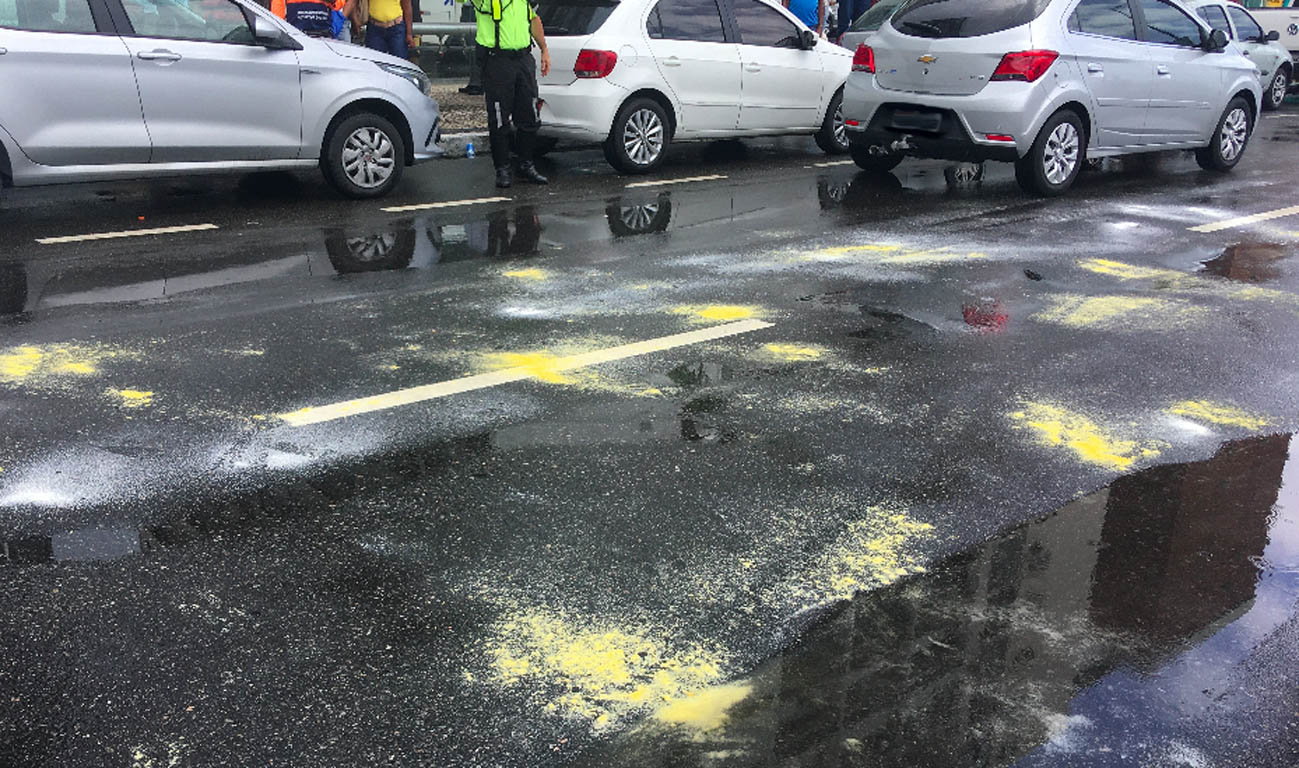
The avenue’s asphalt, marked off to Exu.
The media coverage resonated the activists’ discourse about the event. TV Globo’s Bahia Meio Dia, the main local daytime news program, broadcasted live flashes of the protest and praised “the peaceful manifestation of these religious people, demonstrating that our belief [in Salvador] is in everything good: love, peace, hospitality, and above all religious tolerance.”[115] On the following day, the collective ebó was a cover story for the three major newspapers in the city: “A Tarde,” “Correio,” and “Tribuna da Bahia.” The reports showed a well-known shift of the local press attitude toward Candomblé: from a long history of persecution[116] to a more recent stand committed to instructing the readers with respectful views of the religion.[117] The way journalists dealt with the collective ebó was thus faithful to the political and religious meaning claimed by the activists, as they recurred to Candomblé's devotees and/or researchers to describe the act’s references. The report published by “Correio” is a clear example:
Every Monday is Exu’s day. He is everywhere, searching what is offered to him, as Candomblé priests defend. Not by chance, the offering dedicated to the orixá yesterday consisted of living bodies. The Makota Valdina National Front’s black bodies shaped the collective ebó. And they offered themselves symbolically to Exu, in Salvador’s Port. There was no [animal] killing or dispatch, but disapproval of the demonization of the Lord of the Body [Exu].[118]
One of the activists interviewed by the media pointed out that “religion is like a garment. The garment that fits you well and [makes] you feel good. So, if you belong to any other religion and the clothing suits you well, it’s not up to me to judge you. Belief is individual and we have to respect it. I will always respect it.”[119] His speech suggested that Afro-Brazilian religions have a unique feature among other ethical alternatives: they accept differences in the way the world is understood and experienced. Such feature is a crucial dimension of what Hartikainen calls the politics of respect, i.e., the idea that “in contrast to other religions, [Candomblé's practicioners] not only respect but also welcome all, irrespective of religious commitment, economic means, sexual orientation, or physical ability.”[120] Such respectful acceptance of difference is intertwined with the theology Afro-Brazilian religions follow, since the worshiped deities are as diverse as the people they are willing to embrace. Furthermore, this trait would qualify the politics carried out by the terreiro communities as a democratic mission, for its role in instructing other publics in the various struggles for reparation and rights.
However, not only the Afro-Brazilian field claimed a religiosity able to match democratic precepts during the controversy. One suggestive stand in the construction of the public problem came from the Bahian Ecumenical Council of Christian Churches, joined by the Roman Catholic Apostolic Church and several churches of the Protestant spectrum, including Baptist, Presbyterian, Anglican, and Lutheran denominations. A public note declared the Council was indignant “with yet another act of religious racism towards our Bahian sisters and brothers of Afro-Brazilian religions.”[121] Making a distinction between the Council and the ship, the note stated that “even though we have no connections with the organization mentioned above, we humbly apologize to all Bahians, to all men and women following African-inspired religions for this aggression. … Our ancestors brought the weird accusation that these were ‘Devil religions.”[122] Referring to the legacy of the colonial process – the historical birth of Christianity in Brazil – the Ecumenical Council ended the note by saying that “once again the ‘demons’ arrive in these lands by ship. Five hundred years ago, the ‘demons’ came from Portugal ‘to rob, kill and destroy’ the people of this land. Once again, the structures of sectarianism and hatred – which certainly do not come from God or heaven – are approaching our port.”[123]
On the same day of the collective ebó, the Public Prosecutor’s Office in Bahia and Logos Hope organizers signed a “Termo de Ajustamento de Conduta” (Behavior Adjustment Term), a form of agreement to repair the violation of a collective right without the execution of a judicial process. The document highlighted the “social repercussions and indignation generated by the [ship’s] message, especially among social movements associated with the terreiros peoples, denoting the occurrence of moral damage of a collective nature.”[124] Logos Hope organizers committed to carrying out two actions, both subject to prior approval by the Public Prosecutor’s Office in Bahia. First, they should circulate “an apology in the press media, in two newspapers with large circulation in the city.”[125] The published note argued that the vessel’s statements on social media “were not based on a comprehensive awareness regarding Salvador’s people. … We apologize unreservedly for any appearance of ignorance or religious intolerance that the comment has created.”[126] The text thus mentioned “religious intolerance,” not citing the racist meaning of the social media post.
The adjustment term also required the organization to create and disseminate a 3-minute video whose script “should focus on the phenomenon of religious racism against religions of African origin and the importance of respect and inter-religious dialogue.”[127] The video should capture “testimonials from priests/priestesses from different religions based in Salvador, preferably dressed according to their religious beliefs and in their worship spaces.”[128] In addition to being exhibited on the ship’s social media and institutional channels, the video should also be reduced to a 30-second format, “for dissemination in two of the main local TV outlets, at times of great audience, and for one week.”[129] At the end of November 2019, when the ship had already left the country, the TV ad circulated, bringing testimonials from priests and priestesses linked to the inter-religious movement in the city. With a didactic focus and without mentioning the ship’s controversy, the video script pointed out the many vices of “a history that perpetuated religious racism. This reality urges the Judiciary and society to be attentive to fostering inter-religious respect and guaranteeing equal freedom of belief for all people.”[130]
The controversy involving the Christian ship is illustrative of the diverse uses of “religious racism” as a category by activists, the press, the inter-religious movement, and the Judiciary. Even though that feeling of injustice primarily reached Candomblé's devotees and communities, it also touched several other publics in Salvador at that moment. The collective ebó was thus a very singular way to embody that feeling, bringing the “religious” (its ritual forms, music, objects, etc.) to the “public.” In this sense, we should not overlook that the act occurred at the beginning of “Black November,” a key season for antiracist activism in Salvador. The experience of belonging to a civil environment increasingly aware of such discriminatory gestures was well described by a priest during the protest: “What they [those responsible for the ship] don’t know is that they messed in an anthill.”[131] In the final section, I discuss some of the conditions for the effectiveness of the protest within this controversy, getting back to the discussion on the relationship between Candomblé and the public environment in Salvador.
3 “We Have to Own What is Ours” – Final Considerations
Luana Souza’s research[132] shows that the Makota Valdina National Front has continued to hold collective ebós, even during the pandemic, in an online format. In July 2021, the group resumed on-site protests to oppose the Bahian government’s proposal of privatizing São Bartolomeu Park, a reference site for Afro-religious people in the city. In February 2022, a demonstration at the City Council made a stand against a bill seeking to change the name of Lagoa Dunas do Abaeté (Abaeté Dunes Lagoon), another important place for devotees, to “Monte Santo Deus Proverá” (God will Provide Mount). As part of terreiro politics, the movement has developed its manner to transform religious offense into motivation for civil action. Interestingly, although its political tune, the cosmological rooting of the collective ebó allows it to claim the nature of a religious ritual, according to that triple dimension proposed by Victor Turner:[133] (1) an act of a prescriptive nature that (2) suspends the routine and (3) mediates with mystical beings or powers.
The rise of collective ebó as civil protest technology suggests the role the category “religious racism” has been playing in the political and legal confronting of attacks frequently suffered by Afro-Brazilian religions. This denunciation vocabulary reorganizes social struggle fields, giving legibility to such forms of injury and triggering more effective actions by State institutions compared to appeals against “religious intolerance.”[134] Hermeneutic resources are thus a crucial part of social movements’ endeavor of inscribing a lived experience into a particular moral frame. According to Cardoso de Oliveira,[135] even physical violence depends on a symbolic order to be interpreted as aggression against a person. In this sense, every offense depends on a repertoire of references to make that damage intelligible for the subjects of the experience and the different publics its reparation demands. The historical development of human rights’ grammar has triggered a refinement of such discursive forms to enunciate social suffering. This enterprise has counted on the participation of concerned actors, activists, social movements, research centers, lawyers, the media, etc. More broadly available, such denunciation keys challenge current conceptions of justice, as illustrated by political and epistemic struggles denaturalizing iniquities caused by gender, race, or sexuality.[136]
The social circulation of the category “religious racism” is a historical effect of the law that regulates prejudice based on color or race (Law 7.716/1989), revised in 1997 to comprehend religiously motivated discrimination. This legal framing results from the organization of black movements and responds to a gap in executing the Brazilian Criminal Code (1940). The penalization of crimes against “religious sentiment” (article 208) has historically collided with the interpretations given by law enforcement agents, who tend to reduce the intolerance episodes to mere forms of opinion disagreement.[137] In this context, the injuries suffered by devotees of Afro-Brazilian traditions have become better understood as collective moral damage when re-elaborated as racist attitudes.[138] Such a phenomenon has also made it possible to defend the civil rights of minority religious groups in other political landscapes, as shown by the case of Muslim immigrants in European countries.[139]
Nonetheless, an injury’s discursive and legal translation may be not enough to persuade the different publics which a social transformation depends on. Other conditions also seem necessary for gathering a more generic community around a cause and enabling essential commitments to effective political action. Indeed, the collective ebó not only reflects the hermeneutic assimilation of the category “religious racism” in Salvador’s political context but also exemplifies a second dimension of social movement procedures: the use of performative resources that speak to the emotion, the sensorium and the attention of an audience, presupposed as part of the desired social change. Collective ebó seems to be a successful civil protest technology as it affects politically influential groups in the city (the press, the Public Prosecutor’s Office, the inter-religious movement, etc.) by employing new forms of public performance, as seen in other social mobilizations triggered by the terreiro politics [140] and spiritual citizenship.[141]
The art of civil protest encompasses a dramaturgical composition [142] once it transcends the episodic offenders and facts by positioning them as parts of a broader moral plot, whose display is necessary for the damage to be atoned. In other words, to engage dispersed and socially relevant groups in transforming private suffering into a public problem, an injustice should be felt as so, a feat that laws cannot accomplish alone. Social movements’ claims succeed when they master both the State institutions’ vocabulary and the ideal forms of staging a dramatic action. [143] This is what enables their different audiences to imagine or even feel, in the first person, a specific experience of suffering. Disseminated by different media, protest performances embody a problem whose answer requires a shift of the moral community’s consciousness. Involving social actors who are not directly affected by the injury thus requires not only rationally organized demands, but also a perception engraved in affective and emotional layers of experience, in the political scene that assesses damage.[144]
Some studies on the relationship between the public and the private in Afro-Brazilian religions suggest the ambivalence of historical efforts to make their cosmologies understandable outside the terreiros.[145] First, such analyses acknowledge that the dialogue of those religious traditions with the State corresponds to their inclusion – even if late and controlled – into public recognition frames, as exemplified by the political initiatives to incorporate Candomblé terreiros to the national cultural heritage. On the other hand, such literature also points out that this attempt entails a dangerous consequence: the gradual adjustment of terreiro communities to the conception of “religion” legible through the State’s lens. In this regard, claiming the status of religion “often means talking about Candomblé according to a Protestant Christian model that shifts the focus from ritual practices, historically more important for Candomblé communities than elaborate beliefs.”[146]
Nonetheless, by creatively bringing Candomblé's ritual elements to the public, the collective ebó seems to go in another direction: it outlines what should be “an inter-religious conviviality in an enchanted public space.”[147] This civil protest technology may illustrate an alternative democracy,[148] i.e., the possibility of reimagining the public sphere and remodeling citizenship through religiously oriented values. Such idea was suggested by the Makota Valdina Front’s Manifesto,[149] which placed Candomblé's devotees as guardians of the sacred nature against the fundamentalist groups supporting the Bolsonaro administration. Such an argument implies a conflict articulated not in terms of transcendent truth. Instead, the highlighted point is the greater or lesser ability of the different religious platforms to engender civic virtues, by translating their theological assumptions into secular political experience.
As this article sought to indicate, the semiotics behind the uses of the word “ebó” may be part of a specific history of restoring the political inherent to the religious.[150] When Candomblé's practitioners claim the right “to own what is theirs” in the public sphere, they seem to depict ebó as a sacred resource to manage forces in the search for balance. Following Makota Valdina’s teachings, such mobilization of religious symbols thus suggests a shift. In the twentieth-century “Public Candomblé” repertoire, ebó ritual was not rarely portrayed as a self-interested spiritual good for wide consumption, as seen in “Dona Flor and her Two Husbands’” narrative. In the semantic dispute analyzed in this text, ebó reappears as a sign that racializes the ritual and reappropriates its cosmopolitical heritage for the terreiro communities.
Acknowledgments
I thank the following researchers for sharing with me, on different occasions, their perspectives on some issues raised in this article: Anne Beutter, Carla Nogueira, Emerson Giumbelli, Hannah Bellini, Luana Souza, Maya Mayblin, and Ramona Jelinek-Menke. I also thank the anonymous reviewers of Open Theology for contributing to my argument.
-
Conflict of interest: Author states no conflict of interest.
References
Alexander, Jeffrey. “A Tomada Do Palco: Performances Sociais de Mao Tsé-Tung a Martin Luther King, e a Black Lives Matter hoje.” Sociologias 19, no. 44 (2017), 198–246.10.1590/15174522-019004407Search in Google Scholar
Almeida, Rosiane Rodrigues de. A luta por um “modo de vida”: enfrentamento ao racismo religioso no Brasil. Niterói: Eduff, 2022.Search in Google Scholar
Amado, Jorge. Dona Flor e seus dois maridos: História moral e de amor. São Paulo: Companhia das Letras, 2008.Search in Google Scholar
Bastide, Roger. O candomblé da Bahia (Rito Nagô). São Paulo: Companhia Editora Nacional, 1961.Search in Google Scholar
Boaz, Danielle. “Introducing Religious Reparations: Repairing the Perceptions of African Religions Through Expansions in Education.” Journal of Law and Religion 26, no. 1 (2010), 213–48.10.1017/S0748081400000953Search in Google Scholar
Bosisio, Izabella Pessanha Daltro. Quando a religião se faz pública: um estudo sobre eventos religiosos no calendário e nas ruas da cidade de Porto Alegre. Ph.D Thesis submitted to the Graduate Program in Anthropology, Federal University of Rio Grande do Sul, Brazil, 2021.Search in Google Scholar
Butler, Judith. Notes Toward a Performative Theory of Assembly. London: Harvard University Press, 2015.10.4159/9780674495548Search in Google Scholar
Calvo-González, Elena and Luciana Duccini. “On ‘Black Culture’ and ‘Black Bodies’: State Discourses and Public Policies in Salvador da Bahia, Brazil.” In Tourism, Power and Culture, edited by Donald V. L. Macleod and James G. Carrier, 134–52. Bristol; Bufalo; Toronto: Channel View Publications, 2010.10.21832/9781845411268-011Search in Google Scholar
Camurça, Marcelo and Ozaías Rodrigues. “O debate acerca das noções de ‘intolerância religiosa’ e ‘racismo religioso’ para a compreensão da violência contras as religiões afrobrasileiras.” Revista OQ: Dossiê Racismo Religioso, Cuidado e Comunidades Negras Tradicionais 5, no. 6 (2022), 6–30.Search in Google Scholar
Cid, Gabriel, João Domingues, and Leandro de Paula. “‘Um governo dedicado ao homem comum e seus valores’: a cultura como objeto da política na gestão Bolsonaro.” Antropolítica: Revista Contemporânea de Antropologia 54, no. 1 (2022), 38–63. 10.22409/antropolitica2022.i1.a52002.Search in Google Scholar
Copelotti, Lucía. “As controvérsias em torno das práticas rituais de matriz afro-brasileira no espaço público e a composição de uma arena pública.” In Pensando o Rio: meio ambiente, espaço público e conflitos identitários, edited by Roberto Kant Lima, Fabio Reis Mota, and Felipe Berocan Veiga, 149–74. Niterói: Intertexto, 2019.Search in Google Scholar
Cardoso de Oliveira, Luís Roberto. “Existe violência sem agressão moral?” Revista Brasileira de Ciências Sociais 23, no. 67 (2008), 135–46.10.1590/S0102-69092008000200010Search in Google Scholar
Carvalho, José Jorge de. “Um espaço público encantado: pluralidade religiosa e modernidade no Brasil.” Série Antropologia 249, Departamento de Antropologia da UNB, Brasília (1999), 1–22.Search in Google Scholar
Castor, N. Fadeke. Spiritual Citizenship: Transnational Pathways from Black Power to Ifa in Trinidad. Durham: Duke University Press, 2017.10.1215/9780822372585Search in Google Scholar
Conselho Ecumênico Baiano de Igrejas Cristãs. “Nota,” October 26, 2019. https://conic.org.br/portal/conic/noticias/navio-logos-hope-em-nota-cebic-denuncia-crime-de-racismo. Last accessed on May 29, 2023.Search in Google Scholar
Coutinho, Carlos Nelson. Cultura e Sociedade no Brasil. São Paulo: Expressão Popular, 2011.Search in Google Scholar
Debates do Ner. “Debate.” Debates do NER 13, no. 22 (2012), 123–249.Search in Google Scholar
Duccini, Luciana. Diplomas e decás: identificação religiosa de membros de classe média no candomblé. Salvador: Edufba, 2016.Search in Google Scholar
Elbein dos Santos, Juana. Os nagô e a morte. Pàdà, Asèsè e o culto Égun na Bahia. Petrópolis: Vozes, 1986.Search in Google Scholar
Eyerman, Ron. “Performing Opposition or How Social Movements Move.” In Social Performance: Symbolic Action, Cultural Pragmatics, and Ritual, edited by Jeffrey C. Alexander, Bernhard Giesen, and Jason L. Mast, 193–217. Cambridge: Cambridge University Press, 2006. 10.1017/CBO9780511616839.007.Search in Google Scholar
Giumbelli, Emerson. “Cultura pública: evangélicos y su presencia en la sociedad brasileña.” Sociedad y Religión: Sociología, Antropología e Historia de la Religión en el Cono Sur 23, no. 40 (julio/octobre 2013), 13–43.Search in Google Scholar
Grimes, Ronald L. “Victor Turner’s Definition, Theory and Sense of Ritual.” In Victor Turner and the Construction of Cultural Criticism: Between Literature and Anthropology, edited by Kathleen Ashley, 141–6. Indiana: Indiana University Press, 1990.Search in Google Scholar
Hartikainen, Elina. “A Politics of Respect: Reconfiguring Democracy in Afro-Brazilian Religious Activism in Salvador, Brazil.” American Ethnologist 45, no. 1 (2018), 87–99. 10.1111/amet.12601.Search in Google Scholar
Hartikainen, Elina. “Candomblé and the Academic’s Tools: Religious Expertise and the Binds of Recognition in Brazil.” American Anthropologist 121, no. 4 (December 2019), 815–29. 10.1111/aman.13272.Search in Google Scholar
Hartikainen, Elina. “Racismo Religioso, Discriminação e Preconceito Religioso, Liberdade Religiosa.” Debates do NER 21, no. 40 (2021), 89–114. 10.22456/1982-8136.120588.Search in Google Scholar
Johnson, Paul Christopher. Secrets, Gossip, and Gods: the Transformation of Brazilian Candomblé. Oxford: Oxford University Press, 2002.10.1093/0195150589.001.0001Search in Google Scholar
Frente Nacional Makota Valdina. “Manifesto.” November 3, 2019. https://web.facebook.com/notes/814391572732279/. Last Accessed on May 24, 2023.Search in Google Scholar
Mahmood, Saba. “Religious Reason and Secular Affect: An Incommensurable Divide?” Critical Inquiry 35, no. 4 (Summer 2009), 836–62. 10.1086/599592.Search in Google Scholar
Meyer, Birgit. Translating the Devil: Religion and Modernity among the Ewe in Ghana. Edinburgh: University of Edinburgh Press, 1999.Search in Google Scholar
Meyer, Birgit. “Going and Making Public. Some Reflections on Pentecostalism as Public Religion in Ghana.” In Christianity and Public Culture in Africa, edited by Harri Englund, 149–66. Athens: Ohio University Press, 2011.Search in Google Scholar
Miranda, Ana Paula Mendes de. “A ‘política dos terreiros’ contra o racismo religioso e as políticas ‘cristofascistas’.” Debates do NER 21, no. 40 (2021), 17–54. 10.22456/1982-8136.120344.Search in Google Scholar
Miranda, Ana Paula Mendes de and Rosiane Rodrigues de Almeida. “‘A galinha da religião de preto’ e o reconhecimento de direitos: controvérsias e mobilizações dos povos tradicionais de terreiro em defesa da soberania alimentar e do enfrentamento ao racismo.” Religião e Sociedade 42, no. 2 (2022), 43–65. 10.1590/0100-85872022v42n2cap02.Search in Google Scholar
Miranda, Ana Paula Mendes de, Jacqueline de Oliveira Muniz, Rosiane Rodrigues de Almeida, and Fausto Cafezeiro. “Terreiros sob ataque? A governança criminal em nome de Deus e as disputas do domínio armado no Rio de Janeiro.” Dilemas - Revista de Estudos de Conflito e Controle Social 15, Special Edition no. 4 (2022), 619–50. 10.4322/dilemas.v15nesp4.46976.Search in Google Scholar
Modood, Tariq. “The Liberal Dilemma: Integration or Vilification?” International Migration 44, no. 5 (2006), 4–7.10.1111/j.1468-2435.2006.00386.xSearch in Google Scholar
Montero, Paula. “Controvérsias Religiosas e Esfera Pública: repensando as religiões como discurso.” Religião e Sociedade 32, no. 1 (2012), 167–83. 10.1590/S0100-85872012000100008.Search in Google Scholar
Montero, Paula (ed.). Religiões e controvérsias públicas: Experiências, práticas sociais e discursos. Campinas: Ed. Unicamp, 2015.Search in Google Scholar
Morais, Mariana Ramos de. De religião a cultura, de cultura a religião: travessias afro-religiosas no espaço público. Belo Horizonte: Editora PUC Minas, 2018.Search in Google Scholar
Morais, Mariana Ramos de. “Intolerância, racismo e genocídio religiosos do povo negro.” Debates do NER 21, no. 40 (2021), 137–62. 10.22456/1982-8136.120544.Search in Google Scholar
Morais, Mariana Ramos de. “‘Povos e Comunidades Tradicionais de Matriz Africana’ no combate ao ‘racismo religioso’: a presença afro-religiosa na Política Nacional de Promoção da Igualdade Racial.” Religião e Sociedade 41, no. 3 (2021), 51–73. 10.1590/0100-85872021v41n3cap02.Search in Google Scholar
Nogueira, Carla Maria Ferreira. “Fé, boca calada e pé ligeiro”: Nengua Guanguacesse e Terreiro Bate Folha. Patrimônio e Memórias da Religiosidade Negroafricana na Bahia. Ph.D Thesis submitted to the Graduate Program in Culture and Society, Federal University of Bahia, Salvador, Brazil, 2022.Search in Google Scholar
Novaes, Luciana de Castro Nunes. “A tecnologia do ebó: arqueologia de materiais orgânicos em contextos afro-religiosos.” Revista de Arqueologia 34, no. 3 (2021), 283–306. 10.24885/sab.v34i3.919.Search in Google Scholar
Paula, Leandro de. “A alma como problema público: espiritualidade e saúde no contexto dos EUA.” Religião e Sociedade 40, no. 3 (2020), 95–119. 10.1590/0100-85872020v40n3cap04.Search in Google Scholar
Paula, Leandro de. “A multiplicidade do sagrado na regulação do religioso: uma experiência em Salvador/BA.” Boletim do Observatório da Diversidade Cultural 86, no. 6 (2019), 11–21.Search in Google Scholar
Paula, Leandro de. Entre a Virtude e o Risco: sobre religião e opinião pública. Ph.D. Thesis submitted to the Graduate Program in Communication, Federal University of Rio de Janeiro, Brazil, 2016.Search in Google Scholar
Paula, Leandro de. “Sagrados em Ação: diversidade religiosa e ação curricular em Salvador/BA”. Revista Intolerância Religiosa 6 (2024) (in press).Search in Google Scholar
Paula, Leandro de. “‘Um rio de opinião subterrâneo’: contrapúblicos terrivelmente evangélicos.” Horizonte: Revista de Estudos de Teologia e Ciências da Religião 18, no. 56 (2020), 570–99. 10.5752/P.2175-5841.2020v18n56p570.Search in Google Scholar
Paula, Leandro de and Pedro Ayala. “Contrapublicidade e a política racial da Fundação Cultural Palmares (2019-2022).” Dissonância 7, (2023), 1–51.Search in Google Scholar
Pinho, Osmundo. “A Bahia no Fundamental: notas para uma interpretação do discurso ideológico da Baianidade.” Revista Brasileira de Ciências Sociais 13, no. 36 (1998), 1–16.10.1590/S0102-69091998000100007Search in Google Scholar
Pinto, Valdina. Candomblé Cosmology and Environmental Education, 2002 Lecture at the Iliff School of Theology. Translation by Rachel Harding. Published on the Veterans of Hope Project website. http://www.veteransofhope.org/afro-brazilian-religious-wisdom-environmental-justice.Search in Google Scholar
Pinto, Valdina and Rachel Harding. “Afro-Brazilian Religion, Resistance and Environmental Ethics: A Perspective from Candomblé.” Worldviews 20, no. 1 (2016), 76–86.10.1163/15685357-02001007Search in Google Scholar
Prandi, Reginaldo. Herdeiras do Axé. São Paulo: Hucitec, 1997.Search in Google Scholar
Querino, Manuel. A raça africana e seus costumes na Bahia. Salvador: P55 Edições, 2021.Search in Google Scholar
Rabelo, Miriam. Enredos, feituras e modos de cuidado: dimensões da vida e da convivência no candomblé. Salvador: Edufba, 2014.Search in Google Scholar
Rabelo, Miriam. “Os percursos da comida no Candomblé de Salvador.” Papeles de Trabajo 7, no. 11 (2013), 86–108.Search in Google Scholar
Reinhardt, Bruno. Espelho ante espelho: a troca e a guerra entre o neopentecostalismo e os cultos afro-brasileiros em Salvador. Masters Dissertation submitted to the Graduate Program in Social Anthropology, University of Brasília, Brazil, 2006. https://repositorio.unb.br/handle/10482/3588.Search in Google Scholar
Santos, Carlos Alberto Ivanir dos. Marchar não é caminhar: interfaces políticas e sociais das religiões de matrizes africanas no Rio de Janeiro contra os processos de intolerância religiosa (1950-2008). Ph.D Thesis submitted to the Graduate Program in Compared History, Federal University of Rio de Janeiro, Brazil. 2018. https://ppghc.historia.ufrj.br/index.php? option = com_docman&view = download&alias = 274-marchar-nao-e-caminhar-interfaces-politicas-e-sociais-das-religioes-de-matrizes-africanas-no-rio-de-janeiro-contra-os-processos-de-intolerancia-religiosa-1950-2008&category_slug = teses&Itemid = 155.Search in Google Scholar
Santos, Edmar Ferreira. O poder dos candomblés: perseguição e resistência no Recôncavo da Bahia. Salvador: Edufba, 2009.10.7476/9788523212100Search in Google Scholar
Selka, Stephen. “Candomblé público revisitado.” Debates do NER 21, no. 40 (2021), 61–88. 10.22456/1982-8136.120589.Search in Google Scholar
Serra, Ordep. Águas do Rei. Petrópolis: Vozes/Koinonia, 1995.Search in Google Scholar
Silva Jr., Hédio. “Notas sobre sistema jurídico e intolerância religiosa no Brasil.” In Intolerância Religiosa: impactos do neopentecostalismo no campo religioso afro-brasileiro, edited by Vagner Gonçalves da Silva, 303–23. São Paulo: Edusp, 2007.Search in Google Scholar
Silva, Vagner Gonçalves. Orixás da Metrópole. São Paulo: FEUSP, 2022.10.11606/9786587047324Search in Google Scholar
Sliwinski, Sharon. “Inventing Human Dignity.” In The Routledge Companion to Literature and Human Rights, edited by Sophia Mcclennen and Alexandra Schultheis, 173–83. London: Routledge, 2018. 10.4324/9781315778372.Search in Google Scholar
Souza, Luana. Vozes sagradas: as resistências de mulheres negras de candomblé da Bahia. Masters Dissertation submitted to the Graduate Program in Culture and Society, Federal University of Bahia. 2021. https://repositorio.ufba.br/handle/ri/36421.Search in Google Scholar
Tavares, Fátima. “Sobre a ‘Política dos Terreiros’ em Salvador: comentários ao texto de Ana Paula Mendes de Miranda.” Debates do NER 21, no. 40 (Ago./Dez. 2021), 193–202. 10.22456/1982-8136.120587.Search in Google Scholar
Tavares, Fátima, Camila Chagas, and Lidia Bradymir. “Intolerância religiosa ou racismo religioso? Povos tradicionais de terreiro de matriz africana e discriminação religiosa na Bahia.” In O Desafio da Produção contra colonial e Alternativas Antirracistas em Prol dos Direitos Humanos Fundamentais dos Povos e Comunidades Tradicionais, edited by Edelamare Barbosa Melo, 139–56. Brasília: CONAETE - Ministério Público do Trabalho, 2022.Search in Google Scholar
Teles dos Santos, Jocélio. O poder da cultura e a cultura no poder: a disputa simbólica da herança cultural negra no Brasil. Salvador: Ed. UFBA, 2005.10.7476/9788523208950Search in Google Scholar
Turner, Victor. “Symbols in Ndembu Ritual.” In Sociological Theory and Philosophical Analysis, edited by Dorothy Emmet and Alasdair MacIntyre, 150–82. London: Palgrave Macmillan, 1970.10.1007/978-1-349-15388-6_8Search in Google Scholar
Van de Port, Mattijs. “Candomblé in Pink, Green and Black. Rescripting the Afro-Brazilian Religious Heritage in the Public Sphere of Salvador, Bahia.” Social Anthropology 13, no. 1 (2005), 3–26.10.1017/S0964028204001077Search in Google Scholar
Van de Port, Mattijs. Ecstatic Encounters: Bahian Candomblé and the Quest for the Really Real. Amsterdam: Amsterdam University Press, 2011.10.1515/9789048513963Search in Google Scholar
Verger, Pierre. Notas sobre o culto aos orixás e voduns. São Paulo: Edusp, 2002.Search in Google Scholar
© 2024 the author(s), published by De Gruyter
This work is licensed under the Creative Commons Attribution 4.0 International License.
Articles in the same Issue
- Special issue: Sacrifice and the Body: Explorations beyond Metaphysics, edited by Katerina Koci (Institute for Human Sciences and University of Vienna, Austria) and Esther Heinrich-Ramharter (University of Vienna, Austria)
- Bodies that Give: Sacrifice Beyond Metaphysics
- Sacrifice and Natality: Surrogacy Structures
- Putting on Sarah’s Skin: Victim Identity in the Abrahamic Stories and Beyond
- The Impossibility of Representing the Sacrifice of Abraham and Isaac in Barnett Newman’s Painting
- Sacrifice as Necessity and the Ascetic Principle of Filmmaking: Andrei Tarkovsky Reconsidered
- “The Remedy for a World Without Transcendence”: Georges Bataille on Sacrifice and the Theology of Transgression
- Beyond the Sacrificial Fantasy: Body, Law, and Desire
- Blood Lines: Biopolitics, Patriarchy, Myth
- Special issue: Inductive Theology: How Systematic Theologies Can Relate to Everyday Life, edited by Lea Chilian (University of Zurich, Switzerland) and Frederike van Oorschot (University of Heidelberg, Germany)
- Topical Issue: “Inductive Theology. How Systematic Theologies Can Relate to Everyday Life”
- Distributed Normativity in Theology: On the Relevance of Empirical Research Approaches to Systematic Theology
- Context-Attentive Theology: On the Rearticulation of Experience in Theological Inquiry
- Constructive After Systematic? On Doing Theology in South Africa Today
- Exploring Ethical Potentials of Christian Narrative Testimonies
- Imaginaries and Normativities. Experimental Impulses for Digital and Public Theologies
- Beyond Theory and Practice: Lived Theology and Its Intersection with Empirical Theology
- To Be Oriented and to Orient: Considerations on Principles, Requirements, and Objectives of an Inductive Systematic Theology
- Special issue: Gendered Allegories: Origen of Alexandria and the Representation of the Feminine in Patristic Literature, edited by Lavinia Cerioni (Aarhus University, Denmark)
- Editorial Introduction
- Sophia: The Female Aspect of Christ in Origen of Alexandria
- Feminine Metaphorical Language: Platonic Resonances in Origen of Alexandria
- The Doctrine of Memory in Origen of Alexandria: Intersecting the Theory of Divine Names, Platonic Recollection, and Feminine Perspectives
- The Pastoral Usefulness of Female Scriptural Speech in Origen of Alexandria
- “Teachers of Good Things”: Origen on Women as Teachers
- A Militant Bride: Gender-Loaded Metaphors in Jerome’s Writings to Ascetic Men and Women
- Regular Articles
- Becoming Child of the Moment through Deleuzian Philosophy and Sufism
- Interdisciplinary Approach to Overcoming the Persistence of Patriarchal Islamic Interpretations: Gender Equality, the Development of Empathy and Children’s Rights, and Insights from the Reformist Eurasian Scholars of Early Twentieth Century
- “… God Said”: Toward a Quantum Theology of Creation
- Daniel and Revelation: Blasphemy in the Cosmic Conflict
- Forward and Reverse Gematria are Very Different Beasts
- Candomblé in Public: How Religious Rites Become Civil Technologies in Salvador, Brazil
- Worry and Analytic Theology
- Framing the Reading Experience of an Apocryphal Text: The Case of the 1 Apocryphal Apocalypse of John’s Titles
- Against the Nudity in Art: Eliasian Reading of National Conservative Catholic Habitus
- Almighty, Freedom, and Love: Toward an Islamic Open Theology
- Gender-Oriented Analysis of Witchcraft Discourse in Social Media
- Clergy Becoming Spiritual but not Religious
- The Corrupted “Wheel of Life”: An Essay on Ouroboroses
- Review Article
- From Below, to Inclusion, Through Transformation: Urban Theology in the Twenty-First Century
Articles in the same Issue
- Special issue: Sacrifice and the Body: Explorations beyond Metaphysics, edited by Katerina Koci (Institute for Human Sciences and University of Vienna, Austria) and Esther Heinrich-Ramharter (University of Vienna, Austria)
- Bodies that Give: Sacrifice Beyond Metaphysics
- Sacrifice and Natality: Surrogacy Structures
- Putting on Sarah’s Skin: Victim Identity in the Abrahamic Stories and Beyond
- The Impossibility of Representing the Sacrifice of Abraham and Isaac in Barnett Newman’s Painting
- Sacrifice as Necessity and the Ascetic Principle of Filmmaking: Andrei Tarkovsky Reconsidered
- “The Remedy for a World Without Transcendence”: Georges Bataille on Sacrifice and the Theology of Transgression
- Beyond the Sacrificial Fantasy: Body, Law, and Desire
- Blood Lines: Biopolitics, Patriarchy, Myth
- Special issue: Inductive Theology: How Systematic Theologies Can Relate to Everyday Life, edited by Lea Chilian (University of Zurich, Switzerland) and Frederike van Oorschot (University of Heidelberg, Germany)
- Topical Issue: “Inductive Theology. How Systematic Theologies Can Relate to Everyday Life”
- Distributed Normativity in Theology: On the Relevance of Empirical Research Approaches to Systematic Theology
- Context-Attentive Theology: On the Rearticulation of Experience in Theological Inquiry
- Constructive After Systematic? On Doing Theology in South Africa Today
- Exploring Ethical Potentials of Christian Narrative Testimonies
- Imaginaries and Normativities. Experimental Impulses for Digital and Public Theologies
- Beyond Theory and Practice: Lived Theology and Its Intersection with Empirical Theology
- To Be Oriented and to Orient: Considerations on Principles, Requirements, and Objectives of an Inductive Systematic Theology
- Special issue: Gendered Allegories: Origen of Alexandria and the Representation of the Feminine in Patristic Literature, edited by Lavinia Cerioni (Aarhus University, Denmark)
- Editorial Introduction
- Sophia: The Female Aspect of Christ in Origen of Alexandria
- Feminine Metaphorical Language: Platonic Resonances in Origen of Alexandria
- The Doctrine of Memory in Origen of Alexandria: Intersecting the Theory of Divine Names, Platonic Recollection, and Feminine Perspectives
- The Pastoral Usefulness of Female Scriptural Speech in Origen of Alexandria
- “Teachers of Good Things”: Origen on Women as Teachers
- A Militant Bride: Gender-Loaded Metaphors in Jerome’s Writings to Ascetic Men and Women
- Regular Articles
- Becoming Child of the Moment through Deleuzian Philosophy and Sufism
- Interdisciplinary Approach to Overcoming the Persistence of Patriarchal Islamic Interpretations: Gender Equality, the Development of Empathy and Children’s Rights, and Insights from the Reformist Eurasian Scholars of Early Twentieth Century
- “… God Said”: Toward a Quantum Theology of Creation
- Daniel and Revelation: Blasphemy in the Cosmic Conflict
- Forward and Reverse Gematria are Very Different Beasts
- Candomblé in Public: How Religious Rites Become Civil Technologies in Salvador, Brazil
- Worry and Analytic Theology
- Framing the Reading Experience of an Apocryphal Text: The Case of the 1 Apocryphal Apocalypse of John’s Titles
- Against the Nudity in Art: Eliasian Reading of National Conservative Catholic Habitus
- Almighty, Freedom, and Love: Toward an Islamic Open Theology
- Gender-Oriented Analysis of Witchcraft Discourse in Social Media
- Clergy Becoming Spiritual but not Religious
- The Corrupted “Wheel of Life”: An Essay on Ouroboroses
- Review Article
- From Below, to Inclusion, Through Transformation: Urban Theology in the Twenty-First Century
