Copper and copper nanoparticles: role in management of insect-pests and pathogenic microbes
-
Mahendra Rai
Mahendra Rai is a UGC-BSR Faculty Fellow and Senior Professor at the Department of Biotechnology, Sant Gadge Baba Amravati University at Amravati, Maharashtra, India. He worked as a Visiting Scientist at different Universities including the University of Geneva, Switzerland, Debrecen University, Hungary; University of Campinas, Brazil, and Nicolaus Copernicus University, Poland. His area of expertise includes microbial biotechnology and nanobiotechnology. His present research interests are the application of nanobiotechnology in medicine and agriculture, in particular, the use of metallic nanoparticles as a new generation of antimicrobials. He has published more than 380 research papers in India and abroad. In addition, he has edited/authored more than 45 books.
 ,
Avinash P. Ingle
,
Avinash P. Ingle
Avinash P. Ingle has completed his doctoral degree from the Department of Biotechnology, Sant Gadge Baba Amravati University, Amravati, Maharashtra, India. He had worked as a Research Scientist in the same department from 2013 to 2016. He has more than 55 research publications, 30 book chapters, and two books to his credit. He has been awarded travel grants from different funding agencies to present his research work in international conferences held in Malaysia, China, Spain, and France. Currently, Dr. Ingle is working as a Post-Doctoral Fellow at the Department of Biotechnology, Engineering School of Lorena-University of São Paulo, Brazil, and he is actively engaged in the development of nanotechnology-based methods for the sustainable production of biofuels.
Raksha S. Pandit completed her master’s degree in 2013 and is recently pursuing her Ph.D. degree in Biotechnology at Sant Gadge Baba Amravati University, Amravati, India. Her area of interest includes the phytofabrication of metal nanoparticles and their functionalization with biomolecules for the development of potential antimicrobials.
Priti A. Paralikar graduated from the Department of Biotechnology, Sant Gadge Baba Amravati University, Amravati, India, in 2013. Currently, she is working on her doctoral research on the biosynthesis of sulfur nanoparticles and its conjugation with antibiotics and its
in vitro studies against urinary tract infection. She published her research work in reputed journals. Her area of interest is in the field of Nanobiotechnology and Microbiology.Sudhir completed his M.Sc. in Biotechnology in 2007, and at present, he is pursuing his doctoral study at the Department of Biotechnology, Sant Gadge Baba Amravati University, Amravati, India. He has published about 06 research papers and four book chapters in the journals of national and international repute with a total impact factor of 16 and a 04 h-index. He has been awarded travel grants from CICS, Chennai, the funding agency that participated and presented research papers in international conferences held at The Netherlands. His area of research is in nanobiotechnology, plant tissue culture, and plant sciences. He is currently working on the development of nano-based fungicides using green synthesized nanoparticles.
Indarchand R. Gupta completed his M.Sc. in Biotechnology in 2004, and at present, he is pursuing his doctoral study at the Department of Biotechnology, Sant Gadge Baba Amravati University, Amravati, India. He is working as an Assistant Professor at the Institute of Science, Aurangabad, India. He has published about 13 research papers and four book chapters. His area of interest is in nano-toxicology and animal cell culture. His study is mainly focused on
in vitro cytotoxicity assessment of silver nanoparticles on different animal cell models.Jayanta Kumar Biswas is presently serving as an Associate Professor at the Department of Ecological Studies and International Centre for Ecological Engineering, University of Kalyani. He received his M.Sc. in Zoology, M.Phil. in Ecology, and Ph.D. for his work on ecotechnological approaches toward remediation of environmental problems of aquatic systems. He has about 18 years of teaching experience and 21 years of research experience in the following areas: ecological engineering and ecotechnology, environmental microbiology, ecotoxicology and bioremediation of trace metal(oid)s, nanobiotechnology, aquatic pollution monitoring and ecoremediation, bioregenerative wastewater treatment, etc. He has published about 105 research papers in international and national journals, proceedings, and books, and 50 popular science articles in periodicals and magazines. He has visited Singapore, Belgium, and France with government travel fellowships and presented research papers and chaired scientific sessions in international conferences.
Silvio Silvério da Silva, is a full professor and head at the Department of Biotechnology, Engineering School of Lorena, University of São Paulo (USP Campus), Lorena, Brazil. He has more than 185 research publications, 30 book chapters, four books, and two patents to his credit. Prof. Silvio has presented about 770 papers in various international events. He has coordinated more than 22 research projects and guided 24 Ph.D., 30 master’s, and 74 scientific initiation students. In addition, he has received many prestigious awards. For the exchange of scientific knowledge on the various aspects in bioprocess and fermentation technology, he has visited several international research institutions in different countries. His area of research mainly includes Biotechnology with emphasis on Industrial Microbiology and Fermentation.

Abstract
Crop losses mainly occur due to biotic factors, which include soil-borne phytopathogens, insect pests, parasites, and predators. The major loss of food in the food industry is due to its spoilage by various microorganisms. With advancement in nanotechnology, the use of nanoparticles in food and agriculture crop yield can be improved. In this context, copper nanoparticles (CuNPs) have attracted a great deal of attention from all over the world due to their broad-spectrum antimicrobial activity. Copper is one of the key micronutrients, which plays an important role in growth and development of plants. CuNP-based fertilizer and herbicide can be used in agriculture. The small size of CuNPs facilitates their easy absorption by the plants. CuNPs can be promisingly used in the food packaging to avoid the growth of food spoilage microorganisms. The use of CuNP-based agar packaging materials has substantial potential to increase the shelf-life of food. The present review focuses on the application of Cu and CuNPs in food and agriculture. Moreover, antimicrobial and pesticidal properties of CuNPs are also discussed.
1 Introduction
The global human population is estimated to be seven billion, and it is projected to be more than eight billion by 2025. About 60% of the people of this population (i.e. 4.43 billion) are living in Asia [1], [2]. It is well known that the progress rate of the world is accelerated due to globalization, but as far as the agriculture is concerned, still a large population living in developing countries is facing the shortage of food due to enormous food wastage. According to the Food and Agriculture Organization (FAO), every year, around 1.3 billion tons of the edible food materials produced for human use is wasted globally. It was reported that wastage of food occurs at various stages of the food supply chain, i.e. from initial agricultural production to final household consumption. However, food wastage is more common in medium and high-income countries [3]. Because of these problems, it is a great challenge to produce enough quantity of food, which can feed seven billion people.
Food crop production can be increased by the development of drought- and insect-pest-resistant crop varieties [4], or alternatively, there is a necessity to develop novel fungicides, fertilizers, and pesticides, etc., which are target specific and efficient than their chemical counterparts available in the markets [5]. Chellaram et al. [6] rightly stated that nanotechnology is the only magical spell, which has a potential to revolutionize the current food and agriculture industries. It can be achieved by the development of various nanotechnological strategies including the nano-based products to overcome the problems associated with food and agricultural loss [6]. The remarkable antimicrobial potential of various metal nanoparticles may be applied for the development of novel nanoantimicrobials (antiviral, antibacterial, fungicidal, and pesticidal agents, etc.), which can be used as an effective tool for the management of plant diseases [5]. Similarly, nano-fertilizers can be formulated, which are reported to be easily absorbed by plants [7]. Moreover, the impact of nanotechnology in the food industry has become more apparent over the last few years. The important fields in which nanotechnology has demonstrated prominent applications include smart food packaging, food manufacturing, processing, and food preservations [8], [9], [10]. Among the various metal nanoparticles, silver (Ag), copper (Cu), and zinc (Zn) nanoparticles are preferentially used as antimicrobial agents. Out of these, silver is expensive metal, and hence, the cost involved in the preparation of silver nanoparticle-based products would be higher. On the contrary, Cu is comparatively cheaper and ubiquitously available. Therefore, the use of copper nanoparticles (CuNPs) in various agricultural applications is cost effective [11].
The main aim of this review is to discuss the different applications of CuNPs in agriculture and food sectors. Here, we have focused on antimicrobial and plant protection properties of CuNPs. Other important aspects such as mechanism involved in the interaction of nanoparticles with plant pathogens, CuNPs as nutrient for plant growth and their phytotoxicity, etc., are also discussed.
2 Copper through the ages
The archaeological evidence suggests that Cu was initially used between 8000 and 5000 B.C., most probably in the regions of Iran, Turkey, Iraq, and India. Archaeologists have also found proof of mining as well as annealing of abundant native Cu in the Upper Peninsula of Michigan in the US dating back to 5000 B.C. [12]. The Sumerians and the Chaldeans existing in prehistoric Mesopotamia are believed to be the leading community to make ample use of Cu, and their Cu crafting acquaintance was introduced to the ancient Egyptians. The Egyptians mined Cu from Sinai and used it to create agriculture and forestry tools such as sickles, hoes, chisels, saws, knives, and also utensils [13]. As per the chronology presented by the British Museum, their supreme epoch ranged amid 2800 and 2000 B.C. where Sumerians used bronze pots along with mixing trays originated in al’Ubaid, near Ur (circa 2600 B.C.) along with the silver-sprouted bronze jugs, saucer as well as drinking vessels, which were meant for traditional ceremonial purpose [14]. In ancient Ayurveda, Cu nanopowder (named as “Tamra Bhasma”) was used for the preparation of traditional medicines [15]. Cu and its compounds possess remarkable bactericidal and fungicidal activity, and therefore, are immensely used by the ancient farmers to control crop diseases. Copper sulfate was used to treat cereal seeds by many farmers in 1761 [16]. Nevertheless, it was not until the 1880s that copper sulfate fungicide was developed in an “accidental” invention of the Bordeaux mixture [17]. The farmers of the Bordeaux region, France, were using a paste of copper sulfate and lime mixture onto the grapes, which were infected with downy mildew. The French botany Professor Pierre-Marie-Alexis Millardet from the Bordeaux University observed that the grapes were free of disease [14]. By 1885, Prof. Millardet completed his experiments, which established the applicability of the mixture against downy mildew disease. By this time, the Bordeaux mixture was known globally as a fungicide [18].
3 Strategic role of CuNPs in food protection
The consumption of food contaminated with toxins of bacteria leads to various food-borne diseases such as campylobacteriosis, listeriosis, hemorrhagic colitis, and salmonellosis. In the US, it was estimated that more than 5000 people died and 76 million people suffered from food-borne illness [19]. Hence, it is essential to search for novel antimicrobial substance, which can solve the problem of food spoilage by microbes. Cu is present in green vegetables, meat, and fish (less than 2 mg). When Cu is present in a low concentration, it acts as a cofactor for metalloproteins and enzymes, whereas at a higher concentration, it performs as an antimicrobial agent against common food-borne pathogens such as Salmonella enterica and Campylobacter jejuni [20] yeast and moulds [21]. Al-Holy et al. [22] reported that copper along with lactic acid can be used in the preservation of infant food. Because of the antimicrobial efficacy of copper, researchers focused on its nanoparticles as an antimicrobial agent against food spoilage microorganisms.
3.1 Food preservation
Nanoparticles can be used in the prevention of food spoilage microorganisms. Recently, Arfat and coworkers [9] prepared agar-based active nanocomposite film reinforced with bimetallic nanoparticles, i.e. AgNPs-CuNPs. The authors found that agar film inhibited the growth of food spoilage microorganisms and, thus, prevented spoilage of food.
Agar-based nanocomposites’ film was developed by blending agar and CuNPs, which were synthesized using three different types of salt. All the synthesized nanoparticles were fortified into packaging material such as agar. Agar film, due to its antimicrobial nature, inhibited food spoilage bacteria [23]. Shankar et al. [23] also reported that agar film containing CuNPs have UV light-absorbing capacity without losing its mechanical properties and transparency. The Food and Drug Administration (FDA) recommended that Ag-Cu bimetallic nanoparticles (0.5–4%) can be used to prevent food spoilage [10]. CuNP-embedded nanocomposite film can be utilized in the packaging of food material [24]. Similarly, CuNP-embedded polyvinyl methylketone film demonstrated potential antimicrobial activity and prevented food spoilage. Furthermore, CuNP fluoropolymer film prevents spoilage of food [25].
3.2 As a potential antimicrobial agent
CuNPs have already demonstrated broad-spectrum antimicrobial activity [26]. The hybrid composite of CuNPs and cellulose embedded in polyvinyl alcohol (PVC) film improves the antimicrobial efficacy of nanoparticles. In this case, CuNPs and cellulose act as a nanofiller [27]. The antibacterial efficacy of the film exhibited potential activity against Escherichia coli. Jia et al. [28] synthesized copper-coated cellulose film and reported antimicrobial efficacy against bacteria, which cause food spoilage such as E. coli and Staphylococcus aureus. It was found that antimicrobial activity was highest against S. aureus compared to E. coli [28]. In another study, the antifungal efficacy of chitosan-coated CuNPs was evaluated against fungi such as Alternaria solani and Fusarium oxysporum, which are pathogenic to tomato [29]. Ramyadevi et al. [30] chemically synthesized CuNPs and reported their antimicrobial activity against bacteria including Micrococcus luteus, S. aureus, E. coli, Klebsiella pneumoniae, and Pseudomonas aeruginosa and fungi such as Aspergillus niger, Aspergillus flavus, and Candida albicans. The authors further reported that CuNPs were found to be highly active against E. coli followed by C. albicans, S. aureus, M. luteus, A. niger, K. pneumoniae, A. flavus, and P. aeruginosa [30].
The composite film of CuNPs and chitosan along with iodine as a stabilizing agent showed antibacterial efficacy against E. coli and Bacillus cereus [31]. Similarly, nanocomposite film containing CuNPs and cellulose acts as a potential antimicrobial agent against S. aureus and K. pneumoniae [32]. The antimicrobial study revealed that a composite film of CuNPs and cellulose demonstrated remarkable activity against Pseudomonas sp., which is responsible for spoilage of processed food, and thus, the film can be used in packaging of food [33]. Interestingly, guar gum-based nanocomposite film containing Ag-CuNPs showed antimicrobial activity against food spoilage microbes, viz. Listeria monocytogenes, S. enterica, and Salmonella typhimurium. Further, it was found that guar gum nanocomposite film demonstrated a higher activity against S. typhimurium compared to S. enterica and L. monocytogenes [10].
4 CuNPs as a boon to sustainable agriculture
4.1 As a plant nutrient
Various mineral elements are essentially required in the form of macro- and micronutrients for proper growth of vegetative and reproductive tissues. The macronutrients are generally required at the concentration of greater than 0.1% of dry tissue weight, which includes magnesium (Mg), potassium (K), nitrogen (N), calcium (Ca), sulfur (S), and phosphorus (P). However, nutrients that are required at a concentration less than 0.01% of the dry tissue weight are known as micronutrients. These are mainly copper (Cu), nickel (Ni), iron (Fe), molybdenum (Mo), manganese (Mn), boron (B), zinc (Zn), and chlorine (Cl). The macro- and micronutrients are responsible for various functions as structural components in macromolecules [34]. As mentioned earlier, all the above macro- and micronutrients are necessarily required by plants, but, here, we emphasized the role of Cu as a plant nutrient.
Plants require Cu as a micronutrient, which is evident by the presence of its high concentration in chloroplasts. It was estimated that 70% of the total Cu is found in chloroplasts. In fact, Cu plays an important role in the synthesis of chlorophyll and other plant pigments and is also responsible for protein and carbohydrate metabolism [35].
The deficiency of Cu may lead to various disease conditions in crop plants leading to loss in yield. Its deficiency may cause many disorders, which mainly include necrosis of the apical meristem, stunted growth, bleaching, and distortion of young leaves. Generally, Cu deficiency affects the vegetative growth, formation of grains, seeds, and fruits. In addition, reduction in lignification of cell walls in higher plants is a common anatomical change exhibited due to Cu deficiency. The reduced lignification of cell walls is mainly responsible for the distortion of young leaves, bending and twisting of stems and twigs [36].
The unavailability of Cu in free form is the main reason of Cu deficiency. Cu is mainly associated with organic matter, which is immobile in the soil, and hence, it results in the deficiency [35]. In this context, the use of CuNPs will solve all the above problems related to unavailability of Cu and its deficiency in plants.
The concentration-dependent efficacy of copper oxide nanoparticles (CuONPs) on seed germination and root growth was demonstrated in soybean and chickpea [37]. The seed germination was enhanced by CuONPs (having a diameter <50 nm) up to the concentration of 2000 ppm. However, the further increase in concentration affects the seed germination. On the contrary, root growth was prevented only at 500 ppm concentration [37]. Similarly, in another study, enhanced soybean seed germination percentage (65%) was also recorded when the seeds were treated with nanocrystalline powder of Cu and compared with untreated (control) seeds, which showed only 55% of seed germination [38]. The preliminary studies showed that CuNPs at 10, 20, 30, 40, and 50 ppm increased the plant growth and yield in wheat, whereas untreated (control) plants showed comparatively less growth and yield. Moreover, plants treated with 30 ppm of CuNPs had a significantly higher growth rate due to greater chlorophyll content, leaf area, number of spikes/pot, number of grains/spike, 100-grain weight, and grain yield. On the contrary, there are reports that demonstrated the negative effect of CuNPs on plant growth. Olkhovych et al. [39] reported that exposure of Pistia stratiotes to CuNPs led up to 25% decrease in ascorbic acid, amino acids, except for glycine. Recently, Siddiqi and Husen [40] also reviewed the negative effects of various metal oxide nanoparticles including CuONPs on plant growth [40].
4.2 Management of insect-pests and diseases
The use of Cu in agriculture is the well-known application as a plant protector against diseases caused by fungi and bacteria. As mentioned earlier, it is anticipated that each year, approximately one-third of the global plant harvest vanishes as a consequence of various plant diseases caused by viruses, bacteria, fungi, and insects. To control the menace of pathogens, copper was used in several formulations since ancient times. Copper sulfate is one of those compounds, which has antifungal properties and is a key ingredient in most of the commercially available fungicides for farm and garden. In a typical formulation, copper sulfate mixed with lime or soda ash in water was sprayed onto the plants. Cu-based fungicides create extremely reactive hydroxyl radicals that may damage lipids, DNA, proteins, as well as other bio-molecules, and thus, play a vital role for the prevention of disease occurring in huge diversity of plant species [41]. Copper oxide is also used as a fungicidal agent in the protection of tea, banana, cocoa, citrus, coffee, and other important plant species from major fungal leaf and fruit diseases, for instance, blight, downy or powdery mildew, and rust, etc. [42], [43]. Cu is also used in organic farming as a plant protectant. More than the last 15–20 years, there have been substantial efforts made by the organic farming sector both in search for the copper substitute in crop protection and also in minimizing the amounts of applied Cu. However, until now, there are no active substances, techniques, or methods that could serve as a substitute for Cu. Irrespective of the difficulties for the exploration of Cu substitutes, the research for superior methods and agronomic Cu-minimizing measures need to be intensified in the upcoming years [44]. The overuse of the chemical formulations in the field may lead to environmental hazards as well as soil damage.
With an effective application of emerging technologies like micro-emulsions, liposomes and nano-emulsions in agrochemical formulations reduced the use of petrochemicals in effective delivery of pesticides, herbicides, and fungicides [45]. Therefore, in the recent years, the use of nanotechnology for plant protection has emerged with a great impact [46]. At nanoscale, the active ingredients of the products are able to provide increased efficiency or better penetration of essential components to the plants [47]. Moreover, soda lime glass powder of low melting point containing Cu nanoparticles demonstrated effective antimicrobial activity against bacteria and fungi [48]. The enhanced antimicrobial activity is due to the inhibitory synergistic effect of the Ca2+ lixiviated from the glass. The comparative antifungal effect of Cu-based nanoparticles (11–55 nm) and other commercial agrochemicals on Phytophthora infestans infected tomato (Solanum lycopersicum) led to the conclusion that synthesized Cu-based nanoparticles possess more activity than the commercial agrochemicals at a low concentration [49]. In another study, the nano-copper was used against Xanthomonas axonopodis pv. punicae, a causative agent of bacterial blight in pomegranate [50]. Nano-copper inhibited the growth of bacterium at 0.2 ppm only, i.e. >10,000 times lesser than it is generally suggested for Cu-oxychloride. Cu with chitosan complex nano-gels was reported to inhibit the growth of cereal plant pathogenic fungus Fusarium graminearum due to their synergistic effect. These nano-hydrogels can be considered as a new generation of Cu-based bio-pesticides because of their bio-compatibility [51]. In vitro antifungal activity of CuNPs synthesized by chemical method was studied against plant pathogens, namely, F. oxysporum, Alternaria alternata, Curvularia lunata, and Phoma destructiva [52]. The study demonstrated a remarkable antifungal activity against the test fungi and recommended application of CuNPs as an antifungal agent in nano-formulation. Shende et al. [53] also reported the inhibitory effect of biogenically synthesized CuNPs on the development of F. oxysporum, Fusarium culmorum, and F. graminearum. Chemically synthesized CuNPs also inhibited the growth of F. culmorum, F. oxysporum, and Fusarium equiseti [54]. The nano-based products such as nano-pesticides, nano-fungicides, nano-insecticides, etc., are already in the market, while many others are under the developing stage [55]. Hence, in the agriculture sector, CuNPs will be the most demanding nano-formulations, which could be used in plant protection in the near future by various modes. Figure 1 shows a schematic illustration for various modes by which CuNPs can protect the plants and also help in its growth promotion (Cajanus cajan plant is taken as the model plant). Moreover, the possible mechanism for the antimicrobial action of CuNPs was discussed in detail in the subsequent section.
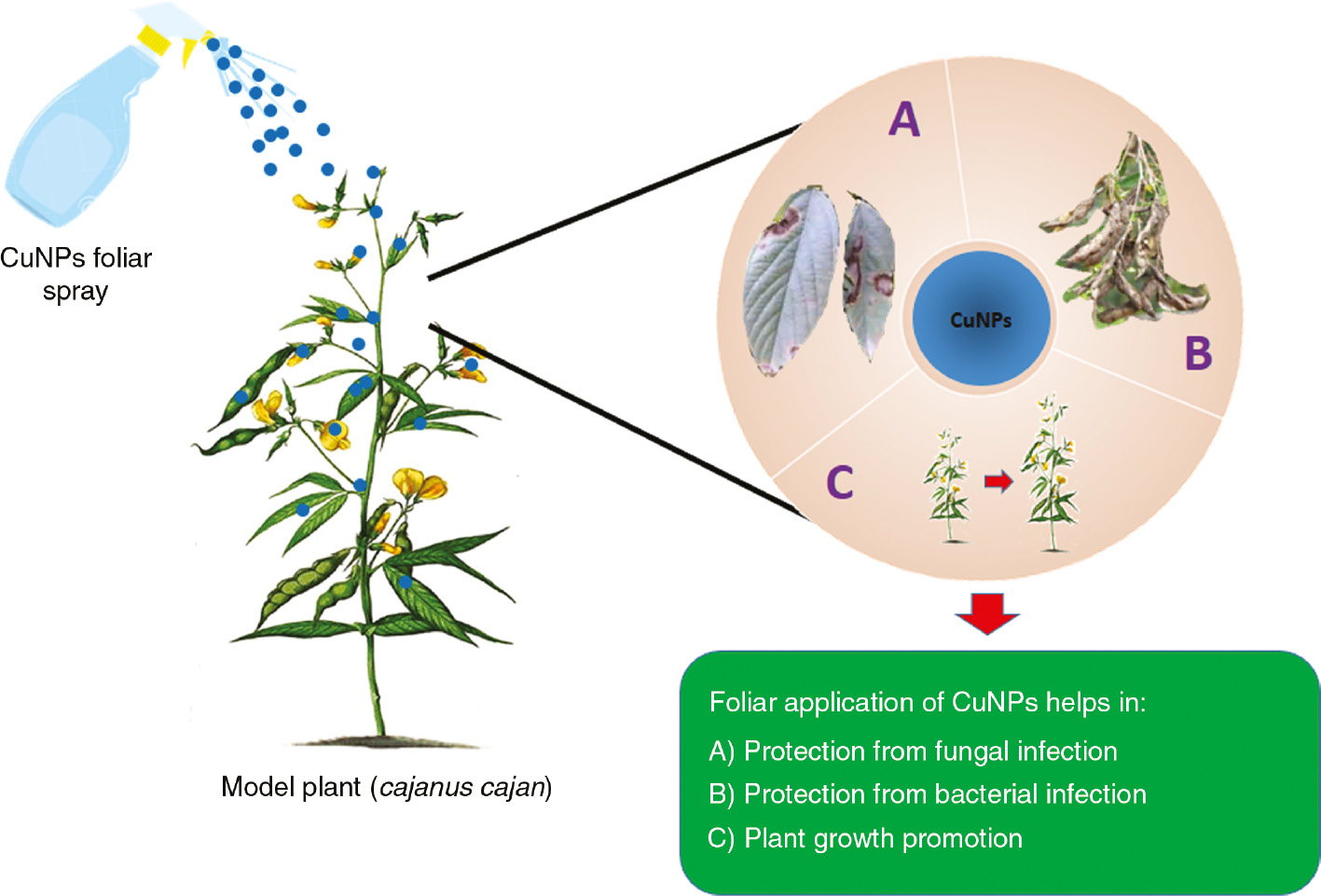
Schematic illustration of CuNPs application for protection of plants and its growth promotion. CuNPs provide protection to crop plants against (A) fungal infections (B) bacterial infections (C) by promoting plant growth.
5 Mechanism of CuNPs-microbe interaction
As previously mentioned, the antimicrobial activity of CuNPs was well studied, but the mechanism of antimicrobial action is not well understood. A few reports are available on the mechanism concerning the antimicrobial action of CuNPs. CuNPs interact with the microbial cell wall because of its affinity toward the carboxyl group present on the microbial surface [11], [56]. Generation of reactive oxygen species (ROS), membrane damage, loss of enzyme activity, protein dysfunction, etc., are accountable for the antimicrobial action of nanoparticles [57], [58]. Raffi et al. [59] investigated the antibacterial behavior of CuNPs. It was revealed that when CuNPs come in contact with a bacterial cell, it releases Cu ions, which are absorbed on the cell wall leading to the generation of ROS and loss of membrane integrity [59]. Similarly, CuNPs are also responsible for the disruption of cellular metabolic pathways, formation of pits in a membrane, development of oxidative stress, which eventually cause cell death [27], [53], [60]. It was proposed that Cu polymer nanocomposites can be an effective antibacterial agent. The authors studied that the bactericidal effect of nanocomposites was due to the release of Cu ions and CuNPs. The released Cu ions, upon interaction with an outer bacterial membrane, interact with amines and carboxyl groups in the peptidoglycan layer as well as with sulfhydryl groups, which leads to denaturation of the protein. Cu ions (Cu2+) bind to DNA and involve in cross-linking of nucleic acid strands, resulting into disorganization of the helical structure. In a similar way, the released CuNPs stick to the cell membrane and penetrate into the bacterium via endocytosis [24]. The hitherto known mechanisms for the bactericidal and fungicidal action of CuNPs are illustrated in Figure 2. The susceptibility of microbes to the microbicidal action of CuNPs mainly depends upon the particle size, electrostatic attraction between microbial cell and nanoparticles, composition of microbial cell wall and membrane, and hydrophobic or hydrophilic nature of the nanoparticles.
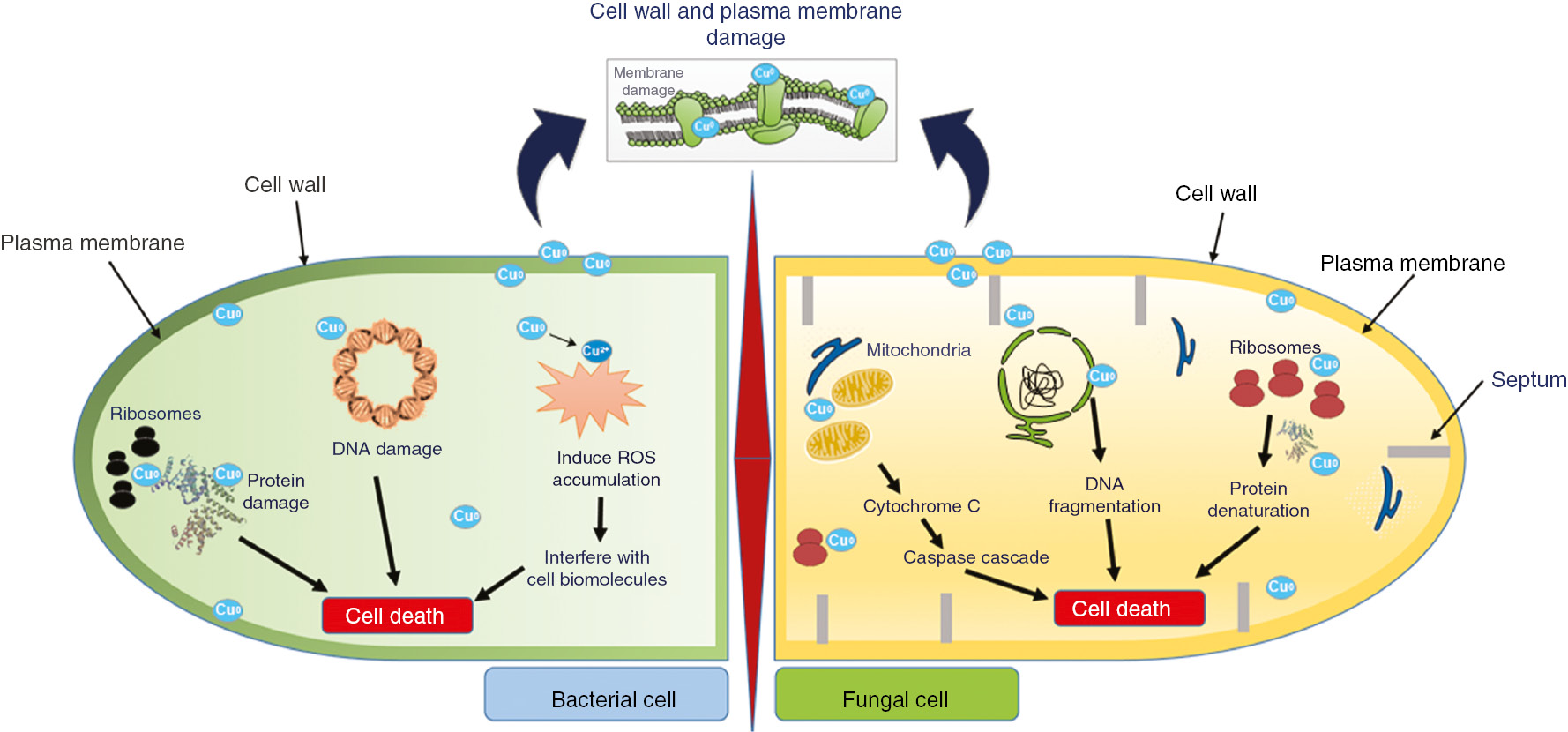
Schematic illustration for possible mechanism of CuNPs on microbes: CuNPs act on microbial cell wall and disturbs its components, which leads to membrane damage. Membrane damage decreases the electrochemical potential, which affects membrane integrity. In addition, CuNPs target DNA, interferes with protein synthesis, and cause damage leading to death of microbial cell.
6 Emerging concerns of CuNPs toxicity
As discussed in the earlier section, CuNPs are a boon to the agricultural sector. However, on the other side, the concerns associated with them are also important particularly the accumulation, biomagnification, and biotransformation of nanoparticles in food crops. These issues warrant more attention and needs in-depth investigation [61]. The concentration of the nanoparticles in the surrounding environment is the major factor contributing to the harmful effects to food crops. Higher accumulation of nanoparticles into the soil will result in their higher uptake through plant roots, thus, showing enhanced harmful effects to the plants. For instance, the concentration of CuNPs in the range of 200–1000 mg/l was reported to exert toxic effects on Triticum aestivum, Cucurbita pepo, and Phaseolus radiatus seeds [62], [63]. Under microscopic study, it was found to penetrate into plant cell membrane. In a 14-day exposure study, at 1000 mg/l concentration of CuNPs, reduction in biomass of C. pepo was recorded [64]. Most probably, due to accumulation of CuNPs in the plant tissues, it interacts with all of its components, and consequently, it disturbs the normal functioning of plant tissues and cells [65]. Bradfield et al. [66] demonstrated the probable effect of CuNPs on sweet potato (Ipomoea batatas). The study claimed that CuNPs show adverse effects on the tuber biomass of sweet potato and were found to be accumulated at the higher concentration in their peel compared to the flesh. The group claimed that prior to the accumulation, nanoparticles underwent dissolution to release the ions [66].
The above studies proved that, if nanoparticles are used in an uncontrolled manner for increasing the plant productivity or in food industries, they may harm the ecosystem. However, concentration, size, shape, and types of nanoparticles are the key factors, which play an important role in their toxicity. As discussed earlier, in agriculture, nanoparticles can be used in the form of foliar spray as described in Figure 1 or supplied through the roots of the plant. In case of foliar application of nanoparticles, these can enter into plant cells through the organs and tissues such as cuticles, trichomes, stomata, stigma, and hydathodes. When nanoparticles are supplied through the roots, they enter into the plant cells through the root tips, lateral roots, root hairs, root wounds, and root junctions (Figure 3) [67].
![Figure 3: Probable entry points for nanoparticles in plants (Reproduced from Wang et al. [67] with copyright permission from Elsevier).](/document/doi/10.1515/ntrev-2018-0031/asset/graphic/j_ntrev-2018-0031_fig_003.jpg)
Probable entry points for nanoparticles in plants (Reproduced from Wang et al. [67] with copyright permission from Elsevier).
However, the entry of the different types of nanoparticles in various plant tissues and cells occur through different ways, which mainly include binding to carrier proteins, through aquaporins, ion channels, or by endocytosis, by creating new pores, or by binding to organic chemicals present in the environment. Apart from these, the increased surface area-to-mass ratio enhances the reactivity of nanoparticles with their surroundings, and hence, they are able to form complexes with membrane transporters or root exudates, which facilitate their entry into the plant cells (Figure 4) [65].
![Figure 4: Probable avenues of cellular uptake of the nanoparticles in a plant cell (Reproduced from Rico et al. [65] with permission from American Chemical society).](/document/doi/10.1515/ntrev-2018-0031/asset/graphic/j_ntrev-2018-0031_fig_004.jpg)
Probable avenues of cellular uptake of the nanoparticles in a plant cell (Reproduced from Rico et al. [65] with permission from American Chemical society).
Once nanoparticles enter into the plant cells, they may travel apoplastically or symplastically from one cell to the other through the plasmodesmata. Wang et al. [26] reviewed the uptake and translocation of engineered nanoparticles (ENPs). They proposed that nanoparticles have to cross a series of chemical and physiological barriers for their transport from one cell to another, which strictly depends on their size generally referred to as size exclusion limits (SELs). It means nanoparticles having a specific size range can enter into the specific cells. In apoplastic transport pathway, transport of nanoparticles is controlled by the SEL of the cell walls, which allows entry of nanoparticles within the size range of 5–20 nm [68], [69], [70]. The Casparian strip allows nanoparticles having an SEL of <1 nm [71]. Moreover, in the case of the symplastic transport pathway, the transport of ENPs depend upon the SEL of the plasmodesmata, which is about 3–50 nm in diameter [72]. The SELs for other plant cells and tissues are provided in Figure 5.
![Figure 5: Size exclusion limits (SELs) of various plant tissues (barriers) for the uptake of nanoparticles (Reprinted from Wang et al. [67] with copyright permission from Elsevier).](/document/doi/10.1515/ntrev-2018-0031/asset/graphic/j_ntrev-2018-0031_fig_005.jpg)
Size exclusion limits (SELs) of various plant tissues (barriers) for the uptake of nanoparticles (Reprinted from Wang et al. [67] with copyright permission from Elsevier).
The entry of nanoparticles in plant cells result into their accumulation in cells. The presence of nanoparticles negatively affects the plant’s metabolism and development. The toxicity of nanoparticles to plant tissues occurs due to many chemical or physical effects. There are some possible ways proposed by the researchers to explain how nanoparticles interact with plant cells and cause toxicity [67], [70]. These include the (i) chemical effects due to dissolution and release of toxic Cu2+ ions from CuNPs, (ii) binding and interaction of nanoparticles with biomolecules such as proteins and nucleic acid (DNA) either by non-covalent or covalent mechanisms. These interactions release surface free energy, leading to surface reconstruction of biomolecular structures [73], [74], (iii) the production of excess ROS through redox cycling and the Fenton reaction in the presence of Fe2+ [67], (iv) oxidation and catalysis of surface biomolecules through catalytic reactions [75], (v) size- or shape-dependent mechanical damage [76]. Considering these facts, we proposed the hypothetical mechanism to understand the toxicity of CuNPs to plants. Figure 6 presents the proposed mechanisms by which CuNPs can cause phytotoxicity.
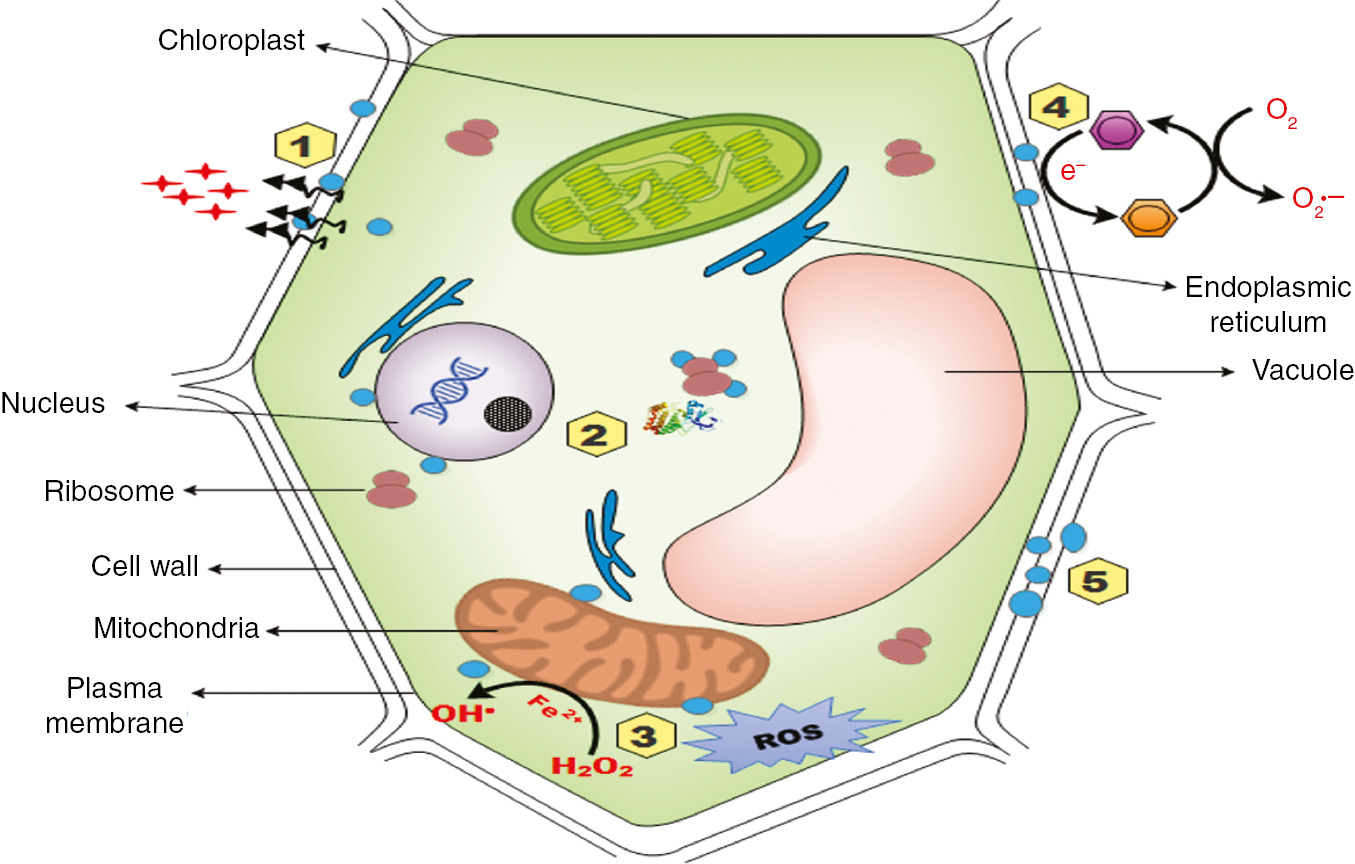
Schematic representation of several proposed mechanisms by which CuNPs cause phytotoxicity: (1) dissolution of nanoparticles and release of toxic ions, (2) binding and interaction of nanoparticles with biomolecules, such as proteins and DNA, (3) production of ROS through redox cycling and Fenton reaction, (4) oxidation and surface catalytic reactions, and (5) size-or- shape-dependent mechanical damage.
The aforementioned studies confirmed the phytotoxicity of CuNPs at a higher concentration. The studies performed in the past proposed a possible mechanism leading to harmful effects of CuNPs on plants. Moreover, the exact toxicity mechanisms involved in seed germination, growth of the roots and shoots, and other changes occurring in plants at the cellular and molecular level due to stress warrant further investigation.
7 Future perspectives
CuNPs possess potent antimicrobial activity against food spoilage microbes. The bimetallic nanoparticles such as Zn-Cu and Ti-Cu can be synthesized, which can inhibit food-borne pathogens and enhance the shelf life of food. Both zinc oxide nanoparticles and titanium dioxide nanoparticles are FDA approved, and therefore, can be used as a food additive for its preservation along with CuNPs. Bimetallic nanoparticles can be used as an effective plant protector. They can be utilized as a vehicle for the delivery of antioxidants, enzymes, and anti-browning agents in order to improve the quality of food. CuNPs can help in the targeted delivery of pesticides and can be stabilized with polyvinylpyrrolidone to enhance its antimicrobial activity. Incorporation of CuNPs in polymer silicate nanocomposite improves the antimicrobial efficacy, physical strength, and thermal stability of the film. CuNP-loaded naturally occurring antimicrobial peptides may be used in enhancing the shelf-life of food. Nisin and pediocin are some antimicrobial peptides used in the preservation of food.
The combination of CuNPs or bimetallic nanoparticles such as Ag-Cu, Cu-Zn, Cu-Ti along with essential oil will be novel antimicrobial agents for the inhibition of food spoilage microbes. The biopolymeric film containing CuNPs along with essential oil can be used in the preservation of food. Further, CuNP-impregnated paper can be a prospective candidate for packaging of food and fruits, by preventing food spoilage and off-odor of the food.
Cu is one of the most essential elements required by the plants. CuNPs showed potential activity against fungi and insect-pests of crop plants and, hence, can be used in the novel formulation such as CuNP-based nanopesticides, nanoherbicides, and nanofertilizers, which will be required in lower quantity. It can also minimize the toxicity problem due to excessive use of pesticides. CuNP-based biosensors can be used for the management of pests and also in the detection of pathogens responsible for food spoilage. Finally, the use of CuNPs may revolutionize the field of food and agriculture industries.
8 Conclusions
The pathogens and insect-pests are responsible for the reduced crop yield, and therefore, their management to minimize the yield loss is essentially required. During the course of time, many researchers have developed remedies to control them to some extent. Cu is a micronutrient, essential for plant growth, whereas it is also used as a fungicide and bactericide. However, with such benefits, there are some harmful effects to the soil ecosystem.
Various scientific groups across the globe have demonstrated that CuNPs are better plant protectors. Compared to bulk copper, nanocopper (CuNP) has been proved to be more efficient in controlling various common fungal and bacterial infections. The CuNPs deteriorate the cell wall and also alter the functioning of the cell organelle, leading to the death of pathogens. Therefore, such properties of nanoscale copper make it a better candidate for use in combating plant diseases. Moreover, it can also be applied for the packaging of food and food products to enhance its shelf-life.
Finally, many reports have claimed that CuNPs also demonstrated harmful effects on plant when used beyond a certain concentration. Application of CuNPs in a higher concentration can affect the plant metabolism, thereby, affecting the yield. Therefore, for safer use of CuNPs in agriculture, there is an urgent need to develop a clear understanding of nanoparticle-plant interaction. If it is done in the right direction, CuNPs will be a great boon for agriculture and the food industry to produce and store food for a longer period of time with the negligible loss to feed growing global human population.
About the authors

Mahendra Rai is a UGC-BSR Faculty Fellow and Senior Professor at the Department of Biotechnology, Sant Gadge Baba Amravati University at Amravati, Maharashtra, India. He worked as a Visiting Scientist at different Universities including the University of Geneva, Switzerland, Debrecen University, Hungary; University of Campinas, Brazil, and Nicolaus Copernicus University, Poland. His area of expertise includes microbial biotechnology and nanobiotechnology. His present research interests are the application of nanobiotechnology in medicine and agriculture, in particular, the use of metallic nanoparticles as a new generation of antimicrobials. He has published more than 380 research papers in India and abroad. In addition, he has edited/authored more than 45 books.

Avinash P. Ingle has completed his doctoral degree from the Department of Biotechnology, Sant Gadge Baba Amravati University, Amravati, Maharashtra, India. He had worked as a Research Scientist in the same department from 2013 to 2016. He has more than 55 research publications, 30 book chapters, and two books to his credit. He has been awarded travel grants from different funding agencies to present his research work in international conferences held in Malaysia, China, Spain, and France. Currently, Dr. Ingle is working as a Post-Doctoral Fellow at the Department of Biotechnology, Engineering School of Lorena-University of São Paulo, Brazil, and he is actively engaged in the development of nanotechnology-based methods for the sustainable production of biofuels.

Raksha S. Pandit completed her master’s degree in 2013 and is recently pursuing her Ph.D. degree in Biotechnology at Sant Gadge Baba Amravati University, Amravati, India. Her area of interest includes the phytofabrication of metal nanoparticles and their functionalization with biomolecules for the development of potential antimicrobials.

Priti A. Paralikar graduated from the Department of Biotechnology, Sant Gadge Baba Amravati University, Amravati, India, in 2013. Currently, she is working on her doctoral research on the biosynthesis of sulfur nanoparticles and its conjugation with antibiotics and its in vitro studies against urinary tract infection. She published her research work in reputed journals. Her area of interest is in the field of Nanobiotechnology and Microbiology.

Sudhir completed his M.Sc. in Biotechnology in 2007, and at present, he is pursuing his doctoral study at the Department of Biotechnology, Sant Gadge Baba Amravati University, Amravati, India. He has published about 06 research papers and four book chapters in the journals of national and international repute with a total impact factor of 16 and a 04 h-index. He has been awarded travel grants from CICS, Chennai, the funding agency that participated and presented research papers in international conferences held at The Netherlands. His area of research is in nanobiotechnology, plant tissue culture, and plant sciences. He is currently working on the development of nano-based fungicides using green synthesized nanoparticles.

Indarchand R. Gupta completed his M.Sc. in Biotechnology in 2004, and at present, he is pursuing his doctoral study at the Department of Biotechnology, Sant Gadge Baba Amravati University, Amravati, India. He is working as an Assistant Professor at the Institute of Science, Aurangabad, India. He has published about 13 research papers and four book chapters. His area of interest is in nano-toxicology and animal cell culture. His study is mainly focused on in vitro cytotoxicity assessment of silver nanoparticles on different animal cell models.

Jayanta Kumar Biswas is presently serving as an Associate Professor at the Department of Ecological Studies and International Centre for Ecological Engineering, University of Kalyani. He received his M.Sc. in Zoology, M.Phil. in Ecology, and Ph.D. for his work on ecotechnological approaches toward remediation of environmental problems of aquatic systems. He has about 18 years of teaching experience and 21 years of research experience in the following areas: ecological engineering and ecotechnology, environmental microbiology, ecotoxicology and bioremediation of trace metal(oid)s, nanobiotechnology, aquatic pollution monitoring and ecoremediation, bioregenerative wastewater treatment, etc. He has published about 105 research papers in international and national journals, proceedings, and books, and 50 popular science articles in periodicals and magazines. He has visited Singapore, Belgium, and France with government travel fellowships and presented research papers and chaired scientific sessions in international conferences.

Silvio Silvério da Silva, is a full professor and head at the Department of Biotechnology, Engineering School of Lorena, University of São Paulo (USP Campus), Lorena, Brazil. He has more than 185 research publications, 30 book chapters, four books, and two patents to his credit. Prof. Silvio has presented about 770 papers in various international events. He has coordinated more than 22 research projects and guided 24 Ph.D., 30 master’s, and 74 scientific initiation students. In addition, he has received many prestigious awards. For the exchange of scientific knowledge on the various aspects in bioprocess and fermentation technology, he has visited several international research institutions in different countries. His area of research mainly includes Biotechnology with emphasis on Industrial Microbiology and Fermentation.
Acknowledgments
MR is thankful to University Grant Commission, New Delhi, India, for financial assistance under UGC-SAP Programme Grant No. F.3-16/2012(SAP-II) and BSR faculty fellowship. RP is grateful to the Department of Science and Technology, New Delhi, India, for providing DST-INSPIRE Fellowship Grant No (IF 150452). API is highly thankful to the Research Council for the State of Sao Paulo (FAPESP), Brazil, for providing financial assistance (Process No. 2016/22086-2) in the form of Post-Doctoral Fellowship. SSS is thankful to Brazilian National Council for Scientific and Technological Development (CNPq) (Process Nos. 401308/2014-6 and 150745/2015-0) for research grants.
Declaration of interest: Authors do not have any conflict of interests to declare.
References
[1] Samantarai SK, Achakzai AKK. Application of nanotechnology in agriculture and food production: opportunity and challenges. Middle-East J. Sci. 2014, 22, 499–501.Suche in Google Scholar
[2] United Nations (UN). Department of Economic and Social Affairs, Population Division, 2015, World Population Prospects: the 2015, Revision: 2016. Available at http://esa.un.org/unpd/wpp/Publications. Accessed on February, 2018.Suche in Google Scholar
[3] FAO (Food and Agriculture Organization). Food loss and food waste. 2015. Available at http://www.fao.org/food-loss-and-food-waste/en. Accessed on February, 2018.Suche in Google Scholar
[4] Dutta SS, Das S, Pale G, Iangrai B, Aochen C, Rai M, Pattanayak A. Current status and future prospects of research on genetically modified rice: a review. Agric. Rev. 2016, 37, 10–18.10.18805/ar.v37i1.9259Suche in Google Scholar
[5] Dubey A, Mailapalli DR. Nanofertilisers, nanopesticides, nanosensors of pest and nanotoxicity in agriculture. In Sustainable Agriculture Reviews, vol. 19, Lichtfouse, E, Ed., Springer: Switzerland, Cham, 2017, pp. 307–330.10.1007/978-3-319-26777-7_7Suche in Google Scholar
[6] Chellaram C, Murugaboopathi G, John AA, Sivakumar R, Ganesan S, Krithika S, Priya G. Significance of nanotechnology in food industry. In APCBEE Procedia, vol. 8, Asia-Pacific Chemical, Biological and Environmental Engineering Society, Ed., Elsevier: B.V., 2014, pp. 109–113.10.1016/j.apcbee.2014.03.010Suche in Google Scholar
[7] Khan MR, Rizvi TF. Application of nanofertilizer and nanopesticides for improvements in crop production and protection. In Nanoscience and Plant-Soil Systems. Soil Biology, vol. 48, Ghorbanpour, M, Manika, M, Varma, A, Eds., Springer: Cham, 2017, pp. 405–427.10.1007/978-3-319-46835-8_15Suche in Google Scholar
[8] Couch LM, Wien M, Brown JL, Davidson P. Food nanotechnology: proposed uses, safety concerns and regulations. Agro. Food Ind. Hi Tech. 2016, 27, 36–39.Suche in Google Scholar
[9] Arfat YA, Ahmed J, Jacob H. Preparation and characterization of agar-based nanocomposite films reinforced with bimetallic (Ag-Cu) alloy nanoparticles. Carbohydr. Polym. 2017, 155, 382–390.10.1016/j.carbpol.2016.08.097Suche in Google Scholar
[10] Arfat YA, Ejaz M, Jacob H, Ahmed J. Deciphering the potential of guar gum/Ag-Cu nanocomposite films as an active food packaging material. Carbohydr. Polym. 2017, 157, 65–71.10.1016/j.carbpol.2016.09.069Suche in Google Scholar
[11] Ingle A, Duran N, Rai M. Bioactivity, mechanism of action and cytotoxicity of copper-based nanoparticles: a review. Appl. Microbiol. Biotechnol. 2014, 98, 1001–1009.10.1007/s00253-013-5422-8Suche in Google Scholar PubMed
[12] Dartmouth Toxic Metals Superfund Research Program. Copper: An ancient Metal. 2010. Available at http://www.dartmouth.edu/∼toxmetal/toxic-metals/more-metals/copper-history.html. Accessed on January, 2018.Suche in Google Scholar
[13] Smith BW. Sixty centuries of copper. UK Copper Development Association. Based on another UK CDA. 1965. Available at https://www.copper.org/. Accessed on January, 2018.Suche in Google Scholar
[14] Copper Development Association. Copper Development Association Inc., 2016. Available at https://www.copper.org/. Accessed on January, 2018.Suche in Google Scholar
[15] Pal DK, Sahu CK, Haldar A. Bhasma: the ancient Indian nanomedicine. J. Adv. Pharm. Technol. Res. 2014, 5, 4–12.10.4103/2231-4040.126980Suche in Google Scholar PubMed PubMed Central
[16] Copper Development Association. Copper Development Association Inc., 2003. Available at https://www.copper.org/. Accessed on January, 2018.Suche in Google Scholar
[17] Ware GW. The Pesticide Book, W.H. Freeman and Company: San Francisco, 1978.Suche in Google Scholar
[18] Millardet A, Gayon U, 1845-1929, (joint author) & Schneiderhan FJ, 1891-, (tr.) 1933, The discovery of Bordeaux mixture: Three papers: I. Treatment of mildew and rot, American phytopathological society, Cayuga Press: Ithaca, NY.Suche in Google Scholar
[19] WHO. Food safety and foodborne illnesses Fact sheet No. 237, 2003. Available at http://www.who.int/mediacentre/factsheets/fs237/en. Accessed on January, 2018.Suche in Google Scholar
[20] Faundez G, Troncoso M, Navarrete P, Figueroa G. Antimicrobial activity of copper surfaces against suspensions of Salmonella enterica and Campylobacter jejuni. BMC Microbiol. 2004, 4, 1–7.10.1186/1471-2180-4-1Suche in Google Scholar PubMed PubMed Central
[21] Weaver L, Michels HT, Keevil CW. Potential for preventing spread of fungi in air conditioning systems constructed using copper instead of aluminium. J. Appl. Microbiol. 2010, 50, 18–23.10.1111/j.1472-765X.2009.02753.xSuche in Google Scholar PubMed
[22] Al-Holy MA, Castro LF, Al-Quadiri HM. Inactivation of Cronobacter spp. (Enterobactersakazakii) in infant formula using lactic acid, copper sulfate and monolaurin. J. Appl. Microbiol. 2010, 50, 246–251.10.1111/j.1472-765X.2009.02782.xSuche in Google Scholar PubMed
[23] Shankar S, Teng X, Rhim JW. Properties and characterization of agar/CuNP bionanocomposite films prepared with different copper salts and reducing agents. Carbohydr. Polym. 2014, 114, 484–492.10.1016/j.carbpol.2014.08.036Suche in Google Scholar PubMed
[24] Tamayo L, Azócar M, Kogan M, Riveros A, Páez M. Copper-polymer nanocomposites: an excellent and cost-effective biocide for use on antibacterial surfaces. Mater. Sci. Eng. C. 2016, 69, 1391–1409.10.1016/j.msec.2016.08.041Suche in Google Scholar PubMed
[25] Cioffi N, Ditaranto N. Analytical characterization of bioactive fluropolymer ultra-thin coatings modified by copper nanoparticles. Anal. Bioanal. Chem. 2005, 381, 607–616.10.1007/s00216-004-2761-4Suche in Google Scholar PubMed
[26] Wang L, Hu C, Shao L. The antimicrobial activity of nanoparticles: present situation and prospects for the future. Int. J. Nanomedicine. 2017, 12, 1227–1249.10.2147/IJN.S121956Suche in Google Scholar PubMed PubMed Central
[27] Zhong T, Oporto GS, Jaczynski J, Jiang C. Nanofibrillated cellulose and copper nanoparticles embedded in polyvinyl alcohol films for antimicrobial applications. BioMed Res. Int. 2015, 2015, 456834.10.1155/2015/456834Suche in Google Scholar PubMed PubMed Central
[28] Jia B, Mei Y, Cheng L, Zhou J, Zhang L. Preparation of copper nanoparticles coated cellulose films with antibacterial properties through one-step reduction. ACS Appl. Mater. Interfaces 2012, 4, 2897–2902.10.1021/am3007609Suche in Google Scholar PubMed
[29] Saharan V, Sharma G, Yadav M,Choudhary MK, Sharma SS, Pal A, Raliya R, Biswas P. Synthesis and in vitro antifungal efficacy of Cu chitosan nanoparticles against pathogenic fungi of tomato. Int. J. Biol. Macromol. 2015, 75, 346–353.10.1016/j.ijbiomac.2015.01.027Suche in Google Scholar PubMed
[30] Ramyadevi J, Jeyasubramanian K, Marikani A, Rajakumar G, Rahuman AA. Synthesis and antimicrobial activity of copper nanoparticles. Mater. Lett. 2011, 71, 114–116.10.1016/j.matlet.2011.12.055Suche in Google Scholar
[31] Mallick S, Sharma S, Banerjee M, Ghosh S, Chattopadhyay A, Paul A. Iodine-stabilized Cu nanoparticle chitosan composite for antibacterial applications. ACS Appl. Mater. Interfaces 2012, 4, 1313–1323.10.1021/am201586wSuche in Google Scholar PubMed
[32] Pinto RJB, Daina S, Sadocco P, Neto CP, Trindade T. Antibacterial activity of nanocomposites of copper and cellulose. BioMed. Res. Int. 2013, 2013, 280512.10.1155/2013/280512Suche in Google Scholar PubMed PubMed Central
[33] Longano DN, Ditaranto N, Cioffi F, Di Niso T, Sibillano A, Ancona A, Conte MA, Del Nobile L, Torsi SL. Analytical characterization of laser-generated copper nanoparticles for antibacterial composite food packaging. Anal. Bioanal. Chem. 2012, 403, 1179–1186.10.1007/s00216-011-5689-5Suche in Google Scholar PubMed
[34] Grusak MA. Plant macro- and micronutrient minerals. In Encyclopedia of Life Sciences, John Wiley & Sons, Ltd: Chichester, 2016, doi: 10.1002/9780470015902.a0001306.pub2.10.1002/9780470015902.a0001306.pub2Suche in Google Scholar
[35] Mengel K, Kirkby EA. Principles of Plant Nutrition, Kluwer Academic Publishers: Dordrecht, 2001.10.1007/978-94-010-1009-2Suche in Google Scholar
[36] Marschner H. Mineral Nutrition of Higher Plants, Academic Press: San Diego, CA, 2002.Suche in Google Scholar
[37] Adhikari T, Kundu S, Biswas AK, Tarafdar JC, Rao AS. Effect of copper oxide nanoparticle on seed germination of selected crops. J. Agric. Sci. Technol. 2012, A2, 815–823.Suche in Google Scholar
[38] Ngo QB, Dao TH, Nguyen HC, Tran XT, Nguyen TV, Khuu TD, Huynh TH. Effects of nanocrystalline powders (Fe, Co and Cu) on the germination, growth, crop yield and product quality of soybean (Vietnamese species DT-51). Adv. Nat. Sci.: Nanosci. Nanotechnol. 2014, 5, 015016.10.1088/2043-6262/5/1/015016Suche in Google Scholar
[39] Olkhovych O, Volkogon M, Taran N, Batsmanova L, Kravchenko I. The effect of copper and zinc nanoparticles on the growth parameters, contents of ascorbic acid, and qualitative composition of amino acids and acylcarnitines in Pistia stratiotes L. (Araceae). Nanoscale Res. Lett. 2016, 11, 218.10.1186/s11671-016-1422-9Suche in Google Scholar PubMed PubMed Central
[40] Siddiqi KS, Husen A. Plant response to engineered metal oxide nanoparticles. Nanoscale Res. Lett. 2017, 12, 92.10.1186/s11671-017-1861-ySuche in Google Scholar PubMed PubMed Central
[41] Borkow G, Gabbay J. Copper as a biocidal tool. Curr. Med. Chem. 2005, 12, 2163–2175.10.2174/0929867054637617Suche in Google Scholar PubMed
[42] HSDB (Hazardous Substances Data Bank). U.S. National Library of Medicine, 2016. Available at https.//toxnet.nlm.nih.gov/cgi-bin/sis/htmlgen?HSDB. Accessed on January, 2018.Suche in Google Scholar
[43] Kiaune L, Singhasemanon N. Pesticidal copper (I) oxide: environmental fate and aquatic toxicity. Rev. Environ. Contam. Toxicol. 2011, 213, 1–26.10.1007/978-1-4419-9860-6_1Suche in Google Scholar PubMed
[44] Wilbois KP, Kauer R, Fader B, Kienzle J, Haug P, Fritzsche-Martin A, Drescher N, Reiners E, Röhrig F. Copper as a plant protection product with special regards to organic farming. J. Kulturpflanzen 2009, 61, 140–152.Suche in Google Scholar
[45] Castro ML, Ojeda C, Cirelli A. Advances in surfactants for agrochemicals. Environ. Chem. Lett. 2014, 12, 85–95.10.1007/s10311-013-0432-4Suche in Google Scholar
[46] Chowdappa P, Gowda S. Nanotechnology in crop protection: status and scope. Pest Manage. Hort. Ecosyst. 2013, 19, 131–151.Suche in Google Scholar
[47] Parisi C, Vigani M, Rodriguez-Cerezo E. In Proceeding of a Workshop on Nanotechnology for the Agriculture Sector: From Research to Field, JRC Scientific and Policy reports, European Commission, 2014, 1.Suche in Google Scholar
[48] Esteban-Tejeda L, Malpartida F, Esteban-Cubillo A, Pecharroman C, Moya JS. Antibacterial and antifungal activity of a soda-lime glass containing copper nanoparticles. Nanotechnology 2009, 20, 505701.10.1088/0957-4484/20/50/505701Suche in Google Scholar PubMed
[49] Giannousi K, Avramidis I, Dendrinou-Samara C. Synthesis, characterization and evaluation of copper based nanoparticles as agrochemicals against Phytophthora infestans. RSC Adv. 2013, 3, 21743–21752.10.1039/c3ra42118jSuche in Google Scholar
[50] Mondal K, Mani C. Investigation of the antibacterial properties of nano-copper against Xanthomonas axonopodis pv. punicae, the incident of pomegranate bacterial blight. Ann. Microbiol. 2012, 62, 889–893.10.1007/s13213-011-0382-7Suche in Google Scholar
[51] Brunel F, El Gueddari NE, Moerschbacher BM. Complexation of copper (II) with chitosan nanogels: towards control of microbial growth. Carbohydr. Polym. 2013, 92, 1348–1356.10.1016/j.carbpol.2012.10.025Suche in Google Scholar PubMed
[52] Kanhed P, Birla S, Gaikwad S, Gade A, Seabra AB, Rubilar O, Duran N, Rai M. In vitro antifungal efficacy of copper nanoparticles against crop pathogenic fungi. Mater. Lett. 2014, 115, 13–17.10.1016/j.matlet.2013.10.011Suche in Google Scholar
[53] Shende S, Ingle AP, Gade A, Rai M. Green synthesis of copper nanoparticles by Citrus medica Linn.(Idilimbu) juice and its antimicrobial activity. World J. Microbiol. Biotechnol. 2015, 3, 865–873.10.1007/s11274-015-1840-3Suche in Google Scholar PubMed
[54] Bramhanwade K, Shende S, Bonde S, Gade A, Rai M. Fungicidal activity of Cu nanoparticles against Fusarium causing crop diseases. Environ. Chem. Lett. 2016, 14, 229–235.10.1007/s10311-015-0543-1Suche in Google Scholar
[55] Chinnamuthu CR, Boopathi PM. Nanotechnology and agroecosystem. Madras Agri. J. 2009, 96, 17–31.Suche in Google Scholar
[56] Ren G, Hu D, Cheng EWC, Vargas-Reus MA, Reip P, Allaker RP. Characterization of copper oxide nanoparticles for antimicrobial applications. Int. J. Antimicrob. Agents 2009, 33, 587–590.10.1016/j.ijantimicag.2008.12.004Suche in Google Scholar PubMed
[57] Lemire JA, Harrison JJ, Turner RJ. Antimicrobial activity of metals: mechanisms, molecular targets and applications. Nat. Rev. Microbiol. 2013, 11, 371–384.10.1038/nrmicro3028Suche in Google Scholar PubMed
[58] Swarnkar RK, Pandey JK, Soumya KK, Dwivedi P, Sundaram S, Prasad S, Gopal R. Enhanced antibacterial activity of copper/copper oxide nanowires prepared by pulsed laser ablation in water medium. Appl. Phys. A 2016, 122, 704.10.1007/s00339-016-0232-3Suche in Google Scholar
[59] Raffi M, Mehrwan S, Bhatti TM, Akhter JI, Hameed A, Yawar W, Ul Hasan MM. Investigations into the antibacterial behavior of copper nanoparticles against Escherichia coli. Ann. Microbiol. 2010, 60, 75–80.10.1007/s13213-010-0015-6Suche in Google Scholar
[60] Deryabin DG, Aleshina ES, Vasilchenko AS, Deryabin TD, Efremova LV, Karimov IF, Korolevskay LB. Investigation of copper nanoparticles antibacterial mechanisms tested by luminescent Escherichia coli strains. Nanotechnol. Russia 2013, 8, 402–408.10.1134/S1995078013030063Suche in Google Scholar
[61] Thul ST, Sarangi BK, Pandey RA. Nanotechnology in agroecosystem: implications on plant productivity and its soil environment. Expert Opin. Environ. Biol. 2013, 2, 1.10.4172/2325-9655.1000101Suche in Google Scholar
[62] Lee W-M, An Y-J, Yoon H, Kweon H-S. Toxicity and bioavailability of copper nanoparticles to the terrestrial plants mung bean (Phaseolus radiatus) and wheat (Triticum aestivum): plant agar test for water-insoluble nanoparticles. Environ. Toxicol. Chem. 2008, 27, 1915–1921.10.1897/07-481.1Suche in Google Scholar PubMed
[63] Musante C, White JC. Toxicity of silver and copper to Cucurbita pepo: differential effects of nano and bulk-size particles. Environ. Toxicol. 2012, 27, 510–517.10.1002/tox.20667Suche in Google Scholar PubMed
[64] Stampoulis D, Sinha SK, White JC. Assay-dependent phytotoxicity of nanoparticles to plants. Environ. Sci. Technol. 2009, 43, 9473–9479.10.1021/es901695cSuche in Google Scholar PubMed
[65] Rico CM, Majumdar S, Duarte-Gardea M, Peralta-Videa JR, Gardea-Torresdey JL. Interaction of nanoparticles with edible plants and their possible implications in the food chain. J. Agri. Food Chem. 2011, 59, 3485–3498.10.1021/jf104517jSuche in Google Scholar PubMed PubMed Central
[66] Bradfield SJ, Kumar P, White JC, Ebbs SD. Zinc, copper, or cerium accumulation from metal oxide nanoparticles or ions in sweet potato: yield effects and projected dietary intake from consumption. Plant Physiol. Biochem. 2017, 110, 128–137.10.1016/j.plaphy.2016.04.008Suche in Google Scholar PubMed
[67] Wang P, Lombi E, Zhao FJ, Kopittke PM. Nanotechnology: a new opportunity in plant sciences. Trends Plant Sci. 2016, 21, 699–712.10.1016/j.tplants.2016.04.005Suche in Google Scholar PubMed
[68] Eichert T, Goldbach HE. Equivalent pore radii of hydrophilic foliar uptake routes in stomatous and astomatous leaf surfaces: further evidence for astomatal pathway. Physiol. Plant. 2008, 132, 491–502.10.1111/j.1399-3054.2007.01023.xSuche in Google Scholar PubMed
[69] Ma X, Geiser-Lee J, Deng Y, Kolmakov A. Interactions between engineered nanoparticles (ENPs) and plants: phytotoxicity, uptake and accumulation. Sci. Total Environ. 2010, 408, 3053–3061.10.1016/j.scitotenv.2010.03.031Suche in Google Scholar PubMed
[70] Dietz KJ, Herth S. Plant nanotoxicology. Trends Plant Sci. 2011, 16, 582–589.10.1016/j.tplants.2011.08.003Suche in Google Scholar PubMed
[71] Aubert T, Burel A, Marie-Andrée E, Cordier S, Grasset F, Cabello-Hurtado F. Root uptake and phytotoxicity of nanosized molybdenum octahedral clusters. J. Hazard Mater. 2012, 219–220, 111–118.10.1016/j.jhazmat.2012.03.058Suche in Google Scholar PubMed
[72] Lucas WJ, Lee JY. Plasmodesmata as a supracellular control network in plants. Nat. Rev. Mol. Cell Biol. 2004, 5, 712–726.10.1038/nrm1470Suche in Google Scholar PubMed
[73] Atha DH, Wang H, Petersen EJ, Cleveland D, Holbrook RD, Jaruga P, Dizdaroglu M, Xing B, Nelson BC. Copper oxide nanoparticle mediated DNA damage in terrestrial plant models. Environ. Sci. Technol. 2012, 46, 1819–1827.10.1021/es202660kSuche in Google Scholar PubMed
[74] Sharifi S, Behzadi S, Laurent S, Laird Forrest M, Stroeve P. Toxicity of nanomaterials. Chem. Soc. Rev. 2012, 41, 2323–2343.10.1039/C1CS15188FSuche in Google Scholar PubMed PubMed Central
[75] Zhao L, Peng B, Hernandez-Viezcas JA, Rico C, Sun Y, Peralta-Videa JR, Tang X, Niu G, Jin L, Varela-Ramirez A, Jian-ying Z, Gardea-Torresdey JL. Stress response and tolerance of Zea mays to CeO2 nanoparticles: cross talk among H2O2, heat shock protein, and lipid peroxidation. ACS Nano 2012, 6, 9615–9622.10.1021/nn302975uSuche in Google Scholar PubMed PubMed Central
[76] Asli S, Neumann PM. Colloidal suspensions of clay or titanium dioxide nanoparticles can inhibit leaf growth and transpiration via physical effects on root water transport. Plant Cell Environ. 2009, 32, 577–584.10.1111/j.1365-3040.2009.01952.xSuche in Google Scholar PubMed
©2018 Walter de Gruyter GmbH, Berlin/Boston
This article is distributed under the terms of the Creative Commons Attribution Non-Commercial License, which permits unrestricted non-commercial use, distribution, and reproduction in any medium, provided the original work is properly cited.
Artikel in diesem Heft
- Frontmatter
- In this issue
- Regular articles
- Design of an integrated optics for transglutaminase conformational change
- Carboxymethyl cellulose-grafted graphene oxide for efficient antitumor drug delivery
- Reviews
- Copper and copper nanoparticles: role in management of insect-pests and pathogenic microbes
- Nanoimmunotherapy – cloaked defenders to breach the cancer fortress
- Nanotechnology for the oil and gas industry – an overview of recent progress
Artikel in diesem Heft
- Frontmatter
- In this issue
- Regular articles
- Design of an integrated optics for transglutaminase conformational change
- Carboxymethyl cellulose-grafted graphene oxide for efficient antitumor drug delivery
- Reviews
- Copper and copper nanoparticles: role in management of insect-pests and pathogenic microbes
- Nanoimmunotherapy – cloaked defenders to breach the cancer fortress
- Nanotechnology for the oil and gas industry – an overview of recent progress
