Advancing Global Social Change: Systems Approaches to the Role of Nonprofits in Climate Policy
-
 und
und

Abstract
The existential threat of climate change requires reimagining foundational aspects of society, including jobs, transportation, energy, the built environment, natural resources, health, and water and food supplies. We argue that to realize such broad scale change requires systems thinking. In this introduction to the special issue on Nonprofits and Climate Policy, we outline four systems-based views of global social change, organized by source of change and assumptions about the technical rationality of the system: engineering, evolutionary, social constructivist, and (critical) realist. By elaborating this framework, we shed light on the fundamental assumptions embedded in climate advocacy and policymaking. Along with describing key scholarship and practice-based examples for each approach, we align the articles in this special issue with the four views of global social change to inspire systems-based research and practice at the nonprofit and climate policy intersection. We hope that creating more explicit accounts of the key beliefs and expectations about how social change occurs at a global systemic level will help to advance research and practice in sustainability.
The existential challenge of climate change demands new ways of conceptualizing and engaging in social transformation. Climate change is a “wicked problem” or “grand challenge” due to its unstructured, multilayered, and relentless nature (Rittel and Webber 1973; Weber and Khademian 2008). It runs from local to global levels, and cuts across all domains of activity, such as education, health, and poverty. In addition, there is no straightforward technical solution; instead, contested issues of ethics and justice are deeply intertwined with possible resolutions. Even naming the problem is polarizing. A major battle for climate activists is the widespread nature of climate change denial, the increasing political polarization around climate change and its surrounding discourse, as well as growing counter movements (Fischer 2019; McCright and Dunlap 2003; Pew Research Center 2023; Van Rensburg 2015). In this special issue we aim to provide insight into how canonical understandings of nonprofits’ influence on public policy can be re-imagined for the contemporary world, where problems are global and systemic, social justice is a more prominent focus of work, and public polarization is extreme.
An emerging response to the unwieldy nature of climate change is to focus on “systems thinking” (e.g. Fiksel 2006). Systems thinking accounts for interconnected dynamics, focusing on the processes that shape an entire structure rather than looking at individual subcomponents in isolation (e.g. Sternberg and Frensch 2014). This approach sounds promising for addressing complex problems, but systems approaches to understanding climate change are poorly spelled out (Ulrich 1993), as are applications in the social sciences. In this introduction we illuminate systemic views of social change by applying them to research and practice about nonprofits and climate policy. We build on literature in public administration and policy, organization and management theory, political science, sociology, economics, and anthropology to develop an interdisciplinary framework outlining four views of how the global system operates: engineering, evolutionary, social constructivist, and (critical) realist. Each perspective is examined regarding its conceptual underpinnings and implications for the role of nonprofits in climate policy.[1] Our goal is to develop the conceptual toolkit available to nonprofit scholars and practitioners about how to achieve large-scale, complex social change. We hope to advance research and practice in sustainability by creating more explicit accounts of how social change occurs at a global systemic level and revealing key assumptions.
In developing global systems approaches to nonprofits and climate policy, we follow others’ views that shifting to a systems perspective is more complex than simply expanding the actors or domains that policymakers, planners, activists and scholars consider (Porter and Córdoba 2009; Ulrich 1993). Instead, we need to develop a deeper understanding of the fundamental assumptions that are embedded in policymaking, practice, and research around climate work. Thus, our discussion focuses on outlining essential beliefs about how the entire system of actors and relationships related to climate change policy operates. The focus on global systems is intended as inclusive of national, subnational, public, and private efforts, while emphasizing the interconnectedness of the system. Our purpose in approaching the problem broadly reflects our starting assumption that a “wicked problem” like climate change requires moving towards understanding the entire complex of actors, practices, ideas and processes rather than individual elements. Much as students of research methods are encouraged to consider their view of the world in selecting and applying their methods, we argue that scholars and practitioners working with nonprofit organizations and climate policy can sharpen their research and activities by spelling out a clear theory of global change. In so doing, all are better equipped to understand their goals and strategies within the context of a systems-based approach to climate change.
The nonprofit-public policy nexus is a useful entry point for developing thinking about a global climate system because it is a focused arena that contains all the dimensions of the “wicked problem” of climate change. For example, nonprofits play a large and growing role in climate policy alongside governments, and the relationships and policies involving nonprofits run from local community interests to international politics (Keohane and Victor 2011). In the environmental realm, nonprofits have a substantial role in advocacy (Child and Grønbjerg 2007; Ganz and Soule 2019; Kagan and Dodge 2023). The pervasive involvement of the third sector to address an existential threat to society adds a layer of complexity that demands systemic thinking across sectors of society to answer questions about desired ends and the roles that various actors should play.
We begin by outlining other recent efforts to examine the ways that nonprofit organizations affect climate policy (especially Gazley and Prakash 2023; Kagan and Dodge 2023). In the main section of the paper, we discuss a four-part framework of systems approaches that together reflect the features of climate change as a multisector, multilevel, and contested arena. We also place each of the four research papers that comprise this special issue and cover the diverse topics of disaster preparedness, land trusts, public perceptions of climate change, and philanthropy, within the framework. The overarching goal is to outline systemic ways of thinking about how nonprofits’ influence on climate policy can produce social change. We hope spelling out distinct paradigms will build awareness around the assumptions embedded in research and practice, fostering new ways of thinking and working.
1 Existing Frameworks
Frameworks and typologies help organize our thinking around complex topics and have proven valuable in nonprofit scholarship.[2] We build on existing frameworks to understand how nonprofits influence climate policy within a variety of systems-based approaches to social change. Two articles in a recent special issue on climate change and the voluntary sector in Nonprofit and Voluntary Sector Quarterly took a bird’s eye view of the literature and aided in conceptual development. First, based on a modified, streamlined systematic literature review, Gazley and Prakash (2023) identify four themes in existing scholarship on the nonprofit sector and climate change. These include the need for a multi-sector approach to climate change; the voluntary sector’s role in climate mitigation and adaptation, especially urban risk mitigation or disaster response and recovery; environmental advocacy; and philanthropy’s role in climate mitigation and adaptation. Our approach echoes these themes, situating them as part as a description of the features of climate change that make it a “wicked problem” – one that requires a multisector approach across many actors and at many levels around the world. We diverge by focusing on different lenses through which researchers and practitioners might approach the problem in order to achieve social change.
Second, Kagan and Dodge (2023) developed a typology of the mechanisms for voluntary sector influence on climate change, which most closely aligns with the goals of this special issue. Drawing on an empirical analysis of published research, they distinguish between those activities that occur within and outside of government and also based on whether activities center around advocacy or implementation, which results in four mechanisms: public policy advocacy, participation in governance, advocacy for behavior change, and direct interventions. We expand their work by focusing on the conceptual underpinnings that drive researchers and practitioners to focus on different mechanisms of change. As we argue below, the assumptions driving different approaches to social change often align with a specific set of tools, which are consistent with those described by Kagan and Dodge (2023).
Thus, the contribution of this special issue is to provide insight, not only around the ways in which nonprofits influence climate policy, but also around the varied ways we can think of systemic changes.
2 Four Views on Global Social Change, Nonprofits, and Climate Policy
Figure 1 outlines four perspectives that offer system-level views about how global social change can be achieved. Each view suggests different implications for the role of nonprofits in shaping public policy. Importantly, our framework is neither exhaustive nor definitive. The schema is intended as a starting heuristic to provoke reflection on unexamined assumptions rather than a final statement. We present ideal analytic types that in practice may occur simultaneously or in more complex combinations; the various lines of thinking do not exclusively describe the world. Within our discussion, we describe activities and scholarship that we view as aligned with each approach. Naturally, other interpretations are possible, and we encourage others to improve, elaborate, and extend on the discussion.
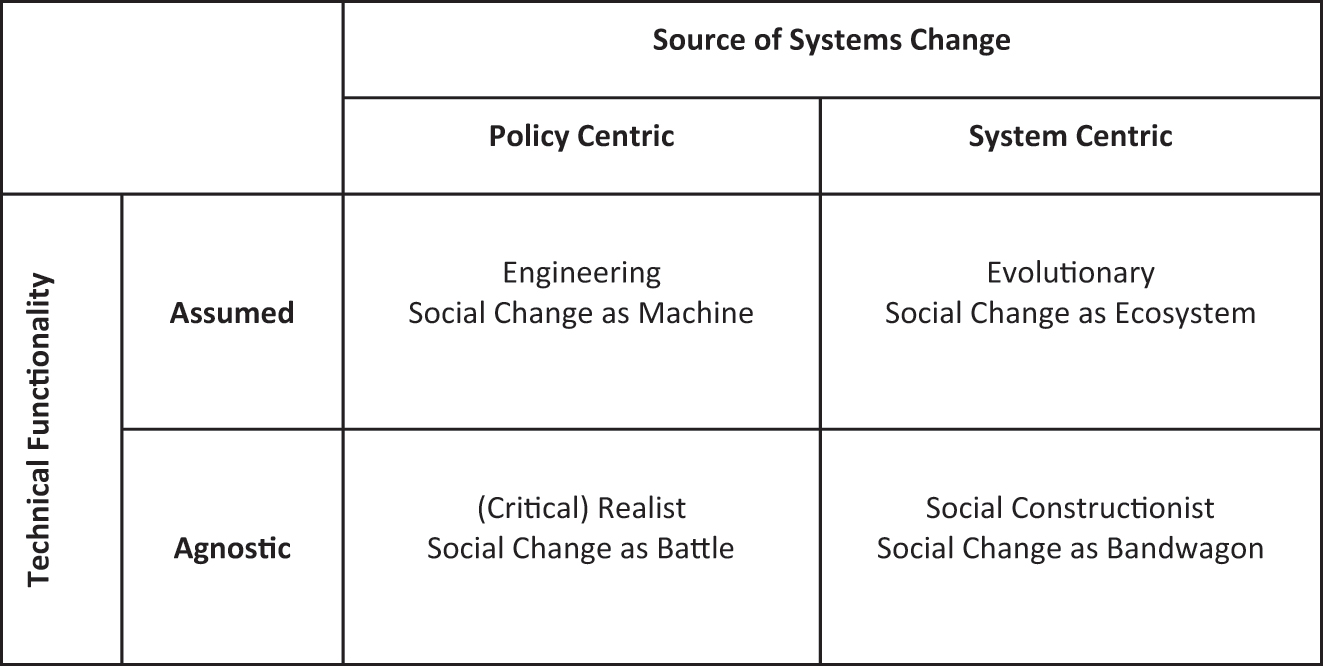
Complex systems approaches to global social change in the social Sciences.
Two key distinctions separate the key approaches to global social change, shown in Figure 1. First, the driving source of social change can be located either as residing in policies and the actors that create them (the focus of views we characterize as engineering and realist) or in self-organizing and self-perpetuating features of the system itself (the focus of evolutionary and social constructionist views). Second, the perspectives differ as to whether they assume the overall system is ultimately a set of functional relations that tends towards desired outcomes like climate mitigation and adaptation or not. Engineering and evolutionary views assume a degree of technical functionality is inherent to the system, such that policies that do not work (engineering) or are a poor fit to the context (evolutionary) will be replaced over time. In contrast, realist and social constructionist views are agnostic on whether systems possess some kind of optimal technical functioning, instead pointing towards the social, political, and economic forces that underpin how the global system operates.
2.1 Engineering: Social Change as Machine
One dominant, if not the dominant, view of achieving change is to envision the collection of actors and policies involved in the climate sphere as a complex system that operates like an elaborate machine. In this view, the relations between elements can be broken down into composite parts with clear causal relations and effects. The causality can be highly complicated, involving several steps and multiple moving parts. But overall, a problem like climate change is imagined as solvable the way we would build a complex operating system through engineering principles. This approach has long been central to the nonprofit sector, particularly considering the historical view of the sector as service-oriented and designed to fulfill social needs unmet by government and the private sector (Hansmann 1980; Weisbrod 1977).
This engineering approach, rooted in general systems thinking, emerged as a dominant strain in sociology, management, and organization theory especially since the 1950s (Jackson 2001). One of the foundational figures of this work, Parsons, was influenced by engineering and the use of automated control systems. Parsons adapted this thinking to compare society to an organism where every part has a clear purpose or function. In functional conceptions, social and political factors are largely absent, they are envisioned simply as necessary and manipulable components for proper machine-link functioning of a system or treated as minor distortions to what otherwise ought to be a rational system.
Functional approaches gained steam in the 1990s as new public management approaches amplified the view of all economic, political and social processes as driven by rational individual decisions. From an engineering perspective, nonprofit activities are often viewed in relation to government. For example, nonprofits contract to provide government services efficiently and use their expertise in particular domains to give feedback and recommendations to government bodies on appropriate policies. Nonprofits are often assumed to emerge to fill a pre-existing and self-evident demand or need in society, filling in for the failures of markets and state (or vice versa) (Hansmann 1980; Salamon 1987; Weisbrod 1977). In public policy, functional views are commonly underpinned by a utilitarian moral ethic that assumes the best (i.e. morally justifiable) option is the one that benefits the greatest number of people (or the average person) (Mulgan 2014).
The environmental policy literature increasingly emphasizes collaborative governance regimes as one key piece of the machinery needed to address environmental issues (Bauer and Steurer 2014; Bodin 2017; Brandtner 2022; Cheng et al 2023; Ostrom 1990). While operating as a functional system, environmental governance is often decentralized with an increasing emphasis on participatory processes (Ostrom 1990; Lemos and Agrawal 2006).[3] In the case of large-scale environmental issues, such as climate change, individual participation may not be feasible, placing the onus on nonprofit organizations to aggregate public voices and represent individual interests (Heikkila and Gerlak 2005). This also tracks with broader nonprofit literature that describes nonprofits as “mediating structures” and “civic intermediaries” connecting individuals and government (Berger and Neuhaus 1977; LeRoux 2007; Lowry 1995).
As another example, functional roles are widely evident in the climate adaptation and disaster response space. Governments often depend on nonprofit organizations for assistance with disaster relief. In response to the fires that ravaged Lahaina on August 8, 2023, Hawaii Community Foundation, a 501(c) (3) community foundation, in consultation with state and local governments, almost immediately created the Maui Strong Fund to funnel money to nonprofits and other organizations to support recovery (HCF 2024).
In this special issue, Gazley and Cash build on research in this area by exploring whether the nonprofits likely to provide disaster relief in Indiana are engaged in their own planning for climate change. In response to findings that these organizations should focus more attention on planning and risk mitigation, they suggest specific opportunities for doing so. Their research expands on prior work by exploring internal aspects of nonprofits as part of a broader disaster response system.
In sum, an archetype of the engineering view of nonprofit influence in public policy has the following features:
Main depiction of change: assumes an underlying machinery that can be technically rational if understood; emphases on rationality, efficiency, effectiveness.
Main mechanisms of change: focus on decisions of actors and policies they create; can be driven by market-like competition (especially since 1990s) or rational bureaucratic control.
Role of nonprofits in public policy: contracting to implement government policies through service provision; providing input on policy design in domains related to implementation expertise.
Key policy focus: measuring and evaluating outcomes; optimizing implementation.
Key tools: econometrics, policy analysis and evaluation, cost-benefit analysis, engineering models, experiments and randomized control trials.
2.2 Evolutionary: Social Change as Ecosystem
Like engineering views, an evolutionary view of social change imagines a process that tends towards optimal outcomes. Here, the assumption is that adaptive systems will select the policies, technological advances, structures, and governance schemes that are the best fit for the current environment (for a review, see Porter and Córdoba 2009). In theory, a globe existentially threatened by climate change will come to favor actors and institutions that protect the natural world. However, unlike the policy- and actor-centric nature of functional views, an evolutionary lens only partly attributes change to intentional and rational decisions that may manifest as policies or other phenomena. Instead, idiosyncratic interactions and random variation also play a role, alongside learning about how to adapt to the environment. The key aspect of the system is that greater diversity of alternatives, interactions, and actors will, over time, allow for greater adaptability. The process is thought to parallel species evolution; some individuals learn new skills that allow them to adapt and others experience random genetic variation that end up proving more suited to the context. But it is difficult to determine or predict in advance which adaptations will be most valuable, minimizing the centrality of rational decision-making by specific actors or policies in controlling the success of the system. Overall, homogeneity hinders a system from adapting effectively and heterogeneity promotes success. Instead, system dynamics such as levels of interaction, diversity, and feedback loops shape the outcomes.
The state is fundamental in bringing solutions to scale and creating incentives or requirements to comply with climate-friendly policies, but nonprofits are especially important in catalyzing innovation (Anheier and Toepler 2019), the issue of central importance from an evolutionary view. Frumkin (2002), for example, cites social entrepreneurship as a foundational role of the nonprofit sector in society as it spurs innovation. This approach to social changes emphasizes not only the need for diversity and innovation, but also requires communication across networks to enhance evolutionary processes. Three features of the sector, elaborated below, are key to its role in innovation – it operates outside of government constraints, is buffered from market demands, and facilitates the exchange of ideas. Although these are general features of the sector, the nature of the climate crisis may amplify the role for nonprofit actors in creating novel policies, structures, and solutions, relative to arenas that can be more centrally controlled within national borders such as national health care or education. As discussed at the outset, in the climate domain the problem and interest diversity running from local to global levels makes top-down, highly centralized solutions implausible.
First, relative to government, the nonprofit sector is unconstrained by election cycles, majoritarian demands, and the accountability pressures of using taxpayer funds. Government projects are often pressed towards proven and incremental investments given the large-scale requirements and public accountability processes. Second, nonprofits operate outside the market constraints of businesses, allowing them to tackle problems that are not (and may never be) profitable. Although investment in research on clean energy technology and related fields is increasing, this is long-term, high-risk, and high-regulation work that is not appealing to many firms. And other aspects of climate mitigation and adaptation, such as mitigating harm to poor communities from extreme weather events, may never be profitable. The public and nonprofit sectors have a central role in supporting the creation of new technologies and solutions for adaptation and mitigation that respond to new adaptive challenges (National Science Foundation 2024).
Finally, by facilitating dialogue and the exchange of ideas and by introducing fresh perspectives, nonprofits can enrich the scope of possibilities available in policymaking processes, thereby improving the adaptability of the system. This is particularly so because nonprofits are less restricted than government agencies in their ability to advocate and influence the public and elected officials (Fyall 2016). For example, coal miner’s advocacy groups bring awareness to the importance of a just energy transition that does not disproportionately impact certain industries.
Nonprofit contributions to climate policy run the spectrum from the invention of technical and scientific products in the hard sciences to social innovation around new programs linked to environmental justice. For example, direct innovations range from finding new ways to use advanced nuclear power to meet global energy needs as in the case of TerraPraxis, to the Rainforest Alliance’s work helping small farmers develop “climate smart agriculture” practices (Rainforest Alliance 2021). Nonprofits also design and advocate for innovative policies. In 2023, the State of California enacted laws that require public disclosure of direct, indirect, and supply change greenhouse gas emissions for large firms. Several environmental advocacy groups, including EnviroVoters, Ceres, and Carbon Accountable were key to promoting the legislation, and the reporting mechanism will take place through a nonprofit organization contracted by the state. Or, in recent research, Allan and Hadden (2017) outline the importance of NGO influence in shaping the creation of a “Loss and Damage Fund” as part of the Paris Agreement. The central point, from an evolutionary perspective, is that we don’t yet know which of these innovations – if any – can move the needle on climate change, but solutions are more likely to be found with higher levels of innovation.
While none of the articles in this special issue fall directly under an evolutionary view, we envision numerous promising lines of research, including research examining drivers and obstacles associated with nonprofit innovation, along with the circumstances that support government adoption of nonprofit innovation.[4]
In sum, as a stylized model the evolutionary view has the following features:
Main explanation of change: assumes the global system will evolve in ways that ensure human survival if the set of alternatives is large.
Main mechanisms of change: adaptation and selection, especially via random variation and learning; path dependence and feedback loops also create self-organizing features of the system.
Role of nonprofits in public policy: create new programs and policies that increase the set of alternatives; communicate options to government and other actors.
Key policy focus: increasing and sharing alternatives.
Key tools: innovation, entrepreneurship, communication, networking, learning, creativity, diversity.
2.3 Social Constructionist
Unlike the prior two discussions of social change, constructionist approaches are agnostic about whether the system is ultimately technically functional or not. Instead, perceptions and beliefs can fundamentally shape how global systems operate. In the mid-twentieth century, the social sciences experienced a broad interpretive turn, in part in reaction to the rational assumptions of functional thinking. In constructionist views, taken-for-granted assumptions and interpretation are central, focusing on the elements of systems that are created as constructs of observers rather than entities with an objective existence (Berger and Luckmann 1966). It is not enough that a phenomenon, such as climate change, objectively exists in the world. Social actors also need to agree or believe that the phenomenon is a problem that warrants action.[5] Often, awareness of a problem and perceptions of solutions need to be created. Further, the mechanisms that generate awareness and action are often based on social processes rather than objective reality. For instance, mimicry of peers or high-status actors, following dominant professional norms and moral pressures, or adherence to various regulative pressures often lead to policy diffusion, regardless of objective “need” in a setting (DiMaggio and Powell 1983; Dobbin et al. 2007; Walker 1969). These social processes are expected to be particularly strong under conditions of uncertainty; when functional solutions are not self-evident, actors search externally for guidance on proper action (Meyer and Rowan 1977). Related, policies are often adopted because they are perceived to be legitimate. The legitimacy rationale for policy adoption helps explain commonplace observations of “decoupling”, when actors are unable or unwilling to implement adopted policies (Bromley and Powell 2012; Meyer and Rowan 1977).
The twentieth century saw a sweeping global emergence of environmentalism (Frank et al. 2000; Meyer et al. 1997). The perception of environmental problems has been actively constructed, led by experts like scientists, the media, and the professionals working in nonprofits (Cooley 2023; Hironaka 2014). Changed perceptions of environmental issues as problems to be actively solved provide an ontological foundation for climate policy. Many nonprofits play a key role in this work by seeking to raise awareness and educate the public about climate change and related issues such as deforestation and social justice. For example, one notable group, Action for the Climate Emergency, has educated over 25 million U.S. high school students through its teaching resource “Our Climate Our Future” (Action for the Climate Emergency 2023). Related, Bies et al. (2013) documented a complex relationship between nonprofit organizations and individual level concern for the climate. Citizens are shaped less by their membership in organizations, and more by their trust in environmental groups. Overall, when climate risk is not immediately apparent, communities may not yet be considering or prioritizing it (Pouliotte et al. 2009).
It is not only problems that are constructed, but also solutions, and the connection between the two. Organizational and public administration scholars have widely noted the weak connection between problems and solutions. Behavioral theories of organization describe how decision-making is akin to a “garbage can” where problems and solutions are tossed into a shared space and brought together by virtue of their joint availability at that moment more than due to purely functional assessments (Cohen et al. 1972). Kingdon’s (1995) “multiple streams” theory in public policy also partly shares the bounded rationality assumptions of the garbage can model and adds the assumption that policy entrepreneurs intentionally draw attention to problems and work to couple problems with policy solutions.
In the environmental realm, constructing the definition of the problem and solution is no small matter. That is, environmental issues are sometimes not immediately recognized by local communities as self-evident crises or are (often understandably) considered less important than other fundamental needs. Research on framing practices (Dodge 2015) and climate politics (Mullin 2022) thus become critical. Nonprofits indirectly – but fundamentally – shape policy by helping to construct attitudes, beliefs, values, and norms about legitimate problems and solutions.
Two articles in this special issue address these points. Zuhlke and Katz link the presence of nonprofit land trust organizations with local agenda setting. They find that land trusts may use temperature anomalies to persuade local governments to consider conservation measures, shaping awareness of the issue. As such, not only do they examine an understudied organization type, but they also illuminate a concrete example of nonprofits working to construct solutions by linking climate phenomena with policy changes. Next, Sun demonstrates that the presence of advocacy-oriented ENPOs within a county is positively correlated, to a point, with public concern about climate change. However, there is an inverted U-shaped relationship between the two, pointing to the fact that public concern does not automatically translate into organized environmental activism.
In sum, the social constructionist approach has the following features:
Main explanation of change: actors’ norms, values, and taken-for-granted assumptions about appropriate roles and actions; agnostic on whether system is functional, although in modern era actors often hold beliefs about its technical rationality.
Main mechanism of change: peer and status influences; bandwagoning as more or high status actors adopt or abandon policies; exogenous shocks can create initial change.
Key policy focus: process, pluralism.
Key tools: understanding meanings and multiple perspectives, self-awareness and reflection, active listening and observation of others, deliberation, raising awareness, empathy, framing, consensus building.
2.4 (Critical) Realist: Social Change as Battle
Like social constructionist approaches, critical realist approaches also do not harbor assumptions about the technical rationality of systems. Realist views represent a policy- and actor-centric approach, viewing the system as a compilation of the policies and actors within it organized by power, resources, and interests. But it is the outcome of struggles over power and resources that determine the nature of the system, rather than whether a particular policy or action is ultimately beneficial for the overall system or not. From the view of its proponents, critical realism responds to the more extreme views of functionalism and constructivism, asserting that while knowledge (epistemology) is subject to interpretation, there is an underlying reality (ontology) that makes some interpretations better than others (Bhaskar 1975; Owens 2011). The thrust of critical realism is its emphasis on causal processes and “aim to discover the structures, powers, propensities, and liabilities of the unobservable and currently unobserved forces” (Ongaro and Yang 2024, 6).
Across the spectrum of their work, nonprofits both reinforce and counteract the dominant power and resource structures. An important critique of nonprofits in the climate policy space is that they reinforce existing systems by representing and amplifying wealthy White voices. Indeed, these were the concerns that helped give rise to the environmental justice movement, which began, by most counts, in 1982 in North Carolina and continues today (Cole and Foster 2001; McGurty 2000). Grassroots groups organized not only to combat oppressive government policies, but also to draw attention to the racist and unjust structures that exist within the mainstream environmental and conservation movements (Bullard et al. 2008; Cole and Foster 2001). But counter-activism aimed at undercutting climate science is also increasingly common; foundations and other nonprofit actors are important actors in a growing anti-environmental movement (Brulle 2014, 2023; Brulle et al. 2021).
There are several ways in which nonprofit organizations might challenge dominant systems and influence climate policy. First, a common distinction drawn in policy, political science, and nonprofit literatures is between inside and outside tactics (Gais and Walker 1991; see also Mosley et al. 2023), where outside tactics, such as protests and rallies, leverage the public to pressure decision makers, rather than work within the rules of agencies or legislatures. Related nonprofit activities also include training citizen advocates and serving as “schools of democracy” (Clemens 2006; Dodge and Ospina 2016), or working to change institutions and government compositions through political advocacy, such as by 501(c) (4) organizations.
Nonprofit organizations also commonly challenge dominant systems through judicial advocacy. Either through the Administrative Procedure Act or through the many citizen suit provisions that exist in environmental laws such as the Clean Water Act and the Clean Air Act, nonprofits often bring lawsuits to enforce environmental laws where governments have failed to do so (Smith 2004). Sometimes viewed as an outside tactic for its ability to force the hands of legislators and regulators, judicial advocacy occurs when nonprofits sue government agencies to force them to take action or challenge actions they have taken. Much as courts have been pivotal in shaping civil rights, courts have made similar impacts in environmental cases. For example, in Massachusetts v. EPA (2007), the Supreme Court ruled that the EPA has the authority under the Clean Air Act to regulate greenhouse gas emissions. Even where nonprofits have not been successful, their efforts may bring attention to and raise awareness around critical issues.
As Ovalle, Bixler, and Ma show in this special issue, power matters. Elitism continues to play a role in financing environmental nonprofits in Texas, where ENPOs with higher assets are more likely to receive foundation funding. Perhaps also supporting a functional engineering view, though, foundation funding is more likely to flow to nonprofits in areas with higher environmental risks.
In sum, the realist and critical realist views have the following features:
Main explanation of change: actors’ power, resources, and self-interest dictate the direction of the system; only some actors define their interests as aligning with climate protection.
Main mechanism of change: coercion and group conflict and competition, e.g. often along lines of wealth, class, race, ethnicity, gender, sex, citizenship status, religion.
Nature of nonprofit influence on policy: nonprofits are a vehicle for pressuring government to align with group interests (e.g. to protect the environment, or to protect anti-environment interests).
Key policy focus: interests and incentives.
Key tools: strategy, alliances, social movements and tactics, policy advocacy, protests.
3 Conclusions
The goal of this introduction is to support research and practice by encouraging more deliberate thought around social change related to climate issues and solutions. Each of the four views can be used as: a starting assumption about how the world works that drives the research questions asked or policy designs and organizational goals; an open analytic possibility for how policy might function that can be examined; or a normative stance making claims about how research, policy, and practice ought to be. It may be useful for future efforts to consider how each of these approaches map on to other frameworks in the broader nonprofit literature, such as those describing government-nonprofit relationships (Najam 2000; Toepler et al. 2023; Young 2000, 2006). Future work could also examine how the different views put forth divergent and sometimes contradictory depictions of the ways nonprofits seek to address climate change (including opposition to climate action). Also, beyond the climate sphere, others may consider applying this framework to problems like education, poverty, or human rights.
We see particular benefits to understanding multiple approaches to global social change, versus advocating for a single view. Awareness of several worldviews can raise the potential oversights that occur when looking at problems from a single lens alone. For example, functionalist and evolutionary perspectives could incorrectly assume that because a policy has spread widely, it must be technically rational. In contrast, a social constructionist approach points to uncertainty around effectiveness as the key driver of diffusion, with ambiguity leading to a great deal of copying. Realist views point to power and self-interest in explaining policy diffusion. Questioning these baseline assumptions and open analysis of alternatives could promote better decisions and solutions. Related, understanding multiple approaches can help explain why the same solution is sometimes viewed divergently. For instance, as many now observe, “innovation” has become imbued with a positive moral valence (Downs and Mohr 1976, 700). However, much innovation can also be seen as failure or waste (Rogers 2003). From a functional view, the critique of failed innovation as wasteful makes sense, but from an evolutionary view a system is expected to be more adaptive in the long run if it has a greater range of alternatives available. In climate policy, it may be the case that government actors using taxpayer funds are less able to sustain “wasteful” innovation due to public pressure, while civil society actors have more leeway. Pressing on the deep assumptions that can lead actors to see solutions differently may enhance understanding of the conditions under which policies may be more successful or accepted.
Awareness of multiple perspectives can broaden our thinking, enhance our grasp of others’ perspectives, and produce better informed decisions. Scholars and practitioners can develop a clearer sense of their goals, along with the paths and actions necessary to achieve them, such as innovation, specific advocacy strategies, funding decisions, and transparency and accountability mechanisms. Ultimately, the sector’s ability to promote effective climate policy rests not only in finding economic and technical solutions, but in wrestling with fundamental questions about how social change is achieved and what roles the various actors, such as nonprofits, governments, firms, and individuals, can and should play in a democratic society.
References
Action for the Climate Emergency. 2023. “Website.” https://acespace.org/ (accessed August 10, 2023).Suche in Google Scholar
Allan, J. I., and J. Hadden. 2017. “Exploring the Framing Power of NGOs in Global Climate Politics.” Environmental Politics 26 (4): 600–20. https://doi.org/10.1080/09644016.2017.1319017.Suche in Google Scholar
Anheier, H. K., and S. Toepler. 2019. “Policy Neglect: The True Challenge to the Nonprofit Sector.” Nonprofit Policy Forum 10 (4): 1–9. https://doi.org/10.1515/npf-2019-0041.Suche in Google Scholar
Bauer, A., and R. Steurer. 2014. “Innovation in Climate Adaptation Policy: Are Regional Partnerships Catalysts or Talking Shops?” Environmental Politics 23 (5): 818–38. https://doi.org/10.1080/09644016.2014.924196.Suche in Google Scholar
Berger, P. L., and T. Luckmann. 1966. The Social Construction of Reality: A Treatise in the Sociology of Knowledge. New York: Anchor Books.Suche in Google Scholar
Berger, P. L., and R. J. Neuhaus. 1977. To Empower People: The Role of Mediating Structures in Public Policy, Vol. 1. Washington: American Enterprise Institution for Public Policy Research.Suche in Google Scholar
Bhaskar, R. 1975. A Realist Theory of Science. London: Routledge.Suche in Google Scholar
Bies, A. L., D. G. Lee, C. Lindsey, J. W. Stoutenborough, and A. Vedlitz. 2013. “Citizens, Nonprofits and Climate Change Policy.” Nonprofit Policy Forum 4 (1): 5–28. https://doi.org/10.1515/npf-2012-0001.Suche in Google Scholar
Bodin, Ö. 2017. “Collaborative Environmental Governance: Achieving Collective Action in Social-Ecological Systems.” Science 357 (6352): eaan1114. https://doi.org/10.1126/science.aan1114.Suche in Google Scholar
Brandtner, C. 2022. “Green American City: Civic Capacity and the Distributed Adoption of Urban Innovation.” American Journal of Sociology 128 (3): 627–79. https://doi.org/10.1086/722965.Suche in Google Scholar
Bromley, P., and W. W. Powell. 2012. “From Smoke and Mirrors to Walking the Talk: Decoupling in the Contemporary World.” Academy of Management Annals 6 (1): 483–530. https://doi.org/10.5465/19416520.2012.684462.Suche in Google Scholar
Brulle, R. J. 2014. “Institutionalizing Delay: Foundation Funding and the Creation of US Climate Change Counter-movement Organizations.” Climatic Change 122 (4): 681–94, https://doi.org/10.1007/s10584-013-1018-7.Suche in Google Scholar
Brulle, R. J. 2023. “Advocating Inaction: A Historical Analysis of the Global Climate Coalition.” Environmental Politics 32 (2): 185–206. https://doi.org/10.1080/09644016.2022.2058815.Suche in Google Scholar
Brulle, R. J., G. Hall, L. Loy, and K. Schell-Smith. 2021. “Obstructing Action: Foundation Funding and US Climate Change Counter-Movement Organizations.” Climatic Change 166 (1–2): 1–7, https://doi.org/10.1007/s10584-021-03117-w.Suche in Google Scholar
Bullard, R. D., P. Mohai, R. Saha, and B. Wright. 2008. “Toxic Wastes and Race at Twenty: Why Race Still Matters after All of These Years.” Environmental Law 38 (2): 371–411.Suche in Google Scholar
Child, C. D., and K. A. Grønbjerg. 2007. “Nonprofit Advocacy Organizations: Their Characteristics and Activities.” Social Science Quarterly 88 (1): 259–81. https://doi.org/10.1111/j.1540-6237.2007.00457.x.Suche in Google Scholar
Cheng, Y., A. Park, and R. Krause. 2023. “Nonprofit Sector Size and the Breadth of Local Government Climate Actions: Exploring the Moderating Role of Collaboration.” Nonprofit and Voluntary Sector Quarterly 52 (4): 845–1137. https://doi.org/10.1177/08997640221146967.Suche in Google Scholar
Clemens, E. S. 2006. “The Constitution of Citizens: Political Theories of Nonprofit Organizations.” In The Nonprofit Sector: A Research Handbook, edited by W. W. Powell, and R. Steinberg, 2nd ed., 207–20. New Haven: Yale University Press.10.12987/9780300153439-012Suche in Google Scholar
Cohen, M. D., J. G. March, and J. P. Olsen. 1972. “A Garbage Can Model of Organizational Choice.” Administrative Science Quarterly 17 (1): 1–25. https://doi.org/10.2307/2392088.Suche in Google Scholar
Cole, L. W., and S. R. Foster. 2001. From the Ground up: Environmental Racism and the Rise of the Environmental Justice Movement. New York: NYU Press.Suche in Google Scholar
Cooley, A. 2023. “The Role of the Nonprofit Sector within the Climate Change Discourse: The View through Russian News Media.” Nonprofit Policy Forum 14 (1): 1–23. https://doi.org/10.1515/npf-2022-0002.Suche in Google Scholar
DiMaggio, P. J., and W. W. Powell. 1983. “The Iron Cage Revisited: Institutional Isomorphism and Collective Rationality in Organizational Fields.” American Sociological Review 48 (2): 147–60. https://doi.org/10.2307/2095101.Suche in Google Scholar
Dobbin, F., B. Simmons, and G. Garrett. 2007. “The Global Diffusion of Public Policies: Social Construction, Coercion, Competition, or Learning?” Annual Review of Sociology 33 (1): 449–72, https://doi.org/10.1146/annurev.soc.33.090106.142507.Suche in Google Scholar
Dodge, J. 2015. “The Deliberative Potential of Civil Society Organizations: Framing Hydraulic Fracturing in New York.” Policy Studies 36 (3): 249–66. https://doi.org/10.1080/01442872.2015.1065967.Suche in Google Scholar
Dodge, J., and S. M. Ospina. 2016. “Nonprofits as “Schools of Democracy”: A Comparative Case Study of Two Environmental Organizations.” Nonprofit and Voluntary Sector Quarterly 45 (3): 478–99. https://doi.org/10.1177/0899764015584063.Suche in Google Scholar
Downs Jr, G. W., and L. B. Mohr. 1976. “Conceptual Issues in the Study of Innovation.” Administrative Science Quarterly 21 (4): 700–14. https://doi.org/10.2307/2391725.Suche in Google Scholar
Fiksel, J. 2006. “Sustainability and Resilience: Toward a Systems Approach.” Sustainability: Science, Practice and Policy 2 (2): 14–21. https://doi.org/10.1080/15487733.2006.11907980.Suche in Google Scholar
Fischer, Frank. 2019. “Knowledge Politics and Post-Truth in Climate Denial: On the Social Construction of Alternative Facts.” Critical Policy Studies 13 (2): 133–52. https://doi.org/10.1080/19460171.2019.1602067.Suche in Google Scholar
Frank, D. J., A. Hironaka, and E. Schofer. 2000. “The Nation-State and the Natural Environment over the Twentieth Century.” American Sociological Review 65 (1): 96–116. https://doi.org/10.2307/2657291.Suche in Google Scholar
Frumkin, P. 2002. On Being Nonprofit: A Conceptual and Policy Primer. Cambridge: Harvard University Press.10.4159/9780674037403Suche in Google Scholar
Fyall, R. 2016. “The Power of Nonprofits: Mechanisms for Nonprofit Policy Influence.” Public Administration Review 76 (6): 938–48. https://doi.org/10.1111/puar.12550.Suche in Google Scholar
Gais, T. L., and J. L. Walker. 1991. “Pathways to Influence in American Politics.” In Mobilizing Interest Groups in America, edited by J. L. Walker, 103–21. Ann Arbor: The University of Michigan Press.Suche in Google Scholar
Ganz, S. C., and S. A. Soule. 2019. “Greening the Congressional Record: Environmental Social Movements and Expertise-Based Access to the Policy Process.” Environmental Politics 28 (4): 685–706. https://doi.org/10.1080/09644016.2019.1565463.Suche in Google Scholar
Gazley, B., and A. Prakash. 2023. “Climate Change and the Voluntary Sector: An Introduction.” Nonprofit and Voluntary Sector Quarterly 52 (4): 845–70. https://doi.org/10.1177/08997640231172523.Suche in Google Scholar
Hansmann, H. B. 1980. “The Role of Nonprofit Enterprise.” The Yale Law Journal 89 (5): 835–901. https://doi.org/10.2307/796089.Suche in Google Scholar
Hawai‘i Community Foundation (HCF). 2024. “Maui Strong Fund.” https://www.hawaiicommunityfoundation.org/strengthening/maui-strong-fund (accessed June 13, 2024).Suche in Google Scholar
Heikkila, T., and A. K. Gerlak. 2005. “The Formation of Large‐scale Collaborative Resource Management Institutions: Clarifying the Roles of Stakeholders, Science, and Institutions.” Policy Studies Journal 33 (4): 583–612. https://doi.org/10.1111/j.1541-0072.2005.00134.x.Suche in Google Scholar
Hironaka, A. 2014. Greening the Globe. Cambridge: Cambridge University Press.10.1017/CBO9781139381833Suche in Google Scholar
Jackson, M. C. 2001. “Critical Systems Thinking and Practice.” European Journal of Operational Research 128 (2): 233–44. https://doi.org/10.1016/s0377-2217(00)00067-9.Suche in Google Scholar
Kagan, J. A., and J. Dodge. 2023. “The Third Sector and Climate Change: A Literature Review and Agenda for Future Research and Action.” Nonprofit and Voluntary Sector Quarterly 52 (4): 871–91. https://doi.org/10.1177/08997640221123587.Suche in Google Scholar
Keohane, R. O., and D. G. Victor. 2011. “The Regime Complex for Climate Change.” Perspectives on Politics 9 (1): 7–23. https://doi.org/10.1017/s1537592710004068.Suche in Google Scholar
Kingdon, J. W. 1995. Agendas, Alternatives and Publics Policies, 2nd ed. New York: Harper Collins.Suche in Google Scholar
Lemos, M. C., and A. Agrawal. 2006. “Environmental Governance.” Annual Review of Environment and Resources 31: 297–325. https://doi.org/10.1146/annurev.energy.31.042605.135621.Suche in Google Scholar
LeRoux, K. 2007. “Nonprofits as Civic Intermediaries: The Role of Community-Based Organizations in Promoting Political Participation.” Urban Affairs Review 42 (3): 410–22. https://doi.org/10.1177/1078087406292257.Suche in Google Scholar
Lowry, R. 1995. “Nonprofit Organizations and Public Policy.” Policy Studies Review 14 (1/2): 107–16. https://doi.org/10.1111/j.1541-1338.1995.tb00624.x.Suche in Google Scholar
McCright, A. M., and R. E. Dunlap. 2003. “Defeating Kyoto: The Conservative Movement’s Impact on U.S. Climate Change Policy.” Social Problems 50 (3): 348–73. https://doi.org/10.1525/sp.2003.50.3.348.Suche in Google Scholar
McGurty, E. M. 2000. “Warren County, NC, and the Emergence of the Environmental Justice Movement: Unlikely Coalitions and Shared Meanings in Local Collective Action.” Society and Natural Resources 13 (4): 373–87. https://doi.org/10.1080/089419200279027.Suche in Google Scholar
Meyer, J. W., D. J. Frank, A. Hironaka, E. Schofer, and N. B. Tuma. 1997. “The Structuring of a World Environmental Regime, 1870–1990.” International Organization 51 (4): 623–51. https://doi.org/10.1162/002081897550474.Suche in Google Scholar
Meyer, J. W., and B. Rowan. 1977. “Institutionalized Organizations: Formal Structure as Myth and Ceremony.” American Journal of Sociology 83 (2): 340–63. https://doi.org/10.1086/226550.Suche in Google Scholar
Mosley, J. E., D. F. Suárez, and H. Hwang. 2023. “Conceptualizing Organizational Advocacy across the Nonprofit and Voluntary Sector: Goals, Tactics, and Motivation.” Nonprofit and Voluntary Sector Quarterly 52 (1_suppl): 187S–211. https://doi.org/10.1177/08997640221103247.Suche in Google Scholar
Mulgan, T. 2014. Understanding Utilitarianism. London: Routledge.10.4324/9781315711928Suche in Google Scholar
Mullin, M. 2022. “To Adapt to Climate Impacts, Come to Grips with Politics.” Nature 609 (7925): 9, https://doi.org/10.1038/d41586-022-02762-0.Suche in Google Scholar
Najam, A. 2000. “The Four C’s of Third Sector–Government Relations: Confrontation, Co-optation, Complementarity, Cooperation.” Nonprofit Management and Leadership 10 (4): 375–96. https://doi.org/10.1002/nml.10403.Suche in Google Scholar
National Science Foundation. 2024. “Higher Education R&D Increase of 3.3% in FY 2020 Is the Lowest since FY 2015.” InfoBrief. https://ncses.nsf.gov/pubs/nsf22312 (accessed February 16, 2024).Suche in Google Scholar
Nicholas, G. 2022. “Getting to Practical: Complementarity between Critical Systems Thinking and Phronetic Social Science.” Systems Research and Behavioral Science 39 (5): 913–22. https://doi.org/10.1002/sres.2880.Suche in Google Scholar
Ongaro, E., and Y. Yang. 2024. “Integrating Philosophical Perspectives into the Study of Public Administration: The Contribution of Critical Realism to Understanding Public Value.” Public Policy and Administration. https://doi.org/10.1177/095207672412466.Suche in Google Scholar
Ostrom, E. 1990. Governing the Commons: The Evolution of Institutions for Collective Action. Cambridge: Cambridge University Press.10.1017/CBO9780511807763Suche in Google Scholar
Owens, J. 2011. An Introduction to Critical Realism as a Meta-Theoretical Research Perspective. London: King’s College London Center for Public Policy Research.Suche in Google Scholar
Pew Research Center. 2023. “Why Some Americans Do Not See Urgency on Climate Change.” https://www.pewresearch.org/science/2023/08/09/why-some-americans-do-not-see-urgency-on-climate-change/ (accessed February 16, 2024).Suche in Google Scholar
Porter, T., and J. Córdoba. 2009. “Three Views of Systems Theories and Their Implications for Sustainability Education.” Journal of Management Education 33 (3): 323–47. https://doi.org/10.1177/1052562908323192.Suche in Google Scholar
Pouliotte, J., B. Smit, and L. Westerhoff. 2009. “Adaptation and Development: Livelihoods and Climate Change in Subarnabad, Bangladesh.” Climate and Development 1 (1): 31–46. https://doi.org/10.3763/cdev.2009.0001.Suche in Google Scholar
Rainforest Alliance, The. 2021. “What Is Climate Smart Agriculture?” https://www.rainforest-alliance.org/insights/what-is-climate-smart-agriculture/ (accessed August 10, 2023).Suche in Google Scholar
Rittel, H. W., and M. M. Webber. 1973. “Dilemmas in a General Theory of Planning.” Policy Sciences 4 (2): 155–69. https://doi.org/10.1007/bf01405730.Suche in Google Scholar
Rogers, E. 2003. Diffusion of Innovations, 5th ed. New York: Free Press.Suche in Google Scholar
Salamon, L. M. 1987. “Of Market Failure, Voluntary Failure, and Third-Party Government: Toward a Theory of Government-Nonprofit Relations in the Modern Welfare State.” Journal of Voluntary Action Research 16 (1-2): 29–49. https://doi.org/10.1177/089976408701600104.Suche in Google Scholar
Smith, K. M. 2004. “Who’s Suing Whom: A Comparison of Government and Citizen Suit Environmental Enforcement Actions Brought under EPA-Administered Statutes, 1995-2000.” Columbia Journal of Environmental Law 29 (2): 359–414.Suche in Google Scholar
Sternberg, R. J., and P. A. Frensch. 2014. Complex Problem Solving: Principles and Mechanisms. New York: Psychology Press.10.4324/9781315807546Suche in Google Scholar
Toepler, S., A. Zimmer, K. Levy, and C. Fröhlich. 2023. “Beyond the Partnership Paradigm: Toward an Extended Typology of Government/Nonprofit Relationship Patterns.” Nonprofit and Voluntary Sector Quarterly 52 (1_suppl): 160S–186. https://doi.org/10.1177/08997640221112890.Suche in Google Scholar
Ulrich, W. 1993. “Some Difficulties of Ecological Thinking, Considered from a Critical Systems Perspective: A Plea for Critical Holism.” Systems Practice 6 (6): 583–611, https://doi.org/10.1007/bf01059480.Suche in Google Scholar
Van Rensburg, W. 2015. “Climate Change Scepticism: A Conceptual Re-evaluation.” Sage Open 5 (2). https://doi.org/10.1177/2158244015579723.Suche in Google Scholar
Walker, J. L. 1969. “The Diffusion of Innovations Among the American States.” American Political Science Review 63 (3): 880–99, https://doi.org/10.1017/s0003055400258644.Suche in Google Scholar
Walt, S. M. 1998. International Relations: One World, Many Theories, 29–46. Foreign Policy.10.2307/1149275Suche in Google Scholar
Waters, M. 1994. Modern Sociological Theory. London: Sage.Suche in Google Scholar
Weber, E. P., and A. M. Khademian. 2008. “Wicked Problems, Knowledge Challenges, and Collaborative Capacity Builders in Network Settings.” Public Administration Review 68 (2): 334–49. https://doi.org/10.1111/j.1540-6210.2007.00866.x.Suche in Google Scholar
Weisbrod, B. A. 1977. The Voluntary Nonprofit Sector. Lexington: Lexington Books.Suche in Google Scholar
Young, D. R. 2000. “Alternative Models of Government-Nonprofit Sector Relations: Theoretical and International Perspectives.” Nonprofit and Voluntary Sector Quarterly 29 (1): 149–72. https://doi.org/10.1177/0899764000291009.Suche in Google Scholar
Young, D. R. 2006. “Complementary, Supplementary, or Adversarial? A Theoretical and Historical Examination of Nonprofit–Government Relations in the United States.” In Nonprofits and Government: Collaboration and Conflict, edited by E. T. Boris, and C. E. Steuerle, 37–80. Washington: Urban Institute Press.Suche in Google Scholar
© 2024 the author(s), published by De Gruyter, Berlin/Boston
This work is licensed under the Creative Commons Attribution 4.0 International License.
Artikel in diesem Heft
- Frontmatter
- Research Articles
- Advancing Global Social Change: Systems Approaches to the Role of Nonprofits in Climate Policy
- Nonprofit Disaster Response and Climate Change: Who Responds? Who Plans?
- Strike While the Iron is Hot: Land Trusts, Temperature Anomalies, and Agenda Setting for Local Open Space Referenda
- Environmental Nonprofit Organizations and Public Opinion on Global Warming
- How Do Nonprofits’ Organizational Characteristics Shape Environmental Philanthropy in Texas? A Network Science Approach
- Book Review
- Anders Sevelsted, Jonas Toubøl (eds.): The Power of Morality in Movements. Civic Engagement in Climate Justice, Human Rights, and Democracy
Artikel in diesem Heft
- Frontmatter
- Research Articles
- Advancing Global Social Change: Systems Approaches to the Role of Nonprofits in Climate Policy
- Nonprofit Disaster Response and Climate Change: Who Responds? Who Plans?
- Strike While the Iron is Hot: Land Trusts, Temperature Anomalies, and Agenda Setting for Local Open Space Referenda
- Environmental Nonprofit Organizations and Public Opinion on Global Warming
- How Do Nonprofits’ Organizational Characteristics Shape Environmental Philanthropy in Texas? A Network Science Approach
- Book Review
- Anders Sevelsted, Jonas Toubøl (eds.): The Power of Morality in Movements. Civic Engagement in Climate Justice, Human Rights, and Democracy
