MERCOSUR and the Brazilian Leadership Challenge in the Era of Chinese Growth: A Uruguayan Foreign Policy Perspective
-
Francisco Urdinez

 ,
Camilo López Burian
,
Camilo López Burian

Abstract
In recent years, China has expanded its presence in Latin America leading to increased trade flows, foreign direct investment, and bilateral cooperation agreements. At the same time, Brazil has attempted to emerge as a global player from its belief in itself as a regional leader. While both countries are part of the emerging South, they are also competing for influence in the South American area. We hypothesize that for MERCOSUR members, deepening commercial ties with China would be a viable option to counterbalance Brazil’s regional leadership, using Uruguayan legislators preferences as a tool for our study. Using logistic models, we conclude that that the probability of supporting a hypothetical free trade agreement with China is larger when politicians viewed MERCOSUR as an obstacle to the interests of his or her country and when he or she had doubts about Brazilian de facto regional leadership. This empirical evidence allows us to reflect on the political consequences of free trade agreements, on Brazil’s leadership in South America, and Brazil-China relations from the perspective of South-South relations in general.
Funding source: São Paulo’s Research Foundation (FAPESP) (Grant/Award Number: “2015/12688-2”) São Paulo’s Research Foundation (FAPESP)
Award Identifier / Grant number: ‘2014/03831’
Funding statement: São Paulo’s Research Foundation (FAPESP) (Grant/Award Number: “2015/12688-2”) São Paulo’s Research Foundation (FAPESP) (Grant/Award Number: ‘2014/03831’)
References
Acuña, C., and M.Chudnovsky. 2013. “Cómo entender las instituciones y su relación con la política: lo bueno, lo malo y lo feo de las instituciones y los institucionalismos.” In ¿Cuánto importan las instituciones? Gobierno, Estado y actores en la política argentina, edited by C.Acuña (comp.), 13–67. Buenos Aires: Siglo Veintiuno.Search in Google Scholar
Arieti, S. A. 2005. “Role of MERCOSUR as a Vehicle for Latin American Integration.” The Chicago Journal of International Law 6 (2):761–73.Search in Google Scholar
Baer, W., and A.Elizagaray. 2014. “Introduction to the Special Issue on Mercosur: Its Successes and Failures.” Latin American Business Review 15 (3–4):191–2.10.1080/10978526.2014.931775Search in Google Scholar
Baier, S. L., and J. H.Bergstrand. 2007. “Do Free Trade Agreements Actually Increase Members’ International Trade?” Journal of International Economics 71 (1):72–95.10.1016/j.jinteco.2006.02.005Search in Google Scholar
Buquet, D. 2000. “Fragmentación y fraccionalización política: de la oferta electoral a la conformación del gobierno.” In La “segunda” transición en el Uruguay. Gobierno y Partidos en un Tiempo de Reformas, edited by Lanzaro, J. (coord.), 259–96. Montevideo: FCU – ICP.Search in Google Scholar
Burges, S. W. 2008. “Consensual Hegemony: Theorizing Brazilian Foreign Policy after the Cold War.” International Relations 22 (1):65–84.10.1177/0047117807087243Search in Google Scholar
Burges, S. W. 2015. “Revisiting Consensual Hegemony: Brazilian Regional Leadership in Question.” International Politics 52 (2):193–207.10.1057/ip.2014.43Search in Google Scholar
Caetano, G. 2011. “Breve historia del MERCOSUR en sus 20 años. Coyunturas e instituciones (1991–2011).” In MERCOSUR: 20 años, edited by Gerardo Caetano (coord.), 21–71. Montevideo: CEFIR Fundación EbertSearch in Google Scholar
Carranza, M. E. 2003. “Can Mercosur survive? Domestic and international constraints on Mercosur.” Latin American Politics and Society 45 (2):67–103.10.1111/j.1548-2456.2003.tb00241.xSearch in Google Scholar
Carranza, M. E. 2014. “Resilient or Declining? Latin American Regional Economic Blocs in the Postneoliberal Era.” Latin American Politics and Society 56 (3):163–72.10.1111/j.1548-2456.2014.00244.xSearch in Google Scholar
Chasquetti, D. 2014. Parlamento y Carreras Legislativas en Uruguay: Un estudio sobre reglas, partidos y legisladores en las Cámaras. Montevideo: Universidad de la República.Search in Google Scholar
Chayes, A., and A. H.Chayes. 1993. “On Compliance.” International Organization 47 (2):175–205.10.1017/S0020818300027910Search in Google Scholar
de Oliveira, A. J., and J.Onuki. 2010. “India, Brazil and South Africa: Collective Action, Divergent Positions.” New Global Studies 4 (2):1–23.10.2202/1940-0004.1087Search in Google Scholar
De Oliveira, H. A. 2012. “Brazil and China: From South-South Cooperation to Competition?.” In Latin America Facing China: South-South Relations Beyond the Washington Consensus, edited by A. E. F.Jilberto, and B.Hogenboom,. Oxford, NY: Berghahn Books.Search in Google Scholar
Doctor, M. 2013. “Prospects for Deepening MERCOSUR Integration: Economic Asymmetry and Institutional Deficits.” Review of International Political Economy 20 (3):515–40.10.1080/09692290.2012.671763Search in Google Scholar
Dosch, J., and Goodman, D. 2012. “China and Latin America: Complementarity, Competition, and Globalisation.” Journal Of Current Chinese Affairs 41 (1):3–19.10.1177/186810261204100101Search in Google Scholar
Federação das Indústrias do Estado de São Paulo – FIESP. 2014. Documento de Posición. Propuestas de integración externa de la industria. São Paulo, SP: FIESP.Search in Google Scholar
Flemes, D. 2009. “Brazilian Foreign Policy in the Changing World Order.” South African Journal of International Affairs 16 (2):161–82.10.1080/10220460903265840Search in Google Scholar
Flemes, D., and L. Wehner. 2015. “Drivers of Strategic Contestation: The Case of South America.” International Politics 52 (2):163–77.10.1057/ip.2014.45Search in Google Scholar
Flemes, D., and T. Wojczewski. 2010. “Contested leadership in international relations: power politics in South America, South Asia and Sub-Saharan Africa.” GIGA Working Paper (121).10.2139/ssrn.1547773Search in Google Scholar
Frente Amplio. 2014. Bases programáticas. Tercer gobierno nacional del Frente Amplio 2015–2020. Montevideo: FA.Search in Google Scholar
Garcé, A. 2014. “Regímenes Políticos de Conocimiento: Construyendo un nuevo concepto a partir de eventos de cambio seleccionados en políticas públicas del gobierno de Tabaré Vázquez (Uruguay, 2005–2009).” Revista de Ciencia Política 34 (2):439–58.10.4067/S0718-090X2014000200005Search in Google Scholar
Genna, G. M., and T.Hiroi. 2005. “The Effects of Unequal Size Costs and Benefits of Unilateral Action in the Development of MERCOSUR.” Journal of Developing Societies 21 (3–4):337–55.10.1177/0169796X05058292Search in Google Scholar
Gómez-Mera, L. 2014. Power and Regionalism in Latin America. Notre Dame, IN: University of Notre Dame Press.Search in Google Scholar
Greif, A. 1993. “Contract Enforceability and Economic Institutions in Early Trade: The Maghribi Traders’ Coalition.” The American Economic Review 83 (3):525–48.Search in Google Scholar
Grossman, G. M., and E.Helpman. 1995. “The Politics of Free Trade Agreements.” The American Economic Review 85 (4):667–9010.3386/w4597Search in Google Scholar
Hettne, B., and F.Söderbaum. 2006. “Theorising the Rise of Regionness.” New Political Economy 5 (3):457–73.10.4324/9780203361672_chapter_3Search in Google Scholar
Houlden, G., and H.Schmidt. 2014. “Rethinking China’s Soft Power.” New Global Studies 8 (3):213–21.10.1515/ngs-2014-0041Search in Google Scholar
Hurrell, A. 1998. “An Emerging Security Community in South America?”In Security Communities, edited by Emanuel Adler and Michael Barnett, 228–64. Cambridge: Cambridge University Press.10.1017/CBO9780511598661.007Search in Google Scholar
Ianchovichina, E., and W.Martin. 2001. “Trade liberalization in China’s Accession to WTO.” Journal of Economic Integration 16 (4):421–45.10.11130/jei.2001.16.4.421Search in Google Scholar
Ikenberry, G. J. 1996. “The Future of International Leadership.” Political Science Quarterly 111 (3):385–402.10.2307/2151968Search in Google Scholar
Jenkins, R. 2012. “China and Brazil: Economic Impacts of a Growing Relationship.” Journal of Current Chinese Affairs 41 (1):21–47.10.1177/186810261204100102Search in Google Scholar
Jenkins, R. 2014. “Chinese Competition and Brazilian Exports of Manufactures.” Oxford Development Studies 42 (3):395–418.10.1080/13600818.2014.881989Search in Google Scholar
Jesus, Santos Vieira de D. 2012. “The Global Role of an Intermediate Power: Brazil and the Iranian Nuclear Program.” New Global Studies 6 (2):1–15.10.1515/1940-0004.1173Search in Google Scholar
Levy, P. I. 1997. “A Political-Economic Analysis of Free-Trade Agreements.” The American Economic Review 87 (4):506–19.Search in Google Scholar
López Burian, C. 2015. “Partidos políticos, ideología y política exterior en Uruguay (2010–2014).” Colombia Internacional83:135–69.10.7440/colombiaint83.2015.06Search in Google Scholar
Malamud, A. 2005. “MERCOSUR Turns 15: Between Rising Rhetoric and Declining Achievement.” Cambridge Review of International Affairs 18 (3):421–36.10.1080/09557570500238068Search in Google Scholar
Malamud, A. 2011. “A leader without followers? The growing divergence between the regional and global performance of Brazilian foreign policy.” Latin American Politics and Society 53 (3):1–24.10.1111/j.1548-2456.2011.00123.xSearch in Google Scholar
Mansfield, E. D., and H. V.Milner. 2012. Votes, Vetoes, and the Political Economy of International Trade Agreements. Princeton, NJ: Princeton University Press.10.23943/princeton/9780691135298.001.0001Search in Google Scholar
Mendes, F. P. 2015. “Brazil and the Security Council Reform: A Realist Analysis.” Contexto Internacional 37 (1):113–42.10.1590/S0102-85292015000100004Search in Google Scholar
Merke, F. 2015. “Neither Balance Nor Bandwagon: South American International Society Meets Brazil’s Rising Power.” International Politics 52 (2):178–92.10.1057/ip.2014.49Search in Google Scholar
Milgrom, P. R., and D. C.North. 1990. “The Role of Institutions in the Revival of Trade: The Law Merchant, Private Judges, and the Champagne Fairs.” Economics & Politics 2 (1):1–23.10.4324/9781315082349-37Search in Google Scholar
Paiva, P., and R.Gazel. 2003. “Mercosur: Past, Present and Future.” Nova Economia 13 (2):115–36.Search in Google Scholar
Pinheiro, L., and G.Gaio. 2014. “Cooperation for Development, Brazilian Regional Leadership and Global Protagonism.” Brazilian Political Science Review 8 (2):8–30.10.1007/978-3-319-22972-0_5Search in Google Scholar
Payne, C. R. 2011. “Pulp Mills on the River Uruguay (Argentina v. Uruguay).” American Journal of International Law 105 (1):94–101.10.5305/amerjintelaw.105.1.0094Search in Google Scholar
Rogowski, R. 1989. Commerce and Coalitions: How Trade Affects Domestic Political Alignments. Princeton, NJ: Princeton University Press.10.1515/9780691219431Search in Google Scholar
Sanahuja, J. A. 2010. “La contracción de una región: Suramérica y el regionalismo postliberal.” In Una región en construcción. UNASUR y la integración en América del Sur, edited by M.Cienfuegos and Sanahuja. Barcelona: CIDOB.Search in Google Scholar
Saraiva, M. G. 2010. “Brazilian Foreign Policy Towards South America During the Lula Administration: Caught Between South America and Mercosur.” Revista Brasileira de Política Internacional 53 (SPE):151–68.10.1590/S0034-73292010000300009Search in Google Scholar
Schenoni, L. L. 2014. “Brasil en América del Sur: la lógica de la unipolaridad regional.” Nueva Sociedad (250):138–49.Search in Google Scholar
Schor, A. 2014. “South–South Cooperation and IBSA: More Trade in Politics.” New Global Studies 8 (2):183–201.10.1515/ngs-2014-0015Search in Google Scholar
Strüver, G. 2014. “‘Bereft of Friends’? China’s Rise and Search for Political Partners in South America.” Chinese Journal of International Politics 7 (1):117–51.10.1093/cjip/pot018Search in Google Scholar
Urdinez, F. 2014. “The Political Economy of the Chinese Market Economy Status given by Argentina and Brazil.” CS (14):47–75.10.18046/recs.i14.1853Search in Google Scholar
Vadell, J. A. 2013. “The North of the South: The Geopolitical Implications of ‘Pacific Consensus’ in South America and the Brazilian Dilemma.” Latin American Policy 4 (1):36–56.10.1111/lamp.12004Search in Google Scholar
Vanbiervliet, S. M. A. 2014. “El liderazgo brasileño en Sudamérica: una aspiración de corta duración.” Revista Andina de Estudios Políticos 4 (2):53–72.Search in Google Scholar
Venables, A. J. 2003. “Winners and Losers from Regional Integration Agreements.” The Economic Journal 113 (490):747–61.10.1111/1468-0297.t01-1-00155Search in Google Scholar
Waltz, K. 1979. Theory of International Relations. Reading, MA: Addison-Webley.Search in Google Scholar
Wehner, L. E. 2015. “Role Expectations as Foreign Policy: South American Secondary Powers’ Expectations of Brazil as a Regional Power.” Foreign Policy Analysis 11 (4):435–55.10.1111/fpa.12048Search in Google Scholar
Yin, R. 2009. Case Study Research. London: Sage Publications.Search in Google Scholar
Appendix 1: The Concept of Brazilian Leadership in Peered-Reviewed Papers
We registered in Google Scholar all the peer-reviewed papers published since 2001 in Social Sciences journals containing in their titles the words “Brazilian” and “leadership”, “Brazil” and “leader”, “Brazil” and “leadership” or “Brazilian” and “leader” in English, Portuguese or Spanish. In total, we registered 33 papers containing the aforementioned combinations. Figure 5 shows that 2010 was the year with the most number of papers containing both words (8) and since then the number has gradually decreased. Interestingly, two of the four paper we registered for 2014 and 2015 focus on how Brazilian leadership is under crisis since 2012/2013 (Vanbiervliet 2014; Burges 2015).
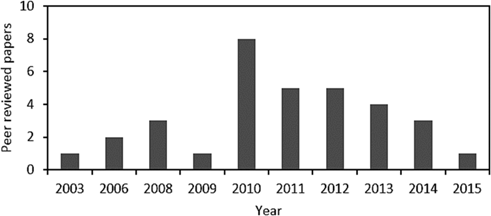
Number of peer reviewed papers per year.
We are aware that our methodology might be excluding papers which are of our interest but do not contain the explicit references to Brazilian leadership in their titles. We assume that this methodology is a proxy for the academic interest in Brazilian rise as an emerging leader and not an exhaustive examination. The list is available within the replication file package at request.
Descriptive statistics.
| Name | Question | Type | Mean | sd | Minimum | Maximum |
| Dependent Variable: | “Would you be willing to strengthen the bilateral relationship with China, regardless of regional considerations, by signing a free trade agreement?” | Dichotomous | 0.44 | 0.498 | 0 | 1 |
| Independent Variables: | ||||||
| Brazilian leadership | “Do you agree that Uruguay should prioritize the region and follow Brazilian leadership?” | Dichotomous | 0.69 | 0.46 | 0 | 1 |
| MERCOSUR is a priority | “Should MERCOSUR be the priority of national foreign policy?” | Dichotomous | 0.14 | 0.34 | 0 | 1 |
| MERCOSUR’s influence | “On a scale of 0–10 (where 0 is zero and 10 is maximum) What degree of influence does MERCOSUR have in Uruguayan foreign policy?” | Ordinal | 6.43 | 2.14 | 0 | 10 |
| Ideology | “In politics, we speak of ideology in terms of left and right. By using this scale from 1 to 10 (where 1 is left and 10 is right), I am going to ask you to indicate what position you would say you occupy.” | Ordinal | 3.90 | 1.64 | 1 | 8 |
| Incumbent party (Frente Amplio Party) | (publicly known information) | Dichotomous | 0.53 | 0.50 | 0 | 1 |
| Opposition party (NP) | (publicly known information) | Dichotomous | 0.29 | 0.45 | 0 | 1 |
| Opposition party (CP) | (publicly known information) | Dichotomous | 0.17 | 0.37 | 0 | 1 |
| Urban area representative | (publicly known information) | Dichotomous | 0.24 | 0.43 | 0 | 1 |
| Opposition party (NP)×Ideology | − | Ordinal | 0.81 | 1.88 | 0 | 7 |
| Opposition party (CP)×Ideology×Ideology | − | Ordinal | 1.54 | 2.52 | 0 | 8 |
| Current relations with Chinese government | “Compared with 10 years ago, do you think Uruguay’s relations with China are better, the same or worse?” | Ordinal | 1.36 | 0.77 | 1 | 3 |
©2016 by De Gruyter
Articles in the same Issue
- Frontmatter
- Articles
- MERCOSUR and the Brazilian Leadership Challenge in the Era of Chinese Growth: A Uruguayan Foreign Policy Perspective
- Global Power Movements, Uncertainty and Democracy in the Middle East
- Review Essay
- Frank Ninkovich: The Global Republic: America’s Inadvertent Rise to World Power / Henry Kissinger: World Order
- David Milne: Worldmaking: The Art and Science of American Diplomacy
- Documentation
- Mismeasuring Humanity: Examining Indicators Through a Critical Global Studies Perspective
- Book Reviews
- Randall L. Schweller: Maxwell’s Demon and the Golden Apple: Global Discord in the New Millennium
- Gordon Chang: Fateful Ties: A History of America’s Preoccupation with China
- Charles S. Maier: Leviathan 2.0: Inventing Modern Statehood
Articles in the same Issue
- Frontmatter
- Articles
- MERCOSUR and the Brazilian Leadership Challenge in the Era of Chinese Growth: A Uruguayan Foreign Policy Perspective
- Global Power Movements, Uncertainty and Democracy in the Middle East
- Review Essay
- Frank Ninkovich: The Global Republic: America’s Inadvertent Rise to World Power / Henry Kissinger: World Order
- David Milne: Worldmaking: The Art and Science of American Diplomacy
- Documentation
- Mismeasuring Humanity: Examining Indicators Through a Critical Global Studies Perspective
- Book Reviews
- Randall L. Schweller: Maxwell’s Demon and the Golden Apple: Global Discord in the New Millennium
- Gordon Chang: Fateful Ties: A History of America’s Preoccupation with China
- Charles S. Maier: Leviathan 2.0: Inventing Modern Statehood
