Quasi-BIC laser enabled by high-contrast grating resonator for gas detection
-
Haoran Zhang

 ,
Jingyi Tian
,
Jingyi Tian

Abstract
In this work, we propose and numerically investigate a two-dimensional microlaser based on the concept of bound states in the continuum (BIC). The device consists of a thin gain layer (Rhodamine 6G dye-doped silica) sandwiched between two high-contrast-grating layers. The structure supports various BIC modes upon a proper choice of topological parameters; in particular it supports a high-Q quasi-BIC mode when partially breaking a bound state in the continuum at Γ point. The optically-pumped gain medium provides sufficient optical gain to compensate the quasi-BIC mode losses, enabling lasing with ultra-low pump threshold (fluence of 17 μJ/cm2) and very narrow optical linewidth in the visible range. This innovative device displays distinguished sensing performance for gas detection, and the emission wavelength sensitively shifts to the longer wavelength with the changing of environment refractive index (in order of 5 × 10⁻⁴). The achieved bulk sensitivity is 221 nm/RIU with a high signal to noise ratio, and a record-high figure of merit reaches to 4420 RIU−1. This ultracompact and low threshold quasi-BIC laser facilitated by the ultra-narrow resonance can serve as formidable candidate for on-chip gas sensor.
1 Introduction
In recent years, the investigation of bound states in the continuum (BICs) has attracted substantial attention due to the interesting physics and practical applications [1]. The BIC theory originated from quantum mechanics and was firstly proposed by von Neumann and Wigner in 1929 [2, 3]. Since then, it has been used to explain the important physical concept of resonance with infinite lifetime in various physical systems, such as photonics [4–7], acoustics [8, 9] and water waves [10]. According to Neumann and Wigner’s seminal work [2], when two resonances pass each other as a function of a continuous parameter, the two channels will interfere, and give rise to an avoided crossing for their resonances. Theoretically, at a given value of the continuous parameter, one of the channels vanishes entirely and hence becomes a dark mode (BIC mode) with an infinite quality (Q) factor [11]. In practice, BICs are limited by finite structure size, material absorption, and structural imperfection [12], they manifest themselves and collapse to Fano resonant states with long lifetime, also known as quasi-BICs [13, 14]. Recently, high-Q quasi-BICs have been observed in many passive systems, and it has been recognized that practical systems supporting such resonances are well suited for lasing and sensing applications [15, 16].
Sub-wavelength high-contrast gratings (HCGs) possess distinct features, such as broadband high reflectivity (>99%) and high-Q resonances (>107) [17]. In particular, it has been shown that HCG systems can support BICs with improved spectral performance [1, 18]. The narrow spectral linewidth (γ) featured by these structures are very sensitive to changes in refractive index around them [19], making them promising candidates for engineering optical sensors with high sensitivity (S) and excellent figure of merit, FOM = S/γ [20]. However, investigations thus far have considered only passive structures, which can limit significantly the device’s sensitivity [21]. Recent studies indicate that active sensors based on small lasers not only supply coherent radiation, but also show enhanced sensing performance [22, 23]. Thus, photonic structures supporting high-Q quasi-BIC lasers are of great interest in sensing applications, as they could offer possibilities of achieving a sensing performance beyond that of more conventional photonic sensors [24, 25].
Lasing action based on BICs or quasi-BICs in two-dimensional photonic-crystal structures has been reported recently [15, 16, 26]. Nonetheless, investigations on potential applications of such devices are scarce, e.g., active sensing based on BIC lasers. In this work, we propose an innovative resonator composed of highly reflecting HCG layers surrounding a thin organic-dye-doped SiO2 layer working as gain material for laser emission. This ultracompact resonator design not only opens an alternative route to generate different resonance modes, but also provides a platform to demonstrate a Fabry–Pérot quasi-BIC laser by combining organic dye molecules with inorganic grating. Finite difference-time-domain (FDTD) numerical simulations have been performed to evaluate the performance of the aforementioned system with the results suggesting that a high-Q quasi-BIC mode (Q > 104) can be established by carefully optimizing the HCG structural parameters. Then, when the quasi-BIC mode spectrum overlaps with that of the gain material, a pronounced lasing action is obtained. More significantly, this quasi-BIC laser allows for a highly precise environment change detection through the reading of the emission wavelength shift. The achieved narrow linewidth (0.05 nm) combined with a large bulk sensitivity of 221 nm/RIU, results in a FOM of 4420 RIU−1, which is approximately 20 times larger than typical passive sensors [27]. Therefore, our results suggest that the proposed quasi-BIC laser offers great potential for optical sensing of gases in low-concentration.
2 Resonator design and numerical model
2.1 Structure design
The schematic diagram of proposed double-HCG resonant structure is shown in Figure 1. The structure is designed to support a quasi-BIC at wavelength of 570 nm. The active region consists of 215 nm thick SiO2 layer doped with Rhodamine 6G (R6G), as shown in Figure 1(a). A similar gain medium has been reported in a previous work [28]. The R6G layer is surrounded by Si3N4 stripes with a symmetric arrangement along z direction, and the refractive index of Si3N4 is 2.0. The HCG parameters are described by the thickness of grating layer T, filling factor (the grating width divided by the period) F and the period Λ. We consider the dimensions of whole device in x- and y-direction are infinite, as exhibited in Figure 1(b). The detail parameters of materials are shown in Table 1.
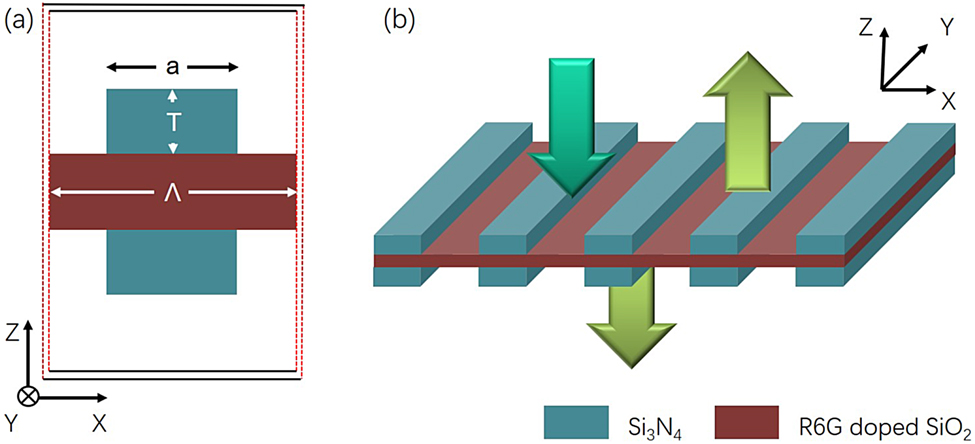
Schematic of proposed resonator based on HCGs:
(a) single unit cell of two dimensional resonator; (b) whole structure with the organic R6G thin layer. The dark green downward arrow represents optical pump, the light green arrows on both sides of resonator are emitted light from the resonator.
Material parameters.
| Layer | Material | Refractive index | Thickness (nm) |
|---|---|---|---|
| Top HCG | Si3N4 | 2.0 | 230 |
| Gain | R6G-doped SiO2 | 1.46 | 215 |
| Bottom HCG | Si3N4 | 2.0 | 230 |
In the point of fabrication view, although there may exist several technical challenges, several experiments on the similar grating structure have been reported [29, 30]. A freestanding cascade grating fabrication technique, based on positive resist e-beam lithography (EBL) and ion coupling plasma, is supposed to be feasible to fabricate the designed structure. The SiO2 layer doped with R6G can be made by using sol–gel technique, which is a suitable method for incorporating organic molecules into inorganic solid hosts. The low-temperature process involving the hydrolysis and condensation reactions of metal alkoxides enables us to dope different molecules with a poor thermal stability into coating films [31]. The fabrication process mainly includes thin film deposition and grating pattern. The Si3N4 thin film is uniformly coated with SiO2 doped R6G sol solution, and then cover another Si3N4 thin film on the other side. The grating structures can be separately patterned on both sides by using EBL and ICP with CHF3 gas [32]. A similar sandwiching structure consisting of two aluminum gratings and a Si3N4 membrane has been reported recently [33].
2.2 Theory and simulation
A semi-quantum framework is adopted to simulate the interaction between the electromagnetic fields and gain medium. The organic dye molecules in this work are well described as a four-energy-level system, and the population inversion is generated between the electronic level of L2 state and L1 state. As shown in Figure 2, which presents the population dynamics of the four relevant electronic levels of the molecule, such as the ground state, L0, and the three excited states, L1, L2, and L3. The molecular polarization given by spontaneous and stimulated transitions are described through the following equation [34]:
where Δωi,j and ωi,j are the bandwidth and frequency of the transition between states i and j,
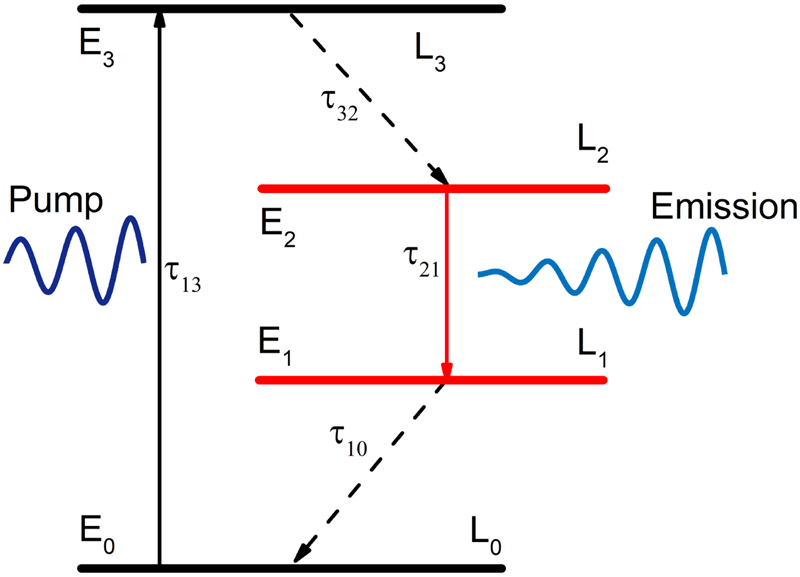
Energy level diagram and parameters used for modelling the dye molecules in FDTD simulations. The transition energies are E30 = E3 − E0 and E21 = E2 − E1. Since the transition from L3 to L2 is much faster than the transition from L3 to L0, the excitation quickly decay to L2, leading to a population inversion for the transition from L2 to L1.
In order to solve for the fields in a self-consistent fashion, it is necessary to couple the molecular polarization
The FDTD method is adopted to solve the coupled equations. A plane wave in 4 ps pump pulse normally incident on the device along z-direction, as shown by the dark green downward arrow in Figure 1(b), and its center wavelength is λP = 512 nm. For the case of R6G-doped SiO2, we set that the absorption transition: λa = 512 nm and Δλa = 35 nm; the emission transition: λe = 570 nm and Δλe = 50 nm; the concentration of dye molecule: C = 1 × 1019 cm−3, which is comparable to the concentrations previously reported in the same material host [28]; and the lifetimes: τ32 = τ10 = 5 × 10⁻¹⁴s, τ30 = 1 × 10⁻⁹ s, τ21 = 1.8 × 10⁻⁹ s. Finally, the calculated emission cross section is around 3 × 10⁻¹⁶ cm2, which is also consistent with the experimental report [39].
3 Bound states in the continuum and quasi-BIC lasing
3.1 BIC modes supported by the passive structure
First, the optical properties of single HCG layer are analyzed. To obtain a perfect mirror for light trapped in a Fabry–pérot BIC system, we carry out FDTD simulations and calculate the structure’s reflectance, for a normally incident plane wave polarized along the y-direction. Figure 3(a) illustrates the results of our simulations as a function of the wavelength and of the grating thickness, taking a grating filling factor F = 0.5. We observe two regions, which we refer to as the dual/multi-mode region (from λ = 530 to 700 nm) and the single-mode region (λ > 700 nm), as suggested by previous nomenclature [40]. For the single mode region, the grating operates in a longer wavelength regime, behaving like a quasi-uniform layer [17], so only Fabry–Pérot modes are supported in this wavelength range. On the other hand, in the dual/multi-modes region, the pattern is quite different, describing contrasting regions with high (>99%) and low reflectance. In addition, we find the localized patterns do not change in an obvious manner when modify the filling factor F, instead, just an overall shifting to the longer wavelength. The reflectance spectrum shown in Figure 3(a) reveals that with a proper selection of the grating parameters (e.g., the thickness T, filling factor F, and period Λ), an ultra-high (>99%) reflectivity over a spectral range is achievable (as shown by the double arrow line).

Reflectance spectra mapping and electric field distribution profile.
(a) Reflectance spectra mapping as a function of grating thickness when the filling factor F = 0.50; (b) reflectance spectra as a function of the thickness of SiO2; (c) reflectance contour distribution of the architecture by sweeping the incident angle from −25° to 25°; (d) electric field distribution profiles within four periods corresponding to the places marked by ‘2’.
We proceed now to study the optical properties of the entire passive structure (SiO2 layer sandwiched by the two HCGs) as a function of the main structural parameters. Figure 3(b) displays the reflectance spectra mapping as function of SiO2 layer thickness, under the condition of T = 230 nm, F = 0.50, and Λ = 530 nm. We notice there are a series of discrete reflectance vanishing points at the SiO2 layer thickness of 20, 210, 400, and 590 nm, corresponding to a periodical disappearance of resonance. These singular points break the high reflection continuum, showing the typical feature of Fabry–Pérot BIC. As mentioned before, an HCG layer possesses high reflectivity within a wide range, thus two HCGs layers with a symmetric alignment can make a Fabry–Pérot cavity. Therefore, BICs are formed when the distance between two HCG layers is tuned to make the round-trip phase shifts add up to an integer multiple of 2π [13]. Similar phenomenon was observed in a hybrid structure composed of a subwavelength grating layer and an un-patterned high-refractive-index cap layer [41]. However, the BIC nature of the modes was not identified. In addition, the high Q resonance in such a structure originates from the constructive interference of two Bloch modes in the grating layer, which is fundamentally different from the Fabry–Pérot BIC that exits in double gratings and stacked photonic crystal (PhC) slabs.
To obtain a quasi-BIC mode at wavelength of 566 nm that could be employed in a practical device, we slightly increase the thickness of SiO2 layer by 5 nm. Figure 3(c) shows the band diagram of the designed structure, which is plotted by varying the angle of incidence (θ, from −25° to 25°) with respect to the z-axis. We observe symmetric patterns relative to the axis of θ = 0° (also Γ point), and the quasi-BIC mode at the position of mode 2, where is marked by the arrow and number ‘2’, is successfully identified. This quasi-BIC mode exhibits a low dispersion near θ = 0° around 566 nm, suggesting a strong resonance in individual unit cell [42]. Apart from mode 2, we also find other BIC modes at θ = 0° (e.g., positions marked by ‘1’ and ‘3’) and 14.8° (e.g., position marked by ‘4’). Those BICs feature vanishing linewidths, suggesting a nonleaky state [4].
To further characterize the quasi-BIC at mode 2, we plot the field distribution profile in (x, z)-plane for this mode under the incident angle θ = 0°, as shown in Figure 3(d). The E y distribution of mode 2 over the (x, z)-plane shows a strong confinement within the cavity and a symmetric profile along z-direction. Due to the high reflectance of the HCGs and the sub-wavelength thickness of the SiO2 layer, the first-order standing wave (i.e., one peak across the SiO2 layer) is observed [43]. Typically, Fabry–Pérot BIC can be generated in systems with two identical resonances coupled to a single radiation channel [13]. Here, the round-trip phase shift between the two resonances in HCGs is 2π, thus the field is constructively interfered and trapped in the cavity while the resonant radiations from the HCGs interfere destructively out side of the cavity, which leads to the formation of Fabry–Pérot BIC.
3.2 Quasi-BIC lasing and characterization
To realize quasi-BIC lasing, we selected the grating parameters (T = 230 nm, F = 0.50, and Λ = 530 nm) which can provide the highest possible reflectivity (as marked in Figure 3), and the SiO2 thickness is 215 nm. Then, R6G dye molecules are doped into SiO2 thin layer to compensated the internal losses of resonator. As shown in Figure 1(b), the proposed sandwiched structure recalls conventional VCSELs, however, our design significantly reduces the cavity length. Figure 4(a) shows the gain spectrum of R6G (black curve), the spectrum of the cavity mode (blue curve) and typical lasing spectrum of resonator (red curve). Clearly, the R6G gain spectrum has a broad linewidth with its central region overlapping with the cavity mode peak, a feature guaranteeing a proper compensation of the cavity losses. Interestingly, the cavity mode shows the typical asymmetric line shape of a Fano resonance. This resonance is caused by the interference of radiative (bright) and nonradiative (dark) modes [44, 45]. For Si3N4-based HCG resonator, dark mode is associated with the Bragg scattering induced by HCG in the lateral direction, which results in a resonant mode with narrow bandwidth. On the other hand, the bright mode is associated with the weak Fabry–Pérot mode induced by the index difference in the vertical direction, which results in a mode with nearly flat-band spectrum. The interference of these two modes result in an asymmetric line shape of the spectrum [46, 47]. Moreover, this phenomenon could confine the optical mode in the structure well and result in a high Q factor, which is beneficial for the BIC laser operation with very narrow linewidth (red curve).
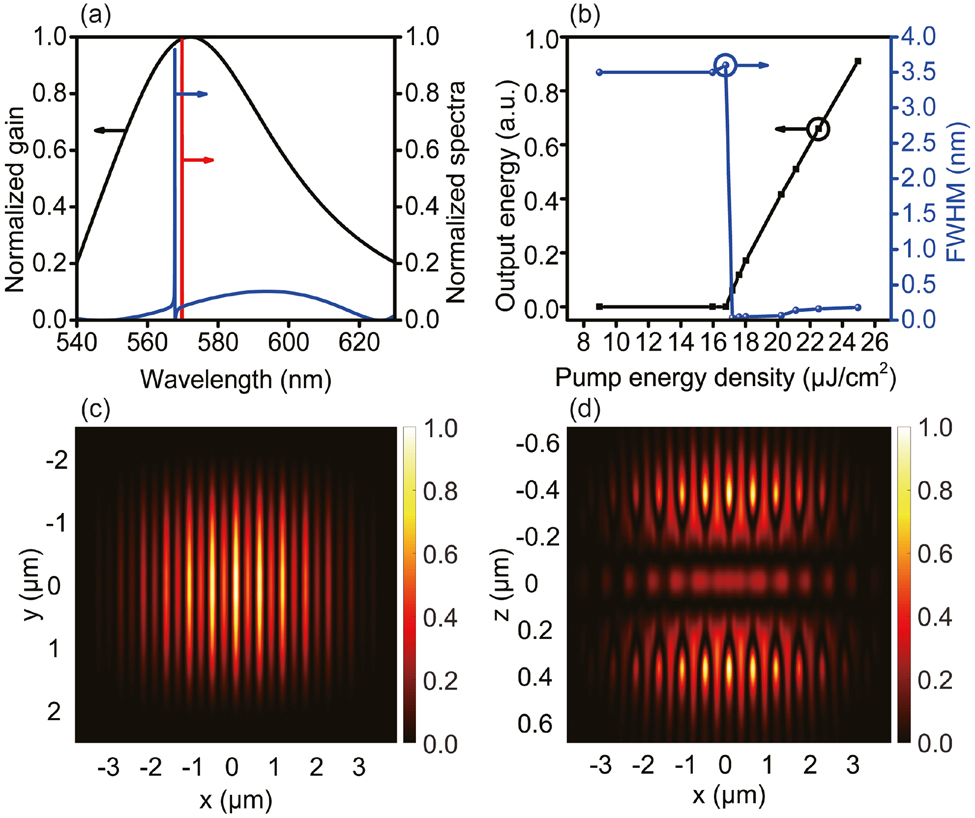
Lasing characterization results.
(a) Gain spectrum of R6G (black curve), cavity mode spectrum (blue curve), and typical emission spectrum of laser (red curve) operated above threshold; (b) input–output function curve (black) and spectrum linewidth changing as a function of input energy (blue); (c) near field intensity distribution of laser in (x, y) plane at z = 612.5 nm; (d) electric field intensity distribution in (x, z) plane at y = 0 nm. Both near fields are calculated at the peak laser emission wavelength, and the pump beam size in the simulation is 7.6 μm × 5.0 μm.
Figure 4(b) shows the detail characterizations of lasing behaviour. The black curve is the conventional plot of output power as a function of pump energy density, so we can estimate the threshold is around 17 μJ/cm2, and the output power can reach to more than 40 μW when the pump is 25 μJ/cm2, which is close to the power of practical device. The blue curve represents the corresponding optical spectrum linewidth (the full-width at half-maximum of the peak, FWHM) changing, the sharp narrowing of spectrum also indicates a coherence emission is achieved when the laser is operated above threshold. Both results are clear indications of lasing. We notice the linewidth is pump power modulated, and it becomes broader in far above threshold region. Such behavior has been reported in several experimental investigations on plasmonic laser systems [48, 49], and can be attributed to the dependence of refractive index on pump power.
Figure 4(c) and (d) are the electric field intensity distributions of resonator in (x, y) and (x, z) planes, respectively. When the resonator is operated above threshold, a large mode overlaps with the input pump contributing to a simple and efficient coupling of the input light, as suggested by the high intensity interfere fringes. In addition, the far field observation indicates a single mode lasing, which makes the laser device is more attractive. From the side view (Figure 4(d)), it is clear how the light is predominantly confined within the grating bars and there is exactly one intensity lobe within the interval of neighboring bars. In the middle, higher intensity stripe indicates the gain medium region, where we can find the vertical confinement of this device is much stronger than the confinement typically found in conventional DBRs-based vertical cavity emitting lasers. Since the double gratings provide the largest power reflectance, all diffraction orders disappear except the 0th order. In addition, the HCGs bring a higher effective refraction index and much higher than the surrounding environment, leading to strong lateral confinement for the lateral modes.
4 Sensing function for gas detection
High-Q resonators with narrow resonance line widths and long photon storage time, have been considered as ideal candidates for sensors with enhanced detection sensitivity [50, 51]. Therefore, we carry out quantitative calculations of the quasi-BIC laser intrinsic sensitivity upon changes of the surrounding refractive index. We first reproduced a gas environment and immersed the resonator in a atmosphere of known refractive index value, then performing a refractive index change from 1.0000 to 1.0020. Figure 5(a) displays the full lasing spectra of the device versus variation of refractive index, where it is easily observe a shift of the emission wavelength towards a longer wavelengths, even though the refractive index increase step was just of the order of 5 × 10⁻⁴. The inset exhibits the laser spectra upon change of the gas environment, where we notice a single wavelength shifting without any other obvious changing. This also can be found from Figure 5(b), which presents the linear dependence of emission peaks on the refractive index (black curve), and the linewidth variation (dash curve). It is further confirmed that the change of refractive index results in only the shift of lasing wavelength without affecting the lasing state. This simple linear relationship between lasing wavelength shift and the variation of environment confirms the sensing capability of the proposed microlaser structure.
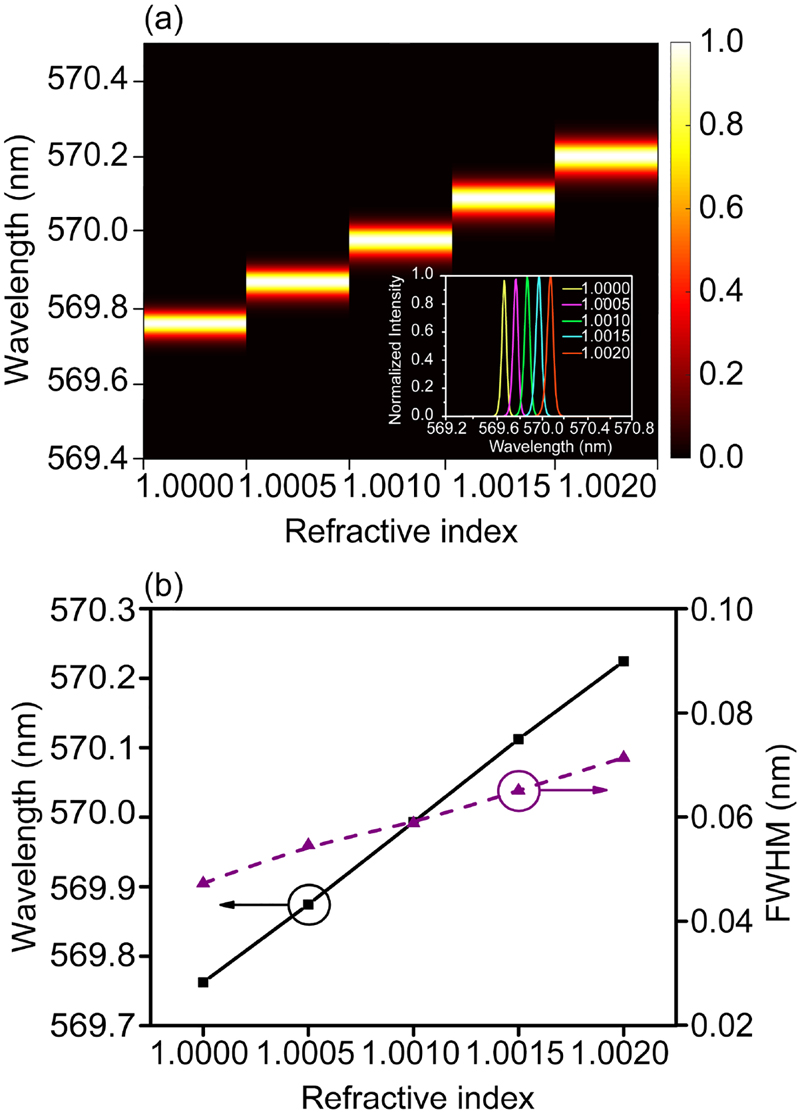
Sensing characterization.
(a) Mapping of emission wavelength shift with the variation of environment refractive index, inset: full lasing spectra for different refractive indexes; (b) linear relationship between emission wavelength shift and environment refractive index (black curve), and the corresponding spectrum linewidth changing with refractive index.
Specifically, the sensing performance of the device was evaluated by estimating the sensitivity (S λ ) and figure of merit (FOM λ ), which can be calculated through using the following formulas:
where Δλ represents the emission wavelength shifting, and Δn is the change of refractive index. γ is the emission spectrum linewidth measured at its full width at half maximum. FOM parameter is another important and more comprehensive benchmark to evaluate sensing performance [52, 53]. From the results in Figure 5(b), we calculated the S λ and FOM λ , which are 221 nm/RIU and 4420 RIU−1, respectively. Very importantly, the achieved FOM value resulted much higher than the theoretical result for localized surface plasmon resonance sensors (∼20) [54], PhC cavity [25], microring [55], and fiber Bragg grating sensors [56]. It is also comparable with that of state-of-the-art symmetry guided-mode resonance based sensors [52]. In addition, the organic gain enabled laser design leads to a coherent light source, which can either be detected at optical far field, or be easily coupled into fiber system. Thus, this flexible operation will facilitate the experimental measurements. In addition, the simple structure design will effectively reduce the cost of fabrication, making the sensor more appealing.
5 Conclusions
In conclusion, we have presented the design and numerical characterization of a compact quasi-BIC-laser based sensor for detecting of gas environment changing. The sensor is designed by using double Si3N4 HCG grating layers and organic R6G dye molecule doped SiO2 layer located between the grating layers. The proposed unique hybrid design enables stimulated vertical emission from the organic gain medium embedded in the HCG stripes. Optimizations concerning HCGs and microcavity configuration designed for a 570 nm resonant wavelength have been performed. Our design features a high-Q resonance, which enables a narrow-linewidth laser emission of 0.05 nm. Therefore, a pronounced BIC lasing behavior with narrow spectrum linewidth have been realized. The emitted light is close to the plane wave in air, which indicates a single lobe far field pattern for laser beam distribution. The sensing mechanism can be reasonably explained through the guided-mode resonance effect originated by constructive interference between the guided modes of the slab grating and the strong reflection modes. Finally, we also investigated the bulk sensing performance by inserting the device in some specific environment with different refractive index values, demonstrating remarkable sensitivity and figure of merit estimated equal to 221 nm/RIU and 4420 RIU−1, respectively. Especially the figure of merit value outperforms recently reported GRM devices [52, 57] and other state-of-the-art passive sensors [25]. In view of these achievements, it is believed that this new platform could improve the current technology in remote gas sensing, e.g., warning from dangerous chemical gas.
Funding source: Zhejiang Province Commonweal Project
Award Identifier / Grant number: LGJ20A040001
Funding source: Zhejiang University Global Partnership Fund
Funding source: Federico Baur Endowed Chair in Nanotechnology
Funding source: Fundamental Research Funds for the Central Universities
Funding source: Natural Science Foundation of China
Award Identifier / Grant number: 61801426
Funding source: Zhejiang Provincial Natural Science Foundation
Award Identifier / Grant number: Z20F010018
Funding source: Zhejiang Province Natural Science Foundation
Award Identifier / Grant number: LR21F010002
Funding source: National Natural Science Foundation of China, Tsinghua University, National Natural Science Foundation of China, Fundamental Research Funds for the Central Universities, Zhejiang University
Award Identifier / Grant number: 61804036
Award Identifier / Grant number: 61875051
Award Identifier / Grant number: Unassigned
Award Identifier / Grant number: Unassigned
Award Identifier / Grant number: Unassigned
Award Identifier / Grant number: Unassigned
Acknowledgments
We are grateful to Prof. Yang Li from Tsinghua University for useful discussions.
-
Author contribution: All the authors have accepted responsibility for the entire content of this submitted manuscript and approved submission.
-
Research funding: This work is supported in part by the National Natural Science Foundation of China (Grant No. 61804036, 61875051, 61801426), Zhejiang Province Natural Science Foundation (Grant No. LGJ20A040001, LR21F010002, Z20F010018), Federico Baur Endowed Chair in Nanotechnology, Fundamental Research Funds for the Central Universities and Zhejiang University Global Partnership Fund.
-
Conflict of interest statement: The authors declare no conflicts of interest regarding this article.
References
[1] S. Joseph, S. Sarkar, S. Khan, and J. Joseph, “Exploring the optical bound state in the continuum in a dielectric grating coupled plasmonic hybrid system,” Adv. Opt. Mater., vol. 9, p. 2001895, 2021. https://doi.org/10.1002/adom.202001895.Suche in Google Scholar
[2] J. von Neumann and E. Wigner, “On the behavior of eigenvalues in adiabatic processes,” Phys. Z., vol. 30, p. 467, 1929.Suche in Google Scholar
[3] S. Han, L. Cong, Y. K. Srivastava, et al.., “All dielectric active terahertz photonics driven by bound states in the continuum,” Adv. Mater., vol. 31, p. 1901921, 2019. https://doi.org/10.1002/adma.201901921.Suche in Google Scholar PubMed
[4] C. Marinica, A. G. Borisov, and S. V. Shabanov, “Bound States in the continuum in photonics,” Phys. Rev. Lett., vol. 100, p. 183902, 2008. https://doi.org/10.1103/physrevlett.100.183902.Suche in Google Scholar
[5] C. W. Hsu, B. Zhen, J. Lee, et al.., “Observation of trapped light within the radiation continuum,” Nature, vol. 499, pp. 188–191, 2013. https://doi.org/10.1038/nature12289.Suche in Google Scholar PubMed
[6] T. Dong, J. Liang, S. Camayd-Munoz, et al.., “Ultra-low-loss on-chip zero-index materials,” Light Sci. Appl., vol. 10, p. 10, 2021. https://doi.org/10.1038/s41377-020-00436-y.Suche in Google Scholar PubMed PubMed Central
[7] H. Tang, C. DeVault, S. A. Camayd-Munoz, et al.., “Low-loss zero-index materials,” Nano Lett., vol. 21, pp. 914–920, 2021. https://doi.org/10.1021/acs.nanolett.0c03575.Suche in Google Scholar PubMed
[8] A. A. Lyapina, D. N. Maksimov, A. S. Pilipchuk, and A. F. Sadreev, “Bound states in the continuum in open acoustic resonators,” J. Fluid Mech., vol. 780, pp. 370–387, 2015. https://doi.org/10.1017/jfm.2015.480.Suche in Google Scholar
[9] Y. X. Xiao, G. Ma, Z. Q. Zhang, and C. T. Chan, “Topological subspace-induced bound state in the continuum,” Phys. Rev. Lett., vol. 118, p. 166803, 2017. https://doi.org/10.1103/physrevlett.118.166803.Suche in Google Scholar
[10] C. M. Linton and P. McIver, “Embedded trapped modes in water waves and acoustics,” Wave Motion, vol. 45, pp. 16–29, 2007. https://doi.org/10.1016/j.wavemoti.2007.04.009.Suche in Google Scholar
[11] C. W. Hsu, B. Zhen, A. D. Stone, J. D. Joannopoulos, and M. Soljacic, “Bound states in the continuum,” Nat. Rev. Mater., vol. 1, p. 16048, 2016. https://doi.org/10.1038/natrevmats.2016.48.Suche in Google Scholar
[12] K. Koshelev, S. Kruk, E. Melik-Gaykazyan, et al.., “Subwavelength dielectric resonators for nonlinear nanophotonics,” Science, vol. 367, pp. 288–292, 2020. https://doi.org/10.1126/science.aaz3985.Suche in Google Scholar PubMed
[13] S. I. Azzam, V. M. Shalaev, A. Boltasseva, and A. V. Kildishev, “Formation of bound states in the continuum in hybrid plasmonic-photonic systems,” Phys. Rev. Lett., vol. 121, p. 253901, 2018. https://doi.org/10.1103/PhysRevLett.121.253901.Suche in Google Scholar PubMed
[14] Z. F. Sadrieva, I. S. Sinev, K. L. Koshelev, et al.., “Transition from optical bound states in the continuum to leaky resonances: role of substrate and roughness,” ACS Photonics, vol. 4, pp. 723–727, 2017. https://doi.org/10.1021/acsphotonics.6b00860.Suche in Google Scholar
[15] A. Kodigala, T. Lepetit, Q. Gu, B. Bahari, Y. Fainman, and B. Kanté, “Lasing action from photonic bound states in continuum,” Nature, vol. 541, pp. 196–199, 2017. https://doi.org/10.1038/nature20799.Suche in Google Scholar PubMed
[16] S. T. Ha, Y. H. Fu, N. K. Emani, et al.., “Directional lasing in resonant semiconductor nanoantenna arrays,” Nat. Nanotechnol., vol. 13, pp. 1042–1047, 2018. https://doi.org/10.1038/s41565-018-0245-5.Suche in Google Scholar PubMed
[17] V. Karagodsky and C. J. Chang-Hasnain, “Physics of near-wavelength high contrast gratings,” Opt. Express, vol. 20, pp. 10888–10895, 2012. https://doi.org/10.1364/oe.20.010888.Suche in Google Scholar PubMed
[18] S. G. Lee, S. H. Kim, and C. S. Kee, “Bound states in the continuum (BIC) accompanied by avoided crossings in leaky-mode photonic lattices,” Nanophotonics, vol. 9, pp. 4373–4380, 2020. https://doi.org/10.1515/nanoph-2020-0346.Suche in Google Scholar
[19] D. N. Maksimov, V. S. Gerasimov, S. Romano, and S. P. Polyutov, “Refractive index sensing with optical bound states in the continuum,” Opt. Express, vol. 28, pp. 38907–38916, 2020. https://doi.org/10.1364/oe.411749.Suche in Google Scholar PubMed
[20] S. Romano, G. Zito, S. Torino, et al.., “Label-free sensing of ultralow-weight molecules with all-dielectric metasurfaces supporting bound states in the continuum,” Photon. Res., vol. 6, no. 7, pp. 726–733, 2018. https://doi.org/10.1364/prj.6.000726.Suche in Google Scholar
[21] N. Bosio, H. Šípová-Jungová, N. O. Länk, T. J. Antosiewicz, R. Verre, and M. Käll, “Plasmonic versus all-dielectric nanoantennas for refractometric sensing: a direct comparison,” ACS Photonics, vol. 6, pp. 1556–1564, 2019. https://doi.org/10.1021/acsphotonics.9b00434.Suche in Google Scholar
[22] R. M. Ma, S. Ota, Y. Li, S. Yang, and X. Zhang, “Explosives detection in a lasing plasmon nanocavity,” Nat. Nanotechnol., vol. 9, pp. 600–604, 2014. https://doi.org/10.1038/nnano.2014.135.Suche in Google Scholar PubMed
[23] J. Sun, T. Wang, Z. Jafari, et al.., “High-Q plasmonic crystal laser for ultra-sensitive biomolecule detection,” IEEE J. Sel. Top. Quant. Electron., vol. 27, pp. 1–7, 2021. https://doi.org/10.1109/jstqe.2021.3051493.Suche in Google Scholar
[24] F. Yesilkoy, E. R. Arvelo, Y. Jahani, et al.., “Ultrasensitive hyperspectral imaging and biodetection enabled by dielectric metasurfaces,” Nat. Photonics, vol. 13, no. 6, pp. 390–396, 2019. https://doi.org/10.1038/s41566-019-0394-6.Suche in Google Scholar
[25] Y. Liu, S. Wang, D. Zhao, W. Zhou, and Y. Sun, “High quality factor photonic crystal filter at k ≈ 0 and its application for refractive index sensing,” Opt. Express, vol. 25, pp. 10536–10545, 2017. https://doi.org/10.1364/oe.25.010536.Suche in Google Scholar
[26] C. Huang, C. Zhang, S. Xiao, et al.., “Ultrafast control of vortex microlasers,” Science, vol. 367, pp. 1018–1021, 2020. https://doi.org/10.1126/science.aba4597.Suche in Google Scholar PubMed
[27] M. Maleki, M. Mehran, and A. Mokhtari, “Design of a near-infrared plasmonic gas sensor based on graphene nanogratings,” J. Opt. Soc. Am. B, vol. 37, pp. 3478–3486, 2020. https://doi.org/10.1364/josab.401589.Suche in Google Scholar
[28] A. Anedda, C. M. Carbonaro, F. Clemente, et al.., “Rhodamine 6G-SiO2 hybrids: a photoluminescence study,” J. Non-Cryst. Solids, vol. 351, pp. 1850–1854, 2005. https://doi.org/10.1016/j.jnoncrysol.2005.04.027.Suche in Google Scholar
[29] A. E. Hollowell, C. L. Arrington, P. Finnegan, et al.., “Double sided grating fabrication for high energy X-ray phase contrast imaging,” Mater. Sci. Semicond. Process., vol. 92, pp. 86–90, 2019. https://doi.org/10.1016/j.mssp.2018.04.016.Suche in Google Scholar
[30] M. Athanasiou, R. M. Smith, S. Ghataora, and T. Wang, “Polarized white light from hybrid organic/III-nitrides grating structures,” Sci. Rep., vol. 7, p. 39677, 2017. https://doi.org/10.1038/srep39677.Suche in Google Scholar PubMed PubMed Central
[31] H. Yanagi, T. Hishiki, T. Tobitani, A. Otomo, and S. Mashiko, “Thin film lasing from a dye-doped silicartitania composite,” Chem. Phys. Lett., vol. 292, pp. 332–338, 1998. https://doi.org/10.1016/s0009-2614(98)00675-7.Suche in Google Scholar
[32] J. Hong, A. M. Spring, F. Qiu, and S. Yokoyama, “A high efficiency silicon nitride waveguide grating coupler with a multilayer bottom reflector,” Sci. Rep., vol. 9, p. 12988, 2019. https://doi.org/10.1038/s41598-019-49324-5.Suche in Google Scholar PubMed PubMed Central
[33] Y. Liang, N. Ruan, S. Zhang, Z. Yu, and T. Xu, “Experimental investigation of extraordinary optical behaviors in a freestanding plasmonic cascade grating at visible frequency,” Opt. Express, vol. 26, pp. 3271–3276, 2018. https://doi.org/10.1364/oe.26.003271.Suche in Google Scholar PubMed
[34] X. L. Zhong and Z. Y. Li, “All-analytical semiclassical theory of spaser performance in a plasmonic nanocavity,” Phys. Rev. B, vol. 88, p. 085101, 2013. https://doi.org/10.1103/physrevb.88.085101.Suche in Google Scholar
[35] K. Wang, H. Qian, Z. Liu, and P. K. L. Yu, “Second-order nonlinear susceptibility enhancement in gallium nitride nanowires,” Prog. Electromagn. Res., vol. 168, pp. 25–30, 2020. https://doi.org/10.2528/pier20072201.Suche in Google Scholar
[36] M. Dridi and G. C. Schatz, “Model for describing plasmon-enhanced lasers that combines rate equations with finite-difference time-domain,” J. Opt. Soc. Am. B, vol. 30, pp. 2791–2797, 2013. https://doi.org/10.1364/josab.30.002791.Suche in Google Scholar
[37] D. J. Trivedi, D. Wang, T. W. Odom, and G. C. Schatz, “Model for describing plasmonic nanolasers using Maxwell-Liouville equations with finite-difference time-domain calculations,” Phys. Rev. A, vol. 96, p. 053825, 2017. https://doi.org/10.1103/physreva.96.053825.Suche in Google Scholar
[38] W. Zhou, M. Dridi, J. Y. Suh, et al.., “Lasing action in strongly coupled plasmonic nanocavity arrays,” Nat. Nanotechnol., vol. 8, pp. 1–6, 2013. https://doi.org/10.1038/nnano.2013.99.Suche in Google Scholar PubMed
[39] T. Grossmann, S. Schleede, M. Hauser, et al.., “Low-threshold conical microcavity dye lasers,” Appl. Phys. Lett., vol. 97, p. 063304, 2010. https://doi.org/10.1063/1.3479532.Suche in Google Scholar
[40] C. J. Chang-Hasnain and W. Yang, “High-contrast gratings for integrated optoelectronics,” Adv. Opt. Photon., vol. 37, pp. 379–440, 2012. https://doi.org/10.1364/aop.4.000379.Suche in Google Scholar
[41] A. Taghizadeh, J. Mørk, and I.-S. Chung, “Ultracompact resonator with high quality-factor based on a hybrid grating structure,” Opt. Express, vol. 23, pp. 14913–14921, 2015. https://doi.org/10.1364/oe.23.014913.Suche in Google Scholar PubMed
[42] A. Taghizadeh and I. I. Chung, “Quasi bound states in the continuum with few unit cells of photonic crystal slab,” Appl. Phys. Lett., vol. 111, p. 031114, 2017. https://doi.org/10.1063/1.4990753.Suche in Google Scholar
[43] J. M. Fitzgerald, S. K. Manjeshwar, W. Wieczorek, and P. Tassin, “Cavity optomechanics with photonic bound states in the continuum,” Phys. Rev. Res., vol. 3, p. 013131, 2021. https://doi.org/10.1103/physrevresearch.3.013131.Suche in Google Scholar
[44] M. F. Limonov, M. V. Rybin, A. N. Poddubny, and Y. S. Kivshar, “Fano resonances in photonics,” Nat. Photonics, vol. 11, pp. 543–554, 2017. https://doi.org/10.1038/nphoton.2017.142.Suche in Google Scholar
[45] H. Heo, S. Lee, and S. Kim, “Tailoring Fano resonance for flat-top broadband reflectors based on single guided-mode resonance,” J. Lightwave Technol., vol. 37, pp. 4244–4250, 2019. https://doi.org/10.1109/jlt.2019.2922397.Suche in Google Scholar
[46] T. T. Wu, S. H. Wu, T. C. Lu, and S. C. Wang, “GaN-based high contrast grating surface-emitting lasers,” Appl. Phys. Lett., vol. 102, p. 081111, 2013. https://doi.org/10.1063/1.4794081.Suche in Google Scholar
[47] Y. Zhou, M. C. Y. Huang, C. Chase, et al.., “High-index-contrast grating (HCG) and its applications in optoelectronic devices,” IEEE J. Sel. Top. Quant. Electron., vol. 15, pp. 1485–1499, 2009. https://doi.org/10.1109/jstqe.2009.2021145.Suche in Google Scholar
[48] A. Yang, T. B. Hoang, M. Dridi, et al.., “Real-time tunable lasing from plasmonic nanocavity arrays,” Nat. Commun., vol. 6, p. 6939, 2015. https://doi.org/10.1038/ncomms7939.Suche in Google Scholar PubMed PubMed Central
[49] W. Zhu, T. Xu, H. Wang, et al.., “Surface plasmon polariton laser based on a metallic trench Fabry-Perot resonator,” Sci. Adv., vol. 3, p. e1700909, 2017. https://doi.org/10.1126/sciadv.1700909.Suche in Google Scholar PubMed PubMed Central
[50] D. K. Armani, T. J. Kippenberg, S. M. Spillane, and K. J. Vahala, “Ultra-high-q toroid microcavity on a chip,” Nature, vol. 421, pp. 925–928, 2003. https://doi.org/10.1038/nature01371.Suche in Google Scholar PubMed
[51] J. Zhu, S. K. Ozdemir, Y. F. Xiao, et al.., “On-chip single nanoparticle detection and sizing by mode splitting in an ultrahigh-Q microresonator,” Nat. Photonics, vol. 4, pp. 46–49, 2010. https://doi.org/10.1038/nphoton.2009.237.Suche in Google Scholar
[52] Y. Zhou, X. Li, S. Li, et al.., “Symmetric guided-mode resonance sensors in aqueous media with ultrahigh figure of merit,” Opt. Express, vol. 27, pp. 34788–34802, 2019. https://doi.org/10.1364/oe.27.034788.Suche in Google Scholar PubMed
[53] Q. L. Huang, J. Peh, P. J. Hergenrother, and B. T. Cunningham, “Porous photonic crystal external cavity laser biosensor,” Appl. Phys. Lett., vol. 109, p. 071103, 2016. https://doi.org/10.1063/1.4961107.Suche in Google Scholar PubMed PubMed Central
[54] J. M. Bingham, J. N. Anker, L. E. Kreno, and R. P. Van Duyne, “Gas sensing with high-resolution localized surface plasmon resonance spectroscopy,” J. Am. Chem. Soc., vol. 132, pp. 17358–17359, 2010. https://doi.org/10.1021/ja1074272.Suche in Google Scholar PubMed PubMed Central
[55] C. Chung-Yen, W. Fung, and L. J. Guo, “Polymer microring resonators for biochemical sensing applications,” IEEE J. Sel. Top. Quant. Electron., vol. 12, pp. 134–142, 2006. https://doi.org/10.1109/jstqe.2005.862945.Suche in Google Scholar
[56] X. Li, S. Liang, Y. Zhang, et al.., “Novel refractive index sensor based on fiber Bragg grating in nano-bore optical fiber,” Opt. Quant. Electron., vol. 51, p. 117, 2019. https://doi.org/10.1007/s11082-019-1836-6.Suche in Google Scholar
[57] Y. H. Wan, N. A. Krueger, C. R. Ocier, P. Su, P. V. Braun, and B. T. Cunningham, “Resonant mode engineering of photonic crystal sensors clad with ultralow refractive index porous silicon dioxide,” Adv. Opt. Mater., vol. 5, p. 1700605, 2017. https://doi.org/10.1002/adom.201700605.Suche in Google Scholar
© 2021 Haoran Zhang et al., published by De Gruyter, Berlin/Boston
This work is licensed under the Creative Commons Attribution 4.0 International License.
Artikel in diesem Heft
- Frontmatter
- Reviews
- Super-resolution imaging: when biophysics meets nanophotonics
- Structuring and functionalization of non-metallic materials using direct laser interference patterning: a review
- Review on fractional vortex beam
- Research Articles
- Tunable Faraday rotation of ferromagnet thin film in whole visible region coupled with aluminum plasmonic arrays
- On-chip nanophotonic broadband wavelength detector with 2D-Electron gas
- Quasi-BIC laser enabled by high-contrast grating resonator for gas detection
- The effects of bending on plasmonic modes in nanowires and planar structures
- A label-free optical system with a nanohole array biosensor for discriminating live single cancer cells from normal cells
- Scalable and compact photonic neural chip with low learning-capability-loss
- A learning based approach for designing extended unit cell metagratings
- Key role of surface plasmon polaritons in generation of periodic surface structures following single-pulse laser irradiation of a gold step edge
- Invisibility concentrator based on van der Waals semiconductor α-MoO3
- High-fidelity nano-FTIR spectroscopy by on-pixel normalization of signal harmonics
- Plasmonic metasurfaces manipulating the two spin components from spin–orbit interactions of light with lattice field generations
- Flat telescope based on an all-dielectric metasurface doublet enabling polarization-controllable enhanced beam steering
Artikel in diesem Heft
- Frontmatter
- Reviews
- Super-resolution imaging: when biophysics meets nanophotonics
- Structuring and functionalization of non-metallic materials using direct laser interference patterning: a review
- Review on fractional vortex beam
- Research Articles
- Tunable Faraday rotation of ferromagnet thin film in whole visible region coupled with aluminum plasmonic arrays
- On-chip nanophotonic broadband wavelength detector with 2D-Electron gas
- Quasi-BIC laser enabled by high-contrast grating resonator for gas detection
- The effects of bending on plasmonic modes in nanowires and planar structures
- A label-free optical system with a nanohole array biosensor for discriminating live single cancer cells from normal cells
- Scalable and compact photonic neural chip with low learning-capability-loss
- A learning based approach for designing extended unit cell metagratings
- Key role of surface plasmon polaritons in generation of periodic surface structures following single-pulse laser irradiation of a gold step edge
- Invisibility concentrator based on van der Waals semiconductor α-MoO3
- High-fidelity nano-FTIR spectroscopy by on-pixel normalization of signal harmonics
- Plasmonic metasurfaces manipulating the two spin components from spin–orbit interactions of light with lattice field generations
- Flat telescope based on an all-dielectric metasurface doublet enabling polarization-controllable enhanced beam steering
