Further Insights into the Mysteries of the Values of Zeta Functions at Integers
-


ABSTRACT
We present a remarkably simple and surprisingly natural interpretation of the values of zeta functions at negative integers and zero. Namely, we are able to relate these values to areas related to partial sums of powers. We apply these results to further interpretations of values of L-functions at negative integers. We hint in a very brief way at some expected connections of this work with other current efforts to understand the mysteries of the values of zeta functions at integers.
Funding statement: J. M. is partially supported by the Natural Sciences and Engineering Research Council of Canada (NSERC) grant R0370A01. He gratefully acknowledges the Western University Faculty of Science Distinguished Professorship in 2020–2021 and support of Western Academy for Advanced Research as Western Fellow.
Funding statement: N. D. T. is partially supported by the Ministry of Education and Training of Vietnam, grant B2022-CTT-01.
Appendix A. Some formulas and figures
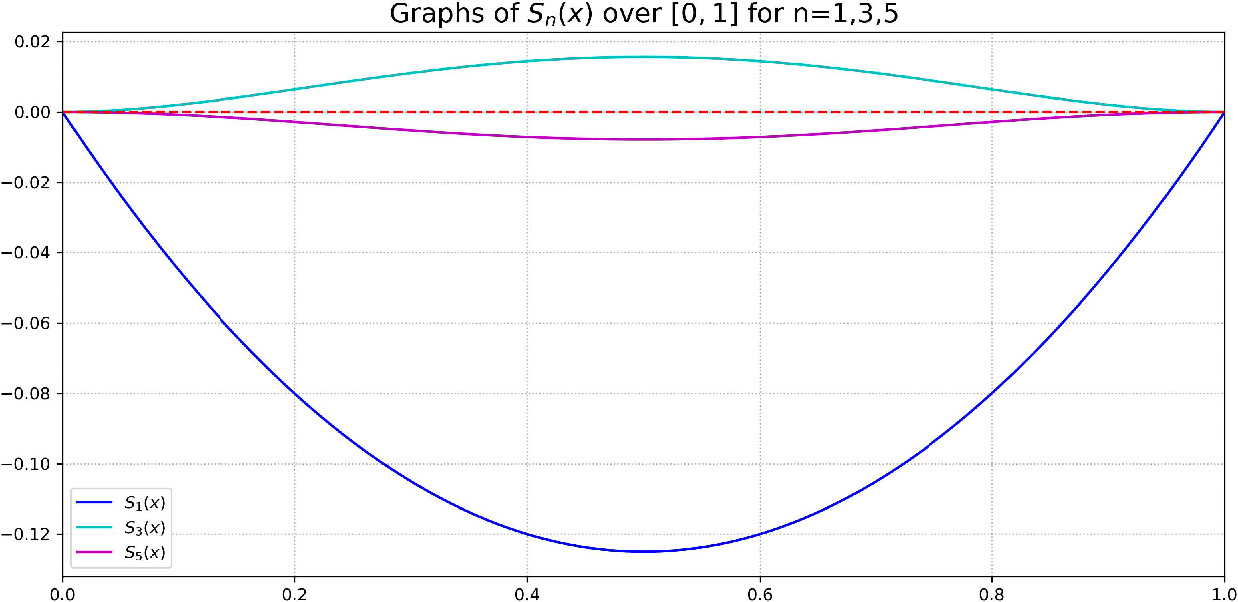
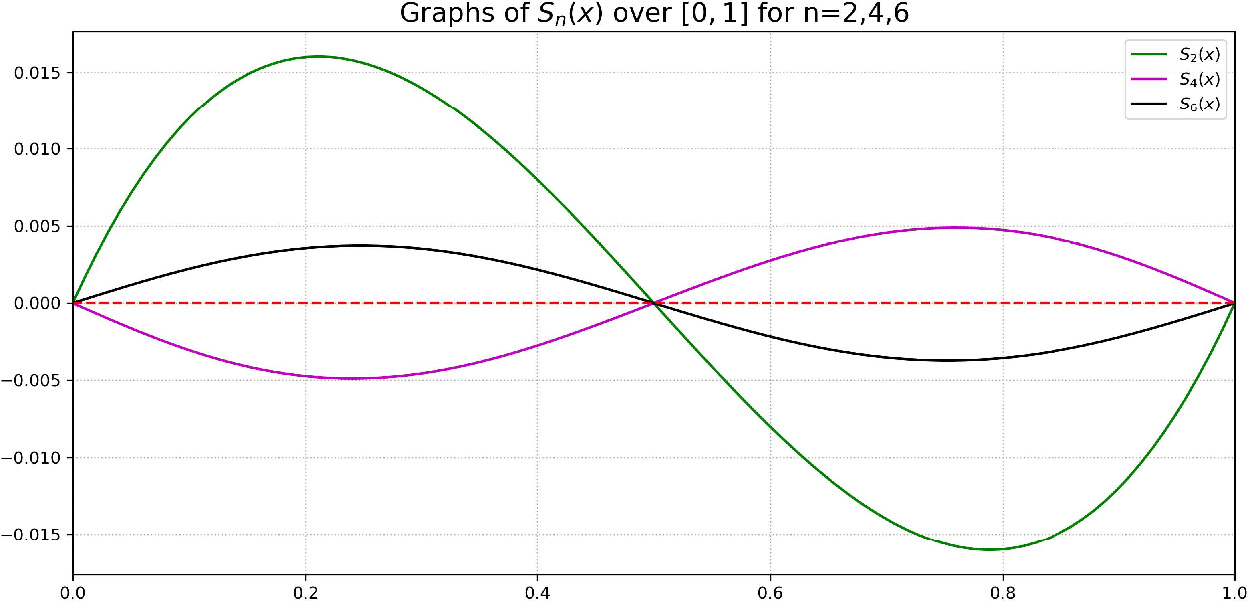
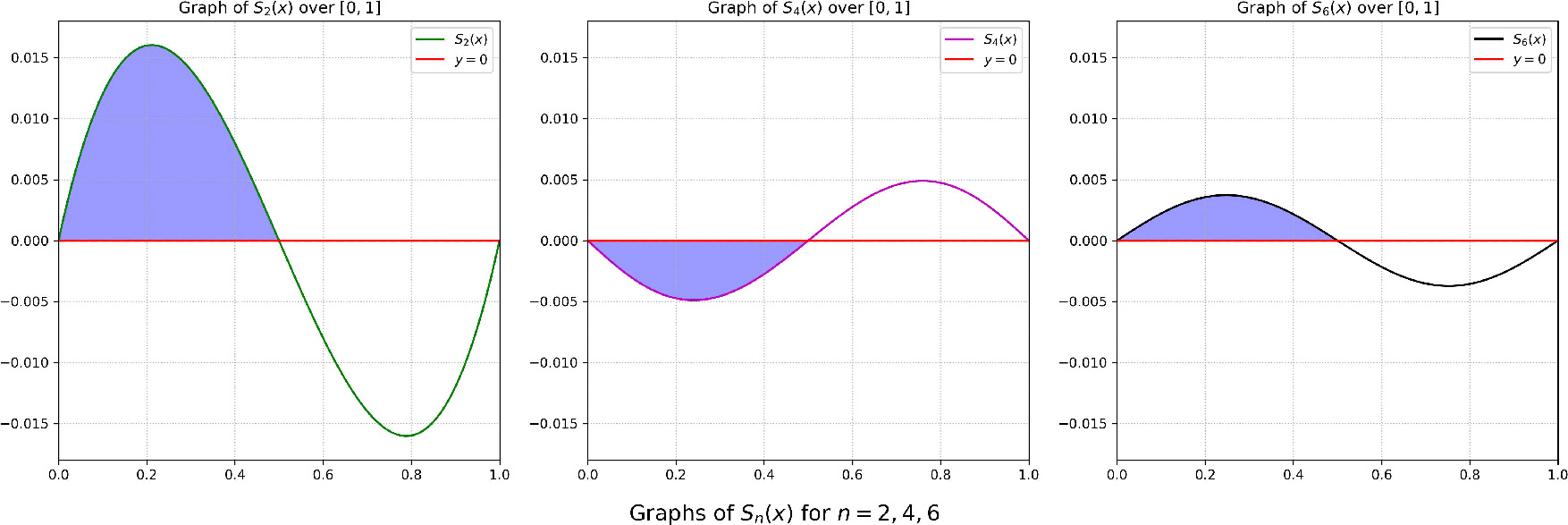
In this appendix, we provide the formulas of Sn (x) for small n and their graphs on the interval [0, 1]. First, we have the following formulas for Sn (x) with 1 ≤ n ≤ 6.
We plot the graphs of Sn (x) for n ∈ {1, 3, 5}.
Here are the graphs of Sn (x) for n ∈ {2, 4, 6}.
Finally, we plot the region bounded by Sn
(x) and y = 0 over
Next, we compute certain generalized Bernoulli numbers Bn,χ
where χ is a quadratic character of conductor p. Concretely, this is the character given by Legendre symbol
| n | Bn | B n,χ 3 | B n,χ 4 | B n,χ 5 | B n,χ 7 | B n,χ 11 |
|---|---|---|---|---|---|---|
| 0 | 1 | 0 | 0 | 0 | 0 | 0 |
| 1 | -1/2 | -1/3 | -1/2 | 0 | -1 | -1 |
| 2 | 1/6 | 0 | 0 | 4/5 | 0 | 0 |
| 3 | 0 | 2/3 | 3/2 | 0 | 48/7 | 18 |
| 4 | -1/30 | 0 | 0 | -8 | 0 | 0 |
| 5 | 0 | -10/3 | -25/2 | 0 | -160 | -12750/11 |
| 6 | 1/42. | 0 | 0 | 804/5 | 0 | 0 |
| 7 | 0 | 98/3 | 427/2 | 0 | 8176 | 152082 |
| 8 | -1/30 | 0 | 0 | -5776 | 0 | 0. |
| 9 | 0 | -1618/3 | -12465/2 | 0 | -5086656/7 | -33743250 |
| 10 | 5/66 | 0 | 0 | 1651004/5 | 0 | 0 |
| 11 | 0 | 40634/3 | 555731/2 | 0 | 99070928 | 11392546506 |
| 12 | -691/2730 | 0 | 0 | -27622104 | 0 | 0 |
Next, we provide a table of Bn,χ for 13 ≤ p ≤ 23.
| n | B n,χ 13 | B n,χ 17 | B n,χ 19 | B n,χ 23 |
|---|---|---|---|---|
| 0 | 0 | 0 | 0 | 0 |
| 1 | 0 | 0 | -1 | -3 |
| 2 | 4 | 8 | 0 | 0 |
| 3 | 0 | 0 | 66 | 144 |
| 4 | -232 | -656 | 0 | 0 |
| 5 | 0 | 0 | -13450 | -34080 |
| 6 | 401556/13 | 138984 | 0 | 0 |
| 7 | 0 | 0 | 5303074 | 18665136 |
| 8 | -7482704 | -958428704/17 | 0 | 0 |
| 9 | 0 | 0 | -66751985430/19 | -17895000384 |
| 10 | 2890943420 | 37040430040 | 0 | 0 |
| 11 | 0 | 0 | 3539203405562 | 605747775717744/23 |
| 12 | -1634752049016 | -35766492971568 | 0 | 0 |
While working on these numerical data, we observed that in our examples, it is always the case that
Remark A.1
After finding a direct proof and searching further the literature, we also found Carlitz’s result (see [10: Theorem 3]) that implies the above observation. The announcement of results in [10] is in [9]. Observe however that there is a misprint in Theorem 1, line 4 in [9]. The relevant part of [10: Theorem 3] states in our special case where values of character are just 1 or −1 the following: “Let g be a primitive root mod p. If the conductor f of the primitive character mod f is a prime number p, p > 2, then
Proposition A.2
Let χ be a quadratic character of conductor p where p is an odd prime number and n ≥ 0. Then:
if
if
Proof
By [15: Theorem 1.2], we know that if n ≢ δχ (mod 2) then Bn,χ = 0. Furthermore, we remark that for all odd primes p
Therefore, it is is sufficient to prove this proposition when n ≡ δχ (mod 2).
By [15: Theorem 1.4], we know that pBn,χ
is p-integral. Additionally, by [15: Theorem 1.5], Bn,χ
is q-integral for all primes q ≠ p. Combining these two facts, we can conclude that
We have the following congruences modulo p 2
The second congruence comes from the expansion of (a + kp) n leaving out terms which are divisible by p 2. The last congruence comes from the identity
We have the following well-known simple lemma.
Lemma A.3
Let r be a natural number. Then
Using this lemma and the fact that
Consequently, we have the following congruences modulo p 2
Combining this congruence and the fact that
Acknowledgements
Over the years after publication of the short note [30], Mináč received a number of encouraging correspondences and discussions concerning further generalizations and explorations of possible values of other zeta functions. We are extremely grateful for our correspondents including but not limited to S. Chebolu, R. Dwilewicz, G. Everest, E. Frenkel, A. Granville, J. Merzel, L. Muller, Š. Porubský, P. Ribenboim, Ch. Rottger, A. Schultz, M. Z. Spivey, B. Sury. Further, we are grateful to K. Dilcher and R. Ernvall for helping us to obtain some related references including the very nice R. Ernvall’s thesis [15]. We are also grateful to an anonymous referee for his/her careful reading of the manusript, and for providing us with helpful comments and valuable suggestions. Last but not least, we are grateful to Leslie Hallock for her careful proofread.
REFERENCES
[1] APOSTOL, M.: Introduction to Analytic Number Theory. Undergraduate Texts in Math., Springer-Verlag, New York-Heidelberg, 1976.10.1007/978-1-4757-5579-4Search in Google Scholar
[2] ANDRÉ, M. D.: Développements de sec(x) et de tang(x), C. R. Acad. Sci. Paris 88 (1879), 965–967Search in Google Scholar
[3] ANDRÉ, M. D.: Sur les permutations alternées, J. de Math. Pures et Appliquées (3) 7 (1881), 167–184Search in Google Scholar
[4] AYOUB, A.: Euler and the Zeta function, Amer. Math. Monthly 74 (1981), 1067–108610.1080/00029890.1974.11993738Search in Google Scholar
[5] BEUKERS, F.—KOLK, J. A. C.—CALABI, E.: Sums of generalized harmonic series and volumes, Nieuw Arch. Wisk. (4) 11 (1993), 217–224Search in Google Scholar
[6] BLOCH, S.—KATO, K.: L-functions and Tamagawa numbers of motives. In: The Grothendieck Festschrift, Vol. I (P. Cartier, L. Illusie, N. M. Katz, G. Laumon, Y. I. Manin, A. Ribet, eds.), Progr. Math. 86, Birkhauser Boston, Boston, MA, 1990, pp. 333—400.Search in Google Scholar
[7] BOMBIERI, E.: The Riemann Hypothesis. The Millennium Prize Problems, Clay Math. Inst., Cambridge, MA, 2006, pp. 31—41.Search in Google Scholar
[8] BOREVICH, Z. I.—SHAFAREVICH, I. R.: Number Theory, Academic Press, New York, 1966.Search in Google Scholar
[9] CARLITZ, L.: Some arithmetic properties of generalized Bernoulli numbers, Bull. Amer. Math. Soc. 65 (1959), 68–6910.1090/S0002-9904-1959-10278-0Search in Google Scholar
[10] CARLITZ, L.: Arithmetic properties of generalized Bernoulli numbers, J. Reine Angew. Math. 202 (1959), 174–18210.1515/crll.1959.202.174Search in Google Scholar
[11] CARLSON, J.—JAFFE, A.—WILES, A. (eds.): The Millennium Prize Problems, Providence, R.I. American Mathematical Society, 2006.Search in Google Scholar
[12] DILCHER, K.: Zeros of Bernoulli, Generalized Bernoulli, and Euler Polynomials, Providence, R.I., USA, American Mathematical Society, 1988.10.1090/memo/0386Search in Google Scholar
[13] DWILEWICZ, R.—MINÁČ, J.: The Hurwitz zeta function as a convergent series, Rocky Mountain J. Math. 36(4) (2006), 1191–121910.1216/rmjm/1181069411Search in Google Scholar
[14] ELKIES, N.: On the sums
[15] ERNVALL, R.: Generalized Bernoulli numbers, generalized irregular primes, and class numbers, Ann. Univ. Turku Ser. A Math. 178 (1979), 72 pp.Search in Google Scholar
[16] EVEREST, G.—ROTTGER, C.—WARD, T.: The continuing story of zeta, Math. Intelligencer 31 (2009), 13–1710.1007/s00283-009-9053-ySearch in Google Scholar
[17] VAN DER GEER, G.—OORT, F.—STEENBRINK, J. H. M.( eds.): Arithmetic Algebraic Geometry, Texel 1989, Birkhauser, Boston, 1991, pp. 359—376.10.1007/978-1-4612-0457-2Search in Google Scholar
[18] HARDY, G.—SESHU AIYAR, P. V.—WILSON, B. M.: Collected Papers of Srinivasa Ramanujan, Cambridge University Press, 1927.Search in Google Scholar
[19] HARDY, G.: Divergent Series, with a preface by J. E. Littlewood and a note by L. S. Bosanquet, Éditions Jacques Gabay, Sceaux, 1992.Search in Google Scholar
[20] KALMAN, D.: Six ways to sum a series, College Math. J. 24 (1993), 402–42110.1080/07468342.1993.11973562Search in Google Scholar
[21] KATO, K.: Lectures on the approach to Iwasawa theory for Hasse-Weil L-functions via BdR . In: Arithmetic Algebraic Geometry, Lecture Notes in Math. 1553, Springer, Berlin, 1993, pp. 50—163.10.1007/BFb0084729Search in Google Scholar
[22] KATO, K.—KUROKAWA, N.—SAITO, T.: Number Theory 1, Fermats Dream. Translated from the 1996 Japanese original by Masato Kuwata, Translations of Mathematical Monographs 186, Iwanami Series in Modern Mathematics, American Mathematical Society, Providence, RI, 2000.10.1090/mmono/186Search in Google Scholar
[23] KATO, K.—KUROKAWA, N.—SAITO, T.: Number Theory 2, Introduction to Class Field Theory. Translated from the 1998 Japanese original by Masato Kuwata and Katsumi Nomizu, Translations of Mathematical Monographs 240, Iwanami Series in Modern Mathematics, American Mathematical Society, Providence, RI, 2011.10.1090/mmono/240Search in Google Scholar
[24] KUROKAWA, N.—KURIHARA, M.—SAITO, T.: Number theory 3, Iwasawa Theory and Modular Forms. Translated from the Japanese by Masato Kuwata. Translations of Mathematical Monographs 242. Iwanami Series in Modern Mathematics. American Mathematical Society, Providence, 2012.10.1090/mmono/242Search in Google Scholar
[25] KIRSTEN, L.—WILLIAMS, F. L. ( eds.): A Window into Zeta and Modular Physics, Cambridge, MSRI, Vol. 57, 2013.Search in Google Scholar
[26] KIRSTEN, K.: Basic zeta functions and some applications in physics, Article in [25], pp. 101—143.Search in Google Scholar
[27] LANDAU, E.: Euler und die Funktionalgleichung der Riemannschen Zetafunktion, Bibliotheca Mathematica Ser. 3 7 (1906), 69–79Search in Google Scholar
[28] LANDAU, E.: Handbuch der Lehre von der Verteilung der Primzahlen, Volume 1., B. G. Teubner, Leipzig, 1909.Search in Google Scholar
[29] LUCK, J. M.—MOUSSA, P.—WALDSCHMIDT, M. (eds.): Number Theory and Physics. Springer Proceedings in Physics 47, Springer, Berlin, 1990.10.1007/978-3-642-75405-0Search in Google Scholar
[30] MINÁČ, J., A remark on the values of the Riemann zeta function, Expo. Math. 12 (1994), 459–462Search in Google Scholar
[31] NGUYEN, T. T.: Heights and Tamagawa number of motives, J. Pure Appl. Algebra 226 (2022), Art. ID 106933.10.1016/j.jpaa.2021.106933Search in Google Scholar
[32] SRINIVASA, R. K.: Srinivasa Ramanujan: Life and Work of a Natural Mathematical Genius, Swayambhu, Springer, Singapore, 2021.10.1007/978-981-16-0447-8Search in Google Scholar
[33] RADEMACHER, H.: Topics in Analytic Number Theory, Berlin, New York, Springer-Verlag, 1973.10.1007/978-3-642-80615-5Search in Google Scholar
[34] SHIMURA, G.: The critical values of generalizations of the Hurwitz zeta function, Doc. Math. 15 (2010), 489–50610.4171/dm/303Search in Google Scholar
[35] SHIMURA, G.: Elementary Dirichlet Series and Modular Forms. Springer Monographs in Mathematics, Springer, New York, 2007.10.1007/978-0-387-72474-4Search in Google Scholar
[36] STANLEY, R.: Problem E2701, Amer. Math. Monthly 85 (1978), p. 197.10.2307/2321067Search in Google Scholar
[37] STANLEY, R.: Two poset polytopes, Discrete Comput. Geom. 1 (1986), 9–2310.1007/BF02187680Search in Google Scholar
[38] SUJATHA, R. Elliptic curves and number theory. In: Math Unlimited: Essays in Mathematics (R. Sujatha, H. N. Ramaswamy, C. S. Yogananda, eds.), CRC Press, Science Publishers, 2012, pp. 42—56.10.1201/b11432Search in Google Scholar
[39] SURY, B.: Bernoulli Numbers and the Riemann Zeta Function, Resonance 8(7) (2003), 54–62 available at https://www.ias.ac.in/describe/article/reso/008/07/054-062.10.1007/BF02834403Search in Google Scholar
[40] TITCHMARSH, E. C.: The Theory of the Riemann Zeta-Function, 2nd ed., edited and with a preface by D. R. Heath-Brown, The Clarendon Press, Oxford University Press, New York, 1986.Search in Google Scholar
[41] VARADARAJAN, V.: Euler Through Time: A New Look at Old Themes, American Mathematical Society, 2006.Search in Google Scholar
[42] WILES, A.: The Birch and Swinnerton-Dyer conjecture. In: The Millennium Prize Problems, Clay Math. Inst., Cambridge, MA, 2006, pp. 31—41.Search in Google Scholar
[43] ZAGIER, D.: Zetafunktionen und Quadratische Körper: eine Einfhrung in die Hhere Zahlentheorie, Hochschul-text, Springer-Verlag, Berlin-Heidelberg-New York, 1981.10.1007/978-3-642-61829-1Search in Google Scholar
[44] ZAGIER, D.: Polylogarithms, Dedekind zeta functions, and the algebraic K-theory of fields. In: Arithmetic Algebraic Geometry (G. v.d. Geer, F. Oort, J. Steenbrink, eds.), Prog. in Math. 89, Birkhuser, Boston, 1990, pp. 391—430.10.1007/978-1-4612-0457-2_19Search in Google Scholar
[45] ZAGIER, D.: The Birch-Swinnerton-Dyer conjecture from a naive point of view. In: Arithmetic Algebraic Geometry (G. van der Geer, F. Oort, J. Steenbrink, eds.), Prog. in Math. 89, Birkhuser, Boston, 1990, pp. 377—389.10.1007/978-1-4612-0457-2_18Search in Google Scholar
© 2023 Mathematical Institute Slovak Academy of Sciences
Articles in the same Issue
- A Note on Special Subsets of the Rudin-Frolík Order for Regulars
- The 2-Class Group of Certain Families of Imaginary Triquadratic Fields
- The Deranged Bell Numbers
- On Index and Monogenity of Certain Number Fields Defined by Trinomials
- The k-Generalized Lucas Numbers Close to a Power of 2
- Shifted Power of a Polynomial with Integral Roots
- Further Insights into the Mysteries of the Values of Zeta Functions at Integers
- Memoryless Properties on Time Scales
- A Study of the Higher-Order Schwarzian Derivatives of Hirotaka Tamanoi
- Besov and Triebel-Lizorkin Capacity in Metric Spaces
- Oscillation of Odd Order Linear Differential Equations with Deviating Arguments with Dominating Delay Part
- An Elliptic Type Inclusion Problem on the Heisenberg Lie Group
- Existence Result for a Double Phase Problem Involving the (p(x), q(x))-Laplacian Operator
- A New Series Space Derived by Absolute Generalized Nörlund Means
- Examples of Weinstein Domains in the Complement of Smoothed Total Toric Divisors
- The Uniform Effros Property and Local Homogeneity
- Limit Theorems for Weighted Sums of Asymptotically Negatively Associated Random Variables Under Some General Conditions
- The Unit-Gompertz Quantile Regression Model for the Bounded Responses
- An Extended Gamma-Lindley Model and Inference for the Prediction of Covid-19 in Tunisia
- Modeling Bivariate Data Using Linear Exponential and Weibull Distributions as Marginals
Articles in the same Issue
- A Note on Special Subsets of the Rudin-Frolík Order for Regulars
- The 2-Class Group of Certain Families of Imaginary Triquadratic Fields
- The Deranged Bell Numbers
- On Index and Monogenity of Certain Number Fields Defined by Trinomials
- The k-Generalized Lucas Numbers Close to a Power of 2
- Shifted Power of a Polynomial with Integral Roots
- Further Insights into the Mysteries of the Values of Zeta Functions at Integers
- Memoryless Properties on Time Scales
- A Study of the Higher-Order Schwarzian Derivatives of Hirotaka Tamanoi
- Besov and Triebel-Lizorkin Capacity in Metric Spaces
- Oscillation of Odd Order Linear Differential Equations with Deviating Arguments with Dominating Delay Part
- An Elliptic Type Inclusion Problem on the Heisenberg Lie Group
- Existence Result for a Double Phase Problem Involving the (p(x), q(x))-Laplacian Operator
- A New Series Space Derived by Absolute Generalized Nörlund Means
- Examples of Weinstein Domains in the Complement of Smoothed Total Toric Divisors
- The Uniform Effros Property and Local Homogeneity
- Limit Theorems for Weighted Sums of Asymptotically Negatively Associated Random Variables Under Some General Conditions
- The Unit-Gompertz Quantile Regression Model for the Bounded Responses
- An Extended Gamma-Lindley Model and Inference for the Prediction of Covid-19 in Tunisia
- Modeling Bivariate Data Using Linear Exponential and Weibull Distributions as Marginals
