Decolonizing the Library: Considering the Movement in the Irish Colonial Contexts


Abstract
Decolonization is a concept which has been rapidly gaining traction in the library community, particularly in England, the United States, and Australia. This article addresses the question: “what does decolonizing the library look like in the Irish colonial contexts?” The role which libraries play in reckoning with colonial pasts cannot be understated. This paper will explore what decolonization can look like through Irish libraries both north and south of the border. This will be examined through Irish language revitalization, the presence of oral histories in library collections, and how libraries respond to underserved communities. This study also establishes areas for further research in this nascent field as well as outlining practical steps to implement the concept of decolonizing the library in the Irish contexts. Drawing on qualitative data pulled from interviews this paper will offer the latest information on the Irish library landscape and its relation to the broader decolonization movement. This paper aims to demonstrate the value of using the decolonization framework to address the colonial past which has impacted the way in which the information services function in modern day Ireland and pave the way towards an inclusive and equitable future.
1 Introduction to the Research
In recent years, the concept of decolonization has gained prominence in the field of library and information studies, prompting many librarians to evaluate both the role libraries play in shaping collective knowledge and the unconscious biases which may be promoted. Librarians have increasingly recognized the importance of engaging in the discourse around decolonizing the library and scrutinizing the historical legacies that continue to exert their influence on the creation, curation, and preservation of information. As libraries strive for greater equity, diversity, and inclusion, it is imperative for Irish libraries to establish how they can address the lingering effects of colonialism across the island of Ireland.
In the context of this research, Irish libraries are approached from two distinct perspectives; the colonial context in the Republic of Ireland, characterized as postcolonial, and the context in Northern Ireland, a direct continuation of the colonial project of the Ulster plantations. For this study, these two regions will be referred to as the south of Ireland and north of Ireland, respectively. This is in recognition of the partitionist connotation which underpins the legal names “Northern Ireland” and “the Republic of Ireland.” In similar ways that those engaged in decolonial dialogues abroad often reject legal names established by colonizers, such as Turtle Island in lieu of North America and Aotearoa in lieu of New Zealand, the aforementioned terms will be used to refer to the two distinct colonial contexts in Ireland. By doing so, this research aims to acknowledge the implications of terminology in framing historical narratives.
Two main observations of the landscape of decolonizing libraries motivated this research, the first being the colonial contexts which dominate the discourse in this field. While the discourse surrounding decolonizing libraries has gained traction in countries such as North America, Australia, and the United Kingdom, these countries share a colonial context of either being settler-colonial states or empires in their own right. One voice that has been under-represented in this discourse is that of postcolonial countries. Failing to consider how libraries in postcolonial countries grapple with the remnants of colonialism omits a side of the decolonization discourse which is rife with complexities and holds unique historical narratives. This study aims to include examples of decolonizing libraries in postcolonial countries abroad when possible, but the literature which falls under this description is limited. The other observation which motivated this study is the absence of any mention of the north of Ireland in discussions surrounding the decolonization of libraries in the United Kingdom. The north is a direct continuation of a colonial project and today is still legally part of the United Kingdom.
The broad aim of this research is to establish a holistic analysis of how libraries in Ireland can engage with decolonization in their institutions under the specific colonial contexts which persist in Ireland. In addition, gaps in existing literature will be outlined and areas which demand further research will be highlighted. By focusing on this crucial element of Irish librarianship, this research also aims to instigate further conversations around the effects of empire on librarianship, encouraging further scholarship, policy making, and practical initiatives in this topic.
2 Literature Review
2.1 Introduction
At the time of writing, no work has been found on the specific context of decolonization from the perspective of Irish libraries. This literature review aims to contribute to the growing body of knowledge on decolonizing libraries by exploring how the decolonization of libraries might take shape in the Irish contexts, that is to say the postcolonial context of the south and the colonial context of the north. This literature review will draw from existing scholarship on two topics which, when considered in tandem, can give us an overview of what decolonizing Irish libraries might resemble, the first being academic pieces related to the wider “decolonize the library” movement across the globe, looking at countries with various relationships to colonialism. This will include indigenous librarianship, views from postcolonial countries such as Kenya, Ghana, and Indonesia, and literature on how the movement has taken shape in settler-colonial countries such as the United States and Canada as well as in the heart of colonial empires such as the United Kingdom. The second section of literature which will bridge the gap on the guiding principles of decolonizing Irish libraries by considering the history of colonization in Ireland and its ongoing effects. To develop an informed approach of decolonizing of libraries within Ireland, it is imperative to examine the specific historical, cultural, and socio-political factors of the British colonization of Ireland. How empire took shape in Ireland will act as a guide for how libraries can address implicit colonial biases they may reproduce.
2.2 Decolonization and Ireland
Libraries have long served as a reflection of the dominant ideologies and power structures within society. They have played a pivotal role in shaping knowledge production, access, and dissemination, often reinforcing colonial narratives and marginalizing perspectives which undermine imperialism. Historically, British libraries can be seen to inhabit this role in colonies such as in Jamaica, Malaysia, and Nigeria, where the
British metropolitan government authorized the British Council to engage in new library development and utilise existing libraries and reading rooms for cultural propaganda activities throughout the British Colonies… [which] would have provided the British Council an orderly and controlled environment through which they could disseminate the values of British culture. (Coleman 2008, 187)
In Ireland, libraries that fulfil this function of empire can be seen in 1707, the founding year of the first public library in Ireland. Marsh’s Library is a historically significant institution but little recognition is paid to the ways in which this institution promoted harmful colonial thought. Narcissus Marsh is examined in Thomas O’Connor’s paper (2004, 235) as an English man who founded the library with the intention of circulating the argument for Protestant conversion and “provid[ing] resources for anti-Catholic controversy in Ireland.” This framing of Marsh is supported within the context of Marsh serving as Chief Justice multiple times between 1699 and 1710 and serving as a member of parliament that passed several penal laws (McCarthy 2009). Rahman et al. (2017, 19) describe the penal laws as “legislating assimilation” of the Irish people to the aforementioned British values which limited the largely Catholic native Irish population from owning land, educating their children, and holding public office. These laws were a tool of the British Empire which “discriminated against the native Irish, culturally, economically, politically, and religiously” (Rahman et al. 2017, 19).
One limitation to this literature review was the limited resources which specifically addressed the colonial process which took place in Ireland. An exemption to this and a key text which informed this study was McVeigh and Rolston’s Anois ar Theacht an tSamhraidh: Ireland, Colonialism, and the Unfinished Revolution (2022). McVeigh and Rolston delve into the creation of the modern Irish state, first as a white dominion within the British Empire in 1922, similar to Canada, Australia, and New Zealand, and in 1948 with the south of Ireland later becoming a republic, with all ties to Britain severed. The first of these two steps towards ending Britain’s involvement in the south of Ireland is interesting because of how this signified, for the first time since Britain began a multi-century long campaign of colonialism in Ireland, the native Irish people being recognized as white. Abroad, Irish people had been assimilated into whiteness before this point in countries where racial categories were stratified by the lightness of skin and we see Irish people become enforcers of oppressive systems which had been used to dehumanize them in Ireland (Ignatiev 2015). This turning point of Irish people being considered as white at home has significant implications for the adoption of the colonial idea of white supremacy which is used in modern day Ireland to racialize and alienate new arrivals as well as Irish Travellers (Joseph 2020). With this in mind, anti-racism needs to be at the forefront of conversations on decolonization in Ireland. Rejecting Britain’s colonial legacy in Ireland is to reject the imported idea of a white race and white superiority.
2.3 Settler-Colonial Perspectives
In North America, where European colonizers never relinquished land back to indigenous populations and racial systems of oppression are still leveraged against native North Americans, there is a focus on promoting indigenous librarianship as well as having libraries as a resource where people can learn about the colonial history of their nation. Edwards (2019, 5) writes on decolonizing academic libraries from a Canadian perspective as a two-fold process where both non-indigenous library patrons are required to learn about the ways in which colonialism has affect their community and indigenous patrons are encouraged to engage with their culture, history, and traditions. The latter of these two steps is echoed and expanded on in the work of Reijerkerk and Nyitray (2022, 17) where the following steps are suggested as starting points for decolonization work in libraries:
Land acknowledgement: collaboratively creating and publicising land acknowledgements with representatives from local Indigenous communities.
Knowledge organisation: recognizing there is multiplicity in the ways knowledge can be organised, described, and communicated.
Physical control: prioritising Indigenous collections for inventory assessments.
Remote access: emphasising and committing resources to digitising Indigenous collections.
Collection description: adopting alternative cataloguing/metadata practices for description.
Education: developing Indigenous specialisations and concentrations; incorporating interdisciplinary coursework in core curriculum.
Cultivate community: engaging with tribal institutions and cultural affiliates to form equitable partnerships; seeking advice or consulting on collection building activities.
When applying North American literature to the Irish contexts, it is important to delineate aspects that can and cannot be applied. Firstly, the colonizer and colonized dynamic is one which is tangible in the north of Ireland although unlike North America there is no racial element to this dynamic. The relationship between colonized and colonizer in this part of Ireland is often misrepresented as religious factionalism between Catholics and Protestants. Although there is some truth to this, refusing to acknowledge the foundations of this conflict is reductionist and fails to adequately recognize the colonial relationship between the largely native Irish population which tends to be Catholic and its subjugators, the Scottish, Protestant planters. Scottish planters who were given land in Ulster by the monarchy after the native Irish population were cleared were required to speak English and pledge loyalty to the monarchy (MacRaild and Smith 2013). The steps outlined by American librarians endorsing reconnection to practices native to the land and education around colonial history become difficult to implement in the north due the reticence of Unionists to show an interest in Irish culture and heritage outside of the Unionist identity, which will be discussed further in the findings and discussion section. In many areas in the north of Ireland, celebrations of the Irish language and the colonial origins of the north are met with open hostility and violence by Loyalist supporters. Celebrations such as Orangemen’s Day, which are defended as being a part of Protestant-Unionist culture, are an example of the hatred that is perpetuated against Irish Catholics (Brewer and Higgins 1998).
2.4 Postcolonial Perspectives
In Narrative Expansions, Mutonga and Okune (2022, 189) direct their process of decolonizing the MacMillan Library in Nairobi with the central questions of “what to remember and what to forget”. This can also be understood by what history of our country we honor and celebrate. Mutonga and Okune aim to identify what elements of Kenya’s culture and history were imposed and represented British colonizers rather than local Kenyans. This is exemplified through a taxidermied lion’s head, originally hunted by the British colonizer MacMillan, which remained in the library for several years and sparked discussions around whether the name of the library should be retained to honor the British colonizer who founded it. These discussions around untangling Britain’s imprint in the aftermath of British colonialism are particularly pertinent to the south of Ireland. Investigations around place names honoring British individuals are relevant in Ireland, with discussions arising about the Berkeley Library in Trinity College Dublin being named after a member of the Protestant Ascendancy who owned slaves (McGreevy 2022). Although the same discussions have not surrounded this library and its parent organization, the Royal Irish Academy is an institution founded by James Caulfeild who exercised formal power in Ireland under the monarchy through the Privy Council of Ireland (Webb n.d.). Conversations around the merits of retaining the “Royal” in the organization’s name raise the same questions covered by Mutongo and Okune.
Another way of honoring indigenous culture and history which is intimately tied with libraries is fostering and awareness of the ways in which colonial conquest has delegitimized the knowledge production of the populations it has subjugated. Schuerkens (2012, n.p.) describes colonization as “the process of taking control of land and accumulating a culture, often deemed inferior, through political and legal dominance.” In “Are We There Yet? Visualizing Indigenous Culture in Today’s Library,” Fullmer (2021) argues that to decolonize the library we must respect indigenous knowledge production and research practices. In Ireland, this struggle between the colonizer’s homogenous culture destroying native practices can be understood in multiple ways. One native practice of passing down knowledge which is diametrically opposed to legitimacy reserved in British culture for the written word is orality. In the words of Jimenez et al. (2022, n.p.), “Privileging of written knowledge over other forms of knowing, particularly oral knowledge, was part of the ideology that justified imperial rule and involved the subordination, even destruction of indigenous knowledge.” Jimenez et al. (2022) develop a framework to understand how colonialism affects the field of library and information studies through three lenses; coloniality of power, being, and knowledge. The aspect of this framework which is most relevant to this discussion on oral tradition in libraries is the coloniality of knowledge where what we recognize as legitimate knowledge is tied to the values of the colonizers. This is particularly pertinent to Irish Traveller culture which to this day remains steeped in the tradition of oral history. Attempts at restoring indigenous knowledge practices of oral history can be observed in Ghana. Plockey and Ahamed (2016, n.p.) write on the importance of conserving the indigenous knowledge of “living libraries” or local people who were taught through generations of colonialism that their knowledge of history, culture, and the land were not legitimate because it had not been passed down in the manner that holds legitimacy within the empire, which they call “oral librarianship.” This type of librarianship developed to promote local Ghanaian knowledge is inarguably a practice which also accommodates native Irish Traveller practices of knowledge production and retention.
In “Decolonization is not a Metaphor” (2012), Tuck and Yang make the case that discussions on decolonization need to crucially involve pragmatic approaches to returning that which has been stolen through colonization, be it land, artefacts, or other. McLaughlin (2021, 276) echoes this point in her essay on the process of decolonizing the library in Indonesia, citing “it is necessary to first recognize that decolonization work cannot be used as a label for all forms of social justice work.” In the library community, reparations and repatriation are the most material ways that libraries can engage with decolonization work. This question of repatriation can be considered in two ways: first, the full, physical repatriation of library materials, as can be seen with the Book of Lismore which was repatriated to the Boole Library, University College Cork from the Chatsworth Trust in 2020 (McGreevy 2020); and second, digital repatriation, as seen with the digital repatriation of the Popol Voh collection back to the Mesoamerican Amerindian community (de los Monteros 2019). Digital repatriation projects can also be seen in the postcolonial context of Kenya where the International Inventories Programme run by the National Museums of Kenya aims to make digital copies of Kenyan artefacts which are permanently held abroad (IIP n.d.). Although these alternatives are not the ideal outcomes when tackling the subject of decolonization and repatriation, they serve as a compromise when institutions are unwilling to repatriate materials which came into their possession by unethical means. For Irish library and archival materials, complex and contradictory positions are raised. On one hand, many Irish manuscripts are held in libraries abroad (see Figure 1) as a result of colonial hangovers. One such example is the Rawlinson collection, a large number of Irish mediaeval manuscripts held in the Bodleian Library in Oxford (Meyer 1909). However, the Chester Beatty Library holds a vast number Islamic and Asian artefacts which are rife for repatriation. The Chester Beatty Library is comprised of Alfred Chester Beatty’s private collection which was donated after his passing (Carey et al. 2018). In the Collector and the Collected: Decolonizing Area Studies Librarianship, Loyer (2021, 27) refers to this practice as the “a colonial impulse: a singular, white man’s joy” where materials have been grouped not by relevance or geographical location but by a singular man with buying power to own artefacts which belong to various indigenous populations across the globe.
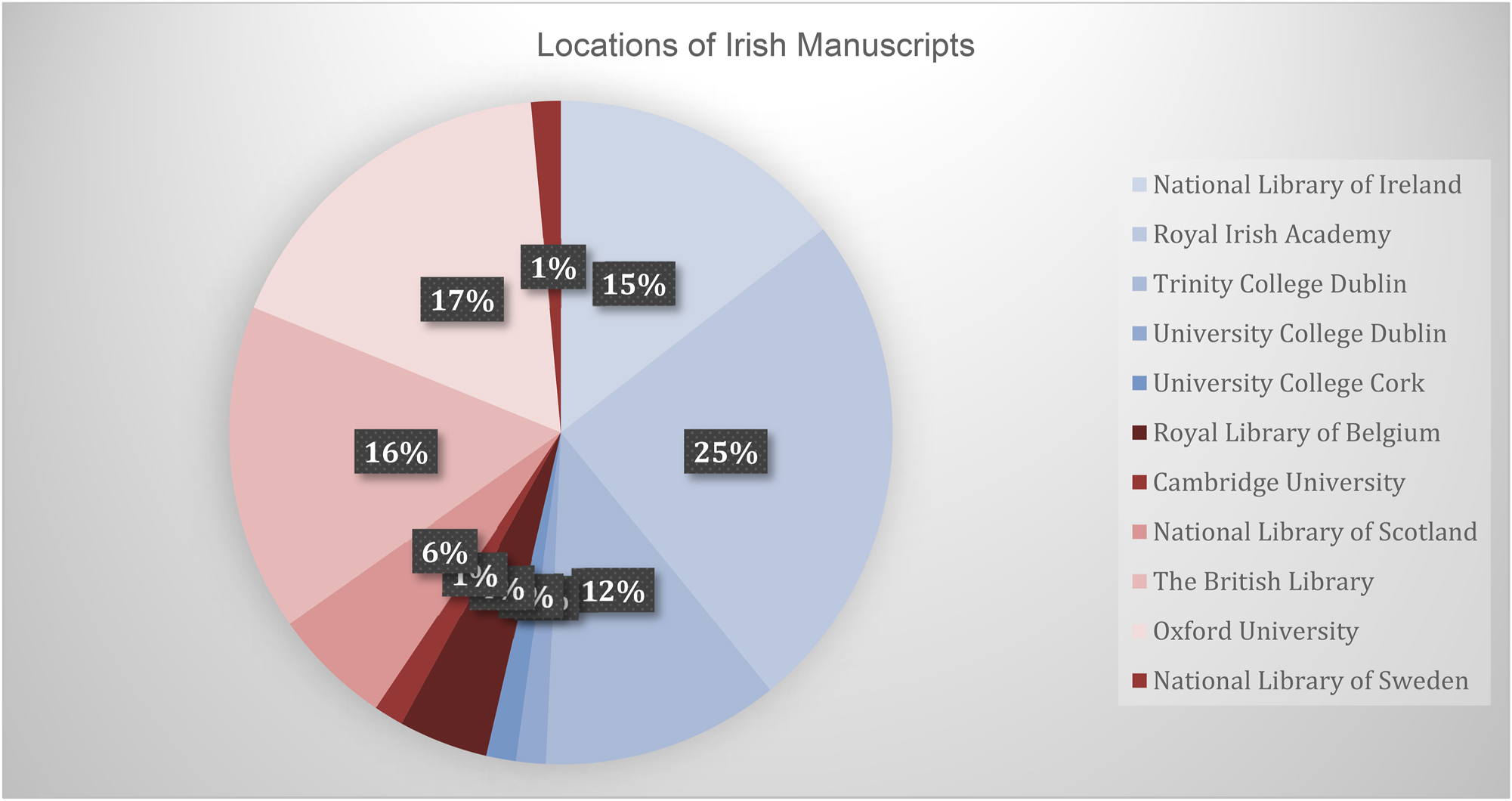
Location of Irish manuscripts (Wikipedia n.d.) with Irish locations indicated in blue and locations abroad indicated in red.
2.5 Summary
Across the British Empire, libraries have been found to promote colonial practices which extinguished native culture. This is important to keep in mind when we look at the history of Irish libraries, what they have promoted in the past, and what hangovers may still exist today. If Irish libraries are to decolonize there should be clear examples of the ways in which they actively promote anti-racism, dismantle white supremacy, and preserve folk knowledge. For the reasons explored above, these are ideas intrinsic to British colonialism and should have no place in libraries who are committed to undoing the centuries of colonialism.
Drawing on the discourse evolving in the field of library and information studies, the imperatives of decolonization have been examined in how effectively they can be translated to the Irish colonial contexts. While the wider global “decolonize the library” movement demonstrates work that has been done in settler-colonial and postcolonial countries, literature that specifically examines the colonization of Ireland offers insight into the nuances which may apply when considering decolonizing Irish libraries.
The transformation of Irish libraries through decolonization is an intricate undertaking, compounded by the scarcity of specific literature dedicated to this topic. As illustrated in the literature review, over the course of this research no academic pieces of literature were found which specifically cover the subject of decolonizing the library in an Irish context. Within the global discourse on decolonizing libraries, because the Irish context has remained relatively unexplored, this has prompted a reliance on broader discussions of the colonization of Ireland and the decolonization of libraries worldwide. These sources have been instrumental in bridging the gap, enabling insights to transcend regional confines and illuminate potential trajectories for the decolonization of Irish libraries.
The overarching aim of this study is to establish a process for decolonizing Irish libraries. By seeking answers to the central research question “what does decolonizing the library look like in the Irish colonial contexts?”, this study endeavors to address the gap that has been identified in the literature. This study breaks down this question into various key topics which are pertinent when addressing colonial biases in Irish libraries, acknowledging the differing colonial historical contexts north and south of the border. This endeavor will be guided by the decolonization work which has proceeded this research abroad from postcolonial and settle-colonial countries.
3 Research Design and Methodology
Qualitative research was conducted to investigate this project’s thesis question of how the decolonization of the library movement should be structured in Ireland, given the country’s specific colonial contexts. The primary data collection method used in this research was qualitative interviews. Qualitative data was chosen as this would facilitate an in-depth understanding of participants’ perspectives on this topic.
This study adopts an interpretive research approach, recognizing that knowledge is socially constructed and shaped by individual experiences and perceptions. Through the research interviews, this study aims to explore the various nuances that may arise from participants’ perspectives on the process of decolonizing libraries within the Irish colonial contexts. This exploratory research was limited to the six interviews that were conducted within the restricted time frame of the study and the findings will be reflective of a limited number of topics relevant to the research question that were covered. While this small sample size allows for in-depth analysis, it may restrict the generalizability of the findings. Therefore, the findings should be interpreted within the context of the specific participants and their experiences (see Table 1). Despite these limitations, the qualitative interviews provide valuable insight into the perspectives of how the “decolonizing the library” movement may be tailored to be relevant to Ireland’s nuanced colonial contexts. The data collected contributes to a comprehensive starting point of the direction for future research on this topic. An outline of the subjects which were not able to be fully explored and would benefit from further study and research will be covered in the conclusion of this paper.
Outline of study participants.
| Participant | Location | Background |
|---|---|---|
| 1 | South of Ireland | Public librarian engaged in Traveller inclusion projects |
| 2 | North of Ireland | Private librarian working in an Irish medium library |
| 3 | South of Ireland | Public librarian working in a library which aims to preserve folk knowledge in the south of Ireland |
| 4 | England | Higher education librarian who has established and chairs a “decolonize the library” working group in their university |
| 5 | North of Ireland | Public librarian |
| 6 | North of Ireland | Irish language advocate engaged in decolonial education |
4 Findings and Discussion
4.1 Language Revitalization and Promotion: Ná hAbair é, Déan é
One theme which arose from the qualitative interviews was around Ireland’s language landscape and how this has been deeply marked by the colonial influence of British settlers. This section focuses on the Irish language and does not cover De Gammon, although this language which is predominantly spoken by Irish Travellers is also native to Ireland and has been profoundly affected by colonialism. This is a topic which would benefit from further extensive study and is outlined in the concluding section of the study. The relationship of the Irish language to Irish libraries and how this has been affected by colonialism is a topic which arose in 67 % of all interviews conducted as part of this study. This topic mirrors some of the decolonization work done abroad, chiefly, Reijerkerk and Nyitray’s (2022) article which emphasizes the duty libraries hold in promoting and preserving knowledge which is indigenous to the land. When translating this point, written originally in the context of the United States, the Irish language is an important aspect of native Irish culture which has suffered over centuries of British colonization. This section explores the role that libraries play in promoting and revitalizing the Irish language as well as the obstacles that prevent libraries from fully inhabiting this role.
Libraries are essential spaces for diverse communities to engage with their heritage in a constructive way, whether that heritage be one of colonizers who planted an area or native people who had aspects of their culture and traditions devalued through the process of colonization. The former of these two can be exemplified with efforts in North American libraries to educate those of European descendants of the power struggles which arose from their ancestors settling the land (Edwards 2019). Libraries’ embeddedness in their local communities offers an opportunity to empower minority and indigenous languages. Participant 2 stressed this point by saying how ”libraries are part of the jigsaw of wider culture and political life… they fit into the realm of education.”
In the north, the relationship between libraries and the Irish language is particularly contentious. The Irish language has historically been associated with Irish nationalism because of British colonial policies to enforce the use of the English language throughout Ireland (MacRaild and Smith 2013). This historical context has complicated the local governments’ relationship to the Irish language in the modern day. Participant 6 pointed to a project run by Belfast City Council, Shared Space, funded by the EU’s Peace IV program as well as local governments in the north and south of Ireland. This project, as outlined by participant 6, aims to create cross community hubs to allow nationalist and unionist communities to come together in a neutral shared space to support peace and reconciliation efforts. One aspect of this project which participant 6 criticized was that the Irish language will be prohibited from being used in these spaces as it is deemed a divisive language. On this, participant 6 said: “across libraries, there needs to be a better understanding of how dealing with the postcolonial situation requires a re-examination of the relationship of the state to minority and indigenous languages.” Another interviewee, participant 2, who works in a private Irish language library in the north of Ireland, echoed this point., emphasizing that, where possible, libraries must understand their duty to encourage the Irish language and cannot wait for government decision to begin this language revitalization. They encapsulated this with the Irish saying “ná habair é, déan é,” meaning “do not talk about it, do it.”
Some libraries in the north provide resources to encourage the learning and use of the Irish language and this has mostly developed, participant 6 says, along with the establishment and growth of Irish language medium schools. However, they also cite that this facet of service provision is not evenly distributed in the north of Ireland and is restricted to libraries in predominantly Catholic and Republican areas, with libraries in majority Unionist areas having no Irish language resources available to those interested. This disparity perpetuates historical power dynamics, with the Irish language remaining intertwined with identity politics and cultural divisions. The question that this raises is if libraries must address these inequalities and work towards making Irish language resources accessible to all communities, entrenching the message that languages indigenous to an area are to be embraced and encouraged. To engage with decolonization in a meaningful way, libraries will be required to assess their relationship with their parent organization, be it a local authority or university, and advocate for policies that promote linguistic inclusivity and cultural appreciation. By supporting marginalized languages, libraries can foster an environment of equity and respect. Participant 6 noted that currently “disengagement in the north from the broad decolonization discourse is very pointed.” To elucidate this point, they took the example of a seminar which took place in Queen’s University Belfast on the subject of decolonization. At this event, “no Irish speakers were invited, it didn’t address the question of Ireland, and it avoided completely any mention of the six counties.” This oversight resulting in the exclusion of conversations around Ulster when discussing decolonization is consistent with other events such as a 2022 University College London seminar on decolonizing UK libraries which failed to mention the north of Ireland. The interviewee continued that, as a result of this frustration, a bilingual symposium was held in Queen’s University Belfast in partnership with the Irish language organization Glór na Móna which exclusively focused on the Irish language and decolonization (Queen’s University Belfast 2023).
In practical terms of effectively incorporating the Irish language into libraries, one Irish language librarian shared frustrations at library management systems typically developed in the UK or North America which have limited functionality for including important linguistic aspects of Irish such as fadas. These aspects of the language are important to preserve meaning as the exclusion of accents can, in certain instances, change the meaning of words or sentences in Irish. Participant 2 explained that over the course of several months and escalating the complaint with the LMS software developers, the library was eventually granted the ability to use accents in the cataloguing and searching. Although this story is a success, it is also an example of the barriers in place for accessing basic ways to represent the Irish language, and other minority languages, in Irish libraries. Participant 6 stressed the importance of libraries needing to cater to everyone, Irish language learners included.
When discussing Irish language inclusion in sectarian areas in the north of Ireland, there needs to be a clear understanding by librarians on how to manage hate and targeted attacks which may arise as a result. There also needs to be anticipation of arguments by Unionists that libraries may be taking a political stance which alienates part of the community they serve. Undoubtedly, similar arguments may have been presented to libraries in the United States by locals of European descent who interpreted celebration and restoration of indigenous culture as an affront to their colonial heritage, but if libraries believe in decolonization this is the strong stance which must be taken to resist the erasure of indigenous, anti-colonial culture. When asked about potential sectarian backlash which may arise from libraries in the north of Ireland funding Irish language resources to all branches, participant 6 explained that backlash must be anticipated but it can not necessarily be avoided. In the same way that anti-LGBT backlash should not defer libraries from providing resources on this topic, there needs to shared support for indigenous and minority languages.
4.2 Oral Histories: Traveller Heritage and Folk Knowledge
In the context of Ireland’s history and cultural practices, libraries committed to decolonization can play an integral role in acknowledging, preserving, and promoting indigenous knowledge. This section explores the theme of indigenous knowledge and how Irish libraries relate to this facet of decolonization. The area mainly covered under this topic is Irish folk knowledge, how this is represented in libraries, and oral history as an essential medium for transmitting indigenous knowledge in Ireland, particularly in the Traveller community. Libraries’ role in relegitimizing oral histories as a form of information distribution in the aftermath of empire was echoed earlier in the study’s literature review under the work of Plockey and Ahamed (2016).
Two interviewees, participant 1 and 3, spoke on their libraries’ effort to accommodate indigenous knowledge into their institutions. Participant 1 spoke of their institution’s efforts to incorporate this information into their traditional written collections. In this instance, the library collaborated with a local historian to develop a toolkit which outlined how to go about recording oral history, including establishing potential interviewees, and how to develop exploratory questions which would produce valuable materials for preservation. The librarian then reached out to the local Traveller community to invite them to go through the toolkit over a number of weeks where they would be supported by the local historian and local librarian and be provided with essential tools such as recorders. Incorporating oral history is not only important for inclusion of varied methods of information preservation but also for accessibility. Traveller literacy levels fall below the national average (Inspectorate of the Department of Education and Science 2006), and for this reason investing in oral history inclusion also allows the library to be a place where Travellers are accommodated. By preserving traditions and histories through oral means, libraries provide accessible avenues for individuals who may face barriers to traditional literacy. Another project underway which participant 1 shared is one where the library collaborated with its local Traveller community to map the routes that Travellers had traditionally taken. This includes documenting the names that Travellers gave to areas that would differ from the names used by the settled Irish population. This project is an exceptional example of the ways in which local libraries can ensure they are fulfilling their duty to represent Traveller history in their collections.
To achieve successes such as this one, libraries need to collaborate with relevant Traveller communities. Participant 1 explained that her perception is that librarians assume Travellers will use the library as they need it but in reality Travellers will not come unless they are catered to through targeted introductory tours. This librarian stressed the importance of regularly inviting them to use the library and to come to library events. This helps build relationships with Traveller communities to be able to open up on how the library can better serve them as well as building habits which cement the idea that the library is a place that sees the importance of having Travellers included and represented. Constant communication was also stressed as an important step for libraries as participant 1 shared that Travellers may sometimes be cautious or fearful of authority and may associate the public library as an institution whose goals align with that of local authorities, which historically have failed to support Traveller needs (Holland 2016).
Oral histories and the indigenous knowledge they preserve are at a risk of being lost if libraries do not recognize their duties to incorporate them into their collections and preserve them alongside the histories of the settled Irish people. One obstacle which stops these projects from being led in libraries across Ireland, participant 1 explained, is the lack of dedicated long-term funding. Reliable funding is essential to ensuring that Irish oral histories and other indigenous traditions which may have been eroded due to colonialism continue to thrive and be preserved for future generations.
Irish folk knowledge is another valuable facet of Irish indigenous knowledge which should be discussed when decolonizing Irish libraries. This includes folklore and folk songs, which hold cultural value and embody beliefs and traditions of past generations. Participant 3 described the process of archivists recording folklore and folk ballads that were then transcribed for preservation. For this process, all dialects and linguistic idiosyncrasies were retained to be true to the source material. This is an example of libraries preserving folk knowledge by translating it to the medium that libraries have traditionally worked in, the written word.
4.3 Decolonization Strategies
When discussing practical strategies for successfully decolonizing Irish libraries, several common themes emerged over six interviews. By bridging theory and practice, this research aims to provide a comprehensive perspective on the decolonization process of Irish libraries, underscoring the connection between broader decolonial discussions and pragmatic implementation of strategies that foster a more inclusive and culturally sensitive library landscape. As custodians of information, libraries shoulder a responsibility of acknowledging historical colonial legacies and their impact on the information that is represented in their collections and the information that is absent from them.
The first theme of decolonial library strategy which was brought up independently by four of the six interviewees was stressing the importance of fostering open discussions to critically engage with historical materials. This approach can be summarized as “retain and explain,” a phrase which has been used widely over the last number of years including by the UK government in their approach to British heritage (Ministry of Housing, Communities & Local Government 2021). A strong opinion which emerged from interviewees was that it is important to remember the colonial past of Ireland by treating outdated materials with consideration and recontextualizing them with resources which represent alternative historical perspectives. Participant 5 stressed the importance of preserving and displaying sectarian materials, ensuring that a full story of history from varied perspectives was represented in the library, and allowing the library patrons to interpret materials themselves.
Although extensive discussions on racism were not included as part of this research study, participants 3, 4, and 5 mentioned using this strategy of retain and explain in the contact of racially insensitive materials that are held in their library’s collections. Racially insensitive passages on the library’s digital portal are obscured and users are issued a content warning, explaining that the passage may be insensitive, that the passage does not reflect the views of the library, and asking users to consent to view the materials. Racism, as briefly mentioned in the literature review and methodology section, is a powerful tool of empire. Ideologically coherent decolonialism and anti-imperialism necessitates strong anti-racist positions.
Another common decolonial strategy which emerged from discussions was the need for education around the topic. Participants 5 and 6 stressed that once implicit biases are addressed in library collections and marginalized perspectives are represented, there is a need for a public forum where library patrons can discuss the topic of decolonization and agree on shared strategies for decolonizing the library. Participant 6 suggested that a way to tackle colonial biases is to develop a book list of educational materials which tackle the colonial tactics used by Britain in Ireland and the methods that were used to politicize and stigmatize Irish culture. This approach is echoed in one case study referred to in the literature review on an American library which designed educational courses as part of their decolonization project, educating Americans of European descent of the process of colonizing North America and the power struggle that took place between the colonizers and the native population and how this history impacts modern day relations.
Participant 4 who has worked on decolonizing their library in England spoke on the importance of being able to train library staff on decolonization, outlining what this process is and why it is important to engage with it as information professionals. This participant spoke of a desire to see a broad national training which library staff throughout the United Kingdom could elect to partake in which could forge connections between information professionals who have begun the process of decolonizing their institutions or have a desire to do so. This training would ideally eventually inform other relevant training such as collection development, equality diversity and inclusion, and outreach. Lastly, participant 4 highlighted that these trainings should vitally include information professionals who are not necessarily familiar with decolonization; “the group that concerns me the most are those who aren’t on the boat, that don’t understand decolonization. They might even get to the point where they feel it is a threat.”
A strategic point on practical steps towards decolonizing the library which is echoed in the above point and which was mentioned in a further two interviews with participants 1 and 6 is that for decolonization to work there is a need for national structures which ensure continued funding for decolonization projects. Establishing comprehensive frameworks would provide libraries with a unified direction and support system. In order for library projects to adequately tackle the task of decolonization, funding must be reliable and long-term.
5 Conclusion
In conclusion, the decolonization of Irish libraries is a complex topic which requires further study to be examined comprehensively. While this study examined various aspects of the decolonization process of Irish libraries including Irish language revitalization, oral history preservation and inclusion, and practical initial steps for decolonizing libraries, these topics only cover a fraction of what the broader discourse on Irish decolonization can entail. The synthesis of this study reveals common themes which emerge from broad decolonial discussion with information professionals, such as the need for national structures and funding, inclusive practices, and comprehensive staff training. These themes provide a foundation for practical decolonial strategies as pointed out by the study’s participants. However, this synthesis also underscores the need for continued research and exploration into other pertinent aspects of Irish decolonization such as historical power dynamics in libraries, agreed definitions of decolonization, and the integration of decolonial principles into all aspects of library practices.
The way in which Irish Travellers and their oral history is incorporated into library services, both north and south of the border, could illuminate the way this part of Irish culture has been delegitimized and under-represented throughout history first by the British Empire and secondly by the Irish state which emerged after colonial ties were cut in part of the country. Traveller oral history was discussed briefly in the study but this topic is far from exhausted. Further study is needed on Traveller traditions and how they can be supported in libraries. The Traveller language of De Gammon is also often sidelined although it is a national native language to the country. One aspect of decolonization which is important in Irish libraries is taking up the mantle of promoting the Irish language as well as De Gammon.
Another area related to decolonizing Irish libraries as discussed above would be an exploration on anti-racism, anti-xenophobia, and how Irish libraries relate to this vitally important facet of decolonization. As outlined in the literature review, racism is a potent tool of colonialism. The work of promoting decolonization in Irish libraries, and all decolonial libraries, must therefore be inextricably tied from the promotion of anti-racism. In-depth research into the ways in which Irish libraries relate or fail to relate to anti-racism work is imperative to the question of how libraries implicitly promote colonial ideas. Projects such as Libraries of Sanctuary may be helpful to guide discussion. This is an initiative which began in the UK which recognizes libraries which have worked to make their spaces as welcoming and inclusive as possible to migrants. At the time of writing, Portlaoise library is the first and only Irish library to hold the status of Library of Sanctuary (Places of Sanctuary Ireland 2020). Within this area of interest, a look towards how treatment of migrants considered to be white differs from those who are migrants of color would also be pertinent for Irish libraries. This would include what resources are afforded to white migrants versus migrants of color in libraries, in particular the response of Irish public libraries to Ukrainian refugees versus other large waves of migration into Ireland.
Lastly, research on community libraries could be fruitful in its contribution to how libraries in Ireland decolonize their service. As mentioned in the literature review, implicit colonial biases in libraries may resemble the promotion of one authoritative voice on information and a delegitimization on other information practices. Community libraries allow people to preserve information which they deem to be important which may not be represented in libraries. In this Irish context, this could include sean nós, folklore, and other forms of folk knowledge. One community archive which is also related to the research topic of anti-racism is Asylum Archive (Nedeljković et al. 2018). In this book, ex-Direct Provision resident Vukašin Nedeljković compiles a photographic archive of Direct Provision centers around Ireland. This is an example of a marginalized voice who has documented his experience which could perhaps be included in the voices represented in libraries in the future.
Further topics of interest may arise as a consequence of this area of librarianship developing and more diverse professional perspectives join the discourse. The above topics are limited examples of research that would contribute novel and impactful information to the complexities of decolonizing libraries but they are by no means exhaustive. Exploring all aspects of this area of library and information science is imperative to our ability as librarians of fostering a more inclusive and decolonial approach to library practices and services.
References
Brewer, J. D., and G. I. Higgins. 1998. “Northern Ireland: 1921–1998.” In Anti-Catholicism in Northern Ireland, 1600-1998: The Mote and the Beam, 87–127. Hampshire: Palgrave Macmillan.10.1057/9780333995020_4Search in Google Scholar
Carey, M., F. Croke, M. Redfern, J. Unkel, and C. Ward. 2018. Gift of a Lifetime: Treasures from Chester Beatty’s Collection. Dublin: Detail Design Studio.Search in Google Scholar
Coleman, S. J. 2008. “Empire of the Mind: Subscription Libraries, Literacy & Acculturation in the Colonies of the British Empire.” PhD diss. Florida State University. http://purl.flvc.org/fsu/fd/FSU_migr_etd-3564 (accessed October 11, 2024).Search in Google Scholar
de los Monteros, P. E. 2019. “Decolonial Information Practices: Repatriating and Stewarding the Popol Vuh Online.” Preservation, Digital Technology & Culture 48 (3–4): 107–19. https://doi.org/10.1515/pdtc-2019-0009.Search in Google Scholar
Edwards, A. 2019. “Unsettling the Future by Uncovering the Past: Decolonizing Academic Libraries and Librarianship.”Partnership: The Canadian Journal of Library and Information Practice and Research 14 (1). https://doi.org/10.21083/partnership.v14i1.5161.Search in Google Scholar
Fullmer, M. 2021. “Are We There Yet? Visualising Indigenous Culture in Today’s Library.” IFLA Journal 47 (3): 313–20. https://doi.org/10.1177/0340035220987577.Search in Google Scholar
Holland, K. 2016. “European Commission Launches Inquiry into Treatment of Travellers.” The Irish Times, October 15. https://www.irishtimes.com/news/social-affairs/european-commission-launches-inquiry-into-treatment-of-travellers-1.2830395 (accessed October 11, 2024).Search in Google Scholar
Ignatiev, N. 2015. How the Irish Became White. London: Routledge.Search in Google Scholar
IIP. n.d. About the IIP Project. International Inventories Programme. https://www.inventoriesprogramme.org/about-iip (accessed October 11, 2024).Search in Google Scholar
Inspectorate of the Department of Education and Science. 2006. Survey of Traveller Education Provision. https://assets.gov.ie/25387/16a0ab0d656e406b938c7f6322daac47.pdf (accessed October 11, 2024).Search in Google Scholar
Jimenez, A., S. Vannini, and A. Cox. 2022. “A Holistic Decolonial Lens for Library and Information Studies.” Journal of Documentation 79 (1). https://doi.org/10.1108/jd-10-2021-0205.Search in Google Scholar
Joseph, E. 2020. Critical Race Theory and Inequality in the Labour Market: Racial Stratification in Ireland. Manchester: Manchester University Press.10.7765/9781526134400.00009Search in Google Scholar
Loyer, J. 2021. “Collections Are Our Relatives Disrupting the Singular, White Man’s Joy that Shaped Collections.” In The Collector and the Collected: Decolonizing Area Studies Librarianship, edited by M. Browndorf, E. Pappas, and A. Arays, 28–43. Sacramento: Library Juice Press.Search in Google Scholar
MacRaild, D., and M. Smith. 2013. “Chapter 9: Migration and Emigration, 1600–1945.” In Ulster since 1600: Politics, Economy, and Society. Oxford: Oxford University Press.10.1093/acprof:oso/9780199583119.003.0010Search in Google Scholar
McCarthy, M. 2009. “Marsh, Narcissus.” In Dictionary of Irish Biography. https://www.dib.ie/biography/marsh-narcissus-a5459 (accessed October 11, 2024).10.3318/dib.005459.v1Search in Google Scholar
McGreevy, N. 2020. “Medieval Manuscript Returns to Ireland after Hundreds of Years in British Hands.” In Smithsonian.com. https://www.smithsonianmag.com/smart-news/one-irelands-most-important-historic-books-will-return-home-180976162/ (accessed October 11, 2024).Search in Google Scholar
McGreevy, R. 2022. “TCD Invites Views on Dropping Berkeley’s Name from Library Over Slave Ownership.” The Irish Times. https://www.irishtimes.com/ireland/education/2022/11/25/tcd-invites-views-on-dropping-berkeleys-name-from-library-over-slave-ownership/ (accessed October 11, 2024).Search in Google Scholar
McLaughlin, Z. 2021. “Indonesian Case Studies in Decolonization.” In The Collector and the Collected: Decolonizing Area Studies Librarianship, edited by M. Browndorf, E. Pappas, and A. Arays, 273–90. Sacramento: Library Juice Press.Search in Google Scholar
McVeigh, R., and B. Rolston. 2022. Anois ar Theacht an tSamhraidh: Ireland, Colonialism and the Unfinished Revolution. Belfast: Beyond the Pale Books.Search in Google Scholar
Meyer, K. 1909. Rawlinson b. 502; a Collection of Pieces in Prose and Verse in the Irish Language Compiled During the Eleventh and Twelfth Centuries; Now Published in Facsimile from the Original Manuscript in the Bodleian Library. Oxford: Clarendon Press.Search in Google Scholar
Ministry of Housing, Communities & Local Government, C. & L. G., the Rt Hon Oliver Dowden CBE MP, and the Rt Hon Robert Jenrick MP. 2021. New Legal Protection for England’s Heritage. https://www.gov.uk/government/news/new-legal-protection-for-england-s-heritage (accessed October 11, 2024).Search in Google Scholar
Mutonga, S., and A. Okune. 2022. “Chapter 13: Re-membering Kenya: Building Library Infrastructures as Decolonial Practice.” In Narrative Expansions: Interpreting Decolonization in Academic Libraries, edited by J. Crilly, and R. Everitt, 189–212. London: Facet Publishing.10.29085/9781783304998.015Search in Google Scholar
Nedeljković, V., R. Lenṭin, C. McIvor, A. Mulhall, and K. E. Till. 2018. Asylum Archive, 2nd ed. Asylum Archive.Search in Google Scholar
O’Connor, T. 2004. “Marsh’s Library and the Irish Catholic Tradition.” In The Making of Marsh’s Library: Learning, Politics, and Religion in Ireland, 1650–1750, edited by M. McCarthy and A. Simmons, 235–80. Portland: Four Courts Press.Search in Google Scholar
Places of Sanctuary Ireland. 2020. “Portlaoise Celebrates Ireland’s First Library of Sanctuary.” Places of Sanctuary Ireland. https://ireland.cityofsanctuary.org/2020/03/21/portlaoise-celebrates-irelands-first-library-of-sanctuary (accessed October 11, 2024).Search in Google Scholar
Plockey, F. D.-D., and B. A.-B. Ahamed. 2016. “Decolonizing Our Library System: The Living Librarians (Baansi) of Dagbon, Northern Ghana.” Library Philosophy and Practice. http://digitalcommons.unl.edu/libphilprac/1366 (accessed October 11, 2024).Search in Google Scholar
Queen’s University Belfast. 2023. Decolonization: Language, Community, Culture. School of Arts, English and Languages | Queen’s University Belfast. https://www.qub.ac.uk/schools/ael/Research/ConferencesandSymposia/DecolonisationLanguageCommunityCulture/ (accessed October 11, 2024).Search in Google Scholar
Rahman, A., M. A. Clarke, and S. Byrne. 2017. “The Art of Breaking People Down: The British Colonial Model in Ireland and Canada.” Peace Research 49 (2): 15–38. https://www.peaceresearch.ca/pdf/49_2/PRJ_49_2_2017_Rahman_Clarke_Byrne_Full.pdf (accessed October 11, 2024).Search in Google Scholar
Reijerkerk, D., and K. J. Nyitray. 2022. “(Re)moving Indigenous Knowledge Boundaries: A Review of Library and Archival Collection Literature since the Enactment of the Native American Graves Protection and Repatriation Act (NAGPRA).” Collection Management 48 (1): 1–26. https://doi.org/10.1080/01462679.2022.2033144.Search in Google Scholar
Schuerkens, U. 2012. “Colonization.” In The Wiley-Blackwell Encyclopedia of Globalization, Vol. 1, edited by G. Ritzer, 246–9. Chichester: Wiley-Blackwell. https://doi.org/10.1002/9780470670590.wbeog082.Search in Google Scholar
Tuck, E., and K. W. Yang. 2012. “Decolonization Is Not a Metaphor.” Decolonization: Indigeneity, Education & Society 1 (1): 1–40. https://jps.library.utoronto.ca/index.php/des/article/view/18630/15554 (accessed October 11, 2024).Search in Google Scholar
Webb, A. n.d. “James Caulfeild, Earl of Charlemont.” Irish Biography. https://www.libraryireland.com/biography/JamesCaulfeildEarlofCharlemont.php (accessed October 11, 2024).Search in Google Scholar
Wikipedia. n.d. List of Irish Manuscripts. Wikipedia.org. https://en.wikipedia.org/wiki/List_of_Irish_manuscripts (accessed October 11, 2024).Search in Google Scholar
© 2024 the author(s), published by De Gruyter, Berlin/Boston
This work is licensed under the Creative Commons Attribution 4.0 International License.
Articles in the same Issue
- Frontmatter
- Winner of the LIBRI Best Student Research Paper Award 2024
- Libraries and the 2030 Agenda: The Portuguese Case
- Honourable Mention for the LIBRI Best Student Research Paper Award 2024
- Decolonizing the Library: Considering the Movement in the Irish Colonial Contexts
- Articles
- Reclaiming and Unlocking Ancient Heritage Knowledge from Ethiopia’s Ancient Cultural Heritages
- Adequacy of Copyright Information or Documentation, the Need for Training in, and Evaluation of Mechanisms for Delivering Copyright Education in Academic Libraries in Ghana
- Local Library Authorities in South Indian Public Libraries Acts: A Case Study
- Effects of E-learning Technologies on Librarians’ Sustainable Competence Development and Smart Library Services: Empirical Evidence from 244 Universities’ Librarians
- Announcement
- Libri Best Student Research Paper Award 2025
Articles in the same Issue
- Frontmatter
- Winner of the LIBRI Best Student Research Paper Award 2024
- Libraries and the 2030 Agenda: The Portuguese Case
- Honourable Mention for the LIBRI Best Student Research Paper Award 2024
- Decolonizing the Library: Considering the Movement in the Irish Colonial Contexts
- Articles
- Reclaiming and Unlocking Ancient Heritage Knowledge from Ethiopia’s Ancient Cultural Heritages
- Adequacy of Copyright Information or Documentation, the Need for Training in, and Evaluation of Mechanisms for Delivering Copyright Education in Academic Libraries in Ghana
- Local Library Authorities in South Indian Public Libraries Acts: A Case Study
- Effects of E-learning Technologies on Librarians’ Sustainable Competence Development and Smart Library Services: Empirical Evidence from 244 Universities’ Librarians
- Announcement
- Libri Best Student Research Paper Award 2025
