
A skeptic’s guide to “intercultural communication”—debunking the “intercultural” and rethinking “culture”
-
Hongbing Yu
Hongbing Yu (b. 1984). Assistant Professor of Culture and Communication, Department of Language, Literatures, and Cultures, Toronto Metropolitan University, Toronto, Canada. Vice-President and President Elect of Semiotic Society of America; Executive Director of the International Institute for Semiotic Studies, Nanjing Normal University, Nanjing, China; Co-director of the International Institute for Language and Cultural Semiotics, Dalian University of Foreign Languages, Dalian, China. Author of two monographs on the semiotic mechanisms of language, culture, and mind:
On Semiotic Modeling (Soochow University Press, 2019) andLiving by Models (Mouton De Gruyter, forthcoming). Sample publications have appeared in The American Journal of Semiotics, Semiotica, Biosemiotics, Society, and Chinese Semiotic Studies, language and philosophy of mind, ancient Chinese philosophy and religion, all of which are studied under the lens of semiotics. He is currently focused on such topics as social rituals and narrative, mythical thinking, and the cognitive dimensions of ancient Chinese philosophy and religion.


Abstract
Starting with a critique of so-called intercultural communication, the present paper contests and challenges the prevalent and dominant essentialist views of “culture”. It is exposed that these views have a detrimental underlying logic that is both destructive and self-destructive. Instead, the paper proposes a radically new idea of culture, a minimalist approach supported by insights gleaned from contemporary semiotic inquiry. In this approach, culture is defined as a biological instinct to acquire information through modeling, that is, learning by models. This instinct is at work, or is realized, in specific acts of such modeling, resulting in cultural practices and cultural artifacts. In the case of humanity, a cultural practice is anything a human does that can be modeled by another human and a cultural artifact is any object that humans make and can model. The paper argues it is imperative to keep in mind that when we deal with the “intercultural”, we are only dealing with concrete yet different cultural practices or cultural artifacts. This is an effective way to completely refute essentialism. In a sense, the paper is meant to be a wake-up call, instead of a fighting talk. Its main objective is not to negate or obliterate the field of “intercultural communication”, among others, but rather to save them from themselves—a true and worthy field of “intercultural communication” is a field against essentialism, instead of an accessory to essentialism, whether the commission is “before the fact” or “after the fact”.
1 Questioning the “intercultural”
As someone who has already spent more than 20 years of his adult life studying, teaching, and most importantly doing (cf. Scollon et al. 2012: 5), what has been conventionally characterized as “intercultural communication”, I still cannot help but doubt the validity of such characterization. And as time has passed, my doubt has considerably grown. A ramification of this is that I increasingly find myself asking students and colleagues, “What on earth is the ‘intercultural’?”, to which I have never received a truly convincing answer. No matter how “critical” or “nuanced” they claim to be, almost all answers that I have surveyed so far, with very few exceptions,[1] reflect essentialism (Appiah 2018; Holliday 2011, 2019, 2021; Holliday et al. 2021; Phillips 2007), that is, representing individual human beings’ “behaviors as entirely defined and constrained by the cultures in which they live so that the stereotype becomes the essence of who they are” (Holliday 2011: 4). Interestingly, essentialism remains deeply entrenched in the field but not for want of wide and public denouncement in the academy. Nevertheless, with a massive amount of work underlain by essentialism being cranked out every year, the situation has significantly worsened since 1959, when Edward T. Hall first used the term “intercultural communication” (Hall 1959: 15), which many people believe marked the birth of a whole field.
Although much work in today’s “intercultural communication” claims a more liberal and non-essentialist vision rejecting cultural overgeneralization and acknowledging diversity, the work is still fundamentally essentialist, or in Adrian Holliday’s words, neo-essentialist (cf. Holliday 2011: 7). An example, which is in effect a major culprit of such neo-essentialism, is the extremely influential theoretical framework of Hofstede (2001, 2011, featuring six cultural dimensions such as individualism versus collectivism, masculinity versus femininity, etc. Against the work in this neo-essentialist vein, Holliday offers an incisive critique:
While it does address a rich complexity that goes beyond national categories and deals with the smaller cultures or discourses of business or educational organizations, and so on, the same items of literature are invariably pulled back towards the traditional, essentialist use of national cultures as the basic unit, either employing Hofstedian categories of difference or others like them. Behaviour which goes against national stereotypes is therefore nearly always framed as an exception to the essentialist rule rather than as a reality in its own right. (Holliday 2011: 7)
Despite sustained criticism of outdatedness and oversimplification in both data gathering and theorizing, Hofstede’s theory and its kind still have taken deep root and remained as prevailing doctrines in relevant fields for decades. A main reason for the popularity and authority of these theories is that they provide a sense of certainty about precise and measurable behavioural formulae for interaction with people “from specific cultural groups” (Holliday 2011: 7). An expected outcome is the illusory reassurance that one can calculate how to act “interculturally effectively” in what they identify as “intercultural situations” based on prescribed information about a certain “culture”, such as how to greet Chinese businesspeople and their American counterparts differently at an international economic forum according to their “cultural traits”.
As a result of the suffusion of essentialism, the fact that what “intercultural communication” faces is actually an overabundance of complex, fluid, and eve largely unpredictable realities is no longer important to theorists, trainers, and practitioners. On the contrary, it has only become an inconvenient fact. We are, therefore, confronted with a bizarre phenomenon—the whole field of “intercultural communication” is little more than a decades-long aberration that has been accepted by the majority as a norm. The field, both in its theoretical orientation and concrete practice, does a grave disservice to not just what it purports to study but also itself, so much so that we should perhaps simply banish all further mention of the phrase. But it seems to be hard advice to follow.
Obviously, the word “intercultural” has become so commonplace over the past decades that it has long been taken for granted and deeply ingrained in both academic and demotic language. In addition, the Western-style liberal need to pose as “open” and “mindful” seems to have overridden the imperative for thorough criticality, that is, keeping questioning and rethinking in the face of new evidence. As a matter of fact, this posture reflects a form of “culture” politicking that is rife in the Western academy and society. It might easily turn into defensive and even offensive prosecuting (cf. Grant 2021: 27) against genuinely less essentialist but more critical ideas that are better attuned and suited to complex realities of human interaction.
2 Debunking the “intercultural”
No matter how stylish or popular it may sound to the ear, the word “intercultural” often turns out to be a pretentious mass cultural delusion. The reason is that this concept is fixated on the presupposition of “cultural boundaries” or “boundaries between cultures” (see Scollon et al. 2012: 4), which, as we shall see soon, is a terribly skewed idea. Most mainstream textbooks and university courses on “intercultural communication” thrive on this presupposition and purport to help readers effectively communicate across these “boundaries”, which are in fact no more than a straw man that has been set up in the research on complex and fluid situations of human interaction. If the arguments of cultural boundaries ever reflect any amount of truth, it would be the truth of bias in the research of “intercultural communication”, so much so that it begs the thorny question, “How much ‘culture’ is there in here?” This would lead to a thornier yet more fundamental question, “What on earth is culture?”, which we will focus on later in this paper.
Anytime someone says something like “communicating more effectively with people from outside their own culture” or uses “culture” as a countable noun, especially in the plural, they have already committed essentialism. If we ever think of ourselves as being politically right or morally righteous in using the word as such, it is even worse because it will reflect nothing but sheer folly or hubris. Interestingly, most of those who have realized the need for “effective intercultural communication” are, in a way, acknowledging the problem of essentialism. But in the end, they still have failed in so-called effective intercultural communication. What might follow is that these self-righteous theorists, trainers, and practitioners would lament how inveterate people’s stereotypes, racism, and bias are, without realizing that it is actually what they have studied and preached that have further consolidated and contributed to these stereotypes, racism, and bias.
Against this general background, the achievements of the whole field so far have been quite superficial. They often involve a sense of loftiness or moral superiority in thinking that some presentable intellectual contribution has been made through the proliferation of grandiose but fundamentally essentialist technical terms such as “intercultural competence”, “integration”, “acculturation”, “accommodation”, and so on. These words are useful, but only insofar as we need to fight racism and cultural chauvinism. Even so, we are barely scratching the surface, because racism and cultural chauvinism are systemic, but all these tightly specialist concepts are built on the same essentialist discourses of racists and cultural chauvinists. In fact, essentialism, racism, and cultural chauvinism form a vicious circle in which they feed on and reinforce each other (Figure 1). We have mainly been fighting an endless war by following the same uncomfortable politics of global inequality (Hall 1997; Hannerz 1997), but we simply shouldn’t combat racism and cultural chauvinism with racism and cultural chauvinism.
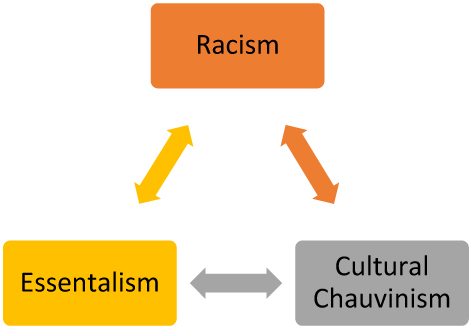
The vicious circle of essentialism.
How could “intercultural communication”, as a field of studies and practice, end up like that? The reason is simple: it is founded on the same logic as the “problems” that it has presupposed for research and practice. We might call this phenomenon a “problem illusion” (cf. Scollon et al. 2012: 4). At the end of the day, other than real human beings who can do things in ways that might be different at different times and in different circumstances, what and where exactly is the “intercultural”? Once again, it is often the research itself that has caused turbulence and problems of communication, not the other way round. This fact has been rightly criticized by Scollon et al. (2012: 4):
You pick a situation to study as an intercultural situation and then you find that nothing at all seems to have gone wrong. The social interaction proceeds smoothly and you come to feel that there is, after all, nothing to the idea that intercultural communication causes problems of communication. Alternatively, you pick a situation to study and things do go wrong, but it is very hard to argue that the problems arise out of cultural differences rather than other more basic differences such as that the participants have different goals.
In the spirit of this critique, we should not make easy and careless attribution of the cause of failure in communication to “cultural differences”, no matter how intuitively right the attribution might seem. In an “inter-racial” marriage, for instance, of a Chinese husband and an American wife, the couple might have different opinions on the education of their children. But these differences are more likely to have to do with the different information each of them has received about the schools, neighborhoods, intuitions, ways of teaching, etc. than with so-called cultural differences between “Chinese-ness” and “American-ness”.
In short, the “intercultural” is, at best, a carelessly and carefreely expedient term that was created by and has fed on uncritical thinking. And at worst, it has caused more problems than it claims to have solved in real situations of human interaction. Consider Jan Blommaert’s trenchant comment below:
Suggesting that intercultural communication is above and beyond all else a matter of colliding cultures, of culture clashes and culture gaps, of uncertainty, stress and loss of confidence, often contributes to the construction of problems. It often generates stress, anxiety and so on, by presenting it as something strange, weird, unusual, in short by abnormalizing it. (Blommaert 1998)
In this aspect, “intercultural” is not alone—the same goes for its ungainly terminological cousins like “cross-cultural”, “trans-cultural”, “intracultural”, and “multicultural”. Other than limited value for political correctness or ideological necessity, these concepts are downright absurd and have not really contributed to understanding human affairs except reinforcing stereotypes about people through incessant label-attaching. Another phrase “cultural communication”, which has gained currency in recent years, is even worse. On the surface, it seems to bypass the redundancy of such prefixes as “inter-”, “cross-”, etc., but the word exists as if there was any form of human communication that was not already cultural! All these concepts reflect a form of “phrenology of culture” and do more harm than good in both theory and praxis, but they are still alive and well, serving as foundational concepts in the fields. Hence, the absurdity—they have become ideologies in themselves.
3 Lo and behold: “culture”, the root of all evil
The absurdity that has come into these words is derived from the over-fullness, or extreme semantic overload, of their ill-defined and pernicious root, the age-old notion of culture. Since it entered public discussion in the past century, the concept has quickly occupied a central place in countless fields. In all honesty, however, it is no more than an intellectual expedience, despite the extremely large number of definitions and accounts out there. Even when “culture” is not merely thought of as a physical end product of human creation, such as a painting, a sculpture, a symphony, a recipe, a way of eating, a dance, and so on, the concept could only signify a largely imagined referent or referential domain that, under scrutiny, simply defies a meaningful consensus. Consequently, the word “culture”—especially when it is used in the plural—has ended up as a source of obscuration, division, and tension, contrary to the beliefs and intentions of “intellectual elements of Western society who pride themselves on their critical support of the oppressed” (Holliday 2011: 8). But how is it possible that such a handy concept could be so pernicious?
One reason is that too many meanings have been associated with the word. It is a truism that we humans are cultural beings, but what exactly does it mean? If we are pressed for an answer—a really good one—the task would not be as easy as expected. What it all boils down to in the end is how we define culture, but this is one of the most prevalent yet most problematic concepts in the humanities and social sciences. In as early as 1952, Kroeber and Kluckhohn had already identified 164 definitions of the word (Kroeber and Kluckhohn 1952: 149). The last seventy years did not witness significant improvement of the situation, which on the contrary has been exacerbated by decades of “culture” war (Appiah 2018: 189). It would be pointless to count how many definitions of culture there are now. As Scollon et al. (2012: 3) observe, “the biggest problem with the word culture is that nobody seems to know exactly what it means, or rather, that it means very different things to different people”. Most, if not all, attempts to pinpoint what culture is have been like chasing a mirage. In effect, “culture” has become too ambitious and all-encompassing a concept to be meaningful.
There is another problem with the notion that might be just as big: most of the very different things that the notion “culture” has come to mean are so essentialist that they end up undermining the notion itself. It has already done a lot of harm in explaining most subjects that have been put under its overly general coverage. For example, what Blommaert has criticized as “the abnormalization of intercultural communication” is precisely based on the gross hypostasis of “culture” as an all-eclipsing contextual factor (Blommaert 1998). The essentialist culture-centered approaches in modern social sciences and especially the humanities are tantalizing, although most, if not all, of them are profoundly wrong. By “wrong” I don’t mean that they are epistemologically mistaken, but that they are built on one of the most detrimental concepts ever invented (Luhmann 2000: 247).
This is a rather unwelcome fact to not just the field of intercultural communication, but also other related fields such as anthropology, sociology, cultural studies, SLA, TESOL, among others that share the same essentialist ideologies. Nevertheless, this fact has already been widely acknowledged, one way or another, albeit sometimes reluctantly, by leading scholars and even founding figures in these fields, including Hall (1959: 42) and Williams (2015 [1976]: 49). Also, there has never been a shortage of skepticism and critique of the loaded word “culture” (Bennett 2013; Eagleton 2016; Scollon et al. 2012; Williams 1979; Zhu 2019). What is particularly interesting is a famous comment made by none other than Raymond Williams, the widely acclaimed progenitor of cultural studies. It goes as follows:
‘culture’ … you know the number of times I’ve wished that I had never heard of the damned word. I have become more aware of its difficulties, not less, as I have gone on (Williams 1979: 154)
Apart from the skepticism and critique, it has also become commonplace to counterpose old and new ideas of culture (Phillips 2007: 42). Nevertheless, with almost no exception, their criticisms and treatments of the term come only in tactful ways of phrasing. An even more disappointing fact is that after putting up their analytical fights, most of these critics and authors retreat into and settle for, more or less willingly, a compromised position without really changing the battlefield. They still end up talking of “cultures” in the common senses of the word, for instance, cultures as nation-states, cultures as peoples, cultures as patterns of behavior, or even cultures as the arts and learning. In short, despite their numerous efforts to either denounce or remedy this very muddied concept (Hall 1959: 42), they still use it to mean a physical thing or mental pattern, something that is bounded, homogeneous, and defined by some core values or underlying principles that can differentiate it from all others (Phillips 2007: 45). Their own compromise over this already “deeply compromised idea” is to such a degree that we are not expected to do without the notion (see for instance, Clifford 1988: 10).
All this reflects an inconsistency of studies and further exacerbates neo-essentialism. Holliday attributes this inconsistency to an inherent lack of criticality, whereas at the same time he also comments that “for criticality to be sustained in any society it should not be too radical” (Holliday 2011: 7). But making such a comment is just another example of giving in to essentialism, although Holliday is among the few defiant theorists committed to fighting against essentialism in the field. The present paper, by contrast, holds the view that to be truly critical requires complete rethinking. In other words, criticality must be radical, especially when it comes to the notion of “culture”.
This criticality is not a mere intellectual stance. It is just that the semantic situation of the notion has left us with no other choice. The longer we mine the vast fields that come into the general category of “culture”, the more likely that we will be dissatisfied by the term—if we think genuinely critically about the underlying self-destructive logic of this ubiquitous notion as it has come to be used. When it comes to being critical, we are faced with two options—either we give up the notion or we make it less pernicious and less pompous by narrowing the scope of its meaning to a sensible and manageable degree that can bring about the good, if any, the word is meant for. My suggestion is that we stop talking about culture as it has been used for so long, and instead, focus on the person as a living, growing, and adaptive biosemiotic being in both their ever-changing Umwelten and social milieux. As a result, we may completely reimagine and reshape “intercultural communication” and related fields in such a way that they don’t merely compose a kind of “culture circus” creating and thriving on such self-fulling prophecies as “cultural differences” and “cultural traits”.
We should acknowledge that, on the surface, the notion of culture does seem like a productive error, since it has created a gigantic field for countless institutions, researchers, university courses, publishers, etc., to depend on. As a social construct, “culture” has a right to exist and is useful insofar as it has been employed and framed in various discourses to create social realities intended for “common grounds”. We could keep reveling in the jovial abyss of essentialism (including neo-essentialism) that we have created for ourselves, but it would be simply a matter of time before we become aware of the difficulties of the notion in the same way that Raymond Williams did. What the concept entails, due to its notorious polysemy, is fundamentally nothing but a nebula of myths, confusing and misleading. Given this extremely chaotic semantic situation of “culture”, if the word continues to be used in the prevalent and dominant essentialist ways (as we shall see in the next section), we might as well just banish all further mention of the word, together with all the other words spawned by this usage, including but not limited to “intercultural”, “cross-cultural”, “transcultural”, “intracultural”, and “multicultural”.
4 Rethinking “culture”
This rather untactful proposal is not the first one that seriously questions the value of the word (See for instance, Kuper 1999: x; Luhmann 2000: 247). Nevertheless, I still anticipate that it will offend many people, who won’t hesitate to dismiss it as a provocation, a joke, an impossible mission, a waste of time, or a blasphemy. The reason is that it violates and threatens a sense of certainty, or even a sense of authority derived from a lifetime of work that has been built on these pleasing yet misleading conceptions of “culture”. Few would be open-minded and bold enough to embrace the proposal as an act and chance of genuinely critical unlearning about the matter of “culture”.
All our ideas[2] about the subject matter will eventually be proven wrong or outdated, one way or another, given enough time. What really matters is that we keep monitoring and improving the efficacy of the concepts that we have invented and used to understand the ever-evolutionary phenomena (cf. Boyd 2018: 173). In this light, the present paper holds that the real issue about “culture” is not so much about the existence of the concept as its content. In saying this, I am not making a compromise, but rather recognizing an opportunity to make “culture” a truly worthy notion that it promises to be. After all, it would be pointless to make such compromise, for it would only bring about lesser knowledge, if any, of the subject matter. Now the question is, how radically critical can we possibly be in rethinking the notion? Before answering this question, let’s first look at some prevalent and dominant views of culture.
Appiah (2018: 189–191) argues that when we are speaking about culture, there are usually two major different views. On the one hand, a representative example is Matthew Arnold’s concept of culture as human pursuit of intellectual refinement and perfection. This would involve, most notably, the arts and learning. In this vein of thought, talking about culture is already a “cultured” act in itself. Many people still hold on to this idea today. On the other hand, there is an anthropological notion proposed by Edward B. Tylor, who equated “culture” with “civilization”, i.e., “that complex whole which includes knowledge, belief, arts, morals, law, customs, and any other capabilities and habits acquired by man as a member of society” (Tylor 1871: 1). Arnold’s notion and its kind were later strongly critiqued by Raymond Williams, who was largely in agreement with Tylor’s notion and held that culture is ordinary and a whole way of life (See Williams 1989: 3–14), not elite, not the arts and learning. This idea is increasingly reflected in current Western political discourses, in which we constantly hear “Our values and ways of life are threatened”.
Appiah’s summary is not only succinct,[3] but also critical. To Appiah, these two views of culture, although diametrically opposing each other, would converge when “culture” is viewed as one of “the lies that bind”, that is, an imagined source of identity. In his own words, the Arnoldian and Tylorian views “are locked together in our concept of Western culture, which many people think defines the identity of modern Western people” (Appiah 2018: 190). Appiah does not stop at banal and rigid understandings of the so-called “Western culture” but goes beyond even the Tylorian notion of culture and refutes essentialism. See his perceptive observation below:
No Muslim essence stops individual inhabitants of Dar al-Islam from taking up anything from the Western Civ. syllabus, including democracy. No Western essence is there to stop a New Yorker of any ancestry taking up Islam. Wherever you live in the world, Li Po can be one of your favorite poets, even if you’ve never been anywhere near China. (Appiah 2018: 207)
Technically speaking, Appiah’s own treatment of culture as a source of identity is not so much of a definition as a heuristic (Scollon et al. 2012: 3), but his perspective is one of a rare kind that has skillfully maneuvered around essentialism, thus bringing in a useful and transcendent point of view. For one thing, any definition of culture, including my own in the later part of the paper, can become a source of identity for the grouping of human individuals. For another thing, identity formation, as can be glimpsed through such pronouns as “us” and “them”, is not just inevitable, as has been well attested by Umberto Eco’s Inventing the Enemy (2013 [2011]) and J. M. Coetzee’s Waiting for the Barbarians (2010 [1980]), but also invariably contingent, contextual, and local. Imagining and anticipating enemies or “barbarians” underlie identity formation, but if a factor emerges that presents a different context, the previous imagination and anticipation are likely to change in the presence of such a factor, thus leading to the formation of a different identity. Nevertheless, useful and transcendent as it is, viewing culture as a source of identity is also intellectually expedient. It does not negate the Arnoldian and Tylorian definitions of culture.
It seems that “culture” can mainly be used either as a countable or uncountable noun (Figure 2), invariably understood as concept, structure, or praxis (Bauman 1999 [1973]). In short, culture is generally thought of as “one thing or another”, as critically summarized by Scollon et al. (2012: 3). To these authors, “culture is a verb” (Scollon et al. 2012: 5). They seek not to think of culture as one thing or another, not even as a thing at all, but rather as a heuristic, a tool for thinking. The good thing is that their study explicitly warns against being taken in by the various views of culture while using them, that is, thinking that their constructions of “culture” are real things, which is precisely what the prevalent and dominant views of culture have done. But unfortunately, the study falls back to the habitual narrative of “culture” as a countable noun (Scollon et al. 2012: 6), and as a result, the view of culture as a verb, exceptional as it promises to be, only turns out to be a metaphorical one.
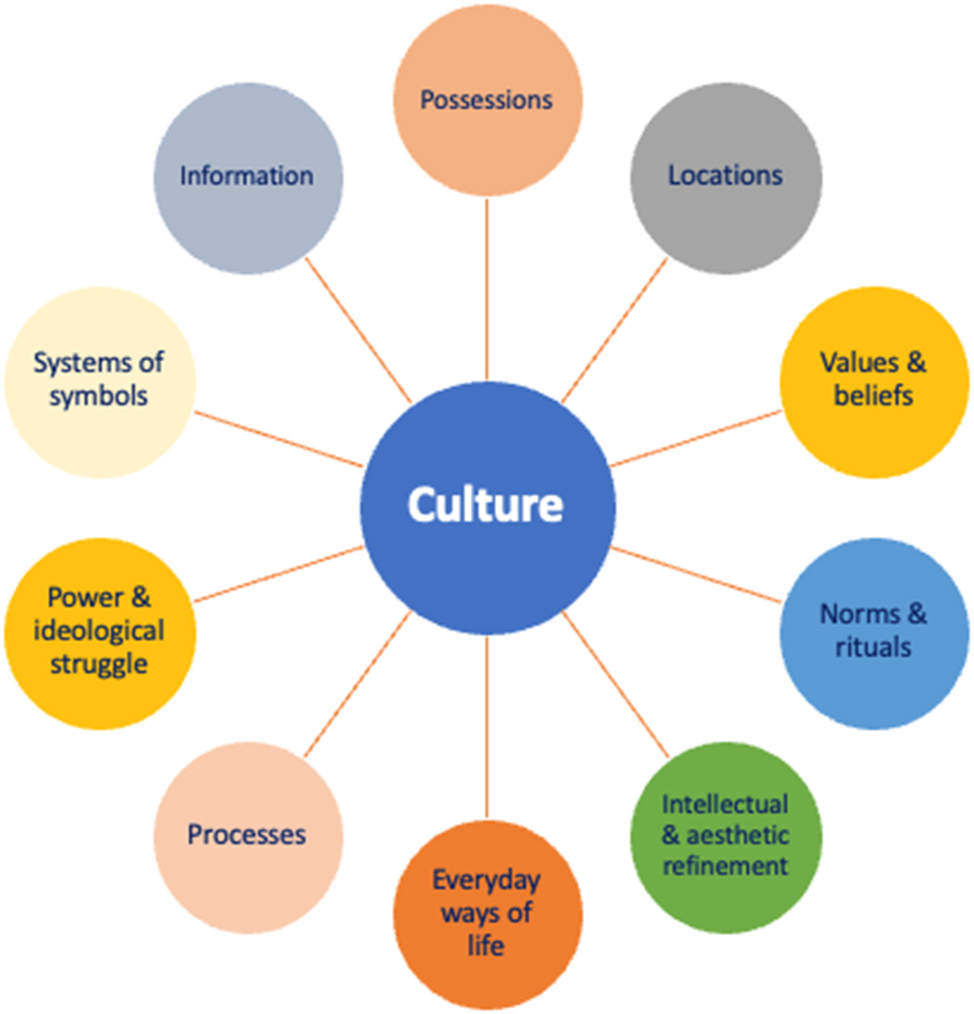
Some prevalent and dominant views of “culture”.
When “culture” is countable, it is often used in the plural, which has become a signature way of addressing “culture matters” in today’s liberal struggles against racism and cultural chauvinism (see Section 2 above). These plural forms include possessions, locations, values and beliefs, norms and rituals, everyday ways of life, processes, and systems of symbols. In Clifford Geertz’s words, they can be called “complexes of concrete behavior patterns—customs, usages, traditions, habit clusters” (Geertz 1973: 44), whether these complexes are physical or mental.[4] By contrast, when “culture” is treated as uncountable, common usages would include intellectual and aesthetic refinement, power and ideological struggle, and information. With the sole exception of “information”, all the other usages indicate “culture”—countable or not—as an all-eclipsing contextual factor, something reified, or ossific, that is bounded, homogeneous, and defined by some core values or underlying principles that can differentiate it from all other types of “cultures” or “culture”. All these usages of the word are essentialist, some more so than others.
The worst kind is using “culture” for locations, for instance, speaking of America as an “American culture” as if there was something homogeneous enough to define an entire country and to be shared by hundreds of millions of human beings in the country. Comparatively, all other usages—in the plural or the singular—are slightly better, but not that much: they feature a simplifying concept that represents the more or less average set of socially learned practices among a certain number of people who can be more or less provisionally called a “group”. These socially learned practices, which have mistakenly gone by the common names of either “cultures” or “culture”, vary greatly among the individuals within the group. And just what variance in such a group is considered normal would also vary by the size of the group. Therefore, even in the prevalent and dominant views, cultures or culture shouldn’t be bounded and homogeneous, but only produced by real individuals, and they are not things that explain why these individuals behave the way they do (cf. Phillips 2007: 45). Also, speaking of “group”, where could we reasonably draw the line to identify it? There are simply no one-size-fits-all standards to do so (cf. Scollon et al. 2012: 4). As Phillips rightly points out:
The way the boundaries are drawn around each culture changes through time, as do the definitions of core practices and beliefs, with the first process often reflecting an outsider need to categorise and place people, and the second an internal struggle for power. Characterising a culture is itself a political act, and the notion of cultures as preexisting things, waiting to be explained, has become increasingly implausible. (Phillips 2007: 45)
Therefore, the need for “culture” as an all-eclipsing contextual factor is hardly justifiable. If we want to talk about different locations, possessions, symbols, beliefs, processes, everyday ways of life, power, intellectual refinement, etc., we should simply go ahead and talk about those things (cf. Kuper 1999: x). Corralling them all together under one single umbrella called “culture” would only lock us up in a tangled web, committing a dual mistake of oversimplification and overgeneralization. To untangle this web, we need a minimalist approach to culture—there is no other way of clearing up the essentialist semantic mess that has been created around the concept. A necessary and effective part of the minimalist approach is giving up “culture” as an all-eclipsing contextual factor, for this usage is precisely what has caused all the confusion and endless ideological bickering over the notion.
5 The minimalist approach
A promising way is to treat “culture” as a verb, signifying a form of action. But considering the Scollon case above, it might be reasonable to speak of “culturing”[5] instead of “culture”, to highlight a sense of “verbality”. This would considerably, if not completely, eliminate the temptation to fall back to using “culture” as a countable noun, especially in the plural. It might seem too outlandish to some people, but the whole point about this way of viewing is that it goes constructively beyond treating culture as an all-eclipsing contextual factor that is bounded and homogeneous. To make our minimalist approach less outlandish and more realistic, we just need to abstract the key element that makes this “going beyond” possible and manageable. The element is information.
Relating culture to information is not a new idea. In as early as the 1990s, Yuri Lotman, a key founder of the Tartu Semiotic School and an initiator of cultural semiotics, had already touched on the idea of considering culture in terms of information. He thought of culture as a semiotic structure that, as an indissoluble unit, fulfills three functions of intelligence, namely, the transmission of available information, the creation of new information, and memory, that is, the capacity to preserve and reproduce information (Lotman 1990: 2). Although he also fell back to the narrative of “culture” as a countable noun, the perspective of information he proposed has some unique explanatory potential, which was later echoed and somewhat unlocked by Robert Boyd’s treatment of culture. There is no evidence that Boyd was under any influence from Lotman, but the coincidence between the two in relating culture to information is an interesting one.
Like Lotman’s metaphor of museum for culture (“semiosphere”, Lotman 1990: 126–127), Boyd mentions the metaphors of compendium and library, in which culture is understood as a kind of storehouse of useful knowledge and innovations (Boyd 2018: 19–20), although he has managed to go beyond this rather limited utilitarian view. To Boyd, culture is one of the three Cs—cognition, culture, and cooperation[6]—that have made humans a runaway ecological success compared with other animal species (Boyd and Silk 2021: 426). In this broad evolutionary view, culture is “information acquired by individuals through some form of social learning” (Boyd and Silk 2021: 434). To be exact, culture is defined as “information stored in human brains that is acquired by imitation, teaching, or some other form of social learning and that can affect behavior or some other aspect of the individual’s phenotype” (Boyd and Silk 2021: G-5).
Some may find Boyd’s definition of culture to be too radical, but I don’t think so. In my opinion, the major problem with Boyd’s definition is that it is not radical enough. After proposing this promising view of culture, the definition uncritically segues into the common narrative like “many cultures” (Boyd and Silk 2021: 435). If the authors had followed their original vein of thought, they would have arrived at a truly nuanced and revolutionary understanding of the subject matter. On second thought, however, this once again reveals the irresistible temptation of slipping into the quagmire of essentialist understanding of culture. Now let’s take one step further.
It is interesting to note that in almost all its definitions, culture has been invariably pitted against biology and considered as something that has little, if not nothing, to do with genes. Against this background, Clifford Geertz, for instance, might have spoken for most people when he claimed that the human being is “precisely the animal most desperately dependent upon such extragenetic, outside-the-skin control mechanisms, such cultural programs, for ordering his behavior” (Geertz 1973: 44). Forcing a dichotomy between culture and biology, or nurture versus nature, is underlain by anthropocentrism and human exceptionalism. It is the root of all the essentialist problems and difficulties that we have come to face over the past decades with the word “culture”, as well as many derivative words such as “intercultural”, “multi-cultural”, “cross-cultural”, and so on.
In fact, it is only in terms of biology that culture can be best understood. Just as Boyd argues, “culture can’t override biology. It cannot because culture is as much a part of human biology as our peculiar pelvis and the thick enamel that covers our molars” (Boyd 2018: 122). Bearing this in mind, I propose here a minimalist definition—culture is a biological instinct to acquire information[7] through modeling, that is, learning by models. This instinct is at work, or is realized, in specific acts of such modeling,[8] resulting in what can be called “cultural practices” (behavioral and/or cognitive) and “cultural artifacts”.
Although, as Bandura (1986: 47) points out, most human behavior is learned by observation through modeling, the capacity of using models is not exclusive to humanity but shared by many other species (see for instance, Boyd and Silk 2021: 431; Chiu and Hong 2006: 47–66; Ottoni et al. 2005). Models, in the broad sense (Yu 2021: 646–647), are any externally or internally perceivable forms that have the potential of becoming signs, that is, signifying. In short, they may be perceived to “bear” meanings.[9] As a result, the chief function of models is to supersede, creating new immediate realities for organisms to experience and thus enabling the modeling organisms to transcend their temporal and spatial bounds of their immediate environment. These organisms can “learn approximately what do to before they perform any behavior” through modeling and thus be “spared the costs and pain of faulty effort” (Bandura 1986: 47).
The reason for keeping the adjective “cultural” before “practices” and “artifacts” is only to highlight a sense of “modelity”, the quality of being modellable. But what exactly are cultural practices and cultural artifacts? Comparatively speaking, the meaning of “cultural artifact” is more straightforward than that of “cultural practice”. For discussions in the present paper, we take the following usual sense of the word “artifact”.[10]
a usually simple object (such as a tool or ornament) showing human workmanship or modification as distinguished from a natural object, especially an object remaining from a particular period, for instance, a prehistoric artifact, a mannequin, a tomb, a plaque, a statue, a painting, an Easter egg.
To put it simply, in the case of humanity, a cultural artifact is any object that humans make and can model. By comparison, a cultural practice in the case of humanity is anything a human does that can be modeled by another human, such as a ketogenic diet, slurping noodles, the V sign, the perm, body piercing, foot binding, flossing, cosplay, peer-review, preaching, storytelling, praying, fasting, rock-climbing, political correctness, protest, anti-Asian racism, copycat crime, suicide, and so on. In short, what people have generally referred to when talking about “culture” (see Figure 2) are mostly cultural practices.[11]
It should be noted that sometimes a cultural practice can be interpreted as an artifact when it is treated more as an object than as behavior, for instance, a ketogenic diet, the V sign, the perm, etc. In addition, things (not objects) that are characteristic of or resulting from a particular human institution, trend, period, or individual can be thought of both as cultural practices and cultural artifacts, such as morality, self-consciousness, monogamy, polygamy, feminism, scientism, the concept of modernity (cf. Latour 1993 [1991]), and so on.
Therefore, even a way of viewing culture like the one in this paper can become a cultural practice. With the new concept of cultural practice, many research results in related fields could still be valid—provided the word “culture”, as it has been commonly used, recedes to the background. Instead, what we have in the foreground are cultural practices. For instance, we might be able to speak of “intercultural communication without culture”, because in the new light, all the dominant and prevalent ways of viewing “culture” and thus “intercultural communication” are themselves cultural practices!
Take, for another instance, the “Cloud Metaphor” that I created in 2019 to describe the role of “culture” for the functioning of individuals:
To the Geertzian conception of culture, it should probably be added that culture is to the individual what cloud storage is to the computer. The individuals, for their own functioning, keep downloading from and uploading to an ever-changing cloud the necessary data and programs. It is unlikely for an individual to exhaust all that can be found on the cloud (Yu 2019: 442)
Now we simply need to substitute “cultural practices” for “culture” in this metaphor. It is cultural practices that compose what the word “culture” was originally meant to cover, given that cultural practices are things that humans[12] can do. Cultural practices are to the individual what cloud storage is to the computer. The individuals, for their own functioning, keep downloading from and uploading to an ever-changing cloud the necessary data and programs. It is unlikely for an individual to exhaust all the cultural practices that can be found on the cloud. Therefore, cultural practices are embodied—partially and dynamically—in individual humans’ behavior and interpretations of behavior.
These cultural practices, coupled with cultural artifacts, are themselves models that can exert formative influence on individuals accessing the models by providing informative and normative (inhibitory or disinhibitory) guidance for these individuals (cf. Bandura 1986: 49). In this sense, we can still say that culture, or to be exact, the realization of culture through cultural practices and artifacts, can affect behavior and some other aspects of the individual’s phenotype (i.e., the set of observable characteristics of an individual living thing, resulting from its combination of genes and the effect of its Umwelt) and underlies meaning-generation. It allows humans, among other species known to have similar capacity, to both adapt to and exploit a variety of environments, that is, their ever-changing Umwelten and social milieux (cf. Yu 2023).
6 Some further elaborations
It should be clear by now that the minimalist approach proposed above has completely rejected and refuted essentialism, but apart from this major advantage, there are two other good things about the approach that I would like to further elaborate on.
First, this new understanding of culture immediately bypasses, if not dissolves, the prevalent but false nature vs nurture dichotomy, which is itself a cultural practice that, like the concept of “modern”, has come to dominate the academy and much of public discourse for so long (cf. Latour 1993 [1991]). On the one hand, culture is no longer considered an external ‘given’, nor countable, but a biological given, or functionally grounded in the body (perhaps not just the brain). The realization of culture through cultural practices and cultural artifacts is invariably a specific instantiation, that is, a contingent, situational, and emergent process or end-product. On the other hand, culture presupposes the existence of society, or grouping, for it is realized through modeling. It is always associated with grouping, although no two individuals in any instances of grouping would share identical cultural characteristics in modeling cultural practices and artifacts.
The other good thing about the approach is that it goes beyond anthropocentrism and human exceptionalism and mocks human hubris. It has overcome the entanglements between the concept of culture and the species-centrism of Western humanism, and in this sense, responds adequately to the ecological imperative of better understanding the relations between non-human and human actors (Nimmo 2010). Now it is safe for us to say that “humans are cultural beings”, biologically programmed to learn by models, like many other animals.
Although humans share the culture instinct with many non-human animals, human cultural practices and artifacts have made human evolution qualitatively different from that of other organisms. Why is that? Boyd and Silk posit that it is because humans rely on the accumulation of information acquired by individuals through some form of social learning.[13] The authors declare that why other species don’t have this accumulation is not clear (Boyd and Silk 2021: 431). This is an easily solvable question through the lens of semiotics—the answer lies in human semiosis (sign activities), featuring a complex universe of symbols, which are externally made and preserved symbolic models (cf. Bandura 1986: 47). These models have a property called “displacement” (Yule 2023: 17), enabling us to be “free”[14] of immediate temporal and spatial restrictions. We may think of this as an evolved derivative of the supersession function of models.
In view of the considerations above, this paper argues that “cultural practices” and “cultural artifacts” are more efficacious words than Dawkins’s “meme” (Dawkins 2016 [1976]: 245). There are two reasons. First, they are not deprived of the human element the way meme is. After all, cultural practices and artifacts are humans’ cultural practices and artifacts. They “spread, accumulate, and evolve”, but that is only possible because of humans. “Memes”, by contrast, are impersonal because they give the illusory impression of being “selfish” (Dawkins 2016 [1976]: 245) and evolving on their own.
Second, “cultural practices” and “cultural artifacts” are models, so they do not “replicate” as memes do. After all, modeling is not imitation, or identification, or copying (cf. Bandura 1986: 48). It invariably involves approximation, so there is always an inherent potential for innovation in the process of modeling. Therefore, “cultural practices” and “cultural artifacts” better capture what “memes” are meant to convey, especially considering the true meaning of the “mutation of memes”. After all, no two human practices (or artifacts) could be completely identical. In this new light, we can rethink “cultural evolution”, which actually refers to change not in “culture”, but in cultural practices and artifacts, such as the ways of making pots and the actual pots (relics) in Holocene North America. It is, therefore, hardly surprising to see that “cultural evolution is about fifty times faster than genetic evolution” (Boyd 2018: 43)—culture, as a biological instinct, does not change. It is cultural practices and artifacts that change (cf. Yu 2013a), and they change much faster than genes, which further invalidates the metaphorical concept of memes.
7 A way forward, in lieu of a conclusion
Now we might have a way forward that promises to help us navigate the essentialist waters in so-called “intercultural communication” and related fields. We have kept “culture”, but in a completely different sense of the word. From now on, whenever we have no choice but to use the noun “culture”, simply think and talk about it as a biological given, instead of complexes of behavioral or cognitive traits that are acquired and transmitted only after birth. What are acquired and transmitted are only cultural practices and artifacts. It is in this context that we can find a way out of the essentialist quagmire and move forward.
It is noteworthy that any cultural practice or artifact has the potential to become, that is, be used as, a “cultural tool” (Scollon et al. 2012: 5–6), and in turn, using the tool will become a new cultural practice. The prevalent and dominant ways of researching the concept of culture are nothing more and nothing less than cultural practices themselves. They might be used as cultural tools for specific purposes. For instance, they can be marshalled in and for racialization (see Lewis 2007), which is exactly the very thing that their whole enterprises pivot on. Thus, once again, it is clear that the prevalent and dominant ways of researching culture really end up doing their core subject matter an ironic disservice. Even if we speak of “cultures”, they do not talk to each other; only individuals do. In this sense, all communication is interpersonal communication and can never be “intercultural” communication. In short, therefore, the prevalent and dominant ways exhibit a detrimental “logic of culture” that is both destructive and self-destructive. To defeat this logic, it is imperative to keep in mind that when we deal with the “intercultural”, we are only dealing with concrete yet different cultural practices or cultural artifacts. This directly echoes a crucial message from Blommaert:
The way in which empirical answers can be found for patterns and problems in intercultural communication is a detailed and nuanced analysis of concrete communicative events. (Blommaert 1998)
Perhaps a more sensible term than “intercultural communication”, as a field of research, would be comparative cultural studies, not of “cultures”, but only of cultural practices and artifacts. At present, it is obviously difficult to obliterate the field, especially when it is treated as a field of practice. Suffice it to say that “intercultural communication”, as a form of cultural practice itself, is interaction between individuals who exhibit not different “cultures” but different cultural practices and artifacts they happen to have modelled. In the process of such interaction, the individuals might negotiate whatever differences that may be perceived relevant by at least one party and probably come up with new cultural practices and artifacts.
This paper presents a radical and counter-intuitive meta-theory of culture. It may come off as cheeky or offensive. Nevertheless, like it or not, we cannot deny that this is much less essentialist than most, if not all, of the prevalent and dominant views of culture out there. Consider this view a wake-up call, instead of a fighting talk, if we ever care or dare to think out of the box about culture and “intercultural communication”. In particular, the main objective of this paper is not to negate or obliterate the field of “intercultural communication”, among others, but rather to save them from themselves—a true and worthy field of “intercultural communication” is a field against essentialism, instead of an accessory to essentialism, whether the commission is “before the fact” or “after the fact”.
It is high time that we carved out better paths of inquiry that could truly deliver on the promise of bringing humans together, instead of fueling and feeding on falsely presupposed “cultural boundaries”. Remember what Terence wrote in his play Heauton Timorumenos in 163 BCE: ‘Homo sum: humani nihil a me alienum puto’ (I am human: and I think nothing human is alien to me).[15] Today, in a world fraught with bigotry, intolerance, and divisive identity politics, this humane adage is more important than ever. It is clearly a cultural practice in itself that, like the updated concept of culture in this paper, should create a shared identity binding us all (cf. Appiah 2018: 219). Does this new concept of culture cancel everything that has been done and achieved in relevant fields? Yes and no. Yes, because their most central concepts have been disputed and debunked. No, because all that has been studied and practiced in the name of “culture” and “intercultural”, etc., is still retained in the new framework, but in two much more sensible and inclusive names: cultural practices and cultural artifacts.
About the author
Hongbing Yu (b. 1984). Assistant Professor of Culture and Communication, Department of Language, Literatures, and Cultures, Toronto Metropolitan University, Toronto, Canada. Vice-President and President Elect of Semiotic Society of America; Executive Director of the International Institute for Semiotic Studies, Nanjing Normal University, Nanjing, China; Co-director of the International Institute for Language and Cultural Semiotics, Dalian University of Foreign Languages, Dalian, China. Author of two monographs on the semiotic mechanisms of language, culture, and mind: On Semiotic Modeling (Soochow University Press, 2019) and Living by Models (Mouton De Gruyter, forthcoming). Sample publications have appeared in The American Journal of Semiotics, Semiotica, Biosemiotics, Society, and Chinese Semiotic Studies, language and philosophy of mind, ancient Chinese philosophy and religion, all of which are studied under the lens of semiotics. He is currently focused on such topics as social rituals and narrative, mythical thinking, and the cognitive dimensions of ancient Chinese philosophy and religion.
References
Appiah, Kwame Anthony. 2018. The lies that bind: Rethinking identity, creed, country, color, class, culture. New York: Liveright Publishing Corporation.Search in Google Scholar
Bandura, Albert. 1986. Social foundations of thought and action: A social cognitive theory. Englewood Cliffs: Prentice Hall.Search in Google Scholar
Bauman, Zygmunt. 1999 [1973]. Culture as praxis. London: Sage Publications.10.4135/9781446218433Search in Google Scholar
Bennett, Tony. 2013. Making culture, changing society. New York: Routledge.10.4324/9780203332320Search in Google Scholar
Blommaert, Jan. 1998. Different approaches to intercultural communication: A critical survey. https://www.researchgate.net/publication/266557453_Approaches_to_intercultural_communication_A_critical_survey (accessed 7 April 2023).Search in Google Scholar
Boyd, Robert. 2018. A different kind of animal. Princeton: Princeton University Press.Search in Google Scholar
Boyd, Robert & Joan B. Silk. 2021. How humans evolved, 9th edn. New York: W. W. Norton & Company.Search in Google Scholar
Chiu, Chi-Yue & Ying-Yi Hong. 2006. Social psychology of culture. New York: Routledge.Search in Google Scholar
Clifford, James. 1988. The predicament of culture: Twentieth-century ethnography, literature, and art. Cambridge, MA: Harvard University Press.10.4159/9780674503724Search in Google Scholar
Coetzee, John M. 2010 [1980]. Waiting for the Barbarians. London: Penguin Books.Search in Google Scholar
Cowley, Stephen J. 2019. The return of languaging. Chinese Semiotic Studies 15(4). 483–512. https://doi.org/10.1515/css-2019-0027.Search in Google Scholar
Cowley, Stephen J. 2023. Living the duty of care: Languaging in semiotic fields. Chinese Semiotic Studies 19(1). 115–136. https://doi.org/10.1515/css-2022-2098.Search in Google Scholar
Cowley, Stephen J. & Rasmus Gahrn-Andersen. 2022. Languaging in an enlanguaged world. Constructivist Foundations 18(1). 54–57.10.1515/css-2021-2049Search in Google Scholar
Dawkins, Richard. 2016 [1976]. The selfish gene. Oxford: Oxford University Press.10.1515/9781400848393-029Search in Google Scholar
Eagleton, Terry. 2016. Culture. New Haven: Yale University Press.Search in Google Scholar
Eco, Umberto. 2013 [2011]. Inventing the enemy and other occasional writings. Richard Dixon (trans.). London: Vintage Books.Search in Google Scholar
Geertz, Clifford. 1973. Interpretation of cultures: Selected essays. New York: Basic Books.Search in Google Scholar
Grant, Adam. 2021. Think again: The power of knowing what you don’t know. New York: Viking.Search in Google Scholar
Hall, Edward T. 1959. The silent language. New York: Doubleday & Company, INC.Search in Google Scholar
Hall, Stuart. 1997. The local and the global: Globalization and ethnicity. In Anthony D. King (ed.), Culture, globalization, and the world-system: Contemporary conditions for the representation of identity, New edn., 19–40. Minneapolis: University of Minnesota Press.10.1007/978-1-349-11902-8_2Search in Google Scholar
Hannerz, Ulf. 1997. Scenarios for peripheral cultures. In Anthony D. King (ed.), Culture, globalization, and the world-system: Contemporary conditions for the representation of identity, New edn., 107–128. Minneapolis: University of Minnesota Press.10.1007/978-1-349-11902-8_6Search in Google Scholar
Hofstede, Geert. 2001. Culture’s consequences: Comparing values, behaviours, institutions and organizations across cultures. London: Sage.Search in Google Scholar
Hofstede, Geert. 2011. Dimensionalizing cultures: The Hofstede model in context. Online Readings in Psychology and Culture 2(1). 1–26. https://doi.org/10.9707/2307-0919.1014.Search in Google Scholar
Holliday, Adrian. 2011. Intercultural communication and ideology. London: Sage.10.4135/9781446269107Search in Google Scholar
Holliday, Adrian. 2019. Understanding intercultural communication: Negotiating a grammar of culture, 2nd edn. New York: Routledge.10.4324/9781351139526Search in Google Scholar
Holliday, Adrian. 2021. Contesting grand narratives of the intercultural. New York: Routledge.10.4324/9781003039174Search in Google Scholar
Holliday, Adrian, Martin Hyde & John Kullman. 2021. Intercultural communication: An advanced resource book for students, 4th edn. New York: Routledge.10.4324/9780367482480Search in Google Scholar
Jocelyn, Henry D. 1973. Homo sum: Humani nil a me alienum puto (Terence. Heauton timorumenos 77). Antichthon 7. 14–46. https://doi.org/10.1017/s0066477400004299.Search in Google Scholar
Kroeber, Alfred L. & Clyde, Kluckhohn. 1952. Culture. A Critical Review of Concepts and Definitions. Cambridge, MA: The Peabody Museum of American Archaeology and Ethnology.Search in Google Scholar
Kuper, Adam. 1999. Culture: The anthropologists’ account. Cambridge, MA: Harvard University Press.10.2307/j.ctv21hrh4pSearch in Google Scholar
Latour, Bruno. 1993 [1991]. We have never been modern. Catherine Porter (trans.). Cambridge, MA: Harvard University Press.Search in Google Scholar
Lewis, Gail. 2007. Racializing culture is ordinary. Cultural Studies 21(6). 866–886. https://doi.org/10.1080/09502380701470783.Search in Google Scholar
Lotman, Yuri M. 1990. Universe of the mind: A semiotic theory of culture. Ann Shukman (trans.). London: I. B. Tauris & Co. LTD.Search in Google Scholar
Luhmann, Niklas. 2000. Art as a social system. Stanford: Stanford University Press.Search in Google Scholar
Nimmo, Richie. 2010. Milk, modernity and the making of the human. London and New York: Routledge.10.4324/9780203867334Search in Google Scholar
Ottoni, Eduardo B., Briseida Dogo de Resende & Patrícia Izar. 2005. Watching the best nutcrackers: What capuchin monkeys (Cebus apella) know about others’ tool-using skills. Animal Cognition 8(4). 215–219. https://doi.org/10.1007/s10071-004-0245-8.Search in Google Scholar
Phillips, Anne. 2007. Multiculturalism without culture. Princeton: Princeton University Press.Search in Google Scholar
Scollon, Ron, Suzanne Wong Scollon & Rodney H. Jones. 2012. Intercultural communication: A discourse approach, 3rd edn. West Sussex: Wiley-Blackwell.10.1002/9781405198431.wbeal0555Search in Google Scholar
Tylor, Edward B. 1871. Primitive culture: Researches into the development of mythology, philosophy, religion, art, and custom, vol. 1. London: John Murray.Search in Google Scholar
Williams, Raymond. 1979. Politics and letters: Interviews with new left review. London: Verso.Search in Google Scholar
Williams, Raymond. 1989. Resources of hope: Culture, democracy, socialism. London: Verso.Search in Google Scholar
Williams, Raymond. 2015 [1976]. Keywords. A Vocabulary of Culture and Society New Edition. Oxford: Oxford University Press.Search in Google Scholar
Yu, Hongbing. 2013a. Human brains function culturally: Semiosis under the culture-driven view. The American Journal of Semiotics 29(1/4). 135–148. https://doi.org/10.5840/ajs2013291-47.Search in Google Scholar
Yu, Hongbing. 2013b. Cultural forgetting mechanism in the cultural semiotic view. Russian Literature & Arts 3. 84–89.Search in Google Scholar
Yu, Hongbing. 2019. Meaning generation: A cocktail of modeling, cultural memory, emotions and human agency. Chinese Semiotic Studies 15(3). 429–447. https://doi.org/10.1515/css-2019-0024.Search in Google Scholar
Yu, Hongbing. 2021. Modeling in semiotics: An integrative update. Chinese Semiotic Studies 17(4). 639–659. https://doi.org/10.1515/css-2021-2038.Search in Google Scholar
Yu, Hongbing. 2023. The peculiar case of danger modeling: Meaning-generation in three dimensions. In Alexei Sharov, George Mikhailovsky, Richard Gordon & Joseph Seckbach (eds.), Pathways to the origin and evolution of meanings in the universe. Beverly: Scrivener Publishing in partnership with Wiley & Sons, Forthcoming.10.1002/9781119865667.ch17Search in Google Scholar
Yule, George. 2023. The study of language, 8th edn. Cambridge: Cambridge University Press.Search in Google Scholar
Zhu, Hua. 2019. Exploring intercultural communication: Language in action, 2nd edn. New York: Routledge.10.4324/9781315159010Search in Google Scholar
© 2023 the author(s), published by De Gruyter, Berlin/Boston
This work is licensed under the Creative Commons Attribution 4.0 International License.
Articles in the same Issue
- Frontmatter
- Peirce Study
- Biosemiotics and Peirce
- Culture and Communication
- A skeptic’s guide to “intercultural communication”—debunking the “intercultural” and rethinking “culture”
- Cultural unit blue in the Old Testament
- The influence of semantic predictability on transposition effects in Chinese and English
- Multimodal Signs
- Visual representation of ASUU strikes in Nigeria: a semiotic analysis of cartoons in selected Nigerian newspapers
- A multimodal analysis of Piggyvest’s animated advertisement videos
- “The soro-soke [speak up] generation”: multimodality and appraisal choices in selected #EndSars civil protest-related memes in Nigeria
Articles in the same Issue
- Frontmatter
- Peirce Study
- Biosemiotics and Peirce
- Culture and Communication
- A skeptic’s guide to “intercultural communication”—debunking the “intercultural” and rethinking “culture”
- Cultural unit blue in the Old Testament
- The influence of semantic predictability on transposition effects in Chinese and English
- Multimodal Signs
- Visual representation of ASUU strikes in Nigeria: a semiotic analysis of cartoons in selected Nigerian newspapers
- A multimodal analysis of Piggyvest’s animated advertisement videos
- “The soro-soke [speak up] generation”: multimodality and appraisal choices in selected #EndSars civil protest-related memes in Nigeria
