
“The soro-soke [speak up] generation”: multimodality and appraisal choices in selected #EndSars civil protest-related memes in Nigeria
-
Saheed Omotayo Okesola
Saheed Omotayo Okesola teaches and conduct research in the Department of English, Obafemi Awolowo University, Ile-Ife, Nigeria. He is a fellow of the African Humanities Program (AHP) and currently a postdoctoral fellow of the Alexander von Humboldt Foundation at the
Albert-Ludwigs-Universität, Freiburg, Germany . His research interests include Sociolinguistics, Applied Linguistics as well as Linguistic Diversity and Multilingual Studies.
 and
Oluwabunmi Opeyemi Oyebode
and
Oluwabunmi Opeyemi Oyebode
Oluwabunmi Opeyemi Oyebode (PhD) lectures in the Department of English, Obafemi Awolowo University, Ile-Ife, Nigeria. Her areas of interest include (multimodal) discourse analysis, applied linguistics and grammar. She has published articles in reputable journals in local and international outlets, including Journal of Pan African Studies, Discourse Studies and Discourse and Society.

Abstract
This paper explores the deployment of multimodal elements as appraisal resources in #Endsars civil unrest-related memes in Nigerian social media space (WhatsApp and Twitter) to express affective meanings and intersubjective positioning. The study investigates how both verbal and non-verbal elements are deployed as appraisal resources to evaluate the trajectory of the protest. The data, which comprise thirty purposively selected Internet memes, collected between October and December, 2020, were analysed qualitatively. The study shows that the meme producers, through the use of multimodal concepts such as symbolic, analytical, action, reactional processes, offer and salience, among others, project various expressions of affect, judgement and appreciation of things to create important narratives in the memes. Thus, the verbal elements are graded/upscaled through the non-verbal elements in the memes to evoke specific reactions, positive/negative, which signal intersubjective positioning about the protest and relevant social actors. The study concludes that meme producers effectively utilize multimodal elements to interrogate various expressions of attitude and intersubjective opinions that Nigerians made about the protest and its management by the Nigerian government.
1 Introduction
The Nigerian #Endsars civil unrest that occurred in October 2020 was an unprecedented protest that caught the Nigerian political class unawares. Its coordination by a group of 14 young women in such an organized manner starting from various communities across the nation enhanced its effectiveness. #Endsars protest seems to be one of the most effective and well-coordinated civil struggles that Nigeria has ever witnessed as it shook Nigeria to its foundations (Aliyu 2020, BBC online) by attracting overwhelming global response from celebrities like Beyonce, Kanye West, and notable figures like former Secretary of State, Hillary Clinton on social media (see Singh 2020, online). Nigeria, the most populous African nation, erupted in mass protests in October 2020 against the rampant brutality of an arm of the Nigeria Police Force known as Special Anti-Robbery Squad (henceforth, SARS) which has been alleged of wielding their authority with impunity especially over Nigerian youths. SARS, as Strong (2020, online) avers, has become the most flagrant source of state violence and corruption that citizens encounter on Nigerian roads. The officers harass, extort, intimidate, and criminalize young people for some kind of dressing and even for merely carrying smartphones or laptops among others. There were apparently widespread human rights violations and abuse of power by SARS officers (see Amnesty International June 2020 report).
The government inability to curtail SARS excesses despite different complaints made by Nigerian youths in 2017, 2018, 2019 and 2020 respectively (Sijuwade 2020, online) forced the youths to social media platforms and streets to demand an end to the operations of this arm of the police force that has made life miserable for them. Nigerian youths, the demographic that propelled the protests, embarked on a peaceful protest on October 8, 2020 to air their grievances about the debased manner in which this unit of security agency has been treating, molesting, abusing and murdering them. This study, therefore, explores #Endsars civil unrest-related Internet memes in the Nigerian Twitter and WhatsApp space, in order to examine how multimodal elements are used for evaluation and intersubjective positioning. The study is significant, considering that such evaluations can unveil certain socio-economic undercurrents issues that led to the protest and made Nigerian youth to “Soro soke” [speak up] in order to shatter the country’s culture of silence.
1.1 Internet memes and civil protest
The social media, as opined by Kushin and Yamamoto (2010) have made the expression of opinions and evaluation of situations easy without any fear of arrest. Today, through different social media platforms, citizens express their judgements of other people or situation and seek to influence the attitudes and behavior of others (Halliday 2007). One important way of doing this in social media interaction is through the use of memes as communicative tools. The use of Internet memes has become very popular among Internet users and they are deployed to express attitudes to, or perception of something.
Memes are learned and constructed by social forces such as culture, religion, education, and greatly determine much of human behaviour (Davison 2012). In social media discourse, “Internet meme” is commonly applied to describe the propagation of content items such as jokes, rumours, videos, etc., from one person to another via the Internet (Shifman 2013). Knobel and Lankshear (2007, p. 202), say memes are employed by Internet users mainly to describe the rapid uptake and spread of a “particular idea presented as a written text, image, language ‘move,’ or some other unit of cultural ‘stuff’”. As pointed out by Shifman, memes were “conceptualized” long before the digital era; however, the unique features of the Internet fast-tracked the spread of memes into a ubiquitous and highly visible concept among social media users. Following the footsteps of researchers such as Johnson (2007), Knobel and Lankshear (2007), Jones and Schieffelin (2009), and Burgess (2008), who all used memes as signpost for understanding certain aspects of contemporary culture, Shifman admonishes people to look at memes from a “communication-oriented” perspective, which is the approach that the present researchers have adopted in this study. To us, memes are communicative tools and discursive weapons conceived and created for humour, digital activism, socio-political dissent or protest in different areas of human society. The nature of Internet communication, vis-a-vis its ability to interact instantaneously, remove social boundaries, and make contents flow faster from one person to another, and from one medium to another, has helped in making memes to be a popular means of communication among Internet users.
Existing works on Internet memes in Nigeria, Adegogu and Oyebode (2015), Omoruyi (2015), Yeku (2018), Tella (2018), Gwandu (2019) have examined the concept from varying perspectives and orientations, and like different other contexts of the world, some of these studies have shown the popularity and centrality of Internet memes to digital communication. In line with Grundlingh’s (2018) argument that memes serve different purposes in online communication, Adegoju and Oyebode (2015) explore the deployment of verbal and visual Internet memes in online campaigns during the 2015 general elections in Nigeria. The study which focuses on the patterns of humour in the memes studied reveals how serious social and political issues were raised by members of the public through Internet memes. Also, Yeku (2018) examines the deployment of Internet memes by Nigerians during the 2015 general electioneering processes. In the study, Yeku demonstrated how Internet memes have opened up the socio-political space to Nigerian youths and women, who were hitherto excluded from some of this social and political discourse in the past. He posits that Nigerian youths in online interactions use “visual culture to shape and express their democratic subjectivities” on the social and political happenings in the country.
Looking at memes and their use in the production of humour, Tella (2018) explores the way the two leading presidential aspirants in Nigeria were represented in the political space during the 2015 general elections. He concludes that the supporters of the two leading aspirants deployed Internet memes to positively present their own candidate and negatively present the other candidate in a humorous manner to the public. He notes that this “negative other-representations” of the aspirants is capable of warming an aspirant into the heart of people and making the same people see the other aspirant as one with little or no electoral value. Msughter (2020), using data from Facebook, also explores how people used Internet memes on social media platforms to respond to the threat or danger inherent in the coronavirus. His study discusses how Internet memes are used as campaign tools in the fight against the coronavirus in Nigeria. As shown in the review above, existing studies have focused on the use of Internet memes for political mobilization/campaign and health advocacy during health crisis. However, there is paucity of studies on the use of Internet memes for civil unrest/protest hence, this present study.
2 Theoretical framework
The theoretical framework upon which this study rests is Martin and White’s (2005) appraisal system and Kress and van Leeuwen’s (2006) concept of visual grammar. Kress and van Leeuwen’s (2006) concept of visual grammar appropriates the metafunctional roles other modes of communication perform with language in the meaning-making process of texts. These three metafunctions are: representational (experiential) meaning, interactive (interpersonal) meaning and compositional (textual) meaning. They are operationalized by appropriating them in the analysis of multimodal texts. There are two kinds of images for representational meaning, and these are narrative images and conceptual images. While narrative images have four processes: action process, reactional process, speech and mental process, and conversion process; conceptual images involve three kinds, which are classificatory process, analytical process, and symbolic process. Three ways are however proposed for examining interactive meaning of images. These are: contact (demand or offer), social distance (intimate, social, or impersonal), and attitude (involvement, detachment, viewer power, equality, and representation power). Similarly, three interrelated systems are given as a means of doing compositional (also known as functional) meaning of images: information value (given or new, ideal or real and important or less), salience (achieved through size, colour, tone, focus, perspective, overlap and repetition) and framing. All these are realised through semiotic resources for the representation of socially and culturally motivated meanings.
Martin and White’s (2005) appraisal framework, on the other hand, focuses on evaluation and intersubjective positioning in texts. Drawing insights from Systemic Functional Linguistics (SFL), the appraisal framework investigates how text producers construe a unique positioning for themselves and how they align/disalign with their respondents. Martin and White (2005) explain that the appraisal framework is based on the notion of stance, which largely depends on the idea that whenever speakers or writers say anything, they encode their point of view towards it. This means that most human communication is infused with personal beliefs and orientations of the speakers or writers at every point in time. The framework operates by three main systems: engagement, attitude, and graduation. Each of these systems has its own subcategories. However, for this study we deploy tenets of the system of attitude which has sub-categories of affect – (un)happiness, (in)security and (dis)satisfaction; judgement – social esteem and social sanction; and appreciation – reaction, composition and valuation – for the analysis of the memes. By doing this, we intend to focus on the attitudes of the creators of these memes, in order to better understand the nuances of the choices that they make in them. Apparently, the visual and verbal choices made by people in these memes are important to understanding the variations in the memes and how these variations in linguistic choices can, to a large extent, affect how people receive or respond to a particular message. Thus, the evaluative language used by a writer or speaker reveals the attitude to the subject matter which may be expressed directly or indirectly. The appraisal framework reveals people’s attitude or dispositions as “dialogically directed towards aligning the addressee into a community of shared values and belief” (Martin and White 2005, p. 95). Deploying this framework in analyzing texts with different modes and stances will unveil the relevance of appraisal resources in expressing attitudinal meanings in visual texts as texts, today, are more multimodal. Consequently, people’s attitudes or mindset towards something is explicitly/implicitly revealed in their evaluative judgements in a communicative interaction using verbal and visual resources. Hence, in the context of the present study, the appraisal framework is capable of showing insightful results on stance or judgement as shown in the Internet memes. The integrated approach is necessary for this study as the Internet memes, which are multimodal texts, are representations of socially and culturally motivated meanings portraying varying degrees of expressions of (inter)subjective opinions of Nigerians about the #Endsars protest.
3 Data source and method
The data for this study include thirty purposively selected Internet memes, collected between October and December, 2020, from Nigerian WhatsApp and Twitter users during the #Endsars protest. This is because Twitter served as the online sphere “to co-ordinate the protests, to amplify the voice of the campaign globally, and to berate brands and public figures deemed to be opposed to the movement” (Obia 2020). Also, protesters made savvy use of memes during the protest relying on the huge number of Nigerians using WhatsApp. In fact, 94% of Nigeria’s 27 million active social media users are on WhatsApp (Kemp 2020). Therefore, the tweets and broadcast messages on these two social media platforms have a wider coverage than other social media platforms. The data were analysed using Kress and van Leeuwen’s (2006) visual grammar and Martin and White’s (2005) appraisal theory in order to examine how multimodal elements are deployed as appraisal resources to evaluate the trajectory of the protest and interrogate various expressions of attitude and intersubjective opinions Nigerians made about the protest and its management by the government.
4 Analysis and discussion
In this section, we analyze and discuss sample memes from the data by dividing them into five broad categories in line with the attitudinal meanings and intersubjective opinions salient in them. The five major categories are: negative evaluation of things; positive portrayal/depiction of self; expression of negative emotions; negative evaluation of other people’s behavior and pronouncement of judgement.
4.1 Negative evaluation of things
Many of the memes circulated during the 2020 #Endsars protest reveal different levels of disappointment and dissatisfaction of the Nigerian citizenry in both the current and past governments. The memes indicate the result of the evaluation of Nigerians about their governments and state of affairs in the country and the result seems to be an abysmal failure. This is exemplified in Figures 1 and 2.
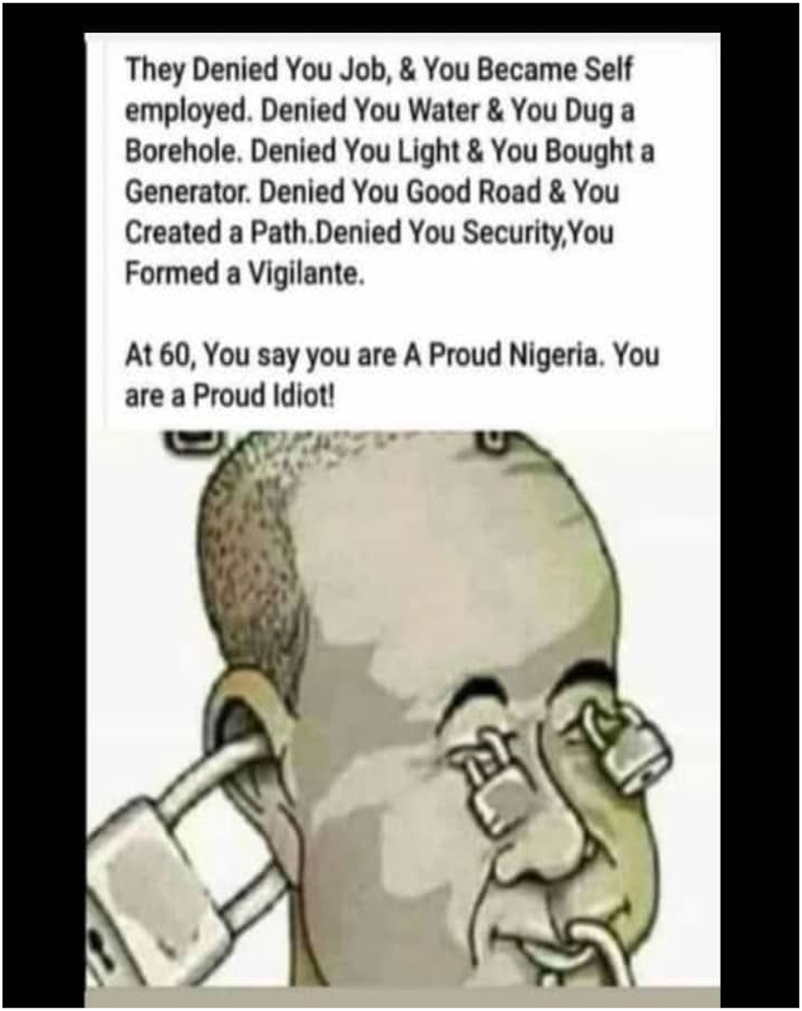
Proud idiot.
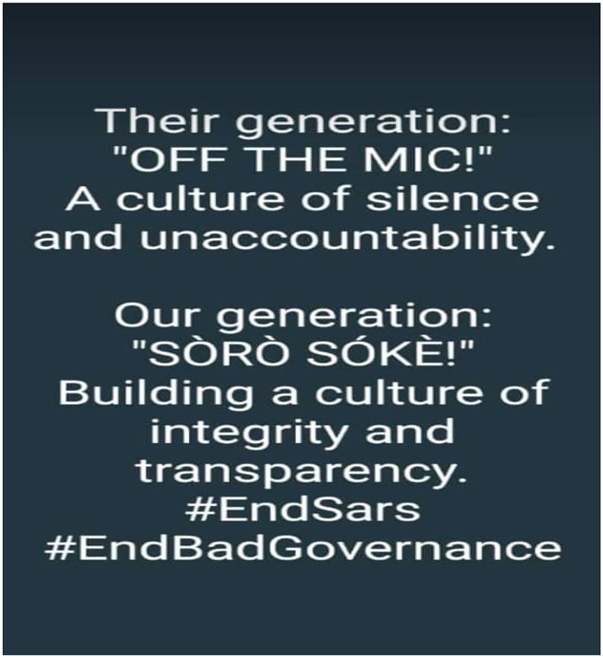
“Soro soke” generation.
Figure 1 combines both verbal and visual resources to evaluate the situation of things in Nigeria since independence in 1960. The visual resource is the represented participant (RP) of the meme and is a symbolic image that is strategically deployed to convey metaphoric meaning about the state of affairs in the country. The visual resource which is an image of a male adult with padlocks on three of his sense organs – ear, eyes and mouth is a symbolic representation of Nigeria as a country which turned sixty years on October 1st, 2020, when the #Endsars crisis occurred. This symbolic image is deployed as an appraisal resource to negatively evaluate the state of affairs in Nigeria and invoke an ideological meaning about how the vital parts of the country have been crippled, non-functional and grounded for the past sixty years that the country has gained political independence. This is shown in the way all the vital organs, ear, eyes, and mouth are locked by four different padlocks. The nose that is not padlocked is also symbolic for meaning. It is used to show that Nigeria is barely surviving since the country still exists as an independent state. However, all the vital organs that would have made it to be an active state have been paralyzed. The RP is a visual anchorage (see Barthes 1977) to the verbal resources listed at the beginning of the meme. The RP reiterates the message the verbal resources in the meme, “ They Denied you Job, & You Became Self-employed. Denied You Water & You Dug a Borehole. Denied You Light & You Bought a Generator. Denied You Good Road & You Created a Path. Denied You Security, You Formed a Vigilante. At 60, You say you are A Proud Nigeria. You are a Proud idiot! ” are trying to convey. The issues raised in the verbal resources are the life line of any progressive country that wants to experience active/functional economy. The meme is strategically deployed by Nigerian youth to X-ray the situation of things in Nigeria and express disappointment and dissatisfaction in the way the country has fared over the years. Unfortunately, as the list shows, they are nowhere to be found in the Nigeria’s national life, rather the citizens have had to upgrade and move to the level of functioning as a country as individuals and start providing for themselves the basic amenities of life their country should provide for them. The reality truly in Nigeria is that Nigerians are the ones that provide basic amenities for themselves (see Dike 2014; Oyebode and Adegoju 2017). Hence, the position of the meme producer in terms of the total evaluation of things as far as Nigeria is concerned, in spite of its sixty years of independence is negative. In addition, through the use of the declarative statement, “At 60, You say you are A Proud Nigeria. You are a Proud idiot!”, the meme producer invokes negative reaction and expresses their dissatisfaction. This is done using an abusive word to air their opinion and express their grievances about the state of things in Nigeria. The statement, “You are a Proud idiot!” is derogatory and it is perhaps, used intentionally to invoke affective meaning in the meme. Therefore, through the use of both verbal and visual resources, the meme producer is able to evaluate the situation of things in Nigeria and conclude that the result is negative as the vital organs of the country have been grounded since independence and the country is merely surviving.
Figure 2 is a verbal representation of the state of affairs in the country. It is a social allusion to an event that happened at the Nigerian National Assembly where the Minister of Niger Delta while appearing before a National Assembly panel investigating alleged fleecing of billions of Naira in the Niger Delta Development Commission (NDDC) was instructed to ‘off-the mic’ to prevent further disclosures or clarifications on the beneficiaries of NDDC contracts (Tade 2020). The declarative statement, “Their generation: OFF THE MIC!” “a culture of silence and unaccountability.”, is an example of judgment, the second category of the system of attitude (see Martin and White 2005). The meme producer deploys the declarative statement as an appraisal resource to invoke negative evaluation of things in the country. The phrase, “Their generation:” is an appraisal resource deployed to express an attitude of disappointment and dissatisfaction in the way the older generation has handled the affairs and resources of the country over the years. The message reaches the climax when the meme producer hits the point by saying “OFF THE MIC!” This is deployed to unravel their offence and judge their character. Thus, the first statement in the meme is deployed as appraisal resource to negatively evaluate the action and inaction of the older generation which turned out to be negative. This then led to a rebuttal of such culture by the younger generation as well as a positive representation of self which is an assertion of self and expression of how things should be. This is expressed in the declarative statement, “Our generation: “SORO SOKE!” Building a culture of integrity and transparency.” The phrase “Our generation:” is inclusive and it portrays a notion of positive representation of self which is a subtle way of expressing self as ‘good’. Through the second declarative statement, “Our generation: “SORO SOKE!” …”, the meme producer reiterates the abysmal failure of the older generation and invokes negative evaluation of their behaviour.
The younger generation however, affirms what should be the norm in the country by positively asserting self as knowing the right thing to be done in the statement “SORO SOKE!” “Building a culture of integrity and transparency.” The expression “SORO SOKE!” – speak up, represents agency activation of voice to know the unknown, clarify a confused state and challenge negligence, right denial and injustice (see Tade 2020). This meaning is further reinforced in the statement, “Building a culture of integrity and transparency.” This perhaps explains why they decided to speak up in order to end the brutality of the special anti-robbery squad and bad governance that have thrived over the years. The deliberate use of capital letters for selected expressions in the meme was to direct the attention of readers to the central message being passed across to the public. Even though the entire meme is in text form, rendering these selected expressions in capital letters as against other expressions in the meme pushes them to prominence and delivers the overall message more efficiently by guiding people’s thinking to what to focus on. Just like size, color, tone, repetition and other devices are used to achieve salience and foreground certain elements, the directives, “OFF THE MIC!” and “SORO SOKE!” are written in block letters in Figure 2 to put them in focus as the central message of the meme. Furthermore, salience is also achieved with the use of capital letters in the presentation of the two directives “OFF THE MIC!” and “SORO SOKE!” to clearly compare and contrast the thinking, culture and attitude of two generations. The capitalization of the two expressions helps in realizing the intended contrasting of things, showing an ugly past of silence and a desired movement from that past to an era of freedom of expression/transparency.
4.2 Positive portrayal/depiction of self
One of the things that the #Endsars protesters never lost sight of during the protest was the reiteration of reasons why the Special Anti-robbery Squad usually arrests young people in Nigeria. They were always going all the way to list out some of those things such as, exotic phones/laptops, styled hairdo, fresh skin, wearing of “crazy or torn” jeans among others that had made many Nigerians suffer molestation, humiliation and injustice in the hands of SARS. Thus, Nigerian youth deployed memes for positive portrayal of self as a counterclaim to many negative assertions the SARS and even the Nigerian government made about them. Figures 3 and 4 evince this.
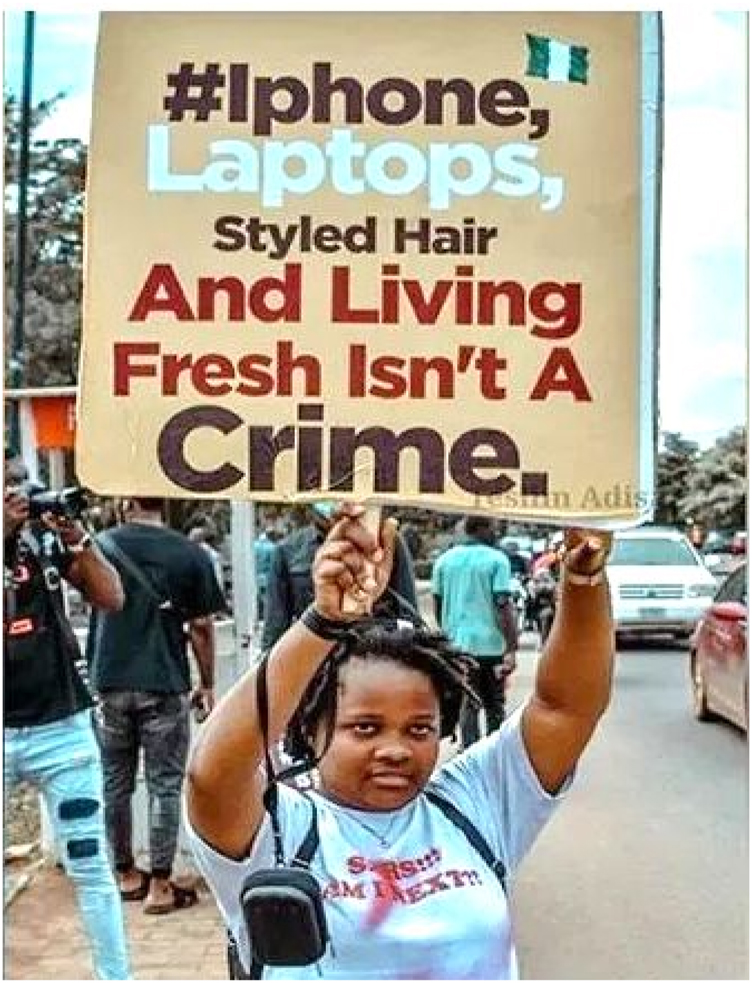
Living fresh isn’t a crime.
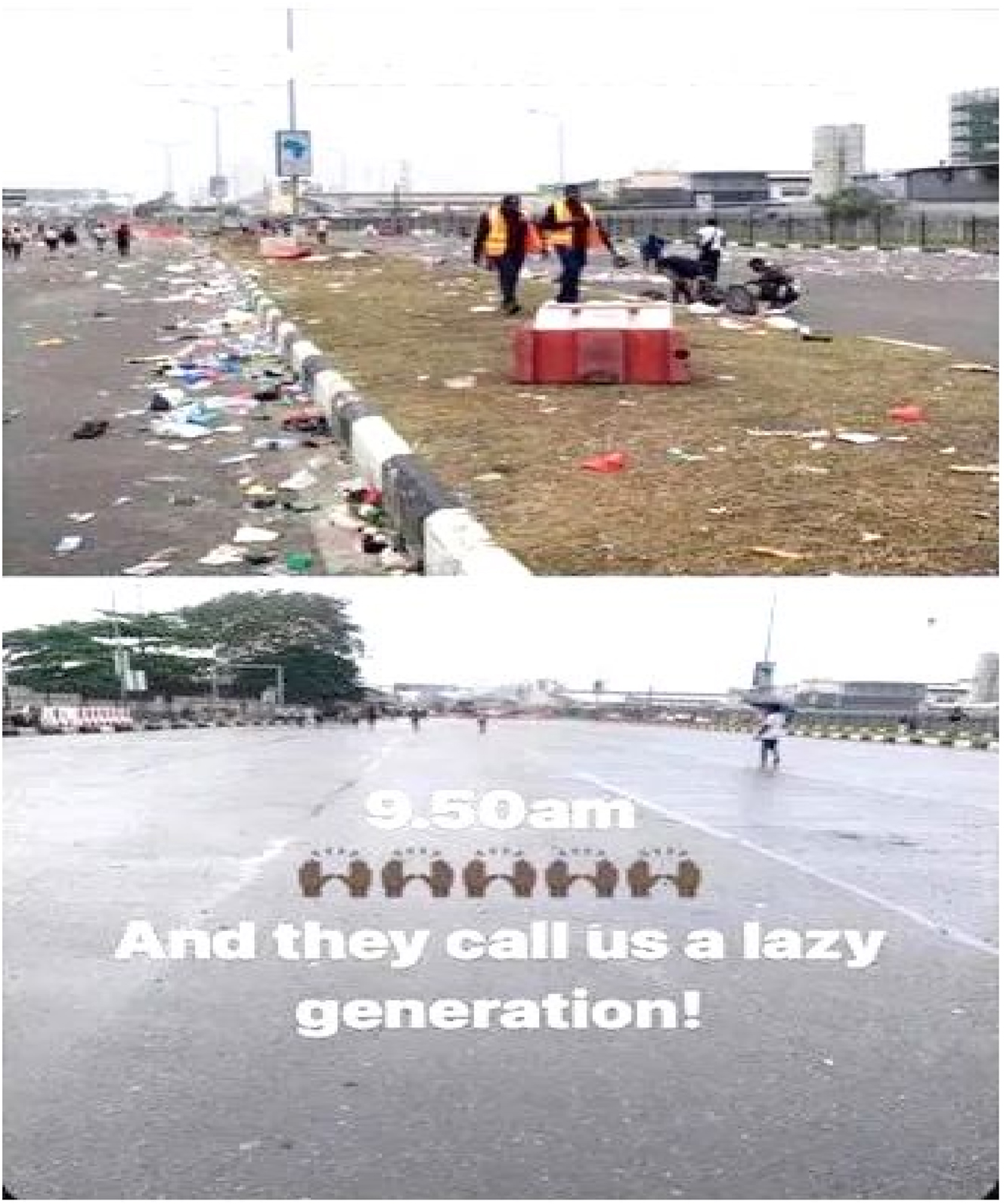
And they call us a lazy generation!
Figure 3 which is also a combination of verbal and visual resources is an appraisal resource subtly deployed to positively represent self as innocent and express affective meaning of insecurity (see Martin and White 2005). The declarative statement, ‘#iPhone, Laptops Styled Hair and Living Fresh isn’t A Crime’ portrays the basic issues that SARS have arrested and are still arresting Nigerian youth for. The lexical item, ‘Crime’ in the statement, is an attitudinal choice of insecurity used to reiterate how SARS classify having those items and qualities listed in the directive statement in Nigeria. Nigerian youth generally crave to have these items in order to enjoy life at its fullest, show affluence, status and command respect among their peers. Therefore, finding such expensive items with an average Nigerian youth whose majority are unemployed has been classified as a crime by SARS thereby making them harass Nigerian youth on the street. Thus, through the use of bold, size and other darkened color to write ‘Crime’ in the statement, the meme producer put salience on ‘Crime’ as the force that led to the protest. Using the image of a freshly looking lady with dread as hair style and perhaps an iPhone, the meme producer portrays a visual representation of the category of the Nigerian youth that are usually victims of SARS assault and evokes an attitudinal meaning of insecurity for the youth. Thus, the representation of a freshly looking lady and the raising up of the placard that itemizes the supposed offences of victims of SARS brutality in Nigeria are discursive strategies deployed to evoke negative reactions form the world at large.
The presentation of the placard to the world (by raising it up) with the list of items SARS classify as a crime has an interactive meaning of demand (see Kress and van Leeuwen 2006). The representational participant raises the list of the supposed crimes to the world in order to demand justice from the world and gather solidarity/support. Conversely, the representation of a lady with styled hairdo and iPhone is strategic to evoke affective meaning of positive portrayal of self as well as counter the claim that victims of SARS brutality are rogues and thugs. Arguably, the meme is an intersubjective tactic deployed to call the attention of the whole world to what SARS tag as crime and beckon on the world for their intervention so that Nigerian youth can walk freely again as freeborn.
Figure 4 is a stacked meme with two pannels. It’s a visual representation of a dirty road in Nigeria which was properly clean before 9.50 am in the morning by the youth during the protest. Thus, the two pannels portray two different scenarios that make an ideological statement about the alleged negative comment the Nigerian president, President Muhammadu Buhari made about the Nigerian youth at the Commonwealth Business Forum in Westminster on Wednesday, 18th April, 2018 (see Jimoh et al. 2018, online). At the forum, President Muhammadu Buhari, reportedly insinuated that Nigerian youths are lazy in the statement,
“A lot of them (Nigerian youths) haven’t been to school and they are claiming, you know, that Nigeria has been an oil-producing country therefore they should sit and do nothing and get housing, health care, education, free.”
The above submission was taken as a public misrepresentation of the Nigerian youth. It was vehemently refuted and totally frowned at by the youths and they criticise Mr President at every slightest opportunity. Therefore, using a conceptual image, the meme producer deploys the analytical process (see Kress and van Leeuwen 2006) to counter the allegation and positively portray Nigerian youths as diligent and orderly people. This is shown in the two pannels of the meme. While the first pannel shows a dirty and litered road with people picking and packing the dirts, the second pannel shows a clean and neat road as early as 9.50 am. Apparently, the youth must have trooped to the road as early as maybe 6.30 am to clear and pack all the dirts littered on the road during the protest the previous day. Thus, the analytical process is strategically deployed to positively portray self and exonerate Nigerian youth as well as evoke negative reaction from the masses against the aspersion Mr President publicly cast on them as being lazy. Using a declarative statement, ‘9.50 am and a praise emoji’ in the first part of the verbal resources, the meme producer expresses positive emotion of happiness with self which affirms an attitudinal feeling of self-exoneration of the Nigerian youth and total disappointment in Mr President’s negative representation of them. This is vividly portrayed in the second part of the declarative statement, ‘And they call us a lazy generation’. The ‘They’, in the statement is used as an engagement expansion to acknowledge the accusation levelled against the Nigerian youth by the President and to counter the accusation using the context of a clean street at 9.50 am. Arguably, the discourse design of Figure 4 is an outright rebuttal of the derogatory assertion the President made about the Nigerian youth and a proof of their diligence. It is a counter discourse deployed to express affective meanings of positive representation of self.
4.3 Expression of negative emotions
Another issue that was a bone of contention during the protest was the failure of Mr President, Muhammadu Buhari, to respond or address Nigerian youth about the protest. Many Nigerians were of the opinion that this would have doused the tension and curtailed the situation. This led to all kinds of negative reactions by Nigerians to show their level of disappointment in the Buhari led-administration in the management of the protest. This is exemplified in Figures 5 and 6.

Update.
The best president Nigeria never had.
Figure 5 is a text meme that uses verbal resources in conjunction with emojis to evaluate Mr President’s action during the protest. Through the use of declarative statement, Buhari basically gave us “UPDATE Iya yin”, the meme producer expresses his dissatisfaction in the president’s address about the crisis. This is reiterated with the use of two emojis. While one symbolises cursing, the other one symbolises mockery. These two emojis are used to visually express negative emotions of the represented participant (RP) of the meme. In the first part of the text, the RP critically appraises Mr President’s address and expresses a negative emotion by placing curse on everyone involved in the Buhari led-administration by saying “Iya yin.” “Iya yin” is an abusive term meaning, “to hell with you”. This is visually represented through the use of an emoji of a raised hand which is a visual representation of the abusive term. This is strategic as it is used as an appraisal resource to express negative feelings of dissatisfaction in the way and manner Mr President handled the protest. Before the October 20, 2020s massacre of some Nigerian youths, many elder statesmen had tried to prevail on President Muhammadu Buhari to publicly address the nation, especially Nigerian youth, on the issue of SARS. He never responded until after the massacre. Unfortunately, by the time he would address the nation, there were no clear steps presented on the intended plan to curb the excesses of SARS, stop their brutality and critically investigate alleged murder cases. Instead, the president just presented information already known to the masses, threatened to arrest them if they do not leave the streets and glossed over the real issue agitating the protesters. Thus, Figure 5 is deployed to evaluate Mr President’s attitude to the crisis, condemn his action/address as being unacceptable and evoke further negative emotions from the general public.
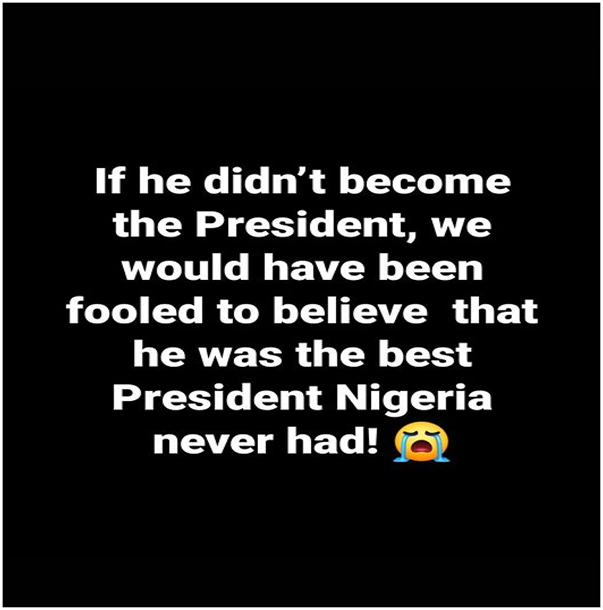
A similar emotion is expressed in Figure 6. The meme producer expresses negative emotions about the emergence of Buhari as the Nigerian president during the last election. Using verbal and visual resources, the meme producers in retrospect, condemns the Buhari-led administration and his performance in office which if put on the scale would be negative. For a president that contested elections three different times before emerging the president, Nigerians, particularly the youth, expected so much from his administration. Unfortunately, their high hopes and expectations were dashed by his shortcomings and non-performance.
Buhari’s campaign during elections rested on four cardinal points which are: fighting corruption, restoring the economy, creating jobs and building infrastructures. All these seem to have gone into the winds as adjudged by the meme producer in Figure 6. Through the use of a conditional statement, ‘if he didn’t become the President, we would have been fooled to believe that he was the best President Nigeria never had!’ and a teary-face emoji, the meme producer expresses disappointment, regret and decry the perceived failure of Buhari as the incumbent Nigerian president. Hence, in what appears to be a regret and lamentation of the people’s perception of the president before assumption of office, the meme evaluates and expresses negative emotion by scoring the president very low in terms of performance.
Beyond the obvious tone of regret and lamentation in the verbal resource, the teary-face emoji in the meme strategically reinforces the frustration of the average Nigerian youth, who welcomed president Buhari in 2015 when he was elected as the president of Nigeria with great expectations but whose hopes were later dashed and replaced with disappointments. The meme depicts expression of negative emotions of anger, dissatisfaction and disappointment in the Buhari presidency in Nigeria. This is a negative evaluation and judgment of his person and government as his government has not only failed the Nigerian youth but Nigerians in general. Hence the teary face emoji represents Nigerians crying and lamenting their plight in the hands of a non-performing government. As depicted through the emoji, Nigerians are heartbroken and sad about the situation of the country. The negative evaluation of the performance of the Buhari government in the meme is therefore, an instance of inscribed attitude used to evoke judgement capable of influencing the public’s evaluation of Buhari’s government.
4.4 Negative evaluation of other people’s behaviour
The Nigerian #Endsars protest also afforded Nigerian youths the opportunity to evaluate people’s behaviour in terms of either good or bad, acceptable or unacceptable, patriotic or unpatriotic, civil or uncivil, etc. During the protest, young people were able to assess, evaluate and place value judgement on people’s behaviour thereby condemning, commending or applauding them. For a protest triggered by the unacceptable and uncivilised manner in which Nigerian youths were being treated by officers of the Nigeria Police, the period of the protest became an important time for young people to say the kind of nation they want to live in and how they want their affairs to be conducted. This is exemplified in Figures 7 and 8.

Looters don’t read and readers don’t loot.

PalliaTHIEVES.
Figure 7 is a combination of verbal and visual resources. The meme producer deploys declarative statements and humorous emojis to negatively evaluate people’s conduct and behaviour during the protest. In the first declarative statement, ‘Only shopping malls get looted during violence’, the meme producer gives some kind of general overview of what happened during the crisis. This is informative, however, his assessment/evaluation of the situation becomes critical in the second statement, when he asserts that, ‘The bookshops remain untouched, looters don’t read and readers don’t loot’. This assertion shows the social values of the two categories of people identified in the meme. The meme producer subtly evaluates the social behaviour of some Nigerians during the protest and gives an outright condemnation of such behaviour. Using the rhetoric of contrast, he subtly compares the values of those Nigerian youths fighting for the noble cause of ending police brutality in Nigeria to some rogues who used the opportunity to loot shops and malls during the protest. The distinction between the two set of people is deliberately deployed to foreground the negativity of the conduct of the looters. While looters, are projected as deviants and ignoble (negative evaluation of people’s behaviour), readers, who do not loot were portrayed as the ideal and acceptable group in the society.
The #Endsars protest in Nigeria was a well-coordinated protest by young Nigerians to seek redress and demand a better deal with regards to policing in the country. However, the protests were later hijacked by hoodlums who took undue advantage of the protest to unleash terror and loot shops, malls and businesses at different locations across the country. This sad development was strongly condemned by the organisers of the protest. The looters, according to genuine youths and organisers of the protest are saboteurs of the genuine demands for change by Nigerian youths. As espoused by Martin (2000), in the systems of judgement and appreciation, we give ethical and emotional assessment of people’s behaviour by making and constructing norms around the way people should act (social or acceptable norm) or should not act (i.e., anti-social and deviant conduct). Thus, the action of looting is condemned as an unacceptable social behavior. Figure 8 also exemplifies negative evaluation of other people’s behaviour during the protest.
The #Endsars protest happened at a time when not only Nigerians but the whole world was grappling with the unprecedented effects of COVID-19. Governments and organisations around the world were taking steps to ameliorate the effects of the virus on their people by initiating and implementing different types of social strategies to help their citizens to survive the undeniable effects of the pandemic. Several coping and palliative strategies or packages were distributed to individuals and homes across the world. In Nigeria, palliatives were also distributed at different locations to the most vulnerable of the society. Soon, there were reports of deliberate hoarding and diversion of these palliatives to private residences and locations by politicians and government officials. This development snowballed into young people going all out, not only to search, but to also open up these palliatives warehoused in private residence. Politicians and public office holders who own such houses were also called out and condemned for their indiscretion and greed. Contrary to what was observed in other places around the world (see Unuabonah and Oyebode 2021), COVID-19 palliatives in Nigeria were hijacked by politicians and public office holders in the peak of the coronavirus pandemic.
Household products and items that were meant to be distributed to the masses were personalised and retained for future use by these greedy leaders. Hence, their conducts with respect to the handling of the palliatives made Nigerian youths came up with the mocking word “palliaTHIEVES” to describe and condemn the perceived inhuman behaviour of these leaders. For example, in a report titled “How COVID-19 palliatives were hijacked, distributed among party loyalists”, BudgIT, a non-governmental and civic organization that applies technology to intersect citizen engagement with institutional improvement, and facilitates societal change says it found evidence of diversion of palliatives in Kano, Lagos and other locations in the country. The use of the word “palliaTHIEVES” mocks the action of these leaders and the culture of unaccountability displayed by the political class in Nigeria even in the middle of a global pandemic. Thus, palliatives that should ordinarily mitigate the sufferings of the people turned Nigerian leaders into “thieves” of palliatives and consequently or justifiably described as “palliaTHIEVES”. They are invariably described as thieves who specialise in the stealing of palliatives. The word as used in the meme is a clear negative evaluation of other people’s behaviour (i.e., Nigerian politicians) at the time of the protest and the COVID-19 crisis.
4.5 Pronouncement of judgement
Judgement is one of the sub-systems under attitude in appraisal theory. It is the evaluation of human behaviour along social norms in any particular context. Judgement aims at evaluating human behaviour in terms of acceptable social norms in human society. Judgement as evaluation is related to people’s assessment given by individuals in relation to the norms in a society. It can be further classified into two subsystems, that is, positive judgement (e.g., admiration or applaud) and negative judgement (e.g., criticism or condemnation). Figures 9 and 10 exemplify the pronouncement of judgement during the #Endsars protest.
It’s not normal.
We don’t expect much from clowns.
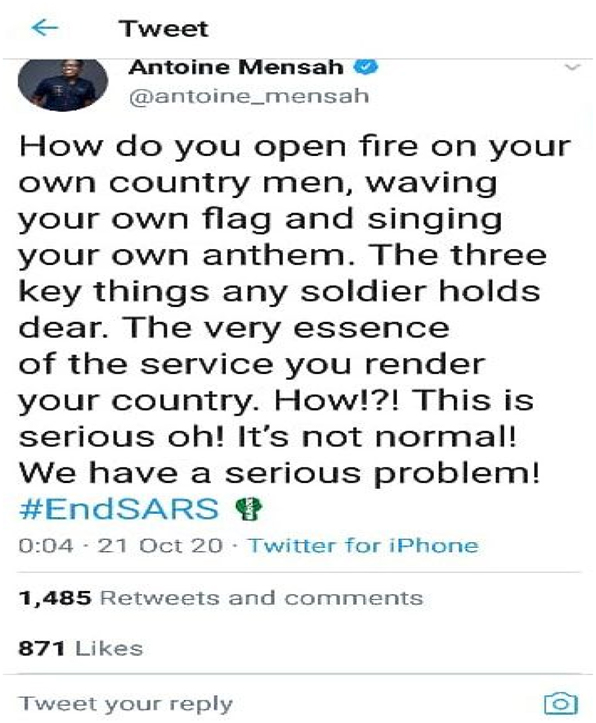
In Figure 9, the meme producer deploys verbal resource to pronounce judgement on the abnormal and unprofessional conduct of officers and men of the Nigerian army who were deployed to the Lekki Toll Gate location in Lagos during the #Endsars protest. Using a rhetorical question, “How do you open fire on your own country men, waving your own flag and singing your own anthem. The three key things that any soldier holds dear. The very essence of the service you render to your country”. “How!? This is serious oh! It is not normal! We have a serious problem”. The meme producer, like many Nigerians, is bewildered about the action of the Nigerian army on October 20, 2020 when they opened life fire on unarmed youths engaged in a civil protest seeking social change. This intentional suppression and deliberate brutality of the youths by the Nigerian army is seen as a complete abuse of power and misplaced show of strength. Ordinarily, the army of any nation is bound to protect its citizens, particularly women and children who are usually seen as vulnerable. Thus, the attacks and shooting of the protesters on October 20, 2020 were condemned by all and sundry – Nigerians and the international community as abuse of power and unreasonable use of force.
To open fire and use live bullets on unarmed youths in a civil agitation portrayed men of the Nigerian army as lacking professionalism and trigger-happy. As shown in the meme the producer makes a negative judgement pronouncement of their conduct by adjudging their actions as abnormal in the statement, “This is serious oh! It is not normal! We have a serious problem”. The action of the men of the Nigerian army as portrayed in the meme was a deviation from the normative practice in army-civilian relation all over the world and thus, was pronounced as abnormal and unacceptable in a civilized society, particularly one governed by civil rule, democratic tenets and respects for the rights of the people. The needless exertion of force on civilian population with no weapons to harm any of the soldiers, Nigerian youths argue, is a reflection of lack of professionalism by some officers of the Nigerian army.
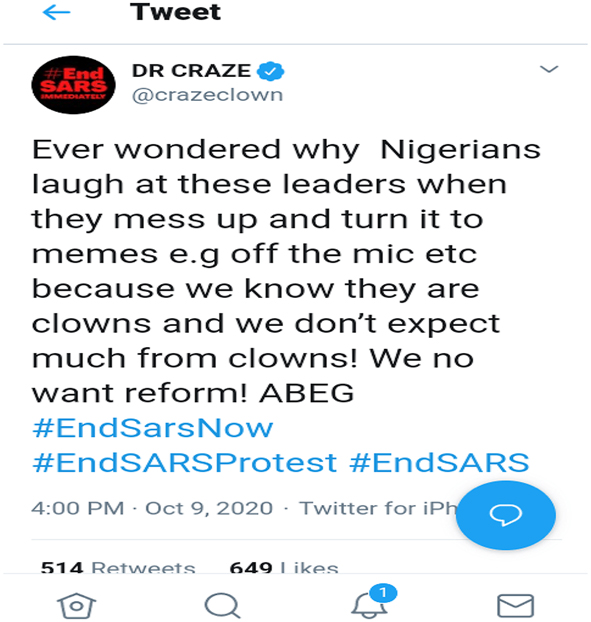
Focusing on Nigerian leaders and abuse of office, Figure 10 also makes a pronouncement of negative judgement about the overall conduct and attitude of Nigerian leaders to governance in different areas of the society and why Nigerians often laugh at them and do not consider them as serious.
The deliberate pronouncement of negative judgement in Figure 10 is to show Nigerian leaders as acting contrary to the good tenets of leadership as practiced in other democratic nations of the world. Some of these tenets include: display of maturity, seriousness, and purposefulness in addressing national issues affecting the lives of citizens and nations. The normative value of the assessment of Nigerian leaders in the meme presented them as incompetent, clueless and incapable of giving good governance (see Adegoju and Oyebode 2015). Their incompetence, as usual, according to the meme was further reiterated during the #Endsars protest when in spite of the enormity of the demands of the youth, the best that Nigerian leaders could suggest was a reform of the SARS unit of the Nigeria police rather than critically assessing the overall situation and proffer lasting solutions to the issue of police brutality in the country. Unfortunately, the leaders disappointed Nigerian youth once again by choosing to be complacent and hypocritical in their leadership approach. Bewildered of their negligence, the meme producer deploys a rhetorical question to subtly interrogates why Nigerian youths mock their leaders and do not take them seriously in the statement, “Ever wondered why Nigerians laugh at these leaders when they mess up and turn it to memes, e.g., off the mic etc because we know they are clowns and we don’t expect much from clowns! We no want reform! ABEG”. The producer mixes two codes (English and Nigerian Pidgin) to present Nigerian leaders as unserious even in the face of serious national issues. The reference to “off the mic”, is a social allusion to an event that ensued at the National Assembly during a public hearing on the activities of the Niger Delta Development Commission (NDDC) as explained in Figure 2. The slogan is a symbol of the irresponsibility and abnormality of Nigerian leaders, a symbolic reminder of the depth of decay and rot in most of the dealings and undertakings of government and its officials in Nigeria.
5 Conclusion
In this study, we have examined how Nigerian social media users deploy memes on WhatsApp and Twitter during the #Endsars protest to express intersubjective opinions about the civil unrest and the roles some stakeholders played during the period. Using Internet memes sourced from two of the leading social media platforms in Nigeria (WhatsApp and Twitter), Nigerians evaluate and express their views and perception about the political class in the country, some government agencies, the older generation, the youths, etc. Through insights from Martin and White’s (2005) appraisal system and Kress and van Leeuwen’s (2006) concept of visual grammar, the study shows how visual and verbal resources in the memes were used to express different kinds of attitude, intersubjectivity and judgement about the key social actors in the #Endsars protest in Nigeria. The study reveals that the meme producers deployed both verbal and visual resources with some pinch of humour, comparison and contrast, as well as rhetorical devices as discursive strategies to evaluate and assess the action(s) of key government officials, government agencies (particularly the Nigeria police and army), and Nigerian youth during the #Endsars protest. Through the theoretical underpinning deployed for the analysis of the memes, we have been able to depict Internet memes as important discourse constructs strategically utilized by Nigerian youth to interrogate sociopolitical happenings in the country and negotiate social change. In addition, the study also lends credence to the importance of social media in the democratization of civic engagement and citizens’ involvement in all issues affecting their lives individually and collectively at the national level. One crucial implication that comes to the fore is that the liberal use of interaction on social media platforms as well as access to these media technologies promotes people’s freedom to express opinions more freely and demand social change for the good of all. Hence, the study is significant for citizens’ involvement, mass mobilization and the entrenchment of democratic values and norms in Nigeria, and by implication other African contexts and democracies. Further studies should be carried out on the democratic/emancipatory role social media play in the national life of other African nations.
About the authors
Saheed Omotayo Okesola teaches and conduct research in the Department of English, Obafemi Awolowo University, Ile-Ife, Nigeria. He is a fellow of the African Humanities Program (AHP) and currently a postdoctoral fellow of the Alexander von Humboldt Foundation at the Albert-Ludwigs-Universität, Freiburg, Germany. His research interests include Sociolinguistics, Applied Linguistics as well as Linguistic Diversity and Multilingual Studies.
Oluwabunmi Opeyemi Oyebode (PhD) lectures in the Department of English, Obafemi Awolowo University, Ile-Ife, Nigeria. Her areas of interest include (multimodal) discourse analysis, applied linguistics and grammar. She has published articles in reputable journals in local and international outlets, including Journal of Pan African Studies, Discourse Studies and Discourse and Society.
-
Research funding: This research did not receive any specific grant from funding agencies in the public, commercial or not-for-profit sectors.
References
Adegoju, Adeyemi & Oluwabunmi Oyebode. 2015. Humour as discursive practice in Nigeria’s 2015 presidential election online campaign discourse. Discourse Studies 17(6). 1–20. https://doi.org/10.1177/1461445615602378.Search in Google Scholar
Aliyu, Tanko. 2020. How the End Sars protests have changed Nigeria forever. Available at: https://www.bbc.com/news/world-africa-54662986.Search in Google Scholar
Amnesty International Report 2020/2021: The State of the World’s Human Rights (April 2021, Index Number POL 10/3202/2021). https://www.amnesty.org (Accessed 10 December 2021).Search in Google Scholar
Barthes, Roland. 1977. Image music text. London: Fontana Press.Search in Google Scholar
Burgess, Jean. 2008. All your chocolate rain are belong to us? Viral video, YouTube and the dynamics of participatory culture. In Geert Lovink & Sabine Niederer (eds.), Video vortex reader: Responses to YouTube, 101–109. Amsterdam, Netherlands: Institute of Network Cultures.Search in Google Scholar
Davison, Patrick. 2012. The language of Internet memes. New York: New York University Press.10.18574/nyu/9780814764077.003.0013Search in Google Scholar
Dike, Victor. 2014. Leadership and the Nigerian economy. Sage Open 4(1). 1–10. https://doi.org/10.1177/2158244014523792.Search in Google Scholar
Gwandu, Umar J. 2019. Internet meme as campaign tool in Nigeria’s presidential election. Zaria Journal of Communication 4(2). 207–226.Search in Google Scholar
Grundlingh, Lezandra. 2018. Memes as speech acts. Social Semiotics 28(2). 147–168. https://doi.org/10.1080/10350330.2017.1303020.Search in Google Scholar
Halliday, Michael A. K. 2007. Language as social semiotic: Towards a general sociolinguistic theory. In Jonathan Webster (ed.), Language and Society, 169–202. London: Continuum.Search in Google Scholar
Jimoh, Azimazi M., Terhemba Daka, Abdulganiyu Alabi & Ayodele AfolabI. 2018. Available at: https://guardian.ng/news/presidentbuhari-under-fire-for-tagging-nigerian-youths-lazy/.Search in Google Scholar
Jones, Graham M. & Bambi B. Schieffelin. 2009. Talking text and talking back: “My BFF Jill” from Boob Tube to YouTube. Journal of Computer-Mediated Communication 14(4). 1050–1079. https://doi.org/10.1111/j.1083-6101.2009.01481.x.Search in Google Scholar
Johnson, Davi. 2007. Mapping the meme: A geographical approach to materialist rhetorical criticism. Communication and Critical Studies 4(1). 27–50.10.1080/14791420601138286Search in Google Scholar
Knobel, Michele & Colin Lankshear. 2007. A new literacies sampler. New York, NY: Peter Lang.Search in Google Scholar
Kemp, Simon. 2020. Digital 2020: Nigeria. Datareportal. Available at: https://datareportal.com/reports/digital-2019-nigeria.Search in Google Scholar
Kress, Gunther & Theo van Leeuwen. 2006. Reading images: The grammar of visual design, 2nd ed. London: Routledge.10.4324/9780203619728Search in Google Scholar
Kushin, Mathew J. & Masahiro Yamamoto. 2010. Did social media really matter? College students’ use of online media and political decision making in the 2008 election. Mass Communication & Society 13(5). 608–630. https://doi.org/10.1080/15205436.2010.516863.Search in Google Scholar
Martin, Jennifer R. 2000. Beyond exchange: Appraisal systems in English. In Susan Hunston & Geoff Thompson (eds.), Evaluation in Text: Authorial Stance and the Construction of Discourse. Oxford: Oxford University Press.10.1093/oso/9780198238546.003.0008Search in Google Scholar
Martin, Jennifer R. & Peter R. White. 2005. The language of evaluation: Appraisal in English. Basingstoke: Palgrave Macmillan.Search in Google Scholar
Msughter, Aondover E. 2020. Internet meme as a campaign tool to the fight against Covid-19 in Nigeria. Global Journal of Human-Social Science 20(6). 26–39.Search in Google Scholar
Obia, Vincent A. 2020. #EndSARS, a unique Twittersphere and social media regulation in Nigeria. Available at: https://blogs.lse.ac.uk/medialse/2020/11/11/endsars-a-unique-twittersphere-and-social-media-regulation-in-nigeria/.Search in Google Scholar
Omoruyi, Paul. 2015. Is Nigeria’s President-Elect, General Mohammadu Buhari Ready for the new Social Media world? Sahara Reporters, May 9th.Search in Google Scholar
Oyebode, Oluwabunmi O. & Adeyemi Adegoju. 2017. Appraisal resources in select WhatsApp political broadcast messages in the 2015 presidential election campaign in Nigeria. Africology: Journal of Pan African Studies 10. 29–47.Search in Google Scholar
Sijuwade, Amber C. 2020. Understanding #EndSARS: A guide to the recent mass protests in Nigeria. Available at: https://www.fodors.com/news/news/understanding-endsars-a-guide-to-therecentmass-protests-in-nigeria.Search in Google Scholar
Singh, Katherine. 2020. What to know about the #EndSARS Protest Movement in Nigeria. Available at: https://www.flare.com/news/end-sars-nigeria-explainer/.Search in Google Scholar
Shifman, Limor. 2013. Memes in a digital world: Reconciling with a conceptual troublemaker. Journal of Computer-Mediated Communication 18(3). 362–377. https://doi.org/10.1111/jcc4.12013.Search in Google Scholar
Strong, Krystal. 2020. The rise and suppression of #EndSARS: A deep dive into the protests in Nigeria and where the movement stands. Available at: https://www.harpersbazaar.com/culture/politics/a34485605/what-is-endsars/.Search in Google Scholar
Tade, Oludayo. 2020. #EndSARS: Between Sòròsókè and ‘Off-the-Mic’ generations (23, October). Available at: https://www.vanguardngr.com/2020/10/endsars-between-sorosoke-and-off-the-micgenerations/.Search in Google Scholar
Tella, Akin. 2018. Humour generation and multimodal framing of political actor in the 2015 Nigerian presidential election campaign memes. European Journal of Humour Research 6(4). 95–117. https://doi.org/10.7592/ejhr2018.6.4.tella.Search in Google Scholar
Unuabonah, Foluke O. & Oluwabunmi O. Oyebode. 2021. “Nigeria is fighting Covid-419”: A multimodal critical discourse analysis of political protest in Nigerian coronavirus-related Internet memes. Discourse & Communication 15(2). 200–2019. https://doi.org/10.1177/1750481320982090.Search in Google Scholar
Yeku, James. 2018. The hashtag as archive: Internet memes and Nigeria’s social media election. In Abimbola Adelakun & Toyin Falola (eds.), Art, Creativity, and Politics in Africa and the Diaspora. African Histories and Modernities, 217–245. Cham: Palgrave Macmillan.10.1007/978-3-319-91310-0_11Search in Google Scholar
© 2023 the author(s), published by De Gruyter, Berlin/Boston
This work is licensed under the Creative Commons Attribution 4.0 International License.
Articles in the same Issue
- Frontmatter
- Peirce Study
- Biosemiotics and Peirce
- Culture and Communication
- A skeptic’s guide to “intercultural communication”—debunking the “intercultural” and rethinking “culture”
- Cultural unit blue in the Old Testament
- The influence of semantic predictability on transposition effects in Chinese and English
- Multimodal Signs
- Visual representation of ASUU strikes in Nigeria: a semiotic analysis of cartoons in selected Nigerian newspapers
- A multimodal analysis of Piggyvest’s animated advertisement videos
- “The soro-soke [speak up] generation”: multimodality and appraisal choices in selected #EndSars civil protest-related memes in Nigeria
Articles in the same Issue
- Frontmatter
- Peirce Study
- Biosemiotics and Peirce
- Culture and Communication
- A skeptic’s guide to “intercultural communication”—debunking the “intercultural” and rethinking “culture”
- Cultural unit blue in the Old Testament
- The influence of semantic predictability on transposition effects in Chinese and English
- Multimodal Signs
- Visual representation of ASUU strikes in Nigeria: a semiotic analysis of cartoons in selected Nigerian newspapers
- A multimodal analysis of Piggyvest’s animated advertisement videos
- “The soro-soke [speak up] generation”: multimodality and appraisal choices in selected #EndSars civil protest-related memes in Nigeria
