Gelatinous urine
-
Yonggang Hu
 ,
Tianji Li
,
Tianji Li
 and
Jie Lü
and
Jie Lü

An 81-year-old male patient presented with urethral pain and a sensation of heaviness in the lower abdomen, with no apparent precipitating factors. His medical history included hypertension and chronic bronchitis with emphysema. On admission, physical examination revealed tenderness in the suprapubic region. Urinalysis of a catheterized urine sample revealed yellow, gelatinous, and highly viscous urine (Figure 1A). The urine had a pH of 8.5 and demonstrated 3+ proteinuria. It also contained significant quantities of bacteria, red blood cells, and white blood cells, as well as multiple coffin-lid-shaped crystals, but no casts were observed.
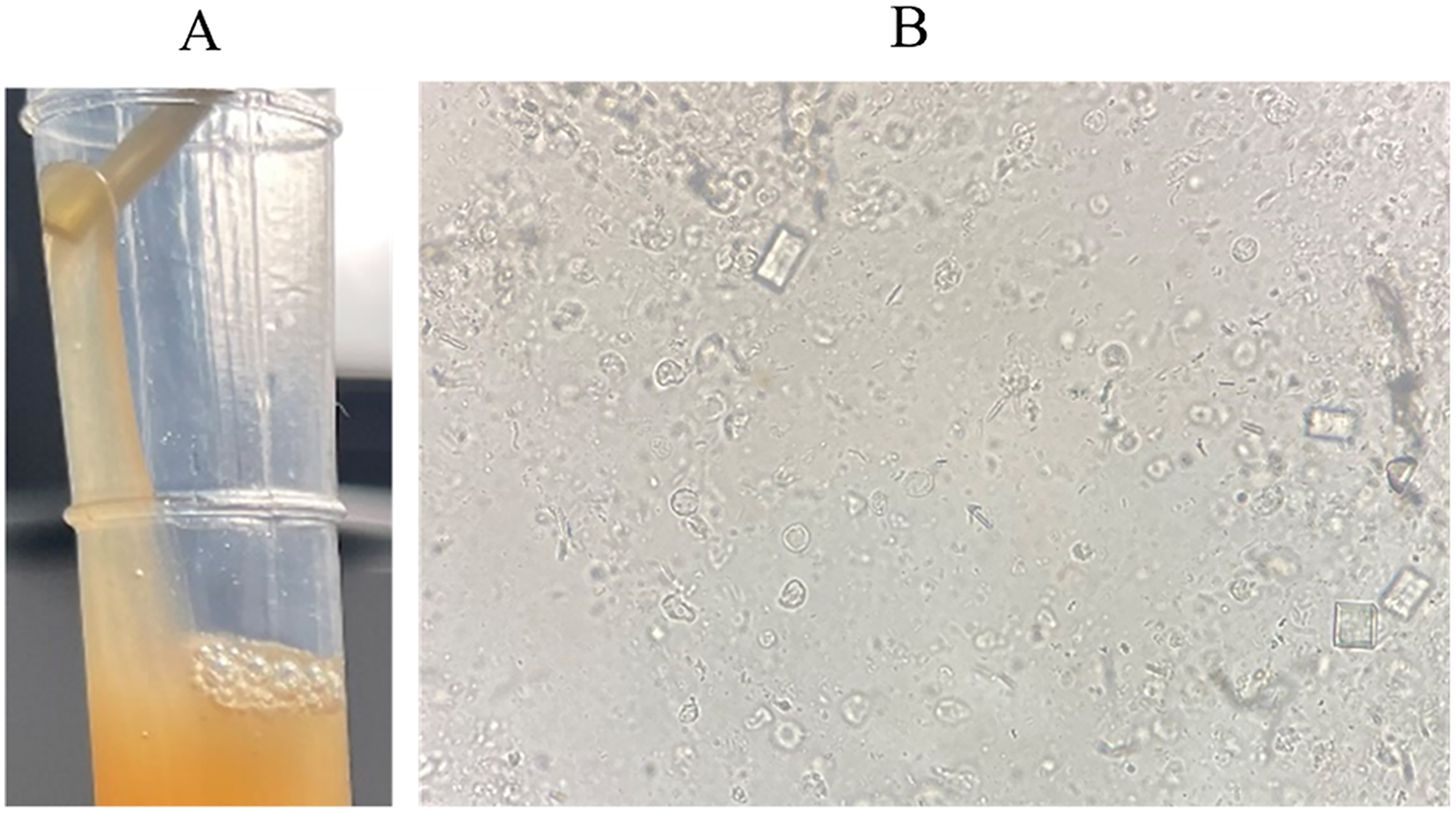
(A) Original urine sample. (B) Original urine smear (unstained, original magnification ×400).
The patient was diagnosed with a urinary tract infection (UTI). Cases of UTI leading to gelatinous urine are rarely reported.
The formation of struvite crystals in alkaline urine is closely associated with bacterial infections [1]. The concentration of ammonia, produced by bacterial urease during urea breakdown, is the primary driver of crystal formation. These crystals can aggregate into clumps of varying sizes, contributing to the development of gelatinous urine [2]. Other potential causes of gelatinous urine should also be considered. For instance, urine samples squeezed from diapers can exhibit a gelatinous consistency due to the gel-forming properties of the polymer water-absorbing resin used in the diapers [3]. Additionally, male prostatitis or prolonged semen retention may lead to the secretion of protein-coagulating enzymes from the seminal vesicles, causing semen to solidify into a gel-like substance [4]. In such cases, urination may result in the presence of pale yellow, gel-like, transparent particles resembling fragmented gelatinous mucus. Furthermore, certain conditions, such as macroglobulinemia or multiple myeloma, which lead to the excretion of abnormal proteins (e.g., globulins) in the urine, may cause the urine to solidify in cold temperatures, requiring careful observation. Following antibiotic therapy, the patient’s gelatinous urine gradually resolved, and he was subsequently discharged.
Funding source: Supported by Luzhou Science and Technology Program
Award Identifier / Grant number: 2024ZRK263
-
Research ethics: The research has complied with all the relevant national regulations, institutional policies, and in accordance with the tenets of the Helsinki Declaration, and has been waived ethics approval by the authors’ Institutional Review Board (2024-003).
-
Informed consent: Informed consent was obtained from the patient prior to the study.
-
Author contributions: All authors have accepted responsibility for the entire content of this manuscript and approved its submission.
-
Use of Large Language Models, AI and Machine Learning Tools: None declared.
-
Conflict of interest: The authors state no conflict of interest.
-
Research funding: None declared.
-
Data availability: Not applicable.
References
1. Danilovic, A, Ferreira, TAC, Gomes, SA, Wei, IA, Vicentini, FC, Torricelli, FCM, et al.. Metabolic assessment in pure struvite stones formers: is it necessary? J Bras Nefrol 2021;43:200–6. https://doi.org/10.1590/2175-8239-JBN-2020-0106.Search in Google Scholar PubMed PubMed Central
2. Zhang, SM, Kong, H, Jia, R. Case analysis and diagnostic value of urine crystal examination. Lab Med 2020;35:1108–11.[in chinese] https://doi.org/10.3969/j.issn.1673-8640.2020.11.006.Search in Google Scholar
3. Damiri, F, Salave, S, Vitore, J, Bachra, Y, Jadhav, R, Kommineni, N, et al.. Properties and valuable applications of superabsorbent polymers: a comprehensive review. Polym Bull 2024;81:6671–701. https://doi.org/10.1007/s00289-023-05068-x.Search in Google Scholar
4. Graziani, A, Grande, G, Martin, M, Ferraioli, G, Colonnello, E, Iafrate, M, et al.. Chronic prostatitis/chronic pain pelvic syndrome and male infertility. Life (Basel) 2023;13. https://doi.org/10.3390/life13081700.Search in Google Scholar PubMed PubMed Central
© 2025 the author(s), published by De Gruyter, Berlin/Boston
This work is licensed under the Creative Commons Attribution 4.0 International License.
Articles in the same Issue
- Frontmatter
- Review
- Contact phase inhibitors: the future of anticoagulation?
- Original Articles
- Validation and implementation of an intraoperative parathyroid hormone assay and workflow: practical advice for endocrine surgery centres
- Serum soluble endorphin combined with BISAP score predicts severe acute pancreatitis combined with septic shock
- Serum LDH and its isoenzymes (LDH2 and LDH5) associated with predictive value for refractory mycoplasma pneumoniae pneumonia in children
- Upregulation of hsa_circ_0000745/hsa_circRNA_101996 in peripheral blood monocytes is associated with coronary heart disease
- Congress Report
- Congress report: 6th German POCT symposium, September 25–26, 2024, Bremen
- Images from the Medical Laboratory
- Gelatinous urine
Articles in the same Issue
- Frontmatter
- Review
- Contact phase inhibitors: the future of anticoagulation?
- Original Articles
- Validation and implementation of an intraoperative parathyroid hormone assay and workflow: practical advice for endocrine surgery centres
- Serum soluble endorphin combined with BISAP score predicts severe acute pancreatitis combined with septic shock
- Serum LDH and its isoenzymes (LDH2 and LDH5) associated with predictive value for refractory mycoplasma pneumoniae pneumonia in children
- Upregulation of hsa_circ_0000745/hsa_circRNA_101996 in peripheral blood monocytes is associated with coronary heart disease
- Congress Report
- Congress report: 6th German POCT symposium, September 25–26, 2024, Bremen
- Images from the Medical Laboratory
- Gelatinous urine
