A systematic literature review on ecological discourse analysis (2014–2023)
-
Xu Song
 ,
Kesumawati A. Bakar
,
Kesumawati A. Bakar
 ,
Azlan Abas
,
Azlan Abas

Abstract
Ecological discourse analysis (EDA) has sparked growing attention in ecolinguistics. To reveal the status and trend of EDA (2014–2023), this research conducts a systematic literature review (SLR) on this topic, employing the PRISMA (Preferred Reporting Items for Systematic Reviews and Meta-Analyses) statement as the established standard. After analysis, the SLR revealed that the number of EDA increased significantly between 2014 and 2023. Notably, Chinese scholars demonstrated the greatest focus on this topic. While EDA was widespread across various countries, international collaboration still needs to be enhanced. Meanwhile, some scholars tended to conduct EDA by adopting multiple research approaches. This SLR also unveiled the latest focuses on EDA, such as the language and its relationship with ecosophy, the ecological influence of discourses, the noteworthy topics of climate change and children’s literature, and the gap of the study on video discourse. This enables the employment of multimodal discourse research and interdisciplinary approaches for EDA to be the future trend. Since this SLR gives a comprehensive description of the trajectory of EDA, it can offer a meaningful reference for the studies relating to EDA in the linguistics domain.
1 Introduction
In the contemporary era, where information disseminates swiftly, numerous scientific facts encourage individuals to scrutinize the relationships between their actions and the ecosystem, especially the adverse ecological effects stemming from human activities. Human activities have resulted in severe environmental problems, leading to increasingly irreparable losses in the ecosystem (United Nations 2023). The gravity of these ecological problems extends beyond environmental concerns, significantly impacting the well-being of individuals. Abas (2023) states problems induced by ecological destruction will ultimately affect people’s well-being. Ecological issues, such as biodiversity loss and ecosystem degradation, have caused a decrease in human well-being in certain communities by exacerbating poverty and widening disparities and injustices (Tallis et al. 2018). In this case, we need to raise awareness about the ecosystem and prevent further deterioration.
To tackle this problem, language can play a crucial role. As a subsystem of the ecosystem, language can exert a beneficial or destructive influence on the environment (He and Ma 2020). It can impact people’s ecological ideology as well as their corresponding actions (Song and Perry 2023), ultimately exerting an impact on the ecosystem (Stibbe 2024). Language functions to construct and resist economic systems, inspiring people to reconsider values and adopt ecologically sustainable practices. As Stibbe (2021) states, language is a crucial factor in shaping economic systems, because it can construct consumerist identities and interpret humans’ relationship with the environment.
This is precisely what ecolinguistics seeks to illuminate. Ecolinguistics accentuates the interaction between language and ecology. Penz and Fill (2022) indicate that language mediates and shapes human interaction with the natural environment. As an “ecological turn” in the disciplines of humanities and social sciences (Stibbe 2015: 7), ecolinguistics explores the connection among language, ecology and their reciprocal influence (Cheng 2022). Steffensen (2024) defines ecolinguistics as the study of how language influences interactions among humans, other species, and the environment. All of their explanations highlight the interactive link between language and ecology.
As an ecology-oriented linguistic exploration, ecological discourse analysis (EDA) is pivotal in ecolinguistics (Penz and Fill 2022), emerging in response to the prevalent global environmental crisis (Xue and Xu 2021). EDA includes both the analysis of ecological discourse and the ecological analysis of discourse (Alexander and Stibbe 2014). The former refers to how we use language to describe ecology (Alexander and Stibbe 2014), which has frequently been applied to the analysis of environmental discourses. The latter considers discourses that influence how humans interact with the ecosystem (Penz and Fill 2022). This means the analyzed discourses may involve environmental topics or encompass ideologies that either promote actions harmful to the ecosystem or advocate for its protection.
Focusing on the pivotal role of language in ecology, EDA has garnered significant attention from researchers in recent years (e.g. Alexander 2018; He and Ma 2020; Huang and Zhao 2021). EDA not only examines lexicon and grammar levels (Alexander 2008) but also delves into metaphor, framing, rhetoric, narratives, and stories (Stibbe 2021, 2024). Various approaches have been utilized for EDA, including critical discourse analysis, corpus discourse analysis, and multimodal discourse analysis (Penz and Fill 2022). EDA encompasses theoretical paradigms (Huang and Zhao 2021; Zhang and He 2021) and explores linguistic characteristics across different discourses, such as ecological discourses in textbooks (Song and Perry 2023), the politics of climate change metaphors in the U.S. discourse (Al-Shboul 2023), and the ecological impact of commercial advertising (Stibbe 2024).
While EDA has been explored from various aspects, no researchers conducted Systematic Literature Review (SLR) on this topic. SLR has been widely used in disciplines such as communication (Nutsugah et al. 2024; Saha et al. 2024), ecology (e.g. Abas 2023; Abas et al. 2022), education (McLucas et al. 2024; Szocik et al. 2024) and medicine (Fernandes et al. 2023; Nursuprianah et al. 2022; Pranić et al. 2024). However, very limited SLR research is within the linguistics field, especially for the study on ecological discourse.
In this case, our analysis will fill this gap by conducting an SLR. This aims to have a comprehensive overview of a decade’s development of EDA from 2014 to 2023. To accomplish this goal, two research objectives have been defined: first, to scrutinize the spatial and temporal distributions and the current status of EDA; second, to delve into the themes and approaches related to EDA.
2 Research methodology
2.1 Preferred Reporting Items for Systematic Reviews and Meta-Analysis (PRISMA) statement
This research adopts the PRISMA 2020 framework to facilitate a transparent reporting of systematic reviews. The methods and outcomes of systematic reviews need to be presented with enough details, which can enable users to evaluate the credibility and relevance of the review’s conclusions (Page et al. 2021). With the assistance of PRISMA 2020 guideline, researchers can conduct their reviews in a clear and transparent way (Rethlefsen and Page 2022). This guideline consists of identification, screening and inclusion. Each stage in this research has been tracked in the PRISMA flow diagram for illustration.
2.2 The principle for formulating the research questions
The research questions were formulated according to the principle of Patient, Intervention, Comparator, and Outcomes (PICO). It can facilitate to construction of clear research questions (Stark and Woods 2022). Initially, the PICO approach was often employed in the realm of health sciences and medicine for developing evidence-based clinical practices. It offers a framework to develop research questions by considering the factors of Population, Intervention, Comparison, and Outcomes. Concerning its usage in the SLR, Cañón and Buitrago-Gómez (2018) consider PICO as an effective tool that can support researchers in developing appropriate research questions. PICO serves as an essential element in formulating a question aimed at addressing gaps in knowledge within a study (Abas 2023). In a review study, PICO revolves around three elements, which are Population or Problem (Issue), Interest, and Context. We incorporate three major features in the review based on these concepts: ecological discourse analysis (issue), ecological discourse (interest) and ecolinguistics (context). Therefore, this article proposes two research questions:
What is the overall status of EDA?
What is the trend of EDA?
2.3 The process of systematic searching
The searching process had three main stages: identification, screening, and inclusion, as depicted in Figure 1.
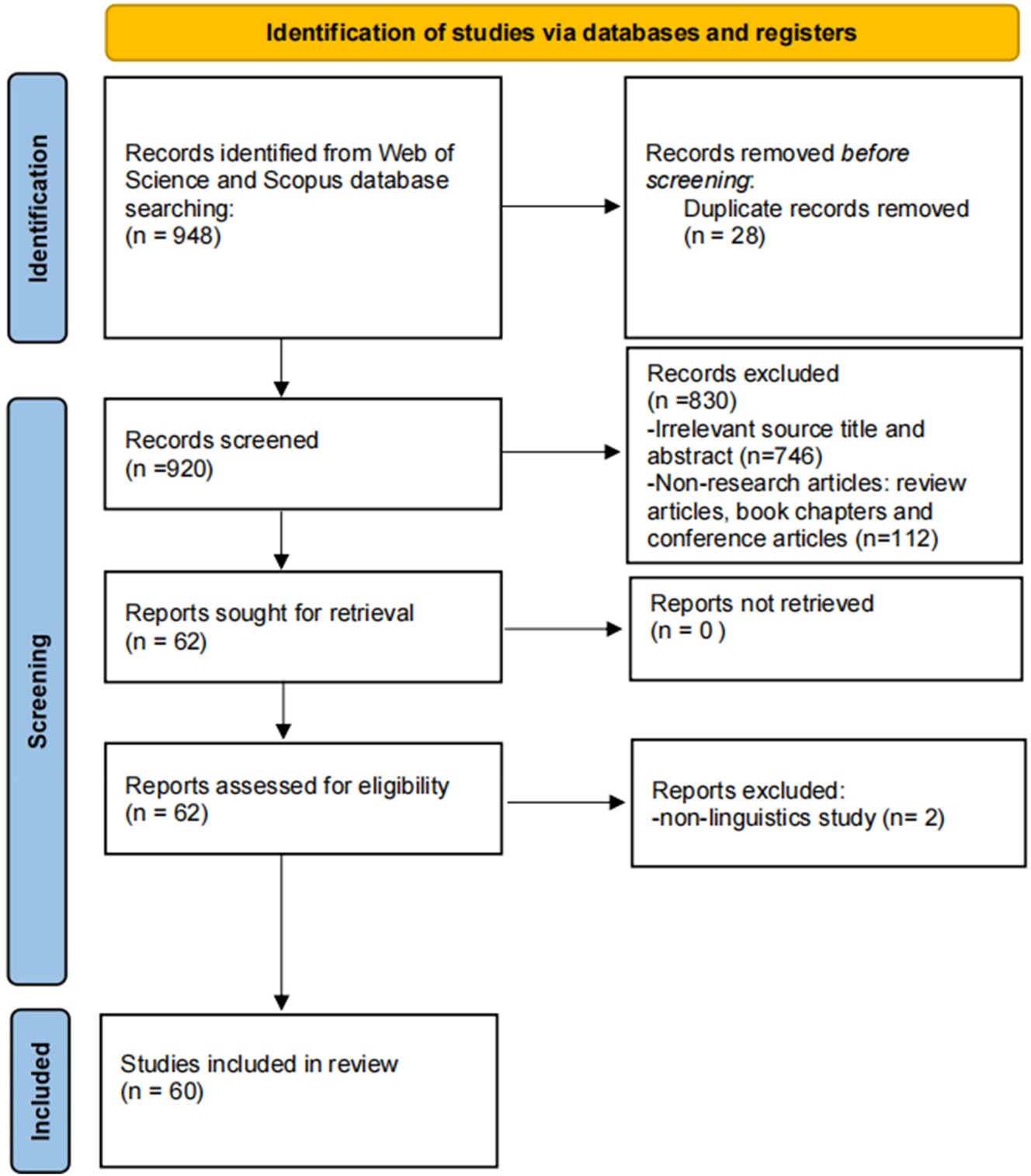
The systematic searching process.
2.3.1 Identification
The identification begins with the literature search. The key search term and its variants or synonym phrases were used in searching. In this research, the key search term was < ecological discourse analysis > and it was developed based on research questions and previous academic articles.
As illustrated in Table 1, this study enhanced several key terms by searching relevant publications in the databases of WoS and Scopus. They are both subscription-based platforms offering access to extensive databases and comprehensive citation information across a broad spectrum of disciplines. Numerous researchers chose them because all journals in these two databases undergo a stringent editing process, which ensures the article quality as well as the impact factor rankings of publications (Abas 2023). Since the number of articles in the databases has changed at various times, there is an acknowledgement that the data in this review was extracted from WoS and Scopus on January 15, 2024.
Searching condition.
| Database | Key terms | |
|---|---|---|
| Web of science | TOPIC: (ecological discourse analysis) | |
| Refined by | TOPIC | <study on ecological discourse OR research on ecological discourse> AND <linguistics OR ecolinguistics> |
| Time | Publication years: From 2014 to 2023 | |
| Language | English | |
| Scopus | TITLE-ABS-KEY: (ecological AND discourse AND analysis) | |
| Refined by | OR <study AND on AND ecological AND discourse> OR <research AND on AND ecological AND discourse> AND <linguistics OR ecolinguistics> |
|
| Time | Publication years: From 2014 to 2023 | |
| Language | English | |
After searching these databases, a comprehensive examination of all 948 articles was conducted to eliminate the duplicated records by using Microsoft Excel and manual checks. After this stage, a final count of 920 articles was left. Subsequently, the remaining 920 papers underwent the next procedure, screening.
2.3.2 Screening
The second stage is screening. According to PRISMA 2020, there are three steps in the screening procedure:
First of all, records are screened. In this step, the authors individually check article titles and the corresponding abstracts of the searched 920 papers. After comparing each person’s selection and discussion where necessary, 830 articles were excluded. There are two reasons to exclude these studies: (1) 746 articles are irrelevant to this research by looking at their titles and abstracts, and they focused on psychology, economics, sociology, education, communication and ecology not ecological discourse in linguistics field; (2) non-research articles, including review articles, book chapters and conference articles, are not included, and the number is 112. Therefore, 62 articles were through for the retrieval step.
The second step is to make reports sought for retrieval. The selected 62 articles in the above step are used for retrieval. The third step is eligibility. After browsing the whole article, 2 articles are not involved with linguistics, so they are excluded. Finally, 60 are included in the review.
2.3.3 Included data and quality appraisal
The selected 60 articles were reported as the data for this SLR. These articles with source information were collected in a repository.[1]
To ensure the accuracy of the data, two experts who are familiar with both ecolinguistics and SLR were invited. They checked the articles selected from WoS and Scopus twice, including the processes of identification and screening.
2.4 Data abstraction and analysis
This research primarily employed thematic analysis, with scientometric analysis serving a complementary role. They were employed to reveal the status and the trend of the studies of ecological discourses in ecolinguistics.
Thematic analysis is an extensively favoured approach in its efficacy of discovering and deciphering themes or patterns within qualitative datasets (Naeem et al. 2023). According to Braun and Clarke (2006), thematic analysis can be utilized to identify themes by clustering, counting, noting patterns, as well as observing similarities and relationships in abstracted data. This method has been well applied in previous SLR studies (e.g. Abas 2023; Abas et al. 2022). We used this method to explore the approaches and thematic topics in the selected articles.
Scientometric analysis in this research was a minor supplement to thematic analysis. We depicted knowledge mapping with the auxiliary analysis tool, VOSviewer. This bibliometric tool can visualize networks of relationships among authors, clusters, institutions, references, terms, etc. It is a powerful and advanced tool for depicting scientific knowledge mapping in scientometrics (Shen et al. 2023). This method also allows one to visualize the evolution of research over time (Nakagawa et al. 2019). In this analysis, due to the relatively limited number of articles, VOSviewer was only utilized to demonstrate the spatial distribution and international co-authorship, as well as to reveal the development of keywords in the selected articles.
3 Results
3.1 The overall description
3.1.1 The spatial and temporal distribution of selected articles
After the systematic selection process, the qualified data comprise a total of 60 articles, covering EDA-related studies from 25 countries worldwide (as demonstrated in Figure 2). According to the result analyzed by VOSviewer, the country which possessed the largest number of articles was China with 21, and it is followed by the United Kingdom (6 articles) and Canada (5 articles). The number of articles that contribute to EDA was the same in Australia, Italy, and the United States, with 3 ones. In addition, Austria, Germany, India, Indonesia, Malaysia, Netherlands, and Ukraine had 2 articles respectively.
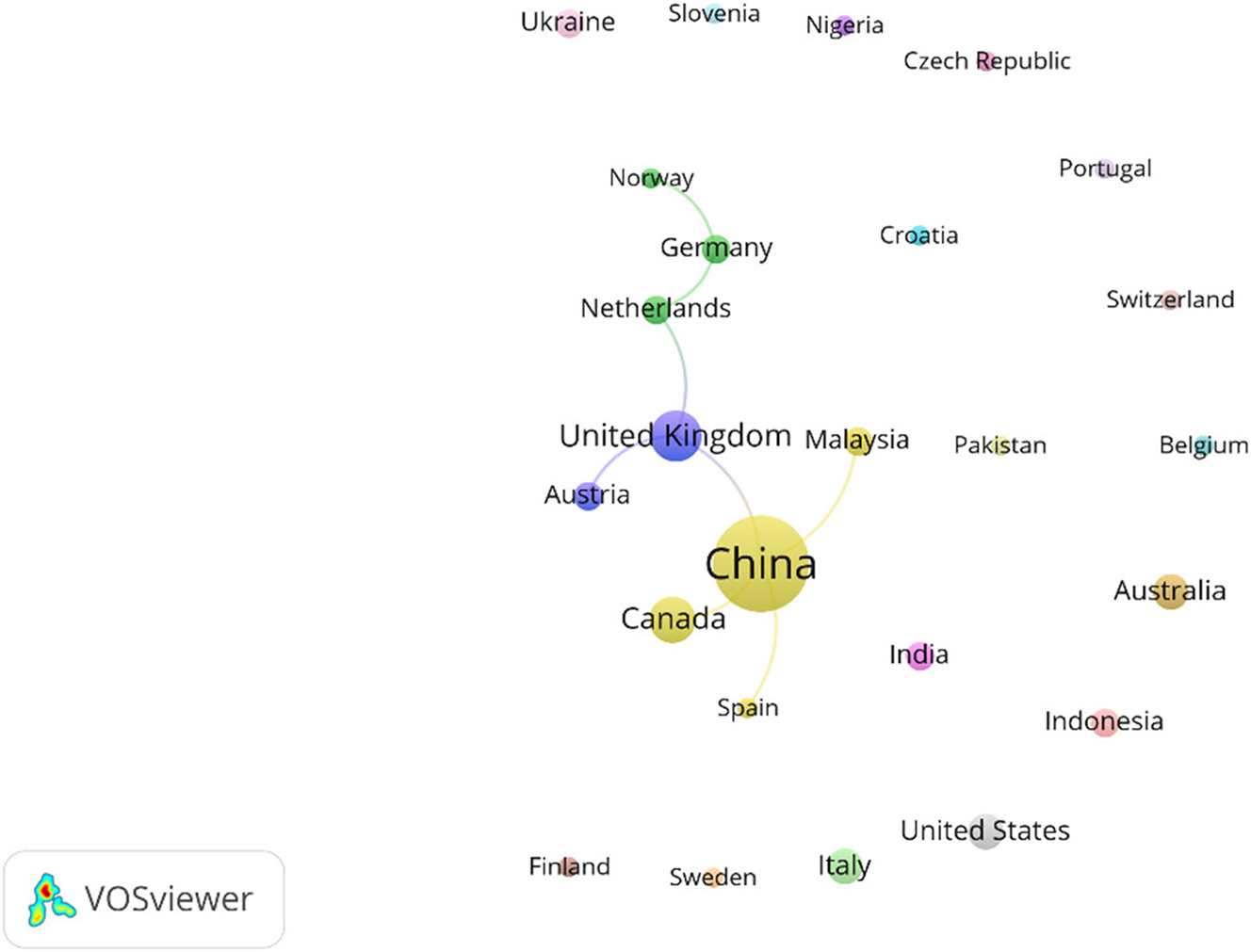
The spatial distribution and coauthor relationship (a).
Concerning the coauthor relationship, China also had the most cooperative authors with other countries in EDA, and their cooperative researchers included those from Canada, the United Kingdom, Spain, and Malaysia, as shown in Figure 2. UK researchers had the second highest number of collaborations with other countries, which were Austria, China, and the Netherlands, as shown. Other countries where international collaborative research has emerged include Germany and the Netherlands, as well as Germany and Norway. In this case, 9 countries out of 25 demonstrated co-authorship, occupying over a third.
With reference to the temporal distribution (as demonstrated in Figure 3), the 60 articles included were distributed starting from January 2014 to December 2023. Overall, the number of EDA demonstrated an upward trend. In the first five years (between 2014 and 2018), there were fewer studies since the number of articles were below 5 on average. In 2019, the number of published articles increased to 7. Afterwards, the results demonstrated an increased interest in EDA. The number of research increased dramatically during the latter half of the decade, reaching to 14 articles in 2021 and 18 ones in 2023 although there was a drop in 2020.
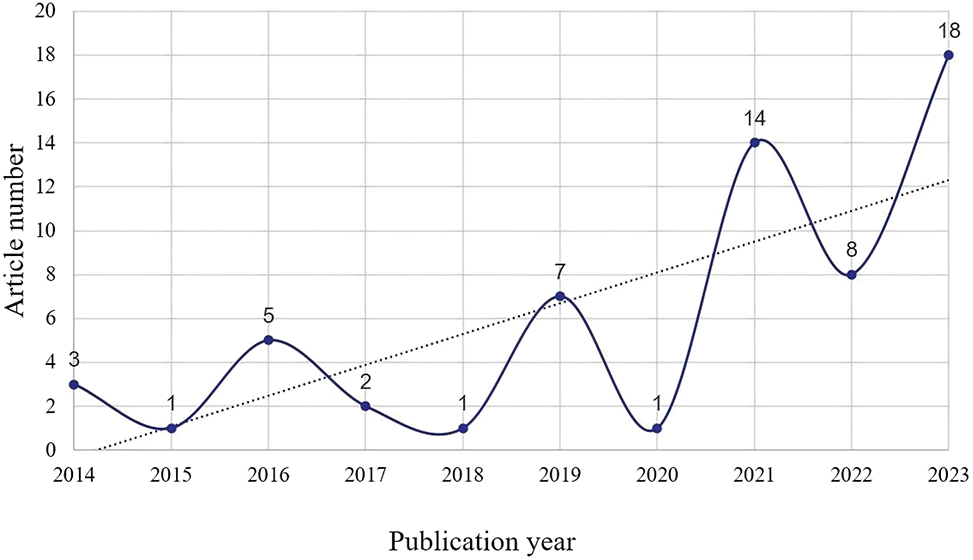
The temporal distribution of selected articles.
3.1.2 Source journals
As demonstrated in Figure 4, language-related journals have published more on EDA. Journal of World Languages took the lead, with 5 articles (taking 8 %), while Text & Talk and Theory and Practice in Language Studies published 4 articles (7 %) respectively from 2014 to 2023. They are followed by journals of interdisciplinary research (with 3 articles each), including Environmental Communication – A Journal of Nature and Culture and Journal of Language Teaching and Research. In addition, Journals of Critical Discourse Studies, Frontiers in Psychology, Language Sciences, and Linguistics and the Human Sciences take an equal percentage of 3 % separately.
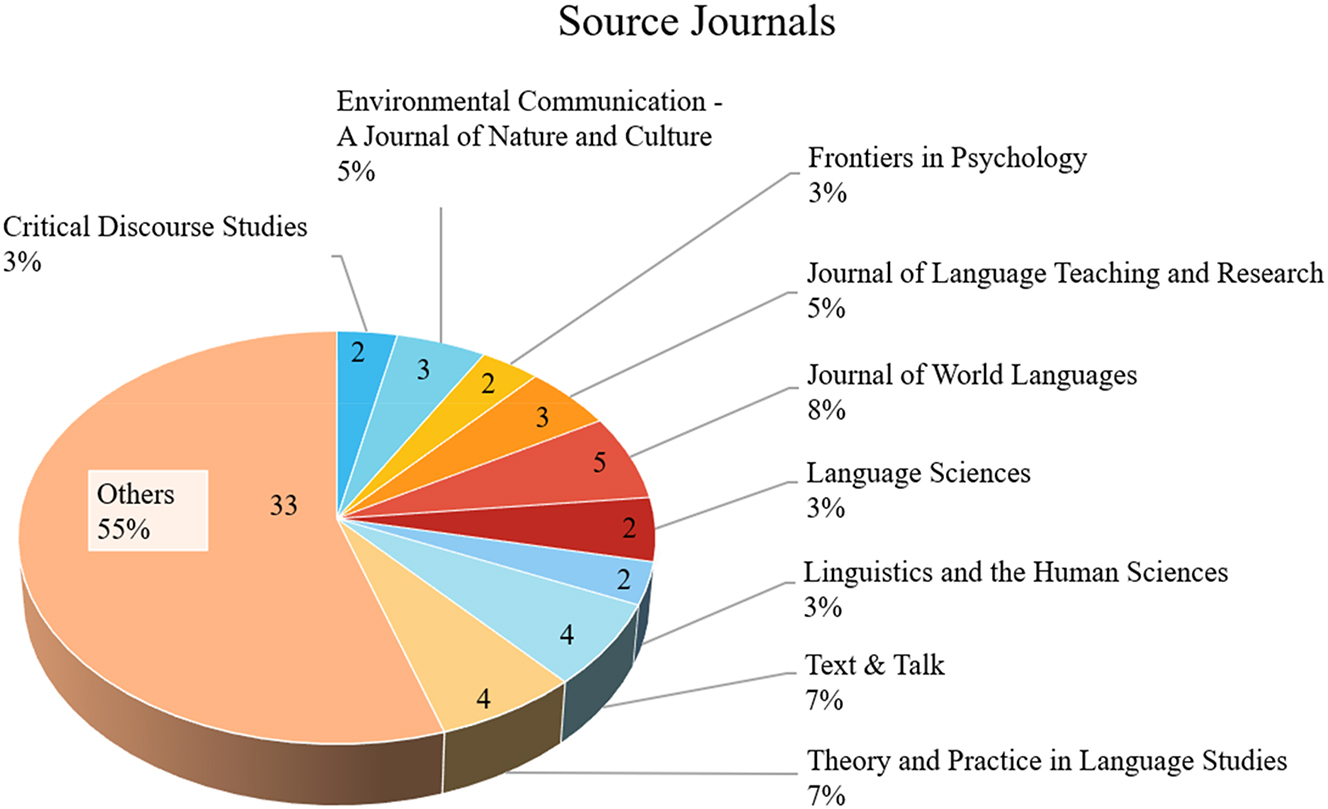
The source journals publishing articles on EDA.
There is a category of journals named others, which refers to those that have published less than 2 articles related to EDA. For example, some journals, such as Chinese Journal of Applied Linguistics, Children Literature in Education, Language and Literature, Pragmatics and Society, and Social Semiotics, also include papers on EDA, but only one article appeared in one of them in the past decade, so these journals were classified as others.
3.1.3 The overlay visualization of EDA
VOSviewer was aided in analyzing 2the general trend of research in the selected journal articles. Since the number of articles was not large, the frequency of co-occurrence of author keywords was selected as twice and above. Figure 5 exhibited an overlay visualization of the selected articles in the systematic review, and it is depicted based on average published years. The yellow shades represent the latest research. Concerning the size of the circle, the more related studies are associated with it, the larger the size and vice versa.
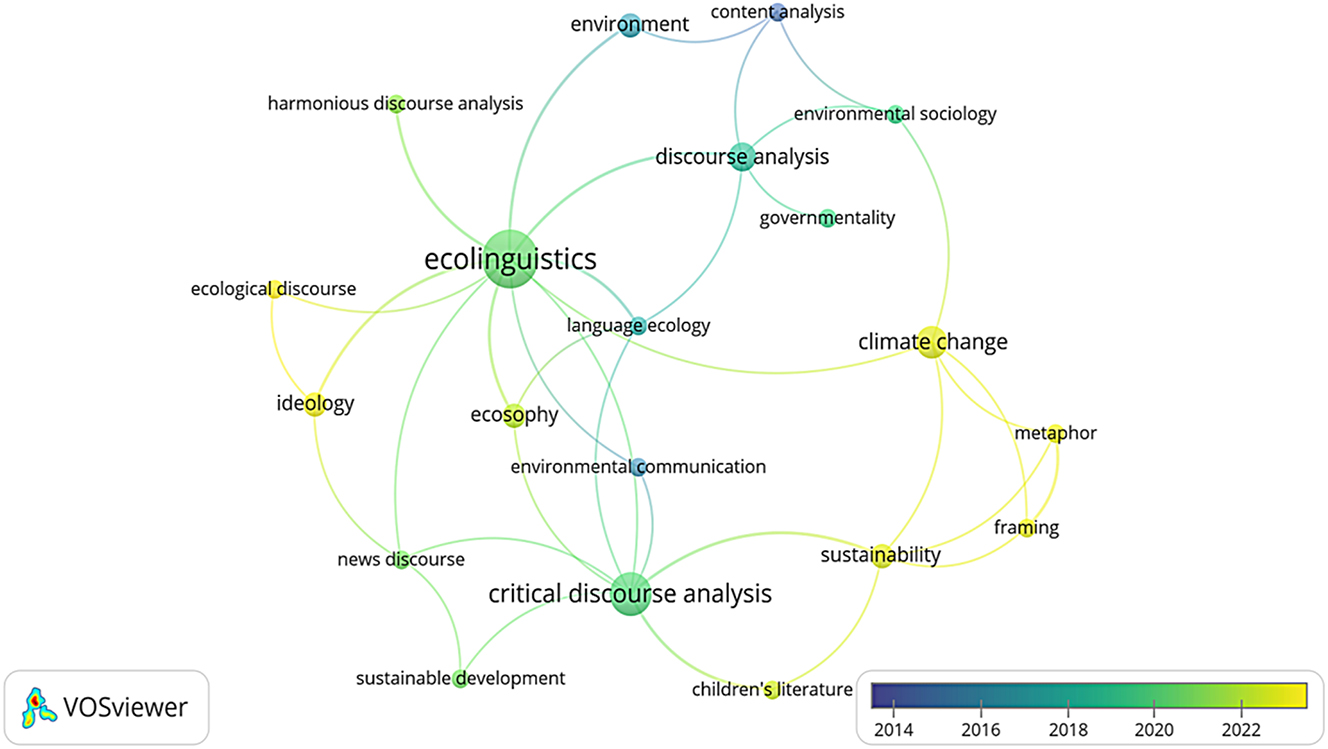
The overlay visualization of keywords in the selected articles.
From 2014 to 2018, scholars primarily concentrated on topics such as environmental sociology, the environment, and the research method of content analysis. Between 2019 and 2022, the research volume increased, and more studies on ecological discourse were around the harmonious discourse analysis and language ecology of ecolinguistics, as well as the critical discourse analysis on news discourse and sustainability. In recent years, EDA on the topic of climate change has gained most widely attentions from analysts (e.g. Hase et al. 2021; Koop-Monteiro et al. 2023; Plastina 2022; Stoddart et al. 2016), particularly regarding its metaphors and framing. In addition, there has been growing interest in the ideology and ecosophy of discourse (e.g. Vaishali and Rukmini 2021; Zhang and He 2021) and children’s literature (e.g. Khan and Zeb 2023; White et al. 2021) although studies on these aspects were still limited.
3.2 Thematic analysis
3.2.1 Research themes
As demonstrated in Figure 6, a total of 14 themes related to EDA have been published in Journals of WoS and Scopus, namely, theory/research approach, news coverage, literature, feedback, language on social media, textbook, political document, report, website advertising, debate, film discourse, leadership commentary, as well as others. Others refer to themes that appear less than twice. In general, the research topics covered a diverse range, and the results of the distribution were relatively average.
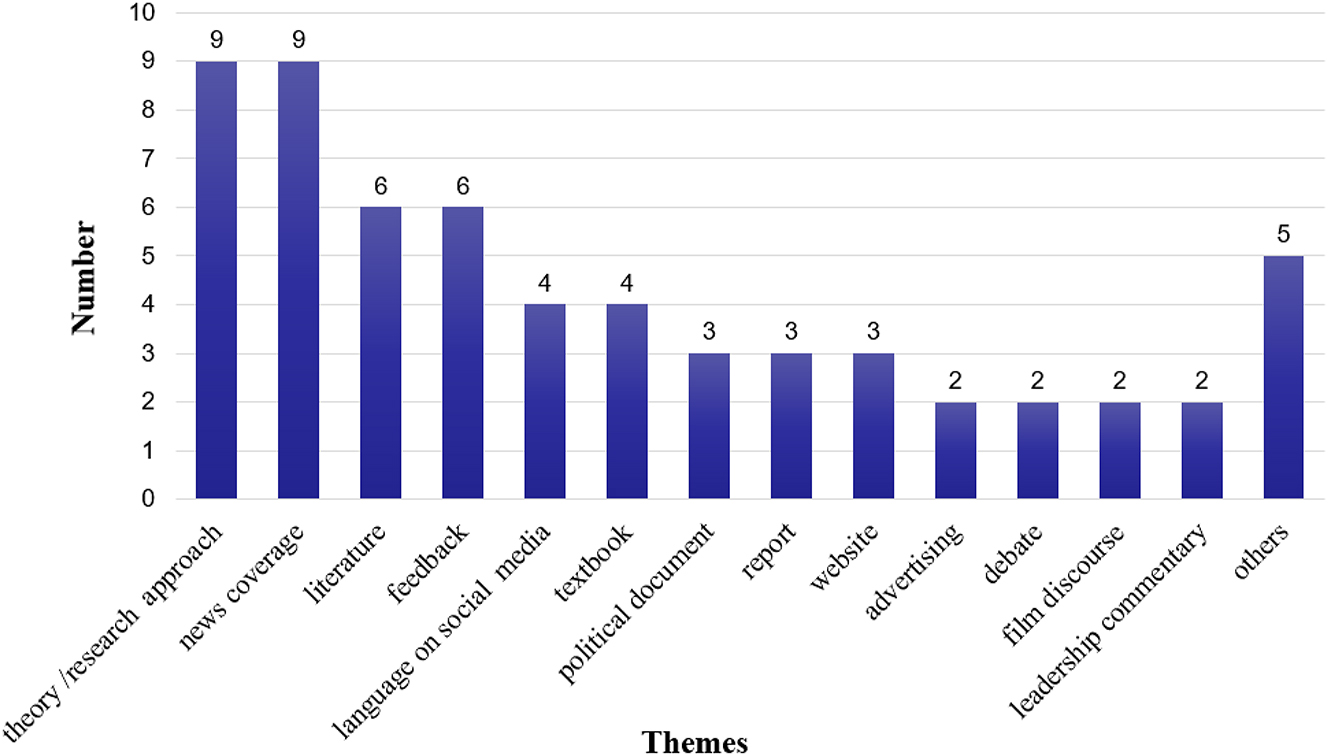
Research themes in the selected articles.
To be specific, both themes of “theory/research approach and news coverage” and “news coverage” took the largest number (with 9 articles). Considering the theory/research approach, it included proposing the research method on EDA (e.g. Huang and Zhao 2021; Stibbe 2014), constructing the analytical framework (Wei 2021), and exploring the linguistic philosophy (ecosophy) (Vaishali and Rukmini 2021). Regarding news coverage, it covered the discourses of climate change (Hase et al. 2021; Stoddart et al. 2016), sustainability (Litofcenko et al. 2023; Yacoumis 2018), ecological events (Mesikämmen et al. 2020; Xiong and Wang 2023), political news report (Zhang et al. 2023), news report of Covid-19 (Xue and Xu 2021), and the selected ecological news (Yuan 2023).
The third frequent studies were on literature (with 6 articles), such as children’s books (Khan and Zeb 2023; White et al. 2021), poetic discourses (Ononye and Chiluwa 2023; Zuo 2019), Portuguese literature (Lopes-Fernandes et al. 2016), and Croatian Renaissance literature (Galić Kakkonen and Mihaljević 2023). The ecological discourse research on feedback also had 6 articles, including multi-faith scholars and leaders who are environmentally active (Boettcher 2021), interviews with forest owners (Takala et al. 2019), and questionnaires of learners’ feedback (Roccia and Iubini-Hampton 2021). The next categories were concerned with the language in social media discourse (e.g. Bhattacherjee and Sinha 2024; Koop-Monteiro et al. 2023) and textbook (e.g. Sharma and Buxton 2015; Song and Perry 2023), with each of them having 4 articles. Ecological discourse studies focusing on political documents, reports, and websites were comparatively less, each comprising 3 articles. Additionally, discourses within advertising, debates, film, and leadership commentary were also considered as research corpora, each represented by 2 articles.
3.2.2 Research approaches
Table 2 presents the research approaches employed in EDA over the past decade. The methods exhibited diversity, predominantly leaning towards qualitative research. Notably, 13 selected articles employed multiple analytical frameworks/methods. However, for clarity in statistical representation, these instances were not categorized as multiple analyses but were counted individually. Consequently, the total sum in the percentage column of Table 2 exceeded 100 %.
Research approaches used in EDA.
| No. | Research approaches | Number | Percentage |
|---|---|---|---|
| 1 | Critical discourse analysis | 19 | 31.67 % |
| 2 | Theoretical exposition | 9 | 15.00 % |
| 3 | Corpus discourse analysis | 9 | 15.00 % |
| 4 | Eco-critical discourse analysis | 8 | 13.33 % |
| 5 | Content analysis | 5 | 8.33 % |
| 6 | Multimodal discourse analysis | 4 | 6.67 % |
| 7 | Foucauldian discourse analysis | 3 | 5.00 % |
| 8 | Comparative analysis | 2 | 3.33 % |
| 9 | Metaphor analysis | 2 | 3.33 % |
| 10 | Multimodal critical discourse analysis | 2 | 3.33 % |
| 11 | Others | 16 | 26.67 % |
Most of the articles adopted the critical discourse analysis although a variety of analytical approaches were used, as illustrated in Table 2. Specifically, critical discourse analysis appeared 19 times (e.g. Stibbe 2014; Stradling and Hobbs 2023; Takala et al. 2019; White et al. 2021; Yacoumis 2018), and this number took 31.67 %. It was followed by theoretical exposition (e.g. Huang and Zhao 2021; Law and Matthiessen 2023; Zou 2021) with 9 articles (16.67 %), and corpus discourse analysis (Frayne 2022; Istianah and Suhandano 2022; Poole 2016; Stradling and Hobbs 2023) with 9 articles (15.00 %).
The frequency of 13.33 % was taken by eco-critical discourse analysis, which was utilized by researchers like Zhang et al. (2023) and Xiong (2014), while content analysis had the percentage of 8.33 %, and it was mentioned by scholars like Stoddart et al. (2016), Takala et al. (2019), and Hase et al. (2021).
Compared to previous research, content analysis, multimodal discourse analysis, Foucauldian discourse analysis, comparative analysis, metaphor analysis and multimodal critical discourse analysis were less frequently used, with each of them taking up 8.33 %, 6.67 %, 5.00 %, 3.33 %, 3.33 %, and 3.33 % respectively.
Research approaches of others refer to those which appeared only once, including: building semantic association network model, cognitive analysis, diachronic discourse analysis, dictionary-based analysis, ecocriticism, ecolinguistic discourse analysis, ecostylistic analysis, frame discourse analyses, harmonious discourse analysis, multilevel analysis, panel analysis, path analysis, positive discourse analysis, sociology-of-knowledge discourse analysis, topic modelling, as well as visual and discourse network analysis. These expressions of research methods were mentioned by the authors in their articles.
4 Discussion
4.1 The overall research status
After the systematic review, 21 of the articles are from China, and the number takes over a third of the total selected articles. Considering the international co-authorship, China also stands out as the country fostering the highest number of collaborative relationships with other nations. There are 9 articles involving international author collaboration, and 4 of them involve Chinese authors. In this sense, EDA in the ecolinguistics field has acquired more attention from Chinese researchers. This may be attributed to China’s increasing recognition of ecological conservation and its strategic efforts in this aspect. Significant progress in studies on EDA in China has been witnessed (He et al. 2021). As China consolidates its global stance on climate initiatives (Liu et al. 2018), a political strategy of ecological civilization has been put forward to emphasize the coexistence between humans and nature alongside economic development (Song et al. 2023). Protecting the ecosystem has become one of China’s national policies in recent decades, especially in recent years. China has already promoted the policy to construct a modern ecological civilization (Song and Perry 2023).
While EDA experienced an obvious increase between 2014 and 2023, its reach was confined to just 25 countries globally. Notably, only China, the UK, Canada, the USA, Italy, and Australia had article numbers exceeding 3, underscoring the relatively limited scope. Meanwhile, cross-border collaborations among different states were notably scarce. Therefore, it is recommended that EDA is suggested to be undertaken by researchers in regions with little research, and more authors from different countries can cooperate more closely. After all, protecting our ecosystem calls for global action and focusing on the ecological language as well as its impact also plays an important role. The humanities should emphasize the duty to the bio-ecology (Cowley 2018). We need to explore the eco-beneficial influence of discourses to protect the ecosystem (Stibbe 2024).
Concerning the latest trend, climate change has become a widespread concern in recent years (as discussed in Section 3.1.3). EDA related to climate change have been discussed from various aspects, such as the metaphor in climate change discourses (Flusberg and Thibodeau 2023), prevalent resource-framing of animals in climate change discourse (Koop-Monteiro et al. 2023), themes and focuses of climate change coverage (Hase et al. 2021), discourses of famous environmentalist leaders (Plastina 2022), as well as the systemic functional linguistics approach to deal with discourses related to climate change (Law and Matthiessen 2023). It is the responsibility of ecolinguistics analysts to shift their efforts to analyzing discourses with climate change topics. Human-induced climate change has resulted in significant harm and irreversible damage to ecosystems and human lives, so immediate collective action is imperative to tackle these challenges (United Nations 2023). As life and language progress, humans bear a responsibility to care for all living beings in the world (Cowley 2018). In addition, Children’s literature was also found in the latest investigations on EDA (e.g. Khan and Zeb 2023; White et al. 2021) but with very limited attention. Language constructs the ecological experience of the world and exerts influence on people’s values. In this case, the texts which can be influential in children’s world values are worth noticing (Law and Matthiessen 2023).
4.2 The discussion on thematic analysis
4.2.1 Research themes
Based on the results in Section 3.2.1, one of the most frequent themes of EDA is the “theory/analytical approach”. This indicates that linguistic scholars have persisted in exploring ecological discourse studies via multiple dimensions in the past decade. They strive to put forward approaches and diversity in the research of ecolinguistics to deal with ecological discourse, such as proposing ecological discourse analysis (Stibbe 2014) and harmonious discourse analysis (Huang and Zhao 2021). Additionally, Zou (2021) and Zhang et al. (2021) add the dimension of people’s cognition into ecological discourse study, which is achieved by melting the conscious operational opposite-unity cognition procedure (Zou 2021) and landsenses ecology and Maslow’s hierarchy of needs (Zhang et al. 2021) into linguistics approach. They proposed new approaches to accentuate the multidimensional nature of EDA. Since EDA highlights interpreting the relationship between language and its impacts ecologically, it is necessary to consider other disciplines. As Cowley (2018) indicates, by collaborating ecolinguistics with ecological psychology and other disciplines, we can enhance people’s consciousness regarding the interconnectedness between humans and bio-ecology.
Moreover, some analysts probed into the ecosophy or philosophical framework in language analysis. The examination of ecosophy was highlighted as the latest trend in EDA, as depicted in Figure 5, the overlay visualization of keywords in selected articles. Vaishali and Rukmini (2021) explored the linguistic philosophy of Tholkappiyam, which is an ancient linguistic treatise, delving into the connection among culture, ecology, and language through the Tinai theory. Despite the predominantly Western roots of ecolinguistics, the linguistic philosophy of Tholkappiyam has the same potential as ecolinguistics study (Vaishali and Rukmini 2021), so they assess the Tinai framework to highlight its capability in ecolinguistics studies. Zhang and He (2021) proposed a philosophical framework for ecolinguistics by adopting both the shared criteria in Chinese schools of philosophy and the Western human geographical concept of a sense of place. They want to create a solid foundation for analyzing and evaluating linguistic resources, contributing to the essential strand of ecolinguistics research. Just as Huang and Zhao (2021) state, to assess the ecological value of language, we should look beyond Western philosophies and explore the interplay between Eastern and Western thoughts. Researchers are encouraged to identify or establish beneficial ecosophy for evaluating discursive ideologies (Stibbe 2021).
In addition, the wide focus on “news coverage” indicates scholars’ attention to the ecological impact of this discourse genre. Conducting ecological analysis of news discourses can unveil how they construct social issues as well as influence the recognition of individuals or policy makers ecologically. According to Mesikämmen et al. (2020) and Van Dijk (2000), news media shape social reality by wielding discursive power, influencing issue agendas and public discourse. Meanwhile, in today’s interconnected media-society landscape, deciphering how news frames key social issues is crucial for researchers and policymakers tackling these challenges (Yacoumis 2018).
When conducting a more in-depth analysis of the latest trend (in Section 3.1.3) and themes (in Section 3.2.1), we found that a relatively small number of studies were concerned with analysis of ecological discourse, while a majority of them were the ecological analysis of discourse. There were 12 of them delving into discourses with environmental-related topics (ecological discourse). Certain academics delved into the ecological discourse in literature, including the nature poetry of Dickinson (Zuo 2019), the representations of wolves in Portuguese literature (Lopes-Fernandes et al. 2016), the environmental devastation constructed in children’s literature (Khan and Zeb 2023), the Croatian Renaissance text of Petar Zoranic’s Planine (Galić Kakkonen and Mihaljević 2023), the Niger Delta poetry (Ononye and Chiluwa 2023), the ecostylistic analysis on two lectures delivered by John Ruskin about The Storm-Cloud of the Nineteenth Century (Virdis 2022). Apart from EDA in literature, Flusberg and Thibodeau (2023) delved into the metaphors in environmental discourse, and Ponton (2022) examined the websites promoting a nature reserve. Meanwhile, scholars (e.g. Hase et al. 2021; Koop-Monteiro et al. 2023; Plastina 2022; Stoddart et al. 2016) also investigate discourses with climate change topics. The discussions on the ecological discourse can contribute to understanding human relations with the natural world (Galić Kakkonen and Mihaljević 2023; Lopes-Fernandes et al. 2016) and provide ways to environmental protection and ecological restoration (Ponton 2022). Realizing the meaning of ecological discourse, language can be critically used to create a more sustainable society (Khan and Zeb 2023).
Apart from the aforementioned research, most themes are related to the ecological analysis of discourse, emphasizing how discourses reflect certain strategies or political views ecologically, influence readers’ ecological actions, and whether the analyzed discourses convey positive or negative ecological ideologies. This indicates the main focus of EDA lies in interpreting the ecological influence of language. As Penz and Fill (2022) state, EDA is not just restricted to analyzing the environmental discourse. The ecological analysis of discourses would be the main focus of ecolinguistics (Alexander and Stibbe 2014). These discourses may cover a wide range of registers, such as political discourse, news coverage, discourse on social media, and talk shows (Law and Matthiessen 2023).
4.2.2 Research approaches
As demonstrated in Section 3.2.2, critical discourse analysis (CDA) was the most popular approach. When conducting ecological discourse, the critical approach can be used to unveil the ecological ideology within discourses. CDA has been utilized to investigate environmental discourses from the late 1990s onward, aiming to uncover the power relationships and ideologies in society (Penz and Fill 2022). When examining ecological discourse, CDA can be used to reveal the hidden ideology in discourses (Stibbe 2014).
In addition, some researchers (e.g. Huang and Zhao 2021; Xiong and Wang 2023; Zhang et al. 2023) employed eco-critical discourse analysis in their articles. This research approach is proposed by Arran Stibbe, the founder of the International Ecolinguistics Association (Nash 2018), who pioneered the integration of ecosophy into CDA. We can utilize eco-critical discourse analysis to discover the hidden positive or negative ecological ideology within discourses (Stibbe 2014). This approach allows scholars to assess whether the ideology embedded in discourse is ecologically beneficial or not. By analyzing the ideology or values within discourse under a certain ecosophy, we can judge whether the language is ecologically beneficial or destructive (Stibbe 2021).
Additionally, corpus discourse analysis was frequently employed, incorporating both corpus-based and corpus-driven methods upon further examination. Researchers (e.g. Frayne 2022; Gilquin 2022; Xiong and Wang 2023) adopted a corpus-based research method to conduct EDA. However, different from the above studies, Roccia and Iubini-Hampton (2021) built an assessment model based on readers’ feedback to measure the ecological influence induced by an ecolinguistics course online. Although they did not mention the term “corpus approach”, their research was assisted with a corpus-driven approach. In this sense, corpus discourse analysis has been employed in investigating ecological discourse from different perspectives. The approach of corpus discourse analysis can offer an objective demonstration of the linguistic features of the selected discourses. According to Alexander (2018), research based on corpus can reveal that specific linguistic features carry significant weight. In this context, corpus research approaches are deliberately employed to avoid confirmation bias, as emphasized by Frayne (2022). This ensures a more robust and unbiased exploration of linguistic features.
Regarding the multimodal approach of EDA, 4 articles utilized multimodal discourse analysis, and 2 articles referred to multimodal critical discourse analysis. They are mainly concerned with textbooks (Song and Perry 2023; Triyono et al. 2023), websites (Chen and Gunster 2016; Ponton 2022), advertising (Liu and Liu 2020), and animation (Ivchenko 2021). Considering the genres in their research, they are typical multimodal discourses, with predominant verbal and visual modes to construct semantic meaning. When a discourse involves different modes, they should be examined as a whole. This can avoid discrepancies between the meaning conveyed by monomodal discourse and multimodal discourse. The ecological ideology also needs the contribution of multimodal resources in discourse. As Song and Perry (2023) elucidate, the semantic meaning and its reflected ideology by multimodal resources may be different from that of the single text or image.
4.3 Research recommendations
Much as the research themes cover a wide range, they are mainly concerned with print discourses, with videos getting little attention. Two ecological discourse investigations on advertising by Chen (2016) and Liu and Liu (2020) involve video discourses. In addition, there are two studies relating to films conducted by Ivchenko (2021) and Soloshchuk and Skrynnik (2022). However, Soloshchuk and Skrynnik’s (2022) analysis only involves the texts of dialogic fragments, which are from the film scripts and fiction in the 20th and 21st centuries, so this research only focuses on the text features not the videos. In this case, so scarce is the focus on scrutinizing the ecological meaning of videos that it demands researchers’ attention. This digital age witnesses a surge in videos, driven by the dominance of social media and the internet for information and entertainment. Video discourses provide a more vivid description of the content compared with print forms. The visual movement of short videos offers a more diverse and vivid portrayal of reality than still images (Powell et al. 2018). Meanwhile, visual images may convey certain ecosophy to influence individuals’ ecological ideology (Song and Perry 2023). It is worthwhile to explore the eco-narratives in films as well as how they affect viewers’ attitudes towards ecology by applying linguistics and rhetoric features (Stibbe 2024). In this case, a gap has emerged: the ecological discourse analysis on video discourses. This can be bridged by future research in ecolinguistics.
Moreover, the genres with multimodal features are not confined to advertising, textbooks with image resources, and animation. There is extensive news coverage that incorporates visual resources, such as illustrations or videos, alongside the written content, but most researchers (e.g. Hase et al. 2021, Xiong and Wang 2023; Yuan 2023; Zhang et al. 2023) have scrutinized only the ecological meaning of the texts. This research suggests that future research can increase their focus on how different resources like images, text, colour, sound, etc. represent their ecological meaning in news coverage. After all, the meaning of today’s media discourse is not entirely embodied by language itself, but by integrating multimodal resources like images, colour, sound, and gesture simultaneously (Van Leeuwen 2022), especially in this digital age when the advancement of modern new media has turned multimodal discourses to be very common. Without incorporating multimodal discourse research, the analysis of contemporary discourse would be incomplete (Teo 2021). This is the same circumstance with the research on ecological discourses. Just as Penz and Fill (2022) accentuate, researchers in ecolinguistics will also extend their methodology by adopting the multimodal approach.
Furthermore, since EDA includes not only the investigation of ecological discourse (Penz and Fill 2022) but also the ecological impact of discourses (Alexander and Stibbe 2014; Stibbe 2021), it may contain interdisciplinary approaches. The source journals with an interdisciplinary nature show the articles of EDA with 13 %. Meanwhile, nearly a quarter of ecological discourse studies include the multiple-method. In addition to linguistic analysis, they also relate to cognitive psychology (e.g. Liu and Liu 2020; Zhang et al. 2021; Zou 2021), philosophy (Vaishali and Rukmini 2021), literature (Galić Kakkonen and Mihaljević 2023), and ecology (Zhang et al. 2021). In this sense, this variety in analytical approaches highlights the interdisciplinary nature of ecological discourse study, and the multiple-approach is worth focusing on for future research. As Penz and Fill (2022) point out, ecolinguistics has consistently valued the diversity of approaches and methodologies employed in the field. Therefore, understanding the relationship between ecological discourse and its impacts or how discourses deliver ecological meaning goes beyond a single research method.
4.4 Advantages and limitations
This research provides a comprehensive summary and synthesis of the studies on ecological discourse within the linguistics field from 2014 to 2023. Through a systematic review of the included academic articles, we present an overview of the research status, themes, and analytical approaches to EDA. Therefore, our review contributes to the study of ecolinguistics. However, it also has its limitations. Our literature review was confined to research articles in the WoS and Scopus databases, excluding book chapters and conference papers. Future research aiming for a more comprehensive understanding may consider expanding the selection of databases and article types.
5 Conclusion
The SLR offers a comprehensive overview of the ecological discourse analysis in ecolinguistics (2014–2023), addressing the research status, approaches, and themes. It identifies gaps and proposes future research directions in this field, so this review has achieved its research aim. We recommend that researchers give attention to video discourses and engage in multimodal discourse studies to explore how various modes of communication impact ecological perceptions. Additionally, there should be more focus on topics of climate change and children’s literature. Given the complexity of ecolinguistics, which encompasses not just the analysis of language’s characteristics and rules but also its relationship with ecology, ecosophy, and individuals’ ecological awareness, it is recommended to employ a multidisciplinary approach in ecological discourse research, integrating various research methods from different fields.
In the future, linguistic scholars are expected to enhance international cooperation to explore a wider variety of ecological discourses, encompassing both the ecological representations in discourses and the ecological impacts of discourses. Human activities have led to significant harm and damage to ecosystems, so we need to raise our awareness of ecological protection. As society progresses and language develops, we have the responsibility to care for the ecosystem. Language is important in shaping individuals’ awareness and attitudes towards the physical environment. Therefore, it is essential to understand language and its influence on people’s actions in the ecosystem through ecological discourse analysis.
Acknowledgments
We are greatly indebted to the editor’s timely communication and three anonymous reviewers’ valuable suggestions.
References
Abas, Azlan. 2023. A systematic literature review on the forest health biomonitoring technique: A decade of practice, progress, and challenge. Frontiers in Environmental Science 11. https://doi.org/10.3389/fenvs.2023.970730.Search in Google Scholar
Abas, Azlan, Azmi Aziz & Azahan Awang. 2022. A Systematic review on the local wisdom of Indigenous people in nature conservation. Sustainability 14(6). https://doi.org/10.3390/su14063415.Search in Google Scholar
Al-Shboul, Othman K. 2023. The politics of climate change metaphors in the U.S. discourse: Conceptual metaphor theory and analysis from an ecolinguistics and critical discourse analysis perspective. Cham: Palgrave Macmillan.10.1007/978-3-031-19016-2Search in Google Scholar
Alexander, Richard J. 2008. Framing discourse on the environment: A critical discourse approach. London: Routledge.Search in Google Scholar
Alexander, Richard J. 2018. Investigating texts about environmental degradation using critical discourse analysis and corpus linguistic techniques. In Alwin F. Fill & Hermine Penz (eds.), The Routledge handbook of ecolinguistics, 196–210. London: Routledge.10.4324/9781315687391-14Search in Google Scholar
Alexander, Richard J. & Arran Stibbe. 2014. From the analysis of ecological discourse to the ecological analysis of discourse. Language Sciences 41. 104–110. https://doi.org/10.1016/j.langsci.2013.08.011.Search in Google Scholar
Bhattacherjee, Monalisa & Sweta Sinha. 2024. A cognitive analysis of animal imagery in digital discourse: A case study of Bengali tweets. Journal of World Languages 10(2). 401–429. https://doi.org/10.1515/jwl-2022-0055.Search in Google Scholar
Boettcher, Miranda. 2021. A leap of green faith: The religious discourse of socio-ecological care as an earth system governmentality. Journal of Environmental Policy and Planning 24(1). 81–93. https://doi.org/10.1080/1523908x.2021.1956310.Search in Google Scholar
Braun, Virginia & Victoria Clarke. 2006. Using thematic analysis in psychology. Qualitative Research in Psychology 3(2). 77–101. https://doi.org/10.1191/1478088706qp063oa.Search in Google Scholar
Cañón, Martín & Quiteria Buitrago-Gómez. 2018. The research question in clinical practice: A guideline for its formulation. Revista Colombiana De Psiquiatría (English Edition) 47(3). 193–200. https://doi.org/10.1016/j.rcpeng.2016.06.003.Search in Google Scholar
Chen, Sibo. 2016. Selling the environment: Green marketing discourse in China’s automobile advertising. Discourse, Context & Media 12. 11–19. https://doi.org/10.1016/j.dcm.2016.03.003.Search in Google Scholar
Chen, Sibo & Shane Gunster. 2016. “Ethereal carbon”: Legitimizing liquefied natural gas in British Columbia. Environmental Communication 10(3). 305–321. https://doi.org/10.1080/17524032.2015.1133435.Search in Google Scholar
Cheng, Ming. 2022. Theoretical framework for ecological discourse analysis: A summary of new developments of ecological discourse analysis. Journal of World Languages 8(1). 188–226. https://doi.org/10.1515/jwl-2021-0030.Search in Google Scholar
Cowley, Stephen J. 2018. Life and language: Is meaning biosemiotic? Language Sciences 67. 46–58. https://doi.org/10.1016/j.langsci.2018.04.004.Search in Google Scholar
Fernandes, André, Mariana Rufino, Divakar Hamal, Amr Mousa, Emma Fossett & Kamalpreet S. Cheema. 2023. Simultaneous bilateral patellar tendon rupture: A systematic review. Curēus 15(7). https://doi.org/10.7759/cureus.41512.Search in Google Scholar
Flusberg, Stephen J. & Paul H. Thibodeau. 2023. Why is mother earth on life support? Metaphors in environmental discourse. Topics in Cognitive Science 15(3). 522–545. https://doi.org/10.1111/tops.12651.Search in Google Scholar
Frayne, Craig. 2022. Corpus-based analysis of genetically modified seed discourse. Discourse & Society 33(2). 175–192. https://doi.org/10.1177/09579265211023234.Search in Google Scholar
Galić Kakkonen, Gordana & Nikica Mihaljević. 2023. On the sources and authorities inPlanineby Petar Zoranić. Zeitschrift Fur Slawistik 68(3). 465–488. https://doi.org/10.1515/slaw-2023-0023.Search in Google Scholar
Gilquin, Gaëtanelle. 2022. “I never get a thing that ain’t been used”: A diachronic corpus-based study of second-hand consumption. Journal of World Languages 8(2). 254–283. https://doi.org/10.1515/jwl-2022-0015.Search in Google Scholar
Hase, Valerie, Daniela Mahl, Mike S. Schäfer & Tobias R. Keller. 2021. Climate change in news media across the globe: An automated analysis of issue attention and themes in climate change coverage in 10 countries (2006–2018). Global Environmental Change 70. https://doi.org/10.1016/j.gloenvcha.2021.102353.Search in Google Scholar
He, Wei, Ran Gao & Jiahuan Liu. 2021. Shengtai huayu fenxi xinfazhan yanjiu [New developments in ecological discourse analysis]. Beijing: Tsinghua University Press.Search in Google Scholar
He, Wei & Zijie Ma. 2020. Shengtai yuyanxue shijiaoxia de pingjia xitong [Appraisal system from an ecolinguistic perspective]. Waiguoyu [Journal of Foreign Languages] 43(1). 48–58.Search in Google Scholar
Huang, Guowen & Ruihua Zhao. 2021. Harmonious discourse analysis: Approaching peoples’ problems in a Chinese context. Language Sciences 85. 1–18. https://doi.org/10.1016/j.langsci.2021.101365.Search in Google Scholar
Istianah, Arina & Suhandano Suhandano. 2022. Appraisal patterns used on the kalimantan tourism website: An ecolinguistics perspective. Cogent Arts & Humanities 9(1). https://doi.org/10.1080/23311983.2022.2146928.Search in Google Scholar
Ivchenko, Natalia. 2021. Comic function in the animated ecodiscourse (Case study of “Zootopia”). Theory and Practice in Language Studies 11(9). 1080–1086. https://doi.org/10.17507/tpls.1109.14.Search in Google Scholar
Khan, Mehnaz & Kainat Zeb. 2023. Corporate power, environmental devastation and children’s literature: Insights from Dr. Seuss’s The Lorax and Bill Peet’s The Wump World. Childrens Literature in Education. https://doi.org/10.1007/s10583-023-09569-1.Search in Google Scholar
Koop-Monteiro, Yasmin, Mark C. J. Stoddart & David B. Tindall. 2023. Animals and climate change: A visual and discourse network analysis of Instagram posts. Environmental Sociology 9(4). 409–426. https://doi.org/10.1080/23251042.2023.2216371.Search in Google Scholar
Law, Locky & Christian M. I. M. Matthiessen. 2023. Revisiting Halliday (1990) ‘New ways of meaning: The challenge to applied linguistics’: What has changed and what still needs to be done? Linguistics and the Human Sciences 15(3). 337–368. https://doi.org/10.1558/lhs.23599.Search in Google Scholar
Litofcenko, Julia, Andrea Vogler, Michael Meyer & Martin Mehrwald. 2023. From controversy to common ground: The discourse of sustainability in the media. Journal of Language and Politics 22(5). 661–686. https://doi.org/10.1075/jlp.22124.lit.Search in Google Scholar
Liu, Yansui, Jintao Li & Yuanyuan Yang. 2018. Strategic adjustment of land use policy under the economic transformation. Land Use Policy 74. 5–14. https://doi.org/10.1016/j.landusepol.2017.07.005.Search in Google Scholar
Liu, Shubo & Xiaoyuan Liu. 2020. Culture and green advertising preference: A comparative and critical discursive analysis. Frontiers in Psychology 11. https://doi.org/10.3389/fpsyg.2020.01944.Search in Google Scholar
Lopes-Fernandes, Margarida, Filipa Soares, Amélia Frazão-Moreira & Ana Isabel Queiroz. 2016. Living with the beast: Wolves and humans through Portuguese literature. Anthrozoos 29(1). 5–20. https://doi.org/10.1080/08927936.2015.1060056.Search in Google Scholar
McLucas, Alan S., William J. Therrien & Dawn A. Rowe. 2024. Secondary transition interventions in rural communities: A systematic literature review. Career Development and Transition for Exceptional Individuals. https://doi.org/10.1177/21651434231223435.Search in Google Scholar
Mesikämmen, Emma, Lisa Waller & Brian Burkett. 2020. Water wars: A “critical listening in” to rural radio discourse on a river system in trouble. Environmental Communication 15(3). 369–385. https://doi.org/10.1080/17524032.2020.1837901.Search in Google Scholar
Naeem, Muhammad, Wilson Ozuem, Kerry Howell & Silvia Ranfagni. 2023. A step-by-step process of thematic analysis to develop a conceptual model in qualitative research. International Journal of Qualitative Methods 22. https://doi.org/10.1177/160940692312057.Search in Google Scholar
Nakagawa, Shinichi, Gihan Samarasinghe, Neal R. Haddaway, Martin J. Westgate, Rose E. O’Dea, Daniel W. A. Noble & Malgorzata Lagisz. 2019. Research weaving: Visualizing the future of research synthesis. Trends in Ecology & Evolution 34(3). 224–238. https://doi.org/10.1016/j.tree.2018.11.007.Search in Google Scholar
Nash, Joshua. 2018. Ecolinguistics and placenames: Interaction between humans and nature. In Alwin F. Fill & Hermine Penz (eds.), The Routledge handbook of ecolinguistics, 355–364. London and New York: Routledge.10.4324/9781315687391-24Search in Google Scholar
Nursuprianah, Indah, Nursanti Anggriani, Nuning Nuraini & Yudi Rosandi. 2022. Mathematical model of interaction of therapist and patients with bipolar disorder: A systematic literature review. Journal of Personalized Medicine 12(9). https://doi.org/10.3390/jpm12091469.Search in Google Scholar
Nutsugah, Noel, Eva Kuupuolo & Theophilus Peculiar. 2024. A systematic review of social media research in Ghana: Gaps and future research avenues. Annals of the International Communication Association 48(2). 167–181.10.1080/23808985.2024.2323739Search in Google Scholar
Ononye, Chuka F. & Innocent Chiluwa. 2023. “There’s still something positive about the Niger delta ecology”: Metaphor and ideology in the Niger delta poetic discourse. Language and Literature 32(3). 275–296. https://doi.org/10.1177/09639470231158694.Search in Google Scholar
Page, Matthew J., David Moher, Patrick M. Bossuyt, Isabelle Boutron, Tammy C. Hoffmann, Cynthia D. Mulrow, Larissa Shamseer, Jennifer M. Tetzlaff, Elie A. Akl, Sue E. Brennan, Roger Chou, Julie Glanville, Jeremy M. Grimshaw, Asbjørn Hróbjartsson, Manoj M. Lalu, Tianjing Li, Elizabeth W. Loder, Evan Mayo-Wilson, Steve McDonald, Luke A. McGuinness, Lesley A. Stewart, James Thomas, Andrea C. Tricco, Vivian A. Welch, Penny Whiting & Joanne E. McKenzie. 2021. PRISMA 2020 explanation and elaboration: Updated guidance and exemplars for reporting systematic reviews. BMJ 372. https://doi.org/10.1136/bmj.n160.Search in Google Scholar
Penz, Hermine & Alwin Fill. 2022. Ecolinguistics: History, today, and tomorrow. Journal of World Languages 8(2). 232–253. https://doi.org/10.1515/jwl-2022-0008.Search in Google Scholar
Plastina, Anna F. 2022. Changing discourses of climate change: Building social-ecological resilience cross-culturally. Text & Talk 42(4). 591–612. https://doi.org/10.1515/text-2020-0078.Search in Google Scholar
Ponton, Douglas M. 2022. Narratives of industrial damage and natural recovery: An ecolinguistic perspective. Text & Talk 42(4). 475–497. https://doi.org/10.1515/text-2020-0079.Search in Google Scholar
Poole, Robert. 2016. A corpus-aided ecological discourse analysis of the Rosemont Copper Mine debate of Arizona, USA. Discourse & Communication 10(6). 576–595. https://doi.org/10.1177/1750481316674775.Search in Google Scholar
Powell, Thomas E., Hajo G. Boomgaarden, Knut De Swert & Claes H. de Vreese. 2018. Video killed the news article? Comparing multimodal framing effects in news videos and articles. Journal of Broadcasting & Electronic Media 62(4). 578–596. https://doi.org/10.1080/08838151.2018.1483935.Search in Google Scholar
Pranić, Shelly, Anika Pulumati & Dubravka Vuković. 2024. Protocol for a systematic review and meta-analysis on Janus kinase inhibitors in the management of vitiligo. Systematic Reviews 13(1). https://doi.org/10.1186/s13643-024-02522-3.Search in Google Scholar
Rethlefsen, Melissa L. & Matthew J. Page. 2022. PRISMA 2020 and PRISMA-S: Common questions on tracking records and the flow diagram. Journal of the Medical Library Association: JMLA 110(2). 253. https://doi.org/10.5195/jmla.2022.1449.Search in Google Scholar
Roccia, Mariana & Jessica Iubini-Hampton. 2021. The stories we live by and the stories we won’t stand by: Measuring the impact of a free online course in ecolinguistics. Journal of World Languages 7(1). 58–79. https://doi.org/10.1515/jwl-2021-0004.Search in Google Scholar
Saha, Raiswa, Sakshi Ahlawat, Umair Akram, Uttara Jangbahadur, Amol S. Dhaigude, Pooja Sharma & Sarika Kumar. 2024. Online abuse: A systematic literature review and future research agenda. International Journal of Conflict Management. https://doi.org/10.1108/ijcma-09-2023-0188.Search in Google Scholar
Sharma, Ajay & Cory A. Buxton. 2015. Human-nature relationships in school science: A critical discourse analysis of a middle-grade science textbook. Science Education 99(2). 260–281. https://doi.org/10.1002/sce.21147.Search in Google Scholar
Shen, Zefang, Wei Ji, Shengnan Yu, Gang Cheng, Quan Yuan, Zhengqi Han, Hongxia Liu & Tiantong Yang. 2023. Mapping the knowledge of traffic collision reconstruction: A scientometric analysis in CiteSpace, VOSviewer, and SciMAT. Science & Justice 63(1). 19–37. https://doi.org/10.1016/j.scijus.2022.10.005.Search in Google Scholar
Soloshchuk, Lyudmyla & Yuliia Skrynnik. 2022. Social roles as a construct of ecological interaction: Diachronic aspects. Theory and Practice in Language Studies 12(8). 1483–1488. https://doi.org/10.17507/tpls.1208.03.Search in Google Scholar
Song, Min, Can Hu, Jiahai Yuan, Anlu Zhang & Xuemei Liu. 2023. Toward an ecological civilization: Exploring changes in China’s land use policy over the past 35 years using text mining. Journal of Cleaner Production 427. https://doi.org/10.1016/j.jclepro.2023.139265.Search in Google Scholar
Song, Xu & Melissa S. Perry. 2023. Multimodal discourse analysis of Communicative English for Chinese Learners (integrated course) from the perspective of ecosophy. Chinese Journal of Applied Linguistics 46(3). 459–484, 487. https://doi.org/10.1515/cjal-2023-0308.Search in Google Scholar
Stark, Michael & Barrett Woods. 2022. Developing an idea into a research question. Clinical Spine Surgery 36(1). 34–36. https://doi.org/10.1097/bsd.0000000000001393.Search in Google Scholar
Steffensen, Sune Vork. 2024. On the demarcation of ecolinguistics. Journal of World Languages. 10(3). 499–527. https://doi.org/10.1515/jwl-2024-0043.Search in Google Scholar
Stibbe, Arran. 2014. An ecolinguistics approach to critical discourses studies. Critical Discourse Studies 11(1). 117–128. https://doi.org/10.1080/17405904.2013.845789.Search in Google Scholar
Stibbe, Arran. 2015. Ecolinguistics: Language, ecology and the stories we live by. London and New York: Routledge.Search in Google Scholar
Stibbe, Arran. 2021. Ecolinguistics: Language, ecology and the stories we live by, 2nd edn. London and New York: Routledge.10.4324/9780367855512Search in Google Scholar
Stibbe, Arran. 2024. Econarrative: Ethics, ecology and the search for new narratives to live by. London: Bloomsbury.10.5040/9781350263154Search in Google Scholar
Stoddart, Mark C. J., Randolph Haluza-DeLay & David B. Tindall. 2016. Canadian news media coverage of climate change: Historical trajectories, dominant frames, and international comparisons. Society & Natural Resources 29(2). 218–232. https://doi.org/10.1080/08941920.2015.1054569.Search in Google Scholar
Stradling, Fransina & Valerie Hobbs. 2023. ‘From there everything changed’: Conversion narrative in the biomimicry movement. Critical Discourse Studies. https://doi.org/10.1080/17405904.2023.2266513.Search in Google Scholar
Szocik, Katherine, Kristen Merrill O’Brien, Sarah A. Nagro & Margaret A. Gerry. 2024. Early childhood special education teacher candidates’ field experiences: A systematic review. Topics in Early Childhood Special Education 44(2). https://doi.org/10.1177/0271121423122589.Search in Google Scholar
Takala, Tuomo, Teppo Hujala, Minna Tanskanen & Jukka Tikkanen. 2019. Competing discourses of the forest shape forest owners’ ideas about nature and biodiversity conservation. Biodiversity and Conservation 28(13). 3445–3464. https://doi.org/10.1007/s10531-019-01831-7.Search in Google Scholar
Tallis, Heather M., Peter L. Hawthorne, Stephen Polasky, Joseph Reid, Michael W. Beck, Kate Brauman, Jeffrey M. Bielicki, Seth Binder, Matthew G. Burgess, Emily Cassidy, Adam Clark, Joseph Fargione, Edward T. Game, James Gerber, Forest Isbell, Joseph Kiesecker, Robert McDonald, Marc Metian, Jennifer L. Molnar, Nathan D. Mueller, Christine O’Connell, Daniel Ovando, Max Troell, Timothy M. Boucher & Brian McPeek. 2018. An attainable global vision for conservation and human well-being. Frontiers in Ecology and the Environment 16(10). 563–570. https://doi.org/10.1002/fee.1965.Search in Google Scholar
Teo, Peter. 2021. ‘It all begins with a teacher’: A multimodal critical discourse analysis of Singapore’s teacher recruitment videos. Discourse & Communication 15(3). 330–348. https://doi.org/10.1177/1750481321999909.Search in Google Scholar
Triyono, Sulis, Wening Sahayu & Sahnaz N. Fath. 2023. Ecological discourse and environmental education in English textbooks: A multimodal eco-critical discourse analysis. Journal of Language Teaching, Linguistics and Literature 29(3). 213–227.10.17576/3L-2023-2903-15Search in Google Scholar
United Nations. 2023. The sustainable development goals report. https://sdgs.un.org/documents/sustainable-development-goals-report-2023-53220 (accessed 10 January 2024).Search in Google Scholar
Vaishali, V. Shri & Dr. S. Rukmini. 2021. Language, ecology and the stories we live by: The ecolinguistics of Tholkappiyam. Rupkatha Journal on Interdisciplinary Studies in Humanities 13(4). https://doi.org/10.21659/rupkatha.v13n4.51.Search in Google Scholar
Van Dijk, Teun A. 2000. New(s) racism: A discourse analytical approach. In Simon Cottle (ed.), Ethnic minorities and the media, 33–49. London: Open University Press.Search in Google Scholar
Van Leeuwen, Theo. 2022. Multimodality and identity. London and New York: Routledge.10.4324/9781003186625-2-3Search in Google Scholar
Virdis, Daniela F. 2022. Opposition in ecological discourse: An ecostylistic scrutiny of speakGreen ecological posts. Journal of World Languages 8(3). 515–545. https://doi.org/10.1515/jwl-2022-0036.Search in Google Scholar
Wei, Ruby Rong. 2021. An interpersonal framework of international ecological discourse. Journal of World Languages 7(2). 305–333. https://doi.org/10.1515/jwl-2020-0004.Search in Google Scholar
White, Peta J., Glenn Auld & Muriel Wells. 2021. A critical analysis of ecological sustainability ideology in award-winning early children’s literature. Australian Journal of Environmental Education 37(2). 147–158. https://doi.org/10.1017/aee.2020.27.Search in Google Scholar
Xiong, Tao. 2014. Shallow environmentalism: A preliminary eco-critical discourse analysis of secondary school English as a foreign language (EFL) texts in China. The Journal of Environmental Education 45(4). 232–242. https://doi.org/10.1080/00958964.2014.943686.Search in Google Scholar
Xiong, Zirui & Yong Wang. 2023. Ambivalent or beneficial? An ecolinguistic study of news reports on the northward migration of a herd of Asian elephants. Social Semiotics 1–18. https://doi.org/10.1080/10350330.2023.2258359.Search in Google Scholar
Xue, Yahong & Qianqiu Xu. 2021. An ecological discourse analysis of news coverage of COVID-19 in China in The Times and The New York Times. Journal of World Languages 7(1). 80–103. https://doi.org/10.1515/jwl-2021-0005.Search in Google Scholar
Yacoumis, Paul. 2018. Making progress? Reproducing hegemony through discourses of “sustainable development” in the Australian news media. Environmental Communication 12(6). 840–853. https://doi.org/10.1080/17524032.2017.1308405.Search in Google Scholar
Yuan, Yuan. 2023. The construction of English ecological discourse system in cognitive linguistics applicable to semantic association network model. Applied Mathematics and Nonlinear Sciences 9(1). https://doi.org/10.2478/amns.2023.2.01104.Search in Google Scholar
Zhang, Ruijie & Wei He. 2021. Ecolinguistics and ecosophy: For a harmonious relationship between people and place through the intermediate medium of language. Linguistics & the Human Sciences 14(3). 261–297. https://doi.org/10.1558/lhs.36843.Search in Google Scholar
Zhang, Lan, Guowen Huang, Yongtao Li & Shitai Bao. 2021. A psychological perception mechanism and factor analysis in landsenses ecology: A case study of low-carbon harmonious discourse. International Journal of Environmental Research and Public Health 18(13). https://doi.org/10.3390/ijerph18136914.Search in Google Scholar
Zhang, Biyun, Shanti Chandran Sandaran & Jing Feng. 2023. The ecological discourse analysis of news discourse based on deep learning from the perspective of ecological philosophy. PLoS One 18(1). e0280190. https://doi.org/10.1371/journal.pone.0280190.Search in Google Scholar
Zou, Chunling. 2021. Ecological cognitive analysis of Chinese harmonious discourse. Frontiers in Psychology 12. https://doi.org/10.3389/fpsyg.2021.713809.Search in Google Scholar
Zuo, Xinya. 2019. An ecological analysis of Emily Dickinson’s “The Grass”. Theory and Practice in Language Studies 9(7). 849. https://doi.org/10.17507/tpls.0907.15.Search in Google Scholar
© 2024 the author(s), published by De Gruyter and FLTRP on behalf of BFSU
This work is licensed under the Creative Commons Attribution 4.0 International License.
Articles in the same Issue
- Frontmatter
- Research Articles
- Surveying ecolinguistics
- A systematic literature review on ecological discourse analysis (2014–2023)
- Linguistic aspects of the scientific research article in 1715 with particular reference to two astronomy articles
- Whom to (dis)benefit: the principle for determining what/how to say in social interaction
- Methodological considerations in language description: an interview with Christian M.I.M. Matthiessen
- Projection in Arabic: a typological overview
- What is finiteness in Dagaare?
- Treading carefully: a genre analysis of “accept with revision” peer reviews of linguistic journal submissions using the appraisal system
- Book Review
- Bo Wang & Yuanyi Ma: Theorizing and applying systemic functional linguistics: Developments by Christian M. I. M. Matthiessen
Articles in the same Issue
- Frontmatter
- Research Articles
- Surveying ecolinguistics
- A systematic literature review on ecological discourse analysis (2014–2023)
- Linguistic aspects of the scientific research article in 1715 with particular reference to two astronomy articles
- Whom to (dis)benefit: the principle for determining what/how to say in social interaction
- Methodological considerations in language description: an interview with Christian M.I.M. Matthiessen
- Projection in Arabic: a typological overview
- What is finiteness in Dagaare?
- Treading carefully: a genre analysis of “accept with revision” peer reviews of linguistic journal submissions using the appraisal system
- Book Review
- Bo Wang & Yuanyi Ma: Theorizing and applying systemic functional linguistics: Developments by Christian M. I. M. Matthiessen
