Exploring the Role of Social Media on International Students’ Adaptation in the Process of Transcultural Communication Within the Context of the Belt and Road Initiative
-
Yuan Yao


Abstract
In recent years, with the advancement of the Belt and Road initiative (BRI) there has been an increasing number of students from participating countries coming to China for study and exchange. This trend provides a practical pathway for global cooperation in transcultural communication research. Social media has emerged as a crucial platform for the collaborative development of the BRI and as a primary channel for understanding China in the context of transcultural communication. Thus, investigating how social media facilitates transcultural communication within the BRI framework is a key area of current research. International students often face challenges in adapting to new environments during their transcultural communication process. Understanding how these students in China manage adaptation stress, comprehend the BRI policies for mutual development, and improve their adjustment to Chinese society are urgent questions in transcultural communication research. Social media offers a multifaceted platform for communication that can help alleviate these adaptation challenges. However, existing research predominantly emphasises the potential of social media in aiding the adaptability of international students, lacking a comprehensive explanation of how it alleviates stress and promotes gradual adaptation. Therefore, this study aims to critically analyse relevant empirical research, theoretical frameworks, and conceptual models to address this gap. The research findings offer general conclusions regarding the adaptation of international students using social media in the process of transcultural communication, further providing a theoretical basis for the adaptation of students from BRI countries to China. Through the research findings, it is observed that international students may predominantly use social media to escape the adaptation stress of a new environment rather than genuinely alleviate stress and better adapt to the local society. Additionally, students from different countries exhibit varying attitudes towards using social media to cope with stress, warranting further investigation. This research contributes to understanding the genuine adaptation of students from BRI countries in the process of transcultural communication in China, promoting mutual cultural cooperation and shared development.
1 Introduction
The BRI proposed by the Chinese government, is aimed to promote global development and deepen regional cooperation along the ancient Silk Road Economic Belt and the 21st-century Maritime Silk Road (Yu 2014). It is a measure for China to enhance transcultural communication. As the BRI fosters partnerships with the participating countries, it strengthens economic and political ties and encourages cultural exchanges (Chen 2016). International students play a crucial role in these cultural exchanges, contributing to the economic and technological development of host countries and exemplifying the effectiveness of transcultural communication in their adaptation processes (Cudmore 2005). Through transcultural communication, international students serve as both transmitters and recipients of cultural exchanges, fostering a deeper understanding among diverse cultures (Song and Xia 2021). Driven by the BRI, cooperation in fields such as economy, culture, and education between China and participating countries has become more frequent, with over half of the international students in China coming from BRI participating countries (Xiao 2021). Effective transcultural communication is essential for international students to understand cultural and social policies and to adapt better to host countries (Wei and Hu 2017). Therefore, understanding the adaptation challenges faced by international students from BRI countries in China and providing theoretical support are crucial for comprehending the BRI policy and facilitating its implementation. Adaptation in unfamiliar environments is a dynamic process, involving initial pressure, gradual adjustment, and eventual integration with the host country’s society (Kim 2017). Research indicates that social media is a vital tool for international students in addressing adaptability challenges during transcultural communication (Yu, Foroudi, and Gupta 2019). Analysing the role of social media in this context provides practical insights for the successful promotion of the BRI, helping international students in their adaptation to China and enhancing transcultural communication.
Currently, BRI countries are the primary source of international students in China, constituting over half of the international student population, with numbers steadily increasing (Yang 2005). These students are key facilitators of cultural exchanges, with their presence and interactions under the BRI framework increasing the frequency of transcultural communication. International students from BRI countries are vital for talent reserves and international exchanges between China and their home countries (Tao 2019). Supporting these students in their cross-cultural adaptation helps them better understand and appreciate Chinese culture (Ma 2018). This study aims to provide a critical review to enhance our understanding of how to guide BRI students in achieving positive cross-cultural adaptation in China and fostering transcultural communication for mutual development.
Understanding the adaptation issues of international students involves integrating individuals with different cultures into the host society’s values and social norms while minimally preserving their original cultural habits (Kim 2005). Extensive research on cross-cultural adaptation provides generalizable insights, applicable to BRI students in China. Social and cultural adaptation levels depend on factors such as length of residence, understanding of the host culture, interaction with locals, cultural differences, language proficiency, and adaptation strategies (Ward and Rana 1999). Psychological adaptation is assessed by individuals’ well-being, life satisfaction, coping strategies, and social support (Berry 2006).
In summary, international students face adaptation pressures both psychologically and socio-culturally in unfamiliar environments. They aim to reduce internal pressures like tension and uncertainty while managing external pressures from the new environment, social interactions, and cultural obstacles (Ye 2006). Social media, as a primary means of establishing social support, plays a crucial role in both psychological and socio-cultural adaptation (Kwon, Stefanone, and Barnett 2014). Examining social media’s role in cross-cultural adaptation offers insights into addressing the adaptation challenges faced by international students from BRI countries in China.
While existing studies indicate that social media aids international students in adapting to new environments (Berry 2006), the specific ways and extent to which it alleviates adaptation pressures remain underexplored. (Kwon, Stefanone, and Barnett 2014) highlights social media’s role in maintaining emotional and social support from home country connections. Although social networks from the home country may not fully resolve adaptation difficulties, they provide essential emotional support (Ye 2006). Research by Sovic (2008), Mahmood and Burke (2018) underscores communication as a key driver for better adaptation. However, these studies do not conclusively address how and whether social media can significantly alleviate the pressures faced by international students.
This study’s core objective is to critically analyze existing literature on how international students use social media to manage adaptation pressures and promote integration. By discussing global trends among international students, the study provides insights into the real role of social media in the cross-cultural adaptation of international students from BRI countries in China.
To achieve this goal, the study comprehensively reviews relevant empirical research, theoretical frameworks, and conceptual models, aiming to understand how international students utilize social media to alleviate stress and promote adaptation during transcultural communication. Emphasizing social media’s role in meeting individual needs, facilitating communication, and fostering development perspectives, the study seeks to provide a deeper understanding of international students’ adaptation processes. The conclusions aim to offer robust support for scientific and educational cooperation and mutual benefit.
2 Literature Review
2.1 Cross-Cultural Adaptation of International Students from BRI Countries in China
The BRI has facilitated interaction and contact among diverse cultures, which, in academic discourse, is regarded as transcultural communication. Transcultural communication entails conscious exchange and interaction between individuals from different cultural backgrounds, encompassing the global dissemination of various cultures (Baker 2016). This perspective highlights the complexity of interactions between different cultural groups. Notably, the implementation and practice of the BRI provide a significant policy foundation for transcultural communication (Li and Li 2020). Since its inception in 2013, the BRI has been a vital conduit for cultural exchange between China and various cultures representing an essential initiative for China to narrate its story to different countries effectively.
As the BRI progresses, it has offered more opportunities for students from participating countries to study in China. The number of international students from BRI countries, including Southeast Asia, South Asia, Central Asia, and Africa, has been on the rise. As highlighted by Ding and Zhou (2019) and Liu (2016), the initiative has enhanced economic and educational cooperation between China and participating countries. In particular, BRI participating countries have become the most significant source of international students in China in recent years. From 2013 to 2019, the proportion of international students from BRI countries studying in China increased from 47 % to 52.44 % of the total international student population (Chu and Zhu 2023). This signifies that the rapid development of cultural exchanges and contacts is conducive to more effective cooperation among nations. For instance, exchanges and improved adaptation between international students from ASEAN countries and other nations provide opportunities for addressing cultural and national differences, enriching the narrative of the BRI (Tan 2020).
To enhance understanding and strengthen cooperation among countries participating in the BRI for mutual learning and benefit, a deeper understanding of the cross-cultural of international students from participating countries in China is crucial. Research on the cross-cultural adaptation of international students from BRI countries enables timely understanding of the current status and obstacles in cultural exchanges between cooperating countries, enhances understanding of the initiative among countries, and reduces conflicts arising from different cultures (Li 2007; Liu and Jia 2014). The current status of cross-cultural adaptation of international students from BRI countries in China holds significant implications for fostering talent development, improving international relations, and further enhancing China’s future international influence (Xia 2017).
However, international students from BRI countries currently face challenges such as a lack of understanding of Chinese culture and values, as well as interpersonal communication and daily life challenges. For instance, research by Huang (2016) on students from Southeast Asian BRI countries in Shaanxi indicated that 41.2 % of students often miss their hometowns and find it challenging to adapt to Chinese communication styles. Similarly, Arab students studying in Zhejiang, besides academic and daily life challenges, express difficulties in adapting to Chinese culture due to religious and interpersonal communication barriers (Li 2007). Despite facing varying degrees of cross-cultural adaptation challenges, current research still lacks strategies to address the difficulties encountered by international students from BRI countries during their adaptation process. Studies suggest that social media serves as an effective tool for enhancing communication, understanding, and adaptation (Demes and Geeraert 2015). Hence, this study reviews the broader international use of social media by international students and its role in their cross-cultural adaptation, aiming to provide theoretical support for better assisting international students from BRI countries in adapting to China.
2.2 Cross-Cultural Adaptation of International Students Using Social Media
Adapting to life in a host country is a challenging task for international students, often accompanied by pressure and difficulties. Social interactions require international students to adapt to new cultural customs and norms, interact with locals, and establish social relationships (Yan and Berliner 2013). Additionally, they must adapt to academic life to better understand the teaching content in the host country (Schachner et al. 2014). The adaptation process involves multiple issues such as understanding the language, culture, and policies of the host country (Smith and Khawaja 2014).
In recent years, he increasing use of social media as a communication channel and source of emotional support has helped international students adapt to studying and living in unfamiliar environments. Social media refers to interactive platforms that facilitate interaction and communication between users (Kim 2017). Through social media, international students can make friends, establish interpersonal relationships, maintain existing friendships, enhance communication, and gain emotional support through the use of social media (Choi and Shin 2017). Especially in the process of transcultural communication, due to the convenience of social media, international students can more easily use it to stay in touch with friends and family from their home countries. As social media provides an interactive platform for transcultural communication (Veronis, Tabler, and Ahmed 2018), the phenomenon of individuals from different cultures using social media for communication warrants further exploration.
Relevant literature suggests that social media use by international students contributes to their adaptation to transcultural communication. Recent studies indicate that closer social support through social media is associated with better psychological adaptation regardless of the nationality of international students (Bender, van Osch, Sleegers, and Ye 2019). When individuals from different cultures move to a new or unfamiliar environment, establishing a new interaction and stable adaptation relationship with the new environment is understood as cross-cultural adaptation(Kim 2012). The adaptation process involves a dual process of cultural and psychological changes. This process will experience varying degrees of adaptation pressure, including physical and mental health, socio-cultural aspects, and identity (Berry 2005).
The adaptation process is a fluid and evolving one. The adaptation process in transcultural communication evolves from experiencing pressure to gradually transitioning to adaptation, ultimately leading to better mutual development with the local society (Lysgaara 1955) summarised the adaptation process of individuals to different cultural environments as the honeymoon period, the frustration period, the recovery period, and the adaptation period. In other words, the cross-cultural adaptation of individuals is not static; it begins with curiosity about the unfamiliar environment, transitions to anxiety and stress as they become familiar with the environment, and eventually adapts gradually. Kim's theory of cross-cultural adaptation also responds to this changing adaptation process, stating that cross-cultural adaptation is a dynamic state, with individuals going through three stages of facing stress, gradual adaptation, and ultimately, mutual growth during the adaptation process.
The pressure in the adaptation process refers to the individual’s response to adapting to life and interaction in an unfamiliar environment (Berry 2005). For international students, the time to adapt to the host country is relatively short, and their cross-cultural adaptation requires maintaining academic performance while coping with various sources of pressure. When facing real-life situations and adapting to unfamiliar cultures, international students are likely to feel confused, anxious, isolated, or depressed, reflecting their psychological adaptation pressure (Constantine, Okazaki, and Utsey 2004). Many international students also face pressures of socio-cultural adaptation, such as interacting and communicating with members of the host country (Chapdelaine and Alexitch 2004). The process of leaving social relationships and family from the home country and experiencing adaptation is likely to be filled with challenges and pressures for international students (Hechanova-Alampay et al. 2002).
Although recent research on international student adaptation has focused on the role of social media, data suggest that social media has the potential to help international students adapt to unfamiliar environments. For example, research by Chen (2013) on the impact of Chinese students using Facebook found a positive correlation between their adaptation to American culture and the use of Facebook, as well as a positive correlation between their identification with Chinese culture and the use of the Chinese social networking site Renren. Social media is considered an effective tool for international students to obtain social support and adapt to unfamiliar environments. Generally, social media provides individuals with a platform that is easy to access for information, communicate, interact, and feel a sense of belonging (Park and Oh 2012).
However, whether the use of social media can truly reduce the pressure of cross-cultural adaptation and achieve better adaptation has not been effectively verified. In particular, the adaptation process of using social media does not always produce positive effects, and in some cases, it even hinders the process of adapting to the host country. Research by Blease (2015) on Facebook indicates that the use of social media has negative effects on users of all age groups and may lead to stress and feelings of discomfort (Chen and Lee 2013). Although research on the negative effects of social media use by international students has not been widely discussed, its negative impact on users is objectively present.
Therefore, this study critically examines whether social media can truly reduce the pressure of cross-cultural adaptation and achieve better adaptation. The complexity of social media’s role in the adaptation process is evident. For example, French Muslim international students using social media to reinforce their Islamic identity are less willing to accept the values of the host country (Croucher and Cronn 2011). Therefore, further verification is needed on how international students’ use of social media alleviates pressure and provides a comprehensive explanation for further adaptation processes.
3 Methods
3.1 Rapid Review Method
To gather pertinent literature to assess available literature related to BRI, international students, cross-cultural adaptation, and “social media.”, a rapid review method was employed. This approach, guided by the rapid review protocol developed by Virginia Commonwealth University, aims to efficiently provide robust evidence within a constrained timeframe (Grant and Booth 2009). The purpose was to conduct a comprehensive systematic review of English and Chinese studies published from September 7, 2013, to September 7, 2023, using electronic databases, adhering to established review guidelines. The selected timeframe was intended to capture studies examining the impact of the BRI on the cross-cultural adaptation of international students in China post-2013.
The critical assessment aimed to identify and provide insights into the role of social media in the adaptation process of international students from BRI countries. The review focused on two primary research questions:
What is the current situation regarding the adaptation of international students from BRI countries in China?
What role does social media play in the cross-cultural adaptation of these students?
Rapid reviews, as a variant of systematic reviews, balance time constraints while adhering strictly to established protocols (Watta et al. 2008). Accordingly, this review categorized relevant studies into thematic areas and searched six research databases: SAGE, ProQuest, ScienceDirect, Routledge, Taylor & Francis, and CNKI. Additionally, Google Scholar was used to conduct a broader search, ensuring the inclusion of studies not indexed in the primary databases. Both Chinese and English studies were reviewed to provide a comprehensive view of social media’s role in the adaptation of international students from BRI countries in China.
Searches in Google Scholar and databases and databases used keywords relevant to the study, such as social media, digital media, international students, foreign students, cross-cultural adaptation, adaptation, and the BRI. Advanced search techniques, including Boolean operators (AND/OR), were utilized to ensure thorough coverage and to avoid overlooking relevant articles. This method expands the search scope across multiple keyword combinations, increasing the breadth of research resources (Finfgeld and Johnson 2013). Combining keywords in search queries is particularly effective for retrieving a broader range of relevant data while focusing on specific research topics using similar yet distinct terms (Mahood et al. 2014).
3.2 Inclusion and Exclusion Criteria
The scope of the study, as determined through the rapid review, includes academic papers and theses relevant to the topic. Non-academic articles, such as those from social media platforms, were excluded. The studies included in this review are divided into two parts:
Research on the cross-cultural adaptation of international students from BRI countries studying in China. Studies focusing on the adaptation of international students in China without a clear indication of their origin from BRI countries were excluded.
Studies discussing the role of social media in the cross-cultural adaptation of international students. Studies focusing solely on the role of social media in education, rather than adaptation, were excluded.
To avoid redundancy, literature reviews were excluded. The inclusion and exclusion criteria are outlined in Tables 1 and 2. After the search, 196 articles were retrieved, of which 38 were related to the BRI and the remaining 158 were about social media and adaptation. Following screening, 17 articles on the cross-cultural adaptation of international students from BRI countries in China and 32 studies on the use of social media for cross-cultural adaptation were included. Articles unrelated to adaptability were excluded based on abstracts and keywords, along with those unrelated to the BRI. This left 85 articles relevant to international students using social media for cross-cultural adaptation and 28 articles relevant to BRI international students. Additionally, duplicates and articles lacking full text or not meeting the time frame criteria were excluded, along with reports, letters, and editorial comments lacking scientific rigor (Donohue and Fox 2000). One literature review was also excluded. Analysis was conducted based on the inclusion criteria for abstracts and full papers.
Inclusion and exclusion criteria for the adaptation of international students in China from BRI countries.
| Criterion | Inclusion | Exclusion |
|---|---|---|
| Article topic | Study on the adaptation of international students from the Belt and Road initiative countries in China | Study sample not from the Belt and Road initiative countries |
| Article type | Academic articles and dissertation | Literature reviews, letters, reports, social media posts |
| Time period | 7 September 2013 to 7 September 2023 | Articles outside the time period |
Inclusion and exclusion criteria for international students’ use of social media and their cross-cultural adaptation.
| Criterion | Inclusion | Exclusion |
|---|---|---|
| Article topic | A study to discuss international students’ use of social media and their cross-cultural adaptation | Lack of discussion of the role of social media in the adaptation of international students |
| Article type | Academic articles and dissertation | Literature reviews, letters, reports, social media posts |
| Time period | 7 September 2013 to 7 September 2023 | Articles outside the time period |
3.3 Data Extraction and Integration
The identified characteristics of the literature included study design, sample size, nationality of the sample, countries where the research was conducted, results, and study limitations. To integrate the data and provide descriptive results relevant to this study’s theme, content analysis was conducted on the included studies following Creswell’s and Tashakkori (2007) coding technique.
Initially, studies were examined and similar data were classified into categories by summarizing descriptive phrases to generate open codes. This provided an understanding of the effects of social media on international students and the current status of cross-cultural adaptation of international students from BRI countries in China.
Subsequently, axial coding was used to analyze relationships between the open codes, establishing connections to determine the role of social media in the cross-cultural adaptation of BRI international students in China. Figure 1 illustrates the literature selection process.
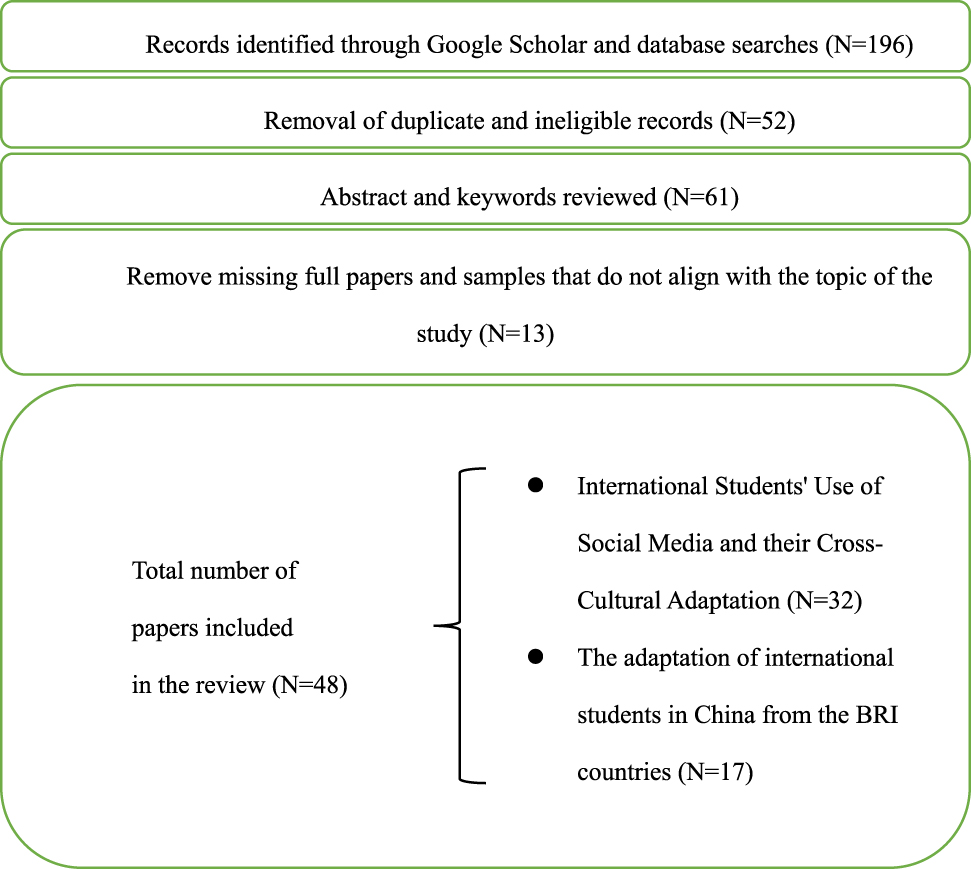
Selection process reviewed.
Finally, a comprehensive summary of the themes and relationships identified in the axial coding was formed. Specifically, 17 studies on the cross-cultural adaptation of BRI international students in China and 32 studies on the use of social media for cross-cultural adaptation were coded separately. The codes were grouped based on similarity to address the core question of this study: the role of social media in the cross-cultural adaptation of BRI international students in China. The data underwent multiple reviews to maintain coding consistency.
4 Descriptive Results and Findings
4.1 Literature Overview
As shown in Figure 2, the majority of studies on international students’ use of social media for cross-cultural adaptation involved samples of East Asian countries (N = 16). Next is the study that does not specify countries and regions (N = 11), and students from West Asian countries (N = 2), Southeast Asian countries (N = 2), and South Asian countries (N = 1).
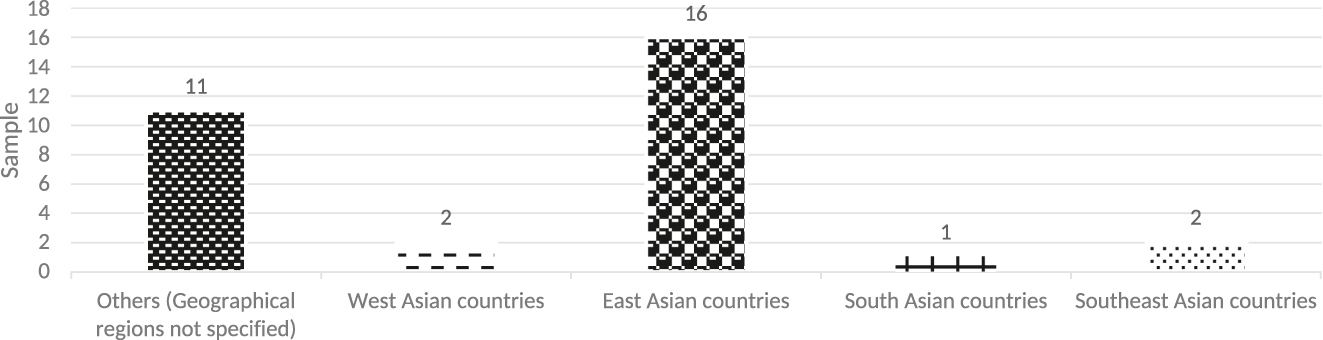
X ray: Sample nationalities in the study of international students’ use of social media.Y ray: Sample size.
Figure 3 illustrates that among the 32 studies reviewed on international students’ use of social media for cross-cultural adaptation, 15 focused on students of unspecified nationality using social media for adaptation in the United States. This was followed by four studies conducted in Australia and three studies on international students in China. Figure 4 shows that 50 % of these studies utilized survey methods, followed by interviews (28 %) and mixed methods (19 %).
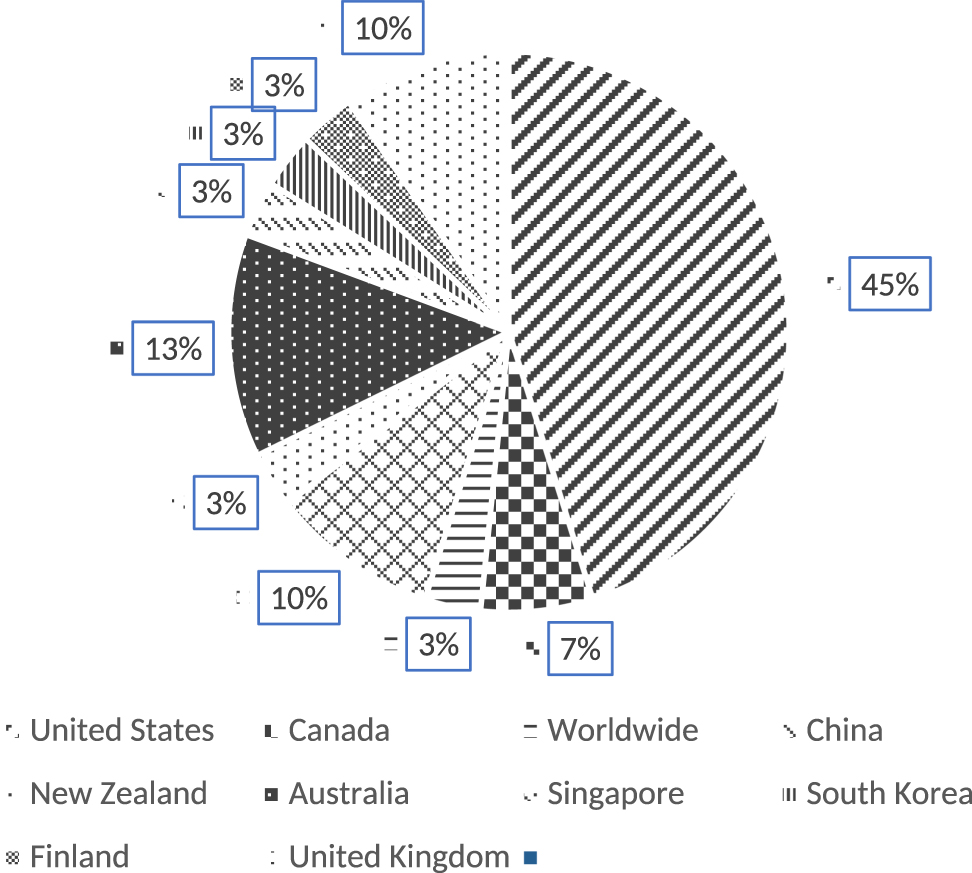
International students’ use of social media adaptation studies concerned countries.
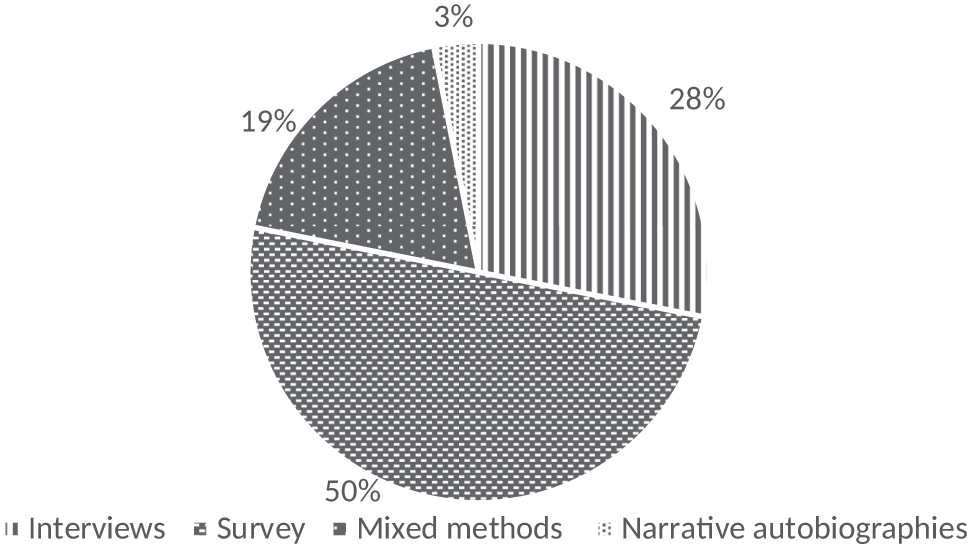
Methods used in studies of international students’ adaptation and social media.
Regarding studies on the cross-cultural adaptation of BRI international students in China, Figure 5 shows that 70 % of the studies did not specify the students’ countries of origin. The remaining 18 % are focused on South Asian countries, while the other 12 % are observed in African countries and South-East Asian countries, separately. Figure 6 indicates that 40 % of these studies employed survey methods, followed by mixed methods (35 %), case studies (18 %), and interviews. Through a critical review of the literature, the following research questions are addressed.
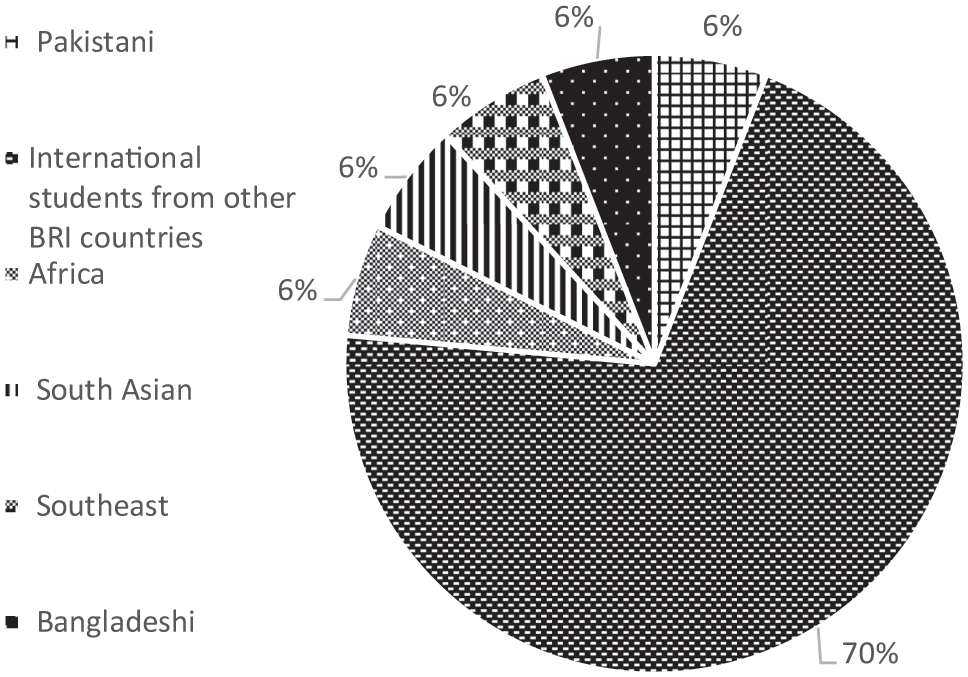
Sample of international students from BRI countries.
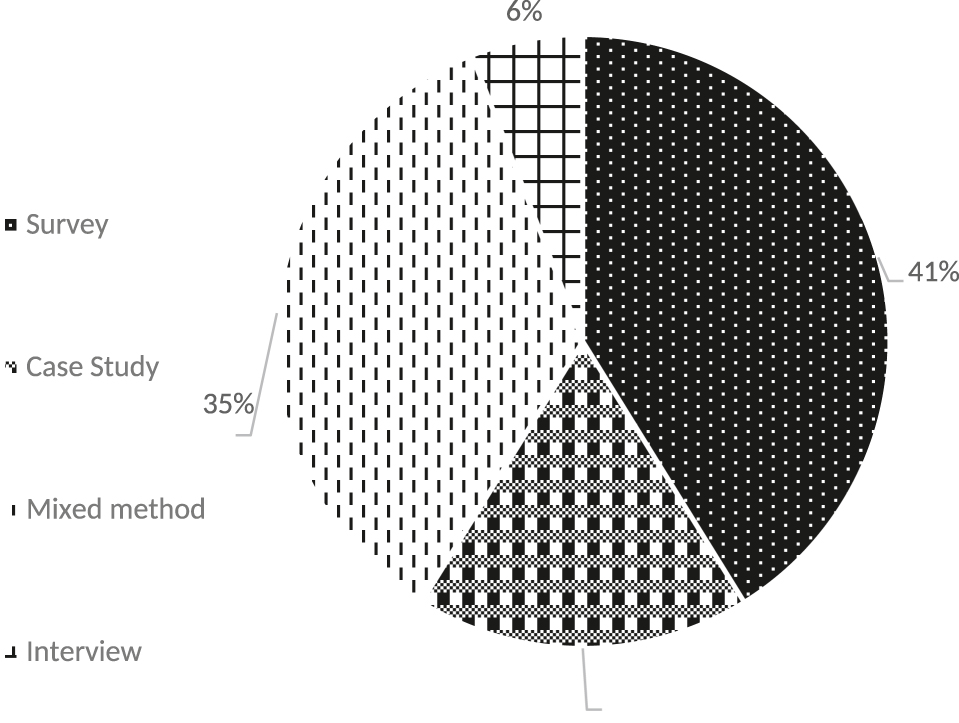
Methods of international students from BRI countries.
4.2 Findings and Addressing Question 1: How Is the Cross-Cultural Adaptation of International Students from BRI Countries in China?
A rapid review of studies on the cross-cultural adaptation of international students from BRI countries in China reveals consistent adaptation challenges. For instance, Wang and Zhao (2019) noted that students from BRI countries face difficulties integrating into the Chinese environment and adapting to learning methods due to cultural differences. Similarly, Fan (2020) found that 116 Bangladeshi students at Yunnan University struggled with understanding Chinese values and bridging cultural gaps, leading to increased psychological adaptation difficulties and loneliness.
These studies, conducted across various universities in different Chinese cities, indicate that the challenges in adapting to Chinese culture, daily life, and interpersonal communication are consistent regardless of location. This aligns with theoretical perspectives on cross-cultural adaptation by Berry (2005) and Kim (2017), suggesting that adaptation stress varies according to cultural interactions. While a deeper understanding of language and culture can help overcome these barriers (Sun 2019), homesickness and interpersonal relationship issues remain primary challenges (Wang 2017).
Additionally, the lesser social and emotional support received by international students compared to domestic students exacerbates their emotional pressure from missing home social networks (Pedersen 1991). Effective communication, as noted in studies across various Chinese provinces, are crucial for building emotional connections and promoting adaptation (Lu 2019; Zhou 2019).
In summary, international students from BRI countries face significant cross-cultural adaptation challenges, primarily due to a lack of emotional support and a longing for home-country relationships. While expanding communication channels could enrich their lives and promote adaptation, the role of social media in this process remains underexplored. As Blease (2015) suggests, social media can facilitate cross-cultural communication and maintain personal networks, highlighting the need for further investigation into its impact on BRI students’ adaptation.
4.3 The Role of Social Media in the Cross-Cultural Adaptation of a Wider Range of International Students
This review also aims to understand how international students utilize social media for cross-cultural adaptation and whether it alleviates their adaptation pressures. Research indicates that the primary need for social media use among international students in unfamiliar environments is to stay connected with people from their home countries. Social media provides a platform for communication and emotional support, helping students express nostalgia and gain support during their adaptation process (Chang and Gomes 2017; Li and Peng 2019). It also facilitates cultural contact and understanding, easing the discomfort of adapting to new cultures (Nuraryo 2014).
For example, international students often use social media to maintain contact with friends and family, providing emotional support and alleviating stress in unfamiliar environments (Hendrickson and Rosen 2017).
Social media also helps establish social networks in host countries, beneficial for adapting to local life (Henze and Zhu 2012).
In summary, social media’s communicative and interactive nature helps international students gain social and emotional support, reduce stress, and adapt to new environments. This supports the second research question, highlighting social media’s role in promoting better cross-cultural adaptation through emotional and social support.
Although findings indicate that social media plays a role in international students’ emotional support and achieving better cross-cultural adaptation, social media is a crucial factor in achieving better adaptation in the process of cross-cultural communication. It is closely related to individuals’ sense of belonging, communication behaviours, information transmission, and social participation. However, according to (Kim 2012), the adaptation process of individuals in unfamiliar environments can be divided into three stages: facing pressure, gradual adaptation, and ultimately, co-development with the host country. As individuals gain a deeper understanding of the environment, feelings of unfamiliarity and novelty will be replaced by anxiety and pressure, furthering adaptation as the cross-cultural process deepens (Lysgaare 1955). Therefore, this study critically discusses the role of social media in the cross-cultural adaptation of international students. It also examines whether it reduces their adaptation pressure, helping them to adapt better. Furthermore, it aims to provide an understanding for guiding future social media use in the cross-cultural adaptation of international students from BRI countries in China.
4.4 International Students Use Social Media to Escape Adaptation Pressure Rather than Reduce It
Adaptation stress is a response to challenges exceeding one’s coping resources (Sheng 2021). Some international students prefer using social media in their native language to avoid face-to-face interactions in the host country, which may hinder adaptation (Zhang and Goodson 2011).
For example, international students from China often use WeChat to share their negative experiences and cultural differences in the host country’s society to their family and friends while also being more resistant to facing challenges in the host country’s society (Park, Song, and Lee 2014). Similarly, frequent communication with one’s home country’s culture through social media may better maintain their cultural identity, which is likely to deepen inherent biases or negative views towards the host country, thus hindering adaptation to the local society (Oommen 2014).
Therefore, the process of international students using social media can be seen as a refuge in virtual space to protect themselves from the pressure of adapting to a foreign society. International students often experience academic and life anxiety in the host country due to language and cultural differences. For instance, Chinese students in the UK, because of language proficiency, are unwilling to participate more in face-to-face communication with local classmates, which makes them feel anxious and uneasy, and they prefer to interact through social media to avoid more offline communication (Newsome and Cooper 2016). Thus, while social media provides emotional support, it can also act as a refuge, which can hinder genuine adaptation to the host culture. This highlights the need for balanced social media use to ensure it supports rather than hinders cross-cultural adaptation.
4.5 Enhancing Understanding of the Challenges for BRI Students
The findings underscore the need for effective communication channels and emotional support to help BRI students in China alleviate their loneliness and homesickness, promoting better adaptation. For instance, Li (2021) conducted a study at Gansu University with students from Central Asia and Southeast Asia, highlighting that organising diverse forms of cultural communication and connecting these students with both their home culture and Chinese culture through communication can reduce the discomfort caused by the unfamiliar environment.
It is worth noting that research shows that social media plays a significant role in the cross-cultural adaptation of international students. Social media is an important platform for interaction, communication, and emotional sharing. Studies have found that international students use various social media platforms, including Renren, WeChat, Twitter, and Facebook to keep up with friends’ activities in their home countries and to stay in touch with family members (Li and Peng 2019). Therefore, the use of social media can help international students obtain social and emotional support, promote positive emotions, and aid in adaptation.
International students from BRI countries are integral to China’s diverse student community. Understanding the role of social media in supporting these students is crucial to enhancing its positive impact. While cross-cultural communication inherently involves pressure, its intensity varies based on individual experiences and circumstances (Ward and Fischer 2008, pp. 159–173). Social media offers interactive communication options for BRI country students in China, potentially aiding their cross-cultural adaptation by providing emotional and social support.
However, some minority ethnic international students have reported feeling isolated from their home culture due to an overload of mainstream host country values on social media (Ren et al. 2021). For instance, Finnish Iranian students using social media to access Finnish information often feel disconnected from their Iranian roots, preferring communication with Iranian peers (Hosseini and Kotilainen 2021). Similarly, many Indonesian Muslim students turn to social media primarily for Islamic cultural information and favor face-to-face interactions with Muslim classmates, anxious about prevalent stereotypes (Nuraryo 2014).
Students from Egypt, Iran, and Indonesia, among others, face challenges in China. Zhou’s (2019) research highlights the adaptability concerns of Indonesian, Thai, and Vietnamese students, particularly regarding dietary and religious practices. The predominance of mainstream cultural content on social media can increase the sensitivity and vulnerability of minority ethnic students in China.
In summary, social media is a vital tool for the adaptation of international students and offers insights into the cross-cultural challenges faced by students from BRI countries in China. Yet, it may not significantly alleviate the psychological and emotional pressures they experience. Relying on social media for emotional support from home country networks, while it may reduce mental stress, could also be a way of avoiding pressure, and might not contribute to effective cross-cultural adaptation.
5 Discussion
With the advancement of the BRI, cooperation and cultural exchange among participating countries continue to deepen. Exploring the adaptation process of international students using social media in transcultural communication can provide valuable insights for individuals from different countries to better adapt to China. Although previous research has confirmed the significant impact of social media on the adaptation of international students, there is a dearth of studies discussing whether social media can alleviate stress and genuinely facilitate adaptation. Additionally, detailed explanations of this process are lacking.
This study, grounded in the theory of cross-cultural adaptation (Kim 2012), focuses on the transition from stress to better adaptation during the adaptation process, ultimately leading to a dynamic process of co-development with the local society. The results indicate that the role of social media in alleviating stress for international students is limited and not always positive. It is also evident that the psychological and emotional stress experienced by international students in unfamiliar academic and living environments cannot be significantly reduced by using social media. This directly impacts their ability to truly adapt to life in a foreign country.
6 Limitations
This study has several limitations. Firstly, the sample size in the literature is relatively small, and the use of convenience sampling in some surveys may limit its representativeness and generalizability to a more diverse population of international students. Secondly, although most studies are cross-sectional and suggest an association between international students’ use of social media in transcultural communication and their adaptation, it remains uncertain whether a causal relationship exists between using social media and the shift from stress to adaptation. Further comprehensive research is needed to establish how the use of social media by international students contributes to the transition from stress to adaptation.
Finally, all the literature discussed in this study relies on surveys that use self-report measures. Due to limitations such as self-subjectivity bias, these assessment scales may yield results that are not entirely objective. Moreover, the majority of participants in most studies are from East Asia or other minority ethnic groups, making it challenging to capture the full diversity of countries and cultural backgrounds.
7 Conclusions
In the context of the BRI, increasing cultural interactions and collaborations among countries provide diverse practical pathways for transcultural communication. Social media, as a crucial tool in promoting BRI developments, serves as an effective communication platform for fostering cooperation and mutual development among different nations. This study focuses on the theoretical perspective of the relationship between social media and adaptation in the practice of transcultural communication. Through a critical examination of the role of social media, it provides theoretical support for better understanding the spread of the BRI across different cultures.
Firstly, this study demonstrates that the use of social media significantly influences the adaptation of students from BRI partner countries to China. Consistent with previous research, the findings suggest that utilising social media as a tool for information acquisition and communication aids international students in establishing interpersonal networks in Chinese society while maintaining social relationships in their home countries. This process plays a significant role in providing psychological and social support to international students, thereby contributing to their adaptation. International students use social media to share experiences and seek emotional support, facilitating encouragement and support from their home countries during the adaptation process (Park and Oh 2012).
However, this study reveals that the use of social media by international students does not genuinely reduce the stress experienced in the process of transcultural communication and their adaptation. It is highly probable that the use of social media serves as a means to escape stress rather than effectively alleviating it. Additionally, the content on the host country’s social media platforms can lead to feelings of isolation and anxiety among some international students, thereby increasing the pressure on their adaptation process.
This perspective provides a more detailed explanation of the adaptive role of social media in the process of transcultural communication. The adaptation process is understood as complex and dynamic, involving adapting to stress, alleviating stress, and continuous growth to successfully adapt to the host country (Berry 2006). Moreover, most participants perceived significant cultural differences between their home country and the host country and were more inclined to communicate with friends from their home country. For instance, Chinese students in the UK were more willing to use Chinese social media to interact with Chinese friends, avoiding more face-to-face communication with local students (Newsome and Cooper 2016). Although previous research has consistently suggested that international students’ use of social media helps them adapt better to life in the host country, the results of this study offer an alternative understanding. Specifically, the use of social media is potentially a way of escaping the pressure of the adaptation process and may not fundamentally assist international students in better adapting to a foreign country. In the process of transcultural communication, the pressure of adaptation is consistently present.
References
Baker, Will. 2016. “Identity and Interculturality Through English as a Lingua Franca.” Asian Perspectives on English as a Lingua Franca and Identity 26 (2): 340–347. https://doi.org/10.1075/japc.26.2.09bak.Suche in Google Scholar
Bender, Michael, Yvette van Osch, Willem Sleegers, and Mengyu Ye. 2019. “Social Support Benefits Psychological Adjustment of International Students: Evidence from a Meta-Analysis.” Journal of Cross-Cultural Psychology 50 (7): 827–847, https://doi.org/10.1177/0022022119861151.Suche in Google Scholar
Berry, John W. 2005. “Acculturation: Living Successfully in Two Cultures.” International Journal of Intercultural Relations 29 (6): 697–712, https://doi.org/10.1016/j.ijintrel.2005.07.013.Suche in Google Scholar
Berry, John W. 2006. “Stress Perspectives on Acculturation.” The Cambridge Handbook of Acculturation Psychology 1: 43–56.10.1017/CBO9780511489891.007Suche in Google Scholar
Blease, Charlotte R. 2015. “Too Many ‘Friends,’ Too Few ‘Likes’? Evolutionary Psychology and ‘Facebook Depression’.” Review of General Psychology 19 (1): 1–13, https://doi.org/10.1037/gpr0000030.Suche in Google Scholar
Chang, Shanton, and Catherine Gomes. 2017. “Digital Journeys: A Perspective on Understanding the Digital Experiences of International Students.” Journal of International Students 7 (2): 347–466, https://doi.org/10.32674/jis.v7i2.385.Suche in Google Scholar
Chapdelaine, Raquel Faria, and Louise R Alexitch. 2004. “Social Skills Difficulty: Model of Culture Shock for International Graduate Students.” Journal of College Student Development 45 (2): 167–184, https://doi.org/10.1353/csd.2004.0021.Suche in Google Scholar
Chen, Lanming. 2013. “The Effect of Acculturation on Chinese International Students’ Usage of Facebook and Renren.” MS Thesis, Bowling Green State University.Suche in Google Scholar
Chen, Huiping. 2016. “China’s ‘One Belt, One Road’ Initiative and Its Implications for Sino-African Investment Relations.” Transnational Corporations Review 8 (3): 178–182, https://doi.org/10.1080/19186444.2016.1233722.Suche in Google Scholar
Chen, Wenhong, and Kye-Hyoung Lee. 2013. “Sharing, Liking, Commenting, and Distressed? The Pathway between Facebook Interaction and Psychological Distress.” Cyberpsychology, Behavior, and Social Networking 16 (10): 728–734, https://doi.org/10.1089/cyber.2012.0272.Suche in Google Scholar
Choi, Doo-Hun, and Dong-Hee Shin. 2017. “A Dialectic Perspective on the Interactive Relationship between Social Media and Civic Participation: The Moderating Role of Social Capital.” Information, Communication & Society 20 (2): 151–166, https://doi.org/10.1080/1369118x.2016.1154586.Suche in Google Scholar
Chu, Kequn, and Fengshu Zhu. 2023. “Impact of Cultural Intelligence on the Cross-Cultural Adaptation of International Students in China: The Mediating Effect of Psychological Resilience.” Frontiers in Psychology 14 (3): 1–6, 1077424, https://doi.org/10.3389/fpsyg.2023.1077424.Suche in Google Scholar
Constantine, Madonna G., Sumie Okazaki, and Shawn O. Utsey. 2004. “Self-Concealment, Social Self-Efficacy, Acculturative Stress, and Depression in African, Asian, and Latin American International College Students.” American Journal of Orthopsychiatry 74 (3): 230–241, https://doi.org/10.1037/0002-9432.74.3.230.Suche in Google Scholar
Creswell, John W., and Abbas Tashakkori. 2007. “Editorial: Differing Perspectives on Mixed Methods Research.” Journal of Mixed Methods Research 1 (4): 303–308, https://doi.org/10.1177/1558689807306132.Suche in Google Scholar
Croucher, Stephen Michael, and Daniel Cronn-Mills. 2011. Religious Misperceptions: The Case of Muslims and Christians in France and Britain. New York: Hampton Press.Suche in Google Scholar
Cudmore, Geoffrey. 2005. “Globalization, Internationalization, and the Recruitment of International Students in Higher Education, and in the Ontario Colleges of Applied Arts and Technology.” Canadian Journal of Higher Education 35 (1): 37–60, https://doi.org/10.47678/cjhe.v35i1.183491.Suche in Google Scholar
Demes, Kali A., and Nicolas Geeraert. 2015. “The Highs and Lows of a Cultural Transition: A Longitudinal Analysis of Sojourner Stress and Adaptation across 50 Countries.” Journal of Personality and Social Psychology 109 (2): 316–337, https://doi.org/10.1037/pspp0000046.Suche in Google Scholar
Ding, Shuiyi 丁水怡, and Zhicheng Zhou, 周志诚. 2019. “Kuawenhua shijiao xia ‘Yidaiyilu’ yanxian guojia liuxuesheng guanli tanxi” 跨文化视角下“一带一路”沿线国家留学生管理探析 [An analysis of the management of international students from BRI participating countries from a cross-cultural perspective]. Nanyang ligong xueyuan xuebao南阳理工学院学报 11 (3): 80–84.Suche in Google Scholar
Donohue, Joan M., and Jeremy B. Fox. 2000. “A multi-method evaluation of journals in the decision and management sciences by US academics.” Omega 28 (1): 17–36, https://doi.org/10.1016/s0305-0483(99)00024-9.Suche in Google Scholar
Fan, Juan 樊娟. 2020. “Mengjialaguo liuxuesheng kuawenhua shiying yanjiu” 孟加拉国留学生跨文化适应研究 [A study on cross-cultural adaptation of Bangladeshi students]. MS Thesis, Yunnan University. https://doi.org/10.27456/d.cnki.gyndu.2020.000117.Suche in Google Scholar
Finfgeld-Connett, Deborah, and E. Diane Johnson. 2013. “Literature Search Strategies for Conducting Knowledge-Building and Theory-Generating Qualitative Systematic Reviews.” Journal of Advanced Nursing 69 (1): 194–204, https://doi.org/10.1111/j.1365-2648.2012.06037.x.Suche in Google Scholar
Grant, Maria J., and Andrew Booth. 2009. “A Typology of Reviews: An Analysis of 14 Review Types and Associated Methodologies.” Health information & libraries journal 26 (2): 91–108, https://doi.org/10.1111/j.1471-1842.2009.00848.x.Suche in Google Scholar
Hechanova-Alampay, Regina, Terry A. Beehr, Neil D. Christiansen, and Roger K. Van Horn. 2002. “Adjustment and Strain among Domestic and International Student Sojourners.” School Psychology International 23 (4): 458–474, https://doi.org/10.1177/0143034302234007.Suche in Google Scholar
Hendrickson, Blake, and Devan Rosen. 2017. “Insights into New Media Use by International Students: Implications for Cross-Cultural Adaptation Theory.” Social Networking 6 (2): 81–106, https://doi.org/10.4236/sn.2017.62006.Suche in Google Scholar
Henze, Jürgen, and Jiani Zhu. 2012. “Current Research on Chinese Students Studying Abroad.” Research in Comparative and International Education 7 (1): 90–104, https://doi.org/10.2304/rcie.2012.7.1.90.Suche in Google Scholar
Hosseini, Zahra, and Sirkku Kotilainen. 2021. “The Role of Communication as the Drive for Immigration: A Case Study in Finland.” In Education and New Developments 2021, 391–395. Lisboa, Portugal: y inScience Press.10.36315/2021end083Suche in Google Scholar
Huang, Yiping. 2016. “Understanding China’s Belt & Road Initiative: Motivation, Framework and Assessment.” China Economic Review 40 (9): 314–321, https://doi.org/10.1016/j.chieco.2016.07.007.Suche in Google Scholar
Kim, Young Yun. 2005. “Adapting to a New Culture.” In Theorizing about Intercultural Communication, edited by William B. Gudykunst, 375–400. Thousand Oaks, CA: Sage Publishing.Suche in Google Scholar
Kim, Young Yun. 2012. “Beyond Cultural Categories: Communication, Adaptation and Transformation.” In The Routledge Handbook of Language and Intercultural Communication, 241–255. London: Routledge.Suche in Google Scholar
Kim, Young Yun. 2017. Cross-Cultural Adaptation. Oxford: Oxford research encyclopedia of communication.10.1093/acrefore/9780190228613.013.21Suche in Google Scholar
Kwon, K. Hazel, Michael A. Stefanone, and George A. Barnett. 2014. “Social Network Influence on Online Behavioral Choices: Exploring Group Formation on Social Network Sites.” American Behavioral Scientist 58 (10): 1345–1360, https://doi.org/10.1177/0002764214527092.Suche in Google Scholar
Li, Danjie 李丹洁. 2007. “Laihua liuxuesheng kuawenhua shehui xinli shiying wenti yanjiu yu duice” 来华留学生跨文化社会心理适应问题研究与对策 [Research on intercultural social psychological adaptation problems and countermeasures for international students in China]. Yunnan shifan daxue xuebao: zhexue shehui kexue ban 云南师范大学学报:哲学社会科学版 (5): 49–51.Suche in Google Scholar
Li, Honglan 李红兰. 2021. “Beifei laihua liuxuesheng kuawenhua shiying wenti yanjiu” 北非来华留学生跨文化适应问题研究[Research on the cross-cultural adaptation of North African international students in China] [Doctoral dissertation]. Lanzhou University. https://doi.org/10.27204/d.cnki.glzhu.2021.001542.Suche in Google Scholar
Li, Linfeng 李林峰, and Hongmei Li, 李红梅. 2020. “‘Yidaiyilu’ yanxian guojia laihua liuxuesheng de kuawenhua shiyingxing wenti ji duice yanjiu” “一带一路”沿线国家来华留学生的跨文化适应性问题及对策研究 [Research on cross-cultural adaptation problems and countermeasures for international students from BRI partner countries in China]. Xiandai shangmao gongye 现代商贸工业 41 (7): 44–45. https://doi.org/10.19311/j.cnki.1672-3198.2020.07.020.Suche in Google Scholar
Li, Lin, and Wei Peng. 2019. “Transitioning Through Social Media: International Students’ SNS Use, Perceived Social Support, and Acculturative Stress.” Computers in Human Behavior 98 (9): 69–79, https://doi.org/10.1016/j.chb.2019.03.011.Suche in Google Scholar
Liu, Yanqing刘彦清. 2016. “Laihua Yemen liuxuesheng kuawenhua shiying yanjiu——yi shanxi daxue liuxuesheng weili” 来华也门留学生跨文化适应研究——以山西大学留学生为例 [A study on school adaptation of Yemeni international students in China—A case study of international students at Shanxi University] [Master’s thesis]. Shanxi University.Suche in Google Scholar
Liu, Hongyu 刘宏宇, and Zhuochao Jia 贾卓超. 2014. “Laihua liuxuesheng kuawenhua shiying yanjiu——yi laihua Zhongya liuxuesheng wei ge’an” 来华留学生跨文化适应研究——以来华中亚留学生为个案 [A study on cross-cultural adaptation of international students in China: A case study of Central Asian international students]. Zhongyang minzu daxue xuebao (zhexue shehui kexue ban) 中央民族大学学报(哲学社会科学版) (4): 171–176, https://doi.org/10.15970/j.cnki.1005-8575.2014.04.025.Suche in Google Scholar
Lu, Sunqi 陆孙琦. 2019. “‘Yidaiyilu’ beijing xia gaozhi yuanxiao laihua liuxuesheng kuawenhua guanli cunzai de wenti ji duice” “一带一路”背景下高职院校来华留学生跨文化管理存在的问题及对策 [Problems and countermeasures in the cross-cultural management of international students in Chinese vocational colleges under the Belt and Road Initiative]. Ningbo zhiye jishu xueyuan xuebao 宁波职业技术学院学报 23 (2): 22–25.Suche in Google Scholar
Lysgaard, Sverre. 1955. “Adjustment in a Foreign Society: Norwegian Fulbright Grantees Visiting the United States.” International Social Science Bulletin 7: 45–51.Suche in Google Scholar
Ma, Jiani 马佳妮. 2018. “‘Yidaiyilu’ yanxian guojia laihua liuxuesheng jiudu jingyan yanjiu” “一带一路”沿线国家来华留学生就读经验研究 [Study on the educational experiences of international students from Belt and Road countries in China]. Bijiao jiaoyu yanjiu 比较教育研究 40 (4): 19–28.Suche in Google Scholar
Mahmood, Hajara, and Monica Galloway Burke. 2018. “Analysis of Acculturative Stress and Sociocultural Adaptation among International Students at a Non-Metropolitan University.” Journal of International Students 8 (1): 284–307, https://doi.org/10.32674/jis.v8i1.166.Suche in Google Scholar
Mahood, Quenby, Dwayne Van Eerd, and Emma Irvin. 2014. “Searching for Grey Literature for Systematic Reviews: Challenges and Benefits.” Research Synthesis Methods 5 (3): 221–234, https://doi.org/10.1002/jrsm.1106.Suche in Google Scholar
Newsome, Linda K., and Paul Cooper. 2016. “International Students’ Cultural and Social Experiences in a British university: ’Such a Hard Life [It] is Here.” Journal of International Students 6 (1): 195–215, https://doi.org/10.32674/jis.v6i1.488.Suche in Google Scholar
Nuraryo, Imam. 2014. “Social Networking Sites Use and Cross-Cultural Adaptation of Muslim Indonesian students in Australian Universities: Valuing Cultural Diversity.” Jurnal komunikasi 8 (2): 103–122, https://doi.org/10.20885/komunikasi.vol8.iss2.art1.Suche in Google Scholar
Oommen, Deepa. 2014. “The Relationships among Perceptions of Social Support, Intercultural Communication Apprehension (ICA), and Conflict Management Preferences in the Context of Cultural Adaptation.” Journal of Intercultural Communication Research 43 (3): 215–237, https://doi.org/10.1080/17475759.2014.935797.Suche in Google Scholar
Park, Jongpil, and Ick-Keun Oh. 2012. “A Case Study of Social Media Marketing by Travel Agency: The Salience of Social Media Marketing in the Tourism Industry.” International Journal of Tourism Sciences 12 (1): 93–106, https://doi.org/10.1080/15980634.2012.11434654.Suche in Google Scholar
Park, Namkee, Hayeon Song, and Kwan Min Lee. 2014. “Social Networking Sites and Other Media Use, Acculturation Stress, and Psychological Well-Being among East Asian College Students in the United States.” Computers in Human Behavior 36 (7): 138–146, https://doi.org/10.1016/j.chb.2014.03.037.Suche in Google Scholar
Pedersen, Torben Feldsgaard. 1991. “Metabolic Adaptations to Hypoxia of Two Species of Polychaeta, Nephtys Ciliata and Nephtys Hombergii.” Journal of Comparative Physiology B 161 (2): 213–215, https://doi.org/10.1007/bf00262886.Suche in Google Scholar
Ren, Zheng, Xiumin Zhang, Xiangrong Li, Minfu He, Hong Shi, and Hanfang Zhao, et al.. 2021. “Relationships of Organisational Justice, Psychological Capital and Professional Identity with Job Burnout among Chinese Nurses: A Cross‐Sectional Study.” Journal of Clinical Nursing 30 (19–20): 2912–2923, https://doi.org/10.1111/jocn.15797.Suche in Google Scholar
Schachner, Maja K., Fons J. R. Van de Vijver, and Peter Noack. 2014. “Family-Related Antecedents of Early Adolescent Immigrants’ Psychological and Sociocultural School Adjustment in Germany.” Journal of Cross-Cultural Psychology 45 (10): 1606–1625, https://doi.org/10.1177/0022022114543831.Suche in Google Scholar
Sheng, Jiejin 盛洁瑾. 2021. “‘Yidaiyilu’ yanxian guojia liuxuesheng de kuawenhua shiying yanjiu” “一带一路”沿线国家留学生的跨文化适应研究 [Research on the cross-cultural adaptation of international students from Belt and Road countries]. Jiaoyu jiaoxue luntan 教育教学论坛 no. 13: 179–184.Suche in Google Scholar
Smith, Rachel A., and Nigar G. Khawaja. 2014. “A Group Psychological Intervention to Enhance the Coping and Acculturation of International Students.” Advances in Mental Health 12 (2): 110–124, https://doi.org/10.1080/18374905.2014.11081889.Suche in Google Scholar
Song, Yang, and Jinyuan Xia. 2021. “Scale Making in Intercultural Communication: Experiences of International Students in Chinese Universities.” Language Culture and Curriculum 34 (4): 379–397, https://doi.org/10.1080/07908318.2020.1857392.Suche in Google Scholar
Sovic, Silvia. 2008. “Coping with Stress: The Perspective of International Students.” Art, Design and Communication in Higher Education 6 (3): 145–158, https://doi.org/10.1386/adch.6.3.145_1.Suche in Google Scholar
Sun, Qian 孙茜. 2019. “‘Yidaiyilu’ beijing xia Feizhou zai Liao liuxuesheng kuawenhua shiying yanjiu” “一带一路”背景下非洲在辽留学生跨文化适应研究 [Research on the cross-cultural adaptation of African international students in Liaoning under the Belt and Road initiative]. Dalian daxue xuebao 大连大学学报 40 (2): 133–136.Suche in Google Scholar
Tan, Shuling 谭淑玲. 2020. “‘Yidaiyilu’ beijing xia fu Dongmeng liuxuesheng kuawenhua chuanbo” “一带一路”背景下赴东盟留学生跨文化传播 [Cross-cultural communication of international students to ASEAN under the Belt and Road initiative]. Xinwen yanjiu daokan 新闻研究导刊 11 (22): 30–31, https://doi.org/10.3969/j.issn.1674-8883.2020.22.012.Suche in Google Scholar
Tao, Nini 陶妮妮. 2019. “Dalianshi gaoxiao Musilin liuxuesheng kuawenhua shiying yanjiu” 大连市高校穆斯林留学生跨文化适应研究 [Research on the cross-cultural adaptation of Muslim international students in universities in Dalian]. MS Thesis, Liaoning Shifan University 辽宁师范大学.Suche in Google Scholar
Veronis, Luisa, Zac Tabler, and Rukhsana Ahmed. 2018. “Syrian Refugee Youth Use Social Media: Building Transcultural Spaces and Connections for Resettlement in Ottawa, Canada.” Canadian Ethnic Studies 50 (2): 79–99, https://doi.org/10.1353/ces.2018.0016.Suche in Google Scholar
Wang, Wei 王崴. 2017. “‘Yidaiyilu’ beijing xia laihua liuxuesheng kuawenhua shiyingxing yanjiu——yi Wuxi shangye zhiye jishu xueyuan weili” “一带一路”背景下来华留学生跨文化适应性研究——以无锡商业职业技术学院为例 [Research on the cross-cultural adaptability of international students in China under the Belt and Road initiative: A case study of Wuxi Business Vocational and Technical College]. Jixie zhiye jiaoyu 机械职业教育 (10): 45–47, https://doi.org/10.16309/j.cnki.issn.1007-1776.2017.10.013.Suche in Google Scholar
Wang, Bingyi 王冰一, and Guodong Zhao 赵国栋. 2019. “Laihua Zhongya liuxuesheng kuawenhua shiying weiji ji duice” 来华中亚留学生跨文化适应危机及对策 [Cross-cultural adaptation crises and countermeasures for Central Asian international students in China]. Heilongjiang gaojiao yanjiu 黑龙江高教研究 37 (2): 35–38.Suche in Google Scholar
Ward, Colleen, and Ronald Fischer. 2008. “Personality, Cultural Intelligence and Cross-Cultural Adaptation.” In Handbook of Cultural Intelligence: Theory, Measurement, and Applications, edited by Soon Ang, and Linn van Dyne, 159–173. London: Routledge.Suche in Google Scholar
Ward, Colleen, and Arzu Rana-Deuba. 1999. “Acculturation and Adaptation Revisited.” Journal of Cross-Cultural Psychology 30 (4): 422–442, https://doi.org/10.1177/0022022199030004003.Suche in Google Scholar
Watt, Amber, Alun Cameron, Lana Sturm, Timothy Lathlean, Wendy Babidge, Stephen Blamey, Karen Facey, David Hailey, Inger Norderhaug, and Guy Maddern. 2008. “Rapid Reviews versus Full Systematic Reviews: An Inventory of Current Methods and Practice in Health Technology Assessment.” International Journal of Technology Assessment in Health Care 24 (02): 133–139, https://doi.org/10.1017/S0266462308080185.Suche in Google Scholar
Wei, Shunli 韦顺莉, and Huiling Hu 胡慧玲. 2017. “‘Yidaiyilu’ shiyu xia de laihua liuxuesheng juese zhuanxing tanxi” “一带一路”视域下的来华留学生角色转型探析 [Exploration of the role transformation of international students in China from the perspective of the Belt and Road Initiative]. In “Yidaiyilu” shiyu xia Dongnanya hanyu rencai peiyang guoji yantaohui lunwenji “一带一路”视域下东南亚汉语人才培养国际研讨会论文集 [Proceedings of the International Symposium on Chinese Talent Cultivation from Southeast Asia under the Belt and Road Initiative], 175–183. Guangzhou: South China Normal University.Suche in Google Scholar
Xia, Yuanfei 夏燕飞. 2017. “Dongnanya, Nanya laihua liuxuesheng de kuawenhua shiying diaocha fankui yu duice tanxi——yi Yunnan daxue Taiguo he Mengjialaguo liuxuesheng kuawenhua shiying weili” 东南亚、南亚来华留学生的跨文化适应调查反馈与对策探析——以云南大学泰国和孟加拉国留学生跨文化适应为例 [Survey feedback and countermeasures for cross-cultural adaptation of Southeast Asian and South Asian international students in China: A case study of Thai and Bangladeshi students at Yunnan University]. Xiandai jiaoji 现代交际 (18): 96–98.Suche in Google Scholar
Xiao, Meng. 2021. “Chinese International Graduate Students at Canadian Universities: Language Barriers, Cultural Identities and Perceived Problems of Engagement.” International Journal of Inclusive Education 28 (5): 1–8, https://doi.org/10.1080/13603116.2021.1941318.Suche in Google Scholar
Yan, Kun, and David C. Berliner. 2013. “Chinese International Students’ Personal and Sociocultural Stressors in the United States.” Journal of College Student Development 54 (1): 62–84, https://doi.org/10.1353/csd.2013.0010.Suche in Google Scholar
Yang, Junhong 杨军红. 2005. “Laihua liuxuesheng kuawenhua shiying wenti yanjiu” 来华留学生跨文化适应问题研究 [Issues of cross-cultural adaptation among international students in China]. Doctoral Thesis, East China Normal University 华东师范大学.Suche in Google Scholar
Ye, Jiali. 2006. “Traditional and Online Support Networks in the Cross-Cultural Adaptation of Chinese International Students in the United States.” Journal of Computer-Mediated Communication 11 (3): 863–876, https://doi.org/10.1111/j.1083-6101.2006.00039.x.Suche in Google Scholar
Yu, Guangjun 于光军. 2014. “Jianshe ‘sichou zhi lu jingji dai’ yu ‘21 shiji haishang sichou zhi lu’ yanjiu redian shuping” 建设“丝绸之路经济带”与“21世纪海上丝绸之路”研究热点述评 [A review of research hotspots on the construction of the Silk Road Economic Belt and the 21st Century Maritime Silk Road]. Neimenggu shehui kexue (hanwen ban)内蒙古社会科学(汉文版) 35 (6): 9–12. https://doi.org/10.14137/j.cnki.issn1003-5281.2014.06.003.Suche in Google Scholar
Yu, Qionglei, Pantea Foroudi, and Suraksha Gupta. 2019. “Far Apart yet Close By: Social Media and Acculturation among International Students in the UK.” Technological Forecasting and Social Change 145 (8): 493–502, https://doi.org/10.1016/j.techfore.2018.09.026.Suche in Google Scholar
Zhang, Jing, and Patricia Goodson. 2011. “Predictors of International Students’ Psychosocial Adjustment to Life in the United States: A Systematic Review.” International Journal of Intercultural Relations 35 (2): 139–162, https://doi.org/10.1016/j.ijintrel.2010.11.011.Suche in Google Scholar
Zhou, Cangku 周仓库. 2019. “‘Yidaiyilu’ guojia laihua liuxuesheng kuawenhua shiyingxing yanjiu” “一带一路”国家来华留学生跨文化适应性研究 [Research on the cross-cultural adaptability of international students from Belt and Road countries in China]. Jiaoyu xiandaihua 教育现代化 6 (47): 101–102, https://doi.org/10.16541/j.cnki.2095-8420.2019.47.046.Suche in Google Scholar
© 2024 the author(s), published by De Gruyter and FLTRP on behalf of BFSU
This work is licensed under the Creative Commons Attribution 4.0 International License.
Artikel in diesem Heft
- Frontmatter
- Research Articles
- Uncertainty Avoidance, News Genres and Framing of Traditional Chinese Medicine: A Content Analysis of News from Seven Countries
- Subsistence and Resistance in the Consumption of Counterfeits in South Africa
- Strategies in Expressing Condolences Via Social Networking Sites: The Case of Instagram and Facebook
- Cultural Bias in Large Language Models: A Comprehensive Analysis and Mitigation Strategies
- Exploring the Role of Social Media on International Students’ Adaptation in the Process of Transcultural Communication Within the Context of the Belt and Road Initiative
- A Mediology Study on the Transcultural Communication of Chinese Animation
- Interview
- Exploring the Intersection of Communication and Labor: A Dialogue with Dan Schiller
- Book Review
- McQuire, Scott, and Wei Sun: Communicative Cities and Urban Space
Artikel in diesem Heft
- Frontmatter
- Research Articles
- Uncertainty Avoidance, News Genres and Framing of Traditional Chinese Medicine: A Content Analysis of News from Seven Countries
- Subsistence and Resistance in the Consumption of Counterfeits in South Africa
- Strategies in Expressing Condolences Via Social Networking Sites: The Case of Instagram and Facebook
- Cultural Bias in Large Language Models: A Comprehensive Analysis and Mitigation Strategies
- Exploring the Role of Social Media on International Students’ Adaptation in the Process of Transcultural Communication Within the Context of the Belt and Road Initiative
- A Mediology Study on the Transcultural Communication of Chinese Animation
- Interview
- Exploring the Intersection of Communication and Labor: A Dialogue with Dan Schiller
- Book Review
- McQuire, Scott, and Wei Sun: Communicative Cities and Urban Space
