Prospective risk of stillbirth according to fetal size at term
-
Umber Agarwal


Corrigendum to: Agarwal U, Hugh O, Gardosi J. Prospective risk of stillbirth according to fetal size at term. Journal of Perinatal Medicine 2022; volume 50, Issue 6, pp. 748–752 (DOI: https://doi.org/10.1515/jpm-2022-0200).
There was an arithmetic error listing 27,000 fewer cases in the denominator of the 3–10 centile band of the SGA analysis. This affected the calculated stillbirth rates and risk ratios within this centile band.
The changes are listed below, with correct values in bold and also highlighted in Tables 1 and 2 in bold. Figure 1A is also corrected.
In Table 1, the value for SGA 3<10 was corrected from 144,814 to 171,814, and the associated percentage SGA from 6.9 to 8.2%
In Table 2, the 37 week value for the <10 centile band was similarly changed from 144,814 to 171,814, and the values for the ongoing pregnancies at 38, 39, 40 and 41+ weeks gestation were corrected accordingly. The corresponding values for stillbirth risk and risk ratio are also corrected.
In the Results section, the SGA (<10 centile) rate is stated as 10%. It should instead state 11.3%, according to the sum of the corrected SGA 3<10 and SGA <3 rows in Table 1.
The Results also incorrectly state the 3 < 10 centile band rising “from 0.72 to 2.43”. It should instead read as rising “from 0.61 to 2.43”.
In the Abstract, the 3<10 centile band risk is incorrectly stated as rising “from 0.72 to 2.43 over the same period, with RR increasing from 2.5 to 8.4”. This should instead read “rising from 0.61 to 2.43 over the same period, with RR increasing from 2.1 to 8.4”.
Descriptives (n=2,094,702 deliveries >37.0 weeks). Birthweight section, corrected values in bold
| n | % | Mean | SD | Median | IQR | |
|---|---|---|---|---|---|---|
| Birthweight, g | 3424.1 | 482.8 | 3425.0 | 650.0 | ||
| LGA >97th | 111,283 | 5.3 | ||||
| LGA 90<97 | 59,678 | 2.8 | ||||
| SGA 3<10 | 171,814 | 8.2 | ||||
| SGA <3 | 65,307 | 3.1 |
-
SD, standard deviation; IQR, interquartile range; SGA, small for gestational age; LGA, large for gestational age
Prospective stillbirth risk and risk ratios by size and gestational age at term (n=2,094,702). Corrected values in bold.
| Centile band | Current week of gestation | |||||
|---|---|---|---|---|---|---|
| 37 | 38 | 39 | 40 | 41+ | ||
| >97 | Ongoing pregnancies, n | 59,678 | 52,177 | 38,626 | 16,914 | 6,101 |
| Stillbirths, n | 48 | 48 | 27 | 25 | 13 | |
| Stillbirth riska | 0.80 | 0.92 | 0.70 | 1.48 | 2.13 | |
| Risk ratiob | 2.8 | 3.2 | 2.4 | 5.1 | 7.3 | |
| 97 > 90 | Ongoing pregnancies, n | 111,283 | 102,344 | 81,564 | 42,536 | 15,979 |
| Stillbirths, n | 45 | 67 | 62 | 46 | 24 | |
| Stillbirth riska | 0.40 | 0.65 | 0.76 | 1.08 | 1.50 | |
| Risk ratiob | 1.4 | 2.3 | 2.6 | 3.7 | 5.2 | |
| 10–90 | Ongoing pregnancies, n | 1,686,620 | 1,557,739 | 1,297,207 | 790,705 | 317,996 |
| Stillbirths, n | 490 | 733 | 904 | 790 | 441 | |
| Stillbirth riska | 0.29 | 0.47 | 0.70 | 1.00 | 1.39 | |
| Risk ratiob | 1.0 | 1.6 | 2.4 | 3.4 | 4.8 | |
| 3 < 10 | Ongoing pregnancies, n | 171,814 | 145,018 | 113,574 | 69,516 | 27,992 |
| Stillbirths, n | 104 | 93 | 134 | 98 | 68 | |
| Stillbirth riska | 0.61 | 0.64 | 1.18 | 1.41 | 2.43 | |
| Risk ratiob | 2.1 | 2.2 | 4.1 | 4.9 | 8.4 | |
| <3 | Ongoing pregnancies, n | 65,307 | 46,884 | 33,416 | 19,764 | 8,114 |
| Stillbirths, n | 106 | 97 | 85 | 72 | 50 | |
| Stillbirth riska | 1.62 | 2.07 | 2.54 | 3.64 | 6.16 | |
| Risk ratiob | 5.6 | 7.1 | 8.8 | 12.5 | 21.2 | |
-
aPer 1,000 births; breference for risk ratio: stillbirth risk for 10–90 centile fetus at 37 weeks.
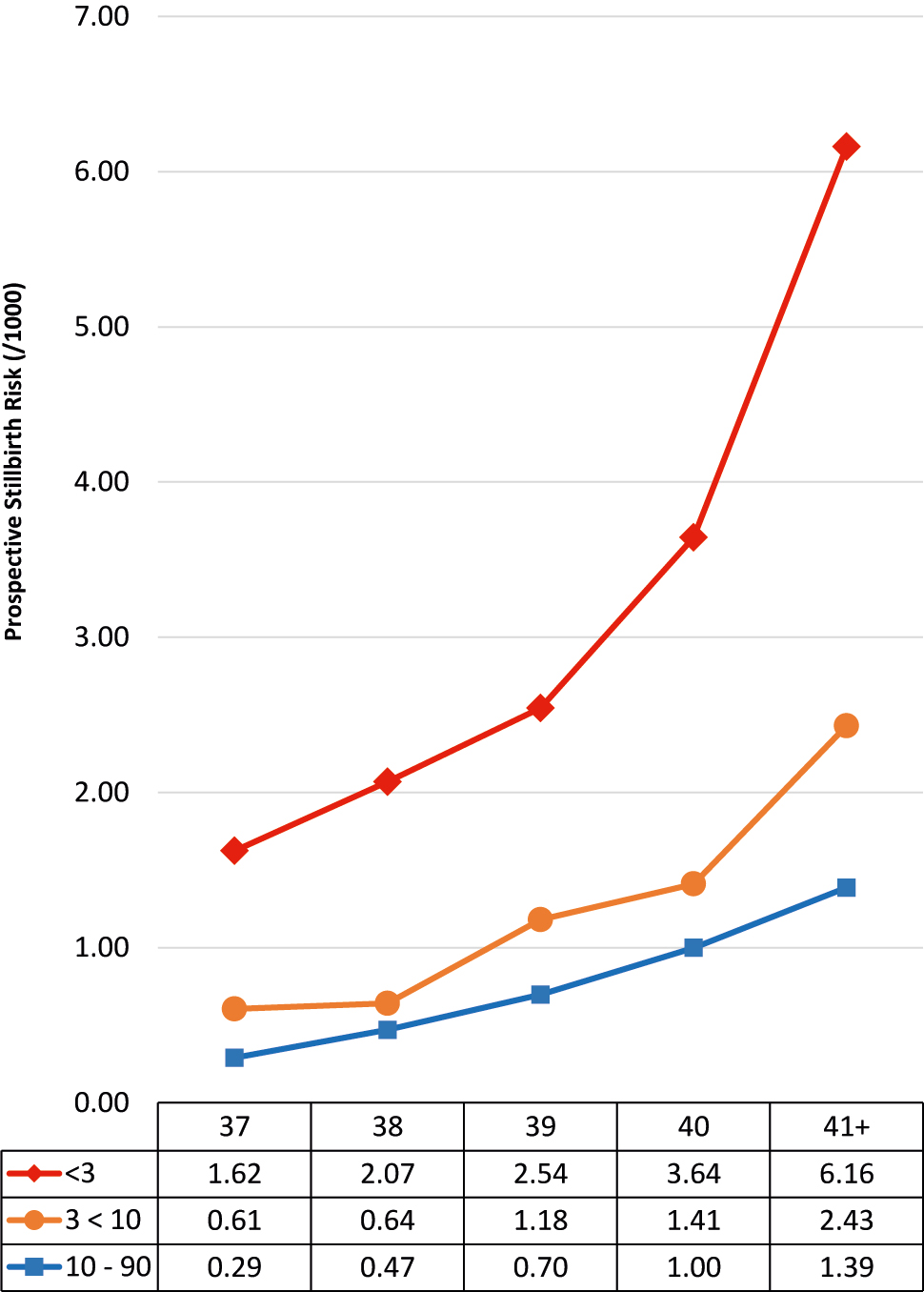
Prospective risk of stillbirth. Appropriate for gestational age (AGA, 10–90 centile) is compared with small for gestational age (SGA; 3<10 and <3) centile bands. Corrected values in 3<10 centile band and graph.
All changes relate to this error in the denominator of the 3<10 centile band. Their corrections do not affect any other results, discussion or conclusions of the study.
© 2022 Walter de Gruyter GmbH, Berlin/Boston
Articles in the same Issue
- Frontmatter
- Review
- Obstetric hemorrhage: effective methods for addressing the menace in Sub-Saharan Africa
- Mini Review
- The use of neurally-adjusted ventilatory assist (NAVA) for infants with congenital diaphragmatic hernia (CDH)
- Opinion Paper
- The role of specialist perinatal psychiatrists in modern medicine
- Corner of Academy
- Maternal perception of fetal movements: onset and associated factors
- Original Articles – Obstetrics
- Cervical ripening as an outpatient procedure in the pandemic – minimizing the inpatient days and lowering the socioeconomic costs
- Can sonographic imaging of the fetal pancreas predict perinatal outcomes in gestational diabetes mellitus?
- Comparison of transvaginal sonographic cervical length measurement and Bishop score for predicting labour induction outcomes
- Regional differences in utilization of 17α-hydroxyprogesterone caproate (17-OHP)
- Effect of anesthesia selection on neonatal outcomes in cesarean hysterectomies for placenta accreta spectrum (PAS)
- Bile-acid levels and lung maturity test in patients with intrahepatic cholestasis of pregnancy
- Evaluation of appropriate vancomycin prescribing for the prevention of newborn group B streptococcal infections in a community hospital obstetrics service
- Effect of supplementation with 5,000 IU of vitamin D on the glycemic profile of women with gestational diabetes mellitus
- Association of methylenetetrahydrofolate reductase (MTHFR) gene polymorphisms with vitamin B12 deficiency and adverse perinatal outcomes among pregnant women of rural South India – a cross sectional longitudinal study
- Original Article – Fetus
- Fetal autopsy for the diagnosis of skeletal dysplasia and comparison with prenatal ultrasound findings over a 16-year period
- Original Articles – Neonates
- Neonatal admission rate after vaginal breech delivery
- Extremely low gestational age neonates and resuscitation: survey on perspectives of Canadian neonatologists
- The effect of 150 and 80 mg doses of aspirin on preventing preterm birth in high-risk pregnant women
- Letters to the Editor
- Aspirin for the prevention of preeclampsia
- Reply to: Aspirin for the prevention of preeclampsia
- Total bile acid levels for clinically suspected intrahepatic cholestasis of pregnancy
- Reply: Neonatal lung injury with intrahepatic cholestasis of pregnancy
- Marijuana and pregnancy: just because its legal doesn’t make it safe
- Corrigenda
- Stillbirth aftercare in a tertiary obstetric center–parents’ experiences
- Prospective risk of stillbirth according to fetal size at term
Articles in the same Issue
- Frontmatter
- Review
- Obstetric hemorrhage: effective methods for addressing the menace in Sub-Saharan Africa
- Mini Review
- The use of neurally-adjusted ventilatory assist (NAVA) for infants with congenital diaphragmatic hernia (CDH)
- Opinion Paper
- The role of specialist perinatal psychiatrists in modern medicine
- Corner of Academy
- Maternal perception of fetal movements: onset and associated factors
- Original Articles – Obstetrics
- Cervical ripening as an outpatient procedure in the pandemic – minimizing the inpatient days and lowering the socioeconomic costs
- Can sonographic imaging of the fetal pancreas predict perinatal outcomes in gestational diabetes mellitus?
- Comparison of transvaginal sonographic cervical length measurement and Bishop score for predicting labour induction outcomes
- Regional differences in utilization of 17α-hydroxyprogesterone caproate (17-OHP)
- Effect of anesthesia selection on neonatal outcomes in cesarean hysterectomies for placenta accreta spectrum (PAS)
- Bile-acid levels and lung maturity test in patients with intrahepatic cholestasis of pregnancy
- Evaluation of appropriate vancomycin prescribing for the prevention of newborn group B streptococcal infections in a community hospital obstetrics service
- Effect of supplementation with 5,000 IU of vitamin D on the glycemic profile of women with gestational diabetes mellitus
- Association of methylenetetrahydrofolate reductase (MTHFR) gene polymorphisms with vitamin B12 deficiency and adverse perinatal outcomes among pregnant women of rural South India – a cross sectional longitudinal study
- Original Article – Fetus
- Fetal autopsy for the diagnosis of skeletal dysplasia and comparison with prenatal ultrasound findings over a 16-year period
- Original Articles – Neonates
- Neonatal admission rate after vaginal breech delivery
- Extremely low gestational age neonates and resuscitation: survey on perspectives of Canadian neonatologists
- The effect of 150 and 80 mg doses of aspirin on preventing preterm birth in high-risk pregnant women
- Letters to the Editor
- Aspirin for the prevention of preeclampsia
- Reply to: Aspirin for the prevention of preeclampsia
- Total bile acid levels for clinically suspected intrahepatic cholestasis of pregnancy
- Reply: Neonatal lung injury with intrahepatic cholestasis of pregnancy
- Marijuana and pregnancy: just because its legal doesn’t make it safe
- Corrigenda
- Stillbirth aftercare in a tertiary obstetric center–parents’ experiences
- Prospective risk of stillbirth according to fetal size at term
