Annular bullous lesions in a child from Uganda: chronic bullous disease of childhood
-
Austin B. Ambur

 ,
Timothy A. Nyckowski
,
Timothy A. Nyckowski

A 10-year-old male presented to our global outreach clinic in Uganda in May 2018 with a recurrent pruritic blistering rash on the lower leg of 1 year in duration. His medical history was unremarkable for autoimmune conditions or exposure to medications. Cutaneous examination showed urticarial plaques and numerous tense bullae in an annular arrangement on the left lower leg (Figure 1). Direct immunofluorescence (DIF) demonstrated a linear band of IgA at the dermoepidermal junction, consistent with a diagnosis of chronic bullous disease of childhood (CBDC). Oral dapsone was initiated with full resolution over the following week.
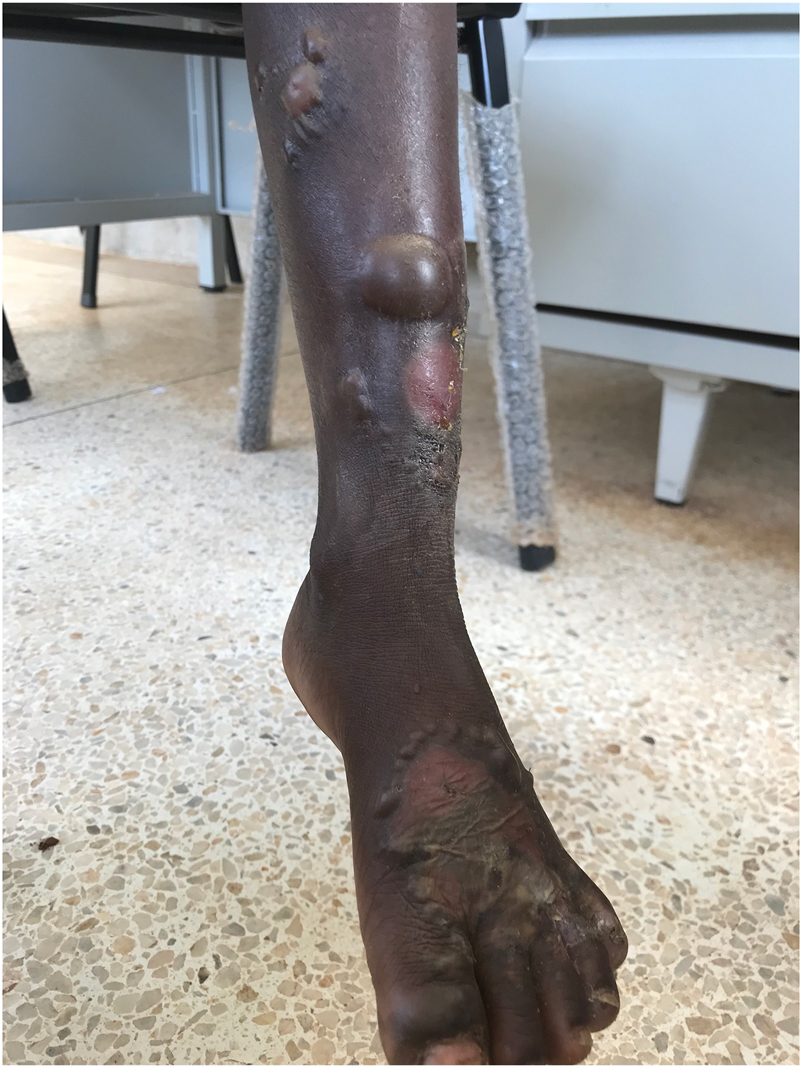
Urticarial plaques and numerous tense bullae in an annular arrangement on the lower left leg and foot.
CBDC is a subepidermal blistering condition driven by autoimmune production of IgA. The disease is characterized by the abrupt onset of edematous plaques and large tense bullae, typically in the first decade of life [1]. Lesions are distributed in an annular, or “crown of jewels,” arrangement, and they commonly affect the trunk and limbs [1]. Although children present with a cutaneous distribution, neonates may have more mucocutaneous involvement [2]. DIF classically demonstrates linear IgA deposition along the basement membrane zone (BMZ) [3]. Although the disease is often idiopathic, genetic susceptibility, infections, drugs, and vaccinations have been implicated in the pathogenesis [1, 3]. Bullous impetigo, epidermolysis bullosa acquisita, and other autoimmune bullous disorders can be considered as differential diagnoses [1]. Although the condition can follow a relapsing and remitting course for several years, spontaneous resolution is common before puberty [4]. Treatment options may include dapsone and topical steroids.
-
Research funding: None reported.
-
Author contributions: All authors provided substantial contributions to conception and design, acquisition of data, or analysis and interpretation of data; all authors drafted the article or revised it critically for important intellectual content; all authors gave final approval of the version of the article to be published; and all authors agree to be accountable for all aspects of the work in ensuring that questions related to the accuracy or integrity of any part of the work are appropriately investigated and resolved.
-
Competing interests: None reported.
-
Informed consent: A parent of the patient described in this report provided written informed consent.
References
1. Mintz, EM, Morel, KD. Clinical features, diagnosis, and pathogenesis of chronic bullous disease of childhood. Dermatol Clin 2011;29:459–ix. https://doi.org/10.1016/j.det.2011.03.022.Search in Google Scholar PubMed
2. Wilson, A, Murrell, DF. Clinical features of chronic bullous dermatosis of childhood. Clin Exp Dermatol 2022;47:873–81. https://doi.org/10.1111/ced.15059.Search in Google Scholar PubMed
3. Mori, F, Saretta, F, Liotti, L, Giovannini, M, Castagnoli, R, Arasi, S, et al.. Linear immunoglobulin a bullous dermatosis in children. Front Pediatr 2022;10:937528. https://doi.org/10.3389/fped.2022.937528.Search in Google Scholar PubMed PubMed Central
4. Tate, C, Christian, W, Newell, L. Chronic bullous dermatosis of childhood and the string of pearls sign. J Pediatr 2018;202:325–e1. https://doi.org/10.1016/j.jpeds.2018.07.070.Search in Google Scholar PubMed
© 2022 the author(s), published by De Gruyter, Berlin/Boston
This work is licensed under the Creative Commons Attribution 4.0 International License.
Articles in the same Issue
- Frontmatter
- Behavioral Health
- Original Article
- Adverse childhood experience categories and subjective cognitive decline in adulthood: an analysis of the Behavioral Risk Factor Surveillance System
- General
- Original Article
- Understanding and preference toward DOs and OMT before and after an osteopathic principles and practice fellow lecture series
- Musculoskeletal Medicine and Pain
- Original Article
- Revisiting chronic low back pain: evidence that it is not non-specific
- Neuromusculoskeletal Medicine (OMT)
- Original Article
- Connecting the dots: alterations in bioelectric activity at acupuncture Ting (Jing-Well) points following CV4 cranial manipulation
- Pediatrics
- Brief Report
- Evaluation of academic detailing to educate clinicians regarding childhood lead poisoning prevention: a pilot study
- Public Health and Primary Care
- Original Article
- Effects of face masks on oxygen saturation at graded exercise intensities
- Clinical Image
- Annular bullous lesions in a child from Uganda: chronic bullous disease of childhood
Articles in the same Issue
- Frontmatter
- Behavioral Health
- Original Article
- Adverse childhood experience categories and subjective cognitive decline in adulthood: an analysis of the Behavioral Risk Factor Surveillance System
- General
- Original Article
- Understanding and preference toward DOs and OMT before and after an osteopathic principles and practice fellow lecture series
- Musculoskeletal Medicine and Pain
- Original Article
- Revisiting chronic low back pain: evidence that it is not non-specific
- Neuromusculoskeletal Medicine (OMT)
- Original Article
- Connecting the dots: alterations in bioelectric activity at acupuncture Ting (Jing-Well) points following CV4 cranial manipulation
- Pediatrics
- Brief Report
- Evaluation of academic detailing to educate clinicians regarding childhood lead poisoning prevention: a pilot study
- Public Health and Primary Care
- Original Article
- Effects of face masks on oxygen saturation at graded exercise intensities
- Clinical Image
- Annular bullous lesions in a child from Uganda: chronic bullous disease of childhood
