A McEliece cryptosystem using permutation codes
-
Adarsh Srinivasan


Abstract
This paper is an attempt to build a new public-key cryptosystem, similar to the McEliece cryptosystem, using permutation error-correcting codes. We study a public-key cryptosystem built using two permutation error-correcting codes. We show that these cryptosystems are insecure. However, the general framework in these cryptosystems can use any permutation error-correcting code and is interesting. We present an enhanced McEliece cryptosystem, which subsumes the McEliece cryptosystem based on linear error correcting codes.
1 Introduction
McEliece and Niederreiter cryptosystems are very popular these days. One of the reasons behind this popularity is that there are some instances of these cryptosystems that can resist quantum Fourier sampling attacks. These make them secure against attacks by quantum computers. Such cryptosystems are called quantum-secure cryptosystems.
McEliece and Niederreiter cryptosystems use linear error-correcting codes. Similar to linear error-correcting codes, we can define permutation error-correcting codes. These codes use permutation groups the same way linear codes use vector-spaces. This paper is an attempt to build secure public-key cryptosystems using permutation codes in the same spirit as McEliece and Niederreiter cryptosystems were built using linear error-correcting codes. Public-key cryptosystems that came out of permutation codes are not secure. However, the journey we took to build these cryptosystems is interesting in its own right. Moreover, we were able to enhance the original McEliece cryptosystem by embedding it into a permutation group. Unlike the case of linear codes, there do not seem to exist families of permutation codes with enough combinatorial and algebraic richness to resist simple attacks. However, we hope to motivate more research into permutation codes through this work. We have used ideas and concepts from the theory of permutation groups freely, Seress [1], Section 1.2.2] or Cameron [2] are good references for permutation groups.
In this paper, we ask two questions:
Can one build a secure public-key cryptosystem using permutation codes, similar to cryptosystems built using linear error-correcting codes?
Are there any advantages of using permutation codes compared to linear codes in public-key cryptosystems?
We try to keep this paper as self-contained as possible. In the next section, we present a brief overview of permutation codes. Most of it is a review of Bailey’s work [3], [4], [5] on permutation codes. We have performed some extra computational analysis on alternate decoding in Section 2.3.1. The section after that presents a public-key cryptosystem using permutation codes whose security depends on the hardness of decoding generic permutation codes. We study this cryptosystem using two permutation codes – the symmetric group acting on 2-subsets and a class of wreath product groups. We show that both these cryptosystems are insecure. The first one is insecure due to an information set decoding attack and the latter due to an inherent structure in the wreath product. We then present the enhanced McEliece cryptosystem in Section 3.5.
2 Permutation error-correcting codes
The use of sets of permutations in coding theory (also referred to as permutation arrays) was studied since the 1970s. Blake et al. [6], 7] were the first to discuss using permutations this way. They had certain applications in mind. One such example was powerline communications. However, permutation codes never got the level of attention that linear codes did. Bailey [5] describes a variety of permutation codes and presents a decoding algorithm, which works for arbitrary permutation groups using a combinatorial structure called uncovering-by-bases. They were also the first to exploit the algebraic structure of groups, to come up with decoding algorithms for several families of groups.
In this section, we explore the use of permutation groups as error-correcting codes. Let [n] be the set {1, 2, …, n}. A permutation on [n] is defined to be a bijection from [n] to itself. The set of all permutations form a group called the symmetric group and is denoted by S n and e its identity element. Subgroups of S n are called permutation groups. For a permutation π ∈ S n , we define its support Supp(π) ≔ {i ∈ [n]: π(i) ≠ i} and set of fixed points Fix(g) ≔ {i ∈ [n]: π(i) = i}. A permutation can be represented in two ways. The first is by listing down all its images. This is called the list form of a permutation. For example, [2, 3, 1] is a permutation π acting on {1, 2, 3} such that π(1) = 2, π(2) = 3, π(3) = 1. The other way to represent permutations is product of disjoint cycles. In this paper, we will use the list form more often than the product form. We now define the Hamming distance between two permutations.
Definition 2.1
(Hamming Distance). For σ, π ∈ S n , the Hamming distance between them, d(σ, π) is defined to be the size of the set {i ∈ [n] | σ(i) ≠ π(i)}.
The Hamming distance between two permutations π, σ can be expressed using support and fixed points of σπ −1.
Proposition 2.1.
For any two permutations σ, π ∈ S n , d(σ, π) = |Supp(σπ −1)| = n − |Fix(σπ −1)|.
Definition 2.2
(Permutation code). A permutation code with minimum distance d is a set C ⊆ S n such that d = min σ,π∈C d(σ, π).
In this paper, we assume that the permutation code C forms a subgroup. We call such a permutation code a permutation group code. A permutation group is generated by a finite set called a set of generators.[1] For a permutation group code C, we can relate its minimum distance to supports of all nonidentity elements in C.
Definition 2.3
(Minimal degree). The minimal degree of a permutation group G ⊆ S n is defined to be
The quantity
Proposition 2.2.
The minimal degree of a permutation group code is equal to its minimum distance.
The security of public-key cryptosystems rests on some hardness assumption. Our hardness assumption is based on the subgroup distance problem [8].
Problem 2.1
(Subgroup distance problem).
Input: A set of generators S for a permutation group G ⊆ S n , a permutation σ ∈ S n .
Output: A permutation π ∈ G minimizing d(π, σ).
We can also generalize this problem to consider inputs σ to be lists of length n with symbols from [n], which do not necessarily form a permutation. A nearest neighbor of σ in G is defined to be a permutation g in G such that d(g, σ) = d(G, σ). This permutation exists because d(g, σ) = min g∈G d(g, σ). If the distance between σ and G is greater than the correction capacity of the group, this nearest neighbor need not be unique. However, if d(σ, G) ≤ r, the nearest neighbor of σ in G is unique. The subgroup distance was shown to be NP-complete [8]. In fact, even the decision version of this problem, which is easier than the search version, is NP-complete. For the purpose of building cryptosystems, the average-case hardness of a problem is more important than the worst-case complexity. While there does not exist a worst case to average case reduction, it is believed that the problem of linear error correcting codes is hard for several families of random linear codes. As we formally prove in Section 3.5, the subgroup distance problem is a generalization of the linear code decoding problem, indicating that the average case hardness of the subgroup distance problem for some families of permutation codes may be a reasonable security assumption for developing public key cryptosystems [9].
A permutation group G can be used as an error-correcting code in the following manner. The information we want to transmit is encoded as a permutation in G and transmitted as a list through a noisy channel. We assume that when the message was received, r or fewer errors were introduced. Such a channel is called a Hamming channel. The received message is a list w of length n with symbols from [n]. Note that w need not be a permutation. Because the correction capacity of G is r, the nearest neighbor of w in G is uniquely determined to be g. The decoder can now solve the subgroup distance problem with the word w and the group G as input to recover the original message g. However, while decoding is possible in theory, because of the fact that the subgroup distance problem is NP-complete, generic algorithms cannot be used to decode permutation codes efficiently. We need a specific algorithm tailor-made for a particular family of permutation codes.
2.1 A decoding algorithm using uncovering-by-bases
In this section, we review Bailey’s work on decoding algorithms for permutation codes. Consider a permutation group G ⊆ S n with correction capacity r acting on the set Ω = [n]. For a permutation σ and i ∈ Ω, we use i ⋅ σ to denote the element σ(i). We start with defining a base for a permutation group, which is the analogue of a basis of a vector space. For more information, we refer to Seress [1], Chapter 4].
Definition 2.4
(base). A base for a permutation group G acting on Ω is B = {b 1, b 2, …, b m }, such that, B ⊆ Ω with the property that all elements in B is fixed only by the identity element of G.
Given a base B = {b
1, b
2, …, b
m
}, define subgroups G = G
[0] and G
[1], …, G
[m], such that,
We say that a base B is irredundant if G
[i] ≠ G
[i+1] for all i. A generating set S of G is called a strong generating set if
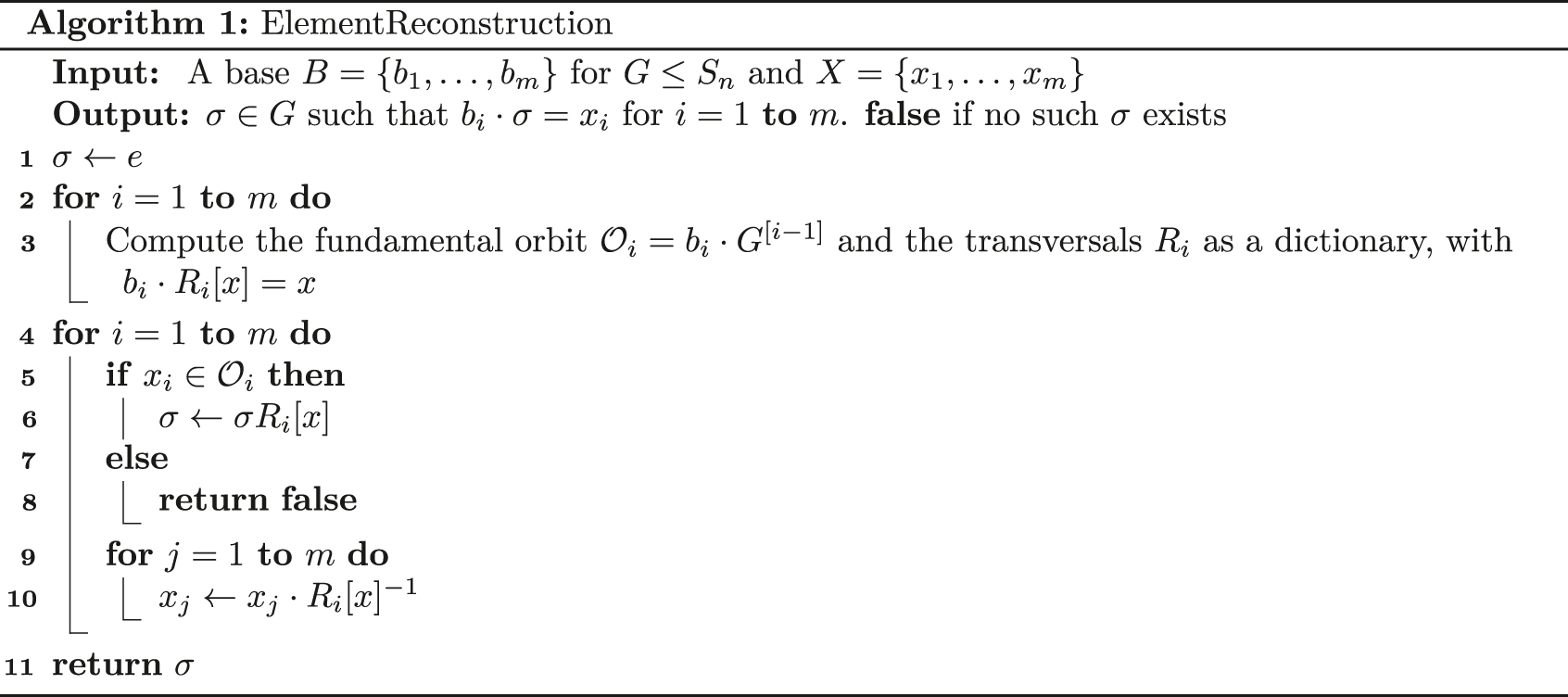
Corresponding to the base B, we construct the fundamental orbits and the right transversals using the Schreier–Sims algorithm. Initially, we set σ to be the identity. We then find the permutation r
1 in R
1 such that b
1 ⋅ r
1 = x
1. If x
1 does not lie in the fundamental orbit of b
1, that means no such σ exists and we can exit the procedure. We then replace (x
1, …, x
m
) with
Definition 2.5
(UBB). An uncovering-by-bases (UBB) to fix r errors in a permutation group acting on Ω is a set of bases for the group, such that, for each r-subset of Ω (an r-subset of Ω is a subset of Ω of size r); there is at least one base in the UBB that is disjoint from the r-subset.
It is known that every permutation group has an uncovering-by-bases [3], Proposition 7]. However, they have been constructed only for a few permutation groups. There is no known procedure to construct a small UBB for an arbitrary permutation group. Uncovering-by-bases can be used to decode as follows:
Let G be a permutation group acting on Ω. Consider a permutation g ∈ G in the list form and w was obtained after r or fewer errors were introduced to g. Note that w can have repeated entries and need not be a permutation. Let R be a subset of Ω of size less than or equal to r. Errors were introduced in positions from R. The set R is not known to the decoder a priory. Let
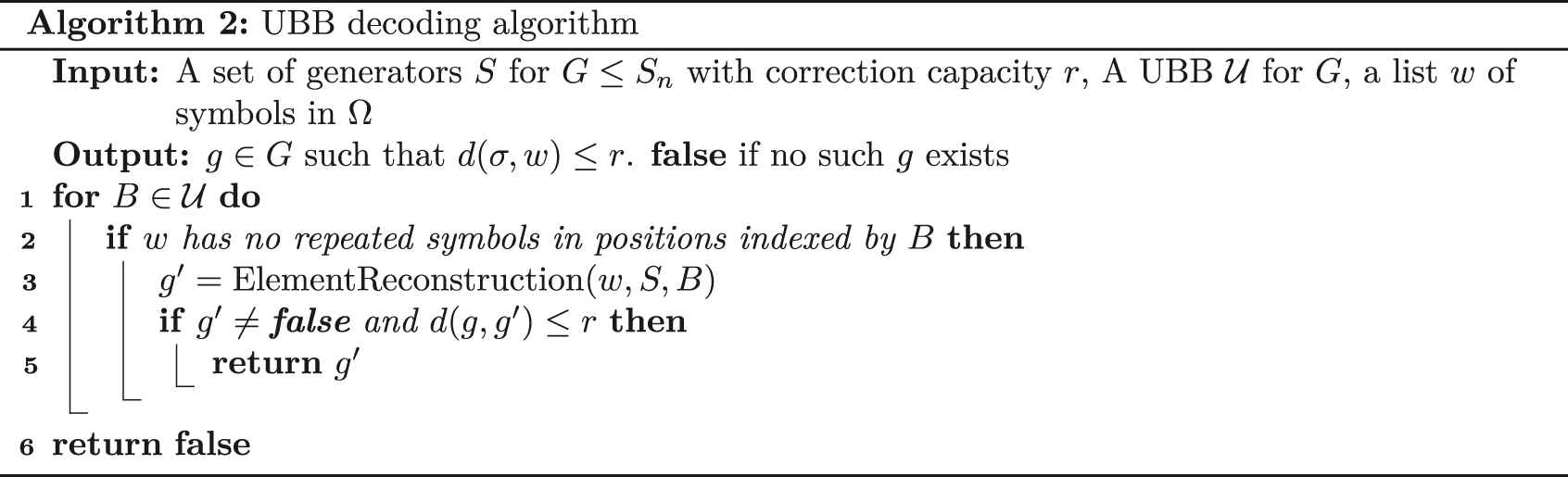
This algorithm is similar to permutation decoding for linear codes proposed by MacWilliams and Sloane [10], which involves using a subset of the automorphism group of the code that moves any errors out of the information positions.
2.2 Some constructions of uncoverings-by-bases
There are only a few examples of UBB that were constructed by Bailey. One of them is a symmetric group acting on 2-subsets, and the other is a wreath product of a regular permutation group with a symmetric group. We discuss them next.
2.2.1 Symmetric group acting on 2-sets
Let m be a positive integer. Let Ω be the set of all subsets of [m] of size 2.
Any permutation σ ∈ S m acts on a set {i, j} ∈ Ω as {i ⋅ σ, j ⋅ σ}. Now the group G is S m acting on Ω, and it has minimal degree 2(m − 2) and correction capacity m − 3 [3], Proposition 21]. The set of all 2-subsets of {1, 2, …, m} can also be viewed as the edge set of the complete graph K m . Thus, we can use graph theoretic results to construct bases for G, which we will use to construct a UBB.
A spanning subgraph of K m , which has at most one isolated vertex and no isolated edges, forms a base for G. A Hamiltonian circuit of K m is a circuit in K m containing each vertex exactly once. From a Hamiltonian cycle of K m , we can obtain such a spanning graph (called a V-graph) by deleting every third edge [3], Fig. 2]. A Hamiltonian decomposition of a graph is a partition of the edge set of the graph into disjoint Hamiltonian circuits and at most one perfect matching. In the 1890s, Walecki [11] showed that K m can be decomposed into (m − 1)/2 Hamiltonian cycles when m is odd. If m is even, it can be decomposed into (m − 2)/2 Hamiltonian cycles and one perfect matching. Using Walecki’s decomposition, we can construct a UBB for G. The UBB is the set of all V-graphs, which can be obtained from the Hamiltonian decomposition of K m , and it can be proved that any r-subset of edges of K m avoids at least one of these V-graphs. For more on this topic, the reader is referred to Bailey [3]. This UBB is of size O(m), and each base is of size O(m). Thus, we can use this UBB in the decoding algorithm, which would have time complexity O(m 4) = O(n 2). This is because n is the number of edges in K m , which is equal to m(m − 1)/2.
2.2.2 Wreath product of regular groups
Let H be a group acting on a set Δ where m = |Δ|. The action of H on Δ is said to be regular if, for every x, y ∈ Δ, there exists exactly one h ∈ H such that x ⋅ h = y. Having defined the action of H on Δ, we can view H as a subgroup of S m , and such a permutation group is called a regular permutation group. We now define the permutation group code G = H ≀ S n to be the wreath product of H, a regular permutation group acting on m points with the symmetric group S n . The group G acts imprimitively on mn points.
We define elements of G as all tuples of the form (h 1, h 2, …, h n , σ), where h i ∈ H and σ ∈ S n . We use the symbol 1 to denote the identity element of H and e for the identity element of S n . In this section, we redefine Ω = [m] × [n] consisting of n copies of the set [m] as n columns each with m rows.
We now define the action of an element g = (h 1, h 2, …, h n , σ) on (i, j) to be (i ⋅ h i⋅σ , j ⋅ σ). The group S n acts on the columns and the group H acts on the rows. Thus, the group G can be defined as a subgroup of the symmetric group acting on Ω. As a regular group acting on m points has size m, |G| = m n n!. See [2] for a proof of |H| = m.
Theorem 2.1.
The minimal degree of the wreath product group G is m and its error correction capacity is
Proof.
Consider the group element (h, 1, …, 1, e) for some h ∈ H. This permutation moves all the points in the first column and fixes all the other points. Thus, the minimal degree of H is less than or equal to m. We now show that any nonidentity permutation in G moves at least m points. Consider a permutation (h 1, h 2, …, h n , σ). If σ is not the identity, it must move all the points in one of the columns to another column and thus moves at least m points. If σ is the identity permutation, at least one of the h i must be a nonidentity element of H, which will move all m points in that column.□
Theorem 2.2.
Any subset of Ω forms an irredundant base for G if and only if it has exactly one point from each column of Ω.
Proof.
Consider any set S, which does not contain any points from the first column. The permutation (h, 1, …, 1, e) fixes every point in S. So, S cannot be a base for G. To prove the converse, consider the following set {(x 1, 1), (x 2, 2), …, (x n , n)} with each x i belonging to the ith column. Suppose here exists g = (h 1, h 2, …, h n , σ) that fixes each of these points. As (x i , i) ⋅ g must lie in the ith column for each i, this implies that σ must be the identity permutation. Thus, the action of g on x i is x i ⋅ h i . As the action of H on [m] is regular, this implies that each h i is the identity. □
Using this theorem, we can now construct a UBB for G. Each row of Ω forms a base and a collection of r + 1 rows form a UBB for G, where
2.3 An alternative decoding algorithm for wreath product
In this section, we present a simple decoding algorithm introduced by Bailey and Prellberg [12], which uses majority logic principles for the wreath product groups and compare its performance to the original UBB algorithm. For simplicity, we assume H to be the cyclic group C m of order m, this algorithm can be extended to any regular group.
Input: For some g ∈ C m ≀ S n , w is constructed from g by introducing r or less errors. The list w is the input.
Output: We aim to recover the permutation g. Because d(g, w) ≤ r, there is a unique permutation in G with distance at most r from w.
The algorithm: To recover the permutation g = (h 1, h 2, …, h n , σ) ∈ H ≀ S n , it suffices to recover h and σ.
For each i ∈ [n], define σ(i) be the majority value of the second coordinates of w((j, i)), for each j ∈ [m]. This way, we can recover the permutation σ ∈ S n .
For each i ∈ [n], let w i,j be the first coordinate of w((j, i)), for each j ∈ [m], and let
We refer to ref. [12] for a proof of correctness of the above algorithm.
Complexity analysis: We now estimate the complexity of this algorithm. The first part of the algorithm involves splitting the word into blocks and rewriting each symbol. This could be done in constant time for each position. Computing the value of the block label and the cyclic shift for each position involves some integer arithmetic, which would take a constant amount of time for each position. Thus, it takes O(mn) time. The second part of the algorithm involves finding the most frequently occurring value of the block value and cyclic shift in each block. Let’s consider the part where we find the most frequently occurring value of the cyclic shift. We maintain an auxiliary list of size m, with each position corresponding to the frequency of that cyclic shift. We iterate through the block, compute the cyclic shift for each location of the block, and update its frequency in the auxiliary list. This procedure takes O(m) time. We then go through the auxiliary list to find the most frequently occurring cyclic shift. We do a similar procedure for finding the action of σ on the block using an auxiliary list of size n and that would take O(n) time. This procedure is repeated for each block. For the final part of the algorithm, which involves converting the reconstructed word back to a permutation can be done with O(mn) arithmetic operations. Thus, the algorithm takes O(mn) time if m > n and O(n 2) time if n > m. This is faster than the UBB algorithm for the same group, which would take O(m 2 n 2) time.
2.3.1 Decoding more than r errors
In fact, the algorithm described above can correct more than r errors, as long as the majority of elements in each block are correct. There are some error patterns with up to nr errors, which can be decoded using this algorithm. An error pattern is a certain set of positions where the errors are induced. Bailey obtained the following expression for the number of error patterns of a certain length, which can be corrected by this algorithm.
Let k be a positive integer. Let P
n,r
(k) be the set of all partitions of k into at most n parts where each part is of size at most r. We write such a partition in the form
Theorem 2.3.
For an integer k ≤ nr, the following number of patterns of k errors can be corrected:
Proof.
For a proof, we refer to Bailey [5], Section 6.7]. □
We ran simulations to find the proportion of error patterns, which can be corrected for the case m = 5. In this case, the minimal degree is 5 and has correction capacity 2. In practice, a much larger number of errors can be corrected, with a high probability of success.
Using a computer program, we calculated the value of E
n,r
(k) for different values of k and obtained the value of
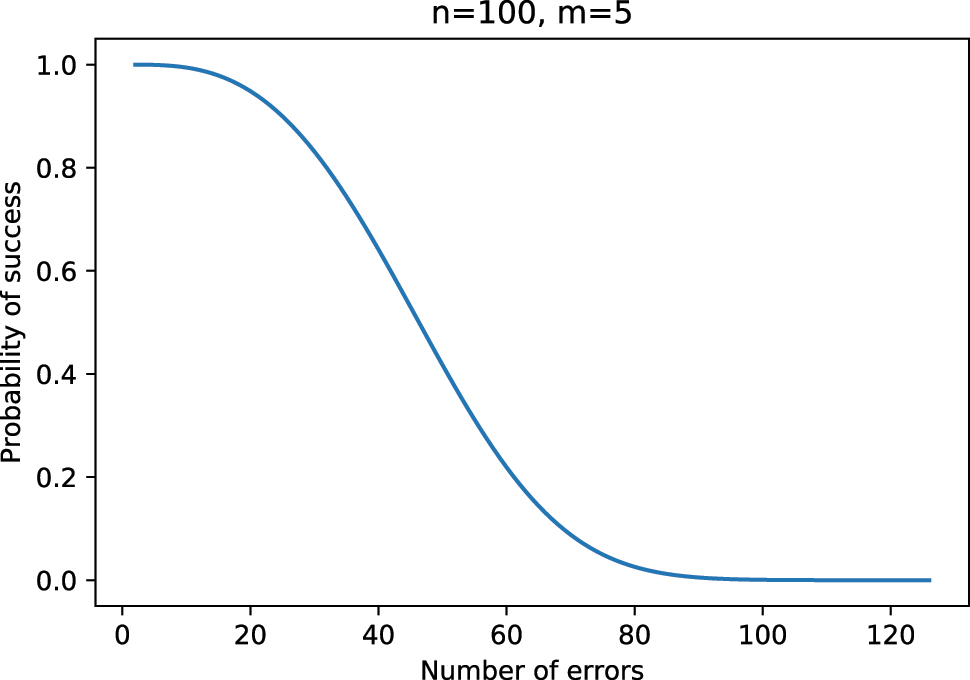
Plot of fraction of errors that can be corrected for n = 100, m = 5.
We can deduce from the data that the algorithm can decode 95 percent of error patterns of length up to 19, 90 percent of error patterns of length up to 24, 80 percent of error patterns of length up to 31, and 50 percent of error patterns of length up to 46.
Interestingly, the number of errors that can be corrected increases with n (for a fixed probability of success). This is despite the minimal degree (correction capacity) remaining the same. We plot the number of errors, which can be plotted with 95 percent probability of success with respect to n, both in terms of absolute number of errors, which can be corrected, and in terms of the error rate, which is the ratio of the error induced to the degree of the permutation group. Unlike the correction capacity, which increases with n, the error rate seems to decrease slightly as n increases (Figure 2).
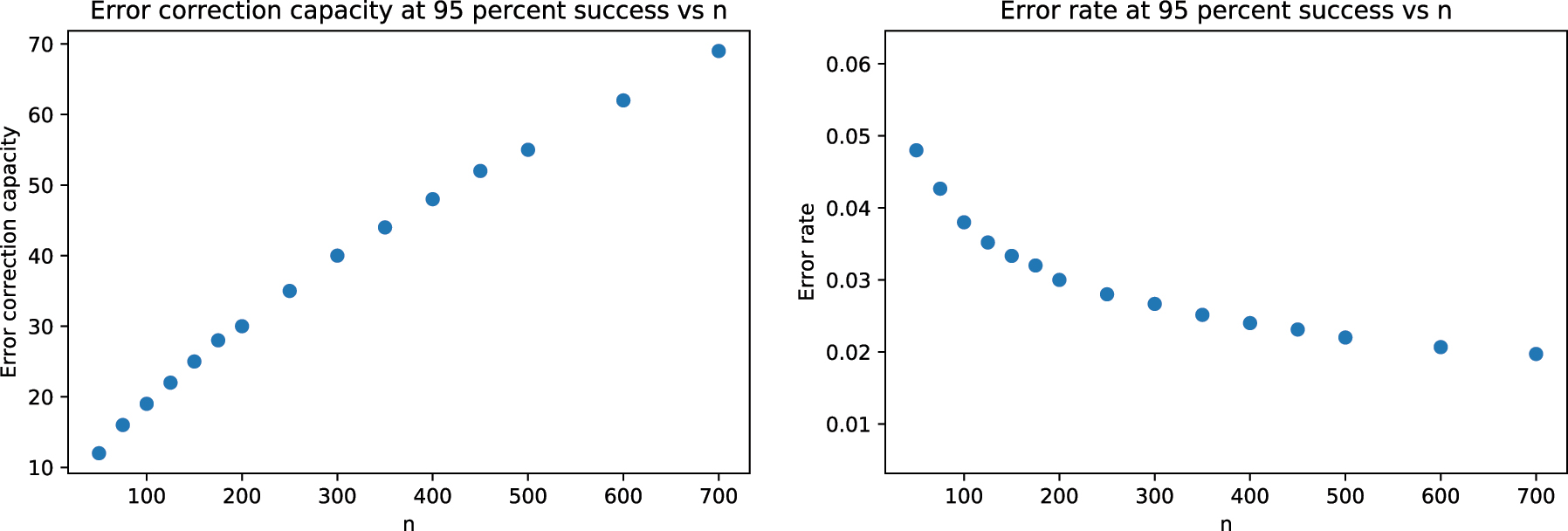
Plot of error correction capacity with 95 % probability of success.
3 A cryptosystem on permutation error-correcting codes
The McEliece cryptosystem is a very popular cryptosystem using linear codes, first proposed by Robert McEliece [13] in 1978. Due to its large key sizes, it never gained a lot of popularity at that time. Recently with the rise of quantum computing, it has gained a lot of attention along with its counterpart proposed by Neiderreiter [14] as a postquantum alternative to currently used public-key cryptosystems. Fundamentally, the McEliece cryptosystem uses two linear codes, one kept private and another made public with the two codes being equivalent in the following way:
Definition 3.1.
Consider two [n, k] linear codes C 1 and C 2 generated by the generator matrices G 1 and G 2. These codes are considered equivalent if, there exists a nonsingular k × k matrix S and an n × n permutation matrix P such that G 2 = SG 1 P.
Consider a linear code C generated by a matrix G. Premultiplying G by a nonsingular matrix will not change the code. Postmultiplying G by a permutation matrix creates a new code, one whose codewords are obtained by permuting the positions of the codewords in C by the permutation corresponding to the permutation matrix. In other words, there is a distance preserving map, or isometry between two equivalent linear codes. The principle behind the McEliece cryptosystem is that we have a map between an easy instance and a hard instance of the closest vector problem in linear codes using this distance preserving map. The private key matrix is chosen from a family of linear codes with a fast decoding algorithm. However, the public key matrix generates a linear code do not have a fast decoding algorithm. The map between these easy and hard instance is known only to the owner of the private key. This provides the one-way property, which is essential to all public-key cryptosystems.
In the previous section, we studied permutation groups as error-correcting codes. In this section, we investigate the following questions:
Can we develop a public key cryptosystem similar to the McEliece cryptosystem using permutation codes instead of linear codes?
Is there any potential advantage of using permutation codes instead of linear codes from the standpoint of cryptography?
The first step in this direction would be to investigate isometries of the symmetric group with the Hamming metric. Assume that ϕ is an isometry of the Hamming space. We can have the private key as a permutation code H (which is a subgroup of S
n
) with an efficient decoding algorithm and the public key as the permutation code
x ↦ gxh for g and h being fixed members of S n
x ↦ gx −1 h for g and h being fixed members of S n
However, the isometries that interest us should be homomorphisms. We would like both codes H and
3.1 A McEliece cryptosystem using permutation codes
In this section, we present a public-key cryptosystem using permutation codes that is similar to the McEliece cryptosystem. The private key is kept secret, and the public key is available to the public.
Private key Let G be a permutation group acting on n letters with a fast decoding algorithm. We choose a subgroup H ≤ G ≤ S n and a permutation g from S n . The private key is a set of generators {h 1, …, h s } of H and g. We will use the decoding algorithm in G as a decoding algorithm for H.
Public key The public key is a set of elements
Encryption The plaintext is
Decryption Once we receive c, we compute gcg −1. We then use the fast decoding algorithm to obtain h, which is its nearest neighbor in H. We then compute
The conjugation map is an isometry of the Hamming space. The distance between h and H is equal to the distance between
Remark 3.1.
There is a possibility of using isometries other than the conjugation map. However, the errors have to be introduced more carefully. For example, suppose we have a group G ≤ S n and a map from G to G, which is an isometry on G. Our permutation code is a subgroup H ≤ G ≤ S n . Thus, if we introduce errors in H so that the ciphertext c lies in the group G, the cryptosystem using this isometry will work. We have not studied this problem carefully and leave it for future work.
3.2 The security of our cryptosystem
3.2.1 Security assumptions
There are two security assumptions:
AS1 Solving the general decoding problem in
AS2 Inability to construct a subgroup H′ of S n with generators
In this paper, we present a cryptosystem that seems to satisfy (for known attacks) AS1 but not AS2 using the symmetric group acting on 2-subsets. The cryptosystem using wreath product group falls apart on AS1 but is resistant to ISD like attacks. Like the McEliece cryptosystem, attacks on this cryptosystem can broadly be classified into two types – unstructured and structural attacks. Unstructured attacks attempt to solve the nearest neighbor problem in
For our cryptosystem to work, the group H must have an efficient decoding algorithm. For the cryptosystem to be secure, the group
We now present some generic attacks on our cryptosystem. Generic attacks are designed without taking into account the choice of the permutation code. Their effectiveness depends only on public parameters, like the correction capacity and size of the code. In Section 3.3, we demonstrate the existence of a code with parameters that make the cryptosystem secure against these attacks.
3.2.2 Brute force attacks
One obvious method to solve the nearest neighbor problem in
Another way is to enumerate all possible permutations within a distance r from the codeword c and check if they belong to
3.2.3 Information set decoding
Information set decoding is one of the more successful attacks on the McEliece cryptosystem. The original idea was proposed by Prange [16] in 1962, and many improvements on this basic attack have been proposed [17], 18]. For a [n, k] linear code, it involves picking k coordinates at random and trying to reconstruct the codeword from those positions. In this section, we recreate a version of Prange’s ISD attack for cryptosystems using permutation codes. We note that there are several notable improvements to Prange’s original ISD algorithm. It is not clear to us whether these improvements can translate to permutation codes as they extensively use the algebraic structure of linear codes. We refer the reader to Weger et al. [9], Section 5] for an excellent survey of the ISD algorithms. We prove a sufficient (but not necessary) condition for a permutation code based cryptosystem to be resistant to ISD attacks.
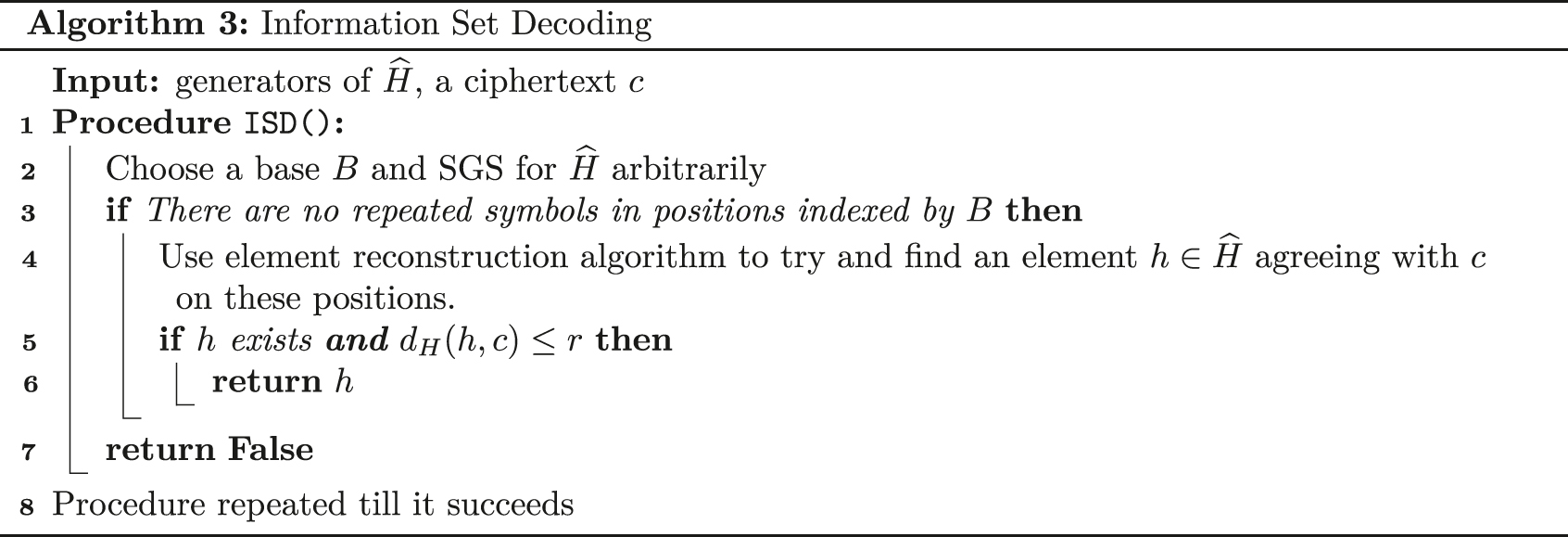
This algorithm is similar to the uncovering-by-bases decoding algorithm proposed by Bailey, except that, we do not know the UBB and thus the running time is not bounded by the size of the UBB. The correctness of this algorithm follows from the proof in Bailey [3], Proposition 7] in which he shows that given any r-subset of {1, …, n}, there exists a base for H disjoint from it. Each iteration is a success if none of the positions of c indexed by the chosen base have an error. This occurs with a finite nonzero probability because such a base exists. The performance of the ISD algorithm is identical for the groups H and
Theorem 3.1.
Let k
max be the size of the irredundant base of largest size of H. The ISD algorithm succeeds in returning a plain text permutation
Proof.
The algorithm uses a procedure to choose an arbitrary base B for the group. At the same time, a set R of size r is chosen uniformly at random, and errors are induced in those positions. Before making concrete complexity estimates, we would like to make some observations. First, it is clear that if there are more error positions, the probability that the information set does not have any error reduces and the complexity of the attack increases with r. Also, if the size of the base chosen is small, the probability that the positions indexed by this base do not have any error positions is high. Thus, the complexity of the attack increases with k, the expectation of the length of the base.
Let E B denote the event that the algorithm chooses subset B as a base for the group. Conditioned on the event E B , an iteration of the algorithm succeeds if the sets R and B are disjoint. Because the set R is chosen uniformly at random from {1, …, n},
As this probability depends only on the size of B and not on the set B, we can obtain an expression for the probability of an iteration of the algorithm succeeding:
Let k max be the size of the irredundant base of largest size of H. As the Pr[Success|E B ] decreases as the size of the base increases, we can obtain the following lower bound on the probability of the algorithm succeeding:
This is a Monte Carlo algorithm, which decodes correctly with probability Pr[Success], and otherwise returns false. If we repeat the algorithm till it succeeds, we obtain a Las Vegas algorithm that always decodes correctly but has a running time, which is a random variable with expectation 1/Pr[Success]. It is also important to note that as each iteration is independent, this attack can be effectively parallelized. Using the following well-known formula for binomials,
we can show that this algorithm has expected complexity
□
The running time of this algorithm increases with both error rate and information rate. The value of k max, which is the size of the largest irredundant base of H, is the analogue of the rank of the permutation code H. For example, it can be shown that the value of k max for the symmetric group S n acting on 2-subsets of [n] is n − 1 or n − 2, depending on the parity of n [19], Theorem 1.1]. The security level of a cryptosystem is measured from the amount of computational resources needed to break it. A cryptosystem is said to be b-bit secure if it requires 2 b operations to be broken. For asymmetric cryptosystems, this security level is upper bounded by the running time of the best known attacks on them. Using the ISD attack, a necessary condition for our cryptosystem to have b-bit security is α(k max, r)n ≥ b. If we want a cryptosystem with b-bit security, we need to choose a permutation code with the appropriate parameters.
So far, we have described a framework to develop cryptosystems using permutation codes and outlined generic attacks on those cryptosystems, whose effectiveness depend on the parameters of the chosen permutation code H. Next, we attempt to use the permutation codes described in Section 2.2 in our cryptosystems.
3.3 Our cryptosystem using wreath product groups
The security and the performance of our cryptosystem depend on the choice of the group H and its decoding algorithm. In this section, we explore using the wreath product groups with the alternate decoding algorithm discussed in Section 2.3. We show that it can be made resistant to information set decoding attacks using appropriate parameters. However, the decoding algorithm can be modified to work in the conjugate group
Let H be the wreath product group C m ≀ S n (more generally, we can take H to be a subgroup of C m ≀ S n with suboptimal decoding). We consider the case of m = 5 for different values of n, for different probabilities of correct decoding. Because the actual minimal degree of this group is 5, there will be cases in which the receiver of the encrypted word cannot decode correctly and will receive a wrong word. In these cases, the receiver will be able to tell that the decoding is wrong (possibly by using an appended hash function) and ask the sender to resend the message. Consider the case for which the probability of correct decoding is 0.9 and 0.95. We find the largest such value of r for which r errors are introduced and can be corrected for at least 0.9 or 0.95 fraction of the cases for different values of n, and estimate the amount of computational resources required for an ISD based attack to break the cryptosystem by plugging in this value of r into Equation (2). As we can see, the computational resources needed to break this cryptosystem are nontrivial and increase with n, although it is still not close to commercial levels of security. We also repeat this exercise for the case of m = 7. For m = 7, we can attain higher security levels for smaller values of n compared with m = 5. These results mean that, by increasing m and n to an appropriate amount, we can reach commercial levels of security such as 128 or 256 bits. Our analysis of larger values of m and n were limited by our computational resources, as our computer program for calculating the proportion of error patterns that can be corrected involves iterating over integer partitions, which is computationally intensive. Judging by the trend in the graphs, however, we can conclude that the values of m and n can be appropriately increased to attain larger levels of security. For example, we can attain 128 bit security using the algorithm 95 percent success rate with n = 1,645, and with 95 percent success rate, we can achieve the same with n = 1,257 (Figures 3 and 4).
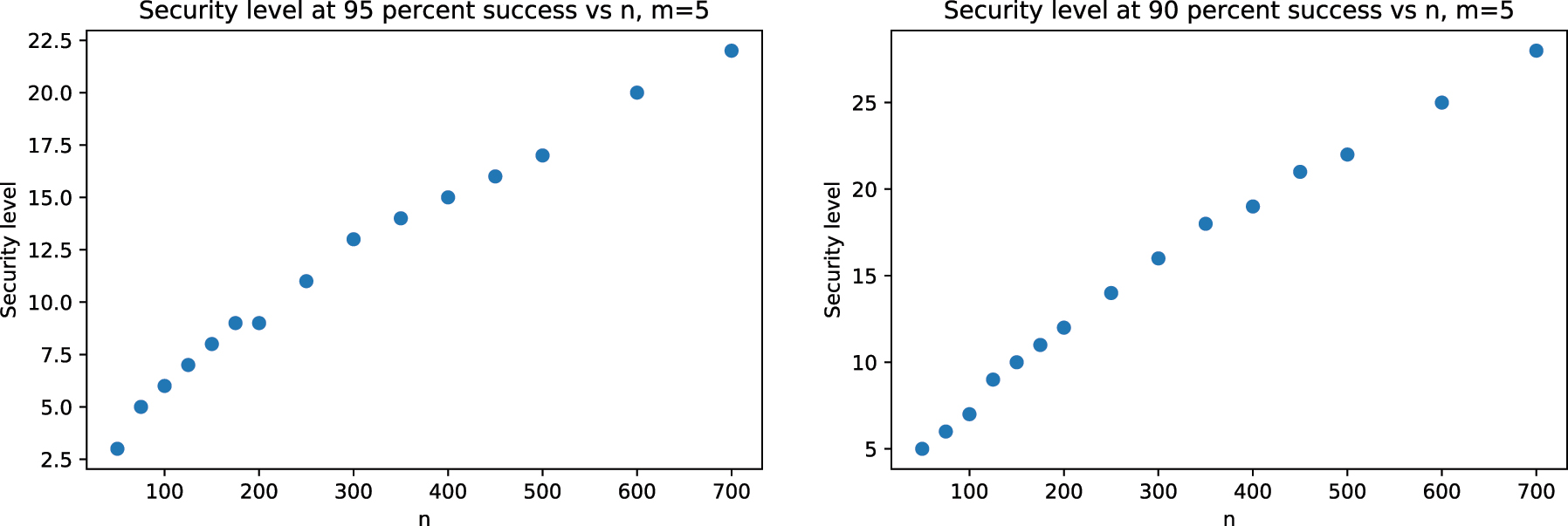
Security levels for m = 5.
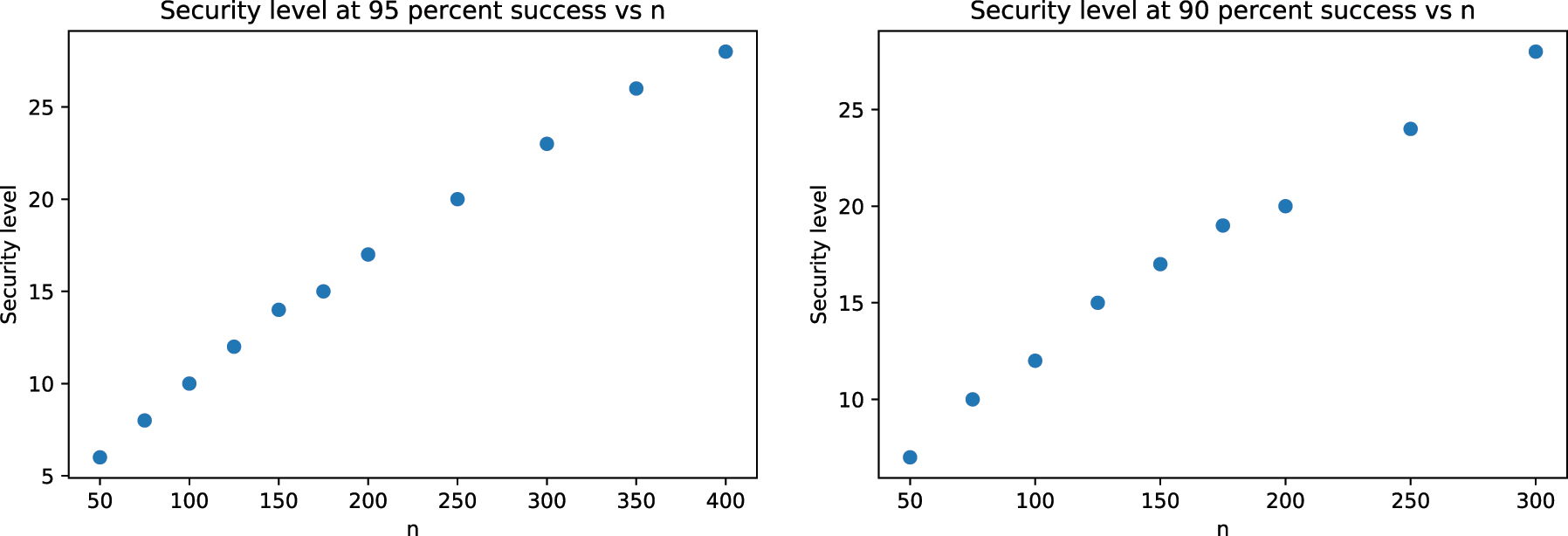
Security levels for m = 7.
3.3.1 Attack using block systems
For a permutation group G acting on Ω, a complete block system
The first property of block systems that we shall prove is that conjugation preserves the block structure of a permutation group.
Theorem 3.2.
Consider a permutation group G with a block system
Proof.
Every permutation in G′ is of the form σ
−1
gσ where g is a member of G. Consider any two points x and y in the set B
i
⋅ σ. Then, x ⋅ σ
−1
gσ = x′ ⋅ gσ and y ⋅ σ
−1
gσ = y′ ⋅ gσ. As x′ and y′ are in the same block B
i
, x′ ⋅ g and y′ ⋅ g are in the same block of
For the wreath product group C
m
≀ S
n
acting on mn points, it is easy to see that the columns form a maximal block system, with the group H acting on the blocks and the group S
n
permuting them. The public key group
Input and output. For h ∈ H ⊆ C
m
≀ S
n
. Let
Step 1: recovering the block system. The first step is to recover the block system
Step 2: Recovering τ
. For each i ∈ [n], let i ⋅ σ be the label of the block that the majority of elements within the block B
i
is moved to by
Step 3: Recovering h
1, …, h
n
. As noted above, for each H
i
, an element in H
i
can be recovered given just the action on a single point. For every point in
3.4 Our cryptosystem using the symmetric group acting on 2-subsets
We now examine the use of a group whose decoding algorithm will not work on its conjugates. Because of its parameters, however, it can be trivially broken using ISD attacks.
Let G be the symmetric group S
m
acting on Ω the set of all two subsets of {1, …, m}. Let
We use the decoding algorithm using the UBB described in Section 2.2.1. As H is a subgroup of G, the same decoding algorithm can be used, although the decoding might be suboptimal because the minimal degree of H might be greater than G. Unlike the case of the alternative decoding algorithm for the wreath product groups, we cannot easily construct a UBB for the conjugate group
3.4.1 Conjugator search attack
The next thing we attempt to do is attack the second security assumption. That is, we attempt to find a conjugator g and a subgroup H′ of S
n
with an efficient decoding algorithm. We assume that these subgroups are all subgroups of G, as we can employ the UBB algorithm for them. We do manage to come up with an attack, which is better than a brute force search for g. To recall, we are given a sequence of generators
Conjugacy in S n vs. S m . Consider any element of S m . Its cycle type in the permutation image acting on 2-subsets is entirely determined by its cycle type acting naturally.[2] It is possible for two different cycle types acting naturally to lead to the same cycle type acting on 2-sets. Two elements, which are conjugate in S m , are also conjugate in S n , but two elements can be conjugate in S n but not in S m .
Determining cycle-type in S
m
. Consider the elements h
1 and
Searching in cosets of the centralizer. Let us say we find an element of S
m
with the same cycle type as h
1 (cycle type in S
n
). The conjugator is unique up to a coset of the centralizer of
3.4.2 ISD attacks
The size of a base for H is less than log2(m!) ≤ mlog2 m. The number of bit operations required to break the cryptosystem using information set decoding is less than
which is upper bounded by a polynomial in m. Hence, we can use information set decoding to break this cryptosystem in polynomial time. To demonstrate this more clearly, we plotted this as a function of m (Figure 5), and we can see that the security level of even 80-bits is not attainable for reasonable values of m.
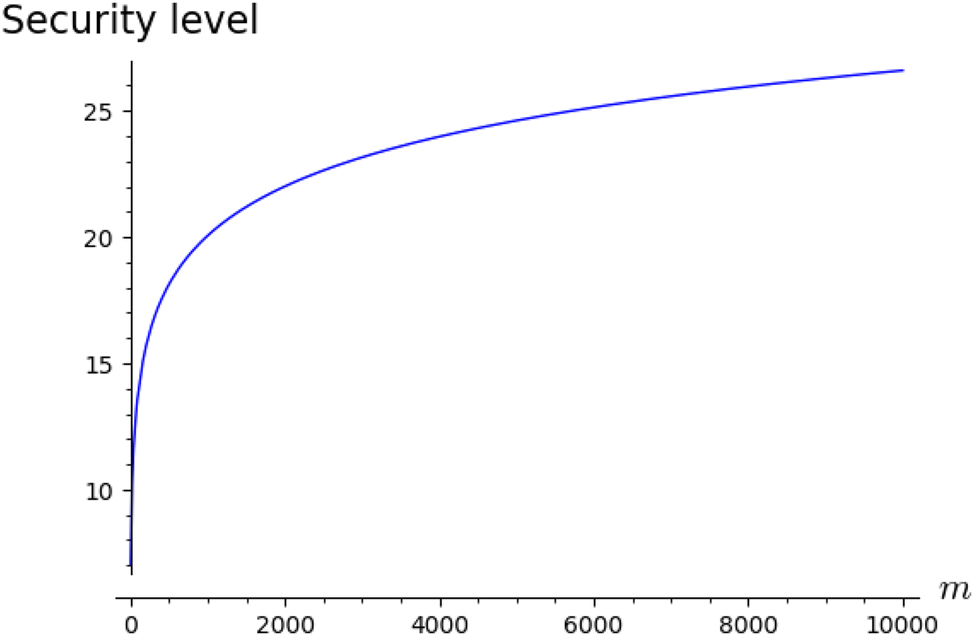
Security of cryptosystem using 2-sets.
The key reason why the cryptosystem using this code is insecure is the parameters of the code. Both the rate of the code and the correction capacity are too low. What we are aiming for is a code where the quantities k/n (on average) and r/n are asymptotically constant, like the binary Goppa codes. This requirement is satisfied by the wreath product groups using the alternative probabilistic decoding algorithm.
3.5 An enhanced McEliece cryptosystem
Permutation codes are permutation groups, which have less structure than linear codes which are vector spaces. Linear codes can also be seen as permutation codes. Let q = p
t
where p is a prime and t a positive integer. A linear code of block size n over the field
Embedding a linear code into the symmetric group. We start with a monomorphism from the abelian group of
Thus,
Let S = ⟨s
1, s
2, …, s
d
⟩ be a d-dimensional subspace of a n-dimensional vector space V, which is a code with a good decoding algorithm. This code has a d × n generator matrix. This basis matrix depends on a fixed ordered basis
In this enhanced McEliece cryptosystem, the public key is the rows of the matrix S
1. The whole structure of the classical McEliece cryptosystem S and S′ is secret and so is the basis map and the conjugator g. The plaintext is [a
1, …, a
n
] where each a
i
is in the
On receiving the ciphertext, use the conjugator g to restore the original labeling. Then, one decomposes it as product of cycles. Then, one computes most of the a
i
from the exponent. Then that gives rise to a vector of length n over
There are few things to note. First, since the basis map is a secret, it enhances the classical McEliece cryptosystem. Thus, one might be able to use linear codes for the enhanced McEliece cryptosystem that is otherwise not secure. When it comes to cycles, computing the exponent has a lot of redundancy. Say, in a cycle after introducing errors, there is one point that gets repeated. Then, we can simply ignore the repeated points and compute the exponent. It is the action on one point that determines the exponent, when it comes to a cycle. Furthermore, a field element now has a permutation representation. Based on this representation, we might be able to introduce much more errors than is possible to fix for a permutation error correcting code. This topic, what is the right way to introduce errors and how many errors we can introduce, is left unsettled in this paper. Lastly, there is no need for the matrix S′. One can just move from S to S 1 directly without using S′. In this case, use a scrambler matrix over the prime subfield. Then, the extra step in decoding can be avoided.
Assume now there is a classical McEliece cryptosystem over linear codes that is secure. Then, for a suitable ciphertext of the original McEliece cryptosystem, one can map it to S 1 by the basis map. If the original plaintext is recovered from the ciphertext in the permutation setting, then that breaks the original McEliece cryptosystem. Note, we assume that the basis map is known in this case. The McEliece cryptosystem using Goppa codes has been remarkably resilient to both classical and quantum attacks. However, this McEliece cryptosystem is an enhanced version of the classical McEliece cryptosystem. It might be secure for other linear codes on which the original McEliece cryptosystem is not secure. Thus, this enhancement is bit more than a mere academic interest and deserves further study. However, at our present state of knowledge, it provides no respite from large key sizes that plagues the original McEliece cryptosystem.
3.6 Why use permutation codes?
So far, we have described a framework for using permutation codes in public-key cryptography and explored this framework using two particular permutation codes. The cryptosystem using wreath product groups can be made resistant to ISD attacks, but its decoding algorithm can be adapted for use in any of its conjugates too, which makes it unsuitable. On the other hand, for the symmetric group acting on 2-sets, the decoding algorithm cannot be modified for use in its conjugates, nor can the conjugator be uncovered easily from H and
Permutation groups differ from vector spaces in their noncommutativity, and it is an interesting question to ask if this would lead to any significant improvements in key size, speed, etc. over traditional linear code based cryptosystems. For example, a rank k subspace of
-
Funding Information: AM was partially supported by an NBHM research grant and AS was supported by a INSPIRE fellowship. Both these fundings were from the Govt. of India.
-
Author contribution: Both authors contributed equally and approve the final version of the manuscript.
-
Conflict of Interest: Both authors report no conflict of interest.
Acknowledgments
This paper was part of the first author’s Master’s thesis at IISER Pune. Both authors thank Upendra Kapshikar for stimulating discussions. Both anonymous referees deserve a special mention for their detailed report, which has benefited this manuscript immensely. We used GAP [20] for our computations.
References
1. Seress, Á. Cambridge tracts in mathematics. In: Permutation group algorithms. Cambridge: Cambridge University Press; 2003.10.1017/CBO9780511546549Search in Google Scholar
2. Cameron, PJ. London mathematical society student texts. In: Permutation groups. Cambridge: Cambridge University Press; 1999.Search in Google Scholar
3. Bailey, RF. Error-correcting codes from permutation groups. Discret Math 2009;309:4253–65. https://doi.org/10.1016/j.disc.2008.12.027.Search in Google Scholar
4. Bailey, RF. Uncoverings-by-bases for base-transitive permutation groups. Des Codes Cryptogr 2006;41:153–76. https://doi.org/10.1007/s10623-006-9005-x.Search in Google Scholar
5. Bailey, RF. Permutation groups, error-correcting codes and uncoverings [Ph.D. thesis]. University of London; 2006.Search in Google Scholar
6. Blake, I. Permutation codes for discrete channels. IEEE Trans Inf Theor 1974;20:138–40. https://doi.org/10.1109/tit.1974.1055142.Search in Google Scholar
7. Blake, IF, Cohen, G, Deza, M. Coding with permutations. Inf Control 1979;43:1–19. https://doi.org/10.1016/s0019-9958(79)90076-7.Search in Google Scholar
8. Buchheim, C, Cameron, PJ, Wu, T. On the subgroup distance problem. Discret Math 2009;309:962–8. https://doi.org/10.1016/j.disc.2008.01.036.Search in Google Scholar
9. Weger, V, Gassner, N, Rosenthal, J. A survey on code-based cryptography. [Online]; 2022. Available from: https://arxiv.org/abs/2201.07119.Search in Google Scholar
10. Macwilliams, J. Permutation decoding of systematic codes. The Bell Syst Tech J 1964;43:485–505. https://doi.org/10.1002/j.1538-7305.1964.tb04075.x.Search in Google Scholar
11. Alspach, B. The wonderful Walecki construction. Bull Inst Comb Appl 2008;52.Search in Google Scholar
12. Bailey, RF, Prellberg, T. Decoding generalised hyperoctahedral groups and asymptotic analysis of correctible error patterns. Contrib Discrete Math 2012;7. https://doi.org/10.55016/ojs/cdm.v7i1.62080.Search in Google Scholar
13. McEliece, RJ. A public-key cryptosystem based on algebraic coding theory. In: The deep space network progress report, DSN PR 42–44; 1978:114–16 pp.Search in Google Scholar
14. Niederreiter, H. Knapsack-type cryptosystems and algebraic coding theory. Probl Control Inf Theor 1986;15:159–66.Search in Google Scholar
15. Farahat, HK. The symmetric group as a metric space. J Lond Math Soc 1960;35:215–20.10.1112/jlms/s1-35.2.215Search in Google Scholar
16. Prange, E. The use of information sets in decoding cyclic codes. IEEE Trans Inf Theor 1962;8:5–9. https://doi.org/10.1109/tit.1962.1057777.Search in Google Scholar
17. Peters, C. Information-set decoding for linear codes over Fq. In: International workshop on post-quantum cryptography. Springer; 2010:81–94 pp.10.1007/978-3-642-12929-2_7Search in Google Scholar
18. Bernstein, DJ, Lange, T, Peters, C. Attacking and defending the McEliece cryptosystem. In: International workshop on post-quantum cryptography. Springer; 2008:31–46 pp.10.1007/978-3-540-88403-3_3Search in Google Scholar
19. Gill, N, Lodà, B. Statistics for Sn acting on k-sets. J Algebra 2022;607:286–99.10.1016/j.jalgebra.2021.10.037Search in Google Scholar
20. The GAP Group. GAP – groups, algorithms, and programming, version 4.11.0; 2020. Available from: https://www.gap-system.org/.Search in Google Scholar
© 2025 the author(s), published by De Gruyter, Berlin/Boston
This work is licensed under the Creative Commons Attribution 4.0 International License.
Articles in the same Issue
- Research Articles
- The condition number associated with ideal lattices from odd prime degree cyclic number fields
- A small serving of mash: (Quantum) algorithms for SPDH-Sign with small parameters
- The least primitive roots mod p
- On the independence heuristic in the dual attack
- Sherlock Holmes zero-knowledge protocols secure against active attackers
- Inner product functional encryption based on the UOV scheme
- A McEliece cryptosystem using permutation codes
- Review Article
- Leveled homomorphic encryption schemes for homomorphic encryption standard
- Special Issue based on CIFRIS24
- Modern techniques in somewhat homomorphic encryption
- Investigation of metabelian platform groups for protocols based on (simultaneous) conjugacy search problem
- Smaller public keys for MinRank-based schemes
- Application of Mordell–Weil lattices with large kissing numbers to acceleration of multiscalar multiplication on elliptic curves
- First-degree prime ideals of composite extensions
- Dynamic-FROST: Schnorr threshold signatures with a flexible committee
- BTLE: Atomic swaps with time-lock puzzles
- Security analysis of ZKPoK based on MQ problem in the multi-instance setting
Articles in the same Issue
- Research Articles
- The condition number associated with ideal lattices from odd prime degree cyclic number fields
- A small serving of mash: (Quantum) algorithms for SPDH-Sign with small parameters
- The least primitive roots mod p
- On the independence heuristic in the dual attack
- Sherlock Holmes zero-knowledge protocols secure against active attackers
- Inner product functional encryption based on the UOV scheme
- A McEliece cryptosystem using permutation codes
- Review Article
- Leveled homomorphic encryption schemes for homomorphic encryption standard
- Special Issue based on CIFRIS24
- Modern techniques in somewhat homomorphic encryption
- Investigation of metabelian platform groups for protocols based on (simultaneous) conjugacy search problem
- Smaller public keys for MinRank-based schemes
- Application of Mordell–Weil lattices with large kissing numbers to acceleration of multiscalar multiplication on elliptic curves
- First-degree prime ideals of composite extensions
- Dynamic-FROST: Schnorr threshold signatures with a flexible committee
- BTLE: Atomic swaps with time-lock puzzles
- Security analysis of ZKPoK based on MQ problem in the multi-instance setting
