Home Mathematics CAT(0) cube complexes and asymptotically rigid mapping class groups
Article Open Access

CAT(0) cube complexes and asymptotically rigid mapping class groups

  • Marie Abadie ORCID logo EMAIL logo
Published/Copyright: December 3, 2024

Abstract

The present paper contributes to the study of asymptotically rigid mapping class groups of infinitely punctured surfaces obtained by thickening planar trees. In a paper from 2022, Genevois, Lonjou and Urech study the latter groups using cube complexes. We determine in which cases their cube complexes are CAT ( 0 ) . From this study, we develop a family of CAT ( 0 ) cubes complexes on which the asymptotically rigid mapping class groups act.

1 Introduction

Thompson’s groups have been the subject of intense study in group theory and have proven to be a rich source of interesting examples [2, 4, 15]. They inspired the construction of other groups through variations of their concepts, called Thompson-like groups [13, 14]. Much recent work has been devoted to the study of braided versions of Thompson-like groups [3, 6], i.e. extensions of Thompson-like groups by infinite braid groups, which turn out to be closely linked to mapping class groups of surfaces of infinite type [1, 7].

Genevois, Lonjou and Urech study in [11] a particular family of braided Thompson-like groups called asymptotically rigid mapping class groups. Their framework is inspired from [8, 9]. These groups are subgroups of big mapping class groups of infinitely punctured surfaces obtained by thickening planar trees A n , m , having one vertex of valence 𝑚, while all the others have valence n + 1 . Briefly, we give a rigid structure S ( A n , m ) to the latter surfaces and consider the group of isotopy classes of homeomorphisms that preserve this structure “almost everywhere”. To investigate the finiteness properties of these groups, denoted m o d ( A n , m ) , the aforementioned authors present a novel family of cube complexes called C ( A n , m ) . In [11, Section 3.3], they raise the question of whether their cube complexes are non-positively curved. The answer to this question is the following result (Theorem 3.14 in the text).

Theorem

The cube complex C ( A n , m ) is CAT ( 0 ) if and only if 1 m n + 1 .

To study the case m n , we consider different rigid structures S ( A n , m ) which are related to the previous one through the following observation (Lemma 2.1).

Lemma

For all m , n 1 , there is a group isomorphism

m o d ( S ( A n , m ) ) m o d ( S ( A n , m n + 1 ) ) .

In [12], the authors suggested that it may be possible to modify their construction. Hence we introduce a cube complex D ( A n , m ) that is CAT ( 0 ) for all m , n 1 , and upon which the asymptotically rigid mapping class groups of S ( A n , m ) act (Theorem 3.20 and Corollary 3.21 in the text).

Theorem

For all m , n 1 , the cube complex D ( A n , m ) is CAT ( 0 ) .

Thus we define a collection of CAT ( 0 ) cube complexes,

E ( A n , m ) : = { D ( A n , m n + 1 ) if m n 1 , C ( A n , m ) if 1 m < n .

Corollary

For all m , n 1 , m o d ( A n , m ) acts on the cube complex E ( A n , m ) which is CAT ( 0 ) .

2 Preliminaries

Let 𝐴 be a locally finite planar tree. Its arboreal surface is the surface S ( A ) obtained by embedding A into the plane and thickening it. Let S ( A ) be the surface obtained from S ( A ) by adding a puncture for each vertex of the underlying tree 𝐴. We give a rigid structure to S ( A ) by dividing the surface into polygons with a family of pairwise non-intersecting arcs whose endpoints are on the boundary of the surface such that

  • each arc intersects one unique edge of 𝐴 and this intersection is transverse,

  • each polygon contains exactly one puncture in its interior.
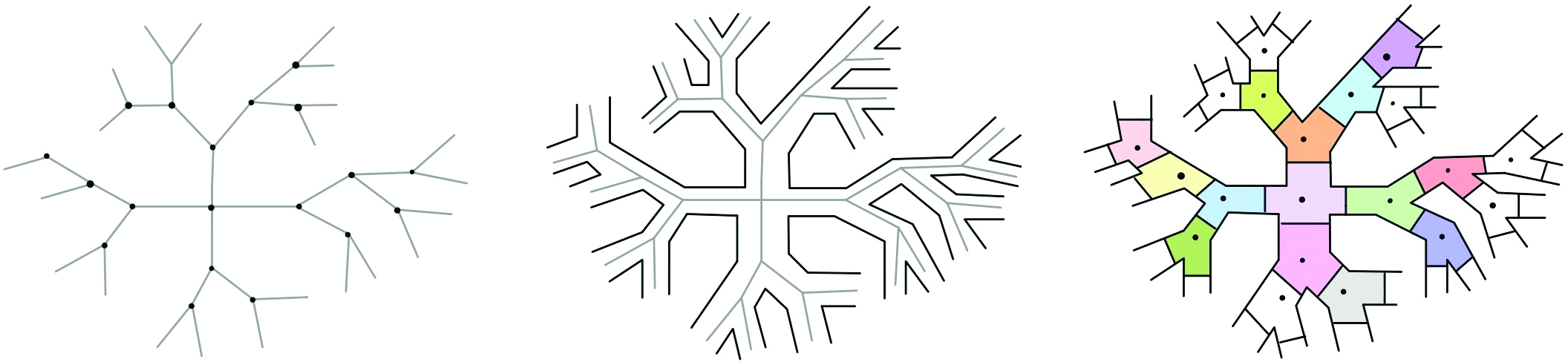
Figure 1 
               From left to right, pictures of 


                              A
                              
                                 2
                                 ,
                                 4


                        A_{2,4}
                     
                  , 


                              S
                              ⁢
                              
                                 (
                                 
                                    A
                                    
                                       2
                                       ,
                                       4
                                    
                                 
                                 )


                        \mathscr{S}(A_{2,4})
                     
                   and 


                                 S
                                 ♯
                              
                              ⁢
                              
                                 (
                                 
                                    A
                                    
                                       2
                                       ,
                                       4
                                    
                                 
                                 )


                        \mathscr{S}^{\sharp}(A_{2,4})
                     
                  .
Figure 1

From left to right, pictures of A 2 , 4 , S ( A 2 , 4 ) and S ( A 2 , 4 ) .

An admissible subsurface Σ S ( A ) is defined as a connected subsurface that can be written as a finite union of polygons from the rigid structure. The height of Σ, denoted as h ( Σ ) , refers to the number of punctures present within Σ. The frontier of Σ refers to the union of all the arcs, called frontier arcs, from the rigid structure lying in the boundary of Σ. It is denoted as Fr ( Σ ) . A polygon 𝐻 is adjacent to Σ if it shares an arc with the frontier of Σ.

An asymptotically rigid homeomorphism of S ( A ) is a homeomorphism 𝜙 from S ( A ) to itself which respects the rigid structure almost everywhere. That is, there exists an admissible surface supp ϕ , called the support of 𝜙, such that

  • its image ϕ ( supp ϕ ) is an admissible surface,

  • outside its support supp ϕ , 𝜙 sends polygons to polygons.

The group of isotopy classes of orientation-preserving asymptotically rigid homeomorphisms of S ( A ) is denoted by m o d ( A ) or m o d ( S ( A ) ) and is called the asymptotically rigid mapping class group associated to 𝐴. Let ϕ m o d ( A ) , and Σ an admissible surface, 𝜙 is rigid outside Σ if each polygon of the rigid structure not in Σ is mapped to a polygon.

Funar and Kapoudjian were the first to consider the group corresponding to a regular tree of degree three and to study its generators and relations [8]. In [11], Genevois, Lonjou and Urech extend the definition to explore the finiteness properties of these groups when the tree 𝐴 is considered to be A n , m .

We define an equivalence relation on the set of pairs ( Σ , ϕ ) , where Σ is an admissible surface of S ( A ) and 𝜙 lies in m o d ( A ) . Two pairs are related by ( Σ , ϕ ) ( Σ , ϕ ) if ϕ 1 ϕ is isotopic to an asymptotically rigid homeomorphism that is rigid outside Σ and maps Σ to Σ . Observe that ( Σ , ϕ ) ( Σ , ϕ ) if 𝜙 is isotopic to ϕ . We denote the equivalence class of the pair ( Σ , ϕ ) by [ Σ , ϕ ] .

In [11], the authors introduce a new family of cube complexes to explore the finiteness properties of this group when the tree 𝐴 is considered to be A n , m . They define the cube complex C ( A n , m ) as follows:

  • vertices [ Σ , ϕ ] for each admissible surface Σ of S ( A n , m ) and ϕ m o d ( A n , m ) ;

  • edges between any two vertices of the form [ Σ , ϕ ] and [ Σ H , ϕ ] , where 𝐻 is a polygon adjacent to Σ;

  • 𝑘-cubes with underlying subgraphs of the form

    { [ Σ i I H i , ϕ ] | I { 1 , , k } } ,

    where [ Σ , ϕ ] is a vertex and H 1 , , H k are distinct adjacent polygons to Σ.

Let g m o d ( A n , m ) and let [ Σ , ϕ ] be a vertex in C ( A n , m ) ; we define

g [ Σ , ϕ ] : = [ Σ , g ϕ ] .

This gives an action of m o d ( A n , m ) on C ( A n , m ) .

Now, let us vary the rigid structure associated to S ( A ) . Let S ( A n , m ) denote the punctured arboreal surface obtained from S ( A n , m ) by adding a puncture for each vertex of the tree excepting the vertex of valence 𝑚. We define another rigid structure on S ( A n , m ) . To this end, we divide the surface into polygons with a family of pairwise non-intersecting arcs whose endpoints are on the boundary of the surface such that

  • each arc crosses once and transversely a unique edge of the tree,

  • each polygon contains exactly one vertex of the underlying tree in its interior. Since each vertex corresponds to a puncture except the 𝑚-valence one, each polygon contains a puncture except the central one.

The definitions of admissible surface, height and frontier arc remain the same as for S ( A n , m ) . It is worth noting that the central polygon has height zero in this new formalism. An asymptotically rigid homeomorphism of S ( A n , m ) is a homeomorphism 𝜙 from S ( A n , m ) to itself which respects the rigid structure almost everywhere. That is, there exists a minimal admissible surface called the support of 𝜙, denoted supp ϕ , such that
  • its image ϕ ( supp ϕ ) is an admissible surface,

  • 𝜙 sends polygons to polygons outside supp ϕ .

We call m o d ( S ( A n , m ) ) the group of isotopy classes of orientation-preserving asymptotically rigid homeomorphisms of S ( A n , m ) . To simplify the notation, we set m o d ( A n , m ) : = m o d ( S ( A n , m ) ) .

Lemma 2.1

There is a group isomorphism

m o d ( A n , m ) m o d ( A n , m n + 1 ) .

Proof

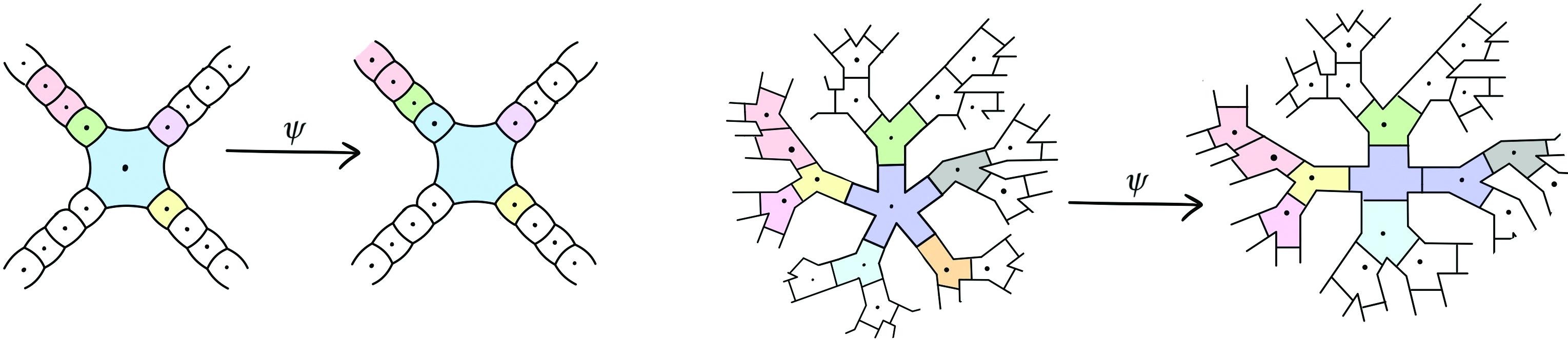
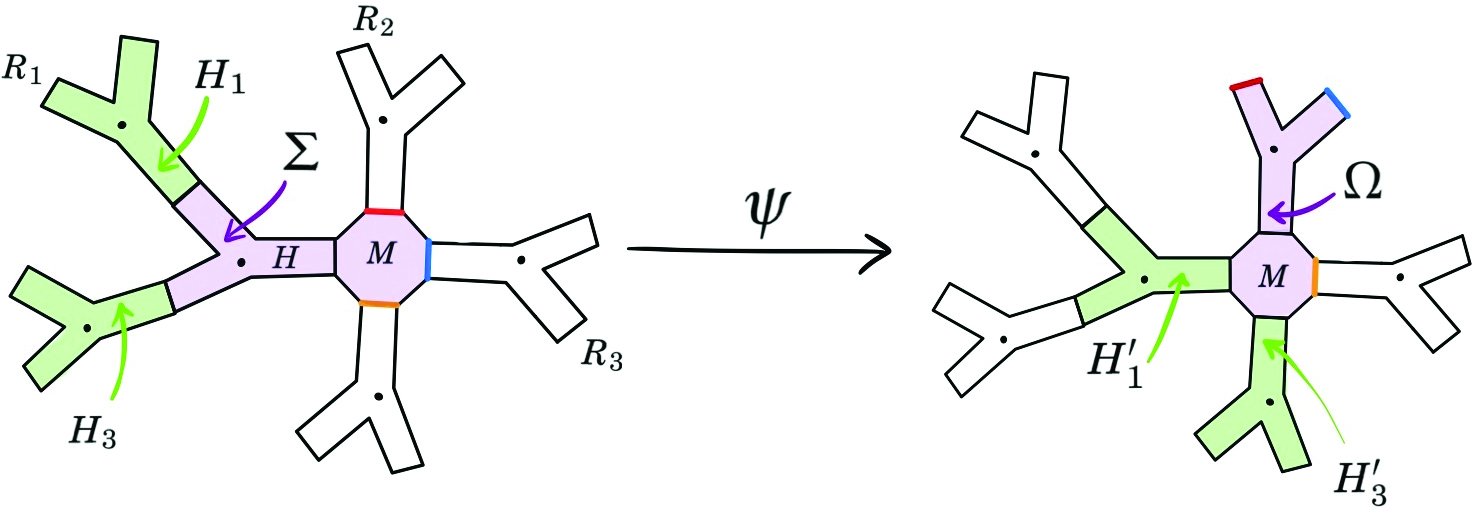
The following argument closely follows the proof of [11, Lemma 2.4]. We fix 𝑢 to be the central vertex in A n , m and 𝑣 one of its neighbours. We let A n , m be the tree obtained from A n , m by collapsing the edges between 𝑢 and 𝑣. Observe that A n , m = A n , m + n 1 . Let 𝑀 and 𝐵 denote the polygons of S ( A n , m ) containing 𝑢 and 𝑣, respectively. We define a new rigid structure on S ( A n , m ) by removing the arc common to 𝑀 and 𝐵, and denote it by S ( A n , m ) . Note that S ( A n , m ) coincides with S ( A n , m ) up to a homeomorphism that preserves the rigid structure. Figure 2 illustrates the case n = 2 . Therefore, there exists a homeomorphism ψ : S ( A n , m ) S ( A n , m ) that sends each polygon of S ( A n , m ) to a polygon of S ( A n , m ) except one that is sent to a union of two polygons. Hence conjugation by 𝜓 gives an isomorphism m o d ( A n , m ) m o d ( A n , m + n 1 ) , so m o d ( A n , m n + 1 ) m o d ( A n , m ) . See Figure 3 for the cases n = 1 , 2 . ∎

Figure 2 
               From left to right, pictures of 


                                 S
                                 ∗
                              
                              ⁢
                              
                                 (
                                 
                                    A
                                    
                                       2
                                       ,
                                       4
                                    
                                 
                                 )


                        \mathscr{S}^{*}(A_{2,4})
                     
                  , 


                                 S
                                 ∘
                              
                              ⁢
                              
                                 (
                                 
                                    A
                                    
                                       2
                                       ,
                                       4
                                    
                                 
                                 )


                        \mathscr{S}^{\circ}(A_{2,4})
                     
                   and 


                                 S
                                 ♯
                              
                              ⁢
                              
                                 (
                                 
                                    A
                                    
                                       2
                                       ,
                                       4
                                    
                                    ′
                                 
                                 )


                        \mathscr{S}^{\sharp}(A^{\prime}_{2,4})
                     
                  .
Figure 2

From left to right, pictures of S ( A 2 , 4 ) , S ( A 2 , 4 ) and S ( A 2 , 4 ) .

Figure 3
Figure 3

In the following definition, we work with the rigid structure S ( A n , m ) . Let D ( A n , m ) be the cube complex defined as follows:

  • vertices [ Σ , ϕ ] , where Σ S ( A n , m ) is an admissible surface that contains the central polygon and ϕ m o d ( A n , m ) ;

  • edges between any two vertices of the form [ Σ , ϕ ] and [ Σ H , ϕ ] , where 𝐻 is a polygon adjacent to Σ;

  • 𝑘-cube with underlying subgraph of the form

    { [ Σ i I H i , ϕ ] | I { 1 , , k } } ,

    where [ Σ , ϕ ] is a vertex and H 1 , , H k are distinct adjacent polygons to Σ.

Note that here two pairs are related by ( Σ , ϕ ) ( Σ , ϕ ) if ϕ 1 ϕ is isotopic to an element of m o d ( A n , m ) that is rigid outside Σ and maps Σ to Σ .

Next, we present some properties about C ( A n , m ) and D ( A n , m ) .

Lemma 2.2

Lemma 2.2 ([11, Lemma 3.4])

Let x = [ Σ , ϕ ] and 𝑦 be two adjacent vertices of C ( A n , m ) , resp. D ( A n , m ) . If h ( y ) > h ( x ) , then there exists a polygon 𝐻 adjacent to Σ such that y = [ Σ H , ϕ ] .

The height orientation is obtained by giving an orientation to all the edges of C ( A n , m ) , resp. D ( A n , m ) , from lower height to higher height. Given a vertex 𝑥, we say that an incident edge of 𝑥points outwards if it is oriented from 𝑥 to another vertex; otherwise, it points towards 𝑥. The height of a vertex x = [ Σ , ϕ ] , denoted by h ( x ) , refers to the height of the admissible surface Σ.

Lemma 2.3

Let 𝑆 be a 2-cube in C ( A n , m ) , resp. D ( A n , m ) . Then 𝑆 has a unique height orientation. More precisely, one of the vertices has some height h Z > 0 , its two adjacent vertices have height h + 1 and the remaining vertex has height h + 2 .

Figure 4
Figure 4

Proof

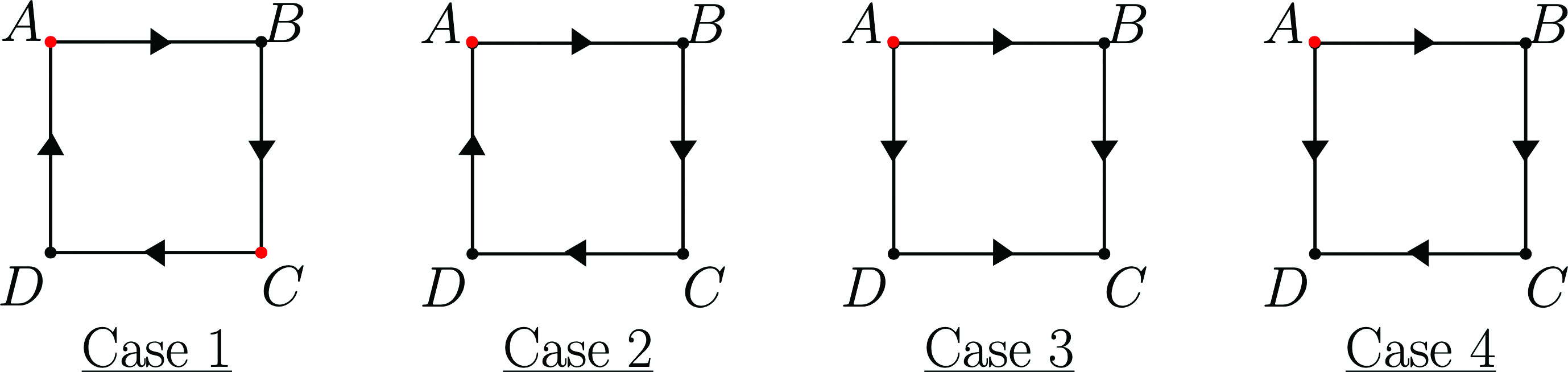
We work with C ( A n , m ) ; the proof remains exactly the same for D ( A n , m ) . Give an orientation to each edge of 𝑆 with respect to height; this leads us to consider the four cases depicted in Figure 4. Applying Lemma 2.2, starting from the vertex 𝐴, allows us to keep only the third case which is a square of the desired form. Indeed, the second and fourth cases are excluded because of a contradiction with the height of the vertices. For the first case, we assume that the vertex 𝐴 (resp. 𝐶) is [ Σ , id ] (resp. [ Γ , π ] ). On one hand, by Lemma 2.2 applied from 𝐴 to 𝐵 and from 𝐶 to 𝐵, one has [ Σ H 1 , id ] = [ Γ I 1 , π ] for some polygons H 1 and I 1 adjacent to Σ and Γ, respectively. Hence π ( Γ I 1 ) = Σ H 1 and 𝜋 is rigid outside Γ I 1 . On the other hand, by Lemma 2.2 applied from 𝐴 to 𝐷 and from 𝐶 to 𝐷, one has [ Σ H 2 , id ] = [ Γ I 2 , π ] . By definition, π ( Γ I 2 ) = Σ H 2 and 𝜋 is rigid outside Γ I 2 . Thus π ( I i ) = H i for i = 1 , 2 . Consequently, we get [ Γ , π ] = [ Σ , id ] , which is a contradiction. ∎

Corollary 2.4

Any 3-cube must have a specific orientation with respect to the height function. In particular, it must have one smallest vertex 𝑥, then three vertices of height h ( x ) + 1 , three vertices of height h ( x ) + 2 , and one maximal vertex of height h ( x ) + 3 .

Let Γ be a graph; its cube-completion Γ is the cube complex obtained from Γ by filling every subgraph isomorphic to the 1-skeleton of a cube with a cube of the corresponding dimension. The cube complex C ( A n , m ) is the cube completion of its underlying graph. This is the content of the following proposition.

Proposition 2.5

Let Γ A n , m be the underlying graph of C ( A n , m ) , resp. D ( A n , m ) . Then Γ A n , m = C ( A n , m ) (resp. D ( A n , m ) ).

Proof

We work with C ( A n , m ) , but the proof remains the same for D ( A n , m ) . The inclusion C ( A n , m ) Γ A n , m follows from the definitions. Let 𝑆 be an 𝑛-cube in Γ A n , m . We show by induction that its vertices form an 𝑛-cube in C ( A n , m ) as well. In other words, we need to show that its vertices have the form

{ [ Σ i I H i , ϕ ] | I { 1 , , n } }

for some admissible surface Σ, an asymptotically rigid homeomorphism 𝜙, and distinct polygons H 1 , , H n adjacent to Σ.

Claim 2.6

We label the vertices of 𝑆 by bit strings e ¯ = e 1 e n with e i { 0 , 1 } so that the height function ℎ attains a minimum at 0 ¯ = 0 0 (and two adjacent vertices differ by one bit). Then h ( e ¯ ) = h ( 0 ¯ ) + i = 1 n e i for each e ¯ . In particular, the function ℎ has a unique global minimum and a unique global maximum on the vertices of 𝑆.

Proof of the claim

We show this by induction on 𝑛. For n = 1 , this is the content of Lemma 2.2. We will need the base case n = 2 (treated by Lemma 2.3) in the proof. Observe that, along any edge, the height must increase by 1 or decrease by 1. Assume that it holds for any ( n 1 ) -cube and consider the 𝑛-cube 𝑆.

Pick a vertex in 𝑆 with minimal height and give it the label 0 ¯ = 0 0 . Label the rest of the cube coherently. Any vertex of 𝑆 except 1 ¯ = 1 1 shares an ( n 1 ) -cube with 0 ¯ ; thus, by the induction hypothesis, we have

h ( e ¯ ) = h ( 0 ¯ ) + i = 1 n e i for all e ¯ 1 ¯ .

In particular, all the neighbours of 1 ¯ have height h ( 0 ¯ ) + ( n 1 ) . Thus 1 ¯ must have height h ( 0 ¯ ) + n or h ( 0 ¯ ) + ( n 2 ) . The latter case cannot happen. Indeed, it would mean that one can find a 2-cube called S containing 1 ¯ , two of its neighbours and a neighbour of them so that we would have two points with maximal height in S , as in Case 1 of Figure 4. Thus 1 ¯ has height h ( 0 ¯ ) + n and we are done. ∎

Fix a labelling of the vertices of 𝑆 as in the above claim. By Lemma 2.2, the 𝑛 neighbours of 0 ¯ must correspond to the attachment of 𝑛 distinct polygons to Σ. More precisely, the vertex with the 1 in the 𝑖-th entry has the form [ Σ H i , ϕ ] , and the polygons H 1 , , H n are all distinct and adjacent to Σ.

Now, the vertices with exactly two 1’s in their label are also determined by the above. For example, the vertex with 1’s in entries 𝑖 and 𝑗 must have the form [ Σ H i H j , ϕ ] . This follows from the base case n = 2 . By induction, we are able to identify all vertices in the cube 𝑆 (each time using the base case n = 2 ). More precisely, the vertex whose label has 1’s in entries i 1 , , i k must have the form [ Σ H i 1 H i k , ϕ ] . This concludes the proof. ∎

3 Studying the CAT(0)-ness of the cube complexes C ( A n , m ) and D ( A n , m )

In the first part of this section, we derive some properties on C ( A n , m ) , D ( A n , m ) in order to deduce, in the second part, under which conditions C ( A n , m ) is CAT ( 0 ) . Finally, in the third part, we study the CAT ( 0 ) -ness of D ( A n , m ) .

Recall that a cube complex is said to be CAT ( 0 ) if it is simply connected and the link of every vertex is a flag. In the context of a cube complex 𝑋, a 1-corner refers to a square with two adjacent edges identified. Similarly, a 2-corner consists of two squares that share two consecutive edges. Hence having a 2-corner implies that the 1-skeleton contains a copy of the bipartite graph K 3 , 2 . A 3-corner in 𝑋 consists of 3 pairwise distinct squares that share a vertex, pairwise share an edge, and are not contained in a 3-cube of 𝑋. The common vertex of these squares is referred to as the root of the 3-corner.

The next proposition provides a tool to show that a cube complex is CAT ( 0 ) . It refers to [10, Theorem 3.3.1] and [5, Theorem 6.1].

Proposition 3.1

Let 𝑋 be a connected graph. Assume that

  1. the cube completion X is simply connected,

  2. 𝑋 has no 1-corner,

  3. X also satisfies the 3-cube condition (every 3-corner must span a 3-cube),

  4. 𝑋 does not contain a copy of the complete bipartite graph K 3 , 2 .

Then X is a CAT ( 0 ) cube complex.

By definition, for all n , m 1 , there is no 1-corner in the 1-skeleton of C ( A n , m ) and D ( A n , m ) , respectively.

Lemma 3.2

There is no copy of the bipartite graph K 2 , 3 in the 1-skeleton of both C ( A n , m ) and D ( A n , m ) .

Proof

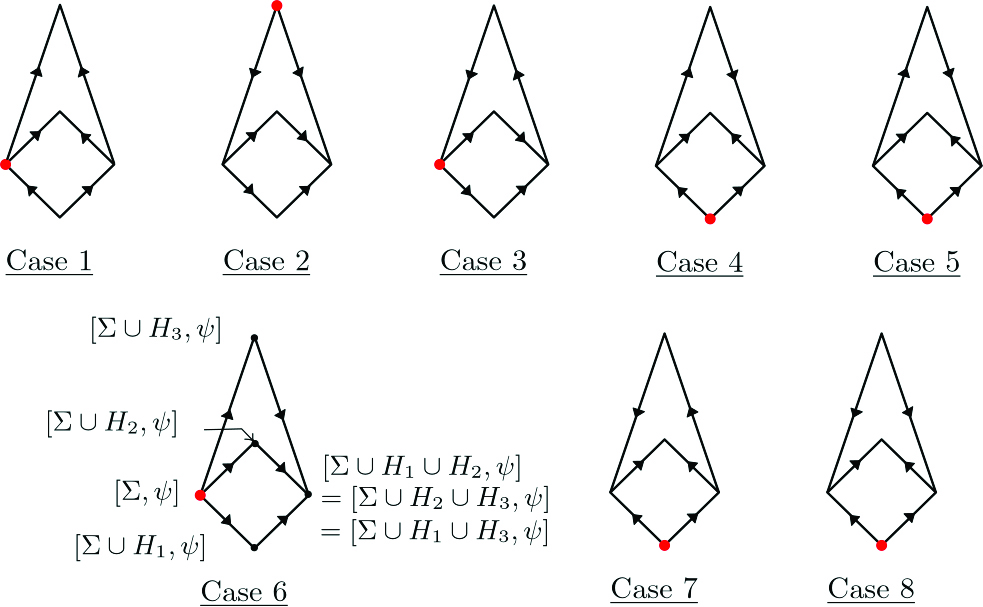
We work with C ( A n , m ) , but the proof is the same for D ( A n , m ) . Assume by contradiction that K 2 , 3 exists in the 1-skeleton of C ( A n , m ) and give the height orientation to each edge. This leads us to consider the eight cases depicted in Figure 5.

Figure 5
Figure 5

By Lemma 2.3, it remains to study Case 6. We mark with a red dot the vertices from which all incident edges point outwards. Let us assume the red point is [ Σ , ψ ] . By Lemma 2.2, its adjacent vertices are [ Σ H 1 , ψ ] , [ Σ H 2 , ψ ] and [ Σ H 3 , ψ ] , where H 1 , H 2 and H 3 are some polygons adjacent to Σ. Then, by Lemma 2.2, the remaining vertex, whose incident edges all point towards it, is [ Σ H 1 H 2 , ψ ] = [ Σ H 2 H 3 , ψ ] = [ Σ H 1 H 3 , ψ ] . Consequently, H 1 = H 2 = H 3 , which contradicts the distinctness of the vertices. ∎

3.1 Completing roots of 3-corners

In this subsection, we study the 3-cube condition in C ( A n , m ) and D ( A n , m ) . A root of a 3-corner is defined as an attracting root if all its incident edges point towards it. A root with at least one incident edge pointing outwards is referred to as a non-attracting root. The main obstacle for C ( A n , m ) to be CAT ( 0 ) comes from the absence of polygons of height zero in the rigid structure. Indeed, there exist 3-corners with three vertices of height 1, three of height 2 and one of height 3. However, by Corollary 2.4, the only way to complete such a 3-corner into a 3-cube would be to add a vertex of height 0. Hence, in the absence of polygons of height zero, 3-corners exist and the CAT ( 0 ) property cannot be verified by Proposition 3.1. By construction, D ( A n , m ) contains a polygon of height zero, the central polygon, which avoids the presence of 3-corners.

Lemma 3.3

Every 3-corner in C ( A n , m ) , resp. D ( A n , m ) , having a non-attracting root can be completed into a 3-cube.

Proof

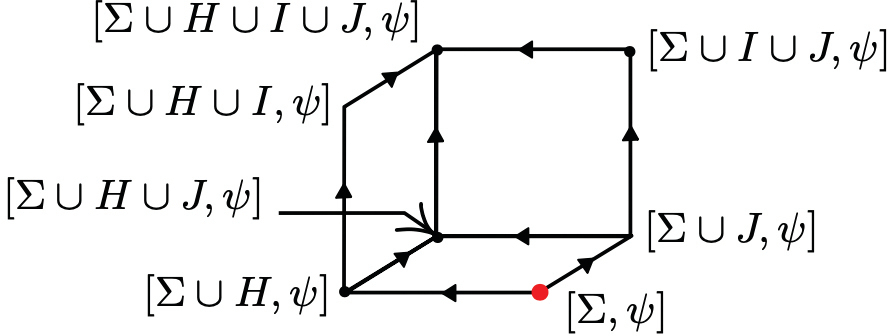
We consider C ( A n , m ) , but the proof remains the same for D ( A n , m ) . In Figure 6, we illustrate the three possible 3-corners with non-attracting roots in C ( A n , m ) . In each case, our objective is to identify a vertex that completes the 3-corner into a 3-cube. We mark with a red dot the vertices from which all incident edges point outwards.

Figure 6
Figure 6
Figure 6
Figure 6

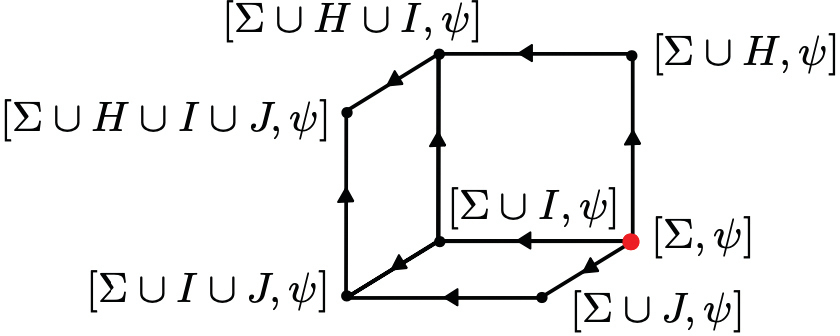
Consider Case 1 in Figure 6. In this case, there is only one red point written as [ Σ , ψ ] . By Lemma 2.2, there are three polygons H , I , J adjacent to Σ, so that the vertices adjacent to the red point are [ Σ H , ψ ] , [ Σ J , ψ ] and [ Σ I , ψ ] . Again by Lemma 2.2, the common adjacent vertices of the previous vertices are [ Σ H J , ψ ] , [ Σ H I , ψ ] and [ Σ I J , ψ ] . The vertex

[ Σ H I J , ψ ]

completes the 3-corner into a 3-cube.

Here we consider Case 2 in Figure 6. There is only one red point which can be written as [ Σ , ψ ] . As for the case above, by Lemma 2.2, its adjacent vertices are [ Σ H , ψ ] , [ Σ J , ψ ] and [ Σ I , ψ ] . The common adjacent vertices of the previous vertices are [ Σ H I , ψ ] and [ Σ I J , ψ ] . The remaining vertex is [ Σ H J , ψ ] and we take the vertex [ Σ H J , ψ ] to complete the 3-corner into a 3-cube.

For the third case in Figure 6, we proceed in the same way as above. Assume that the red point is [ Σ , ψ ] . Again by Lemma 2.2, the adjacent vertices of the latter are [ Σ H , ψ ] and [ Σ J , ψ ] . Consequently, the root of the 3-corner is [ Σ H J , ψ ] . The remaining adjacent vertices of [ Σ H , ψ ] and [ Σ J , ψ ] are written [ Σ H K 1 , ψ ] and [ Σ J K 2 , ψ ] , respectively. Next, the common adjacent vertices of [ Σ H K 1 , ψ ] , [ Σ J K 2 , ψ ] and [ Σ H J , ψ ] must have height equal to h ( Σ ) + 3 , so I : = K 1 = K 2 . The remaining vertex, having all its edges pointing towards it, is

[ Σ H J I , ψ ] .

The vertex [ Σ I , ϕ ] completes the 3-corner into a 3-cube. ∎

Figure 7
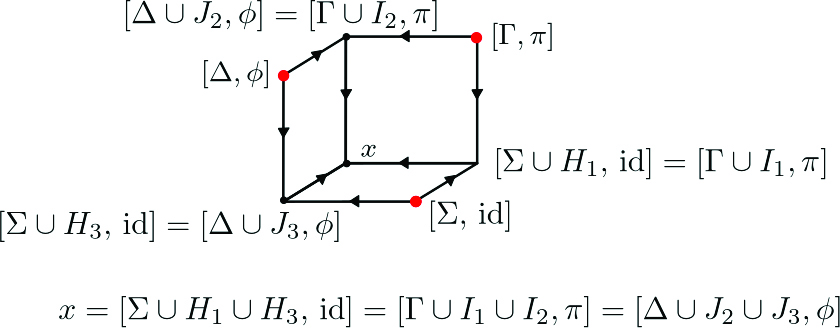
Figure 7

In this section, we denote by 𝑀 the central polygon in C ( A n , m ) , resp. D ( A n , m ) , which is the polygon whose underlying vertex has valence 𝑚. If m = n + 1 , the central polygon in C ( A n , m ) is an arbitrary polygon that we fix. We use the notation in Figure 7 to describe a 3-corner in C ( A n , m ) , resp. D ( A n , m ) , having an attracting root.

Our last goal in this subsection is to show the following proposition.

Proposition 3.4

If ( m , n ) ( 1 , 2 ) , ( 2 , 1 ) , then every 3-corner with an attracting root in D ( A n , m ) can be completed into a 3-cube. If 1 m n + 1 , then this also holds in C ( A n , m ) .

The following facts can be deduced from the equalities associated with each vertex in Figure 7:

  1. π ( Γ I 1 ) = Σ H 1 and 𝜋 is rigid outside Γ I 1 ,

  2. ϕ ( Δ J 3 ) = Σ H 3 and 𝜙 is rigid outside Δ J 3 ,

  3. π 1 ϕ ( Δ J 2 ) = Γ I 2 and π 1 ϕ is rigid outside Δ J 2 ,

  4. π ( Γ I 1 I 2 ) = Σ H 1 H 3 and 𝜋 is rigid outside Γ I 1 I 2 ,

  5. ϕ ( Δ J 2 J 3 ) = Σ H 1 H 3 and 𝜙 is rigid outside Δ J 2 J 3 ,

  6. π 1 ϕ ( Δ J 2 J 3 ) = Γ I 1 I 2 and π 1 ϕ is rigid outside Δ J 2 J 3 .

We need the four following lemmata to prove Proposition 3.4.

Lemma 3.5

Assume that we are in the situation of a 3-corner with an attracting root in C ( A n , m ) , resp. D ( A n , m ) , as depicted in Figure 7. The image of the polygon I 1 by 𝜋 is contained in Σ and includes Fr ( I 1 ) 1 frontier arcs from polygons lying outside Σ and distinct from H 1 and H 3 .

Proof

We use the same notation as depicted in Figure 7. On one hand, by facts iii and vi, we deduce that π 1 ϕ ( J 3 ) = I 1 . Moreover, by i, π ( I 1 ) Σ H 1 . On the other hand, by fact ii, ϕ ( J 3 ) Σ H 3 . So we deduce that

π ( I 1 ) = ϕ ( J 3 ) Σ .

The polygon I 1 is adjacent to Γ; more precisely, it shares one frontier arc with Γ and the remaining frontier arcs are shared with polygons lying outside Γ I 2 . Then π ( I 1 ) is not necessarily a polygon of the rigid structure. However, since 𝜋 is rigid outside Γ I 1 , it respects the adjacency of polygons outside Γ I 1 . Hence, among the Fr ( I 1 ) images of the frontier arcs of I 1 by 𝜋, Fr ( I 1 ) 1 are shared with polygons lying outside π ( Γ I 2 ) = Σ H 3 , whereas one image of a frontier arc is shared with π ( Γ ) Σ H 1 . ∎

Consider a 3-corner with an attracting root in D ( A n , m ) , as depicted in Figure 7. By the previous proof, π ( I 1 ) Σ , so we deduce that Σ is an admissible surface containing at least one puncture: h ( Σ ) 1 .

Corollary 3.6

Let 𝑥 be a vertex with minimal height in a 3-corner with an attracting root in D ( A n , m ) . Then h ( x ) 1 .

Remark 3.7

Let Σ be an admissible surface in C ( A n , m ) and let 𝑘 be the height of Σ. If Σ contains the central polygon, then the number of frontier arcs of Σ is given by Fr ( Σ ) = m + ( n 1 ) ( k 1 ) ; otherwise,

Fr ( Σ ) = n + 1 + ( n 1 ) ( k 1 ) = k ( n 1 ) + 2 .

Lemma 3.8

Let 1 m n + 1 and let 𝑥 be a vertex with minimal height in a 3-corner with an attracting root in C ( A n , m ) . Then h ( x ) 2 .

Proof

Consider a 3-corner with an attracting root in C ( A n , m ) as depicted in Figure 7; we use the same notation. By Lemma 3.5, π ( I 1 ) lies in Σ. Therefore, Σ has enough frontier arcs so that π ( I 1 ) shares its boundary with Fr ( I 1 ) 1 polygons lying outside Σ H 1 and distinct from H 3 = π ( I 2 ) (since I 1 and I 2 are not adjacent). Consequently, the number of frontier arcs of Σ minus two (for the one shared with H 1 and H 3 ) must be greater than (or equal to) Fr ( I 1 ) 1 ,

(3.1) Fr ( Σ ) 2 Fr ( I 1 ) 1 .

First, we assume that I 1 is not the central polygon 𝑀 and let

k : = h ( Σ ) = h ( Γ ) = h ( Δ ) .

Hence (3.1) becomes

m + ( k 1 ) ( n 1 ) 2 if M Σ , k ( n 1 ) otherwise } n .

Both cases imply directly that k 2 .

Secondly, we assume that I 1 is the central polygon. Observe that if m = n + 1 , inequality (3.1) directly implies that k 2 . Then, by fact i, we have the following equality:

Fr ( Γ I 1 ) = Fr ( Σ H 1 ) .

Under our assumptions, this equality becomes

m + k ( n 1 ) = { m + k ( n 1 ) if M Σ H 1 , ( k + 1 ) ( n 1 ) + 2 otherwise .

So if M Σ H 1 , we obtain m = n + 1 and so k 2 . We consider the remaining case where I 1 = M and Σ H 1 contains 𝑀.

Assume H 1 = M , and so Σ does not contain 𝑀. By ii and v, ϕ ( J 2 ) = H 1 , and by the rigidity of 𝜙 outside Δ J 3 , we deduce that J 2 = M . Now, since I 1 = M , the subsurface Γ I 2 does not contain 𝑀. Moreover, by ii, one has Fr ( Γ I 2 ) = Fr ( Δ J 2 ) , which becomes

( k + 1 ) ( n 1 ) + 2 = m + k ( n 1 ) ,

so m = n + 1 and k 2 .

Assume Σ contains 𝑀. By iii and vi, π 1 ϕ ( J 3 ) = I 1 , and by the rigidity of π 1 ϕ outside Δ J 2 , we deduce that J 3 = M . By contradiction, assume that k = 1 and thus Σ = M . Recall that, by Lemma 3.5, one has π ( I 1 ) Σ ; on top of that, by i, 𝜋 is rigid outside Γ H 1 . Similarly, one has ϕ ( J 3 ) Σ , and by v, 𝜙 is rigid outside Δ J 3 . Hence, on one side, π ( I 1 ) = M and ϕ ( J 3 ) = M . But, on the other side, this implies that π ( I 1 ) is adjacent to H 3 = π ( I 2 ) and, similarly, ϕ ( J 3 ) is adjacent to H 1 = ϕ ( J 2 ) , which contradicts the rigidity of 𝜋 and 𝜙 at I 2 and J 2 , respectively. We conclude that k 2 . ∎

Let m o d ( A n , m ) denote either m o d ( A n , m ) or m o d ( A n , m ) .

Lemma 3.9

Let Σ be an admissible surface in C ( A n , m ) , resp. D ( A n , m ) , with h ( Σ ) 2 . Let D Σ be a one-punctured disk such that

  • Σ D is connected and 𝐷 contains exactly either 𝑛 or m 1 frontier arcs from the polygons of the rigid structure;

  • if 𝐷 contains m 1 frontiers arcs, then either m = n + 1 or Σ contains the central polygon.

Then there exist χ m o d ( A n , m ) and an admissible surface Ω such that

[ Ω , χ ] = [ Σ , id ]

and χ 1 ( D ) Ω is a polygon from the rigid structure.

Proof

Let Σ be an admissible surface in C ( A n , m ) (the proof is the same for D ( A n , m ) ), and let D Σ be a one-punctured disk. We assume that the assumptions in the statement above hold. Let 𝐾 be a polygon inside Σ with as many arcs from the rigid structure as 𝐷. There exists a minimal admissible surface Γ containing both 𝐷 and 𝐾 and an asymptotically rigid homeomorphism 𝜇 permuting cyclically the frontier arcs of Γ and such that the 𝑛 (resp. m 1 ) frontiers arcs contained in 𝐷 are sent onto those of 𝐾; see Figure 8. Then χ : = μ 1 satisfies the statement with Ω : = μ ( Σ ) . ∎
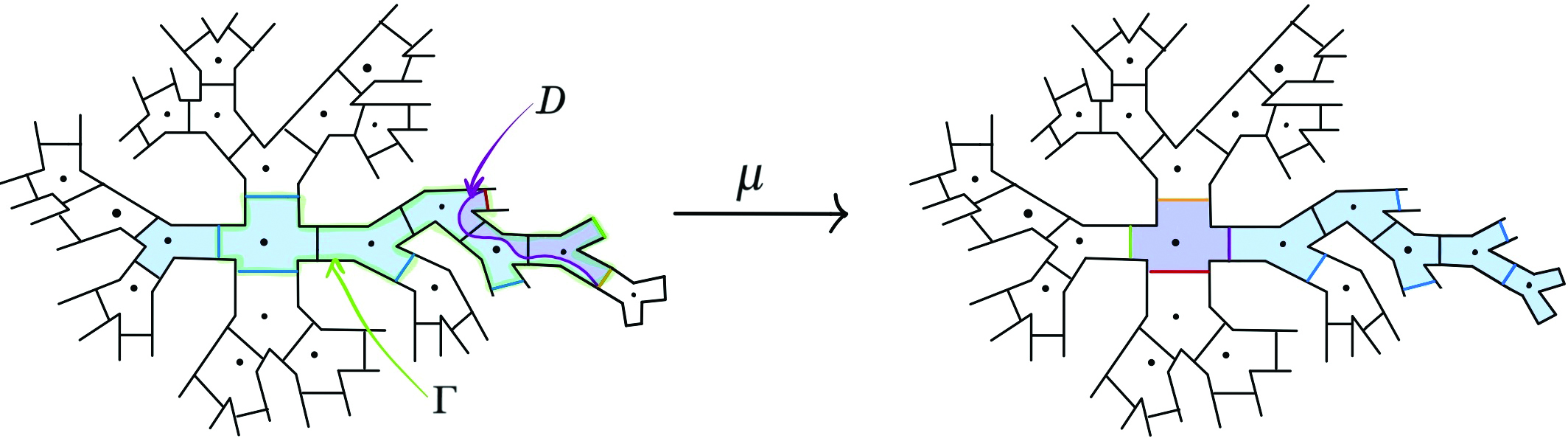
Figure 8
Figure 8
Lemma 3.10

Consider a 3-corner with an attractive root whose minimum vertex height is at least 2. Assume that we are in one of the following situations:

  • 1 m n + 1 , and we are considering a 3-corner with an attracting root in C ( A n , m ) ;

  • ( m , n ) ( 1 , 2 ) , ( 2 , 1 ) , and we are considering a 3-corner with an attracting root in D ( A n , m ) .

Then the attracting root can be completed into a 3-cube.

Proof

Consider a 3-corner with an attracting root and the notation as in Figure 7. Assume that we are in one of the situations described by the assumptions of the statement; in particular, h ( Σ ) 2 . Let D = π ( I 1 ) ; first we show that 𝐷 satisfies the assumptions of Lemma 3.9.

  • Recall that, in the case of a 3-corner with an attracting root,

    π ( Γ I 1 ) = Σ H 1 ,

    where I 1 is adjacent to Γ and π ( I 1 ) Σ . Thus Σ D is connected. Moreover, I 1 shares either 𝑛 or m 1 frontier arcs with polygons outside Γ I 2 . By rigidity of 𝜋 outside Γ I 1 , we deduce that D = π ( I 1 ) contains 𝑛 or m 1 frontier arcs from the polygons of the rigid structure.

  • Assume that 𝐷 contains 𝑚 frontier arcs. If m = n + 1 , the second assumption is satisfied. Otherwise, m n + 1 and I 1 is the central polygon 𝑀. Recall that, in our situation, one has Fr ( Γ I 1 ) = Fr ( Σ H 1 ) . On one side, we have Fr ( Γ I 1 ) = m + k ( n 1 ) . On the other side, if 𝑀 is not contained in Σ H 1 , then Fr ( Σ H 1 ) = ( k + 1 ) ( n 1 ) + 2 , and so m = n + 1 , which is excluded. Hence 𝑀 is contained in Σ H 1 ; if 𝑀 is contained in Σ, then the assumption is satisfied. By contradiction, if H 1 = M , then Σ does not contain 𝑀. By ii and v, ϕ ( J 2 ) = H 1 , and by the rigidity of 𝜙 outside Δ J 3 , we deduce that J 2 = M . Now, since I 1 = M , the subsurface Γ I 2 does not contain 𝑀. Moreover, by ii, one has Fr ( Γ I 2 ) = Fr ( Δ J 2 ) , which becomes ( k + 1 ) ( n 1 ) + 2 = m + k ( n 1 ) , so m = n + 1 , which is excluded.

By Lemma 3.9 applied with D = π ( I 1 ) , we can rewrite

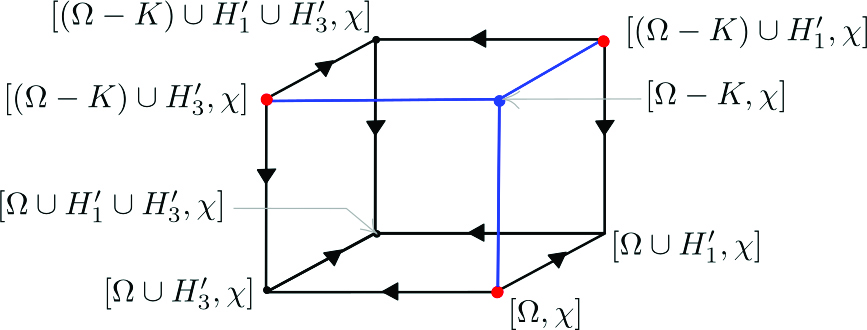
[ Σ H 1 H 3 , id ] = [ Ω H 1 H 3 , χ ] = [ ( Ω K ) K H 1 H 3 , χ ] ,

where K : = χ 1 ( D ) is a polygon of the rigid structure and H i = χ 1 ( H i ) . Observe that Ω K is connected. Thus we complete our 3-corner into a 3-cube by adding the vertex [ Ω K , χ ] . See Figure 9. ∎

Figure 9
Figure 9

Proof of Proposition 3.4

Consider a 3-corner with an attracting root and the notation as in Figure 7. Let 1 m n + 1 ; by Lemma 3.8, in the case of a 3-corner with an attracting root in C ( A n , m ) , one has h ( Σ ) 2 , and by Lemma 3.10, the 3-corner can be completed in a 3-cube. By the same lemma and Corollary 3.6, it remains to consider the 3-corners in D ( A n , m ) with an attracting root such that h ( Σ ) = 1 .

First assume that m 3 and consider a 3-corner with an attracting root in D ( A n , m ) such that h ( Σ ) = 1 ; then there exists a polygon, denoted as 𝐻, adjacent to the central polygon in such a way that Σ = M H . If the H i are both adjacent to 𝑀, we are done since, in this case, the vertex [ M , id ] completes the 3-corner into a 3-cube. Otherwise,

  • either H 1 and H 3 are not adjacent to 𝑀; thus they are both adjacent to 𝐻 and lie in the R 1 strand. Since m 3 , one can push R 1 into R 2 using 𝜓 as depicted in Figure 10. Then let χ : = ψ 1 , Ω : = ψ ( Σ ) and H i = χ 1 ( H i ) .

    Figure 10
    Figure 10

  • Or H 1 is adjacent to 𝑀, whereas H 3 is not. We proceed as in the previous case, but we need to be careful to push the strands where H 3 lies into the one where H 1 does not lie (this is valid since here m 3).

In both cases, we complete our 3-corner into a 3-cube by adding the vertex [ M , χ ] .

Secondly, assume that m = 1 , n 2 and let h ( Σ ) = 1 . Since m = 1 , one has Σ = Γ = Δ = M H and 𝑀 shares no arcs with polygons distinct from 𝐻. By fact i, the n 1 frontier arcs of I 1 (not shared with 𝐻) can only be sent to those of 𝐻 and those of H 1 (not shared with resp. H 1 and 𝐻). Thus there exists some 𝜒 homotopic to 𝜋 such that χ ( M ) = M . Hence we have [ M , id ] = [ M , π ] . In the same way, we obtain [ M , ϕ ] = [ M , id ] , and so the latter vertex completes the 3-corner into a 3-cube.

Thirdly, let m = 2 , n 2 and let h ( Σ ) = 1 . A priori, we have two possible configurations: either the H i ’s (resp. I i ’s, 𝐽’s) are not adjacent to 𝑀 or one of them is. Assume that, for instance, [ Σ H 1 H 3 , id ] has the second configuration. Then, since m = 2 and n 2 , there exists ψ m o d ( A n , m ) rigid outside Σ which cyclically permutes the frontier arcs of Σ so that [ Ω H 1 H 3 , ψ 1 ] has the first configuration, where Ω : = ψ ( Σ H 1 H 3 ) . Hence

[ Σ H 1 H 3 , id ] = [ Ω H 1 H 3 , ψ 1 ] ,

where ψ ( H i ) = H i , and so we reduce our work to the first configuration. In this case, with reasoning similar to the case m = 1 (excepting that Σ = M H may differ to Γ = M H ), we complete the 3-corner by adding [ M , id ] . ∎

3.2 When is C ( A n , m ) a CAT(0) cube complex?

In this section, we determine for which subfamilies of A n , m the associated cube C ( A n , m ) is CAT ( 0 ) . Let us first consider some examples.
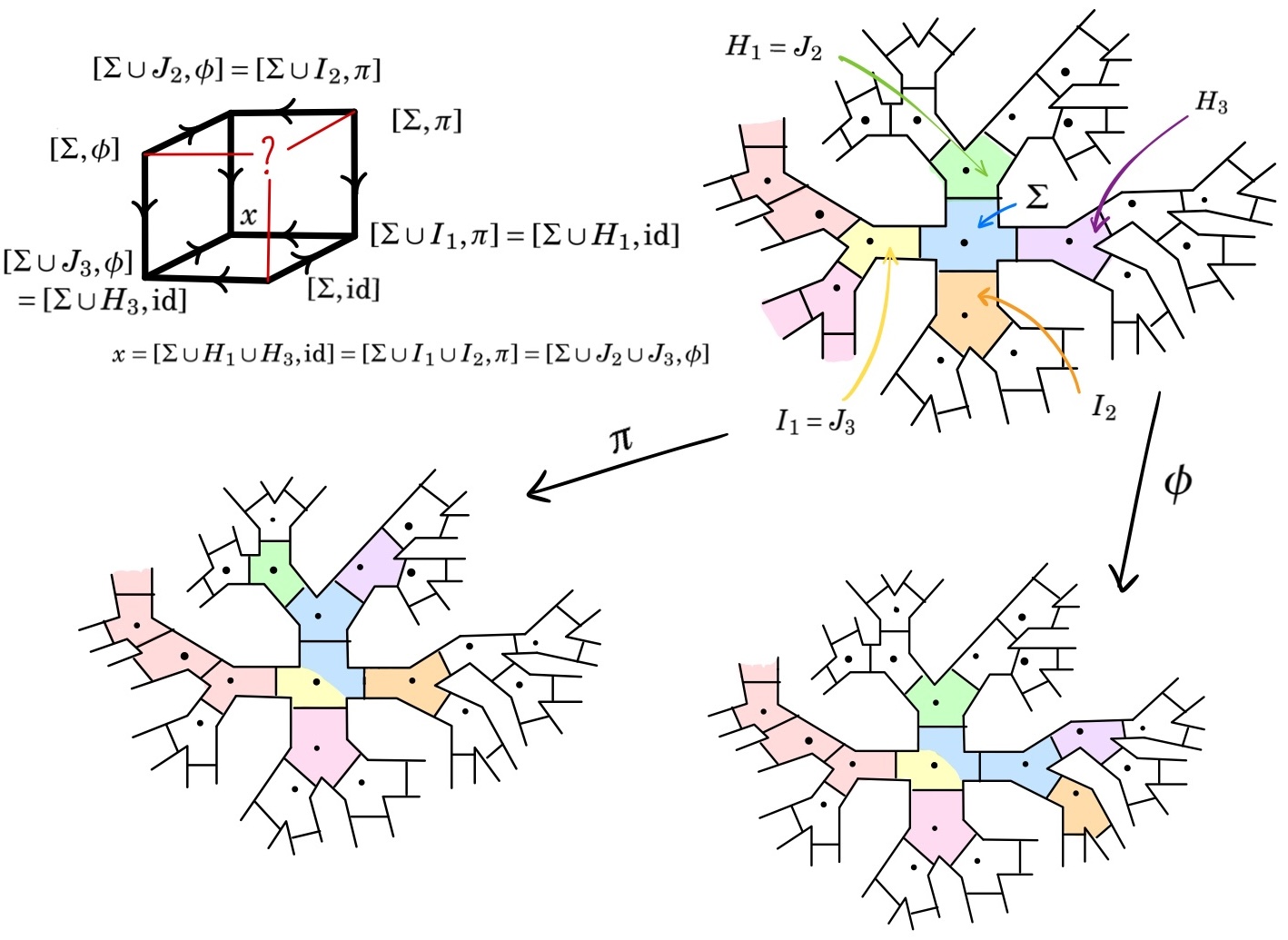
Figure 11
Figure 11
Example 3.11

The cube complexes C ( A 1 , 1 ) and C ( A 1 , 2 ) are CAT ( 0 ) . The two cases are similar, so we consider C ( A 1 , 2 ) . By [11, Theorem 3.3], C ( A 1 , 2 ) is simply connected. By Lemma 3.2, there is no copy of K 2 , 3 . By definition, we do not have 1-corners, and by Lemma 3.3, it only remains to show that, in C ( A 1 , 2 ) , every 3-corner with an attracting root can be completed into a 3-cube. This follows from the fact that C ( A 1 , 2 ) is a square-complex (there are only two ways to remove or add adjacent polygons). Since π ( I 2 ) = H 3 and 𝜋 is rigid outside Γ I 1 , one cannot have π ( I 1 ) Σ . Thus π ( I 1 ) = H 1 , π ( Γ ) = Σ and so [ Σ , id ] = [ Γ , π ] . Consequently, there are no 3-corners. And we conclude that C ( A 1 , 2 ) is CAT ( 0 ) . Similarly, one can show that C ( A 1 , 1 ) , D ( A 1 , 1 ) and D ( A 1 , 2 ) are CAT ( 0 ) .

Remark 3.12

As noted in [11], C ( A 1 , 3 ) is not CAT ( 0 ) , and this observation can be extended to A 1 , m for m 3 .

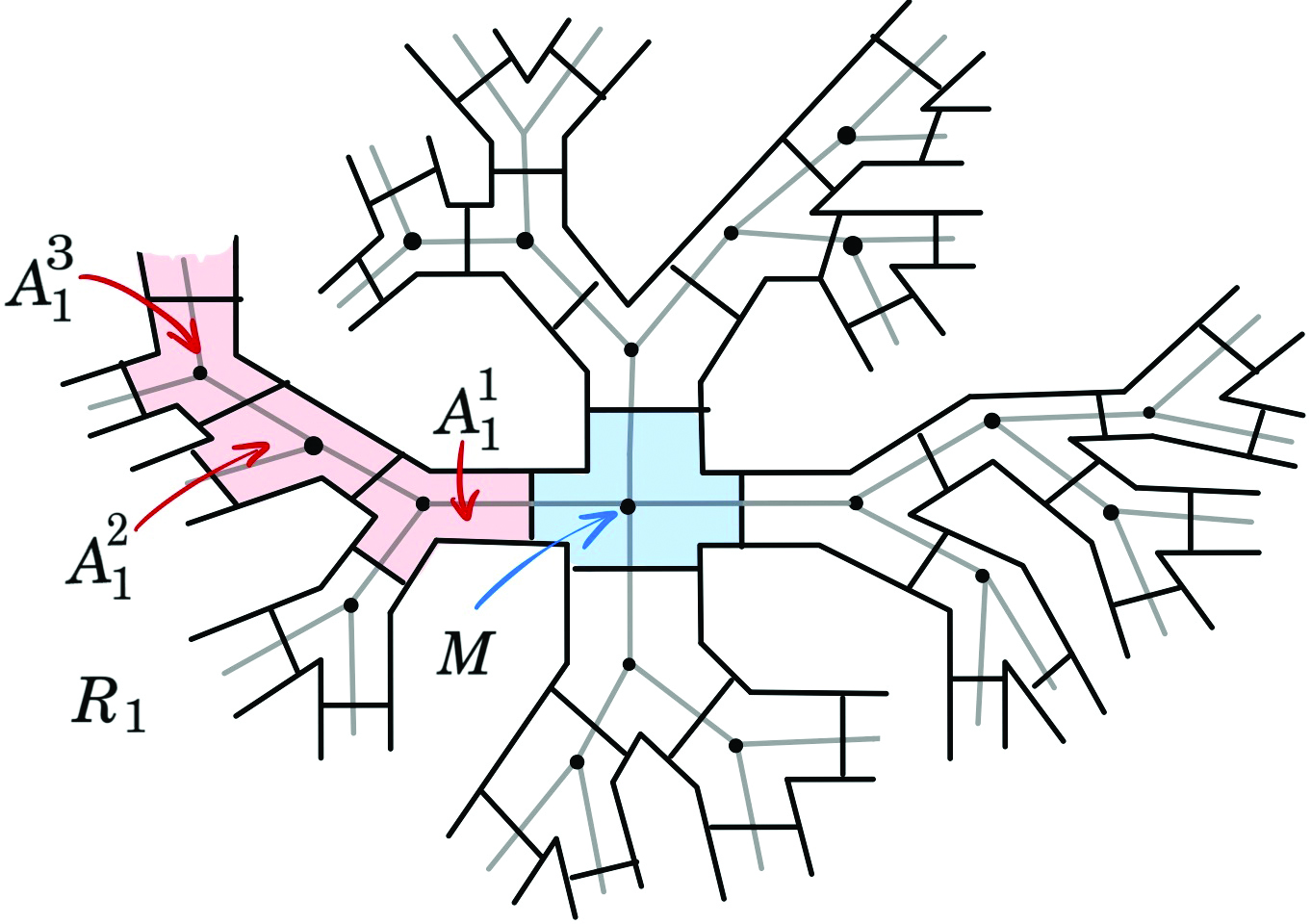
Consider the cube complex C ( A n , m ) and denote by R 1 , , R m the 𝑚 trees branching out the central polygon 𝑀. An infinite ray of polygons𝐿 in R j is a semi-infinite chain of polygons L = ( A j 1 , A j 2 , ) starting from the polygon adjacent to 𝑀 in R j and such that A j k and A j k + 1 are adjacent for all k 1 .

Example 3.13

For m > n + 1 , the cube complex C ( A n , m ) is not CAT ( 0 ) . The key obstacle here is that there is no vertex in C ( A n , m ) of height 0. Consider the 3-corner in C ( A n , m ) with the same notation as in Figure 7. We construct a 3-corner with 3 vertices of height 1, 3 of height 2, and 1 of height 3 so that, by Corollary 2.4, the only way to complete it to a 3-cube would be to add a vertex of height 0. We take the following vertices: let Σ, Δ and Γ be the central polygon 𝑀 and let I 1 = J 3 (resp. H 1 = J 2 , H 3 = I 2 ) be the polygons in R 1 (resp. R 2 , R 3 ) adjacent to the central polygon. See Figure 11.

Figure 12
Figure 12

Fix three infinite rays of polygons L 1 = ( A 1 1 , A 1 2 , ) (resp. L 2 , L 3 ) in R 1 (resp. R 2 , R 3 ). The ray L i is built recursively as follows. Start by letting A i 1 be the polygon adjacent to 𝑀 and lying in the branch R i . Then, as A i 2 , take the adjacent polygon whose puncture corresponds to the right-most child of the vertex corresponding to the puncture of A i 1 . Then we iterate the process. See Figure 12 for an illustration of the infinite ray L 1 . Let 𝜋 be an asymptotically rigid homeomorphism that shifts each polygon of L 1 M L 2 by one polygon such that π ( A 1 1 ) lies in the central polygon. Let 𝜙 be an asymptotically rigid homeomorphism that shifts each polygon of L 1 M L 3 by one polygon such that ϕ ( A 1 1 ) is the central polygon. See Figure 11 for an illustration with m = 4 and n = 2 . Then, by construction, we cannot complete this 3-corner into a 3-cube because we do not have a vertex of height zero. So the link of the vertex x = [ Σ H 1 H 3 , id ] represented in Figure 11 is not a flag and C ( A n , m ) is not CAT ( 0 ) for m > n + 1

Theorem 3.14

If n 1 , then the cube complex C ( A n , m ) is CAT ( 0 ) if and only if 1 m n + 1 .

Proof

Let n 1 and 1 m n + 1 . The case n = 1 is given by Example 3.11. By [11, Theorem 3.3], C ( A n , m ) is contractible and thus simply connected. Proposition 2.5 allows us to use Proposition 3.1 with C ( A n , m ) in order to prove Theorem 3.14. Thus we need to show that C ( A n , m ) satisfies the assumptions in Proposition 3.1. By definition, we do not have 1-corners, and by Lemma 3.2, there is no 2-corner. By Proposition 3.4 every 3-corner with an attracting root can be completed into a 3-cube; the same holds for non-attracting root by Lemma 3.3. By Proposition 3.1, we conclude that C ( A n , m ) is CAT ( 0 ) .

For the converse, let m > n + 1 ; if n = 1 , by Remark 3.12, C ( A 1 , m ) is not CAT ( 0 ) for m 3 . If n > 1 , m > n + 1 , then C ( A n , m ) is not CAT ( 0 ) by Example 3.13. This concludes the proof of Theorem 3.14. ∎

Remark 3.15

Let m , n 1 ; the subcomplex of C ( A n , m ) generated by the vertices of the form [ Σ , ϕ ] , where Σ is an admissible surface containing the central polygon, is called the spine. This contractible complex was first introduced in [11] and is denoted by S C ( A n , m ) . With similar work, we can show that S C ( A n , m ) is CAT ( 0 ) if and only if n 1 and 1 m n + 1 .

3.3 CAT(0)-ness of the cube complex D ( A n , m )

First, we show that D ( A n , m ) is contractible. To do this, we follow closely the proof of the contractibility of C ( A n , m ) in [11, Section 3.2]. Let 𝑥 be a vertex in D ( A n , m ) and Σ S ( A n , m ) an admissible surface. If there exists a finite path of vertices x 0 , x 1 , , x n from x 0 = x to x n = [ Σ , id ] such that h ( x i ) > h ( x i 1 ) , one says that [ Σ , id ] dominates 𝑥. Let 𝒮 be a finite collection of vertices in D ( A n , m ) . We denote by X ( S , Σ ) the subcomplex in D ( A n , m ) generated by the height-increasing paths from a vertex in 𝒮 to [ Σ , id ] .

Lemma 3.16

Lemma 3.16 ([11, Claim 3.6])

Let 𝒮 be a finite collection of vertices in D ( A n , m ) . Then there exists an admissible surface Σ such that [ Σ , id ] dominates all the vertices in 𝒮.

Proof

Let S = ( [ Δ i , ϕ i ] ) i I and let Σ i be the admissible surface supporting ϕ i for each i I . We denote by Ω i the smallest admissible surface such that Σ i Δ i Ω i for each i I . Then let Σ be an admissible surface containing all the ϕ ( Ω i ) . One obtains a height-increasing path from [ Δ i , ϕ i ] to [ Ω i , ϕ i ] by adding polygons. Similarly, by definition of Σ, one has a second height-increasing path from [ Ω i , ϕ i ] to [ Σ , id ] . By concatenating the two paths we obtain a height-increasing path from [ Δ i , ϕ i ] to [ Σ , id ] . Thus [ Σ , id ] dominates all the vertices in 𝒮. ∎

For the next lemma, the proof follows the same steps as in [11, Section 3.2], where the case of C ( A n , m ) is considered. We review the proof.

Lemma 3.17

Let 𝒮 be a finite collection of vertices in D ( A n , m ) . Then there exists an admissible surface Σ such that X ( S , Σ ) is contractible.

Proof

Let 𝒮 be a finite collection of vertices in D ( A n , m ) . By Lemma 3.16, there exists an admissible surface Σ such that [ Σ , id ] dominates all the vertices in 𝒮. If X ( S , Σ ) = [ Σ , id ] , we are done. Assume that X ( S , Σ ) [ Σ , id ] . Now, take a vertex x X ( S , Σ ) with minimal height. Since X ( S , Σ ) [ Σ , id ] , 𝑥 admits x 1 , , x k as neighbours in X ( S , Σ ) . By Lemma 2.2, we assume that

x = [ Δ , ϕ ] and x i = [ Δ H i , ϕ ] for 1 i k ,

where Δ is an admissible surface and H 1 , , H k are some adjacent polygons.

Claim 3.18

The cube generated by the vertices { [ Δ i I H i , ϕ ] } I { 1 , , k } lies in X ( S , Σ )

Proof of the claim

One has a height-increasing path from 𝑥 to [ Σ , id ] . Thus, by Lemma 2.2, [ Σ , id ] = [ Δ J 1 J p , ϕ ] , where J 1 , , J p are some polygons. Similarly, since one also has an increasing path from x i = [ Δ H i , ϕ ] to [ Σ , id ] , by Lemma 2.2, one has [ Σ , id ] = [ Δ H i M 2 i M l i , ϕ ] , where M 2 i , , M l i are some polygons. To sum up,

[ Σ , id ] = [ Δ J 1 J p , ϕ ] = [ Δ H i M 1 i M l i , ϕ ] ,

so l = p and J i = H σ ( i ) for some permutation 𝜎. Hence one can add to Δ the adjacent polygons H i and next the remaining J i to obtain a path from 𝑥 to [ Σ , id ] passing through { [ Δ i I H i I { 1 , , k } ] } . ∎

In particular, all the direct neighbours x i of 𝑥 in X ( S , Σ ) are contained in a cube in X ( S , Σ ) . Thus it follows that the complex X ( S , Σ ) deformation retracts onto X ( ( S { x } ) { x 1 , , x k } , Σ ) . Since [ Σ , id ] dominates the vertices in ( S { x } ) { x 1 , , x k } , we iterate the process. Hence we find a sequence

X ( S , Σ ) X ( S 1 , Σ ) .

This sequence stops since X ( S , Σ ) contains finitely many cells. Hence we obtain, from a certain rank 𝑘, X ( S k , Σ ) = [ Σ , id ] for some finite collection S k dominated by [ Σ , id ] . Thus X ( S , Σ ) deformation retracts onto [ Σ , id ] , so is contractible ∎

Proposition 3.19

If m , n 1 , the cube complex D ( A n , m ) is contractible.

Proof

Let n 1 and let ψ : S n D ( A n , m ) be a continuous map. The image of 𝜓 lies in a compact subcomplex which has a finite collection of vertices 𝒮. By Lemma 3.16, there exists an admissible surface Σ such that [ Σ , id ] dominates all the vertices in 𝒮. Thus the image of 𝜓 lies in X ( S , Σ ) , which is contractible by Lemma 3.17. Hence 𝜓 is homotopically trivial. By Whitehead’s theorem, we deduce that D ( A n , m ) is contractible. ∎

Proposition 3.20

Let m , n 1 ; then the cube complex D ( A n , m ) is CAT ( 0 ) .

Proof

Let n , m 1 . By Proposition 3.19, D ( A n , m ) is contractible and thus simply connected. Proposition 2.5 allows us to use Proposition 3.1 with D ( A n , m ) in order to show that D ( A n , m ) is CAT ( 0 ) . Thus we need to show that D ( A n , m ) satisfies the assumptions in Proposition 3.1. By definition, we do not have 1-corners, and by Lemma 3.2, there is no 2-corner. In Example 3.11, we show that we do not have 3-corners in D ( A 1 , 1 ) and D ( A 1 , 2 ) , so by Proposition 3.4, every 3-corner with an attracting root can be completed into a 3-cube. By Lemma 3.3, every 3-corner with a non-attracting root can be completed into a 3-cube. Hence, by Proposition 3.1, we conclude that D ( A n , m ) is CAT ( 0 ) . ∎

Now, we define the collection of cube complexes

E ( A n , m ) : = { D ( A n , m n + 1 ) if m n 1 , C ( A n , m ) if 1 m < n .

Corollary 3.21

For all m , n 1 , m o d ( A n , m ) acts on the cube complex E ( A n , m ) , which is CAT ( 0 ) .

Proof

Let m , n 1 . If 1 m < n , then m o d ( A n , m ) acts on E ( A n , m ) = C ( A n , m ) , which is CAT ( 0 ) by Theorem 3.14. Otherwise, m n , and by Lemma 2.1,

m o d ( A n , m ) m o d ( A n , m n + 1 ) ;

now the latter group acts on E ( A n , m ) = D ( A n , m n + 1 ) , which is CAT ( 0 ) by Theorem 3.20. ∎

Award Identifier / Grant number: O19/13865598

Funding statement: This work was partially supported by the Luxembourg National Research Fund OPEN grant O19/13865598.

Acknowledgements

The main part of this work was carried out in the context of a master’s thesis under the supervision of Christian Urech who provided the main question, guidance and a friendly environment. We thank the referee for the comments and suggestions that helped us to improve the clarity of the presentation.

  1. Communicated by: Rachel Skipper

References

[1] J. Aramayona and N. G. Vlamis, Big mapping class groups: An overview, In the Tradition of Thurston—Geometry and Topology, Springer, Cham (2020), 459–496. 10.1007/978-3-030-55928-1_12Search in Google Scholar

[2] J. M. Belk, Thompson’s group F, Ph.D. Thesis, Cornell University, 2007. Search in Google Scholar

[3] M. G. Brin, The algebra of strand splitting. I. A braided version of Thompson’s group 𝑉, J. Group Theory 10 (2007), no. 6, 757–788. 10.1515/JGT.2007.055Search in Google Scholar

[4] J. W. Cannon, W. J. Floyd and W. R. Parry, Introductory notes on Richard Thompson’s groups, Enseign. Math. (2) 42 (1996), no. 3–4, 215–256. Search in Google Scholar

[5] V. Chepoi, Graphs of some CAT ( 0 ) complexes, Adv. Appl. Math. 24 (2000), no. 2, 125–179. 10.1006/aama.1999.0677Search in Google Scholar

[6] P. Dehornoy, The group of parenthesized braids, Adv. Math. 205 (2006), no. 2, 354–409. 10.1016/j.aim.2005.07.012Search in Google Scholar

[7] L. Funar, Braided Houghton groups as mapping class groups, An. Ştiinţ. Univ. Al. I. Cuza Iaşi. Mat. (N.S.) 53 (2007), no. 2, 229–240. Search in Google Scholar

[8] L. Funar and C. Kapoudjian, The braided Ptolemy–Thompson group is finitely presented, Geom. Topol. 12 (2008), no. 1, 475–530. 10.2140/gt.2008.12.475Search in Google Scholar

[9] L. Funar, C. Kapoudjian and V. Sergiescu, Asymptotically rigid mapping class groups and Thompson’s groups, Handbook of Teichmüller Theory. Volume III, IRMA Lect. Math. Theor. Phys. 17, European Mathematical Society, Zürich (2012), 595–664. 10.4171/103-1/11Search in Google Scholar

[10] A. Genevois, Algebraic properties of groups acting on median graphs, 2022. Search in Google Scholar

[11] A. Genevois, A. Lonjou and C. Urech, Asymptotically rigid mapping class groups, I: Finiteness properties of braided Thompson’s and Houghton’s groups, Geom. Topol. 26 (2022), no. 3, 1385–1434. 10.2140/gt.2022.26.1385Search in Google Scholar

[12] A. Genevois, A. Lonjou and C. Urech, Asymptotically rigid mapping class groups, II: Strand diagrams and nonpositive curvature, preprint (2021), https://arxiv.org/abs/2110.06721; to appear in Trans. Amer. Math. Soc. Search in Google Scholar

[13] G. Higman, Finitely Presented Infinite Simple Groups, Notes Pure Math. 8, Australian National University, Canberra, 1974. Search in Google Scholar

[14] S. R. Lee, Geometry of Houghton’s groups, Ph.D. Thesis, The University of Oklahoma, 2012. Search in Google Scholar

[15] E. T. Shavgulidze, The Thompson group 𝐹 is amenable, Infin. Dimens. Anal. Quantum Probab. Relat. Top. 12 (2009), no. 2, 173–191. 10.1142/S0219025709003719Search in Google Scholar

Received: 2024-03-26
Revised: 2024-11-14
Published Online: 2024-12-03
Published in Print: 2025-07-01

© 2024 the author(s), published by De Gruyter

This work is licensed under the Creative Commons Attribution 4.0 International License.

Downloaded on 18.1.2026 from https://www.degruyterbrill.com/document/doi/10.1515/jgth-2024-0075/html?lang=en
Scroll to top button