Coordinated tautologies in Spanish and Russian
-
Victoria Escandell-Vidal
Victoria Escandell-Vidal is Professor of Linguistics at the Universidad Nacional de Educación a Distancia (UNED). Her research focus on the interfaces between grammar, semantics and pragmatics from a cognitive perspective. She is the author of several books
Introducción a la Pragmática (Ariel, 1996/2006)Fundamentos de Semántica composicional (Ariel, 2004),La comunicación: lengua, cognición y sociedad (Akal, 2014) and has co-editedProcedural Meaning: Problems and Perspectives (Emerald, 2011, with M. Leonetti and A. Ahern) and60 problemas de gramática (Akal, 2011, with M. Leonetti and C. Sánchez). She has published papers in journals such asLanguage Sciences, Lingua, Studies in Language, Journal of Pragmatics, Language and Speech . She is currently the PI of a project investigating how semantic feature mismatches are inferentially solved in the course of utterance interpretation. and
Elena Vilinbakhova
and
Elena Vilinbakhova
Elena Vilinbakhova is Senior Lecturer of Linguistics at St Petersburg State University. Her research interests include semantics, pragmatics and corpus linguistics. Dr Vilinbakhova has published several papers in linguistic journals. In 2016 she was awarded an Academia Europea Prize for young Russian scientists in the category Humanities for her work on Russian tautologies. Her current project explores how patterns with lexical repetitions (tautologies and reduplication) can be analyzed and interpreted within the stereotype theory.

Abstract
This paper examines a special pattern of tautological constructions – a is a and b is b – in Spanish and Russian. The phenomenon was first described by A. Wierzbicka, who cited Rudyard Kipling’s “East is East and West and West,” referring to it as “double tautologies” with the associated meaning of “irreducible difference.” Later, J. Meibauer called this pattern “coordinated tautologies” (CT) and suggested that they carry the implicature that “the referents of the respective subject NPs should be kept distinct, should not be confused, etc.”
In the present study, we address the issue of compositionality in the construction and interpretation of CT. The data taken from Spanish and Russian corpora listed in the appendix and an Internet survey conducted with 91 native Spanish speakers prove that “irreducible difference” is not a necessary ingredient in the interpretation of and-conjoined tautologies, nor is it its only argumentative point. We also argue that “irreducible difference” is not associated with this pattern alone (it can also appear in tautologies linked by the conjunction but, or without any conjunction) and that the exact number of conjuncts is not limited to two. Later, we discuss how exactly the frequent contrastive interpretation arises. Finally, we conclude that coordinated tautologies are not fixed form/function pairs; rather, the meaning they encode can be accounted for in regular compositional terms, and their different interpretations are the result of pragmatic enrichment in which the encoded meaning is combined with contextual information.
About the authors
Victoria Escandell-Vidal is Professor of Linguistics at the Universidad Nacional de Educación a Distancia (UNED). Her research focus on the interfaces between grammar, semantics and pragmatics from a cognitive perspective. She is the author of several books Introducción a la Pragmática (Ariel, 1996/2006) Fundamentos de Semántica composicional (Ariel, 2004), La comunicación: lengua, cognición y sociedad (Akal, 2014) and has co-edited Procedural Meaning: Problems and Perspectives (Emerald, 2011, with M. Leonetti and A. Ahern) and 60 problemas de gramática (Akal, 2011, with M. Leonetti and C. Sánchez). She has published papers in journals such as Language Sciences, Lingua, Studies in Language, Journal of Pragmatics, Language and Speech. She is currently the PI of a project investigating how semantic feature mismatches are inferentially solved in the course of utterance interpretation.
Elena Vilinbakhova is Senior Lecturer of Linguistics at St Petersburg State University. Her research interests include semantics, pragmatics and corpus linguistics. Dr Vilinbakhova has published several papers in linguistic journals. In 2016 she was awarded an Academia Europea Prize for young Russian scientists in the category Humanities for her work on Russian tautologies. Her current project explores how patterns with lexical repetitions (tautologies and reduplication) can be analyzed and interpreted within the stereotype theory.
Acknowledgements
This research has been partially supported by grant FFI2015-63497-P from the Spanish Ministerio de Economía y Competitividad and the European Regional Development Fund to the project SPIRIM (Escandell-Vidal and Vilinbakhova), and by grants MK-713.2017.6 of President of Russian Federation for young scientists and grant 31.42.653.2017 of St Petersburg State University (Vilinbakhova).
We have presented previous versions of this research at the 7th International Conference on Intercultural Pragmatics and Communication (Split, 2016) and at a UNED seminar (Madrid 2016). We are very grateful to the audiences (particularly L. Horn and V. Žegarac) for stimulating debate and discussion. We thank the two anonymous reviewers for their constructive comments, which helped us to improve the manuscript. Thanks also to K. Hook for checking the English and to V. Leonetti for her help with the survey, as well as to E. Babaina, A. Kriukova & A. Prousakova for the English translation of the appendices. Any remaining shortcomings are our own.
References
Apresjan, Yuri. 1995. Konnotatsii kak chastʹ pragmatiki slova [Connotations as a part of pragmatic meaning of a word]. Izbrannye trudy: V 2 t. T. II: Integral’noe opisanie yazyka i sistemnaya leksikografiya [Selected works: In 2 vol. Vol. II: Integrated description of language and systematic lexicography], 156–178. Moscow: Shkola «Yazyki Russkoi Kul’tury».Search in Google Scholar
Blakemore, Diane & Robyn Carston. 2005. The pragmatics of sentential coordination with and. Lingua 115(4). 569–589.10.1016/j.lingua.2003.09.016Search in Google Scholar
Bulhof, Johannes & Steven Gimbel. 2001. Deep tautologies. Pragmatics and Cognition 9(2). 279–291.10.1075/pc.9.2.06bulSearch in Google Scholar
Bulygina, Tatiana V & Alexej D Shmelev. 1997. Yazykovaya kontseptualizatsiya mira (na materiale russkoy grammatiki) [Linguistic conceptualization of the world (on the material of the Russian grammar)]. Мosсow: Shkola «Jazyki russkoy kul’tury».Search in Google Scholar
Carston, Robin. 1993. Conjunction, explanation and relevance. Lingua 90. 27–48.10.1016/0024-3841(93)90059-6Search in Google Scholar
Carston, Robin. 2009. The explicit/implicit distinction in pragmatics and limits of explicit communication. International Review of Pragmatics 1(1). 35–62.10.1163/187731009X455839Search in Google Scholar
Combariza, Jhann. 2015. Se proactiva y dinámica. cosas interesantes. http://tutorialesjhann2015.blogspot.ru/2015/07/se-pro-activa-y-dinamica.html (accessed 10 March 2018).Search in Google Scholar
Corpus del Español. http://www.corpusdelespanol.org/ (accessed 10 March 2018)Search in Google Scholar
Escandell-Vidal, Maria Victoria. 1990. Nominal tautologies in Spanish. Paper presented at the International Conference on Pragmatics, Barcelona, Spain.Search in Google Scholar
Farghal, Mohammed. 1992. Colloquial Jordanian Arabic tautologies. Journal of Pragmatics 17(3). 223–240.10.1016/0378-2166(92)90003-TSearch in Google Scholar
Fobiasocial.net. 2011. https://fobiasocial.net/me-estoy-quedando-solo-41740/ (accessed 11 March 2018)Search in Google Scholar
Fraser, Bruce. 1988. Motor oil is motor oil: An account of English nominal tautologies. Journal of Pragmatics 12. 215–220.10.1016/0378-2166(88)90080-XSearch in Google Scholar
Gibbs, Raymond W. & Nancy S. McCarrell. 1990. Why boys will be boys and girls will be girls: Understanding colloquial tautologies. Journal of Psycholinguistic Research 19. 125–145.10.1007/BF01068094Search in Google Scholar
Goldfish, Mis. 2007. Maduración y Venta. http://misgoldfish.blogspot.ru/2007/08/ (accessed 11 March, 2018)Search in Google Scholar
Grice, Paul. 1975. Logic and conversation. In Peter Cole & Jerry L. Morgan (eds), Syntax and Semantics 3: Speech Acts, 41–58. New York: Academic Press.10.1163/9789004368811_003Search in Google Scholar
Hartmann, Katharina. 2000. Right Node Raising and Gapping. Interface conditions on prosodic deletion. Amsterdam: John Benjamins.10.1075/z.106Search in Google Scholar
Hoffmann, Thomas & Graeme Trousdale (eds.). 2013. The Oxford Handbook of Construction Grammar. Oxford: Oxford University Press.10.1093/oxfordhb/9780195396683.001.0001Search in Google Scholar
Horn, Laurence. 1981. A Pragmatic Approach to Certain Ambiguities. Linguistics and Philosophy 4. 321–358.10.1007/BF00304400Search in Google Scholar
Horn, Laurence. 1984. Towards a new taxonomy for pragmatic inference: Q-based and R-based implicature. In Deborah Schiffrin (ed.), Meaning, form, and use in context: Linguistic applications, 11–42. Washington: Georgetown University Press.Search in Google Scholar
Horn, Laurence. 2012. Implying and inferring. In Keith Allan & Kasia Jaszczolt (eds.), The Cambridge Handbook of Pragmatics, 3–28. Cambridge: Cambridge University Press.10.1017/CBO9781139022453.005Search in Google Scholar
Immigrant. Today. 2016. https://immigrant.today/article/7805-vygodno-li-stroit-samomu-sebe-dom-v-kanade-stroitelstvo-zhilja-v-toronto.htm (accessed 11 March, 2018)Search in Google Scholar
Jasinskaya, Katja. 2016. Salience and (not-)at-issue status of subordinate clauses. Paper presented at Sinn und Bedeutung 21. Edinburgh, UK: University of Edinburgh.Search in Google Scholar
Jasinskaya, Katja & Henk Zeevat. 2008. Explainig additive, adversative and contrast marking in Russian and English. Revue de Sémantique et Pragmatique 24. 65–91.Search in Google Scholar
Kavkaz-chess. 2013. http://kavkaz-chess.ru/?p=19817 (accessed 11 March 2018)Search in Google Scholar
Lang, Ewald. 1984. The Semantics of Coordination. Amsterdam: John Benjamins.10.1075/slcs.9Search in Google Scholar
Levinson, Steven. 1983. Pragmatics. Cambridge: Cambridge University Press.10.1017/CBO9780511813313Search in Google Scholar
Levinson, Steven. 2000. Presumptive meanings: The theory of generalized conversational implicature. Cambridge: MIT Press.10.7551/mitpress/5526.001.0001Search in Google Scholar
Meibauer, Jörg. 2008. Tautology as presumptive meaning. Pragmatics and Cognition 16. 439–470.10.1075/pc.16.3.02meiSearch in Google Scholar
Miki, Etsuzo. 1996. Evocation and tautologies. Journal of Pragmatics 25. 635–648.10.1016/0378-2166(94)00105-7Search in Google Scholar
Mironov, Sergey. 2004. The dialogue between the government and the people is necessary. Диалог власти с народом необходим. Trud, sociopolitical newspaper. http://www.trud.ru/article/08-07-2004/74151_sergej_mironov_dialog_vlasti_s_narodom_neobxodim.html (accessed 11 March, 2018)Search in Google Scholar
Okamoto, Shigeko. 1993. Nominal repetitive constructions in Japanese: The tautology controversy revisited. Journal of Pragmatics 20. 433–466.10.1016/0378-2166(93)90039-RSearch in Google Scholar
Paducheva, Elena V. 2004. Dinamicheskie modeli v semantike leksiki [Dynamic models in lexical semantics]. Мosсow: Jazyki Slavyanskoi Kulʹtury.Search in Google Scholar
Peoples.ru. http://www.peoples.ru/facts/all/f723.shtml (accessed 11 March, 2018)Search in Google Scholar
Perdidas, Las Horas. 2014. Comment to the article “La quinta temporada de “Juego de Tronos” se rodará parcialmente en Espaňa”. http://www.lashorasperdidas.com/index.php/2014/05/29/la-quinta-temporada-de-juego-de-tronos-se-rodara-parcialmente-en-espana (accessed 11 March, 2018)Search in Google Scholar
Posner, Roland. 1980. Semantics and pragmatics of sentence connectives and natural language. In John Searle, Ferenc Keifer & Manfred Bierwisch (eds.), Speech Act Theory and Pragmatics, 168–203. Dordrecht: Reidel.10.1007/978-94-009-8964-1_8Search in Google Scholar
Pskow Newsline. 2013. Псковская Лента новостей. http://pln-pskov.ru/forum/132363.html (accessed 11 March, 2018)Search in Google Scholar
Rhodes, Russel. 2009. A Cross-linguistic comparison of tautological constructions with special focus on English. http://www.linguistics.berkeley.edu/~russellrhodes/pdfs/taut_qp.pdf (accessed 30 September 2016)Search in Google Scholar
Rojas, Manuel. 1951. Hijo de Ladrón. Santiago de Chile: Editorial Nascimento. https://jeffersonal.issuu.com/rositanavarretegaete/docs/93513257-hijo_de_ladr_n_4_/239 accessed 17 January, 2018.Search in Google Scholar
Russian National Corpus. Национальный корпус русского языка. http://www.ruscorpora.ru/ (accessed 10 March, 2018).Search in Google Scholar
Schwabe, Kerstin. 2000. Coordinative Ellipsis and Information Structure. In Kerstin Schwabe & Niina Ning Zhang (eds.), Ellipsis in Conjunction, 247–269. Tübingen: DeGruyter.10.1515/9783110952155-013Search in Google Scholar
Sí es destino. 2010. Comment to the article “Super Junior habla sobre Kangin y Hangeng”. http://siesdestino.com/2010/09/24/super-junior-habla-sobre-kangin-y-hangeng/ (accessed 11 March, 2018)Search in Google Scholar
Snider, Todd. 2015. Using tautologies and contradictions. Proceedings of Sinn und Bedeutung 19. 590–607.Search in Google Scholar
Sonnenhauser, Barbara. 2017. Tautologies at the interfaces: Wer kann, der kann. Journal of Pragmatics 117. 16–28.10.1016/j.pragma.2017.05.010Search in Google Scholar
Sperber, Dan & Deirdre Wilson. 1986/1995. Relevance: Communication and Cognition. Oxford: Blackwell.Search in Google Scholar
Umbach, Carla. 2004. On the Notion of Contrast in Information Structure and Discourse Structure. Journal of Semantics 21(2). 155–175.10.1093/jos/21.2.155Search in Google Scholar
Vilinbakhova, Elena. 2016. Coordinated tautologies in Russian//Voprosy Jazykoznanija [Topics in the study of language]. № 2. 61–74.10.31857/S0373658X0000981-8Search in Google Scholar
Vilinbakhova, Elena & Mikhail Kopotev. 2017. Does «X est’ X» mean «X eto X»? Looking for an answer in synchrony and diachrony//Voprosy yazykoznaniya [Topics in the Study of Language]. № 3. 110–124.10.31857/S0373658X0001003-2Search in Google Scholar
Vitónica. 2016. Comment to the article “Una caloría no siempre es una caloría” https://www.vitonica.com/alimentos-funcionales/una-caloria-no-siempre-es-una-caloria-i (accessed 11 March 2018)Search in Google Scholar
Ward, Gregory & Julia Hirschberg. 1990. Why boys will be boys and girls will be girls: Understanding colloquial tautologies. Journal of Psycholinguistic Research 19. 125–145.10.1007/BF01068094Search in Google Scholar
Wierzbicka, Anna. 1987. Boys will be boys: ‘Radical semantics’ vs. ‘Radical pragmatics’. Language 63. 95–114.10.2307/415385Search in Google Scholar
Wierzbicka, Anna. 1988. Boys will be boys: A rejoinder to Bruce Fraser. Journal of Pragmatics 12. 221–224.10.1016/0378-2166(88)90081-1Search in Google Scholar
Wierzbicka, Anna. 1991. Cross-cultural pragmatics: The semantics of human interaction. Berlin/New York: Mouton-DeGruyter.10.1515/9783112329764Search in Google Scholar
Appendix
A The questionnaire
Spanish version (original)
Frases coloquiales
Estamos investigando cómo se interpretan algunas frases coloquiales. Puedes colaborar con esta investigación proporcionando tus respuestas a través de un cuestionario muy simple. Completarlo no te llevará más de cinco minutos.
Antes de empezar necesitamos saber algo sobre ti, para poder establecer algunas correlaciones estadísticas. No te pediremos ni recopilaremos ninguna información personal, ni tu nombre ni tu correo electrónico.
¡Gracias por tu colaboración!
Proyecto SPIRIM (FFI2015-63 497-P)Las frases que nos interesan aparecerán entre comillas. Por favor, marca para cada frase la opción o las opciones que te parezcan naturales.
[Contexto: “Los de Alcafrán” son un grupo de música que acaba de empezar su carrera.] La frase “Los de Alcafrán son los de Alcafrán y los Beatles son los Beatles.” puede querer decir que…
son muy diferentes; los Beatles son claramente mejores.
son muy distintos; cada grupo tiene cosas positivas.
La frase “El trabajo es el trabajo y la casa es la casa.” significa que…
lo más importante es la casa.
lo mejor es poder trabajar desde casa.
hay que saber dejar el trabajo en la oficina y dedicar el tiempo en casa a la vida familiar.
La frase “Madrid es Madrid y Barcelona es Barcelona.” quiere decir que…
Madrid y Barcelona son muy diferentes.
Madrid y Barcelona son muy parecidas.
4. “El dinero es el dinero ____ la salud es la salud, porque sin salud no se puede hacer nada.” ¿Qué falta en el espacio en blanco?
y
pero
,
“Aunque al final el tribunal te acabe declarando inocente, una imputación es una imputación y un juicio es un juicio.” ¿Cómo podría continuar esta frase?
Una imputación es una cosa y un juicio es otra cosa diferente.
Las imputaciones y los juicios siempre causan desgaste y estrés.
“Madrid es Madrid y Barcelona es Barcelona, pero para vivir la mejor ciudad es Sevilla.” Esto implica que…
Madrid y Barcelona son, en el fondo, muy parecidas.
Madrid y Barcelona son, en el fondo, muy diferentes.
“El trabajo es el trabajo y el amor es el amor.” ¿Cómo podría continuar esta frase?
El amor es lo que realmente importa.
No debes enamorarte de un compañero de trabajo.
Si dos personas se aman de verdad, sus caminos acabarán juntándose.
“El teatro es el teatro y el cine es el cine.” ¿Cómo podría continuar esta frase?
A mí me gustan las dos cosas por igual.
Tienes que escoger lo que prefieras.
Desde el punto de vista narrativo, son dos géneros muy diferentes.
“Moscú es Moscú, Londres en Londres, Bruselas es Bruselas y París es París.” significa que…
en el fondo, son ciudades muy diferentes.
en el fondo, son ciudades muy parecidas.
“Hoy en día el matrimonio no es el matrimonio y la familia no es la familia.” ¿Qué significa?
La idea actual de matrimonio y de familia ya no es la de antes.
Hoy la gente no aprecia las cosas importantes.
Matrimonio y familia son dos cosas muy diferentes entre sí.
English translation (not used to collect data)
Colloquial phrases
We are investigating how some colloquial phrases are interpreted. You can collaborate with our research by providing your answers through a very simple questionnaire. Completing it will take you no more than five minutes.
Before we start we need to know something about you to be able to establish some statistical correlations. We will not ask for or collect any personal information, your name or email.
Thank you for your cooperation!
The SPIRIM project (FFI2015-63 497-P)
The target sentences occur within quotation marks. Please, for each sentence choose the option or options that seem natural to you.
[Context: “Los de Alcafrán” is a musical group that has just begun its career.] The phrase “Los de Alcafrán is los de Alcafrán and the Beatles is the Beatles” can mean that
the groups are very different; the Beatles are clearly better.
the groups are very different; each group has its own strengths.
The phrase “work is work and home is home“ can mean that
the most important thing is home.
it’s better to work from home.
one has to know how to leave work at the office and devote time at home to family life.
The phrase “Madrid is Madrid y Barcelona is Barcelona“ can mean that
Madrid and Barcelona are very different.
Madrid and Barcelona are very similar.
“Money is money ____ health is health, because one can’t make money without health.“ What could you fill the blank with?
y (and)
pero (but)
, (comma)
“Even if in the end the court finds you not guilty, an imputation is an imputation and a trial is a trial“. How could you continue the phrase?
An imputation is one thing and a trial is something different.
Imputations and trials always cause exhaustion and stress.
“Madrid is Madrid, and Barcelona is Barcelona, but the best city to live in is Seville.“ This suggests (>implies) that…
Essentially, Madrid and Barcelona are very similar.
Essentially, Madrid and Barcelona are very different.
“Work is work, and love is love.“ How would you complete this sentence?
Love is what really matters.
You should not fall in love with a coworker (>colleague).
If two people really love each other, they will end up together.
“[The] theatre is [the] theatre and [the] cinema is [the] cinema.“ How would you complete this sentence?
I like them both equally.
You have to choose which you like better.
From a literary point of view, they represent two different genres.
“Moscow is Moscow, London is London, Brussels is Brussels, and Paris is Paris.“ This sentence means that…
These cities are essentially very different.
These cities are essentially very similar.
“Today marriage is not marriage and family is not family.“ What does it mean?
The current vision of marriage and family is no longer thе same as before.
People do not appreciate important things today.
Marriage and family are two very different things.
Marriage and family differ seriously.
B Results
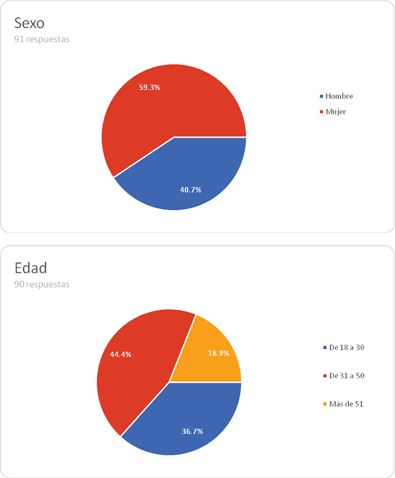

Sex (91 respondents who provided the information)
Men – 40.7 %
Women – 59.3 %
Age (90 respondents who provided the information)
18 to 30 – 36.7 %
31 to 50 – 44.4 %
51 or Older – 18.9 %
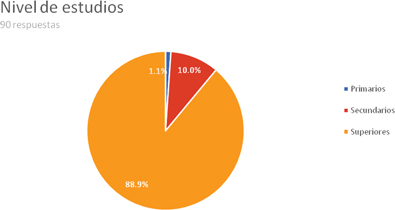
Level of Study (90 respondents who provided the information)
Primary – 1.1 %
Secondary – 10 %
Higher – 88.9 %
[Context: “Los de Alcafrán” is a musical group that has just begun its career.] The phrase “Los de Alcafrán is Los de Alcafrán and the Beatles is the Beatles” can mean that (91 individuals who responded to this question)
the groups are very different; the Beatles are clearly better. 39 (42.9%) respondents found this interpretation acceptable
the groups are very different; each group has its own strengths. 57 (62.6%) respondents found this interpretation acceptable
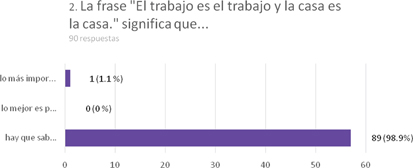
The phrase “work is work and home is home” can mean that (90 individuals who responded to this question)
The most important thing is home. 1 (1.1 %) respondents found this interpretation acceptable
It’s better to work from home. 0 (0%) respondents found this interpretation acceptable
One has to know how to leave work at the office and devote time at home to family life. 89 (98.9 %) respondents found this interpretation acceptable
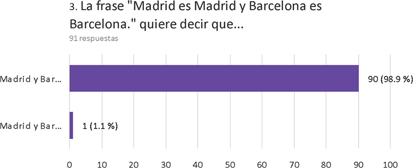
The phrase “Madrid is Madrid y Barcelona is Barcelona.” can mean that (91 individuals who responded to this question)
Madrid and Barcelona are very different. 90 (98.9 %) respondents found this interpretation acceptable
Madrid and Barcelona are very similar. 1 (1.1 %) respondents found this interpretation acceptable
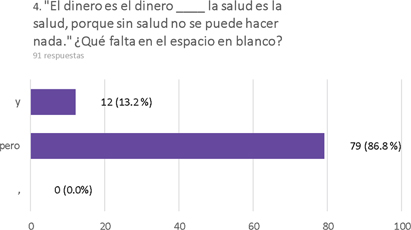
“Money is money ____ health is health, because one can’t make money without health.” What could you fill the blank with? (91 individuals who responded to this question)
y (and) 12 (13.2 %) respondents found this insertion acceptable
pero (but) 79 (86.8 %) respondents found this insertion acceptable
, (comma) 0 (0%) respondents found this insertion acceptable
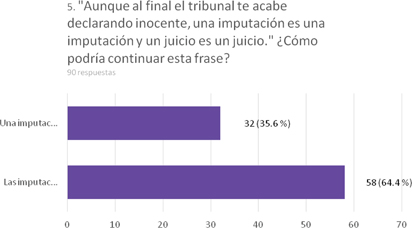
“Even if in the end the court finds you not guilty, an imputation is an imputation and a trial is a trial.” How could you continue the phrase? (90 individuals who responded to this question)
An imputation is one thing and a trial is something different. 32 (35.6 %) respondents found this continuation acceptable
Imputations and trials always cause exhaustion and stress. 58 (64.4 %) respondents found this continuation acceptable
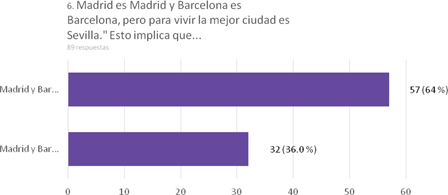
“Madrid is Madrid, and Barcelona is Barcelona, but the best city to live in is Seville.” This suggests (>implies) that… (89 individuals who responded to this question)
In the(ir) essence, Madrid and Barcelona are very similar. 57 (64 %) respondents found this interpretation acceptable
In the(ir) essence, Madrid and Barcelona are very different. 32 (36 %) respondents found this interpretation acceptable
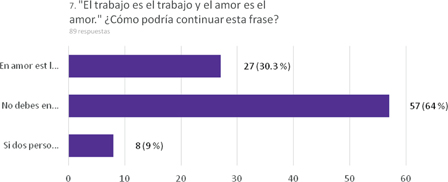
“Work is work and love is love.” How would you complete this sentence? (89 individuals who responded to this question)
Love is what really matters. 27 (30.3 %) respondents found this continuation acceptable
You should not fall in love with a coworker (>colleague). 57 (64 %) respondents found this continuation acceptable
If two people really love each other, they will end up together. 8 (9 %) respondents found this continuation acceptable
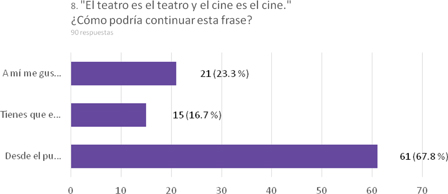
“[The] theatre is [the] theatre and [the] cinema is [the] cinema.” How would you complete this sentence? (90 individuals who responded to this question)
I like them both equally. 21 (23.3 %) respondents found this continuation acceptable
You have to choose which you like better. 15 (16.7 %) respondents found this continuation acceptable
They represent two different genres. 61 (67.8 %) respondents found this continuation acceptable
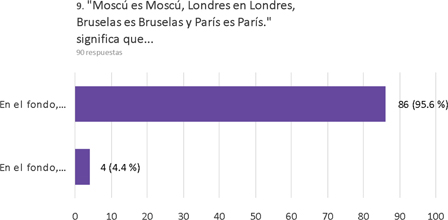
“Moscow is Moscow, London is London, Brussels is Brussels, and Paris is Paris.” [This sentence] means that… (90 individuals who responded to this question)
These cities are very different in the(ir) essence. 86 (95.6 %) respondents found this interpretation acceptable
These cities are very similar in the(ir) essence. 4 (4.4 %) respondents found this interpretation acceptable
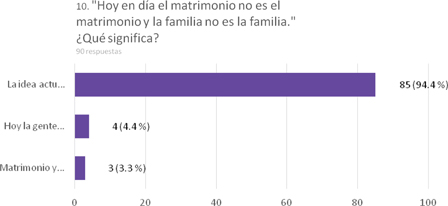
“Today marriage is not marriage and family is not family.” What does it mean? (90 individuals who responded to this question)
The current vision of marriage and family is no longer thе same as before. 85 (94.4 %) respondents found this interpretation acceptable
People do not appreciate important things today. 4 (4.4 %) respondents found this interpretation acceptable
Marriage and family are two very different things. 3 (3.3 %) respondents found this interpretation acceptable
© 2018 Walter de Gruyter GmbH, Berlin/Boston
Articles in the same Issue
- Frontmatter
- Coordinated tautologies in Spanish and Russian
- “Stop doing this at once!”: The preferred use of modality for advice-giving by English language learners
- Comprehension of conversational implicatures in L2 English
- Forum
- Politeness strategies and the representation of women in the Holy Qur’an
- Book Reviews
- Troy McConachy: Developing Intercultural Perspectives on Language Use: Exploring Pragmatics and Culture in Foreign Language Learning
- Grosjean, François Li, Ping: The Psycholinguistics of Bilingualism
Articles in the same Issue
- Frontmatter
- Coordinated tautologies in Spanish and Russian
- “Stop doing this at once!”: The preferred use of modality for advice-giving by English language learners
- Comprehension of conversational implicatures in L2 English
- Forum
- Politeness strategies and the representation of women in the Holy Qur’an
- Book Reviews
- Troy McConachy: Developing Intercultural Perspectives on Language Use: Exploring Pragmatics and Culture in Foreign Language Learning
- Grosjean, François Li, Ping: The Psycholinguistics of Bilingualism
