Language and ethnic statistics in twentieth century Sudanese censuses and surveys
-
Catherine Miller


Abstract
The article investigates the creation of language statistics in the Sudan, from the beginning of the twentieth century up to the division of the country into two states. Like many other African countries, Sudan is characterized by a high degree of ethnic and linguistic diversity that has participated in the fueling of murderous civil wars since independence. The article recontextualizes the construction of the ethno-linguistic categories and statistics within their broader political and administrative contexts. It analyzes the objectives and output of each type of statistics and questions their influence on the foreign and native representations of Sudanese society.
References
Abdelhay, Ashraf. 2008. The politics of language planning in the Sudan: The case of the Naivasha language policy. Edinburgh: University of Edinburg.Search in Google Scholar
Abdelhay, Ashraf. 2010. The politics of writing tribal identities in the Sudan: The case of the colonial Nuba policy. Journal of Multilingual and Multicultural Development 31(2). 201–213.10.1080/01434630903515698Search in Google Scholar
Abdelhay, Ashraf, Al-Amin Abu-Manga & Catherine Miller. 2015. From vernacular languages to national languages: Language planning in the Sudan from 1990 to 2010. In Barbara Casciarri, Munzul A. Assal & François Ireton (eds.), Multidimensional Change in the Republic of Sudan (1989-2011), 263–280. London: Berghahn Books.10.2307/j.ctt9qcjvs.22Search in Google Scholar
Abdelhay, Ashraf, Busi Makoni & Sinfree Makoni. 2010. The politics of linguistic indigenousness in Sudan. In Jay Spaulding, Stephanie Beswick, Carolyn Fluehr-Lobban & Richard Lobban (eds.), Sudan’s wars and peace agreements, 17–58. Newcastle Upon Tyne: Cambridge Scholars.Search in Google Scholar
Abdelhay, Ashraf, Busi Makoni & Sinfree Makoni. 2011a. The Naivasha language policy: The language of politics and the politics of language in the Sudan. Language Policy 10. 1–18.10.1007/s10993-011-9192-9Search in Google Scholar
Abdelhay, Ashraf, Busi Makoni & Sinfree Makoni. 2016. The colonial linguistics of governance in Sudan: The Rejaf Language Conference, 1928. Journal of African Cultural Studies 28(3). 343–358.10.1080/13696815.2016.1146129Search in Google Scholar
Abdelhay, Ashraf, Busi Makoni, Sinfree Makoni & Hamid Mugadam Abdel Rahim. 2011b. The sociolinguistics of nationalism in the Sudan: The politicisation of Arabic and the Arabicisation of politics. Current Issues in Language Planning 12(4). 457–501.10.1080/14664208.2011.628079Search in Google Scholar
Abu Bakr, Yussif Khalifa, & Hurreiz, Sayyid Hamid. 1984. The linguistic map of Sudan” (in Arabic), Paper presented at the 1rst International Linguistics Conference, Khartoum: Institute of Afro-Asian Studies.Search in Google Scholar
Abu Bakr, Yussif Khalifa. 1995. al-siyasaat al-lughawiya fi-l-Suudaan [Language Policies in the Sudan]. Dirasaat Ifriqiyya 12. 125–152.Search in Google Scholar
Abu Shouk, Ahmed Ibrahim. 1998. Kordodan: From tribes to Nazirates. In Endre Stiansen & Michael Kevane (eds.), Kordofan invaded, 120–144. Leiden: Brill.10.1163/9789004491380_009Search in Google Scholar
Abu-Manga, Al-Amin & Abu Bakr Yussif Khalifa. 2006. ’awdâ’ al-lugha fî as-Sûdân [The language situation in Sudan]. Khartoum: University of Khartoum.Search in Google Scholar
Anderson, Benedict. 1991. Imagined Communities: Reflection on the origin and spread of nationalism. London: Verso.Search in Google Scholar
Anderson, Margo & Stephen E Fienberg. 2000. Race and ethnicity and the controversy over the US Census. Current Sociology 48(3). 87–116.10.1177/0011392100048003007Search in Google Scholar
Appadurai, Arjun. 1993. Number in the colonial imagination. In Carol A Breckenridge & Peter Van Der Veer (eds.), Orientalism and the Post-colonial Predicament, 314–339. Philadelphia: University of Pennsylvania Press.Search in Google Scholar
Arel, Dominique. 2002. Demography and politics in the first post-Soviet censuses: Mistrusted state, contested identities. Population 57(6). 801–827.10.3917/pope.206.0801Search in Google Scholar
Arel, Dominique. 2009. Recensement et légitimation nationale en Russie et dans la zone postsoviétique. Critique Internationale 45(4). 19–36.10.3917/crii.045.0019Search in Google Scholar
Bell, Herman. 1975. A data bank for Sudanese languages. In Sayyid H Hurreiz & Herman Bell (eds.), Directions in Sudanese Linguistics and Folklore, 155–172. Khartoum: University of Khartoum.Search in Google Scholar
Bell, Herman. 1979-1980. Language Survey of the Sudan (Sample of locality, Vols 1-29). Khartoum: University of Khartoum.Search in Google Scholar
Bell, Herman. 1995. The Nuba mountains: Who spoke what in 1976?. Presented at the Third Conference on Language in Sudan. University of Khartoum, 3-5 December 1995. Sudanic Africa Text and Sources Archive 1. http://www.hf.uib.no/smi/sa/tan/nuba.htlm (accessed 06 March 2017).Search in Google Scholar
Bendor-Samuel, John. 1975. A language survey of Southern Sudan (Report presented to the Ministry of Education in Southern Sudan, typewritten). Southern Sudan: Summer Institute of Linguistics.Search in Google Scholar
Berair, Ahmed Sadiq. 2007. Linguistic politics in Sudan: Issues of power, ideology & cultural difference. Khartoum: University of Khartoum dissertation.Search in Google Scholar
Beshir, Mohamed Omar. 1968. The Southern Sudan: Background to Conflict. London: Hurst.Search in Google Scholar
Beshir, Mohamed Omar. 1969. Educational Development in the Sudan, 1898 to 1956. Oxford: Clarendon Press.Search in Google Scholar
Cohn, Bernard S. 1987. The census, social structures and objectivation in south Asia. In Bernard S Cohn (ed.), An anthropologist among the historians and other essays, 224–240. Delhi & London: Oxford University Press.Search in Google Scholar
Doornbos, Paul. 1988. On becoming Sudanese. In Tony Barnett & Abbas Abdelkarim (eds.), Sudan: State, Capital and Transformation, 99–120. New York: Croon Helm.Search in Google Scholar
Doornbos, Paul & M. Lionel Bender. 1983. Languages of Wadai-Darfur. In M. Lionel Bender (ed.), Nilo-Saharan Language Studies (Vol. 13), East Lansing, MI: Michigan State University.Search in Google Scholar
Errington, Joseph. 1998. Shifting Languages: Interaction and Identity in Javanese Indonesian. Cambridge & New York: Cambridge University Press.10.1017/CBO9780511612480Search in Google Scholar
Fick, Maggie. 2009. South Sudan Census Bureau releases official results amidst ongoing census controversy. Enoughhttp://www.enoughproject.org/blogs/s-sudan-census-bureau-releases-official-results-amidst-ongoing-census-controversy accessed 17 October 2016Search in Google Scholar
FPCS. 1962. Final Report. First Population Census of Sudan 1955/1956. Khartoum: Department of Statistics.Search in Google Scholar
Gal, Susan & Judith Irvine. 1995. The boundaries of languages and disciplines: How ideologies construct difference. Social Researches 62(4). 967–1001.Search in Google Scholar
Greenberg, Joseph H. 1963. The Languages of Africa. Bloomington: Indiana University.Search in Google Scholar
Guilmoto, Christophe Z. 1992. Chiffrage, déchiffrage : Les institutions démographiques dans l’Inde du sud colonial. Annales : Economies, Sociétés, Civilisations 47(4-5). 815–840.10.3406/ahess.1992.279080Search in Google Scholar
Guilmoto, Christophe Z. 1998. Le texte statistique colonial : A propos des classifications sociales de l’Inde britannique. Histoire et Mesure 13(1-2). 39–57.10.3406/hism.1998.889Search in Google Scholar
Hair, Paul E. H. 1966. A Layman’s guide to the languages of the Sudan Republic. Sudan Notes and Records 47. 65–78.Search in Google Scholar
Harir, Sherif. 1983. Old timers and newcomers: Politics and ethnicity in a Sudanese community (African Savannah 29). Bergen: University of Bergen.Search in Google Scholar
Henin, Roushdy A. 1960. Methods Report. First Population Census of Sudan 1955/1956. Khartoum: Department of Statistics.Search in Google Scholar
Hurreiz, Sayyid Hamid. 1968. Linguistic diversity and language planning in the Sudan (African Studies Seminar 5). Khartoum: University of Khartoum.Search in Google Scholar
Hurreiz, Sayyid Hamid. 1989. Ethnic, cultural and national identity in the Sudan: An overview. In Sayyid H Hurreiz & El-Fatih Abdel Salam (eds.), Ethnicity, Conflict and National Integration in the Sudan, (Sudan Library Studies 16). 69–101. Khartoum: University of Khartoum.Search in Google Scholar
Hurreiz, Sayyid Hamid & Herman Bell. 1975. Directions in Sudanese Linguistics and Folklore. Khartoum: University of Khartoum.Search in Google Scholar
Irvine, Judith. 2008. Subjected words: African linguistics and the colonial encounter. Language and Communication 28. 323–343.10.1016/j.langcom.2008.02.001Search in Google Scholar
Jernudd, Bjorn. 1979. The Language Survey of the Sudan: The first phase, a questionnaire survey in schools. Umeå: University of Umeå.Search in Google Scholar
Kertzer, David & Dominique Arel. (eds.). 2002. Census and Identity: The Politics of Race, Ethnicity and Language in National Censuses. Cambridge-New York: Cambridge University Press.10.1017/CBO9780511606045Search in Google Scholar
Kronenberg, Andreas. 1965. Review of McLoughlin 1964: Language-switching as an index of socialization in the Republic of the Sudan. American Anthropologist 67. 791–792.10.1525/aa.1965.67.3.02a00210Search in Google Scholar
Krótki, Carol Joseph. 1955. 1953 Pilot Population census for the First Population census in Sudan. Khartoum: Department of Statistics.Search in Google Scholar
Lesch, Ann. 1998. Sudan: Contested National Identities. Oxford & Bloomington: James Currey & Indiana University Press.Search in Google Scholar
MacMichael, Harold A. 1922. A History of the Arabs in the Sudan. Cambridge: Frank Cass.Search in Google Scholar
Mahmud, Ushari. 1983. Arabic in the Southern Sudan. Khartoum: FAL.Search in Google Scholar
Manfredi, Stefano. 2015. ‘One tribe, one language’: Ethno-linguistic identity and language revitalization in the Nuba mountains, the case of the Logori. In Barbara Casciari, Munzul Assal & François Ireton (eds.), Multidimensional Change in the Republic of Sudan (1989-2011): Reshaping Livelihoods, Conflicts and Identities, 281–301. London: Berghahn Books.10.2307/j.ctt9qcjvs.23Search in Google Scholar
Mansour, Gerda. 1993. Multilingualism and Nation Building. Clevedon & Philadelphia: Multilingual Matters.Search in Google Scholar
Marshall, Jacqueline. 2013. A primary teacher qualifications framework for multilingual education. In South Sudan & Hamish McIlwraith (ed.), Multilingual Education in Africa: Lessons from the Juba Language-in-Education Conference, 187–202. London: British Council. https://www.teachingenglish.org.uk/sites/teacheng/files/C413%20Juba%20Publication_FINAL_WEB%20ONLY%20v3.pdf (accessed 05 April 2014).Search in Google Scholar
McIlwraith, Hamish. 2013. Multilingual education in Africa: Lessons from the Juba Language-in-Education Conference. London: British Council. https://www.teachingenglish.org.uk/sites/teacheng/files/C413%20Juba%20Publication_FINAL_WEB%20ONLY%20v3.pdf accessed 05 April 2014.Search in Google Scholar
McLoughlin, Peter F. M. 1964. Language-switching as an index of socialization in the Republic of the Sudan. Berkeley, CA: University of California Press.Search in Google Scholar
Miller, Catherine. 1986. Langues et intégration nationale au Soudan. Design langues et des états: Politique Africaine 23. 24–41.Search in Google Scholar
Miller, Catherine. 2003. Linguistic policies and language issues in the Middle East. In A. Usuki & H. Kato (eds.), Islam in the Middle Eastern Studies: Muslims and Minorities, (JCAS Symposium Series 7). 149–174. Osaka: Japan Center for Area Studies.Search in Google Scholar
Miller, Catherine. 2006. Language, identities and ideologies: A new era for Sudan?. Proceedings of the 7th International Sudan Studies Conference 2006. University of Bergen, 6-8 April. http://halshs.archives-ouvertes.fr/docs/00/15/04/38/PDF/millerBergen.pdf (accessed 21 January 2017).Search in Google Scholar
Miller, Catherine. 2014. Juba-Arabic as a written language. Journal of Pidgin and Creole Languages 29(2). 352–391.10.1075/jpcl.29.2.06milSearch in Google Scholar
Miller, Catherine. 2015. Retour sur les catégorisations ethno-linguistiques au Soudan: Entre construction allogène, appropriation autochtone et perpétuel réajustement. Canadian Journal of African Studies 49(1). 127–146.10.1080/00083968.2015.1031147Search in Google Scholar
MoEst. 2008a. 2cd draft of GOSS Education Act. Juba, Ministry of Education, Science and Technology.Search in Google Scholar
MoEST. 2008b. Technical finding of MoEST principles, practice and planning of multilingual education workshop.Search in Google Scholar
Mugaddam, Abdel, Rahim Hamid & Gerrit J Dimmendaal. 2006. Sudan: Language situation. In Keith Brown (ed.), Encyclopedia of Language and Linguistics, 265–270. New York: Elsevier.10.1016/B0-08-044854-2/01666-7Search in Google Scholar
Nyombe, Bureng G. V. 1994. The politics of language, culture, religion and race in the Sudan. Frankfurter Afrikanistische Blätter 6. 9–21.Search in Google Scholar
Nyombe, Bureng G. V. 1997. Survival or extinction: The fate of the local languages of Southern Sudan. International Journal of the Sociology of Language 125. (Sociolinguistic Issues in Sub Saharan Africa). 99–130.10.1515/ijsl.1997.125.99Search in Google Scholar
Prah, Kwesi Kraah (ed.). 1998. Between distinction and extinction: The harmonization and standardization of African languages. Johannesburg: Witwatersrand University Press.Search in Google Scholar
Rondyang, Henry Wani. 2007. The role of indigenous languages in Southern Sudan: Educational policy and planning. Doctoral thesis, Institute of Education, University of London.Search in Google Scholar
Sanderson, Lilian Passmore & Neville Sanderon. 1981. Education, Religion and Politics in Southern Sudan 1899-1964. London & Khartoum: Ithaca Press & University of Khartoum.Search in Google Scholar
Sharkey, Heather. 2003. Living with Colonialism: Nationalism and Culture in the Anglo-Egyptian Sudan. Berkeley, CA: University of California Press.10.1525/california/9780520235588.003.0001Search in Google Scholar
Sharkey, Heather. 2008. Arab identity and ideology in the Sudan: The politics of language, ethnicity and race. African Affairs 107(426). 21–43.10.1093/afraf/adm068Search in Google Scholar
Siddiek, Ahmed Gumaa. 2010. Language situation in post war Sudan. International Education Studies 3(3). 79–87.10.5539/ies.v3n3p79Search in Google Scholar
Spaulding, Jay. 1985. The heroic Age in Sinnar. East Lansing: African Studies Center, Michigan State University.Search in Google Scholar
Spronk, Tanya. 2014. Addressing the challenges of language choice in the implementation of mother-tongue based bilingual education in South Sudan. Multilingual Education 4. 16. 10.1186/s13616-014-0016-zSearch in Google Scholar
Summer Institute of Linguistics & Institute of Regional Languages (SIL). 1987. 1977-1987: Ten years of partnership. Juba: Summer Institute of Linguistics.Search in Google Scholar
Sundar, Nandini. 2000. Census as a caste category: Implication for sociology. Current Sociology 48(3). 111–126.10.1177/0011392100048003008Search in Google Scholar
Thelwall, Robin. 1978. Linguistic profile. In Robin Thelwall (ed.), Aspects of Language in the Sudan, (Occasional Papers in Linguistics and Language Learning). 1–23. Coleraine: New University of Ulster.Search in Google Scholar
Tucker, Archibald N. 1940. The Eastern Sudanic Language. London: Oxford University Press.Search in Google Scholar
Tucker, Archibald N & Margaret A Bryan. 1956. Handbook of African Languages (Part III: The non-Bantu languages of North-East Africa). London: Oxford University Press.Search in Google Scholar
Appendix
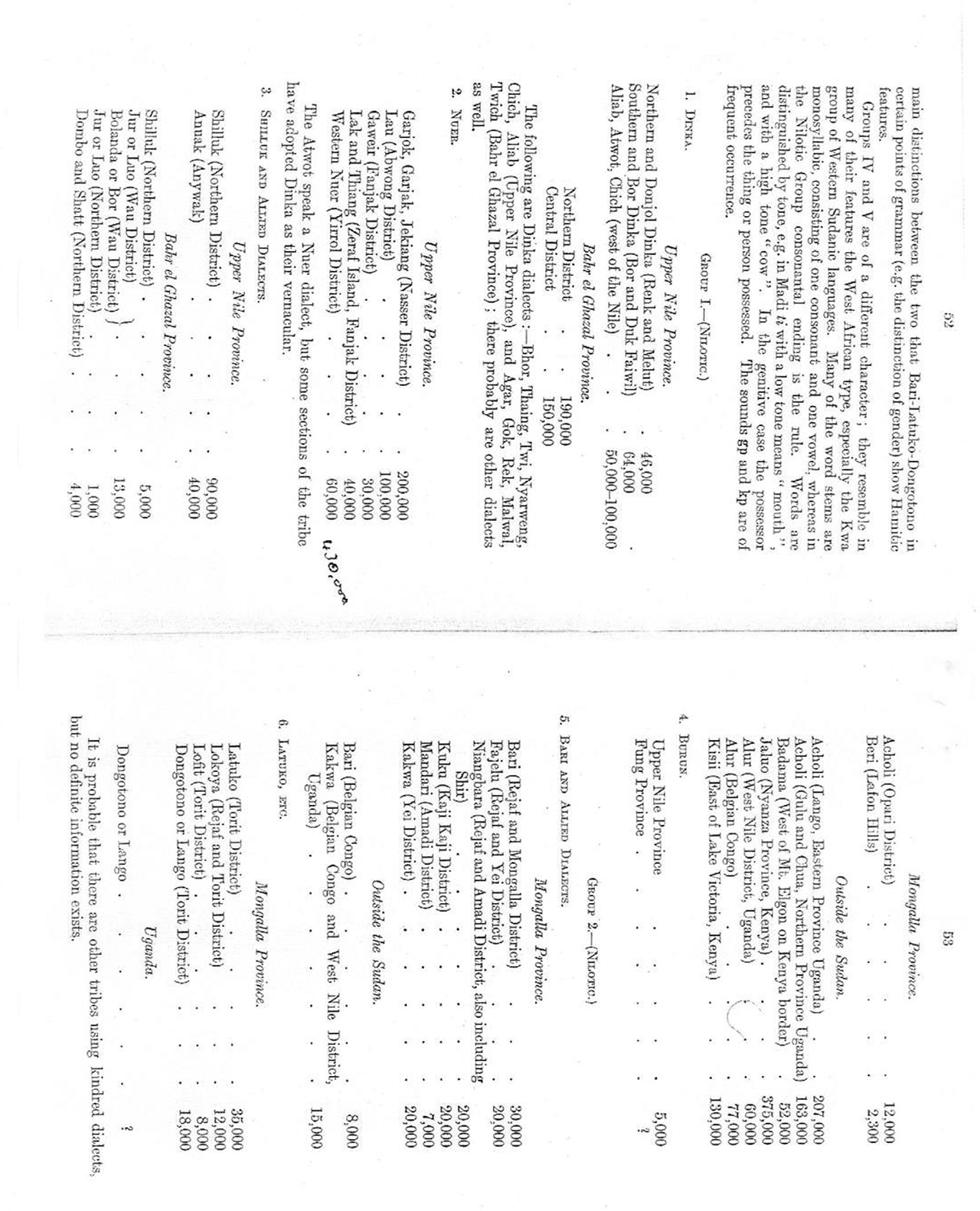
Rejaf Report (page 1)
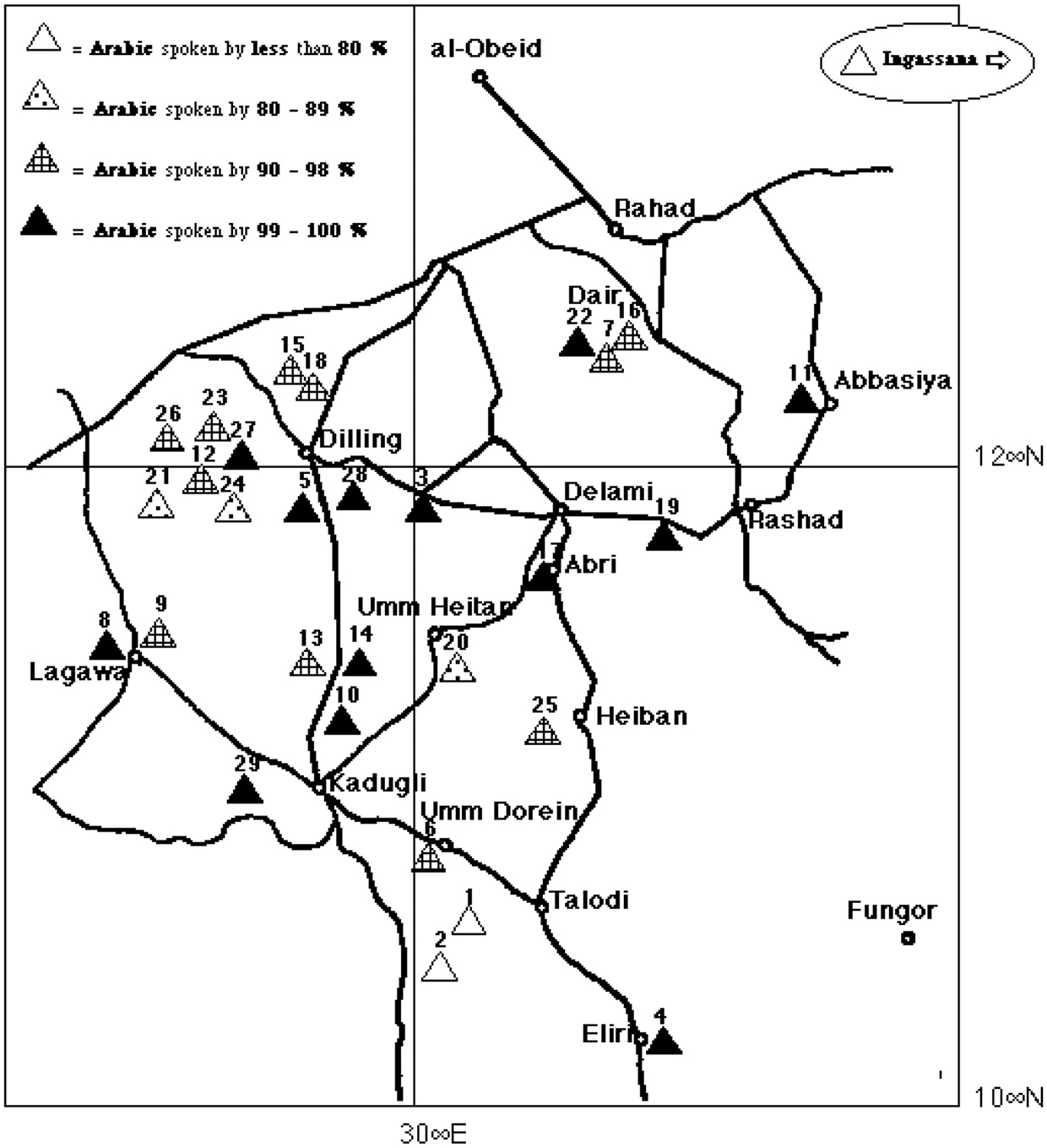
Maps from the Nuba Mountain Language Survey, Bell (1995)
© 2018 Walter de Gruyter GmbH, Berlin/Boston
Articles in the same Issue
- Frontmatter
- Surveying languages: the art of governing speakers with numbers
- It’s all about English: the interplay of monolingual ideologies, language policies and the U.S. Census Bureau’s statistics on multilingualism
- How to ask questions on language? Ideological struggles in the making of a state survey
- Counting matters: quantifying the vitality and value of Basque
- “In the mouth of an aborigine”: language ideologies and logics of racialization in the Linguistic Survey of India
- Language and ethnic statistics in twentieth century Sudanese censuses and surveys
- Book Reviews
- Luis Fernando Angosto Ferrández Sabine Kradolfer: Everlasting countdowns: race, ethnicity and national censuses in Latin American states
- Cacophonies d’empire: Le gouvernement des langues dans l’Empire russe et l’Union soviétique
- Small Languages and Small Language Communities
- Tracing the “extinctness” of Tai Ahom: issues of language loss and death
Articles in the same Issue
- Frontmatter
- Surveying languages: the art of governing speakers with numbers
- It’s all about English: the interplay of monolingual ideologies, language policies and the U.S. Census Bureau’s statistics on multilingualism
- How to ask questions on language? Ideological struggles in the making of a state survey
- Counting matters: quantifying the vitality and value of Basque
- “In the mouth of an aborigine”: language ideologies and logics of racialization in the Linguistic Survey of India
- Language and ethnic statistics in twentieth century Sudanese censuses and surveys
- Book Reviews
- Luis Fernando Angosto Ferrández Sabine Kradolfer: Everlasting countdowns: race, ethnicity and national censuses in Latin American states
- Cacophonies d’empire: Le gouvernement des langues dans l’Empire russe et l’Union soviétique
- Small Languages and Small Language Communities
- Tracing the “extinctness” of Tai Ahom: issues of language loss and death
