Enhancing Cognitive Load, Collaboration Tendency, and Enjoyment Through 3D Augmented Reality in Engineering Education
-
 ,
,
 ,
,

Abstract
This study aims to explore the effect of using 3D Augmented Reality (AR) on cognitive load, collaboration tendency, and enjoyment in engineering education. A quasi-experimental design was conducted involving 111 students, divided into three groups: a control group (conventional), an experimental group with hints (AR + scaffolding), and an experimental group without hints (AR only). Data were collected through pretest-posttest scores and post-intervention questionnaires measuring Cognitive Load (CL), Collaboration Tendency (CT), and Enjoyment (EJ). Data analysis included normality tests (Shapiro–Wilk and Kolmogorov–Smirnov), Wilcoxon Signed-Rank Test, Kruskal–Wallis test, One-Way ANOVA, and Multiple Linear Regression. Results showed that all groups experienced learning improvement, with the highest gains in the AR with hints group. Effect size analysis using Cohen’s d indicated a large impact of AR with hints (d = 1.10) and moderate impact of AR without hints (d = 0.63) compared to the control group. Regression analysis revealed that EJ (p = 0.012) and CT (p = 0.034) significantly predicted learning performance, while CL had a negative effect (p = 0.035). Two-Way ANOVA showed no significant gender effect on CL or CT, but found a significant interaction between gender and group on EJ (p = 0.028), suggesting gender-based differences in emotional engagement with AR. Female students reported higher EJ without hints, while male students preferred guided AR learning. These findings highlight that 3D AR enhances learning outcomes not only cognitively but also socially and emotionally. The integration of scaffolding into AR environments increases effectiveness by reducing cognitive overload and fostering collaboration. Designing adaptive, gender-responsive AR learning environments can further optimize educational impact in technical disciplines.
1 Introduction
Augmented reality (AR) technology has changed the paradigm in education, especially in engineering education, by providing a more interactive and immersive learning experience. AR enables the integration of virtual elements with the real world (Hanid et al. 2020), making it easier to understand complex technical concepts that are often difficult to master using conventional learning methods, such as textbooks and lectures. This research aims to address these challenges by utilizing three-dimensional AR (3D AR) in designing a more effective learning environment that meets the needs of engineering students in developing practical skills and an in-depth understanding of concepts.
Previous studies have indicated that AR can enhance learning through clearer visualization of complex material (Alkhabra et al. 2023). In addition, AR has also been shown to improve collaboration between students by providing a more interactive and engaging platform (Wen 2021). However, there is still a lack of research that simultaneously examines the effect of 3D AR on various dimensions of learning, such as Cognitive Load, Collaborative Tendency, and Enjoyment in the context of engineering education.
Traditional technical education often relies on textbooks and lectures to convey information, which can limit student engagement and understanding. Cognitive Load (CL) refers to the amount of mental effort required to process information and complete learning tasks (Sweller and Chandler 1991). Collaborative Tendency (CT) refers to an individual’s tendency to cooperate and collaborate with others in achieving a common goal (Johnson and Johnson 1989; Slavin 1996). While Enjoyment (EJ), in the context of learning, refers to the sense of pleasure and satisfaction that students experience during the learning process (Ryan and Deci 2000). Although many studies have shown that AR can enhance various aspects of learning, literature regarding how 3D AR affects CL, CT, and EJ simultaneously in the context of engineering education remains underexplored.
This research aims to answer several important questions related to the utilization of 3D AR in engineering education, namely:
How does the use of 3D AR affect the cognitive load of engineering students?
How does the use of 3D AR affect the collaborative tendency of engineering students?
How does the use of 3D AR affect the learning pleasure of engineering students?
By answering these questions, this research seeks to fill the existing research gap in the context of engineering education and provide insights that can be applied in the design of AR-based learning environments. The contribution of this research is expected to enrich the existing literature on the use of AR technology in learning, especially in the context of e-learning. This research offers a holistic approach that explores the influence of 3D AR on three key variables in education, which will make a significant contribution in the development of e-learning theory and practice. The results of this study are also expected to provide practical guidance for educators and educational technology developers in designing and implementing more effective AR-based learning materials, as well as improving operational efficiency in the implementation of technology-based learning initiatives.
2 Literature Review
2.1 AR in Engineering Education Learning
As aforementioned, AR is a technology that combines virtual objects with the real world, enabling deeper and more realistic interactions for users. Early discoveries of AR in engineering education showed that this technology can help students understand complex engineering concepts through better visualization (Dunleavy et al. 2009; Shelton and Hedley 2004). AR can improve spatial understanding in engineering concepts (Shelton and Hedley 2002), marking the potential of AR in facilitating collaborative learning in engineering laboratories (Dunleavy et al. 2009).
In line with these initial findings, recent research shows that AR is increasingly being adopted in engineering education to provide a more interactive and effective learning experience. AR in electrical engineering courses was found to improve students’ problem-solving skills (Tuli et al. 2022). The use of AR in engineering design projects can improve students’ collaboration and creativity, suggesting that AR has great potential to transform traditional engineering education (Criollo-C et al. 2021).
2.2 CL, CT, and EJ Among Engineering Students
CL refers to the amount of mental effort required to process information and complete learning tasks (Sweller 1988; Sweller and Chandler 1991). Describing CL as cognitive load consists of three components: intrinsic load, extrinsic load, and germane load (Sweller 1988). Managing CL is considered pivotal in improving learning efficiency (Sweller and Chandler 1991).
Research on CL has shown that effective management can improve learning performance and concept understanding. In general, research shows that effective management of CL can improve learning performance and concept understanding (Paas et al. 2010; van Merriënboer and Ayres 2005). In the context of engineering education, research shows that the use of technologies such as AR can help reduce CL by providing better visualization and interaction (Ayres and Sweller 2014; Radu 2014). However, there is a gap in the literature regarding how 3D AR affects CL in engineering education.
CT refers to the tendency of individuals to cooperate and collaborate with others in achieving a common goal (Johnson and Johnson 1989; Slavin 1996). Positive group dynamics was found to be an important factor in promoting a successful collaborative learning (Johnson and Johnson 1989). Furthermore, previous research highlights the significance of cooperative learning in improving student learning outcomes (Slavin 1996).
In addition, general research shows that positive CT is associated with improved group performance and learning satisfaction. It shows that positive CT is associated with improved group performance and learning satisfaction (Tedla and Chen 2024). In the context of engineering education, research shows that group work can improve students’ conceptual understanding and practical skills (Byrd et al. 2022; Rezvanifar and Amini 2020). However, more research is needed to understand how 3D AR can influence CT in engineering learning.
EJ in the context of learning refers to the sense of pleasure and satisfaction that students experience during the learning process (Ryan and Deci 2000). Cziksentmihalyi links EJ to the concept of “flow,” where students are fully engaged and enjoying their learning activities. Ryan and Deci (2000) emphasizes the importance of intrinsic factors in motivating students and increasing EJ in learning.
Moreover, research shows that EJ in learning is related to intrinsic motivation and better academic performance (Yan et al. 2024). In engineering education, EJ has been associated with increased student engagement and learning achievement (Li et al. 2019). However, there is a gap in research regarding the specific impact of 3D AR on EJ in engineering learning.
Although many studies show that AR can improve various aspects of learning, such as CL, CT, and EJ, there is still a gap in the literature regarding how 3D AR affects these three variables simultaneously in the context of engineering education. Therefore, this study aims to fill the gap by exploring the effects of 3D AR on CL, CT, and EJ among engineering students.
3 Methods
3.1 Activity Design
The learning activity was conducted at Universitas Negeri Malang, by dividing the students into three groups based on different interventions. The students in the control group were guided by the teacher, while the students in the experimental group were guided by a mobile learning system via unity. The students in the experimental with a hint group were guided by a mobile learning system via unity and the teacher. During the learning process, students in all three groups were asked to study about the topic of renewable energy by studying the materials from the learning module provided. Within the module, a barcode was provided, containing the 3D AR explanation of the image in the module, which was designed to facilitate learning. In the module, some questions designed by the teacher must be answered by the students by observing the learning materials.
For students in the control group, the teacher explained the materials from the module which then will be discussed in the discussion group. At the end of the discussion, students will be given some questions about the discussion and materials presented about renewable energy.
On the other hand, students in the experimental group were guided by the mobile learning system, which navigated the students to learning targets and displayed images of objects in the material presented. Questions regarding the material presented were included in the module studied. With the help of mobile 3D AR, students can better understand what was conveyed in the module. If the materials in the module, supported by the AR application still cannot clarify what students were looking for, they can further browse the internet. The tutor in this class only helped them to use the application, not to provide learning materials.
Meanwhile, students in the experimental group with hints were guided by the mobile learning system and supported by the tutor. If the mobile system cannot help students in understanding the materials, then they can ask the tutor. In this case, the tutor – in addition to help using the application – can also be a friend to discuss the materials, leading to deepening the materials studied. Similar with the previous group, students within this group can also search for answers on the internet. Figure 1 shows the research design of this study.

Activity design.
3.2 3D AR-Based Learning Approach
This research utilizes a 3D AR application designed to learn renewable energy concepts in engineering education, specifically focusing on solar power, wind energy, hydropower, and biomass energy systems. These topics were chosen because of their relevance to sustainability-focused engineering education and because they involve complex concepts that utilize spatial visualization. The application allows students to visualize and interact with 3D models of various renewable energy systems such as solar panels, wind turbines, and bioenergy systems. One of the main features of the app is the interactive 3D models that can be viewed from different angles and dimensions. Students can rotate, and zoom in and out of the model to view more specific technical details. This feature is very helpful in understanding the structure and function of the components of renewable energy systems, which are difficult to explain only with two-dimensional images or text. This can be seen in Figure 2.

3D interactive AR.
In addition to interactive 3D models, the app also comes with dynamic simulations that show how renewable energy systems work under different conditions. For example, the app can simulate changes in light intensity on solar panels and how this affects energy output. Likewise, the wind speed can be adjusted in the wind turbine simulation to show its impact on energy efficiency. These simulations provide a more immersive and contextualized learning experience, allowing students to understand the working principles and factors that affect the performance of renewable energy systems more comprehensively.
This 3D AR application is also equipped with animations and explanations that help clarify the work process and basic principles of each renewable energy system. These animations are accompanied by text and sound to provide a clearer and easier-to-understand explanation. The 3D AR display will appear by scanning the barcode in the learning module, this is shown in Figure 3. Quizzes and exercises are designed to reinforce the concepts that have been learned and provide direct feedback to students. The app is built using the Unity platform and can be accessed through tablets or smartphones that support AR technology, both with iOS and Android operating systems, making it flexible and easy to use in various learning settings. The learning module that accompanies this app includes theoretical material, practical exercises, as well as evaluations designed to ensure comprehensive understanding.

Scan barcode 3D AR interaktif in mobile apps.
Learning for the experimental group “with hints” and the AR Group “without hints” is different, where without hints it is only conceptual, while that used in the experimental group “with hints” is a mixture of conceptual and metacognitive. For example, conceptual: “What is the relationship between wind direction and turbine performance?”; metacognitive: “Do you think you understand how biomass is converted into electricity?” These questions are delivered both through the AR application interface and through teacher facilitation during learning activities. The rationale for using these prompts was to enhance reflection, guide inquiry and encourage deeper understanding. The ‘without hint’ AR group uses the same AR application without teacher guidance. They explore the AR content independently according to the instructions in the learning module.
3.3 Participant
In this research, electrical engineering education students from universities in Malang, especially those who have completed renewable energy courses, participated. The Basic Electronics course (2 credits) covers the basic concepts and calculations of solar power generation, hydropower generation, wind power generation, and biomass power generation. The majority of participants had no prior experience with AR-based learning. Students were assigned into three groups based on their class enrollment to ensure equal distribution of academic background. Within each group – both control and experimental – students were further divided into small teams through random selection to support group-based activities. The students who participated in this research represented various levels of academic achievement. The total number of students involved in this study was 111, as detailed in Table 1.
Participants’ distribution.
| Program study | Total student | Male | Female |
|---|---|---|---|
| Electrical engineering A | 37 | 24 | 13 |
| Electrical engineering B | 37 | 26 | 11 |
| Electrical engineering C | 37 | 31 | 6 |
| Total | 111 | 81 | 30 |
The purpose of this study was to determine the demographic characteristics of participants in terms of academic achievement and age, and to ascertain how these variations may affect learning outcomes. Table 1 illustrates that the majority of respondents were male (n = 81), while female respondents accounted for a smaller proportion (n = 30). This gender imbalance indicates that the study participants were predominantly male, which may reflect the demographic composition of the training programs attended by the respondents. In terms of age, Table 2 illustrates that the majority of respondents were within the age range of 22–23 years, with a mean age of 23 years and a standard deviation of 0.47956 years. This relatively young age profile is common in student populations and reflects that this study largely involved individuals who are in the early stages of higher education. This may influence the perspective and results obtained from this study.
Age of respondents.
| N | Minimum | Maximum | Mean | Std. deviation | |
|---|---|---|---|---|---|
| Age | 111 | 1.00 | 2.00 | 1.6486 | 0.47956 |
| Valid N | 111 |
-
Description: 1.00 = 22 years; 2.00 = 23 years.
3.4 Procedure
The learning process consists of five main stages, each of which is designed to enhance the effectiveness of the learners’ educational experience. The initial stage is a pretest, which aims to assess learners’ knowledge and understanding before the start of the learning process. The second stage is the introduction of the learning media to be used, providing learners with an initial understanding of the tools and resources they will be using. The third stage is the utilization of 3D AR-based media. This media is designed to stimulate learners’ critical and analytical thinking through interactive simulations and practical experiences. The fourth stage is the posttest to assess the improvement of learners’ knowledge and understanding after following the whole learning process with 3D AR media. Lastly, the fifth stage is questionnaire filling to collect feedback from learners regarding the effectiveness of the learning media used and their learning experience during the learning process (Figure 4).
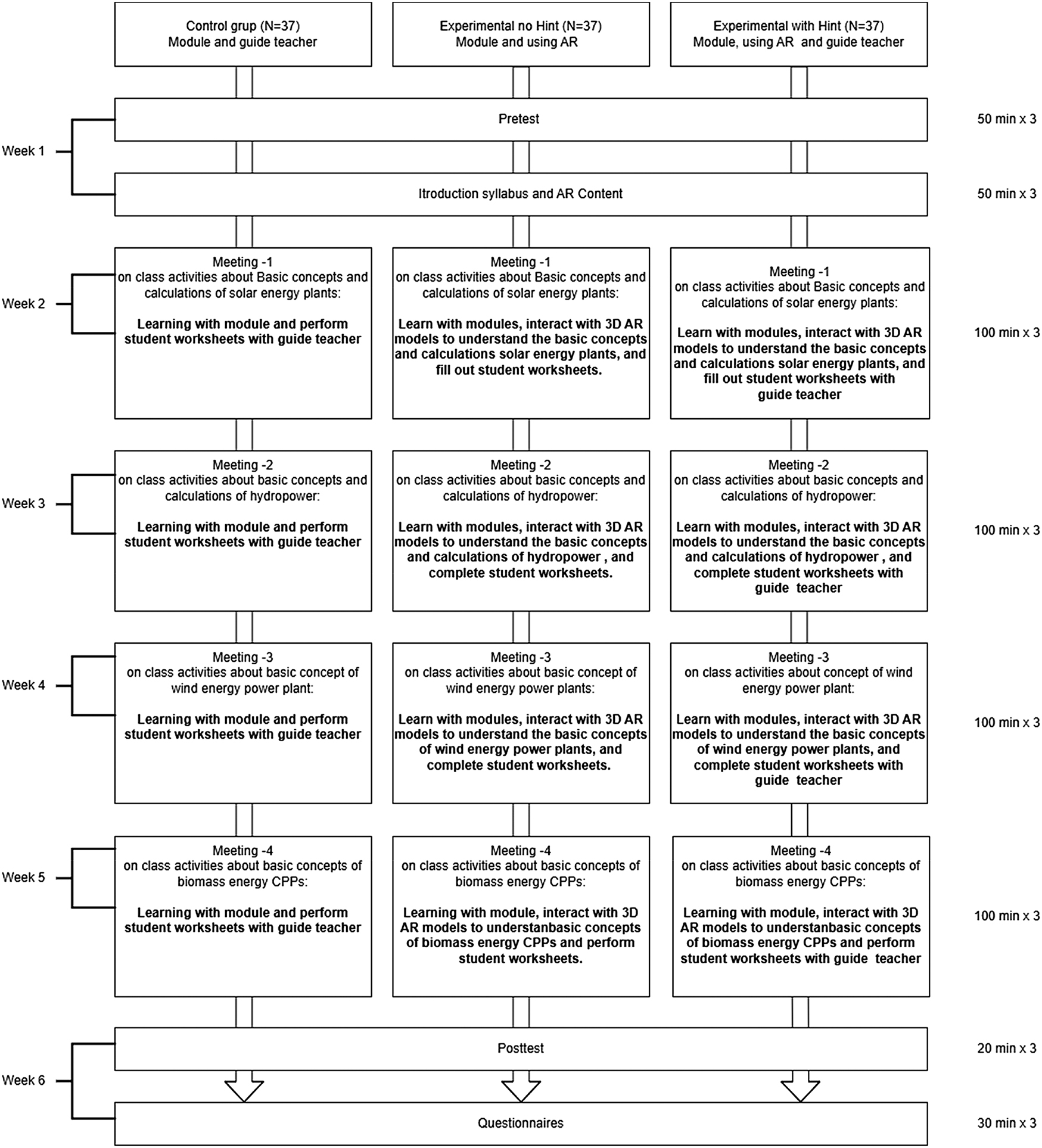
Research procedures.
The study involved three groups with different learning approaches: an experimental group with hints, an experimental group without hints, and a control group. Each group followed an inquiry-based learning model, but with varying levels of guidance and support. The experimental group with hints used AR-based digital/mobile learning tools and received support from an instructor, while the experimental group without hints learned independently without direct intervention. In contrast, the control group used conventional learning methods with printed or digital materials delivered by an instructor. The study was conducted over six weeks to measure how different levels of guidance in AR-based learning affected students’ CL, CT, and EJ level in learning.
The learning activities in each group were similar in structure but executed in different ways. All groups started with an initial pre-test and questionnaire to assess initial levels of CL, CT, and EJ. In the first week, students completed a 20-min pre-test, followed by a 30-min pre-questionnaire, and then received 50 min of module instruction and AR media introduction. During the inquiry-based learning phase (weeks two to five), the experimental group utilized AR technology that allowed interaction with 3D models in a mobile learning environment, while the control group learned with conventional methods. In this phase, the experimental group utilizes the learning module that has been equipped with a barcode for 3D AR scanning, while the control group uses the standard learning module that has been given at the beginning. This learning activity was conducted for four days per week, with material coverage covering the basic concepts and calculations of solar, hydropower, wind power, and biomass power plants. In the sixth week, all participants completed a 20-min post-test and a 30-min questionnaire to evaluate their increased knowledge and understanding of the material learned.
The role of the instructor in each group was also different. In the instructed experimental group, the instructor provided guidance when needed, helping students understand the material through AR interactions supported with guidance. This aims to reduce cognitive overload and improve concept understanding more effectively. In the experimental group without prompts, students are required to complete the AR-based learning independently, which may encourage exploration but also risks incurring higher CL. Meanwhile, the control group follows the traditional learning method, where the instructor provides direct guidance without the use of AR, which allows for a more directed but less interactive learning structure compared to the AR-based group.
The learning environment in this study also varied between groups. The experimental group experienced a blended learning environment that combined a conventional classroom with the use of AR-based mobile tools, allowing for more realistic exploration of 3D models. With the interactive visualization, students were able to understand complex engineering concepts better than using only static 2D images. In contrast, the control group remained in a traditional classroom environment, with learning relying more on printed or digital materials without interactive features. The content covered was equivalent to that in the AR group, ensuring that differences in performance were not due to differences in content. Their experience consisted of lectures and group discussions without the AR applications. This difference is expected to have an impact on the level of EJ and collaboration tendencies within each group.
This research assumes that the expected learning outcomes will differ between the groups. The experimental group with hints is expected to show the highest improvement in optimal CL, higher tendency for collaboration, and greater EJ than the other two groups. The experimental group without prompts may experience higher CL due to having to grasp concepts independently, but they may still benefit from deeper AR engagement. In contrast, the control group is expected to experience lower CL but lower engagement and EJ, as their learning is less interactive than the experimental group. Through this research, it is hoped to gain deeper insights into how the use of AR in engineering education can improve learning effectiveness, especially in terms of students’ cognition, collaboration, and EJ levels.
3.5 Instrument
Data collection was conducted using three main instruments, namely pretests, posttests, and post-questionnaires. The pretest and posttest were designed to measure students’ learning performance before and after the intervention. Each consisted of 20 multiple-choice items with the same question type to maintain consistency of measurement. For example, one of the pretest and posttest items was “How can the use of a Solar Charge Controller (SCC) in solar power plants affect the overall efficiency of the system?” with the following answer options: (a) The SCC prevents the battery from being fully charged too quickly; (b) The SCC regulates the current flow from the panel to the battery, maintaining charging efficiency and preventing battery damage; (c) The SCC converts direct current into alternating current; (d) The SCC prevents over-discharge of the solar panel; (e) The SCC only functions as a voltage meter on the panel. After completing the posttest, respondents were asked to fill out a 45-item questionnaire to evaluate the variables of collaborative tendency, EJ, and CL. Sample questionnaire questions for CT variables “The use of AR in the renewable energy module increases the spirit of cooperation between group members”, sample questionnaire questions for EJ variables “AR makes me more motivated to learn renewable energy topics”, sample questionnaire questions for CL variables “AR facilitates deep thinking about renewable energy concepts”. All of these instruments were developed by three lecturers who have more than 10 years of experience in related fields, to ensure content validity and relevance to the research objectives. This approach aims to obtain comprehensive and reliable data in evaluating respondents’ knowledge and experience.
The number of items in the 45-item questionnaire was determined based on an even distribution across the three main variables under study, namely CL, CT, and EJ. Each variable has 15 questions. The determination of the number of items in each variable was done to ensure a comprehensive and representative measurement of the dimensions to be revealed. To be able to describe the behavior, perceptions, and experiences of respondents in detail, the questionnaire applied a 5-point Likert Scale (1 = strongly disagree; 2 = disagree; 3 = neutral; 4 = agree; 5 = strongly agree), which provides flexibility in the level of agreement of respondents. This application is in line with standard practice approaches in social and educational settings, and is designed to optimize the validity and reliability of measurement. All variables were measured after the intervention.
The CT is one of the important dimensions in the project-based learning process designed to facilitate teamwork to achieve optimal results. This concept refers to an individual’s tendency to actively and cooperatively contribute to group activities, including giving feedback, sharing knowledge, and completing tasks together in a technology-supported learning environment. The main function of measuring CT is to identify the degree to which respondents are willing and able to cooperate, and aims to ensure that group interaction can lead to creative and innovative solutions to problems. The CT was measured with five items based on a 5-point Likert scale (1 = strongly disagree; 5 = strongly agree). One of the items was “In team activities, I believe that all team members will try their best to complete the task”. The instrument has high reliability and consistency as indicated by a Cronbach alpha value of 0.89 (Zhang and Hwang 2023).
The EJ variable in this study refers to the level of pleasure felt by respondents during learning activities. This variable is measured using a questionnaire with a 5-point Likert scale approach, 1 representing “not at all” and 5 representing “completely”. The EJ variable aims to evaluate the relationship between EJ, motivation to learn, and academic achievement. One example question is “Do you enjoy studying at university?”. Research shows that EJ scores are positively associated with academic motivation and a sense of belonging to the university environment, which results in better academic achievement. Cronbach’s alpha value was 0.859 to demonstrate the reliability of the instrument results.
The CL in this study refers to the cognitive mental load experienced by individuals during the learning process, particularly in the context of technology-based learning. The CL questionnaire is designed to evaluate the process that individuals experience during learning, to understand the extent to which learning interventions affect cognitive capacity. The questionnaire consists of four items that evaluate intellectual effort and CL. Answers are given on a 5-point Likert scale, with 1 representing “strongly disagree” and 5 representing “strongly agree”. Example question “I feel I need to exert a lot of effort to understand the objectives of this learning activity”. The CL instrument showed good reliability with a Cronbach’s alpha value of 0.82 (Paas and Van Merriënboer 1994).
3.6 Data Analysis
The data analysis technique in this study began with testing learning outcomes (performance) through pretest and posttest scores. Because the data were not normally distributed (based on the Shapiro–Wilk and Kolmogorov–Smirnov tests), the nonparametric Wilcoxon Signed-Rank Test was used to test the difference between the pretest and posttest in one group. To compare learning outcomes across the three treatment groups, the Kruskal–Wallis test was used, followed by the Mann–Whitney U test with Bonferroni correction to avoid type I errors. Additionally, effect size calculations were performed using Cohen’s d to assess the magnitude of the treatment’s influence (Figure 5).

Relationship between variables.
In the analysis of the three main variables, CL, CT, and EJ, which are predictor variables while the independent variable is the posttest, data processing for the three predictor variables was carried out separately according to the characteristics of each distribution. The first measurement used multiple linear regression. For CL, since one group did not have a normal distribution, the Kruskal–Wallis test was used. For CT and EJ, since the data met the assumptions of normality and homogeneity, a One-Way ANOVA was used, followed by a Tukey HSD post hoc test to examine differences between groups.
To analyze the influence of gender and its interaction on learning outcomes and the three main variables, a Two-Way ANOVA was used. This analysis aimed to evaluate whether there were differences in scores between males and females, as well as whether the type of treatment had different effects based on gender.
4 Results and Discussion
To begin the analysis, descriptive statistics were used to examine students’ initial abilities (pretest scores) and learning outcomes after treatment (posttest scores) across the three groups. This comparison provides a foundation for interpreting the effects of each learning condition on performance.
Table 3 presents descriptive statistics of pretest and posttest scores for each group. The pretest results show that the three groups had equivalent initial abilities, with relatively uniform average scores (ranging from 65.21 to 66.30). This indicates that the initial conditions of the students before the treatment were balanced, so that differences in posttest scores can be associated with the treatment given.
Descriptive statistics of all variables by group.
| Variable | Group | Mean | SD | N |
|---|---|---|---|---|
| Pretest | Control | 65.21 | 9.87 | 37 |
| experimental with hints | 66.30 | 10.12 | 37 | |
| experimental without hints | 66.00 | 9.67 | 37 | |
| Posttest | Control | 74.59 | 10.95 | 37 |
| experimental with hints | 86.08 | 9.94 | 37 | |
| experimental without hints | 81.49 | 10.98 | 37 |
After the treatment, there was an increase in posttest scores across all groups. The highest increase occurred in experimental group I (AR with hints) with an average of 86.08, followed by experimental group II (AR without hints) at 81.49, and the control group at 74.59. These differences indicate that the use of AR media, especially those equipped with scaffolding features such as hints, significantly contributes to improved learning outcomes. These findings also suggest that the presence of hints not only clarifies information but also strengthens cognitive processing and concept retention.
Table 4 shows the results of the Kruskal–Wallis test conducted because the posttest data were not normally distributed. The analysis results showed significant differences between treatment groups (p < 0.05). To determine the specific differences between pairs of groups, a Mann–Whitney U test was conducted. The results showed that both Experiment I (AR with hints) and Experiment II (AR without hints) had significantly higher posttest scores than the control group. However, the comparison between Experiment I and Experiment II did not show a significant difference, although descriptively, Experiment I had a higher average score.
Results of Kruskal–Wallis and Mann–Whitney U tests for posttest scores.
| Group comparison | Statistical test | Z value | p-Value | Description | Cohen’s d | Effect category |
|---|---|---|---|---|---|---|
| Control vs. experimental with hints | Mann–Whitney U | – | <0.001 | Significant | 1.10 | Big |
| Control vs. experimental without hints | Mann–Whitney U | – | <0.016 | Significant | 0.63 | Medium |
| Experimental with hints vs. experimental without hints | Mann–Whitney U | – | 0.143 | Not significant | 0.44 | Medium |
These findings indicate that the presence of AR media, with or without hint features, provides a clear advantage in improving learning outcomes compared to conventional learning. Although the addition of hints did not result in a statistically significant difference when compared to AR without hints, the data trend shows the potential for performance improvement when scaffolding is applied. This supports previous empirical findings stating that the use of AR can significantly improve student engagement and learning outcomes (Chen et al. 2011). To gain further insight into the variables influencing learning outcomes, a multiple linear regression analysis was conducted in the subsequent stage.
Table 5 shows the results of multiple linear regression with posttest scores as the dependent variable and three predictors: CL, CT, and EJ. All three variables were found to have a significant influence on learning outcomes (p < 0.05). Among the three, EJ was the strongest positive predictor (B = 0.271; p = 0.012), followed by CT (B = 0.254; p = 0.034). Meanwhile, CL showed a significant negative effect (B = −0.301; p = 0.035), meaning that the higher the CL perceived by students, the lower their learning outcomes.
Multiple linear regression results (posttest as dependent variable).
| Predictor variables | B | t | Sig. |
|---|---|---|---|
| CL | −0.301 | −2.148 | 0.035 |
| CT | 0.254 | 2.158 | 0.034 |
| EJ | 0.271 | 2.569 | 0.012 |
These findings are consistent with Self-Determination Theory (Ryan and Deci 2000), which emphasizes the importance of intrinsic motivation, comfort, and active engagement in supporting effective learning. EJ and a high tendency toward collaboration reflect students’ affective and social engagement, which strengthens learning outcomes. Conversely, high CL may indicate that the content or learning interface is too complex or unintuitive. Therefore, the design of learning media such as AR must balance cognitive challenges with learning comfort, so that students not only understand the material but also feel engaged and motivated.
Table 6 has the Two-Way ANOVA results that check out how gender, treatment group, and their interaction affect three main variables: CL, CT, and EJ. Overall, gender doesn’t really affect the three variables (p > 0.05). However, the treatment group had a significant effect on CT (F = 3.713; p = 0.028; η 2 = 0.066) and EJ (F = 4.975; p = 0.009; η 2 = 0.087), with effect sizes classified as moderate. Conversely, the effect of treatment on CL was not significant (F = 0.632; p = 0.533), and the very small η 2 value (≈0) indicates that treatment variation does not explain meaningful changes in students’ CL.
Results of Two-Way ANOVA for each variable.
| Factor | F | df | Sig. | η 2 | Description |
|---|---|---|---|---|---|
| Gender (CL) | 0.196 | 1.105 | 0.659 | 0.002 | Not significant |
| Group (CL) | 0.632 | 2.105 | 0.533 | 0.012 | Not significant |
| Gender × Group (CL) | 1.685 | 2.105 | 0.190 | 0.031 | Not significant |
| Gender (CT) | 0.044 | 1.105 | 0.835 | 0.000 | Not significant |
| Group (CT) | 3.713 | 2.105 | 0.028 | 0.066 | Significant |
| Gender × Group (CT) | 1.796 | 2.105 | 0.171 | 0.033 | Not significant |
| Gender (EJ) | 0.710 | 1.105 | 0.401 | 0.007 | Not significant |
| Group (EJ) | 4.975 | 2.105 | 0.009 | 0.087 | Significant |
| Gender × Group (EJ) | 3.694 | 2.105 | 0.028 | 0.066 | Significant |
An interesting finding was the significant interaction between gender and treatment group on the EJ variable (F = 3.694; p = 0.028; η 2 = 0.066). This suggests that the EJ of learning experienced by students through the use of AR is influenced by a combination of gender and treatment type. Implicitly, preferences for features in AR media (such as the presence of hints or navigation structures) may differ between males and females. Therefore, technology-based learning designs should be flexible and adaptive to the demographic characteristics of learners. Although gender is not a primary factor directly influencing learning outcomes, this finding underscores the importance of a responsive approach to diversity to maximize the effectiveness of AR-based learning.
Effect size (eta squared).
| Variable | Statistical test | η 2 | Interpretation |
|---|---|---|---|
| CL | Kruskal–Wallis | ≈0 | Small |
| CT | ANOVA | 0.066 | Medium |
| EJ | ANOVA | 0.087 | Medium |
Table 7 summarizes the eta squared (η 2) values of each variable as a measure of the effect of the treatment given. The CL variable has an η 2 value close to zero, indicating that the treatment did not have a significant effect on students’ CL. Conversely, CT and EJ show η 2 values of 0.066 and 0.087, which, according to Cohen’s (1988) and Lakens’ (2013) classification, fall into the moderate category. This indicates that the use of AR has a fairly strong effect on the affective and social aspects in the context of technical learning.
This effect size aligns with the results of the previous ANOVA and regression tests, where variables related to motivation and interaction play a dominant role in influencing learning outcomes. Thus, these results emphasize the importance of considering the affective dimension in the design of technology-based learning media. Not only content and visualization need to be considered, but also enjoyable and collaborative learning experiences are the key to the successful integration of technologies like AR into complex technical learning environments.
The results of the post hoc test using the Tukey HSD.
| Variable | Gender | Control | Experimental with hints | Experimental without hints |
| CL | Male | 51.58 | 51.73 | 48.65 |
| Female | 44.00 | 49.18 | 54.83 | |
| CT | Male | 56.42 | 60.35 | 56.45 |
| Female | 52.69 | 58.64 | 60.83 | |
| EJ | Male | 61.79 | 65.08 | 61.10 |
| Female | 54.54 | 62.73 | 66.17 |
Table 8 presents the average score distribution for the three main variables based on gender and treatment group combinations. This analysis is a further exploration of the gender × treatment interaction results previously found to be significant on the EJ variable. For this variable, the highest scores were achieved by female students in the AR group without hints (66.17), while males showed the highest EJ scores in the AR group with hints (65.08). This pattern supports the finding that affective responses to AR media can be influenced by gender-based preferences for navigation structure or scaffolding.
In the CL variable, the highest scores were recorded among females in the AR group without hints, which may indicate that without guidance, their mental load tends to increase. Conversely, CL scores among males were relatively lower across all groups, suggesting potential differences in perceived complexity between genders. Meanwhile, CT scores among females showed a stable upward trend across treatments, while those among males exhibited fluctuations. These findings emphasize the importance of considering demographic characteristics in AR-based instructional design. An adaptive approach to learning styles and gender-based preferences can enhance overall student learning effectiveness, engagement, and comfort.
Figure 6 presents a visualization of the average scores for the three main variables – CL, CT, and EJ – based on treatment groups. The highest scores for CT and EJ were found in experimental group I (AR + hint), while the lowest scores consistently appeared in the control group. This reinforces the statistical findings that AR-based learning, especially when accompanied by scaffolding features such as hints, has a positive impact on the affective and social dimensions of technical learning.

Graph of variables against groups.
Conversely, CL scores were relatively stable across all groups, showing no significant differences. This is consistent with the results of the ANOVA test, which showed that the treatment did not have a significant effect on students’ CL. These findings indicate that the use of AR does not excessively increase cognitive complexity but rather tends to strengthen students’ emotional and social engagement. From a pedagogical perspective, this graph emphasizes that the success of AR integration is not solely determined by the delivery of information, but also by interactive, cooperative, and enjoyable learning experiences. Therefore, AR functions more as a medium that facilitates motivation and engagement, rather than merely a tool for content delivery.
Figure 7 presents an interaction plot between gender and treatment group on the EJ variable. This visualization shows that the pattern of EJ increase differs according to gender: female students recorded the highest EJ scores in AR without hints, while male students obtained the highest scores in AR with hints. This pattern reflects a meaningful interaction between demographic characteristics (gender) and the scaffolding-based learning design approach.

Interaction plot by gender and group treatment.
This visual finding is consistent with the results of the Two-Way ANOVA test, which identified a significant interaction between gender and treatment group on EJ (p = 0.028). This indicates that while the use of AR generally enhances learning EJ, preferences for types of support (such as the presence of hints) may differ between males and females. Therefore, technology-based learning design needs to be adaptive and inclusive to optimally accommodate the diversity of students’ preferences and learning styles.
The results on the EJ variable can be further explained through the perspective of flow theory, which emphasizes the importance of psychological conditions in which individuals are immersed in an activity with feelings of focus, full engagement, and intrinsic satisfaction. In the context of this study, the significant increase in EJ among the group using AR, especially when accompanied by hints, indicates that the learning experience presented was able to create a learning environment that approached a state of flow. The interactive elements and 3D visualization of AR, combined with appropriate scaffolding, likely contributed to creating a balance between challenge and student ability, which is a key characteristic of flow. Thus, these results not only show that AR statistically increases EJ but also support the theoretical understanding that technology-based learning designs, when appropriately designed, can facilitate deep engagement and intrinsic motivation among learners, as described in flow theory.
The results of this study provide an important contribution to understanding how AR-based learning media influence not only cognitive outcomes but also affective and social aspects among engineering students. The findings indicate that EJ and CT are essential components in supporting engagement and teamwork, while CL was not significantly affected by the treatment, suggesting that AR-based instruction can enhance motivation and collaboration without excessively increasing mental effort. However, the non-significant direct effects of CT and EJ on learning performance may be explained by methodological and contextual factors. One possible reason is the limited variability or ceiling effect in participants’ responses – when collaboration or enjoyment levels are already high, there is little room for measurable improvement (Syed et al. 2023). Furthermore, task design and interdependence appear to be critical moderators: CT often influences learning indirectly through coordination and role clarity, and its direct contribution weakens when group activities require minimal interdependence (Zamecnik et al. 2024). The fluctuating influence of EJ may also relate to novelty and habituation effects; the initial excitement of using AR can fade without structured guidance and reflective prompts (Jo and Park 2023). Moreover, enjoyment in AR-based environments typically enhances engagement rather than directly improving performance (Sun et al. 2023). Finally, suboptimal management of extraneous cognitive load may suppress affective and social benefits (Rahimi et al. 2025). Therefore, CT and EJ can be understood as indirect or conditional contributors that operate through engagement, coordination, and cognitive regulation mechanisms, rather than as direct predictors of learning performance.
In addition to being statistically significant, the use of AR has also been shown to have a substantial practical impact on learning outcomes. Effect size calculations using Cohen’s d show that Experiment I (AR with hints) compared to the control group had a large effect (d = 1.10), while Experiment II compared to the control group showed a moderate effect (d = 0.63). These results reinforce that the use of AR, especially when accompanied by scaffolding features such as hints, is not only theoretically effective but also meaningful in the context of everyday engineering education.
Conceptually, these findings align with experiential learning theory (Kolb 1984) and self-determination theory (Ryan and Deci 2000), which emphasize the importance of enjoyable, challenging, and motivating learning experiences. The low effect size on CL supports the use of AR as a user-centered and responsive medium for technical learning. Thus, these results confirm that the success of AR-based learning lies in its ability to align information, interactivity, and learning comfort.
This study has several limitations. First, the sample size is limited to one institution and study program, so generalizing the results to a broader context should be done with caution. Second, the experimental design does not use full randomization, which may introduce potential selection bias. Third, the instruments used are perception-based, so they may contain subjectivity. In addition, the AR media used is static and does not yet include advanced interactive features such as gamification, sound, or adaptive feedback.
Future research is recommended to explore the development of more interactive and adaptive AR and test it at different educational levels and scientific domains. A longitudinal approach is also needed to evaluate the long-term impact on 21st-century skills. Furthermore, a combination of quantitative and qualitative methods such as interviews, observations, or case studies can provide a more holistic understanding of how students interact with AR media, particularly regarding individual preferences such as learning styles and social backgrounds.
5 Conclusions
This study aims to evaluate the effect of using 3D AR media on CL, CT, and learning EJ of engineering students in three learning conditions: conventional (control), AR with hints (experiment with hints), and AR without hints (experiment without hints).
First, the analysis showed that the use of 3D AR did not significantly affect students’ CL (p > 0.05), with a very small effect size value (η 2 ≈ 0). This finding suggests that the integration of AR, both with and without hint support, does not significantly increase students’ mental load. Instead, the proper design of AR content allows students to stay focused without experiencing cognitive overload during the learning process of complex techniques.
Second, The AR with scaffolding features significantly enhanced students’CT compared to the control group (p < 0.05; η2 = 0.082), suggesting that AR-based guidance effectively fosters social interaction and cooperation – key elements in project- and team-based engineering education. However, while scaffolding in AR environments promotes collaborative behaviors, CT itself did not directly predict learning performance.
Third, the use of AR was also shown to significantly increase the level of EJ. In addition, an interaction between gender and treatment type was found (p = 0.028), indicating that the learning experience with AR is not uniform between genders. Male students showed the highest EJ in the AR with hints condition, while female students recorded the highest EJ in the AR without hints condition. This finding confirms the importance of adaptive AR learning design that caters to demographic preferences, creating a more inclusive and optimized learning experience.
This research thus contributes to the development of technology-based engineering learning models that not only focus on cognitive effectiveness, but also strengthen affective and social aspects through an experiential, adaptive, and collaborative approach.
In applying AR to engineering education, educators should design collaborative tasks with interdependent roles such as designer, analyst, and reviewer to promote teamwork and shared decision-making. Short orientation sessions and guided tutorials are recommended to reduce novelty effects, while scaffolding elements like hints and reflective prompts help sustain engagement and guide problem-solving without increasing cognitive load. Challenges such as technical issues, unequal participation, and visual overload can be minimized through device testing, peer-assessment rubrics, and simple interface designs. Overall, effective AR-based learning relies on structured collaboration, adaptive strategies, and proactive management to create an inclusive and engaging learning environment.
-
Funding information: This work was supported by the RKI Grant 2024 Republik Indonesia.
-
Author contributions: All authors have accepted responsibility for the entire content of this manuscript and consented to its submission to the journal. They reviewed all the results and approved the final version of the manuscript. SP was responsible for project administration and writing the final draft. WNH contributed to data collection and analysis. DUS assisted in writing the original draft. AMD conducted the simulations. MAI contributed to the research design. GK provided supervision and critical review throughout the writing process. All authors contributed to the manuscript and approved its final version.
-
Conflict of interest: The authors declare no conflict of interest.
-
Data availability statement: Data are available upon request.
References
Alkhabra, Y.A., Ibrahem, U.M., and Alkhabra, S.A. (2023). Augmented reality technology in enhancing learning retention and critical thinking according to STEAM program. Humanit. Soc. Sci. Commun. 10: 1–10, https://doi.org/10.1057/s41599-023-01650-w.Search in Google Scholar
Ayres, P. and Sweller, J. (2014). The split-attention principle in multimedia learning. In: Mayer, R.E. (Ed.). The Cambridge handbook of multimedia learning, 2nd ed. Cambridge University Press, Cambridge, England, pp. 206–226.10.1017/CBO9781139547369.011Search in Google Scholar
Byrd, J., Gallagher, M.A., and Habib, E. (2022). Assessments of students’ gains in conceptual understanding and technical skills after using authentic, online learning modules on hydrology and water resources. Front. Educ. 7, https://doi.org/10.3389/feduc.2022.953164.Search in Google Scholar
Chen, Y.-C., Chi, H.-L., Hung, W.-H., and Kang, S.-C. (2011). Use of tangible and augmented reality models in engineering graphics courses. J. Prof. Issues Eng. Educ. Pract. 137: 267–276, https://doi.org/10.1061/(ASCE)EI.1943-5541.0000078.Search in Google Scholar
Cohen, S. (1988). Psychosocial models of the role of social support in the etiology of physical disease. Health Psychol. 7: 269.10.1037//0278-6133.7.3.269Search in Google Scholar
Criollo-C, S., Abad-Vásquez, D., Martic-Nieto, M., Velásquez-G, F.A., Pérez-Medina, J.-L., and Luján-Mora, S. (2021). Towards a new learning experience through a Mobile application with augmented reality in engineering education. Appl. Sci. 11: 4921, https://doi.org/10.3390/app11114921.Search in Google Scholar
Dunleavy, M., Dede, C., and Mitchell, R. (2009). Affordances and limitations of immersive participatory augmented reality simulations for teaching and learning. J. Sci. Educ. Technol. 18: 7–22, https://doi.org/10.1007/s10956-008-9119-1.Search in Google Scholar
Hanid, M.F.A., Said, M.N.H.M., and Yahaya, N. (2020). Learning strategies using augmented reality technology in education: meta-analysis. Univers. J. Educ. Res. 8: 51–56, https://doi.org/10.13189/ujer.2020.081908.Search in Google Scholar
Jo, H. and Park, D.-H. (2023). Affordance, usefulness, enjoyment, and aesthetics in sustaining virtual reality engagement. Sci. Rep. 13: 15097, https://doi.org/10.1038/s41598-023-42113-1.Search in Google Scholar
Johnson, D.W. and Johnson, R.T. (1989). Cooperation and competition: theory and research. Interaction Book Company, Edina, USA, p. viii, 253.Search in Google Scholar
Kolb, D. (1984). Experiential learning: experience as the source of learning and development. Prentice-Hall, Englewood Cliffs, NJ.Search in Google Scholar
Lakens, D. (2013). Calculating and reporting effect sizes to facilitate cumulative science: a practical primer for t-tests and ANOVAs. Front. Psychol. 4, https://doi.org/10.3389/fpsyg.2013.00863.Search in Google Scholar
Li, H., Öchsner, A., and Hall, W. (2019). Application of experiential learning to improve student engagement and experience in a mechanical engineering course. Eur. J. Eng. Educ. 44: 283–293, https://doi.org/10.1080/03043797.2017.1402864.Search in Google Scholar
Paas, F.G.W.C. and Van Merriënboer, J.J.G. (1994). Variability of worked examples and transfer of geometrical problem-solving skills: a cognitive-load approach. J. Educ. Psychol. 86: 122–133, https://doi.org/10.1037/0022-0663.86.1.122.Search in Google Scholar
Paas, F., Renkl, A., and Sweller, J. (2010). Cognitive load theory and instructional design: recent developments. Educ. Psychol. 38: 1–4, https://doi.org/10.1207/S15326985EP3801_1.Search in Google Scholar
Radu, I. (2014). Augmented reality in education: a meta-review and cross-media analysis. Personal Ubiquitous Comput. 18: 1533–1543, https://doi.org/10.1007/s00779-013-0747-y.Search in Google Scholar
Rahimi, F., Sadeghi-Niaraki, A., Song, H., Wang, H., and Choi, S.-M. (2025). Exploring augmented reality’s influence on cognitive load and emotional dynamics within AAV training environments. IEEE Trans. Learn. Technol. 18: 581–592, https://doi.org/10.1109/TLT.2025.3568416.Search in Google Scholar
Rezvanifar, S.C. and Amini, R. (2020). Self-efficacy versus gender: project-based active learning techniques in biomedical engineering introductory computer programming courses. J. Biomech. Eng. 142, https://doi.org/10.1115/1.4047924.Search in Google Scholar
Ryan, R.M. and Deci, E.L. (2000). Self-determination theory and the facilitation of intrinsic motivation, social development, and well-being. Am. Psychol. 55: 68–78, https://doi.org/10.1037/0003-066X.55.1.68.Search in Google Scholar
Shelton, B.E. and Hedley, N.R. (2002). Using augmented reality for teaching Earth-Sun relationships to undergraduate geography students, The First IEEE International Workshop Agumented Reality Toolkit . 8. https://doi.org/10.1109/ART.2002.1106948.Search in Google Scholar
Shelton, B. and Hedley, N. (2004). Exploring a cognitive basis for learning spatial relationships with augmented reality. Technol., Instr., Cognit. Learn. 1: 323–357.Search in Google Scholar
Slavin, R.E. (1996). Research on cooperative learning and achievement: what we know, what we need to know. Contemp. Educ. Psychol. 21: 43–69, https://doi.org/10.1006/ceps.1996.0004.Search in Google Scholar
Sun, J.C.-Y., Ye, S.-L., Yu, S.-J., and Chiu, T.K.F. (2023). Effects of wearable hybrid AR/VR learning material on high school students’ situational interest, engagement, and learning performance: the case of a physics laboratory learning environment. J. Sci. Educ. Technol. 32: 1–12, https://doi.org/10.1007/s10956-022-10001-4.Search in Google Scholar
Sweller, J. (1988). Cognitive load during problem solving: effects on learning. Cogn. Sci. 12: 257–285, https://doi.org/10.1016/0364-0213(88)90023-7.Search in Google Scholar
Sweller, J. and Chandler, P. (1991). Evidence for cognitive load theory. Cognit. Instruct. 8: 351–362, https://doi.org/10.1207/s1532690xci0804_5.Search in Google Scholar
Syed, T.A., Siddiqui, M.S., Abdullah, H.B., Jan, S., Namoun, A., Alzahrani, A., Nadeem, A., and Alkhodre, A.B. (2023). In-Depth review of augmented reality: tracking technologies, development tools, AR displays, collaborative AR, and security concerns. Sensors 23: 146, https://doi.org/10.3390/s23010146.Search in Google Scholar
Tedla, Y.G. and Chen, H.-L. (2024). The impacts of computer-supported collaborative learning on students’ critical thinking: a meta-analysis. Educ. Inf. Technol. 30: 1487–1516, https://doi.org/10.1007/s10639-024-12857-y.Search in Google Scholar
Tuli, N., Singh, G., Mantri, A., and Sharma, S. (2022). Augmented reality learning environment to aid engineering students in performing practical laboratory experiments in electronics engineering. Smart Learn. Environ. 9: 26, https://doi.org/10.1186/s40561-022-00207-9.Search in Google Scholar
van Merriënboer, J.J.G. and Ayres, P. (2005). Research on cognitive load theory and its design implications for e-learning. Educ. Technol. Res. Dev. 53: 5–13, https://doi.org/10.1007/BF02504793.Search in Google Scholar
Wen, Y. (2021). Augmented reality enhanced cognitive engagement: designing classroom-based collaborative learning activities for young language learners. Educ. Technol. Res. Dev. 69: 843–860, https://doi.org/10.1007/s11423-020-09893-z.Search in Google Scholar
Yan, W., Lowell, V.L., and Yang, L. (2024). Developing English language learners’ speaking skills through applying a situated learning approach in VR-enhanced learning experiences. Virtual Real. 28: 167, https://doi.org/10.1007/s10055-024-01061-5.Search in Google Scholar
Zamecnik, A., Kovanović, V., Joksimović, S., Grossmann, G., Ladjal, D., and Pardo, A. (2024). The perceptions of task cohesion in collaborative learning teams. Int. J. Comput.-Support. Collab. Learn. 19: 369–393, https://doi.org/10.1007/s11412-024-09424-5.Search in Google Scholar
Zhang, D. and Hwang, G.-J. (2023). Effects of interaction between peer assessment and problem-solving tendencies on students’ learning achievements and collaboration in Mobile technology-supported project-based learning. J. Educ. Comput. Res. 61: 208–234, https://doi.org/10.1177/07356331221094250.Search in Google Scholar
© 2026 the author(s), published by De Gruyter, Berlin/Boston
This work is licensed under the Creative Commons Attribution 4.0 International License.
Articles in the same Issue
- Research Articles
- Pedagogical System for Hybrid Training of Future Special Educators
- The Creativity-Centric Framework: Redefining Academic Performance through Task Completion and Cognitive Synergies
- Enhancing Cognitive Load, Collaboration Tendency, and Enjoyment Through 3D Augmented Reality in Engineering Education
- The Influence of Grit and Social Support on University Students’ Psychological Well-Being: The Mediating Role of Problem-Focused Coping
- Augmented Reality as a Supporting Tool for Building Mathematical Knowledge: The Case of Parallel Projection, Perpendicular Projection, and Representation of a Figure in Space
- Marriage Obstacles for Individuals with Intellectual Disabilities from Their Perspectives
- Extending the UTAUT Model with External Variables in Inclusive Schools: An Analysis of Teacher Satisfaction and AI-STEM Use Using SEM and ANN Models
- Moral Agency in Saudi Education: Defining Suitable Outcomes Within Curriculum Reform
- The Influence of English Proficiency on Comprehending Referential Types among EFL Students in Jordan
- Review Articles
- Unlocking the Healing Power of Writing in the Classroom: A Systematic Literature Review on the Implications for Educational Practices
- Digital Literacy as a Tool for Developing Computational Thinking in Young Learners: A Literature Review
Articles in the same Issue
- Research Articles
- Pedagogical System for Hybrid Training of Future Special Educators
- The Creativity-Centric Framework: Redefining Academic Performance through Task Completion and Cognitive Synergies
- Enhancing Cognitive Load, Collaboration Tendency, and Enjoyment Through 3D Augmented Reality in Engineering Education
- The Influence of Grit and Social Support on University Students’ Psychological Well-Being: The Mediating Role of Problem-Focused Coping
- Augmented Reality as a Supporting Tool for Building Mathematical Knowledge: The Case of Parallel Projection, Perpendicular Projection, and Representation of a Figure in Space
- Marriage Obstacles for Individuals with Intellectual Disabilities from Their Perspectives
- Extending the UTAUT Model with External Variables in Inclusive Schools: An Analysis of Teacher Satisfaction and AI-STEM Use Using SEM and ANN Models
- Moral Agency in Saudi Education: Defining Suitable Outcomes Within Curriculum Reform
- The Influence of English Proficiency on Comprehending Referential Types among EFL Students in Jordan
- Review Articles
- Unlocking the Healing Power of Writing in the Classroom: A Systematic Literature Review on the Implications for Educational Practices
- Digital Literacy as a Tool for Developing Computational Thinking in Young Learners: A Literature Review
