Estimation of GPA at Undergraduate Level using MLR and ANN at Arab International University During the Syrian Crisis: A Case Study
-
Aref M. al-Swaidani
 und
Tamer al-Hajeh
und
Tamer al-Hajeh

Abstract
The aim of the current study is to estimate the graduation grade point average (GPA) at the Arab International University (AIU). The importance of this study is that it is the first of its kind in Syria, particularly under the conditions of the bitter war, which has not yet come to its end. The sample of the study consists of data collected from AIU registry system, which covers students of six faculties from both sexes over a period of 5 years, i.e., between 2014 and 2018. The variables of the study include the student’s high school GPA, the source of the student’s certificate, and the gender of the student (GR). MLR and ANN approaches were employed in the analytical study. The correlation coefficients and several statistical criteria were calculated to evaluate the developed models. Based on the results, it can be concluded that the male students were among the key factors affecting the output, i.e., GPA. In addition, ANN tool is more accurate when the estimation of GPA value is concerned. Further, re-evaluation of this study can be done in future particularly when the male student’ trepidation disappears as stability and safety return to the country.
1 Introduction
The Syrian crisis resulted in a loss of more than 25 years of development (Alnafrah & Mouselli, 2019; Dillabough et al., 2018) including the educational development. Millions of Syrian refugees were dispersed in the neighboring countries and some European countries (UNHCR, 2017). The depreciation of the Syrian pound and the high inflation rates are the main repercussions of the crisis. Despite the fact there are indicators of a decline in military battles in the last 3 years, this has not been translated into a secure environment for the students (SCPR, 2022).
Young males over 18 are mandatorily conscripted in Syria. To capture the military service dodgers (King, 2016), the Syrian government has established temporary and roaming checkpoints. The fear of being drafted, the lack of security, the deterioration of social and economic situations alongside the widespread poverty have created a feeling of hopelessness and depression for students and push them a lot to leave the country (SCPR, 2022; Tozan, 2023). In addition, male students, in particular, have opted to linger at their living places to avoid the military/security checkpoints hindering their way to and from the campus (Dillabough et al., 2018; Milton, 2019; Tozan, 2023). Further, many adult males enrolled in higher education to postpone or exempt from military conscription (Davis, Taylor, & Murphy, 2014; Milton, 2019), as the death rates among the new recruits were high (Adleh & Favier, 2017; Milton, 2019). Therefore, some male students have deliberately failed in their exams to prolong time away from the compulsory service during the war times (Al-Haj Ali & Nelson, 2015).
The schooling system on the Syrian territories controlled by the Syrian government is divided into three levels, i.e., primary, preparatory, and secondary education levels, with grades ranging from 1 to 12 (ACU, 2022). The ninth (preparatory) and the twelfth (secondary) grades are subject to standardized examinations at a national level (ACU, 2022; Al Hessan, 2016). The Syrian Ministry of Education grants the secondary education certificates to all students according to their scores taken in the final national examination (ACU, 2022; Shaban, 2020). Mathematics, physics, chemistry, biology, Arabic, English, French, and national civic education are the main subjects, which are taught, in the scientific branch at Syrian secondary schools. In addition to Arabic, English, French, and national civil education, geography, history, and philosophy are the main subjects in the literature branch (ACU, 2022). Vocational branches such as commerce, agriculture, computer, and industry are included in the secondary education system as well (ACU, 2022).
The students after graduating higher secondary schools are generally designated to enroll in higher education according to the following criteria (Thatha & Almshayikh, 2016):
Their high school grade point average (HS-GPA), also known as the Baccalaureate results in Syria,
Personal interviews,
Written exams.
The first criterion is the most frequently used basis for college admission in the Arab countries, especially in Syrian Arab Republic, either for the governmental or non-governmental universities. It is well known that this procedure has an implicit premise: the higher the grades of the student in high school, the better they will do in university and vice versa (Cyrenne & Chan, 2012; Thatha & Almshayikh, 2016). However, this assumption has not been scientifically proven in the Universities. Experiments proved that excellent grades at high school tests do not necessarily mean excelling in university studies that explains why many higher education institutions tend to have sophisticated university admission tests. For instance, all public universities in Japan including the most prestigious universities require the candidate to take an institution-specific secondary exam, alongside “the National Center Test” (Hafalir, Hakimov, Küblerb, & Kurino, 2018). In the United States, students take both the centralized exams like the Scholastic Aptitude Test and complete college-specific requirements such as college admission essays (Chade, Lewis, & Smith, 2014). Institution-specific exams have also been used in UK. BMAT (medicine), ENGAA (engineering), and TMUA (mathematical skills) tests are some of the admission exams at the Cambridge University (Cambridge Assessment Admission Testing (CAAT), 2022). In Hungary, the admission is based on a score combining grades from school and an entrance exam (Biro, 2012). These tests are often designed by independent/non-governmental committees or centers (Thatha & Almshayikh, 2016).
In Syria, there are 8 governmental universities, 16 higher educational institutes, and 24 private universities working under the umbrella of the Ministry of Higher Education and Scientific Research (Al Hessan, 2016; MHESR, 2023). The governmental universities and higher institutes still adopt the semester system (Al Hessan, 2016; OUL, 2006) whereas all private universities adopt the credit hours system.
2 Previous Studies and the Significance of the Current Study
Most of the studies reported in the literature have addressed the impact of the Syrian conflict on the higher education in areas not controlled by the Syrian government (Abedtalas, Alawak, Aldien Aloklah, Aljasem, & Sarmini, 2020; Abdulkerim et al., 2022; Assaf et al., 2022; El-Senousy, Alomari, Mousa, Ghanem, & Faid, 2021; Jesry et al., 2022; Millican, 2020; Omaish et al., 2022; Shaban, 2020). This can be ascribed to the facile accessibility to data and the available participants, with no or fewer degree of intervention by the authorities into the educational process when compared with the Syrian education authorities (Milton, 2019). However, the educational environment, the living situation, and other factors affecting the educational process in such areas are quite different from those controlled by the Syrian governments. Fewer studies have addressed the higher education in areas controlled by the Syrian government (Ashoush & Khadra, 2019; Al Saadi, Zaher Addeen, Turk, Abbas, & Alkhatib, 2017; Milton, 2019). This may be due to the difficulty of data collection, particularly when such data contain identity particulars of the investigated students.
Due to the increase in the number of Syrian universities, and the increase in the number of high school graduates who want to study in such universities, the need has become more urgent to assess the quality of HS-GPA as a criterion for admission to the Syrian universities. According to the best of our knowledge, there are no studies, to date, that address the effectiveness of HS-GPA as a criterion for admission to the Syrian private universities, particularly during the war times and after the increase in its number. Therefore, it has become necessary to assess the feasibility of adopting such a criterion, in a way that contributes to proposals that would assist policymakers of the local admission policies. Adopting the applicable requirements for admission of students to Syrian private universities, or the development of additional new criteria will be of interest.
The aim of the current paper is to estimate GPA as an output based on several variables as input. This study can fill the gap in the literature related to the investigation of the higher education in areas controlled by the Syrian government.
3 Case Study: Arab International University (AIU)
The evaluation of university admission criteria is an important issue that has attracted many researchers due to its close relationship to determining the future characteristics of the student applying for any university education institutions. This evaluation is an urgent need particularly for the Syrian private universities during the Syrian crisis, and more importantly for the reconstruction stage, where the future educational policies should take into consideration such kinds of evaluation. Nevertheless, it is well known that Syria can provide the European & American markets with highly qualified and cheap labor force (Alnafrah & Mouselli, 2019).
The current case study was performed on the AIU University, which is located at about 40 km south of Damascus (Figure 1). It was founded in 2005 and is currently one of the leading private universities in Syria. For more than 8 years, AIU has been occupying the first rank among all the Syrian private universities, according to the Webometrics ranking (Webometrics, 2023). AIU has six earlier opened faculties, namely, pharmacy, information technology, business, architectural engineering, civil engineering, and fine arts, and two recently opened faculties, namely, dentistry and law. The current study covers only the six earlier opened faculties. AIU still mainly depends on the HS-GPA as an admission criterion, with two exceptions adopted by the faculties of architectural engineering and fine arts, which require admission tests (design and drawing tests) alongside the HS-GPA criterion.
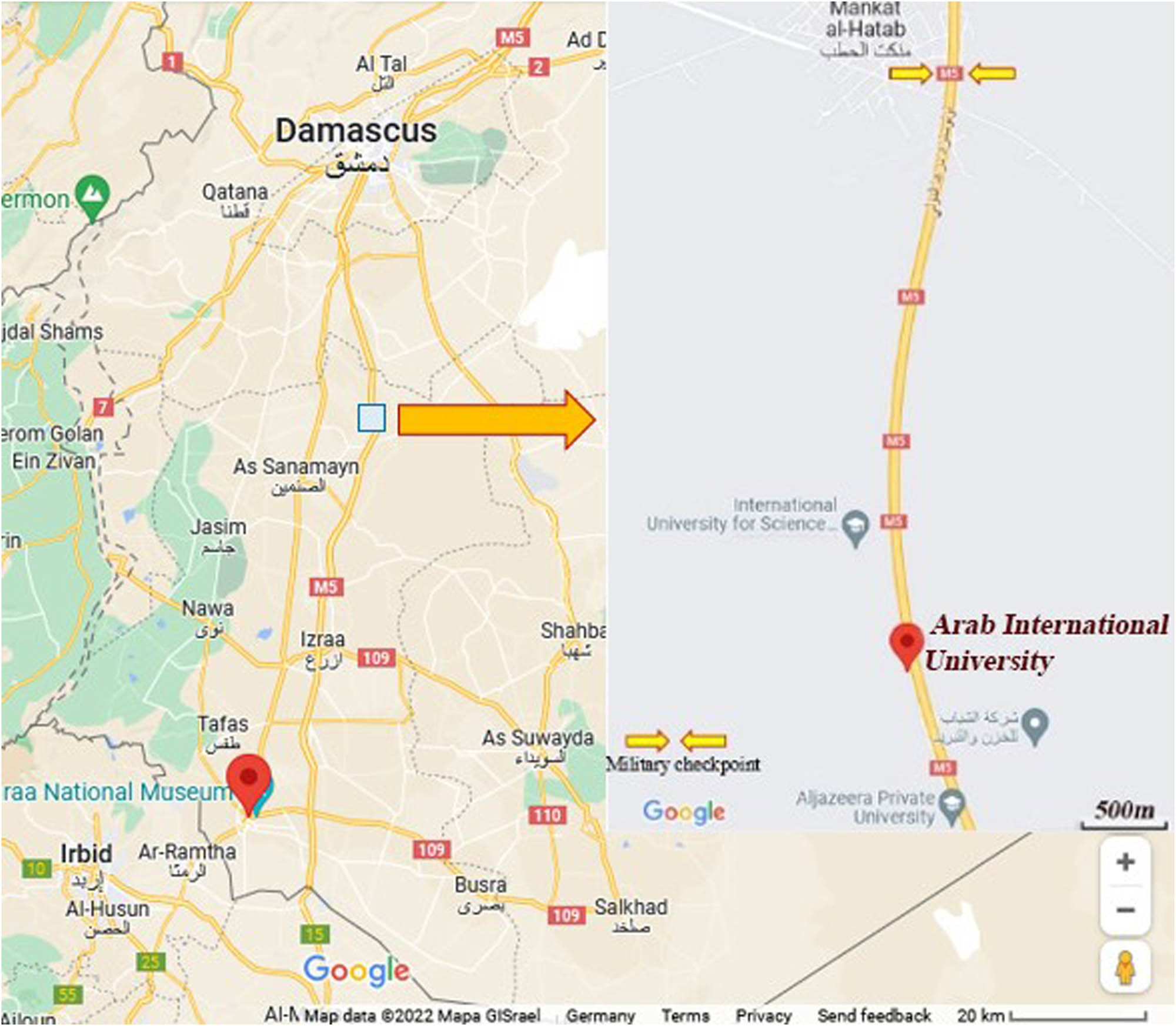
Map showing the location of AIU and the military/security checkpoint at Mankat al-Hatab “on the way to and from the campus.”
3.1 Data Collection
The data collection represents a big challenge, particularly during the ongoing conflict times. Therefore, since the educational system is nearly quite the same in all private universities, data have been collected, at this stage, from the GPA results of the AIU graduates over 5 years. (2014–2018), after being reviewed and approved by the AIU’s Scientific research Board (AIU, 2020). The selection of such a period was because the conflict in Syria reached its peak in 2015 (Tozan, 2023). Further, in 2015, the number of Syrian asylum seekers in Europe was the biggest since 2011. The study sample consists of 2,449 students at 6 faculties: 957, 254, 432, 290, 213, and 303 at the faculties of pharmacy, information technology, business, architectural engineering, civil engineering, and fine arts, respectively. Slightly more than half of the registered students in the current study were female (53.2%). Nearly 5.3% of students have non-Syrian high school certificates.
3.2 Study Variables
The study’s variables are HS-GPA, gender (GR), and student’s certificate (SC). Table 1 shows the characteristics of the independent and dependent variables and the correlation between them. In addition, Figures 2–7 plots GPA & HS-GPA for all investigated faculties. HS-GPA and GPA results were converted to a 100-point scale. The GPA is based on a scale of 4 as tabulated in Table 2. The GR and SC variables were needed to be converted into numerical feature, they were given a score of 1 (male) and 0 (female), and 1 (Syrian certificate) and 0 (foreign or non-Syrian certificate), respectively.
Characteristics of the independent and dependent variables
| Faculty | Gender | Source | HS-GPA | GPA | ||||||||
|---|---|---|---|---|---|---|---|---|---|---|---|---|
| Female | Male | Syrian | Foreign | Min | Max | Avg. | SD | Min | Max | Avg. | SD | |
| Pharm. | 716 | 241 | 901 | 56 | 66.66 | 99.71 | 84.757 | 7.377 | 2 | 3.7 | 2.493 | 0.355 |
| Bus. | 172 | 260 | 410 | 22 | 50 | 99 | 65.149 | 10.615 | 2 | 3.91 | 2.562 | 0.429 |
| Arch. | 143 | 147 | 274 | 16 | 53.75 | 99.9 | 72.865 | 9.666 | 2 | 3.59 | 2.639 | 0.331 |
| IT | 57 | 197 | 234 | 20 | 50 | 99.58 | 74.202 | 10.789 | 2 | 3.83 | 2.635 | 0.456 |
| CEng. | 19 | 194 | 205 | 8 | 55 | 95.07 | 75.172 | 10.173 | 2 | 3.7 | 2.348 | 0.321 |
| Arts | 195 | 108 | 285 | 18 | 46.67 | 93.59 | 65.437 | 10.939 | 2 | 3.67 | 2.676 | 0.356 |

GPA and HS-GPA as “variables” of the Pharmacy student sample.

GPA and HS-GPA as “variables” of the IT student sample.

GPA and HS-GPA as “variables” of the Business student sample.

GPA and HS-GPA as “variables” of the Architectural Engineering student sample.

GPA and HS-GPA as “variables” of the Civil Engineering student sample.

GPA and HS-GPA as “variables” of the Fine Arts student sample.
GPA scale adopted at AIU
| Point grade | 4 | 3.75 | 3.50 | 3.25 | 3.00 | 2.75 | 2.50 | 2.25 | 2.00 | 1.75 | 1.5 | 0 |
| Letter grade | A+ | A | A− | B+ | B | B− | C+ | C | C− | D+ | D | F |
3.3 Questions Needed to be Answered
Does the HS-GPA variable have a statistical significance in terms of GPA estimation?
Does the GR variable have a statistical significance in terms of GPA estimation?
Does the SC variable have statistical significance in terms of GPA estimation?
Is there an acceptable relationship between HS-GPA and GPA?
Is the HS-GPA variable the only important estimating criterion for GPA irrespective of the faculty?
It is clearly seen, particularly in Figures 5 and 7, that HS-GPA is not the decisive factor when estimating the student’s skills and abilities although it is considered one of the good indicators of academic potential. A significant percentage of the faculties of Fine Arts and Architectural Engineering students of low HS-GPA have high GPA and vice versa. This can be considered an important indicator that the good performance of the students in some faculties such as Architectural Engineering and Fine Arts is related to the skill and the talent rather than HS-GPA criterion alone.
4 Analytical Techniques
Modeling nonlinear relations between input and output variables can be done using ANNs (Al-Swaidani & Khweis, 2018; Graupe, 2007; Kalejaye, Folorunso, & Usman, 2015). The dataset used to develop the ANN models are divided into subsets (i.e., 70% for training set, 15% for testing set, and 15% for validation set). The present study deals with the estimation of GPA at a college level using ANNs. MLR analysis has been used for comparison (Johnson, 2000). The estimated GPA values have been plotted against the collected GPA results.
ANN uses the back propagation procedure, which can be considered the most widely used method among the ANN methods (Al-Swaidani & Khweis, 2018; Graupe, 2007). It consists of multiple layers: an input layer, one or more hidden layers, and an output layer. Hidden layers may contain a large number of hidden neurons. Activation propagation is forwarded from the input layer toward the output layer, and then the algorithm compares the network outputs with known targets. Weights and biases are updated based on calculated errors in order to meet the target. The logistic sigmoid activation function with a scaling range between 0 and 1 was found to be the best settings for the present application, as follows (Graupe, 2007):
where α is a constant used to control the slope of the semi-linear region (Saridemir et al., 2009).
By repeating the procedure described above until the error is acceptably small or no marked improvement is noted, the final output can be obtained (Masters, 1993).
The structures of the ANN models are shown in Figure 8.
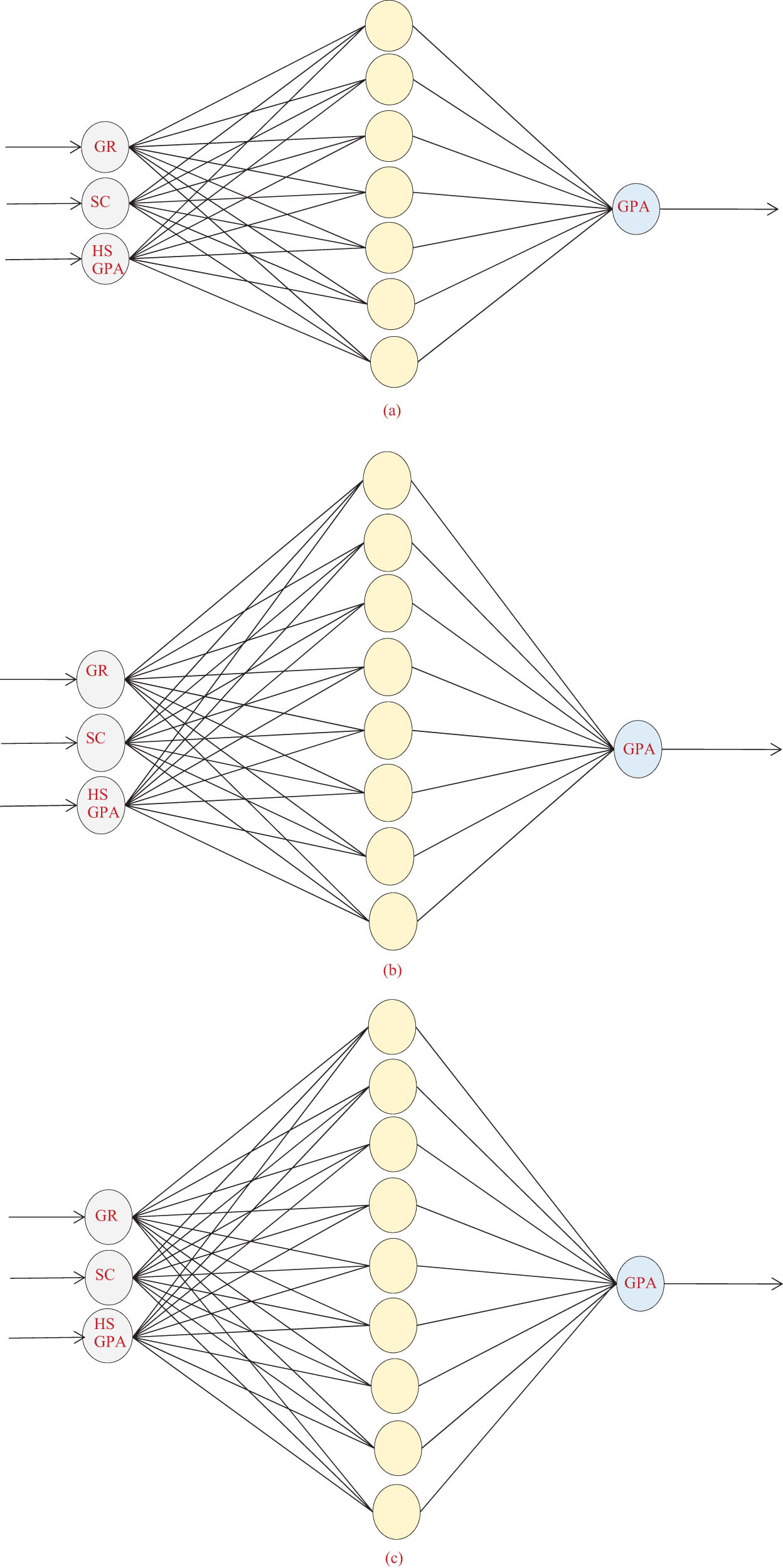

Architecture of the developed ANN models. (a) Architecture of ANN model for the Faculty of Fine Arts (7 neurons in the hidden layer). (b) Architecture of ANN model for each of IT, Business, and Civil Engineering (8 neurons in the hidden layer). (c) Architecture of ANN model for the faculty of Pharmacy (9 neurons in the hidden layer). (d) Architecture of ANN model for the Faculty of Architectural Engineering (10 neurons in the hidden layer).
The artificial neural networks were developed using MATLAB software, NN Tool. The validity of the constructed models was evaluated using the following criteria:
Root mean squared error (RMSE) which can be calculated using the following equation:
(2)When the RMSE value is smaller, the ANN model is better.
Mean Absolute Error (MAE):
(3)Mean absolute percentage error (MAPE), which can be calculated using the following equation:
(4)R-square coefficient (R 2) which can be calculated using the following function:
(5)There will be a closer relationship between output and targeted output, when R is closer to 1.
Durbin–Watson statistic (DW) is used to verify the existence of multicollinearity. Its value varies between 0 and 4. The acceptable range of 1.5–2.5 indicates that the developed models are unaffected by multicollinearity.
5 Results and Discussion
5.1 MLR Analysis
Figures 9–11 show the results of MLR analysis for all parameters, for GR alone, and for the certificate source, respectively. As can be obviously seen in Figure 9, IT and CEng faculties have the highest R-values when compared with other faculties. In addition, as noted in Figure 10, R values for the female students are significantly higher than those for the male students at all faculties. This result can be attributed to the unstable conditions that the male students were suffering from in Syria during the crisis. These conditions can be mainly summarized by the fearfulness of the compulsory military service after the graduation, particularly under the conditions of the bitter war in Syria. Moreover, the male student’s poor commitment to the participation and the attendance at the university in fear of the checkpoints may also be one another important reason. It is also interesting to note from Figure 11 that the foreign certificate other than the Syrian certificate has the best R-value for only the IT students. This can be explained by the higher English level that the students with foreign certificates have when compared with the students with Syrian certificates, where the Arabic language is the main language in the Syrian courses.

Statistical values (all variables are included).

Statistical values (the variable “source of the certificate” was integrated with HS-GPA).

Statistical values (the variable “gender” was integrated with HS-GPA).
The relationships between the output (GPA) and the input variables obtained using MLR are as follows:
For the Faculty of Pharmacy:
For the Faculty of IT:
For the Faculty of Business:
For the Faculty of Architecture Engineering:
For the Faculty of Civil Engineering:
For the Faculty of Fine Arts:
It is interesting to note from the abovementioned equations (6)–(11) that HS-GPA variable at all faculties has a statistical significance. In addition, all input variables for the faculties of pharmacy and IT have also statistical significance. Thus, at both faculties, GPA can be estimated based on all input variables with a confidence level of 95% or more. This result can be explained by the fact that these kinds of faculties may offer a promising future and job opportunities to the graduates in Syria.
Further, it is worth mentioning that the correlation coefficient (R) at all faculties were not affected when GR and SC variables were integrated with the HS-GPA variable. The correlation coefficients recorded when the HS-GPA variable alone was taken into consideration were: 0.35, 0.51, 0.26, 0.31, 0.46, and 0.12 for the faculties of Pharmacy, IT, Business, Architecture, Civil Engineering, and Fine Arts, respectively. However, these values when GR and SC variables were integrated increased to the following: 0.36, 0.57, 0.27, 0.40, 0.51, and 0.15.
5.2 ANN Analysis
The analysis results obtained using either ANN or MLR approaches are tabulated in Table 3. It can be noted that the results obtained using ANN were significantly better when compared with those obtained using MLR analysis. The correlation coefficients increased noticeably from 0.36 to 0.78, from 0.57 to 0.82, from 0.51 to 0.78, from 0.27 to 0.62, from 0.15 to 0.57, and from 0.4 to 0.8 for the faculties of Pharmacy, Information Technology, Civil Engineering, Business, Fine Arts, and Architectural engineering, respectively. In addition, RMSE values decreased from 0.33 to 0.22, from 0.37 to 0.25, from 0.28 to 0.20, from 0.41 to 0.33, from 0.35 to 0.29, and from 0.30 to 0.20 for the faculties of Pharmacy, Information Technology, Civil Engineering, Business, Fine Arts, and Architectural Engineering, respectively. Further, MAPE and MAE registered lower values when the estimation process was done using ANN. The relationships obtained by ANN indicate that modeling using ANN tool is more accurate than MLR, Figure 12. These results are in well agreement with similar results reported by Falát and Piscová (2022), Isljamovic and Suknovic (2014), and Oladokun, Adebanjo, and Charles-Owaba (2008). Although the results obtained using ANN analysis are not very good, according to the scale of Montgomery and Peck (1982), they can be considered acceptable (R ranges from 0.57 to 0.82). The Syrian crisis “according to authors” might have affected these results, because the male students, who are considered the most affected group in the society, represent about half of the investigated sample. Furthermore, the DW values for both ANN and MLR models were consistent with the desirable range of values, i.e., between 1.5 and 2.5, which indicates the absence of positive auto correlation.
Comparison between MLR and ANN
| Faculty | Model | MSE | RMSE | MAE | MAPE | R 2 | R | DW |
|---|---|---|---|---|---|---|---|---|
| Pharm. | MLR | 0.1097 | 0.3312 | 0.2669 | 10.6654 | 0.1289 | 0.3591 | 1.9649 |
| ANN | 0.0489 | 0.2211 | 0.1909 | 7.742 | 0.6118 | 0.7822 | 2.0285 | |
| IT | MLR | 0.1406 | 0.3749 | 0.3031 | 11.8107 | 0.3247 | 0.5698 | 1.9511 |
| ANN | 0.0671 | 0.2591 | 0.2288 | 8.9171 | 0.6777 | 0.8232 | 1.9671 | |
| CEng | MLR | 0.0768 | 0.2771 | 0.2156 | 8.9602 | 0.2572 | 0.5071 | 2.2254 |
| ANN | 0.041 | 0.2024 | 0.1735 | 7.3692 | 0.6031 | 0.7766 | 2.2182 | |
| Bus. | MLR | 0.1708 | 0.4133 | 0.3329 | 12.9186 | 0.0752 | 0.2743 | 1.8444 |
| ANN | 0.1142 | 0.3381 | 0.2858 | 11.3095 | 0.3811 | 0.6174 | 1.9517 | |
| Arts | MLR | 0.1238 | 0.3518 | 0.2865 | 10.7723 | 0.0239 | 0.1549 | 2.0867 |
| ANN | 0.0851 | 0.2917 | 0.2550 | 9.6510 | 0.3287 | 0.5733 | 2.1072 | |
| Arch | MLR | 0.0915 | 0.3026 | 0.2409 | 9.1378 | 0.1632 | 0.4041 | 1.9337 |
| ANN | 0.0394 | 0.1984 | 0.1761 | 6.8159 | 0.6403 | 0.8002 | 1.9394 |


Comparison between ANN and MLR models. Estimation of GPA for all students using ANN & MLR techniques for (a) Pharm (9 neurons). (b) IT (8 neurons). (c) Bus (8 neurons). (d) Arch (10 neurons). (e) CEng (8 neurons). (f) Fine Arts (7 neurons).
5.3 Sensitivity Analysis of ANN Models
Sensitivity analysis was conducted based on the Garson equation (Garson, 1991) to assess the relative importance of the input variables. Garson (1991) proposed the following equation:
where I j is the relative importance of the jth input parameter on the output; N i and N h are the numbers of input and hidden neurons, respectively; W is the connection weight; the superscripts i, h, and o refer to input, hidden, and output layers, respectively; and subscripts k, m, and n refer to input, hidden, and output neurons, respectively.
Figure 13 shows the relative importance of the input variables (HS-GPA, GR, and SC). It can be noted that all variables have a strong effect on GPA. As clearly seen in Figure 13, HS-GPA was found to be the most influential variable with a relative importance of 37.2, 34.9, 36.4, 34.8, 42.7, and 31.6% for the faculties of Pharmacy, IT, Business, Architecture, Civil Engineering, and Fine Arts, respectively. The higher relative importance of HS-GPA can be attributed to the significant effect of this variable on the GPA at the university level. It is one of the good indicators of academic potential. In addition, it is to be noted that other variables have also considerable effects on the output values. For example, GR can be considered predominant at the faculty of Fine Arts. This can be explained by the increase in the number of female students when compared with the male students at this faculty. Thus, two thirds of the students, i.e., the female students were not seriously suffering the repercussions of the Syrian crisis, as this category is not drafted into the military service according to military service law in Syria. The lower relative importance noted for the SC variable can be ascribed to the lower percentage of the students having foreign certificates.


The relative importance values of input variables for all studied faculties. Relative importance of input variables for (a) Faculty of Pharm. (b) Faculty of IT. (c) Faculty of Bus. (d) Faculty of Arch. (10 neurons). (e) Faculty of CEng. (f) Faculty of Fine Arts.
6 Conclusion
The present case study is the first of its kind in Syria. Estimation of GPA using MLR and ANN approaches was done using the data obtained from AIU. Analysis of six faculty’s data during the Syrian crisis aimed at having the answer to the most demanding question: Is HS-GPA still considered the decisive factor in the admission policies, particularly at the Syrian private Universities?
Based on the results obtained, the following conclusions can be drawn:
A comparison between MLR and ANN approaches depicts that ANN models can be used to estimate the GPA at a college level, effectively. The developed ANN models give acceptable results; the linear correlation coefficient (R) is more than 0.55, error of estimation in all ANN models is lower when compared with that obtained in MLR models.
The values estimated by ANN models are not far from the collected data. Statistical indicators, such as RMSE, MAPE, R, and DW have demonstrated that ANN models are all acceptable for estimating GPA. MLR models are less accurate than the ANN ones.
Sensitivity analysis showed that all studied variables in this case study (HS-GPA, GR, and certificate source) have considerable effects on GPA. However, HS-GPA was found to be the most influential variable with relative importance of more than 30%.
Admission tests are highly encouraged for the faculties of Fine Arts and Architecture.
Investigating other Syrian governmental or non-governmental universities is highly recommended. Meanwhile, the findings obtained can be shared with these universities.
Investigating a pre-war period is highly recommended in order to deeply understand the real effects of the Syrian crisis on the GPA estimation.
Further research with integration of further variables and a larger sample collected from other private universities is highly recommended. Variables such as the student age, the education level of parents, the results of the early academic year, number of years to earn the bachelor’s degree, and the socio-economic level can be further investigated.
Re-evaluation of this study can be done in future, particularly, when the male student’s trepidation disappears as stability and safety return to the country.
Acknowledgments
The authors thank Mr. Alla a Qabbani from the AIU staff for his appreciated help with data collection and indexing.
-
Funding information: The authors declare that no funding was received.
-
Author contributions: The authors have contributed equally to the manuscript.
-
Conflict of interest: Authors state no conflict of interest.
-
Data availability statement: All collected data were employed in the current study.
References
Abdulkerim, S., Nasir, A., Parkinson. T., Marais, D., Altaha, R., & Shaban, F. (2022). Enhancing higher education teaching and learning in northern Syria: Academic development needs of teaching staff at free Aleppo and Sham universities. International Journal of Educational Research Open, 3, 100143.10.1016/j.ijedro.2022.100143Suche in Google Scholar
Abedtalas, M., Alawak, A., Aldien Aloklah, W., Aljasem, A., & Sarmini, I. (2020). Syrian higher education and social capital in times of conflict. Education and Conflict Review, 3, 9–15.Suche in Google Scholar
ACU. (2022). Schools in Syria 2022, Edition 07. Thematic Reportthe Information Management Unit (IMU).Suche in Google Scholar
Adleh, F., & Favier, A. (2017). Local Reconciliation Agreements” in Syria: A Non-Starter for Peacebuilding. Research Project Report RSCAS/Middle East Directions 2017/01. European University Institute.Suche in Google Scholar
AIU. (2020). Order of the Scientific Research Board, Arab International University, 01.07.2020.Suche in Google Scholar
Al-Haj Ali, M., & Nelson, M. (2015). No Point in Fighting: Damascus Youth Under the Shadow of Conscription. 1 June. Available online at:. Syria Direct. http://syriadirect.org/news/%E2%80%98no-point-in-fighting%E2%80%99-damascus-youth-under-the-shadow-of-conscription/.Suche in Google Scholar
Al Hessan, M. (2016). Understanding the Syrian educational system in a context of crisis?. Vienna Institute of Demography, Austrian Academy of Sciences, paper nr. 09.2016.Suche in Google Scholar
Alnafrah, I., & Mouselli, S. (2019). Constructing the reconstruction process: a smooth transition towards knowledge society and economy in post-conflict Syria. Journal of the Knowledge Economy, 11, 931–948. https://doi.org/10.1007/s13132-019-0582-0.10.1007/s13132-019-0582-0Suche in Google Scholar
Al Saadi, T., Zaher Addeen, S., Turk, T., Abbas, F., & Alkhatib, M. (2017). Psychological distress among medical students in conflicts: A cross-sectional study from Syria. BMC Medical Education, 17, 173. doi: 10.1186/s12909-017-1012-2.Suche in Google Scholar
Al-Swaidani, A., & Khweis, W. (2018). Applicability of Artificial Neural Networks to predict mechanical and permeability properties of volcanic scoria-based concrete. Advances in Civil Engineering, 2018, 5207962. https://doi.org/10.1155/2018/5207962.10.1155/2018/5207962Suche in Google Scholar
Ashoush, A., & Khadra, S. (2019). The impact of the conflict on the higher education sector in Syria: A case study of Tishreen University. Tishreen University Journal Economic and Legal Science, 41, 75–92.Suche in Google Scholar
Assaf, M., Lakmes, A., Alobaidy, M. G., Shabou, F., Ahmad, W., Alhasan, M., … De Vries, L. A. (2022). Evaluating the effectiveness of student-record systems in conflict-affected universities in northwest Syria relative to student transition and mobility. International Journal of Educational Research Open, 3, 100128.10.1016/j.ijedro.2022.100128Suche in Google Scholar
Biro, P. (2012). University Admission Practices – Hungary. Working paper.Suche in Google Scholar
Cambridge Assessment Admission Testing (CAAT). (2022). Reforms to Cambridge Assessment Admissions Testing from 2024, 10/11/2022. Accessed on 11.07.2023. https://www.admissionstesting.org/news/view/reforms-to-cambridge-assessment-admissions-testing-from-2024/.Suche in Google Scholar
Chade, H., Lewis, G., & Smith, L. (2014). Student portfolios and the college admissions problem, Review of Economic Studies, 81, 971–1002.10.1093/restud/rdu003Suche in Google Scholar
Cyrenne, P., & Chan, A. (2012). High school grades and university performance: A case study. Economics of Education Review, 31, 524–542.10.1016/j.econedurev.2012.03.005Suche in Google Scholar
Davis, R., Taylor, A., & Murphy, E. (2014). Gender, conscription and protection, and the war in Syria. Forced Migration Review, 47, 35–38.Suche in Google Scholar
Dillabough, J. A., Fimyar, O., McLaughlin, C., Al-Azmeh, Z., Abdullateef, S., & Abedtalas, M. (2018) Conflict, insecurity and the political economies of higher education: The case of Syria post-2011. International Journal of Comparative Education and Development, 20(3/4), 176–196. doi: 10.1108/IJCED-07-2018-0015.Suche in Google Scholar
El-Senousy, H., Alomari, N. A., Mousa, N. A., Ghanem, R. A., & Faid, R. (2021). The impact of the syrian crisis on the educational elements in Neighboring Countries-Palarch’s. Journal of Archaeology of Egypt/Egyptology, 18(1), 3257–3279.Suche in Google Scholar
Falát, L., & Piscová, T. (2022). Predicting GPA of university students with supervised regression machine learning models. Applied Sciences, 12, 8403. doi: 10.3390/app12178403.Suche in Google Scholar
Garson, G. D. (1991). Interpreting neural-network connection weights, AI Expert, 6, 47–51.Suche in Google Scholar
Graupe, D. (2007). Principles of Artificial Neural Networks (2nd ed.), World Scientific, Singapore, 2007.10.1142/6429Suche in Google Scholar
Hafalir, I. E., Hakimov, R., Küblerb, D., & Kurino, M. (2018). College admissions with entrance exams: Centralized versus decentralized. Journal of Economic Theory, 176, 886–934.10.1016/j.jet.2018.05.009Suche in Google Scholar
Isljamovic, S., & Suknovic, M. (2014). Predicting students’ academic performance using artificial neural network: A case study from faculty of organizational sciences, The Eurasia Proceedings of Educational & Social Sciences, 1, 68–72.Suche in Google Scholar
Jesry, M., Omar, F. A., Rashwani, A., Bark, I., Jammo, K., Ajam, S., & Kassab, Z. (2022). Exploring the value of a risk-management quality-assurance model to support delivery of quality higher education in the conflict-affected northwest of Syria. International Journal of Educational Research Open, 3, 100134.10.1016/j.ijedro.2022.100134Suche in Google Scholar
Johnson, J. W. (2000). A heuristic method for estimating the relative weight of predictor variables in multiple regression. Multivariate Behavioral Research, 35(1), 1–19.10.1207/S15327906MBR3501_1Suche in Google Scholar
Kalejaye, B. A., Folorunso, O., & Usman, O. L. (2015). Predicting students’ grade scores using training functions of artificial neural network. Journal of Natural Sciences, Engineering & Technology, 14, 1–22.10.51406/jnset.v14i1.1482Suche in Google Scholar
King, J. (2016) Interview with James King. International Journal of Research from the Front-line, 1(2), 10–16. https://newresearchvoicesdotorg.files.wordpress.com/2016/04/def-volume-ii-06-04-2016-2.pdf.Suche in Google Scholar
Masters, T. (1993). Practical neural network recipes C++. Cambridge, MA, USA: Academic Press.10.1016/B978-0-08-051433-8.50017-3Suche in Google Scholar
MHESR. (2023). Ministry of the Higher Education and Scientific research, Syria, accessed on 13.07.2023.Suche in Google Scholar
Millican, J. (2020). The survival of universities in contested territories: Findings from two roundtable discussions on institutions in the North West of Syria. Education and Conflict Reveiw, 3, 38–44.Suche in Google Scholar
Milton, S. (2019). Syrian HE during conflict: Survival, protection, and regime security. International Journal of Educational Development, 64(1), 38–47.10.1016/j.ijedudev.2018.11.003Suche in Google Scholar
Montgomery, D. C., & Peck, E. A. (1982). Introduction to linear regression analysis. New York: Wiley.Suche in Google Scholar
Oladokun, V. O., Adebanjo, A. T., & Charles-Owaba, O. E. (2008). Predicting students’ performance using Artificial Neural Network: A case study of an engineering course. The Pacific Journal of Science and Technology, 9(1), 72–79.Suche in Google Scholar
Omaish, H. A., Sennuo, A., Alymany, G., Abdullah, M. U., AlNakib, S., Divan, A., & Dionigi, F. (2022). Knowledge gaps amongst students entering higher education in the non-regime North of Syria: Causes and possible solutions. International Journal of Educational Research Open, 3, 100129.10.1016/j.ijedro.2022.100129Suche in Google Scholar
OUL. (2006). The Organizing Universities Law in Syria (in Arabic).Suche in Google Scholar
Saridemir, M., Topcu, I. B., Ozcan, F., Severcan, M. H. (2009) Prediction of long term effects of GGBFS on compressive strength of concrete by artificial neural networks and fuzzy logic. Construction and Building Materials, 23(3), 1279–1286.10.1016/j.conbuildmat.2008.07.021Suche in Google Scholar
SCPR. (2022). Voices of adolescents on education and ICT during the Syrian conflict, Syrian Center for Policy Research and British Council-Syria.Suche in Google Scholar
Shaban, F. (2020) Rebuilding higher education in Northern Syria. Education and Conflict Review, 3, 53–59.Suche in Google Scholar
Thatha H. I., & Almshayikh, J. K. (2016) Comparing the predictive ability of the Jordanian general secondary education average (GSEA) and foreign high school averages for Jordanian students with the grade point average (GPAs) at Jordanian public universities, Dirasat, 43(2), 637–662.10.12816/0033444Suche in Google Scholar
Tozan, O. (2023). The impact of the Syrian conflict on the higher education sector in Syria: A systematic review of literature. International Journal of Educational Research Open, 4, 100221.10.1016/j.ijedro.2022.100221Suche in Google Scholar
UNHCR. (2017). Syrian in focus, The UN Refugee Agency, 18.Suche in Google Scholar
Webometrics. (2023). Ranking Web of Universities, accessed, 08.07.2023.Suche in Google Scholar
© 2023 the author(s), published by De Gruyter
This work is licensed under the Creative Commons Attribution 4.0 International License.
Artikel in diesem Heft
- Special Issue: Transforming Education in the COVID-19 Era
- Digital Learning Ecosystem: Current State, Prospects, and Hurdles
- Special Issue: Building Bridges in STEAM Education in the 21st Century - Part I
- STEMbach Experiences at Higher Education
- Poly-Universe Resource for Solving Geometric Tasks by Portuguese Basic Education Students
- Automatic Exercise Generation for Exploring Connections between Mathematics and Music
- “Literally I Grew Up” Secondary–Tertiary Transition in Mathematics for Engineering Students beyond the Purely Cognitive Aspects
- Narrative Didactics in Mathematics Education: Results from a University Geometry Course
- Solving Authentic Problems through Engineering Design
- Using STEAM and Bio-Inspired Design to Teach the Entrepreneurial Mindset to Engineers
- Escape Rooms for Secondary Mathematics Education: Design and Experiments
- Towards a Pedagogical Model Applying Commedia dell’Arte and Art Workshops in Higher Education Design Studies
- A Pilot Study on Investigating Primary School Students’ Eye Movements While Solving Compare Word Problems
- Utilising a STEAM-based Approach to Support Calculus Students’ Positive Attitudes Towards Mathematics and Enhance their Learning Outcomes
- Regular Articles
- Motivators for University of Professional Studies Accra Students to Adopt a Learning Management System in Ghana
- Self-Confidence and STEM Career Propensity: Lessons from an All-Girls Secondary School
- “Tis Early Practice only Makes the Master”: Nature and Nurture in Economic Thinking During School Time – A Research Note on Economics Education
- Commuter Students and Psychological Sense of Community: How Ties to Home Relate to Academic Success
- International Students’ Experience of Remote Teaching and Learning in Portugal
- Exploring the Validity of a Single-Item Instrument for Assessing Pre-Service Primary School Teachers’ Sense of Belonging to Science
- Barriers to Basic School Teachers’ Implementation of Formative Assessment in the Cape Coast Metropolis of Ghana
- The Impact of Organizational Climate on Teacher Enthusiasm: A Two-Staged Structural Equation Modelling–Artificial Neural Network Approach
- Estimation of GPA at Undergraduate Level using MLR and ANN at Arab International University During the Syrian Crisis: A Case Study
- Research is for Hunters, Teaching for Farmers. Investigating Solutions to Lecturer-Related Problems of the Teaching–Research Mission of Swiss Universities of Applied Sciences
- Strategic Performance Management Using the Balanced Scorecard in Educational Institutions
- Reciprocal Teaching as a Cognitive and Metacognitive Strategy in Promoting Saudi University Students’ Reading Comprehension
- The Effects of Learning Design on Learning Activities Based on Higher Order Thinking Skills in Vocational High Schools
- Estimating the Returns to Education Using a Machine Learning Approach – Evidence for Different Regions
- Conceptualizing and Reimagining the Future of Inclusive Education in the UAE
- Transformative Assessment Practices in Mathematics Classes: Lesson from Schools in Jimma, Ethiopia
- Teacher’s Constraints and Challenges in Implementing Student Attitude Assessment in Junior High School
- Pedagogical Design as a Tool to Increase Students’ Learning Motivation During Distance Learning
- The Effectiveness of Online Problem-Based Learning Tasks on Riyadh’s Secondary School Students’ Problem-Solving Ability and Programming Skills
- Review Articles
- Underlying Educational Inequalities in the Global and Fijian Context
- Challenges and Emerging Perspectives of Quality Assurance and Teacher Education in Nigerian Universities: A Literature Review
Artikel in diesem Heft
- Special Issue: Transforming Education in the COVID-19 Era
- Digital Learning Ecosystem: Current State, Prospects, and Hurdles
- Special Issue: Building Bridges in STEAM Education in the 21st Century - Part I
- STEMbach Experiences at Higher Education
- Poly-Universe Resource for Solving Geometric Tasks by Portuguese Basic Education Students
- Automatic Exercise Generation for Exploring Connections between Mathematics and Music
- “Literally I Grew Up” Secondary–Tertiary Transition in Mathematics for Engineering Students beyond the Purely Cognitive Aspects
- Narrative Didactics in Mathematics Education: Results from a University Geometry Course
- Solving Authentic Problems through Engineering Design
- Using STEAM and Bio-Inspired Design to Teach the Entrepreneurial Mindset to Engineers
- Escape Rooms for Secondary Mathematics Education: Design and Experiments
- Towards a Pedagogical Model Applying Commedia dell’Arte and Art Workshops in Higher Education Design Studies
- A Pilot Study on Investigating Primary School Students’ Eye Movements While Solving Compare Word Problems
- Utilising a STEAM-based Approach to Support Calculus Students’ Positive Attitudes Towards Mathematics and Enhance their Learning Outcomes
- Regular Articles
- Motivators for University of Professional Studies Accra Students to Adopt a Learning Management System in Ghana
- Self-Confidence and STEM Career Propensity: Lessons from an All-Girls Secondary School
- “Tis Early Practice only Makes the Master”: Nature and Nurture in Economic Thinking During School Time – A Research Note on Economics Education
- Commuter Students and Psychological Sense of Community: How Ties to Home Relate to Academic Success
- International Students’ Experience of Remote Teaching and Learning in Portugal
- Exploring the Validity of a Single-Item Instrument for Assessing Pre-Service Primary School Teachers’ Sense of Belonging to Science
- Barriers to Basic School Teachers’ Implementation of Formative Assessment in the Cape Coast Metropolis of Ghana
- The Impact of Organizational Climate on Teacher Enthusiasm: A Two-Staged Structural Equation Modelling–Artificial Neural Network Approach
- Estimation of GPA at Undergraduate Level using MLR and ANN at Arab International University During the Syrian Crisis: A Case Study
- Research is for Hunters, Teaching for Farmers. Investigating Solutions to Lecturer-Related Problems of the Teaching–Research Mission of Swiss Universities of Applied Sciences
- Strategic Performance Management Using the Balanced Scorecard in Educational Institutions
- Reciprocal Teaching as a Cognitive and Metacognitive Strategy in Promoting Saudi University Students’ Reading Comprehension
- The Effects of Learning Design on Learning Activities Based on Higher Order Thinking Skills in Vocational High Schools
- Estimating the Returns to Education Using a Machine Learning Approach – Evidence for Different Regions
- Conceptualizing and Reimagining the Future of Inclusive Education in the UAE
- Transformative Assessment Practices in Mathematics Classes: Lesson from Schools in Jimma, Ethiopia
- Teacher’s Constraints and Challenges in Implementing Student Attitude Assessment in Junior High School
- Pedagogical Design as a Tool to Increase Students’ Learning Motivation During Distance Learning
- The Effectiveness of Online Problem-Based Learning Tasks on Riyadh’s Secondary School Students’ Problem-Solving Ability and Programming Skills
- Review Articles
- Underlying Educational Inequalities in the Global and Fijian Context
- Challenges and Emerging Perspectives of Quality Assurance and Teacher Education in Nigerian Universities: A Literature Review
