Lights, flames, action! – What we really learn from a chemical Christmas lecture


Abstract
Science shows, such as chemical Christmas lectures, are a 200-year-old tradition in science communication. While their entertainment value is evident, their educational impact remains less understood. This study examines audience perceptions and student learning experiences from a Chemical Christmas Lecture. A qualitative survey revealed that striking visual experiments left strong impressions but were often recalled without deeper scientific context. Meanwhile, university students actively involved in the event reported gains in confidence, communication skills, and risk assessment. These results highlight the potential of science shows as both outreach and training tools and provide a first step toward understanding their dual impact, warranting further, more systematic investigation.
1 Introduction
A while ago, I was invited to present a chemistry lecture with demonstration experiments for school students during a science congress. The session featured a range of chemical demonstrations, including striking reactions with carbon dioxide. In the afternoon, the students were asked what they had learned in the individual sessions throughout the day. One student enthusiastically recalled “the Coke and Mentos experiment.” I was taken aback: I had only mentioned this experiment in passing but had not performed it. This moment prompted a deeper reflection: What do audiences actually retain from science shows? Do they remember what was actually shown, or what they expected to see?
Science shows, including Christmas lectures, represent a time-honored and widely popular format of science communication, with a tradition that dates back to 1825 when Michael Faraday first delivered a chemistry lecture intended for young people and the public. 1 Notable among these lectures was “The History of a Candle”, which was later published as a book, laying the foundation for the Royal Institution’s annual Christmas lectures. 2 Beyond that, Faraday focused on communicating science to the general public 3 and these lectures are often regarded as the inception of science communication. 4 Until today such lectures are a traditional part of the pre-christmas season at many universities. Yet despite their long-standing tradition and wide appeal, there is surprisingly little empirical research on their educational impact.
The first question addresses a known but under-researched phenomenon: Science shows often leave a vivid impression, but it remains unclear which ideas, concepts, or messages actually stay with the audience. Evaluating such impact poses a methodological challenge. Large-scale tools are difficult to implement in festive, informal contexts. Audience members typically leave the venue right after the show, and participation in surveys is low.
The second question focuses on the active role of students, which is still relatively uncommon in the context of university science shows. In the case presented here, a group of student teachers planned, developed, and performed a full-scale chemistry show as part of a teaching practicum. Their involvement extended from experiment selection and safety assessments to stage presentation and audience interaction. This constellation raises an important question: can the students involved gain authentic, meaningful learning experiences? Exploring this dimension contributes not only to the understanding of science shows as a communication format, but also to the development of practice-oriented teacher education.
2 Theoretical framework
Science shows, including chemical Christmas lectures, represent a distinctive form of science communication situated at the interface of education and entertainment. Their appeal lies largely in the use of live demonstration experiments, which have a long tradition in science education for engaging audiences and making abstract processes tangible. Yet, despite their popularity, the question of what participants, whether audience members or performers, learn from such events remains open. Previous research offers valuable insights but also reveals gaps: the effectiveness of demonstration-based learning is contested, the educational value of science shows as a specific communication format is underexplored, and the potential benefits for those who design and deliver them are rarely addressed.
2.1 Limitations of demonstration-based learning
Demonstration experiments have long been a staple of science education, valued for their ability to capture attention and make abstract processes visible. However, their effectiveness for promoting deeper conceptual understanding remains contested. Hofstein and Lunetta note that while demonstrations can enhance visualization and motivation, they often fail to foster sustained understanding unless accompanied by opportunities for discussion, prediction, or reflection. 5 Students may enjoy watching experiments but rarely connect them meaningfully to underlying scientific concepts, particularly when the emphasis lies on surprise and spectacle. 6 This often results in limited learning outcomes. Learning gains can be enhanced when students are actively involved. 7 This can include predicting outcomes before an experiment, engaging in post-demonstration discussions, or reflecting on discrepancies between expected and observed results. 8 , 9
In contrast to these more evidence-based perspectives, Obendrauf takes a more practice-oriented position, arguing that emotionally engaging presentations, or what he calls “beautiful packaging,” can enhance attention and memory. 10 While this view highlights the potential importance of aesthetic and affective elements, it remains a proposition rather than a tested claim.
2.2 The science show as a distinct communication format
Science shows, including chemical Christmas lectures, occupy a unique position at the intersection of education and entertainment. In their review, Austin and Sullivan 11 distinguish between classroom demonstrations, demonstration-based science shows, theatrical science shows, museum theatre and socio-scientific plays. To help engage with the public, the Royal Institution has also introduced supplementary events to their annual Christmas lectures. 12 Despite the popularity of such lectures and shows, there is surprisingly little systematic research on the educational impact of science shows. 11 Most studies are small and limited to the evaluation of the show. Research on these science shows has repeatedly addressed whether they effectively appeal to new audiences or primarily attract individuals who are already interested in science. 13 , 14 Some more systematic studies have been carried out as part of the traditional Royal Institution Christmas Lectures. These studies demonstrate that students watching the lectures rate them as “cool,” “exciting,” and “fun,” emphasizing the experiments as a highlight. 15 Participants appear to leave the event with a positive image of science. Not only the visiting students in the audience were interviewed, but also so-called “science enthusiasts”. These individuals watched the Christmas lectures on television and voluntarily participated in a survey. They stated that the Christmas lecture often constitutes a part of their annual Christmas tradition. It is evident that these individuals possess a substantial amount of “science capital” and exhibit a profound interest in science. This, however, is crucial in determining the impact and learning effect of such science shows and lectures. In the context of a physics show in South Africa it was shown, that children from less educated homes learn significantly less from such shows and may even develop misconceptions. 16
There have been only few studies on the particularly effective design of such science shows. Beeken investigated a chemistry science show and found that well-designed demonstration lectures can spark and sustain situational interest in chemistry, with effects still measurable after six weeks. He also identified significant gender differences, with boys scoring higher in subject-specific interest, disciplinary interest, and self-concept. 17
In case of the transfer of knowledge, it can be said that such shows provide only basic knowledge 18 but links to everyday life can be helpful. Sadler 19 found that viewers often make connections between the content of a science program and other areas of their lives, particularly with respect to experiments that are surprising, unexpected, or entertaining, which are remembered in the long term, while educational formats, such as analogy experiments, are often less memorable. On the other hand, Walker revealed that elements of a spectacular show have the potential to distract from learning. 20 But if they are linked to core messages, they can also have a reinforcing and therefore positive effect on learning. In German-speaking countries, chemical Christmas shows have become an integral component of university science communication and usually consist of a compilation of spectacular demonstration experiments, sometimes linked by a funny storyline with more or less focus on imparting knowledge. 21 , 22 , 23
Science shows typically take place in informal learning environments such as theatres or auditoriums, where participation is voluntary and the atmosphere emphasizes entertainment. Learning in such settings is shaped by emotions, prior expectations, and momentary engagement. 24 Drawing on museum research, Falk and Dierking note that attention in informal environments is often fragmented and that opportunities for structured assessment are limited. 25 In such contexts, traditional evaluation tools may be impractical. Low-threshold methods, such as the single open-ended question used in this study, can provide practical alternatives for capturing spontaneous impressions without disrupting the event. While these approaches cannot measure learning in the conventional sense, they can reveal what participants themselves perceive as memorable or meaningful.
2.3 Learning through performances: the student perspective
A distinctive feature of this study is its focus on what student teachers learn from creating and performing science shows. While science outreach activities are increasingly recognized as valuable components of science education, research has largely concentrated on their impact on audiences rather than on the learning experiences and professional development of those who deliver them. DeWitt and Osborne note that teacher engagement in informal science education settings can enhance student learning outcomes, yet the involvement of student teachers in such events remains underexplored. 26 Self-Determination Theory offers a useful lens for understanding why this context can be particularly powerful for learning. 27 Students experience autonomy in selecting and designing experiments, develop competence through preparation and performance, and build relatedness through collaborative work and audience interaction. These conditions foster intrinsic motivation that extends beyond typical laboratory experiences. Moreover, the learning extends beyond cognitive outcomes. Following Anderson and Krathwohl’s expanded taxonomy, students can also develop affective and psychomotor competencies such as self-confidence, public speaking skills, spontaneous communication abilities, and stress management. 28 , 29
In summary, existing research consistently shows that science shows can capture attention, spark situational interest, and create memorable emotional experiences for audiences. However, their capacity to promote deeper conceptual understanding remains contested, with evidence suggesting that spectacular effects often dominate memory at the expense of underlying scientific ideas. Moreover, the vast majority of studies focus on audience reception, leaving the learning experiences and professional development of those who create and deliver such shows, especially student teachers, largely unexplored. This omission is notable given the potential of such experiences to foster autonomy, competence, and relatedness, 27 as well as affective and psychomotor competencies 28 , 29 that are rarely addressed in traditional chemistry education.
Addressing these gaps, the present study examines both the audience’s takeaways and the student presenters’ learning experiences from a university-based Chemical Christmas Show. By combining a simple post-event audience survey with a reflective survey of participating students, we aim to provide a more comprehensive picture of the educational potential of this long-standing science communication format.
3 Research focus
Guided by the gaps identified above, this study focuses on two complementary questions:
What three key insights, impressions, or contents do visitors express directly after the event?
What personal insights, experiences and learnings do students express after their active participation in a chemical Christmas show?
These questions allow us to investigate not only the immediate, self-reported impact of a science show on its audience, but also the potential of the format as a practice-oriented learning environment for future chemistry teachers.
4 Conception of the Chemical Christmas Show
The Chemical Christmas Lecture at the University of Graz has a long tradition. After a break of several years it has been offered again for the last five years. For the past four years, the event has been presented by students as part of a laboratory course and is thus integrated into the chemistry teaching program. The students select, prepare and perform experiments, often in the form of short sketches. Three years ago, the Christmas Lecture was renamed the Chemical Christmas Show and moved to public theaters in the city, and for the last two years it has been held in the local theatre “Schauspielhaus Graz” in front of 520 spectators. The relocation of the event to well-established cultural venues underscores the significance of the occasion and facilitates its appeal to a more extensive and heterogeneous audience Figure 1.
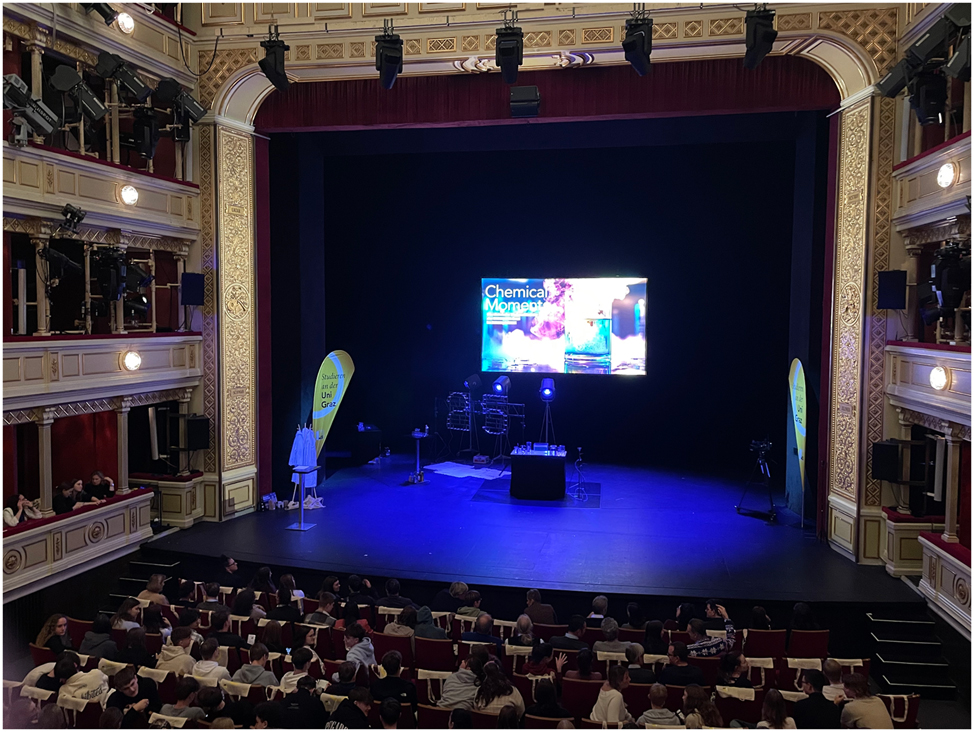
Stage and view into the theater before the show
The study took place as part of the 2024 Chemical Christmas Show themed “Chemical Moments”. This show featured and explained popular experiments from social media, including well-known experiments such as “elephant toothpaste” and “the chemical traffic light,” as well as more novel experiments, such as the production of rubies in a microwave (see Table 1).
Brief description of the experiments.
| Experiment | Description |
|---|---|
| [1] Luminol and fluorescence | Various experiments on luminescence and fluorescence. |
| [2] Student experiment from a school competition | Production of alginate balls that glow under UV light by students from a local school. |
| [3] Supercooled melt | Supercooled melt and experiments with saturated sodium acetate solution. |
| [3a] Different ways to open a beer bottle | Different ways to open a beer bottle (inspired by social media). |
| [4] Rainbowshots and color-changing gin | Experiment in which liquids of different densities and colors are carefully layered on top of each other to create a rainbow effect when poured, illustrating the principles of density and layering. Colored gin changes color when tonic water is added. |
| [5] Chemical chameleon | Redox reaction in which indigocarmine in alkaline solution repeatedly changes color between green, red and yellow due to oxidation and reduction, depending on the oxidation states of the dye. |
| [6] Woosh bottle and burning banknote | A banknote is dipped into a mixture of water and ethanol and ignited. The “woosh bottle” is an experiment in which alcohol vapors are ignited in a large bottle, resulting in a rapid combustion that impresses with a loud “woosh” sound and a short flame. |
| [7] Experiments on blue dyes | Various experiments on the color “blue”, including dyeing with indigo |
| [8] Rubies out of a microwave | Rubies are synthesized using a mixture of aluminium oxide and chromium(III)-oxide in a microwave. |
| [9] Gummy bears and Nutella | Experiment in which a gummy bear is oxidized in molten potassium chlorate, resulting in a violent exothermic reaction that illustrates the energy of the sugar. The situation is similar with Nutella. Here, however, the energy content of the fat also becomes clear. |
| [10] Experiments with black powder | Production of black powder and demonstration of the difference between open burning and compression (cannonball). |
| [11] Chemical fireflies | Catalyzed oxidation of ammonia with chromium(III)-oxide. |
| [12] Elephant toothpaste | Experiment in which the catalytic decomposition of hydrogen peroxide with potassium iodide or another catalyst releases large quantities of oxygen which, together with a surfactant, produce an impressive foam formation. |
| Pyrotechnics: See you in 2025 |
Lighting of lanterns in the shape of the number 25 as a conclusion and reference to the new year 2025. |
In preparing the experiments, special attention was given to ensuring that they were appropriate for the target audience. Emphasis was also placed on the safe execution of the experiments on stage, including a thorough risk assessment. Some of the experiments were accompanied by quiz questions about the experiment, which the audience could answer via Mentimeter. This interactive element was deliberately implemented to encourage active participation and cognitive engagement, in line with research showing that such involvement can enhance learning gains compared to passive observation. The winners were awarded prizes at the end of the show. The students presented their experiments in the form of entertaining and individually designed contributions to the show (see Figure 2).

Show experiments were presented, some of which could also be imitated. Here you can see the burning banknote using 60 % rum. (Copyright: Angele/University of Graz).
At the beginning of each presentation, the underlying social media post was also presented. Only realistic experiments were considered for the show. So called fake experiments were excluded.
5 Methods
Surveying the audience after the show is challenging. To keep it as efficient as possible, the survey was limited to a single open-ended question: ‘What three things did you take away from today’s show?’ Responses were recorded using audio recorders, and no other personal data was collected. Thirty-three individuals participated in the survey. Subsequently, the students’ learnings were surveyed one week after the chemical Christmas show. All students who had been actively involved in the design and implementation of the show were surveyed with the open-ended question “What personal insights and experiences will you take away from your active participation in the Christmas show?”. Unlike the audience, the students answered the question in writing with optional using bullet points. Their responses were not recorded in interviews, as this would have required them to forfeit their anonymity. I also hoped that this approach would encourage more open and honest answers. In contrast to the audience survey, there was no limit to the number of aspects they could mention.
The responses from both surveys were transcribed and analyzed separately as part of a qualitative content analysis according to Kuckartz. 30 Categories were derived inductively from the material. These categories were then grouped into subcategories where it made sense in terms of content.
Subsequently, the experiments cited in the audience survey were assigned to the show schedule. It was also evaluated whether the experiments were merely mentioned or described, or if they were connected to additional explanations from the show. These responses were then assessed for accuracy.
6 Results
The results are presented in two parts, corresponding to the study’s dual focus. First, we examine the audience’s immediate takeaways from the show, analyzing both the content and nature of their responses. Second, we explore the learning experiences reported by student presenters, revealing a distinct set of professional and personal development outcomes.
6.1 Audience perspectives: what viewers take away
First, the results of the audience survey are reported. The responses of the interviewees were categorized. In most cases, three categories were identified per person. However, the responses of five people could only be assigned to two categories, while the responses of two people could only be assigned to one category. The responses of one person were assigned to four categories. This resulted in a total of 91 responses. These are shown in Table 2.
Categories of responses from the audience (N = 33, maximum 3 responses possible)
| Category | N | Subcategory | N | Subcategory | N |
|---|---|---|---|---|---|
| Experiments | 38 | ||||
| Experiments (unspecific) | 6 | ||||
| Joy about already known or favorite experiments | 3 | ||||
| Mention of a specific experiment | 31 | ||||
| Elefant toothpaste | 9 | ||||
| Chemical firefly | 4 | ||||
| Experiments with black powder | 5 | ||||
| Rubies out of a microwave | 3 | ||||
| Experiments on blue dye | 2 | ||||
| “Woosh bottle” and burning banknote | 2 | ||||
| Rainbowshots | 2 | ||||
| Different ways to open a beer bottle | 1 | ||||
| Supercooled melt | 1 | ||||
| Pyrotechnics | 2 | ||||
| Presentation | 16 | ||||
| Exciting presentation | 5 | ||||
| Presentation by students | 9 | ||||
| Personal connection to contributors | 2 | ||||
| Chemistry | 15 | ||||
| Chemistry is exciting/interesting | 8 | ||||
| Chemistry is exciting | 4 | ||||
| Chemistry is interesting | 4 | ||||
| Chemistry is cool/fun | 4 | ||||
| Chemistry is dangerous | 1 | ||||
| Learned about new chemicals/connection to prior knowledge | 2 | ||||
| Quiz | 5 | ||||
| Quiz (unspecific) | 3 | ||||
| Glowing banana peel | 2 | ||||
| Studies/University | 5 | ||||
| Studies are exciting | 2 | ||||
| Positives image positive image of teacher training | 2 | ||||
| Good chemists at the university | 1 | ||||
| Location | 3 | ||||
| Everyday relevance | 3 | ||||
| Miscellaneous | 6 | ||||
| Total | 91 | ||||
| Only one mention | 2 | ||||
| Only two mentions | 5 | ||||
| Four mentions | 1 |
The post-event survey of the audience members revealed that the Chemical Christmas Show elicited a profound response, both in terms of its content and the emotions it evoked. The survey results indicated that the most prevalent responses were related to the “experiments” category, with 38 nominations. Notable experiments such as “elephant toothpaste” (mentioned nine times), “fireflies” (mentioned four times), and “black powder” (mentioned five times) garnered significant attention. Additionally, three individuals expressed particular satisfaction with experiments they had prior knowledge of, indicating a personal connection to the scientific content. The quiz, as an interactive element of the show, was mentioned five times. Two individuals specifically highlighted one particular fact: the fluorescence of banana peel cells upon dying (‘glowing banana peel’). The unique presentation of the show was mentioned by 16 people, with the design of the show by students (nine mentions) and the exciting design (five mentions) being particularly emphasized. Two individuals also expressed a personal connection to the performers. The “chemistry” category, which received 15 mentions, demonstrates the show’s impact on shaping perceptions of chemistry. Statements such as “chemistry is exciting” (4 mentions), “chemistry is interesting” (4 mentions), and “chemistry is fun” (4 mentions) were made in this category. One audience member exemplified this shift in perception: ‘Until now, I always thought chemistry was completely a dry subject that only happens behind a test tube. But wow – really amazing experiments’ (Audience #24). Additionally, the event had a positive influence on the image of the university (5 mentions), particularly in relation to teacher training and the perception of chemists. One respondent explicitly connected the show to the university’s educational mission: ‘I saw that […] at the university, good chemists and great teachers are being trained […] and I think that’s cool’ (Audience #23).
In a subsequent evaluation phase, the experiments cited by name or in detail were assigned to the specific course of the show and evaluated based on their accuracy. Mere mentions of experiments were coded yellow, while mentions accompanied by incorrect additional information were coded red, and those accompanied by correct additional information were coded green (see Table 3).
Classification of the experiments mentioned in the program and presentation of the correctness of the information given (green: naming of the experiment with correct explanations; yellow: naming of the experiment; red: naming of the experiment with incorrect additional information). Experiments accompanied by quiz questions were marked with (Q).
| Duration [min] | Experiment | N | ||||||||||
|---|---|---|---|---|---|---|---|---|---|---|---|---|
| 00:05 | [1] Luminol and fluorescence | |||||||||||
| Quiz: glowing banana | 2 | |||||||||||
| 00:10 | [2] Student experiment | |||||||||||
| 00:05 | [3] Supercooled melt | 1 | ||||||||||
| [3a] Ways to open a beer bottle | 1 | |||||||||||
| 00:10 | [4] Rainbowshots (Q) | 2 | ||||||||||
| 00:05 | [5] Chemical chameleon (Q) | |||||||||||
| 00:10 | [6] Burning banknote (Q) | 2 | ||||||||||
| 00:10 | [7] Experiments on blue dye | 2 | ||||||||||
| 00:10 | [8] Rubies out of a microwave | 3 | ||||||||||
| 00:10 | [9] Gummy bears and Nutella (Q) | |||||||||||
| 00:05 | [10] Black powder | 5 | ||||||||||
| 00:05 | [11] Chemical fireflies | 4 | ||||||||||
| 00:05 | [12] Elephant toothpaste (Q) | 9 | ||||||||||
| 00:05 | Pyrotechnics | 2 | ||||||||||
| 1 | 2 | 3 | 4 | 5 | 6 | 7 | 8 | 9 | ||||
The experiments that were mentioned most frequently were “elephant toothpaste,” “black powder,” and “chemical firefly.” A notable trend is the increased frequency with which experiments conducted at the conclusion of the show are cited, although these experiments typically possess a discernible effect and frequently involve flames or explosions. A prevailing tendency towards experiments involving fire or a distinctly observable effect is evident. Notably, the burning of a gummy bear or Nutella with potassium chlorate stood out as an exception. Notably, experiments without supplementary information were most frequently cited (N = 16). Seven instances were associated with technically inaccurate supplementary information. Conversely, as many as 11 experiments were correctly identified by referencing the additional information provided in the show.
6.2 Students perspective: learning through performance
In addition, a survey was conducted among the students. The responses of the 22 students are displayed in Table 4.
Categories mentioned by students (N = 22, multiple answers).
| Category | N | Subcategory | N | Subcategory | N |
|---|---|---|---|---|---|
| Experiments | 19 | ||||
| Experimenting in front of an audience | 5 | ||||
| Experiments can inspire | 3 | ||||
| Preparation of experiments | 8 | ||||
| Experiments found online can contain errors | 1 | ||||
| Risk assessment/safety evaluation | 2 | ||||
| Preparation of self-chosen experiments | 2 | ||||
| Planning is important | 2 | ||||
| Rehearsing is important | 1 | ||||
| Explanation for laypeople | 2 | ||||
| Everyday phenomena can inspire the audience | 1 | ||||
| Personal development | 14 | ||||
| Strengthening self-confidence/self-assurance | 4 | ||||
| Dealing with nervousness | 6 | ||||
| Learning spontaneity/improvisation | 3 | ||||
| Recognition from the audience | 1 | ||||
| Stage | 12 | ||||
| Stage experience | 7 | ||||
| Acting/creativity | 3 | ||||
| Organization/preparation of a show | 2 | ||||
| Team | 7 | ||||
| Working in a team | 3 | ||||
| Team building | 4 | ||||
| Miscellaneous | 11 | ||||
| Stressful/time-consuming | 5 | ||||
| Many people interested in chemistry | 1 | ||||
| Great experience | 5 | ||||
| Total | 63 |
In the domain of “experiment,” students most frequently cite learning effects. In this context, the students primarily highlight positive learning outcomes associated with the preparation and presentation of experiments. The students express a favorable opinion of the approach that emphasizes meticulous preparation and presentation of experiments. Additionally, they underscore the value of risk assessment as a pivotal component of experimental preparation, recognizing its potential to enhance learning outcomes. In contrast to the laboratory setting, where experiments are conducted for the sake of scientific discovery, these activities are specifically designed for the designated venue and stage, necessitating a more thorough examination of potential hazards. A total of 14 mentions are associated with the category “personal development”. Within this category, students reported an increase in self-confidence (N = 4) and the acquisition of strategies to manage nervousness (N = 6). Additionally, students highlighted the positive impact of fostering teamwork (N = 7). The stage experience is mentioned positively by the students. However, five students acknowledged the event as being both stressful and time-consuming. Nevertheless, none of the students articulated exclusively negative impressions, which suggests that, in general, the experience had a predominantly positive impact on the participating students. This positive impact is captured in one student’s reflection: ‘Breaking down the explanation so that it was understandable for the audience was not so easy. […] The evening of the Christmas lecture was very nice and also a cool experience because you felt very professional. The experiments of the others were also cool and you could take something away for school’ (Student #14). This response encapsulates key themes from this small study: the challenge of science communication, the professional development aspect, and the transferable learning for future teaching practice.
7 Discussion and outlook
Like a bit to be expected, the results indicate that the primary value of such events lies less in the direct transfer of deeper knowledge and more in their entertainment factor and their ability to enhance the public perception of chemistry. Experiments with striking visual effects like the “elephant toothpaste” or experiments with black powder left a particularly strong impression on participants and were frequently mentioned. However, these experiments were often recalled without further details or even false explanations, indicating that science shows primarily serve to spark excitement and curiosity rather than to convey in-depth scientific knowledge. Experiments accompanied by quiz questions seemed to be not recalled more frequently than other experiments. Notably, one quiz question about “glowing banana” was explicitly mentioned in audience responses, suggesting that targeted investigation of such interactive elements could be worthwhile. This aspect should be examined more specifically in future studies. Furthermore, several participants expressed enjoyment at seeing familiar experiments again, which were also among the most frequently mentioned, such as the “elephant toothpaste” or black powder. These instances may tap into prior knowledge, potentially prompting more focused observation. However, it is important to note that these experiments were often listed without any accompanying explanation, meaning no inference about improved understanding can be made in this context. Future investigations should place greater emphasis on this aspect. One possible approach is the use of test classes, which will be implemented for the next Christmas show. This will allow for more detailed feedback and make it possible to assess prior knowledge and expectations.
These findings are consistent with previous research by Sadler. 19 While such events may not always facilitate deep learning, they appear to foster positive attitudes toward science and can also contribute to a positive image of the hosting institution and its scientists. Interestingly, this effect appears to extend to the perception of research itself, as some respondents stated after the show that they believed the university had excellent scientists and high-quality courses, drawing broader conclusions about the institution’s research from the show. This is an interesting approach for further research and demonstrates that it may be worthwhile to put more effort in the investigation on the effect of such science to public events. From the perspective of Brossard and Lewenstein’s framework on public engagement with science, the Chemical Christmas Show primarily achieved “inspirational” and “attitudinal” outcomes, rather than deep conceptual change. 31 While factual recall was limited and sometimes inaccurate, the event succeeded in enhancing curiosity and fostering a more positive perception of chemistry and its practitioners.
Integrating such events into the curriculum and student training can also provide significant added value. Students had already been actively involved in previous shows. While their positive experiences had previously been perceived subjectively, they were now objectively confirmed by the small survey. The results suggest that actively participating in a science show can offer valuable learning experiences, especially when integrated into coursework. Students particularly emphasized the added value of preparing experiments for the audience. They highlighted the importance of handling hazards and conducting risk assessments, which had to be adapted to the venue and stage—an aspect less common in standard laboratory work. This experience allowed them to effectively apply the theoretical content from their teacher training courses in practice. Additionally, they reported investing more effort in developing the experiments due to the highly diverse target audience. Beyond scientific skills, participation in the show also appears to foster the improvement of personal skills. Some students reported increased self-confidence and an improved ability to manage nervousness. These findings support the idea that including students in the design and execution of such events can be beneficial—not only for the audience but also for the students themselves. Engaging in these activities helps future chemistry teachers develop essential skills, such as designing and delivering experiments tailored to specific learning and target groups (Figure 3).

All participants of the 2024 Christmas show on stage (Copyright: Angele/University of Graz).
These findings align with Self-Determination Theory (Ryan & Deci, 2000), which predicts that contexts offering autonomy, competence, and relatedness can foster intrinsic motivation and sustained engagement. The students’ reflections on self-confidence, risk assessment, and audience interaction directly map onto these needs. Furthermore, the affective and psychomotor competencies reported—such as public speaking, improvisation, and stress management—are consistent with Anderson and Krathwohl’s (2001) expanded taxonomy, suggesting that performance-based outreach activities can address dimensions of teacher education that traditional laboratory instruction rarely reaches.
The aim of the study reported here was to gain insight into the learning effects of a chemical Christmas show or lecture. It is important to note that the present study is based on a simple, ad hoc survey with a comparatively small sample size. Consequently, the results can only be generalized to a limited extent and cannot make any definitive statements about the impact of such shows. Nevertheless, the results show that it can be worthwhile to take a closer look at the impact of such chemical shows and chemical Christmas lectures. Overall, these results also show that the communication of content and knowledge at such events is not particularly successful. However, the finding that the image of the university and its researchers can be improved through such formats is promising. This opens new opportunities to improve these 200 year old science communication events.
Acknowledgments
I would like to express my sincere gratitude to all the students who participated in the Christmas show for their enthusiasm and commitment. I would also like to extend my special thanks to the team at the Center for Chemistry Education and the Schauspielhaus Graz for their support. The University of Graz played a crucial role in making this event possible by providing financial support and helping to organize the collaboration with the Schauspielhaus Graz.
-
Research ethics: Not applicable. Participation in the survey was anonymous and voluntary. No further questions were asked beyond the one posed. Personal data was not collected.
-
Informed consent: The audience survey was conducted anonymously, voluntarily, and only with their consent. The University of Graz’s data protection regulations were observed. The people depicted in the photos have consented to publication.
-
Author contributions: The author has accepted responsibility for the entire content of this manuscript and approved its submission.
-
Use of Large Language Models, AI and Machine Learning Tools: DeepL and ChatGPT were used for language improvement.
-
Conflict of interest: The author states no conflict of interest.
-
Research funding: The Christmas show was sponsored by the University of Graz.
-
Data availability: The anonymized transcripts can be requested from the author.
References
1. The Royal Institution. History of the Christmas Lectures. https://www.rigb.org/christmas-lectures/history-christmas-lectures (accessed 2025-01–04).Search in Google Scholar
2. Faraday, M. The Chemical History of a Candle: A Course of Lectures Delivered Before a Juvenile Audience at the Royal Institution; Chatto & Windus: London, 1886.Search in Google Scholar
3. James, F. A. J. L. Never Talk About Science, Show it to them”: The Lecture Theatre of the Royal Institution. Interdiscip. Sci. Rev. 2002, 27 (3), 225–229. https://doi.org/10.1179/030801802225003178.Search in Google Scholar
4. Mulder, H. A. J.; Longnecker, N.; Davis, L. S. The State of Science Communication Programs at Universities Around the World. Sci. Commun. 2008, 30 (2), 277–287. https://doi.org/10.1177/1075547008324878.Search in Google Scholar
5. Hofstein, A.; Lunetta, V. N. The Laboratory in Science Education: Foundations for the Twenty‐First Century. Sci. Educ. 2004, 88 (1), 28–54. https://doi.org/10.1002/sce.10106.Search in Google Scholar
6. Abrahams, I.; Millar, R. Does Practical Work Really Work? A Study of the Effectiveness of Practical Work as a Teaching and Learning Method in School Science. Int. J. Sci. Educ. 2008, 30 (14), 1945–1969. https://doi.org/10.1080/09500690701749305.Search in Google Scholar
7. Hofstein, A.; Mamlok-Naaman, R. The Laboratory in Science Education: The State of the Art. Chem. Educ. Res. Pr. 2007, 8 (2), 105–107. https://doi.org/10.1039/B7RP90003A.Search in Google Scholar
8. Crouch, C.; Fagen, A. P.; Callan, J. P.; Mazur, E. Classroom Demonstrations: Learning Tools or Entertainment? Am. J. Phys. 2004, 72 (6), 835–838. https://doi.org/10.1119/1.1707018.Search in Google Scholar
9. Roth, W. M.; McRobbie, C. J.; Lucas, K. B.; Boutonn, S. Why May Students Fail to Learn from Demonstrations? A Social Practice Perspective on Learning in Physics. J. Res. Sci. Teach. 1997, 34 (5), 509–533. https://doi.org/10.1002/(SICI)1098-2736(199705)34:5<509::AID-TEA6>3.0.CO;2-U.10.1002/(SICI)1098-2736(199705)34:5<509::AID-TEA6>3.0.CO;2-USearch in Google Scholar
10. Obendrauf, V. Hübsch verpackt ist halb erinnert. Emotional Gesteuertes Lernen. Chem. Unserer Zeit 2006, 40 (6), 384–390. https://doi.org/10.1002/ciuz.200600384.Search in Google Scholar
11. Austin, S. R. P.; Sullivan, M. How are we Performing? Evidence for the Value of Science Shows. Int. J. Sci. Educ. Part B 2019, 9 (1), 1–12. https://doi.org/10.1080/21548455.2018.1532620.Search in Google Scholar
12. Little, H.; Fogg-Rogers, L.; Sardo, A. M. The Christmas Lectures: Extending the Experience Outside the Lecture Theatre. J. Sci. Commun. 2022, 21 (02), A01. https://doi.org/10.22323/2.21020201.Search in Google Scholar
13. Bultitude, K. Science Festivals: Do they Succeed in Reaching Beyond the ‘Already Engaged. J. Sci. Commun. 2014, 13 (04), C01. https://doi.org/10.22323/2.13040301.Search in Google Scholar
14. Bultitude, K.; McDonald, D.; Custead, S. The Rise and Rise of Science Festivals: An International Review of Organised Events to Celebrate Science. Int. J. Sci. Educ. Part B 2011, 1 (2), 165–188. https://doi.org/10.1080/21548455.2011.588851.Search in Google Scholar
15. Sardo, A. M.; Little, H.; Fogg-Rogers, L. Transforming Tradition: How the Iconic Christmas Lectures Series is Perceived by its Audiences. Int. J. Sci. Educ. Part B 2021, 11 (4), 378–393. https://doi.org/10.1080/21548455.2021.2012298.Search in Google Scholar
16. Fish, D.; Allie, S.; Pelaez, N.; Anderson, T. A. Cross-Cultural Comparison of High School Students’ Responses to a Science Centre Show on the Physics of Sound in South Africa. Public Underst. Sci. 2017, 26 (7), 806–814. https://doi.org/10.1177/0963662516642725.Search in Google Scholar PubMed
17. Beeken, M. Innovative Anwendungsmöglichkeiten naturwissenschaftlicher Experimente: Entwicklung, Konzeption und Evaluation von (Schau-)Experimenten im und über den Chemieunterricht hinaus [Innovative Applications of Scientific Experiments: Development, Conception and Evaluation of (Demonstration)Experiments in an Beyond Chemistry Lessons]. Dissertation, Der Andere Verl, Tönning, 2010.Search in Google Scholar
18. Price, C. A.; Gean, K.; Barnes, H. The Effect of Live Interpretation with Theater on Attitudes and Learning of Children in the Mythbusters Exhibit. J. Mus. Educ. 2015, 40 (2), 195–206. https://doi.org/10.1179/1059865015Z.00000000095.Search in Google Scholar
19. Sadler, W. J. Evaluating the Short-Term and Long-Term Impact of an Interactive Science Show. Res. All 2021, 5 (2). https://doi.org/10.14324/RFA.05.2.14.Search in Google Scholar
20. Walker, G. J. Motivational Features of Science Shows; The Australian National University: Canberra, 2012.Search in Google Scholar
21. Albert, B.; Janek, J. Chemie Und Licht: eine Weihnachtliche Experimentalvorlesung. Chem. Unserer Zeit 2001, 35 (6), 390–401. https://doi.org/10.1002/1521-3781(200112)35:6<390::AID-CIUZ390>3.0.CO;2-R.10.1002/1521-3781(200112)35:6<390::AID-CIUZ390>3.3.CO;2-ISearch in Google Scholar
22. Kerk, A.; Dücker‐Benfer, C.; Schneppensiepe, T.; Müller, B.; Calle, M.; Van Eldik, R.; Felser, C.; Renz, F.; Tremel, W.; Zimehl, R.; Drieß, M. N. Spot, Fanfare‐Wie Schüler Noch Chemie Lernen Können. Nachrichten Aus. Chem. 2000, 48 (12), 1481–1486. https://doi.org/10.1002/nadc.20000481209.Search in Google Scholar
23. Müller, B.; Galle, M.; Schneppensieper, T.; Dücker-Benfer, C.; Van Eldik, R. Die Zaubervorlesung:„Chemie am laufenden Band. Chem. Unserer Zeit 2002, 36 (4), 246–255. https://doi.org/10.1002/1521-3781(200208)36:4<246::AID-CIUZ246>3.0.CO;2-8.10.1002/1521-3781(200208)36:4%3C246::AID-CIUZ246%3E3.0.CO;2-8Search in Google Scholar
24. Osborne, J.; Simon, S.; Collins, S. Attitudes Towards Science: A Review of the Literature and its Implications. Int. J. Sci. Educ. 2003, 25 (9), 1049–1079. https://doi.org/10.1080/0950069032000032199.Search in Google Scholar
25. Falk, J. H.; Dierking, L. D. Learning from Museums, 2nd ed.; Rowman & Littlefield: Lanham Boulder New York London, 2018.Search in Google Scholar
26. DeWitt, J.; Osborne, J. Supporting Teachers on Science‐Focused School Trips: Towards an Integrated Framework of Theory and Practice. Int. J. Sci. Educ. 2007, 29 (6), 685–710. https://doi.org/10.1080/09500690600802254.Search in Google Scholar
27. Ryan, R. M.; Deci, E. L. Self-Determination Theory and the Facilitation of Intrinsic Motivation, Social Development, and Well-Being. Am. Psychol. 2000, 55 (1), 68–78. https://doi.org/10.1037/0003-066X.55.1.68.Search in Google Scholar
28. Anderson, L. W., Ed. A taxonomy for learning, teaching, and assessing: A Revision of Bloom’s Taxonomy of Educational Objectives, Abridged ed., [Nachdr.]; Longman: New York Munich, 2009.Search in Google Scholar
29. Krathwohl, D. R. A Revision of Bloom’s Taxonomy: An Overview. Theory Pract 2002, 41 (4), 212–218. https://doi.org/10.1207/s15430421tip4104_2.Search in Google Scholar
30. Kuckartz, U.; Beltz: Weinheim, 2016. Qualitative Inhaltsanalyse. Methoden, Praxis, Computerunterstützung, 3., überarbeitete Aufl.; Grundlagentexte Methoden.Search in Google Scholar
31. Brossard, D.; Lewenstein, B. A critical appraisal of models of public understanding of science: using practice to inform theory. In Communicating Science: New Agendas in Communication; Kahlor, L.; Stout, P., Eds.; Routledge, 2010; pp. 11–39.Search in Google Scholar
© 2025 the author(s), published by De Gruyter, Berlin/Boston
This work is licensed under the Creative Commons Attribution-NonCommercial-NoDerivatives 4.0 International License.
Articles in the same Issue
- Frontmatter
- Editorial
- Progress in Chemistry Teacher International
- Research Articles
- Active learning oriented to green chemistry with virtual laboratories to promote higher order thinking skills to achieve quantitative analytical chemistry competency
- Assessing conceptual understanding in high school chemistry: particulate nature of gas concept test (PNGCT) with Rasch modeling
- Using context-based and AI-enhanced approaches to improve student engagement and achievement in secondary chemistry education
- Project-based learning with STEM to promote higher order thinking skills as a strategy to improve high school chemistry learning outcomes
- Introducing a simplified model of frontier molecular orbital theory as a pre-organic foundations module for high school students in advanced programs
- AI-based causal evaluation of teacher’s opening lessons: a multidimensional study
- ChatGPT as a direct formative assessment tool in stoichiometry: correlation with achievement and insights into pre-service science teachers’ perceptions
- The role of virtual laboratories in advancing student learning on acid–base equilibrium
- Good Practice Reports
- Smartphone-assisted colorimetric determination of chemical equilibrium constant (Kc) as an alternative method in high school chemistry
- Ensuring the relevance of an evidence-based chemistry teacher education study program: narrative insights from continuous research-based development conducted at the University of Helsinki
- Development of chemistry teachers’ sense of ownership through leadership-oriented continuous professional development courses
- Research Articles
- Implementation of socio-scientific issue learning to promote chemical literacy as a strategy to achieve chemistry competency
- Secondary school chemistry teachers’ attitudes toward developing entrepreneurial competencies in chemistry education
- Good Practice Reports
- Lights, flames, action! – What we really learn from a chemical Christmas lecture
- Why does it explode? Determining learning progress through an experimental concept on dust explosions
Articles in the same Issue
- Frontmatter
- Editorial
- Progress in Chemistry Teacher International
- Research Articles
- Active learning oriented to green chemistry with virtual laboratories to promote higher order thinking skills to achieve quantitative analytical chemistry competency
- Assessing conceptual understanding in high school chemistry: particulate nature of gas concept test (PNGCT) with Rasch modeling
- Using context-based and AI-enhanced approaches to improve student engagement and achievement in secondary chemistry education
- Project-based learning with STEM to promote higher order thinking skills as a strategy to improve high school chemistry learning outcomes
- Introducing a simplified model of frontier molecular orbital theory as a pre-organic foundations module for high school students in advanced programs
- AI-based causal evaluation of teacher’s opening lessons: a multidimensional study
- ChatGPT as a direct formative assessment tool in stoichiometry: correlation with achievement and insights into pre-service science teachers’ perceptions
- The role of virtual laboratories in advancing student learning on acid–base equilibrium
- Good Practice Reports
- Smartphone-assisted colorimetric determination of chemical equilibrium constant (Kc) as an alternative method in high school chemistry
- Ensuring the relevance of an evidence-based chemistry teacher education study program: narrative insights from continuous research-based development conducted at the University of Helsinki
- Development of chemistry teachers’ sense of ownership through leadership-oriented continuous professional development courses
- Research Articles
- Implementation of socio-scientific issue learning to promote chemical literacy as a strategy to achieve chemistry competency
- Secondary school chemistry teachers’ attitudes toward developing entrepreneurial competencies in chemistry education
- Good Practice Reports
- Lights, flames, action! – What we really learn from a chemical Christmas lecture
- Why does it explode? Determining learning progress through an experimental concept on dust explosions
