Negotiation of identity and indexical order in linguistic landscapes in Hong Kong: a comparison among Central, Tsim Sha Tsui, and Sheung Shui
-
Zihan Xia
Zihan Xia (b. 2002) is currently a master’s student at The Hong Kong Polytechnic University. His research interests include (multimodal) discourse analysis, corpus linguistics, and sociolinguistics.


Abstract
This study explores the relationship between linguistic landscapes, language choice, and regional identity, with a focus on the cultural and historical context of Hong Kong. Through the collection and analysis of photos from three locations, Central, Tsim Sha Tsui, and Sheung Shui, scaled in a center–periphery continuum, I demonstrate the difference in regional identity construction through the language choices in the respective linguistic landscapes. By applying indexical order to linguistic landscape study, this study shows how presupposed indexicalities of language are applied to construct distinct identities, driven by language ideology. Furthermore, it is found that all three locations exhibit a degree of internationalism, as evidenced by the high proportion of multilingual signs. The intensity of internationalism varies across locations, with Central being constructed as the most international, Tsim Sha Tsui as a blend of local and international, and Sheung Shui as the most local. This research contributes to the understanding of the complex relationship between linguistic landscapes, language ideology, and identity construction, shedding light on how indexical order can map out the language ideology and its influence on the regional identity of Hong Kong.
1 Introduction
Hong Kong’s ethnolinguistic landscape is shaped by a complex interplay of historical, political, and social dynamics, reflecting its colonial heritage and contemporary status as a Special Administrative Region of China. The region’s trilingual and biliterate language policy, promoting Cantonese, English, and Putonghua (Mandarin), underscores its sociolinguistic diversity, although the functional distribution of these languages remains uneven (Fleming 2017; Poon 2010). Cantonese persists as the dominant vernacular, spoken by 96.0 % of the population (Census and Statistics Department 2021) and deeply rooted in local identity, while English retains prominence in professional, legal, and written domains and Putonghua, although increasingly emphasized, occupies a secondary role in business and daily communication (Evans 2010). Historically, Hong Kong’s linguistic landscape transitioned from segregated monolingual communities, Cantonese-speaking locals, and English-speaking colonial elites to a multilingual milieu shaped by post-1997 political integration and globalization (Poon 2010). This evolution is further complicated by the region’s ethnic diversity, which encompasses native Cantonese speakers, expatriate English users, and a growing South Asian population exhibiting bilingual competencies (Leung and Lee 2023). According to the 2021 Population Census, ethnic minorities (including White, Black, and non-Chinese Asian groups such as Filipinos, Indonesians, and South Asians) constituted 8.4 % of Hong Kong’s population, marking a 37.3 % increase from 2011 (Census and Statistics Department 2021). This indicated that after Hong Kong was returned to China, the global population had only grown (Han and Shang 2024).
Despite Cantonese serving as Hong Kong’s lingua franca, other languages have gained increasing importance. Survey data indicates that 57.7 % of residents report English proficiency, 56.5 % speak Putonghua, and 14.1 % use other Chinese dialects, while languages such as Bahasa Indonesian, Tagalog, Hindi, Urdu, and Nepali collectively account for 8.1 % of speakers (Census and Statistics Department 2021). Divergent public sentiments toward trilingualism, as documented in recent surveys, reflect the complexities of maintaining a multicultural society: on the one hand, English proficiency is widely valued for economic mobility; on the other, Cantonese remains central to cultural identity, and Putonghua is often subject to political debate (Bacon-Shone et al. 2015). Yet the city’s embrace of English as a language of education from the 1970s onward was a critical turning point in its development, boosting English literacy and bolstering Hong Kong’s role as an international hub (Evans 2015). Over time, these developments have been manifested in the linguistic landscape, from monolingual Chinese signage to a bilingual Chinese–English environment, reflecting shifting power relations and evolving collective identities (Wong and Chan 2018).
Hong Kong’s post-handover language policy promotes biliteracy (written Chinese and English) and trilingualism (spoken Cantonese, English, and Putonghua) (Li 2017), though its implementation is uneven. While Cantonese remains the principal medium of instruction, English has persisted as the de facto lingua franca since the 1980s (Wong and Chan 2018) due to the unequal access to the social and economic capital it confers (Harwood and Lai 2017). Unlike in mainland China, Hong Kong’s government does not centrally regulate its linguistic landscape, creating space for individuals and communities to exercise agency in constructing public signs and choosing language codes to express identities and achieve particular objectives. Accordingly, these sociolinguistic complexities are spatially manifest throughout Hong Kong’s urban fabric: distinct districts often exemplify divergent socioeconomic, cultural, and linguistic realities. In this context, language serves both as a unifying force, reinforcing multicultural coexistence, and as a boundary marker, reflecting evolving power relations and social stratification. Given that language use in public settings allows people and communities to actively create and negotiate their identities, this phenomenon is especially important.
2 Linguistic landscape, identity, and indexical order
The most comprehensive and well-known definition of linguistic landscape (LL) is that it concerns the “issue of language in the written form in the public sphere” (Landry and Bourhis 1997: 25). It is thus predominantly the study of languages on public signs in the cityscape. One key focus is the visibility and salience of the language (Landry and Bourhis 1997). Visibility refers to a certain language appearing in written form, which concerns presence or absence. Salience is whether a specific language is prominent in signs. The LL mainly fulfills two functions: an informative function and a symbolic function (Landry and Bourhis 1997). The symbolic function, by contrast, reflects the social status and identity of the LL, a process closely tied to indexicality (Pütz and Mundt 2018). This process can operate through what Silverstein (2003) terms indexical order, a hierarchical framework in which linguistic forms acquire layered contextual meanings. At its core, indexical order posits that linguistic signs (n-th order indexicals) derive meaning by presupposing contextual norms (e.g., English indexing prestige in commercial signage), while their usage simultaneously generates higher-order meanings (n + 1st) shaped by ideological engagement (Silverstein 2003: 193–194). Following Wang and Liang (2024), I regard ideology as language ideology, a system of ideas, presuppositions, beliefs, attitudes, and values regarding languages, their status, and their use in society (Zhou 2019). For instance, a language’s association with modernity and globalization (n-th order) may, through repeated ideological valorization, come to be appropriated and used for ideological purposes (n + 1st order), such as constructing a modern and global identity.
The LL serves as a key site for identity construction and negotiation, functioning not merely as a passive reflection of language policy but as a space of agency where individuals and groups strategically select language codes to index local, global, or hybrid identities (Blackwood et al. 2016; Han and Shang 2024). Identity, in this context, can be understood as “a discursive practice that connects internal emotions with external discourse” (Zhang 2024: 4). As Bucholtz and Hall (2005: 585) argued, identity is “the product of semiotic practices and therefore is a social and cultural phenomenon.” Language use is particularly crucial to identity construction, as it provides a primary and accessible means of signaling individual and group affiliations (Bucholtz and Hall 2005; Peirce 1995). A key aspect of this relationship is the indexical connection between languages and social attributes, such as English indexing prestige, modernity, and high-quality products (Kelly-Holmes 2005; Piller 2001), or local language indexing cultural authenticity (Helal 2023), which exemplifies how n-th order indexicality stabilizes certain associations. As Silverstein (2003) emphasizes, these associations are inherently unstable, as ideological contestation can confer the n-th order to construct an identity (n + 1st) adhering to the n-th order’s schema. Empirical studies illustrate this complexity: Besnier’s (2004) analysis of English usage in Nuku’alofa’s secondhand marketplace reveals how the language is ideologically appropriated to construct cosmopolitan identities of the speakers. Similarly, Jaworski and Yeung (2010) demonstrated how English and other high-status languages in Hong Kong’s residential property names are strategically deployed to index symbolic capital tied to globalization, sophistication, and reliability, an n-th order association that may simultaneously evoke n + 1st order meanings, an aspirational class identity.
Such findings underscore the interplay between macro-level processes (e.g., globalization) and micro-level linguistic practices, demonstrating how languages and their indexical orders mediate the “settl[ing] into the everyday lives of ordinary people around the world” (Bucholtz and Hall 2005: 598). As Lam (2024: 121) noted, “the same social actors may interact with different zones at different times with a change of roles, practices and movements, which highlights interaction between such changing social identities and the landscape.” This aligns with Scollon and Scollon’s (2003) view of the LL as a social practice, that is, the LL is both constitutive of and constituted by the society. From an indexical order perspective, the LL becomes a site where n-th order associations can be continually recontextualized into n + 1st order meanings, contingent on ideologically driven appropriation. In this way, the LL becomes a space where identity is continually manifested, reflected, and negotiated.
3 LLs in mainland China, Hong Kong, and Macau
In the context of globalization, LLs have emerged as a crucial symbol system in public spaces, playing a significant role in the construction of identity. The unique historical trajectories and institutional arrangements of mainland China, Macau, and Hong Kong have given rise to distinct multilingual ecologies, providing a paradigmatic case for examining how the LL negotiates identity construction.
Mainland China’s language policies, which emphasize the promotion of Mandarin Chinese and simplified Chinese characters, may marginalize minority languages and dialects, as evident in cases such as Shangri-La City (Nie et al. 2021) and the handwritten signs of Yi ethnicity students (Nie and Yao 2025). In Guangzhou, the intersection between globalization and localization has led to conflicts between the official promotion of Mandarin Chinese and simplified characters and the local use of Cantonese, traditional characters, and English by expatriates (Han and Wu 2020). For instance, the Xiaobei area in Guangzhou, known as “Little Africa,” has undergone significant changes in its LL, shifting from Latinization and Arabization to de-Arabization and Sinicization, reflecting the dynamic impact of social politics and language policies on the community (Gu 2025). These cases illustrate that the LL not only reflects macro-level policies but also refracts local social, cultural, and power relationships, constructing multiple identities.
Research has also shown that LLs in different regions of mainland China exhibit distinct characteristics, entailing complex identity-negotiation processes. A notable example is the negotiation of identity between internationalization and localization in the LL as exhibited, for instance, at Shanghai Pudong International Airport (Li and Yang 2022, 2023). Additionally, Huaihai Street in Suzhou, as a liminal space, reflects the complex interplay between language policies and the LL through its public signage, demonstrating the coexistence and negotiation of Japanese and Chinese languages in this space (Li 2024). The LL in historical areas such as Wuhan’s Hankou Concession (An and Shang 2025), Jianghan Road (An and Zhang 2022), and Wuzhen (Zhang 2024) can also reveal how traditional Chinese characters and historical signage coexist with modern elements to create layered identities that balance local authenticity with global aspirations.
In contrast to the LL of mainland China, Macau’s LL is characterized by the coexistence of multiple languages, with Portuguese and Chinese as official languages, alongside English and other languages, forming a unique linguistic ecology (Yan 2019; Zhang and Chan 2017). This linguistic diversity plays a crucial role in constructing Macau’s distinct identity, as evidenced by the use of multiple languages in tourist-attraction signage and casino promotional materials, which creates an image that is both locally distinctive and internationally oriented (Yan 2019). Furthermore, the LL in Macau exhibits variability and complexity across different locations. For example, on Coloane Island, the LL is constructed through the use of and switching among multiple languages, reinforcing the area’s identity as a hub of East–West cultural exchange (Song 2024). In contrast, the language landscape in casino areas presents a different profile, with simplified Chinese and English supplanting Portuguese and traditional Chinese, reflecting the influence of a modern commercial identity (Song and Gu 2025; Zhang and Chan 2017). These findings suggest that the LL in Macau’s identity construction involves not only language use but also processes of translation and conversion (Song 2024), as well as the combination of linguistic and visual elements (Zhang and Chan 2017). Ultimately, Macau’s LL plays a multifaceted role in identity construction, using multiple languages, combining linguistic and visual elements, and switching and selecting languages in different contexts to create a city image that is characterized by the fusion of multiple cultures, the coexistence of tradition, and modernity (Song 2024; Yan 2019; Zhang and Chan 2017).
Hong Kong’s LL is a complex and dynamic reflection of the city’s history, culture, and economic status (Wong and Chan 2018). Characterized by a high degree of linguistic diversity, with over 20 languages represented on private signs in areas such as Chungking Mansions (Wang and Liang 2024), the city’s LL is shaped by its unique historical and cultural context. Since the handover, China’s influence on Hong Kong has been growing, although its impact on the LL has been minimal, with the adoption of simplified Chinese being a bottom-up choice influenced by demographic and economic considerations (Lai 2013). In the context of globalization, the LL of Hong Kong is characterized by a negotiation between global and local forces (Han and Shang 2024). The widespread use of English on signs in Hong Kong, particularly in affluent commercial areas, reflects the city’s international connections and economic status. English plays a crucial role in Hong Kong’s LL, serving as a symbol of the city’s global aspirations and economic ambitions. Other languages, such as traditional Chinese and written Cantonese, seek public space in the creation of a city image that blends local and foreign features, even though English’s dominance is not uncontested (Han and Shang 2024; Lam 2024). Lai (2013: 264) found that brands with names in foreign languages aim to convey a globalized and Westernized image, while Cantonese is “irreplaceable as a language of solidarity and a marker of the Hong Kong identity.”
Recent studies have also explored the LL of Hong Kong in specific contexts. For example, during the COVID-19 pandemic, Hong Kong’s linguistic landscape utilized official and unofficial multilingual signs to convey important information, such as the necessity of wearing masks, maintaining social distancing, and getting vaccinated (Gu 2023). These signs use not only official languages like Chinese and English but also other languages like Filipino, Indonesian, and Hindi to reach a broader audience. Additionally, research has found that high-end restaurants in Hong Kong employ marketing strategies that incorporate Chinese characters, reflecting the cultural hybridity and consumers’ diverse language demands (Theng and Lee 2022). Hong Kong’s neon signs are also a product of cultural hybridity, combining text, images, and colors to create a unique urban landscape (Lou 2016; Song 2021).
In conclusion, the LLs of mainland China, Macau, and Hong Kong exhibit distinct characteristics and multilingual ecologies, reflecting their unique histories, cultures, and institutional arrangements. The LLs in these regions did not evolve simply as a matter of language overlay, but rather as a complex interplay of language, culture, and history that constructs a multifaceted urban identity. These research findings demonstrate that the LL is an important window into identity construction, reflecting the cultural, historical, and social contexts of a region. Moreover, they highlight the need for LL research to consider the complex interplay of language, culture, and history to better understand the role of LLs in identity construction. However, less attention has been devoted to indexical order, the layered or hierarchical meanings that these varied linguistic choices create within the same landscape, although recent research suggests that identity construction is linked to indexical meaning. Understanding indexical order in LLs can shed light on how different levels of semiotic meaning, such as power relations or historical continuity, coexist, reinforce, or even contradict one another in the shaping of urban and cultural identities (Zhang 2024). Addressing this gap could significantly deepen our understanding of how identities and social hierarchies are jointly constructed and contested in these public textual and visual landscapes. Therefore, this study tries to answer the following questions:
How does language use on the signage differ in different districts in Hong Kong?
How is indexical meaning and indexical order constructed on the signage?
How is identity constructed through the signage?
4 Data collection
The geographical locations where the data collection took place are illustrated on the maps provided below. Upon exiting the Mass Transit Railway (MTR) station, I commenced photographing the surroundings, traversing the area in a roughly circular trajectory (see Figures 1–3). The choice of Central, Tsim Sha Tsui (TST), and Sheung Shui is grounded in a center–periphery perspective, driven by economic and spatial considerations. As the initial area developed by the British, Central exhibits a pronounced Western character, with English being widely spoken due to its historical significance as an administrative and commercial center. In comparison, TST, a more recently established tourist destination, also features a notable presence of English, albeit with a distinct cultural identity shaped by its appeal to tourists. Conversely, Sheung Shui, situated near the Shenzhen border, i.e., the periphery to the Central as center, is characterized by a relatively weaker Western cultural influence and a stronger affinity with mainland Chinese culture (Lai 2013). According to the 2021 census (Census and Statistics Department 2021), Central has a Chinese majority (70.5 %) with notable Filipino and White populations, and while TST also has a Chinese majority (60.9 %), it is a more diverse community with a large Other/Mixed category. By contrast, the census showed that Sheung Shui has a predominantly Chinese population (89.1 %) accompanied by smaller Filipino and Indonesian communities. Notably, the majority of the photographs were captured in TST, owing to its larger spatial scale and more diverse LL. In Sheung Shui, due to the scarcity of shops along the road adjacent to the station exit, I ventured into a market that was directly linked to the station via a pedestrian overpass. The methodology employed in this study involved treating each shop as a discrete unit of analysis, irrespective of its size, and collecting data from a single sign per shop, thereby ensuring a standardized approach to data collection.

Map of Central showing trajectory of data collection (Google 2025a).
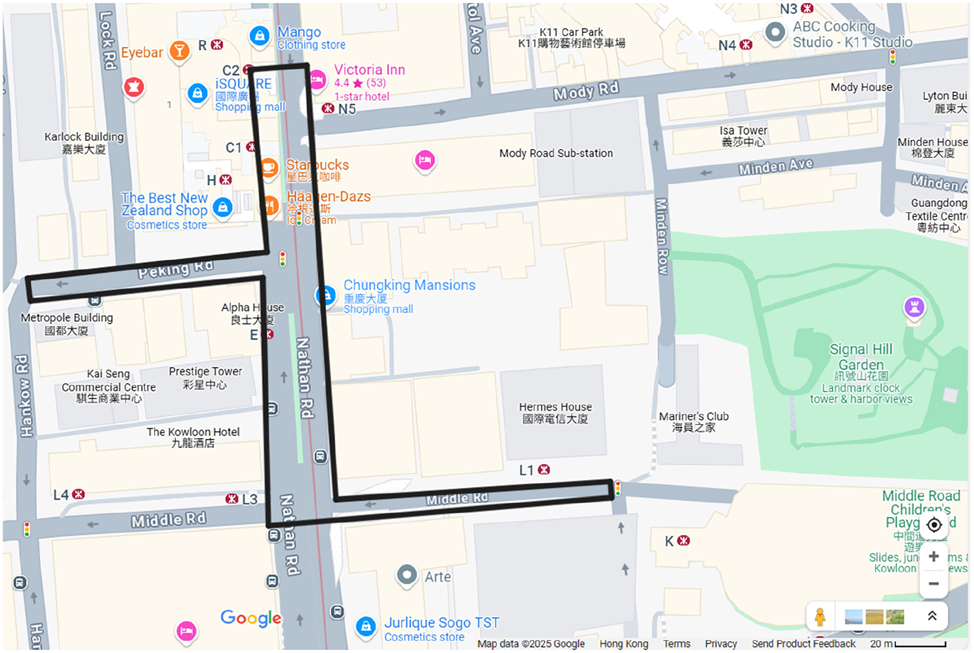
Map of Tsim Sha Tsui showing the trajectory of data collection (Google 2025b).

Map of Sheung Shui showing the trajectory of data collection (Google 2025c).
The data collected for this study was coded and classified according to a systematic framework to facilitate analysis and interpretation. The coding scheme includes six categories: (1) place, (2) code number, (3) official vs. private, (4) monolingual type, (5) code preference, and (6) multilingual type. Due to space constraints, this section will focus on three key aspects of the coding: (1) code type, (2) distribution of official and private signs, and (3) code choice of private monolingual and multilingual signs. The coding framework employed in this study follows the approach by An and Zhang (2022), which involves categorizing signs into two main types: official and private. Each sign is further coded according to its linguistic characteristics, including monolingual and multilingual types. As there are many Roman scripts, which cannot be regarded as a specific language, all of them are categorized into English/Roman scripts (Lam 2024) (see Table 1 for code type, Table 2 for official and private signs, and Table 3 for code type in monolingual signs).
Code type.
| Monolingual | Multilingual | Total | |
|---|---|---|---|
| Central | 19 (29.69 %) | 45 (70.31 %) | 64 |
| Tsim Sha Tsui | 34 (40.48 %) | 50 (59.52 %) | 84 |
| Sheung Shui | 17 (29.31 %) | 41 (70.69 %) | 58 |
| Total | 70 (33.98 %) | 136 (66.02 %) | 206 |
Official and private.
| Place | Official | Private | Total |
|---|---|---|---|
| Central | 17 | 47 | 64 |
| Tsim Sha Tsui | 18 | 64 | 84 |
| Sheung Shui | 29 | 29 | 58 |
| Total | 64 | 142 | 206 |
Code choice on private monolingual signs.
| Chinese only | Cantonese only | English/Roman script only | Others | Total | |
|---|---|---|---|---|---|
| Central | 4 (23.53 %) | 0 | 12 (70.59 %) | 1 (5.88 %) | 17 |
| Tsim Sha Tsui | 6 (20.00 %) | 1 (3.33 %) | 23 (76.67 %) | 0 | 30 |
| Sheung Shui | 5 (29.41 %) | 1(5.88 %) | 10 (58.82 %) | 1 (5.88 %) | 17 |
| Total | 15 | 2 | 45 | 2 | 62 |
Bilingual and multilingual landscapes are the most prevalent forms of LL, with Chinese–English bilingual signs being the most common. In such cases, it is essential to discern the code preference (Scollon and Scollon 2003) embedded within the signs. Language policies often dictate the relative positioning of languages, and in many instances, governments specify guidelines for the arrangement of languages on public signs. Typically, in a surround-style text arrangement, the preferred code is situated in a central position, while the non-preferred code is relegated to the periphery. Conversely, when the text is arranged horizontally, the preferred code is often placed at the top or in the upper portion of the sign, while the non-preferred code is positioned at the bottom or lower part (see Table 4 for the code preference in multilingual signs). As noted in previous research (e.g., Han and Shang 2024; Lai 2013), the language choice on signage in Hong Kong involves Chinese (traditional and simplified) and Cantonese as the vernacular. Here I followed previous studies to distinguish Chinese and Cantonese in the LLs. Chinese in the following sections refers to the LLs using either traditional or simplified Chinese.
Code choice on private multilingual signs.
| Ca–En | Ch–En | En–Ch | Others | Total | |
|---|---|---|---|---|---|
| Central | 0 | 19 | 6 | 5 | 30 |
| Tsim Sha Tsui | 0 | 27 | 7 | 1 | 35 |
| Sheung Shui | 1 | 6 | 3 | 2 | 12 |
| Total | 1 | 52 | 16 | 8 | 77 |
-
Ca=Cantonese; Ch=Chinese; En=English.
5 Indexicality analysis
5.1 Monolingual English/Roman script signs
The data reveals that monolingual English/Roman script signs constitute a significant proportion of the total. A notable subset within this category comprises high-status brands, such as Chanel and Tissot. The prevalence of English/Roman script on global chain brands is a phenomenon that has been referred to as globalese (Jaworski 2015). In these cases, the products associated with these brands are typically characterized by high prices and international recognition. Consequently, the use of monolingual English/Roman script on signs indexes high economic status, thereby constructing a global identity. This association is facilitated by the familiar and salient perception of English/Roman script as a marker of prestige, which has been ideologically entrenched (Agha 2003, 2005). As a result, a salient indexical meaning is created, which is subsequently taken for granted as “presupposed,” exemplifying the n-th order of indexicality (Silverstein 2003: 193) (see Figure 4).
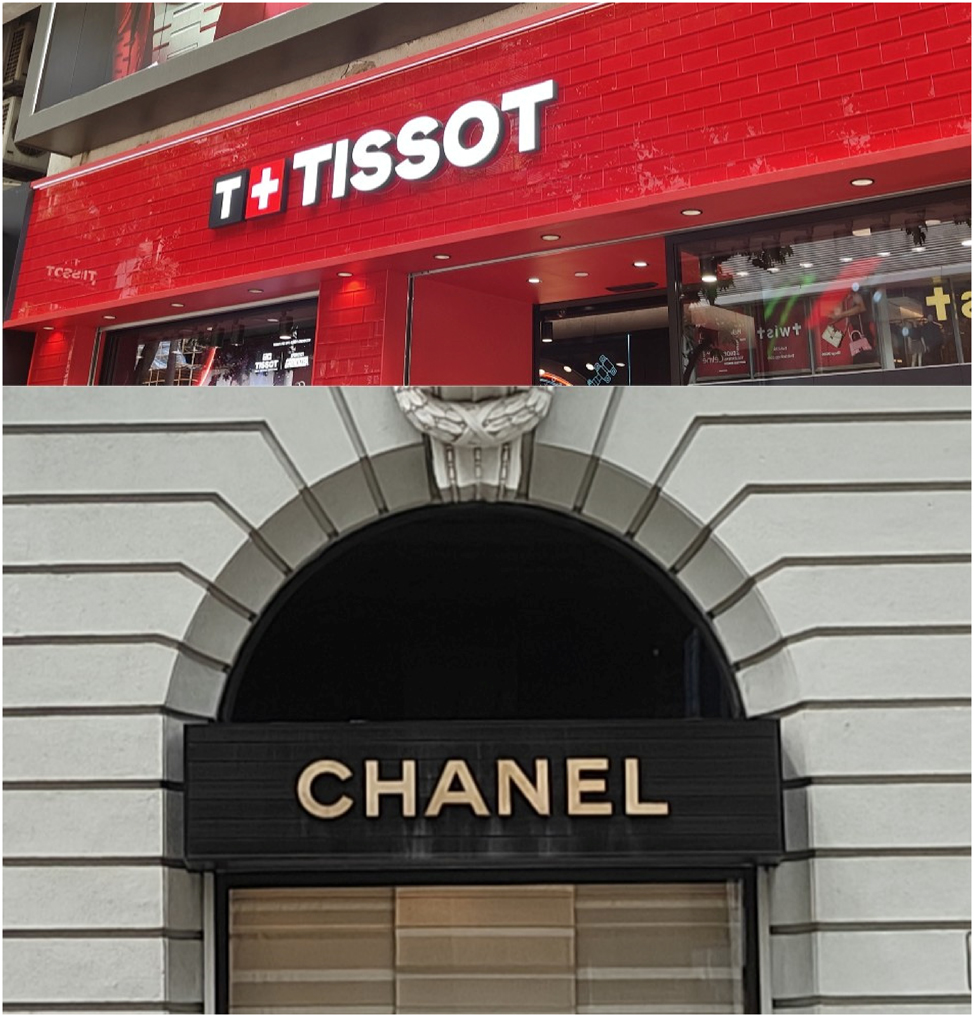
Example of monolingual English/Roman script (global brands).
The use of monolingual English/Roman script is not exclusive to global brands; regional brands, such as local clothing brands Glordano and Brilliant Mlle, also employ this strategy. From the names of the brands, we cannot know what exactly a Glordano or a Brilliant Mlle is. The language choice on the signage thus serves a symbolic function and contains indexicality. In such cases, the adoption of English/Roman script in brand names is motivated by the desire to convey a sense of globalness and lavishness. This perception is rooted in the association of English/Roman script with luxury brands, which has created a cultural expectation that English/Roman script is synonymous with high-end products. By labeling themselves with English names, these brands simultaneously assume the identity of globalization, affluence, and high economic status.
Indexicality plays a crucial role in this process, as it enables the mapping of linguistic forms to specific social meanings. Local chain brands in particular strive to achieve a “uniform manner” (Piller 2011: 109) akin to that of international brands, thereby constructing themselves as global, affluent, and fashionable. Notably, these chain brands often exhibit a top-down policy, where the names and signs are determined by brand administrators rather than owners. The origins of these brands can be broadly categorized into international and regional ones. International brands with Western origins typically use English in their brand name, whereas regional brands from Hong Kong appropriate the first order of indexicality to establish their identity. However, it can be argued that this creation also indexes local identity, as these brands are primarily accessible to local consumers.
As illustrated above, the use of English/Roman script indexes certain social meanings, such as globalese, high status, high quality, and fashion, which are deeply ingrained in the cultural ideology. Building on this indexical meaning, “entailment” (Silverstein 2003: 193) emerges in this commercial context, where the use of monolingual English/Roman script becomes a consequence of the established indexicality. Consequently, the deployment of monolingual English/Roman script serves to construct an identity that embodies these social meanings, indexing both the owners and potential consumers. This process gives rise to a new indexicality, which is layered upon the previous one, thereby establishing an n + 1st order of indexicality (see Figure 5).

Example of monolingual English/Roman script (regional brands).
5.2 Monolingual Chinese/Cantonese signs
The use of monolingual Chinese signs in Hong Kong presents a distinct perspective. Notably, there is a distinction between traditional and simplified Chinese, which holds significant implications for the target audience and the designers’ intentions. As English is widely recognized by international travelers, Chinese signs are inaccessible to those who cannot read them, effectively serving only those who can, namely, Chinese people. This dichotomy renders Chinese use both symbolic, conveying meaning to both locals and non-locals, and informative, providing specific information to locals.
As Taylor-Leech (2012) analyzed, the indexical meaning of monolingual local-language signs is constructed through a two-tiered process. Firstly, the language code is linked to the people who can read it, establishing a first-order indexical meaning. Secondly, this meaning is further indexed to social meaning. For instance, in Figure 6, the use of traditional Chinese on official posters indexes a specific audience, implying that the message is targeted exclusively at those who can read it. In the context of a Chinese society, the choice of Chinese as a code indexes a Chinese local identity, reinforcing a sense of solidarity.
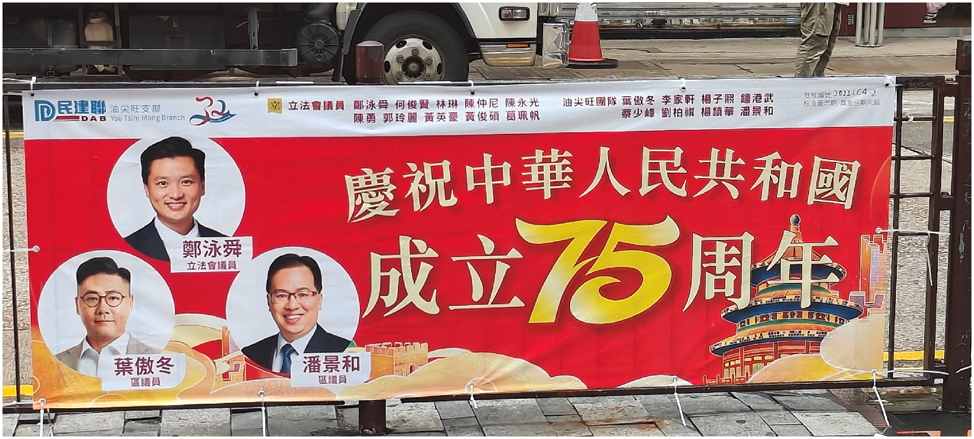
Example of a monolingual Traditional Chinese sign.
Written Cantonese is relatively scarce, aligning with previous research (e.g., Han and Shang 2024; Lai 2013; Wong and Chan 2018). Despite its limited presence, written Cantonese exhibits a similar pattern of indexicality to written Chinese. Specifically, the first-order indexicality of written Cantonese is grounded in the target audience and the designers’ intentions, reflecting a deliberate choice to communicate with a specific group. At the second-order level of indexicality, written Cantonese indexes localism (Wong and Chan 2018), signifying a unique identity that distinguishes Hong Kong from other places. This localist connotation underscores the significance of written Cantonese as a marker of cultural distinctiveness. For instance, Figure 7 is a commercial advertisement for a logistics company in written Cantonese.
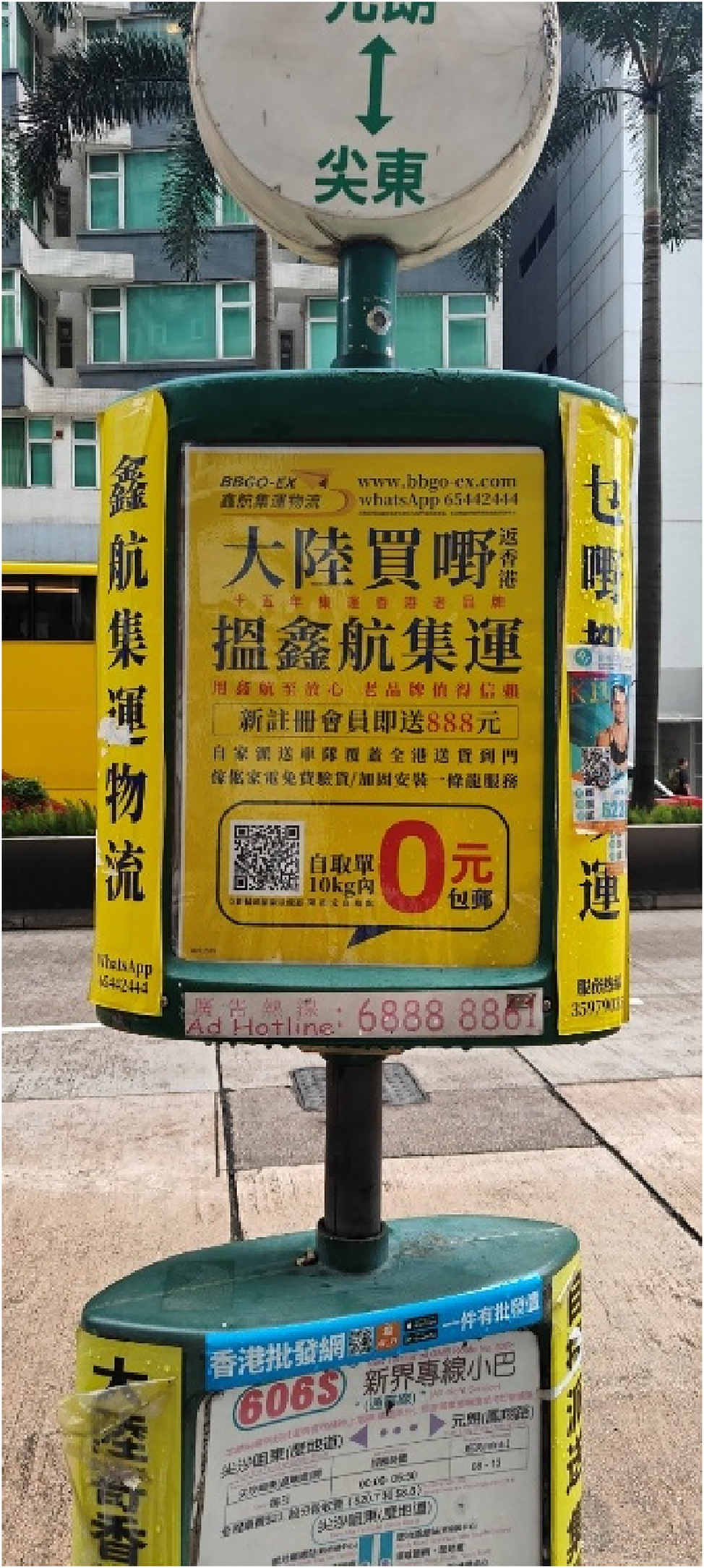
Example of a monolingual Cantonese sign.
As a result of increasing contact with mainland China, Hong Kong has witnessed the introduction of various chain brands from the mainland. Notably, these brands often feature simplified Chinese characters in their names. While these chain brands may share a uniform manner, their use of simplified Chinese characters also indexes the construction of a mainland identity that is distinct from the Hong Kong identity (see Figure 8).
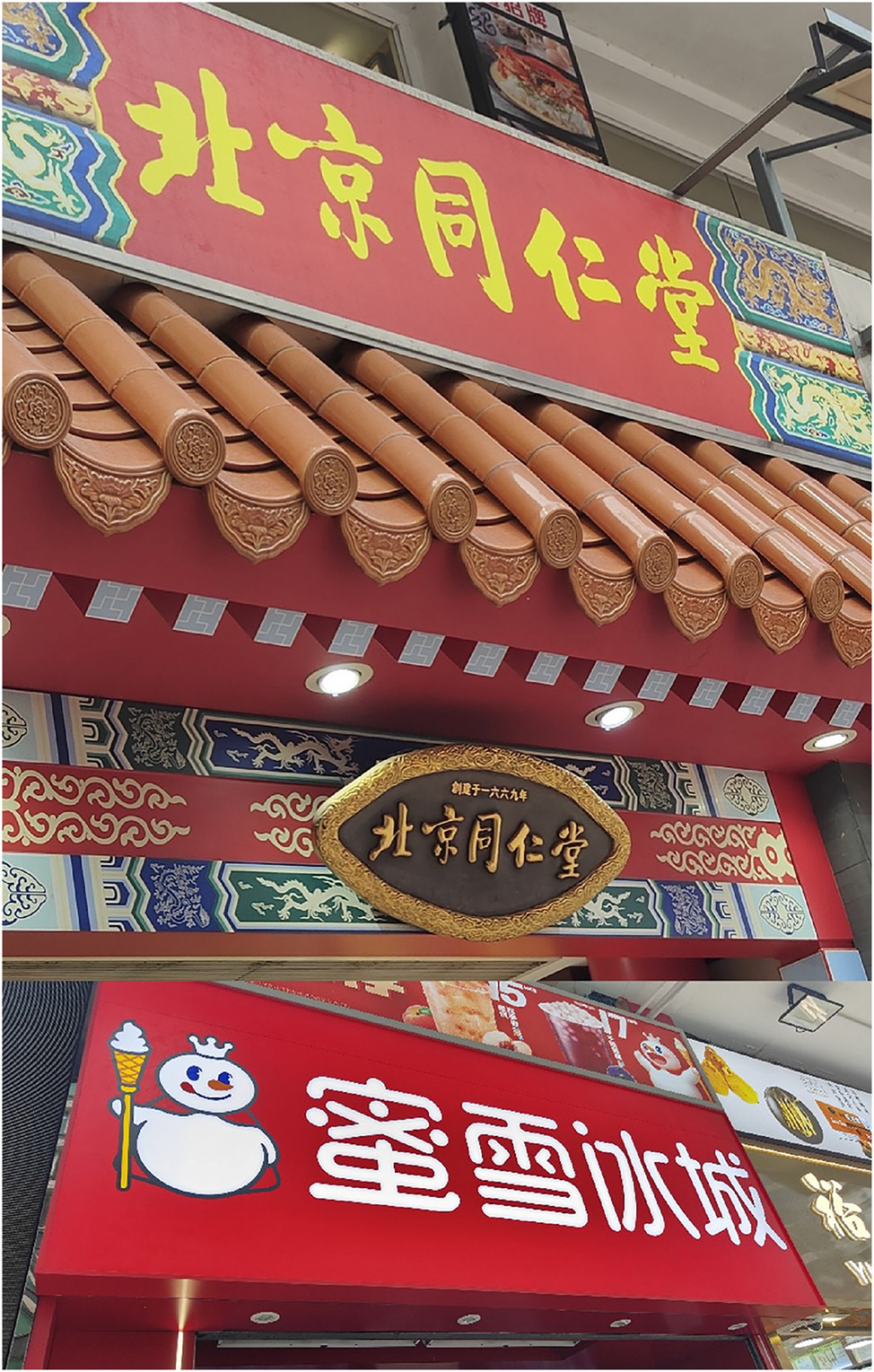
Examples of monolingual Simplified Chinese signs.
5.3 Multilingual signs
In the data, there are many multilingual signs, with Chinese–English bilingual signs being the most prominent. It should be noted that the information in English and Chinese is not equivalent. In many cases, the English text is simply the pinyin or Romanized transcription of the Chinese/Cantonese pronunciation, while other instances combine the name with a profession, as observed by Lam (2024: 119). Some signs also feature literal translations. The use of two languages in these signs strikes a balance between localness and globalese. The indexicality of these bilingual signs is multifaceted: the Chinese characters index both the target audience and the authenticity of products such as traditional Chinese medicines, while the English text, as Lam (2024) points out, is often used creatively, therefore indexing a local hybrid identity. Notably, the combination of Chinese and English in these signs creates a unique indexicality that blends the global and local identities. While the use of English indexes a globalized identity, the use of Chinese serves to maintain cultural and local identity, highlighting the complex interplay between globalization and localization in Hong Kong (see Figure 9).

Examples of multilingual signs.
6 Comparison among the three places
6.1 Central
The Central district in Hong Kong, a hub of financial and economic activity, is distinguished by a high concentration of multinational corporations, financial institutions, and upscale commercial establishments. A notable feature of this area is the prevalence of English-only and multilingual signs, as observed in previous studies (Lai 2013; Wong and Chan 2018). Consistent with these findings, the data reveals that Central has the highest proportion of multilingual signs and the second-highest proportion of English/Roman script-only signs. This LL reflects the district’s cosmopolitan character and may relate to the high English proficiency of actors there, who are likely to be familiar with English-only signs. The private signs in Central predominantly feature economic-related entities, such as banks and financial institutions, as well as global chain brands, such as in Figure 10. The relatively dominant appearance of English/Roman script only indexes the district’s global and economic identity, with a diminished emphasis on local identity. This is further reinforced by the limited presence of regional brands and Chinese-only signs in the area. In this context, the first order of indexicality is dominant, where English/Roman script indexes economy and prestige. The first-order indexical meaning of English/Roman script, which associates it with economy and prestige, is presupposed and reinforced by the functional context of Central as a financial and economic hub. In this context, the second-order indexical meaning, which involves the intentional use of English/Roman script to construct a global and high-status identity, is less prominent. This is evident in the limited appearance of local brands that strategically employ English/Roman script to project a global image. As a result, the second-order indexical meaning is relatively absent in Central, suggesting that the use of English/Roman script in this area is more closely tied to its functional and economic purposes rather than its symbolic value.
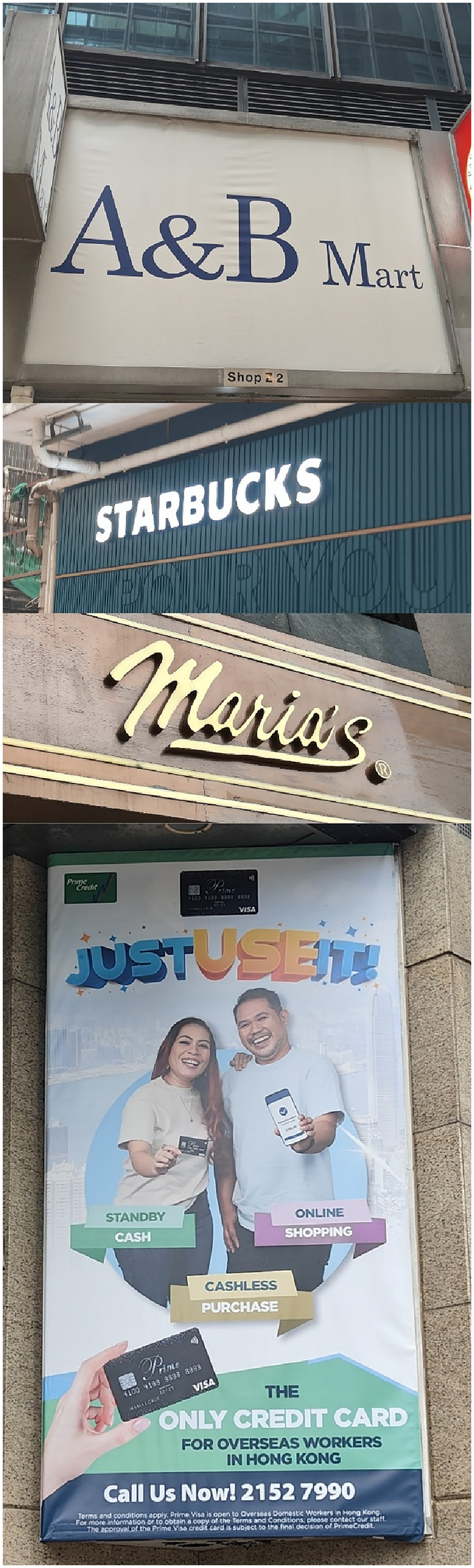
Examples of monolingual English signs in Central.
From the perspective of multilingual signs, the English/Roman script signs in Central are characterized by a lack of creativity, as they are predominantly used by chain brands, with fewer individual shops present. As a result, the information conveyed by these signs is largely parallel and informative, serving an informative purpose rather than a symbolic one. The indexicality of these signs is primarily of the first order, where English/Roman script is used to convey prestige and high status (see Figure 11).
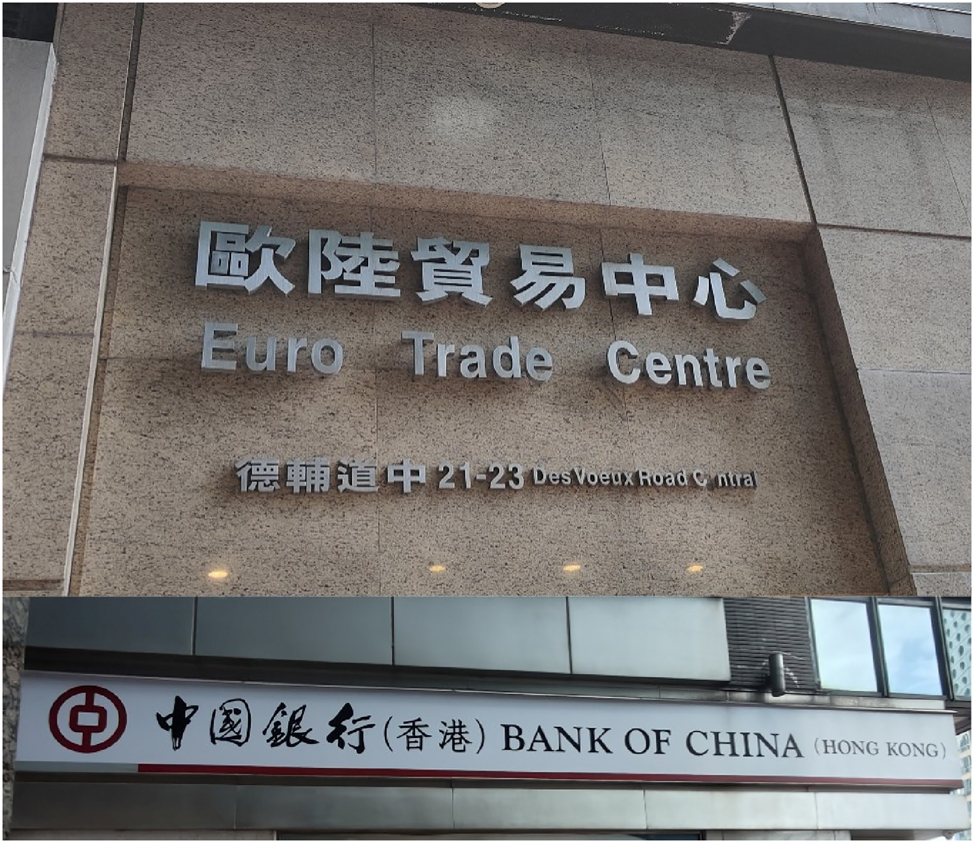
Examples of multilingual signs in Central.
6.2 Tsim Sha Tsui
Tsim Sha Tsui (TST), a popular destination for international travelers, exhibits a unique LL. Notably, monolingual signs account for nearly 40 % of the total signs, the highest proportion among the three areas studied, while multilingual signs comprise approximately 60 %, the lowest proportion. Furthermore, English/Roman script-only signs are the most prevalent in this area. Luxury brands, such as Tissot and Chanel, are there, which suggests that the monolingual English/Roman script signs index a global, luxury, high-status identity. This is an example of first-order indexicality, where the use of English/Roman script is associated with prestige and exclusivity. Many regional brands shown in TST have adopted English/Roman script-only signs in their names, rather than using Chinese characters (see Figure 12). This phenomenon represents the second-order indexicality, where the use of English/Roman script is intentionally employed to construct a global and high-status identity.
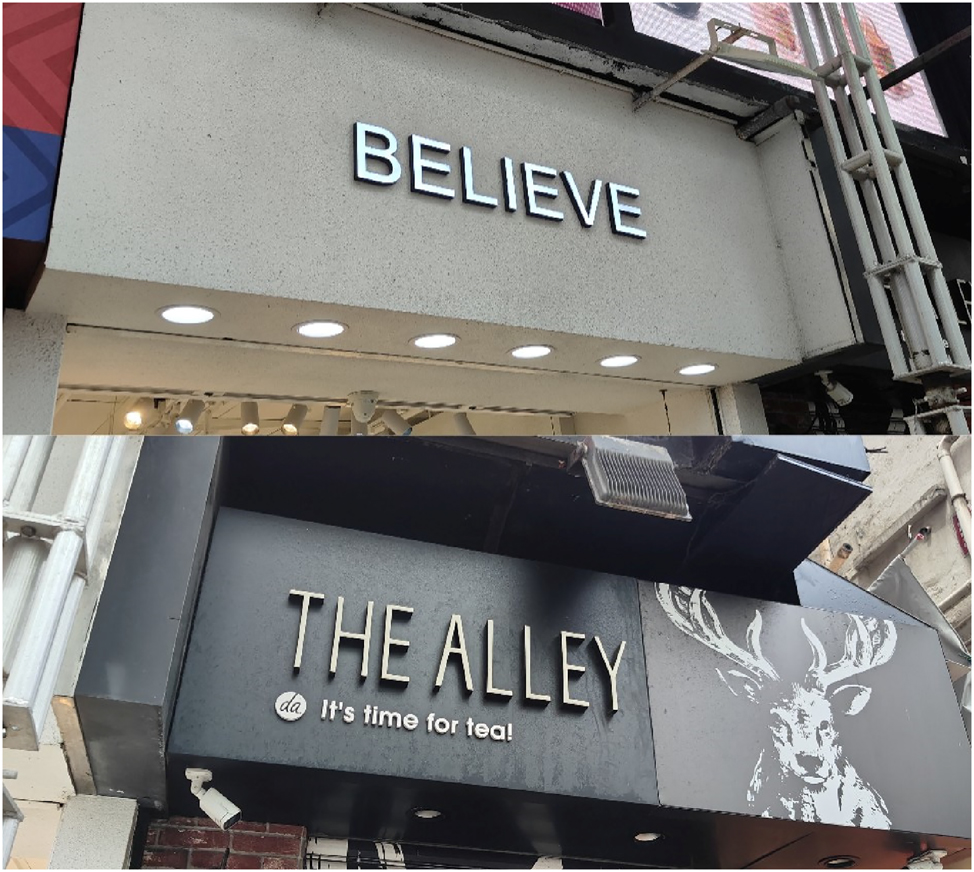
Examples of monolingual English signs in Tsim Sha Tsui.
In contrast to the monolingual signs, the multilingual signs in TST exhibit a high degree of creativity, largely due to the presence of numerous individual shops in the area. The use of multiple languages on these signs serves to convey distinct identities and meanings, reflecting the owners’ agency in using language to construct specific identities. On the first order of indexicality, English/Roman script is employed (as a literal translation or Romanized transcription of the Chinese/Cantonese pronunciation, as mentioned in Section 5.3) to index a global identity, while Chinese is used to convey authenticity. Notably, both languages also exhibit second-order indexicality, where the owners use different codes to target specific audiences. In the case of English/Roman script, it is often with less information, being used as part of the shop’s name to construct an international identity, indexing a global and cosmopolitan image. In contrast, Chinese is used to target a local audience, as it is assumed that international travelers may not be able to read Chinese characters. This strategic use of language allows shop owners to differentiate themselves and appeal to specific customer groups (see Figure 13).
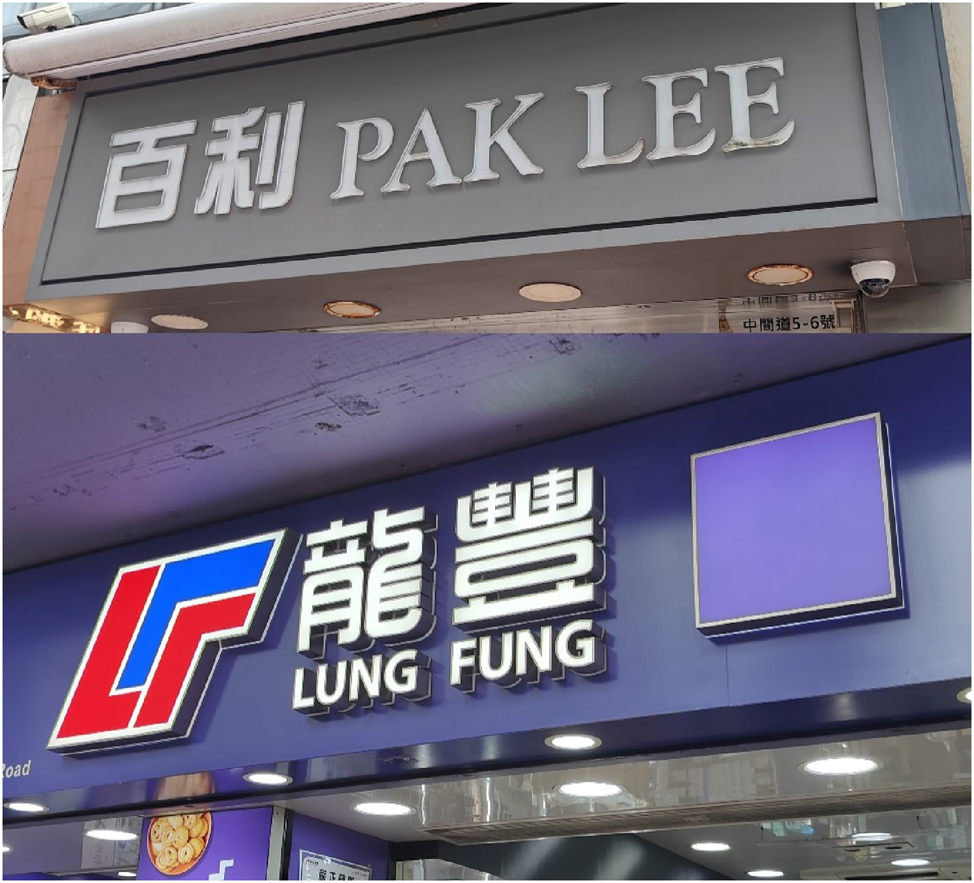
Examples of multilingual signs in Tsim Sha Tsui.
6.3 Sheung Shui
Notably, the LL of the mall in Sheung Shui exhibits a unique characteristic, with a relatively high proportion of English-only signs and multilingual signs, but no simplified Chinese characters. This is in contrast to previous studies (Lai 2013), which may be attributed to the data collection site, in a mall. Despite Chinese being the dominant language in Hong Kong, the data reveals that English is also widely used on commercial signs in the mall. However, this is not primarily for communicative purposes, but rather for symbolic functions. The use of monolingual English on these signs indexes prestige and high status, as evident in the slogan “We are always moving forward” in Figure 14, which may not necessarily be understood by the local population but is still prominently displayed below the brand’s name. The English language is being used in a decorative rather than communicative manner, which is the second-order indexicality of language use in this context. The prevalence of Chinese in Hong Kong, as noted by Lai (2013), makes it a strong identity marker and a language of solidarity among the general public. However, the use of English on commercial signs in the mall suggests that there is a desire to project a more global and cosmopolitan image, even if it is not necessarily for communicative purposes (see Figure 14).

Example of monolingual English sign in Sheung Shui.
The monolingual Chinese signs in the mall primarily serve an informative function, as they often contain information relevant to local life, such as the medical services on the left of Figure 15 and the voluntary donation on the right. This aligns with the second-order indexicality discussed in Section 5.2, where the use of Chinese indexes not only the ability to read the language, but also the social meaning of local identity. In other words, the use of monolingual Chinese signs conveys a sense of superiority to residents who can read and understand the language, as it implies that they possess a certain level of cultural knowledge and belonging (Han and Shang 2024; Han and Wu 2020).
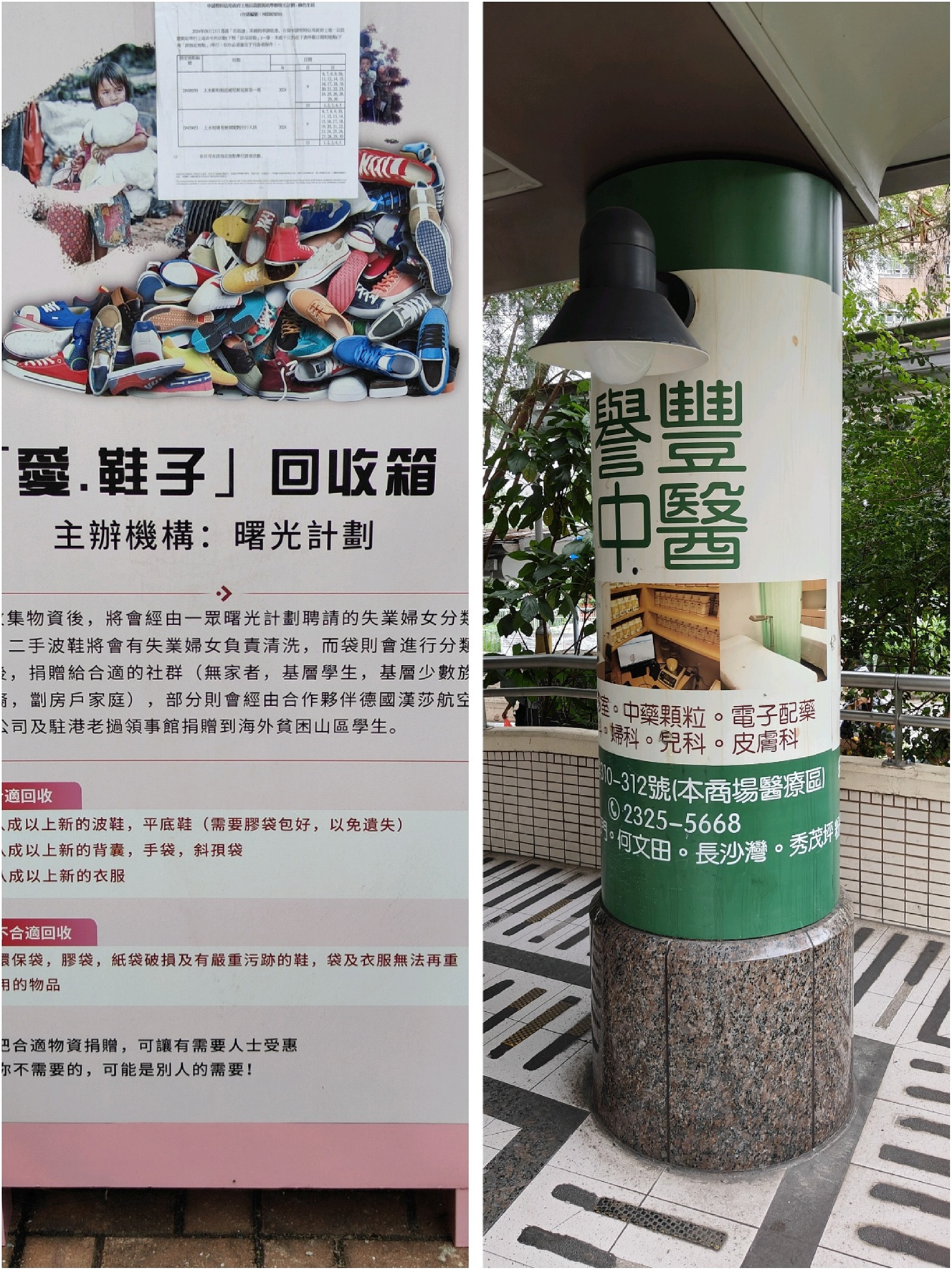
Examples of monolingual Traditional Chinese signs in Sheung Shui.
In contrast to the monolingual English/Roman script signs, multilingual signs exhibit a different dynamic. While they share similarities with those in TST, the demographic composition of the population in these areas is distinct, with a higher proportion of Chinese residents. As a result, the use of English in multilingual signs assumes a more symbolic function, whereas Chinese assumes a more informative function (see Figure 16).
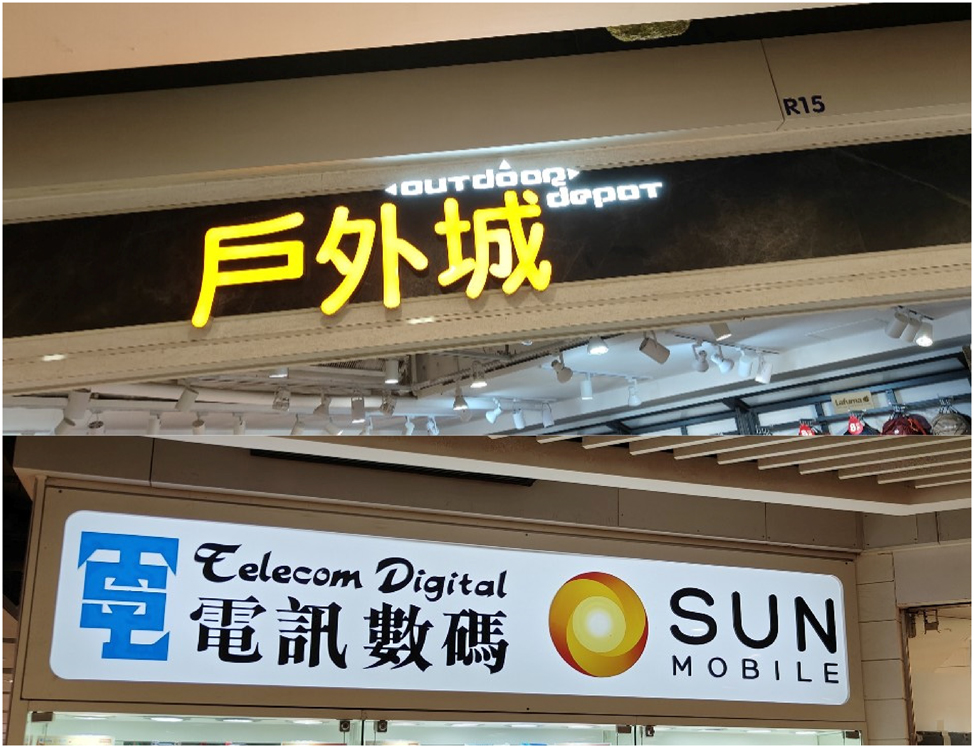
Example of a multilingual sign in Sheung Shui.
7 Concluding discussion
This study examined the linguistic landscapes (LLs) of three Hong Kong districts – Central, Sheung Shui, and Tsim Sha Tsui (TST) – revealing distinct yet interconnected identity negotiations shaped by global–local dynamics. While Central and Sheung Shui exhibit similar proportions of monolingual and multilingual signs, the dominance of monolingual English signage in Central reflects its status as a global financial hub, where corporate language policies prioritize standardized symbols to project an international identity. Conversely, the higher proportion of monolingual signs in TST underscores its role as a tourist and commercial zone, where language choices mediate tensions between cosmopolitan desire and localized authenticity. Notably, Chinese–English bilingualism emerges as a unifying feature across all three districts, presenting Hong Kong’s historical bilingualism and its postcolonial navigation of globalized modernity (Wong and Chan 2018). The indexical orders of language use further illuminate these dynamics. In Central, the prevalence of English/Roman scripts indexes first-order indexicality, English as a default marker of prestige (Lai 2013), reinforced by top-down corporate branding strategies that suppress localized linguistic agency. In contrast, Sheung Shui and TST exemplify second-order indexicality, where English is creatively recontextualized to serve hyperlocal agendas. For instance, Sheung Shui’s predominantly Chinese-speaking population paradoxically deploys multilingual signage to construct a global identity, repurposing English not as a colonial relic but as a tool for place-making (Lam 2024). Similarly, TST’s local brands leverage English to evoke prestige while retaining Chinese to anchor authenticity, producing a hybridized identity that fluctuates between global aspiration and local rootedness.
In other words, Hong Kong has managed to maintain its regional features, which are reflected in the LLs of the city. The indexicality of the LLs in Hong Kong reveals a complex negotiation between localism and internationalism. On the one hand, the use of English on the signage indexes a global identity. On the other hand, the use of Chinese and creative and innovative ways of English indexes a local identity that is deeply featured in the city’s cultural and historical background. While the visibility of Chinese is high in all three locations, its use aligns with the demographic features of each area. For instance, in Sheung Shui, the predominantly Chinese population is reflected in the language use on the signage, i.e., a higher proportion of Chinese monolingual signs compared with the other two places. The identity of Hong Kong is not a fixed or essentialized concept, but rather a dynamic construct that is shaped by the city’s unique cultural, historical, economic, and demographic context. The LLs of different districts in Hong Kong reveal distinct identities, but despite these differences, a common thread runs through the LLs of all districts: the negotiation between localism and internationalism.
The LLs of different regions embody a certain degree of similarity and shared logic in the construction of identity. As symbolic markers, signs index multilayered identities – ethnolinguistic, social, cultural, religious, and sociopolitical – while reflecting broader ideological negotiations between tradition and modernity, unity and diversity, and globalization and locality (Gu 2025). These dynamics are particularly salient in postcolonial contexts (Taylor-Leech 2012), where LLs often serve as battlegrounds for reclaiming, hybridizing, or contesting identities shaped by historical power asymmetries. Consequently, the utilization of symbols in LLs has become a manifestation of showcasing the unique identity of a city or region (e.g., An and Shang 2025; An and Zhang 2022; Lam 2024; Li and Yang 2022, 2023; Zhang 2024). Such contexts underscore the need to analyze LLs not merely as static representations but as active sites where language ideologies are enacted, resisted, and reinterpreted.
This dynamic perspective reveals how such attitudes and practices toward languages (i.e., language ideology) in LLs reflect a negotiation of the complex relationships between tradition and modernity, unity and diversity, and globalization and locality. This phenomenon is exemplified by the concept of indexical order, which highlights how individuals position themselves on a scale in their unique ways of interpreting the social meaning behind languages (Zhang and Chan 2017). As Blommaert et al. (2005: 199) argue, the study of indexicality “forces us to look at social processes as culturalized, i.e., as turned into complexes of meaningful and understandable (indexical) items that offer semiotic potential to people.” In other words, language choices in LLs can lead to different identity constructions due to varying factors. As Blommaert (2010) notes, regions may change as a result of globalization, but the particulars of these changes depend on the local norms and conditions. Amid the ever-changing background of globalization, multiple identities in LLs can form recognizable and localized identities that also possess a globalized character. Therefore, adopting an indexical order perspective can facilitate a deeper understanding of the tensions and negotiations between different languages and identities.
To conclude, this study illustrates how indexical order serves as a critical framework for analyzing identity construction in LLs. By examining how language and semiotic resources are stratified and mobilized within orders of social meaning, the analysis reveals how identities are negotiated through public signs and demonstrates the role of language ideologies in mediating interpretations of linguistic practices, while bridging micro-level communicative practices with macro-level sociopolitical structures. Ultimately, this study sheds light on how indexical order can be applied in LL research by systematically unraveling the interplay of power, cultural dynamics, and identity in public discourse.
As Theng and Lee (2022: 164) emphasize, overemphasizing dominant indexicalities risks overlooking the potential of doing things with words, to “perform a transgressive semiotic.” By leveraging the second order of indexicality, as evident in the cases of Sheung Shui and TST, languages are utilized for creative commercial purposes. However, this reveals a potential limitation of this research and direction for further research. Concerning this argument along with the point made by Blommaert et al. (2005), it is essential to incorporate ethnographical elements, such as interviews with private shop owners, to understand the designers’ decision-making processes and rationales for selecting the languages displayed on signs. Collecting data on a larger scale would also enable a more comprehensive analysis, providing a more nuanced understanding of the complex dynamics at play.
About the author
Zihan Xia (b. 2002) is currently a master’s student at The Hong Kong Polytechnic University. His research interests include (multimodal) discourse analysis, corpus linguistics, and sociolinguistics.
Acknowledgement
I would like to thank Professor Anne Schluter for her advice on forming the framework and methodology, as well as anonymous reviewers and Associate Editor Catherine Schwerin for their very insightful comments on an earlier version of this paper.
References
Agha, Asif. 2003. The social life of cultural value. Language & Communication 23(3–4). 231–273. https://doi.org/10.1016/S0271-5309(03)00012-0.Suche in Google Scholar
Agha, Asif. 2005. Voice, footing, enregisterment. Journal of Linguistic Anthropology 15(1). 38–59. https://doi.org/10.1525/jlin.2005.15.1.38.Suche in Google Scholar
An, Ran & Guowen Shang. 2025. Communication across time and space: Chronotope in the linguistic landscape of a concession area. Journal of Multilingual and Multicultural Development 16. 1–19. https://doi.org/10.1080/01434632.2025.2452332.Suche in Google Scholar
An, Ran & Yanyan Zhang. 2022. Language choice and identity construction: Linguistic landscape of Jianghan Road in Wuhan. Journal of Multilingual and Multicultural Development 45(10). 4236–4253. https://doi.org/10.1080/01434632.2022.2152456.Suche in Google Scholar
Bacon-Shone, John, Kingsley Bolton & Kang Kwong Luke. 2015. Language use, proficiency and attitudes in Hong Kong. Hong Kong: Social Sciences Research Centre, the University of Hong Kong. http://hub.hku.hk/handle/10722/218437 (accessed 17 March 2025).10.5353/ds_dataset95133Suche in Google Scholar
Besnier, Niko. 2004. Consumption and cosmopolitanism: Practicing modernity at the second-hand marketplace in Nuku’alofa, Tonga. Anthropological Quarterly 77(1). 7–45. https://doi.org/10.1353/anq.2004.0002.Suche in Google Scholar
Blackwood, Robert J., Elizabeth Lanza & Hirut Woldemariam (eds.). 2016. Negotiating and contesting identities in linguistic landscapes (Advances in Sociolinguistics). London & New York: Bloomsbury Academic.Suche in Google Scholar
Blommaert, Jan. 2010. The sociolinguistics of globalization (Cambridge Approaches to Language Contact). Cambridge: Cambridge University Press.Suche in Google Scholar
Blommaert, Jan, James Collins & Stef Slembrouck. 2005. Spaces of multilingualism. Language & Communication 25(3). 197–216. https://doi.org/10.1016/j.langcom.2005.05.002.Suche in Google Scholar
Bucholtz, Mary & Kira Hall. 2005. Identity and interaction: A sociocultural linguistic approach. Discourse Studies 7(4–5). 585–614. https://doi.org/10.1177/1461445605054407.Suche in Google Scholar
Census and Statistics Department. 2021. Census results – Snapshot. 2021 Population Census. https://www.census2021.gov.hk/en/mrpsg_dashboard.html (accessed 22 March 2025).Suche in Google Scholar
Evans, Stephen. 2010. Language in transitional Hong Kong: Perspectives from the public and private sectors. Journal of Multilingual and Multicultural Development 31(4). 347–363. https://doi.org/10.1080/01434632.2010.497218.Suche in Google Scholar
Evans, Stephen. 2015. Modelling the development of English in Hong Kong. World Englishes 34(3). 389–410. https://doi.org/10.1111/weng.12154.Suche in Google Scholar
Fleming, Kara. 2017. Hong Kong’s language ecology and the racialized linguistic order. Language Ecology 1(1). 25–43. https://doi.org/10.1075/le.1.1.03fle.Suche in Google Scholar
Google Map Data. 2025a. Central district, Hong Kong, scale: 20 m. https://maps.app.goo.gl/HJav9e2iZe2mSmbv7 (accessed 19 May 2025).Suche in Google Scholar
Google Map Data. 2025b. Tsim Sha Tsui district, Hong Kong, scale: 20 m. https://maps.app.goo.gl/ZET2QqZdNNZRk9hj6 (accessed 19 May 2025).Suche in Google Scholar
Google Map Data. 2025c. Sheung Shui district, Hong Kong, scale: 50 m. https://maps.app.goo.gl/UccoKb1iAup1NMFM9 (accessed 19 May 2025).Suche in Google Scholar
Gu, Chonglong. 2023. “Mask must wear at all times”: Top-down and bottom-up multilingual COVID-scape in Hong Kong as a prime site of epidemiological and public health knowledge (re)construction during the COVID-19 pandemic. Language and Intercultural Communication 24(3). 195–221. https://doi.org/10.1080/14708477.2023.2225483.Suche in Google Scholar
Gu, Chonglong. 2025. The (un)making and (re)making of Guangzhou’s “Little Africa”: Xiaobei’s linguistic and semiotic landscape explored. Language Policy 24(1). 51–84. https://doi.org/10.1007/s10993-024-09689-4.Suche in Google Scholar
Han, Yanmei & Guowen Shang. 2024. The linguistic landscape in China: Commodification, image construction, contestations and negotiations. Singapore: Springer Nature.10.1007/978-981-99-8753-5Suche in Google Scholar
Han, Yanmei & Xiaodan Wu. 2020. Language policy, linguistic landscape and residents’ perception in Guangzhou, China: Dissents and conflicts. Current Issues in Language Planning 21(3). 229–253. https://doi.org/10.1080/14664208.2019.1582943.Suche in Google Scholar
Harwood, Chris & Conttia Lai. 2017. Linguistic capital: Language medium of instruction policy in Hong Kong. Language Problems and Language Planning 41(2). 159–167. https://doi.org/10.1075/lplp.41.2.05har.Suche in Google Scholar
Helal, Fethi. 2023. Multilingualism in linguistic landscapes in Tunisia: A critical discourse analysis of language policy activities. International Multilingual Research Journal 18(1). 1–21. https://doi.org/10.1080/19313152.2023.2209368.Suche in Google Scholar
Jaworski, Adam. 2015. Globalese: A new visual-linguistic register. Social Semiotics 25(2). 217–235. https://doi.org/10.1080/10350330.2015.1010317.Suche in Google Scholar
Jaworski, Adam & Simone Yeung. 2010. Life in the Garden of Eden: The naming and imagery of residential Hong Kong. In Elana Shohamy, Eliezer Ben-Rafael & Monica Barni (eds.), Linguistic landscape in the city, 153–181. Bristol, UK & Blue Ridge Summit, PA: Multilingual Matters.10.2307/jj.29308476.13Suche in Google Scholar
Kelly-Holmes, Helen. 2005. Advertising as multilingual communication. London: Palgrave Macmillan UK.10.1057/9780230503014Suche in Google Scholar
Lai, Mee Ling. 2013. The linguistic landscape of Hong Kong after the change of sovereignty. International Journal of Multilingualism 10(3). 251–272. https://doi.org/10.1080/14790718.2012.708036.Suche in Google Scholar
Lam, Phoenix W. Y. 2024. A multi-sited analysis of the linguistic landscape of Hong Kong through a center–periphery approach. World Englishes 43(1). 109–124. https://doi.org/10.1111/weng.12625.Suche in Google Scholar
Landry, Rodrigue & Richard Y. Bourhis. 1997. Linguistic landscape and ethnolinguistic vitality: An empirical study. Journal of Language and Social Psychology 16(1). 23–49. https://doi.org/10.1177/0261927X970161002.Suche in Google Scholar
Leung, Alex Ho-Cheong & Patrick Chi-Wai Lee. 2023. Ethnic group affiliation and second/foreign language accentedness in English and Mandarin among Hong Kong speakers. Language, Culture and Curriculum 37(2). 171–185. https://doi.org/10.1080/07908318.2023.2285797.Suche in Google Scholar
Li, David Chor-Shing. 2017. Multilingual Hong Kong: Languages, literacies and identities. Cham: Springer. Available at: https://link.springer.com/book/10.1007/978-3-319-44195-5.Suche in Google Scholar
Li, Songqing. 2024. Walking on Huaihai Street: Liminality, linguistic landscape, and language policy. Journal of Multilingual and Multicultural Development 20. 1–18. https://doi.org/10.1080/01434632.2024.2309916.Suche in Google Scholar
Li, Songqing & Hongli Yang. 2022. Semiotic practices, power and identity: Linguistic landscape at the airport in Shanghai. In Seyed Hadi Mirvahedi (ed.), Linguistic landscapes in South-East Asia: The politics of language and public signage (Routledge Studies in Sociolinguistics), 162–184. Abingdon: Routledge.10.4324/9781003166993-11Suche in Google Scholar
Li, Songqing & Hongli Yang. 2023. ‘Open’, ‘connected’, ‘distinctive’, ‘pioneering’, and ‘committed’: Semioscaping Shanghai as a global city. International Journal of Multilingualism 20(2). 250–269. https://doi.org/10.1080/14790718.2020.1865970.Suche in Google Scholar
Lou, Jackie Jia. 2016. Shop sign as monument: The discursive recontextualization of a neon sign. Linguistic Landscape 2(3). 211–222. https://doi.org/10.1075/ll.2.3.01lou.Suche in Google Scholar
Nie, Peng & Xiaofang Yao. 2025. Translanguaging in the linguistic landscape: Creative scripts in Yi ethnicity students’ handwritten signs. Applied Linguistics Review 16(4). 1681–1703. https://doi.org/10.1515/applirev-2023-0274.Suche in Google Scholar
Nie, Peng, Jiazhou Yao & Namgyal Tashi. 2021. Mapping the linguistic landscape from a multi-factor perspective: The case of a multi-ethnolinguistic city in China. International Journal of Multilingualism 20(2). 231–249. https://doi.org/10.1080/14790718.2021.1898620.Suche in Google Scholar
Peirce, Bonny Norton. 1995. Social identity, investment, and language learning. TESOL Quarterly 29(1). 9–31. https://doi.org/10.2307/3587803.Suche in Google Scholar
Piller, Ingrid. 2001. Identity constructions in multilingual advertising. Language in Society 30(2). 153–186. https://doi.org/10.1017/S0047404501002019.Suche in Google Scholar
Piller, Ingrid. 2011. Intercultural communication: A critical introduction. Edinburgh: Edinburgh University Press.Suche in Google Scholar
Poon, Anita Y. K. 2010. Language use, and language policy and planning in Hong Kong. Current Issues in Language Planning 11(1). 1–66. https://doi.org/10.1080/14664201003682327.Suche in Google Scholar
Pütz, Martin & Neele Mundt. 2018. Expanding the linguistic landscape: Linguistic diversity, multimodality and the use of space as a semiotic resource. Bristol, UK: Multilingual Matters.10.21832/9781788922166Suche in Google Scholar
Scollon, Ron & Suzie Wong Scollon. 2003. Discourses in place: Language in the material world. London: Routledge.10.4324/9780203422724Suche in Google Scholar
Silverstein, Michael. 2003. Indexical order and the dialectics of sociolinguistic life. Language & Communication 23(3). 193–229. https://doi.org/10.1016/S0271-5309(03)00013-2.Suche in Google Scholar
Song, Ge. 2021. Hybridity and singularity: A study of Hong Kong’s neon signs from the perspective of multimodal translation. The Translator 27(2). 203–215. https://doi.org/10.1080/13556509.2020.1829371.Suche in Google Scholar
Song, Ge. 2024. Towards a translational landscape: A study of Coloane’s urban features through the lens of translational spaces. Translation Studies 17(2). 352–373. https://doi.org/10.1080/14781700.2023.2255607.Suche in Google Scholar
Song, Ge & Chonglong Gu. 2025. Deciphering translation practices in Macao’s casino wonderland of Cotai. International Journal of Multilingualism 10. 1–24. https://doi.org/10.1080/14790718.2025.2456063.Suche in Google Scholar
Taylor-Leech, Kerry Jane. 2012. Language choice as an index of identity: Linguistic landscape in Dili, Timor-Leste. International Journal of Multilingualism 9(1). 15–34. https://doi.org/10.1080/14790718.2011.583654.Suche in Google Scholar
Theng, Andre Joseph & Tong King Lee. 2022. The semiotics of multilingual desire in Hong Kong and Singapore’s elite foodscape. Signs and Society 10(2). 143–168. https://doi.org/10.1086/718861.Suche in Google Scholar
Wang, Jinjun & Zihui Liang. 2024. Indexical order and language ideology in the linguistic landscape of tourism in Hong Kong: Chungking Mansions and its surroundings. Chinese Semiotic Studies 20(2). 273–295. https://doi.org/10.1515/css-2024-2019.Suche in Google Scholar
Wong, Alicia S. H. & Susan S. S. Chan. 2018. From ‘the world of Suzie Wong’ to ‘Asia’s world city’: Tracing the development of bilingualism in Hong Kong’s linguistic landscape (1957–2014). International Journal of Multilingualism 15(4). 435–454. https://doi.org/10.1080/14790718.2017.1418364.Suche in Google Scholar
Yan, Xi. 2019. A study of language choices in the linguistic landscape of Macao’s heritage and gaming tourism. Journal of Multilingual and Multicultural Development 40(3). 198–217. https://doi.org/10.1080/01434632.2018.1498853.Suche in Google Scholar
Zhang, Tianyang. 2024. Linguistic landscape as a way to construct multiple identities in the context of globalization: The case of an ancient town in China. Social Semiotics 1–21. https://doi.org/10.1080/10350330.2024.2405511.Suche in Google Scholar
Zhang, Hong & Brian Hok-Shing Chan. 2017. The shaping of a multilingual landscape by shop names: Tradition versus modernity. Language and Intercultural Communication 17(1). 26–44. https://doi.org/10.1080/14708477.2017.1261674.Suche in Google Scholar
Zhou, Minglang. 2019. Language ideology and order in rising China. London and New York: Palgrave Macmillan.10.1007/978-981-13-3483-2Suche in Google Scholar
© 2025 the author(s), published by De Gruyter, Berlin/Boston
This work is licensed under the Creative Commons Attribution 4.0 International License.
Artikel in diesem Heft
- Frontmatter
- Research Articles
- On the naturalist foundations of any truly general theory of signs
- “Invitational” metaphors in China Women’s News: gender egalitarianism, feminist axiology, and female autonomy
- Negotiation of identity and indexical order in linguistic landscapes in Hong Kong: a comparison among Central, Tsim Sha Tsui, and Sheung Shui
- EduMeme: using internet memes in foreign language education from an edusemiotic perspective
- The semiotics of lie and lying: a journey to hyperreality
- An illustration of the polysemiosis of jade as a sign vehicle in traditional Chinese culture – an exemplar of formal and essential intuition
- The magic of repetition: the narrative presentation of time in Yeats’s poetry
Artikel in diesem Heft
- Frontmatter
- Research Articles
- On the naturalist foundations of any truly general theory of signs
- “Invitational” metaphors in China Women’s News: gender egalitarianism, feminist axiology, and female autonomy
- Negotiation of identity and indexical order in linguistic landscapes in Hong Kong: a comparison among Central, Tsim Sha Tsui, and Sheung Shui
- EduMeme: using internet memes in foreign language education from an edusemiotic perspective
- The semiotics of lie and lying: a journey to hyperreality
- An illustration of the polysemiosis of jade as a sign vehicle in traditional Chinese culture – an exemplar of formal and essential intuition
- The magic of repetition: the narrative presentation of time in Yeats’s poetry
