A review of hydrogen embrittlement of martensitic advanced high-strength steels
-
Jeffrey Venezuela (BS Metallurgical Engineering, MS Metallurgical Engineering, University of the Philippines, 2003) is currently working on his PhD in Materials Engineering at The University of Queensland, Australia. His current research interest is in the HE of MS-AHSS. From 1998 to 2014, he was an assistant professor at the Department of Mining, Metallurgical, and Materials Engineering, University of the Philippines, Diliman.
Qinglong Liu is a senior PhD student at The University of Queensland, Australia. He received his Bachelor’s degree from the Ocean University of China and his Master’s degree in engineering from the University of Science and Technology, Beijing, China, where his research focused on the corrosion and protection of magnesium alloys for aerospace applications. He is currently working on his PhD, studying the influence of hydrogen on steels for autoconstruction. In 2015, he spent 1 month in the Baoshan Iron & Steel Co., Ltd., Shanghai, China, for his PhD research.
Mingxing Zhang (BEng IMUST 1984, MEng NWPU 1987, PhD UQ 1997) is professor of Materials at The University of Queensland, where he has been since 1994. Prof. Zhang is a world leader in the area of phase transformations and application in engineering materials. He is recognized as one of the top researchers in crystallography of phase transformations in solids and grain refinement of cast metals. His other research focuses on surface engineering of metallic materials to improve their surface durability and on the development of new alloys, including lightweight alloys and high-strength, high-ductility steels. He has expertise in the areas of cold spray, packed powder diffusion coating, and surface nanocrystallization of metallic materials.
Qingjun Zhou, PhD (USTB 2007), is a senior engineer of Research Institute, Baosteel Group Corporation, China. His research areas are corrosion of steels, HE, and hydrogen-induced delayed fracture of high-strength automobile steels.
Andrej Atrens [BSc (Hons), PhD Adelaide 1976, GCEd, DEng UQ 1997] is professor of Materials at The University of Queensland, where he has been since 1984. His research areas are corrosion of magnesium, HE and SCC, corrosion mechanisms, atmospheric corrosion, and patination of copper. An international academic reputation is evident from invitations for keynote papers at international conferences, invitations as guest scientist/visiting professor at leading international laboratories, an ISI H-index of 47 (Web of Science), many citations [9063 citations (Web of Science)], 14 journal papers with more than 100 citations, five journal papers with more than 400 citations, and an excellent publication record in top international journals with more than 230 refereed journal publications.


Abstract
The martensitic advanced high-strength steels (MS-AHSS) are used to create fuel-efficient, crashworthy cars. Hydrogen embrittlement (HE) is an issue with high-strength steels; thus, the interaction of hydrogen with MS-AHSS needs to be studied. There are only a few published works on the HE of MS-AHSS. The current literature indicates that the HE susceptibility of MS-AHSS is affected by (i) the strength of the steel, (ii) the applied strain rate, (iii) the concentration of hydrogen, (iv) microstructure, (v) tempering, (vi) residual stress, (vii) fabrication route, (viii) inclusions, (ix) metallic coatings, and (x) specific precipitates. Some of the unresolved issues include (i) the correlation of laboratory results to service performance, (ii) establishing the conditions or factors that lead to a certain HE response, (iii) studying the effect of stress rate on HE, and (iv) a comprehensive understanding of hydrogen trapping in MS-AHSS.
1 Introduction
Advanced high-strength steels (AHSS) are a new class of steels that exhibit high strength coupled with good formability. The use of AHSS allows significant weight reduction and improved crash performance of vehicles to provide better fuel economy and higher passenger safety (Zhu, Ma, & Wang, 2014). Martensitic AHSS (MS-AHSS) is the strongest among this class of steels. MS-AHSS can have strengths well above 1000 MPa but have relatively low ductility. Nevertheless, MS-AHSS have gained acceptance in the car manufacturing industry and are currently used for making anti-intrusion parts in automobiles. A concern for high-strength steels is hydrogen embrittlement (HE), a degradation mechanism that can occur with stressed steel components containing hydrogen. Consequently, the extent that HE limits the applicability of AHSS needs to be addressed (Loidl, 2015). Although there are good reviews of HE of conventional steels (Elboujdaini & Revie, 2009; Gangloff, 1986; Hirth, 1980; Lynch, 2012a; Louthan, 2008; Louthan, Caskey, Donovan, & Rawl, 1972; Liu & Atrens, 2013; Thompson & Bernstein, 1981), this work reviews the HE of MS-AHSS and places this review in the context of HE of the martensitic steels.
This paper presents the current state of knowledge on the HE of MS-AHSS. The paper introduces AHSS and MS-AHSS, describes HE, explains HE, evaluates the techniques employed in HE studies, critically evaluates the recent works on the HE of martensitic steels, and identifies the gaps in HE research to propose possible future research directions.
1.1 History of AHSS
Research on AHSS began with studies on dual-phase (DP) steels in the late 1970s and early 1980s. This led to the creation of first-generation AHSS (Bouaziz, Zurob, & Huang, 2013; Kot & Morris, 1979; Rashid & Rao, 1981): DP (Davies, 1978; Kim & Thomas, 1981; Speich, Demarest, & Miller, 1981), martensitic (MS or MART; Automotive Applications Council, 2014; ULSAB-AVC, 2014a), complex phase (CP; Matlock, Speer, de Moor, & Gibbs, 2012; Zhu, Barbier, & Iung, 2013), and transformation-induced plasticity (TRIP; Sakuma, Matsumura, & Takechi, 1991; Tamura, 1982). The DP steel was one of the first to gain commercial acceptance in the early 1990s (Bouaziz et al., 2013). First-generation AHSS have mechanical properties better than conventional high-strength steels. However, these steels have poor formability.
Second-generation AHSS were developed to tackle this weakness. These steels are based on the more ductile and formable austenitic microstructure. Examples include the twinning-induced plasticity (TWIP; Frommeyer, Brüx, & Neumann, 2003; Grässel, Krüger, Frommeyer, & Meyer, 2000), lightweight steel with induced-plasticity (L-IP; Hofmann, Menne, Göklü, & Richter, 2005), and shear band formation-induced plasticity (SIP; Allain et al., 2006) steels. However, these steels require high amounts of austenite-stabilizing elements, such as manganese and nickel (~20% wt), which are consequently expensive and have limited industrial use.
The latest research focus is on creating third-generation AHSS with a suitable compromise between formability and cost. Examples of third-generation AHSS include quenching and partitioning (Q&P) steels (Speer et al., 2011) and the medium Mn steels (Santofimia et al., 2011). Third-generation AHSS show strong potential, and the response of the car industry is encouraging. There may also be other applications such as in ship building, aircraft, domestic appliances, and civil structures (Demeri, 2013).
1.2 Types and properties of AHSS
AHSS have tensile strengths >500 MPa and typically possess complex microstructures (Bhattacharya, 2006). Figure 1 compares the mechanical properties of AHSS and conventional steels. Conventional steels have yield strengths <500 MPa. In contrast, the strength of AHSS is often between 600 and 1200 MPa. Furthermore, AHSS have relatively high ductility (5–70%) and good formability.

Mechanical properties of AHSS versus conventional steels.
Adapted from ULSAB-AVC (2014b) and Automotive Applications Council (2014).
The following AHSS nomenclature was proposed by the ultralight steel auto body (ULSAB) program (ULSAB-AVC, 2014c): “XX aaa/bbb” (e.g. MS 800/980). The first two letters “XX” identify metallurgy. For example, DP identifies a DP steel and MS identifies a MS-AHSS. The next set of three numbers “aaa” and “bbb” represent the minimum yield and tensile strengths, respectively.
AHSS also differ from conventional steels in that their microstructure is typically more complex. The ferrous microstructures include ferrite, cementite, austenite, martensite, pearlite, and bainite (Callister & Rethwisch, 2014). Each microstructure has its own set of properties. Combining these microstructures can give novel properties. For example, DP steels contain a combination of ferrite and martensite. CP steels have a ferrite and bainite matrix together with discrete martensite, pearlite, and retained austenite islands. The number of feasible microstructural combinations, together with known strengthening mechanisms, gives a range of possibilities to customize the properties of the steel.
The strengthening mechanisms for AHSS include solid solution strengthening, precipitation strengthening, grain refinement, phase transformation, and cold deformation (Automotive Applications Council, 2014; Ramazani, Berme, & Prahl, 2013). Furthermore, the multiphase nature of AHSS allows second-phase strengthening such as in composites.
1.3 MS-AHSS
MS-AHSS were derived from the low-carbon martensite steels (LCMS), which were introduced in the 1970s by the Inland Steel Co. (McFarland & Taylor, 1969). In 1982, there were four commercial grades with tensile strengths of 900, 1100, 1300, and 1500 MPa (Bhattacharya, 2015). Interest increased for LCMS in automotive applications, and eventually, the LCMS became part of the AHSS family.
Another type of martensitic steel sheet is the press hardened (PH) or hot-formed (HF) steel. This steel was introduced in 1977 for hot stamping. PH steels typically have higher carbon contents and considerable amounts of boron to create the desired martensitic microstructures. Common examples of PH steels include 22MnB5, 27MnCrB5, and 37MnB4 steel grades. 22MnB5 is the most commercially used grade.
1.3.1 Properties, advantages, and limitations of MS-AHSS
Table 1 summarizes the microstructures and typical tensile strengths of common AHSS. MS-AHSS are the strongest of the AHSS, having the highest values of yield and tensile strength (ULSAB-AVC, 2014a). MS-AHSS are also different from other AHSS in that they have a single microstructure of martensite, although some ferrite and bainite may also be present depending on fabrication (Bhattacharya, 2011). The strength of the martensite depends on the carbon concentration and tempering treatment. MS-AHSS contain sufficient amounts of alloying elements, such as B, Cr, Mo, V, and Ni, to ensure sufficient hardenability to obtain the fully martensitic microstructure (WorldAutoSteel, 2014). The carbon concentration is typically <0.30% to prevent excessive martensite hardness that could lead to problems in metal forming (Mohrbacher, 2014).
Properties of selected types of AHSS (Automotive Applications Council, 2014; Heimbuch, 2006).
| AHSS | Microstructure | Typical tensile strength (MPa) |
|---|---|---|
| DP | Ferrite+martensite | 400–1000 |
| MS | Martensite | 900–1700 |
| CP | Ferrite/bainite matrix+martensite, pearlite, and retained austenite | 400–1000 |
| TRIP | Ferrite/retained austenite matrix+martensite and bainite | 500–1000 |
| TWIP | Austenite | 800–1100 |
| Q&P | Martensite+austenite | 950–1200 |
MS-AHSS have relatively poor ductility, which range from 2% to 10%. The consequent limited formability requires strict control of deformation processing. MS-AHSS can be tempered for greater ductility and formability, such as required for multiple bending operations. Nevertheless, MS-AHSS are used in car manufacturing because of their high strength to price ratio (Bouaziz et al., 2013).
1.3.2 Martensitic microstructure
Martensite is a metastable phase formed via a diffusionless, displacive, and shear transformation of rapidly cooled austenite (Cohen, 1988). The martensite crystal structure changes at 0.6 wt% C (Askeland, Fulay, & Wright, 2011), which is designated the H point. Martensite with a carbon concentration below the H point is body-centered cubic (BCC), whereas, for a higher carbon concentration, martensite is body-centered tetragonal (BCT; Marder & Krauss, 1967). The terms primary and secondary martensite are also used for the BCC and BCT structures, respectively (Sherby, Wadsworth, Lesuer, & Syn, 2008). Zener (1946) suggested that this change from cubic to tetragonal represents a change from an ordered distribution of carbon to a more random one. However, this hypothesis would require the lattice parameter to steadily increase up to the H-value, contrary to experiment. Bell and Owen (1967) found that the cubic lattice parameters are constant up to the H-value, after which the c-value increases with carbon content. Sherby et al. (2008) proposed that a C-rich phase is formed during quenching. This phase takes out all of the carbon from the BCC structure; hence, the constant lattice parameters are observed below the H-point. Furthermore, they proposed the sequential transformation from face-centered cubic (FCC) to hexagonal close-packed (HCP) then HCP to BCC occurring for primary martensite. At the H-point, the BCT structure is created as a result of the carbon solubility limit of HCP and interstitial carbon, causing an elongation along the c-direction of the BCC structure.
Martensite also has two types of microstructure, namely, lath and plate (Krauss & Marder, 1971). Lath martensite, also described as lenticular or massive, appears as thin and parallel strips of martensite crystals (Marder & Krauss, 1967; Speich, 1973) Plate martensite, also referred to as acicular or “needle-like”, is wider and lacks the parallel arrangement between adjacent crystals in lath martensite (Marder & Krauss, 1967). The occurrence of each type depends on the carbon content. Pure plate martensite occurs for a carbon content >1% C, lath occurs at <0.6% C (Askeland et al., 2011; Callister & Rethwisch, 2014; Marder & Krauss, 1967), and a mixture of lath and plate martensite occurs for intermediate carbon contents.
Most hardenable steels have low or medium-carbon contents; consequently, their microstructure contains lath martensite (Krauss, 2005). Thus, lath martensite has the greater industrial significance. MS-AHSS, which have carbon content typically <0.2%, also have the lath microstructure (Automotive Applications Council, 2014; Mohrbacher, 2014). Each prior austenite grain (PAG) typically transforms to numerous discrete laths, as shown in Figure 2. Each lath is a single martensite crystal with 0.2–0.5 μm width (Maki, 2012). The lath boundaries are often low-angle boundaries with misorientations of about 3° and do not represent significant crystallographic discontinuity (Morito, Huang, Furuhara, Maki, & Hansen, 2006). These laths occur in packets with the same habit plane. Packets occur in blocks in which laths possess a similar crystallographic variant of the martensitic transformation (Marder & Marder, 1969).

Microstructure of a martensite showing blocks and packets inside a PAG.
Adapted from Kinney et al. (2014) and Mohrbacher (2014).
A packet may be considered as the single martensite crystal or grain, although partitioned by many low-angle boundaries and having a dense dislocation population (Kinney, Pytlewski, Khachaturyan, & Morris, 2014; Krauss, 2005). The abundance of these tangled dislocations is characteristic of the fine lath microstructure, in which the dislocation densities can reach up to 1012 dislocations/cm2. Dislocation density is proportional to carbon content up to 0.6 wt% C. Twinning may also occur in lath martensite, although twinning is more favored at higher carbon contents and is more important for plate martensite (Krauss, 1999).
1.3.3 Mechanical properties of martensite
Martensite is considered the strongest of the ferrous microstructures but has low ductility (Callister & Rethwisch, 2014). The strength of martensite has a large scatter in reported values (Krauss, 1999), attributed to the presence of second phases, such as retained austenite and autotempering carbides. Nevertheless, the hardness of martensite is solely dependent on carbon concentration (Askeland et al., 2011; Callister & Rethwisch, 2014; Krauss, 1999; Mohrbacher, 2014). Plots of martensite hardness versus carbon concentration often show a parabolic relationship (Krauss, 1999), with peak hardness at a carbon content of about 0.8% C. For carbon concentrations >0.8% C, martensite hardness may increase or decrease depending on the process used to control the amount of the soft retained austenite phase (Krauss, 1978). Carbon strengthens martensite by solid solution strengthening. The solute carbon is supersaturated in the martensite matrix and distorts the crystal lattice. The resulting lattice strains effectively hinder dislocation motion, prevent crystal slip, and reduce ductility and toughness.
Several techniques may be used to increase the toughness of martensite. The concentration of critical impurities can be reduced, such as nitrogen, phosphorous, arsenic, and sulfur, which weaken grain boundaries (Mohrbacher, 2014). Finely dispersed precipitates can be introduced into the martensite matrix, which have little effect on strength but can significantly increase fracture toughness (Krauss, 1995). However, coarse brittle precipitates along former austenite grain boundaries, or between laths, promote brittle fracture (Ebrahimi & Krauss, 1984). Toughness can also be increased by refining the effective grain size of the martensite (Mohrbacher, 2014). Decreasing grain size also increases the strength as given by the Hall-Petch equation (Morris, Lee, & Guo, 2003). In martensite, lath boundaries are barriers to dislocation motion and consequently influence strength. Furthermore, high-angle packet boundaries can effectively stop cleavage fracture along crystal planes. Grain refinement creates more grain boundary areas and thereby reduces the concentration of grain boundary embrittling elements, such as phosphorus or arsenic, by distributing them over a larger area. Fine-grained martensitic structure is produced by refining the PAG site (Mohrbacher, 2014) by either limiting the austenitizing temperature or adding alloying elements that inhibit austenite grain growth.
1.3.4 Fabrication techniques
Martensite is produced by heating the steel above a critical temperature to create austenite followed by rapid cooling or quenching. The amount of martensite that forms from the austenite depends on the rate of cooling and the final temperature (Callister & Rethwisch, 2014). The cooling rate must be faster than the critical cooling rate to prevent the formation of competing phases such as pearlite and bainite. The martensite finish temperature, Mf, defines the temperature below which 100% of the austenite is transformed to martensite. The critical cooling rate and Mf depend on the steel chemistry. Aside from carbon, alloying elements such as boron, nickel, chromium, manganese, silicon, molybdenum, and vanadium are controlled to enhance hardenability (Automotive Applications Council, 2014). Furthermore, although a pure martensite matrix is ideal in the quenched product, it is also possible to get small amounts of ferrite and bainite (WorldAutoSteel, 2014).
MS-AHSS may be produced in several ways (Automotive Applications Council, 2014; WorldAutoSteel, 2014; Zhu et al., 2014). The most popular method is to heat the steel into the austenitizing temperature, followed by hot rolling to form sheets, and then to quench the sheets in the run-out table, or in the cooling section of the continuous annealing line, to create martensitic; a process called hot rolling. Alternatively, an already formed steel sheet may be austenitized and then directly quenched. The advantage is that sheet forming would be relatively easy because austenite is quite ductile and workable. However, hot forming creates poor dimensional tolerances, due to large springback, and a scaled or oxidized surface.
A second method involves cold rolling the already martensitic steel at low temperatures, referred to as the cold-rolled and annealed process. The inherently high mechanical strength and the poor ductility of the martensite limit the amount of deformation of the specimen. To achieve additional ductility and impart toughness in the product, the cold-rolled martensite is heated at an appropriate tempering temperature. A similar process to cold form the steel is by shaping the hypoeutectoid microstructure of pro-ferrite and pearlite, which is more ductile than the hard martensite. The formed metal is then subjected to a post-heat treatment consisting of an austenitizing anneal and quenching.
Supplementary treatments, such as bake hardening and electrogalvanized, for applications requiring corrosion resistance may also be carried out on MS-AHSS (Mohrbacher, 2014). These steps are implemented to further customize and improve the properties of the steel.
Hot stamping process is an innovation compared to the traditional method of forming martensitic steel. The process was pioneered by the Swedish company Plannja in 1977, and its first products were saw and lawn mower blades (Norrbottens Jaernverk, 1977). In 1984, the first hot-stamped automotive parts were used in the SAAB 9000. In 2007, more than 107 million automotive hot-stamped parts were manufactured, and the process continues to attract the attention of an increasing number of car manufacturers (Hu, Ma, Liu, & Zhu, 2013).
Hot stamping combines metal forming and quenching in a single operation and may be done via either a direct or an indirect process (Karbasian & Tekkaya, 2010). Direct hot stamping begins by heating the blank in an oven at the austenitizing temperature of 900°C to 950°C. The blank typically possesses a protective Al-Si coating that prevents decarburization and scale formation on the specimen. The steel is retrieved and formed in the press. The die itself is water cooled and quenches the austenite at rates of more than 50°C/s (Bouaziz et al., 2013). The indirect process involves cold forming the blank followed by austenitization. The preformed blank is then put in the press for dimensional calibration and quenching.
The hot stamping process offers distinct advantages over the other two techniques (ArcelorMittal, 2014b). Hot stamping allows the production of complex geometry and thus eliminates multipart assembly. Good dimensional tolerance is obtained by eliminating product springback. The part has uniform mechanical properties and good fatigue and impact resistance.
1.3.5 Applications of MS-AHSS
McWilliams (2015) stated that high-strength steels (both conventional and AHSS) accounted for the largest weight percentage of lightweight materials used in the transportation industry. The good mechanical properties of the steel coupled with low cost and ease of manufacture mean that steel is the material of choice for car making (Ghassemieh, 2014). McWilliams (2015) further stated that this usage, as it has in the last decade, is to continue to increase in the coming years. This is because the future consumption of AHSS is not limited to the automotive industry only but includes the shipbuilding and aircraft industry (McWilliams, 2015). These two industries were ranked second and third behind the auto industry in the amount of lightweight materials used. Furthermore, the proposed regulations for 2017–2025 require stricter corporate average fuel economy standards for cars and could significantly increase AHSS use (Abraham, 2014).
The WorldAutoSteel organization produced a set of guidelines for the application of AHSS in vehicles (WorldAutoSteel, 2014). These guidelines were created to help car manufacturers, particularly engineers and press shop personnel, to decide which type of AHSS was best for particular applications. Most AHSS are used in the main structure of the automobile called the body-in-white (BIW; Ghassemieh, 2014). The BIW consists of pressed steel joined together to create a strong and stiff frame. This form of construction accounts for almost all of the cars created today. It is projected that 50% of the average BIW will consist of AHSS by the end of this decade, by 2020 (Abraham, 2014). Due to its good strength, MS-AHSS finds applications in the parts of the vehicle that requires good crash resistance. These areas are often in the crash cage, as shown in Figure 3. Applications include bumper beams and reinforcements, door intrusion beams and reinforcements, windscreen upright reinforcements, B-pillar reinforcements, rocker panel inners, side sill and belt line reinforcements, springs, clips, floor reinforcements, and roof and dash panel cross members (ArcelorMittal, 2014a,b; Automotive Applications Council, 2014; Mallen, Tarr, & Dykeman, 2008; WorldAutoSteel, 2014). Recent reports estimate from 4% up to 10% by weight use of MS-AHSS in cars (Bhat, 2014; Han, 2014; Morgans, 2015).

Typical application of MS-AHSS in automotive BIW construction: (i) front and rear bumper beams, (ii) door beam, (iii) side sill reinforcement, and (iv) roof cross member.
Photo used with permission from ArcelorMittal (2015). MartINsite® Steels.
2 HE in steel
HE refers to the degradation of the mechanical properties of the steel due to hydrogen. The adverse effects of hydrogen on steel have been known for more than a century. Some of the earliest accounts were given by Cailletet (1868) and Johnson (1875). HE manifests in different ways in steels. HE can reduce the ultimate tensile or fracture strength, breaking strain or ductility, fatigue strength, and fracture toughness (Louthan, 2008). The term “embrittlement” implies a shift from a ductile to a brittle state. HE may involve failure at an applied stress below the yield or tensile stress. Furthermore, there are cases where unstressed specimens have fractured. An example is the phenomenon called “shelf popping” (Willan, 2002) where unassembled parts at the production shelf crack as a result of hydrogen interaction with the residual stress in the steel. However, HE can also refer to the case where there is a decrease in ductility but no change of yield and tensile strength.
Various terms have been used to describe HE and several types of HE have been named (Cwiek, 2010; Lynch, 2012a). Internal HE refers to an embrittlement as a result of hydrogen inherent or preexisting in the steel. Hydrogen environment embrittlement (HEE), on the contrary, involves embrittlement caused by hydrogen external to, or in the working environment of, the steel. Hydrogen-assisted cracking (HAC) is used together with either the terms “internal” or “external”. Some industries even have their own terms to describe HE. In the welding industry, for example, hydrogen-assisted cold cracking (HACC) is used to refer to a phenomenon of weld failure after cooling to ambient temperatures. In the corrosion industry, environmental HE (EHE) is used to describe fractures brought about by hydrogen in cathodically protected structures. In addition, for hydrogen-induced failures under cyclic loads, there is hydrogen-assisted fatigue (HAF).
Steel has been the focus of numerous HE studies. Steel is ubiquitous, as it continues to be the most commercially used metal. Steel finds relevance in most structural applications where strength and ductility is needed. However, the HE susceptibility of steels increases with tensile strength. Such increased susceptibility to hydrogen-induced fracture therefore limits the use and applicability of high- and ultra-high-strength steels. Furthermore, any advances in creating stronger steels need to examine HE.
The volume of published work on the HE in steels is large and has greatly increased in the last 60 years, as better tools for research were developed. However, despite the amount of research, scientists still continue to study the mechanisms of HE. The following section presents a general description of some of the critical factors that influence the HE susceptibility of steels. The succeeding sections contain a description of the different modes and mechanism of hydrogen entry into steels. The section ends with a description of three relevant mechanisms for HE in steels.
2.1 Factors affecting the HE susceptibility of steels
HE can cause subcritical crack growth at stresses a fraction of the tensile strength. Alternatively, HE can be manifested as a loss of ductility with no decrease of yield strength and no decrease in tensile strength.
For steel, HE susceptibility and hydrogen sensitivity increases with increasing mechanical strength, providing that there is no great difference in microstructure. To illustrate, at tensile strengths below 850 MPa, tempered steels are practically immune to hydrogen-induced fractures unless the hydrogen content is about 10 ppm (Willan, 2002). However, martensitic high-strength steels, with strengths in the range of 900–1400 MPa, are susceptible to HE at hydrogen concentrations as low as 0.5–1 ppm (Lynch, 2012a). Some have adopted a simple quasi-exponential relationship between strength and HE susceptibility (Willan, 2002), that is, a doubling of the strength leads to a quadruple increase in HE susceptibility.
The strength of steels is closely related to its microstructure. In traditional steels, high strengths are typically attributed to the presence of martensite. Moreover, the as-quenched martensite is the most prone to HE (Garrison & Moody, 2012; Willan, 2002). This may be attributed to the high transformation stress of martensite that creates high residual stresses in the lattice. It has also been hypothesized that thermodynamically stable phases are less susceptible to HE (Quadrini, 1989). This would explain why tempering can improve the HE resistance of martensitic steels (Bates & Loginow, 1964; Nagao, Martin, Dadfarnia, Sofronis, & Robertson, 2014). However, the presence of martensite alone does not necessarily translate to high HE susceptibility. Other factors, such as the presence of other ferrous microstructures, alloy content, second-phase precipitates, grain structure, and type of martensite, can easily change the dynamics of HE in martensite-bearing steels (Garrison & Moody, 2012; Pussegoda & Tyson, 1981). As an example, the presence of retained austenite increases the HE resistance of martensitic steels (Kovalev, Waintein, Mishina, & Zabilsky, 2002). Hydrogen diffusion in the atomically dense austenite crystal lattice is about three to four orders of magnitude lower than in martensite. This means that it takes longer for hydrogen to accumulate and reach critical amounts in austenite. Therefore, a propagating crack can be stopped when the crack meets the hydrogen-resistant austenite phase. However, the retained austenite can become a problem if it transforms to other phases and begins imparting residual stresses on martensite.
The amount of hydrogen present is an important factor (ASM Handbook, 1986; Cwiek, 2010; Loginow & Phelps, 1975). Increasing hydrogen concentrations, either internal or external, lead to increasing HE susceptibility. However, the exact amount of hydrogen necessary to cause embrittlement can be affected by other factors. The critical value may depend on the applied stress, microstructure, tensile strength level, etc. (Louthan, 2008). It is further believed that a threshold or saturation concentration exist (Lynch, 2012a). Above this saturation level, there is a minimal change in HE susceptibility.
The surface condition of the steel also considerably affects HE susceptibility. Specifically, the presence of stress concentrators, such as notches, surface scratches, and machining marks, increase hydrogen sensitivity. Several studies showed increasing HE susceptibility with increasing notch severity (Liu, Zhu, Ke, & Hardie, 1996; Toribio & Elices, 1992; Xu, 2012) and in the presence of residual tensile stresses (RTS) at the surface (Toribio & Lancha, 1993) of the steel. Thus, certain manufacturing processes, such as cold drawing or excessive grinding, which create RTS in steels should be avoided. On the contrary, inducing controlled residual compressive stresses provides some benefits against HE (Walton, 2002).
The HE susceptibility of steels is also strain rate dependent (Louthan, 1974; Smallman & Bishop, 1999; Toh & Baldwin, 1976) and temperature dependent (Gangloff & Wei, 1977; Livne, Chen, & Gerberich, 1986; Tan, Gao, & Wan, 1993; Xu, 2012). Higher HE vulnerability often occurs at low strain rates, and a critical rate of stressing is necessary to reveal HE. Consequently, impact loading is not useful in detecting HE (Smallman & Bishop, 1999). However, HE may show under impact loads at certain conditions such as when high levels of hydrogen and alloy impurities are present at grain boundaries or when hydride formation occurs (Lynch, 2012a). On the contrary, it is believed that the temperature of highest susceptibility occurs near ambient temperature, although it rarely occurs at room temperature (Xu, 2012). For the majority of the steels, maximum HE susceptibility occurs at 0°C (Louthan, 2008). At higher temperatures, HE gradually decreases and, above a critical temperature (at about 100°C), is significantly reduced (Lynch, 2012a).
The amount of hydrogen trapping is an important factor that influences HE susceptibility in steel (Bernstein, Garber, & Pressouyre, 1976). Hydrogen trapping refers to the process by which hydrogen enters the steel and gets caught in certain physical inhomogeneities or defects in the lattice. The concept explains how hydrogen can accumulate in the steel and how the traps can become sinks or sources of hydrogen for possible interactions that may cause embrittlement. Hydrogen trapping is discussed in greater detail in a succeeding section.
2.2 Hydrogen entry into steel
Hydrogen is the lightest of the elements. Hydrogen gas typically occurs in the molecular form as H2. A molecule of hydrogen is relatively large and cannot diffuse in solid metals, neither interstitially in the metal nor across the gas/metal boundary (Carter & Cornish, 2001). Hydrogen entry into steel requires the hydrogen to be broken down into the smaller hydrogen atom, although it is reported that molecular hydrogen can be dissolved in molten steel (Walton, 1999). Nevertheless, the molecule rapidly dissociates and hydrogen is in the monoatomic form in solid steel. For entry of gaseous hydrogen, three stages are necessary: physisorption, chemisorption, and absorption (Carter & Cornish, 2001). Physisorption, or physical absorption, results from the van der Waals interaction between the solid (or the adsorbent) and the adsorbed hydrogen molecule (or the adsorbate). The process is reversible and is accompanied by a small enthalpy change. Chemisorption involves a chemical reaction between the adsorbent surface and the adsorbate. The reaction involves the splitting of the hydrogen molecule into two atoms, as the chemisorption energy exceeds the dissociation energy of molecular hydrogen, H2. The atoms are then held by a polarized covalent bond with the steel at the surface. The process is reversible but slow and typically needs activation. The final step, absorption, involves the transfer of the chemisorption hydrogen into the bulk metal. It is debated which form of hydrogen is absorbed: the neutral H atom or the ionic H+ and H- (Myers et al., 1992). Opinions would tend to favor the ionized form, although the sign is still an issue.
Hydrogen produced by a metal immersed in a corrosive liquid is evolved as a cathodic partial reaction, the hydrogen evolution reaction (HER). HER occurs by two successive reactions. The reaction first reaction is either proton discharge or water electrolysis according to the following:
A product is MHads, which represents atomic hydrogen adsorbed at the metal surface. The adsorbed hydrogen can subsequently undergo either of two reactions. The adsorbed hydrogen can recombine with another hydrogen atom, via chemisorption, to produce H2. This reaction can occur in both acid and basic solutions. Alternatively, hydrogen can undergo electrochemical desorption via the reactions:
The rate-determining step (RDS) in these reactions determine the speed of the overall HER. Furthermore, these reactions indicate that there is a free energy decrease when molecular hydrogen is formed. Alternatively, some of the adsorbed hydrogen diffuses inside the metal via the hydrogen absorption reaction (HAR). Several mechanisms have been proposed for the electrolytic entry of hydrogen into metals. Bockris and coworkers (Bockris & Potter, 2004; Flitt & Bockris, 1981) proposed that, following reaction (1), the absorbed hydrogen undergoes absorption or recombination via
Alternatively, Bockris (2000) proposed that absorbed hydrogen can be produced as follows:
where the absorbed hydrogen becomes incorporated in the lattice.
Some chemicals inhibit the hydrogen recombination reaction even when present in small concentrations. These chemicals are the hydrogen recombination poisons. Therefore, they promote hydrogen entry into steels. Common examples include compounds of Ar, P, S, Sb, Se, Sn, and Te and carbon compounds such as CN-, CNS-, CS2, and CO (Cwiek, 2010). These hydrogen poisons can exacerbate the HE of steels. They are often used for laboratory experiments for HE.
2.3 Hydrogen entry during manufacture and service
HE logically commences with the entry of hydrogen into the steel, and this occurs either during manufacturing or in service. Several fabrication techniques are sources of hydrogen. Examples include the solutions used for electroplating, acid cleaning, and applying protective coatings, pickling, etching, phosphating, and paint stripping (Walton, 1999). In other cases, such as in welding and casting, moisture can come into contact with the hot metal creating atomic hydrogen (Lynch, 2012a). For example, during casting, hydrogen can enter the molten metal from water trapped in fluxes, mold sands, and alloy stocks (Woodtli & Kieselbach, 2000). During welding, moisture can be present in the filler materials, fluxes and shielding gases, and wet and oil-bearing welded surfaces (Cwiek, 2010). Also, the annealing of steel in hydrogen-rich atmospheres leads to hydrogen ingress.
Hydrogen absorption can also occur in service. Hydrogen is adsorbed from wet oxides or rusts and iron sulfides as a result of the iron-water and iron-H2S reactions, respectively (Walton, 1999). Similarly, the corrosion of steel and of sacrificial anodes or protective porous coatings can generate hydrogen. Studies have shown the importance of the surface condition in controlling hydrogen ingress during service. For example, some surface oxides from tempering or carburizing and electrolytic coatings can prevent hydrogen ingress into steel (Walton, 1999). The chemical nuclear, space, and other industries have utilized both gaseous and liquid hydrogen for various purposes. Unsurprisingly, HE in the hydrogen steel tanks has occurred as a result of the direct exposure of steel to hydrogen (Fritzmeier & Chandler, 1989). Recently, hydrogen is being promoted as a viable energy vector; thus, many more structures (e.g. hydrogen storage and hydrogen production facilities) are expected to be exposed to hydrogen.
2.4 Mechanism of HE
Although hydrogen-induced cracking and embrittlement has been studied for a long time, there is no unifying theory. Several mechanisms have gained considerable acceptance. For non-hydride-forming metals, such as steel, the following three mechanisms are considered the most viable (Lynch, 2012a): (i) hydrogen-enhanced decohesion (HEDE), (ii) hydrogen-enhanced local plasticity (HELP), and (iii) adsorption-induced dislocation emission (AIDE).
2.4.1 HEDE
The HEDE mechanism was introduced by Troiano (1960) in 1959 and was subsequently developed by Oriani and coworkers (Oriani, 1972; Oriani & Josephic, 1972; Wriedt & Oriani, 1970). The HEDE mechanism proposes that hydrogen causes a reduction in the cohesive bond strength of the steel. Troiano (1960) suggested that the drop in cohesive strength was due to a transfer of the hydrogen 1s electron to the unfilled 3d shell of iron. Consequently, the tensile separation of atoms occurs instead of lattice sliding associated with slip and plastic deformation.
The HEDE mechanism proposes that crack nucleation occurs when a critical crack-tip opening displacement is reached, typically equal to half the interatomic spacing. Crack propagation occurs when the maximum stress at the crack tip exceeds the critical stress equal to the local, hydrogen-weakened cohesive strength.
Hydrogen accumulates in the metal in interstitial lattice cites, in locations of high triaxial state of stress, and hydrogen is trapped in microstructural defects. In the HEDE mechanism, hydrogen accumulates at potential fracture zones (Lynch, 2003), such as (i) sharp crack tips where hydrogen is adsorbed, (ii) regions ahead of cracks where dislocation-shielding occurs, (iii) positions of maximum hydrostatic stress, and (iv) interfaces such as grain and phase boundaries ahead of cracks. Troiano (1960) showed that controlling the hydrogen concentration is important in reducing HE. He found that the minimum hydrogen concentration necessary in triaxial stress locations is about 5 ppm. Increasing notch severity and the steel strength also increases HE susceptibility (Steigerwald, Schaller, & Troiano, 1960). Increasing the sharpness of a notch increases the stress concentrations; thus, the critical stress level is more easily reached. Higher strength steels have a lower threshold stress. The threshold stress is the stress below which hydrogen has no effect on the mechanical properties. For lower strength steels, a higher threshold stress is a result of plastic deformation that occurs at the yield point. Plastic flow shields the metal from stress concentrations, so a much higher stress is required to generate hydrogen at the maximum triaxiality and cause HE.
Indirect evidence for the HEDE include (i) quantum mechanical calculations that support the reduction of interatomic bond strength by hydrogen (Oriani, 1987) and (ii) the observation of high concentrations of hydrogen in the fracture zone, such as near grain boundaries and precipitate-matrix interfaces (Daw & Baskes, 1987). However, the HEDE mechanism is still debated as a direct experimental evidence is difficult to obtain. A featureless fracture surface could be cited as proof of decohesion (Gangloff, 2003), but it has been argued that the technique used to image the fracture was not able to accurately resolve features supporting plasticity (e.g. dimples). Currently, there is no available technique that allows the atomic scale observation of bulk material crack-tip behavior in the presence of hydrogen and that will conclusively support the HEDE mechanism.
2.4.2 HELP
The HELP mechanism was first suggested by Beachem (1972) and has been promoted and developed by other researchers such as Birnbaum and coworkers (Birnbaum, 1990; Birnbaum & Sofronis, 1994b; Birnbaum, Robertson, & Sofronis, 2000). The HELP mechanism has considerable support, although, at first blush, the terms enhanced plasticity and embrittlement appear contradictory. The HELP mechanism proposes that as solute hydrogen accumulates locally in regions near crack tips, caused by the presence of hydrostatic stresses or hydrogen entry at the crack tip, deformation becomes localized owing to the ability of hydrogen to promote dislocation motion. Crack growth is envisaged to occur as a more localized microvoid coalescence (MVC) process, a mechanism that is more associated with ductile rather than brittle fracture. Other failure modes, such as intergranular, transgranular, and quasi-cleavage, may also be activated depending on microstructure, crack-tip stress intensity, and hydrogen concentration (Beachem, 1972). Because the plastic deformation is concentrated in a small volume, a consequence of localized softening, the total macroscopic ductility is low.
The fundamental concept in the HELP model is the ability of solute hydrogen to shield dislocations from elastic interactions with physical obstacles in the lattice. High-energy elastic interactions typically hinder dislocation motion causing a reduction in slip and plastic flow. Conversely, a decrease in the energy of these interactions leads to greater dislocation mobility and plastic deformation. In the HELP mechanism, mobile solute hydrogen diffuses and concentrates, forming atmospheres around dislocations, solutes, and precipitates. Being weakly bound, the hydrogen atmospheres move together with the dislocations. The HELP phenomenon has been observed in numerous metals including in the different crystalline types (i.e. FCC, BCC, and HCP), in both pure and alloyed metals, and in solution- and precipitation-hardened metals (Birnbaum, 1990; Lynch, 2012a).
There is considerable evidence in favor of the HELP mechanism. Linear elastic calculations and finite-element modeling have proven the shielding nature of hydrogen and have shown that the typical repulsive forces between dislocations and obstacles are indeed lower when hydrogen is present (Birnbaum, Robertson, Sofronis, & Teter, 1997). In situ observation, via high-voltage transmission electron microscopy (TEM), have shown increased dislocation mobility and an increase in dislocation pile up in stressed thin foils (<200 nm) when hydrogen is introduced (Robertson, 2001). Hydrogen also increased the rate at which dislocation sources operate (Robertson et al., 2015). On the contrary, some have argued that the behavior of dislocations in these foils may not reflect behavior in bulk materials. However, experiments on bulk metals have shown that hydrogen reduced both the activation energy and the activation area needed for dislocation motion (Wang, Hashimoto, Wang, & Ohnuki, 2013). The reduction in the flow stress of a steel in hydrogen-charged specimens has also been reported (Hirth, 1980; Kimura & Birnbaum, 1987). At the condition of highest embrittlement, the stress-strain curve has serrated yielding indicating negative strain-dependent behavior (Birnbaum, 1994a,b). However, the amount of “local softening”, although usually minimal in most metals, varies on the type and composition of the metal and the conditions of mechanical testing (Lynch, 2003). The presence of small and shallow dimples, an indication of MVC and nanovoid coalescence, in the fracture surfaces of hydrogen-induced failures is also evidence supporting the HELP mechanism (Beachem, 1972; Hanninen, Lee, Robertson, & Birnbaum, 1993). Moreover, nanoindentation experiments, conducted simultaneously with electrochemical hydrogen charging, indicated that hydrogen decreased the pop-in loads and pop-in times in single crystal nickel (Barnoush & Vehoff, 2006). Both of these pop-in events (Schuh, 2006) indicated an enhanced softening with hydrogen. Furthermore, these nanoindentation experiments indicated that the embrittlement was reversed when the hydrogen was removed.
2.4.3 AIDE
The AIDE mechanism was proposed and subsequently developed by Lynch (1988, 1989, 2003). The AIDE mechanism advocates enhanced localized plasticity due to hydrogen, similar to the HELP mechanism. The key difference is that AIDE proposes that the localized plasticity occurs due to adsorbed hydrogen at the surface, whereas the HELP mechanism considers the role of solute hydrogen in the bulk. In the AIDE mechanism, hydrogen is adsorbed at the surface, particularly at regions of stress concentrations such as crack tips (Lynch, 1988). The hydrogen triggers the emission of dislocations from the advancing crack tip, causing crack growth, and intense plastic deformation in the crack vicinity.
An important aspect of the AIDE mechanism is the concept of dislocation emission, which includes both nucleation, as facilitated by hydrogen adsorption, and movement of dislocations away from the advancing crack tip. Dislocation nucleation occurs by a process of cooperative shearing, a consequence of the weakening of interatomic bonds over a several atomic distances in the vicinity of high hydrogen concentrations. Crack growth is proposed to occur by the same dislocation emission mechanism and also by the nucleation and coalescence of voids ahead of the advancing crack. Dislocation emission occurs under a sufficiently high stress that dislocation activity is triggered in the plastic zone ahead of the crack tip.
High concentrations of adsorbed hydrogen on surfaces, or within a few atomic distances of surfaces, have been observed for Fe, Ni, and Ti and are deemed as evidence to support the AIDE mechanism (Christmann, 1995; Fischer, 1982; Pundt & Kirchheim, 2006). Metal surfaces, and the interstices at subsurfaces, are strong traps and are expected to accumulate high amounts of hydrogen. Atomistic calculations on Ni crack growth indicated that hydrogen AIDE from crack tips is possible when slip planes have a favorable orientation to the crack plane. Other studies showed that the lowering of stacking fault energies (Lu, Zhang, Kioussis, & Kaxiras, 2001) and perturbations in surface stresses caused by hydrogen adsorption (Oriani, 1984) facilitates easier dislocation emissions. HE was also observed in some cases (e.g. Ni) where the crack advance was much faster than the diffusivity of hydrogen to areas ahead of the crack tip (Lynch, 1988, 1989). This indicates that only an adsorption-induced crack growth mechanism is possible. The HELP mechanism is not possible due to the absence of solute hydrogen, whereas the HEDE mechanism was excluded as localized plastic deformation was present. Fracture surfaces obtained from liquid-metal embrittlement (LME) failures were found to share remarkably similar features with those from HE fractures (Lynch, 1989). For LME, only surface adsorption at the crack tip is possible as crack propagation occurs rapidly and there is insufficient time for other possible interactions. This means that, by sharing fracture features with LME, HE may have occurred under similar mechanisms of adsorption-induced fracture. There are some arguments against AIDE. Some studies noted that similar fracture features are not necessarily the result of similar fracture mechanisms (Fenske et al., 2012; Wang et al., 2014). Studies have also found that microstructures can evolve during a particular loading condition and dislocation structures can self-organize (Robertson et al., 2015). These factors could also have implications on the microstructures that are being used to support AIDE and thereby make the proposed mechanism debatable.
3 Hydrogen trapping in steel
Hydrogen trapping has a large influence on the hydrogen accumulation and mobility in steels. Hydrogen is attracted to and confined by microstructural features in the steel. Trapping is thermodynamically favorable as hydrogen has a lower energy when trapped. HE occurs when sufficient hydrogen accumulates at highly stressed sites to cause decreased ductility or fracture. The occurrence of fracture requires a critical amount of hydrogen and sufficient stress. Thus, if sufficient hydrogen cannot accumulate (e.g. if evenly distributed in the lattice at a sufficiently low concentration), then there would be no embrittlement. However, traps change the dynamics of hydrogen supply and transport. Traps can serve as a hydrogen reservoir and thus can furnish the necessary hydrogen critical for failure. Moreover, some traps, such as dislocations, can move and transport large amounts of hydrogen faster than typical diffusion processes.
Darken and Smith (1949) first proposed the existence of hydrogen traps. Subsequent works identified these traps to be defects in the metals such as dislocations, grain boundaries, voids, and phase boundaries (Laurent, Lapasset, Aucouturier, & Lacombe, 1974). Bernstein and coworkers (Bernstein et al., 1976; Pressouyre & Bernstein, 1978, 1979) recognized the impact of hydrogen trapping on hydrogen segregation and embrittlement. Pressouyre (Pressouyre, 1979, 1980) classified hydrogen traps accordingly as having either a reversible or irreversible character depending on the hydrogen desorption activation energy. The activation energy, EA, may be determined using thermal desorption spectroscopy (TDS). If EA of the trap is above 50 kJ/mol, the trap is irreversible and can capture and hold hydrogen up to saturation (Michler & Balogh, 2010). At higher temperatures, or beyond the saturation concentration, the hydrogen escapes and diffuses to the lattice. Reversible traps are those with energy values <30 kJ/mol (Grabke, Gehrmann, & Riecke, 2001), and these traps can easily hold and release hydrogen even at low temperatures.
The known hydrogen traps in steel are quite numerous. Examples of hydrogen traps include (Lynch, 2012a; Walton, 1999) (i) vacancies, (ii) solute atoms, (iii) dislocations, (iv) grain boundaries, (v) external surfaces, (vi) precipitates, (vii) inclusions, (viii) cracks, and (ix) voids. Table 2 presents the different hydrogen traps with their corresponding activation energies determined by thermal desorption experiments (Szost, Vegter, & Rivera-Díaz-del-Castillo, 2013). The activation energy is influenced by defect size, composition, process history, and the charging condition of the steel.
Different traps in steels with corresponding activation energies.
| Type of trap | Activation energy (kJ/mol) | Heating rate (°C/min) | Material | References |
|---|---|---|---|---|
| Reversible H traps | ||||
| Dislocations | 26.9 | 3 | Pure iron | Choo and Lee, 1982 |
| Grain boundaries | 17.2 | 3 | Pure iron | Choo and Lee, 1982 |
| Ferrite/Fe3C interface | 18.4 | 2.6 | Medium C steel | Hong and Lee, 1983 |
| TiC (coherent) | 46–59 | 1.7 | Low-carbon steel | Wei, Hara, and Tsuzaki, 2004 |
| NbC (coherent) | 28 | 1.7 | Martensitic steel (tempered) | Wei and Hara, 2009 |
| NbC (coherent) | 39–48 | 3.33–20 | C080 low-carbon steel (electrochemical charging) | Wallaert, Depover, Arafin, and Verbeken, 2014 |
| Microvoids | 35.2 | 3 | Pure iron | Choo and Lee, 1982 |
| Irreversible H traps | ||||
| Grain boundaries | 59.9 | 3 | Deformed iron | Kumnick and Johnson, 1980 |
| Retained austenite | 55 | 4 | DP steel | Park, Maroef, Landau, and Olson, 2002 |
| NbC (incoherent) | 63–68 | 3.33–20 | C080 low-carbon steel (gaseous H charging) | Wallaert et al., 2014 |
| TiC (incoherent) | 86 | 3 | Medium C steel | Wei et al. 2004 |
| MnS | 72.3 | 3 | Low alloy steel | Lee and Lee, 1986 |
| Fe3C | 84 | 4 | Medium C steel | Maroef, Olson, Eberhart, and Edwards, 2002 |
| TiC | 138–149 | 3.33–20 | Experimental steel (0.025 wt% C-0.09% Ti) | Perez Escobar, Wallaert, Duprez, Atrens, and Verbeken, 2013 |
Traps affect hydrogen solubility and diffusivity (Gibala & Kumnick, 1985; Krom & Bakker, 2000); therefore, trapping can enhance or diminish HE susceptibility. Weak or reversible traps can supply the necessary diffusible hydrogen to highly stressed sites in the lattice and induce HE (Thomas, Scully, & Gangloff, 2003). Conversely, the presence of homogenous and well-distributed irreversible traps could reduce the HE vulnerability of the steel, especially if only a finite amount of hydrogen is present (Gangloff, 2003; Pressouyre & Bernstein, 1978). Both effects may occur simultaneously in steel owing to the often complex microstructural features that possess a variety of hydrogen traps.
3.1 Alloying elements and impurity atoms
Alloying elements are intentionally added to the steel. These elements may be dissolved in the lattice or may form compounds such as carbides. Some steels only have a few alloying elements at minute quantities, but other steels have more than 10 other elements present. When dissolved in the lattice, the solute atoms occupy an interstice or a normal lattice position and strain the lattice. Some solute atoms may be impurity atoms, as these are unwanted but are incorporated during steel manufacture. Examples are sulfur, silicon, and phosphorus.
Solute alloying elements cause dilatational strains in the iron crystal lattice if the solute element is larger than its host lattice site and the opposite for smaller solute atoms. These strained lattice sites serve as hydrogen traps. Therefore, an increase in alloying elements increases the number of hydrogen traps (Albert, Ramasubbu, Parvathavarthini, & Gill, 2003). These traps have weak binding energies and are reversible traps (Aosaka, 1982). Generally, most solutes have little influence on hydrogen diffusion (Hickel et al., 2014) and consequently will have little impact on HE susceptibility. Exceptions are the elements Si, Cr, Mn, Co, and Al, which are reported to improve HE resistance (Kovalev et al., 2002; Walton, 1999). These solute atoms have a tendency to attract hydrogen and delay hydrogen diffusion. In contrast, vacancies are a more effective hydrogen trap and can decrease the hydrogen diffusion coefficient by several orders of magnitude in steels (Fukai, 2003; Nazarov, Hickel, & Neugebauer, 2010).
Impurities such as S, P, Sb, and Sn increase HE (Briant & Banerji, 1978; Kovalev et al., 2002) based on an increase in the critical temperature of brittleness, T50, when these impurities are present in steels. T50 is the temperature below which there is brittle fracture and has been used as a measure of HE susceptibility. The deleterious effect of these impurities is attributed to their interaction with hydrogen when these impurities are segregated at the grain boundaries. For example, in martensitic steels, these impurities can embrittle the PAG and cause intergranular fracture (Briant & Banerji, 1983). For sulfur, the effect is due to the creation of MnS stringers. The sharp crack tip of the MnS, coupled with its ability to trap hydrogen at the precipitate-matrix interface, causes hydrogen sensitivity (Kovalev et al., 2002). It was even proposed that the elimination of these impurities might eliminate HE in high-strength steels. However, HE occurs in high-purity martensitic ultra-high-strength steels, indicating that grain boundary composition is not the only factor causing HE (Dautovich & Floreen, 1977; Gangloff, 2003).
3.2 Dislocations
Dislocations are important hydrogen traps. A dislocation is a line defect that has a stress field around the dislocation core. The binding of a solute atom to a dislocation has been explained by the classic theory of the interaction between the elastic stresses at the dislocation core and the lattice strains caused by the solute atom (Hirth & Lothe, 1968). Similarly, hydrogen is attracted to the dilatational stress field of the dislocation, especially to the strong hydrostatic stresses present in edge dislocations. Thus, hydrogen is trapped at the dislocation core, along the length of the dislocation line.
The hydrogen-dislocation interaction has several consequences. Hydrogen can increase the dislocation velocity (Robertson, 2001), leading to a reduction in the flow stress of the steel (Ferreira, Robertson, & Birnbaum, 1998; Matsui, Kimura, & Moriya, 1979). Hydrogen can increase dislocation mobility in two ways. Hydrogen lowers the core energy of a dislocation and consequently lowers the resistive Peierls energy needed to start dislocation motion. Second, the hydrogen atmospheres act to shield the dislocation from the strong elastic interactions with lattice defects and thereby lower barrier resistance during dislocation movement (Sofronis & Birnbaum, 1995). Hydrogen can also cause the solid solution hardening of metals (Nelson, 1983). The hydrogen atmospheres can create drag forces that slow down the dislocation and change the slip character of the steel. The softening is dominant at low hydrogen concentrations, whereas hardening occurs at higher hydrogen concentrations (Kirchheim & Pundt, 2014).
Hydrogen transport through the metal lattice is also affected by dislocations. Bulk hydrogen transport is enhanced by dislocation sweep (Donovan, 1976; Louthan et al., 1972). Dislocation sweep is the phenomenon wherein the trapped hydrogen is carried by the moving dislocations (Tien, Thompson, Bernstein, & Richards, 1976). The hydrogen may be deposited and concentrated around crystalline discontinuities where the dislocation pushes through. Dislocation enhanced hydrogen transport can lead to greater hydrogen penetration in the metal at rates faster than typical diffusion processes. The short path diffusion of hydrogen may also be increased by the movement through the dislocation network (Brass & Chene, 1998; Brass, Chanfreau, & Chêne, 1990). The phenomenon, referred to as pipe diffusion, can cause rapid hydrogen transport. However, this fast motion is believed to be short-ranged, typically within the length of a grain. Thus, the contribution of pipe diffusion to the total flux may be minimal.
Hydrogen can induce the nucleation of dislocations at the steel surface (Lynch, 2012a). It is proposed that chemisorbed hydrogen reduces the surface-lattice distortion energy that hinders dislocation nucleation and emission. In this way, dislocation nucleation and emission from the surface becomes easier. Observations using field ion microscopes have provided direct evidence of hydrogen facilitating dislocation nucleation (Clum, 1975).
The effect of plastic deformation on HE susceptibility is closely tied with dislocation trapping. Crystal slip explains plastic deformation in metals. An applied stress causes the dislocation movement that leads to a crystalline displacement and permanent deformation. The applied stresses can also generate dislocations during plastic straining. For example, Hashimoto and Latanision (1988) showed that the effect of strain rate on HE susceptibility could be explained by the dynamic hydrogen trapping of dislocations. They showed that, at slow strain rates, high HE susceptibility is due to the ability of dislocation to be saturated by hydrogen and transports this hydrogen to embrittlement regions. Conversely, at high strain rates, diffusion processes are not quick enough to saturate the fast moving dislocations with hydrogen, and effective hydrogen segregation and concentration does not occur. As a consequence, HE susceptibility is reduced in the rapidly strained material.
3.3 Grain boundaries
A grain boundary is a planar defect that can trap hydrogen. Similarly, hydrogen can be trapped by phase boundaries, twin boundaries, slip bands, martensitic lath boundaries, and PAG boundaries (Louthan, 2008). Hydrogen readily segregates along grain boundaries (Laurent et al. 1974), and first-principle studies have indicated that hydrogen lowers the cohesive energy of the iron grain boundary (Yamaguchi et al., 2011). This could lead to intergranular fracture, a phenomenon often present during HE.
Grain boundaries can interact with hydrogen in two main ways. First, grain boundaries can accumulate large amounts of hydrogen, and their strong binding energies make them highly effective traps (Hirth, 1980). In this manner, grain boundaries can increase HE resistance as reported by several studies on conventional steels (Bernstein & Thompson, 1976; Fuchigami, Minami, & Nagumo, 2006; Takasawa, Wada, Ishigaki, & Kayano, 2010). Zhang et al. (2014) also reported lower hydrogen diffusion and improved HE resistance in high-strength martensitic steels due to grain refinement. In contrast, grain boundaries can also serve as a conduit for rapid hydrogen diffusion, thus increasing the diffusivity and permeability of hydrogen (Choo & Lee, 1982; Fukushima & Birnbaum, 1984). This concept is totally opposite to that of trapping, where hydrogen mobility is decreased (Krom & Bakker, 2000). Moreover, an increase in hydrogen mobility increases HE susceptibility. Furthermore, it has been reported that (i) grain size had no effect on HE (Banerji, McMahon, & Feng, 1978) and (ii) hydrogen diffusivity was maximum at an intermediate grain size (Yazdipour, Dunne, & Pereloma, 2012) because diffusivity decreased as the grains become finer and trapping became more dominant.
In addition, grain boundaries can contain a variety of other defects such as impurity atoms and second-phase precipitates, which affect the hydrogen-grain boundary interaction, and make the analysis more complex.
In martensitic steels, particular attention should be given to interfaces as hydrogen-related fracture can be along boundaries (Morris et al., 2003; Mohrbacher, 2014). Studies on lath martensite have indicated that predominant hydrogen trapping sites are lath interfaces and PAG boundaries (Luppo & Ovejero-Garcia, 1991; Takai, Seki, & Homma, 1995) and that intergranular fracture follows the former austenite grain boundaries. In contrast, transgranular fracture occurs through martensite lath boundaries and by cleavage parallel to the {011} or {112} glide planes.
3.4 Second-phase precipitates
Precipitates can also trap hydrogen (Gibala & Kumnick, 1985). Examples include Fe3C, MoC, TiC, VC, and NbC. Most of these phases increase the mechanical strength of steels. Precipitates may be coherent, semicoherent or incoherent, depending on how the precipitate lattice registers with the steel lattice. A coherent precipitate has near-perfect registry. If there is no matching, the precipitate is incoherent. A semicoherent precipitate occurs when the presence of dislocations help decrease the interphase mismatch. In general, the strength of trapping increases from coherent to semicoherent and to the incoherent form (Szost et al., 2013).
The strong irreversible hydrogen trapping nature of some precipitates, specifically incoherent carbides, was proven beneficial to steels. Carbides of molybdenum, vanadium, and niobium (Nb) dramatically increased the time to failure of tested steels (Hagihara et al., 2012; Kovalev et al., 2002; Spencer & Duquette, 1998). The effect seems to be dependent on several factors such as carbide distribution, morphology, and size. Fine, flat, and uniformly distributed precipitates are believed to be the most beneficial to combating HE.
Numerous studies were conducted to reveal the site of hydrogen trapping in fine precipitates. Early models proposed that trapping could occur at the inside of the particle, the matrix-particle interface, or the strain field surrounding the coherent particle (Lee & Lee, 1987; Pressouyre, 1979; Wei & Tsuzaki, 2006). On the contrary, ab initio-based modeling predicted that hydrogen solubility in the precipitate was relatively low and hydrogen segregation was favored at the precipitate-matrix interface (Hickel et al., 2014). Recently, the use of modern tools such as the atom probe tomography enabled the direct observation of hydrogen trapping in precipitates (Takahashi, Kawakami, & Tarui, 2012; Takahashi, Kawakami, Kobayashi, & Tarui, 2010). These studies confirmed that hydrogen resides primarily at the broad surface and interphases of precipitates. Two possible trapping sites for hydrogen were also proposed: (i) the vacancies present on the surface of the precipitate or (ii) the misfit dislocations at the interphase boundary.
4 Evaluation tools for understanding HE
4.1 Mechanical testing: linearly increasing stress test (LIST)
Most studies on HE and stress corrosion cracking (SCC) have involved determining the response of the steel to the combination of an applied mechanical loading and a hydrogen-charging environment (Dietzel, Atrens, & Barnoush, 2012). Specimens may be smooth or prenotched. An early testing method called the constant load test involves a notched or smooth specimen under an applied static load exposed to the environment (Turnbull, 1992). The constant load test is described in detail in ASTM E 1681. The time of failure is noted in each test and the test is repeated with different loads. A threshold stress is determined as the stress below which HE did not occur and can serve as a measure of HE resistance. A variation of this test is the constant-displacement test wherein the sample is subjected to a static extension instead of constant load (Baboian, 2005). A common problem encountered with constant-load and constant-extension test is that samples are not assured to fail; therefore, tests may take a long time to finish. In these cases, the pragmatic approach is to end the test after a certain time (e.g. 100 h) has elapsed without specimen fracture.
The constant extension rate test (CERT) is also often called the slow strain rate test (SSRT; Parkins, 1979). The SSRT is standardized in ASTM G 129. In the SSRT, a smooth or notched tensile sample is subjected to a constantly increasing elongation until specimen fracture. The test is considered relatively severe compared to the constant load test. The extent of HE is related to time to failure, reduction in area, fracture strain, and fracture morphology. Another relevant parameter that could be obtained is the threshold stress, σTH, for the onset of hydrogen-induced cracking.
The LIST is a relatively novel technique that is conceptually similar to the CERT. The LIST was pioneered by Atrens and coworkers and was based on an earlier work determining the threshold stress for Zircalloy 4 (Atrens & Dannhaeuser, 1984; Atrens, Brosnan, Ramamurthy, Oehlert, & Smith, 1993). Figure 4 shows a schematic of the LIST apparatus. In the LIST, a smooth sample is loaded to failure under a linearly increasing applied stress. The load is applied via the movement of the 14 kg weight along the length of the cross-beam. A motor controls the rate of motion of the weight and thereby determines the applied stress rate on the sample. The test may be conducted in different environments to simulate various corrosion conditions.

Schematic of the linear increasing stress test (LIST) apparatus.
Adapted from Atrens et al. (1993) and Liu et al. (2013).
The LIST provides advantages compared to CERT. Just like in the CERT, the LIST allows the measurement of the threshold stress using the potential drop method (Atrens et al., 1993; Barnett & Troiano, 1957). Other indicators of hydrogen influence that may be derived from the LIST include fracture stress, fracture strain, reduction in area, and fractographic analysis (Atrens et al., 1993; Liu, Irwanto, & Atrens, 2013; Salmond & Atrens, 1992; Villalba & Atrens, 2008a,b). One essential difference between the CERT and the LIST is that CERT is displacement controlled, whereas the LIST is load controlled (Atrens et al., 1993). Winzer, Atrens, Dietzel, Song, and Kainer (2008) found that the LIST and CERT are essentially identical up to the crack initiation, giving similar values for σTH. However, once the critical crack size is reached, the LIST sample experiences plastic instability and the specimen fails ending the test. The CERT, on the contrary, can take much more time to finish as it allows the sample to extend longer before fracture occurs. Another advantage of the LIST is that the test condition is more representative of typical service conditions (Atrens et al., 1993). When a part is used in service, it usually is subjected to constant loads, which in a way is a load-controlled case.
Over the years, several works have been published on SCC and HE studies on steel using the LIST. Examples of the steels investigated include plain carbon (e.g. 1003, 1004, and 1008; Atrens & Oehlert, 1998; Villalba & Atrens, 2008a), carbon-manganese (X1340F; Villalba & Atrens, 2008a), high tensile alloy [e.g. 4140, 4145H (Villalba & Atrens, 2007, 2008a,b), and 4340 (Ramamurthy & Atrens, 2010)], microalloyed steels (e.g. 10M40, X11M47, X65, and X70; Gamboa & Atrens, 2003a,b, 2005; Villalba & Atrens, 2008a,b), and medium-strength Ni-Cr-Mo steels [e.g. NiCrMo1, 27NiCrMoV15-6, 34NiCrMo6 (Liu, Irwanto, & Atrens, 2014a), and 3.5NiCrMoV (Liu et al., 2013, 2014a; Ramamurthy & Atrens, 2010; Ramamurthy, Lau, & Atrens, 2011)].
4.2 TDS
TDS or temperature-programmed desorption (TPD) is an important tool in the study of hydrogen-induced failures in steel (Nagumo, Nakamura, & Takai, 2001; Nagumo, Yagi, & Saitoh, 2000; Perez Escobar, Verbeken, Duprez, & Verhaege, 2012a,b; Wang, Akiyama, & Tsuzaki, 2007). Several techniques can quantify the amount of diffusible hydrogen in steels, and these are important to understand the role of hydrogen in causing fracture. However, the mobility of hydrogen in the lattice is equally important to assess (Wilson & Baskes, 1978; Tal-Gutelmacher, Eliezer, & Abramov, 2007). Few techniques have the ability to both qualify and quantify this mobility, and TDS can do both (Bergers, Camisao de Souza, Thomas, & Mabho, 2010).
Figure 5 shows a schematic of the TDS apparatus. TDS measures the amount of hydrogen desorbed from a steel subjected to controlled heating (Perez Escobar et al., 2012a; Verbeken, 2012). The steel has traps that hold hydrogen by a binding energy, the strength of which varies depending on the properties of the trap. Hydrogen absorbs thermal energy as the steel is heated and is released when the absorbed energy reaches a critical level equal to the desorption activation energy. The temperature at which hydrogen is desorbed is called the desorption temperature. The amount of desorbed hydrogen is measured using either a quadrupole mass spectrometer or a time-of-flight (TOF) mass spectrometer (Verbeken, 2012). Tests are done over a range of temperatures and at different heating rates from 2 to 10 K/s. TDS requires ultra-high vacuum conditions to reduce complications from ambient gases.

Schematic of the TDS apparatus.
Adapted from von Zeppelin et al. (2003) and Verbeken (2012).
TDS data consist of a plot of mass spectrometer intensity, often having an arbitrary unit, versus temperature (in K). The spectrum shows intensity peaks at different temperatures. Specific traps in the specimen are identified from these peaks, as each corresponds to a characteristic binding energy (Perez Escobar et al., 2012a). A quantitative analysis of the data (e.g. determination of desorption activation energies) requires using mathematical models of desorption. Different algorithms for analyzing TDS data exist (Song, Suh, & Bhadeshia, 2013), and De Jong and coworkers reported the different approaches to obtaining reliable information from TDS (de Jong & Niemantsverdriet, 1990).
The primary use of TDS in HE studies is for the analysis of hydrogen absorption and desorption mechanisms, which is key in determining hydrogen traps (Enomoto, Hirakami, & Tarui, 2012; Perez Escobar, Duprez, Atrens, & Verbeken, 2014; Perez Escobar et al., 2012a,b) and defects (Nagumo, Ohta, & Saitoh, 1999a) in steel microstructures. TDS may be used for quantitative analysis but requires calibration (Fernandez, Cuevas, & Sanchez, 2000; von Zeppelin, Haluska, & Hirscher, 2003). When properly calibrated, TDS offers a very low detection limit and allows accurate measurements of small concentrations of hydrogen (<0.1 mg/kg; Bergers et al., 2010; Mizuno, Anzaih, Aoyama, & Suzuki, 1994; Mommer, Hirscher, Cuevas, & Kronmüller, 1998; von Zeppelin et al., 2003). This high sensitivity and low detection limit for hydrogen is unique to TDS. TDS is mechanically non-destructive, but the sample may be microstructurally altered by the heat treatment during the test (Nagumo, Takai, & Okuda, 1999b). One disadvantage of TDS is its lack of spatial resolution, eliminating the possibility of identifying specific microstructures in multiphase systems where hydrogen intake is highest (Evers, Senöz, & Rohwerder, 2013). TDS data alone cannot be used to detect HE. However, when used with other tests, TDS gives a better understanding of HE mechanisms.
4.3 Electrochemical permeation test
The hydrogen permeation test is a relatively simple test to measure diffusivity or permeability of hydrogen in steel. This information could be used to assess HE susceptibility. Just like TDS, the permeation test is often used complementary with other diagnostic tests to reveal the influence of hydrogen on steels (Figueroa & Robinson, 2010; Park, Koh, Jung, & Kim, 2008; Tsay, Chi, Wu, Wu, & Lin, 2006).
Devanathan and Stachurski (1962) proposed the permeation test based on the classic double-cell set-up. This method continues to be relevant today, and few alterations were made on the original design (Frappart et al., 2012; Zakroczymski, 2006). Figure 6 shows a schematic of the typical hydrogen permeation test. The test uses two chambers, the charging (entry) cell and the oxidation (exit) cell, separated by a thin steel membrane. Hydrogen is introduced at the charging cell, diffuses through the membrane, and emerges at the oxidation cell. Hydrogen charging is done via an electrochemical process in an appropriate electrolyte. The amount of hydrogen at the entry side may be controlled potentiostatically or galvanostatically. Alternatively, hydrogen charging may be done in a high-pressure gas chamber. The exit cell is filled with electrolyte (e.g. 0.1 m NaOH), and an anodic potential is applied on the membrane to oxidize the diffusing hydrogen. Consequently, this oxidation reaction releases electrons and an output current is measured. The exit side of the steel is typically coated with nickel or palladium, which lowers noise levels from other oxidation currents and ensures the sufficient catalytic activity for hydrogen oxidation (Devanathan & Stachurski, 1964).
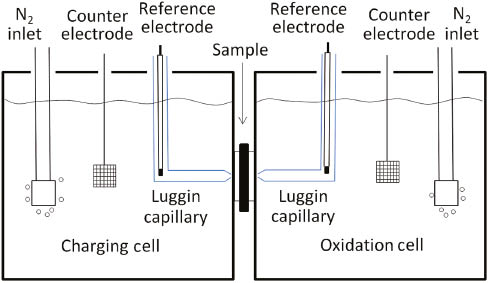
Schematic of a typical double-cell permeation set-up using electrochemical hydrogen charging.
Adapted from Devanathan and Stachurski (1962) and Liu et al. (2014b).
Data collection in the permeation test consists of monitoring the changes in current at the exit cell, whereas a step change in hydrogen concentration at the entry cell is made. The test data can then be mathematically processed to yield diffusion parameters such as hydrogen solubility, permeability and diffusivity, and even density of trapping site and trap energies (Evers et al., 2013; Frappart et al., 2011, 2012; Liu & Atrens, 2015; Liu, Atrens, Shi, Verbeken, & Atrens, 2014b; Zakroczymski, 2006).
4.4 Microstructural analysis: scanning electron microscopy (SEM) and TEM
SEM has been an invaluable tool in the study of HE in metals and is often used in HE and SCC studies involving steel. The technique allows the direct examination of the fracture surface and helps identify several phenomena related to hydrogen-induced failures. The popularity of SEM is due to its versatility, simplicity of use, and lack of stringent requirements on sample preparation (Goldstein et al., 2003). The SEM image also possesses a large depth of field and therefore provides three-dimensional quality to the image. This becomes valuable when assessing fracture features such as microvoids, shear dimples, and hydrogen fisheyes (Moser & Schmidt, 2014). SEM can be paired with other characterization tools, such as energy-dispersive spectroscopy (EDS) and electron backscatter diffraction (EBSD), resulting to a widening of its analytical capability. One minor disadvantage of SEM is the relatively lower magnification and resolution attainable compared to the other more powerful microscopes. However, for most fractographic studies, SEM is adequate and has found its niche in surface imaging studies.
TEM is another tool used for studying the hydrogen influence in metals. TEM has long been considered the most powerful of the electron microscopes, capable of offering up to a million times magnification and nanometer resolution (Williams & Carter, 2009). This microscope can be used to obtain morphological, topographical, and crystallographic information. However, a disadvantage with TEM is the complexity and difficulty in sample preparation. TEM imaging requires a sample to be electron transparent, and this means that the sample needs to have a thickness of <100 nm.
Numerous studies have used TEM for imaging hydrogen fractures and understanding fracture mechanics. Moreover, the use of the environmental TEM paved the way for several important discoveries on the effect of hydrogen on metals (Bond, Robertson, & Birnbaum, 1986; Matsumoto, Eastman, & Birnbaum, 1981; Robertson & Birnbaum, 1986; Tabata & Birnbaum, 1984). This type of TEM has special specimen holders where temperature, deformation, and different chemicals and gases may be introduced to interact with the imaged sample. The environmental TEM may also be reconfigured to enable the in situ straining of the sample (Robertson & Teter, 1998). This technique led to the real-time observation of hydrogen and stress effects in numerous metals. For example, iron hydrogen was found to increase dislocation mobility (Tabata & Birnbaum, 1983) and enhance crack propagation (Tabata & Birnbaum, 1984) under an applied stress.
4.5 Hydrogen microprint technique (HMT)
Sometimes it is important to detect the path of diffusible hydrogen in the metal. These paths can help identify specific microstructures that contribute to the hydrogen influence. HMT is a method that allows the visualization of hydrogen ingress or egress points in steel. This process is relatively simple and provides good accuracy and high spatial resolution (Ichitani, Kanno, & Kuramoto, 2003a; Ichitani, Kuramoto, & Kanno, 2003b; Perez & Ovejero-Garcia, 1982), providing details even of defect and trap distribution (Ohmisawa, Uchiyama, & Nagumo, 2003). HMT is not a stand alone technique for evaluating HE but, similar to TDS and the permeation test, is used complementary to other methods.
HMT studies have been carried out on different steels such as low-carbon steels (Luppo & Ovejero-Garcia, 1991), hypo- and hypereutectoid steels (Matsuda, Ichitani, & Kanno, 2008), austenitic stainless steels (Luppo, Hazarabedian, & Ovejero-Garcia, 1999), duplex stainless steels (Chasse & Singh, 2011; Luu, Liu, & Wu, 2002), microalloyed steels (Mohtadi-Bonab, Szpunar, & Razavi-Tousi, 2013), and high-strength steels (Nagao, Kuramoto, Ichitani, & Kanno, 2001; Nakatani, Fujihara, Sakihara, & Minoshima, 2011; Ronevich, Speer, Krauss, & Matlock, 2012). HMT was also used to study the hydrogen distribution around stress fields, such as in notched and deformed steels (Ichitani et al., 2003a; Nagao et al., 2001).
Perez and Ovejero-Garcia (1982) introduced HMT, which is patterned after the silver decoration process. A thin layer of AgBr gel is applied on the surface of a hydrogen-charged metal. Hydrogen diffuses out of the metal and reacts with the silver salt. The silver ion is reduced to its metallic form and leaves a trail on the areas where hydrogen contact occurred. The silver particles are fixed at these locations and the unreacted gel is removed. The sample is imaged with SEM, and the areas where there is silver represent exit points of hydrogen.
Over the years, several studies have contributed to improving HMT. Ichitani and Kanno (2003) developed a high-sensitivity HMT that offered better resolution and higher hydrogen detection efficiency. This was done by adopting a new silver fixing scheme that included (i) etching the sample before emulsion coating and (ii) exposing the emulsion to a high relative humidity environment. Ronevich et al. (2012) used the work of Ichitani et al., but they altered the way the sample was imaged after silver fixing. They developed the process called “image-before-etch”, where the sample was viewed twice at a fixed spot using SEM. The first imaging was done right after silver fixing and the other after removing the silver particles and etching the sample. This procedure gave better accuracy in identifying hydrogen egress locations especially in fine and multiphase metallic microstructures such as those in AHSS.
5 HE in conventional martensitic steels
The term martensitic steel refers to a large range of steels, including not only those whose microstructure consist wholly of martensite but also those whose strength is based on this microstructure (Garrison & Moody, 2012). These steels are first austenitized, quenched to form martensite, and then heat treated to create different microstructures. Hence, commercial martensitic steels are rarely pure martensite but typically have the tempered martensite microstructure. Some examples of martensitic steels include (i) martensitic stainless steels (e.g. 403 or 410), (ii) high-strength low alloy steels (e.g. 4340), (iii) high alloy, non-stainless secondary hardening steels (e.g. AerMet 100), and (iv) maraging steels (e.g. C200 and T200).
Good reviews on the HE of martensitic steels are available. These reviews have covered different aspects of HE, including the (i) influence on mechanical properties (Hirth, 1980; Louthan, 1974; Louthan, 2008), (ii) microstructural effects (Elboujdaini & Revie, 2009; Thompson & Bernstein, 1981), (iii) influence of material on HE thresholds (Gangloff, 1986; Gerberich, 1974), (iv) crack growth and fracture mechanics (Eliaz, Shachar, Tal, & Eliezer, 2002; Gangloff, 2003; Lynch, 2012b; Williams, Pao, & Wei, 1979), and (v) HE mechanisms (Lynch, 2012a; Nagao, Smith, Dadfarnia, Sofronis, & Robertson, 2012; Robertson et al., 2015). The current work now summarizes HE susceptibility studies on martensitic steels published in the last 5 years. Also, because the strength of martensitic steels has a broad range, then this review reports on the steels with strength <1500 MPa.
Several reviews on the influence of hydrogen on the properties of martensitic steels were published during this period. Garrison and Moody (2012) gave a comprehensive review on the HE of six types of high-strength martensitic steels. They focused on the influence of hydrogen on the crack nucleation and growth for three different environments or conditions: (i) in the presence of hydrogen gas during testing, (ii) when hydrogen is introduced via charging, and (iii) when hydrogen is introduced through corrosion in distilled and salt water. Liu and Atrens (2013) reviewed the HE of medium-carbon steels, including the martensitic types. They discussed the influence of hydrogen on mechanical properties, fracture features, fatigue strength, and fatigue cracking parameters. They also covered microstructural effects on HE susceptibility. Ramamurthy and Atrens (2013) reviewed the SCC of low alloy high-strength steels. They focused primarily on reviewing the SCC crack growth kinetics and discussed the influence of strain, strain rate, and stress rate on SCC.
Studies on the influence of different factors (e.g. strength and loading rates) on the HE of martensitic steels were common. Ham et al. (2013) evaluated the HE susceptibility of high-strength steel bolts (1100–1300 MPa). They tested the bolts at different levels of stresses and strain rates to simulate service conditions. They found that HE susceptibility is proportional to the strength of the steel. Also, HE susceptibility was only evident at low strain rates (<8.3×10⁻⁴/s) and at high stress ratios (0.87). Akiyama et al. (2013) studied martensitic high-strength steels (TS=1100–1500 MPa) used for high-strength bolt applications and found that HE susceptibility increases with increasing mechanical strength. Wang et al. (2013) observed that HE susceptibility of TM210 maraging steels not only depends on strength but also on the reverted austenite content. Ramamurthy et al. (2011) studied the effect of the applied stress rate on the SCC susceptibility of hydrogen-charged 4340 and 3.5NiCrMoV. Both the fracture and threshold stresses decreased with decreasing applied stress rate. Fracture morphologies were predominantly intergranular with quasi-cleavage features, although significant plasticity was also present at the higher applied stress rates. These results indicated that HE susceptibility of the two steels favored low stress rates. Lai, Tsay, and Chen (2013) noted the benefits of tempering in improving the HE resistance of the 410 martensitic stainless. Several studies investigated the effect of prestraining on the HE susceptibility of martensitic steels. Li et al. (2015) examined the effect of hydrogen on the mechanical properties of prestrained high-strength martensitic steels (TS=1300 MPa). The steels were subjected to different levels of prestraining (1–6%), and the ultimate tensile strength (UTS) increased in proportion to the amount of prestraining. They observed that tensile strength decreased when the steels were charged with hydrogen. The steels subjected to >3% prestrain showed the highest HE susceptibility, although this was observed at high hydrogen fugacities only. Prestraining caused a decrease in the hydrogen diffusion coefficient of the steel due to the attendant increase in dislocation density. Hydrogen trapping in the dislocations may have caused the high hydrogen sensitivity of the heavily prestrained steels. Doshida, Nakamura, Saito, Sawada, and Takai (2013) examined the effect of cyclic prestressing on the HE susceptibility of a quenched and tempered martensitic steel (UTS=1500 MPa). They found that, in the presence of hydrogen, the fracture strength and fracture strain decreased with increasing prestress cycles and decreasing strain rate. The fracture mode also shifted from a ductile fracture to brittle, intergranular fracture. This increase in HE susceptibility was caused by the increase in the volume of hydrogen-enhanced defects (e.g. vacancies and vacancy clusters).
A number of studies focused on the effect of microstructure, specifically precipitates and fine grain structures, on the HE susceptibility of martensitic steels. Sun, Chen, and Liu (2015) examined the influence of hydrogen on the ductility and fracture characteristics of low-carbon (0Cr16Ni5Mo) and medium-carbon (40CrNiMoA) quench and tempered high-strength Cr-Ni-Mo steels. The 0Cr16Ni5Mo exhibited a significant decrease in ductility (measured via reduction in area) accompanied by brittle features in the fracture surface after hydrogen charging. In contrast, the tensile properties of 40CrNiMoA were not affected by hydrogen, and all corresponding fractures were ductile. The difference in HE susceptibility was attributed to the difference in the microstructure of the two steels, in particular, to the fine grain structure and the abundant irreversible traps present in 40CrNiMoA. Liu, Wang, and Liu (2014c) studied the effect of Mo on the HE susceptibility of the martensitic 3NiCrMoV steels (UTS=1300–1500 MPa). Two steels with different amounts of Mo were tested. They noted that Mo increased the critical hydrogen concentration necessary for HE due to the occurrence of Mo2C carbides. Nagao et al. (2014) examined the effect of tempering on the HE susceptibility of tempered lath martensitic steels (UTS=1100–1300 MPa). They observed that the occurrence of nanosized (Ti,Mo)C precipitates (i) increased the critical hydrogen concentration for HE and (ii) caused a transition in the fracture features from a combination of intergranular and quasi-cleavage features to quasi-cleavage and ductile MVC features. They proposed that the role of the nanoprecipitates is to trap and remove hydrogen away from dislocations where it could facilitate enhanced dislocation motion and plasticity-mediated failures. Kuduzović et al. (2014) also cited the benefits of carbide precipitates (e.g. V4C3 and TiC) on the delayed fracture susceptibility of the martensitic 34CrNiMo6 (UTS=1300–1500 MPa). Depover, Monbaliu, Wallaert, and Verbeken (2015) investigated the effect of Ti, Mo, and Cr on the HE susceptibility of Fe-C-X (X=Ti, Mo, and Cr) quench and tempered steels. They found that Mo and Cr carbides had a positive effect on HE resistance and Ti carbides showed the opposite effect. Tempering increased the HE susceptibility of the Ti-bearing steels. The high HE susceptibility of the Ti-bearing steels was attributed to the abundance of TiC precipitates that weakly trapped hydrogen in the lattice. Moon et al. (2016) studied the effect of precipitates on the HE of low-carbon quench and tempered API steel (UTS=1200 MPa). At the end of tempering at 650°C, two types of precipitates were present: M7C3 and M23C6, where M is V, Nb, or Ti. Tempering improved the HE resistance due to the presence of the tempered martensite microstructure. On the contrary, the appearance of coarse M7C3 and M23C6 precipitates increased the HE susceptibility of the steels. Sasaki, Koyama, and Noguchi (2015) found that Mn segregation and MnS promote hydrogen-assisted cracking in medium-carbon quenched and tempered Cr-Mo martensitic steel (TS=950 MPa) that are used for hydrogen storage. Failure was associated with the HELP and HEDE mechanism, with Mn specifically promoting HEDE during crack propagation.
Several studies confirmed the adverse effect of nonmetallic inclusions on the HE resistance of martensitic steels. Liu et al. (2013, 2014a) studied the hydrogen influence on the mechanical properties of four quench and tempered NiCrMo martensitic steels (600–800 MPa) using the LIST. They found that the steels had good resistance to HE, although the presence of aluminum oxide inclusions increased HE susceptibility by serving as crack nucleation points. Todoshchenko, Yagodzinskyy, Saukkonen, and Hänninen (2014) confirmed the crack-initiating role of inclusions in high-strength carbon steels (TS=1200 MPa). Huang, Liu, Liu, Zhang, and Xi (2014) investigated the sulfide stress cracking resistance of a welded HSLA (600 MPa). This type of SCC failure is hydrogen related. The presence of (i) an inhomogeneous microstructure (martensite, bainite, and ferrite) and (ii) inclusions in the heat-affected zone of the welded area contributed to the poor HE resistance of the steel. Hydrogen concentrations were high around the nonmetallic inclusions, which signifies strong hydrogen trapping by these defects. Liu, Li, Li, and Yang (2011) investigated the influence of inclusions in creating “fisheyes”, a typical fracture morphology associated with HE in high-strength steels. They noted that the size of fisheyes increased with increasing inclusion size. Furthermore, the stress needed to create fisheyes decreased in the presence of hydrogen. Cracks also heightened the HE susceptibility of martensitic steels. Solano-Alvarez, Song, Han, Suh, and Bhadeshia (2015) observed that tiny cracks reduced the (i) effective hydrogen diffusion and the (ii) amount of hydrogen released via the desorption in martensitic-bearing steels.
Some studies looked at new ways to mitigate the effect of HE in martensitic steels. Nie et al. (2012) improved the HE resistance of a tempered martensitic steel (TS=1500 MPa) via a tempforming process. The microstructure of the steel consisted of (i) an ultrafine elongated grain structure that had a strong rolling direction fiber texture and (ii) finely dispersed cementite particles. Barnoush, Asgari, Johnsen, and Hoel (2013) noted the ability of the nitride layer on low-alloy 2.25Cr-1Mo martensitic structural steel to reduce HE susceptibility. Wang, Tasan, Koyama, Ponge, and Raabe (2015) found that austenite nanofilms present in between martensite laths had the potential to remedy HE in martensitic steels. Park, Nam, Kim, and Kim (2013) used an electrotransport treatment to remove accumulated hydrogen in an ASME SA508 Gr.1A quench and tempered martensitic steel. The treatment involved the application of an electrostatic field to induce mass transportation of solute elements in the steel. The amount of extracted hydrogen increased with increasing applied currents. The treatment restored the original tensile properties and ductile fracture characteristics of the hydrogen-charged steel.
Several studies proposed new ways to study and evaluate HE in high-strength steels. García, Rodríguez, Belzunce, Peñuelas, and Arroyo (2015) used a novel small punch test (SPT) to study HE in CrMoV steels. The SPT is quasi-non-destructive and involves only a small amount of test material. Calabrese et al. (2015) proposed a noninvasive assessment tool to detect and assess damage associated with SCC. They used a combination electrochemical noise (EN) and acoustic emission (AE) techniques to study SCC of a 17-4PH martensitic stainless steel. The EN technique was successful in identifying electrochemical damage mechanisms (e.g. pitting and activation), whereas the AE technique was useful in identifying the evolution of mechanical damage (e.g. crack nucleation and growth). These combined techniques could be used for the reliable detection and study of damage during SCC. Raykar, Singh Raman, Maiti, and Choudhary (2012) successfully used the circumferentially notched tensile (CNT) test technique to investigate the HE susceptibility of ASTM 4340 steel in 3.5% NaCl solution. The stress intensity factor at fracture decreased with increasing hydrogen precharging and decreasing loading rates. They found that the experimental threshold values for HE at the slow loading rates determined using the CNT were in good agreement with published data. Yonezu, Hara, Kondo, Hirakata, and Minoshima (2012) used the Vickers test to investigate the HE susceptibility of high-strength steel. Radial cracks initiated and propagated from the corners of the indentations in the hydrogen-charged specimens. They proposed that the length of these cracks may be used to evaluate HE susceptibility, as they found good agreement between the computed value of the stress intensity factor at the indentation crack and the threshold stress intensity factor for crack propagation. Szost and Rivera-Díaz-del-Castillo (2013) studied the hydrogen sensitivity of martensitic 1C-1.5Cr steel using the hydro-hardness analysis. In this method, crack formation was induced via indentation of hydrogen-charged specimens, and gas bubble emission from the crack was subsequently filmed. They observed that the process of crack nucleation in the hydrogen-bearing samples occurred with an attendant release of hydrogen. They concluded that this observation supports the hydrogen-enhanced localized plasticity model as a primary HE mechanism in these steels. Smanio et al. (2011) used the AE technique to study SCC in high-strength low alloy martensitic steels. The technique enabled the quantitative information on SCC fracture mechanics (e.g. incubation-initiation time and crack propagation rate).
HE susceptibility studies were also conducted to determine the applicability of some martensitic steels for certain applications. Matsunaga, Yoshikawa, Kondo, Yamabe, and Matsuoka (2015) examined the HE susceptibility of a CrMo (JIS-SCM435) quench and tempered martensitic steel (UTS=900 MPa), which are being considered in gaseous hydrogen storage. SSRT results indicated that, whereas mechanical strength of the martensitic steel was unaffected, ductility was significantly reduced by hydrogen. In contrast, fatigue tests did not indicate significant HE susceptibility in the steels. The results indicated the feasibility of using the steel in hydrogen applications. Similarly, Liu et al. (2014a) used the LIST and found good HE resistance in CrMoV steels that were considered for gaseous hydrogen storage. Depover, Perez-Escobar, Wallaert, Zermout, and Verbeken (2014) observed good HE resistance in high-strength low alloy steel used for automotive applications. Kuduzović et al. (2014) assessed the HE susceptibility of 34CrNiMo6 steel for possible applications in ultra-high-strength bolts and fasteners. They observed good HE resistance in the 34CrNiMo6 steel. They also noted the potential of using the martensitic steel in ultra-high-strength bolt and fastener applications, especially if microstructure optimisation was applied.
6 HE in MS-AHSS and low-carbon martensite sheet steels
HE can cause subcritical crack growth at stresses a fraction of the tensile strength. Alternatively, HE can be manifested as a loss of ductility with no decrease of yield strength and no decrease in tensile strength.
MS-AHSS are relatively new, having been of commercial importance only for the last 5–10 years. There are few published work on the HE of MS-AHSS. Other AHSS such as TRIP, TWIP, and DP have attracted more attention owing to either their high commercial acceptance, as in the case of DP steels, or novelty and potential, as in the TRIP and TWIP steels. Thus, studies on MS-AHSS are typically combined with the results of tests done on other types of AHSS. The current section presents a review of HE studies on MS-AHSS. Studies on low-carbon martensite sheet steels are included as these were the precursors of MS-AHSS and the PH steels with focus on the 22MnB5.
Payer, Preban, and Leckie (1976) published maybe the first study on the HE of low-carbon (i.e. 0.15 wt% C) martensitic steels. They investigated different grades of low-carbon martensitic steels, cold-rolled AISI 1055, and quench and tempered AISI 1074 steels. Notched samples were charged cathodically in a sodium sulfate solution and were subjected to a static load test. HE susceptibility was measured using (i) the time to failure at different stresses, expressed as a percentage of the UTS, and the (ii) threshold stress. Their observations included the following: (i) as the UTS of the steel increased, the threshold stress and time to failure decreased and HE susceptibility increased; (ii) there exists a threshold stress below which HE did not occur; (iii) cold-rolled martensitic steels had HE susceptibility higher than the hot-rolled counterpart, which indicated the influence of residual stress on HE; (iv) zinc coating increased HE susceptibility; and (v) tempering decreased HE susceptibility. The hydrogen mobility was highest and HE susceptibility was lowest in the low-carbon martensitic steel. For a short charging time, HE susceptibility was related to low hydrogen mobility attributed to hydrogen accumulation at the surface, where it did the most damage, instead of diffusing rapidly into the steel.
Conder, Felton, Burke, and Dent (2010) studied HE of low-carbon martensitic steels using SSRTs and the constant load tests. The smooth samples were cathodically precharged at various potentials (from -700 to -1300 mVSCE) in NaCl solution containing a hydrogen recombinant poison. The amount of hydrogen in the samples was measured using the hot extraction method. They found that significant hydrogen uptake (~2 ppm) only occurred at -1300 mVSCE. They observed minimal embrittlement behavior as manifested in the reduction of the elongation to failure and in the appearance of brittle features after SSRT of the hydrogen-charged samples. However, this embrittlement was only apparent after the onset of considerable plastic deformation. In the constant load test, there was no failure even at an applied stress equivalent to 90% of the tensile strength. They concluded that, contrary to Payer et al., the absence of significant HE susceptibility in the low-carbon martensitic steel for cathodic polarizations in the presence of a hydrogen poison. It is possible that the difference between the results of Payer et al. and Conder et al. was due to the difference in the properties of the steel tested and the presence of a notch in the specimens.
Lee, Ronevich, Krauss, and Matlock (2010) studied the HE of hardened low-carbon steel using tensile tests of smooth, hydrogen-charged specimens. The steel tested was the 10B22 (22MnB5) PH sheet steel. Tensile specimens were cathodically charged in 1 N H2SO4 containing 1 mg/l As2O3 to inject a constant hydrogen concentration (1.7 ppm). HE susceptibility was evaluated from the tensile properties and the fracture features. The steel as-quenched was the most sensitive to hydrogen, and tempering decreased this sensitivity, attributed to a reduction in the dislocation density and an increase in cementite particle density. Furthermore, boron had no significant influence in improving the HE resistance.
Ronevich, Speer, and Matlock (2010) reported on the HE susceptibility of martensitic M220 AHSS and other commercial AHSS. The study used the tensile test of cathodically charged specimens. HE was assessed based on tensile properties, such as yield, UTS and ductility, and fracture behavior. There was a significant decrease in the fracture strength and tensile ductility of MS-AHSS at hydrogen levels of 1.8 ppm. There was also a shift from ductile to brittle, transgranular cleavage fracture with increasing amounts of hydrogen in MS-AHSS. They concluded that the martensite phase was especially sensitive to hydrogen and susceptible to hydrogen-induced failure.
Loidl, Kolk, Veith, and Gobel (2011) studied the HE of five AHSS, including an MS-AHSS with a tensile strength of 1200 MPa. They used SSRT of smooth specimens, undergoing hydrogen charging in gaseous hydrogen at a pressure of 100 bar at room temperature. The amount of hydrogen was measured using TDS. HE susceptibility was evaluated using an HE index that was calculated from the breaking strains of the charged and uncharged specimens. MS-AHSS experienced a significant reduction in ductility and enhanced brittle fracture, although the amounts of diffusible hydrogen (0.14 ppm) and trapped metallurgical hydrogen (0.48 ppm) were considered to be relatively small. MS-AHSS had the highest tensile strength and third highest HE susceptibility after the TRIP and DP steels. They attributed the higher HE susceptibility of the multiphase steels to phase transformation and phase interactions.
Lovicu et al. (2012) studied the HE susceptibility of several AHSS, including two MS-AHSS with different strength levels, and a PH or hot-stamped steel. They used the SSRT on notched samples that were electrochemically charged with hydrogen. The fracture stress was used as an indication of HE susceptibility, on the grounds that the presence of the notch could obscure the use of ductility as an assessment criterion. The hydrogen content was also measured using the barnacle electrode method based on ASTM F113 standard. HE susceptibility was dependent on the mechanical strength and microstructure. The martensitic steels were more susceptible to HE, especially those with higher strengths such as the hot-stamped steels. The critical hydrogen concentration for MS-AHSS ranged from 1 to 4 wppm. The presence of volume defects (e.g. inclusions) was also deleterious and lead to greater hydrogen sensitivity.
Rehrl, Mraczek, Pichler, and Werner (2015) reported on the effect of Ti(C,N) on the HE susceptibility of several AHSS, including a tempered martensitic grade AHSS with a nominal strength of 1400 MPa. The constant load test was used on smooth samples that were hydrogen charged in 1 N H2SO4 with 10 mg/l thiourea. They concluded that Ti(C,N) particles had no pronounced positive effect on the HE susceptibility of MS-AHSS, although hydrogen diffusion was slowed by the presence of these precipitates.
Nagao, Hayashi, Oi, and Mitao (2012) studied the effect of cementite particles on the HE susceptibility in 1000–1300 MPa class, low-carbon martensitic steels. Smooth samples were cathodically charged in a 3% NaCl with 0.3 g/l NH4SCN solution and were subjected to SSRT and the constant load tests. The fine, uniformly distributed cementite improved HE resistance in the steels when subjected to dynamic loading via the SSRT. However, cementite had no effect for the constant load tests. The difference was attributed to the continuously increasing strain during which the SSRT created enough strains in the precipitate-matrix interface that shifted the hydrogen trapping energy state in the interface from low to high.
Momotani, Shibata, Terada, and Tsuji (2013) studied the effect of strain rate on the HE of low-carbon (0.2% C) martensitic steel. They used smooth samples and applied strain rates from 8.3×10⁻⁶ to 8.3×10⁻¹ s-1. The tensile strengths were largely unaffected by strain rate. However, the total elongation of the steel decreased significantly after hydrogen charging, and the fraction of the fracture area exhibiting brittle features, such as intergranular fracture and flat planes with striations, increased with decreasing strain rate. At the slowest strain rate, all microcracks originated exclusively from PAG boundaries. Shibata, Takahashi, and Tsuji (2012) had similar results in their study of hydrogen-related crack propagation in low-carbon martensitic steels. They concluded that the primary mechanism of hydrogen-induced fracture in martensitic sheet steels involved microcrack nucleation around PAG boundaries and subsequent crack propagation occurs along block and lath boundaries. They proposed hydrogen-enhanced plasticity as the main mechanism for hydrogen-related fractures in these steels.
Rehrl, Mraczek, Pichler, and Werner (2014) also studied the effect of strain rate on the HE susceptibility of four types of AHSS, including a tempered martensitic-type AHSS. They used two strain rates: a high rate equal to 20 s-1 and a low rate equal to 10-5 s-1. There was no sign of hydrogen sensitivity in any of the steels at the high strain rate. However, there was significant HE susceptibility at the low strain rate, with the martensitic steel showing the highest susceptibility. There were areas of quasi-cleavage fracture mixed with ductile regions in the hydrogen-influenced specimens, attributed to a combination of the HEDE and HELP mechanisms.
Mohrbacher (2014) reviewed the metallurgical techniques that may be used to study MS-AHSS for automotive applications. He noted several processes that may improve the hydrogen resistance of MS-AHSS. These include (i) grain refinement of the PAG structure, (ii) decrease of impurities and inclusions to a minimum, (iii) the addition of Nb to form fine carbides as strong hydrogen traps, and (iv) alloying with molybdenum to neutralize the negative effects of impurities along grain boundaries. Zhang et al. (2015) confirmed that alloying with Nb improved the HE resistance of 22MnB5 steels and attributed the improvement to (i) effective trapping by NbC, as evidenced by the decrease in the diffusion coefficient, and (ii) a decrease in grain size by the Nb(C,N), which increased the grain boundary area and redistributed the H more uniformly.
Matsuno et al. (2014) investigated the HE behavior of hot-sheared and quenched 22MnB5 steels. The steels were initially austenitized, sheared at high temperature, and quenched into water. The specimens were then cathodically hydrogen charged in an electrolyte for 48 h. Despite the presence of more than 1 GPa residual stress and about 1.5 ppm H, the quenched 22MnB5 showed high HE resistance. This was attributed to the presence of fine ferrite and bainite phases in the vicinity of the sheared surface. The large strains in the austenite caused a delay in martensite transformation, enabling the formation of these ductile phases that lessened the hydrogen sensitivity.
Zhou, Wang, and Li (2014) compared the susceptibility to hydrogen-delayed failures of three types of AHSS, namely, martensitic, DP, and Q&P steels. The three steels possessed similar tensile strength equal to 980 MPa. HE susceptibility was assessed using three techniques: (i) U-bend test, (ii) SSRT, and (iii) constant load test. For the U-bend test, the specimens were immersed in 0.1 m HCl for 300 h. For the SSRT and constant load tests, hydrogen charging was carried in 0.5 m H2SO4+0.22 g/l CN2H4S. There were no hydrogen-related fractures in the three steels subjected to the U-bend test even after 300 h of exposure attributed to the low amount of hydrogen produced during the immersion. In contrast, both the SSRT and the constant load test indicated that HE susceptibility was highest in MS-AHSS. The fracture surface of MS-AHSS consisted primarily of brittle quasi-cleavage fracture features.
Moli-Sanchez, Zermout, Duprez, and Malet (2014) studied HE in two families of MS-AHSS, both with tensile strength exceeding 1000 MPa. Tempering was applied on these two steels and produced two more sets of steels with different strength. Constant load and step loading tests were used to assess HE susceptibility of notched hydrogen-charged specimens. HE susceptibility increased with the strength of MS-AHSS, and tempering improved the HE resistance.
In summary, these studies indicated the HE susceptibility of MS-AHSS. The HE susceptibility of MS-AHSS was strongly influenced by the following factors: (i) tensile strength, (ii) strain rate, (iii) degree of hydrogen charging, (iv) tempering, (v) microstructure, (vi) residual stress, (vii) fabrication route, (viii) inclusions, (ix) metallic coatings, and (x) specific secondary phases or precipitates. Some rules applicable to conventional steels may not apply to MS-AHSS. For example, although carbides, in general, can improve the HE susceptibility of conventional steels, it appears that only certain types of precipitates work on MS-AHSS. This shows that HE is complex, even for cases where only a single phase such as martensite is present in the steel. Thus, further studies are warranted to help reveal more about the nuances of HE in MS-AHSS.
The concentration of hydrogen present in the tested steels varied from 0.5 to 4 ppm. Only Lovicu et al. (2012) attempted to measure the critical hydrogen concentration, Hcr, at which the steel exhibited significant HE susceptibility. The Hcr for MS-AHSS with UTS of 1400 MPa was measured to be 1.0 ppm. The Hcr increased to 3.8 ppm for MS-AHSS with UTS of 1200 MPa, indicating a lower sensitivity to hydrogen. Surprisingly, the hot-stamped steel with UTS of 1500 MPa showed similar Hcr equal to 4.0 ppm but displayed the highest HE susceptibility. This means that Hcr needs to be used with caution.
The most commonly employed test to assess HE susceptibility is the SSRT followed by the constant stress/load test and the tensile test. These tests are standardized and have gained wide acceptance. The specimens tested were either smooth or notched. A smooth specimen is a logical sample, as many components spend much, if not all, of their serviceable life free of defects. On the contrary, a notched specimen may more accurately reflect the sensitivity to the presence of both a defect and a hydrogen. Moreover, a notched test often ensured specimen failure, as the presence of a hydrostatic stress at the notch increases the embrittling effect of hydrogen. However, some discrepancy in findings may occur when comparing the HE behavior of notched and unnotched steels, such as those cited by Conder et al. (2010). The hydrogen charging of steels was achieved via two methods: (i) in aqueous solutions with the application of a cathodic potential and (ii) by exposure to high pressures of gaseous hydrogen. Only the study by Loidl et al. (2011) used in situ gaseous hydrogen charging. Clearly, an advantage of using aqueous solutions is their simplicity, as using gaseous hydrogen requires a special sealed chamber and poses some risks during operation.
The effect of hydrogen on MS-AHSS was manifested in the reduction of the tensile strength and/or ductility, and these parameters were used to quantify HE susceptibility. Some studies indicated that UTS was unaffected, and invariably ductility and fracture features were influenced by hydrogen. This indicated that these two parameters were more sensitive in detecting the impact of hydrogen on martensitic steels. For notched samples, monitoring changes in ductility for HE assessment may not be applicable, as the presence of the notch limits the amount of ductility. For notched specimens, it was proposed that considering strength parameters and investigating fracture features were the more appropriate approach (Lovicu et al., 2012).
Two common observations in the studies that examined the fracture surfaces were (i) the shift from ductile microvoid fracture features in the uncharged specimens to brittle fracture features in the hydrogen-charged samples and (ii) an increase in the areas possessing brittle fractures coincident with a more brittle behavior. The brittle fracture features included (i) transgranular, (ii) intergranular, and (iii) quasi-cleavage fractures. Transgranular fracture occurred at the lath and packet boundaries, whereas intergranular fracture occurred through the PAG. MVC dimples also occurred in hydrogen-affected samples, and these were often small and shallow, indicating relatively poor ductility. Figure 7A and B gives typical examples of a mixed transgranular-intergranular fracture and MVC dimples in a hydrogen-influenced steel. Furthermore, there were fisheyes in the studies by Lee et al. (2010). A fisheye is a circular brittle region that initiates from a defect such as void or inclusion, and this fracture phenomenon is often associated with HE. An image of a fisheye is shown in Figure 7C. Finally, with insight from fracture analysis, most of the studies agreed on the HELP as the predominant mechanism to explain hydrogen-influenced brittle fractures in MS-AHSS.

SEM images of (A) transgranular-intergranular fracture, (B) MVC dimples, and (C) fisheyes.
Reproduced from Venezuela, Liu, Zhang, Zhou, and Atrens (2015).
7 Concluding remarks: future research
The following are some of the (i) unresolved issues with the HE of MS-AHSS and (ii) suggested future researches in this field.
The relationship of hydrogen concentration and the hydrogen-charging conditions with HE in MS-AHSS is still unclear. The critical hydrogen concentration sets the allowable level of hydrogen to prevent HE. This parameter is influenced by several factors such as mechanical strength, residual stress, and processing, and this complicates attempts at measuring the value. Hydrogen charging is done in either electrolytic or gaseous conditions. It may be worthwhile to correlate the electrolytic charging potentials with the equivalent hydrogen fugacity and establish a relationship between these two hydrogen-charging practices.
The actual hydrogen uptake of MS-AHSS car components during service is also important to measure. An accurate measurement of the hydrogen uptake would help assess the chance of HE occurrences, especially if the critical hydrogen concentration is known. Some efforts to conduct this type of measurement are under way. For example, Ootsuka, Fujita, Tada, Nishikata, and Tsuru (2015) used the electrochemical permeation test to do in situ measurements of the hydrogen uptake of a steel plate connected to the underside of a car. Future studies may test MS-AHSS components and could examine using more accurate techniques to do in situ hydrogen measurements.
In some steels, HE failure is preceded by crack nucleation and subcritical crack growth. In other HE cases, the mechanical strength is stable and ductility is significantly affected. It is important to understand what conditions or factors (e.g. strength of steel, hydrogen concentration, charging condition, and loading condition) can lead to the specific HE response in MS-AHSS.
Most HE studies on MS-AHSS are conducted under controlled laboratory conditions. The question of how these results reflect the actual performance of the steel in service needs to be examined. Furthermore, most studies use an HE index, based on either strength or ductility parameters, to quantify HE susceptibility. However, there is no standard that establishes the acceptable value of an HE index to guarantee the “safe” application of the steel with respect to HE.
One study lacking is an investigation on the effect of controlling applied stress rates on the HE susceptibility of MS-AHSS. The typical approach has been to use a constant stress, as in the constant load test, or to control the applied strain rate, as in the tensile test and the SSRT. However, steels are often subjected to constant or varying loads when in service and therefore in a condition that is load controlled (Atrens et al., 1993). A stress-controlled test, such as the LIST, may be more suitable in predicting the behavior of the steel under such conditions.
A comprehensive study of the trapping mechanisms in MS-AHSS is worthwhile. This is relevant to understand the complex interactions between MS-AHSS and hydrogen and could help in designing preventive measures against hydrogen-induced failures. A series of tests may be done, including (i) assessing hydrogen permeability and diffusivity using the permeation test, (ii) investigating hydrogen trapping profiles with TDS, and (iii) combining these with a test that shows the spatial relationship of structural traps such as HMT. A microstructural analysis with TEM could also reveal the contribution of PAG and lath boundaries, nanoprecipitates, and retained austenite to the overall trapping mechanisms.
Computer-aided modeling has considerably progressed in the last few years. This field may be tapped to solve hydrogen-related problems in MS-AHSS or even design strong yet hydrogen-resistant AHSS. An advantage in computer modeling is that one can have an idea of possible results without the need to perform exhaustive and expensive experiments. A recent trend is to use ab initio computer modeling to predict the interaction of hydrogen with solid solution elements, grain sizes, or second-phase precipitates. These interactions determine if a specific microstructure can be beneficial to the steel with regard to HE.
The automotive industry lacks a simple, quick yet conclusive test that assesses HE-related problems in AHSS. This test would help manufacturers make timely and informed decisions regarding product issues. Recently, Horvath and Oxley (2015) proposed a modified U-bend immersion test to rank the HE susceptibilities of AHSS used for automotive applications. However, they conclude that more work is required to improve the accuracy and applicability of the test.
About the authors

Jeffrey Venezuela (BS Metallurgical Engineering, MS Metallurgical Engineering, University of the Philippines, 2003) is currently working on his PhD in Materials Engineering at The University of Queensland, Australia. His current research interest is in the HE of MS-AHSS. From 1998 to 2014, he was an assistant professor at the Department of Mining, Metallurgical, and Materials Engineering, University of the Philippines, Diliman.

Qinglong Liu is a senior PhD student at The University of Queensland, Australia. He received his Bachelor’s degree from the Ocean University of China and his Master’s degree in engineering from the University of Science and Technology, Beijing, China, where his research focused on the corrosion and protection of magnesium alloys for aerospace applications. He is currently working on his PhD, studying the influence of hydrogen on steels for autoconstruction. In 2015, he spent 1 month in the Baoshan Iron & Steel Co., Ltd., Shanghai, China, for his PhD research.

Mingxing Zhang (BEng IMUST 1984, MEng NWPU 1987, PhD UQ 1997) is professor of Materials at The University of Queensland, where he has been since 1994. Prof. Zhang is a world leader in the area of phase transformations and application in engineering materials. He is recognized as one of the top researchers in crystallography of phase transformations in solids and grain refinement of cast metals. His other research focuses on surface engineering of metallic materials to improve their surface durability and on the development of new alloys, including lightweight alloys and high-strength, high-ductility steels. He has expertise in the areas of cold spray, packed powder diffusion coating, and surface nanocrystallization of metallic materials.

Qingjun Zhou, PhD (USTB 2007), is a senior engineer of Research Institute, Baosteel Group Corporation, China. His research areas are corrosion of steels, HE, and hydrogen-induced delayed fracture of high-strength automobile steels.

Andrej Atrens [BSc (Hons), PhD Adelaide 1976, GCEd, DEng UQ 1997] is professor of Materials at The University of Queensland, where he has been since 1984. His research areas are corrosion of magnesium, HE and SCC, corrosion mechanisms, atmospheric corrosion, and patination of copper. An international academic reputation is evident from invitations for keynote papers at international conferences, invitations as guest scientist/visiting professor at leading international laboratories, an ISI H-index of 47 (Web of Science), many citations [9063 citations (Web of Science)], 14 journal papers with more than 100 citations, five journal papers with more than 400 citations, and an excellent publication record in top international journals with more than 230 refereed journal publications.
Acknowledgments
This research is supported by the Baosteel-Australia Joint Research & Development Centre (BAJC) Grant BA13037, with linkage to Baoshan Iron & Steel Co., Ltd. (Shanghai, China).
References
Abraham A. Future Growth of AHSS. Ducker Worldwide. Great Designs in Steel Seminar. Available at: http://www.ducker.com/. Retrieved July 17, 2014.Search in Google Scholar
Akiyama E, Wang M, Li S, Zhang Z, Kimura Y, Uno N, Tsuzaki K. Studies of evaluation of hydrogen embrittlement property of high-strength steels with consideration of the effect of atmospheric corrosion. Metall Mater Trans A 2013; 44: 1290–1300.10.1007/s11661-012-1403-2Search in Google Scholar
Albert SK, Ramasubbu V, Parvathavarthini N, Gill TPS. Hydrogen-assisted cracking and diffusible hydrogen content in Cr-Mo steel welds. Sadhana 2003; 28: 383–393.10.1007/BF02706439Search in Google Scholar
Allain S, Chateau JP, Bouaziz O, Migot S, Guelton N, Frommeyerr G, Brux U. Microstructures and mechanical properties of high-strength FeMn-Al-C light TRIPLEX steels. Steel Res Int 2006; 77: 627–633.10.1002/srin.200606440Search in Google Scholar
Aosaka T. Metal hydrogen systems: hydrogen trapping behaviour in plain carbon and Cr-Mo alloy steel. In: Veziroglu N, editor. Proc Int Symp Metal Hydrogen Syst. Oxford: Pergamon, 1982: 197–204.10.1016/B978-0-08-027311-2.50024-3Search in Google Scholar
ArcelorMittal. Steel Providing Solutions to OEMs Challenges. Available at: http://automotive.arcelormittal.com/. Retrieved July 21, 2014a.Search in Google Scholar
ArcelorMittal. Usibor: Steels for Hot Stamping. Available at: http://automotive.arcelormittal.com/. Retrieved April 12, 2014b.Search in Google Scholar
ArcelorMittal. MartINsite® Steels. Available at: http://automotive.arcelormittal.com/. Retrieved September 12, 2015.Search in Google Scholar
Askeland D, Fulay P, Wright V. The science and engineering of materials, SI edition, Canada: Cengage Learning, 2011.Search in Google Scholar
Atrens A, Dannhaeuser G. Stress corrosion cracking of Zircaloy-4 cladding tubes, part I. Threshold in the presence of iodine. J Nucl Mater 1984; 126: 91–102.10.1016/0022-3115(84)90078-3Search in Google Scholar
Atrens A, Oehlert A. Linearly-increasing-stress testing of carbon steel in 4 N NaNO3 and on Bayer liquor. J Mater Sci 1998; 33: 783–788.10.1023/A:1004314517742Search in Google Scholar
Atrens A, Brosnan CC, Ramamurthy S, Oehlert A, Smith IO. Linearly increasing stress test (LIST) for SCC research. Meas Sci Technol 1993; 4: 1281–1292.10.1088/0957-0233/4/11/017Search in Google Scholar
Automotive Applications Council. AHSS 101 – The Evolving Use of Advanced High-Strength Steels for Automotive Application. Available at: http://www.autosteel.org/. Retrieved April 20, 2014.Search in Google Scholar
Baboian R. Corrosion tests and standards: application and interpretation, 2nd ed., West Conshohocken, PA: ASTM International, 2005: 302–321.10.1520/MNL20_2ND-EBSearch in Google Scholar
Banerji SK, McMahon CJ, Feng C. Intergranular fracture in 4340-type steels: effects of impurities and hydrogen. Met Trans A 1978; 9A: 237–247.10.1007/BF02646706Search in Google Scholar
Barnett WJ, Troiano AR. Crack propagation in hydrogen induced brittle fracture of steel. J Met 1957; 9: 486–494.10.1007/BF03397905Search in Google Scholar
Barnoush A, Vehoff H. Electrochemical nanoindentation: a new approach to probe hydrogen deformation interaction. Scr Metall 2006; 55: 185–198.10.1016/j.scriptamat.2006.03.041Search in Google Scholar
Barnoush A, Asgari M, Johnsen R, Hoel R. Hydrogen effect on nanomechanical properties of the nitrided steel. Metall Mater Trans A 2013; 44: 766–775.10.1007/s11661-012-1462-4Search in Google Scholar
Bates JF, Loginow AW. Principles of stress corrosion cracking as related to steels. Corrosion 1964; 20: 189–197.10.5006/0010-9312-20.6.189tSearch in Google Scholar
Beachem CD. A new model for hydrogen assisted cracking (hydrogen embrittlement). Metall Trans 1972; 3: 437–451.10.1007/BF02642048Search in Google Scholar
Becker WT, Shipley RJ, editors. Hydrogen Damage and Embrittlement, Failure Analysis and Prevention. Vol 11 ASM Handbook, Materials Park, OH: ASM International, 1986.Search in Google Scholar
Bell T, Owen WS. Martensite in iron-nitrogen alloys. J Iron Steel Inst 1967; 205: 428–434.Search in Google Scholar
Bergers K, Camisao de Souza E, Thomas I, Mabho N, Flock J. Determination of hydrogen in steel by thermal desorption mass spectrometry. J Flock Steel Res Int 2010; 81: 499–507.10.1002/srin.201000023Search in Google Scholar
Bernstein IM, Garber R, Pressouyre GM. Effect of hydrogen on behavior of materials. In: Thompson AW, Bernstein IM, editors. Effect of hydrogen on behavior of materials. New York: TMS-AIME, 1976: 37.Search in Google Scholar
Bernstein IM, Thompson AW. Effect of metallurgical variables on environmental fracture of steels. Int Met Rev 1976; 21: 269–287.Search in Google Scholar
Bhat SP. Advances in High Strength Steels for Automotive Applications. Automotive Product Applications Arcelor Mittal, 2008. Available at: http://www.autosteel.org/. Retrieved April 12, 2014.Search in Google Scholar
Bhattacharya D. An overview of advanced high strength steels (AHSS). Advanced High Strength Steel Workshop. Arlington, VA: Auto/Steel Partnership, October 22–23, 2006.Search in Google Scholar
Bhattacharya D. Metallurgical perspectives on advanced sheet steels. In: Weng Y, Dong H, Gan Y, editors. Advanced steels: the recent scenario in steel science and technology. New York: Metallurgical Industry Press and Springer-Verlag GmbH, 2011: 174.10.1007/978-3-642-17665-4_18Search in Google Scholar
Bhattacharya D. The MartINsite® Success Story – From Shoe Shanks to Car Bumpers. Available at: http://automotive.arcelormittal.com/. Retrieved June 15, 2015.Search in Google Scholar
Birnbaum HK. Mechanisms of hydrogen related fracture of metals. In: Moody NR, Thompson AW, editors. Hydrogen effects on materials behavior. Warrendale, PA: TMS, 1990: 639–658.10.21236/ADA208210Search in Google Scholar
Birnbaum HK. Hydrogen effects on deformation-relation between dislocation behavior and the macroscopic stress strain behavior. Scr Metall Mater 1994a; 31: 149–153.10.1016/0956-716X(94)90166-XSearch in Google Scholar
Birnbaum HK, Sofronis P. Hydrogen-enhanced localized plasticity – a mechanism for hydrogen related fracture. Mater Sci Eng A 1994b; 176: 191–202.10.1016/0921-5093(94)90975-XSearch in Google Scholar
Birnbaum HK, Robertson IM, Sofronis P, Teter D. Mechanisms of hydrogen related fracture – a review. In: Magnin T, editor. Corrosion-deformation interactions, 1997: 172.Search in Google Scholar
Birnbaum HK, Robertson IM, Sofronis P. Hydrogen effects on plasticity. In: Lépinoux J, editor. Multiscale phenomena in plasticity. Kluwer Academic Pub, 2000: 367–381.10.1007/978-94-011-4048-5_29Search in Google Scholar
Bockris J. Modern electrochemistry: an introduction to an interdisciplinary area, Plenum Press, 2000.Search in Google Scholar
Bockris J, Potter E. The mechanism of hydrogen evolution at nickel cathodes in aqueous solutions. J Chem Phys 2004; 20: 614.10.1063/1.1700503Search in Google Scholar
Bond GM, Robertson IM, Birnbaum HK. On the determination of the hydrogen fugacity in an environmental cell TEM facility. Scr Metall 1986; 20: 653–658.10.1016/0036-9748(86)90484-9Search in Google Scholar
Bouaziz O, Zurob H, Huang M. Driving force and logic of development of advanced high strength steels for automotive applications. Steel Res Int 2013; 84: 937–947.10.1002/srin.201200288Search in Google Scholar
Brass AM, Chene J. Influence of deformation on the hydrogen behavior in iron and nickel base alloys: a review of experimental data. Mater Sci Eng A 1998; 242: 210–221.10.1016/S0921-5093(97)00523-6Search in Google Scholar
Brass AM, Chanfreau A, Chêne J. Helium 3 precipitation in tritiated AISI 316 stainless steels. In: Thompson NW, Moody NR, editors. Hydrogen effects on material behavior. Warrendale: TMS, 1990: 19.Search in Google Scholar
Briant CL, Banerji SK. Intergranular failure in steel: the role of grain boundary composition. Int Metall Rev 1978; 23: 164–199.10.1179/095066078790136652Search in Google Scholar
Briant CL, Banerji SK. Treatise on materials science and technology: embrittlement of engineering alloys, New York: Academic Press, 1983.Search in Google Scholar
Cailletet ML. Comptes Rendus 1868; 68: 847–850.Search in Google Scholar
Calabrese L, Bonaccorsi L, Galeano M, Proverbio E, Pietro D, di Cappuccini F. Identification of damage evolution during SCC on 17-4 PH stainless steel by combining electrochemical noise and acoustic emission techniques. Corros Sci 2015; 98: 573–584.10.1016/j.corsci.2015.05.063Search in Google Scholar
Callister WD, Rethwisch DG. Materials science and engineering: an introduction, Hoboken, NJ: John Wiley and Sons, Inc., 2014.Search in Google Scholar
Carter TJ, Cornish LA. Hydrogen in metals. Eng Fail Anal 2001; 8: 113–121.10.1016/S1350-6307(99)00040-0Search in Google Scholar
Chasse KR, Singh PM. Hydrogen embrittlement of a duplex stainless steel in alkaline sulfide solution. Corros J Sci Eng 2011; 67: 1–12.10.5006/1.3546848Search in Google Scholar
Choo WY, Lee JY. Thermal analysis of trapped hydrogen in pure iron. Metall Trans 1982; 13A: 135–140.10.1007/BF02642424Search in Google Scholar
Christmann K. Some general aspects of hydrogen chemisorption on metal surfaces. Prog Surf Sci 1995; 48: 15–26.10.1016/0079-6816(95)93412-ZSearch in Google Scholar
Clum JA. The role of hydrogen in dislocation generation in iron alloys. Scr Metall 1975; 9: 51–58.10.1016/0036-9748(75)90145-3Search in Google Scholar
Cohen M. Martensitic transformations in materials science and engineering. Trans JIM 1988; 29: 609–624.10.2320/matertrans1960.29.609Search in Google Scholar
Conder RJ, Felton P, Burke R, Dent P. Hydrogen embrittlement testing of high strength low carbon martensitic steels, corrosion 2015, San Antonio, TX: NACE International, 2010.10.5006/C2010-10290Search in Google Scholar
Cwiek J. Prevention methods against hydrogen degradation of steel. JAMME 2010; 43: 214–221.Search in Google Scholar
Darken LS, Smith RP. Behavior of hydrogen in steel during and after immersion in acid. Corrosion 1949; 5: 1.10.5006/0010-9312-5.1.1Search in Google Scholar
Dautovich DP, Floreen S. International Corrosion Conference – the stress corrosion and hydrogen embrittlement behavior of maraging steels. In: Proceedings, 1977: 798–815.Search in Google Scholar
Davies RG. Influence of martensite composition and content on the properties of dual-phase steels. Metall Trans A 1978; 9A: 671–679.10.1007/BF02659924Search in Google Scholar
Daw MS, Baskes MI. Application of embedded atom method to hydrogen embrittlement. In: Jones RH, Latanision RM, editors. Chemistry and physics of fracture. Netherlands: Martinus Nijhoff, 1987: 196–218.10.1007/978-94-009-3665-2_12Search in Google Scholar
de Jong AM, Niemantsverdriet JW. Thermal desorption analysis: comparative test of ten commonly applied procedures. Surf Sci 1990; 233: 355–365.10.1016/0039-6028(90)90649-SSearch in Google Scholar
Demeri MY. Advanced high-strength steels: science, technology and applications, Materials Park, OH: ASM International, 2013.10.31399/asm.tb.ahsssta.9781627082792Search in Google Scholar
Depover T, Perez-Escobar D, Wallaert E, Zermout Z, Verbeken K. Effect of hydrogen charging on the mechanical properties of advanced high strength steels. Int J Hydrogen Energy 2014; 39: 4647–4656.10.1016/j.ijhydene.2013.12.190Search in Google Scholar
Depover T, Monbaliu O, Wallaert E, Verbeken K. Effect of Ti, Mo and Cr based precipitates on the hydrogen trapping and embrittlement of Fe-C-X Q&T alloys. Int J Hydrogen Energy 2015; 40: 16977–16984.10.1016/j.ijhydene.2015.06.157Search in Google Scholar
Devanathan MAV, Stachurski Z. The absorption and diffusion of electrolytic hydrogen in palladium. Proc R Soc 1962; A270: 90–102.10.1098/rspa.1962.0205Search in Google Scholar
Devanathan MAV, Stachurski Z. The mechanism of hydrogen evolution in iron in acid solutions by determination of permeation rates. J Electrochem Soc 1964; 111: 619–623.10.1149/1.2426195Search in Google Scholar
Dietzel W, Atrens A, Barnoush A. Mechanics of modern test methods and quantitative-accelerated testing for hydrogen embrittlement. In: Gangloff RP, Somerday BP, editors. Gaseous hydrogen embrittlement of materials in energy technologies. Woodhead Publishing Ltd., 2012.10.1533/9780857093899.2.237Search in Google Scholar
Donovan JA. Accelerated evolution of hydrogen from metals during plastic deformation. Metall Trans 1976; 7A: 1677–1683.10.1007/BF02817885Search in Google Scholar
Doshida T, Nakamura M, Saito H, Sawada T, Takai K. Hydrogen-enhanced lattice defect formation and hydrogen embrittlement of cyclically prestressed tempered martensitic steel. Acta Mater 2013; 61: 7755–7766.10.1016/j.actamat.2013.09.015Search in Google Scholar
Ebrahimi Z, Krauss G. Mechanisms of tempered martensite embrittlement in medium carbon steels. Acta Metall 1984; 32: 1767–1777.10.1016/0001-6160(84)90233-5Search in Google Scholar
Elboujdaini M, Revie RW. Metallurgical factors in stress corrosion cracking (SCC) and hydrogen-induced cracking (HIC). J Solid State Electrochem 2009; 13: 1091–1099.10.1007/s10008-009-0799-0Search in Google Scholar
Eliaz N, Shachar A, Tal B, Eliezer D. Characteristics of hydrogen embrittlement, stress corrosion cracking and tempered martensite embrittlement in high-strength steels. Eng Fail Anal 2002; 9: 167–184.10.1016/S1350-6307(01)00009-7Search in Google Scholar
Enomoto M, Hirakami D, Tarui T. Thermal desorption analysis of hydrogen in high strength martensitic steels. Metall Mater Trans A 2012; 43A: 572–581.10.1007/s11661-011-0909-3Search in Google Scholar
Evers S, Senöz C, Rohwerder M. Hydrogen detection in metals: a review and introduction of a Kelvin probe approach. Sci Technol Adv Mater 2013; 14: 014201.10.1088/1468-6996/14/1/014201Search in Google Scholar PubMed PubMed Central
Fenske JA, Robertson IM, Ayer R, Hukle M, Lillig D, Newbury B. Microstructure and hydrogen-induced failure mechanisms in Fe-Ni weldments. Metall Mater Trans A 2012; 43A: 3011–3022.10.1007/s11661-012-1129-1Search in Google Scholar
Fernandez JF, Cuevas F, Sanchez C. Simultaneous differential scanning calorimetry and thermal desorption spectroscopy measurements for the study of the decomposition of metal hydrides. J Alloy Compd 2000; 298: 244–253.10.1016/S0925-8388(99)00620-9Search in Google Scholar
Ferreira PJ, Robertson IM, Birnbaum HK. Hydrogen effects on the interaction between dislocations. Acta Metall 1998; 46: 1749–1757.10.1016/S1359-6454(97)00349-2Search in Google Scholar
Figueroa D, Robinson MJ. Hydrogen transport and embrittlement in 300 M and AerMet100 ultra high strength steels. Corros Sci 2010; 52: 1593–1602.10.1016/j.corsci.2010.01.001Search in Google Scholar
Fischer TE. Hydrogen on metal surfaces. In: Fiore NF, Berkowitz BJ, editors. Advanced techniques for characterizing hydrogen in metals. Met Soc AIME 1982: 135–148.Search in Google Scholar
Flitt H, Bockris J. Hydrogen/metal interactions with special reference to electrochemical approaches. Int J Hydrogen Energy 1981; 6: 119–138.10.1016/0360-3199(81)90001-XSearch in Google Scholar
Frappart S, Oudriss A, Feaugas X, Creus J, Bouhattate J, Thébault F, Delattre L, Marchebois H. Hydrogen trapping in martensitic steel investigated using electrochemical permeation and thermal desorption spectroscopy. Scr Mater 2011; 65: 859–862.10.1016/j.scriptamat.2011.07.042Search in Google Scholar
Frappart S, Feaugas X, Creus J, Thebault F, Delattre L, Marchebois H. Hydrogen solubility, diffusivity and trapping in a tempered Fe-C-Cr martensitic steel under various mechanical stress states. Mater Sci Eng A 2012; 534: 384–393.10.1016/j.msea.2011.11.084Search in Google Scholar
Fritzmeier LG, Chandler WT. Hydrogen-embrittlement – rocket motor applications. In: Superalloys, supercomposites and superceramics. Academic Press, 1989: 491–524.10.1016/B978-0-12-690845-9.50021-XSearch in Google Scholar
Frommeyer G, Brüx U, Neumann P. Supra-ductile and high-strength manganese-TRIP/TWIP steels for high energy absorption purposes. ISIJ Int 2003; 43: 438–446.10.2355/isijinternational.43.438Search in Google Scholar
Fuchigami H, Minami H, Nagumo M. Effect of grain size on the susceptibility of martensitic steel to hydrogen-related failure. Philos Mag Lett 2006; 86: 21–29.10.1080/09500830500482316Search in Google Scholar
Fukai Y. Formation of superabundant vacancies in M-H alloys and some of its consequences: a review. J Alloy Compd 2003; 356–357: 263–269.10.1016/S0925-8388(02)01269-0Search in Google Scholar
Fukushima H, Birnbaum HK. Surface and grain boundary segregation of deuterium in nickel. Acta Metall 1984; 32: 851–859.10.1016/0001-6160(84)90021-XSearch in Google Scholar
Gamboa E, Atrens A. Environmental influence on the stress corrosion cracking of rock bolts. Eng Fail Anal 2003a; 10: 521–558.10.1016/S1350-6307(03)00036-0Search in Google Scholar
Gamboa E, Atrens A. Stress corrosion cracking fracture mechanisms in rock bolts. J Mater Sci 2003b; 38: 3813–3829.10.1023/A:1025996620197Search in Google Scholar
Gamboa E, Atrens A. Material influence on the stress corrosion cracking of rock bolts. Eng Fail Anal 2005; 12: 201–235.10.1016/j.engfailanal.2004.07.002Search in Google Scholar
Gangloff RP. A review and analysis of the threshold for hydrogen embrittlement of steel. In: Levy M, Isserow S, editors. Corrosion prevention and control. Watertown, MA: U.S. Army Laboratory Command, Materials Technology Laboratory, 1986: 64–111.Search in Google Scholar
Gangloff RP. Hydrogen assisted cracking of high strength alloys. In: Milne I, Ritchie RO, Karihaloo B, editors. Comprehensive structural integrity. Vol. 6, Environmentally assisted fracture. Elsevier, 2003: 31–101.10.1016/B0-08-043749-4/06134-6Search in Google Scholar
Gangloff RP, Wei RP. Gaseous hydrogen embrittlement of high strength steels. Metall Trans A 1977; 8: 1043–1053.10.1007/BF02667388Search in Google Scholar
García TE, Rodríguez C, Belzunce FJ, Peñuelas I, Arroyo B. Development of a methodology to study the hydrogen embrittlement of steels by means of the small punch test. Mater Sci Eng A 2015; 626: 342–351.10.1016/j.msea.2014.12.083Search in Google Scholar
Garrison Jr WM, Moody NR. Hydrogen embrittlement of high strength steels. In: Gangloff RP, Somerday BP, editors. Gaseous hydrogen embrittlement of materials in energy technologies. Woodhead Publishing Ltd., 2012: 421–484.10.1533/9780857093899.3.421Search in Google Scholar
Gerberich W. Effect of hydrogen on high-strength and martensitic steels. In: Bernstein IM, Thompson AW, editors. Hydrogen in metals. Metals Park, OH: ASM, 1974: 115–147.Search in Google Scholar
Ghassemieh E. Materials in Automotive Application, State of the Art and Prospects. Available at: http://www.intechopen.com/. Retrieved July 14, 2014.Search in Google Scholar
Gibala R, Kumnick AJ. Hydrogen trapping in iron and steel. In: Hehemann RF, Gibala R, editors. Hydrogen embrittlement and stress corrosion cracking: a Troiano Festschrift. OH: ASM, 1985: 61–77.Search in Google Scholar
Goldstein J, Newbury DE, Joy DC, Lyman CE, Echlin P, Lifshin E, Sawyer L, Michael JR. Scanning Electron Microscopy and X-ray Microanalysis, 3rd ed., Springer-Verlag, 2003.10.1007/978-1-4615-0215-9Search in Google Scholar
Grabke HJ, Gehrmann F, Riecke E. Hydrogen in microalloyed steels. Steel Res Int 2001; 72: 225–235.10.1002/srin.200100110Search in Google Scholar
Grässel O, Krüger L, Frommeyer G, Meyer LW. High strength Fe-Mn-(Al, Si) TRIP/TWIP steels development – properties – application. Int J Plasticity 2000; 16: 1391–1409.10.1016/S0749-6419(00)00015-2Search in Google Scholar
Hagihara Y, Shobu T, Hisamori N, Suzuki H, Takai K, Hirai K. Delayed fracture using CSRT and hydrogen trapping characteristics of V-bearing high-strength steel. ISIJ Int 2012; 52: 298–306.10.2355/isijinternational.52.298Search in Google Scholar
Ham J, Jang Y, Lee G, Kim B, Rhee K, Cho C. Evaluation method of sensitivity of hydrogen embrittlement for high strength bolts. Mater Sci Eng A 2013; 581: 83–89.10.1016/j.msea.2013.06.012Search in Google Scholar
Han I. Advanced High-Strength Steel Technologies in the 2014 Chevy Spark, General Motors, Great Designs in Steel 2014. Michigan, USA. May 2014. Available at: http://www.autosteel.org/. Retrieved October 12, 2014.Search in Google Scholar
Hanninen HE, Lee TC, Robertson IM, Birnbaum HK. In situ observations on effects of hydrogen on deformation and fracture of A533B pressure vessel steel. J Mater Eng Perform 1993; 2: 807–818.10.1007/BF02645681Search in Google Scholar
Hashimoto M, Latanision RM. The role of dislocations during transport of hydrogen in hydrogen embrittlement of iron. Metall Trans A 1988; 19A: 2799–2803.10.1007/BF02645814Search in Google Scholar
Heimbuch R. An overview of the auto/steel partnership and research needs. In: Advanced High Strength Steel Workshop. Arlington, VA: Auto/Steel Partnership, October 22–23, 2006.Search in Google Scholar
Hickel T, Nazarov R, McEniry EJ, Leyson G, Grabowski B, Neugebauer J. Ab initio based understanding of the segregation and diffusion mechanisms of hydrogen in steels. JOM 2014; 66: 1399–1405.10.1007/s11837-014-1055-3Search in Google Scholar
Hirth JP. Effects of hydrogen on the properties of iron and steel. Metall Trans A 1980; 11: 861–890.10.1007/BF02654700Search in Google Scholar
Hirth JP, Lothe J. Theory of Dislocations, New York: McGraw-Hill, 1968.Search in Google Scholar
Hofmann H, Menne M, Göklü S, Richter H. Properties of austenitic high manganese steels with induced plasticity (LIP steels). In: Proc Int Conf on Steel Future for the Automotive Industry, Wiesbaden, Germany, 2005: 73–80.Search in Google Scholar
Hong JY, Lee GW. The interaction of hydrogen and the cementite-ferrite interface in carbon steel. J Mater Sci 1983; 18: 271–277.10.1007/BF00543835Search in Google Scholar
Horvath CD, Oxley B. A Practical and Effective Test for Rank Ordering Advanced High-Strength Steels Based on Their Sensitivity to Hydrogen Embrittlement, Great Designs in Steel 2015. Livonia, Michigan, May 2015. Available at: http://www.autosteel.org/. Retrieved July 17, 2015.Search in Google Scholar
Hu P, Ma N, Liu L, Zhu Y. Theories, methods and numerical technology of sheet metal cold and hot forming, London: Springer-Verlag, 2013.10.1007/978-1-4471-4099-3Search in Google Scholar
Huang F, Liu S, Liu J, Zhang KG, Xi TH. Sulfide stress cracking resistance of the welded WDL690D HSLA steel in H2S environment. Mater Sci Eng A 2014; 591: 159–166.10.1016/j.msea.2013.10.081Search in Google Scholar
Ichitani K, Kanno M. Visualization of hydrogen diffusion in steels by high sensitivity hydrogen microprint technique. Sci Technol Adv Mater 2003; 4: 545–551.10.1016/j.stam.2003.12.006Search in Google Scholar
Ichitani K, Kanno M, Kuramoto S. Recent development in hydrogen microprint technique and its application to hydrogen embrittlement. ISIJ Int 2003a; 43: 496–504.10.2355/isijinternational.43.496Search in Google Scholar
Ichitani K, Kuramoto S, Kanno M. Quantitative evaluation of detection efficiency of the hydrogen microprint technique applied to steel. Corros Sci 2003b; 45: 1227.10.1016/S0010-938X(02)00218-4Search in Google Scholar
Johnson WH. On some remarkable changes produced in iron and steels by the action of hydrogen acids. Proc R Soc 1875; 23: 168–175.10.1098/rspl.1874.0024Search in Google Scholar
Karbasian H, Tekkaya AE. A review on hot stamping. J Mater Proc Tech 2010; 210: 2103–2118.10.1016/j.jmatprotec.2010.07.019Search in Google Scholar
Kim NJ, Thomas G. Effects of morphology on the mechanical behavior of a dual phase Fe/2Si/0.1C steel. Metall Trans A 1981; 12A: 483–489.10.1007/BF02648546Search in Google Scholar
Kimura A, Birnbaum HK. Effects of hydrogen on flow stress of nickel. Acta Metall 1987; 35: 1077–1088.10.1016/0001-6160(87)90055-1Search in Google Scholar
Kinney C, Pytlewski K, Khachaturyan A, Morris Jr J. The microstructure of lath martensite in quenched 9Ni steel. Acta Mater 2014; 69: 372–385.10.1016/j.actamat.2014.01.058Search in Google Scholar
Kirchheim R, Pundt A. Hydrogen in Metals. In: Laughlin DE, Hono K, editors. Physical metallurgy. Elsevier. III, 2014.10.1016/B978-0-444-53770-6.00025-3Search in Google Scholar
Kot RA, Morris JW. Structure and properties of dual-phase steels, warradale, PA: TMS AIME, 1979.Search in Google Scholar
Kovalev AI, Waintein DL, Mishina VP, Zabilsky VV. Effect of residual stress on hydrogen embrittlement and stress corrosion cracking. In: Totten G, Howes M, Inoue T, editors. Handbook of residual stress and deformation. ASM International, 2002: 81.Search in Google Scholar
Krauss G. Martensitic transformation, structure and properties in hardenable steels. In: Doane DV, Kirkaldy JS, editors. Hardenability concepts with applications to steel. Warrendale, PA: AIME, 1978: 229–248.Search in Google Scholar
Krauss G. Heat treated martensitic steels: microstructural systems for advanced manufacture. ISIJ Int 1995; 35: 349–359.10.2355/isijinternational.35.349Search in Google Scholar
Krauss G. Martensite in steel: strength and structure. Mater Sci Eng A 1999; 273–275: 40–57.10.1016/S0921-5093(99)00288-9Search in Google Scholar
Krauss G. Steels: processing, structure, and performance, USA: ASM International, 2005.Search in Google Scholar
Krauss G, Marder AR. The morphology of martensite in iron alloys. Metall Trans 1971; 2: 2343–2357.10.1007/BF02814873Search in Google Scholar
Krom AHM, Bakker A. Hydrogen trapping models in steel. Metall Mater Trans B 2000; 31: 1475–1482.10.1007/s11663-000-0032-0Search in Google Scholar
Kuduzović A, Poletti M, Sommitsch C, Domankova M, Mitsche S, Kienreich R. Investigations into the delayed fracture susceptibility of 34CrNiMo6 steel, and the opportunities for its application in ultra-high-strength bolts and fasteners. Mater Sci Eng A 2014; 590: 66–73.10.1016/j.msea.2013.10.019Search in Google Scholar
Kumnick A, Johnson H. Deep trapping states for hydrogen in deformed iron Acta Metall 1980; 28: 33–39.10.1016/0001-6160(80)90038-3Search in Google Scholar
Lai CL, Tsay LW, Chen C. Effect of microstructure on hydrogen embrittlement of various stainless steels. Mater Sci Eng A 2013; 584: 14–20.10.1016/j.msea.2013.07.004Search in Google Scholar
Laurent JP, Lapasset G, Aucouturier M, Lacombe P. The use of high resolution autogadiography in studying hydrogen embrittlement. In: Bernstein IM, Thompson AW, editors. Hydrogen in metals. Metals Park, OH: American Society for Metals, 1974: 559–574.Search in Google Scholar
Lee JY, Lee SM. Hydrogen trapping phenomena in metals with B.C.C. and F.C.C. crystals structures by the desorption thermal analysis technique. Surf Coat Technol 1986; 28: 301–314.10.1016/0257-8972(86)90087-3Search in Google Scholar
Lee SM, Lee JY. The effect of the interface character of TiC particles on hydrogen trapping in steel. Acta Metall 1987; 35: 2695–2700.10.1016/0001-6160(87)90268-9Search in Google Scholar
Lee SJ, Ronevich JA, Krauss G, Matlock DK. Hydrogen embrittlement of hardened low-carbon sheet steel. ISIJ Int 2010; 50: 294–301.10.2355/isijinternational.50.294Search in Google Scholar
Li X, Zhang J, Wang Y, Li B, Zhang P, Song X. Effect of cathodic hydrogen-charging current density on mechanical properties of prestrained high strength steels. Mater Sci Eng A 2015; 641: 45–53.10.1016/j.msea.2015.06.003Search in Google Scholar
Liu Q, Atrens A. A critical review of the influence of hydrogen on the mechanical properties of medium-strength steels. Corros Rev 2013; 31: 85–103.10.1515/corrrev-2013-0023Search in Google Scholar
Liu Q, Atrens A. Reversible hydrogen trapping in a 3.5NiCrMoV medium strength steel. Corros Sci 2015; 96: 112–120.10.1016/j.corsci.2015.04.011Search in Google Scholar
Liu S, Zhu Z, Ke W, Hardie D. Notch severity effect on hydrogen embrittlement of type 4340 steel. J Mater Sci Technol 1996; 12: 51–55.Search in Google Scholar
Liu YB, Li SX, Li YD, Yang ZG. Factors influencing the GBF size of high strength steels in the very high cycle fatigue regime. Mater Sci Eng A 2011; 528: 935–942.10.1016/j.msea.2010.10.017Search in Google Scholar
Liu Q, Irwanto B, Atrens A. The influence of hydrogen on 3.5NiCrMoV steel studied using the linearly increasing stress test. Corros Sci 2013; 67: 193–203.10.1016/j.corsci.2012.10.019Search in Google Scholar
Liu Q, Irwanto B, Atrens A. Influence of hydrogen on the mechanical properties of some medium-strength Ni-Cr-Mo steels. Mater Sci Eng A 2014a; 617: 200–210.10.1016/j.msea.2014.08.056Search in Google Scholar
Liu Q, Atrens A, Shi Z, Verbeken K, Atrens A. Determination of the hydrogen fugacity during electrolytic charging of steel. Corros Sci 2014b; 87: 239–258.10.1016/j.corsci.2014.06.033Search in Google Scholar
Liu Y, Wang M, Liu G. Effect of hydrogen on ductility of high strength 3Ni-Cr-Mo-V steels. Mater Sci Eng A 2014c; 594: 40–47.10.1016/j.msea.2013.11.058Search in Google Scholar
Livne T, Chen X, Gerberich WW. Temperature effects on hydrogen assisted crack growth in internally charged AISI 4340 steel. Scr Metall 1986; 20: 659–662.10.1016/0036-9748(86)90485-0Search in Google Scholar
Loginow AW, Phelps EH. Steels for seamless hydrogen pressure vessels. Corrosion 1975; 31: 404–412.10.5006/0010-9312-31.11.404Search in Google Scholar
Loidl M. Hydrogen Embrittlement in HSSs Limits Use in Lightweight Body in White Design. Available at: http://www.asminternational.org/. Retrieved June 13, 2015.Search in Google Scholar
Loidl M, Kolk O, Veith S, Gobel T. Characterization of hydrogen embrittlement in automotive advanced high strength steels. Mater Werkst 2011; 42: 1105–1109.10.1002/mawe.201100917Search in Google Scholar
Louthan Jr MR. Effects of hydrogen on the mechanical properties of low carbon and austenitic steels. In: Bernstein IM, Thompson AW, editors. Hydrogen in metals. Metals Park, OH: American Society for Metals, 1974: 53–77.Search in Google Scholar
Louthan Jr MR. Hydrogen embrittlement of metals: a primer for the failure analyst. J Fail Anal Prev 2008; 8: 289–307.10.1007/s11668-008-9133-xSearch in Google Scholar
Louthan Jr MR, Caskey GR, Donovan JA, Rawl DE. Hydrogen embrittlement of metals. Mater Sci Eng 1972; 10: 357–368.10.1016/0025-5416(72)90109-7Search in Google Scholar
Lovicu G, Bottazzi M, D’Aiuto F, de Sanctis M, Dimatteo A, Santus C, Valentini R. Hydrogen embrittlement of automotive advanced high-strength steels. Metall Mater Trans A 2012; 43: 4075–4087.10.1007/s11661-012-1280-8Search in Google Scholar
Lu G, Zhang Q, Kioussis N, Kaxiras E. Hydrogen enhanced local plasticity in aluminum: an ab-initio study. Phys Rev Lett 2001; 87: 095501.10.1103/PhysRevLett.87.095501Search in Google Scholar PubMed
Luppo MI, Hazarabedian A, Ovejero-Garcia J. Effects of delta ferrite on hydrogen embrittlement of austenitic stainless steel welds. Corros Sci 1999; 41: 87–103.10.1016/S0010-938X(98)00083-3Search in Google Scholar
Luppo MI, Ovejero-Garcia J. The influence of microstructure on the trapping and diffusion of hydrogen in a low carbon steel Corros Sci 1991; 32: 1125–1136.10.1016/0010-938X(91)90097-9Search in Google Scholar
Luu WC, Liu PW, Wu JK. Hydrogen transport and degradation of a commercial duplex stainless steel. Corros Sci 2002; 44: 1783–1791.10.1016/S0010-938X(01)00143-3Search in Google Scholar
Lynch SP. Environmentally assisted cracking: overview of evidence for an adsorption-induced localised-slip process. Acta Metall 1988; 20: 2639–2661.10.1016/0001-6160(88)90113-7Search in Google Scholar
Lynch SP. Metallographic contributions to understanding mechanisms of environmentally assisted cracking. Metallography 1989; 23: 147–171.10.1016/0026-0800(89)90016-5Search in Google Scholar
Lynch SP. Mechanisms of hydrogen assisted cracking – a review. In: Moody NR, Thompson AW, Ricker RE, Was GW, Jones RH, editors. Hydrogen effects on materials behavior and corrosion deformation interactions. TMS 2003: 449–466.Search in Google Scholar
Lynch SP. Hydrogen embrittlement phenomena and mechanisms. Corros Rev 2012a; 30: 105–123.10.1515/corrrev-2012-0502Search in Google Scholar
Lynch SP. Metallographic and fractographic techniques for characterising and understanding hydrogen-assisted cracking of metals. In: Gangloff RP, Somerday BP, editors. Gaseous hydrogen embrittlement of materials in energy technologies. Woodhead Publishing Ltd., 2012b: 274–346.10.1533/9780857093899.2.274Search in Google Scholar
Maki T. Morphology and substructure of martensite in steels. In: Pereloma E, Edmonds DV, editors. Phase transformations in steels. Woodhead Publishing Ltd., 2012: 34–58.10.1533/9780857096111.1.34Search in Google Scholar
Mallen RZ, Tarr S, Dykeman J. Recent Applications of High Strength Steels in North American Honda Production, Great Designs in Steel Seminar. Michigan, USA, April 2008. Available at: http://www.autosteel.org/. Retrieved July 22, 2014.Search in Google Scholar
Marder AR, Krauss G. The morphology of martensite in iron-carbon alloys. Trans ASM 1967; 60: 651–660.Search in Google Scholar
Marder JM, Marder AR. Massive martensite in quenched Fe-Ni alloys. Trans ASM 1969: 1–10.10.1007/BF02641999Search in Google Scholar
Maroef I, Olson DL, Eberhart M, Edwards GR. Hydrogen trapping in ferritic steel weld metal. Int Mater Rev 2002; 47: 191–223.10.1179/095066002225006548Search in Google Scholar
Matlock DK, Speer JG, de Moor E, Gibbs PJ. Recent developments on advance high strength sheet steels for automotive applications: an overview. JESTECH 2012; 15: 1–12.Search in Google Scholar
Matsuda S, Ichitani K, Kanno M. Visualization of hydrogen diffusion path by a high sensitivity hydrogen microprint technique. Environ Induced Crack Mater 2008; 1: 239–248.10.1016/B978-008044635-6.50022-4Search in Google Scholar
Matsui H, Kimura H, Moriya S. The effect of hydrogen on the mechanical properties of high purity iron I. Softening and hardening of high purity iron by hydrogen charging during tensile deformation. Mater Sci Eng 1979; 40: 207–216.10.1016/0025-5416(79)90191-5Search in Google Scholar
Matsumoto T, Eastman J, Birnbaum HK. Direct observations of enhanced dislocation mobility due to hydrogen. Scr Metall 1981; 15: 1033–1037.10.1016/0036-9748(81)90249-0Search in Google Scholar
Matsunaga H, Yoshikawa M, Kondo R, Yamabe J, Matsuoka S. Slow strain rate tensile and fatigue properties of Cr-Mo and carbon steels in a 115 MPa hydrogen gas atmosphere. Int J Hydrogen Energy 2015; 40: 5739–5748.10.1016/j.ijhydene.2015.02.098Search in Google Scholar
Matsuno T, Sekito Y, Sakurada E, Suzuki T, Kawasaki K, Suehiro M. Resistance of hydrogen embrittlement on hot-sheared surface during die-quench process. ISIJ Int 2014; 54: 2369–2374.10.2355/isijinternational.54.2369Search in Google Scholar
McFarland W, Taylor H. Properties and Applications of Low Carbon Martensitic Steel Sheets. SAE Technical Paper, 1969; 690263.10.4271/690263Search in Google Scholar
McWilliams A. Lightweight Materials in Transportation. Available at: http://www.bccresearch.com/market-research/advanced-materials/lightweight-materials-transportation/. Retrieved July 17, 2015.Search in Google Scholar
Michler T, Balogh MP. Hydrogen environment embrittlement of an ODS RAF steel – role of irreversible hydrogen trap sites. Int J Hydrogen Energy 2010; 35: 9746–9754.10.1016/j.ijhydene.2010.06.071Search in Google Scholar
Mizuno M, Anzaih H, Aoyama T, Suzuki T. Determination of hydrogen concentration in austenitic stainless steels by thermal desorption spectroscopy. Mater Trans JIM 1994; 35: 703.10.2320/matertrans1989.35.703Search in Google Scholar
Mohrbacher H. Martensitic automotive steel sheet – fundamentals and metallurgical optimization strategies. Adv Mater Res 2014; 1063: 130–142.10.4028/www.scientific.net/AMR.1063.130Search in Google Scholar
Mohtadi-Bonab MA, Szpunar JA, Razavi-Tousi SS. A comparative study of hydrogen induced cracking behavior in API 5L X60 and X70 pipeline steels. Eng Fail Anal 2013; 33: 163–175.10.1016/j.engfailanal.2013.04.028Search in Google Scholar
Moli-Sanchez L, Zermout Z, Duprez L, Malet L. Hydrogen embrittlement of 4 martensitic steels with strength levels above 1000 MPa. In: Proc 2nd Int Conf Metals Hydrogen, Ghent, Belgium, May 5–7, 2014: 70–84.Search in Google Scholar
Mommer N, Hirscher M, Cuevas F, Kronmüller H. Influence of the microstructure on the desorption kinetics of single- and multiphase LaNiFe alloys. J Alloy Compd 1998; 266: 255–259.10.1016/S0925-8388(97)00512-4Search in Google Scholar
Momotani Y, Shibata A, Terada D, Tsuji N. Effect of strain rate on hydrogen embrittlement in low carbon martensitic steel. In: Proc Int Symp on New Developments in Advanced High-Strength Sheet Steels, Vail, Colorado, USA, June 2013.Search in Google Scholar
Moon J, Choi J, Han S, Huh S, Kim S, Lee C, Lee T. Influence of precipitation behavior on mechanical properties and hydrogen induced cracking during tempering of hot-rolled API steel for tubing. Mater Sci Eng A 2016; 652: 120–126.10.1016/j.msea.2015.11.083Search in Google Scholar
Morgans S. Advanced High-Strength Steel Technologies in the 2014 Ford Mustang, Ford Motor Co., Great Design in Steel 2014, Michigan, USA, May 2014. Available at: http://www.autosteel.org/. Retrieved January 10, 2015.Search in Google Scholar
Morito S, Huang X, Furuhara T, Maki T, Hansen N. The morphology and crystallography of lath martensite in alloy steels. Acta Mater 2006; 54: 5323–5331.10.1016/j.actamat.2006.07.009Search in Google Scholar
Morris JW, Lee CS, Guo Z. The nature and consequences of coherent transformations in steel. ISIJ Int 2003; 43: 410–419.10.2355/isijinternational.43.410Search in Google Scholar
Moser M, Schmidt V. Fractography and Mechanism of Hydrogen Cracking – The Fisheye Concept. Available at: http://www.martin-moeser.de/. Retrieved July 20, 2014.Search in Google Scholar
Myers SM, Baskes ML, Birnbaum HK, Corbett JW, Deleo GG, Estreicher SK, Haller EE, Jena P, Johnson NM, Kirchheim R, Pearton SJ, Stavola MJ. Hydrogen interactions with defects in crystalline solids. Rev Mod Phys 1992; 64: 559.10.1103/RevModPhys.64.559Search in Google Scholar
Nagao A, Kuramoto S, Ichitani K, Kanno M. Visualization of hydrogen transport in high strength steels affected by stress fields and hydrogen trapping. Scr Mater 2001; 45: 1227–1232.10.1016/S1359-6462(01)01154-XSearch in Google Scholar
Nagao A, Hayashi K, Oi K, Mitao S. Effect of uniform distribution of fine cementite on hydrogen embrittlement of low carbon martensitic steel plates. ISIJ Int 2012; 52: 213–221.10.2355/isijinternational.52.213Search in Google Scholar
Nagao A, Smith C, Dadfarnia M, Sofronis P, Robertson IM. The role of hydrogen in hydrogen embrittlement fracture of lath martensitic steel. Acta Mater 2012; 60: 5182–5189.10.1016/j.actamat.2012.06.040Search in Google Scholar
Nagao A, Martin ML, Dadfarnia M, Sofronis P, Robertson IM. The effect of nanosized (Ti,Mo)C precipitates on hydrogen embrittlement of tempered lath martensitic steel. Acta Mater 2014; 74: 244–254.10.1016/j.actamat.2014.04.051Search in Google Scholar
Nagumo M, Ohta K, Saitoh H. Deformation induced defects in iron revealed by thermal desorption spectroscopy of tritium. Scr Mater 1999a; 40: 313–319.10.1016/S1359-6462(98)00436-9Search in Google Scholar
Nagumo M, Takai K, Okuda N. Nature of hydrogen trapping sites in steels induced by plastic deformation. J Alloy Compd 1999b; 293–295: 310–316.10.1016/S0925-8388(99)00322-9Search in Google Scholar
Nagumo M, Yagi T, Saitoh H. Deformation-induced defects controlling fracture toughness of steel revealed by tritium desorption behaviors. Acta Mater 2000; 48: 943–951.10.1016/S1359-6454(99)00392-4Search in Google Scholar
Nagumo M, Nakamura M, Takai K. Hydrogen thermal desorption relevant to delayed-fracture susceptibility of high-strength steels. Metall Mater Trans A 2001; 32A 339.10.1007/s11661-001-0265-9Search in Google Scholar
Nakatani M, Fujihara H, Sakihara M, Minoshima K. Influence of irreversible hydrogen and stress cycle frequency on the fatigue crack growth property in high-strength steel and hydrogen visualization. Proc Eng 2011; 10: 2381–2386.10.1016/j.proeng.2011.04.392Search in Google Scholar
Nazarov R, Hickel T, Neugebauer J. First-principles study of the thermodynamics of hydrogen-vacancy interaction in fcc iron. Phys Rev B 2010; 82: 224104.10.1103/PhysRevB.82.224104Search in Google Scholar
Nelson HG. Hydrogen embrittlement. In: Briant CL, Banerji SK, editors. Treatise on materials science and technology: embrittlement of engineering alloys. New York: Academic Press, Inc., 1983: 285.10.1016/B978-0-12-341825-8.50014-3Search in Google Scholar
Nie Y, Kimura Y, Inoue T, Yin F, Akiyama E, Tsuzaki K. Hydrogen embrittlement of a 1500-MPa tensile strength level steel with an ultrafine elongated grain structure. Metall Mater Trans A 2012; 43: 1670–1687.10.1007/s11661-011-0974-7Search in Google Scholar
Norrbottens Jaernverk AB. Manufacturing a hardened steel article. Patent number GB1490535. Great Britain, UK. November 2, 1977.Search in Google Scholar
Ohmisawa T, Uchiyama S, Nagumo M. Detection of hydrogen trap distribution in steel using a microprint technique. J Alloy Compd 2003; 356–357: 290–294.10.1016/S0925-8388(03)00355-4Search in Google Scholar
Ootsuka S, Fujita S, Tada E, Nishikata A, Tsuru T. Evaluation of hydrogen absorption into steel in automobile moving environments. Corros Sci 2015; 98: 430–437.10.1016/j.corsci.2015.05.049Search in Google Scholar
Oriani RA. A mechanistic theory of hydrogen embrittlement of steels. Ber Bunsenges Phys Chem 1972: 848–857.10.1002/bbpc.19720760864Search in Google Scholar
Oriani RA. On the possible role of surface stress in environmentally induced embrittlement and pitting. Scr Metall 1984; 18: 265–268.10.1016/0036-9748(84)90520-9Search in Google Scholar
Oriani R. Hydrogen-the versatile embrittler. Corrosion 1987; 43: 390–397.10.5006/1.3583875Search in Google Scholar
Oriani RA, Josephic PH. Testing of the decohesion theory of hydrogen-induced crack propagation. Scr Metall 1972; 6: 681–688.10.1016/0036-9748(72)90126-3Search in Google Scholar
Park YD, Maroef IS, Landau A, Olson L. Retained austenite as a hydrogen trap in steel welds. Weld J 2002; 81: 2–35.Search in Google Scholar
Park GT, Koh SU, Jung HG, Kim KY. Effect of microstructure on the hydrogen trapping efficiency and hydrogen induced cracking of linepipe steel. Corros Sci 2008; 50: 1865–1187.10.1016/j.corsci.2008.03.007Search in Google Scholar
Park JS, Nam TH, Kim JS, Kim JG. Effect of electrotransport treatment on susceptibility of high-strength low alloy steel to hydrogen embrittlement. Int J Hydrogen Energy 2013; 38: 12509–12515.10.1016/j.ijhydene.2013.07.040Search in Google Scholar
Parkins RN. Stress Corrosion Cracking-The Slow Strain Rate Technique. ASTM STP 665. Philadelphia, USA: American Society for Testing and Materials, 1979.Search in Google Scholar
Payer JH, Preban AG, Leckie HP. Hydrogen-stress cracking of low carbon martensitic steel. Corrosion 1976; 32: 52–56.10.5006/0010-9312-32.2.52Search in Google Scholar
Perez TE, Ovejero-Garcia J. Direct observation of hydrogen evolution in the electron microscope scale. Scr Metall 1982; 16: 161.10.1016/0036-9748(82)90377-5Search in Google Scholar
Perez Escobar D, Verbeken K, Duprez L, Verhaege M. Evaluation of hydrogen trapping in high strength steels by thermal desorption spectroscopy. Mater Sci Eng A 2012a; 551: 50–58.10.1016/j.msea.2012.04.078Search in Google Scholar
Perez Escobar D, Verbeken K, Duprez L, Verhaege M. On the methodology of thermal desorption spectroscopy to evaluate hydrogen embrittlement. Mater Sci Forum 2012b; 706–709: 2354–2359.10.4028/www.scientific.net/MSF.706-709.2354Search in Google Scholar
Perez Escobar D, Wallaert E, Duprez L, Atrens A, Verbeken K. Thermal desorption spectroscopy study of the interaction of hydrogen with TiC precipitates. Met Mater Int 2013; 19: 741–748.10.1007/s12540-013-4013-7Search in Google Scholar
Perez Escobar D, Duprez L, Atrens A, Verbeken K. Influence of experimental parameters on thermal desorption spectroscopy measurements during evaluation of hydrogen trapping. J Nucl Mater 2014; 450: 32–41.10.1016/j.jnucmat.2013.07.006Search in Google Scholar
Pressouyre GM. A classification of hydrogen traps in steel. Metall Trans A 1979; 10: 1571–1573.10.1007/BF02812023Search in Google Scholar
Pressouyre GM. Trap theory of hydrogen embrittlement. Acta Metall 1980; 28: 895.10.1016/0001-6160(80)90106-6Search in Google Scholar
Pressouyre GM, Bernstein IM. A quantitative analysis of hydrogen trapping. Metall Trans A 1978; 9A: 1571–1580.10.1007/BF02661939Search in Google Scholar
Pressouyre GM, Bernstein IM. A kinetic trapping model for hydrogen induced cracking. Acta Metall 1979; 27: 89.10.1016/0001-6160(79)90059-2Search in Google Scholar
Pundt A, Kirchheim R. Hydrogen in metals: microstructural aspects. Annu Rev Mater Res 2006; 36: 555–608.10.1146/annurev.matsci.36.090804.094451Search in Google Scholar
Pussegoda LN, Tyson WR. Relationship between microstructure and hydrogen susceptibility of some low carbon steels. In: Bernstein IM, Thompson AW, editors. Hydrogen effects in metals, New York, NY: The Metallurgical Society of AIME. 1981: 349–360.Search in Google Scholar
Quadrini E. Study of the effect of heat treatment on hydrogen embrittlement of AISI 4340 steel. J Mater Sci 1989; 24: 915–920.10.1007/BF01148778Search in Google Scholar
Ramamurthy S, Atrens A. The influence of applied stress rate on the stress corrosion cracking of 4340 and 3.5NiCrMoV steels in distilled water at 30 °C. Corros Sci 2010; 52: 1042–1051.10.1016/j.corsci.2009.11.033Search in Google Scholar
Ramamurthy S, Atrens A. Stress corrosion cracking of high-strength steels. Corros Rev 2013; 31: 1–31.10.1515/corrrev-2012-0018Search in Google Scholar
Ramamurthy S, Lau WML, Atrens A. Influence of the applied stress rate on the stress corrosion cracking of 4340 and 3.5NiCrMoV steels under conditions of cathodic hydrogen charging. Corros Sci 2011; 53: 2419–2429.10.1016/j.corsci.2011.03.028Search in Google Scholar
Ramazani A, Berme B, Prahl U. Steel and iron based alloys. In: Lehmhus D, Busse M, Herrmann A, Kayvantash K, editors. Structural materials and processes in transportation. Germany: Wiley-VCH, 2013.10.1002/9783527649846.ch1Search in Google Scholar
Rashid MS, Rao BVN. Tempering characteristics of a vanadium containing dual phase steel. In: Kot RA, Bramfitt BL, editors. Fundamentals of dual-phase steels, Warrendale, PA: TMS-AIME, 1981: 246–264.Search in Google Scholar
Raykar N, Singh Raman R, Maiti S, Choudhary L. Investigation of hydrogen assisted cracking of a high strength steel using circumferentially notched tensile test. Mater Sci Eng A 2012; 547: 86–92.10.1016/j.msea.2012.03.086Search in Google Scholar
Rehrl J, Mraczek K, Pichler A, Werner E. Mechanical properties and fracture behavior of hydrogen charged AHSS/UHSS grades at high- and low strain rate tests. Mater Sci Eng A 2014; 590: 360–367.10.1016/j.msea.2013.10.044Search in Google Scholar
Rehrl J, Mraczek K, Pichler A, Werner E. Influence of Microstructure and Ti(C,N) on the Susceptibility to Hydrogen Embrittlement of AHSS Grades for the Automotive Industry. Available at: http://ebooks.asmedigitalcollection.asme.org/. Retrieved April 2, 2015.Search in Google Scholar
Robertson IM. The effect of hydrogen on dislocation dynamics. Eng Fract Mech 2001; 68: 671–692.10.1016/S0013-7944(01)00011-XSearch in Google Scholar
Robertson IM, Birnbaum HK. HVEM study of hydrogen effects on the deformation and fracture of nickel. Acta Metall 1986; 34: 353–366.10.1016/0001-6160(86)90071-4Search in Google Scholar
Robertson IM, Teter D. Controlled environment transmission electron microscopy. J Microsc Res Tech 1998; 42: 260.10.1002/(SICI)1097-0029(19980915)42:4<260::AID-JEMT5>3.0.CO;2-USearch in Google Scholar
Robertson IM, Sofronis P, Nagao A, Martin ML, Wang S, Gross DW, Nygren KE. Hydrogen embrittlement understood. Metall Mater Trans B 2015; 46B: 1085–1103.10.1007/s11663-015-0325-ySearch in Google Scholar
Ronevich JA, Speer JG, Matlock DK. Hydrogen embrittlement of commercially produced advanced high strength steels. SAE Int J Mater Manuf 2010; 3: 255–267.10.4271/2010-01-0447Search in Google Scholar
Ronevich JA, Speer JG, Krauss G, Matlock DK. Improvement of the hydrogen microprint technique on AHSS steels. Metallogr Microstruct Anal 2012; 1: 79–84.10.1007/s13632-012-0015-ySearch in Google Scholar
Sakuma Y, Matsumura O, Takechi H. Mechanical-properties of retained austenite in intercritically heat-treated bainite-transformed steel and their variation with Si and Mn additions. Metall Trans A 1991; 22: 489–498.10.1007/BF02656816Search in Google Scholar
Salmond J, Atrens A. SCC of copper using the linearly increasing stress test. Scr Met Mater 1992; 26: 1447–1450.10.1016/0956-716X(92)90664-ZSearch in Google Scholar
Santofimia MJ, Zhao L, Petrov R, Kwakernaak C, Sloof WG, Sietsma J. Microstructural development during the quenching and partitioning process in a newly designed low-carbon steel. Acta Mater 2011; 59: 6059–6068.10.1016/j.actamat.2011.06.014Search in Google Scholar
Sasaki D, Koyama M, Noguchi H. Factors affecting hydrogen-assisted cracking in a commercial tempered martensitic steel: Mn segregation, MnS, and the stress state around abnormal cracks. Mater Sci Eng A 2015; 640: 72–81.10.1016/j.msea.2015.05.083Search in Google Scholar
Schuh CA. Nanoindentation studies of materials. Mater Today 2006; 9: 32–40.10.1016/S1369-7021(06)71495-XSearch in Google Scholar
Sherby OD, Wadsworth J, Lesuer DR, Syn CK. Revisiting the structure of martensite in iron-carbon steels. Mater Trans 2008; 49: 2016–2027.10.2320/matertrans.MRA2007338Search in Google Scholar
Shibata A, Takahashi H, Tsuji N. Microstructural and crystallographic features of hydrogen-related crack propagation in low carbon martensitic steel. ISIJ Int 2012; 52: 208–212.10.2355/isijinternational.52.208Search in Google Scholar
Smallman RE, Bishop RJ. Modern Physical Metallurgy and Materials Engineering, 6th ed., Woburn, MA, USA: Elsevier Science Ltd., 1999.10.1016/B978-075064564-5/50013-6Search in Google Scholar
Smanio V, Fregonese M, Kittel J, Cassagne T, Ropital F, Normand B. Contribution of acoustic emission to the understanding of sulfide stress cracking of low alloy steels. Corros Sci 2011; 53: 3942–3949.10.1016/j.corsci.2011.07.041Search in Google Scholar
Sofronis P, Birnbaum HK. Mechanics of the hydrogen-dislocation-impurity interactions: part I-increasing shear modulus. J Mech Phys Solids 1995; 43: 49–90.10.1016/0022-5096(94)00056-BSearch in Google Scholar
Solano-Alvarez W, Song EJ, Han DK, Suh D, Bhadeshia HKDH. Cracks in martensite plates as hydrogen traps in a bearing steel. Metall Mater Trans A 2015; 46: 665–673.10.1007/s11661-014-2680-8Search in Google Scholar
Song EJ, Suh DW, Bhadeshia HKDH. Theory for hydrogen desorption in ferritic steel. Comp Mater Sci 2013; 79: 363–344.10.1016/j.commatsci.2013.06.008Search in Google Scholar
Speer JG, De Moor E, Findley KO, Matlock DK, de Cooman BC, Edmonds DV. Analysis of microstructure evolution in quenching and partitioning automotive sheet steel. Metall Mater Trans A 2011; 42: 3591–3601.10.1007/s11661-011-0869-7Search in Google Scholar
Speich GR. Tempered Ferrous Martensitic Structures: Metallography, Structures and Phase Diagrams in Metals Handbook, Vol 8, 8th ed., Materials Park, OH. American Society for Metals, 1973: 202–204.Search in Google Scholar
Speich GR, Demarest VA, Miller RL. Formation of austenite during intercritical annealing of dual-phase steels. Metall Trans A 1981; 12: 1419–1428.10.1007/BF02643686Search in Google Scholar
Spencer GL, Duquette DJ. The Role of Vanadium Carbide Traps in Reducing the Hydrogen Embrittlement Susceptibility of High Strength Alloy Steels. Tech. Report ARCCB-TR-98016 1998;(1–27). Available at: http://oai.dtic.mil/. Retrieved July 11, 2014.10.21236/ADA354284Search in Google Scholar
Steigerwald EA, Schaller FW, Troiano AR. The role of stress in hydrogen induced delayed failure. Trans AIME 1960; 218: 832–841.Search in Google Scholar
Sun Y, Chen J, Liu J. Effect of hydrogen on ductility of high strength quenched and tempered (QT) Cr-Ni-Mo steels. Mater Sci Eng A 2015; 625: 89–97.10.1016/j.msea.2014.12.013Search in Google Scholar
Szost BA, Rivera-Díaz-del-Castillo P. Unveiling the nature of hydrogen embrittlement in bearing steels employing a new technique. Scr Mater 2013; 68: 467–470.10.1016/j.scriptamat.2012.11.018Search in Google Scholar
Szost BA, Vegter RH, Rivera-Díaz-del-Castillo PEJ. Hydrogen-trapping mechanisms in nanostructured steels. Metall Mater Trans A 2013; 44: 4542–4550.10.1007/s11661-013-1795-7Search in Google Scholar
Tabata T, Birnbaum H. Direct observations of the effect of hydrogen on the behaviour of dislocations in iron. Scr Metall 1983; 17: 947–950.10.1016/0036-9748(83)90268-5Search in Google Scholar
Tabata T, Birnbaum HK. Direct observation of hydrogen enhanced crack propagation in iron. Scr Metall 1984; 18: 231–236.10.1016/0036-9748(84)90513-1Search in Google Scholar
Takahashi J, Kawakami K, Kobayashi Y, Tarui T. The first direct observation of hydrogen trapping sites in TiC precipitation-hardening steel through atom probe tomography. Scr Mater 2010; 63: 261–264.10.1016/j.scriptamat.2010.03.012Search in Google Scholar
Takahashi J, Kawakami K, Tarui T. Direct observation of hydrogen-trapping sites in vanadium carbide precipitation steel by atom probe tomography. Scr Mater 2012; 67: 213–216.10.1016/j.scriptamat.2012.04.022Search in Google Scholar
Takai K, Seki J, Homma Y. Observation of trapping sites of hydrogen and deuterium in high-strength steels by using secondary ion mass spectrometry. Mater Trans JIM 1995; 36: 1134–1139.10.2320/matertrans1989.36.1134Search in Google Scholar
Takasawa K, Wada Y, Ishigaki R, Kayano R. Effects of grain size on hydrogen environment embrittlement of high strength low alloy steel in 45 MPa gaseous hydrogen. Mater Trans 2010; 51: 347–353.10.2320/matertrans.M2009241Search in Google Scholar
Tal-Gutelmacher E, Eliezer D, Abramov E. Thermal desorption spectroscopy (TDS) – application in quantitative study of hydrogen evolution and trapping in crystalline and non-crystalline materials. Mater Sci Eng A 2007; 445–446: 625–631.10.1016/j.msea.2006.09.089Search in Google Scholar
Tamura I. Deformation induced martensitic transformation and transformation-induced plasticity in steels. Met Sci 1982; 16: 245–254.10.1179/030634582790427316Search in Google Scholar
Tan SM, Gao SJ, Wan XJ. Temperature effects on gaseous hydrogen embrittlement of a high-strength steel. J Mater Sci Lett 1993; 12: 643–646.10.1007/BF00465578Search in Google Scholar
Thomas RLS, Scully JR, Gangloff RP. Internal hydrogen embrittlement of ultrahigh-strength AerMet®100 steel. Metall Trans A 2003; 34A: 327–344.10.1007/s11661-003-0334-3Search in Google Scholar
Thompson AW, Bernstein IM. Microstructure and hydrogen embrittlement. In: Bernstein IM, Thompson AW, editors. Hydrogen effects in metals. Warrendale, PA: AIME. 1981: 291–308.Search in Google Scholar
Tien J, Thompson AW, Bernstein IM, Richards RJ. Hydrogen transport by dislocations. Metall Trans A 1976; 7: 821–829.10.1007/BF02644079Search in Google Scholar
Todoshchenko OM, Yagodzinskyy Y, Saukkonen T, Hänninen H. Role of nonmetallic inclusions in hydrogen embrittlement of high-strength carbon steels with different microalloying. Metall Mater Trans A 2014; 45: 4742–4747.10.1007/s11661-014-2447-2Search in Google Scholar
Toh T, Baldwin WM. Stress Corrosion Cracking and Embrittlement, New York, USA: John Wiley and Sons, Inc., 1976.Search in Google Scholar
Toribio J, Elices M. The role of local strain rate in the hydrogen embrittlement of round-notched samples. Corros Sci 1992; 33: 1387–1395.10.1016/0010-938X(92)90179-7Search in Google Scholar
Toribio J, Lancha AM. Effect of cold drawing on susceptibility to hydrogen embrittlement of prestressing steel. Mater Struct 1993; 26: 30–37.10.1007/BF02472235Search in Google Scholar
Troiano AR. The role of hydrogen and other interstitials in the mechanical behavior of metals. Trans ASM 1960; 52: 54–80.Search in Google Scholar
Tsay LW, Chi MY, Wu YF, Wu JK, Lin DY. Hydrogen embrittlement susceptibility and permeability of two ultra-high strength steels. Corros Sci 2006; 48: 1926–1938.10.1016/j.corsci.2005.05.042Search in Google Scholar
Turnbull A. Test methods for environment-assisted cracking, Teddington, Middlesex, UK: National Physical Laboratory Report DMM(A)66, 1992.10.1179/000705992798268459Search in Google Scholar
ULSAB-AVC Consortium. Jan 2001. ULSAB-AVC (Advanced Vehicle Concepts) Overview Report. Available at: http://www.autosteel.org/. Retrieved April 12, 2014a.Search in Google Scholar
ULSAB-AVC-PES Engineering Report. Oct 2001. Available at: http://c315221.r21.cf1.rackcdn.com/. Retrieved May 12, 2014b.Search in Google Scholar
ULSAB-AVC. ULSAB-Advance Vehicle Concepts Technical Transfer Dispatch. Available at: http://www.autosteel.org/. Retrieved June 2, 2014c.Search in Google Scholar
Venezuela J, Liu Q, Zhang M, Zhou Q, Atrens A. The influence of hydrogen on the mechanical and fracture properties of some martensitic advanced high strength steels studied using the linearly increasing stress test. Corros Sci 2015; 99: 98–117.10.1016/j.corsci.2015.06.038Search in Google Scholar
Verbeken K. Analysing hydrogen in metals: bulk thermal desorption spectroscopy (TDS) methods. In: Gangloff RP, Somerday BP, editors. Gaseous HE of materials in energy technologies: mechanisms, modelling and future development. Woodhead Publishing Ltd., 2012: 27–55.10.1533/9780857095374.1.27Search in Google Scholar
Villalba E, Atrens A. An evaluation of steels subjected to rock bolt SCC conditions. Eng Fail Anal 2007; 14: 1351–1393.10.1016/j.engfailanal.2006.11.006Search in Google Scholar
Villalba E, Atrens A. Metallurgical aspects of rock bolt stress corrosion cracking. Mater Sci Eng A 2008a; 491: 8–18.10.1016/j.msea.2007.11.086Search in Google Scholar
Villalba E, Atrens A. SCC of commercial steels exposed to high hydrogen fugacity. Eng Fail Anal 2008b; 15: 617–641.10.1016/j.engfailanal.2007.10.004Search in Google Scholar
von Zeppelin F, Haluska M, Hirscher M. Thermal desorption spectroscopy as a quantitative tool to determine the hydrogen content in solids. Thermochim Acta 2003; 404: 251–258.10.1016/S0040-6031(03)00183-7Search in Google Scholar
Wallaert E, Depover T, Arafin M, Verbeken K. Thermal desorption spectroscopy evaluation of the hydrogen trapping capacity of NbC and NbN precipitates. Metall Mater Trans A 2014; 45A: 2412–2420.10.1007/s11661-013-2181-1Search in Google Scholar
Walton HW. Ubiquitous hydrogen. In: Proc Heat Treating: Including Steel Heating in the New Millennium, ASM Int, 1999: 558–564.Search in Google Scholar
Walton HW. The Influence of Residual Stresses on the Susceptibility to Hydrogen Embrittlement in Hardened Steel Components Subjected to Rolling Contact Conditions. SAE Technical Paper 2002-01-1412. SAE World Congress. Michigan, USA, 2002.10.4271/2002-01-1412Search in Google Scholar
Wang M, Akiyama E, Tsuzaki K. Effect of hydrogen on the fracture behavior of high strength steel during slow strain rate test. Corros Sci 2007; 49: 4081.10.1016/j.corsci.2007.03.038Search in Google Scholar
Wang G, Yan Y, Li J, Huang J, Qiao L, Volinsky A. Microstructure effect on hydrogen-induced cracking in TM210 maraging steel. Mater Sci Eng A 2013; 586: 142–148.10.1016/j.msea.2013.07.097Search in Google Scholar
Wang S, Hashimoto N, Wang Y, Ohnuki S. Activation volume and density of mobile dislocations in hydrogen-charged iron. Acta Mater 2013; 61: 4734–4742.10.1016/j.actamat.2013.05.007Search in Google Scholar
Wang S, Martin ML, Sofronis P, Ohnuki S, Hashimoto N, Robertson IM. Hydrogen-induced intergranular failure of iron. Acta Mater 2014; 69: 275–282.10.1016/j.actamat.2014.01.060Search in Google Scholar
Wang M, Tasan C, Koyama M, Ponge D, Raabe D. Enhancing hydrogen embrittlement resistance of lath martensite by introducing nano-films of interlath austenite. Metall Mater Trans A 2015; 46: 3797–3802.10.1007/s11661-015-3009-ySearch in Google Scholar
Wei T, Hara FG. Hydrogen trapping character of nano-sized NbC precipitates in tempered martensite. In: Sofronis P, Somerday B, Jones R, editors. Effects of hydrogen in metals. Ohio, USA: ASM International, 2009: 456–463.Search in Google Scholar
Wei FG, Tsuzaki K. Quantitative analysis on hydrogen trapping of TiC particles in steel. Metall Mater Trans A 2006; 37: 331–353.10.1007/s11661-006-0004-3Search in Google Scholar
Wei FG, Hara T, Tsuzaki K. Precise determination of the activation energy for desorption of hydrogen in two Ti-added steels by a single thermal-desorption spectrum. Metall Mater Trans B 2004; 35: 587–597.10.1007/s11663-004-0057-xSearch in Google Scholar
Willan C. Hydrogen Embrittlement: A Historical Overview. Available at: http://www.omegaresearchinc.com/. Retrieved July 1, 2014.Search in Google Scholar
Williams DB, Carter CB. Transmission electron microscopy: a textbook for materials science, 2nd ed., Springer Science LLC, 2009.Search in Google Scholar
Williams DP, Pao PS, Wei RP. The Combined Influence of Chemical, Metallurgical, and Mechanical Factors on Environment Assisted Cracking, Warrendale, PA: TMS-AIME, 1979.Search in Google Scholar
Wilson KI, Baskes MI. Deuterium trapping in irradiated 316 stainless steel. J Nucl Mater 1978; 76–77: 291–297.10.1016/0022-3115(78)90160-5Search in Google Scholar
Winzer N, Atrens A, Dietzel W, Song G, Kainer KU. Comparison of the linearly increasing stress test and the constant extension rate test in the evaluation of transgranular stress corrosion cracking of magnesium. Mater Sci Eng A 2008; 472: 97–106.10.1016/j.msea.2007.03.021Search in Google Scholar
Woodtli J, Kieselbach R. Damage due to hydrogen embrittlement and stress corrosion cracking. Eng Fail Anal 2000; 7: 427–450.10.1016/S1350-6307(99)00033-3Search in Google Scholar
WorldAutoSteel. Advanced High-Strength Steels Application Guidelines V5.0. Published May 5, 2014. Available at: http://www.worldautosteel.org/. Retrieved July 7, 2014.Search in Google Scholar
Wriedt HA, Oriani RA. Effect of tensile and compressive elastic stresses on equilibrium hydrogen solubility in a solid. Acta Metall 1970; 18: 753–760.10.1016/0001-6160(70)90039-8Search in Google Scholar
Xu K. Hydrogen embrittlement of carbon steels and their welds. In: Gangloff RP, Somerday BP, editors. Gaseous hydrogen embrittlement of materials in energy technologies. Woodhead Publishing Ltd., 2012: 526–558.10.1533/9780857093899.3.526Search in Google Scholar
Yamaguchi M, Ebihara K, Itakura M, Kadoyoshi T, Suzudo T, Kaburaki H. First-principles study on the grain boundary embrittlement of metals by solute segregation: part II. Metal (Fe, Al, Cu)-hydrogen (H) systems. Metall Mater Trans A 2011; 42: 330–339.10.1007/s11661-010-0380-6Search in Google Scholar
Yazdipour N, Dunne D, Pereloma E. Effect of grain size on the hydrogen diffusion process in steel using cellular automaton approach. Mater Sci Forum 2012; 706–709: 1568–1573.10.4028/www.scientific.net/MSF.706-709.1568Search in Google Scholar
Yonezu A, Hara T, Kondo T, Hirakata H, Minoshima K. Evaluation of threshold stress intensity factor of hydrogen embrittlement cracking by indentation testing. Mater Sci Eng A 2012; 531: 147–154.10.1016/j.msea.2011.10.049Search in Google Scholar
Zakroczymski T. Adaptation of the electrochemical permeation technique for studying entry, transport and trapping of hydrogen in metals. Electrochim Acta 2006; 51: 2261–2266.10.1016/j.electacta.2005.02.151Search in Google Scholar
Zener C. Kinetics of decomposition of austenite. Trans AIME 1946; 167: 550–595.Search in Google Scholar
Zhang S, Huang Y, Liao Q, Zhao L, Hong J, Zhang Y. Hydrogen diffusion and hydrogen-induced delayed cracking of ultra-high strength steels for hot stamping. J Iron Steel Res 2014; 26: 47–52.10.1179/1743281212Y.0000000093Search in Google Scholar
Zhang S, Huang Y, Sun B, Liao Q, Lu H, Jian B, Mohrbacher H, Zhang W, Guo A, Zhang Y. Effect of Nb on hydrogen-induced delayed fracture in high strength hot stamping steels. Mater Sci Eng A 2015; 626: 136–143.10.1016/j.msea.2014.12.051Search in Google Scholar
Zhou Q, Wang L, Li J. Experimental study on delayed fracture of TS 980 MPa grade steels for automotive applications. In: Proc 2nd Int Conf Metals Hydrogen, Ghent, Belgium, May 5–7, 2014: 21–34.Search in Google Scholar
Zhu K, Barbier D, Iung T. Characterization and quantification methods of complex BCC matrix microstructures in advanced high strength steels. J Mater Sci 2013; 48: 413–423.10.1007/s10853-012-6756-9Search in Google Scholar
Zhu X, Ma Z, Wang L. Current status of advanced high strength steel for auto-making and its development in Baosteel. Available at: http://www.baosteel.com/. Retrieved May 21, 2014.Search in Google Scholar
©2016 by De Gruyter
