The Etymology of Chemical Names

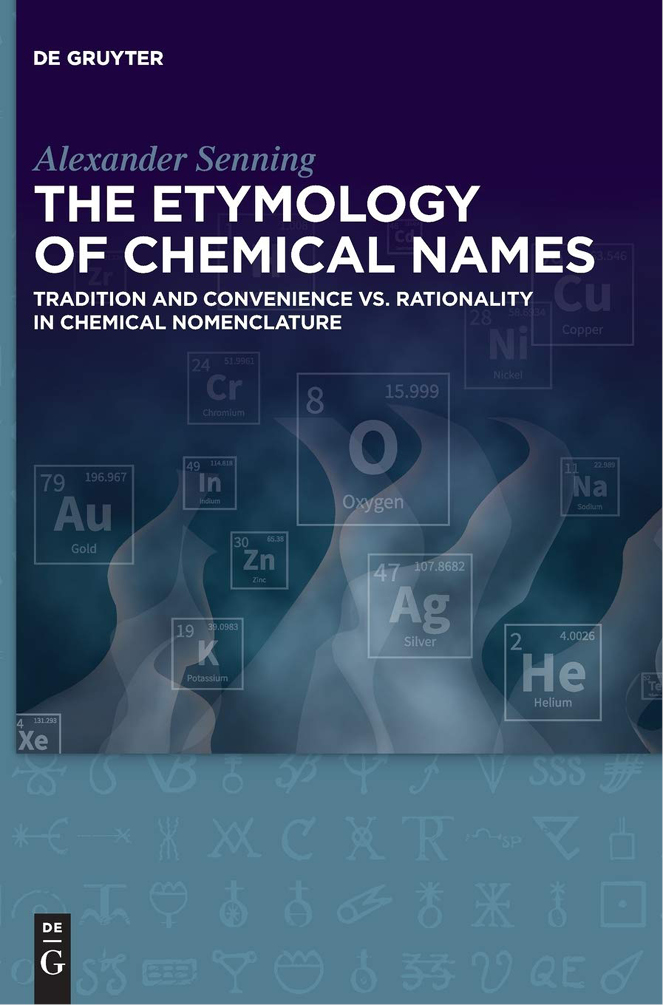
Alexander Senning. The Etymology of Chemical Names. Tradition and Convenience vs. Rationality in Chemical Nomenclature. De Gruyter, 2019. https://doi.org/10.1515/9783110612714. ISBN: 9783110611069. eBook ISBN: 9783110612714
Reviewed by Edwin C. Constable and Richard M. Hartshorn
Etymology is the study of a word’s origin and the evolution of its meaning. Chemical etymology is as much about the history of our science as it is about linguistics, and it is surprising how sparse the literature is in this regard. Crosland’s 1962 Historical Studies in the Language of Chemistry [1] was a ground-breaking work and is complemented by Senning’s more tabular work Elsevier’s Dictionary of Chemoetymology. The Whies and Whences of Chemical Nomenclature and Terminology from 2007 [2]. Alexander Senning has now delighted us with a new volume entitled The Etymology of Chemical Names. Tradition and Convenience vs. Rationality in Chemical Nomenclature. This labour of love and treasury of hidden gems was published shortly before his death in 2020.
Before commencing a detailed review, it is appropriate to answer two questions: for whom is this book written? And for whom is it not written?
We believe that this book will be of value to any chemist with an interest in the language they use to communicate their science. On the one hand, this book is an invaluable reference for matching materials identified by a trivial or common name (for example, ixoric or tariric acids) with a definitive chemical identity. On the other hand, The Etymology of Chemical Names is a sourcebook regarding the origins of chemical names that you always wondered about, but never had time to research. If you are intrigued why picric acid (from the Greek pikros meaning sharp or bitter) was also called lyddite (after the town of Lydd in Kent, United Kingdom, where it was manufactured in the early part of the last Century), then this book is for you. Herein lies the charm and possibly the minor irritation of this book. For us, it is a book to pick up and browse. It is no coincidence that it is next to Brewer’s Dictionary of Phrase and Fable on my bookshelf … this is a book you open for the sheer pleasure of encountering some new and hidden gem of information rather than one to read from cover to cover. It is more likely to be found in institutional libraries than on the shelves of practicing chemists. It is also not primarily for the historian of science looking for a structured discussion of the historical and philosophical development of nomenclature, although, it is an essential companion to the classical works of Partington [3, 4] and Crosland [1].
The book comprises 20 chapters of various lengths. The second chapter is devoted to trivial and semi-trivial names and occupies about a third of the book. This catalogue runs from Aaptamine to Zyzzine, giving the IUPAC name and occasional trivia about the compound and the origin (or origins) of its name. The information is organized by the origin of the name (smell, shape, property, etc.), which is etymologically logical but a hindrance in practical usage. To research a particular compound, you need to know the origin of the name! To find lewisite, the chemical warfare agent, you need to know that it is named after Winford Lewis (Eponyms and demonyms) rather than the Isle of Lewis (Toponyms) and recognise that it differs from the mineral lewisite. In this respect, the easy searchability of the electronic version of the book provides distinct advantages over the printed publication. An enormous amount of information is provided in the form of off-the-cuff comments that enrich and enhance the text. The section on ambiguous names should be de rigueur reading for all chemists.
The chapter entitled “Rudimentary systematic nomenclature” encompasses the semi-systematic names used by chemists, despite the strictures of IUPAC, and proceeds, often anecdotally, to develop specific aspects and identify how chemists subjectively link classes of compounds. This highlights the challenges that IUPAC faces in developing a systematic nomenclature for compounds that are “obviously” related but whose Preferred IUPAC Names (PINs) have little in common. The role of IUPAC is developed in subsequent chapters which give extensive listings of acceptable (and unacceptable) names for natural products, their IUPAC names and PINs, together with a thought-provoking summary of the evolution of the recommendations for the nomenclature of organic chemistry.
While both the IUPAC “Red Book” [5] and the “Blue Book” [6] are mentioned in the introduction, the inorganic community is subsequently largely ignored, except for a chapter concerning element names and the periodic table and another addressing mineral names. The former topic is well-documented elsewhere [7], but Senning provides a good one-stop source for the history and prehistory of the elements, whilst avoiding transatlantic debates about caesium, cesium, aluminium and aluminum. Several versions of the periodic table’s long, medium and short forms are presented, although, unfortunately, the necessities of production split some over multiple pages. The author includes a remarkably concise and complete discussion of the terms used in connection with the periodic table. The book also contains a short section on elements that never were, and the interested reader is directed to the authoritative and comprehensive work of Fontani et al [8]. There is a section on mineral names which, as the author says, “… have been coined with little regard for euphony as perceived by English-speakers.” The collection of these names is useful, although, once again, the presentation is based on etymological origin making it more suited to electronic searching.
The book also introduces the reader to Chemical Abstracts Service (CAS) nomenclature and registry numbers, with taxol used as an example to demonstrate the differences between the CAS and IUPAC systems. This topic is covered more extensively in Bünzli-Trepp’s Systematic Nomenclature of Organic, Organometallic and Coordination Chemistry. Chemical-Abstracts Guidelines with IUPAC Recommendations and Many Trivial Names [9].
Several chapters that may be less interesting to the general reader are devoted to natural products. However, some chapter titles are a little misleading and “The naming of lipids and lipid constituents” is used as an excuse to discuss the exotic and etymologically diverse naming of the carboxylic acids. Similarly, the chapter on terpenes delights and informs the reader about their names’ linguistic complexity and etymological origins. However, we wonder how many of these elaborately derived names are used in common parlance. The first sentence of the chapter “On the naming of carbohydrates” says it all: “IUPAC’s glycose nomenclature comes in three versions, each suitable for a different purpose.” The author subsequently collects trivial names of carbohydrates and their nasty semi-systematic derivatives. As always, the reader is often left wanting to know more: sedoheptulose is apparently named after the stonecrop sedum acre; but why? Our favourite names are primeverose or swietenose (really! Look it up). The same treatment is given to amino acids and their shorter condensation products. In addition to the well-known compounds, exotic creatures such as willardiine are included, and the text abounds with dry comments such as “Abrin … Not to be confused with abrine” – as if one would even think of confusing the two!
International non-proprietary names for drugs, ISO common names for pesticides and other agrochemicals, and common abbreviations and initialisms are also covered. These relatively specialized areas are covered with brevity. Unfortunately, the section on abbreviations is, of necessity, neither complete nor polylingual. For example, the abbreviation PET, for polyethylene terephthalate, is commonly seen on food containers in Switzerland but is absent from the list.
The book draws to a close with a miscellany of chemical and related terms, which will provide material for innumerable quizzes and quiz shows, and finishes with two final two chapters entitled “Trivial chemical names with disputed etymology” and “Some chemical names without known etymology.”
Overall, this is a book that chemists will find of great use in answering questions about the origins of their daily vocabulary. Is there anything that the book does not do well? The emphasis is on organic compounds, and the title promises inorganic chemists more than it delivers. Even though the trivial names of organic compounds far outnumber those of inorganic species, an opportunity has been missed to educate and inform the reader about such inorganic oddities as reineckate. Having said this, the vexed question of the nomenclature of minerals is addressed very well, as is the identification of names for inorganic compounds from the early historical period.
References:
1. Crosland, M.P. Historical Studies in the Language of Chemistry; Dover, 1978.Search in Google Scholar
2. Senning, A. Elsevier’s Dictionary of Chemoetymology. The whies and whences of chemical nomenclature and terminology; Elsevier, 2006.Search in Google Scholar
3. Partington, J.R. A History of Chemistry, Vols. 1-4; Macmillan, 1961-1970.Search in Google Scholar
4. Partington, J.R. A Short History of Chemistry; Macmillan, 1937.Search in Google Scholar
5. Connelly, N.G.; et al. Nomenclature of Inorganic Chemistry: IUPAC Recommendations 2005; Royal Society of Chemistry Publishing, 2005. Search in Google Scholar
6. Favre, H.A.; Powell, W.H. Nomenclature of Organic Chemistry: IUPAC Recommendations and Preferred Names 2013; Royal Society of Chemistry Publishing, 2014.Search in Google Scholar
7. Scerri, E. The Periodic Table Its Story and Its Significance 2nd Ed.; Oxford University Press, 2019.10.1093/oso/9780190914363.001.0001Search in Google Scholar
8. Fantoni, M. The Lost Elements, The Periodic Table’s Shadow Side; Oxford University Press, 2014.10.1093/oso/9780199383344.001.0001Search in Google Scholar
9. Bünzli-Trepp, U. Systematic Nomenclature of Organic, Organometallic and Coordination Chemistry. Chemical-Abstracts Guidelines with IUPAC Recommendations and Many Trivial Names; Logos, 2021.Search in Google Scholar
©2024 by Walter de Gruyter Berlin/Boston
This work is licensed under the Creative Commons Attribution-NonCommercial-NoDerivatives 4.0 International License.
Articles in the same Issue
- Masthead - Full issue pdf
- Past President’s column
- Embracing Change: IUPAC’s Opportunities Moving Forward
- Features
- BOLD: Color from Test Tube to Textile
- The renaissance and evolving design of radical polymerization
- Two Young Observers at the WCC in The Hague Share Their Reflections
- IUPAC Wire
- The 2024 IUPAC-Richter Award Goes to Craig M. Crews
- Science as a Global Public Good
- IUPAC Emeritus Fellows 2022-23
- Ty Coplen received a US Presidential Rank Award
- One World Chemistry—IOCD Call for Volunteers
- 2024 Franzosini Prize and Balarew Award—Call for Nominations
- InCHI Changing Pace
- IUPAC Standards Online—Free Access
- PAC Open for Submissions
- Teaching Ethics and Core Values in Chemistry Education—Call for Papers
- Inorganic Chemistry Division—Feb 2024 Newsletter
- Project Place
- InChI Open Education Resource
- The Gender Gap in Chemistry—Building on the ISC Gender Gap Project
- Medicinal Chemistry in Drug Discovery & Development, India
- Advanced Technologies for Carbon Sequestration and Capture
- Terminology and Symbolism for Mechanochemistry
- IUPAC Provisional Recommendations
- Definition of Materials Chemistry
- Up for Discussion
- How Young Are You?
- Bookworm
- The Etymology of Chemical Names
- IUPAC Green Book—New Abridged Version
- IUPAC Blue Book—Updated release
- Conference Call
- The Presidents’ Forum: Advancing Chemistry through Global Cooperation
- IUPAC’s Role in the International Year of Basic Sciences for Sustainable Development and the Closing Ceremony
- Thailand Younger Chemists Network
- Where 2B & Y
- Solubility Phenomena and Related Equilibrium Processes
- Chemistry: a solution for global changes
- Mark Your Calendar
Articles in the same Issue
- Masthead - Full issue pdf
- Past President’s column
- Embracing Change: IUPAC’s Opportunities Moving Forward
- Features
- BOLD: Color from Test Tube to Textile
- The renaissance and evolving design of radical polymerization
- Two Young Observers at the WCC in The Hague Share Their Reflections
- IUPAC Wire
- The 2024 IUPAC-Richter Award Goes to Craig M. Crews
- Science as a Global Public Good
- IUPAC Emeritus Fellows 2022-23
- Ty Coplen received a US Presidential Rank Award
- One World Chemistry—IOCD Call for Volunteers
- 2024 Franzosini Prize and Balarew Award—Call for Nominations
- InCHI Changing Pace
- IUPAC Standards Online—Free Access
- PAC Open for Submissions
- Teaching Ethics and Core Values in Chemistry Education—Call for Papers
- Inorganic Chemistry Division—Feb 2024 Newsletter
- Project Place
- InChI Open Education Resource
- The Gender Gap in Chemistry—Building on the ISC Gender Gap Project
- Medicinal Chemistry in Drug Discovery & Development, India
- Advanced Technologies for Carbon Sequestration and Capture
- Terminology and Symbolism for Mechanochemistry
- IUPAC Provisional Recommendations
- Definition of Materials Chemistry
- Up for Discussion
- How Young Are You?
- Bookworm
- The Etymology of Chemical Names
- IUPAC Green Book—New Abridged Version
- IUPAC Blue Book—Updated release
- Conference Call
- The Presidents’ Forum: Advancing Chemistry through Global Cooperation
- IUPAC’s Role in the International Year of Basic Sciences for Sustainable Development and the Closing Ceremony
- Thailand Younger Chemists Network
- Where 2B & Y
- Solubility Phenomena and Related Equilibrium Processes
- Chemistry: a solution for global changes
- Mark Your Calendar
