NUTRIAGEING: Combining Chemistry, Cooking, and Agriculture

The website NUTRIAGEING was created to bring chemistry to the general public by demonstrating how chemistry offers unique solutions for society’s needs in terms of healthy living and better ageing. It is now open to academic partners and the general public athttp://nutriageing.fc.ul.pt. Offering modules to promote healthier nutrition, and showing the contribution of food chemistry to health, the website educates, not only on how to improve eating habits, but also on how to grow vegetables and condiments, demonstrating the added value of their chemical activity. In addition, games on the site offer entertainment and allow the user to confirm the knowledge acquired.
Developed within the scope of the IUPAC project “Healthy life and active ageing–the contribution of functional food ingredients” (2013-054-2-300) and the EU Project “Personalized ICT Supported Service for Independent Living and Active Ageing” (GA 610359), this new platform was built for the transfer of scientific knowledge into usable personal advice, with a clean, easy-to-use, “app-like” interface with minimal menus. The responsive layout ensures device-independent accessibility and a good viewing experience for the user.
The website is structured around three major themes: (1) Healthy eating, (2) Recipes and videos, and (3) Vegetable gardens.
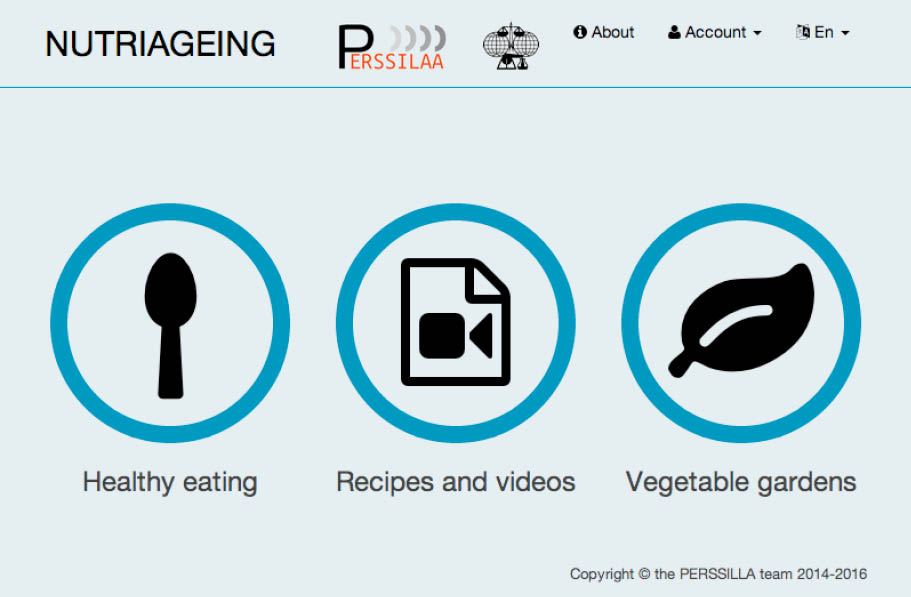
The Healthy eating section, developed by chemists, biochemists, and nutritionists, is mainly focused on nutritional literacy, supported by chemical and biochemical science. The How much should I eat subsection covers macronutrients and micronutrients, but also answers questions, such as “what type of fat should I choose for eating and cooking”, “what about fiber”, and “how much water should I drink”. Further information covers calcium and salt intake, antioxidants, and functional ingredients, the latter also reporting findings that are the outcome of lab work to illustrate the importance of chemistry for the discovery of the active principles isolated from natural resources. Clinical nutrition focuses on the importance of an integrated approach for the nutritional evaluation of subjects. Nutritional risk factors, clinical nutrition evaluation, nutritional intake, anthropometric measurements, and nutritional status classification, and dietary plans are included in this subsection. Nutritional labelling, another subsection, aims to give the user concepts for informed choices when buying food products, covering the type of information available on the package, mandatory food information, how to understand it, reference intakes, etc. Finally, the Enjoy subsection is interactive, with quizzes that allow the user to evaluate if he/she knows how to make a balanced diet and word puzzles. Gaining knowledge with pleasure!
A Recipes and videos section is an innovation of this website. It includes 15 videos of recipes developed by the famous Portuguese chef, Hélio Loureiro. While cooking a recipe, he chats with two experts and a young researcher, discussing the chemical principles of recipe components and their benefits. Overall, about 23 experts in various areas of chemistry (e.g. organic, analytical, food chemistry, etc.) and biochemistry participated in the videos. Scientific discussions were conveyed to the public in a simple and understandable manner.
Finally, the Vegetable gardens section is another innovative area. The user may wish to produce some of the recipe ingredients in his/her garden. A landscape architect teaches users how to plan a vegetable garden in a variety of settings, from the backyard to the balcony or even small pots on the kitchen window. By accessing the recipe, e.g. one with peppermint, and clicking on the icon that appears on the word “peppermint”, the user is taken to the vegetable garden section, where the information on how to grow this herb is given.
Enjoy, learn, cook, and eat with Nutriageing, and take part in some of the great pleasures of a healthy life!
www.iupac.org/project/2013-054-2-300
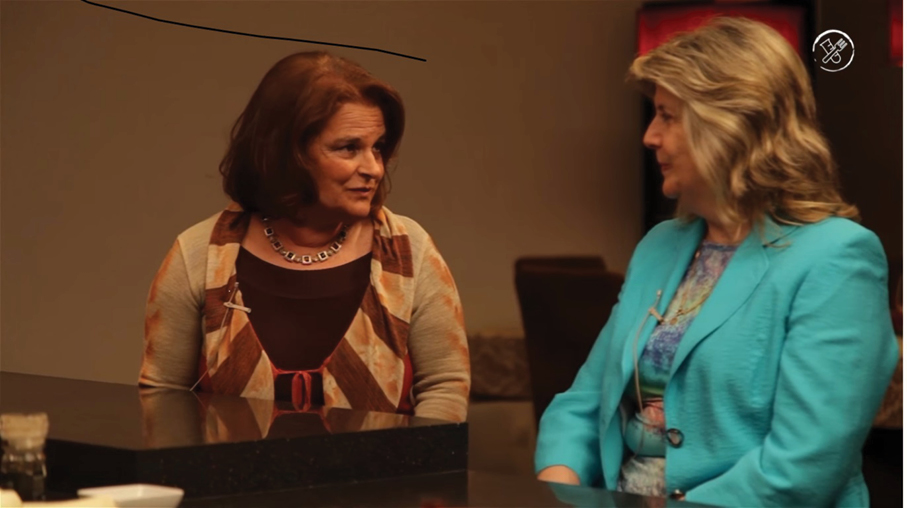
Lívia Sarkadi (Department of Food Chemistry and Nutrition, Szent István University) and Amelia Pilar Rauter (Universidade de Lisboa) (left) in the session dedicated to functional ingredients
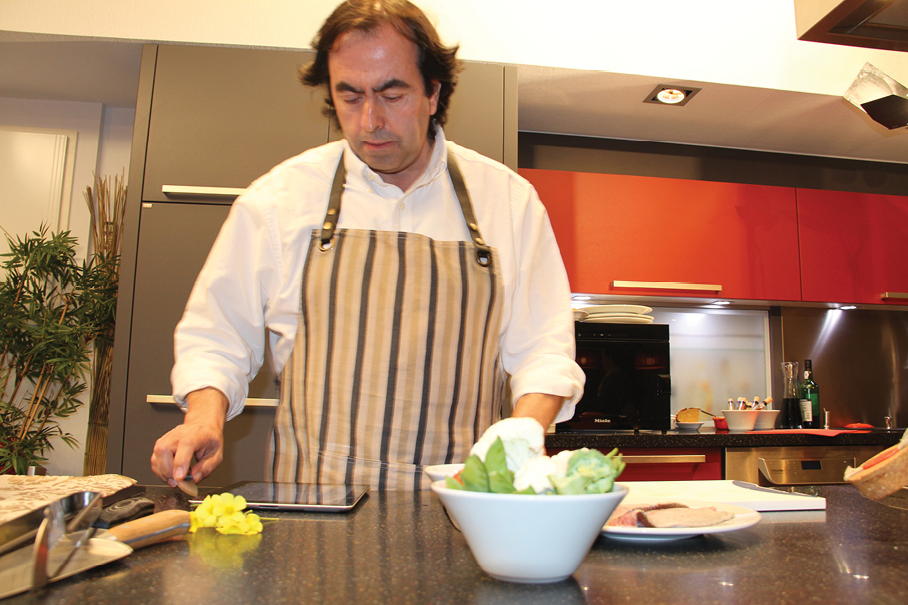
Chef Hélio Loureiro, cooking and talking....
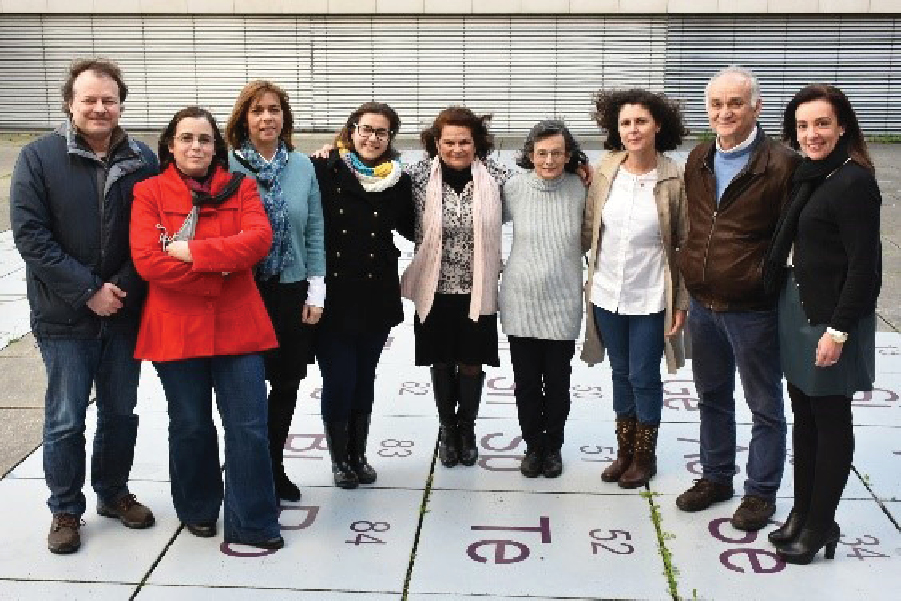
The Portuguese team standing on the periodic table at DQB-FCUL. From left to right: Antonio Ferreira, Marta Sousa Silva (FCUL), Helena Soares da Costa (INSA), Amelia Pilar Rauter, Antonia Turkman, Marília Antunes, Feridun Turkman (FCUL), and Tania Albuquerque (INSA). Absent: Alice Martins
For more information and comments, contact Task Grup Chair Amélia Pilar Rauter <aprauter@fc.ul.pt>
©2017 by Walter de Gruyter Berlin/Boston
Articles in the same Issue
- Masthead - Full issue pdf
- From the Editorial Board
- Contents
- The First IUPAC World Chemistry Congress with a Latin Flavor
- Features
- IYCN: A Journey That Has Just Begun
- IUPAC Facilitating Chemistry Data Exchange in the Digital Era
- Nanomaterials—On the Brink of Revolution? Or the Endless Pursuit of Something Unattainable?
- Hero Worship in Words: Imitating the Grand Style of R. B. Woodward
- IUPAC Wire
- Awardees of the IUPAC 2017 Distinguished Women in Chemistry or Chemical Engineering
- Neil Garg is the Recipient of the 2016 Thieme–IUPAC Prize
- The Franzosini Award of 2016
- A Global Approach to the Gender Gap in Mathematical and Natural Sciences: How to Measure It, How to Reduce It?
- New InChI Software Release
- Project Place
- Database on Molecular Compositions of Natural Organic Matter and Humic Substances as Measured by High Resolution Mass Spectrometry
- Integrating Green Chemistry and Socio-Sustainability in Higher Education: Successful Experiences Contributing to Transform Our World
- NUTRIAGEING: Combining Chemistry, Cooking, and Agriculture
- Safety Training Program
- The Silver Book and the NPU Format for Clinical Laboratory Science Reports Regarding Properties, Units, and Symbols
- Bookworm
- Engineered Nanoparticles and the Environment: Biophysicochemical Processes and Toxicity
- Compendium of Terminology and Nomenclature of Properties in Clinical Laboratory Sciences
- Making an ImPACt
- Isotope-Abundance Variations and Atomic Weights of Selected Elements: 2016 (IUPAC Technical Report)
- Names and Symbols of the Elements with Atomic Numbers 113, 115, 117 and 118 (IUPAC Recommendations 2016)
- On the Naming of Recently Discovered Chemical Elements—the 2016 Experience
- IUPAC Provisional Recommendations
- Terminology of Bioanalytical Methods
- Nomenclature and Terminology for Dendrimers with Regular Dendrons and for Hyperbranched Polymers
- Definition of the Mole
- Terminology of Separation Methods
- NOTeS
- IUPAC Standards and Recommendations
- Conference Call
- Chemical Industry of Sustainable Development
- Bioinspired and Biobased Chemistry & Materials
- International Carbohydrate Symposium
- Validation of Test Methods, Human Errors and Measurement Uncertainty of Results
- Where 2B & Y
- Chemistry in a Multidisciplinary, Interdisciplinary World
- Trace Elements Analysis of Environmental Samples with X-rays
- Ionic Polymerization
- Global Challenges and Data-Driven Science
- Mark Your Calendar
Articles in the same Issue
- Masthead - Full issue pdf
- From the Editorial Board
- Contents
- The First IUPAC World Chemistry Congress with a Latin Flavor
- Features
- IYCN: A Journey That Has Just Begun
- IUPAC Facilitating Chemistry Data Exchange in the Digital Era
- Nanomaterials—On the Brink of Revolution? Or the Endless Pursuit of Something Unattainable?
- Hero Worship in Words: Imitating the Grand Style of R. B. Woodward
- IUPAC Wire
- Awardees of the IUPAC 2017 Distinguished Women in Chemistry or Chemical Engineering
- Neil Garg is the Recipient of the 2016 Thieme–IUPAC Prize
- The Franzosini Award of 2016
- A Global Approach to the Gender Gap in Mathematical and Natural Sciences: How to Measure It, How to Reduce It?
- New InChI Software Release
- Project Place
- Database on Molecular Compositions of Natural Organic Matter and Humic Substances as Measured by High Resolution Mass Spectrometry
- Integrating Green Chemistry and Socio-Sustainability in Higher Education: Successful Experiences Contributing to Transform Our World
- NUTRIAGEING: Combining Chemistry, Cooking, and Agriculture
- Safety Training Program
- The Silver Book and the NPU Format for Clinical Laboratory Science Reports Regarding Properties, Units, and Symbols
- Bookworm
- Engineered Nanoparticles and the Environment: Biophysicochemical Processes and Toxicity
- Compendium of Terminology and Nomenclature of Properties in Clinical Laboratory Sciences
- Making an ImPACt
- Isotope-Abundance Variations and Atomic Weights of Selected Elements: 2016 (IUPAC Technical Report)
- Names and Symbols of the Elements with Atomic Numbers 113, 115, 117 and 118 (IUPAC Recommendations 2016)
- On the Naming of Recently Discovered Chemical Elements—the 2016 Experience
- IUPAC Provisional Recommendations
- Terminology of Bioanalytical Methods
- Nomenclature and Terminology for Dendrimers with Regular Dendrons and for Hyperbranched Polymers
- Definition of the Mole
- Terminology of Separation Methods
- NOTeS
- IUPAC Standards and Recommendations
- Conference Call
- Chemical Industry of Sustainable Development
- Bioinspired and Biobased Chemistry & Materials
- International Carbohydrate Symposium
- Validation of Test Methods, Human Errors and Measurement Uncertainty of Results
- Where 2B & Y
- Chemistry in a Multidisciplinary, Interdisciplinary World
- Trace Elements Analysis of Environmental Samples with X-rays
- Ionic Polymerization
- Global Challenges and Data-Driven Science
- Mark Your Calendar
