Does one size fit all? The scope and type of error in direct feedback effectiveness
-
Chian-Wen Kao


Abstract
This study is an attempt to investigate the scope and type of error in feedback effectiveness. This study consists of two experiments. One was conducted to investigate the feedback effects on a rule-based error type (i.e. subject–verb agreement errors) and the other was conducted to investigate the effects on a lexically-based error type (i.e. verb–noun collocation errors). In addition, the scope of error was investigated in both experiments. In terms of the rule-based error type, results for the immediate posttest writing task showed focused feedback to be effective for the narrowly defined subject–verb agreement errors (i.e. subject–verb agreement involving lexical verbs or copula be). In the delayed posttest writing task, the benefit still persisted for the narrowly defined subject–verb agreement errors. In terms of the lexically-based error type, results for the immediate posttest writing tasks showed focused feedback to be effective for the broadly defined verb–noun collocation errors (three or four collocation errors made and corrected in pretests). In the delayed posttest writing tasks, the benefit still persisted for the broadly defined verb–noun collocation errors broadly defined. These findings suggest that the notion of error type should influence the feedback effectiveness. Theoretical implications regarding the role of notice in the second language acquisition process were discussed based on the results obtained in this study.
Funding source: Ministry of Science and Technology, Taiwan
Award Identifier / Grant number: MOST 110-2511-H-263-001
Appendix: Writing tasks over the three testing stages
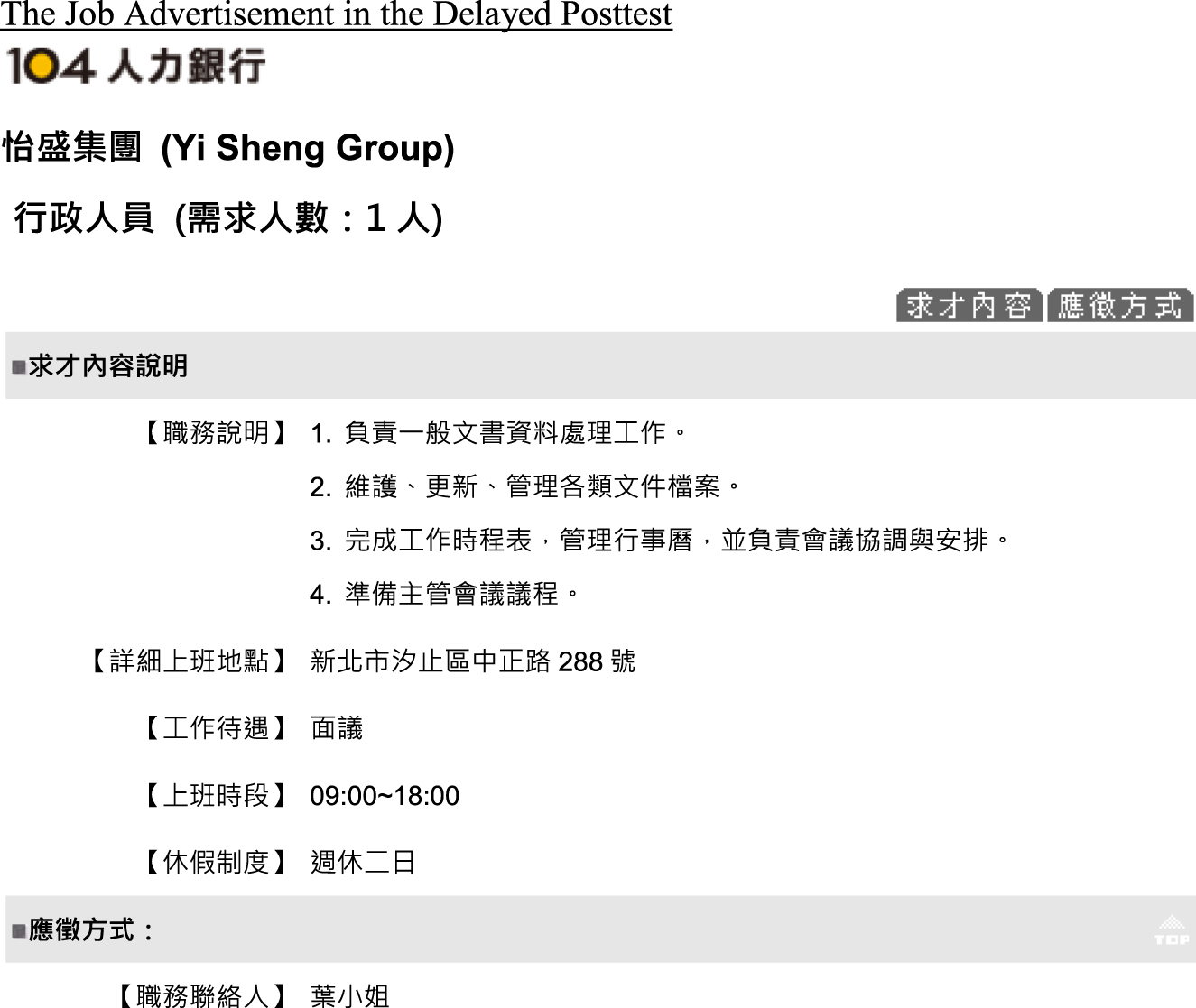
The Writing Prompt in the Pretest/Posttest/Delayed Posttest
請根據以下的職缺廣告, 針對該職缺的 職務說明 及 寫作要求 , 運用 所提供的單字 寫一封約 120 字的英文求職信給雇主。
寫作要求:
敘述在哪裡看到該職缺, 並表達想要提出申請的意願。
敘述該職缺所需能力為何, 簡述自己與該職缺相關的經驗(如 : 修過什麼課程、參加過什麼訓練…等), 並說明這些經驗使自己具備了哪些能力。
敘述所附履歷包含哪些資訊, 並指出這些資訊顯示所擁有的資格符合該職缺需求。
請求雇主給予參加面試的機會並預約可見面的時間。
單字: application, course, interview, appointmen


References
Benson, Susan & Robert DeKeyser. 2019. Effects of written corrective feedback and language aptitude on verb tense accuracy. Language Teaching Research 23. 702–726. https://doi.org/10.1177/1362168818770921.Search in Google Scholar
Bitchener, John. 2008. Evidence in support of written corrective feedback. Journal of Second Language Writing 17. 102–118. https://doi.org/10.1016/j.jslw.2007.11.004.Search in Google Scholar
Bitchener, John & Dana Ferris. 2012. Written corrective feedback in second language acquisition and writing. UK: Taylor & Francis.10.4324/9780203832400Search in Google Scholar
Bitchener, John, Stuart Young & Denise Cameron. 2005. The effect of different types of feedback on ESL student writing. Journal of Second Language Writing 14. 191–205. https://doi.org/10.1016/j.jslw.2005.08.001.Search in Google Scholar
Corder, Stephen Pit. 1967. The significance of learner’s errors. International Review of Applied Linguistics in Language Teaching 4. 161–170.10.1515/iral.1967.5.1-4.161Search in Google Scholar
Ding, Chen & Barry Lee Reynolds. 2019. The effects of L1 congruency, L2 proficiency, and the collocate-node relationship on the processing of L2 English collocations by L1-Chinese EFL learners. Review of Cognitive Linguistics 17. 331–357. https://doi.org/10.1075/rcl.00038.din.Search in Google Scholar
Ellis, Rod. 2003. Task-based language learning and teaching. Oxford: Oxford University Press.Search in Google Scholar
Ellis, Rod, Younghee Sheen, Mihoko Murakami & Hide Takashima. 2008. The effects of focused and unfocused written corrective feedback in an English as a foreign language context. System 36. 353–371. https://doi.org/10.1016/j.system.2008.02.001.Search in Google Scholar
Farrokhi, Farahman & Simin Sattarpour. 2011. The effects of focused and unfocused written corrective feedback on grammatical accuracy of Iranian EFL learners. Theory and Practice in Language Studies 1. 1797–1803. https://doi.org/10.4304/tpls.1.12.1797-1803.Search in Google Scholar
Ferris, Dana. 1999. The case for grammar correction in L2 writing classes: A response to Truscott. Journal of Second Language Writing 8. 1–11. https://doi.org/10.1016/S1060-3743(99)80110-6.Search in Google Scholar
Ferris, Dana. 2004. The “grammar correction” debate in L2 writing: Where are we, and where do we go from here? (and what do we do in the meantime…?). Journal of Second Language Writing 13. 49–62. https://doi.org/10.1016/j.jslw.2004.04.005.Search in Google Scholar
Ferris, Dana. 2010. Second language writing research and written corrective feedback in SLA. Studies in Second Language Acquisition 32. 181–210. https://doi.org/10.1017/S0272263109990490.Search in Google Scholar
Ferris, Dana. 2011. Treatment of error in second language student writing. Ann Arbor: University of Michigan Press.10.3998/mpub.2173290Search in Google Scholar
Ferris, Dana & Barrie Roberts. 2001. Error feedback in L2 writing classes: How explicit does it need to be? Journal of Second Language Writing 10. 161–184. https://doi.org/10.1016/S1060-3743(01)00039-X.Search in Google Scholar
Frear, David. 2010. The effect of focused and unfocused direct written corrective feedback on a new piece of writing. In S.C. Huang (ed.), Selected Papers from the Third Conference on College English, Taipei, Taiwan, 57–71. Foreign Languages Center, National Chengchi University.Search in Google Scholar
Frear, David & Yi-Hui Chiu. 2015. The effect of focused and unfocused indirect written corrective feedback on EFL learners’ accuracy in new pieces of writing. System 53. 24–34. https://doi.org/10.1016/j.system.2015.06.006.Search in Google Scholar
Guénette, Danielle. 2007. Is feedback pedagogically correct? Research design issues in studies of feedback on writing. Journal of Second Language Writing 16. 40–53. https://doi.org/10.1016/j.jslw.2007.01.001.Search in Google Scholar
Han, Zhaohong. 2002. A study of the impact of recasts on tense consistency in L2 output. TESOL Quarterly 36. 543–572. https://doi.org/10.2307/3588240.Search in Google Scholar
Hill, Jimmie. 1999. Collocational competence. In English teaching professional, vol. 11, 3–6. West Sussex: Pavilion Publishing and Media Ltd.Search in Google Scholar
Kang, Eun-Young & Zhaohong Han. 2015. The efficacy of written corrective feedback in improving L2 written accuracy: A meta-analysis. The Modern Language Journal 99. 1–18. https://doi.org/10.1111/modl.12189.Search in Google Scholar
Kao, Chian-Wen. 2019. Developing second language literacy: Taiwanese college students’ error types in focused feedback effectiveness. In Barry Lee Reynolds & Mark Feng Teng (eds.), English literacy instruction for Chinese speakers, 245–264. Singapore: Palgrave Macmillan.10.1007/978-981-13-6653-6_15Search in Google Scholar
Kao, Chian-Wen & Barry Lee Reynolds. 2020. High school writing teacher feedback on word choice errors. Language Learning & Technology 24. 19–29.Search in Google Scholar
Kao, Chian-Wen & David Wible. 2014. A meta-analysis on the effectiveness of grammar correction in second language writing. English Teaching & Learning 38. 29–69. https://doi.org/10.6330/ETL.2014.38.3.02.Search in Google Scholar
Karimi, Masoome & Zahra Fotovatnia. 2012. The effects of focused vs. unfocused written teacher correction on the grammatical accuracy of Iranian EFL undergraduates. Asian EFL Journal 62. 42–59.Search in Google Scholar
Krashen, Stephen D. 1981. Second language acquisition and second language learning. Oxford: Pergamon.Search in Google Scholar
Krashen, Stephen D. 1985. The input hypothesis: Issues and implications. London: Longman.Search in Google Scholar
Laufer, Batia & Tina Waldman. 2011. Verb–noun collocations in second language writing: A corpus analysis of learners’ English. Language Learning 61. 647–672. https://doi.org/10.1111/j.1467-9922.2010.00621.x.Search in Google Scholar
Lee, Icy. 2020. Utility of focused/comprehensive written corrective feedback research for authentic L2 writing classroom. Journal of Second Language Writing 49. 1–7. https://doi.org/10.1016/j.jslw.2020.100734.Search in Google Scholar
Lewis, Michael. 2000. Language in the Lexical Approach. In Michael Lewis (ed.), Teaching collocation: Further development in the Lexical Approach. London: Language Teaching Publications.Search in Google Scholar
Liu, Li-Er. 2002. A corpus-based lexical semantic investigation of verb–noun miscollocations in Taiwan learners’ English. Unpublished MA thesis. Tamkang University.Search in Google Scholar
Lyster, Roy, Kazuya Saito & Masatoshi Sato. 2013. Oral corrective feedback in second language classrooms. Language Teaching 46. 1–40. https://doi.org/10.1017/S0261444812000365.Search in Google Scholar
Mackey, Alison & Jaemyung Goo. 2007. Interaction research in SLA: A meta-analysis and research synthesis. In Alison Mackey (ed.), Conversational interaction in SLA: A collection of empirical studies, 408–452. New York: Oxford University Press.Search in Google Scholar
Mohebbi, Hassan. 2021. 25 years on, the written error correction debate continues: an interview with John Truscott. Asian-Pacific Journal of Second and Foreign Language Education 6. 1–8. https://doi.org/10.1186/s40862-021-00110-9.Search in Google Scholar
Parreno, Arlan. 2015. Written corrective feedback impact on grammatical accuracy in L2 writing: A quantitative and qualitative look. Writing and Pedagogy 7. 279–303. https://doi.org/10.1558/wap.v7i2-3.25991.Search in Google Scholar
Pienemann, Manfred. 1989. Is language teachable? Psycholinguistic experiments and hypotheses. Applied Linguistics 10. 52–79.10.1093/applin/10.1.52Search in Google Scholar
Pienemann, Manfred. 1998. Language processing and second language acquisition: Processability theory. Amsterdam: John Benjamins.10.1075/sibil.15Search in Google Scholar
Reynolds, Barry Lee. 2015. Action research: Applying a bilingual parallel corpus collocational concordancer to Taiwanese medical school EFL academic writing. RELC Journal 47. 213–227. https://doi.org/10.1177/0033688215619518.Search in Google Scholar
Reynolds, Barry Lee & Mark Feng Teng. 2020. Online first. Involving native speakers in oral corrective focused grammar feedback while conversing: An Activity Theory perspective. The Language Learning Journal. https://doi.org/10.1080/09571736.2020.1845225.Search in Google Scholar
Reynolds, Barry Lee & Mark Feng Teng. 2021. Innovating teacher feedback with writing activities aimed at raising secondary school students’ awareness of collocation errors. Studies in Second Language Learning and Teaching 11. 423–444. https://doi.org/10.14746/ssllt.2021.11.3.6.Search in Google Scholar
Sato, Masatoshi & Shawn Loewen. 2018. Metacognitive instruction enhances the effectiveness of corrective feedback: Variable effects of feedback types and linguistic targets. Language Learning 68. 507–545. https://doi.org/10.1111/lang.12283.Search in Google Scholar
Saussure, Ferdinand. 1959 [1916]. Course in general linguistics. (trans. Wade Baskin). New York: Philosophical Library.Search in Google Scholar
Schmidt, Richard. 1990. The role of consciousness in second language learning. Applied Linguistics 11. 129–158. https://doi.org/10.1093/applin/11.2.129.Search in Google Scholar
Schmidt, Richard. 2001. Attention. In Peter Robinson (ed.), Cognition and second language instruction, 3–32. Cambridge: Cambridge University Press.10.1017/CBO9781139524780.003Search in Google Scholar
Selinker, Larry. 1972. Interlanguage. International Review of Applied Linguistics in Language Teaching 10. 209–232.10.1515/iral.1972.10.1-4.209Search in Google Scholar
Shao, Jinshi & Yongcan Liu. 2020. Online first. Written corrective feedback, learner-internal cognitive processes, and the acquisition of regular past tense by Chinese L2 learners of English. Applied Linguistics Review. https://doi.org/10.1515/applirev-2019-0131.Search in Google Scholar
Sheen, Younghee. 2007. The effect of focused written corrective feedback and language aptitude on ESL learners’ acquisition of articles. TESOL Quarterly 41. 255–283. https://doi.org/10.1002/j.1545-7249.2007.tb00059.x.Search in Google Scholar
Sheen, Younghee, David Wright & Anna Moldawa. 2009. Differential effects of focused and unfocused written correction on the accurate use of grammatical forms by adult ESL learners. System 37. 556–569. https://doi.org/10.1016/j.system.2009.09.002.Search in Google Scholar
Shintani, Natsuko. 2015. The incidental grammar acquisition in focus on form and focus on forms instruction for young beginner learners. TESOL Quarterly 49. 115–140. https://doi.org/10.1002/tesq.166.Search in Google Scholar
Shintani, Natsuko & Rod Ellis. 2013. The comparative effect of direct written corrective feedback and metalinguistic explanation on learners’ explicit and implicit knowledge of the English indefinite article. Journal of Second Language Writing 22. 286–306. https://doi.org/10.1016/j.jslw.2013.03.011.Search in Google Scholar
Stefanou, Charis & Andrea Revesz. 2015. Direct written corrective feedback, learner differences, and the acquisition of second language article use for generic and specific plural reference. The Modern Language Journal 99. 263–282. https://doi.org/10.1111/modl.12212.Search in Google Scholar
Szudarski, Paweł & Kathy Conklin. 2014. Short- and long-term effects of rote rehearsal on ESL learners’ processing of L2 collocations. TESOL Quarterly 48. 833–842. https://doi.org/10.1002/tesq.201.Search in Google Scholar
Truscott, John. 1996. The case against grammar correction in L2 writing classes. Language Learning 46. 327–369. https://doi.org/10.1111/j.1467-1770.1996.tb01238.x.Search in Google Scholar
Truscott, John. 1998. Noticing in second language acquisition: A critical review. Second Language Research 14. 104–135. https://doi.org/10.1191/026765898674803209.Search in Google Scholar
Truscott, John. 2001. Selecting errors for selective error correction. Concentric: Studies in English Literature and Linguistics 27. 225–240.Search in Google Scholar
Truscott, John. 2007. The effect of error correction on learners’ ability to write accurately. Journal of Second Language Writing 16. 255–272. https://doi.org/10.1016/j.jslw.2007.06.003.Search in Google Scholar
Wang, Wan-Ju. 2005. The effects of degrees of explicitness of automated feedback on English learners’ acquisition of collocations. Unpublished MA thesis. Tamkang University.Search in Google Scholar
© 2022 Walter de Gruyter GmbH, Berlin/Boston
Articles in the same Issue
- Frontmatter
- Research Articles
- Communicating across educational boundaries: accommodation patterns in adolescents’ online interactions
- Tracking telecollaborative tasks through design, feedback, implementation, and reflection processes in pre-service language teacher education
- Individual versus pair work on L2 speech acts: production and cognitive processes
- Self-identity construction and pragmatic compensation in a Chinese DAT elder’s discourse
- Verbal and nonverbal disagreement in an ELF academic discussion task
- Relationships between struggling EFL writers’ motivation, self-regulated learning (SRL), and writing competence in Hong Kong primary schools
- Chinese university students’ self-regulated writing strategy use and EFL writing performance: influences of self-efficacy, gender, and major
- Does one size fit all? The scope and type of error in direct feedback effectiveness
- Immersing learners in English listening classroom: does self-regulated learning instruction make a difference?
- The pedagogical potential of speech-language therapy materials for the teaching of idiomatic expressions in a foreign language
- “This topic was inconsiderate of our culture”: Jordanian students’ perceptions of intercultural clashes in IELTS writing tests
- Positioning of female marriage immigrants in South Korea: a multimodal textbook analysis
- Hearing parents learning American Sign Language with their deaf children: a mixed-methods survey
- Teacher resilience and triple crises: Confucius Institute teachers’ lived experiences during the Covid-19 pandemic
- Translanguaging in self-praise on Chinese social media
Articles in the same Issue
- Frontmatter
- Research Articles
- Communicating across educational boundaries: accommodation patterns in adolescents’ online interactions
- Tracking telecollaborative tasks through design, feedback, implementation, and reflection processes in pre-service language teacher education
- Individual versus pair work on L2 speech acts: production and cognitive processes
- Self-identity construction and pragmatic compensation in a Chinese DAT elder’s discourse
- Verbal and nonverbal disagreement in an ELF academic discussion task
- Relationships between struggling EFL writers’ motivation, self-regulated learning (SRL), and writing competence in Hong Kong primary schools
- Chinese university students’ self-regulated writing strategy use and EFL writing performance: influences of self-efficacy, gender, and major
- Does one size fit all? The scope and type of error in direct feedback effectiveness
- Immersing learners in English listening classroom: does self-regulated learning instruction make a difference?
- The pedagogical potential of speech-language therapy materials for the teaching of idiomatic expressions in a foreign language
- “This topic was inconsiderate of our culture”: Jordanian students’ perceptions of intercultural clashes in IELTS writing tests
- Positioning of female marriage immigrants in South Korea: a multimodal textbook analysis
- Hearing parents learning American Sign Language with their deaf children: a mixed-methods survey
- Teacher resilience and triple crises: Confucius Institute teachers’ lived experiences during the Covid-19 pandemic
- Translanguaging in self-praise on Chinese social media
