Home Mathematics (In)dependence of the axioms of Λ-trees
Article Open Access

(In)dependence of the axioms of Λ-trees

  • Raphael Appenzeller EMAIL logo
Published/Copyright: April 1, 2024

Abstract

A Λ -tree is a Λ -metric space satisfying three axioms (1), (2), and (3). We give a characterization of those ordered abelian groups Λ for which axioms (1) and (2) imply axiom (3). As a special case, it follows that for the important class of ordered abelian groups Λ that satisfy Λ = 2 Λ , (3) follows from (1) and (2). For some ordered abelian groups Λ , we show that axiom (2) is independent of axioms (1) and (3) and ask whether this holds for all ordered abelian groups. Part of this work has been formalized in the proof assistant Lean .

MSC 2010: 51M30; 06F20; 05C05

1 Introduction

Let ( Λ , + ) be an ordered abelian group. A set X together with a Λ -valued function d : X × X Λ that is positive definite, symmetric, and satisfies the triangle inequality is called a Λ -metric space. A Λ -metric space ( X , d ) is a Λ -tree if it satisfies the following three axioms (definitions in Section 2):

  1. ( X , d ) is geodesic: any two points can be joined by a segment.

  2. If two segments s , s X intersect in a single point s s = { p } , which is an endpoint of s and s , then their union s s is a segment.

  3. If two segments s , s X have an endpoint in common, then their intersection s s is a segment.

It is known that for Λ = Z and Λ = R , axiom (3) follows from (1) and (2) (see [8, Lemma I.2.3, Lemma I.3.6]). As Λ -trees generalize trees from graph theory ( Λ = Z ) and real trees ( Λ = R ), the following question arises. For which ordered abelian groups Λ is the addition of axiom (3) necessary? In Theorem 1.1, we give a complete characterization of the groups Λ , for which axiom (3) follows from (1) and (2), answering the question.

Theorem 1.1

Let Λ be an ordered abelian group. The following are equivalent:

  1. For every positive λ 0 Λ , the set { t Λ : 0 2 t λ 0 } has a maximum.

  2. Every Λ -metric space that satisfies axioms (1) and (2) also satisfies (3).

For Λ = Z and Λ = R , we recover the statement of [8, Lemma I.2.3], as every closed bounded subset of Z and R has a maximum. Condition (a) can also be satisfied if every element in Λ is divisible by 2, showing that axiom (3) follows from (1) and (2) for groups like Q , Z [ 1 / 2 ] or R × R with the lexicographical ordering. On the other hand, Theorem 1.1 also shows that in general, (e.g., for Λ = Z [ 1 / 3 ] or Λ = Z [ 2 ] ), axiom (3) is independent of (1) and (2).

When Λ -trees were introduced in [11], X was required to be uniquely geodesic as part of the definition of Λ -trees. The uniqueness, however, already follows from Conditions (1) and (2) (see [8, Lemma I.3.6]). We show in Proposition 1.2 that uniqueness also follows from Conditions (1) and (3).

Proposition 1.2

Let ( X , d ) be a geodesic Λ -metric space. If ( X , d ) satisfies axiom (3), then ( X , d ) is uniquely geodesic.

We show further that for many ordered abelian groups Λ , axiom (2) does not follow from axioms (1) and (3).

Theorem 1.3

Let Λ 2 Λ or let Λ be the additive group of an ordered field. Then, axiom (2) is independent of the axioms (1) and (3).

Theorem 1.3 does not cover all the cases: the group Λ 2 Z [ 1 / 2 ] , for instance, does not satisfy the conditions of Theorem 1.3. It is not even clear whether every uniquely geodesic Λ 2 -metric space is a Λ 2 -tree. We would therefore like to propose the following two questions. In view of Proposition 1.2, a positive answer to the first question would imply a positive answer to the second.

(Question 1, Question 2)

Let Λ be a non-trivial ordered abelian group. Is axiom (2) independent of axioms (1) and (3)?

Let Λ be a non-trivial ordered abelian group. Is there a uniquely geodesic Λ -metric space that does not satisfy axiom (2)?

In applications, the algebraic condition Λ = 2 Λ is often satisfied. An important source of ordered abelian groups is as the image of a valuation v : F > 0 Λ of an ordered field F . If F is Euclidean, meaning that all positive elements have square roots in the field, then Λ = 2 Λ , because v turns multiplication into addition. In particular, all real closed fields are Euclidean. For example, Brumfiel [7] starts with a non-Archimedean Euclidean field F with a valuation v : F > 0 Λ R and obtains a Λ -metric space X as a quotient of a non-standard hyperbolic plane over F . By Theorem 1.1, it suffices to check axioms (1) and (2) when proving that the Λ -metric space obtained is a Λ -tree.

Formalization in the proof assistant Lean . The Lean theorem prover is a proof assistant developed mainly by Leonardo de Moura at Microsoft Research [9]. There is an extensive community-built mathematical library mathlib [10], which, by now, contains a large part of undergraduate mathematics. Recently, some more advanced projects such as a formalization of perfectoid spaces [5] have been completed. We build on the definition of ordered abelian groups already present in mathlib to formalize parts of this manuscript. We first formalize the notions of Λ -metric spaces and Λ -trees. We show some basic properties such as reparametrizations of segment maps. We give complete formal proofs for Lemmas 2.1, 2.3 and the direction (a) implies (b) of Theorem 1.1. The Lean -files can be found in [2]. We believe that the formalization of proofs can considerably improve the reliability of new mathematical results.

Relation to Λ -buildings. The notion of a Λ -tree, was introduced in [11] to generalize the notion of R -trees, which itself is a generalization of trees (or Z -trees) from graph theory. Analogously, Bennett [3] gave a system of axioms (A1)–(A6) for affine Λ -buildings, that generalize affine R -buildings that themselves generalize the classical affine buildings (or Z -buildings). Indeed, the dimension 1 affine Λ -buildings are exactly the Λ -trees without leaves. While axiom (3) ensures that the tree segments intersect where they should, axiom (A6) has a similar role in the theory of affine Λ -buildings. Just like (3) follows from (1) and (2) in the case Λ = R , (A6) follows from the other axioms for affine R -buildings [12]. To show that (A6) is independent of (A1)–(A5), Bennett ([4], Remark 3.3) claims to give an example of a Q -metric space that satisfies all axioms of a dimension 1 affine Q -building except for (A6). However, there is a mistake in the example: not all distances are Q -valued. Indeed, Theorem 1.1 implies, that no dimension 1 counterexample for Λ = Q can exist. However, the example in [4] can be modified by taking Λ = Z [ 1 / 3 ] instead of Q to show that axiom (A6) is independent of the other axioms. The axioms of affine Λ -buildings have been studied and simplified in [6], and it would be interesting to know under which assumptions on Λ (A6) follows from the other axioms, thus simplifying the axioms further and possibly generalizing Theorem 1.1.

Structure of this article. In Section 2, we state the definitions and some elementary results in the theory of Λ -trees, such as Proposition 1.2. In Section 3, we prove the implication (a) (b) of Theorem 1.1. In Section 4, we construct counterexamples to show the direction (b) ⇒ (a) of Theorem 1.1 using proof by contrapositive ¬ (a) ¬ (b). We also show Theorem 1.3 in Section 4.

2 Definitions and elementary results

We define the notion of a Λ -tree following Chiswell’s book [8], where more details can be found. Let ( Λ , + ) be an ordered abelian group. A set X together with a Λ -valued function

d : X × X Λ

that is positive definite, symmetric, and satisfies the triangle inequality is called a Λ -metric space. A closed Λ -interval is a set of the form:

[ a , b ] { λ Λ : a λ b } ,

for a b Λ . Closed Λ -intervals with d Λ ( t , t ) = t t for t , t [ a , b ] are Λ -metric spaces. Let X be any Λ -metric space. An isometric embedding φ : [ a , b ] X is called a parametrization of its image s = φ ( [ a , b ] ) X , which is called a segment. Note that the set of endpoints { φ ( a ) , φ ( b ) } X is independent of the parametrization φ of the segment s . A Λ -metric space is geodesic if for any two points p , q X , there exists a segment that has p and q as endpoints. If there is only one such segment, then X is called uniquely geodesic (or geodesically linear in [8]). In a uniquely geodesic Λ -metric space, we denote a segment s with endpoints x , y X by s = [ x , y ] .

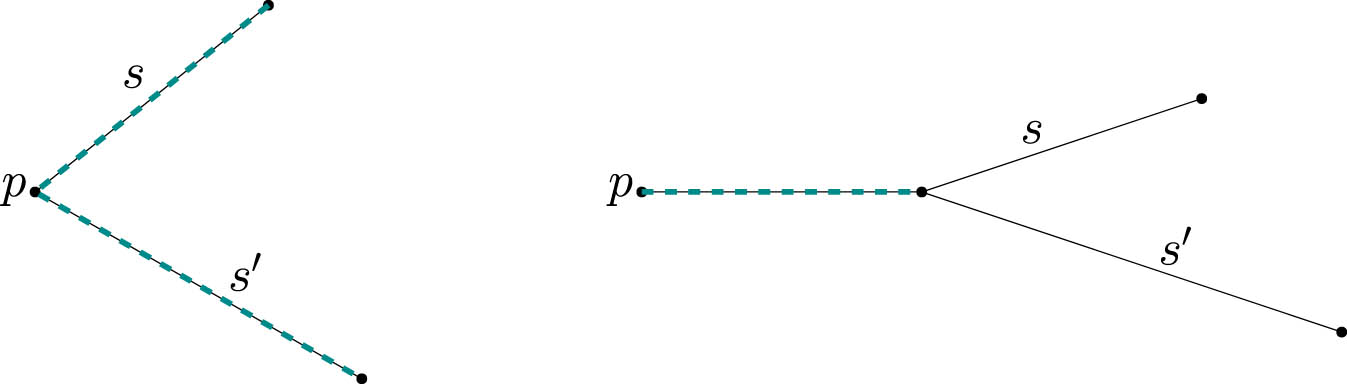
A Λ -metric space ( X , d ) is a Λ -tree if it satisfies the following three axioms, two of which are illustrated in Figure 1:

  1. ( X , d ) is geodesic.

  2. If two segments s , s X intersect in a single point s s = { p } , which is an endpoint of s and s , then their union s s is a segment.

  3. If two segments s , s X have an endpoint in common, then their intersection s s is a segment.

Figure 1 
               Illustration of axiom (2) (left) and axiom (3) (right) of 


                           Λ
                        
                        \Lambda 
                     
                  -trees. In axiom (2), the segments 


                           s
                           ,
                           s
                           ′
                        
                        s,s^{\prime} 
                     
                   are only allowed to intersect in one point.
Figure 1

Illustration of axiom (2) (left) and axiom (3) (right) of Λ -trees. In axiom (2), the segments s , s are only allowed to intersect in one point.

In the presence of either axiom (2) or axiom (3), geodesic Λ -metric spaces are uniquely geodesic. For axiom (2), this is Lemma 2.1 and was shown in [8, Lemma I.3.6]. For axiom (3), this is Proposition 2.2 and we give a proof here.

Lemma 2.1

(Lemma I.3.6 in [8]) Let ( X , d ) be a geodesic Λ -metric space. If ( X , d ) satisfies axiom (2), then ( X , d ) is uniquely geodesic.

Proposition 2.2

Let ( X , d ) be a geodesic Λ -metric space. If ( X , d ) satisfies axiom (3), then ( X , d ) is uniquely geodesic.

Proof

Let us assume that axiom (3) is satisfied and let s and s be two segments with common endpoints p and q . By axiom (3), their intersection s s is a segment. We note that p , q s s . Let φ : [ 0 , d ( p , q ) ] X be a parametrization of (potentially a subsegment of) s s with φ ( 0 ) = p and φ ( d ( p , q ) ) = q . For r s , we have d ( p , r ) d ( p , q ) , and hence, φ ( d ( p , r ) ) s s s . Since r is the unique point on s with distance d ( p , r ) from p , we have φ ( d ( p , r ) ) = r showing s s s . Similarly, s s s , and hence, s = s s = s .□

The idea for the following lemma appears also in Chiswell’s proof of Lemma 2.1. We will use this lemma in the proof of Theorem 1.1. The situation is illustrated in Figure 2.

Figure 2 
               Lemma 2.3 states that the segment 


                              [
                              
                                 z
                                 ,
                                 p
                              
                              ]
                           
                        
                        \left[z,p]
                     
                   cannot intersect both 


                              [
                              
                                 x
                                 ,
                                 z
                              
                              ]
                           
                        
                        \left[x,z]
                     
                   and 


                                 [
                              
                              
                                 y
                                 ,
                                 z
                              
                              ]
                           
                        
                        [y,z]
                     
                   outside of 


                              {
                              
                                 z
                              
                              }
                           
                        
                        \left\{z\right\}
                     
                  . It is also possible that 


                              [
                              
                                 z
                                 ,
                                 p
                              
                              ]
                           
                        
                        \left[z,p]
                     
                   intersects 


                              [
                              
                                 x
                                 ,
                                 y
                              
                              ]
                           
                        
                        \left[x,y]
                     
                   in only one point 


                           z
                        
                        z
                     
                  , in which case both possibilities in the lemma are correct.
Figure 2

Lemma 2.3 states that the segment [ z , p ] cannot intersect both [ x , z ] and [ y , z ] outside of { z } . It is also possible that [ z , p ] intersects [ x , y ] in only one point z , in which case both possibilities in the lemma are correct.

Lemma 2.3

Let ( X , d ) be a uniquely geodesic Λ -metric space. Let s = [ x , y ] be a segment, z s , and p X . Then,

[ x , z ] [ z , p ] = { z } o r [ y , z ] [ z , p ] = { z } .

Proof

For a d ( z , p ) Λ , let φ : [ 0 , a ] X be a parametrization of [ z , p ] with φ ( 0 ) = z and φ ( a ) = p . Note that z is an endpoint of [ z , p ] . Let x [ x , z ] [ z , p ] and y [ y , z ] [ z , p ] . We would like to show that x = z or y = z .

There are t x , t y [ 0 , a ] , such that φ ( t x ) = x and φ ( t y ) = y , and thus, d ( x , y ) = t y t x . Looking at the segment [ x , y ] , we also know that z [ x , y ] s , since [ x , y ] [ x , y ] = [ x , z ] [ z , y ] is unique. So d ( x , y ) = d ( x , z ) + d ( z , y ) = t x + t y . The equation t y t x = t y + t x can only be resolved if t x = 0 or t y = 0 , so x = z or y = z . This concludes the proof of the lemma.□

3 Dependence results

Recall that r Λ is called the maximum of a subset S Λ if r S and for all s S , s r . We now state the main theorem and prove (a) (b). This proof of this direction is formalized in Lean in [2]. The converse direction is proved in Section 4.

Theorem 3.1

Let Λ be an ordered abelian group. The following are equivalent:

  1. For every positive λ 0 Λ , the set { t Λ : 0 2 t λ 0 } has a maximum.

  2. Every Λ -metric space that satisfies axioms (1) and (2) also satisfies (3).

Proof

We will show (a) implies (b). So let Λ be an ordered abelian group such that for every positive λ 0 Λ , the set [ 0 , λ 0 2 ] { λ Λ : 0 2 λ λ 0 } has a maximum and let ( X , d ) be a Λ -metric space, which is (1) geodesic and (2) whenever two segments intersect in a single common endpoint, then their union is a segment. Let s and s be two segments with a common endpoint x X . We want to prove that in (3), the intersection s s is a segment.

By Lemma 2.1, X is uniquely geodesic. Let y be the other endpoint of s and let z be the other endpoint of s , i.e., s = [ x , y ] and s = [ x , z ] . For a d ( x , y ) and b d ( x , z ) , we have parametrizations:

φ : [ 0 , a ] X , φ ( 0 ) = x , φ ( a ) = y , ψ : [ 0 , b ] X , ψ ( 0 ) = x , ψ ( b ) = z ,

of the segments s and s . Without loss of generality, let a b . We consider z ˜ = ψ ( a ) [ x , z ] . By (1), there is a segment [ y , z ˜ ] with parametrization:

σ : [ 0 , d ( y , z ˜ ) ] X , σ ( 0 ) = y , σ ( d ( y , z ˜ ) ) = z ˜ .

We consider the subset S = { λ Λ : 0 2 λ d ( y , z ˜ ) } , which, by assumption (a), has a maximum r Λ . We define = d ( y , z ˜ ) r and note that r , since 2 r d ( y , z ˜ ) . Next, we show that a : if d ( y , z ˜ ) a , then d ( y , z ˜ ) a is clear; otherwise, we have d ( y , z ˜ ) a 0 , and by the triangle inequality,

2 ( d ( y , z ˜ ) a ) = d ( y , z ˜ ) + d ( y , z ˜ ) 2 a 2 a + d ( y , z ˜ ) 2 a = d ( y , z ˜ ) ,

and hence, d ( y , z ˜ ) a S , which implies d ( y , z ˜ ) a r , i.e., a .

We can now define the points p σ ( r ) , y φ ( a ) and z ψ ( a ) , such that d ( y , y ) = d ( y , q ) = = d ( z ˜ , p ) = d ( z ˜ , z ) . The situation is illustrated in Figure 3.

Our goal is to show that y = z and to then conclude that s s = [ x , y ] is a segment. We apply Lemma 2.3 to the segments s = [ x , y ] (and s ˜ = [ x , z ˜ ] ), y s (and z s ˜ ) and p to create the following case distinction, illustrated in Figure 4. In all cases, we prove that y = z .

Case (1a): [ x , y ] [ y , p ] = { y } and [ x , z ] [ z , p ] = { z } .

In this case, we have by axiom (2) that [ x , y ] [ y , p ] and [ x , z ] [ z , p ] are the segments from x to p . Since the segment [ x , p ] is unique, and d ( x , y ) = a = d ( x , z ) , it follows that y = z .

Case (1b): [ y , y ] [ y , p ] = { y } and [ x , z ] [ z , p ] = { z } .

In this case, we have by axiom (2) that [ y , y ] [ y , p ] = [ y , p ] is a segment. Since r = d ( y , y ) d ( y , y ) + d ( y , p ) = d ( y , p ) = r , we have, in this case, = r and d ( y , p ) = 0 ; hence, y = p . Now, we apply (2) again to see that [ x , z ] [ z , p ] = [ x , p ] = [ x , y ] is a segment. By uniqueness, it is a subsegment of s = [ x , y ] , and since d ( x , z ) = a = d ( x , y ) , we have that z = y = p .

Case (2a): [ x , y ] [ y , p ] = { y } and [ z ˜ , z ] [ z , p ] = { z } .

This case is similar to (1b). We have by axiom (2) that [ z ˜ , z ] [ z , p ] = [ z ˜ , p ] is a segment. Since d ( z ˜ , z ) d ( z ˜ , z ) + d ( z , p ) = d ( z ˜ , p ) = = d ( z ˜ , z ) , we have d ( z , p ) = 0 , and hence, z = p . Now, we apply (2) again to see that [ x , y ] [ y , p ] = [ x , p ] = [ x , z ] is a segment. By uniqueness, it is a subsegment of s = [ x , z ˜ ] , and since d ( x , y ) = a = d ( x , z ) , we have that y = z = p .

Case (2b): [ y , y ] [ y , p ] = { y } and [ z ˜ , z ] [ z , p ] = { z } .

In this case, y = p follows as in the first part of Case (1b) and z = p follows as in the first part of Case (2a).

In all cases, we have established that y = z . By uniqueness, we see that [ x , y ] = [ x , z ] s s . It remains to show that s s [ x , y ] = [ x , z ] . Let t , t Λ such that φ ( t ) = ψ ( t ) s s . Then, t = d ( x , φ ( t ) ) = d ( x , ψ ( t ) ) = t . We use the triangle inequality to obtain d ( y , z ˜ ) d ( y , φ ( t ) ) + d ( ψ ( t ) , z ˜ ) = 2 ( a t ) ; hence,

2 ( d ( y , z ˜ ) ( a t ) ) 2 ( a t ) + d ( y , z ˜ ) 2 ( a t ) = d ( y , z ˜ ) ,

from which we conclude that d ( y , z ˜ ) ( a t ) S = { λ Λ : 0 2 λ d ( y , z ˜ ) } (or is smaller than 0); hence, d ( y , z ˜ ) ( a t ) r , so = d ( y , z ˜ ) r a t and t a = d ( x , y ) = d ( x , z ) . Thus, φ ( t ) [ x , y ] = [ x , z ] and s s = [ x , y ] , proving axiom (3).□

Figure 3 
               Given the segments 


                           s
                           =
                           
                              [
                              
                                 x
                                 ,
                                 y
                              
                              ]
                           
                           ,
                           s
                           ′
                           =
                           
                              [
                              
                                 x
                                 ,
                                 z
                              
                              ]
                           
                           ⊆
                           X
                        
                        s=\left[x,y],s^{\prime} =\left[x,z]\subseteq X
                     
                  , we can construct points 


                                 z
                              
                              
                                 ˜
                              
                           
                           ,
                           p
                           ,
                           y
                           ′
                        
                        \tilde{z},p,y^{\prime} 
                     
                  , and 


                           z
                           ′
                        
                        z^{\prime} 
                     
                   with 


                           d
                           
                              
                                 (
                              
                              
                                 y
                                 ,
                                 y
                                 ′
                              
                              )
                           
                           =
                           d
                           
                              (


                                       z
                                    
                                    
                                       ˜
                                    
                                 
                                 ,
                                 z
                                 ′
                              
                              )
                           
                           =
                           d
                           
                              (


                                       z
                                    
                                    
                                       ˜
                                    
                                 
                                 ,
                                 p
                              
                              )
                           
                           =
                           ℓ
                        
                        d(y,y^{\prime} )=d\left(\tilde{z},z^{\prime} )=d\left(\tilde{z},p)=\ell 
                     
                  . The idea of the proof is to show that 


                           p
                           =
                           y
                           ′
                           =
                           z
                           ′
                        
                        p=y^{\prime} =z^{\prime} 
                     
                   and 


                           s
                           ∩
                           s
                           ′
                           =
                           
                              [
                              
                                 x
                                 ,
                                 p
                              
                              ]
                           
                        
                        s\cap s^{\prime} =\left[x,p]
                     
                   and thus a segment.
Figure 3

Given the segments s = [ x , y ] , s = [ x , z ] X , we can construct points z ˜ , p , y , and z with d ( y , y ) = d ( z ˜ , z ) = d ( z ˜ , p ) = . The idea of the proof is to show that p = y = z and s s = [ x , p ] and thus a segment.

Figure 4 
               We apply Lemma 2.3 to two segments. The two possibilities in the lemma lead to four cases we have to consider.
Figure 4

We apply Lemma 2.3 to two segments. The two possibilities in the lemma lead to four cases we have to consider.

4 Independence results

In this section, we construct three counterexamples X 1 , X 2 , and X 3 . Their properties are summarized in the following proposition.

Proposition 4.1

  1. When condition (a) of Theorem 1.1 does not hold, there is a Λ -metric space X 1 satisfying axioms (1) and (2), but not axiom (3).

  2. When Λ is the additive group of an ordered field, there is a Λ -metric space X 2 satisfying axioms (1) and (3), but not axiom (2).

  3. When Λ 2 Λ , there is a Λ -metric space X 3 satisfying axioms (1) and (3), but not axiom (2).

The existence of X 1 proves that ¬ (a) implies ¬ (b) in Theorem 1.1. Together with the results of Section 3, this concludes the proof of Theorem 1.1. The existence of X 2 and X 3 together implies Theorem 1.3.

4.1 Construction of X 1

We will construct a Λ -metric space X 1 that satisfies axioms (1) and (2), but not (3), whenever the condition

  1. For every positive λ 0 Λ , the set { t Λ : 0 2 t λ 0 } has a maximum, which is not satisfied. So let λ 0 Λ be an element such that the set

    I = { t Λ : 0 2 t λ 0 }

has no maximum and is not empty. Intuitively, I is an interval that has a minimum 0, but no maximum. In particular, λ 0 is not divisible by 2. We construct a Λ -metric space X 1 as illustrated in Figure 5. We will sometimes use the fact that Λ and [ 0 , λ 0 ] are Λ -trees without proof.

Figure 5 
                  When 


                              Λ
                           
                           \Lambda 
                        
                      does not satisfy Condition (a), we can construct the 


                              Λ
                           
                           \Lambda 
                        
                     -metric space 


                                    X
                                 
                                 
                                    1


                           {X}_{1}
                        
                      that satisfies (1) and (2), but not (3). The idea is that the branch-point is missing.
Figure 5

When Λ does not satisfy Condition (a), we can construct the Λ -metric space X 1 that satisfies (1) and (2), but not (3). The idea is that the branch-point is missing.

Lemma 4.2

The set

X 1 = i = 1 3 I × { i }

with the distance function

d : X 1 × X 1 Λ , ( ( x , i ) , ( y , j ) ) x y i f ; i = j , λ 0 x y o t h e r w i s e ,

is a Λ -metric space.

Proof

Positive definiteness and symmetry follow directly, and the triangle inequality requires a case distinction: if all three points are in I × { i } , then the triangle inequality follows from the one on Λ . For ( x , i ) , ( y , i ) , ( z , j ) X 1 with i j , where without loss of generality x y , explicit calculations show

d ( ( x , i ) , ( y , i ) ) + d ( ( y , i ) , ( z , j ) ) = d ( ( x , i ) , ( z , j ) ) , d ( ( x , i ) , ( z , j ) ) + d ( ( z , j ) , ( y , i ) ) = 2 λ 0 2 y 2 z + ( y x ) > d ( ( x , i ) , ( y , i ) ) , d ( ( y , i ) , ( x , i ) ) + d ( ( x , i ) , ( z , j ) ) = x y + λ 0 x z d ( ( y , i ) , ( z , j ) ) .

For ( x , i ) , ( y , j ) , ( z , k ) X 1 with distinct i , j , k a calculation shows that the strong triangle inequality:

d ( ( x , i ) , ( z , k ) ) < d ( ( x , i ) , ( y , j ) ) + d ( ( y , j ) , ( z , k ) )

holds.□

Lemma 4.3

Let ( x , i ) , ( y , j ) X 1 and x y or i j . The image of the map

φ : [ 0 , D ] X 1 , t ( x + t , i ) , i f 2 ( x + t ) < λ 0 , ( λ 0 x t , j ) , i f 2 ( x + t ) > λ 0 ,

where D = d ( ( x , i ) , ( y , j ) ) , is a segment from ( x , i ) to ( y , j ) . The Λ -metric space ( X 1 , d ) is geodesic.

Proof

If i = j and x y , D = y x and 2 ( x + t ) < λ 0 is satisfied for all t [ 0 , D ] . It is then clear that the map φ is an isometry with φ ( 0 ) = ( x , i ) and φ ( D ) = ( y , j ) . The corresponding segment is given by [ x , y ] × { i } .

For i j , we have D = λ 0 x y . The map φ is well defined since if 2 ( x + t ) > λ 0 , then 2 ( λ 0 x t ) = 2 λ 0 2 ( x + t ) < 2 λ 0 λ 0 = λ 0 . The endpoints behave correctly, φ ( 0 ) = ( x , i ) and φ ( D ) = ( y , j ) since 2 ( x + D ) = 2 ( x + λ 0 x y ) = λ 0 + ( λ 0 2 y ) > λ 0 , and hence, φ ( D ) = ( λ 0 x D , j ) = ( y , j ) . It remains to show that φ is an isometry. Let t , t [ 0 , D ] with t < t . If 2 ( x + t ) and 2 ( x + t ) are both either larger or smaller than λ 0 , then φ ( t ) and φ ( t ) are contained in the same copy of I and d ( φ ( t ) , φ ( t ) ) = t t follows from calculations in Λ . If 2 ( x + t ) < λ 0 and 2 ( x + t ) > λ 0 , then

d ( φ ( t ) , φ ( t ) ) = λ 0 ( x + t ) ( λ 0 x t ) = t t .

We now know that the image of φ is a segment from ( x , i ) , ( y , j ) . Without loss of generality, any set of two points in X 1 can be written as { ( x , i ) , ( y , j ) } with x y . The image of the map φ above thus gives us the segment, showing that X 1 is geodesic.□

From Lemma 4.3, we can conclude that [ 0 , λ 0 ] is isometric to I × { i } I × { j } whenever i j , (choose x = y = 0 ). The segments described in Lemma 4.3 can therefore be viewed as subsets of [ 0 , λ 0 ] . The next lemma states that the segments in Lemma 4.3 are the only ones.

Lemma 4.4

The Λ -metric space ( X 1 , d ) is uniquely geodesic.

Proof

Every segment from ( x , i ) to ( y , j ) admits a parametrization of the form ψ : [ 0 , D ] X 1 , where ψ ( 0 ) = ( x , i ) and ψ ( D ) = ( y , j ) . We first claim that for every t [ 0 , D ] , ψ ( t ) I × { i } I × { j } . If this were not the case, then we would have

d ( ( x , i ) , ψ ( t ) ) = λ 0 x r , d ( ( y , j ) , ψ ( t ) ) = λ 0 y r ,

for some r I with ( r , k ) = ψ ( t ) . We would then have

D = d ( ( x , i ) , ( y , j ) ) = d ( ( x , i ) , ψ ( t ) ) + d ( ( y , j ) , ψ ( t ) ) = 2 λ 0 x y 2 r

since ψ is an isometry. If i = j and without loss of generality x < y , then

y x = 2 λ 0 x y 2 r ,

which contradicts λ 0 > 2 r and λ 0 > 2 y . If i j , then

D = λ 0 x y = 2 λ 0 x y 2 r ,

which contradicts λ 0 > 2 r .

Let k i and k = j if j i . We can use Lemma 4.3 with ( 0 , i ) and ( 0 , k ) to obtain an isometry f : [ 0 , λ 0 ] I × { i } I × { k } . Since segments in [ 0 , λ 0 ] , are unique, also segments in f ( [ 0 , λ 0 ] ) = I × { i } I × { k } , such as ψ ( [ 0 , D ] ) , are unique, concluding the proof.□

Lemma 4.5

The Λ -metric space ( X 1 , d ) satisfies axiom (2).

Proof

Let s and s be two segments that intersect exactly in one common endpoint ( x , i ) X 1 . We will show that there is a j i such that the other endpoints of both s and s are contained in I × { i } I × { j } . Assume for contradiction that the other endpoint of s is in I × { j } and the other endpoint of s is in I × { k } for distinct i , j , and k . Let y I with x < y , which exists because x is not a maximum of I (we are assuming that I does not have a maximum). But then ( y , i ) s s by the description of the segments in Lemma 4.3 and the uniqueness in Lemma 4.4, which contradicts the assumption s s = { ( x , i ) } .

We conclude that there is a j i such that both s and s are contained in I × { i } I × { j } , which is isometric to [ 0 , λ 0 ] . Since axiom (2) holds in [ 0 , λ 0 ] , also s s is a segment.□

Lemma 4.6

The Λ -metric space ( X 1 , d ) does not satisfy axiom (3).

Proof

Let s be the unique segment from ( 0 , 1 ) to ( 0 , 2 ) and let s be the unique segment from ( 0 , 1 ) to ( 0 , 3 ) . The point ( 0 , 1 ) is a common endpoint of s and s . Since s s = I × { 1 } , and I does not have a maximum, s s is not isometric to a closed Λ -interval and hence is not a segment.□

We have constructed a Λ -metric space ( X 1 , d ) , which satisfies axioms (1) and (2) but not (3). This shows ¬ (a) ¬ (b) in Theorem 1.1 and thus completes its proof.

This example shows that axiom (3) forces the branchpoints to be part of the Λ -tree. For groups such as Λ = Q (or Z [ 1 2 ] ), one might be tempted to construct Λ -metric spaces with branchpoints at an irrational distance (or at 1 3 ). However, that construction fails, since the resulting metric does not take values in Λ . The number 1 2 plays a special role, as reflected in Condition (a) of Theorem 1.1.

4.2 Construction of X 2

It was noted in [1] that for Λ = R , axiom (2) is independent from axioms (1) and (3), consider, for instance, R 2 with the Euclidean distance. In view of Proposition 2.2, any such example has to be geodesically unique. The idea of this section is thus to build a uniquely geodesic Λ -metric space X 2 , which is two-dimensional in some sense.

Let Λ be the additive group of a ordered field. The idea is to create a version of the 1 -distance (also called the Manhattan-distance) but using polar coordinates instead of the usual Cartesian coordinates. The distance can be thought as the length of the shortest path consisting only of radial and circumferential movements. To be uniquely geodesic, we restrict ourselves to a subset. The situation is illustrated in Figure 6. We consider the set

X 2 = ( 0 , 2 ] × [ 0 , 1 ] = { ( t , φ ) Λ 2 : 0 < t 2 , 0 φ 1 }

and endow it with the function d : X 2 × X 2 Λ given by:

d ( ( t 1 , φ 1 ) , ( t 2 , φ 2 ) ) = t 2 t 1 + min { t 1 , t 2 } φ 2 φ 1 .

Figure 6 
                  In the 


                              Λ
                           
                           \Lambda 
                        
                     -metric space, 


                                    X
                                 
                                 
                                    2


                           {X}_{2}
                        
                      segments consist of a radial part and the shorter of two circumferential parts. Unlike in the Manhattan distance, segments are unique.
Figure 6

In the Λ -metric space, X 2 segments consist of a radial part and the shorter of two circumferential parts. Unlike in the Manhattan distance, segments are unique.

Lemma 4.7

The pair ( X 2 , d ) is a Λ -metric space.

Proof

Symmetry is clear from the definition and positive definiteness follows from the fact that Λ is a field. We prove the triangle inequality. Let p i = ( t i , φ i ) X 2 for i { 1 , 2 , 3 } be three points. To prove d ( p 1 , p 2 ) d ( p 1 , p 3 ) + d ( p 3 , p 2 ) , we may assume without loss of generality that t 1 t 2 . We first show the triangle inequality for the case t 3 t 1 ,

d ( p 1 , p 2 ) = t 2 t 1 + t 1 φ 2 φ 1 = t 2 t 1 + ( t 1 t 3 ) φ 2 φ 1 + t 3 φ 2 φ 1 t 2 t 1 + 2 ( t 1 t 3 ) + t 3 φ 2 φ 1 t 2 t 3 + t 1 t 3 + t 3 φ 3 φ 1 + t 3 φ 2 φ 3 = d ( p 1 , p 3 ) + d ( p 3 , p 2 ) ,

and then in the case t 1 t 3 ,

d ( p 1 , p 2 ) = t 2 t 1 + t 1 φ 2 φ 1 t 2 t 3 + t 3 t 1 + t 1 φ 3 φ 1 + t 1 φ 2 φ 3 t 3 t 2 + t 3 t 1 + t 1 φ 3 φ 1 + t 1 φ 2 φ 3 = d ( p 1 , p 2 ) + d ( p 2 , p 3 ) .

Remark 4.8

We note that we could also define this metric on some other subsets of Λ × Λ . For some examples like ( 0 , 1 ] × [ 0 , 2 ] and Λ 0 × [ 0 , 2 ] , we also obtain a Λ -metric space, but the triangle inequality would not hold on ( 0 , 1 ] × [ 0 , 3 ] . We could also add one more point ( 0 , 0 ) to X 2 and obtain a metric space that includes the “centerpoint.”

Lemma 4.9

The Λ -metric space ( X 2 , d ) is uniquely geodesic.

Proof

For the points p i = ( t i , φ i ) with i { 1 , 2 } , we may assume without loss of generality that t 1 t 2 . We write φ 0 t 1 φ 2 φ 1 , so that d ( p 1 , p 2 ) = φ 0 + ( t 2 t 1 ) . One can check that

f : [ 0 , d ( p 1 , p 2 ) ] X 2 , t t 1 , 1 φ 0 ( t φ 2 + ( φ 0 t ) φ 1 ) , if t < φ 0 , ( t φ 0 + t 1 , φ 2 ) , if t φ 0 ,

defines a segment map whose image s is a segment with p 1 and p 2 as endpoints. Let p = ( t , φ ) X s . We claim that then d ( p 1 , p 2 ) < d ( p 1 , p ) + d ( p , p 2 ) . If t < t 1 t 2 , then

d ( p 1 , p 2 ) = t 2 t 1 + t 1 φ 2 φ 1 = t 2 t 1 + ( t 1 t ) φ 2 φ 1 + t φ 2 φ 1 < t 2 t 1 + 2 ( t 1 t ) + t φ 2 φ 1 t 2 t + t 1 t + t φ φ 1 + t φ 2 φ = d ( p 1 , p ) + d ( p , p 2 ) .

If t 1 t 2 < t , then t 2 t < t t 2 = t t 2 and

d ( p 1 , p 2 ) = t 2 t + t t 1 + t 1 φ 2 φ 1 < t 2 t + t 1 t + t 1 φ 2 φ + t 1 φ φ 1 t 2 t + t 2 φ 2 φ + t 1 t + t 1 φ φ 1 = d ( p 1 , p ) + d ( p , p 2 ) .

If t [ t 1 , t 2 ] , we have

d ( p 1 , p 2 ) = t 2 t 1 + t 1 φ 2 φ 1 t 2 t + t t 1 + t 1 ( φ 2 φ + φ φ 1 ) = t t 1 + t 1 φ φ 1 + t 2 t + t 1 φ 2 φ t t 1 + t 1 φ φ 1 + t 2 t + t φ 2 φ = d ( p 1 , p ) + d ( p , p 2 ) ,

and the equality d ( p 1 , p 2 ) = d ( p 1 , p ) + d ( p , p 2 ) can only hold when either t 1 = t and φ is between φ 1 and φ 2 , or φ 2 = φ , and this is exactly when p s .

This shows the claim, and we can conclude that s is the unique segment from p 1 to p 2 .□

Remark 4.10

We note that the Λ -metric space X 2 could also be defined more generally for Λ the additive group of an ordered integral domain, but the segment-parametrization in Lemma 4.9 requires division.

Lemma 4.11

The Λ -metric space ( X 2 , d ) satisfies axiom (3).

Proof

Let s 1 and s 2 be two segments with a common endpoint p = ( t , φ ) . Let p 1 = ( t 1 , φ 1 ) be the other endpoint of s 1 and p 2 = ( t 2 , φ 2 ) be the other endpoint of s 2 . If φ 1 φ 2 , then the intersection s 1 s 2 is contained in { t } × [ 0 , 1 ] . By Lemma 4.9, s { t } × [ 0 , 1 ] and s { t } × [ 0 , 1 ] are the segments with a single common endpoint. Since { t } × [ 0 , 1 ] is a Λ -tree satisfying axiom (3), we know that s 1 s 2 is a segment. If φ 1 = φ 2 , then we know that s 1 s 2 ( 0 , 1 ] × { φ 1 } is a segment of the Λ -tree ( 0 , 1 ] × { φ 1 } . By the description of the segments in the proof of Lemma 4.9, s 1 s 2 is a segment.□

Lemma 4.12

The Λ -metric space ( X 2 , d ) does not satisfy axiom (2).

Proof

We consider the segments s 1 = [ ( 1 , 0 ) , ( 2 , 0 ) ] and s 2 = [ ( 1 , 0 ) , ( 2 , 1 ) ] . The two segments intersect exactly in one point ( 1 , 0 ) , but the union s 1 s 2 is not a segment by the description of segments in Lemma 4.9.□

4.3 Construction of X 3

We now give an example for the case Λ 2 Λ . Let a Λ not divisible by 2. Consider the set X 3 = [ 0 , 3 a ) with the Λ -metric:

d ( p , q ) = min { q p + k 3 a : k Z } = p q , if 2 p q < 3 a , 3 a p q , otherwise ,

for points p , q X 3 . Intuitively, we have turned the interval [ 0 , 3 a ] into a circle with the shortest path metric by gluing 0 to 3 a . The segment from p to q , where p q , is given by [ p , q ] if 2 p q < 3 a , and by [ q , 3 a ) [ 0 , p ] otherwise. From the definition, it follows that ( X 3 , d ) is a Λ -metric space and that it satisfies (1) and (3). Axiom (2) is, however, not satisfied, because the union [ 0 , a ] [ a , 2 a ] of two segments is not again a segment, since d ( 0 , 2 a ) = a 2 a . The actual segment connecting 0 to 2 a is [ 2 a , 3 a ) { 0 } .

Acknowledgements

The author would like to thank L. De Rosa and X. Flamm for insightful discussions. The author is also grateful for the detailed feedback of an anonymous referee.

  1. Conflict of interest: The author states no conflict of interest.

References

[1] R. Alperin and H. Bass, Length functions of group actions on Λ-trees, in: Combinatorial Group Theory and Topology, S. M. Gersten and J. R. Stallings, (Ed.), Annals of Mathematical Studies, vol. 111, Princeton University Press, Princeton, NJ,1987, p. 265–378.10.1515/9781400882083-017Search in Google Scholar

[2] R. Appenzeller, Λ-metric-space - Lean project, 2023, https://github.com/Strichcoder/lambda-metric-space.Search in Google Scholar

[3] C. Bennett. Affine Λ-buildings, Ph.D.-thesis. University of Chicago, 1990.Search in Google Scholar

[4] C. Bennett, Affine Lambda-buildings I, Proc. London Math. Soc. 68 (1994), no. 3, 541–576.10.1112/plms/s3-68.3.541Search in Google Scholar

[5] K. Buzzard, J. Commelin, and P. Massot, Formalising perfectiod spaces, in: Proceedings of the 9th ACM SIGPLAN International Conference on Certified Programs and Proofs, 2020.10.1145/3372885.3373830Search in Google Scholar

[6] C. Bennett, P. Schwer, and K. Struyve, On axiomatic definitions of non-discrete affine buildings, Adv. Geom. 14 (2014), no. 3, 381–412.10.1515/advgeom-2014-0017Search in Google Scholar

[7] G. W. Brumfiel, The tree of a non-Archimedean hyperbolic plane, Contemporary Mathematics, vol. 74, 1988.10.1090/conm/074/957513Search in Google Scholar

[8] I. M. Chiswell, Introduction to Λ-trees, World Scientific Publishing Co. Inc., River Edge, NJ, 2001, ISBN 981-02-4386-3.Search in Google Scholar

[9] L. M. de Moura, S. Kong, J. Avigad, F. van Doorn, J. von Raumer, The Lean Theorem Prover (System Description), Automated Deduction - CADE-25 - 25th International Conference on Automated Deduction, Berlin, Germany, August 1–7, 2015, Proceedings, 2015, p. 378–388.10.1007/978-3-319-21401-6_26Search in Google Scholar

[10] The mathlib Community. The Lean mathematical library, 2019. arXiv:1910.09336.10.1145/3372885.3373824Search in Google Scholar

[11] J. W. Morgan and P. B. Shalen. Valuations, trees, and degenerations of hyperbolic structures. I, Ann. Math. (2) 120 (1984), no. 3, 401–476.10.2307/1971082Search in Google Scholar

[12] A. Parreau, Immeubles affines: construction par les normes, in: Crystallographic Groups and Their Generalizations: Workshop, Katholicke Universiteit Leuven Campus Kortrijk, Belgium, May 26–28, 1999, vol. 262, American Mathematical Soc., 2000, p. 263.10.1090/conm/262/04180Search in Google Scholar

Received: 2023-07-26
Accepted: 2023-12-29
Published Online: 2024-04-01

© 2024 the author(s), published by De Gruyter

This work is licensed under the Creative Commons Attribution 4.0 International License.

Downloaded on 5.12.2025 from https://www.degruyterbrill.com/document/doi/10.1515/agms-2023-0106/html
Scroll to top button