Home Mathematics On strongly just infinite profinite branch groups
Article Publicly Available

On strongly just infinite profinite branch groups

  • François Le Maître EMAIL logo and Phillip Wesolek
Published/Copyright: June 19, 2016

Abstract

For profinite branch groups, we first demonstrate the equivalence of the Bergman property, uncountable cofinality, Cayley boundedness, the countable index property, and the condition that every non-trivial normal subgroup is open; compact groups enjoying the last condition are called strongly just infinite. For strongly just infinite profinite branch groups with mild additional assumptions, we verify the invariant automatic continuity property and the locally compact automatic continuity property. Examples are then presented, including the profinite completion of the first Grigorchuk group. As an application, we show that many Burger–Mozes universal simple groups enjoy several automatic continuity properties.

1 Introduction

Given a Polish group[1], it is natural to study the extent to which topological properties are determined by the group’s algebraic structure. A common approach is to study automatic continuity properties: For a Polish group G and some interesting class of topological groups , one asks if every homomorphism ψ:GH with H is continuous. Such questions explore the connection between algebraic and topological structure since homomorphisms from a Polish group must respect algebraic structure, but they do not necessarily respect the topology.

In the setting of non-locally compact Polish groups, there are now many groups known to enjoy the automatic continuity property, namely that every homomorphism into any Polish group is continuous; we refer the reader to the survey by C. Rosendal [25] for further discussion. For non-discrete locally compact Polish groups, however, much less is known. Indeed, the following fundamental question remains open.

Question 1.1

Question 1.1 (Rosendal [24])

Is there a non-discrete locally compact Polish group which has the automatic continuity property?

In the work at hand, we study automatic continuity properties for profinite branch groups. Our results fall just short of answering Question 1.1 positively; specifically, we obtain the weak Steinhaus property. Nonetheless, we do elucidate an interesting characterization of those groups which enjoy various weaker automatic continuity properties. Moreover, we connect these properties to combinatorial boundedness conditions; the strongest of these being the Bergman property.

1.1 Statement of results

Definition 1.2

Definition 1.2 (see Section 2.4)

A profinite branch group is a closed spherically transitive subgroup of the automorphism group of a rooted locally finite tree such that every rigid level stabilizer is an open subgroup.

Profinite branch groups form a rich, interesting class of compact Polish groups; an introduction to these groups and their structure can be found in [13].

A profinite group is strongly just infinite if every non-trivial normal subgroup is open. A straightforward adaption of an argument due to R. I. Grigorchuk, cf. [13, Theorem 4], gives a characterization of strongly just infinite profinite branch groups.

Proposition 1.3

Proposition 1.3 (see Theorem 3.2)

Suppose that GAut(Tα) is a profinite branch group. Then the following are equivalent:

  1. G is strongly just infinite.

  2. For every vertex vTα, the derived subgroup of ristG(v) is open in ristG(v).

  3. For every level n1, the derived subgroup of ristG(n) is open.

The celebrated work of N. Nikolov and D. Segal [21] along with the previous proposition imply that all just infinite topologically finitely generated profinite branch groups are strongly just infinite.

Our main result establishes for profinite branch groups an equivalence between being strongly just infinite, automatic continuity properties, and combinatorial boundedness conditions.

Theorem 1.4

Theorem 1.4 (see Theorem 4.8)

Let G be a profinite branch group. Then the following are equivalent:

  1. G is strongly just infinite.

  2. Every commensurated subgroup of G is either finite or open.

  3. G has the normal countable index property.

  4. G has the countable index property.

  5. G has the weak Steinhaus property.

  6. G has uncountable cofinality.

  7. G is Cayley-bounded.

  8. G has property (FA).

  9. G has the Bergman property.

Remark 1.5

Infinite products of non-abelian finite simple groups are known to satisfy a similar characterization; see [27, 28].

Examples of groups satisfying the equivalent conditions of Theorem 1.4 include many iterated wreath products as well as the profinite completion of the Grigorchuk group. (See Section 7.)

Under slightly stronger hypotheses, we obtain additional automatic continuity properties.

Theorem 1.6

Theorem 1.6 (see Theorem 5.10)

If G is a strongly just infinite profinite branch group which locally has derangements and has uniform commutator widths, then G enjoys the equivalent properties of Theorem 1.4, the invariant automatic continuity property, and the locally compact automatic continuity property.

We go on to observe that profinite branch groups have a unique Polish group topology. Additionally, strongly just infinite profinite branch groups admit exactly two locally compact group topologies: their profinite topology and the discrete topology. (See Section 6.)

Our study of profinite branch groups concludes by considering applications of our results. We give the first examples of non-discrete compactly generated locally compact Polish groups that are simple and enjoy the automatic continuity properties discussed herein.

Theorem 1.7

Theorem 1.7 (see Theorem 8.4)

Suppose that FSd is non-trivial, perfect, and two transitive. Suppose further the point stabilizers of F are also perfect. The Burger–Mozes universal simple group U(F)+ then enjoys the countable index property, the invariant automatic continuity property, and the locally compact automatic continuity property.

The commensurated subgroups of these Burger–Mozes groups are also classified. Classifying commensurated subgroups gives information on the possible homomorphisms into totally disconnected locally compact groups, see [22]; a compelling example of such a classification is the work of Y. Shalom and G. Willis on commensurated subgroups of arithmetic groups [26].

Theorem 1.8

Theorem 1.8 (see Theorem 8.6)

Suppose that FSd is non-trivial, perfect, and two transitive. Suppose further that the point stabilizers of F are also perfect. Then every commensurated subgroup of U(F)+ is either finite, compact and open, or equal to U(F)+.

The alternating group Ad for any d6 is an example of a finite group F that satisfies the hypotheses of the above theorems.

2 Preliminaries

For a topological group G, the commutator of g,hG is [g,h]:=ghg-1h-1. The set of commutators of G is [G,G]:={[g,h]g,hG}. We put

[G,G]n:={[g1,h1][gn,hn]gi,hiG}.

The derived subgroup of G is D(G):=[G,G]; in general this subgroup is not closed, hence we occasionally add the modifier “abstract” to call attention to this point.

The symmetric group on a set X is denoted 𝔖(X). For all d, we let [d] denote the set {0,,d-1} and set 𝔖d:=𝔖([d]).

2.1 Generalities on groups

We shall require a lemma likely well-known to mathematicians more familiar with the theory of uncountable abelian groups; we include a proof for completeness.

Lemma 2.1

If A is an uncountable abelian group, then A has an infinitely generated countable quotient.

Proof.

Let Tor(A) be the torsion subgroup of A and form A~:=A/Tor(A). Suppose first that A~ is uncountable, so A~ is an uncountable torsion free abelian group. The extension of scalars A~ is an uncountable -vector space, and there is a canonical injection A~A~, since A~ is torsion free. We may find a set {ai1}i with aiA~ linearly independent vectors in A~. We then have a projection

A~span({ai1i})=:V.

The composition AA~A~V has a countably infinite image that is infinitely generated, verifying the lemma in this case.

If A/Tor(A) is countable, then it suffices to find a countable quotient of Tor(A) that is infinitely generated; we thus assume A=Tor(A). By [12, Theorem 8.4], we have a decomposition A=p primeAp where Ap are abelian p-groups, and since A is uncountable, there is a prime p such that Ap is uncountable. We may thus also assume A is an uncountable p-group.

Appealing to [12, Theorem 32.3], there exists BA such that B is a direct sum of cyclic p-groups and A/B is divisible. Suppose first A/B is non-trivial. Divisible abelian groups are direct sums of copies of and Prüfer p-groups via [12, Theorem 23.1], and both of these are countably generated. Projecting onto one of these summands, we obtain a countable quotient of A which is infinity generated. If A/B is trivial, then A is an uncountable direct sum of cyclic p-groups. Projecting onto a countable direct sum gives the desired countable quotient which is infinitely generated. The lemma is thus verified. ∎

For a group G, define the function l:D(G) by

l(g):=min{n|g=i=1n[hi,ki]}.

The commutator width of G is then cw(G):=supgD(G)l(g).

For profinite groups, we note a useful sufficient condition for finite commutator width.

Lemma 2.2

Lemma 2.2 (Hartley [14, Lemma 1])

If G is a profinite group such that D(G) is open in G, then cw(G)<.

Lastly, a topological group is called just infinite if all its non-trivial closed normal subgroups are of finite index. Discarding the topology, we arrive at the central notion of the current work.

Definition 2.3

A topological group G is called strongly just infinite if every non-trivial normal subgroup is open with finite index.

2.2 Combinatorial boundedness conditions

Our work primarily considers three boundedness conditions.

Definition 2.4

Let G be a group.

  1. G has the Bergman property if every G-action by isometries on a metric space has bounded orbits.

  2. G has uncountable cofinality if there is no increasing chain (Gn)n of proper subgroups of G such that nGn=G. Otherwise, G has countable cofinality.

  3. G is Cayley bounded if for any symmetric generating set U containing 1, there is some n1 such that Un=G. Equivalently, every Cayley graph for G has finite diameter.

The Bergman property admits a useful algebraic reformulation.

Definition 2.5

A sequence (An)n of subsets of a group G is called a Bergman sequence if it is increasing, each of its elements is symmetric, 1A0, and the union nAn is equal to G.

Theorem 2.6

Theorem 2.6 (Cornulier, cf. [9, Proposition 2.7])

Let G be a group. The following assertions are equivalent.

  1. G has the Bergman property.

  2. If (An)n is a Bergman sequence such that AnAnAn+1 for all n, then there exists k such that Ak=G.

  3. If (An)n is a Bergman sequence, then there exist two integers k,n such that Ank=G.

The Bergman property is related to uncountable cofinality and Cayley boundedness as follows:

Proposition 2.7

Proposition 2.7 (Cornulier [9, Proposition 2.4])

A group G has the Bergman property if and only if it has uncountable cofinality and is Cayley bounded

We also require a sufficient condition to be non-Cayley bounded, due to A. Khelif. Here we reproduce his unpublished proofs with his kind permission. In his work [17], his terminology differs from ours: what he calls “Bergman’s property” is for us “Cayley boundedness.”

Theorem 2.8

Theorem 2.8 (Khelif [17, Théorème 10])

If Γ is a countable infinite subgroup of a compact group G, then Γ is not Cayley bounded.

Proof (Khelif).

First note that we may assume G is metrizable: By the Peter–Weyl Theorem, for each γΓ there is a finite dimensional unitary representation πγ:G𝒰(nγ) such that πγ(γ)1, so Γ embeds into the compact metrizable group γΓ𝒰(nγ). Furthermore, by taking the closure of Γ in G, we may assume that Γ is dense in G. Fix a compatible right-invariant metric d on G.

Enumerate Γ={γnn} and for all n let Γn:=γ0,,γn. Consider the sequence of continuous functions fn:G[0,+[ given by

fn(g)=d(Γn,g):=infγΓnd(γ,g).

This sequence of functions decreases pointwise to zero, so by Dini’s theorem, they converge uniformly to zero. We can thus find a sequence (un)n such that unΓn and d(un,γn+1) tends to zero.

Set S:={1,γ0}{γn+1un-1n} and let U:=SS-1. The set U is a symmetric generating set for Γ which contains 1, and since γn+1un-11, the set U is also a compact subset of G. If Γ is Cayley bounded, we can find k such that Γ=Uk. In particular, Γ is then compact, but by the Baire category theorem, there is no countable infinite compact group. We thus deduce that Γ is not Cayley bounded. ∎

Corollary 2.9

Corollary 2.9 (Khelif [17, Corollaire 11])

If G is an infinite solvable-by-finite group, then G is not Cayley bounded.

Proof (Khelif).

Let H be a finite index normal subgroup of G such that H is solvable and consider the derived series H(n+1):=D(H(n)), where H(0):=H. Let n be the smallest integer such that H/H(n) is infinite. Since H(n-1)/H(n) is abelian, the quotient group G/H(n) is infinite and abelian-by-finite. It thus suffices to show that no infinite abelian-by-finite group is Cayley bounded, so we assume G has a finite index normal subgroup N which is abelian.

By Lemma 2.1, the group N has a subgroup BN with countable index. Letting x1,,xk be coset representatives for N in G, the subgroup

L:=i=1kxiBxi-1

is a normal subgroup of G such that G/L is a countably infinite abelian-by-finite group. Passing to G/L, we may also assume G is countable.

Since N is abelian, Pontryagin duality gives a morphism ψ:NK with countable infinite image where K is a compact group. Taking coset representatives x1,,xk for N in G, define ρ:NKk by

h(ψ(x1hx1-1),,ψ(xkhxk-1)).

The action of G on N by conjugation induces an action of G on ρ(N) by defining

g.ρ(h):=ρ(ghg-1).

For each gG and hN, it follows that there is a σ𝔖(k) such that

g.(ψ(x1hx1-1),,ψ(xkhxk-1))=(ψ(xσ(1)hxσ(1)-1),,ψ(xσ(k)hxσ(k)-1)).

Each element gG thus acts on ρ(N) by permuting coordinates. Such an action extends to an action on ρ(N)¯ by continuous automorphisms.

Under this action, the group ρ(N)¯G is a locally compact group. A straightforward calculation shows the subset {(ρ(h),h-1)hN} is a discrete normal subgroup of ρ(N)¯G. The quotient is furthermore a compact group into which G embeds. The desired conclusion now follows via Theorem 2.8. ∎

We lastly note that any quotient of a Cayley bounded group is again Cayley bounded.

2.3 Automatic continuity properties

Definition 2.10

A topological group is Polish if the underlying topology is separable and admits a compatible, complete metric. A Polish group is called non-archimedean if the topology admits a basis at 1 of open subgroups.

The automatic continuity properties of primary interest have a useful algebraic description.

Definition 2.11

Let G be a Polish group.

  1. The group G has the normal countable index property if every countable index normal subgroup of G is open.

  2. The group G has the countable index property if every countable index subgroup of G is open.

Lemma 2.12

Let G be a Polish group.

  1. The group G has the normal countable index property if and only if every homomorphism ψ:GH with H a countable discrete group is continuous.

  2. The group G has the countable index property if and only if every homomorphism ψ:GH with H a non-archimedean Polish group is continuous.

Proof.

The first claim is immediate, so we prove the second. Suppose first G has the countable index property and ψ:GH is a homomorphism with H a non-archimedean Polish group. Taking OH an open subgroup of H, the index of O is countable, since H is second countable. Hence, ψ-1(O) is a countable index subgroup of G. That G has the countable index property now ensures ψ-1(O) is open, and we deduce that ψ is continuous.

Conversely, suppose G is such that every homomorphism ψ:GH is continuous where H is a non-archimedean Polish group. Take OG a countable index subgroup. The action of G on the left cosets G/O induces a homomorphism σ:G𝔖(G/O). The group 𝔖(G/O) with the topology of pointwise convergence is a non-archimedean Polish group, hence σ is continuous. Furthermore, the collection of permutations in 𝔖(G/O) which fix the coset O, denoted Σ, form an open subgroup of 𝔖(G/O). We thus see that σ-1(Σ)=O is open in G, whereby G has the countable index property. ∎

The countable index property is a weakening of the small index property which states that every subgroup of index less than the continuum is open. The latter has been studied in the context of automorphism groups of countable structures; see [10].

Our proofs will require analyzing σ-syndetic sets: For a Polish group G, a subset AG is called σ-syndetic if there is a sequence (gn)n of elements of G such that G=ngnA.

Definition 2.13

A Polish group G has the weak Steinhaus property if for any symmetric σ-syndetic set A, there exists n such that the set An contains a neighborhood of 1.

Let us collect two technical results concerning σ-syndetic sets.

Lemma 2.14

Lemma 2.14 ([29, Lemma 4])

Suppose that G is a group and H is a subgroup of G. If A is a symmetric σ-syndetic set containing 1 for G, then HA2 is a symmetric σ-syndetic set containing 1 for H.

Lemma 2.15

Suppose that G is a group and g0,,gnG. If A is a symmetric σ-syndetic set containing 1, then i=0ngiA2ngi-1 is symmetric σ-syndetic set containing 1.

Proof.

The fact that i=0ngiA2ngi-1 is again symmetric and contains 1 is straightforward. To see that this set is also σ-syndetic, one argues via the obvious induction. This induction comes down to the following claim, which we prove here: If A,BG are two σ-syndetic symmetric sets containing 1, then the set B2A2 is also σ-syndetic.

Let A and B be two σ-syndetic symmetric sets containing 1, fix a sequence (hk)k such that G=khkB and set

K:={khkBA}.

For each kK, fix akhkBA and say ak=hkbk with bkB.

For aA, there are kK and bB such that a=hkb, hence a=akbk-1b. We also have a=akak-1a, so aak(B2A2). It now follows that

AkKak(B2A2).

Since the set A is σ-syndetic, we conclude that B2A2 is σ-syndetic, completing the proof. ∎

2.4 Rooted trees and profinite branch groups

A rooted treeT is a locally finite tree with a distinguished vertex r called the root. Letting d be the usual graph metric, the levels of T are the sets

Vn:={vTd(v,r)=n}.

The children of a vertex vVn are those wVn+1 for which there is an edge from v to w.

We think of the levels of the tree as linearly ordered so that the orders cohere. That is to say, if v0<v1 in Vn with w0 a child of v0 and w1 a child of v1, then w0<w1 in Vn+1. This ordering allows us to take the right-most branch: the right-most branch of T is the unique infinite path from the root (vi)i such that vi is the maximal element of Vi for all i.

When vertices k and w lie on the same path to the root and d(k,r)d(w,r), we write kw. Given a vertex sT, the tree below s, denoted Ts, is the collection of t such that st along with the induced graph structure.
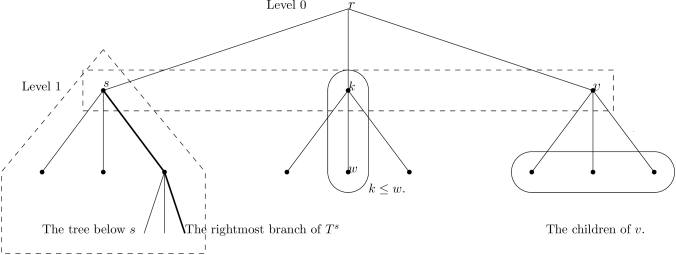
Figure 1 Levels, children, and trees below vertices
Figure 1

Levels, children, and trees below vertices

We call a rooted tree spherically homogeneous if for all v,wVn the number of children of v is the same as the number of children of w. A spherically homogeneous tree is completely determined by specifying the number of children of the vertices at each level. These data are given by an infinite sequence α such that α(i)2 for all i; the condition α(i)2 ensures non-triviality. We denote a spherically homogeneous tree by Tα for α2. When αd, we write Td. The group of rooted tree automorphisms, denoted Aut(Tα), is naturally a profinite group.

Profinite branch groups are certain closed subgroups of Aut(Tα); our approach to branch groups follows closely Grigorchuk’s presentation in [13]. For a closed subgroup GAut(Tα) and for a vertex vTα, the rigid stabilizer of v in G is defined to be

ristG(v):={gGg.w=w for all wTαTαv}.

The rigid stabilizer acts non-trivially only on the subtree Tαv.

The n-th rigid level stabilizer in G is defined to be

ristG(n):=ristG(v)vVn.

It is easy to see that ristG(n)vVnristG(v), and as a consequence, ristG(n) is a closed subgroup of G.

For a level n, we denote the pointwise stabilizer in G of Vn by stG(n). The subgroup stG(n) is called the n-th level stabilizer of G. Observe that it can be the case that ristG(n)<stG(n), even for profinite branch groups.

Definition 2.16

A profinite group G is said to be a profinite branch group if there is a tree Tα for some α2 such that the following hold:

  1. G is isomorphic to a closed subgroup of Aut(Tα).

  2. G acts transitively on each level of Tα.

  3. For each level n, the index |G:ristG(n)| is finite.

We shall always identify a profinite branch group G with the isomorphic closed subgroup of Aut(Tα).

The rigid level stabilizers form a basis at 1 for the topology on a profinite branch group G. The transitivity of the action on the levels ensures that

ristG(v)ristG(w)

for all v,wVn. The transitivity further insures that profinite branch groups are always infinite.

Lemma 2.17

Suppose that GAut(Tα) is a profinite branch group and vTα. Then each element gCG(ristG(v)) fixes pointwise Tαv. In particular, the center of ristG(v) is trivial for all vTα.

Proof.

Fix vTα and suppose for contradiction that there is a wv such that g.ww. The subgroup ristG(w) is non-trivial since G is infinite, so we may find yristG(w) and uw with y.uu. The element gy then sends u to g.(y.u), but the element yg sends u to g.u. Hence, gyyg contradicting the hypothesis that g centralizes ristG(v). ∎

As an immediate corollary, we obtain a description of ristG(v).

Lemma 2.18

Suppose GAut(Tα) is a profinite branch group. If vTα is at level n, then

ristG(v)=wVn{v}CG(ristG(w)).

3 Commutators and diagonalization in branch groups

3.1 The commutator trick

The following lemma is well known and dates back to the fifties, where it was used by G. Higman [15] to show the simplicity of various permutation groups. It has since become a cornerstone to proofs that various groups are simple.

The support of a permutation σ𝔖(X) is the set

supp(σ):={xXσ(x)x}.
Lemma 3.1

Let X be a set and let GS(X) be a permutation group with τG. If σ1,σ2G are such that τ(supp(σ1)) is disjoint from supp(σ1)supp(σ2), then the commutator [σ1,σ2] is the product of four conjugates of τ±1 by elements of G.

Proof.

Whenever two permutations have disjoint support, they commute. Moreover,

τ(suppσ1)=supp(τσ1τ-1),

so by our hypothesis, τσ1τ-1 commutes with both σ1 and σ2. It follows τσ1-1τ-1 also commutes with both σ1 and σ2.

Setting σ1¯:=[σ1,τ]=σ1(τσ1-1τ-1), the fact that τσ1-1τ-1 commutes with both σ1 and σ2 yields that [σ1,σ2]=[σ¯1,σ2]. The permutation σ¯1=(σ1τσ1-1)τ-1 is the product of two conjugates of τ±1 by elements of the group G. Hence, [σ¯1,σ2] is the product of four conjugates of τ±1 by elements of G, verifying the lemma. ∎

We now adapt Grigorchuk’s argument [13, Theorem 4] to characterize strongly just infinite profinite branch groups.

Theorem 3.2

Suppose that GAut(Tα) is a profinite branch group. Then the following are equivalent:

  1. G is strongly just infinite.

  2. For all vTα, the abstract derived subgroup D(ristG(v)) is open in ristG(v).

  3. For all n1, the abstract derived subgroup D(ristG(n)) is open in G.

Proof.

For (1)  (2), we prove the contrapositive. Suppose for some vTα the abstract commutator D(ristG(v)) is not open in ristG(v); Lemma 2.17 ensures D(ristG(v)) is also non-trivial. Letting n be the level of v, the subgroup

D(ristG(n))=wVnD(ristG(w))

is a characteristic subgroup of ristG(n) which is non-trivial and not open. Since ristG(n) is a normal subgroup of G, we deduce that G has a non-trivial normal subgroup which is not open, hence G is not strongly just infinite.

The implication (2)  (3) is immediate.

For (3)  (1), let H be a non-trivial normal subgroup of G and let τH{1}. There exists a vertex v such that τ(v)v; let n be its level. Taking two elements σ1,σ2 in ristG(v), their support is a subset of Tαv, and since τ(Tαv)=Tατ.v is disjoint from Tαv, we apply the commutator trick and deduce that the commutator [σ1,σ2] is the product of four conjugates of τ±1.

The commutator group D(ristG(v)) is thus a subgroup of H. Since H is normal and G acts spherically transitively on Tα, it follows that the open subgroup

D(ristG(n))=wVnD(ristG(w))

is a subgroup of H, hence H is open. ∎

The next lemma establishes a version of the commutator trick for certain large sets.

Definition 3.3

For GAut(Tα), we call a subset A of Gfull above the vertex vTα if every element of ristG(v) coincides with an element of A restricted to Tαv.

For a group G with ristG(v)={1}, any set containing 1 is full above v. In profinite branch groups, however, rigid stabilizers are necessarily infinite, so this trivial case never occurs.

The relevance of this definition stems from the following observation.

Lemma 3.4

Suppose that GAut(Tα) is a strongly just infinite profinite branch group and that AG is full above v. If AristG(v){1}, then there is a wv such that D(ristG(w))A10k with k:=cw(ristG(w)).

Proof.

Take xAristG(v){1} and find wv such that x.ww. We now consider g,hristG(w). Since A is full above v, there are g~,h~A with the same action on Tαv as g and h, respectively. The element x is supported on ristG(v), so h~x-1h~-1=hx-1h-1. In particular, [h~,x]=[h,x]. The element [h,x] is again supported on Tαv, so we have that [g~,[h,x]]=[g,[h,x]].

Now xh-1x-1 commutes with both h and g since supp(xh-1x-1)Tαx.w, so we further have that [g,h]=[g,[h,x]]. Therefore,

[g,h]=[g,[h,x]]=[g~,[h,x]]=[g~,[h~,x]],

and we deduce that [g,h]A10.

The set A10 thus contains every commutator of ristG(w). In view of Lemma 2.2, Theorem 3.2 implies that k:=cw(ristG(w)) is finite, so D(ristG(w))A10k. ∎

3.2 The diagonalization trick

We now show we can find full sets under certain mild conditions. This lemma was already present in the work of J. Dixon, P. Neumann, and S. Thomas on the small index property for permutation groups [10].

Lemma 3.5

Let GAut(Tα) be a closed subgroup and let (An)nN be a countable family of subsets of G such that G=nNAn. Then for any vertex wTα, there exists a vertex vw and nN such that An is full above v.

Proof.

Let (wn)n enumerate the vertices of the rightmost branch of Tαw. For each n, let vn be a child of wn different from wn+1. Let us prove by contradiction that there is some n such that An is full above vn; this implies the lemma.

If not, for each n there is a tree automorphism gnG supported on Tαvn such that its restriction to Tαvn does not extend to an element of An. The products i=0ngi converge to a limit g, and g extends gi for all i. Since G is closed in Aut(Tα), we have that gG, but for all n, the restriction of g to Tαvn does not extend to an element of An. We conclude gAn for any n, contradicting the assertion nAn=G. ∎

Sets which are σ-syndetic are natural sources of sets full above a vertex.

Lemma 3.6

Let GAut(Tα) be a closed subgroup and let A be a symmetric σ-syndetic subset of G. Then for any wTα, there exists vw such that A2 is full above v.

Proof.

We may find a sequence (gn)n of elements of G such that ngnA is equal to G. Lemma 3.5 provides n and a vertex vw such that gnA is full above v. Since 1ristG(v), there exists agnA such that aTαv is the identity. It now follows that Agn-1gnA=A2 is full above v. ∎

4 Strongly just infinite profinite branch groups

4.1 Combinatorial boundedness conditions

Our characterization of profinite branch groups with boundedness conditions requires a general observation.

Lemma 4.1

If G is a profinite group with uncountable cofinality, then the derived group D(O) is open for every open normal OG.

Proof.

We prove the contrapositive. Suppose that OG is open but that D(O) is not. The subgroup D(O) is then meagre in O, hence the quotient group O/D(O) is uncountable. Appealing to Lemma 2.1, we may find D(O)AO such that O/A is countable and infinitely generated.

Taking g0,,gn left coset representatives for O in G, the subgroup

A~:=i=0ngiAgi-1

is normal in G, and G/A~ is countable. The group G/A~ must be infinitely generated since O/A~ is a finite index subgroup. Since infinitely generated countable groups plainly have countable cofinality, we conclude that G has countable cofinality. ∎

We note one further boundedness condition, which we will obtain for free from results in the literature: A group G satisfies property (FA) if whenever G acts on a tree without edge inversions, then it fixes a vertex.

Theorem 4.2

Let GAut(Tα) be a profinite branch group. Then the following are equivalent:

  1. G is strongly just infinite.

  2. G has the Bergman property.

  3. G has uncountable cofinality.

  4. G has property (FA).

  5. G is Cayley bounded.

Proof.

For (1)  (2), let (An)n0 be a Bergman sequence. By Lemma 3.5, there are n00 and vTα such that An0 is full above v. Appealing to Lemma 3.4, we may find wv on some level l such that

D(ristG(w))An010k

for k:=cw(ristG(w)).

Since G acts transitively on the levels, there are g1,,gnG such that

{g1.w,,gn.w}=Vl,

and the fact that (An)n0 is a Bergman sequence ensures there is an n1n0 for which g1,,gnAn1. It now follows that

i=1ngiAn010kgi-1An110nk+2n.

We infer D(ristG(l))An110nk+2n.

The set An110nk+2n contains the open subgroup D(ristG(l)) of G, which has finite index. Letting h1,,hm be left coset representatives for this subgroup, there is an n2n1 such that h1,,hmAn2. We deduce that An210nk+2n+1=G, hence G has the Bergman property.

The implications (2)  (3) and (2)  (5) are given by Proposition 2.7. H. Bass’ work [3] establishes the equivalence (3)  (4). It thus remains to show (3)  (1) and (5)  (1). The former is an easy exercise: The contrapositive follows from Lemma 4.1 and Theorem 3.2.

To show (5)  (1), we prove the contrapositive. Suppose G is not strongly just infinite. In view of Theorem 3.2, there is a level k such that D(ristG(k)) is not open in G. The quotient G/D(ristG(k)) is then an infinite abelian-by-finite group. Applying Corollary 2.9, G/D(ristG(k)) is not Cayley bounded, whereby G is not Cayley bounded. ∎

4.2 Automatic continuity properties

We now consider automatic continuity properties.

Theorem 4.3

Suppose that G is a profinite branch group. Then the following are equivalent:

  1. G is strongly just infinite.

  2. G has the weak Steinhaus property.

  3. G has the countable index property.

  4. G has the normal countable index property.

Proof.

The implications (2)  (3) and (3)  (4) are immediate. The contrapositive of (4)  (1) follows from Lemma 2.1 and Theorem 3.2.

For (1)  (2), suppose G is strongly just infinite and let AG be a σ-syndetic symmetric set. The set A¯ is then also σ-syndetic. Applying the Baire category theorem, some left translate of A¯ has non-empty interior, so A is dense in some open set V. Since V-1V is a neighborhood of the identity and A is symmetric, we deduce that A2 is dense in a neighborhood of the identity. There is thus a level n such that A2 is dense in the pointwise stabilizer of Vn, denoted stG(n). Fixing a symmetric set of right coset representatives g0,,gl for stG(n) in G, put B:=i=0lgi-1A2lgi. Via Lemma 2.15, B is again a symmetric σ-syndetic set.

For vVn, we apply Lemma 3.6 to find wv such that B2 is full above w. By Lemma 2.14, the set B4ristG(w) is σ-syndetic in ristG(w), and since ristG(w) is uncountable, we have B4ristG(w){1}. Lemma 3.4 now implies we may find sw such that D(ristG(s))(B4)10k=B40k.

Let m be the level of s. The group G acts transitively on Vm, so for all tVm, there exists zG such that z.s=t. We may write z=xgi for some xstG(n) and gi one of the previously fixed right coset representatives. Since A2 is dense in stG(n), there is an hA2 such that hgi.s=xgi.s=t. We now have that hgiD(ristG(s))gi-1h-1=D(ristG(t)). Moreover,

hgiD(ristG(s))gi-1h-1hgiB40kgi-1h-1A40k2l+4.

We conclude that A40k2l+4 contains D(ristG(t)) for all tVm. The open subgroup D(ristG(m)) is thus contained in A(40k2l+4)|Vm|, whereby G enjoys the weak Steinhaus property. ∎

We pause for a moment to observe that the branch assumption in Theorem 4.3 is necessary.

Proposition 4.4

For n2, the profinite group PSLn(Zp) fails the countable index property but is strongly just infinite.

Proof.

The profinite group PSLn(p) is strongly just infinite via the main theorem of the appendix of [23].

On the other hand, via [16, Theorem 1], there is an injective homomorphism ξ:GLn()𝔖. Considered as abstract fields, the algebraic closure of p is isomorphic to , hence we may see SLn(p)GLn(). For each αAut(), the map ϕα given by applying α to the entries of a matrix is an automorphism of GLn(). We therefore obtain maps ξϕα:SLn(p)𝔖 for each automorphism αAut().

For α and β in Aut(), the maps ξϕα and ξϕβ are equal if and only if

ϕαSLn(p)=ϕβSLn(p).

The maps ϕα and ϕβ agree on SLn(p) if and only if ϕα-1β is the identity on SLn(p). The group SLn(p) contains elementary matrices Ei,j(a) for ij and ap, where Ei,j(a) has ones on the diagonal, a in the (i,j)-entry, and zeros elsewhere. We conclude α-1β(a)=a, so α-1β fixes p pointwise. Therefore, ξϕα and ξϕβ are equal if and only if α-1βAut(/p).

It is well known that |Aut()|=2𝔠. On the other hand, Aut(/p) is a second countable profinite group and thus has size 𝔠. We conclude there are 2𝔠 distinct left cosets of Aut(/p) in Aut(). In view of the previous paragraph, there must be 2𝔠 distinct homomorphisms ξϕα:SLn(p)𝔖. Since there can be at most continuum many continuous homomorphisms, we conclude that SLn(p) fails the countable index property, and as SLn(p) is an open subgroup of SLn(p), the group SLn(p) also fails the countable index property. It now follows PSLn(p) fails the countable index property. ∎

4.3 Commensurated subgroups

We finally give a characterization of strongly just infinite profinite branch groups in terms of commensurated subgroups.

For a group G, subgroups H and K are commensurate, denoted HcK, if |H:HK| and |K:HK| are both finite. We say HG is commensurated if HcgHg-1 for all gG.

We shall need an important feature of the commensuration relation.

Theorem 4.5

Theorem 4.5 (Bergman–Lenstra [4, Theorem 6])

Let G be a group with subgroups H and K. Then the following are equivalent:

  1. supkK|H:HkHk-1|<.

  2. There is an N normalized by K such that NcH.

Via Theorem 4.5, groups with the Bergman property have strong restrictions on commensurated subgroups:

Proposition 4.6

If a Polish group G has the Bergman property, then every commensurated subgroup is commensurate to a normal subgroup.

Proof.

Suppose that CG is commensurated. For each n1, set

Ωn:={gG|C:CgCg-1|n and |gCg-1:CgCg-1|n}.

The sets Ωn are symmetric, and since C is commensurated, G=n1Ωn. For all n,m1, an easy computation further verifies ΩnΩmΩnm. Since G has the Bergman property, there are n,k such that Ωnk=G, whereby Ωnk=G. Appealing to Theorem 4.5, there is LG which is commensurate with C, verifying the proposition. ∎

Theorem 4.7

Suppose that GAut(Tα) is a profinite branch group. Then G is strongly just infinite if and only if every commensurated subgroup of G is either finite or open.

Proof.

Suppose that G is strongly just infinite and that CG is a commensurated subgroup. Since G is strongly just infinite, G has the Bergman property via Theorem 4.2. Proposition 4.6 then supplies DG such that CcD, and since G is strongly just infinite, D is either open or trivial. If D is trivial, then C is finite. If D is open, then C has finite index in G. That G is strongly just infinite implies the normal core of C in G is open, whereby C is open.

Conversely, suppose every commensurated subgroup of G is either finite or open. Fix a level n of Tα. The subgroup D(ristG(n)) is normal in G, so a fortiori, it is commensurated. Suppose toward a contradiction that D(ristG(n)) is finite. The subgroups stG(k) form a basis at 1 for G, so we may find mn for which stG(m)D(ristG(n))={1} and stG(m)ristG(n).

The group stG(m) thus injects into ristG(n)/D(ristG(n)) and therefore is abelian. For any vVm, the rigid stabilizer ristG(v) then has a non-trivial center, but this is absurd in view of Lemma 2.17. We conclude D(ristG(n)) is open for all levels n. Theorem 3.2 now implies G is strongly just infinite. ∎

Bringing together Theorems 4.2, 4.3, and 4.7, we have established the claimed equivalences.

Theorem 4.8

Let GAut(Tα) be a profinite branch group. Then the following are equivalent:

  1. G is strongly just infinite.

  2. Every commensurated subgroup of G is either finite or open.

  3. G has the normal countable index property.

  4. G has the countable index property.

  5. G has the weak Steinhaus property.

  6. G has uncountable cofinality.

  7. G is Cayley bounded.

  8. G has property (FA).

  9. G has the Bergman property.

5 Invariant and locally compact automatic continuity properties

We now consider two further automatic continuity properties in the setting of profinite branch groups.

5.1 Preliminaries

A Polish group is called a small invariant neighborhood group, abbreviated SIN group, if it admits a basis of conjugation invariant neighborhoods at 1. By integrating a compatible left-invariant metric on a compact metrizable group against the Haar measure, we obtain a two-sided invariant metric, so every compact metrizable group is a SIN group.

Definition 5.1

Let G be a Polish group.

  1. The group G has the invariant automatic continuity property if every homomorphism ψ:GH with H a SIN Polish group is continuous.

  2. The group G has the locally compact automatic continuity property if every homomorphism ψ:GH with H a locally compact Polish group is continuous.

The invariant automatic continuity property has an associated Steinhaus property. A subset AG is called invariant if gAg-1=A for all gG.

Definition 5.2

A Polish group G has the invariant Steinhaus property if there is N>0 such that for any symmetric invariant σ-syndetic set A, the set AN contains a neighborhood of 1.

Proposition 5.3

Proposition 5.3 (Dowerk–Thom [11])

If a Polish group G has the invariant Steinhaus property, then G has the invariant automatic continuity property.

Remark 5.4

In [11], P. Dowerk and A. Thom show that finite-dimensional unitary groups satisfy the invariant automatic continuity property, but these groups fail the automatic continuity property by a result of Kallman [16].

For a finite permutation group (F,Ω), a derangement of Ω is a permutation fF such that f fixes no point in Ω. It is an easy, amusing exercise to see that every finite transitive permutation group (F,Ω) with |Ω|>1 contains a derangement; this observation is originally due to C. Jordan. Given a derangement fF, we may write f as a product of disjoint cycles f=c1cn, and each ci has length at least 2.

Definition 5.5

We say a profinite branch group GAut(Tα)locally has derangements if for each n0 there is Nn for which stG(n) contains a derangement of VN.

Groups built by iterated wreath products of transitive permutation groups are easy examples of branch groups which locally have derangements. Indeed, suppose that GAut(Tα) is such an iterated wreath product. For each vVn, the rigid stabilizer ristG(v) acts transitively on the children of v in Vn+1, so there is xvristG(v) a derangement of the children of v in Vn+1. The element vVnxv is then an element of ristG(n) which is a derangement of Vn+1. The reader is encouraged to look ahead to Section 7 to see examples of such constructions.

We remark that we do not know of a profinite branch group which fails to locally have derangements. As this seems an independently interesting question, we set it out explicitly:

Question 5.6

Does every (profinite) branch group locally have derangements?

Lastly, let us isolate a class of profinite branch groups with well-behaved commutator widths of rigid stabilizers.

Definition 5.7

A profinite branch group GAut(Tα) is said to have uniform commutator widths if sup{cw(ristG(v))vTα}=c<. The value c is called a uniform bound for the commutator widths.

Examples of profinite branch groups with uniform commutator widths are also presented in Section 7.

5.2 Automatic continuity results

Let us begin with a general, elementary lemma.

Lemma 5.8

Let G be a Polish group. If G has the invariant automatic continuity property and the Bergman property, then G has the locally compact automatic continuity property.

Proof.

Let H be a locally compact Polish group and φ:GH a homomorphism. Since H is locally compact and Polish, it is σ-compact, so we may write H=nKn where (Kn)n is an increasing sequence of compact subsets. We may assume that 1K0 and up to replacing Kn by KnKn-1 we may also assume that each Kn is symmetric.

The sequence (φ-1(Kn))n is a Bergman sequence in G, so there exists k,n such that φ-1(Kn)k=G. We deduce that φ(G)Knk. Thus, φ(G) has compact closure, and since compact groups are SIN groups, the conclusion follows from the invariant automatic continuity property. ∎

Proposition 5.9

Suppose G is a profinite branch group which locally has derangements and has uniform commutator widths with uniform bound c. If AG is an invariant symmetric σ-syndetic set, then D(ristG(k))A24c for some level k.

Proof.

Since A is σ-syndetic, the Baire category theorem implies that A is dense in some open set V. The set A2 is then dense in the neighborhood of the identity V-1V. Let n be such that stG(n) is contained in A2¯.

As G locally has derangements, there exist kn and ystG(n) such that y is a derangement of Vk. The set A2 is dense in stG(n), whereby we may find zA2 such that z.w=y.w for all wVk. Hence, z acts as a derangement on Vk.

Let the action of z on Vk be given by the product of disjoint cycles c1cm. This action is a derangement, so each cycle has length at least 2. A cycle c may be written as a tuple (wi0,,wil-1) of vertices from Vk such that

c:wijwij+1modl.

We may thus choose every other vertex appearing in c; that is to say, we take wi1,wi3,. Let Z list every other vertex from each of the c1,,cm.

Consider the subgroup H:=vZristG(v). For each hH, we see that

(z.supp(h))supp(h)=.

Lemma 3.1 therefore implies that every commutator [g,t] with g,tH is a product of four conjugates of z±1. Recalling A is conjugation invariant, we conclude that [H,H]A8. Since the derived subgroup of H is vZD(ristG(v)), the group H has commutator width at most c, hence D(H)A8c.

Since z is a derangement, it follows that z-1ZzZzZz-1=Vk, and as A is conjugation invariant, we infer that

wzZz-1D(ristG(w))wz-1ZzD(ristG(w))A8c.

Hence, D(ristG(k))A24c, verifying the proposition. ∎

Theorem 5.10

If G is a strongly just infinite profinite branch group which locally has derangements and has uniform commutator widths, then G has the invariant automatic continuity property.

Proof.

In view of Proposition 5.3, it suffices to show that G satisfies the invariant Steinhaus property.

Let c>0 be a uniform bound on the commutator widths and suppose AG is an invariant σ-syndetic subset of G. Proposition 5.3 ensures A24c contains D(ristG(n)) for some level n. The group G is strongly just infinite, so D(ristG(n)) is open via Theorem 3.2. The subset A24c therefore contains a neighborhood of 1, whereby G has the invariant Steinhaus property with constant 24c. ∎

Corollary 5.11

If G is a strongly just infinite profinite branch group which locally has derangements and has uniform commutator widths, then G has the locally compact automatic continuity property.

Proof.

By Lemma 5.8 we need only check that G has the Bergman property and the invariant automatic continuity property, and these are given by Theorems 4.2 and 5.10.∎

Neither the condition that G is strongly just infinite nor the condition that G has uniform commutator widths are implied by the other hypotheses. In a private communication, Nikolov explained to us an example of a profinite branch group which is strongly just infinite and locally has derangements, but it fails to have uniform commutator widths.

On the other hand, letting (pi)i be a sequence of distinct primes, the iterated wreath product W(Cpi,[pi]), as defined in Section 7, is topologically two generated via [5, Corollary 3.2] and the discussion thereafter. All rigid stabilizers are also topologically two generated, so work of Nikolov and Segal [21, Theorem 1.2] implies there is a uniform bound on the commutator widths. Additionally, W(Cpi,[pi]) locally has derangements as it is built via iterated wreath products. However, it surjects onto an infinite profinite abelian group, so it is not strongly just infinite. Uniform commutator widths and local derangements therefore do not imply strongly just infinite.

6 Rigidity of the group topology

We now consider the group topologies a profinite branch group admits.

Theorem 6.1

The profinite topology of a profinite branch group is its unique Polish group topology as well as its unique compact Hausdorff group topology.

Proof.

Suppose that GAut(Tα) is a profinite branch group and suppose that ψ:GH is a bijective homomorphism with H a topological group. For each vTα with vVn, Corollary 2.18 gives that

ψ(ristG(v))=wVn{v}ψ(CG(ristG(w)))=wVn{v}CH(ψ(ristG(w))).

As centralizers are always closed, we conclude that ψ(ristG(v)) is closed in H.

If H is a Polish group, we deduce that the subgroup ψ(ristG(n)) is analytic, as it is a finite product of closed sets, so it is Baire measurable for all levels n. The subgroup ψ(ristG(n)) is also finite index in H, so via the Baire category theorem, ψ(ristG(n)) is indeed open. We deduce that the map ψ-1:HG is continuous, whereby ψ is continuous since both G and H are Polish. It now follows that G has a unique Polish group topology.

If H is a compact group, for every n the subgroup ψ(ristG(n)) is compact as the product of finitely many compact sets, so it is closed. Since ψ(ristG(n)) has finite index, it must be open. We conclude that the map ψ-1:HG is continuous, so by compactness, φ is a homeomorphism. Hence, G has a unique compact group topology. ∎

Under the additional assumption of being strongly just infinite, we can upgrade our rigidity results.

Theorem 6.2

A strongly just infinite profinite branch group admits exactly two locally compact Hausdorff group topologies: the discrete topology and the profinite topology of a profinite branch group.

Proof.

Let GAut(Tα) be a strongly just infinite profinite branch group and suppose that ψ:GH is a bijective homomorphism with H a locally compact group. Consider first the connected component HH. Since G is strongly just infinite, ψ-1(H) is either trivial or open with finite index.

Let us eliminate the latter case first. In this case, H is almost connected, and since connected locally compact groups are compactly generated, H is compactly generated. Theorem 4.2 ensures H Cayley bounded, hence compact generation implies H is compact. This is absurd since G has a unique compact group topology by Theorem 6.1.

It is therefore the case that H is trivial, so H is a totally disconnected locally compact group. Assume that H is non-discrete. By van Dantzig’s theorem, H admits a basis at 1 of infinite compact open subgroups. Let U be such a subgroup. Since compact open subgroups are necessarily commensurated, ψ-1(U) is a commensurated subgroup of G, whereby Theorem 4.7 implies ψ-1(U) is open in G. It now follows that the map ψ is continuous, hence GH as topological groups. ∎

7 Examples

We write (G,X) for a permutation group, where G is a group acting on the set X. Let (A,X) and (B,Y) be finite permutation groups. We may form the group B(A,X):=BXA, where ABX by permuting the domain. The group BXA is a permutation group via the following canonical action on X×Y:

(f,a).(x,y):=(a.x,f(a.x).y).

The wreath product of (B,Y) with (A,X), denoted (B,Y)(A,X), is the permutation group (B(A,X),X×Y). Wreath products defined in this way are associative.

For an infinite sequence ((Ai,Xi))i of finite permutation groups, the set of finite wreath products (An,Xi)(A0,X0) forms an inverse system via the obvious quotient maps

(An+1,Xn+1)(A0,X0)(An,Xn)(A0,X0).

We define

W((Ai,Xi)i):=limn((An,Xn)(A0,X0)).

The action of the finite wreath products (An,Xn)(A0,X0) on the product X0××Xn induces an action of the group W((Ai,Xi)i) on the tree Tα where α(i):=|Xi|. When the permutation groups (An,Xn) are transitive and non-trivial for all n, the action of the group W((Ai,Xi)i) on Tα witnesses that W((Ai,Xi)i) is a profinite branch group. The rigid stabilizers are also easy to understand: If vTα lies on level n, then

ristG(v)W((Ai,Xi)i>n).

7.1 Iterated wreath products

Many of the groups W((Ai,Xi)i) are strongly just infinite, locally have derangements, and have uniform commutator widths. The latter requires a theorem due to Nikolov.

Theorem 7.1

Theorem 7.1 (Nikolov [20, Corollary 1.4])

Let ((Ai,Xi))iN be a sequence of finite perfect permutation groups. If we have sup{cw(Ai)iN}=N<, then W((Ai,Xi)iN) is perfect as an abstract group, and cw(W((Ai,Xi)iN))N.

Via Theorem 7.1, we isolate a rich family of profinite branch groups to which our results apply.

Proposition 7.2

Suppose that ((Ai,Xi))iN is a sequence of finite non-trivial perfect transitive permutation groups. If we have sup{cw(Ai)iN}<, then W((Ai,Xi)iN) is strongly just infinite, locally has derangements, and has uniform commutator widths.

Proof.

Suppose that sup{cw(Ai)i}=N, set G:=W((Ai,Xi)i), and let Tα be the rooted tree on which G acts, as discussed above. For each vTα with vVn, we have that ristG(v)W((Ai,Xi)i>n), so Theorem 7.1 implies ristG(v) is abstractly perfect and cw(ristG(v))N. The group G thus has uniform commutator widths, and Theorem 3.2 ensures G is strongly just infinite. That G locally has derangements follows since ristG(v)W((Ai,Xi)i>n). ∎

Remark 7.3

We note a weak converse: if infinitely many of the Ai are not perfect, then W((Ai,Xi)i) fails to be just infinite. Indeed, if ((Ai,Xi))i is any sequence of finite transitive permutation groups, the group W((Ai,Xi)i) surjects continuously onto the abelian group iAi/D(Ai).

An easy example of this situation is provided by the full automorphism group of Tα. The group Aut(Tα) may be written as W((𝔖(αi),[αi])i) and thus surjects onto i/2.

Corollary 7.4

Suppose that ((Ai,Xi))iN is any sequence of non-abelian finite simple transitive permutation groups. Then W((Ai,Xi)iN) is strongly just infinite, locally has derangements, and has uniform commutator widths.

Proof.

Non-abelian finite simple groups have commutator width one by the celebrated solution to the Ore conjecture [18]. The desired result then follows from Proposition 7.2. ∎

7.2 The profinite completion of the first Grigorchuk group

Our discussion of the first Grigorchuk group follows V. Nekrashevych’s work [19]. The first Grigorchuk group, denoted G1, is a four generated group that acts on the two regular rooted tree T2. Identifying the vertices of T2 with finite binary sequences in the obvious way, the generators a,b,c,d of G1 are defined recursively as follows:

a.(0α):=1α,a.(1α):=0α,
b.(0α):=0a.α,b.(1α):=1c.α,
c.(0α):=0a.α,c.(1α):=1d.α,
d.(0α):=0α,d.(1α):=1b.α.

Letting σ be the non-trivial element of /2, these generators can be given by so-called wreath-recursion as follows:

a:=(1,1)σ,b:=(a,c),c:=(a,d),d:=(1,b).

These are forms of the generators upon realizing Aut(T2) as Aut(T2)2/2.

Fact 7.5

Fact 7.5 (Grigorchuk)

The first Grigorchuk group G1 enjoys the following properties:

  1. It is an infinite two group. (See [19, Theorem 1.6.1].)

  2. It is a branch group. (See [13, Corollary of Proposition 8].)

  3. It is just infinite. (See [13, Corollary of Proposition 9].)

  4. For all vT2, ristG1(v) is at most four generated. (See [2, Theorem 4.3].)

Lemma 7.6

For every nonnegative integer n, the rigid level stabilizer ristG1(n) contains a derangement of Vn+2.

Proof.

Via [13, Proposition 8], the subgroup K:=x,(x,1),(1,x)G1 with x:=(ca,ac) is self-replicating, i.e. for each level n, the group K contains KVn where v-th coordinate acts on the tree below the vertex v. The element x obviously acts on as a derangement on the level two vertices of T2.

For an arbitrary level n0, that K is self-replicating ensures

KristK(v)ristG1(v)

for all vVn. We may thus find xvristK(v) such that xv is a derangement of level 2 of the tree T2v. The element z:=vVmxvristG1(n) is then a derangement of Vn+2, verifying the lemma. ∎

We are now ready to prove the desired result.

Theorem 7.7

The profinite completion of the first Grigorchuk group is a profinite branch group which is strongly just infinite, locally has derangements, and has uniform commutator widths.

Proof.

Via [13, Theorem 9, Propostion 10], the profinite completion G^1 is isomorphic to the topological closure G1¯ in Aut(T2). For each level n, the rigid level stabilizer ristG1(n) additionally contains stG1(m) for some mn via [13, Proposition 10]. The subgroup ristG1(n)¯ is then open in G1¯, so G1¯ is a profinite branch group. It follows further that

ristG1¯(v)=ristG1(v)¯.

Lemma 7.6 now implies that G1¯ locally has derangements. Fact 7.5 ensures the rigid stabilizer ristG1¯(v) is topologically 4-generated for any vT2, and since G1¯ is a pro-2 group, ristG1¯(v) has commutator width at most 4 by classical results – e.g., [8, Proposition 4.7]. The group G1¯ therefore also has uniform commutator widths.

Finally, that ristG1¯(v) has finite commutator widths implies D(ristG1¯(v)) is closed. On the other hand, ristG1(v) is dense in ristG1¯(v), and D(ristG1(v)) has finite index in ristG1(v), since G1 is just infinite. It follows that D(ristG1¯(v)) has finite index in ristG¯1(v). Theorem 3.2 now implies G1¯ is strongly just infinite. ∎

8 Application: Burger–Mozes universal groups

Let 𝒯d be the d-regular unrooted tree for d3. Let V𝒯d and E𝒯d denote the collection of vertices and edges. For a vertex vV𝒯d, the set E(v) denotes the collection of edges with origin v. Recall [d]:={0,1,,d-1} and fix a map c:E𝒯d[d] such that cE(v)=:cv is a bijection for each vV; the map c is called a coloring. For each vV𝒯d and gAut(𝒯d), there is a bijection gv:E(v)E(g.v) arising from the action of g.

Definition 8.1

Let d3, F𝔖d, and let c:E𝒯d[d] be a coloring. The Burger–Mozes universal group is defined to be

U(F):={gAut(𝒯d)cg.vgvcv-1F for all vV𝒯d}.

The subgroup generated by all pointwise edge stabilizers in the group U(F) is denoted U(F)+.

The group U(F) is closed in Aut(𝒯d) and so is a totally disconnected locally compact Polish group. When F is transitive, the isomorphism type of the group U(F) is independent of the coloring c; indeed, any two groups built using different colorings are conjugate in Aut(𝒯d). We therefore will suppress the coloring.

Proposition 8.2

Proposition 8.2 (Burger–Mozes [6, Proposition 3.2.1])

Let d3 and let FSd be transitive and generated by its point stabilizers. Then U(F)+ is a non-discrete compactly generated totally disconnected locally compact Polish group which is simple and has index two in U(F).

The group U(F)+ is often called the Burger–Mozes universal simple group. The structure of a compact open subgroup of U(F)+ is well-understood.

Proposition 8.3

Proposition 8.3 (Burger–Mozes [6, Section 3.2] (cf. [7, Proposition 4.3]))

Let d3, let FSd be transitive and generated by its point stabilizers, and set H:=StabF(v) for some v[d]. The group U(F)+ has a compact open subgroup isomorphic to W((Ai,Xi)iN) where

(Ai,X):={(F,[d])if i=0,(H,[d]{v})𝑒𝑙𝑠𝑒.

We are now ready to apply our results on branch groups. Since 𝔖n is solvable for n4, we shall have to consider 𝒯d with d6.

Theorem 8.4

Suppose that d6 and that FSd is perfect and two transitive. Suppose further the point stabilizers of F are also perfect. The group U(F)+ then enjoys the countable index property, the invariant automatic continuity property, and the locally compact automatic continuity property.

Proof.

Let H:=StabF(v) for some v[d]. Since F is generated by its point stabilizers, Proposition 8.3 ensures that U(F)+ has a compact open subgroup U isomorphic to W((Ai,Xi))i where

(Ai,X):={(F,[d])if i=0,(H,[d]{v})else.

The groups (F,[d]) and (H,[d]{v}) are perfect transitive permutation groups, so Proposition 7.2 implies the compact open subgroup U is strongly just infinite, locally has derangements, and has uniform commutator widths. Theorems 4.8 and 5.10 and Corollary 5.11 imply U has the countable index property, the invariant automatic continuity property, and the locally compact automatic continuity property.

Let K be either a non-archimedean Polish group, a SIN Polish group, or a locally compact Polish group and suppose that ψ:U(F)+K is a homomorphism. The restriction ψU:UK must be continuous, so taking OK open, (ψU)-1(O) contains an open subset of U. Therefore, ψ-1(O) contains an open subset of U(F)+, and it follows that ψ is continuous. ∎

Corollary 8.5

For AnSn the alternating group with n6, the Burger–Mozes universal simple group U(An)+ has the countable index property, the invariant automatic continuity property, and the locally compact automatic continuity property.

Proof.

The group An is perfect, two transitive on [n], and generated by its point stabilizers. The point stabilizers are An-1, so they are also perfect. Theorem 8.4 now implies the corollary. ∎

Of course, that the Burger–Mozes universal simple groups have these automatic continuity properties follows from our results on profinite groups. As it is known that similar results hold for infinite products of non-abelian finite simple groups, [27, 28], one naturally asks if such examples can be found using infinite products instead. It turns out this is not possible: There is no compactly generated locally compact group which is topologically simple and contains an infinite product of non-trivial finite groups as a compact open subgroup. This follows by considering the quasi-center of such a group and applying [1, Theorem 4.8].

We conclude by classifying the commensurated subgroups of certain Burger–Mozes universal simple groups.

Theorem 8.6

Suppose that d6 and that FSd is perfect and two transitive. Suppose further that the point stabilizers of F are also perfect. Then every commensurated subgroup of U(F)+ is ether finite, compact and open, or equal to U(F)+.

Proof.

Let U be the compact open subgroup given by Proposition 8.3 and let OG:=U(F)+ be a commensurated subgroup of G. The group OU is then a commensurated subgroup of U, and since U is strongly just infinite, Theorem 4.8 implies OU is either open or finite. If OU is open, then O is open. Via [7, Proposition 4.1], O is either compact and open or equal to G; in either case we are done.

We thus suppose that OU is finite. If O is finite, we are done, so we suppose for contradiction that O is infinite. The sets

Ωn:={uU|O:OuOu-1|n and |uOu-1:OuOu-1|n}

form an increasing exhaustion of U by symmetric sets since O is commensurated; recall for all n,m1, we have ΩnΩmΩnm. The group U has the Bergman property via Theorem 4.8, whereby Ωm=U for some sufficiently large m. Appealing to Theorem 4.5, we conclude there is OcO such that U normalizes O.

The intersection OU is again finite, hence O is a non-trivial discrete subgroup of G. The group U normalizers O, whereby each element oO has an open centralizer. The collection of elements with open centralizer in G, denoted QZ(G), forms a normal subgroup. Since G is abstractly simple, we conclude that QZ(G)=G. This is absurd in view of [1, Theorem 4.8]. ∎

Corollary 8.7

For AnSn the alternating group with n6, every commensurated subgroup of U(An)+ is either finite, compact and open, or U(An)+.


Communicated by John S. Wilson


Award Identifier / Grant number: ANR-14-CE25-0004 GAMME

Funding statement: François Le Maître was supported by Interuniversity Attraction Pole DYGEST and Projet ANR-14-CE25-0004 GAMME. Phillip Wesolek was supported by the ERC grant no. 278469.

Acknowledgements

We thank Pierre-Emmanuel Caprace for his many helpful comments around this project and Nikolay Nikolov for his detailed remarks on examples. We also thank Anatole Khelif for allowing us to reproduce an unpublished proof of his in the present work and the anonymous referee for his or her detailed comments.

References

[1] Barnea Y., Ershov M. and Weigel T., Abstract commensurators of profinite groups, Trans. Amer. Math. Soc. 363 (2011), no. 10, 5381–5417. 10.1090/S0002-9947-2011-05295-5Search in Google Scholar

[2] Bartholdi L. and Grigorchuk R. I., On parabolic subgroups and Hecke algebras of some fractal groups, Serdica Math. J. 28 (2002), no. 1, 47–90. Search in Google Scholar

[3] Bass H., Some remarks on group actions on trees, Comm. Algebra 4 (1976), no. 12, 1091–1126. 10.1080/00927877608822154Search in Google Scholar

[4] Bergman G. M. and Lenstra, Jr. H. W., Subgroups close to normal subgroups, J. Algebra 127 (1989), no. 1, 80–97. 10.1016/0021-8693(89)90275-5Search in Google Scholar

[5] Bondarenko I. V., Finite generation of iterated wreath products, Arch. Math. (Basel) 95 (2010), no. 4, 301–308. 10.1007/s00013-010-0169-2Search in Google Scholar

[6] Burger M. and Mozes S., Groups acting on trees: From local to global structure, Publ. Math. Inst. Hautes Études Sci. 92 (2000), 113–150. 10.1007/BF02698915Search in Google Scholar

[7] Caprace P.-E. and De Medts T., Simple locally compact groups acting on trees and their germs of automorphisms, Transform. Groups 16 (2011), no. 2, 375–411. 10.1007/s00031-011-9131-zSearch in Google Scholar

[8] Carbone L., Ershov M. and Ritter G., Abstract simplicity of complete Kac–Moody groups over finite fields, J. Pure Appl. Algebra 212 (2008), no. 10, 2147–2162. 10.1016/j.jpaa.2008.03.023Search in Google Scholar

[9] de Cornulier Y., Strongly bounded groups and infinite powers of finite groups, Comm. Algebra 34 (2006), no. 7, 2337–2345. 10.1080/00927870600550194Search in Google Scholar

[10] Dixon J. D., Neumann P. M. and Thomas S., Subgroups of small index in infinite symmetric groups, Bull. Lond. Math. Soc. 18 (1986), 580–586. 10.1112/blms/18.6.580Search in Google Scholar

[11] Dowerk P. A. and Thom A., Bounded normal generation and invariant automatic continuity, preprint 2015, http://arxiv.org/abs/1506.08549. 10.1016/j.aim.2019.01.047Search in Google Scholar

[12] Fuchs L., Infinite Abelian Groups, Vol. I, Pure Appl. Math. 36, Academic Press, New York, 1970. Search in Google Scholar

[13] Grigorchuk R. I., Just infinite branch groups, New Horizons in Pro-p Groups, Progr. Math. 184, Birkhäuser, Boston (2000), 121–179. 10.1007/978-1-4612-1380-2_4Search in Google Scholar

[14] Hartley B., Subgroups of finite index in profinite groups, Math. Z. 168 (1979), no. 1, 71–76. 10.1007/BF01214436Search in Google Scholar

[15] Higman G., On infinite simple permutation groups, Publ. Math. Debrecen 3 (1954), 221–226. 10.5486/PMD.1954.3.3-4.06Search in Google Scholar

[16] Kallman R. R., Every reasonably sized matrix group is a subgroup of S, Fund. Math. 164 (2000), no. 1, 35–40. 10.4064/fm-164-1-35-40Search in Google Scholar

[17] Khelif A., À propos de la propriété de Bergman, C. R. Math. Acad. Sci. Paris 342 (2006), no. 6, 377–380. 10.1016/j.crma.2006.01.010Search in Google Scholar

[18] Liebeck M. W., O’Brien E. A., Shalev A. and Tiep P. H., The Ore conjecture, J. Eur. Math. Soc. (JEMS) 12 (2010), no. 4, 939–1008. 10.4171/JEMS/220Search in Google Scholar

[19] Nekrashevych V., Self-Similar Groups, Math. Surveys Monogr. 117, American Mathematical Society, Providence, 2005. 10.1090/surv/117Search in Google Scholar

[20] Nikolov N., On the commutator width of perfect groups, Bull. Lond. Math. Soc. 36 (2004), no. 1, 30–36. 10.1112/S0024609303002601Search in Google Scholar

[21] Nikolov N. and Segal D., Generators and commutators in finite groups; abstract quotients of compact groups, Invent. Math. 190 (2012), no. 3, 513–602. 10.1007/s00222-012-0383-6Search in Google Scholar

[22] Reid C. D. and Wesolek P. R., Homomorphisms into totally disconnected, locally compact groups with dense image, preprint 2015, http://arxiv.org/abs/1509.00156. 10.1515/forum-2018-0017Search in Google Scholar

[23] Riehm C., The norm 1 group of a p-adic division algebra, Amer. J. Math. 92 (1970), 499–523. 10.2307/2373336Search in Google Scholar

[24] Rosendal C., Automatic continuity in homeomorphism groups of compact 2-manifolds, Israel J. Math. 166 (2008), 349–367. 10.1007/s11856-008-1034-xSearch in Google Scholar

[25] Rosendal C., Automatic continuity of group homomorphisms, Bull. Symb. Log. 15 (2009), no. 2, 184–214. 10.2178/bsl/1243948486Search in Google Scholar

[26] Shalom Y. and Willis G. A., Commensurated subgroups of arithmetic groups, totally disconnected groups and adelic rigidity, Geom. Funct. Anal. 23 (2013), no. 5, 1631–1683. 10.1007/s00039-013-0236-5Search in Google Scholar

[27] Thomas S., Infinite products of finite simple groups. II, J. Group Theory 2 (1999), no. 4, 401–434. 10.1515/jgth.1999.029Search in Google Scholar

[28] Thomas S. and Zapletal J., On the Steinhaus and Bergman properties for infinite products of finite groups, Confluentes Math. 4 (2012), no. 2, Article ID 1250002. 10.1142/S1793744212500028Search in Google Scholar

[29] Tsankov T., Automatic continuity for the unitary group, Proc. Amer. Math. Soc. 141 (2013), no. 10, 3673–3680. 10.1090/S0002-9939-2013-11666-7Search in Google Scholar

Received: 2016-1-31
Revised: 2016-4-29
Published Online: 2016-6-19
Published in Print: 2017-1-1

© 2017 by De Gruyter

Downloaded on 7.12.2025 from https://www.degruyterbrill.com/document/doi/10.1515/jgth-2016-0022/html
Scroll to top button