Doing translation history and writing a history of translation: the main issues and some examples concerning Portuguese culture
-
Teresa Seruya
Teresa Seruya is Full professor in the Department of Germanic Studies at the Arts Faculty [Faculdade de Letras] of the University of Lisbon, teaching literature and culture in the German language. She also teaches History of Translation and Translation Theory. She has collaborated with the Catholic University of Portugal, teaching on the translation course and leading (1998–2005) a research project on “Literary History and Translations”. She is now responsible for the projects “Intercultural Literature in Portugal 1930–2000: A Critical Bibliography”, and “Translation and Censorship in Portugal during the
Estado Novo Regime”. Her main research areas in the present are the history of translation in Portugal in the 20th century and contemporary migration literature in German speaking countries. She has published on literature and culture in the German language, particularly from the 20th century, the history of Germanic Studies in Portugal and the history of translation in Portugal. She is a literary translator of the following German authors: Goethe, Kleist, Leopold von Sacher-Masoch, Döblin, Thomas Mann and Kafka.

Abstract
Within Translation Studies, much research has been conducted under “the specific viewpoint [history] applied to the variety of material objects that share the label ‘translation’”. Moreover, the historical viewpoint responds to readers’ expectations: be it a case study or a theoretical discussion, some historical background is demanded by accepted academic standards. It is part of a required context. However, a different issue emerges when the project of a history of translation in a particular country is to be reflected upon. My concern will be meta-historiographical in nature. Indeed, one of the main hurdles to be cleared is the use of some recurrent concepts in traditional historiography, such as “fact” and “event,” “change,” “progress” or “period.” To what extent are they appropriate in translation history? Additionally, the narrative form implicit in history writing has to be tackled, as it implies a great deal of selection and exclusion, and above all questions of sequence and causation which are at the core of historical thought. The discussion of the above mentioned concepts will be illustrated with examples from Portuguese translation history.
1. Introduction
Within Translation Studies, much research has been conducted under “the specific viewpoint [history] applied to the variety of material objects that share the label ‘translation’” (D’hulst 2010). Moreover, the historical viewpoint responds to readers’ expectations: be it a case study or a theoretical discussion, some historical background is inevitably demanded by generally accepted academic standards. It is part of a required context. As a construction, a context always includes a factual and diachronic dimension in addition to evoking the synchronies deemed necessary.
However, a very different issue emerges when the project of a history of translation in a particular country/culture/language gets reflected upon and eventually carried out. In fact, many established academic disciplines in the humanities have enjoyed the fortune of being canonised by their history as is the foremost case of national literatures and languages. In these terms, the Portuguese case proves thought provoking, given there is only one History of Portuguese Literature by A.J. Saraiva and O. Lopes, canonical and first published in 1954 and with successive re-editions (corrected and updated) through to contemporary times and yet without any other publisher having dared to come out with a rival proposal. In the case of translation in Portugal, as an activity and object of study and research (indeed, exactly as in the case of literature), has yet to deserve its own history even while in recent years registering various contributions that have enabled the building up (slow and dispersed) of knowledge on the field. This shortcoming has (inevitably?) led to the absence and silencing of Portugal within the scope of the histories of translation now available to those interested.
Indeed, the history of translation is not virgin territory, and some very relevant attempts are to be remembered. We would begin with the partial histories of translation whether in terms of their geographic scope or the geographic-cultural studies (van Hoof’s Histoire de la traduction en Occident (1991); national (História de la traducción en España, ed. by Francisco Lafarga and Luis Pegenaute (2004); linguistic (Histoire des traductions en langue française, edited by Yves Chevrel et al.), a four-volume project published by Verdier, with its first volume, dedicated to the nineteenth century, released in October 2012, with a second volume, spanning the seventeenth and eighteenth centuries, 1610–1815, due out in 2015; with another work also falling within this category and highly influential through to contemporary times, that by Lawrence Venuti, The Translator’s Invisibility (2nd ed. 2008) that, irrespective of containing the subtitle “a history of translation” is in fact a history of English language translation; or typological (centred on only one type of text), such as the five-volume Oxford History of Literary Translation in English (2005–2008).
Above all, Delisle and Woodsworth’s impressive endeavour Translators through History (2nd ed. 2012) has to be praised for its universal claim, not to mention the second part (“History and Traditions”) of Mona Bakerand Gabriela Saldanha’s Routledge Encyclopedia of Translation Studies (2nd edition 2009) which aims to cover all cultures (except the Portuguese…). More recently, Michel Ballard (2013) published a highly impressive Histoire de la traduction (Brussels, de boeck) with its title duly indicative of the scope of the work: from Classical times through to the present and adopting the traditional periods (Classical, Middle Ages, Renaissance, the Neo-Classical through to the Enlightenment, from the Enlightenment through to the early twentieth century). Each one of the five chapters contains micro-histories of translation in the main European countries (Britain, France, Spain, Germany, Italy) whilst on occasion reaching further to focus on the Middle and the Far East and highlighting the texts and translators of particular note. As regards the history of translation methodology, Anthony Pym’s Method in Translation History (1998) constitutes a difficult to replace benchmark and to which we shall return below.
We may therefore conclude that there is no lack of either model for the history of translation or for methodological reflection on the steps to be followed. Nevertheless, the aforementioned models do not in any way exhaust the possible configurations of a history of translation nor are they all applicable without due adjustment to all cultures. Indeed, returning to that stated above, Portugal has not yet written its own history of translation and still requires placing on the map of the crossroads and interchanges that make up the humus feeding the cultures of the West (to span only this dimension within this context). We are thus faced by a problem: how to begin writing the history of translation in Portugal? That the point of departure is no clean slate (as there are partial studies and international models and methods) represents a major challenge even while also a clear stimulus.
In this study, we thus aim to:
review the main questions raised by a translation focused historiographic project;
critically reflect on some of the tasks (defining and selecting the object) and on some of the basic concepts (change, progress, cause, period) that sustain the historiographic discourse whilst discussing its applicability to the project in question;
illustrate the different questions raised both in terms of the results and the problems emerging within the scope of Translation Studies in Portugal;
conclude with some research findings and recommendations for the implementation of the project in question.
2. General problems with a history of translation
Considering how the activity of translation and its result, the translation, spans an enormous range of diversity – written, oral, audiovisual texts, each bearing numerous ramifications, the very definition of the object stands out as the first problem requiring resolution. The many text typologies that have been put forward (e.g. Nord 2005; Chestermann and Wagner 2002) convey a certain image of the complexity to this problem. Should we opt for the most simplifying: technical/non-technical translations, we would nevertheless still have to clarify the technical concept/adjective and dichotomy applied to distinguish between the technical and the scientific, the latter and philosophy, etcetera. This comes in addition to the historical variation in the understanding as to just what translation is. We need only consider the two extremes constituted by the Middle Ages, with great fluidity in the boundaries between the diverse types of text (cf. Bernardo 2001/2, 21), through to the definition in absolute pragmatic terms as proposed by Toury (“assumed translations” 1995, 31–32). As the result of an activity, translation congregates a heterogeneous set of institutions and actors and beginning with the translator and ending with the reader/consumer/client with publishers and other means of communication in the midst (Milton and Bandia 2009). Translators, beyond their own personal and professional circumstances, take their own decisions, follow their own methods and with neither one nor the other merely idiosyncratic and, hence, regularly integrating into the various systems to which they respectively belong. Immediately, actors, the media, the methods make up part of this concept. Upstream of all of this process, we furthermore need to consider the training and education of the translators alongside its role in the quality and the social image of translation. Downstream, we encounter all of this process of receiving translations alongside their effective function in the host culture. We would add that in more recent times, there were those who warned of the non-translation phenomenon, to the need to differentiate between translation and non-translation and, correspondingly, consider those cases bordering on this frontier (Pym 1998, 57; Duarte 2000), a subject that may prove to be culture-specific.1 In summary, when we talk of “translation” we in fact refer to a poly-system of translation.
The theory of translation, very often confused with discussion as to the methods of translation, a situation ongoing since Cicero, clearly does not fall beyond the scope of the history of translation even while its actual repercussions on the practices in effect remain to be proven. However, there is, without doubt, a history to the theories of translation, especially the contemporary (Gentzler 2001; Pym 2010). The theory of translation has indeed elicited the interests of many translators, thinkers, philosophers and as a rule it does form part of university curricula, whether at the undergraduate or the post-graduate level. And even when there is a clear lack of space in the six terms of an undergraduate degree for subjects focusing on both the Theory of Translation and on the History of Translation, the decision inevitably goes in favour of placing a greater emphasis on the theory within the scope preparing future translators. For the historian of translation, the problem resides in the differentiation between theory and methodology. Would Friedrich Schleiermacher, having written on “the different methods of translation”, not have also drafted a theory of translation?
We would finally refer to another question that impacts at the “meta” level. Common historiography is narrative, operating according to the assumptions inherent to it; facts, subjects of actions, their respective chains, explanations and causalities, evolution, change or progress. Furthermore, also making up part of the expectations of the reader of any history of … finding chapters structured according to periods. What may be verified by the existing histories of translations is the trend to loan the period structure common to either general history or to the history of art (Classical, Middle Ages, Renaissance, the Neo-Classical, the Century of Enlightenment and Romanticism, although greater diversity in the proposals emerges following the latter). These essentially form the questions of a meta-historiographic nature that we seek to discuss within the framework of our project: a history of translation in Portugal.2
3. Defining and selecting
Given how undertaking any history of translation in Portugal proves so difficult to implement, given its immeasurable nature – for the reasons sketched above – there is however the scope for discussing the terms of its implementation within a reasonable time frame. The first facet stems from defining the object under study which, in turn, cannot obey exclusively scientific criteria but rather also has to take into account the practical order of affairs and, for example, drawing upon the work that has already been done and the real scope for its continuation in human term. Hence, and above all from the eighteenth century, the translation of literature has remained at the centre of the interests of Portuguese scholars (and some international peers) and hence it makes corresponding good sense to also focus on this type of text. We would however note that we necessarily must impose a non-canonical understanding of the “literature” concept in order to do justice to reading, to the universe of readers and the editorial universe and therefore making recourse to a functional concept of literature – everything that readers consider as such.3 Interestingly, this position aligns across all facets with that proposed by Toury for “translation”, as referred to above: everything that the host culture consumes as such and thereby safeguarding diverse modalities such as “adaptation” and “version” and extending to include the pseudo-translations that abounded in Portugal between the 1940s and 1970s. In the objective identification of what literature is, we need to make recourse to a consultation of the sources by chronological order with the seminal bibliography by Gonçalves Rodrigues A Tradução em Portugal, in five volumes (1992–1999), spanning the years from 1495 to 1930 with its sui generis organisation: alignment by consecutive year with each year containing six major categories with literature corresponding to the letter A (1992, 35). In turn, the Boletim de Bibliografia Portuguesa, first published in 1937 but covering the period through to 1935, makes recourse to the Decimal Universal Classification with Literature belonging to class 8. This ongoing bibliographic project Intercultural Literature in Portugal 1930–2000: a Critical Bibliography already represents a specialised source for the history of twentieth century literature translation (Seruya 2015; Rosa 2012; Seruya 2009).
However, we would note that the primary object itself, the “translation of literature” requires both selection and systematic organisation. Beginning with this, and in considering that history is “always contemporaneous” in the words of Benedetto Croce (apud Torgal 2015, 73) and how we always visit the past with our eyes still on the present (twentieth and twenty-first centuries), three categories dominate the field: the literature deemed “canonical”, the literature considered as “entertainment” (subdivided into at least crime, romance, western and science fiction) and children/youth. We are nevertheless fully aware that each one of these categories proves complex and problematic and necessarily requiring prior conceptual clarification. In its favour, however, we may affirm that they do display a reasonable level of consistency as from the eighteenth century onwards. As regards selection, this also inherently encapsulates a subjective facet even while accompanied by objective standards of evaluation based upon duly exhaustive bibliographic reviews. Consider this example: should we look towards the romance literature published in Portugal between the 1950s and the 1970s, we clearly encounter a situation in which the overwhelming majority of source texts were derived from Spain and published by the Agência Portuguesa de Revistas (Portuguese Magazine Agency). Indeed, not only were the texts imported but the names of the collections were also immediate derivatives of the Spanish. Some collections even bear the same names (pseudonyms) as their Spanish authors as is the case with “Carlos de Santander” (with 50 books already published by 1979) or “Sérgio Duval” (130 books through to 1975).4 Furthermore, it was not only the romance sub-category reflecting a strong Spanish influence, the “western” also did so. There is thus no doubt that the literary relationships ongoing between the two Iberian neighbours across the “entertainment” category deserve their appropriate reference.
As regards the selection of the “literature translation” object, we also need to remain aware that this correspondingly incorporates the co-selection of the actors and institutions or instances that brought about their publication and promotion. Therefore, the core material for study rises considerably and correspondingly broadening the field of observation. The research therefore also undoubtedly becomes far more lengthy. The act of selection also extends as far as the actors, especially translators and editors: it is undebatable that St. Jerome (347–420) emerges as one of the greats in the translation of the late Classical period; the Portuguese publisher Portugália undertook an exemplary role in promoting and canonising the foreign literature translated between the 1940s and the 1970s.
The structural time frame in turn also raises many questions. From the outset, this derives from attributing an appropriate weighting to each period and ascertaining the time frame needed to observe the changes ongoing – and certainly never overnight in scope…. Given that there may be no rule stipulating the periods of observation and that this also proves fairly dependent on the respective object, the decade has become a fairly functional instrument of analysis for works carried out on the 20th century and alongside epochs clearly historically defined by their own very specific political and cultural characteristics, as is the case with dictatorships, in particular the Portuguese (Estado Novo, 19(26)33–1974, v. Seruya 2010); whilst the Italian Fascism and German National Socialism only spanned far shorter periods and hence an annual period of observation proves most appropriate (Rundle and Sturge 2010; Sturge 2004; Rundle 2010).
As stated above, a good percentage of those already published studies follow the classical historical time division both in terms of the general history of translation (Van Hoof 1991; Ballard 2013) and for particular national cultures (Lafarga and Peguenaute 2004). In order to implement our project, we excluded the possibility of spanning all periods of time as well as always following their traditional denominations (Renaissance, Baroque, etcetera). As an alternative, we adapt our approach to the specifics of Portuguese time and make recourse to the already acquired knowledge. Thus, and for example, the Era of the Discoveries, a period in which Portugal took on a never to be repeated profile in universal history, provides a deeply rich and complex panorama over translation and the interpretation of the multiple intercultural contacts across the different ports of call that the Portuguese caravels reached from Africa over to the Far East (Mullender 2014; Barreto and Changsen 2013). Interpretation as a fundamental instrument to interculturality may thus correspondingly be raised to a central theme to the history of translation in Portugal in the sixteenth century. Meanwhile, the Portuguese twentieth century contained two defining periods that firmly underpin the hypothesis of a change in the translation panorama: the approximate four decades of the Estado Novo regime and the transition to democracy, that is, basically the 1930–1980 time frame. Both the political and the social changes observed over these 50 years certainly bore an influence on the initiators of translation processes. This therefore throws into relief just what happened in relevant epochs of national history and thus eliciting such core topics as the relationship between translation and colonisation, translation and dictatorship or translation and democracy.
4. The construction of a historiographic discourse on translation or towards a theory of the history of translation
Whilst taking into account the specific characteristics of its object, the historian of translation, who arrives after the tout court historian, necessarily gains familiarity with the assumptions of historiographic discourse in conjunction with its underlying concepts. These, in turn, stem from the already referred to expectations of any reader of history(ies) which revolve around notions of progress, change (“les transitions de la réalité”, according to Ballard (2013, 209), causalities and explanations. These core basic concepts also form part of that which the historian Fernando Catroga termed “prognostic reason” (2003, 13). We shall here refer to them as “perspectives”, a more modest expression that soberly conveys that which might be achievable in the wake of the stage that we wish first to attain.
In general, histories of translation do not give over significant space to reflecting on their respective theoretical framework while nevertheless showing an awareness of the complexity of the problems at stake and resulting from the options taken. We shall briefly detail three cases: Van Hoof (1991) recognises the vastness of the undertaking and its parallelism with universal history and the history of civilisations with the difference lying in how the history of translation “n’a pas la continuité de l’Histoire et qu’elle presente, bien au contraire, de nombreuses lacunes et dans le temps et dans l’espace.” (7) He furthermore recognises that advancing with a history of translation in general would inherently require a “universal encyclopaedia of translation” and the reason for which he decided “not to extend beyond the horizon of our western world” (9). A completely different option was taken by Delisle/Woodsworth (2012) who, in rejecting the historiographic option of “great deeds of great men”, justify their “history from below” that derives from a focus on the actors of translation more than the respective product or process. They then proceeded with the identification of the themes and activities that were then accounted for in the form of histories:
We identified certain themes, or spheres of activity in which translators have played an important role, and in telling the selected stories, dealt to different degrees with the social, political, economic or religious context in which the particular translators worked. (xv)
In turn, Ballard provided a significant subtitle to his history of translation “Repères historiques et culturelles” which stem from “choices” and “limits” (7). In the wake of his French language predecessor van Hoof, Ballard also accepts that any attempt at a history of translation requires an “encyclopaedic character” (8).
The work of Lawrence Venuti on the history of translation deserves a particular emphasis within this context due to the profile awarded to its fairly sophisticated theoretical and methodological framework in conjunction with the awareness displayed that he was then engaged in something new (which is here the truth). Venuti (1995, 2008) claims to have produced “effectively a history of English-language translation from the seventeenth century to the present” (2008, viii). He in fact offers “historical narratives”, which study the past “to question the marginal position of translation in contemporary Anglo-American culture” (viii), the most visible sign of which is the translator’s constant invisibility. Despite the traditional intentionality within historiography (i.e. history is useful because through it we can draw lessons from the past), this work is not organised like a traditional history, on the contrary, Venuti explicitly states that he abandoned “the two principles that govern much conventional historiography: teleology and objectivity” (32). He follows instead the genealogical method developed by Nietzsche and Foucault: “a form of historical representation that depicts, not a continuous progression from a unified origin (…) but a discontinuous succession of division and hierarchy, domination and exclusion, which destabilize the seeming unity of the present by constituting a past with plural, heterogeneous meanings.” (32). That is to say, each chapter is devoted to a strong theme, which defines the central role of translation within a particular period. It begins with the dominant values governing translation (as a rule, fluency and transparency, resulting from the domestication of the foreign text) and then presents, with in-depth textual analyses, translations and translators that have deviated from this model, and how this type of translation produced foreignising translations, always in a different sense. That is to say, in Anglo-Saxon culture since the seventeenth century, there have been dominant ideas and practices about translation and its deviation; hence, its history consists of chronologically identifying the “norm” and revealing the various processes by means of which this has been subverted, always with attention to the controversies aroused by it. In his own words, Venuti proposes a “cultural history with a professed political agenda” (32). But this does intend to be exemplary, to function as a model. This model is, without doubt, worthy of due note and Venuti’s work constitutes one of the most influential in the field of Translation Studies. However, this does not prove easily adaptable to the state of knowledge, still fairly incipient, on the history of translation in Portugal. This may partially be explained by how translation has only so rarely constituted a motive for public controversy in Portuguese literary life. One exceptional case indeed requiring the attention of Translation Studies was that labelled the Faust question that, in the third quarter of the nineteenth century involved practically all Portuguese writers of any renown in a discussion about the indirect translation (based on earlier Portuguese versions and the French translation by Gérard de Nerval) of Faust, by Johann Wolfgang von Goethe, by António Feliciano de Castilho (1872, see Pais 2013), who was not proficient in the German language. One great curiosity of this controversy (with both defenders and detractors of Castilho) relates to how just a few years earlier (1867), Agostinho d’Ornellas had published the first direct translation of the magnum opus by Goethe but going all but unnoticed (see Pais 2013). A case such as this, in which the identification of a translation norm and contrary practices occurs, might indeed establish an interesting field of experimentation for Venuti’s methodology.
Following this overview, we would now concentrate our analysis on three foreseeable concepts to historiographic discourse: fact, progress and change, change and causality(ies)
4.1. Fact(s)
We begin with fact (historical), the prime material of any historiographic work that strives for rigor. In recent Portuguese historical works, this is not a matter that elicits general attention. L. Reis Torgal (2015) prefers to say that historical knowledge is based upon its “documents” and “should approximate the object of analysis as closely as possible” (45, our emphasis). Of course, this object of analysis has to trace its foundations to some res gestae basis, “facts”… documentable facts. However, I have always held the idea that a fact is a construction because its constitution derives from an act of language. Simply take the Portuguese language difference in the connotations between “facto” and “ocorrência” (fact and occurrence) – with the latter far less assertive than the former. Sérgio Campos Matos (2008), in a study on one of the great thinkers on the Portuguese nation, António Sérgio (1883–1969), highlights the great modernity to his notion of fact that he maintains remains valid still today: “[this is a] mental construct, a structuring of the intellect.” (224). All these “facts” thus stem from dynamic mental operations (Ibidem).
In profiling this vision of history, we may see that the history of translation is based on facts, at first sight, purely objective: those really existing translations. However, the translations we seek to render as history are not only constituted by translations as already detailed above. There is therefore a return to the question: what represents a fact to the history of translation? The response is highly diversified and depends on the object of analysis. There are documentable “facts”: texts, translators, publishers, clients (initiators of processes). Nevertheless, we also know that the limited prestige of translators so commonly led to anonymity or to recourse to pseudonyms so that they are not always identifiable. In twentieth century Portugal, there are dozens of translators who have left behind no trails about whom we neither have nor do we have any feasible means of acquiring information about. Take the period from 1930 to 1959 for example, this type of translator surged in number in conjunction with the large growth in the number of translations seeing the light of day.5 Source: www.translatedliteratureportugal.org (accessed September 2013).
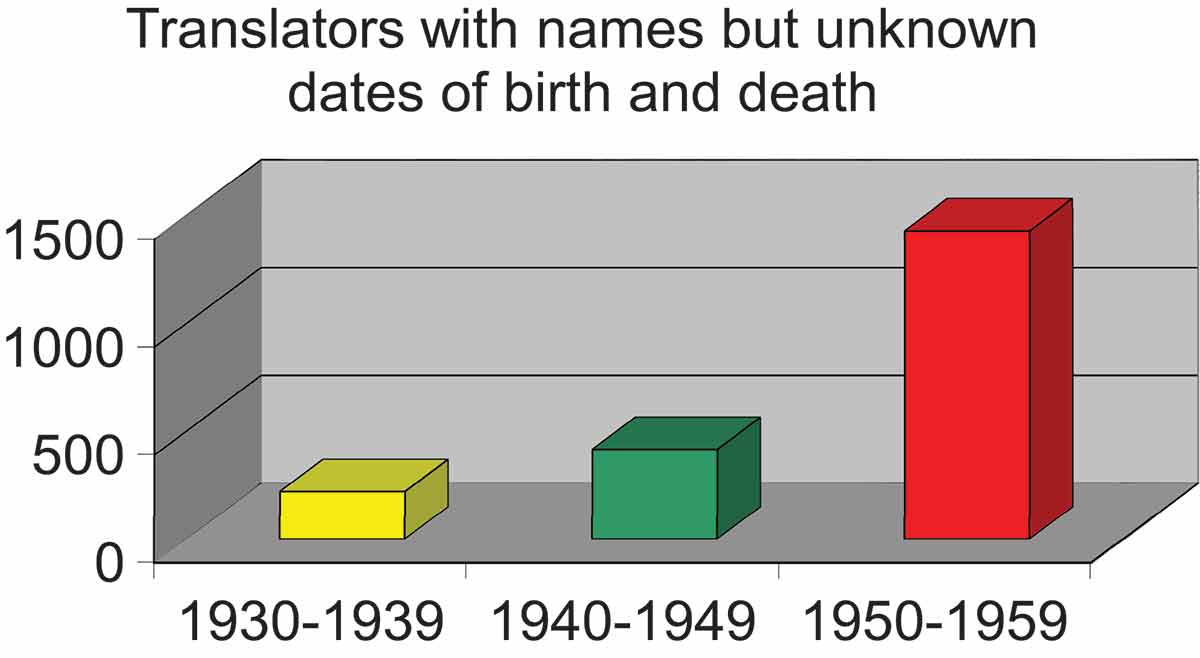
The same happens with various publishers that have in the meanwhile disappeared and/or have no archive available for consultation. Hence, whilst they had a very real existence, this remains practically inaccessible to knowledge.
The concept we analyse here will enable us to go deeper into the question of the objectivity of facts interconnected to history, whether as a science or as an art. According to Torgal, history is an objective science in a position soon contradicted by the concept of José Mattoso that the field is rather “a representation of representations” as historical knowledge has at its base documents that in turn constitute representations (2015, 44, 45), which led Mattoso into an oscillating cycle of considering history as either a science or as an art.6 Indeed, however much translation gets perceived as a creative act, this nevertheless retains the specific characteristics stemming from the rewriting of something that predates the translation (the source text). As rewriting, translation is also a dual re-presentation of the original and, as a creative act in another language, the new text produced by the translator. Gideon Toury did not hesitate in terming translations “facts” and part of the target culture (1995, 26–29), on the one hand downplaying their nature as representations but, on the other hand, fundamentally convincing as to the “objectivity” of Descriptive Translation Studies to which he subscribed and further developing the “map” of Translation Studies by James Holmes within the scope of an empirical science and in alignment with Carl Hempel (9).
Translation Studies in Portugal, a source contributing to the history of translation, sets out from descriptive studies structured according to the work of Toury. They may, however, make recourse to the objectivity specific to science. As two different fields, they are interdependent: history needs descriptive studies, these descriptive studies not only cannot be written without history but would also be left incomplete without a narrative and an interpretation specific to a historian.
4.2. Progress, evolution, change
Another expectation of any reader of history is encountering a narrative of evolution in a specific object tracing from its origins through to some higher state. This would be the case with the means of transport and of communication and undoubtedly also the case of medicine. In any of these cases, we would not hesitate to deploy the term progress (scientific) even in the full knowledge that such does not take place linearly. This thus raises the question as to just whether there is any progress in the history of translation. We may state for certain that the works known, and already quoted, do not function within the scope of this category. “Progress” is a topic that falls beyond the extent of the methodological work by Pym (1998), for example. The question nevertheless retains its relevance from the historian’s point of view.
The idea of progress, deriving from the Enlightenment postulate (optimist) of human perfectibility, would seem difficult to apply to translation. How do you justify just how a translator from the eighteenth century translates some Classical text “better” than his/her medieval peer for example? What is “translates better”? What does translate better and better actually mean? Is the Bible translation undertaken by Luther better than that by St. Jerome? Such comparison proves an absurdity as each translation owes its outcome to the state of the language and the philological knowledge then present. This marked historicity of translation also drives their ageing and endows upon them an ephemeral life: we would now only deal poorly with nineteenth century translations of Odyssey. In addition to the forever retranslated classics, we have the contemporary translations of new publications. However, any translation represents a novelty to its recipient culture but whether that amounts to progress proves far more controversial.
Research methodologies in the arts, sciences and the humanities have most certainly undergone progress, thus not only gaining in refinement and sophistication but also contributing to raising and improving the knowledge returned as well as bestowing credibility on it. In relation to translation, we may therefore inquire as to what evolution we might note as regards the methods of translating. On this matter, there is an important distinction between the activity of translating and its output, translations, on the one hand, and the research done on translations made, the “pure” branch of Translation Studies, on the other, according to the traditional map of the field originally put forward by James Holmes. Andrew Chestermann attempted to respond to the question of progress in Translation Studies (1998), making this dependent on his vision of the field as an applied science, a hermeneutic discipline and an empirical human science, which resulted in different notions of progress that he equates with the resolution of problems in terms of explaining cause/effect. His conclusion states that any “real progress” in Translation Studies would need “to build a general empirical theory of translation that is both rich and robust (…)” (13).
Without referring to the discipline but rather to translating, we return to its methods. Is there any relevance in mentioning progress in this field? It would not seem the case. From Cícero to the present, what we may verify is a surprising level of consistency as regards the taking of two options: by the letter and literally or by the meaning. Clearly, translation academics deploy more sophisticated vocabulary and duly recognise the differences in relation to the traditional dichotomy: the productive reception of the seminal conference by Friedrich Schleiermacher On the Different Methods of Translating (1813) undertaken by Lawrence Venuti (2008) popularised the translation terminology “domestication” versus “foreignization” (that the German author theorised but never used). Despite the revolutionising consciousness of Schleiermacher, explicitly demarcating tradition (2003, 66–67) from the “new” methods, they all still retain a relationship with the alternative of literal versus meaning, with analysis of the latter beyond the scope of this context (Kitzbichler 2016). After all, the position of G. Steiner holds that all translation theories are variants on the question as to just what would be the optimal correlation between text A in the source language and text B in the target language does not seem to stray very far from the truth:
The issue has been debated for over two thousand years. But is there anything of substance to add to Saint Jerome’s statement of the alternatives: verbum e verbo, word by word in the case of mysteries, but meaning by meaning, sed sensum exprimere de sensu, everywhere else? (1992, 275)
Therefore, while there lacks any pertinence in talking of progress as regards translation methods, there is indeed progress as regards everything that facilitates the work of translators and enabling them to leverage their efforts and ranging from dictionaries and scientific studies of languages through to the technological means. Hence, we may continue to refer to the “dream of the perfect translation” (Azevedo 2015, 35) through the constant improvement of an automatic translation system that, according to ongoing research (see Unbabel),7 for example, enable the translation of 40,000 words per hour when a human translator without recourse to technological means can only manage between 300 and 400 words per hour (Ramos 2015, 18). Clearly, we speak here only of non-literary translation. Indeed, in another sense, there has been in this field (technical translation!) progress: should we finally be able to bring to an end or at least reduce the anonymity of their co-authors (because automatic translation shall always require some recourse to human intervention). Without any authors, technical translation would not seem susceptible to historically recording.8
Pondering the value of an indirect translation in relation to its direct counterpart constitutes another aspect worthy of reflection within the scope of our present topic. Indirect translation has been the target of recent interest and study partially due to its strong presence in cultures labelled as peripheral or semi-peripheral, such as the Portuguese case (see Pieta-Cândido 2013; Spirk 2014). Recourse to indirect translation results from the level of knowledge of foreign languages among the elites (where we are including translators) on the one hand and is determined by the dominant culture in the country on the other hand. Speaking about Portugal and in the case of Russian literature, we may observe the following: through to the 1980s, the Russian classics (Dostoyevsky, Tolstoy, Chekhov, Gogol, etcetera) were translated from the French as there were no Russian speakers in Portugal and the language was not then taught (for various reasons). Furthermore, France was without question the culture holding the greatest influence over the Portuguese social and cultural elites (even if not the more popular layers of society that consumed another type of literature) through to the April Revolution (1974). We currently have more than one translator of Russian and hence have arrived at a point of gaining new translations of the classics and, in some cases, even having competing translations (as is the case with Ana Karenina). Does direct translation represent progress in relation to its indirect counterpart? Yes, if such may be explained by a greater diffusion of international languages and cultures within a country….
As translation constitutes a socially organised and regulated practice, translators form a social group with their own interests and aspirations, restrictions and resource access limitations and correspondingly becoming an important object of study (Sela-Sheffy 2005, 2). Pym reaches the point of considering that the central object of historical knowledge on translation is neither the text nor the context, nor even the linguistics characteristics but rather instead the “human translator”: “since only humans have the kind of responsibility appropriate to social causation” (1998, ix). He furthermore continues: “Only through translators and their social entourage (clients, patrons, readers) can we try to understand why translations were produced in a particular historical time and place.” (ix) Indeed, despite the relevance attributed by researchers, in many societies such as the Portuguese, and above all in a not particularly distant past, translators (with some exceptions) lack any visibility or social recognition. We would recall how L. Venuti (1995, 2008) identified the invisibility of the translator as characterising his proposed history of translation. Should we postulate that this recognition is desirable, in order to raise the level of the presence and the role of translation in (Portuguese) culture, and looking to contexts in which such a situation is far more favourable (e.g. Germany), we may accept as progress any steps taken to improve, encourage and recognise the work of translators, for example, by the setting up of awards, appropriate levels of remuneration, professional associations, the application of the European quality norm (UNE-EN 15038; 2006), the university preparation of translators, university level teaching and research, among others. Publishers here take on deep responsibility in terms of the provision of a minimum of information (date of birth) about their translators in the publication details on works. This information along would have ensured that dozens of translators from the years of the Estado Novo dictatorship might emerge from practically total anonymity (see above).
We finish these reflections on the notion of progress in the history of translation by casting a glance towards another history, that of philosophy. In 2012, two Portuguese philosophers published a “brief history of philosophy” entitled As Questões que se Repetem (Questions that Repeat Themselves) (Tunhas and Abranches 2012). In a review of this work, fellow philosopher Pires Aurélio highlights how the history of philosophy in the understanding of these authors is: “the history of formulations that address a certain number of questions, those which philosophy always addresses” (Aurélio 2012, 38), with them therefore assuming the non-existence of progress in philosophy. They nevertheless manage to avoid sacrificing history as “[the book] attributes to the difference in times and the variations in genius the successive formulations in which these questions insistently reappear” (38). We would dare here to suggest that in overall terms, the idea of progress in translation does not entirely function, as the very core questions of its historians – who translated what, how, where, on the initiative of whom, why, for what purpose, to what effect – always remain the same. The times serve to shape the differing responses.
Other less “ideological” concepts shall cause fewer problems to the history of translation and to a greater or lesser extent peacefully slotting into its historiographic discourse: evolution and change. In order to illustrate an evolution of note, we would propose the following example: a quantitative analysis of the translation flows within a cultural and thereby flagging the trend in its relative weighting within the society as a whole. Thus, the aforementioned bibliography of translation in Portugal, by Gonçalves Rodrigues (1992–1999), includes in its first volume, referring to the 1495–1834 period, 359 pages of bibliography of which 153 are dedicated to the 1800–1834 period; the second volume spans only 15 years (1835–1850) while containing 175 pages of titles and demonstrating how the nineteenth century proves the beginning of a considerable increase in Portuguese literary translation. Of course, such an evolution may also reflect a slipping backwards, for example, in the titles translated, the titles translated from a particular language, the translation of literature or technical translation, etcetera.
Nevertheless, history gets written to record phenomena of change specific to the passage of time. One example is given by Pym: in European culture, should we count the number of translations in free verse in the late nineteenth century, we correspondingly encounter the trend towards the prosification of verse, a change with which readers of poetry were aware (1998, 110). This would be a case of change in the internal history of translation. In the external history, the change would be more obvious: quantitative analysis of countries proving the source of texts in literary translation would throw up such changes in the dominant culture(s) over the course of any time frame.
4.3. Change and causality
Change may impact on various components to the translation poly-system. The interest in certain source authors and works may wax and wane and where not disappearing, new translators may enter into the scene and edging others out, their educational and training backgrounds and skills may vary with the same holding true of the publishers releasing their translations, collections and anthologies that may rise in sales, continue or drop out of the market, etcetera. The problem thus resides in the rates of change taking place in each of the poly-system’s components, rates that are in all probability discontinuous and resulting in consequences for the hypotheses underpinning the time frames proposed.
Pym (1998) clearly details how explanation (“Explanation”) represents the third phase in the construction of a history of translation (with the other two being the “archaeology of translation” and “historical criticism”) (5–6). And he immediately establishes an intrinsic connection between explanation and change, between causality and change:
Explanation is the part of translation history that tries to say why archaeological artefacts occurred and where they did, and how they were related to change (…) Explanation must be concerned with the causation of (…) data (…) (6)
These explanations in turn translate into narratives as has indeed already been mentioned with Pym highlighting how they contribute towards the quality of the historiographic project in imposing the requirement that they have to be “close to good storytelling” (7). Pym goes onto dedicate an entire chapter to this subject and beginning with examples from the histories of translation that he considers having partially failed due to not having found explanations for the defining trends and characteristics (e.g. why were there around 50 different translations of Byron into German between 1900 and 1905?) (144). He is clearly correspondingly aware of the difficulties faced in searching and finding explanations for transitory translated phenomena on the one hand whilst also demonstrating how causality is, in many cases, multiple and, furthermore, make take on a hierarchical structure on the other hand. Establishing this hierarchical structure, we may tell ourselves, incorporates a task involving specific explanation/interpretation and demanding rationality and a logical linkage between cause and effect.
Unable to comment in detail on the extent of this chapter, including the non-relevant criticisms that Pym makes as regards what he perceives to be the issue of causality in Toury (152–154), some facets to Pym’s argumentation do deserve due comment here. In referring to the functionalist theories of translation (Handlungstheorie and Skopostheorie), he well identifies how, under the spotlight of functionalism, the purpose of a translation becomes the dominant factor in the process. Nevertheless, we do not grasp how the purpose of a translation interrelates with causality within the historiographic discourse. The purpose underlying one specific translation and its respective explanation may result in the same, within the scope of a case study within the scope of a homogenous and restricted corpus and within a very unrestricted period of time. This does not deny that, in theory, a history of translation may be founded on this basis but this would only be an exception; seeking to write a history of translation, we would have to approach a corpora of a far vaster range and over the course of a relatively vast period of time to attain a more solid object and any (eventual) observation of change. Is it possible to talk about the “purpose” of a corpus or only for an individual translation? We may take this example into consideration: in our research on translation under the Estado Novo regime, we have detected, within the framework of the policies deployed by publishers of literary translations, a clear and overwhelming preference for their inclusion and organisation into anthologies and above all into collections (Seruya et al. 2013; Seruya 2005, 2013). The following table provides a concrete reference to this practice (Source: www.translatedliteratureportugal.org).
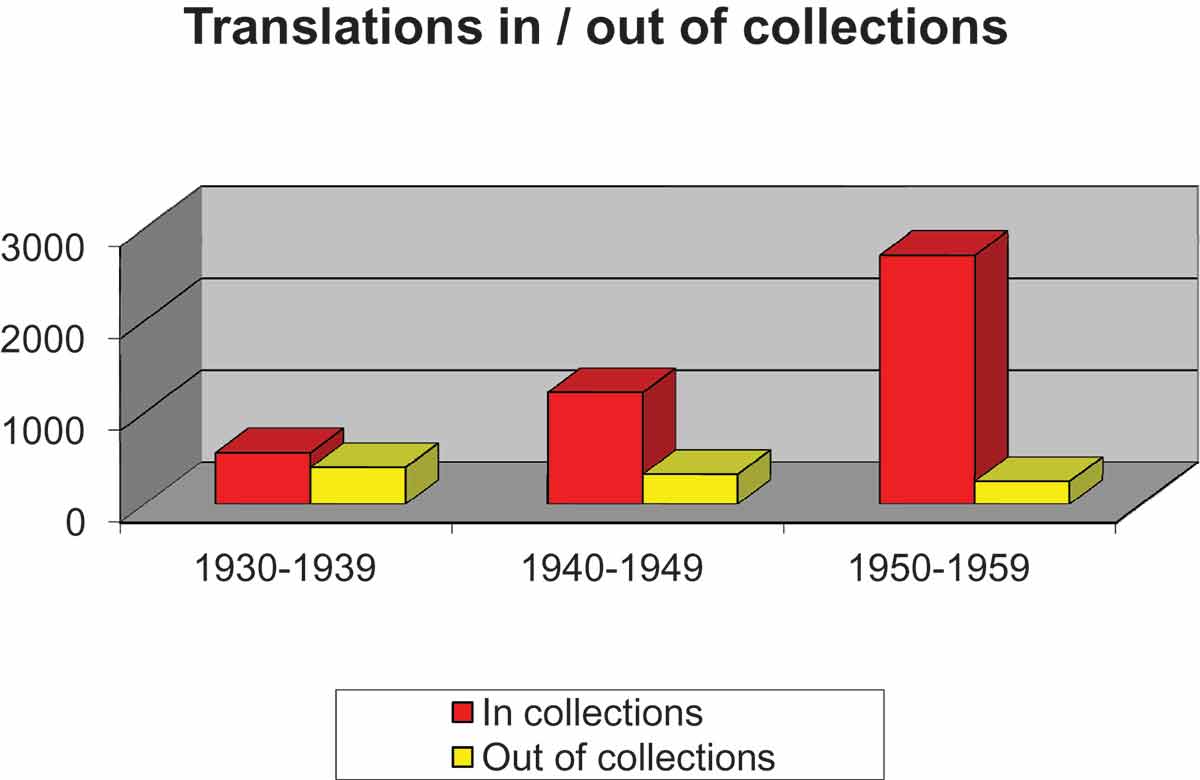
Both the anthologies and the collections turn out to be representative corpora. However, may we really refer to a “purpose” in relation to a set?
We hence return to causality or explanation as is the case with the collections we have just referenced. We would necessarily reiterate that this has to be multiple and interdisciplinary and may thus be formulated: they constitute a case of culture planning (Toury 1999), they are plans/proposals for the literary, scientific and technical instruction of a country with a high rate of illiteracy,9 they respond to the increase and diversification of the reading public, in particular the urban, otherwise facing a shortage of choice and lack of quality in national outputs,10 they are educational projects in good taste, a contribution towards the founding of a canon, they foster an image of cosmopolitism in a climate of heightened nationalism nurtured by the ruling power, in a closed society deprived of freedom and under strict censorship. We might also extend into psychological reasoning: the taste of the Portuguese for collectionism? And why? Was there the emulation by some publishers of their peers within a competitive spirit that would not have proven particularly pleasing to the corporatism of the Estado Novo? As we may grasp, the “causes” listed, and certainly amongst others, belong to many areas of knowledge, which have to be convened in order to build up this multiple causality – which in all truth we might just as well call fabricated context…
5. Conclusion
To begin writing a history of translation in Portugal within a worthwhile time frame, the already existing knowledge needs to be leveraged. This knowledge is highly dispersed and fragmented, more solid on the nineteenth and twentieth centuries, very scarce in the period running through to the sixteenth century and only incipient on the seventeenth and eighteenth centuries. Therefore, what would seem feasible in the short term is observing the nineteenth and twentieth centuries that have received the greatest attention from Portuguese research in accordance with the greater number and ease of access to sources. Whilst not dismissing the potential of archaeology (facilitated by the bibliographies), there shall necessarily have to be a fairly selective focus either on translators or on genres or alternatively on textual corpora, on editors or on the dominant ideas about translation; clearly the combination of more than one constituent of the translation process shall also certainly be adopted. That is, we shall make the history of that which we propose as deserving of due highlighting at each particular moment and for various reasons. This correspondingly sets to one side any panoramic history of translation. This shall, on the contrary, prove exemplary in dealing with the textual and human phenomena that “are going to go down in history” due to their interventions in processes of cultural change.
About the author
Teresa Seruya is Full professor in the Department of Germanic Studies at the Arts Faculty [Faculdade de Letras] of the University of Lisbon, teaching literature and culture in the German language. She also teaches History of Translation and Translation Theory. She has collaborated with the Catholic University of Portugal, teaching on the translation course and leading (1998–2005) a research project on “Literary History and Translations”. She is now responsible for the projects “Intercultural Literature in Portugal 1930–2000: A Critical Bibliography”, and “Translation and Censorship in Portugal during the Estado Novo Regime”. Her main research areas in the present are the history of translation in Portugal in the 20th century and contemporary migration literature in German speaking countries. She has published on literature and culture in the German language, particularly from the 20th century, the history of Germanic Studies in Portugal and the history of translation in Portugal. She is a literary translator of the following German authors: Goethe, Kleist, Leopold von Sacher-Masoch, Döblin, Thomas Mann and Kafka.
Disclosure statement
No potential conflict of interest was reported by the author.
Notes
- 1.
Non-translation may be understood both in the way it is used by Pym (1998, 57 onwards) (i.e. as everything that is not translated in a culture) and in the sense given by Duarte (2000) (i.e. foreign texts that do not exist in translation for a variety of reasons: linguistic proximity, ideological embargo, censorship, etcetera). What emerges from non-translation in Duarte’s sense is paradoxical: A history of non-translation could ultimately be as interesting as a history of translation.
- 2.
We do not discuss here the question as to the (im)possibility of a Portuguese language history of translation.
- 3.
“A piece of writing is ‘literature’ not because it possesses certain characteristics that other pieces lack, but because its readers regard it – for a variety of reasons – as literature.” (Patterson 1995, 256)
- 4.
These data have been gathered under the auspices of the ongoing bibliographic project Intercultural Literature in Portugal 1930–2000: A Critical Bibliography. At the time of writing, the data covering the 1975–1980 period are not yet online.
- 5.
On the contrary, the number of unknown translators has decreased over the same period: dropping from 288 in the 1930s to 181 in the 1950s. Our explanation: the greater thoroughness in effect in the publishing industry, the (partial) emergence from anonymity as a means of attracting more labour into a sector experiencing enormous growth (entertainment literature).
- 6.
Torgal, as regards this hesitation by Mattoso, later quotes another passage from the same work, A Escrita da História. Teoria e Métodos (1988), in which this renowned historian does accept history is a science (2015, 46).
- 7.
Unbabel is a recent start-up that combines technology and a community of translators (Expresso, 22 August 2015).
- 8.
There is a need to distinguish between scientific and technical translation, with the former far more “author” influenced.
- 9.
Between 1930 and 1970, the literacy rate (determined based on the illiteracy rate) rose from almost 39% to around 76%; in 1991 this rate was 89.5% (Melo 2004, 68s.); in 1940, over half of the literate had never attended any level of schooling (c. 1.5 million Portuguese citizens), in 1960 their absolute number had risen to almost 1.9 million persons. Following the 1974 revolution, the literacy rate grew only 12% between 1970 and 1991.
- 10.
In the history of the Portuguese publishing company, Portugália Editora, the following fact is recounted in a photobiography of Agostinho Fernandes, owner of the firm: “In 1943, the initial plan was drawn up by Gaspar Simões [JGS], the literary director of Portugália Editora, with the notorious omission of Portuguese authors. Before this, in the late 1930s, JGS had directed the Collection of Modern Portuguese Authors (with Almada, Madeira, Branquinho, Aleixo, etcetera) in the ‘European editions’ section of the paper firm Amado Dominguez, Lda, but it had failed spectacularly because the moderns, including the Presença authors, did not reach the general public. Thus JGS, at the start of a period of relentless fame, focused his attention upon translations and anthologies (…)”, (Agostinho Fernandes…2000, 213 onwards).
References
Agostinho Fernandes – Um Industrial Inovador, um Coleccionador de Arte, um Homem de Cultura – Fotobiografia . 2000 . Edited by J. da Cruz Santos . Lisbon: Portugália, s.d . Search in Google Scholar
Aurélio D. P. 2012 . “ Em filosofia não há progresso…. .” Expresso , “Actual” , 11 03 , 36 – 38 . Search in Google Scholar
Azevedo V. 2015 . “ O sonho da tradução perfeita .” Expresso , 1st booklet , January 10 , 35 . Search in Google Scholar
Baker M. , and G.Saldanha . eds. 2009 . Routledge Encyclopedia of Translation Studies . 2nd ed. London : Routledge . 10.4324/9780203872062Search in Google Scholar
Ballard M. 2013 . Histoire de la traduction. Repères historiques et culturelles . Brussels : de boeck . Search in Google Scholar
Barreto L. F. and L.Changsen , eds. 2013 . Para a História da Tradução em Macau . Lisbon : Centro Científico e Cultural de Macau . Search in Google Scholar
Bernardo A. M. 2001/2 . “ A mobilidade da tradução na Idade Média .” Runa. Revista Portuguesa de Estudos Germanísticos 29 : 17 – 31 . Search in Google Scholar
Catroga F. 2003 . Caminhos do Fim da História . Coimbra : Quarteto Editora . 10.14195/2183-8925_23_6Search in Google Scholar
Chestermann A. 1998 . “ What Constitutes ‘Progress’ in Translation Studies? ” In Översättning och tolkning. Rapport Från ASLA:s höstsymposium , Stockholm , November 5–6 , edited by B. E. Dimitrova , 33 – 49 . Uppsala : ASLA . Accessed 0823, 2015 . Search in Google Scholar
Chestermann A. , and E.Wagner . 2002 . Can Theory Help Translators? A Dialogue Between the Ivory Tower and the Wordface . Manchester, UK : St. Jerome Publishing . Search in Google Scholar
Delisle J. , and J.Woodsworth . eds. 2012 . Translators Through History . Amsterdam : John Benjamins Publishing Company . 10.1075/btl.101Search in Google Scholar
D’hulst L. 2010 . “ Translation History .” In Handbook of Translation Studies , edited by Y. Gambier and L.van Doorslaer , 397 – 405 . Amsterdam : John Benjamins . Search in Google Scholar
Duarte J. F. 2000 . “ The Politics of Non-Translation: A Case Study in Anglo-Portuguese Relations .” TTR: Traduction, Terminologie, Redaction 13 ( 1 ): 95 – 112 . doi: 10.7202/037395ar . Search in Google Scholar
Gentzler E. 2001 . Contemporary Translation Theories . Clevedon : Multilingual Matters . Search in Google Scholar
Kitzbichler J. 2016 . “ From Jerome to Schleiermacher? Translation Methods and the Irrationality of Languages .” In Rereading Schleiermacher: Translation, Cognition & Culture , edited by T. Seruya and J.Justo , 27–39. Berlin: Springer-Verlag. 10.1007/978-3-662-47949-0_3Search in Google Scholar
Lafarga F. , and L.Peguenaute . 2004 . Historia de la Traducción en España . Salamanca : Editorial Ambos Mundos . Search in Google Scholar
Matos S. C. 2008 . Consciência Histórica e Nacionalismo . Lisbon : Livros Horizonte . Search in Google Scholar
Mattoso J. 1988 . A Escrita da História. Teoria e Métodos . Lisbon : Estampa . Search in Google Scholar
Melo D. 2004 . A Leitura Pública no Portugal Contemporâneo 1926–1987 . Lisbon : Imprensa de Ciências Sociais . Search in Google Scholar
Milton J. , and P.Bandia . 2009 . Agents of Translation . Amsterdam : John Benjamins . 10.1075/btl.81Search in Google Scholar
Mullender G. 2014 . “ The Importance of Interpreting During the Portuguese Discoveries in Africa and Asia .” PhD diss. , University of Lisbon . Search in Google Scholar
Nord C. 2005 . Text Analysis in Translation: Theory, Methodology, and Didactic Application of a Model for Translation-Oriented Text Analysis . 2nd ed. Amsterdam : Rodopi . 10.1163/9789004500914Search in Google Scholar
Pais C. C. 2013 . “ António Feliciano de Castilho, tradutor do Fausto .” Accessed 0822, 2015 . https://repositorioaberto.uab.pt/bitstream/10400.2/2588/1/Ant%C3%B3nio%20Feliciano%20de%20Castilho,%20tradutor%20do%20FAUSTO.pdf Search in Google Scholar
Patterson L. 1995 . “ Literary History .” In Critical Terms for Literary Study , edited by F. Lentricchia and T.McLaughlin , 250 – 262 . Chicago, IL : The University of Chicago Press . Search in Google Scholar
Pięta-Cândido H. M. 2013 . “ Entre Periferias. Contributo para a História Externa da Tradução da Literatura Polaca em Portugal (1855-2010) .” PhD diss. , University of Lisbon . Search in Google Scholar
Pym A. 1998 . Method in Translation History . Manchester, UK : St. Jerome Publishing . Search in Google Scholar
Pym A. 2010 . Exploring Translation Theories . London : Routledge . 10.4324/9780203869291Search in Google Scholar
Ramos J. 2015 . “ Para Acabar Com a Torre De Babel .” Expresso , Economia , 08 22 , 18 . Search in Google Scholar
Rodrigues, A. G . 1992 . A Tradução em Portugal (Vol. I 1495–1834) . Lisbon : Imprensa Nacional-Casa da Moeda . Search in Google Scholar
Rosa A. A. 2012 . “ A Long and Winding Road: Mapping Translated Literature in 20th Century Portugal .” In: New Directions in Translation Studies , Special Issue of Anglo-Saxónica, 3.3, edited by A. Pym and A.Assis Rosa , 205 – 227 . Lisbon: University of Lisbon Centre for English Studies. Search in Google Scholar
Rundle C. 2010 . Publishing Translations in Fascist Italy . Oxford : Peter Lang . Search in Google Scholar
Rundle C. , and K.Sturge . 2010 . Translation under Fascism . London: Palgrave Macmillan . 10.1057/9780230292444Search in Google Scholar
Schleiermacher F. 2003 . Sobre os Diferentes Métodos de Traduzir . Translated by José Miranda Justo (bilingual edition German/Portuguese) . Porto : Elementos Sudoeste . Search in Google Scholar
Sela-Sheffy R. 2005 . “ How to Be a (Recognized) Translator. Rethinking Habitus, Norms, and the Field of Translation .” Target 17 ( 1 ): 1 – 26 . doi: 10.1075/target.17.1.02sel . Search in Google Scholar
Seruya T. 2005 . “ Colecções e bibliotecas entre os anos 40 e os anos 70. Apontamentos para uma história da colecção Livros RTP – Verbo .” In Estudos de Tradução em Portugal. Colecção Livros RTP – Biblioteca Básica Verbo- I , 3º Colóquio de Estudos de Tradução em Portugal, edited by T. Seruya , 31 – 52 . Lisbon : Universidade Católica Editora . Search in Google Scholar
Seruya T. 2009 . “ Introdução a uma bibliografia crítica da tradução de literatura em Portugal durante o Estado Novo .” In Traduzir em Portugal durante o Estado Novol , edited by T. Seruya , M.Lin Moniz, and A.Assis Rosa , 69 – 86 . Lisbon : Universidade Católica Editora . Search in Google Scholar
Seruya T. 2010 . “ Translation in Portugal during the Estado Novo Regime .” In Translation under Fascism , edited by C. Rundle and K.Sturge , 117 – 144 . London: Palgrave Macmillan . 10.1057/9780230292444_5Search in Google Scholar
Seruya T. [2011] 2015 . “ The Project of a Critical Bibliography of Translated Literature and its Relevance for Translation Studies in Portugal .” In How Peripheral is the Periphery? Translating Portugal Back and Forth , Essays in Honour of João Ferreira Duarte, edited by R. B. Maia , M. P.Pinto, and S. R.Pinto , 21 – 30 . Newcastle upon Tyne: Cambridge Scholars Publishing . Search in Google Scholar
Seruya T. 2013 . “ Anthologies and Translation .” In Handbook of Translation Studies , edited by Y. Gambier and L.van Doorslaer . Amsterdam: John Benjamins Publishing Company . 10.1075/hts.4.ant1Search in Google Scholar
Seruya T. , L.D’hulst, A.Assis Rosa, and M.Lin Moniz . 2013 . Translation in Anthologies and Collections (19th and 20th Centuries) . Amsterdam : John Benjamins Publishing Company . 10.1075/btl.107Search in Google Scholar
Spirk J. 2014 . Censorship, Indirect Translations and Non-Translation. The (Fateful) Adventures of Czech Literature in 20th Century Portugal . Newcastle upon Tyne: Cambridge Scholars Publishing . Search in Google Scholar
Steiner G. 1992 . After Babel. Aspects of Language & Translation . 2nd ed. Oxford : Oxford University Press . Search in Google Scholar
Sturge K. 2004 . ‘The Alien Within’: Translation into German during the Nazi Regime . Munich : iudicium . Search in Google Scholar
Torgal L. R. 2015 . História… Que História? Notas Críticas de um Historiador . Lisbon : Temas e Debates-Círculo de Leitores . Search in Google Scholar
Toury G. 1995 . Descriptive Translation Studies and Beyond . Amsterdam : John Benjamins Publishing Company . 10.1075/btl.4Search in Google Scholar
Toury G. 1999 . “A Tradução como Meio de Planificação e a Planificação da Cultura . In Histórias Literárias Comparadas , edited by T. Seruya and M. L.Moniz , 17 – 32 . Lisbon: Ed . Colibri and CLCPB . Search in Google Scholar
Tunhas P. , and A.Abranches . 2012 . As Questões que se Repetem. Breve História da Filosofia . Lisbon : Dom Quixote . Search in Google Scholar
Van Hoof H. 1991 . Histoire de la traduction en Occident . Paris : Duculot . Search in Google Scholar
Venuti L. 1995 . The Translator's Invisibility. A History of Translation . London : Routledge . Search in Google Scholar
Venuti L. 2008 . The Translator’s Invisibility. A History of Translation . 2nd ed. London : Routledge . Search in Google Scholar
© 2016 Informa UK Limited, trading as Taylor & Francis Group
This work is licensed under the Creative Commons Attribution-NonCommercial-NoDerivatives 4.0 International License.
Articles in the same Issue
- Editorial
- Translation across time in East and West encounters: an overview
- Article
- Doing translation history and writing a history of translation: the main issues and some examples concerning Portuguese culture
- Translating erased history: Inter-Asian translation of the national Changgeuk company of Korea’s Romeo and Juliet
- From the Far East to the Far West. Portuguese Discourse on Translation: A case study of Camilo Pessanha
- Translating politeness cues in Philippine missionary linguistics: “Hail, Mister Mary!” and other stories
- Translating otherness: images of a Chinese city
- Narrative structure, context and translation in Paulo Coelho’s O Alquimista in English, Arabic and Turkish
Articles in the same Issue
- Editorial
- Translation across time in East and West encounters: an overview
- Article
- Doing translation history and writing a history of translation: the main issues and some examples concerning Portuguese culture
- Translating erased history: Inter-Asian translation of the national Changgeuk company of Korea’s Romeo and Juliet
- From the Far East to the Far West. Portuguese Discourse on Translation: A case study of Camilo Pessanha
- Translating politeness cues in Philippine missionary linguistics: “Hail, Mister Mary!” and other stories
- Translating otherness: images of a Chinese city
- Narrative structure, context and translation in Paulo Coelho’s O Alquimista in English, Arabic and Turkish
