Strategic Social Marketing and TVET Enrollment in Cambodia: Insights from a National Impact Survey (2018–2020)
-
Sok Chanrithy
 ,
Reinsch Andreas
,
Reinsch Andreas

Abstract
This paper assesses the effectiveness and reaches of social marketing interventions in the period between 2018 and 2020 by the General Department of TVET, Ministry of Labor and Vocational Training (MLVT)’s Department of Labor Market Information (DLMI) in Cambodia. Conducted with a mixed-method design in eight provinces using questionnaires for 788 high school students and 1,404 TVET students, the research determines how social marketing campaigns, both digital and conventional, especially using Facebook, TV, posters, and seminars, shape public opinion and student enrollment in vocational schools. The results point to social marketing’s strong effect on awareness but suggest that more efforts are required to engage parents and break recurrent stereotypes against TVET. Recommendations are provided for strengthening strategy in using early interventions, dissemination of labor market information, and multi-channel outreach.
1 Introduction
Cambodia has received the economic status as a lower-middle-income country. Cambodia has a steadily improving economy and reduced poverty rates, but it faces critical challenges in aligning its labor market demands with the skills of its youth. Despite significant national investments in human resource development across seven education sub-sectors, Technical and Vocational Education and Training (TVET) institutions still struggle to attract enrollment and meet employer needs.
A number of challenges negatively affect the effectiveness of TVET in Cambodia, especially in responding to the demands of basic and intermediate skills for national economic development. Some of those challenges were identified by the Policy Study Working Group “Future Directions and Financing for TVET in Cambodia”, such as:
Most public TVET institutions do not focus on entrepreneurship development program
Large gaps among policies, strategic plans and the budget
Limited participation of private institutions in providing TVET
Poor quality control and quality of standards
Searching or market demand for high skill training is still limited
Lack of information, especially about current labor market opportunities as well as future prediction
Lack of information about the benefits of TVET for industries, individuals, and communities
Education window and entry/exit doors for motivating lifelong learning are still neglected
The current window of opportunity for studying in TVET sector is open to the youth in general education. The knowledge about TVET is still low among students. Consequently, the number of student registrations in TVET is remarkably low compared to the academic stream. Awareness raising and the working on improving the perception of TVET are still the main challenges for the General Department of TVET and TVET institutions. It is, therefore, necessary to encourage all stakeholders to view the TVET system as attractive, modern, accessible and trustable. According to the KAP (Knowledge, Attitude, and Practices), 86 % of the secondary and high school students do not know about TVET, and 50 % learned about TVET through their friends and relatives, social media (Facebook 25 %), participating National TVET Day (10 %) and from teachers and brochures (MLVT 2020).
The installment of billboards in urban areas, such as markets, public primary schools, tourism attraction sites, nearby TVET institutions and industry manufacturers is a good example for promotional activities in urban areas. Study tour programs of TVET institutions across the country are carried out only once a year. Programs such as “I Am a Role Model” “Robot and New Technology Competition” “Preparation and Competition of New Innovation and Technologies” and “Innovation for TVET Program” are not yet implemented. On-site promotional activities are not conducted systematically.
This study investigated the effectiveness of social marketing strategies implemented by the Ministry of Labor and Vocational Training (MLVT) through the General Department of TVET. The findings reveal that while Cambodia boasts 38 public TVET institutions serving all 25 provinces, systemic gaps – such as poor entrepreneurship training, weak public-private coordination, and a lack of labor market data – continue to hinder progress. Social stereotypes, underfunded promotion, and misaligned curricula exacerbate the situation.
Since the development of social marketing, enterprises have adopted this concept for their business interests and profits. The social marketing system is a core element for enterprises in the 21st century. Many enterprise leaders have been using this marketing strategy to raise awareness of their products and services and market access in order to maximize their business success and sustainability in the new age of competition (Taneja and Toombs 2014). Social marketing is defined as “a process of negotiation or interest through social media platforms”. In order to increase the effectiveness of the social marketing system, Zhu and Chen (2015) stated that efforts should be made around consistency and alignment to the demands of social media users. The purpose of social marketing is to raise brand awareness, communication and sales (profits). However, most importantly, all enterprises should reflect on their social marketing campaigns to assess whether the communication is effective in reaching their target groups.
Similarly, social marketing is the combination of the marketing concept and other strategic activities in order to influence or manipulate individual or community behaviors for social development (WUSC Sri Lanka 2016). While, Ajit (2015) defined social marketing as the implementation design and management program which have calculated the influences or impact on the acceptance by a society related to their product planning (services), pricing, communication, distribution and market studies.
In order to make social marketing more effective, efficient and connected in all TVET systems and TVET institutions, it is necessary to provide high-quality education for students and skilled workers to meet labor market and economic demands. Social Marketing Strategic Plan was developed in response to the National TVET Policy 2017–2025, such as:
Strategy 1: Increase promotional activities by various means, especially social marketing to raise public awareness about TVET;
Strategy 2: Prepare social marketing strategy and promote TVET to reach villages, and communes as well as communities to attract dropped out students, poor people, vulnerable groups, and indigenous people to get a chance of studying in TVET;
Strategy 3: Increase promotional activities about information related to TVET and provide orientation sessions for students at general schools in the capital/all provinces;
Strategy 4: Organize public forums and student exhibitions in the TVET sector;
Strategy 5: Facilitate the cooperation between TVET institutions and industries to improve quality and implement on-job practices, study tours and on-job training.
The “Marketing Mix Strategy” is a terminology used to describe the various strategic options used for bringing products or services into the markets. 4Ps are a tool which has been recognized in the strategic marketing mix (Kotler and Armstrong 2016). Those 4Ps include Product, Place, Price and Promotion (Table 1).
4Ps adapted to TVET in Cambodia.
| Product | Place |
|
|
| Price | Promotion |
|
|
The study provides policy-making insights for DLMI of the General Department of TVET and MLVT. It also benefits secondary schools and TVET students who are at the stage of preparation and making decisions for their future professional careers. The paper emphasizes the need for coordinated reforms in TVET, supported by strategic public-private partnerships (PPP), early interventions in school curricula, and a robust national promotional strategy. Ultimately, Cambodia’s goal is to build a high-quality, industry-responsive technical education system that equips its young population with practical, in-demand skills, especially in key sectors like mechanics, construction, and ICT.
2 Research Objectives
This study evaluates the impact of social marketing efforts led by Cambodia’s Department of Labor Market Information (DLMI) on public perceptions and enrollment in Technical and Vocational Education and Training (TVET). It was guided by five key questions:
How do students view DLMI’s marketing content across platforms such as Facebook, TV, and school events? This includes their awareness, interests, and perceived relevance of the promotional messages.
What actions did the campaigns prompt – such as attending seminars, discussing TVET with parents, or applying for admission?
To what extent did social marketing shape student choices and loyalty toward TVET, especially among undecided youths?
How well did DLMI’s strategy improve two-way communication between institutions and prospective students via digital tools and outreach programs?
What factors contributed to or limited the campaign’s effectiveness – including funding, outreach scope, message targeting, and parental engagement?
These questions informed both the quantitative and qualitative research design and helped identify areas for improving future promotional strategies in Cambodia’s TVET sector.
3 Methodology
This study employed a mixed-methods design to evaluate the effectiveness of DLMI’s social marketing strategy. Quantitative surveys were administered to 788 high school students (Grades 9–12), and interviews and focus group discussions (FGDs) were conducted with 1,404 TVET students, staff, and directors across five regional TVET institutes – Battambang, Svay Rieng, Takeo, Siem Reap, and Kampot – and two northeastern provinces, Ratanakiri and Mondulkiri.
A stratified random sampling procedure was used to ensure proportional representation by gender, region, and program type. The participants were randomly selected to minimize bias. Data collectors explained survey procedures and clarified questions to reduce response errors, and institutional coordination was established in advance to facilitate data collection.
Instrument validity and reliability were ensured through pre-testing and expert review to confirm content accuracy and clarity. The internal consistency and measurement precision of quantitative data were further verified using t-tests (p ≤ 0.05). To strengthen analytical rigor, secondary data from national and international sources, including the National TVET Strategic Plan, were incorporated for cross-validation. Quantitative data were analyzed using SPSS (Version 21.0), while qualitative data were thematically analyzed to provide contextual depth and triangulation of findings. Additionally, independent t-tests were applied to assess the impact of DLMI’s social marketing strategies on students’ perceptions and interest in TVET, as well as to identify key influencing factors that inform more cost-effective promotional approaches moving forward.
4 Results
Reach of Social Marketing: Findings show that 85 % of high school students surveyed were aware of what Technical and Vocational Education and Training (TVET) is. Among all communication channels, Facebook was most frequently used by students, though it was found to be underutilized by the Department of Labor Market Information (DLMI) in its campaigns. Conversely, posters and leaflets received the highest ratings for effectiveness, particularly in provincial schools where digital access is limited.
Changes in Perception: Exposure to DLMI’s social marketing initiatives contributed to a positive shift in perceptions about TVET. Approximately 71 % of students reported a more favorable view of vocational education following the campaigns. A majority rejected the stereotype that TVET is only suitable for students with lower academic performance or limited opportunities, indicating growing social acceptance of the vocational track.
Influential Factors: The study confirms that parents remain a key influence on students’ educational decisions. Additionally, there is a strong correlation between students’ knowledge of labor market information (LMI) and their intent to enroll in TVET programs. Notably, 91.5 % of respondents agreed that students should pursue subjects aligned with their personal interests, suggesting that individualized guidance and access to real-time labor market insights could further improve TVET enrollment.
4.1 Secondary School Students
The responses from 788 high school students show that a vast majority of them are using social media like Facebook. The social marketing strategy by DLMI has reached 85 % of the respondents. The high school students understood well about the TVET skills set and TVET programs for both scholarship and school fees and they are equally aware of the current labor market demands.
This result indicates that the promotional strategy by DLMI and the public TVET institutions made the high school students realize the pricing strategy and labor market information, and raised their awareness of the importance of TVET. The results of the study show that social marketing, through exhibition events, television, brochures, and social media has contributed to the understanding of the importance of TVET by a vast majority of students. Among students who are studying in TVET, 75 % received information from TV, posters, and Facebook.
The results of the study showed that 1,004 of TVET students (female 61 %) surveyed expressed interest in studying technical skills. Most of them studied in grade 12 or Master’s/Bachelor’s degree in Electricity.
The study also evaluated the marketing mix (4Ps[1]) which was implemented by DLMI to attract more students to study in TVET. The result shows that 96 % of the TVET students understand well the technical skills and locations of TVET institutions as well as scholarship programs and tuition fees. Approximately 52 % of them were well aware of the TVET qualifications in Cambodia.
The study, moreover, found that about 90 % of the TVET students understood well the labor market information and the important role TVET holds for national development, including priority sectors in Cambodia. These results as described above are evidence for the remarkable effectiveness of social marketing in attracting students into TVET.
However, some detrimental factors to the effectiveness of TVET social marketing persist. The factors include a limited satisfaction of TVET institutions and technical teachers with the current situation of TVET. This low satisfaction is grounded in five aspects negatively impacting TVET performance, including: (1) infrastructure and facilities of TVET institutions; (2) capacity of technical teachers; (3) TVET programs quality; (4) ability and competence of graduating students compared to labor market demands; and (5) limited communication and collaboration with key stakeholders on the demand side and investors.
These objective factors are reinforcing a generally negative perception of TVET in the community, which remains to be a major challenge for the TVET sector in Cambodia, indicating that (1) efforts addressing the main concerns about TVET quality need to be continued, an (2) that continuous efforts and innovative approaches are required to raise public awareness of TVET’s benefits and to address negative stereotypes.
However, public budget shortage for TVET social marketing remains to be a main barrier to unlocking the potential of this sector for increased promotional activities covering a wider range of target groups and stakeholders.
The assessment of students’ behaviors towards different promotional channels showed that many students “rarely or never use the promotional tools” like radio, television and newspaper. However, they always use social media and the Internet (Figure 1).
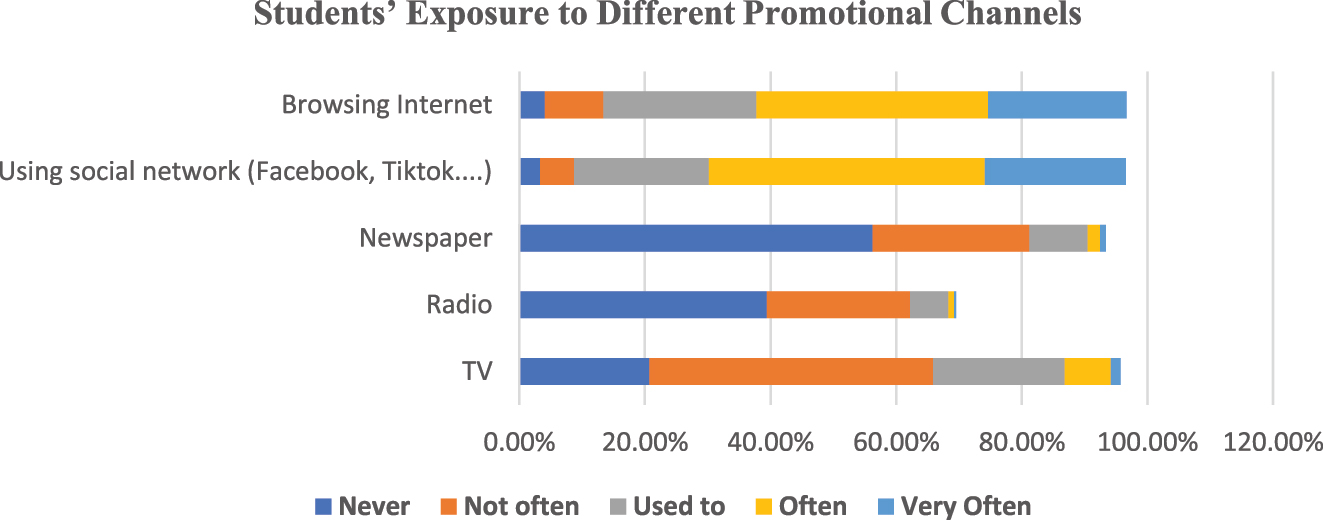
Exposure/use of different promotional channels by students.
Table 2 shows that 50.1 % of all high school students who participated in this study have heard or seen the promotional materials or programs about TVET, while 45 % have never seen them. More than half of the students who attended TVET seminars were grade 12 students, followed by grade 11 students.
Exposure of students to promotional channels.
| High school | Have you ever heard about or seen TVET promotions? | What kind of promotional sources have you received? | ||||||
|---|---|---|---|---|---|---|---|---|
| Yes | No | Workshop | Job fair | TV | Poster | Website | ||
| Total | 395 (50.1 %) | 358 (45.4 %) | 226 (28.6 %) | 44 (5.6 %) | 76 (9.6 %) | 133 (16.9 %) | 173 (21.9 %) | 48 (6.1 %) |
| Missing System | 36 (4.6 %) | |||||||
This indicates that only about half of the students are aware of TVET promotions, suggesting that the current outreach efforts may not have fully reached the target audience. Among the different sources of promotional information, workshops were the most common, attended by 28.6 % of students, followed by Facebook (21.9 %), posters (16.9 %), and television (9.6 %). A smaller proportion, 6.1 %, received information from the DLMI website, while only 5.6 % reported attending job fairs. While some students are aware of TVET initiatives, there is still a need for broader and more engaging promotional strategies, particularly through digital channels and interactive events that appeal to younger students.
Figure 2 illustrates student participation in DLMI-organized TVET seminars across secondary schools. The results show that 80 students (10.1 %) have never attended a TVET seminar, while 136 students (17.2 %) participated at least once. Among those who attended, the highest participation was from students who joined once (4.4 %), followed by more than three times (1.1 %), two times (0.9 %), and three times (0.6 %). These findings suggest that while DLMI’s outreach efforts have successfully encouraged initial participation, sustained engagement and repeat attendance remain limited, indicating the need for stronger follow-up and reinforcement strategies to enhance student awareness and interest in TVET.

Number of participants in TVET seminars at school.
Table 3 shows the average number of respondents about their understanding of TVET from the seminars, but those respondents answered that they just got little information about skills and job requirements from the seminars. Remarkably, the respondents agreed that seminars are really important to learn and prepare their future career plans. Those who participated in the previous seminars, in addition, said that seminars are so important for them, but their attractiveness is rather low and also difficult to understand. In summary, the effectiveness of seminars for preparing students for their future career is low, and it seems unable to provide much relevant information about skill requirements and the labor market.
Evaluation of the seminars.
| No. | Perception of students on TVET seminars | Min | Max | Mean | SD |
|---|---|---|---|---|---|
| 1 | I have gained an understanding of TVET | 1 | 5 | 3.47 | 1.336 |
| 2 | I have gained an understanding of current skill needs | 1 | 5 | 3.75 | 1.149 |
| 3 | I have gained an understanding of current market needs | 1 | 5 | 2.67 | 0.522 |
| 4 | I have gained an understanding of my skill choice | 1 | 5 | 3.53 | 1.077 |
| 5 | I have gained an understanding of my career choice | 1 | 5 | 3.28 | 1.054 |
| 6 | Level of my interest | 1 | 5 | 2.93 | 0.985 |
| 7 | Level of effectiveness | 1 | 5 | 3.16 | 0.785 |
| 8 | Level of importance | 2 | 5 | 3.53 | 0.909 |
| 9 | Level of difficulty to understand | 2 | 5 | 2.88 | 0.762 |
7 % of high school students responded that they attended job fairs organized by DLMI. 18 % of them have attended job fairs at least 3 times. About 5 % have attended the job fairs only once. Table 4 presents the average of respondents who have attended the job fairs and they are strongly interested and learned a lot from the job fairs. Though the number of participants in job fairs is rather small (most of them are students in Phnom Penh), they understand well the skill needs and current market demands, as well as career and skill choices in the future. In summary, job fairs are effective to guide students for studying skills, but less effective for future career preparation. Though the job fairs are likely to be at a small scale, not covering all provinces yet.
Evaluation of job fairs.
| No. | Perception of students on job fairs | Min | Max | Mean | SD |
|---|---|---|---|---|---|
| 1 | Provide knowledge | 1 | 5 | 3.40 | 1.31 |
| 2 | Level of my interest | 1 | 5 | 3.67 | 1.26 |
| 3 | Level of effectiveness | 1 | 5 | 3.56 | 1.30 |
| 4 | Level of importance | 1 | 5 | 3.89 | 1.26 |
| 5 | Level of difficulty to understand | 1 | 5 | 2.67 | 1.40 |
| 6 | I have gained an understanding of TVET | 1 | 5 | 3.56 | 1.23 |
| 7 | I have gained an understanding of current skill needs | 1 | 5 | 3.62 | 1.18 |
| 8 | I have gained an understanding of current market needs | 1 | 5 | 3.79 | 1.19 |
| 9 | I have gained an understanding of my skill choice | 1 | 5 | 3.83 | 1.17 |
| 10 | I have gained an understanding of my career choice | 1 | 5 | 3.59 | 1.24 |
Approximately 15 % of high school students in this study responded that they had seen TVET promotion of DLMI on television programs. As Table 5 shows, the average proportion of respondents who learned about TVET through television is higher than for any other communication channel. They reported being extremely interested and demonstrated a good understanding of the importance of television promotion.
Evaluation of TVET promotion on television.
| No. | Perception of students on TV | Min | Max | Mean | SD |
|---|---|---|---|---|---|
| 1 | Provide knowledge | 1 | 5 | 3.66 | 1.12 |
| 2 | Level of my interest | 1 | 5 | 3.61 | 1.12 |
| 3 | Level of effectiveness | 1 | 5 | 3.66 | 1.16 |
| 4 | Level of importance | 1 | 5 | 3.96 | 1.07 |
| 5 | Level of difficulty to understand | 1 | 5 | 2.66 | 1.30 |
| 6 | I have gained an understanding of TVET | 1 | 5 | 3.51 | 1.25 |
| 7 | I have gained an understanding of current skill needs | 1 | 5 | 3.52 | 1.23 |
| 8 | I have gained an understanding of current market needs | 1 | 5 | 3.57 | 1.18 |
| 9 | I have gained an understanding of my skill choice | 1 | 5 | 3.57 | 1.20 |
| 10 | I have gained an understanding of my career choice | 1 | 5 | 3.62 | 1.27 |
In summary, television promotion is also an effective way not only to guide students to prepare for their future careers and learn about the skills needed in the future, but also to achieve nationwide coverage that includes all provinces and the capital city.
22 % of high school students said they had seen the posters or leaflets about TVET distributed by DLMI and TVET institutions. Table 6 presents that on average the respondents have learned a lot about the importance of TVET through posters and/or leaflets. They also mentioned that posters/leaflets are the most effective way to learn about TVET. In short, DLMI and TVET institutions have widely distributed posters and leaflets, which are effective in raising students’ awareness to prepare for their career and education decisions.
Evaluation of posters/leaflets effectiveness.
| No. | Perception of students on posters | Min | Max | Mean | SD |
|---|---|---|---|---|---|
| 1 | Provide knowledge | 1 | 5 | 3.61 | 1.15 |
| 2 | Level of my interest | 1 | 5 | 3.68 | 1.11 |
| 3 | Level of effectiveness | 1 | 5 | 3.72 | 1.10 |
| 4 | Level of importance | 1 | 5 | 3.89 | 1.08 |
| 5 | Level of difficulty to understand | 1 | 5 | 2.66 | 1.35 |
| 6 | I have gained an understanding of TVET | 1 | 5 | 3.53 | 1.16 |
| 7 | I have gained an understanding of current skill needs | 1 | 5 | 3.43 | 1.26 |
| 8 | I have gained an understanding of current market needs | 1 | 5 | 3.56 | 1.26 |
| 9 | I have gained an understanding of my skill choice | 1 | 5 | 3.77 | 1.10 |
| 10 | I have gained an understanding of my career choice | 1 | 5 | 3.71 | 1.23 |
-
26 % of high school students stated they had heard about TVET through social media prepared by DLMI and TVET institutions. More than 19 % stated that they had seen the posts or information related to TVET on social media (Facebook) at least twice.
Table 7 presents that a vast majority of respondents stated that they learned about TVET through social media, which was interesting and important. Currently, there are many students using social media and they received information about TVET through social media related to current labor market needs, career choices and future career options for them.
Evaluation of social media (Facebook) as a TVET promotion channel.
| No. | Perception of students on social media | Min | Max | Mean | SD |
|---|---|---|---|---|---|
| 1 | Provide knowledge | 1 | 5 | 3.61 | 1.15 |
| 2 | Level of my interest | 1 | 5 | 3.68 | 1.11 |
| 3 | Level of effectiveness | 1 | 5 | 3.72 | 1.10 |
| 4 | Level of importance | 1 | 5 | 3.89 | 1.08 |
| 5 | Level of difficulty to understand | 1 | 5 | 2.66 | 1.35 |
| 6 | I have gained an understanding of TVET | 1 | 5 | 3.53 | 1.16 |
| 7 | I have gained an understanding of current skill needs | 1 | 5 | 3.43 | 1.26 |
| 8 | I have gained an understanding of current market needs | 1 | 5 | 3.56 | 1.26 |
| 9 | I have gained an understanding of my skill choice | 1 | 5 | 3.77 | 1.10 |
| 10 | I have gained an understanding of my career choice | 1 | 5 | 3.71 | 1.23 |
Approximately 74 % of 694 respondents reported attending at least one workshop, with the majority (414 students) participating once. Smaller groups attended two (161 students), three (66 students), or more than three times (54 students), while 232 students had never participated. This suggests strong initial outreach by DLMI but relatively limited repeat participation, indicating opportunities to strengthen follow-up engagement activities (Figure 3).
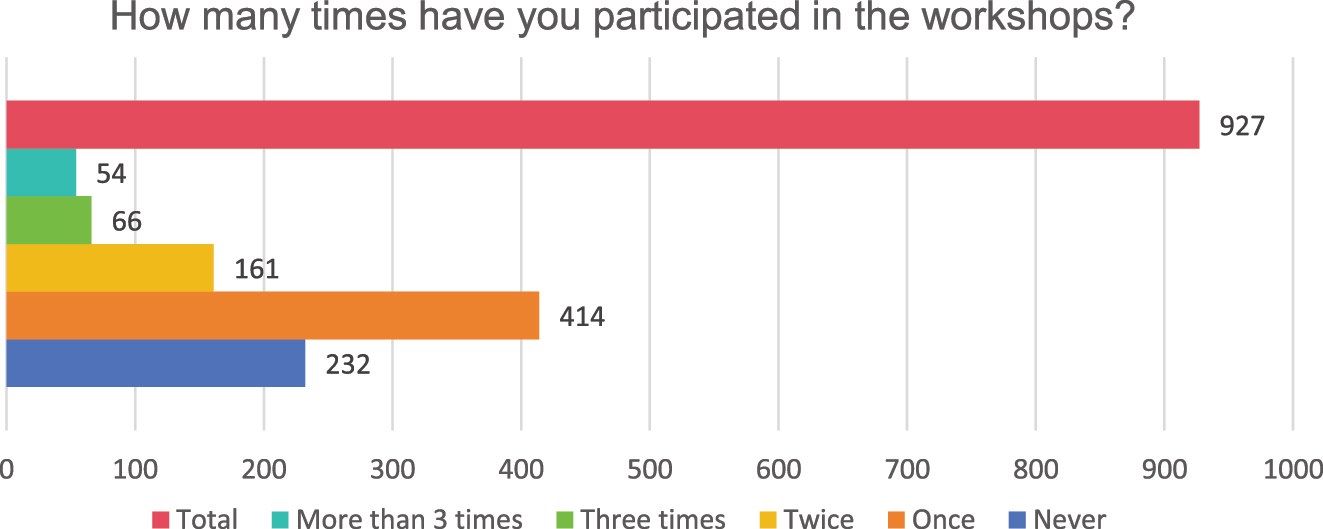
Secondary students’ participation in TVET workshops.
Table 8 shows that, on average, respondents said they occasionally learned about TVET and tried to learn about skills, labor market needs, and career options through TVET workshops, but they received limited information about future careers. Remarkably, the respondents agreed that workshops helped them to learn more about their future education and they are very interested to participate in the workshops. They also mentioned that workshops are important and effective for them (easy to get information), but they don’t seem so attractive for students yet.
Evaluation of TVET workshops.
| No. | Perception of students on workshops | Min | Max | Mean | SD |
|---|---|---|---|---|---|
| 1 | I have gained an understanding of TVET | 1 | 5 | 3.6102 | 1.22685 |
| 2 | I have gained an understanding of current skill needs | 1 | 5 | 3.7598 | 1.18329 |
| 3 | I have gained an understanding of current market needs | 1 | 5 | 3.7057 | 1.19043 |
| 4 | I have gained an understanding of my skill choice | 1 | 5 | 3.9824 | 1.17628 |
| 5 | I have gained an understanding of my career choice | 1 | 5 | 2.6964 | 1.33332 |
| 6 | Level of my interest | 1 | 5 | 3.6189 | 1.18338 |
| 7 | Level of effectiveness | 1 | 5 | 3.6737 | 1.15217 |
| 8 | Level of importance | 2 | 5 | 3.6352 | 1.17525 |
| 9 | Level of difficulty to understand | 2 | 5 | 3.9106 | 1.09633 |
In short, the promotional activities through workshops are effective in providing guidance for students, but their effectiveness remains limited in preparing students for future careers and in providing enough information about skills needs and labor market demands.
4.2 TVET Students
Table 9 shows that more than 85 % of the respondents answered correctly what TVET is and what the concept of skills represents. Almost 71 % stated that they knew the place and location of TVET institutions, while 91 % knew both scholarships and school tuition fees. It explicitly means they understand well the pricing strategy and promotional strategy of the TVET sector. Nearly 39.50 % of student respondents did not understand the level of TVET education, while 28.80 % answered correctly.
TVET students’ understanding of the TVET sector.
| No. | Knowledge about TVET | True | False | Don’t know |
|---|---|---|---|---|
| 1 | TVET is explicitly a professional education | 84.80 % | 3.40 % | 7.10 % |
| 2 | TVET level 5 is equal to a bachelor’s degree | 28.80 % | 24.70 % | 39.50 % |
| 3 | TVET is only available in provinces | 12.80 % | 71.40 % | 9.90 % |
| 4 | Vocational and technical skills include electricity, technology and automotive engineering etc. | 76.30 % | 6.50 % | 11.90 % |
| 5 | TVET has both scholarships and tuition fees | 91.50 % | 3.20 % | 1.40 % |
Around 91 % of respondents believed that they should study skills which are suitable to their interest and talents. However, most of them do not agree that they should study the same things as their friends do after graduating from high school. At the same time, 80 % of them answered that they already had their future plan concerning both skills and career. Surprisingly, 18 % stated that their parents should have planned for them, while 20 % said if they are good at math, they should study social science rather than real science or technical skills (Table 10).
Students’ knowledge about career guidance.
| No. | Students’ knowledge about their life plan | True | False | Don’t know |
|---|---|---|---|---|
| 1 | I should study the majors that fit my interest and talents | 91.50 % | 3.20 % | 1.40 % |
| 2 | When I graduate from high school, I should follow what my friends study | 3.80 % | 87.70 % | 4.30 % |
| 3 | My parents should prepare my life plan | 18.40 % | 68.90 % | 7.20 % |
| 4 | If I am good at math, I should study social science | 20.40 % | 58.30 % | 15.60 % |
| 5 | If I have a clear life plan, I will have a good career path. | 79.10 % | 3.30 % | 11.40 % |
Most students (79.1 %) understood that labor market information includes market needs, working conditions, and salary. However, 13.8 % believed they could get a good job without such knowledge, and 44.2 % viewed scientific expertise as the country’s key need. While 47.3 % thought Cambodia’s development would focus on industry and energy, 25.7 % were unsure. Although students grasp the concept of labor market information, many still lack the awareness of actual labor market demands and national priorities (Table 11).
Students’ understanding of labor market information.
| No. | Understanding of labor market information | True | False | Don’t know |
|---|---|---|---|---|
| 1 | Labor market information includes market needs, working conditions and salary | 79.10 % | 3.30 % | 11.40 % |
| 2 | I can find a good job without labor market information | 13.80 % | 71.10 % | 10.30 % |
| 3 | I think the necessary expertise in the country is scientific expertise. | 44.20 % | 29.30 % | 20.30 % |
| 4 | The job market today I narrow for true scientific expertise. | 17.60 % | 54.20 % | 22.20 % |
| 5 | Cambodia development directions will focus on industry and energy. | 47.30 % | 21.10 % | 25.70 % |
One of the main research questions is to investigate the significant influential factors which relate to the interest and perception of TVET by targeted respondents. A Likert-Scale from 1 (Strongly Disagree) to 5 (Strongly Agree) was used to rank the respondents’ answers.
The majority of respondents did not agree with the statement that “TVET jobs are not for women” and “TVET jobs are tiring and dirty”. However, they are likely to disagree with the ideas that: (1) College degrees are better than TVET certification; (2) TVET jobs are for dropouts and poor people (Table 12). All of this means that most of the students are very positive about the TVET sector.
Students’ perception on the TVET sector.
| No. | Students’ perception on the TVET sector | Total | Mean | SD |
|---|---|---|---|---|
| 1 | TVET jobs are not for women | 709 | 1.67 | 1.20 |
| 2 | TVET jobs are laborious, dirty, outdoors, and under the sun (blue collar jobs) | 736 | 1.94 | 1.22 |
| 3 | University degrees offer better chances of landing a job than TVET degrees | 731 | 2.45 | 1.41 |
| 4 | TVET jobs are for those who are not smart, who had low grades at school, and dropouts. | 738 | 2.16 | 1.33 |
| 5 | TVET jobs are for the poor/those with low economic status and those in rural areas (peasants) | 732 | 2.49 | 1.13 |
Most of the respondents among the TVET students themselves have attached great importance to TVET. Also, the question regarding TVET’s contribution to and impact on national development received a high rating from respondents (Table 13). It can be said that students who are currently studying TVET have a better understanding or knowledge of the importance of TVET, labor and employment market information, and human resources development as well as the country’s development (Tables 14 and 15).
General TVET perception of TVET students.
| No. | Perceived importance of TVET | Total | Mean | SD |
|---|---|---|---|---|
| 1 | How important is TVET to you? | 1,028 | 4.18 | 0.98 |
| 2 | How important is TVET for Cambodia’s labor market? | 1,023 | 4.23 | 0.93 |
| 3 | How important is TVET for Cambodia’s resource development? | 1,024 | 4.28 | 0.93 |
| 4 | How important is TVET for country development? | 1,027 | 4.38 | 0.88 |
Average value and standard error mean about the TVET sector.
| No. | Workshops/Seminars | N | Mean | SD | SEMa |
|---|---|---|---|---|---|
| 1 | Perception about the TVET sector | 1,342.00 | 2.55 | 1.24 | 0.034 |
| 2 | Perceived importance of the TVET sector | 1,033.00 | 4.26 | 0.82 | 0.025 |
-
aStandard Error Mean (SEM).
Independent t-test for TVET students’ perception and perceived importance.
| Through the social | Test value = 0 | |||||
|---|---|---|---|---|---|---|
| marketing materials for TVET | t | Df | Sig. (2-Tailed) | Mean difference | 95 % confidence interval of the difference | |
| Lower | Upper | |||||
| Perception about the TVET sector | 74.96 | 1,342 | 0.000a | 2.550 | 2.483 | 2.617 |
| Perceived importance of the TVET sector | 166.61 | 1,033 | 0.000a | 4.267 | 4.217 | 4.317 |
-
aCorrelation is significant at the 0.05 level.
An independent t-test explains some impacts of social marketing strategy in terms of promoting and attracting students to learn and understand the importance of the TVET sector. As a result, Statistical Significant Difference, and mean values are observed among 1,342 students with the t-Value = 74.96, p = 0.00 (<0.05). While 1033 TVET students have well understood the importance of TVET with the t-Value of 166.61, p = 0.00 (<0.05).
4.3 General Findings on Perception, Impact and Effectiveness
Questions around the perception of TVET showed that many respondents placed a high value on the TVET sector and that a tendency towards improved perception can be observed (Table 16).
General perception of the TVET sector by students.
| No. | How important is TVET? | Total | Mean | SD |
|---|---|---|---|---|
| 1 | How important is TVET to you? | 739 | 3.73 | 1.17 |
| 2 | How important is TVET for Cambodia’s labor market? | 737 | 3.98 | 1.05 |
| 3 | How important is TVET for Cambodia’s resource development? | 733 | 4.10 | 1.06 |
| 4 | How important is TVET for country development? | 732 | 4.20 | 1.05 |
Table 17 shows that 71 % of respondents expressed their perception about the TVET sector as more positive than the previous years, while 29 % remained the same. However, no student said their perception on TVET was more negative than the previous years.
Students’ perception of TVET compared to previous years.
| Perception of students on TVET | Total | |||
|---|---|---|---|---|
| Level | Same to last year | More positive than last year | More negative than last year | |
| Total | 28.80 % | 71.20 % | 0 % | 100 % |
Table 18 indicates the effectiveness of social marketing in the TVET sector through exhibitions or job fairs, TV, posters, and social media to raise awareness about TVET and its roles among students. Therefore, the results show that TVET social marketing has dramatically raised the awareness and understanding of students in Cambodia. However, their understanding and knowledge is still low.
Mean and standard error mean about students’ perception (likert scale 1–5).
| No. | Workshop | Total | Mean | Standard deviation | Std. Error mean |
|---|---|---|---|---|---|
| 1 | Students’ perception about TVET | 752.00 | 2.15 | 0.87 | 0.03 |
| 2 | Level of understanding about TVET | 741.00 | 4.00 | 0.91 | 0.03 |
This means DLMI, TVET institutions and relevant stakeholders should continue to raise public awareness through developing more interesting topics to attract attention from students.
To get a more precise understanding of the impact, an independent test was conducted. Table 19 provides an analysis of an independent t-test to investigate influential actors on social marketing strategy in order to define the most cost-effective way forwards. The result shows that there is a Statistically Significant Difference (SSD) in terms of the mean value between perception (t-value = 67.96) and level of understanding (t-value = 119.64).
Independent T-Test on students’ perception and understanding.
| No. | Workshop | Test value = 0 | |||||
|---|---|---|---|---|---|---|---|
| t | Df | Sig. (2-Tailed) | Mean difference | 95 % confidence interval of the difference | |||
| Lower | Upper | ||||||
| 1 | Students’ perception about TVET | 67.963 | 751 | 0.000a | 2.15366 | 2.0914 | 2.2159 |
| 2 | Level of understanding about the TVET sector | 119.646 | 740 | 0.000a | 4.00146 | 3.9358 | 4.0671 |
-
aCorrelation is significant at the 0.05 level.
An assessment on the effectiveness of promotion and social marketing by DLMI among secondary school students and their behaviors on the main promotional channels is based on Likert-Scale by which five levels are given: 1 (Never), 2 (Seldom), 3 (Sometime), 4 (Often) and 5 (Always). As shown in Figure 4, most students reported that they rarely or never listen to radio, watch television, or read newspapers. In contrast, the majority indicated that they frequently obtain information through social media platforms and the Internet, highlighting the growing dominance of digital communication among youth audiences.

Preferences of secondary school students in regard to promotion and information channels.
Table 20 illustrates that 77 % of TVET students who participated in this survey have heard or seen TVET promotional materials, while only 20 % of them reported never having been exposed to them.
Perception of students on social marketing.
| High school | Have you ever heard or seen the TVET promotion? | How did you receive the information? | ||||||
|---|---|---|---|---|---|---|---|---|
| Yes | Never | Workshop | Job fairs | TV | Poster | Website | ||
| Total | 1,074 (76.5 %) | 283 (20.2 %) | 712 (36.6 %) | 115 (5.9 %) | 167 (8.6 %) | 317 (16.3 %) | 483 (24.8 %) | 154 (7.9 %) |
| Missing System | 47 (3.3 %) | |||||||
This result indicates that social marketing strategy about TVET has attracted many students to enroll in TVET. About 36.6 % of respondents participated in workshops organized by DLMI, while others received information through TV (8.6 %), posters (16.3 %), Facebook (24.8 %), and the website (7.9 %). Interestingly, although almost all students reported using Facebook daily, only about a quarter (24.8 %) had received TVET information from DLMI’s Facebook page. This suggests that DLMI’s promotional activities on social media remain limited in reach and effectiveness, despite high student engagement online.
5 Conclusion and Recommendations
This study concludes that students directly exposed to DLMI’s social marketing campaigns demonstrated significantly higher awareness, understanding, and positive perceptions of TVET compared to their non-targeted peers. However, student decision-making remains shaped by multiple socio-cultural and informational influences, including parental attitudes, peer networks, teachers, and access to labor market information. Misconceptions about TVET persist, reflecting limited integration of vocational orientation within early secondary education and inadequate dissemination of employment outcome data.
TVET in Cambodia faces complex, multi-dimensional development challenges that cannot be resolved solely through economic or skills mismatch analysis. Skills acquisition is not limited to formal institutions, and long-term social transformation is required to elevate the sector’s standing. These findings align with social learning theory and social cognitive theory, which view attitudes and behavior as shaped through observation, modeling, and reinforcement in social contexts (Firmansyah and Saepuloh 2023). They also complement contemporary critiques in digital and educational research that emphasize the socio-cultural embedding of learning, including the roles of family, community, and network in shaping educational trajectories (Gillani and Eynon 2023). Moreover, recent global assessments of TVET underscore the importance of elevating its public image, ensuring equitable access, and strengthening governance to align with labor market needs (UNESCO 2024).
In order to attract more youth to pursue TVET, this study recommends that DLMI and TVET institutions develop a comprehensive TVET promotional strategy focusing on four key policy and practical dimensions.
Integrate TVET Orientation in Lower Secondary Education: MLVT and MoEYS should consider including a TVET orientation in lower secondary school level from grade 9 onwards. This could include TVET promotional campaigns or practical introduction into the world of work. Currently, DLMI focuses on students in Grade 12, but those students often have their future study plan. The process of attracting and convincing youths as well as general public requires time and resources. Therefore, long-term TVET promotion and social marketing are necessary.
Strengthen LMI Dissemination: Promotional activities and increased labor market information are essential to students and parents and should not be overlooked. Most of the respondents appear not to have a clear understanding of labor market demands and the skill sets required to meet them. Therefore, it is crucial to enhance students’ awareness of Cambodia’s labor market trends, enabling them and their parents to make informed educational and career choices aligned with market needs.
Engage Parents as Key Influencers in TVET Decision-Making: The TVET promotion strategy should include a focus on “Parents”. Students’ parents should be given enough information about the labor market demands and skills demands in Cambodia. A vast majority of respondents in this study are firmly confident in their parents and consequently, their parents play an important role in decision making. This is partly because their parents often support their studies financially. The public awareness among students’ parents about TVET should be targeted through brochures, television and radio. Seminars and other measures should be considered to address the negative TVET stereotypes among students’ parents.
Leverage Social Media for TVET Promotion: DLMI should increase TVET promotion through social media (Facebook). Almost 50 % of respondents answered that they use Facebook daily. Facebook is a popular and powerful social media platform for promoting information among Cambodian youths. Any campaigns to raise awareness of TVET on social media will be highly effective and efficient in reaching the youth.
The implementation of one or more of the recommendations above will possibly increase public awareness and improve the level of understanding of TVET in Cambodia.
Acknowledgments
The authors would like to thank the staff of the Department of Labor Market Information (DLMI), the Directorate General of TVET, and the Ministry of Labor and Vocational Training (MLVT) for their support and cooperation. We also appreciate the contributions of the participating students, school administrators, and field researchers across the eight provinces.
-
Research ethics: This study was conducted in accordance with the ethical guidelines of PRI Consulting (Panhchak Research Institute Co.,Ltd) , ensuring the anonymity, confidentiality, and voluntary participation of all respondents.
-
Informed consent: Informed consent was obtained from all participants prior to data collection. For participants under 18 years of age, consent was also obtained from parents or legal guardians.
-
Author contributions: Conceptualization: [Initials]; Methodology: [Initials]; Data Collection: [Initials]; Data Analysis: [Initials]; Writing – Original Draft: [Initials]; Writing – Review & Editing: [Initials]. All authors have read and approved the final manuscript.
-
Use of Large Language Models, AI and Machine Learning Tools: This study used AI Grammarly and OpenAI’s ChatGPT tools, to support paraphrasing and editing English writing as our second language during the manuscript preparation process. All analysis and interpretation were conducted by the authors.
-
Conflict of interest: The authors declare no conflict of interest.
-
Research funding: Government funded under Ministry of Labor and Vocational Training.
-
Data availability: The data that support the findings of this study are available from the corresponding author upon reasonable request. Due to privacy concerns, individual-level data are not publicly shared.
References
Ajit, K. N. 2015. “Social Marketing: a Literature Review.” International Journal of Science and Research 4 (9). https://www.ijsr.net/archive/v4i9/SUB158156.pdf.Search in Google Scholar
Firmansyah, D., and D. Saepuloh. 2023. Social Learning Theory: Cognitive and Behavioral Approaches. Jurnal Ilmiah Pendidikan Holistik. [Open access article discussing updated SLT and social cognitive theory perspectives] ResearchGate.Search in Google Scholar
Gillani, N., and R. Eynon. 2023. “Understanding and Improving Social Factors in Education: a Computational Social Science Approach.” arXiv:2301.05619. https://doi.org/10.48550/arXiv.2301.05619.Search in Google Scholar
Hunsinger, Jeremy, and Theresa M. Senft, eds. 2013. The Social Media Handbook. https://ebookcentral.proquest.com.10.4324/9780203407615Search in Google Scholar
Kotler, P., and G. Armstrong. 2016. Principles of Marketing, 16th ed. London: Pearson.Search in Google Scholar
Lalwani, R. 2012. “Social Media and Business.” The Journal for Decision Makers 37 (4): 69–70.10.1177/0256090920120406Search in Google Scholar
Ministry of Labour and Vocational Training (MLVT). 2020. KAP – Knowledge, Attitude and Practice Research Study.Search in Google Scholar
Taneja, Shalini, and Lawrence Toombs. 2014. “Putting a Face on Small Businesses: Visibility, Viability, and Sustainability—The Impact of Social Media on Small Business Marketing.” Academy of Marketing Studies Journal 18 (1): 249–60. http://proxy.lib.odu.edu/login?url=https://search-proquest-com.proxy.lib.odu.edu/docview/1645849603?accountid=12967.Search in Google Scholar
UNESCO. 2024. Recommendation on Technical and Vocational Education and Training: Results and Trends 2019–2022. UNESCO. (Report summarizing TVET policy progress, challenges, and global trends).Search in Google Scholar
WUSC Sri Lanka. 2016. Social Marketing Strategic Plan. October 4.Search in Google Scholar
Zhu, Yifeng, and Hongwei Chen. 2015. “Social Media and Human Need Satisfaction: Implications for Social Media Marketing.” Business Horizons 58 (3): 335–45. https://doi.org/10.1016/j.bushor.2015.01.006.Search in Google Scholar
© 2025 the author(s), published by De Gruyter, Berlin/Boston
This work is licensed under the Creative Commons Attribution 4.0 International License.
