“No Gain? No Pain!”: metapragmatic comments and their role in online fandom construction on social media
-
Jialiang Chen
Jialiang Chen is a PhD candidate in the School of English for International Business, Guangdong University of Foreign Studies, Guangzhou, China. His research interests include pragmatics and business discourse. He has publications in Journal of Pragmatics, Journal of Historical Pragmatics, Iberica, Corpus Pragmatics, and in some prominent journals of linguistics in Chinese.
 and
Ping Liu
and
Ping Liu
Ping Liu is a professor at the Center for Linguistics and Applied Linguistics and School of English for International Business at Guangdong University of Foreign Studies, P. R. China. Her research interests include intercultural pragmatics, metapragmatics, and business discourse. She has publications in Journal of Pragmatics, Intercultural Pragmatics, Pragmatics and Society, Pragmatics & Cognition, Lingua, East Asian Pragmatics, Internet Pragmatics, and in some prominent journals of linguistics in Chinese.


Abstract
Comments play a significant role in online fandom construction on social media. This paper investigates the role of metapragmatic comments (MPCs) in constructing online fandom, discussing the underlying mechanism behind the use of MPCs on Chinese social media. The present study draws on a self-built dataset of 69,086 comments gathered from Weibo, which were employed in response to a public apology by a top Chinese e-commerce live-streaming influencer. Through a mixed-methods analysis, this study finds that different types of MPCs illustrate varying reactions and demonstrate how fans respond to the apology by either expressing their acceptance or signaling their rejection. Special attention is then paid to three emerging interactive patterns that reveal how MPCs are intended to dynamically construct online fandom, namely eliciting intense resentment, engaging in satirical humor, and catalyzing new topics. This study not only deepens our understanding of metapragmatic awareness revealed by fans’ discourse within the context of e-commerce but also highlights how social media affordances and digital fan culture contribute to online fandom construction.
1 Introduction
This study explores the role of metapragmatic comments (MPCs) in online fandom construction on Weibo, a platform considered China’s equivalent to X. On Weibo, fan culture and communities are often manifested through both personal and official engagement (e.g., Yin 2020; Yin and Xie 2021). Central to their engagement are fans’ comments in digital spaces, which aligns with Locher and Messerli’s (2023) study on comments in online fandom. In today’s social media environment, interactions within fan communities are not always positive but can sometimes be conflictual, since “assuming all fan communication to be affirmative would be simplistic” (Biri 2023: 71). By ‘fans’ here we refer to Weibo users who signify an active investment in online engagement and exhibit a sustained interest in specific topics through both direct responses (primary comments) and follow-up discussions (secondary comments). These comments are defined in the current study as MPCs (cf. Bi and Ren 2023; Liu 2023), as they offer “assessments of the communicative status and meaning of the described speech events” in computer-mediated communication (CMC) contexts (Tanskanen 2007; Verschueren 2000: 451).
We examine fans’ MPCs in response to a public apology issued by Li Jiaqi, a top Chinese live-streaming influencer. This incident originated from Li’s inappropriate comment during a live-streaming session, followed by a public apology on Weibo. While the issue initially appeared to be a personal matter attached to Li’s misstep, his representative role in the e-commerce sector (Li et al. 2023; Zhang and Hou 2024) generated widespread public criticism and media attention to this industry (Yang 2024). Thus, this incident provides a lens through which one can appreciate the broader impact of such controversies on the e-commerce industry. In this case, we specifically investigate comments on Weibo in response to Li’s apology, offering empirical insights into how fan communities deconstruct the apology and influence the dynamic interactions on social media. From an interpersonal pragmatic perspective (Locher and Graham 2010; Locher et al. 2015), we trace how these MPCs manifest fans’ engagement on Weibo, particularly in how they evaluate and reflect on norms, practices, and standards within their communities (cf. Graham 2019).
Despite an extensive literature on MPCs in institutional settings, their role in constructed commercial-related fandom on social media remains underexplored. Hence, the present study proposes two research questions: 1) What types of MPCs are used in response to Li’s public apology?; and 2) What role do MPCs play in online fandom construction? To address these questions, both quantitative and qualitative methods are employed.
The remainder of this paper is structured as follows. After reviewing prior research in Section 2, we present the data and methods in Section 3. Section 4 delineates and scrutinizes the findings at both static and dynamic levels. We then discuss our findings in Section 5, before concluding our study in Section 6.
2 Literature review
2.1 Metapragmatic comments
MPCs are defined as “explicit metapragmatic evaluations in actually-occurring contexts” (Ciliberti and Anderson 2007: 144), functioning as “situated comments about or evaluations of language use” (Culpeper and Haugh 2014:24). MPCs are used to either reinforce or challenge the communicative norms that influence interactions or discourse (Hübler and Bublitz 2007). As demonstrated in previous research (e.g., Liu and Liu 2017, 2021, and 2022; Liu and Yao 2019), these metapragmatic devices not only serve as tools for reflection on communication but also regulate ongoing interactions, manage social dynamics, and even manipulate the communication process. While extensive studies on MPCs involve different settings, such as legal, educational, and other professional environments (e.g., Culpeper and Pat 2021; Jacobs 2022; Kim and Spencer-Oatey 2021; Liu and Yao 2019; Unuabonah 2017), their role in social media have not yet been fully explored. In digital settings, MPCs serve as catalysts for “a sequence of […] instances in which participants join to create a metapragmatic discussion” (Tanskanen 2007: 88), revealing societal perceptions, emotional expressions, and the manipulation of public opinion within digital communities (Bi and Ren 2023).
The present study specifically focuses on MPCs in response to a public apology on Weibo. Building on Pizziconi’s (2007) discussion of apologetic MPCs, recent studies have expanded the scope to include diverse forms of MPCs, such as personal statements or interviews, as well as responses from third-party observers like media and online communities (e.g., Ancarno 2015; Chang and Haugh 2011; Lutzky 2024; Rieger 2017; Yang and Hu 2023; Yang 2024). This diversity offers a valuable first-order perspective for analyzing apologies and understanding the dynamics of identity and discourse within online platforms (Reyes 2019; Porto López 2023; Tanskanen et al. 2024). Prior studies have primarily discussed apologies and their responses on X (Lutzky 2021, 2024), Instagram (Matley 2020), and Facebook (Lee and Atkinson 2019), but less attention has been paid to Chinese social media. Research on Chinese social media tends to center on self-praise (Ren and Guo 2020, 2022), metaphorical engagement (Sun et al. 2022), and public criticism (Wu and Fitzgerald 2021), with insufficient discussion on metapragmatic awareness in this context. This study, therefore, explores MPCs on Weibo in response to a public apology and further investigates their role in online fandom construction.
2.2 Online fandom
Online fandom, emerging from the well-established concept of online community of practice (CofP), describes fan interactions in CMC environments (Hauser and Meier-Vieracker 2022). Much of the prior research on fandom is often associated with static phenomena, such as identity performance (Thorne et al. 2015) and affective stance (Biri 2023), while the dynamic interactions involved in fandom construction have not been fully mapped. More relevant to the present study is Locher and Messerli’s (2023) study of the CMC streaming platform Viki.com, especially their investigation of comments and online fandom, which strengthens the theoretical foundations of the present study on fan interactions in digital spaces and an extension into commerce-related contexts.
It is through conflictual interactions that fandom becomes more prominent (cf. Locher and Messerli 2023), mainly when apologies and responses are involved. In these critical situations, apologies serve as effective strategies on social media (Yang 2024), inevitably triggering responses (i.e., MPCs in the present study) due to concerns about appropriateness, trust, and relationship management within these communities (e.g., Shrikant 2020; Sillence 2017; Tanskanen 2007). As such, apologies can be examined through subsequent MPCs, which serve as “evidence of reflexive or metapragmatic awareness” in the CMC setting (Tanskanen 2021: 220), offering insights into the negotiation of societal norms and expectations in fandom.
Our investigation lies in the distinct commercial elements of fan interactions on Weibo. Unlike platforms such as X and Facebook (cf. Wikström 2019), Weibo facilitates a shift where fans transition from passive consumers to active participants in e-commerce, largely due to the widespread popularity of e-commerce in China (Huang and Ran 2024; Huang and Liu 2025). On Weibo, fans engage in discussions about their shopping experiences, signaling a departure from traditional forms of fandom, typically centered around admiration for artistic achievements, towards more commerce-oriented participation (cf. Liu and Cheng 2025). In this context, the present study further examines these transformations associated with fandom behavior and its implications for fan engagement in e-commerce-related activities.
3 Data and methodology
3.1 The context
E-commerce live-streaming integrates live video broadcasts into online shopping, enabling influencers (also called streamers or broadcasters) to promote and facilitate direct purchases (e.g., Shi and Dou 2023; Yang and Wang 2022). Among the prominent influencers, Li Jiaqi is a well-known representative for his charismatic and persuasive streaming style (Zhang and Hou 2024).
Weibo, a leading Chinese social media platform, stands as a major space for influencers to engage with their fans and share upcoming streams through comments beyond live-streaming. This platform allows influencers to gauge public sentiment, address concerns, and participate in damage control by responding to comments or issuing statements. It is, thus, unsurprising that in critical situations, Weibo becomes a “battleground” of public opinion, highlighting the platform’s affordances in engaging with the general public (Yang 2024).
Li’s apology stemmed from a particular streaming session, during which he criticized the audience for not working hard enough to earn money. When the audience complained about the high price of the eyebrow pencil, Li angrily responded, “79元哪里贵了? 这么多年都是这个价格好吧。不要睁着眼睛乱说。有的时候找找自己原因好吧。这么多年了工资涨没涨? 有没有认真工作? [How could 79 yuan be expensive? It’s been the same price for many years. Stop talking nonsense. Sometimes, you should consider the reasons within yourself. Has your salary gone up over these years? Are you working hard enough? (No Gain? No Pain!)]” This response sparked public criticism and damaged some brand partnerships with Li. His actions were replicated through satirical comments and videos across multiple platforms, magnifying its social impact. Meanwhile, the situation was captured by media coverage, which labeled it a critical controversy in both his streaming career and the e-commerce live-streaming industry. In response, Li issued an apology on Weibo the next day (Figure 1). Perceived as insincere (Yang 2024: 37), this post triggered a new round of discussions, ranging from discussion threads and media coverage to the widespread use of memes mocking the situation. The scope and severity of this public apology far exceeded Li’s original misconduct during the live-streaming session.
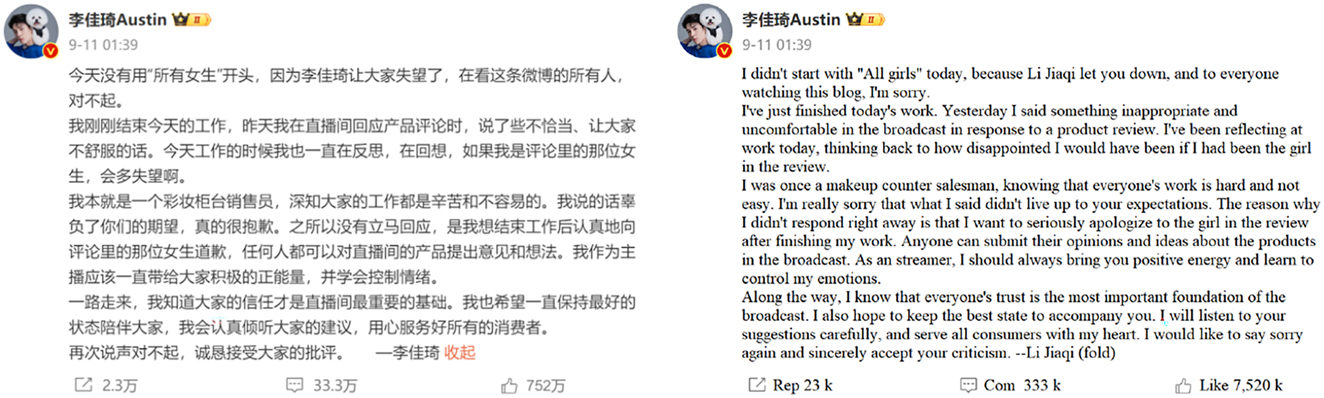
Li’s public apology on Weibo after the e-commerce live-streaming.
3.2 Data collection
Our data consist of fans’ primary and secondary comments following Li’s apology on Weibo. To clarify, primary comments are direct responses to the apology, while secondary comments are responses to primary comments, creating threads that focus on specific topics. These comments were automatically collected from Weibo using a Python script without any transcription or modification to preserve the authenticity of the original material. We also adopted methods from existing studies on online comments (e.g., Hsu et al. 2024; Trnavac and Taboada 2023) to organize our data. The dataset includes usernames, user IDs, timing of comments, and the contents of the comments. To protect privacy, all identifiable information of the fans has been anonymized and their names are referred to as “A”, “B”, “C”, etc. Data were compiled on November 13, 2023, and the dataset contains 299 primary comments and 68,787 secondary comments, totaling 14,188 and 2,401,002 words, respectively. Figure 2 illustrates the number of secondary comments made in response to specific primary comments.
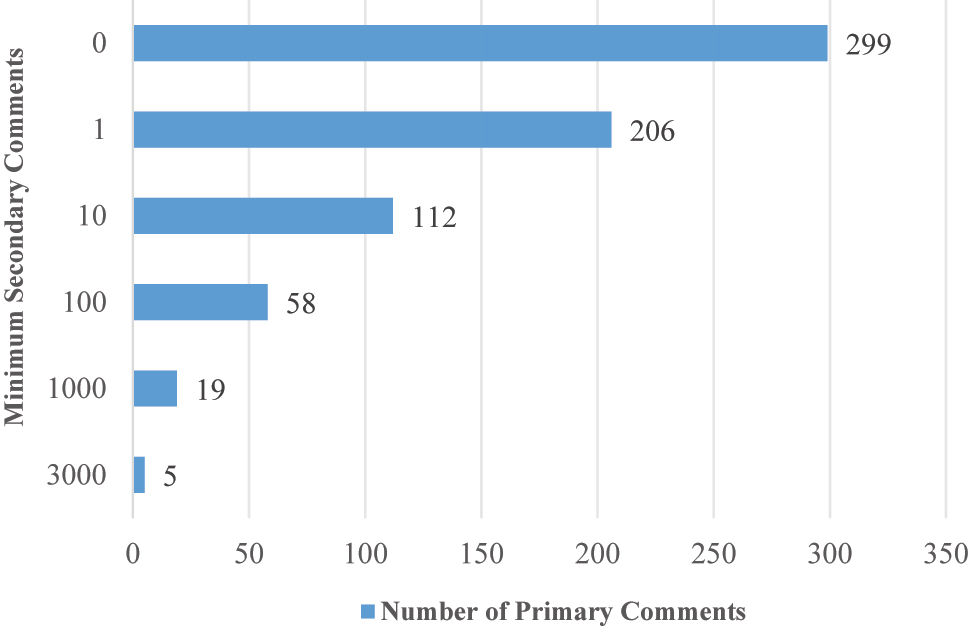
Minimum secondary comments to primary comments.
3.3 Analytical approach
To answer the first research question, all primary comments were identified and classified using both top-down and bottom-up approaches. The top-down approach was informed by previous studies on categories of apology responses (Adrefiza and Jones 2013: 78–79; An et al. 2022: 36), which guided our initial identification and classification. At first, we attempted to apply An et al.’s (2022) categories to our dataset, which only reached a 60 percent coder agreement. After careful scrutiny, we found that their categories are specifically targeted at individual apologies and responses, so we refined our methodology to include a bottom-up approach, which we tailored to the diverse, broad audience found on public platforms. That is why some bottom-up paradigms regarding the felicity conditions for apologies (e.g., Lutzky 2021, 2024; Yang 2025) supplement our analysis of apology responses on Weibo. These conditions – such as sincerity, adequacy, and the appropriateness of the apology – were used to improve our classification of MPCs and help distinguish between acceptance and rejection of the apology.
Inter-coder reliability and the robustness of the categories were then tested. Regarding inter-coder reliability, we revised our codebook in several cycles until a 95 percent coder agreement was reached. To ensure the accuracy of the coding, we consulted with colleagues and students experienced in researching or posting Weibo comments to discuss the remaining 5 percent before ultimately reaching a consensus. Additionally, we invited another researcher to independently code the data by applying the codebook, which allowed us to test the stability of the coding categories. The Cohen’s Kappa value was approximately 0.967, indicating a very high level of inter-coder reliability. Finally, minor refinements were then made to the codebook to ensure clarity and consistency.
During the coding process, we also encountered some comments that neither explicitly accepted nor rejected the apology or only contained irrelevant pictures. While these comments appeared in our dataset, they did not fall under the metapragmatic category. Table 1 displays the final version of our codebook.
Types, coding schema, and examples of MPCs.
| Comment type | Coding scheme | Example |
|---|---|---|
| Acceptance by | MPCs that show a positive or understanding reaction toward the apology | |
| Showing alignment | Expressing support for the sentiments or facts presented in the apology | 加油! 永远支持你!  Come on! Always support you!  |
| Expressing empathy | Demonstrating understanding and sympathy for the person apologizing | 懂你, 舆论真的太可怕了。 I understand you. Public opinion can be really terrifying. |
| Giving suggestions | Offering advice or recommendations for future actions or improvements | 谨言慎行  Speak cautiously; act prudently.  |
| Contesting rejections | Arguing against those who reject or criticize the apology | 何必墙倒众人推! Why topple the wall and blame others! |
| Rejection by | MPCs that indicate an adverse or skeptical reaction toward the apology | |
| Evaluating inappropriateness | Judging the apology as inadequate or inappropriate | 写的不够真挚, 打回公关部重写吧 Not sincere enough, send it back to the PR department for a rewrite. |
| Making complaints | Expressing dissatisfaction or grievances related to the apology or the incident | 打工人没惹 We workers haven’t done anything wrong. |
| Using sarcasm | Resorting to sarcasm to undermine or mock the apology | 你这话说的还挺委屈啊 You sound quite aggrieved. |
| Refuting acceptances | Arguing against those who accept or support the apology | 居然还有人觉得他很诚恳? How is it possible that some still find him genuine? |
For the second research question, we focused on the role of MPCs in online fandom construction. We selected the secondary comments that followed the first primary comment for three key reasons. First, this primary comment had been followed by 7,871 secondary comments, offering an extensive and diverse dataset for the study. Second, as this primary comment signified support, it triggered more intense and conflictual interactions within the community compared to other top five primary comments (≥3,000). As Locher and Messerli (2023: 6) suggest, investigating conflictual interactions is valuable because it sheds light on the dynamism of fan discourse and culture. Third, the contextual constraints provided a more focused and coherent analysis, which mitigated the potential influence of external factors on the use of MPCs.
Later, we scrutinized the recurring themes among the 7,871 secondary comments, with a particular focus on those that elicited strong reactions or further discussions, as indicated by the number of “@” mentions. For our analysis, we set a threshold of 50 “@” mentions to identify comments that generated significant attention within the community. This process revealed 13 key interactions, which were subsequently summarized into three distinct interactive patterns. These patterns illuminate the role of MPCs in online fandom construction, supported by typical examples in Section 4.2.
4 Data analysis
4.1 Primary comments: types of MPCs in response to the apology
This section answers the first research question. Table 2 quantitatively presents an overall picture of the types and distribution of primary comments.
Types and distribution of primary comments.
| Comment type | Frequency | Percentage |
|---|---|---|
| Acceptance by | 84 | 28.09 % |
| Showing alignment | 31 | 10.37 % |
| Expressing empathy | 7 | 2.34 % |
| Giving suggestions | 35 | 11.71 % |
| Contesting rejections | 11 | 3.68 % |
| Rejection by | 200 | 66.89 % |
| Evaluating inappropriateness | 49 | 16.39 % |
| Making complaints | 80 | 26.76 % |
| Using sarcasm | 65 | 21.74 % |
| Refuting acceptances | 6 | 2.01 % |
| Other comments (not MPCs) | 15 | 5.02 % |
| Total | 299 | 100.00 % |
The categorizations of comments and their frequencies reflect the fans’ attitudes and sentiments toward Li’s apology. An initial analysis of the primary comments reveals a predominant sentiment of rejection (66.89 %), indicating widespread dissatisfaction and criticism, contrasted with a smaller segment of acceptance (28.09 %), showing the fans’ empathy and support. Additionally, 15 comments (5.02 %) were found to be neutral or to address irrelevant topics, which fall outside the scope of this paper as they are not typically metapragmatic. These quantitative findings set the stage for the following qualitative analysis of the comments, which range from alignment and forgiveness to skepticism and critique.
In our categories, acceptance is the first type. Consider the following examples:
| 我一如既往的支持你,我永远爱你 |
| I support you as usual. I’ll always love you. |
| 人非圣贤孰能无过 To err is human.1 |
- 1
All translations in this paper are rendered from Chinese to idiomatic English glosses, for the benefit of international readers.
| 期待双十一你继续给大家带来物美价廉的物品,慎言慎言。 |
| Hope you’ll continue to offer cost-effective products on Singles’ Day. Be cautious in your words. |
| 嘴下留情吧 |
| Please be gentle with your words. |
In (1), the fan shows their alignment by offering ongoing support, while the comment in (2) encourages understanding and forgiveness by framing mistakes as a universal issue, aiming to reduce the severity of criticism for the apology. (3) also accepts the apology but advises caution in future e-commerce live-streaming, combining encouragement with a gentle reminder. The last sub-type of comments is distinct, as these comments address rejections from other fans. For example, the fan in (4) regards rejections as sensitive and inappropriate. The metapragmatic awareness of this sub-type is more pronounced than that of the other three, as they evaluate and potentially manipulate future comments (cf. Liu 2023: 4–5). These MPCs call for accountability, growth, and mindful communication of the apology.
Rejection enjoys the highest frequency in our findings. Consider the following examples:
| 不要因为自己成功,就批评别人不够努力。 Don’t criticize others for not working hard enough just because you’ve been successful. |
| 现在花钱都花的不快乐,还要被你内涵和嘲讽,真的无语。 |
| Spending money doesn’t even bring me joy anymore, and I have to deal with your insinuations and mockery. It’s really frustrating. |
| 当然要道歉了,双十一的品都定好了,不道歉怎么播啊,双十一怎么办啊! |
| Of course, you have to apologize. The items for Double 11 are already ordered. How could you proceed with the livestream sales without apologizing? What would happen to the Double 11 event itself? |
| 评论区里怎么还有共情护主的汪汪队啊……一条多少我也想赚 |
| Why are there still empathy-driven loyal barking dogs in the comment section… How much for one? I want to earn too. |
For example, (5) evaluates Li’s misconduct during the e-commerce live-streaming, judging his remark as inappropriate (Tanskanen 2007: 96–99). Likewise, (6) expresses frustration with perceived sarcasm and mockery in Li’s misbehavior. The other two sub-types are based more on the apology than the streaming: (7) reveals a rejection of insincerity in the apology and judges the apology as a strategy to manage customer relations and business continuity, potentially for upcoming promotion activities. Another perspective in (8) signals severe criticism towards those comments that defend Li’s apology. To illustrate, the pejorative term “loyal barking dogs” discloses their opposition to the fans’ devotion to supporting Li despite his misconduct. These MPCs represent a spectrum of perspectives regarding the sincerity, practicality, and motivations behind the apology.
These primary comments provide an overall picture of how the fans on Weibo perceive and react to Li’s apology. While examining the static comments uncovers initial sentiments and perspectives, analyzing the dynamic, especially conflictual, interactions (Locher and Messerli 2023: 6), will enhance a holistic understanding of the metapragmatic awareness behind the use of MPCs within these communities.
4.2 Secondary comments: the role of MPCs on online fandom construction
Compared with the static comments, it is more significant to examine the interactions between the fans, as they display how online fandom is dynamically constructed. The secondary comments are more interactive and dynamic, incorporating a variety of perspectives. As mentioned in Section 3.3, we selected the first primary comment that received the largest number of secondary comments (see the following Extract).
Extract:
现在大家就是听不得大实话, 社会戾气太重了, 情绪化一点点, 但是不至于掐头去尾, 老李只是在反驳那些觉得国产货不值这个价格的人, 不要被带节奏了喂。
Right now, people just can’t handle the harsh truth. The social atmosphere is too hostile, getting a bit too emotional. But it’s not to the point of being exaggerated. Mr. Li was simply refuting those who think domestic products aren’t worth the price. Don’t let yourself be influenced.
These patterns are distinct yet interrelated, operating on the same conceptual level. Through these interactions, the fans express their emotions, engage with content, and influence their relationships within the fan communities.
4.2.1 Eliciting intense resentment: striving to protect yet provoking fan conflicts
This sub-section draws on a representative dialogue that exemplifies conflictual interactions and intense resentment among fans through MPCs. The exchange in (9) reveals an interplay of conflicting interpretations, affective stances, and social dynamics in fandom. The use of MPCs triggers heightened resentment, underscoring how the supporters’ efforts to protect or justify their idol can inadvertently provoke further controversy and division within the fan communities.
| 1: A | 什么叫 大实话?工资不涨是因为我不努力?我努力加班 工资不涨难道怪只能怪我自己?抑郁症都被你们 pua 出来了 |
| What do you mean by “harsh truth”? Is it because I’m not working hard enough that my salary isn’t increasing? I work hard and do overtime, and my salary still doesn’t increase. Should I blame only myself? You guys even attribute depression to me. | |
| 2: B to A | 人家说的是不努力的人 不是所有努力的人 还有自己找骂的 |
| He’s talking about people who aren’t working hard, not everyone. Some are just asking for trouble themselves. | |
| 3: A to B | 你哪句话看出的是这个意思 还在硬洗 真是跪久站不起本尊 找骂我都懒得骂你 |
| Where did you get that meaning in the conversation? You’re still insisting on twisting things. It’s really hard to stand up after kneeling for so long. I’m too lazy to even argue with you. | |
| 4: C to B | 跪久了站不起来了 好心疼你 好心疼你 |
Kneeling for too long to stand up anymore.  I feel really sorry for you. I feel really sorry for you. |
|
| 5: D to B | 你真会想,他就是嫌弃粉丝穷,不能帮他赚钱 |
| You really have a vivid imagination. He just looks down on fans for being poor, thinking they can’t help him make money. | |
| 6: E to B | 语文阅读理解不及格 |
| You failed the language comprehension. | |
| 7: F to B | 他骂的是不涨工资的,理解能力堪忧  |
He’s scolding those whose salaries aren’t increasing. Your comprehension skills are worrying.  |
|
| 8: G to B | 你是真能洗,还是说你阅读理解不过关? |
| You’re really good at twisting things. Or is it that your reading comprehension is lacking? | |
| 9: H to B | 呵呵当好韭菜就行了多努力多挣钱买你主子的东西 |
| Haha, just be a good leek. The more you work hard, the more money you’ll make to buy things for your idol. | |
| 10: I to B | 说实话 也轮不到他说 消费者评价产品,他评价消费者? |
| Honestly, it’s not his place to say. Consumers evaluate products, and can he evaluate consumers? |
Most MPCs in (9) disclose disagreement with Li’s words. The participants accuse others of “twisting” statements, implying their affective stance within the fan community (Biri 2023). For instance, A accuses B of distorting the case (line 3), and others, such as D, join by criticizing B’s “vivid imagination” (line 5). Moreover, the subsequent MPCs question B’s comprehension skills, attributing B’s opinion to a failure in reading comprehension (lines 6–8). This illustrates how interpretations of Li’s intended meaning diverge in a fractured community.
Specific to these rejections, the critics (A, D, and G) assess the inappropriateness of B’s support (lines 3, 5, and 8). More typically, I’s MPC expresses concern over the right of a public figure to evaluate his fans (line 10), which implies a fundamental tension between fans as consumers and celebrities as authoritative figures. Likewise, C’s MPC shows empathy for B, who has blind faith in Li (line 4), while H’s MPC mocks those supporters (line 9) (cf. Liu 2023), thus ridiculing the notion of subservience between the fans and their idol. These rejections suggest a critique not only of B’s interpretation but also of the uncritical support that often accompanies fandom.
(9) exemplifies the complexities of online fandom, where interpretations of a celebrity’s words diverge dramatically, leading to conflicts that are not just about content but also about broader issues of identity, loyalty, and power within the community. The MPCs function as both a window into these underlying conflicts and a tool for navigating the tensions that arise when the fans are called upon to defend or critique their idol’s actions.
4.2.2 Engaging in satirical humor: debating over “leeks” to address fan loyalty
Unlike the critical arguments in (9), the exchange in (10) reveals another facet of community interaction – satirical humor. MPCs are employed to convey rejection and critique while reinforcing the unique communication style and shared culture of the fandom.
| 1: A | 韭菜成精了 太可怕了  |
Leeks have gained sentience. It’s so scary.  |
|
| 2: B to A | 哈哈哈哈哈 形容的好到位,韭菜成精  |
Hahaha, that description is so accurate. Leek with sentience.  |
|
| 3: C to A | 哈哈哈哈哈 一直找不到怎么形容这些人 你说到点子上了 |
| Hahaha, I’ve been trying to find a way to describe these people, and you nailed it. | |
| 4: D to A | “工人和资本家共情纯粹是贱得难受” |
| “The empathy between workers and capitalists is purely disgusting.” | |
| 5: E to A | 保证的前提下他的价格就是最低的,跟他买有什么问题。不信他难不成以后靠那些更黑的主播 |
| With the guarantee, his prices are the lowest. What’s the problem with buying from him? Don’t tell me you’ll rely on even shadier streamers in the future. | |
| 6: F to E | 不买不行么  非得在直播间买 非得在直播间买 |
Can’t you not buy?  Do you have to buy during the live-streaming? Do you have to buy during the live-streaming? |
|
| 7: A to E | 没问题啊  你买啊 你买啊  我买不起79的眉笔不行吗 我买不起79的眉笔不行吗  我就是穷鬼好了吧(窝囊组+1) 我就是穷鬼好了吧(窝囊组+1) |
No problem.  You buy it. You buy it.  Can’t I afford a 79-yuan eyebrow pencil? Can’t I afford a 79-yuan eyebrow pencil?  I’m just a poor devil. (timid group +1) I’m just a poor devil. (timid group +1) |
The interaction starts with sarcasm embodied in the “leeks[2] with sentience” analogy (line 1). Other than expressing negative sentiments, this MPC resonates with the experience of the fans who feel exploited. This is evident in B’s and C’s MPCs (lines 2 and 3), which reinforce the metapragmatic nature of the exchange by activating shared common ground in the community (Liu and Liu 2017), signaling the speaker’s awareness of social and cultural references that are easily understood by the fandom members. This collective engagement suggests cohesion in fandom, where humor functions not only as a critique but also as a bond mechanism, thus solidifying group identity.
More relevant to fandom construction is A’s subsequent response, “I’m just a poor devil. (timid group +1)” (line 7). This self-deprecating comment portrays the fans as those who may be financially or socially disadvantaged, while simultaneously disarming potential hostility from others. The marker “group” further signals A’s identification with a smaller, more intimate community that shares a particular stance (Graham 2019). Another example is D’s MPC concerning the irrational relationship between workers and capitalists (line 4), which extends the discussion beyond fandom-specific issues to broader societal concerns, blending emotional reaction with critical thought. It is manifested that fandom not only constitutes individual emotions, but can also integrate more profound reflections on societal structures, such as the fan-celebrity relationship in e-commerce in this case. In contrast to the criticisms, E’s MPC represents a more traditional form of fandom defense (line 5). This defense suggests that some fans are also vocal advocates who seek to convince others of the merit of their idol’s actions within the community.
In (10), the MPCs serve as tools to critique while managing and navigating the interaction in fandom, where humor, loyalty, and critique coexist. This diversity illustrates the varied emotional and intellectual investments that the fans bring to the conversation, further emphasizing the role of humor as a social bond within fan communities.
4.2.3 Catalyzing new topics: advocating collective self-validation in online fandom
We also observe the fans raising new ideas that advocate collective feelings and emotions. The interaction in (11) is one scenario where the fans seek self-validation and positive affirmation within the community, catalyzing a shared sense of empowerment.
| 1: A | 可是我不想反思自己 我努力生活 认真工作 我没有得到我想要的 我会继续努力 但我不会反思不会批评自己 因为我知道我已经很棒了 |
| But I don’t want to self-reflect. I work hard and live seriously, but I haven’t got what I want. I will keep working hard, but I won’t self-reflect or criticize myself because I know I’m already great. | |
| 2: B to A |  超棒 超棒 |
 Super amazing! Super amazing! |
|
| 3: A to B | 我们都超棒!!! |
| We are all super amazing!!! | |
| 4: C to A | 是呀  我们都超级棒 我们都超级棒  看到这里破防了 看到这里破防了 |
Yes,  we are all super amazing. we are all super amazing.  I’m touched seeing this. I’m touched seeing this. |
|
| 5: A to C | 是的!我们努力生活 热爱生活 更要热爱自己! |
| That’s right! We live diligently, love life, and most importantly, love ourselves! | |
| 6: D to A | 姐妹你说的太好了 |
| You said it so well, sister. | |
| 7: E to A | 对,我现在都是告诉自己,自己已经很棒了,不接受任何pua!不然真的活不下去 |
| Yes, I now tell myself that I’m already great enough and won’t accept any pua! Otherwise, I really can’t survive. | |
| 8: F to A | 说的太好了,钱不是衡量一个人努不努力的标准。 |
| Well said, money is not the measure of how hard someone works. | |
| 9: G to A | 我们都超级棒!!!我们已经很努力了!!!! |
| We are all super amazing!!! We’ve already worked so hard!!!! |
In (11), A’s MPC rejects self-reflection and criticism (line 1), “steer[ing] the discussion in a new direction” (Tanskanen 2021: 220). This stance challenges the norm of self-criticism encouraged in society and promotes self-appreciation, prompting an outpouring of support from the community. The repeated affirmations for A’s perspective underscore the fandom’s shared norms of rejecting negative self-assessment (lines 2 to 9). These MPCs reflect a communal identity where the members affirm each other’s worth, fostering solidarity and shared emotional resilience within the community.
Among these favorable voices, E’s mention of rejecting “pua”[3] (line 7) not only deepens the emotional intensity of the discussion but also introduces a broader societal critique. By rejecting manipulation, this MPC invokes wider struggles with societal pressure and reinforces the group’s stance on protecting individual dignity and self-worth.
Similarly, F’s MPC about the relationship between money and hard work (line 8) further challenges materialistic norms, which reflects a broader reevaluation of societal standards related to conventional measures of success in fandom. In what follows, G’s MPC reinforces “the (mutual) shaping of identity” (Tanskanen et al. 2024: 1), recognizing the hard-working individuals who deserve recognition (line 9), and bringing the group’s collective identity into sharper focus. These MPCs reflect mutual efforts to empower each other against external criticism or societal pressure, further shaping the collective identity and cohesion of the fandom.
The emotionally supportive atmosphere in (11) fosters an environment where the fans can express pride and solidarity without fear of external judgment or societal norms. These shared emotional stances within the community (Bi and Ren 2023; Messerli and Locher 2021) amplify the role of MPCs in reinforcing collective resilience and empowerment. These MPCs exemplify the fandom’s dedication to advocating for self-validation, making the community a space for personal growth and communal support.
5 Discussion
The present study has examined the role of MPCs in constructing online fandom on Weibo, revealing the communicative practices and societal norms that underpin fan discourse, particularly within the context of e-commerce. The tension between divergent reactions underscores “the fandom’s involvement with the community” (Locher and Messerli 2023: 8), revealing how the fans actively shape and are shaped by the prevailing communicative norms within the community (Hübler and Bublitz 2007). Moreover, these varying responses reflect broader societal norms or standards, similar to those observed by Ran and Hu (2025) in corporate apologies for food safety incidents, as they relate to e-commerce practices. Fans’ acceptance or rejection of public figures’ actions reflects more considerable societal expectations, as well as the level of trust within the e-commerce live-streaming industry.
In addressing the first research question regarding the types of MPCs, we found that they disclose the fans’ emotional and attitudinal stances within the fan communities and the relational dynamics, whether fostering closeness or distancing between the community members (Kleinke and Bös 2015). Rejections largely dominate these fan interactions, particularly when the fans express skepticism about the sincerity and appropriateness of the apology, reflecting a perceived failure to meet the fandom’s expectations. In contrast, there exist a minority group of fans who express acceptance and deem the apology genuine and sufficient.
More emphasis is placed on the second research question: the dynamic role of MPCs in online fandom construction. From an interpersonal pragmatic perspective, the interactions between the fans signify ongoing relationship development and negotiation (Locher and Graham 2010). For example, we have observed face-threatening interventions in Section 4.2.1, which challenge rapport and influence relationship management (Shrikant 2020; Tanskanen 2021). Figure 3 attempts to model the underlying mechanisms, illustrating MPCs as salient devices in both reinforcing and destabilizing fan-community relations on social media.
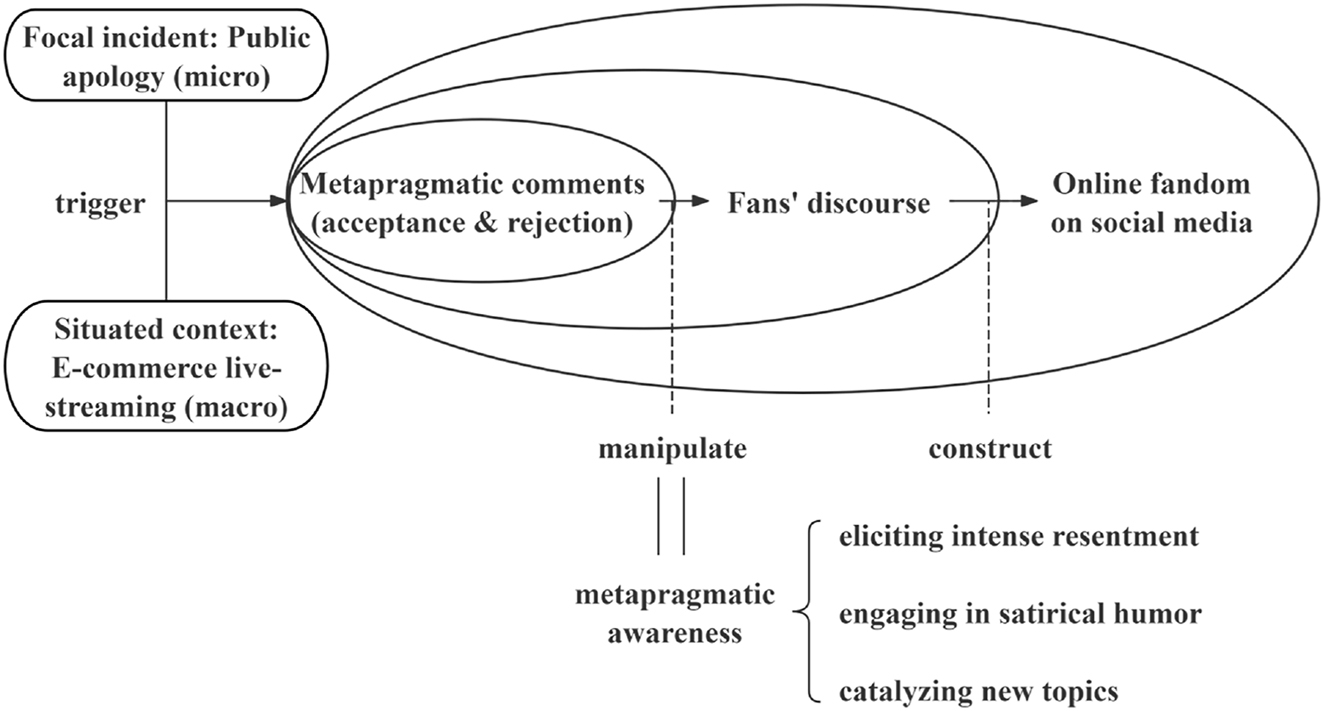
Metapragmatic mechanism of online fandom construction on Weibo.
Metapragmatic awareness has a crucial impact on online fandom construction, largely through the manipulative function of MPCs on social media (cf. Liu and Liu 2022). As demonstrated in Section 4.2.1, MPCs spark conflict within the fan communities, where efforts to support or defend inadvertently provoke resentment. Section 4.2.2 has further considered manipulation as satirical humor that drives more critical discussions, while more differently, Section 4.2.3 has delved into how MPCs act as catalysts for new topics, fostering collective self-validation in online fandom. These three interactive patterns point to how MPCs manipulate public opinion on social media (Bi and Ren 2023), influencing both micro-level issues, such as the sincerity of the apology, and macro-level ones, including shifts in consumer behavior and societal standards driven by fandom dynamics within the e-commerce live-streaming industry. In this context, MPCs regulate interactions, steering public opinion, and ultimately influencing both personal and collective fandom experiences.
Finally, our discussion extends to the affordances on Weibo that enhance shared e-commerce experiences and help shape fandom culture. The platform’s expansive audience reach and interest-based communities offer an ideal environment for MPCs to be widely disseminated. These affordances reinforce interactions between fans and e-commerce, directly affecting public opinion and transforming consumer behavior. Functioning as salient indicators (Liu and Liu 2021), MPCs play a role in constructing online fandom, encapsulating the intersection of shared consumer interests, participatory e-commerce engagement, and fan-driven content (cf. Graham 2019). These interactions on Weibo simultaneously strengthen community cohesion, foster consumer values, and cultivate a collective online identity (Reyes 2019; Tanskanen et al. 2024; Ran and Hu 2025), all of which center around e-commerce and modern forms of fandom on social media.
6 Conclusions
The present study sheds light on the dynamic construction of online fandom via MPCs in response to a public apology contextualized in an e-commerce incident. It observes various kinds of MPCs employed by the Weibo fans, ranging from expressions of acceptance to manifestations of rejection based on their engagement within online communities. Through a qualitative analysis of three interactive patterns, the study accentuates the role of MPCs in manipulating dynamic interactions and constructing online fandom. Based on our empirical findings, we discuss the notion of metapragmatic awareness behind the use of MPCs, further unraveling the interplay between MPCs and online fandom construction, which is influenced by social media affordances.
The study has certain limitations, as it primarily focuses on a typical but single case, which may constrain the generalizability of its findings. Future research can explore relevant emotional responses and collective identity evolution within fan communities and assess the impact of digital transformation on fan interactions. While MPCs have been demonstrated in our study as salient devices in online fandom construction, there is still room for further investigation into how specific cultural factors may influence these dynamics in one way or another. Such possibilities would deepen our understanding of digital fan culture and its intersection with e-commerce practices.
Funding source: Guangdong Planning Office of Philosophy and Social Science
Award Identifier / Grant number: GD25YWY04
About the authors
Jialiang Chen is a PhD candidate in the School of English for International Business, Guangdong University of Foreign Studies, Guangzhou, China. His research interests include pragmatics and business discourse. He has publications in Journal of Pragmatics, Journal of Historical Pragmatics, Iberica, Corpus Pragmatics, and in some prominent journals of linguistics in Chinese.
Ping Liu is a professor at the Center for Linguistics and Applied Linguistics and School of English for International Business at Guangdong University of Foreign Studies, P. R. China. Her research interests include intercultural pragmatics, metapragmatics, and business discourse. She has publications in Journal of Pragmatics, Intercultural Pragmatics, Pragmatics and Society, Pragmatics & Cognition, Lingua, East Asian Pragmatics, Internet Pragmatics, and in some prominent journals of linguistics in Chinese.
Acknowledgements
We wish to express our sincere gratitude to Professor Miriam Locher for her insightful feedback during the panel she organized at the 18th International Pragmatics Conference in Brussels, and for her continued guidance in preparing this manuscript following the conference. We are also deeply grateful to the Editor-in-Chief, Professor Srikant Sarangi, and the four anonymous reviewers for their valuable comments and suggestions.
-
Research funding: This work was supported by Guangdong Planning Office of Philosophy and Social Science under grant GD25YWY04.
References
Adrefiza & Jeremy F. Jones. 2013. Investigating apology response strategies in Australian English and Bahasa Indonesia: Gender and cultural perspectives. Australian Review of Applied Linguistics 36(1). 71–101. https://doi.org/10.1075/aral.36.1.04jon.Search in Google Scholar
An, Yi, Hang Su & Mingyou Xiang. 2022. Apology responses and gender differences in spoken British English: A corpus study. Pragmatics 32(1). 28–53. https://doi.org/10.1075/prag.19029.an.Search in Google Scholar
Ancarno, Clyde. 2015. When are public apologies “successful”? Focus on British and French apology press uptakes. Journal of Pragmatics 84. 139–153. https://doi.org/10.1016/j.pragma.2015.04.015.Search in Google Scholar
Bi, Xiaoyi & Wei Ren. 2023. Metapragmatic comments deconstructing the concept of self-mockery in Chinese on social media. Language & Communication 92. 91–104. https://doi.org/10.1016/j.langcom.2023.07.002.Search in Google Scholar
Biri, Ylva. 2023. Affective stance as positioning in an English-speaking online fan community. Journal of Pragmatics 215. 70–83. https://doi.org/10.1016/j.pragma.2023.07.004.Search in Google Scholar
Chang, Wei-Lin Melody & Michael Haugh. 2011. Evaluations of im/politeness of an intercultural apology. Intercultural Pragmatics 8(3). 411–442. https://doi.org/10.1515/iprg.2011.019.Search in Google Scholar
Ciliberti, Anna & Laurie Anderson. 2007. Metapragmatic comments in institutional talk: A comparative analysis across settings. In Büblitz Wolfram & Axel Hübler (eds.), Metapragmatics in use, 143–166. Philadelphia: John Benjamins.10.1075/pbns.165.11cilSearch in Google Scholar
Culpeper, Jonathan & Michael Haugh. 2014. Pragmatics and the English language. Basingstoke: Palgrave Macmillan.10.1007/978-1-137-39391-3Search in Google Scholar
Culpeper, Jonathan & Kevin Pat. 2021. Compliment responses in Hong Kong: An application of Leech’s pragmatics of politeness. Text & Talk 41(5–6). 667–690. https://doi.org/10.1515/text-2020-0047.Search in Google Scholar
Graham, Sage L. 2019. A wink and a nod: The role of emojis in forming digital communities. Multilingua 38(4). 377–400. https://doi.org/10.1515/multi-2018-0037.Search in Google Scholar
Hauser, Stefan & Simon Meier-Vieracker (eds.), 2022. Fankulturen und Fankommunikation. Berlin: Peter Lang.10.3726/b19029Search in Google Scholar
Hsu, Chan Chia, Yu Yun Chang & Yun Biao. 2024. Evaluative language in Chinese online food discourse: Overall distribution, local patterning, and readers’ involvement. Text & Talk 45(4). 485–508. https://doi.org/10.1515/text-2023-0165.Search in Google Scholar
Huang, Xu & Xuekun Liu. 2025. Understanding complaints: The role of moral transgressions in e-commerce interactions. Humanities and Social Sciences Communications 12(5). https://doi.org/10.1057/s41599-024-04316-3.Search in Google Scholar
Huang, Xu & Yongping Ran. 2024. “Ni kanzhe ban ba”: Negotiating complaint solutions in e-shopping service encounters. Text & Talk 44(5). 597–622. https://doi.org/10.1515/text-2021-0188.Search in Google Scholar
Hübler, Axel & Wolfram Bublitz. 2007. Introducing metapragmatics in use. In Büblitz Wolfram & Axel Hübler (eds.), Metapragmatics in use, 1–26. Philadelphia: John Benjamins.10.1075/pbns.165.02hubSearch in Google Scholar
Jacobs, Marie. 2022. The metapragmatics of legal advice communication in the field of immigration law. Pragmatics 32(4). 537–561. https://doi.org/10.1075/prag.21047.jac.Search in Google Scholar
Kim, Kyung Hye & Helen Spencer-Oatey. 2021. Metapragmatic comments on relating across cultures Korean students’ uncertainties over relating to UK academics. Pragmatics 31(2). 198–224. https://doi.org/10.1075/prag.20004.kim.Search in Google Scholar
Kleinke, Sonja & Birte Bös. 2015. Intergroup rudeness and the metapragmatics of its negotiation in online discussion fora. Pragmatics 25(1). 47–71.10.1075/prag.25.1.03kleSearch in Google Scholar
Lee, So Young & Lucy Atkinson. 2019. Never easy to say “sorry”: Exploring the interplay of crisis involvement, brand image, and message appeal in developing effective corporate apologies. Public Relations Review 45(1). 178–188. https://doi.org/10.1016/j.pubrev.2018.12.007.Search in Google Scholar
Li, Hongzhen, Ruojin Wang & Can Shi. 2023. “Oh my god! Buy it!” analysis on the characteristics of anchor’s speech in live broadcast e-commerce and purchase intention: A linguistic perspective. SAGE Open 13(3). 1–12. https://doi.org/10.1177/21582440231202126.Search in Google Scholar
Liu, Shengnan. 2023. You’re so mean but I like it – Metapragmatic evaluation of mock impoliteness in Danmaku comments. Discourse, Context & Media 53. 100700. https://doi.org/10.1016/j.dcm.2023.100700.Search in Google Scholar
Liu, Qian & Wei Cheng. 2025. ‘I’m telling you’: The use of interactional metadiscourse in Chinese live streaming commerce. Journal of Pragmatics 237. 14–29. https://doi.org/10.1016/j.pragma.2025.01.001.Search in Google Scholar
Liu, Ping & Huiying Liu. 2017. Creating common ground: The role of metapragmatic expressions in BELF meeting interactions. Journal of Pragmatics 107. 1–15. https://doi.org/10.1016/j.pragma.2016.10.006.Search in Google Scholar
Liu, Ping & Huiying Liu. 2021. Salience adjusting: Metapragmatic expressions in complaint responses. Journal of Pragmatics 176. 150–163. https://doi.org/10.1016/j.pragma.2021.01.003.Search in Google Scholar
Liu, Ping & Huiying Liu. 2022. Pragmatic manipulation of metapragmatic expressions in BELF meetings. Applied Pragmatics 4(1). 92–118. https://doi.org/10.1075/ap.19014.liu.Search in Google Scholar
Liu, Ping & Xiaoye Yao. 2019. Metapragmatic comments in web-based intercultural peer evaluation. Intercultural Pragmatics 16(1). 57–83. https://doi.org/10.1515/ip-2019-0003.Search in Google Scholar
Locher, Miriam A., Bolander Brook & Nicole Höhn. 2015. Introducing relational work in Facebook and discussion boards. Pragmatics 25(1). 1–21.10.1075/prag.25.1Search in Google Scholar
Locher, Miriam A. & Sage L. Graham (eds.). 2010. Interpersonal pragmatics. Berlin & New York: Mouton de Gruyter.10.1515/9783110214338Search in Google Scholar
Locher, Miriam A. & Thomas C. Messerli. 2023. “This is not the place to bother people about BTS”: Pseudo-synchronicity and interaction in timed comments by Hallyu fans on the video streaming platform Viki. Discourse, Context and Media 52. 100686. https://doi.org/10.1016/j.dcm.2023.100686.Search in Google Scholar
Lutzky, Ursula. 2021. “You keep saying you are sorry”. Exploring the use of sorry in customer communication on Twitter. Discourse, Context & Media 39. 100463. https://doi.org/10.1016/j.dcm.2020.100463.Search in Google Scholar
Lutzky, Ursula. 2024. “Doesn’t really answer my question.”: Exploring customer service interactions on Twitter. International Journal of Business Communication 61(1). 92–114. https://doi.org/10.1177/23294884231200247.Search in Google Scholar
Matley, David.. 2020. “I can’t believe #Ziggy #Stardust died” Stance, fan identities and multimodality in reactions to the death of David Bowie on Instagram. Pragmatics 30(2). 247–276. https://doi.org/10.1075/prag.18061.mat.Search in Google Scholar
Messerli, Thomas C. & Miriam A. Locher. 2021. Humour support and emotive stance in comments on Korean TV drama. Journal of Pragmatics 178. 408–425. https://doi.org/10.1016/j.pragma.2021.03.001.Search in Google Scholar
Pizziconi, Barbara. 2007. Facework and multiple selves in apologetic metapragmatic comments in Japanese. In Büblitz Wolfram & Axel Hübler (eds.), Metapragmatics in use, 49–72. Philadelphia: John Benjamins.10.1075/pbns.165.05pizSearch in Google Scholar
Porto López, Pablo. 2023. The dynamic configuration of non-linear texts in live blogs: A discursive approach. Text & Talk 43(3). 313–332. https://doi.org/10.1515/text-2020-0207.Search in Google Scholar
Ran, Yongping & Jiabei Hu. 2025. How public discourse functions to restore moral orders: Online impolite comments on corporate apologies. Pragmatics. https://doi.org/10.1075/prag.24035.ran.Search in Google Scholar
Ren, Wei & Yaping Guo. 2020. Self-praise on Chinese social networking sites. Journal of Pragmatics 169. 179–189. https://doi.org/10.1016/j.pragma.2020.09.009.Search in Google Scholar
Ren, Wei & Yaping Guo. 2022. Translanguaging in self-praise on Chinese social media. Applied Linguistics Review 15(1). 355–376. https://doi.org/10.1515/applirev-2021-0169.Search in Google Scholar
Reyes, Antonio. 2019. Virtual communities: Interaction, identity and authority in digital communication. Text & Talk 39(1). 99–120. https://doi.org/10.1515/text-2018-2020.Search in Google Scholar
Rieger, Caroline L. 2017. “I want a real apology” a discursive pragmatics perspective on apologies. Pragmatics 27(4). 553–590. https://doi.org/10.1075/prag.27.4.04rie.Search in Google Scholar
Shi, Xingsong & Huanqin Dou. 2023. How broadcasters enhance rapport with viewers in live streaming commerce. Pragmatics 33(4). 592–617. https://doi.org/10.1075/prag.22009.shi.Search in Google Scholar
Shrikant, Natasha. 2020. Metadiscourse and the management of relationships during online conflict among academics. Text & Talk 40(4). 513–535. https://doi.org/10.1515/text-2020-2069.Search in Google Scholar
Sillence, Elizabeth. 2017. Having faith in the online voice. Exploring contemporary issues of trust, language and advice in the context of e-health. Linguistik Online 87(8). 107–125. https://doi.org/10.13092/lo.87.4175.Search in Google Scholar
Sun, Ya, Hu Yang, Dicong Gou & Qiong Wang. 2022. To orient and to engage: Metaphorical hashtags in Weibo posts of Chinese banks. Journal of Pragmatics 194. 87–100. https://doi.org/10.1016/j.pragma.2022.04.011.Search in Google Scholar
Tanskanen, Sanna-Kaisa. 2007. Metapragmatic utterances in computer-mediated interaction. In Büblitz Wolfram & Axel Hübler (eds.), Metapragmatics in use, 87–116. Philadelphia: John Benjamins.10.1075/pbns.165.07tanSearch in Google Scholar
Tanskanen, S. K. 2021. “Stop arguing”: Interventions as metapragmatic acts in discussion forum interaction. In Johansson Marjut, Tanskanen Sanna-Kaisa & Jan Chovanec (eds.), Analyzing digital discourses: Between convergence and controversy, 219–244. Cham: Palgrave Macmillan.10.1007/978-3-030-84602-2_9Search in Google Scholar
Tanskanen, Sanna-Kaisa, Lehti Lotta, Kristin V. Lexander, Mikko T. Virtanen & Chaoqun Xie (eds.). 2024. Explorations in internet pragmatics: Intentionality, identity, and interpersonal interaction (studies in Pragmatics; Vol. 23). Leiden: Brill.10.1163/9789004694453Search in Google Scholar
Thorne, Steven L., Sauro Shannon & Smith. Bryan. 2015. Technologies, identities, and expressive activity. Annual Review of Applied Linguistics 35. 215–233. https://doi.org/10.1017/s0267190514000257.Search in Google Scholar
Trnavac, Radoslava & Maite Taboada. 2023. Engagement and constructiveness in online news comments in English and Russian. Text & Talk 43(2). 235–262. https://doi.org/10.1515/text-2020-0171.Search in Google Scholar
Unuabonah, Foluke Olayinka. 2017. “Are you saying?” Metapragmatic comments in Nigerian quasi-judicial public hearings. Pragmatics 27(1). 115–143. https://doi.org/10.1075/prag.27.1.05unu.Search in Google Scholar
Verschueren, Jef. 2000. Notes on the role of metapragmatic awareness in language use. Pragmatics 10(4). 439–456. https://doi.org/10.1075/prag.10.4.02ver.Search in Google Scholar
Wikström, Peter. 2019. Acting out on Twitter: Affordances for animating reported speech in written computer-mediated communication. Text & Talk 39(1). 121–145.10.1515/text-2018-2021Search in Google Scholar
Wu, Xiaoping & Richard Fitzgerald. 2021. “Hidden in plain sight”: Expressing political criticism on Chinese social media. Discourse Studies 23(3). 365–385. https://doi.org/10.1177/1461445620916365.Search in Google Scholar
Yang, Jia. 2025. Saying “sorry” in online language: A pragmatic analysis of apologies posted on a Chinese online shopping website. Pragmatics and Society online first 16(3). 333–356. https://doi.org/10.1075/ps.22041.yan.Search in Google Scholar
Yang, Kun. 2024. How to rebuild trust through apology: Evidence from public apology letters. Journal of Pragmatics 224. 36–45. https://doi.org/10.1016/j.pragma.2024.03.001.Search in Google Scholar
Yang, Na & Jiabei Hu. 2023. Getting involved or acting in defence: How a corporation uses the ritual act of apology in response to public criticism. Pragmatics and Society 14(3). 410–433. https://doi.org/10.1075/ps.20014.yan.Search in Google Scholar
Yang, Na & Zihe Wang. 2022. Addressing as a gender-preferential way for suggestive selling in Chinese e-commerce live streaming discourse: A corpus-based approach. Journal of Pragmatics 197. 43–54. https://doi.org/10.1016/j.pragma.2022.05.014.Search in Google Scholar
Yin, Yiyi. 2020. An emergent algorithmic culture: The data-ization of online fandom in China. International Journal of Cultural Studies 23(4). 475–492. https://doi.org/10.1177/1367877920908269.Search in Google Scholar
Yin, Yiyi & Zhuoxiao Xie. 2021. Playing platformized language games: Social media logic and the mutation of participatory cultures in Chinese online fandom. New Media & Society 26(2). 1–23. https://doi.org/10.1177/14614448211059489.Search in Google Scholar
Zhang, Huiyu & Yining Hou. 2024. The construction of interpersonal meanings in Jiaqi Li’s e-commerce live streams: Integrating verbal and visual semiotics. Journal of Business and Technical Communication 38(4). 371–409. https://doi.org/10.1177/10506519241258445.Search in Google Scholar
© 2026 the author(s), published by De Gruyter, Berlin/Boston
This work is licensed under the Creative Commons Attribution 4.0 International License.
