Effect of a wearable-sensor-assisted multicomponent exercise program on physical fitness, cognition and quality of life in frail older adults
-


Abstract
Objectives
To assess the effects of a wearable-sensor-assisted multicomponent exercise program on physical fitness, cognition and quality of life in a practical setting involving frail older adults.
Methods
Frail older adults (n=130) were randomly divided into a control (CG, n=68) group and an exercise group (EG, n=62) in a 12-week intervention, which included stride gait training with wearable sensors; aerobic exercise; and resistance, flexibility, balance, and cognitive training. Primary outcomes (physical fitness) were evaluated via the SPPB and SFT. Secondary outcomes (cognitive ability, quality of life and frailty) were evaluated via the MoCA-BC, SF-36 and Fried frailty criteria, respectively.
Results
After the 12-week intervention, the EG demonstrated significant improvements (p<0.05) vs. the CG in gait speed (β3=0.424, coefficient of interaction effect between group and time from the generalized linear mixed model), chair stand (β3=0.501) and total score (β3=65.466) of SPPB and all SFT components including 6MWT (walked distance, β3=1.098; walking speed, β3=0.105; stride length, β3=0.041), back scratch (β3=4.926), chair sit and reach (β3=3.762), 30s arm curl (β3=6.124), 30s sit-to-stand (β3=3.04), and TUG (β3=−6.712). The MoCA-BC total, verbal fluency and delayed recall scores; the physical function, general health, vitality, and mental health scores of the SF-36; and the frailty phenotype in the EG were significantly improved compared with those of the CG.
Conclusions
The progressive wearable-sensor-assisted multicomponent exercise program designed in this study enhanced physical fitness, cognitive ability and quality of life and slowed down the progression of frailty in frail older adults, supporting its potential as a feasible community-based health intervention.
Introduction
Frailty, a multifaceted geriatric syndrome, is characterized by diminished physiological reserves and compromised intrinsic capacity that progressively erodes an individual’s adaptive resilience. This degenerative process heightens vulnerability to external stressors while reducing functional autonomy, thereby increasing the risk of destabilizing events that include accidental falls, acute health deterioration requiring medical intervention, long-term care dependency, and stressor-induced complications that may culminate in premature mortality [1], [2], [3]. The accelerating demographic transition marked by an unprecedented increase in life expectancy juxtaposed with a reduction in global fertility rates has led to accelerated population aging trajectories throughout developed countries and even developing countries, accompanied by an increasing prevalence and incidence of frailty, which poses a severe challenge for health management in older adults [2], [3], [4]. Depending on the frailty assessment tool used and the population included, the global prevalence of frailty ranges from 12 to 24 % [3]. The pooled prevalence rate of frailty was 20.5 % among older adults in Asian communities [5], and the aggregate prevalence rates of frailty and prefrailty were 10.1 and 43.9 %, respectively, in older dwellers in Chinese communities [6]. Given the high susceptibility to frailty among community-residing older adults, preventing frailty and minimizing its adverse consequences in this population subgroup are vital [7].
Progressive declines in physiological function often lead to gait velocity attenuation, impaired chair-rise capacity, and postural instability [8]. Gait plasticity impairment is closely associated with fall risk and is suggested to be an early biomarker of frailty [9]. The phenotypes of frailty include nonvolitional body mass loss, self-reported exhaustion, diminished grip strength, gait velocity reduction, and low physical activity [10]. These close links between frailty risk and the components of physical fitness highlight the possibility of prevention. In addition, the physical decline of frail older adults is frequently linked to cognitive impairments, which can also be alleviated by improving physical function [11], [12]. It has been reported that integrated pharmacological management and nonpharmacological interventions, such as physical activity, nutritional interventions and multicomponent exercise interventions, have protective effects against the development of frailty [13]. Notably, physical activity is currently considered the most effective regimen for the prevention and treatment of frailty, and even the frailest older adults can benefit from any tolerable physical activity [1].
Regular physical activity can act on multiple critical physiological systems to prevent muscle atrophy and weakness, maintain cardiorespiratory fitness and cognitive function, and promote metabolic health and functional independence [14]. According to the recommendations of multiple sets of guidelines, the first-line therapy for the improvement of frailty should include multicomponent physical activities such as aerobic, resistance and balance training [15], [16], [17]. Multicomponent exercise intervention programs such as the OTAGO exercise program (OEP) and Vivifrail, which are stratified according to fall risk and physical function, can improve physical fitness, cognitive performance and fall risk, thereby improving quality of life in frail older adults [18], [19]. In addition, multidisciplinary team cooperation in physical medicine can dynamically adjust exercise programs according to the feedback and physical condition of frail older adults during the implementation of exercise interventions, possibly resulting in improved rehabilitation effects [20]. However, how to design and implement a multicomponent exercise intervention program suitable for local frail residents has been a key issue in health management for older people.
Both the short physical performance battery (SPPB) and the senior fitness test (SFT) serve as validated quantitative metrics for evaluating the physical function of older community-residing individuals [21], [22]. The SPPB reflects fall risk as a quick assessment of participants’ lower-limb function, including balance, movement, and strength [21], whereas the SFT is more complex and time-consuming and is composed of several tests aimed at assessing cardiorespiratory endurance, musculoskeletal integrity, and neuromotor coordination and ultimately assessing body fitness and intrinsic capacity [22]. Fortunately, technological innovations in wearable sensors have made these detection methods easier to implement and more precise [23], [24]. The wearable sensor system Ambulosono provides standardized and automated detection modules such as the six-minute walking test (6MWT) and timed up-and-go (TUG) test to obtain precise data on walking speed, stride length, distance walked and balance [23]. In addition, Ambulosono’s stride gait training may be useful for interventions in frail older adults since gait plasticity impairment is a biomarker of frailty [9], [25].
In this study, we designed a progressive multicomponent exercise intervention program assisted by the Ambulosono wearable sensor system, which was modified on the basis of the Vivifrail and OEP and followed the specific, progressive overload and reversibility training principles of sports [26]. Through the systematic assessment of the SPPB/SFT, Chinese version of the Montreal Cognitive Assessment–Basic (MoCA-BC), and 36-Item Short Form Health Survey (SF-36) scores before and after the intervention, we hypothesize that this multicomponent exercise intervention program could more effectively improve the physical fitness, cognition and quality of life of frail older adults than a control population that received regular health education and care only. The summary of this article is presented in Figure 1.
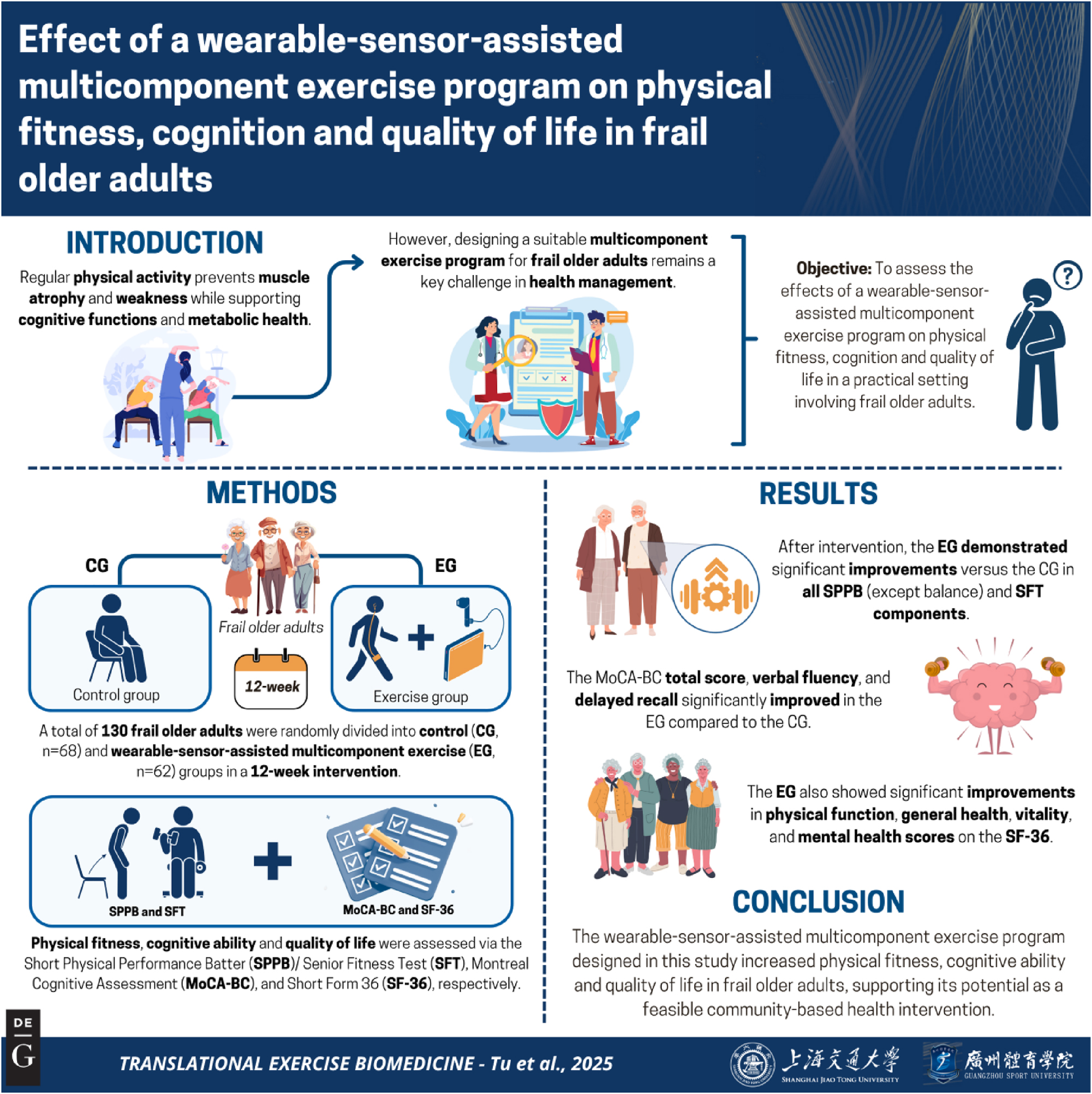
Graphical representation of this study. Key points: (1) to assess the effects of a wearable-sensor-assisted multicomponent exercise program on physical fitness, cognition and quality of life in a practical setting involving frail older adults. (2) a total of 130 frail older adults were randomly divided into control and exercise groups in a 12-week intervention. Physical fitness, cognitive ability and quality of life were assessed via the SPPB/SFT, MoCA-BC, and SF-36, respectively. (3) the wearable-sensor-assisted multicomponent exercise program increased physical fitness, cognitive ability and quality of life in frail older adults, supporting its potential as a feasible community-based health intervention. Figure created with BioRender.
Materials and methods
Study design and setting
This study was conducted from May 2023 to August 2024 in five communities in Guangzhou, China. Based on the differences pre and post intervention in physical fitness (12 outcomes of SPPB and SFT analyzed using repeated-measures ANOVA) in our pilot study (n=16 per group), the minimum Cohen’s d of 0.383 for the four significantly different indicators was selected as the value of the effect size. Using G*Power 3.1.9.7 with α=0.0167 (adjusted for 12 outcomes), power=0.80, two groups, and two measurements, 48 participants per group were required. Accounting for 20 % anticipated dropout, the final sample size was set to be no less than 60 per group (total n=120). The research was conducted in full compliance with the World Medical Association’s Declaration of Helsinki ethical principles and followed good clinical practice guidelines. This study was approved by the Chinese Registered Clinical Trial Ethics Committee (No. ChiCTR2000035138) and the Ethics Committee of Guangzhou Sport University (No. 2020CLLL-003). All the participants provided voluntary written informed consent after the study procedures were explained.
Participants
A total of 217 participants were initially recruited for this study. Data on age, sex, income, education, marital status, number of chronic diseases, type of medication, smoking and drinking status and sports self-efficacy (SSE) were collected via questionnaires. The study cohort was selectively enrolled through a stratified screening protocol requiring (1) being aged≥60 years; (2) having a Fried frailty index≥1; (3) being able to communicate verbally; (4) being able to move independently or with assistance; and (5) signing informed consent to participate in the study voluntarily. Exclusionary parameters systematically excluded candidates who presented (1) acute-phase pathophysiological states such as injuries and infections; (2) psychiatric or psychological disorders compromising protocol adherence; (3) uncontrolled cardiometabolic decompensation such as diabetes, cardiac diseases and high blood pressure; and (4) other iatrogenic contraindications precluding safe research participation. One hundred 33 eligible participants fulfilling the criteria were randomly divided into a routine care control group (CG, n=68) and an exercise group (EG, n=65) on the basis of a matched group design according to sex, age, SSE and SPPB. Three participants were excluded for concealing their medical history. Finally, a total of 130 participants were included, comprising 44 men and 86 women aged 62–94 years. During the experiments, 29 participants dropped out due to illness, loss to follow-up or refusal to follow-up, with 101 participants (51 in the CG and 50 in the EG) completed the study (Figure 2). No adverse events were found to be directly attributable to the exercise intervention during the experiment. Owing to the behavioral nature of the intervention, a single-blind strategy was adopted in this study.

Flow diagram of the study.
Multicomponent exercise program
The multicomponent exercise program applied in this study was based on the Vivifrail and OEP with modifications, and followed the specific, progressive overload and reversibility training principles of exercise [18], [19], [26]. Based on routine care, participants in the EG were further subgrouped according to their baseline SPPB scores, using a score of 7 as the cut-off. Each subgroup consisted of 5–6 participants with similar SPPB levels. Participants with an SPPB score≥7 received the standard progressive multicomponent exercise intervention. Those with an SPPB score≤6 received a modified exercise protocol incorporating more seated chair-based exercises to meet their functional capacity and exercise demands [27]. The exercise interventions were divided into adaptation, improvement and maintenance/adjustment stages. Each stage lasted 4 weeks, for a total of 12 weeks. The weekly exercise program included a variety of alternative movements for selection, such as gait training, aerobic exercise, upper- and lower-limb resistance and flexibility training, balance, and cognitive training. Specifically, an Ambulosono wearable sensor (AT-GR-001, Buge Technology [Guangzhou] Co., Ltd., China), which can improve participants’ stride length and frequency through linking auditory musical reward stimulation to adjustable motor action, was used for stride gait training [23]. First, an account for each participant was registered in the Ambulosono backend management system. The sensor was attached to the participant’s leg approximately 5 cm above the knee, and a 6MWT was conducted before starting stride gait training. Based on the average stride length in the 6MWT, the target stride length was set at 110 % of the average. The participants subsequently engaged in 8∼15 min auditory cue-guided gait training sessions via real-time biofeedback. A closed-loop feedback mechanism modulated auditory stimulus delivery contingent upon stride length achievement: continuous musical reinforcement occurred when participants maintained the target stride length, whereas auditory feedback interruption served as a corrective signal for subthreshold performance. This paradigm created an operant conditioning framework to promote motor learning through immediate performance-contingent reinforcement. In addition, neuromuscular training and cognitive‒motor dual-task training were added during the improvement and maintenance stages. Moderate-intensity exercise training (Rating of Perceived Exertion, RPE 3–4) was conducted 50–70 min a day, 3 days a week [28]. The participants followed the instructions of a coach, assisted by an assistant coach, and two nurses provided medical supervision to monitor health and safety during training. The detailed exercise prescriptions and training movements are shown in Tables S1 and S2.
In contrast, the participants in the CG did not use Ambulosono wearable sensors or receive exercise interventions. Both groups received health education and the Vivifrail sports health manual for older adults; routine care, such as health testing and diet guidance; and physical therapy in community hospitals according to actual needs during the 12 weeks.
Measurements
Anthropometric measurements
Height and mass were measured, and body fat mass and skeletal muscle mass were measured via a body composition analyzer (Inbody 370, Korea), which is based on bioelectrical impedance analysis. Body mass index (BMI) was calculated via the formula BMI=mass/height2 (kg/m2). In addition, the exercise self-efficacy scale was used to evaluate participants’ subjective willingness to exercise [29].
Frailty criteria
Frailty phenotypes were classified using the Fried criteria as diagnostic thresholds, where syndromes with≥3/5 geriatric vulnerability markers – nonvolitional body mass loss, self-reported exhaustion, diminished grip strength, gait velocity reduction, and low physical activity – were defined as frail (robust: 0; prefrail: 1–2; frail: ≥3) [10].
SPPB
The SPPB consists of three subtests: balance, gait speed and repeated chair stand tests. The balance ability was timed by three progressive difficulty standing postures, including unaided feet-together stand, semi-tandem stand and full tandem stand, until participant moved or 10 s elapsed. Gait speed was measured by recording the shorter duration of the two 4-m walking tests. In the chair stand test, the participants were asked to perform five chair stands as quickly as possible with their arms folded across their chest. The total score of the SPPB (range: 0–12) is the sum of the three subtests, each scored from 0–4 [21].
SFT
The SFT consists of six subtests, including the 6MWT, TUG, back scratch, chair sit and reach, 30 s arm curl and 30 s sit-to-stand tests. The 6MWT is used for aerobic endurance and gait function; the TUG test is used for explosive speed, agility, and dynamic balance; the back scratch is used for upper-body flexibility; the chair sit and reach for lower-body flexibility; the 30 s arm curl for upper-body strength; and the 30 s sit to stand for lower-body strength. All tests were conducted by trained assessors in strict accordance with the guidelines provided in the second edition of the SFT Manual [30]. The 6MWT and TUG were conducted with the assistance of an Ambulosono wearable sensor to obtain accurate total walking distance, walking speed, average stride length and time. The specific operation details are as follows: the sensor is attached to the participant’s leg approximately 5 cm above the knee, log in to the Ambulosono app via mobile phone, and the 6MWT assessment item is selected to record the total walking distance, walking speed, and average stride length within 6 min. Alternatively, the TUG assessment item is selected to record the time spent completing the series of actions: standing up from a seated position, walking 5 m, turning around, returning to the original position, and sitting back down. After the 6MWT or TUG test is completed, the corresponding assessment report in the backend system is viewed.
MoCA-BC
The MoCA-BC was used to assess the participants’ cognitive ability, which included nine domains: executive function, verbal fluency, orientation, conceptual thinking, calculation, delayed recall, visuoperception, naming and attention. The maximum score of the MoCA-BC is 30 points, and a higher score indicates greater cognitive ability. To correct for the deviation caused by education level, the cutoff values for mild cognitive impairment were set as follows: 19 points for years≤6, 22 points for years 7–11, and 24 points for years≥12 [31]. The questionnaires were evaluated by professionally trained nurses following standardized protocols.
SF-36
The Chinese version of the SF-36 was used to evaluate the participants’ quality of life and included eight domains: physical function (PF), role physical (RP), bodily pain (BP), general health (GH), vitality (VT), social functioning (SF), role emotional (RE) and mental health (MH). The score for each area was calculated according to previous literature [32]. The questionnaires were evaluated by professionally trained nurses following standardized protocols.
Data processing and statistics
The chi-square test was used to compare categorical variables. Independent-sample t tests were used for between-group comparisons of continuous variables from the clinical and demographic characteristics of the participants. A generalized linear mixed model (with correction parameters such as age, number of chronic diseases, number of medicines, and SSE, etc.) was used to evaluate the significance of the differences between the EG group and the CG group pre and post intervention. The values of β1 and β2 respectively represent the coefficients of change within the CG and EG pre and post intervention, and the value of β3 represents the coefficient of the interaction effect between group and time from the generalized linear mixed model. The d value of the model (dm) represents the effect size which is calculated by dividing the adjusted group difference by the standard deviation (SD) of the model residuals. On the basis of principle of intention-to-treat analysis, for participants who dropped out during the intervention, the data from the preintervention were used as the postintervention results via the single-fill method. All analyses were performed via SPSS 26.0 software (IBM, USA). The continuous data are expressed as the means±SDs, and the categorical data are expressed as frequencies and percentages. p<0.05 was considered to indicate statistical significance.
Results
Characterization of the participants
One hundred 30 participants were included in the present study (mean age [SD]=76.83 ± 8.11; 66.86 % [n=86] women). The clinical and demographic characteristics of the participants in each group are displayed in Table 1. Sociodemographic variables included age, sex, education level, income and marriage status. The health and health behavior variables included height, mass, number of chronic diseases and medicines, frailty stage, and smoking and drinking status. Subjective exercise intention was evaluated by SSE, and fall risk was assessed by the SPPB. Except for a significant difference in frailty status (p<0.05), the conditions of the participants in the two groups were similar. None of the participants or their proxies reported adverse effects during the follow-up.
Clinical and demographic characteristics of the participants.
| Characteristic | Control group | Exercise group | X2\T | p-Value |
|---|---|---|---|---|
| (CG, n=68) | (EG, n=62) | |||
| Female, n (%) | 42/68 (61.76) | 44/62 (70.97) | 1.227 | 0.268 |
| Age, years | 76.72 ± 7.54 | 76.95 ± 8.75 | −0.161 | 0.873 |
| Height, cm | 155.80 ± 6.67 | 154.84 ± 7.68 | 0.765 | 0.446 |
| Mass, kg | 55.79 ± 9.50 | 55.61 ± 11.18 | 0.099 | 0.921 |
| Frailty stage, n (%) | ||||
| Pre-frailty | 49/68 (72.10) | 34/62 (54.80) | 4.166 | 0.041 |
| Frailty | 19/68 (27.9) | 28/62 (45.20) | ||
| Education, n (%) | ||||
| ≤ 6th grade | 20/68 (29.41) | 21/62 (33.87) | 4.11 | 0.25 |
| 7–9th grade | 18/68 (26.47) | 21/62 (33.87) | ||
| 10–12th grade | 25/68 (36.76) | 13/62 (20.97) | ||
| > 12th grade | 5/68 (7.35) | 7/62 (11.29) | ||
| Income, n (%) | ||||
| ≤ 3 K | 18/68 (26.47) | 13/62 (20.97) | 0.541 | 0.462 |
| > 3 K | 50/68 (73.53) | 49/62 (79.03) | ||
| Marital status, n (%) | ||||
| Married | 51/68 (75.00) | 41/62 (66.13) | 1.862 | 0.394 |
| Unmarried/divorced | 2/68 (2.94) | 1/62 (1.61) | ||
| Widowed | 15/68 (22.06) | 20/62 (32.26) | ||
| Number of chronic diseases | 2.93 ± 1.98 | 2.65 ± 1.93 | 0.818 | 0.415 |
| Number of medicines | 2.74 ± 2.18 | 2.40 ± 2.11 | 0.881 | 0.38 |
| Smoking status, n (%) | ||||
| Yes | 57 (83.82) | 56 (90.32) | 1.205 | 0.272 |
| No | 11 (16.18) | 6 (9.68) | ||
| Drinking status, n (%) | ||||
| Yes | 57 (83.82) | 58 (93.55) | 3.005 | 0.083 |
| No | 11 (16.18) | 4 (6.45) | ||
| SSE | 60.43 ± 16.23 | 60.50 ± 17.10 | −0.025 | 0.98 |
| SPPB | 8.54 ± 2.68 | 8.61 ± 2.96 | 0.465 | 0.497 |
Effect of exercise programs on physical fitness in frail older adults
At baseline, there was no difference in body composition between EG and CG participants. After the 12 weeks of progressive multicomponent exercise intervention, the EG presented a significant increase in skeletal muscle mass before and after the intervention, although we did not find significant differences in body composition (BMI, body fat mass, or skeletal muscle mass) between the CG and EG (Figure 3A–C and Table 2). Furthermore, we used both the SPPB and SFT to comprehensively evaluate the primary outcomes of participants’ physical function. At baseline, there was also no difference in SPPB or SFT scores between the EG and CG. After the intervention, the balance, gait speed, chair stand and total SPPB scores of the EG improved significantly compared with the baseline scores. Compared with those of the CG, the gait speed, chair stand test and total SPPB scores were significantly improved in the EG after the exercise intervention (Figure 3D–G and Table 2). Similarly, the distance walked, walking speed and stride length during the 6MWT, back scratch, chair sit and reach, 30 s arm curl, 30 s sit-to-stand and TUG test results in the EG were significantly better than those at baseline and those in the CG after the intervention, whereas only the 30 s sit to stand test results in the CG were significantly better than those at baseline (Figure 4 and Table 2).

The effects of the multicomponent exercise program on the body composition and the SPPB scores of the participants in each group. At baseline, there was no difference in the body composition (A–C) and the SPPB scores (D–G) between the EG and CG before and after intervention. After the intervention, multicomponent exercise significantly increased the skeletal muscle mass (C) of frail older adults in the EG compared with baseline. All subtests of the SPPB in the EG were significantly improved compared with those at baseline. Compared with those of the CG, the total scores of the SPPB (D) and the scores of gait speed (F) and the chair stand test (G) were significantly improved in the EG after the exercise intervention. Mean±SD, *p<0.05, **p<0.01, ***p<0.001.
Between-group effect sizes for outcome measures.
| CG | EG | Between-group | |||||||||
|---|---|---|---|---|---|---|---|---|---|---|---|
| β1 | n | SD | β2 | n | SD | β3 | n | SD | Significance | dm (95 % CI) | |
| Skeletal muscle mass, kg | 0.72 | 68 | 3.04 | 0.43 | 62 | 1.05 | −0.292 | 130 | 4.63 | 0.473 | −0.13 (−0.47, 0.22) |
| Body fat mass, kg | −0.50 | 68 | 3.00 | −0.36 | 62 | 1.85 | 0.135 | 130 | 5.04 | 0.761 | 0.05 (−0.29, 0.40) |
| BMI, kg/m2 | 0.01 | 68 | 2.44 | 0.56 | 62 | 4.56 | 0.552 | 130 | 7.23 | 0.385 | 0.15 (−0.19, 0.50) |
| SPPB balance test score | 0.10 | 68 | 0.55 | 0.29 | 62 | 0.82 | 0.187 | 130 | 1.38 | 0.124 | 0.27 (−0.08, 0.61) |
| SPPB gait speed test score | −0.12 | 68 | 1.09 | 0.31 | 62 | 0.76 | 0.424 | 130 | 1.89 | 0.011 | 0.45 (0.10, 0.79) |
| SPPB chair stand test score | 0.18 | 68 | 1.01 | 0.68 | 62 | 0.92 | 0.501 | 130 | 1.93 | 0.003 | 0.52 (0.17, 0.87) |
| SPPB total score | 0.18 | 68 | 1.81 | 1.27 | 62 | 1.53 | 1.098 | 130 | 3.37 | <0.001 | 0.65 (0.30, 1.00) |
| SFT chair sit and reach, cm | 1.71 | 68 | 8.99 | 5.47 | 62 | 8.93 | 3.762 | 130 | 17.94 | 0.018 | 0.42 (0.07, 0.77) |
| SFT back scratch, cm | −0.54 | 68 | 7.59 | 4.39 | 62 | 6.69 | 4.926 | 130 | 14.37 | <0.001 | 0.69 (0.33, 1.04) |
| SFT 30 s sit-to-stand, n | 1.41 | 68 | 3.96 | 4.45 | 62 | 5.89 | 3.04 | 130 | 9.96 | 0.001 | 0.61 (0.26, 0.96) |
| SFT 30 s arm curl, n | 0.12 | 68 | 6.44 | 6.24 | 62 | 6.69 | 6.124 | 130 | 13.14 | <0.001 | 0.93 (0.57, 1.29) |
| SFT TUG, s | 3.02 | 68 | 13.15 | −3.69 | 62 | 11.15 | −6.712 | 130 | 24.50 | 0.002 | −0.55 (−0.90, −0.19) |
| SFT 6MWT walked distance, m | −3.41 | 68 | 65.19 | 62.06 | 62 | 85.91 | 65.466 | 130 | 151.71 | <0.001 | 0.86 (0.50, 1.22) |
| SFT 6MWT walking speed, m/s | 0.04 | 68 | 0.22 | 0.14 | 62 | 0.23 | 0.105 | 130 | 0.45 | 0.008 | 0.47 (0.12, 0.82) |
| SFT 6MWT stride length, m | 0.01 | 68 | 0.08 | 0.05 | 62 | 0.11 | 0.041 | 130 | 0.19 | 0.015 | 0.43 (0.08, 0.77) |
| MoCA total score | −0.24 | 68 | 3.09 | 1.74 | 62 | 3.20 | 1.977 | 130 | 6.29 | <0.001 | 0.63 (0.27, 0.98) |
| MoCA executive function score | 0.02 | 68 | 0.44 | 0.15 | 62 | 0.54 | 0.13 | 130 | 0.98 | 0.13 | 0.27 (−0.08, 0.61) |
| MoCA verbal fluency score | −0.29 | 68 | 0.67 | 0.02 | 62 | 0.78 | 0.31 | 130 | 1.45 | 0.015 | 0.43 (0.08, 0.77) |
| MoCA orientation score | 0.10 | 68 | 1.22 | 0.13 | 62 | 0.90 | 0.026 | 130 | 2.16 | 0.891 | 0.02 (−0.32, 0.37) |
| MoCA calculation score | −0.07 | 68 | 0.63 | 0.13 | 62 | 0.84 | 0.203 | 130 | 1.48 | 0.119 | 0.28 (−0.07, 0.62) |
| MoCA conceptual thinking score | 0.15 | 68 | 0.50 | 0.32 | 62 | 0.84 | 0.176 | 130 | 1.37 | 0.146 | 0.26 (−0.09, 0.60) |
| MoCA delayed recall score | −0.07 | 68 | 1.00 | 0.61 | 62 | 1.14 | 0.686 | 130 | 2.13 | <0.001 | 0.64 (0.29, 0.99) |
| MoCA visuoperception score | 0.00 | 68 | 0.83 | 0.24 | 62 | 0.84 | 0.242 | 130 | 1.67 | 0.1 | 0.29 (−0.06, 0.63) |
| MoCA naming score | −0.07 | 68 | 0.63 | 0.15 | 62 | 0.72 | 0.219 | 130 | 1.35 | 0.066 | 0.32 (−0.02, 0.67) |
| MoCA attention score | 0.02 | 68 | 0.61 | 0.03 | 62 | 0.57 | 0.018 | 130 | 1.19 | 0.866 | 0.03 (−0.32, 0.37) |
| SF-36 PF score | −5.44 | 68 | 17.51 | 7.26 | 62 | 17.27 | 12.699 | 130 | 34.82 | <0.001 | 0.73 (0.37, 1.08) |
| SF-36 RP score | −2.21 | 68 | 42.92 | 8.87 | 62 | 32.67 | 11.077 | 130 | 76.84 | 0.102 | 0.29 (−0.06, 0.63) |
| SF-36 BP score | 0.62 | 68 | 26.00 | 3.69 | 62 | 14.59 | 3.076 | 130 | 42.72 | 0.413 | 0.14 (−0.20, 0.49) |
| SF-36 GH score | 4.25 | 68 | 19.52 | 12.26 | 62 | 20.50 | 8.008 | 130 | 40.03 | 0.023 | 0.40 (0.05, 0.75) |
| SF-36 VT score | 1.99 | 68 | 12.37 | 12.25 | 62 | 14.63 | 10.265 | 130 | 27.02 | <0.001 | 0.76 (0.40, 1.11) |
| SF-36 SF score | −0.56 | 68 | 20.66 | 4.26 | 62 | 20.74 | 4.818 | 130 | 41.44 | 0.186 | 0.23 (−0.11, 0.58) |
| SF-36 RE score | 1.55 | 68 | 33.50 | 6.44 | 62 | 22.45 | 4.895 | 130 | 57.59 | 0.333 | 0.17 (−0.18, 0.51) |
| SF-36 MH score | −1.59 | 68 | 15.44 | 11.42 | 62 | 15.12 | 13.008 | 130 | 30.61 | <0.001 | 0.85 (0.49, 1.20) |
| Frailty score | 0.13 | 68 | 0.57 | −0.48 | 62 | 0.78 | −0.616 | 130 | 1.36 | <0.001 | −0.90 (−1.26, −0.54) |

The effects of the multicomponent exercise program on the SFT results of participants in each group. At baseline, there was no difference in the distance walked (A), walking speed (B), and stride length (C) of the 6MWT; back scratch (D); chair sit and reach (E); 30 s arm curl (F); 30 s sit-to-stand test (G); and TUG (H) between the EG and CG. After the intervention, all SFT subtests in the EG and only the 30 s sit-to-stand test (G) of the SFT in the CG were significantly improved compared with those at baseline. Compared with those in the CG, all SFT subtests were significantly improved in the EG after the exercise intervention. Mean±SD, *p<0.05, **p<0.01, ***p<0.001.
Effect of exercise programs on cognition in frail older adults
At baseline, there was no difference in any of the aspects of the MoCA-BC except verbal fluency between the EG and CG. After the 12 weeks of progressive multicomponent exercise intervention, the total score and the subdomain of executive function, conceptual thinking, delayed recall and visuoperception scores of the MoCA-BC in the EG were significantly improved compared with those at baseline. In the CG, only conceptual thinking was significantly improved, and verbal fluency was significantly weakened compared with that at baseline. In addition, compared with those of the CG, the total score and delayed recall score of the MoCA-BC were significantly improved, and the degradation of verbal fluency was delayed in the EG after the exercise intervention. However, after adjusting for the participants’ education level, there was no significant difference in the distribution of participants with normal cognition and mild cognitive impairment in each group (Figure 5 and Table 2).

The effects of the multicomponent exercise program on the MoCA-BC scores of participants in each group (A) Radar map of the performance of frail older adults in each domain of the MoCA-BC before and after the intervention in each group (L) Distribution of participants with normal cognition and mild cognitive impairment in each group. At baseline, there was no difference in the total score (B), executive function (C), orientation (E), conceptual thinking (F), calculation (G), delayed recall (H), visuoperception (I), naming (J), and attention (K) scores of the MoCA-BC, except for verbal fluency (D), between the EG and CG. Compared with those at baseline, the total score (B) and executive function (C), conceptual thinking (F), delayed recall (H) and visuoperception (I) scores of the MoCA-BC in the EG significantly improved. Compared with those at baseline, only conceptual thinking (F) in the CG significantly improved, and verbal fluency (D) significantly weakened. Compared with those of the CG, the total score (B) and delayed recall (H) scores of the MoCA-BC were significantly improved, and the degradation of verbal fluency (D) was delayed in the EG after the exercise intervention. Mean±SD, *p<0.05, **p<0.01, ***p<0.001.
Effects of exercise programs on quality of life and frailty status in frail older adults
At baseline, there was no difference in the SF-36 score between the EG and CG. After the 12 weeks of progressive multicomponent exercise intervention, the PF, RP, BP, GH, VT, RE and MH domains of the SF-36 in the EG were significantly improved compared with those at baseline. However, none of the domains in the CG improved compared with those at baseline, and even the PF domain significantly deteriorated. In addition, compared with those in the CG, the PF, GH, VT and MH scores of the SF-36 were significantly improved in the EG after the exercise intervention (Figure 6A–I and Table 2). The frailty status of the participants in the EG was worse than that in the CG before the intervention. After the intervention, there was a significant improvement in the Fried frailty index and phenotype of frailty in the EG, whereas there was no significant change in the CG compared with the baseline value. Compared with those in the CG, the Fried frailty index and phenotype of frailty in the EG were significantly alleviated after the intervention (Figure 6J and K and Table 2).

The effects of the multicomponent exercise program on the SF-36 scores and frailty of participants in each group (A) Radar map of the performance of frail older adults in each domain of the SF-36 before and after the intervention in each group. At baseline, there was no difference in the PF (B), RP (C), BP (D), GH (E), VT (F), SF (G), RE (H), and MH (I) domains of the SF-36; and the frailty index (J) between the EG and CG. Compared with those at baseline, the PF (B), RP (C), BP (D), GH (E), VT (F), RE (H) and MH (I) domains of the SF-36 and the frailty index (J) in the EG significantly improved, whereas the PF (B) domain in the CG significantly deteriorated. Compared with those of the CG, the PF (B), GH (E), VT (F), and MH (I) domains of the SF-36 and the frailty index (J) were significantly improved in the EG after the exercise intervention (K) The phenotype of frailty in each group before and after the intervention. Mean±SD, *p<0.05, **p<0.01, ***p<0.001.
Discussion
Frailty is a complex and age-related condition that leads to an increased risk of falls or other adverse events in older adults [2], [10]. Multicomponent exercise intervention is the first-line therapy for the management of frailty [15], [16]. However, the best exercise prescription that is specific and implementable for frail older adults is still unknown. In this study, we employed an intention-to-treat analysis to evaluate the overall effectiveness of the wearable-sensor-assisted multicomponent exercise program in a practical setting involving frail older adults. This analysis demonstrated benefits for physical fitness, cognition, quality of life and clinical symptoms of frailty among community-residing older adults with frailty. In addition, a per-protocol analysis, focusing exclusively on participants who fully adhered to the intervention, is crucial for understanding the program’s efficacy under optimal conditions and preventing potential dilution of the treatment effect due to noncompliance. Therefore, we also conducted a generalized mixed linear analysis on the data from 51 participants in the CG and 50 participants in the EG who completed the entire study protocol. The results (presented in Supplementary Table S3) consistently indicated that the wearable-sensor-assisted multicomponent exercise program designed in our study may offer a feasible strategy for the health management of aging individuals.
There are varying degrees of weakness in multiple physiological systems of frail older adults [2]. To maximize the benefits of multicomponent exercise interventions, it is necessary to stratify the participants on the basis of their physical function levels. Like the Vivifrail program, our intervention is stratified on the basis of the total SPPB score of 7 as the cut-off and follows the exercise training principles of differentiated cluster training [19], [33]. The adoption of seated chair-based exercises for participants with SPPB scores≤6 not only meets their exercise demands but also enhances initiative, safety and compliance [27]. In addition, what distinguishes this study from previous multicomponent exercise intervention programs is that it offers a variety of exercise movements for each component that can be flexibly selected according to the participants’ physical weaknesses and exercise preferences [18], [19], [20, 34]. OEP, a representative multicomponent exercise program that consists of several strength, endurance, flexibility and balance exercises supervised by a physiotherapist, has been shown to be effective in reducing falls among older community-residing individuals in both group and individual training [18]. Another well-known exercise intervention is the Vivifrail multicomponent intervention, which involves designing a tiered exercise training program on the basis of physical function level and fall risk (https://vivifrail.com). Multiple studies have shown that Vivifrail improves physical fitness, cognitive performance and fall risk, thereby improving quality of life in frail older adults [19], [34]. However, both programs adopt a single-track training approach, with only a few exercise movements repeated until the end of the intervention [18], [19], [34]. These single-track training programs are prone to causing the plateau phenomenon or even triggering sports injuries; therefore, they may not be the best training programs for long-term adoption by frail older adults [33]. Our exercise intervention plan is more in line with the principles of exercise training, which can elicit the optimal magnitude of exercise response, amplify adaptation, avoid local tissue fatigue caused by repetitive single movements and lead to improved exercise performance capabilities of the participants [26].
The phenotypes of frailty are closely associated with physical fitness, which can be improved through regular physical activity [10], [14]. Early intervention to alleviate the decline in functional fitness among frail older adults may counteract the reduction in physiological reserve capacity and increase their ability to cope with complex environmental stress [35]. In this study, we adopted both the SPPB and SFT to comprehensively evaluate changes in physical function in multiple dimensions, including gait, aerobic capacity, strength and flexibility of the upper and lower limbs, speed, agility, and balance [21], [22]. The significant improvement in all the SFT components suggests that our progressive multicomponent exercise intervention can be used to improve the physical fitness of frail older adults. In addition, gait plasticity impairment increases fall risk and is an early frailty biomarker, which highlights the necessity of gait training for frailty in older adults [9]. The consistently significant improvements in gait-related outcomes observed in both the SPPB and the SFT in our study may be attributable to the integration of Ambulosono wearable-sensor-assisted gait training with multicomponent exercise. The key characteristic of Ambulosono’s stride gait training is integrating musical rewards with walking movements, as music can be played only when the stride length reaches the prescribed threshold during the training process. This kind of music-rewarded stimulation was reported to cause neuroplasticity in the limbic corticostriatal system, thereby promoting the active adjustment of stride length and enhancing walking ability [36]. Ambulosono’s stride gait training also helps to maintain the target training intensity by specifying the stride length, which may be more suitable for multimedicated frail older individuals than monitoring heart rate during exercise, as many medicines may affect the heart rate and thus interfere with the judgment of exercise intensity. However, to clarify the key role of wearable sensors on the improvement of gait plasticity in frail older adults, it is necessary to further explore whether wearable-sensor-assisted multicomponent exercise is better than multicomponent exercise without wearable sensors. In addition, our results suggest that the TUG test might be more sensitive than the balance test of the SPPB in terms of evaluating balance ability, which may explain why an increasing number of studies regard the TUG test as an important indicator for evaluating the risk of falling [24], [37].
Frailty in older adults manifests not only as a decline in physical function but also as a decline in cognitive function. The concurrent presentation of physical frailty and neurocognitive decline may constitute a bidirectional risk nexus for accelerated neurodegeneration trajectories and geriatric functional decline syndromes in aging populations [11]. The overall health condition of older adults is frequently linked to cognitive impairments, as cognitive function always decreases with increasing frailty status [38]. Emerging physical decline and prefrail status may serve as clinically detectable prodromal markers of occult neurodegenerative cascades in aging populations [12]. Therefore, early identification of frailty and early intervention in frail older adults with cognitive decline are critical. In this study, cognitive‒motor dual-task training was added during the maintenance/adjustment stage of the multicomponent exercise intervention, and the MoCA-BC was used to evaluate the participants’ cognitive ability. Some studies have suggested that improving physical frailty may have an impact on cognitive outcomes and even potentially delay or reverse cognitive decline [11]. Indeed, a 12-week Vivifrail exercise program has demonstrated efficacy in enhancing cognition in frail, cognitively impaired community-residing older adults [34]. Similarly, our research revealed that, along with multiple improvements in physical fitness, the cognitive ability of the participants in the EG significantly improved, mainly manifested as delayed degradation of verbal fluency and improved delayed recall ability. Although the pathophysiological interdependencies between frailty syndrome and cognitive degeneration remain complex, our findings suggest that they may share a common developmental trajectory and that early interventions, such as multicomponent exercise programs for frailty, may be effective strategies for preventing cognitive decline [38].
As frailty is a geriatric-related condition, progressive functional decline is associated with decreased physical activity and increased occurrence of adverse events such as falls, hospitalization, and institutionalization, hindering the capacity of frail older adults to maintain independence and social engagement [2]. Maintaining and improving the quality of life of frail older adults can make their later life more dignified and meaningful and lighten the burden on families and societies, which is in line with the global healthy aging goals proposed by the WHO [3]. Therefore, quality of life is an important aspect for evaluating the effects of interventions for frail individuals. The results of the SF-36 in this study showed that this progressive multicomponent exercise program can improve the quality of life of frail older adults in terms of both physical and mental health. Our results are in line with those of previous studies, which suggested that multicomponent exercise contributes to physical and mental well-being and improves quality of life in frail individuals with different diseases [39], [40]. The effective improvement in quality of life provides favorable support for the promotion of this multicomponent exercise program in community-residing frail older adults. On the one hand, participants can realize the continuous improvement of their physical functions with the gradual increase in the intensity of exercise, resulting in increased exercise efficacy and positive exercise outcome expectations. On the other hand, the design of multiple movements for each component allows participants to choose suitable exercise movements individually and increases their enthusiasm to participate in sports, and group-based training during the intervention helps enhance participants’ social interaction and belonging.
Our study has several limitations that need to be considered. First, our study is not a multicenter, large-sample randomized controlled trial, and the placebo control group for exercise intervention without the use of a wearable device was missing, which may affect the scope of the conclusions. Secondly, the multiple movements for each exercise component also increase the difficulty of maintaining consistent exercise intensity among individuals, which requires particularly experienced coaches to conduct the intervention. Finally, only 12 weeks of exercise intervention were conducted in this study, which cannot provide information on the compliance and intervention effects of individuals with frailty after longer interventions.
Conclusions
The progressive wearable-sensor-assisted multicomponent exercise program designed in this study increases physical fitness, cognitive ability, the quality of life and relieves clinical symptoms of frailty in frail older adults, which may provide a feasible program for the health management of local frail communities.
-
Research ethics: The research was carried out in accordance with the Declaration of Helsinki and followed good clinical practice guidelines. This study was approved by the Chinese Registered Clinical Trial Ethics Committee (no ChiCTR2000035138) and the Ethics Committee of Guangzhou Sport University (no 2020CLLL-003).
-
Informed consent: All the participants provided written informed consent after the study procedures were explained.
-
Author contributions: LB and TG designed the study and revised the manuscript. TG wrote the manuscript. TG, LL, TH and CW performed the experiments and analyzed the data. All authors have accepted responsibility for the entire content of this manuscript and approved its submission.
-
Use of Large Language Models, AI and Machine Learning Tools: None declared.
-
Conflict of interest: The authors state no conflict of interest.
-
Research funding: This work was supported by the project of Guangzhou Sports Science and Technology Collaborative Innovation Center (No. SL2022B04J00034) and the National Key Research and Development Program of China (No. 2020YFC2002900).
-
Data availability: The data that support the findings of this study are available from the corresponding author, [LB], upon reasonable request.
References
1. Cadore, EL, Saez de Asteasu, ML, Izquierdo, M. Multicomponent exercise and the hallmarks of frailty: considerations on cognitive impairment and acute hospitalization. Exp Gerontol 2019;122:10–4. https://doi.org/10.1016/j.exger.2019.04.007.Suche in Google Scholar PubMed
2. Doody, P, Lord, JM, Greig, CA, Whittaker, AC. Frailty: pathophysiology, theoretical and operational definition(s), impact, prevalence, management and prevention, in an increasingly economically developed and ageing world. Gerontology 2023;69:927–45.10.1159/000528561Suche in Google Scholar PubMed PubMed Central
3. Dlima, SD, Hall, A, Aminu, AQ, Akpan, A, Todd, C, Vardy, E. Frailty: a global health challenge in need of local action. BMJ Glob Health 2024;9:e015173.10.1136/bmjgh-2024-015173Suche in Google Scholar PubMed PubMed Central
4. Dent, E, Martin, FC, Bergman, H, Woo, J, Romero-Ortuno, R, Walston, JD. Management of frailty: opportunities, challenges, and future directions. Lancet 2019;394:1376–86. https://doi.org/10.1016/S0140-6736-19-31785-4.Suche in Google Scholar
5. To, TL, Doan, TN, Ho, WC, Liao, WC. Prevalence of frailty among community-dwelling older adults in Asian countries: a systematic review and meta-analysis. Health Care 2022;10:895.10.3390/healthcare10050895Suche in Google Scholar PubMed PubMed Central
6. Zhou, Q, Li, Y, Gao, Q, Yuan, H, Sun, L, Xi, H, et al.. Prevalence of frailty among Chinese community-dwelling older adults: a systematic review and meta-analysis. Int J Publ Health 2023;68:1605964.10.3389/ijph.2023.1605964Suche in Google Scholar PubMed PubMed Central
7. Ofori-Asenso, R, Chin, KL, Mazidi, M, Zomer, E, Ilomaki, J, Zullo, AR, et al.. Global incidence of frailty and prefrailty among community-dwelling older adults: a systematic review and meta-analysis. JAMA Netw Open 2019;2:e198398. https://doi.org/10.1001/jamanetworkopen.2019.8398.Suche in Google Scholar PubMed PubMed Central
8. McPhee, JS, French, DP, Jackson, D, Nazroo, J, Pendleton, N, Degens, H. Physical activity in older age: perspectives for healthy ageing and frailty. Biogerontology 2016;17:567–80. https://doi.org/10.1007/s10522-016-9641-0.Suche in Google Scholar PubMed PubMed Central
9. Nogueron Garcia, A, Huedo Rodenas, I, Garcia Molina, R, Ruiz Grao, MC, Avendano Cespedes, A, Esbri, VM, et al.. Gait plasticity impairment as an early frailty biomarker. Exp Gerontol 2020;142:111137. https://doi.org/10.1016/j.exger.2020.111137.Suche in Google Scholar PubMed
10. Fried, LP, Cohen, AA, Xue, QL, Walston, J, Bandeen-Roche, K, Varadhan, R. The physical frailty syndrome as a transition from homeostatic symphony to cacophony. Nat Aging 2021;1:36–46.10.1038/s43587-020-00017-zSuche in Google Scholar PubMed PubMed Central
11. Nader, MM, Cosarderelioglu, C, Miao, E, Whitson, H, Xue, QL, Grodstein, F, et al.. Navigating and diagnosing cognitive frailty in research and clinical domains. Nat Aging 2023;3:1325–33.10.1038/s43587-023-00504-zSuche in Google Scholar PubMed PubMed Central
12. Wallace, LMK, Theou, O, Godin, J, Andrew, MK, Bennett, DA, Rockwood, K. Investigation of frailty as a moderator of the relationship between neuropathology and dementia in alzheimer’s disease: a cross-sectional analysis of data from the rush memory and aging project. Lancet Neurol 2019;18:177–84. https://doi.org/10.1016/S1474-4422-18-30371-5.Suche in Google Scholar
13. Sun, X, Liu, W, Gao, Y, Qin, L, Feng, H, Tan, H, et al.. Comparative effectiveness of non-pharmacological interventions for frailty: a systematic review and network meta-analysis. Age Ageing 2023;52:1–10.10.1093/ageing/afad004Suche in Google Scholar PubMed
14. Bull, FC, Al-Ansari, SS, Biddle, S, Borodulin, K, Buman, MP, Cardon, G, et al.. World health organization 2020 guidelines on physical activity and sedentary behaviour. Br J Sports Med 2020;54:1451–62. https://doi.org/10.1136/bjsports-2020-102955.Suche in Google Scholar PubMed PubMed Central
15. You, HS, Kwon, YJ, Kim, S, Kim, YH, Kim, YS, Kim, Y, et al.. Clinical practice guidelines for managing frailty in community-dwelling Korean elderly adults in primary care settings. Kor J Fam Med 2021;42:413–24.10.4082/kjfm.21.0162Suche in Google Scholar PubMed PubMed Central
16. Dent, E, Morley, JE, Cruz-Jentoft, AJ, Woodhouse, L, Rodriguez-Manas, L, Fried, LP, et al.. Physical frailty: ICFSR international clinical practice guidelines for identification and management. J Nutr Health Aging 2019;23:771–87. https://doi.org/10.1007/s12603-019-1273-z.Suche in Google Scholar PubMed PubMed Central
17. Izquierdo, M, de Souto Barreto, P, Arai, H, Bischoff-Ferrari, HA, Cadore, EL, Cesari, M, et al.. Global consensus on optimal exercise recommendations for enhancing healthy longevity in older adults (ICFSR). J Nutr Health Aging 2025;29:100401.10.1016/j.jnha.2024.100414Suche in Google Scholar PubMed PubMed Central
18. Albornos-Munoz, L, Blanco-Blanco, J, Cidoncha-Moreno, MA, Abad-Corpa, E, Rivera-Alvarez, A, Lopez-Pisa, RM, et al.. Efficacy of the otago-exercise-programme to reduce falls in community-dwelling adults aged 65-80 when delivered as group or individual training: non-Inferiority-clinical-trial. BMC Nurs 2024;23:705.10.1186/s12912-024-02310-3Suche in Google Scholar PubMed PubMed Central
19. Casas-Herrero, A, Saez de Asteasu, ML, Anton-Rodrigo, I, Sanchez-Sanchez, JL, Montero-Odasso, M, Marin-Epelde, I, et al.. Effects of vivifrail multicomponent intervention on functional capacity: a multicentre, randomized controlled trial. J Cachexia Sarcopenia Muscle 2022;13:884–93.10.1002/jcsm.12925Suche in Google Scholar PubMed PubMed Central
20. Li, X, Zhao, R, Zhang, H. Effects of an individualized multicomponent exercise program in older patients with frailty. Chin Nurs Manag 2022;22:1164–9.Suche in Google Scholar
21. Li, W, Rao, Z, Fu, Y, Schwebel, DC, Li, L, Ning, P, et al.. Value of the short physical performance battery (SPPB) in predicting fall and fall-induced injury among old Chinese adults. BMC Geriatr 2023;23:574.10.1186/s12877-023-04290-6Suche in Google Scholar PubMed PubMed Central
22. Lima, AB, Baptista, F, Henrinques-Neto, D, Pinto, AA, Gouveia, ER. Symptoms of sarcopenia and physical fitness through the senior fitness test. Int J Environ Res Publ Health 2023;20:2711.10.3390/ijerph20032711Suche in Google Scholar PubMed PubMed Central
23. Hu, B. Application of wearable technology in clinical walking and dual task testing. J Translat Int Med 2019;7:87–9. https://doi.org/10.2478/jtim-2019-0019.Suche in Google Scholar PubMed PubMed Central
24. Buisseret, F, Catinus, L, Grenard, R, Jojczyk, L, Fievez, D, Barvaux, V, et al.. Timed up and Go and six-minute walking tests with wearable inertial sensor: one step further for the prediction of the risk of fall in elderly nursing home people. Sensors 2020;20:3207. https://doi.org/10.3390/s20113207.Suche in Google Scholar PubMed PubMed Central
25. Chomiak, T, Watts, A, Meyer, N, Pereira, FV, Hu, B. A training approach to improve stepping automaticity while dual-tasking in parkinson’s disease: a prospective pilot study. Medicine (Baltim) 2017;96:e5934. https://doi.org/10.1097/MD.0000000000005934.Suche in Google Scholar PubMed PubMed Central
26. Furrer, R, Hawley, JA, Handschin, C. The molecular athlete: exercise physiology from mechanisms to medals. Physiol Rev 2023;103:1693–787.10.1152/physrev.00017.2022Suche in Google Scholar PubMed PubMed Central
27. Li, Q, Han, B, Chen, X. Best evidence summary for physical exercise in frail elderly. Chin Nurs Res 2020;34:1681–7.Suche in Google Scholar
28. Bray, NW, Smart, RR, Jakobi, JM, Jones, GR. Exercise prescription to reverse frailty. Appl Physiol Nutr Metabol 2016;41:1112–6. https://doi.org/10.1139/apnm-2016-0226.Suche in Google Scholar PubMed
29. Lee, LL, Perng, SJ, Ho, CC, Hsu, HM, Lau, SC, Arthur, A. A preliminary reliability and validity study of the Chinese version of the self-efficacy for exercise scale for older adults. Int J Nurs Stud 2009;46:230–8. https://doi.org/10.1016/j.ijnurstu.2008.09.003.Suche in Google Scholar PubMed
30. Rikli, RE, Jones, CJ. Senior fitness test manual, 2nd ed.. Champaign, IL: Human Kinetics; 2013.Suche in Google Scholar
31. Chen, KL, Xu, Y, Chu, AQ, Ding, D, Liang, XN, Nasreddine, ZS, et al.. Validation of the Chinese version of Montreal cognitive assessment basic for screening mild cognitive impairment. J Am Geriatr Soc 2016;64:e285–90. https://doi.org/10.1111/jgs.14530.Suche in Google Scholar PubMed
32. Li, L, Wang, H, Shen, Y. Development and psychometric tests of a Chinese version of the SF-36Health survey scales. Chin J Prev Med 2002;36:109–13.Suche in Google Scholar
33. Tian, M, Sports training science. 2nd ed. Beijing: Higher Education Press; 2017.Suche in Google Scholar
34. Sanchez-Sanchez, JL, de Souto Barreto, P, Anton-Rodrigo, I, Ramon-Espinoza, F, Marin-Epelde, I, Sanchez-Latorre, M, et al.. Effects of a 12-week vivifrail exercise program on intrinsic capacity among frail cognitively impaired community-dwelling older adults: secondary analysis of a multicentre randomised clinical trial. Age Ageing 2022;51:1–10.10.1093/ageing/afac303Suche in Google Scholar PubMed PubMed Central
35. Tay, L, Tay, EL, Mah, SM, Latib, A, Koh, C, Ng, YS. Association of intrinsic capacity with frailty, physical fitness and adverse health outcomes in community-dwelling older adults. J Frailty Aging 2023;12:7–15.10.14283/jfa.2022.28Suche in Google Scholar PubMed PubMed Central
36. Burt, J, Ravid, EN, Bradford, S, Fisher, NJ, Zeng, Y, Chomiak, T, et al.. The effects of music-contingent gait training on cognition and mood in parkinson disease: a feasibility study. Neurorehabilitation Neural Repair 2020;34:82–92. https://doi.org/10.1177/1545968319893303.Suche in Google Scholar PubMed
37. Tan, TC, Guo, YY, Ho, DJ, Sanwari, NAB, Quek, PH, Tan, RS, et al.. Reference values, determinants and regression equation for the Timed-Up and Go test (TUG) in healthy Asian population aged 21 to 85 years. Int J Environ Res Publ Health 2023;20:5712.10.3390/ijerph20095712Suche in Google Scholar PubMed PubMed Central
38. Ji, X, Wu, Y, Gu, Z, Zhong, Z, Wang, K, Ye, S, et al.. Trajectories of cognitive function and frailty in older adults in China: a longitudinal study. Front Aging Neurosci 2024;16:1465914.10.3389/fnagi.2024.1465914Suche in Google Scholar PubMed PubMed Central
39. Luo, Y, Hao, J, Zhu, L, Huang, Y, Liu, Z, Chen, Y, et al.. Effects of multicomponent exercise nursing intervention in elderly stroke patients with frailty: a randomized controlled trial. Front Med 2024;11:1450494.10.3389/fmed.2024.1450494Suche in Google Scholar PubMed PubMed Central
40. Chittrakul, J, Siviroj, P, Sungkarat, S, Sapbamrer, R. Multi-system physical exercise intervention for fall prevention and quality of life in pre-frail older adults: a randomized controlled trial. Int J Environ Res Publ Health 2020;17:3102. https://doi.org/10.3390/ijerph17093102.Suche in Google Scholar PubMed PubMed Central
Supplementary Material
This article contains supplementary material (https://doi.org/10.1515/teb-2025-0014).
© 2025 the author(s), published by De Gruyter on behalf of Shangai Jiao Tong University and Guangzhou Sport University
This work is licensed under the Creative Commons Attribution 4.0 International License.
Artikel in diesem Heft
- Frontmatter
- Section: Integrated exercise physiology, biology, and pathophysiology in health and disease
- Power, cardiorespiratory fitness and physical activity in young people with cerebral palsy
- Section: Personalized and advanced exercise prescription for health and chronic diseases
- Supported exercise within transdiagnostic mental health services: a protocol paper for a two-arm hybrid effectiveness-implementation trial
- Section: Physical activity/inactivity and health across the lifespan
- Exploring the impact of short-term adherence to physical activity guidelines to improve the intrinsic capacity of older adults
- Walking sports and subjective wellbeing in older adults: a comparative study
- Section: Exercise and E-health, M-health, AI and technology
- Examining communication effectiveness in multicultural fitness programs-multivariate analyses
- Effect of a wearable-sensor-assisted multicomponent exercise program on physical fitness, cognition and quality of life in frail older adults
- Pacing, conventional physical activity and active video gaming to increase physical activity levels for adults with myalgic encephalomyelitis/chronic fatigue syndrome: a pilot feasibility study
Artikel in diesem Heft
- Frontmatter
- Section: Integrated exercise physiology, biology, and pathophysiology in health and disease
- Power, cardiorespiratory fitness and physical activity in young people with cerebral palsy
- Section: Personalized and advanced exercise prescription for health and chronic diseases
- Supported exercise within transdiagnostic mental health services: a protocol paper for a two-arm hybrid effectiveness-implementation trial
- Section: Physical activity/inactivity and health across the lifespan
- Exploring the impact of short-term adherence to physical activity guidelines to improve the intrinsic capacity of older adults
- Walking sports and subjective wellbeing in older adults: a comparative study
- Section: Exercise and E-health, M-health, AI and technology
- Examining communication effectiveness in multicultural fitness programs-multivariate analyses
- Effect of a wearable-sensor-assisted multicomponent exercise program on physical fitness, cognition and quality of life in frail older adults
- Pacing, conventional physical activity and active video gaming to increase physical activity levels for adults with myalgic encephalomyelitis/chronic fatigue syndrome: a pilot feasibility study
