Plasma-induced vapor generation technique for analytical atomic spectrometry
-
Qian He received her BSc in chemistry in 2005 and is now a PhD candidate under the direction of Dr. Shenghong Hu in the State Key Laboratory of Biogeology and Environmental Geology at China University of Geosciences (Wuhan). Her research interests include plasma-CVG, microplasma excitation source, and protein immunoassay. She has published more than four papers in international journals.
Zhenli Zhu received his PhD degree with a major in analytical chemistry from Tsinghua University in 2008 under the supervision of Professor Xinrong Zhang, working on the development of new atomization/ionization sources based on atmospheric microplasmas. Currently, he is a professor in the State Key Laboratory of Biogeology and Environment Geology at China University of Geoscience (Wuhan). In 2007 and 2010, he worked with Professor Gary M. Hieftje in Bloomington as a visiting scientist. His interests center on atomic spectrometry, comprising trace element and isotope analysis, excitation source development, plasma-induced chemical vapor generation, elemental speciation, and miniaturized instrument development.
 and
and
Shenghong Hu is a full professor in the faculty of Earth Sciences at China University of Geosciences (Wuhan). Prof. Hu is also in charge of the elemental and isotopic analysis laboratory at the State Key Laboratory of Biogeology and Environmental Geology at China University of Geosciences (Wuhan). He received his BSc and MSc in analytical chemistry and his PhD in geochemistry from China University of Geosciences (Wuhan). He is interested in analytical geochemistry, including microanalysis of element and isotope by LA-ICP-MS, environmental markers of geological processes, and biomolecule detection with an ICP-MS linked immunoassay method.

Abstract
Chemical vapor generation is widely used as an efficient sample-introduction technique for atomic spectrometry. Plasma-induced vapor generation (plasma-CVG), where the dissolved ions are converted to volatile species by the plasma-induced chemical process, is an emerging green vapor generation technique. The most distinguished characteristic of plasma-CVG is that it avoids the use of chemical reduction/oxidation reagents. Comparing with conventional vapor generation method, plasma-CVG offers several other advantages: sensitive and simple in operation, high vapor generation efficiency, and rapid reaction kinetic speed. Its analytical applications have been demonstrated in analysis of Hg, Cd, Se, Zn, As, Sb, Te, Os, and I. This review summarizes the developments of plasma-CVG, including solution cathode glow discharge plasma and dielectric barrier discharge plasma, for several analytes determination. We also discuss the possible mechanism and future trends in plasma-CVG in this review.
Introduction
Chemical vapor generation is an effective sample-introduction technique (Wu et al. 2010, Ślachciński 2014). Metal or nonmetal ions in liquid sample can be converted into volatile species by various chemical vapor generation techniques, which not only greatly increase the sample introduction efficiency but also reduce the matrix interference effectively. Several chemical vapor generation techniques have been developed, including conventional chemical vapor generation, electrochemical hydride generation, photochemical vapor generation (photo-CVG), sono-induced vapor generation, thermo-chemical vapor generation, and plasma-induced vapor generation (plasma-CVG).
Conventional chemical vapor generation technologies (Smichowski and Farías 2000, D’Ulivo 2004, D’Ulivo et al. 2011, Long et al. 2012), including hydride generation (HG), elemental vapor generation, alkylation, halide generation, and metal-carbonyl generation, usually make use of chemical reducing agents for vapor generation. For example, sodium tetrahydroborate (III) was commonly used in HG for reduction. This HG reaction is very efficient and can be accomplished in both batch and online systems. However, these reducing agents are expensive and unstable (i.e., freshly prepared reagents are required). In addition, traditional tetrahydroborate (III)-based chemical HG methods are prone to interferences by transition metals due to their interaction with the reducing reagent or catalytic decomposition of the reaction products on the surfaces of the reduced concomitant metals (He et al. 2007a). Electrochemical vapor generation (EcHG) (Denkhaus et al. 2001a,b, Laborda et al. 2007), which uses electrons as reductants, has been shown to be a suitable alternative to chemical HG. The most significant advantage of electrochemical generation is that it obviates the need for chemical reducing reagents. However, there are several shortcomings for EcHG (Denkhaus et al. 2001a). First, the cathode material must be carefully selected because it strongly influences the performance of the electrochemical process. Second, the cathode surface requires frequent conditioning, typically on a daily basis. Transition metal ions interfere with the vapor production by being reduced and deposited on the cathode surface. Furthermore, adsorption of gaseous reaction products reduces vapor generation efficiency. Photo-CVG (He et al. 2007a, Bendicho et al. 2010, Yin et al. 2011) utilizes a photoreaction process based on UV-vis irradiation. Hydrogen and carboxyl radicals that arise from photodissociation of low molecular weight organic acids (e.g., formic, acetic, and propionic) are employed to reduce metal or nonmetal ions to the volatile vapor. This process obviates the need for expensive and high-purity reducing reagents (i.e., NaBH4 or SnCl2), is amenable to speciation analysis with or without chromatographic separation, and is less prone to interference from concomitant ions. Sono-induced vapor generation technique has also been reported as a green vapor generation method (Gil et al. 2006, Ribeiro et al. 2007), which also eliminates the need for conventional reducing agents. Reduction of Hg2+ to Hg0 was accomplished in a sonoreactor owing to the reducing gases and radicals formed upon sonolysis of formic acid added to the sample solution. A drawback of this method is that the presence of oxidizing substances in the sample precludes the reduction of Hg2+ to Hg0 by ultrasound (Gil et al. 2006). In addition, it is used only in a batch system and is difficult to couple with flow injection (FI). Thermo-chemical vapor generation technologies by using oil bath heating (Sturgeon and Luong 2013) or microwave oven (Wu et al. 2012a) irradiation have also been reported for mercury determination. In the presence of formic acid, only Hg2+ can be converted to mercury cold vapor (Hg0) by microwave irradiation, while both Hg2+ and methylmercury (MeHg) can be converted to Hg0 at a temperature of 85°C by oil bath heating after a long reaction time over 10 min. Thermolysis of formic acid may account for the generation of numerous reducing radicals, identical to those produced by its UV photolysis.
Plasma chemistry is a rapidly expanding area in science and engineering (Hu et al. 2011, Luo and Duan 2012, He et al. 2014). It is well known that the radicals, electrons, and energetic charged or excited particles involved in plasma could simulate various chemical reactions. Plasma-CVG, which avoids the use of chemical reduction/oxidation reagents, is an emerging green technique for the production of volatile species. Compared with other vapor generation methods, plasma-CVG has additional advantages: (1) the device of plasma is less costly and simple to operate; (2) the size of the device is small, and it is potentially useful for field analysis since it can be readily adapted to portable atomic fluorescence spectrometry (AFS)/atomic emission spectrometry (AES) systems; and (3) the chemical kinetics are fast and the technique can be readily coupled with FI or high-performance liquid chromatography (HPLC). Furthermore, the vapor generation efficiency appears to be higher than conventional vapor generation method. Considering these advantages, plasma-CVG technology is served as a useful alternative to conventional vapor generation for ultra-trace element determination.
In this review, we summarize the development and the state of the art of plasma-CVG as a sample-introduction technique for atomic spectrometry. Moreover, we discuss the possible mechanism and future trends in plasma-CVG.
Development of plasma-CVG
In recent years, more attention has been given to the development of plasma-CVG. Solution cathode glow discharge (SCGD) and dielectric barrier discharge (DBD) are the mainly reported plasmas used for element vapor generation.
SCGD
The predecessor of SCGD, called atmosphere Electrolyte-as-Cathode Glow Discharge (ELCAD), invented in 1992, was first used as an optical emission source for monitoring the concentrations of toxic heavy metals in waters and wastewaters (Mottaleb et al. 2002, Mezei and Cserfalvi 2007). This new source operates using the electrolyte solution as the cathode electrode body in a dc glow discharge while a metal counter electrode is positioned in the gas phase above the solution. Various ELCAD-like discharge arrangements have been investigated in different laboratories, mostly for achieving miniaturized and/or simplified analytical methods. Cserfalvi and Mezei (2005) investigated the element dependency of sputtering process in the closed ELCAD system to suggest a chemical model for the mass transport and atomization in the cathode glow region. The ELCAD sputtering produced about three times higher mass transport for Al, Cr, Pb, and Cd than for Mg and Cu. B, Ba, and Ca had an even lower signal, while Hg showed a “super-sputtering” effect, having a 17 times higher signal with ELCAD than with pneumatic nebulization. These authors’ results indicated that the dissolved Hg ion was easily transformed to vapor through the plasma discharge. To demonstrate this, Zhu et al. (2008a) tested the feasibility and developed a new vapor generation technique for Hg based on a closed SCGD in 2008.
The schematic diagram of the closed SCGD as a vapor generation unit is shown in Figure 1. In this design, the tungsten anode, tapered to a rounded point, is positioned 2 mm above the sample solution. A graphite electrode (cathode) in the reservoir grounds the solution. A 1-kΩ resistor inserted between the tungsten anode and the positive output of a high-voltage power supply is used to stabilize the discharge current. The sample solution is delivered through a glass capillary with a 1.1-mm outer diameter and 0.38-mm inner diameter. A portion of the solution that is not vaporized by the discharge overflows into a glass waste reservoir; this overflow provides an electrical connection between the discharge and the solution in the reservoir. In this case, the discharge is sustained between the anode and the outlet of the capillary tube. Samples were supplied to the cell with the aid of a peristaltic pump at a flow rate of 2.5 ml min-1. When Hg-containing samples were fed into the discharge, volatile Hg0 vapor was produced. All generated products issuing from the plasma were swept by an argon stream through a gas-liquid separator (GLS) and then for detection. This cell is simpler than the design of most other ELCAD cells. The dead volume has been reduced to 3 ml compared with 15 ml in the common ELCAD. The power used with an SCGD is typically approximately 70 W, which is much less than that commonly used plasmas like inductively coupled plasma (ICP).
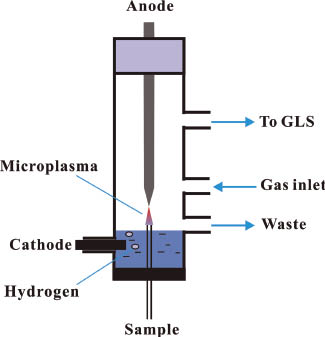
Schematic diagram of SCGD according to the ref. Zhu et al. (2008a). Copyright 2008 American Chemical Society.
The SCGD-induced Hg-vapor generation eliminates the need for chemical reducing reagents such as sodium tetrahydroborate or stannous chloride. In addition, besides inorganic mercury (Hg2+), organic mercury (thiomersal) also can be directly transformed to volatile Hg vapor without the need for prior oxidation (Zhu et al. 2008a). Moreover, our group further found that both iodine (Zhu et al. 2010) and osmium (Zhu et al. 2013a) ions in solution also can be transformed to volatile species through SCGD-induced vapor generation. Both I- and IO3- could be directly converted to volatile iodine vapor (I2) by this SCGD system without any redox reagent. Dissolved Os ion can also be readily converted to volatile osmium tetraoxide vapor (OsO4) in the SCGD system without any chemical oxidizing agents.
It was reported that the presence of organic substances in the SCGD system could affect the element vapor-generation efficiency significantly. In a plain HNO3 medium without the addition of formic acid, the efficiency of the SCGD for Hg was estimated to be about 45%, while the efficiency of the SCGD for Hg rose to 124% in the presence of 1% HCOOH, compared with the traditional approach based on SnCl2-HCl reduction (Zhu et al. 2008a). However, the ethanol and acetic acid presented in the solution increased the vapor generation efficiency of IO3- but decreased the efficiency of I- (Zhu et al. 2010). The reason for this difference was currently unknown but might be related to differences in the vapor generation mechanism of I- and IO3-.
The vapor generation efficiency of SCGD-induced vapor generation appears to be high. The Hg, I, and Os signals induced by SCGD are about 16-fold (Zhu et al. 2008a), 30-fold (Zhu et al. 2010), and 28-fold (Zhu et al. 2013a) of those produced by pneumatic nebulization, respectively. The efficiency of Hg is even better than that of the conventional SnCl2-HCl method in the presence of HCOOH promoter. The limits of detection (LODs) for Hg2+, I-, IO3-, and Os3+ determined by ICP-OES were found to be 0.7, 0.30, 0.43, and 0.51 μg l-1, respectively. The LODs of Hg2+, I-, and IO3- were comparable with conventional chemical vapor generation [0.21 μg l-1 for Hg2+ (Grotti et al. 2005) and 0.4 μg l-1 for I- (Vtorushina et al. 2008)].
The interference of coexisting ions on the vapor generation efficiency of SCGD-induced CVG has also been studied. It was found that interferences from concomitant ions in SCGD-induced vapor generation are mild compared with those of other CVG methods. For samples that contain simple alkali-metal ions (i.e., NaCl, NaNO3, and KNO3), at 10 mg l-1, the effects were all negligible for Hg, I, and Os. Oxidants did not suppress the signal for Hg even at the 10 mg l-1 level (Zhu et al. 2008a). And no significant interferences from Fe3+, Fe2+ (both 10 and 100 mg l-1), and Cu2+ (10 mg l-1) for Os determination were also observed (Zhu et al. 2013a). However, the suppressive effect of chloride was observed even at the 0.001 M level for Hg vapor generation (Zhu et al. 2008a), which was also reported in photo-CVG (Zheng et al. 2005) and sono-induced vapor generation (Gil et al. 2006). The suggested interference mechanism involves stabilization of Hg2+ by chloride owing to the formation of strong complexes (Gil et al. 2006).
SCGD-induced vapor generation is virtually instantaneous and occurs as soon as the sample is introduced into the SCGD; thus, the technique can be readily coupled with FI and HPLC. SCGD-induced vapor generation as interface to online coupled HPLC with AFS for the speciation of Hg2+, MeHg, and ethylmercury (EtHg) was further developed by our group (He et al. 2011). It was found that in addition to Hg2+, MeHg and EtHg also can be directly transformed to elemental mercury by SCGD. The decomposition of organic mercury species and the reduction of Hg2+ could be completed in one step with this proposed SCGD-induced vapor generation system. Both 2-mercaptoethanol in the mobile phase and formic acid mixed in the sample solution were effective in enhancing the mercury fluorescence signal. Under the optimum conditions of separation and determination, the three mercury species were fully resolved with a mobile phase of 0.06 mol l-1 NH4 Ac and 0.1% 2-mercaptoethanol at pH 6.8 and the separation was completed within 13 min. Figure 2 shows the chromatograms obtained from shrimp tissue extract with and without standard addition of 100 μg l-1 of mercury standards by HPLC-SCGD-AFS system.

Chromatogram of shrimp tissue extract sample spiked with or without 100 μg l-1 of each Hg species by HPLC-SCGD-AFS system. Reproduced from He et al. (2011) with permission of Elsevier.
DBD
DBD was first introduced to the analytical chemistry community by Miclea et al. (2002). The term DBD refers to a kind of gas discharge in which plasma is separated from one or two electrodes by a dielectric barrier. DBD is an old nonthermal plasma generation technique that can produce highly energetic electrons (1–10 eV), and then various radicals and ions are generated when these electrons collide with the ambient gas molecules. In contrast to other plasma techniques, DBD provides several unique advantages of excellent dissociation capability for molecular species, simplicity, low gas temperature, and low cost for instrumentation as well as operation at atmospheric pressure, and thus, new measurement methods based on DBD are of growing interest in the field of analytical spectrometry (Hu et al. 2011, Meyer et al. 2011). For example, DBD has been used as a low-temperature atom reservoir for AAS (Zhu et al. 2006) and AFS (Zhu et al. 2008b), as an excitation source for AES (Yu et al. 2008, 2014, Zhu et al. 2008c), as a soft-ionization source for mass spectroscopy (MS) (Na et al. 2007, Harper et al. 2008, Hayen et al. 2009) or GC detector (Kunze et al. 2003, He et al. 2007b), etc.
In most DBD systems, the analyte in the solution sample is often required to be pretransferred into gaseous form (e.g., through hydride or cold-vapor generation) to maintain plasma stability. Direct solution analysis with DBD was very challenging, partly because typical DBD cannot provide sufficient power for complete solvent evaporation and the subsequent analyte atomization. In 2011, Hou Xiandeng’s group (Wu et al. 2011) demonstrated that DBD-induced vapor generation technology can be used for direct liquid analysis. They reported a novel approach to high yield production of Hg0 by using a laboratory-built mini-DBD. Figure 3 is the schematic of the mini-DBD. The mini-DBD consists of a large quartz tube (10 cm×5 mm i.d.×7 mm o.d.) as a dielectric barrier and two copper wires (1 mm in diameter) as electrodes, one of which was inserted into a small quartz tube to protect the electrode from erosion by sample solution. This small quartz tube with the electrode inside was inserted into the large quartz tube, which was tightly and evenly wrapped with another electrode. A high-voltage power supply was connected to the electrodes for the DBD plasma generation. A standard solution of Hg2+ with or without formic acid, together with Ar flow rate, was pumped through the DBD cell. The DBD was ignited by adjusting the input voltage to produce Hg0 inside the DBD plasma. The mixture was flushed to the GLS at a nominal flow rate of 2.0 ml min-1, and the waste was pumped out of the GLS at this same flow rate, while the mercury vapor was rapidly separated from the liquid phase and directed to the ICP for the measurements. The mercury vapor can be fairly easily generated from the analyte solution in the DBD, even without any chemicals. Moreover, the vapor generation efficiency of mercury could be significantly enhanced with the addition of formic acid (Wu et al. 2011). Compared with conventional solution nebulization, Hg emission signal achieved for the solution in the presence of 10% formic was improved 38-fold. Without formic acid, the VG efficiency from the DBD was estimated to be about 40% and 35% from the SnCl2-HCl and alkali solution system, respectively. However, in the presence of 10% HCOOH, the relative sensitivity of the proposed technique was enhanced to 220% and 190%, respectively. The LOD of Hg was 0.090 μg l-1. Therefore, the proposed technique is one of the most highly sensitive techniques for the determination of ultratrace mercury. Since the LOD of Hg was relatively low, it was necessary to avoid the potential Hg contamination from the used reagents such as acetic acid. In addition, no significant interference from NaNO3, Fe(NO3)3, Co(NO3)2, Ni(NO3)2, Zn(NO3)2, Cd(NO3)2, Pb(NO3)2, and Cu(NO3)2 for Hg determination was evident, even at concentrations as high as 100 mg l-1. However, several chloride-containing concomitants, including NaCl, HCl, and AuCl3, induced significant interference.

Schematic of the setup of mini-DBD used in Hg vapor generation. Reproduced from Wu et al. (2011) with permission of the Royal Society of Chemistry.
Later, Yang et al. (2011) demonstrated that Se (IV) also could be determined with the same setup of mini-DBD. The vapor generation efficiency of Se (IV) could also be significantly enhanced with the addition of formic acid. Compared with conventional solution nebulization, Se (IV) emission signal achieved by the DBD-vapor generation was improved 10-fold with a LOD of 6 μg l-1. For samples that contain 100 mg l-1 of Co2+, Ni2+, Sb3+, Ge2+, and Zn2+, the effects were all negligible for Se (IV) determination, while the low concentration of Cu2+ caused high interference. In addition, the authors found that Se (VI) could not be determined by this DBD-induced vapor generation, which indicated that a separation of Se (IV) and Se (VI) would be realized by this method.
At the same time, our group also developed similar work on DBD-induced vapor generation for element determination. In 2011, we reported a DBD plasma-induced vaporization (PIV) technique using mercury as a model analyte (Liu et al. 2011). The schematic diagram of this method is shown in Figure 4. This DBD system included a 70-mm-long quartz with inner and outer diameters of 5 and 6 mm, respectively. A copper rod (diameter 1.9 mm), which was embedded inside a quartz tube (2 mm i.d., 3 mm o.d., 70 mm length) with one sealing side, acted as the internal electrode and was placed coaxially inside the larger quartz tube. An aluminum foil (40 mm length), surrounding the outside of the larger quartz tube, was used as the outer electrode. Argon gas was used as the discharge gas at a flow rate of 300 ml min-1. The analytes were introduced to the AFS detector by the argon gas flow. The sample introduction efficiency for the DBD-PIV system was by a factor of approximately 3.5 when compared with conventional cold vapor system (NaBH4-HCl reduction). The presence of formic acid could enhance Hg2+ signal by a factor of 1.4 but has much less effect on the fluorescence signal of MeHg and EtHg. The LODs were all 0.02 μg l-1 for Hg2+, MeHg, and EtHg. This method, in which evaporation and atomization of dissolved mercury species can be achieved in one step, consumes less sample (approximately 6 μl) and power (≤5 W). It offers several additional advantages: (1) low temperature (approximately 60°C), so there is no analyte loss due to heating; (2) no analyte contamination because of the elimination of contact between sample and electrodes, which also extends the lifetime of the DBD-PIV unit; (3) not only inorganic mercury but also organic mercury species can be directly transformed to free Hg atoms, and no prior oxidation is needed; and (4) similar intensities of three mercury species can be obtained in the presence of ≥1% formic acid. Afterward, our group further used this DBD-PIV system for thiomersal determination (Wu et al. 2012b). This method was also successfully applied to directly measure thiomersal in five commercial vaccines and was validated by comparing with results from ICP-MS.

Schematic diagram of DBD-PIV of mercury species. HCL, hollow cathode lamp; PMT, photomultiplier. Reproduced from Liu et al. (2011) with permission of the Royal Society of Chemistry.
Compared with the works of Hou’s group, less sample volume is needed in our work. A flow rate of 2 ml min-1 was employed in Hou’s mini-DBD system, where the sample was mixed together with the Ar carrier gas before its introduction to the DBD. While the sample solution was coated onto the inner quartz tube by inserting it into the centrifugal tube for 10 s in our DBD-PIV system, only about 6 μl of the sample was consumed. Thus, it is indicated that the setup proposed by our group is more suitable for volume-limited samples. In addition, formic acid will obviously cause enhancement (38-fold) for Hg2+ determination in Hou’s work, while it has much less effect on the fluorescence signal of Hg2+, MeHg, and EtHg in our work. It is indicated that formic acid is necessary in Hou’s mini-DBD system for Hg determination, but it is not necessary in our DBD-PIV system.
Although DBD-induced vapor generation techniques have produced higher sample introduction efficiency than conventional vapor system has, they have thus far been demonstrated to be applicable only to Hg and Se. Shayesteh et al. (2005) reported that gaseous HgH2, CdH2, and ZnH2 molecules could be synthesized by the direct gas-phase reaction of excited mercury, cadmium, and zinc atoms with molecular hydrogen in the presence of an electrical discharge. It indicated that the chemical reaction that cannot be reacted in routine condition might be readily realized in plasma by adding different reaction species, which could be useful to expand the element range of plasma-CVG. To demonstrate this, our group proposed a thin-film DBD plasma-assisted chemical process used for Cd (Zhu et al. 2013b) and Zn (Zhu et al. 2014) vapor generation with the addition of hydrogen. A schematic diagram of the FI thin-film DBD plasma-CVG-AFS experiment setup is shown in Figure 5. The sample was exposed to the plasma and reacted with hydrogen in the DBD plasma to produce volatile vapor; the generated volatile species were swept by a mixture of argon (or helium) and hydrogen stream though a GLS, where the volatile species was separated from liquid; and the volatile species were transported to a quartz tube atomizer for AFS detection. It was found that both atomic and molecular Cd species were produced when a solution containing Cd2+ was exposed to hydrogen-containing DBD plasma. For Zn vapor generation, the volatile species of Zn generated in DBD plasma was mostly atomic (Zn0) species in nature since there was no significant difference in Zn fluorescence signal, whether the atomizer was heated or not. The efficiency of Cd in this He-DBD plasma is even better than that from the conventional HCl-KBH4-thiourea-Co2+ system. The LODs of Cd were found to be 0.03 ng ml-1 (Ar-DBD) and 0.008 ng ml-1 (He-DBD) and the LOD of Zn was 0.2 μg l-1, which is 10- to 20-fold lower than that of conventional CVG method.
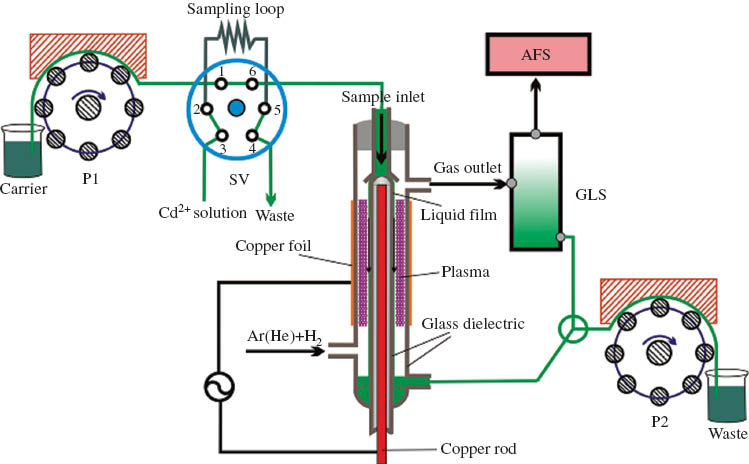
Schematics diagram of the instrumental setup of the FI thin-film DBD plasma-CVG-AFS. P1, P2, peristaltic pump; SV, six-port valve. Reproduced with permission from Zhu et al. (2013b). Copyright 2013 American Chemical Society.
Afterward, Yang et al. (2014) further demonstrated that the common hydride generated elements, such as As, Te, Sb, and Se, can be vaporized by hydrogen DBD plasma-CVG (Figure 6) to replace the hydride generation system with NaBH4. Sample solutions were converted to aerosol by a nebulizer and then mixed with the plasma to generate hydrides. Also, a mixture of four arsenic species [As(III), As(V), monomethylarsenic acid (MMA), and dimethylarsenic acid (DMA)] had been successfully analyzed after HPLC separation through this hydrogen DBD plasma-CVG system. The authors further confirmed that the enhancement of fluorescent intensities by the introduction of hydrogen was caused by the hydrogen reaction with sample aerosols in the plasma, not in the quartz furnace atomizer of AFS. The absolute detection limits for As, Te, Sb, and Se were 0.6, 1.0, 1.4, and 1.2 ng, respectively.
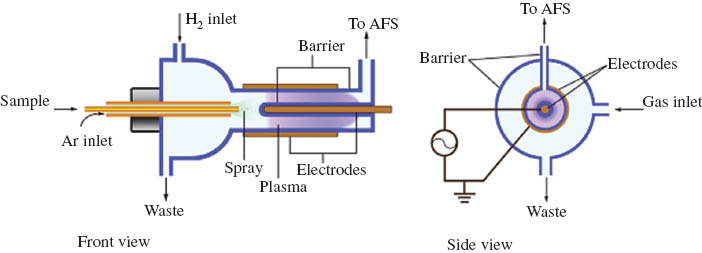
Schematic diagram of the hydrogen DBD plasma-CVG-AFS experiment setup. Reproduced from Yang et al. (2014) with permission of Elsevier.
Possible mechanism in plasma-CVG
Table 1 summarizes the possible products of SCGD- and DBD-induced vapor generation for several element systems. It can be seen that both reduction and oxidation reaction are present in the SCGD system, while only reduction reactions are reported in the DBD system. The oxidation of I- and the reduction of IO3- could be completed in one step to volatile I2 with SCGD-induced vapor generation system. Os3+ can be readily converted to volatile osmium tetraoxide vapor (OsO4) in the SCGD system without any chemical oxidizing agents. For Hg vapor generation, besides inorganic mercury (Hg2+), organic mercury (MeHg, EtHg, thiomersal) also could be reduced to Hg0 in one step without prior oxidation both in the SCGD and DBD systems. Se4+ could be reduced to volatile Se hydride through DBD-induced vapor generation system with and without the addition of hydrogen. However, for the element Cd, Cd2+ contained in a solution could be reduced to both atomic and molecular Cd species only with the presence of hydrogen in the DBD system as well as the element Zn. Similarly, the elements As, Sb, and Te also could be reduced to their vaporized hydrides (presumably, AsH3, SbH3, and H2 Te, respectively) through the hydrogen DBD plasma. For As vapor generation, four arsenic species [As(III), As(V), DMA, and MMA] all could be reduced to the vaporized hydride of arsenic in one step through the hydrogen DBD plasma without prior oxidation.
Possible products of SCGD- and DBD-induced vapor generation for several element systems.
| Analyte | Product | References | |
|---|---|---|---|
| SCGD | Hg2+/Thiomersal | Hg | Zhu et al. 2008a |
| MeHg/EtHg | Hg | He et al. 2011 | |
| IO3-/I- | I2 | Zhu et al. 2010 | |
| Os3+ | OsO4 | Zhu et al. 2013a | |
| DBD | Hg2+ | Hg | Liu et al. 2011, Wu et al. 2011 |
| MeHg/EtHg | Hg | Liu et al. 2011 | |
| Thiomersal | Hg | Wu et al. 2012b | |
| Cd2+ | CdH2/Cd | Zhu et al. 2013b | |
| Se4+ | H2 Se | Yang et al. 2011, 2014 | |
| Zn2+ | Zn | Zhu et al. 2014 | |
| As(III)/As(V)/DMA/MMA | AsH3 | Yang et al. 2014 | |
| Te2+ | H2 Te | ||
| Sb3+ | SbH3 |
Since plasma-CVG avoids the use of chemical reduction/oxidation reagents, the reduction/oxidation reaction in the plasma must be caused by itself. Zhu et al. (2008a) proposed that hydroxyl radicals, atomic hydrogen, and free electrons were all present in the SCGD, as evidenced by experimental observation of very strong OH emission bands and the significantly Stark-broadened (due to collisions with free electrons) hydrogen atomic emission line in its Balmer series (Mezei and Cserfalvi 2007). Thus, it may be concluded that the hydroxyl radicals can simulate the oxidation reaction and the atomic hydrogen and free electrons can simulate the reduction reaction in the SCGD system. Earlier reports have found that a >1015 cm-3 electron density could be obtained during operation of a DBD plasma (Kunze et al. 2002). The high-density, energetic electrons and high excitation temperature provide a high dissociation ability to form radicals, ions, and atoms. It is indicated that electron that abundantly existed in the DBD system may play an important role in the reduction reaction. For Cd, Zn, As, Sb, Te, and Se vapor generation, when hydrogen is introduced to Ar plasma, H2 is excited by Ar plasma to generate active hydrogen species, such as H, H+, H2+, and H3+, further forming the hydrogen plasma. Then, the sample aerosols generate the chemical vapors (presumably, hydrides) by the reduction abilities of those active hydrogen species (Yang et al. 2014).
Comparing SCGD- and DBD-induced vapor generation, it is found that besides elemental (Hg, I2) vapor, oxide (OsO4) vapor can be generated in the SCGD system, while elemental vapor (Hg, Zn) and molecular volatile species (presumably CdH2, AsH3, SbH3, H2 Te, and H2 Se) can be produced in the DBD system. To investigate whether hydride could be produced in the SCGD system, Zhu et al. (2008a) tried to study the feasibility for other known volatile hydride-forming elements (As, Se, Pb, and Sn) in the SCGD system. However, there was no measurable ICP emission from these elements even when they were introduced into the SCGD at a level of 10 mg l-1, a concentration that is orders of magnitude higher than the detection limits in the ICP by conventional solution nebulization. The absence of signals from hydride-forming elements might be the result of the high temperature of the SCGD plasma, at which the hydrides either do not form or else dissociate or are lost in transport to the ICP. DBD is a nonthermal plasma, and it is already demonstrated that As, Te, Sb, and Se could be transformed to volatile hydride vapor by DBD-induced vapor generation system. Therefore, it is indicated that the low temperature of the plasma is favorable for producing some unstable volatile species.
Moreover, although the reason for organic substance enhancement is not well investigated for Hg, Se, etc., it might be that organic compounds such as formic acid give rise to the formation of reducing radicals and result in the enhancement of the vapor generation efficiency (Wu et al. 2011). In addition, formic acid might alter the boiling point or surface tension of the sample solution and consequently change its vaporization rate, thereby, may also contribute to intensity enhancement (Zhu et al. 2008a).
Future trends in plasma-CVG
In recent years, plasma-CVG was proposed and developed as a useful alternative method for introducing liquid samples to atomic spectrometry, including ICP-AES and AFS. Compared with conventional CVG, plasma-CVG has many advantages, including being simple in operation and low cost, having high vapor-generation efficiency, and being environmentally friendly. Plasma-CVG is also potentially useful for field analysis since it can be readily adapted to portable AFS/AES systems.
Future directions include investigation of the underlying vapor generation mechanism as well as the organic substance enhancement and extending it to other elements through adding other reagent or gas, modifying the discharge setup, etc. The potential interference, such as high concentration of Cl- for element vapor generation, needs to be considered, and analysis of various samples with different matrixes is necessary to further demonstrate that it could be applicable to real samples. Moreover, it is useful to combine plasma-CVG with separation techniques for elemental speciation analysis.
In addition, Tung et al. (2012) reported that Ag nanoparticles could be determined by liquid discharge atomic emission spectrometry; thus, it is interesting to investigate whether nanoparticles can be transformed to volatile vapor by plasma-CVG technology. Furthermore, plasma jet desorption atomization source, which was developed by our group (Liu et al. 2012), also may be used as a vapor generation technology in the future.
About the authors

Qian He received her BSc in chemistry in 2005 and is now a PhD candidate under the direction of Dr. Shenghong Hu in the State Key Laboratory of Biogeology and Environmental Geology at China University of Geosciences (Wuhan). Her research interests include plasma-CVG, microplasma excitation source, and protein immunoassay. She has published more than four papers in international journals.

Zhenli Zhu received his PhD degree with a major in analytical chemistry from Tsinghua University in 2008 under the supervision of Professor Xinrong Zhang, working on the development of new atomization/ionization sources based on atmospheric microplasmas. Currently, he is a professor in the State Key Laboratory of Biogeology and Environment Geology at China University of Geoscience (Wuhan). In 2007 and 2010, he worked with Professor Gary M. Hieftje in Bloomington as a visiting scientist. His interests center on atomic spectrometry, comprising trace element and isotope analysis, excitation source development, plasma-induced chemical vapor generation, elemental speciation, and miniaturized instrument development.

Shenghong Hu is a full professor in the faculty of Earth Sciences at China University of Geosciences (Wuhan). Prof. Hu is also in charge of the elemental and isotopic analysis laboratory at the State Key Laboratory of Biogeology and Environmental Geology at China University of Geosciences (Wuhan). He received his BSc and MSc in analytical chemistry and his PhD in geochemistry from China University of Geosciences (Wuhan). He is interested in analytical geochemistry, including microanalysis of element and isotope by LA-ICP-MS, environmental markers of geological processes, and biomolecule detection with an ICP-MS linked immunoassay method.
Acknowledgments
We gratefully acknowledge the financial support from the National Nature Science Foundation of China (nos. 21375120, 21175120, and 41173018), the R&D Special Fund for Public Welfare Industry of Hubei province (2012DCA19001), and the Fundamental Research Funds for the Central Universities (CUG120117, CUG120502), China University of Geosciences (Wuhan).
References
Bendicho, C.; Pena, F.; Costas, M.; Gil, S.; Lavilla, I. Photochemistry-based sample treatments as greener approaches for trace-element analysis and speciation. Trends Anal. Chem.2010, 29, 681–691.Search in Google Scholar
Cserfalvi, T.; Mezei, P. Investigations on the element dependency of sputtering process in the electrolyte cathode atmospheric discharge. J. Anal. At. Spectrom.2005, 20, 939–944.Search in Google Scholar
D’Ulivo, A. Chemical vapor generation by tetrahydroborate (III) and other borane complexes in aqueous media: a critical discussion of fundamental processes and mechanisms involved in reagent decomposition and hydride formation. Spectrochim. Acta Part B2004, 59, 793–825.10.1016/j.sab.2004.04.001Search in Google Scholar
D’Ulivo, A.; Dědina, J.; Mester, Z.; Sturgeon, R. E.; Wang, Q.; Welz, B. Mechanisms of chemical generation of volatile hydrides for trace element determination (IUPAC Technical Report). Pure Appl. Chem.2011, 83, 1283–1340.Search in Google Scholar
Denkhaus, E.; Beck, F.; Bueschler, P.; Gerhard, R.; Golloch, A. Electrolytic hydride generation atomic absorption spectrometry for the determination of antimony, arsenic, selenium, and tin – mechanistic aspects and figures of merit. Fresenius J. Anal. Chem.2001a, 370, 735–743.Search in Google Scholar
Denkhaus, E.; Golloch, A.; Guo, X.-M.; Huang, B. Electrolytic hydride generation (EC-HG) – a sample introduction system with some special features. J. Anal. At. Spectrom.2001b, 16, 870–878.Search in Google Scholar
Gil, S.; Lavilla, I.; Bendicho, C. Ultrasound-promoted cold vapor generation in the presence of formic acid for determination of mercury by atomic absorption spectrometry. Anal. Chem.2006, 78, 6260–6264.Search in Google Scholar
Grotti, M.; Lagomarsino, C.; Frache, R. Multivariate study in chemical vapor generation for simultaneous determination of arsenic, antimony, bismuth, germanium, tin, selenium, tellurium and mercury by inductively coupled plasma optical emission spectrometry. J. Anal. At. Spectrom.2005, 20, 1365–1373.Search in Google Scholar
Harper, J. D.; Charipar, N. A.; Mulligan, C. C.; Zhang, X.; Cooks, R. G.; Ouyang, Z. Low-temperature plasma probe for ambient desorption ionization. Anal. Chem.2008, 80, 9097–9104.Search in Google Scholar
Hayen, H.; Michels, A.; Franzke, J. Dielectric barrier discharge ionization for liquid chromatography/mass spectrometry. Anal. Chem.2009, 81, 10239–10245.Search in Google Scholar
He, Y.; Hou, X.; Zheng, C.; Sturgeon, R. E. Critical evaluation of the application of photochemical vapor generation in analytical atomic spectrometry. Anal. Bioanal. Chem.2007a, 388, 769–774.Search in Google Scholar
He, Y.; Lv, Y.; Li, Y.; Tang, H.; Li, L.; Wu, X.; Hou, X. Dielectric barrier discharge-induced chemiluminescence: potential application as GC detector. Anal. Chem.2007b, 79, 4674–4680.Search in Google Scholar
He, Q.; Zhu, Z.; Hu, S.; Jin, L. Solution cathode glow discharge induced vapor generation of mercury and its application to mercury speciation by high performance liquid chromatography-atomic fluorescence spectrometry. J. Chromatogr. A2011, 1218, 4462–4467.Search in Google Scholar
He, Q.; Zhu, Z.; Hu, S. Flowing and nonflowing liquid electrode discharge microplasma for metal ion detection by optical emission spectrometry. Appl. Spectrosc. Rev.2014, 49, 249–269.Search in Google Scholar
Hu, J.; Li, W.; Zheng, C.; Hou, X. Dielectric barrier discharge in analytical spectrometry. Appl. Spectrosc. Rev.2011, 46, 368–387.Search in Google Scholar
Kunze, K.; Miclea, M.; Musa, G.; Franzke, J.; Vadla, C.; Niemax, K. Diode laser-aided diagnostics of a low-pressure dielectric barrier discharge applied in element-selective detection of molecular species. Spectrochim. Acta Part B2002, 57, 137–146.Search in Google Scholar
Kunze, K.; Miclea, M.; Franzke, J.; Niemax, K. The dielectric barrier discharge as a detector for gas chromatography. Spectrochim. Acta Part B2003, 58, 1435–1443.Search in Google Scholar
Laborda, F.; Bolea, E.; Castillo, J. R. Electrochemical hydride generation as a sample-introduction technique in atomic spectrometry: fundamentals, interferences, and applications. Anal. Bioanal. Chem.2007, 388, 743–751.Search in Google Scholar
Liu, Z.; Zhu, Z.; Wu, Q.; Hu, S.; Zheng, H. Dielectric barrier discharge-plasma induced vaporization and its application to the determination of mercury by atomic fluorescence spectrometry. Analyst2011, 136, 4539–4544.Search in Google Scholar
Liu, Z.; Zhu, Z.; Zheng, H.; Hu, S. Plasma jet desorption atomization-atomic fluorescence spectrometry and its application to mercury speciation by coupling with thin layer chromatography. Anal. Chem.2012, 84, 10170–10174.Search in Google Scholar
Long, Z.; Luo, Y.; Zheng, C.; Deng, P.; Hou, X. Recent advance of hydride generation – analytical atomic spectrometry: part I – technique development. Appl. Spectrosc. Rev.2012, 47, 382–413.Search in Google Scholar
Luo, D.; Duan, Y. Microplasmas for analytical applications of lab-on-a-chip. Trends in Anal. Chem.2012, 39, 254–266.Search in Google Scholar
Meyer, C.; Müller, S.; Gurevich, E.; Franzke, J. Dielectric barrier discharges in analytical chemistry. Analyst2011, 136, 2427–2440.Search in Google Scholar
Mezei, P.; Cserfalvi, T. Electrolyte cathode atmospheric glow discharges for direct solution analysis. Appl. Spectrosc. Rev.2007, 42, 573–604.Search in Google Scholar
Miclea, M.; Kunze, K.; Franzke, J.; Niemax, K. Plasmas for lab-on-the-chip applications. Spectrochim. Acta Part B2002, 57, 1585–1592.10.1016/S0584-8547(02)00067-8Search in Google Scholar
Mottaleb, M. A.; Yang, J. S.; Kim, H.-J. Electrolyte-as-cathode glow discharge (ELCAD)/glow discharge electrolysis at the gas-solution interface. Appl. Spectrosc. Rev.2002, 37, 247–273.Search in Google Scholar
Na, N.; Zhao, M.; Zhang, S.; Yang, C.; Zhang, X. Development of a dielectric barrier discharge ion source for ambient mass spectrometry. J. Am. Soc. Mass Spectrom.2007, 18, 1859–1862.Search in Google Scholar
Ribeiro, A. S.; Vieira, M. A.; Willie, S.; Sturgeon, R. E. Ultrasound-assisted vapor generation of mercury. Anal. Bioanal. Chem.2007, 388, 849–857.Search in Google Scholar
Shayesteh, A.; Yu, S.; Bernath, P. F. Gaseous HgH2, CdH2, and ZnH2. Chem. Eur. J.2005, 11, 4709–4712.Search in Google Scholar
Ślachciński, M. Recent achievements in sample introduction systems for use in chemical vapor generation plasma optical emission and mass spectrometry: from macro- to microanalytics. Appl. Spectrosc. Rev.2014, 49, 271–321.Search in Google Scholar
Smichowski, P.; Farías, S. Advantages and analytical applications of chloride generation. A review on vapor generation methods in atomic spectrometry. Microchem. J.2000, 67, 147–155.Search in Google Scholar
Sturgeon, R.; Luong, V. Photo- and thermo-chemical vapor generation of mercury. J. Anal. At. Spectrom.2013, 28, 1610–1619.Search in Google Scholar
Tung, N. H.; Chikae, M.; Ukita, Y.; Viet, P. H.; Takamura, Y. Sensing technique of silver nanoparticles as labels for immunoassay using liquid electrode plasma atomic emission spectrometry. Anal. Chem.2012, 84, 1210–1213.Search in Google Scholar
Vtorushina, E.; Saprykin, A.; Knapp, G. Optimization of the conditions of oxidation vapor generation for determining chlorine, bromine, and iodine in aqueous solutions by inductively coupled plasma atomic-emission spectrometry. J. Anal. Chem.2008, 63, 643–648.Search in Google Scholar
Wu, P.; He, L.; Zheng, C.; Hou, X.; Sturgeon, R. E. Applications of chemical vapor generation in non-tetrahydroborate media to analytical atomic spectrometry. J. Anal. At. Spectrom.2010, 25, 1217–1246.Search in Google Scholar
Wu, X.; Yang, W.; Liu, M.; Hou, X.; Zheng, C. Vapor generation in dielectric barrier discharge for sensitive detection of mercury by inductively coupled plasma optical emission spectrometry. J. Anal. At. Spectrom.2011, 26, 1204–1209.Search in Google Scholar
Wu, L.; Long, Z.; Liu, L.; Zhou, Q.; Lee, Y.; Zheng, C. Microwave-enhanced cold vapor generation for speciation analysis of mercury by atomic fluorescence spectrometry. Talanta2012a, 94, 146–151.10.1016/j.talanta.2012.03.009Search in Google Scholar PubMed
Wu, Q.; Zhu, Z.; Liu, Z.; Zheng, H.; Hu, S.; Li, L. Dielectric barrier discharge-plasma induced vaporization for the determination of thiomersal in vaccines by atomic fluorescence spectrometry. J. Anal. At. Spectrom.2012b, 27, 496–500.Search in Google Scholar
Yang, W.; Zhu, X.; Wu, X. Dielectric barrier discharge induced chemical vapor generation for determination of selenium (IV) by ICP-OES. Chem. Res. Appl.2011, 23, 644–648.Search in Google Scholar
Yang, M.; Xue, J.; Li, M.; Han, G.; Xing, Z.; Zhang, S.; Zhang, X. Low temperature hydrogen plasma assisted chemical vapor generation for atomic fluorescence spectrometry. Talanta2014, 126, 1–7.Search in Google Scholar
Yin, Y.; Liu, J.; Jiang, G. Photo-induced chemical-vapor generation for sample introduction in atomic spectrometry. Trends Anal. Chem.2011, 30, 1672–1684.Search in Google Scholar
Yu, Y.; Du, Z.; Chen, M.; Wang, J. Atmospheric-pressure dielectric-barrier discharge as a radiation source for optical emission spectrometry. Angew. Chem. Int. Ed.2008, 47, 7909–7912.Search in Google Scholar
Yu, Y.; Cai, Y.; Chen, M.; Wang, J. Development of a miniature dielectric barrier discharge – optical emission spectrometric system for bromide and bromate screening in environmental water samples. Anal. Chim. Acta2014, 809, 30–36.Search in Google Scholar
Zheng, C.; Li, Y.; He, Y.; Ma, Q.; Hou, X. Photo-induced chemical vapor generation with formic acid for ultrasensitive atomic fluorescence spectrometric determination of mercury: potential application to mercury speciation in water. J. Anal. At. Spectrom.2005, 20, 746–750.Search in Google Scholar
Zhu, Z.; Zhang, S.; Lv, Y.; Zhang, X. Atomization of hydride with a low-temperature, atmospheric pressure dielectric barrier discharge and its application to arsenic speciation with atomic absorption spectrometry. Anal. Chem.2006, 78, 865–872.Search in Google Scholar
Zhu, Z.; Chan, G. C.-Y.; Ray, S. J.; Zhang, X.; Hieftje, G. M. Use of a solution cathode glow discharge for cold vapor generation of mercury with determination by ICP-atomic emission spectrometry. Anal. Chem.2008a, 80, 7043–7050.Search in Google Scholar
Zhu, Z.; Liu, J.; Zhang, S.; Na, X.; Zhang, X. Evaluation of a hydride generation-atomic fluorescence system for the determination of arsenic using a dielectric barrier discharge atomizer. Anal. Chim. Acta2008b, 607, 136–141.10.1016/j.aca.2007.11.041Search in Google Scholar PubMed
Zhu, Z.; Chan, G. C.-Y.; Ray, S. J.; Zhang, X.; Hieftje, G. M. Microplasma source based on a dielectric barrier discharge for the determination of mercury by atomic emission spectrometry. Anal. Chem.2008c, 80, 8622–8627.Search in Google Scholar
Zhu, Z.; He, Q.; Shuai, Q.; Zheng, H.; Hu, S. Solution cathode glow discharge induced vapor generation of iodine for determination by inductively coupled plasma optical emission spectrometry. J. Anal. At. Spectrom.2010, 25, 1390–1394.Search in Google Scholar
Zhu, Z.; Huang, C.; He, Q.; Xiao, Q.; Liu, Z.; Zhang, S.; Hu, S. On line vapor generation of osmium based on solution cathode glow discharge for the determination by ICP-OES. Talanta2013a, 106, 133–136.10.1016/j.talanta.2012.12.010Search in Google Scholar PubMed
Zhu, Z.; Wu, Q.; Liu, Z.; Liu, L.; Zheng, H.; Hu, S. Dielectric barrier discharge for high efficiency plasma-chemical vapor generation of cadmium. Anal. Chem.2013b, 85, 4150–4156.Search in Google Scholar
Zhu, Z.; Liu, L.; Li, Y.; Peng, H.; Liu, Z.; Guo, W.; Hu, S. Cold vapor generation of Zn based on dielectric barrier discharge induced plasma chemical process. Anal. Bioanal. Chem.2014. DOI: 10.1007/s00216-014-7911-8.10.1007/s00216-014-7911-8Search in Google Scholar PubMed
©2014 by De Gruyter
This article is distributed under the terms of the Creative Commons Attribution Non-Commercial License, which permits unrestricted non-commercial use, distribution, and reproduction in any medium, provided the original work is properly cited.
Articles in the same Issue
- Masthead
- In this Issue
- Studies of drug interactions with glycated human serum albumin by high-performance affinity chromatography
- Silicon nanowire-transistor biosensor for study of molecule-molecule interactions
- Plasma-induced vapor generation technique for analytical atomic spectrometry
- Analysis and impurity identification in pharmaceuticals
- Interfacing commercially available capillary electrophoresis to sample preparation and/or detection systems to solve analytical problems
Articles in the same Issue
- Masthead
- In this Issue
- Studies of drug interactions with glycated human serum albumin by high-performance affinity chromatography
- Silicon nanowire-transistor biosensor for study of molecule-molecule interactions
- Plasma-induced vapor generation technique for analytical atomic spectrometry
- Analysis and impurity identification in pharmaceuticals
- Interfacing commercially available capillary electrophoresis to sample preparation and/or detection systems to solve analytical problems
