Copyright, Ghosts, Information
-
Jose Bellido
Dr. Jose Bellido teaches law at the University of Kent. He is particularly interested in the history of intellectual property law and has additional research interests in legal theory, evidence, and legal history. His last publications include
Adventures in Childhood: Intellectual Property, Imagination and the Business of Play (Cambridge University Press, 2022) [with Kathy Bowrey] andIntellectual Property and the Design of Nature (Oxford University Press, 2023) [co-edited with Brad Sherman].


Abstract
In 1985, Marianne Mele Hall, the chairman of the Copyright Royalty Tribunal, resigned after a controversy surrounding her role in writing Lawrence Hafstad’s book, Foundations of Sand (1982), which included several racist passages. Although at first she claimed to have been the co-author, when the scandal broke she tried to avoid the political controversy by describing her role as a ghost writer or an editor. While the effort was to no avail and she had to resign, it nevertheless prompted an interesting epistolary conversation between the information scientist, Eugene Garfield, and the sociologist of science, Robert K. Merton, about the differences between the two terms. This essay looks at that correspondence and situates it alongside the emergence of the information industry affecting copyright.
What’s in a name may or may not always be evident, as ghosts, subterfuges,
and collaborative teamwork often obscure the true begetters of published works.
– Anne B. Piternick (1992)[1]
1 Introduction
In November 1983, Marianne Mele Hall was nominated to serve on the Copyright Royalty Tribunal, a federal regulatory agency overseeing the compulsory licensing scheme established by the US Copyright Act of 1976.[2] She got the job after a clearance process that involved the submission of a curriculum vitae, a personal data statement in response to a Senate questionnaire in which she described herself as “attorney/author/lecturer,” and an interview.[3] An ambitious conservative lawyer, Hall was selected by the Reagan administration to steady the ship at what was then a troubled agency. The tribunal, once called “the child of the cable problem,”[4] was seen as an administrative experiment designed to set or adjust copyright rates.[5] As a bureaucratic body set up for compromise, balancing exercises, and adjudication, the tribunal began having difficulty dealing with disputes between publishers and record companies, cable operators and Hollywood, and trouble regulating royalty distribution. The lack of clear statutory guidance for the tribunal’s operations and constitution meant not only that its mandate was considered nebulous but that it quickly became a political battleground for Republicans and Democrats. Its decisions were depicted as a “tale of a bureaucratic Garden of Eden” falling from grace from copyright policies promoted in the spirit of deregulation that characterised the early 1980s.[6] If regulation was out, the marketplace was in, so the chain of appeals and the shadow of arbitrariness haunted a tribunal tasked with the difficult role of acting as an arbiter in an environment increasingly defined by a reluctance to be administered.[7] This reminds us that copyright law involves not just a private right but a device embracing different understandings of where the distinction between the private and the public might lie. And this distinction was drawn on the ground by agencies and departments such as the Copyright Royalty Tribunal. It is no surprise, then, that for the two decades it existed the tribunal was characterised by a struggle for political control.[8]
Two years after her appointment, Marianne Hall tried to take the chairmanship of the tribunal. She emphasised her literary credentials and copyright expertise, in contrast with the other two candidates, both non-lawyers – Mario F. Aguero, a Cuban American, and Edward W. Ray, an African American.[9] Their entertainment industry background was used against them, and they were referred to as “former Olympic basketball star” and “former road manager for Chuck Berry.”[10] While her campaign to become chairman succeeded – she was appointed in April 1985 – it also garnered public attention for other reasons. Less than two weeks after her appointment, she was forced to resign, making her chairmanship the shortest in the history of the tribunal.[11] At the centre of the controversy was her involvement in Lawrence Hafstad’s book, Foundations of Sand: A Hard Look at the Soft Sciences (1982), which included several racist passages specially targeting African Americans.[12] This was particularly distressing because racial oppression in America had remained as a spectre whose ghosts still lived on.[13] As the past haunts the present, the book’s troubling passages confronted not only Hall’s appointment but also the Copyright Royalty Tribunal. As a journalist observed, how could someone write such intellectual garbage and wind up in a $700,000-a-year position in government?[14] It was clear then that “people who hold or have associated themselves with the racist views expounded by this book do not belong in public office.”[15]
Although she tried to distance herself from the book, her defence failed, and she was forced to resign.[16] Just a few days before the scandal broke, the White House received news that some politicians were unhappy with Hall’s no-nonsense approach to changing the profile of the tribunal and were working to remove her from office.[17] Once it was revealed that Hall had participated in that book, her political fate was sealed. She became a major political embarrassment because questions were raised not only about her character and the need for her to resign but also about the lack of thoroughness in the evaluation and appointment process.[18] In other words, the concern was why and how she was nominated in the first place, whether the nomination and confirmation procedures failed for lack of awareness of the contents of the book, and whether Hall had made any inconsistent statements in her sworn testimony. At face value, the episode showcased the typical rise and fall of a public figure, a common trajectory for celebrities and politicians alike. But this footnote in copyright history is significant because it provides a privileged perspective on questions of authorship, ghost writing, and collaboration. The episode was especially remarkable as the authorship controversy affected the chairman of the tribunal. And the specific issue of Hall’s credentials and her suitability for office constituted part of the scandal.[19]
2 Visibility
The main obstacle preventing Hall from disassociating herself from the book was that her name was on the cover (Figure 1). Nor did it help that the book and her name were linked in the copyright registration certificate, the papers of a company to receive royalties, and the publication list she submitted to the Senate.[20] As this mounting evidence against her came to light, public outrage intensified and the possibility of erasing or downplaying her role in the publication became increasingly difficult.[21] But what had first motivated Hall to collaborate and make herself prominent in a project she was now so desperate to disown? Why would she make public a collaboration that would haunt and destroy her political career? One reason might have simply been her desire to boost her chances of getting the job by signalling literary associations with scientists like Lawrence Hafstad, head of the Reactor Development Division of the Atomic Energy Committee and subsequently vice president of General Motors.[22] In fact, the book ended up being advertised only in Human Events, a well-known conservative media outlet and Ronald Reagan’s favourite newspaper.[23] Crafting such an image and alluding to what could be seen as familiar conservative credentials seemed likely to improve her application in a politically motivated selection process. As it turned out, nobody from the nominating or appointment panel got around to reading the book, which had actually sold less than two hundred copies.[24] However, in retrospect, this was extraordinarily naïve, because in a political minefield like the tribunal the chances of the book being read beyond that context were high. A few days after her appointment, a journalist bought the book, read it, and quickly filed a piece about the racist passages contained therein.[25]
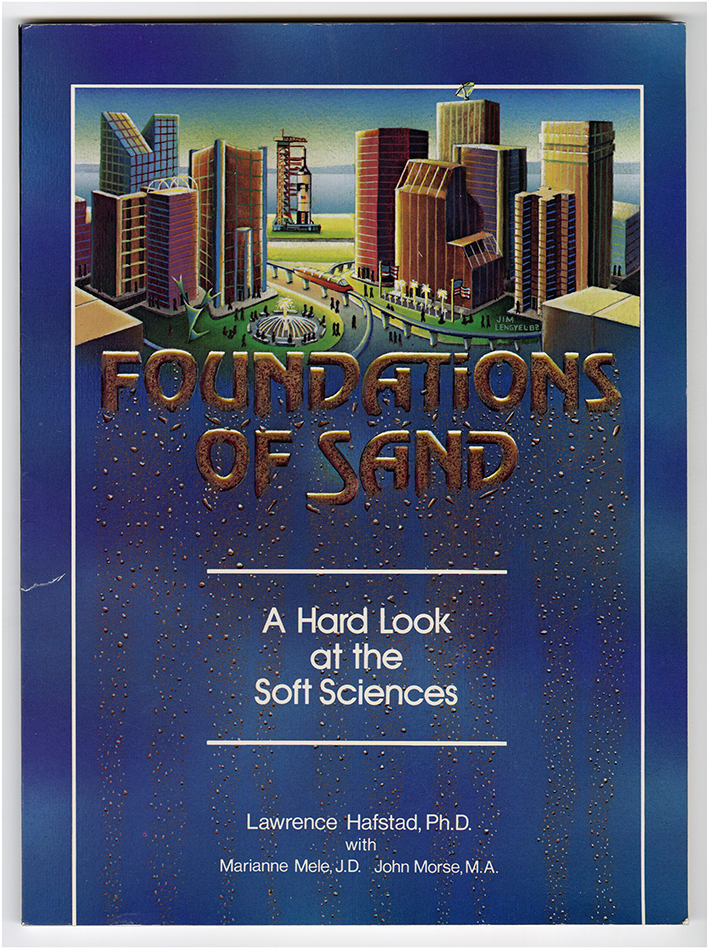
One of the customs in publishing and copyright is that names on the cover constitute a presumption of authorship. Her name appeared on a reduced font size and after Hafstad, perhaps eliciting a lesser level of creative input to it (Photo courtesy of the Norwegian-American Historical Association).
Whatever it was that caused Hall to make this literary collaboration visible, the most interesting part of the scandal was her attempt to avoid responsibility for the content. She did so by trying to deny that she was the co-author of the text and accusing the journalist of raising “specters of illusionary attitudes.”[26] However, her position became even more untenable in the public eye as she began developing smokescreen tactics that fuelled further controversy, irritating not only Democrats but also Republicans and civil rights groups.[27] When Hall was summoned to explain her participation in the writing of the book, she entangled herself in a web of muddled answers. In her attempts to distance herself from its content, she went from calling herself an editor, to an “editing clerk,” and finally to a ghost author.[28] Although her point was to emphasise a “ministerial” role,[29] the last claim did not seem to make much sense since the main attribute of ghosts is their invisibility. Ghosts are incorporeal and notoriously difficult to summon. And when ghost writers get visibility, legal problems ensue since the relationship between truth and source is brought to the fore.[30] Her contribution to the acknowledgements section, a space reserved to authors (and not editors) also weakened the denial of authorship and responsibility. Yet Hall’s lack of focus and sloppy answers precipitated her downfall precisely by rendering manifest a fundamental character trait, casting serious doubts on her competence as a copyright expert. Called upon to identify the source of responsibility for such a disturbing book, her attempt to try to avoid the accountability implied by its publication was not good enough. The dedication and association within and outside the book, either as an editor or a co-author, revealed another concern that ended up raising doubts about her qualifications: how could the chairman of the Copyright Royalty Tribunal be so unclear and confused about the various possibilities attending the author function?
3 Help
The scandal caught the attention of Eugene Garfield, founder of the Institute for Scientific Information (ISI) and inventor of the Science Citation Index. Garfield came across the story in The New York Times and was particularly intrigued by Hall’s confused statements. Although he thought about organising a conference on the topic in light of the public attention that the news had garnered, the most significant output prompted by this scandal was an “interim essay” on ghost writing published in the weekly magazine Current Contents® a few months after the row.[31] When Marianne Hall’s erratic answers about authorship were first reported, Garfield cut out the newspaper article and shared it with an old friend and collaborator, the sociologist of science, Robert K. Merton (Figure 2).[32] As an advisor to the Institute, Merton received an honorarium for his editorial work, which consisted of going over drafts, exchanging ideas, suggestions, and notes with Garfield and other members of the Institute.[33] This collaboration spanned decades and continents, becoming a sort of collective writing in transit, inflected by travels, academic conferences, and business meetings as they fulfilled their crowded schedules. It evolved as a writing-up system carried out on the move, mediated by faxes, tape recordings, phone calls, postcards, and letters in the development of essays for Current Contents®.[34] Despite being overshadowed by other publications and achievements of the Institute, such as the Science Citation Index, this book-length weekly became a key publishing outlet because it acted as a nexus between academia and the information and scientific industry.[35] It included the tables of contents from recent scientific journals and provided indexes by author and title words, thereby representing a search engine with which to navigate scientific publications. In other words, it served as a useful alerting method for libraries and scientists to keep up with the flow of publications as it provided timely access to information in journals. Among its regular features there was a section entitled “Current Comments,” with essays that offered views on issues ranging from copyright to eponymy and obliteration; from the problem of pageless journals to the importance of not being cited.[36] What made these short essays remarkable was that, despite looking like mainstream magazine content, popular and accessible, they were thoroughly researched and fact-checked, and indeed enjoyed a substantial and devoted readership.[37]
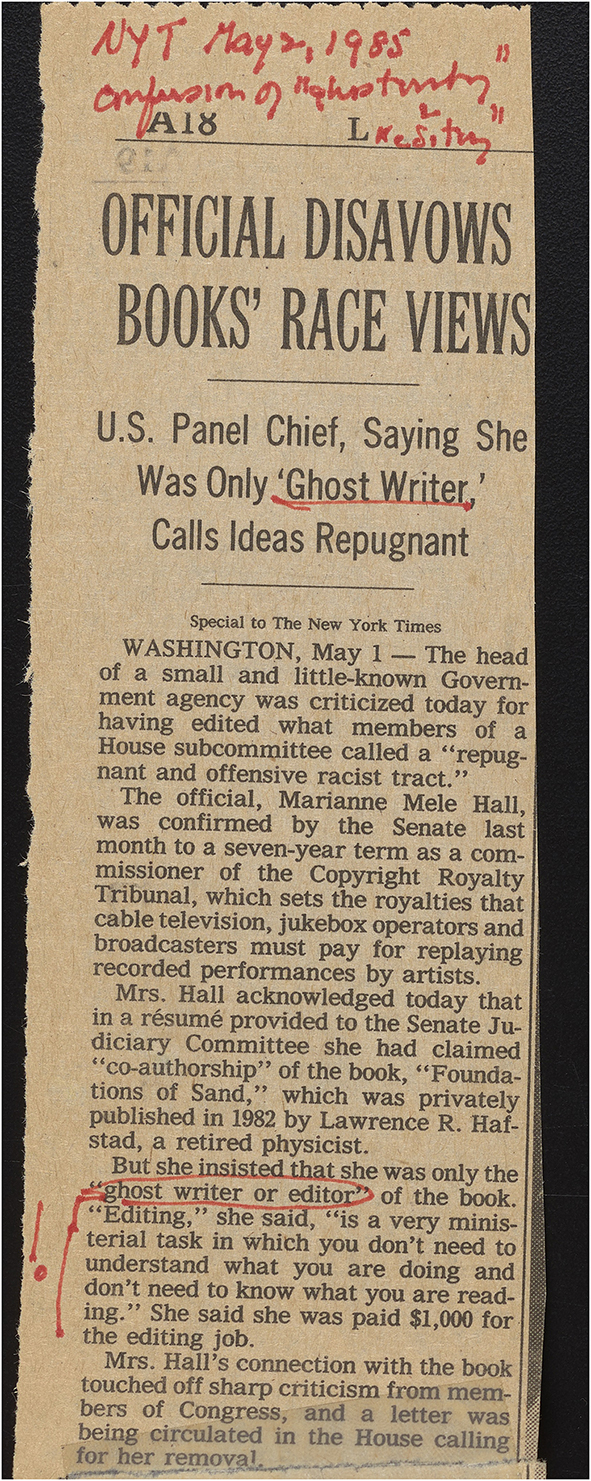
An exclamation mark highlighting the confusion by Marianne Mele Hall was scribbled in the newspaper clipping that circulated between Garfield and Merton (Courtesy of the Science History Institute).
One of the routines for the preparation of “Current Comments” was the passing around of newspaper clippings among the group of writers and collaborators. So, news about Hall’s controversy might not have come as a surprise. Both Garfield and Merton shared a longstanding interest in, even amusement at, conflicts over authorship, the inadequate or delayed recognition of scientists, and the difficulty of pinning down ghosts in literature and science.[38] It was not only that rescuing ghosts from anonymity constituted a common pastime; they also worked through them at a theoretical and a practical level. On the one hand, Merton famously wrote about ghost writing “in reverse,”[39] that is, authors trying to pass off their own compositions under the name of famous authors of an earlier time. On the other, Garfield frequently confided in Merton about collaborating with ghost writers for his edited volumes on citation indexes.[40] Anyway, Marianne Hall’s misunderstanding of editing and writing provided a prime opportunity for them to discuss ghost writing in this weekly medium, a review of reviews that promoted a popular take on issues such as citation in science and culture.
During the spring of 1985, work on the rough drafts about ghost writing that circulated in the Institute intensified. A first draft produced by one of the staff writers, Joan L. Cochran, provisionally entitled “How to be a Science Writer, or the use and abuse of ghost writers in science,” was subjected to annotations by Garfield, Merton, and others.[41] The comments and changes helped to structure the outlined object. Instead of a ghost writer “authoring” a text, the point was to leave the question of authorship out and hence to consider that the ghost “wrote” but not “authored” a piece. In other words, ghosts are not born but made, depending on just how much writing they do themselves without instructions or indications from authors. Furthermore, responsibility for the text was problematic, leading to a different set of issues, and so was discarded as an issue. Finally, the suggestions offered by Merton highlighted the distinct paths that editing and writing follow, illuminating the different areas in which a ghost might be rendered visible.[42] This last point centred on Marianne Hall’s confusion about her role in the infamous book. According to Merton, there existed a clear distinction between ghost writing (the actual writing of full drafts subject to various degrees of supervision) and editing. Writing and editing constituted two separate worlds and the difference between the two was not just a semantic quibble.[43]
The difficulty of defining a ghost came from the diverse operations it could perform, the different places it could appear, and the varied functions it might possess. Like authorship, the semantic ungraspability of ghost writing is such that attempts to define it often conclude in a sort of tautology. However, the interesting feature of the collective draft that was being produced at the Institute was a peculiar focus that shaped the essay published in Current Contents®. Instead of looking at the manifestations of the author function, the draft began to consider the ghost function, and the degrees of collaboration that a ghost could offer, as a subject in writing and editing operations. In a number of scribblings and commentaries, Merton emphasized the distinction by calling these axes (x and y) so one could visualize the different conditions where ghosts could be useful (Figure 3).
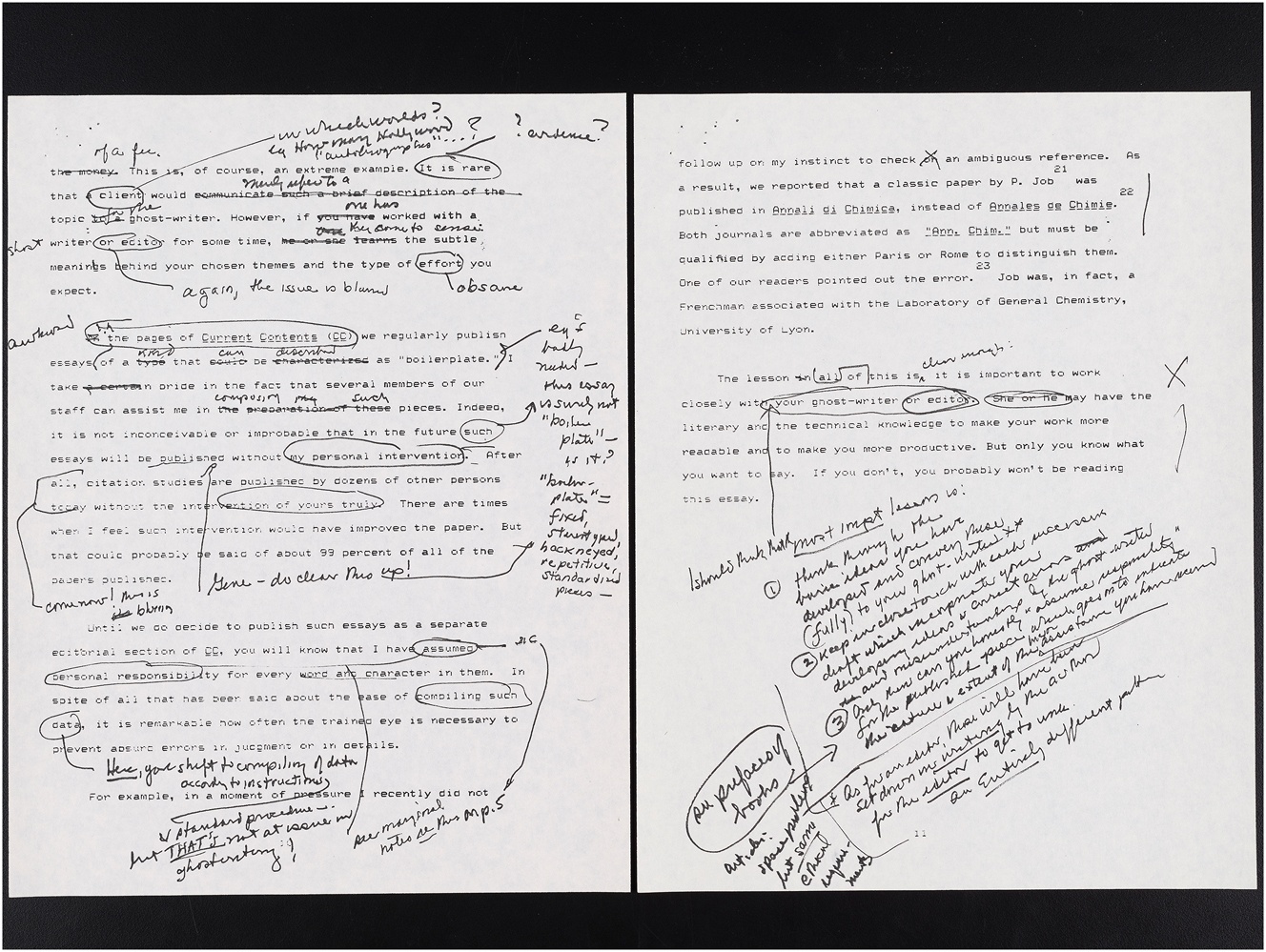
First draft on ghost writing annotated by Robert K. Merton. Courtesy of the Science History Institute.
The mapping-out process was reinforced by another tool used in the drafting process that enabled these differences to be elucidated. As Viviana A. Zelizer has shown, Merton was an avid reader of dictionaries, and this way of approaching topics also informed a drafting process that questioned the scope and boundaries of ghost writing.[44] In order to get this process under way, Merton sent Garfield a photocopy of a dictionary entry of the term which suggested that ghost writing refers to just one segment of the spectrum encompassing participation in the writing of texts that are conventionally and officially attributed to the publicly declared author.[45] This iterative drafting process subjected the term to the logic of sociological enquiry, identifying specific sites and dimensions where ghosts could haunt the public, from individual gags to speech writing, and from memoirs to scientific endeavours. Interestingly, Garfield commented specifically on the pace of the correspondence around the draft saying that “maybe historians will one day need a reminder that this did occasionally happen in the transitional period of the electronic revolution.”[46]
4 Spectrum
Many of the various functions that ghosts could perform were set out in an essay published in the December 1985 issue of Current Contents®.[47] As a result of the attempts to pursue ghosts through their possible entries, the essay began considering the types of help a ghost could offer in different areas. As we know, ghosts are inherently difficult to identify because erasure from the final text is a precondition for their existence. This elusive nature can be understood as a normative problem, but also, as Garfield demonstrates, as a cultural practice deemed acceptable under certain conditions.[48] While scholars orientated towards law and economics tend to conceive ghosts as market failures, others involved in the doctrinal enterprise often subject them to empirical research for the purpose of law reform. Although they understand the root cause of ghosts differently, their scholarship is united by a view of ghosts as legal loopholes in need of a regulatory answer.[49] However, a conscious sense of professional ethics and courtesy could help when it comes to an awareness of when the assistance of a ghost needs to be explicitly acknowledged and when it is best left out. This can in turn take us back to legal forms and obligations, questions of copyright and, particularly, the issue of ownership as a distinct matter of law.[50] In fact, most legal disputes concerning ghost writers tend to relate to this proprietary dimension because copyright law is underpinned by a functional desire to stabilise normative expectations around money, recognition, and attribution.[51] Focusing on the degrees of help and any consequent ramifications, the Current Contents® essay provided a topology of designated areas between editing and writing where ghosts could emerge. Such an attempt resembled Newton’s prism experiments in the sense that it reflected the various bands of the spectrum between the two activities.[52] Moreover, this map could be linked to the publishing activities for which the Institute became well known, showing their potential as a medium for bringing to light lost and otherwise invisible traces of authorship. After all, what was the Science Citation Index if not a tool (to measure influence)?
The most significant aspect of the essay was, however, the way in which it reflected the sources and perambulations that preceded the writing down of the text. As such, it included endnotes that contain references to threads of conversations, both by telephone and other personal communications, that shaped its writing. It also evidenced the temporal dimension through which the drafting process took place. The inclusion and highlighting of such communications were not just a gesture to acknowledge participation but also an indication of the generative potential of the system of conversations, reviews, and collaborations upon which ISI products were built. This is illustrated further in the way the essay refers to the making of the Atlas of Science, another product from the Institute that used co-citation to map research topics.[53] This followed the circulating logic of advancing in and through drafts prepared by editors and researchers, which were then sent to experts for commentary. This approach was, according to Garfield, “collaborative writing and editing at its best because it combines the knowledge and the authority of the expert with the skills of the editor-writer and the systematic screening of the literature by the artificially intelligent machine.”[54]
One might legitimately ask, then, what is the place of the author in such a collective drafting process. Perhaps an interesting detour in thinking about authorship lies in how it is configured by the way texts are disseminated. In that sense, Lionel Bently has reflected on a more serious challenge to copyright resulting from new modes of distribution. This, he says, would require “the text to be reconceived and new ways of identifying the boundary between what is mine and what is yours be established.”[55] In that system, he continues, users would be much more likely to be charged by reference to time rather than number of pages.[56] This description curiously echoes the services that the Institute for Scientific Information provided, and their constant updating and transformation, and enables us to think about the ways information processing and dissemination has had an impact on authorship, as it exemplifies a method conditioned by the prescription of editorial and managerial guidelines. One way to consider such an effect is to trace the relationship between the Institute, copyright, and authorship and how it evolved over time. In the last few years, a lot has been written about Garfield and the Institute,[57] but this connection to copyright is often overlooked. In December 1975, Merton had proposed that Garfield join the Authors’ League of America, Inc., a society consisting of the most prominent authors, playwrights, and artists of the United States.[58] Garfield’s response was as follows: “Funny, but I never thought of myself as an ‘author’ before. If you think I should be a member, then I would like to know more about it.”[59] A few years later, he made explicit the authorship arrangements established in the writing of essays for Current Contents®, indicating that “after many long and painful arguments, we agreed that the authorship was mine and that I could only publish essays that truly reflected my knowledge and interests. This agreement remains in effect with my staff today.”[60] Behind this view lies a framing of the authorial locus as a negotiated domain, and a matter that can be practically arranged. In other words, the agreement would be enough to bestow authorship, making it simultaneously a legal operation, a logistical issue, and a transactional subject. Eventually, responsibility for a text could be agreed and signing a piece with a name and a letterhead would involve taking a stance about it.
Is this just an economic and pragmatic decision? An interesting way to examine this function in practice can be found in the way Garfield constantly shifted between the first person singular, to the names of collaborators, to the plural and collective “we.”[61] This associative gesture and enunciation, visible in his weekly texts, brought names alongside the property spectrum and under a single corporate umbrella. At the centre of this subtle articulation in Current Contents® was a shift from copyright to trademark, reflected not only in the symbol of registration used with the magazine title but also in the different efforts to elevate the Institute and turn it into a brand.[62] Clearly, in such circumstances, it seemed like a logical step to construct a corporate identity since the Institute was a private corporation that required an impulse to promote its products. This commercial imperative continued in the following decades and reached its peak when the Institute was sold to Thomson Reuters in 1992.[63]
5 Conclusion
Garfield compiled his previously published articles in a volume series entitled Essays of an Information Scientist. The eighth instalment, evocatively subtitled Ghostwriting and Other Essays was published in 1986.[64] Its preface, also produced in collaboration with Merton and other members of the Institute,[65] highlights the essay on ghosts published a year earlier in Current Contents®. It does so by raising the query once again: why ghost writing? The answer given introduces a curious perspective, comparing ghosts to information workers. “A ghostwriter,” it says, is a figure that:
serves as messenger of another’s thoughts, and thus facilitates communication. In today’s information society, that facilitating role is also the one played by information workers of all kinds – indexers, reviewers, abstractors, librarians, and others. Their work provides a conduit through which scientists, particularly those in relative isolation, can communicate.[66]
What similarities enable this analogy between ghosts and information workers? Why did Garfield bring these two together? Perhaps what makes the analogy so intriguing and productive is the mediating and invisible role played by information workers. Much like a ghost, an information worker connects us to the past and anticipates the future by revealing processes and behaviours that remain hidden. At stake in this analogy is not just the attempt to give legitimacy to information science but also a preoccupation with its unintended consequences, oscillations, and quandaries. The concern with ethical behaviour, and therefore with the use and abuse of ghosts or citations, is not a coincidence. The preface concludes with a reference to the social mission of information work: “It is my perhaps naïve belief that the quest for information and knowledge is the artificial means we use to avoid destruction. Information workers serve as a vital social, as well as intellectual, mission in the world today.”[67] Although the point at which it is possible to achieve social missions through business ventures is problematic, the conclusion serves to bring back the idea of information work and ghost writing to the domain of help and its benefits to society, now somehow universalised. In that sense, this last paragraph constituted a counterpoint to the fears around the latest advances in technology that abounded in the information industry in the 1970s and 1980s.
And yet, the eliciting of ghosts in the context of this type if work can also be linked to the copyright dilemma looming behind the informational turn. During his life, Garfield and other information entrepreneurs brought copyright into discussion of policy and legislative discourses.[68] This took place mainly in the context of the Information Industry Association, a group that was formed to help and give a unified political voice to corporations exploiting new technologies in the information field. This non-profit trade association was established to bring together commercial information sellers and publishers such as the Institute for Scientific Information and McGraw & Hill Inc.[69] Perhaps the most important subcommittee constituted for such endeavour was the Proprietary Rights Committee, chaired by Garfield, that took an active role in defending information entrepreneurs against non-profit ventures that made information accessible and free. Whether or not one subscribes to such strategies, morally or legally, the fact is that they produced several paradoxes. Although their focus was on the protection of information initiatives as socially desirable, the effect of recasting information as a legal subject was the perception of copyright as a tool to serve missions and interests, despite having been initially considered an obstacle.[70] This is not something new, after all. If the history of copyright can teach us one thing, it is that copyright-based arguments to justify protection have been used rhetorically to support different and even opposing conclusions, particularly when the protection of new subject matter arises. However, it could explain why the law of copyright has encountered difficulties engaging with information not just due to its elusive character as a subject matter but also – indeed mainly – because of the ghosts that facilitated its emergence as an industry.
This might be the place to return to the downfall of Marianne Hall as the chairman of the Copyright Royalty Tribunal and how it triggered the conversation between Garfield and Merton. There is an irony in the way they focused on her ambiguous reference to writing and editing to consider the difference between the two activities. While the Current Contents® essay mentioned the ethical stakes underpinning these practices, the curious thing about the disgraceful episode was not her confused statements regarding writing and editing, but her attempt to deflect responsibility by claiming that editing did not involve any understanding of what you do or read. Her relationship to the contentious passages of the book and the attempt to distance herself from the content by referencing the editing process would somehow be elided if we draw a spectrum whereby authors are considered as having exclusive responsibility for texts. And the deflection is problematic because the question of accountability might need to cover not just authors but also publishers, platforms and intermediaries who construct and facilitate them, especially after the shift from an industrial to an information economy that increasingly conflates the two.
About the author
Dr. Jose Bellido teaches law at the University of Kent. He is particularly interested in the history of intellectual property law and has additional research interests in legal theory, evidence, and legal history. His last publications include Adventures in Childhood: Intellectual Property, Imagination and the Business of Play (Cambridge University Press, 2022) [with Kathy Bowrey] and Intellectual Property and the Design of Nature (Oxford University Press, 2023) [co-edited with Brad Sherman].
© 2023 the author(s), published by De Gruyter, Berlin/Boston
This work is licensed under the Creative Commons Attribution 4.0 International License.
Articles in the same Issue
- Frontmatter
- Editorial
- Introduction to the ‘The Spectral Nature of Intellectual Property’ Pólemos
- Focus
- The Spectre of the Machine: Finding Space for Empirical Inventions in Patent Law
- Copyright, Ghosts, Information
- Impossible Realities and Intellectual Property: Specters of Value in Amie Siegel’s Provenance
- The Emergence of Yoga-as-Property in American Law: The Haunting Presence of Commercial Logics from Swami Vivekananda to Bikram’s Hot Yoga
- Spectres of Intellectual Property in the Soviet Union: The Development and Recognition of the Inventor’s Certificate
- “A Name Which to Them is Sacred”: Quakers and Religious Trademarks in American Enterprise
- Schrödinger’s Rose: Indeterminacy and Contingent Futures in the Plant Variety Rights System of Aotearoa New Zealand
- Non-singular Logics of Intellectual Property in Biomedical Innovation
- Spectral Shadows in Scientific Practice: Unveiling the Haunting Effects of Authorship and Scientific Capital Accumulation
- Research
- Domination and Submission. From the Idea of ‘Legal Personality’ Back to the Metaphor of the ‘Mask’
- “The Whore That Lost Everything”: The Tyranny of Law and the Queer Feminisation of Soft Power as Explored in Black Sails
- Book Review
- Ian Ward: The Trials of Charles I
Articles in the same Issue
- Frontmatter
- Editorial
- Introduction to the ‘The Spectral Nature of Intellectual Property’ Pólemos
- Focus
- The Spectre of the Machine: Finding Space for Empirical Inventions in Patent Law
- Copyright, Ghosts, Information
- Impossible Realities and Intellectual Property: Specters of Value in Amie Siegel’s Provenance
- The Emergence of Yoga-as-Property in American Law: The Haunting Presence of Commercial Logics from Swami Vivekananda to Bikram’s Hot Yoga
- Spectres of Intellectual Property in the Soviet Union: The Development and Recognition of the Inventor’s Certificate
- “A Name Which to Them is Sacred”: Quakers and Religious Trademarks in American Enterprise
- Schrödinger’s Rose: Indeterminacy and Contingent Futures in the Plant Variety Rights System of Aotearoa New Zealand
- Non-singular Logics of Intellectual Property in Biomedical Innovation
- Spectral Shadows in Scientific Practice: Unveiling the Haunting Effects of Authorship and Scientific Capital Accumulation
- Research
- Domination and Submission. From the Idea of ‘Legal Personality’ Back to the Metaphor of the ‘Mask’
- “The Whore That Lost Everything”: The Tyranny of Law and the Queer Feminisation of Soft Power as Explored in Black Sails
- Book Review
- Ian Ward: The Trials of Charles I
