How individuals cope with anger- and sadness-induced narrative misinformation on social media: roles of transportation and correction
-
Xinyan Zhao (PhD University of Maryland) is an assistant professor in the Hussman School of Journalism and Media at the University of North Carolina at Chapel Hill. Her research focuses on computational strategic communication, social networks, and crisis and health communication.
 ,
,
Jessica Shaw is a PhD student in the Hussman School of Journalism and Media at the University of North Carolina at Chapel Hill. Her research interests in digital media, digital privacy, crisis communication, and risk and health communication.
Zexin Ma (PhD University of Maryland) is an assistant professor in the Department of Communication at the University of Connecticut. She conducts research at the intersection of health communication, narrative persuasion, misinformation, and social and emerging media.

Abstract
Purpose
The spread of health conspiracies and misinformation online threatens public health as most Americans choose to acquire health information online. This study examines how discrete emotions like anger and sadness influence individuals’ responses to narrative-based health misinformation, proposing a theoretical model of narrative misinformation coping and exploring the mechanisms through which these emotions affect risk perception and misinformation coping.
Design/methodology/approach
Through a 2 (Misinformation type: narrative vs. non-narrative) × 2 (Issue: climate change vs. fentanyl overdose) × 2 (Correction: present vs. absent) online experiment (N = 401), our results underscore the importance of both risk coping and misinformation coping in individuals’ responses to emotional narrative misinformation, along with the role of narrative transportation in intensifying felt emotions and facilitating both types of coping.
Findings
Our results elucidate how individuals cope with anger- and sadness-induced narrative misinformation. Specifically, sadness decreases susceptibility to narrative misinformation’s negative effects, and anger prompts intuitive actions. Narrative transportation deepened felt emotions and both coping processes, and corrections reduced the perceived truthfulness of misinformation.
Practical implications
Our findings offer practical strategies for mitigating misinformation by disrupting narrative transportation, particularly for anger-induced stories.
Social implications
Our findings can contribute to the development of targeted policies aimed at mitigating online misinformation dissemination and provide a roadmap to executing effective correction measures.
Originality/value
This study proposes and tests a theoretical model of people’s responses to narrative misinformation addressing both misinformation coping and risk coping through cognitive and behavioral routes. The model also explains how transportation, along with different appraisal tendencies, can intensify both coping processes.
1 Introduction
Amid the growth of digital communication technologies and social networking sites, there have been increasing concerns about the proliferation and dissemination of conspiracies, misinformation, or disinformation online, particularly in health communication (Peng et al. 2022; Walter et al. 2021). As most Americans choose to acquire health information online (National Institutes of Health 2020), untruthful content and misleading narratives pose significant threats to public health.
Narratives help decode information in a manner that is more intelligible to people, thus influencing public understanding of health information (Frank et al. 2015; Sools 2013). However, audiences often struggle to distinguish what is true and not true within narrative messages. Recent research suggests narrative misinformation, which involves misleading stories, fake experts, and negative emotions, has been a common strategy for crafting health misinformation (Massey et al. 2020; Peng et al. 2022; Chen et al. 2021b). Also, initial evidence shows individuals are particularly susceptible to narrative misinformation presenting story-like information in an emotional and personal manner (Zhao and Tsang 2024). Such tactics further distrust in doctors and foster conspiratorial thinking around officially recommended health practices; they have been used to link the measles-mumps-rubella (MMR) vaccine to autism or suggest severe side effects can result from COVID-19 vaccination (Mann 2019; Skafle et al. 2022). Thus, it is vital to further examine the influence of discrete emotions on individuals’ processing of narrative misinformation on social media where users often share personal stories.
This study contributes to the growing literature on narrative misinformation in the realms of health, risk, and environment. First, the Appraisal-Tendency Framework (ATF) explains specific emotions with unique appraisal tendencies can influence one’s risk decision-making (Lerner et al. 2007). This study extends the ATF to the misinformation literature by examining how individuals respond to social media narrative misinformation inducing anger and sadness with distinct appraisals. Second, despite extensive research in narrative communication (Banerjee and Greene 2012; Lillie et al. 2021) and health misinformation (van der Meer and Jin 2020; Zhao and Tsang 2024), understanding of the psychological processes through which individuals cope with narrative misinformation remains limited. Coping with health and risk misinformation entails both assessing content truthfulness (Lu et al. 2022; Taddicken and Wolff 2020) and evaluating hazard likelihood (Chang 2021; Weinstein 1993). To explicate both processes, this study proposes and tests a theoretical model examining the influence of online narrative misinformation on misinformation and risk coping through sadness, anger, and narrative transportation (see Figure 1). Drawing upon the misinformation literature (e.g., Walter et al. 2021), this study also investigates the efficacy of fact-checking corrections for aiding misinformation and risk coping.
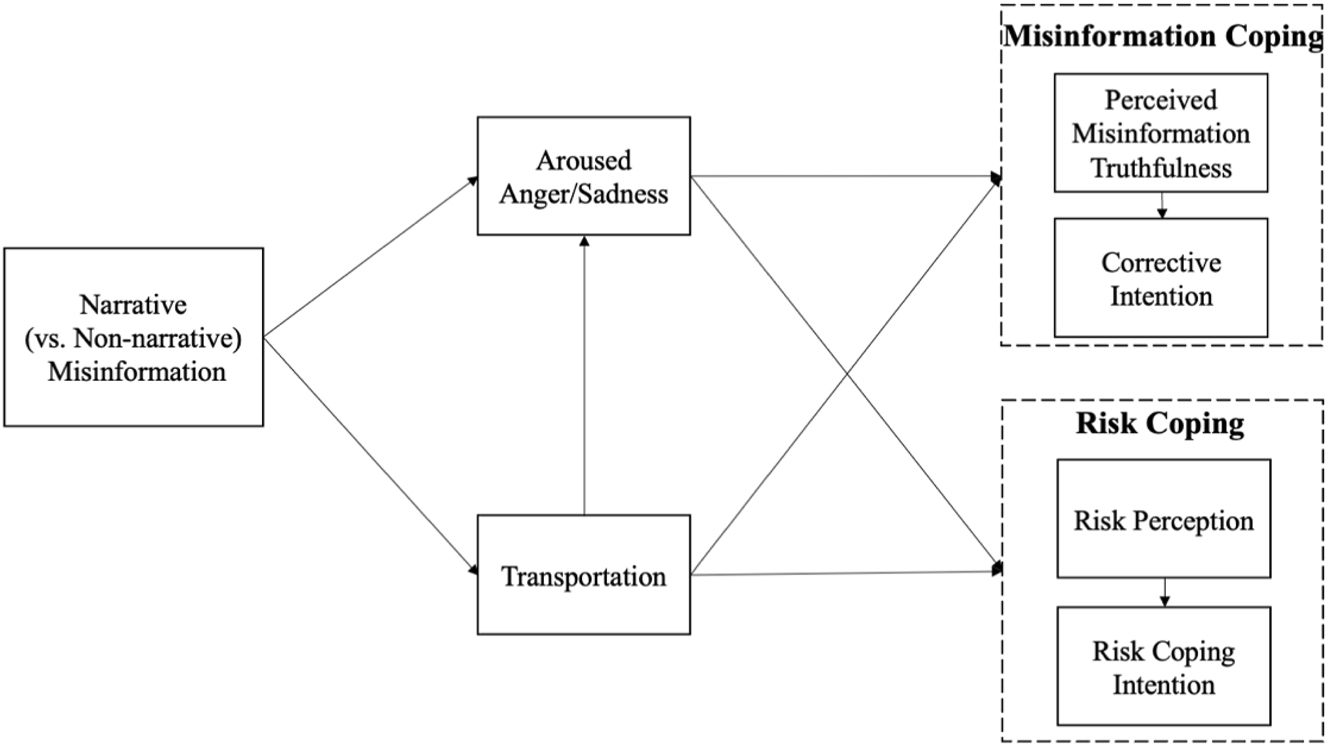
Theoretical model of narrative health misinformation coping.
We conducted a 2 (Misinformation type: narrative vs. non-narrative) × 2 (Issue: climate change vs. fentanyl overdose) × 2 (Correction: present vs. absent) online experiment (N = 401) to test the theoretical model. Our results suggest the importance of both risk coping and misinformation coping in individuals’ responses to emotional narrative misinformation. Narrative transportation deepened felt emotions and both coping processes, and corrections reduced the perceived truthfulness of misinformation. Our results elucidate how individuals cope with anger- and sadness-induced narrative misinformation, offering strategies for mitigating misinformation by disrupting narrative transportation, particularly for anger-induced stories.
2 Literature review
2.1 Misinformation on social media
Misinformation is defined as false or misleading information based on the best available scientific evidence and expert knowledge at the time (Vraga and Bode 2020). The threat of misinformation can be heightened by health issues, such as unverified COVID-19 vaccine mandates, Zika Virus conspiracies, and fabricated opioid anecdotes. Recent research shows that misinformation spread online poses a greater threat than its offline counterpart, due to digital technologies and social media amplifying its reach and engagement (Peng et al. 2022; Chen et al. 2021a). A meta-analysis shows that health misperceptions, due to exposure to misinformation on social media, can generally be corrected (Walter et al. 2021). Corrective information can increase awareness surrounding the severity of a crisis, aiding in changing attitudes and emotions (van der Meer and Jin 2020).
However, in the social media context, emerging evidence has found the correction of narrative misinformation, such as personal stories, anecdotes, or testimonials, is less successful, compared to the correction of blatantly wrong claims (Zhao and Tsang 2024). Narrative misinformation is defined as false or misleading information that deviates from scientifically validated knowledge, conveyed through a narrative format consisting of a sequence of events and characters (Kreuter et al. 2007; Vraga and Bode 2020). One reason could be that social media users perceive fake testimonials and stories shared by like-minded others as more relatable and authentic, thereby lowering verification motivation. Another reason could be the emotional impact of narrative misinformation, as reliance on heuristic cues such as strong emotions can strengthen the impact of misinformation.
To enhance our understanding of individual coping mechanisms with narrative misinformation in the social media environment, this study introduces a theoretical model detailing responses to narrative misinformation that elicits anger and sadness, each with unique appraisal tendencies. We discuss narrative communication theories and Appraisal Tendency Framework (ATF) in the misinformation context as a basis for the model as follows.
2.2 Narrative misinformation and emotions
A narrative is ‘the telling of someone’s experience about something’ (Dahlstrom 2021, p. 2). A fundamental part of human communication, narratives are a popular approach to conveying health information and promoting healthy behavior change (Hinyard and Kreuter 2007). Extensive research has shown narratives to be powerful influences in health-related beliefs, attitudes, and behaviors (see Shen et al. 2015). However, just as narratives are utilized for communicating scientific health information, they can also be used to spread misinformation, disinformation, and conspiracy theories. Narratives are a common strategy for creating online health misinformation (Peng et al. 2022; Chen et al. 2021b). For example, in a content analysis of HPV vaccine-related posts on Instagram, Massey et al. (2020) found that anti-vaccine posts were more likely to include personal narratives than pro-vaccine posts.
The primary mechanism for narratives to persuade is through transporting readers to the narrative world, namely, drawing their attention to the story and evoking strong emotions (Green and Brock 2000; Moyer-Gusé 2008). Similarly, online narrative misinformation can induce transportation. This is because narrative misinformation tends to feature vivid and detailed descriptions that can capture attention and arouse strong emotions. The consequence of being transported into a story world is to adopt story-relevant beliefs, attitudes, and behaviors. For example, Ma and Yang (2022) found transportation was positively related to intentions to reduce alcohol use and seek information about alcohol use. Zhao and Tsang (2024) found that narrative (vs. statistical) misinformation led to greater transportation, and consequently, increased intentions to share the misinformation on social media.
Although emotions are a critical component of narrative transportation, they are often measured by asking participants to indicate their overall feelings (e.g., This story affected me emotionally). Based on the appraisal approach to emotions (Lazarus 1991), researchers have explored the role that discrete emotions play in narrative processing and effects (e.g., Banerjee and Greene 2012; Lillie et al. 2021). However, the impact of different emotions on misinformation processing and its behavioral outcomes remains unexplored.
2.3 Appraisal tendency framework: anger and sadness
The Appraisal-Tendency Framework (ATF) explains the effect of emotions on individual judgments and decision-making (Lerner et al. 2007). Namely, ATF suggests each emotion links to specific appraisal tendencies – or set of motivations and cognitive patterns. Appraisal tendencies then give rise to associated sets of judgments, actions, and behaviors (Lazarus 1991). For example, sadness is linked to situations where circumstances are seen as controlling the event and appraisals of helplessness and loss are present (Tiedens and Linton 2001). Anger, on the other hand, is tied to experiences where other individuals are seen as controlling the event and appraisals of certainty, control, and perceptions of unfairness are found (Lerner et al. 2007). While ATF addresses both positive and negative emotions, a large portion of misinformation is found to contain negative emotions, such as anger and sadness (Lee et al. 2022). Additionally, Han et al. (2020) suggest anger makes individuals more susceptible to misinformation as the emotion adds to a propensity to resolve a perceived unjust situation. Sadness-eliciting misinformation on social media was also found to increase attention and sharing efforts (Lee et al. 2022). Thus, the study examines anger and sadness as two discrete emotions that merit additional attention within narrative misinformation.
2.3.1 Anger
Anger relates to lower cognitive efforts, as angry people tend to rely on heuristics and intuition in judgment-making (Carnahan et al. 2023; Tiedens and Linton 2001). This perceptual bias is characterized by attributions of blame and an inflated sense of certainty. Anger, typically arising from goal-blocking or offensive events, propels individuals toward action, reinforcing a behavioral tendency to affirm one’s beliefs while dismissing conflicting evidence (Lerner and Keltner 2001). Anger’s role in misinformation extends to an increased vulnerability to falsehoods, as the energizing nature of anger can predispose individuals to hastily embrace false information. For example, anger increases the likelihood of perceiving false COVID-19 cures as scientifically valid (Han et al. 2020).
Anger also influences risk perception (Slovic 1987), leading individuals to minimize or underestimate potential risks. Studies suggest anger motivates people to defend against or attack threats, therefore, tricking individuals to feel more in control (Lazarus 1991; Lerner and Keltner 2001). Anger also triggers appraisals that make people feel more certain regarding information accuracy, and thus, less likely to take precautions (Kim 2021). Specifically, for health misinformation on e-cigarettes, anger mediated false information and significantly decreased risk perception (Liu et al. 2021).
2.3.2 Sadness
Sadness can foster deliberation (Bago et al. 2022). Sadness is linked to the perception of goal failure, thereby promoting cognitive processes conducive to problem-solving (Schwarz 1990). Compared to anger, individuals experiencing sadness tend to engage in more systematic and detail-oriented information processing (Bodenhausen et al. 1994). Limited research has investigated sadness’s impact on misinformation perception. Luo et al. (2021) found that sadness does not affect susceptibility to false information, whereas Koch and Forgas (2012) observed that sadness decreases belief in misinformation with repeated exposure.
In terms of risk, individuals experiencing sadness have been found to increase perceived levels of risk (Kim 2021), as sadness can trigger the need to problem-solve (Lerner et al. 2007; Schwarz 1990). As sadness is often linked to appraisals of situational control where people have little autonomy, the pessimism associated can result in greater risk perception. For example, individuals shown sad videos were more likely to think the issue at hand posed a greater threat than those in the control group (Myrick and Oliver 2015).
2.4 Appraisal tendency framework and health misinformation
Within existing ATF literature, negative emotions and associated appraisal tendencies have been found to play a critical role in the evaluation and understanding of health misinformation. Liu et al. (2021) examined the role of emotions in e-cigarette-related misinformation and found that anger mediated the relationship between exposure to misinformation and people’s perception of e-cigarette risks, making them more likely to believe that e-cigarettes were not harmful and reducing their perception of associated risks. Similarly, Šrol et al. (2021) found that anxiety increased people’s belief in COVID-19 misinformation, suggesting that different negative emotions can amplify the acceptance of misinformation.
Emotion heuristics – or mental shortcuts that encourage judgments based on emotions rather than logic – are often used to spread misinformation (Kata 2010). Thus, messages with misinformation often elicit more intense negative emotions than messages with accurate information (Paschen 2020). Ali et al. (2022) also found misinformation designed to discourage vaccination frequently utilized anger to motivate people to share and spread the misinformation. Since anger triggers appraisals that make individuals feel more certain about information accuracy (Lerner and Tiedens 2006), they are more likely to share misinformation on vaccination (Ali et al. 2022).
ATF has begun to be used to examine health behaviors and better understand misinformation processing, but limited research has applied the framework to narrative misinformation on social media. Further explorations into different discrete emotions, particularly the use of strong negative emotions such as sadness and anger within narratives offer opportunities to expand the literature.
3 Theoretical model and hypotheses
Based on the discussion on narrative misinformation and ATF, we propose a theoretical model that explains how people respond to narrative misinformation arousing anger versus sadness through the dual processes of misinformation coping and risk coping (see Figure 1). Both coping processes entail cognitive and behavioral components. On the one hand, misinformation coping involves the cognitive assessment of perceived truthfulness of misinformation and the behavioral tendency of corrective intention (Taddicken and Wolff 2020). Namely, perceived truthfulness of misinformation addresses people’s evaluation and authentication of content accuracy, while corrective intentions focus on intended behaviors taken to cope with incorrect information, such as fact-checking the information at hand. Literature suggests that perceived truthfulness of misinformation can affect individuals’ misinformation correction intention (Lu et al. 2022; Zhao and Tsang 2024). On the other hand, risk coping involves both the cognitive assessment of perceived risk and action tendencies toward the risk factor (Austin et al. 2023; Weinstein 1993). Perceived risk examines people’s evaluation of their risk regarding an issue, such as one’s risk of contracting HPV. Coping intention examines the likelihood of individuals taking part in coping actions to deal with the identified risk, such as opting for HPV vaccination. Literature also suggests that perceived risk can motivate coping intention (Weinstein 1993). Taken together, individuals exposed to narrative misinformation can engage in both coping processes, with narrative transportation intensifying the emotional experience and coping processes, leading to distinct cognitive and behavioral outcomes. We detail misinformation coping and risk coping, including their respective cognitive and behavioral components, in the sections below.
3.1 Misinformation coping: roles of anger and sadness
Misinformation coping literature suggests individuals faced with misinformation turn to information-seeking as a method of verifying the information (Taddicken and Wolff 2020). Message truthfulness involves one’s judgment of content veracity (Zhao and Tsang 2024). Tandoc et al. (2018) suggested people often utilize multiple strategies to authenticate and determine if the message is truthful. Corrective intentions, such as debunking or fact-checking misinformation, are also useful in helping individuals develop new narratives around misperceptions (van der Meer and Jin 2020). For this study, the message content contains misinformation. The study thus considers the perceived truthfulness of misinformation and correction intention as cognitive and behavioral forms of misinformation coping.
In examining the role of discrete emotions within misinformation coping, ATF research finds anger to be an activating emotion linked to a tendency to take actions without systematic cognitive responses (Lazarus 1991). The misinformation literature also supports that anger can increase perceived message credibility (Han et al. 2020). This can reduce their likelihood of corrective actions, a key outcome in misinformation research defined as ‘outward behavior that seeks to rectify what is seen as flawed’ (Koo et al. 2021, p. 12). Following O’Keefe’s (2003) recommendation to analyze effect-based message variables (e.g., fear appeal) as mediating states rather than direct outcomes, we propose the following mediation hypothesis:
H1a-b:
Exposure to anger-arousing narrative misinformation increases anger, which subsequently (a) increases perceived truthfulness of misinformation and (b) decreases corrective intention.
By contrast, sadness triggers more deliberative and detail-oriented information processing (Bago et al. 2022; Lerner and Tiedens 2006). Following this rationale, individuals viewing sadness-inducing misinformation might put additional thought into the perceived truthfulness of misinformation and become more apt in identifying and implementing corrections to counteract misinformation.
H2a-b:
Exposure to sadness-arousing narrative misinformation increases sadness, which subsequently (a) decreases perceived truthfulness of misinformation and (b) increases corrective intention.
3.2 Risk coping: roles of anger and sadness
As health misinformation can result in the spread of disease or other potential harms, individuals have also been found to cope with misinformation by formulating perceptions of risk (Austin et al. 2023; Chang 2021). In assessing risk, individuals consider the prevalence, severity, and susceptibility of the suggested risk (Weinstein 1993). In other words, people first determine whether a threat is present before taking action through either treatment or prevention behaviors (Tandoc et al. 2018). This study considers risk perception and coping intention as cognitive and behavioral forms of risk coping.
Within the context of risk coping, the research on ATF suggests that angry people tend to rely on heuristics in judgment-making at the expense of systematic risk evaluation (Carnahan et al. 2023; Tiedens and Linton 2001), thereby leading individuals to underestimate potential risks (Slovic 1987). Anger also triggers appraisals that make people feel more certain regarding information accuracy, and thus, less likely to take precautions (Kim 2021). Therefore, anger-eliciting misinformation should mitigate risk coping by reducing risk perception and coping intention. We propose the following hypothesis.
H3a-b:
Exposure to anger-arousing narrative misinformation (vs. the control condition) decreases risk coping (i.e., risk perception and coping intention) through aroused anger, such that exposure increases anger, which reduces (a) risk perception and (b) coping intention.
Sadness, on the other hand, encourages problem-solving through inward contemplation (Nabi 1999). Sad individuals often focus on issue-relevant thinking and perceive higher levels of risk (Kim 2021), and risk perception can motivate coping intention (Weinstein 1993). We thus hypothesize:
H4a-b:
Exposure to sadness-arousing narrative misinformation (vs. the control condition) increases risk coping (i.e., risk perception and coping intention), such that misinformation exposure increases sadness, which increases (a) risk perception and (b) coping intention.
3.3 Role of transportation
Transportation is defined as “a distinct mental process, an integrative melding of attention, imagery, and feelings” (Green and Brock 2000, p. 701). The consequences of transportation include losing access to the real-world facts, experiencing strong emotions, and adopting story-consistent beliefs and attitudes (Green and Brock 2000; Moyer-Gusé 2008). Therefore, we predict transportation will deepen the experiences of discrete emotions and the degrees of risk coping and misinformation coping in processing narrative misinformation. We hypothesize transportation following narrative misinformation exposure increases felt emotions, risk coping, and misinformation coping (see Figure 1).
H5a-c:
Exposure to narrative misinformation (vs. the control condition) increases (a) felt emotions, (b) risk coping, and (c) misinformation coping through transportation.
3.4 Role of correction
Last, meta-analyses have found corrections, such as fact-checking or debunking, to be effective strategies for mitigating misinformation (Walter et al. 2021). After exposure to health misinformation, corrections can counter misperceptions by reducing misinformation credibility (Walter et al. 2021). As such, correction following narrative misinformation is expected to aid misinformation and risk coping, thus, we hypothesize:
H6a-b:
A correction (vs. no correction) following narrative misinformation affects (a) misinformation coping and (b) risk coping.
4 Method
All studies received approval from the university’s ethical review board. Participants were recruited from Prolific, a company that provides an online panel of research participants. First, experimental stimuli were designed using a series of pilot studies. Afterward, a final survey was launched in November 2022. Once the participants signed up for the study, they were directed to the study on Qualtrics through an anonymous link. They were debriefed and provided a detailed explanation of authentic information at the end of the study.
4.1 Pilot studies
The first pilot was conducted in September 2022 to select two misinformation topics with emotional impact. Participants (N = 75) reported their emotions on 7-point scales for false Facebook posts on several topics. The results revealed two issues with the strongest emotional impact: the first focused on the impact of a climate change bill on the increase in grocery prices (abbreviated as climate change below), arousing anger (M = 3.95, SD = 0.21), and the second on alleged incidents of dollar bills covered with fentanyl causing unintentional overdoses (abbreviated as fentanyl overdose below), arousing sadness (M = 4.27, SD = 0.29). Specific measures of anger and sadness are included in the measurement section of the main study.
A second pilot (N = 64) was launched in September 2022 to test narrative versus non-narrative versions of the two topics and ensure narrative misinformation aroused significantly higher anger for climate change and higher sadness for fentanyl overdose when compared to non-narrative conditions. For climate change policy, narrative versions (M = 5.08, SD = 0.88) elicited more anger than the non-narrative versions (M = 3.36, SD = 1.78), t (39) = −3.89, p < 0.001. For opioid overdose, narrative versions (M = 5.27, SD = 1.62) elicited more sadness than the non-narrative versions (M = 4.05, SD = 1.76), t (40) = −2.34, p = 0.041. Results also confirmed that participants distinguished between a narrative post and a non-narrative post: t (36) = −4.52, p < 0.001 for climate change and t (36) = −2.20, p = 0.032 for opioid overdose.
A third pilot (N = 60), launched in October 2022, tested whether various stories of the same issue could arouse anger and sadness, respectively, to remove the potential confounding effect of the issue. For example, for climate change policy, a fake story about a single mother suffering from the policy was designed to elicit sadness, whereas a fake story about an angry consumer toward the policy was designed to elicit anger. Results showed various stories on the same issue generated both high anger and sadness, suggesting the two discrete emotions cannot be manipulated separately using the same issue. To ensure internal validity, we kept the climate change story of the angry consumer to primarily arouse anger and the fentanyl overdose story of a sad mom to primarily arouse sadness. The implications of this approach were discussed in the section on Limitations and Future Directions.
4.2 Main study
We conducted a 2 (Narrative: present vs. absent) × 2 (Topic: climate change policy vs. accidental fentanyl overdose) × 2 (Correction: present vs. absent) between-subject experiment in November 2022. A total of 444 participants were recruited. However, 43 participants were removed due to incomplete responses or failure to pass attention checks, yielding a final sample of 401 participants. Most respondents were male (49.4 %, n = 198) with roughly 73 % (n = 291) of participants between 18 and 40 years old. Approximately 13 % had at least a high school degree, 72 % had some college education or more, and the remainder had a graduate degree. The average household income fell between $50,000 and $59,9999.
Participants were randomly assigned to view Facebook post stimuli regarding a fabricated climate change policy or a fabricated fentanyl overdose (see Appendix A for stimuli). For the 200 participants viewing climate change stimuli, each one was randomly assigned to see an anger-arousing narrative post (experimental condition) or a non-narrative post (control condition). For the remaining 201 participants viewing the fentanyl stimuli, each one was randomly assigned to see one a sadness-arousing narrative post (experimental condition) or a non-narrative post (control condition). The stimuli creation was informed by all pilots to elicit the discrete emotions (for detail, see the section of Pilot Studies and Appendices). After message exposure, participants answered questions on their perceptions and behaviors related to the corresponding topic. Respondents were then randomly assigned to view a correction post or non-correction (i.e., click to proceed; see Appendix B) and reported message perceptions using similar measures worded in a slightly different way. Last, demographic information was collected.
4.2.1 Measurements
Discrete emotions . Following the literature (Dillard et al. 1996), anger was measured by 7-point scales using the items: angry, irritated, and annoyed (1 = not at all, 7 = extremely). The mean of anger is 4.43 (SD = 1.73, Cronbach’s α = 0.90). Sadness was measured by 7-point scales using sad and dismal (1 = not at all, 7 = extremely). The mean of sadness is 4.19 (SD = 1.64, Pearson’s r = 0.64).
Transportation . Following previous studies (Banerjee and Greene 2012), transportation was measured on 7-point scales (1 = strongly disagree, 7 = strongly agree), with items such as ‘I could picture myself in the scene of the events described in the post.’ The average of the items is 4.44 (SD = 1.33, Cronbach’s α = 0.81).
Perceived risk. Respondents indicated their perceived risk by estimating the likelihood of the fake issue affecting themselves or others on 7-point scales (1 = extremely unlikely, 7 = extremely likely) (van der Linden 2015). For climate change, respondents estimated the likelihood of the fake policy affecting their standard of living/well-being and other’s standard of living/well-being (M = 4.78, SD = 1.35, Cronbach’s α = 0.89). For accidental fentanyl overdose, respondents estimated the likelihood that themselves, their family members, community, and others would be affected (M = 3.23, SD = 1.41, Cronbach’s α = 0.85).
Coping intention. Adapted from Ojala’s (2021) measures, coping intention was assessed on 7-point scales (1 = strongly disagree, 7 = strongly agree) with four, tailored statements, such as ‘I reach out to the government or other officials to suggest they address climate change,’ or ‘I search for information to learn more about opioid issues,’ depending on the issue. The mean of coping intention is 4.07 (SD = 1.47, Cronbach’s α = 0.87) for climate change and 3.52 (SD = 1.51, Cronbach’s α = 0.89) for fentanyl overdose.
Misinformation truthfulness . Respondents assessed the truthfulness, accuracy, and correctness of the misinformation on 7-point scales (1 = strongly disagree, 7 = strongly agree) (Zhao and Tsang 2024). The mean is 4.50 (SD = 1.35, Cronbach’s α = 0.97) for climate change and 4.30 (SD = 1.80, Cronbach’s α = 0.99) for fentanyl overdose.
Corrective intention. Respondents indicated their agreement on 7-point scales (1 = strongly disagree, 7 = strongly agree) with three statements such as ‘I would advise the user who posted this news to check its authenticity,’ or ‘I try to remind other people reading this news to check its accuracy’ (Talwar et al. 2020). The mean is 2.98 (SD = 1.26, Cronbach’s α = 0.73) for climate change and 3.24 (SD = 1.49, Cronbach’s α = 0.84) for fentanyl overdose.
Covariate . Issue alignment, the degree to which the respondents’ views align with the featured issue, was measured on a 6-point scale (1 = not aligned at all, 6 = extremely aligned) and used as a covariate, following previous work (Zhao and Tsang 2024).
4.2.2 Manipulation checks
The validity of narrativity manipulation was confirmed: t (199) = −7.74, p < 0.001 for climate change and t (200) = −7.15, p < 0.001 for fentanyl overdose. Compared to the non-narrative condition (climate change: M = 2.76, SD = 1.63; fentanyl overdose: M = 3.05, SD = 1.63), respondents perceived higher narrativity in the narrative post (climate change: M = 4.52, SD = 1.60; fentanyl overdose: M = 4.61, SD = 1.45). The validity of discrete emotion manipulation was also supported. For climate change, respondents exposed to narrative misinformation posts reported significantly higher anger (M = 4.70, SD = 1.52) than those who viewed the non-narrative version (M = 3.56, SD = 1.85): t (199) = −4.73, p < 0.001, Cohen’s d = −0.67, suggesting a medium to large effect size. For fentanyl overdose, respondents exposed to narrative misinformation posts reported a higher level of sadness (M = 4.76, SD = 1.51) than those exposed to the non-narrative version (M = 4.36, SD = 1.65): t (200) = −1.77, p = 0.079, Cohen’s d = −0.25, suggesting a small effect size.
4.2.3 Analytical scheme
We conducted structural equation modeling (SEM) through the R “Lavaan” package. In the structural model, exogenous variables were message condition (1 = narrative misinformation, 0 = non-narrative control) and issue alignment (as a covariate). Mediators included aroused anger, sadness, and transportation. Endogenous variables included risk coping outcomes and misinformation coping outcomes (see Figure 1). Table 1 shows descriptive statistics and a correlation matrix of these variables. In the measurement model, latent constructs with fewer than 3 items were identified through all items. To identify latent constructs with more than 3 items, a parceling approach was used to create three items.
Summary statistics and correlation matrix of all constructs across issues.
| M | SD | Msg condition | Issue alignment | Anger | Sadness | Transportation | Perceived risk | Truthfulness | Coping intent | Corrective intent | |
|---|---|---|---|---|---|---|---|---|---|---|---|
| Msg condition | 0.50 | 0.50 | 1.00 | −0.08 | 0.14a | 0.19a | 0.20b | 0.05 | −0.04 | −0.11c | 0.03 |
| Issue alignment | 3.89 | 1.50 | −0.08 | 1.00 | 0.13c | 0.33b | 0.42b | 0.20b | 0.61b | 0.33b | −0.31b |
| Anger | 4.43 | 1.73 | 0.14a | 0.13c | 1.00 | 59b | 0.36b | 0.17a | 0.15a | 0.13a | 0.11c |
| Sadness | 4.19 | 1.64 | 0.19a | 0.33b | 0.59b | 1.00 | 0.51b | 0.17b | 0.33b | 0.19b | 0.02 |
| Transportation | 4.44 | 1.33 | 0.20b | 0.42b | 0.36b | 0.51b | 1.00 | 0.39b | 47b | 0.37b | −0.10c |
| Perceived risk | 4.00 | 1.58 | 0.05 | 0.20b | 0.17a | 0.17b | 0.39b | 1.00 | 0.28b | 0.43b | −0.08 |
| Truthfulness | 4.40 | 1.59 | −0.04 | 0.61b | 0.15a | 0.33b | 0.47b | 0.28b | 1.00 | 0.21b | −0.45b |
| Coping intent | 3.79 | 1.51 | −0.11c | 0.33b | 0.13a | 0.19b | 0.37b | 0.43b | 0.21b | 1.00 | 0.17b |
| Corrective intent | 3.11 | 1.38 | 0.03 | −0.31b | 0.11c | 0.02 | −0.10c | −0.08 | −0.45b | 0.17b | 1.00 |
-
Note. N = 401. a p < 0.01, b p < 0.001, c p < 0.05.
Parameters were estimated by maximum likelihood. The model was evaluated using standard cutoff values for the model-data fit indices (Hu and Bentler 1999). To estimate indirect effects, the bootstrap method (N = 5,000, biased corrected) was used. Two separate models were fit for two issues to test Hs1–5. To test H6, we conducted 2 (Misinformation type: narrative vs. non-narrative) × 2 (Correction: present vs. absent) ANOVA tests for each issue.
5 Results
For climate change, the hypothesized model fit the data well: chi-squared value (155, N = 200) = 267.69, p < 0.001, CFI = 0.96, SRMR = 0.059, RMSEA = 0.060, 90 % CI [0.048, 0.072], p = 0.083. For fentanyl overdose, the model-data fit was also satisfactory: chi-squared value (137, N = 201) = 210.497, p < 0.001, CFI = 0.98, SRMR = 0.060, RMSEA = 0.052, 90 % CI [0.037, 0.065], p = 0.408.
H1 predicted exposure to anger-arousing narrative misinformation (vs. control) affected misinformation coping (perceived truthfulness of misinformation and corrective intention) through aroused anger. Our results showed that anger-arousing narrative misinformation on climate change (vs. control) raised anger, which significantly increased corrective intention (b = 0.22, SE = 0.07, p = 0.002) but not truthfulness of misinformation (see Figure 2). Truthfulness of misinformation was negatively associated with correction intention: b = −0.22, SE = 0.09, p = 0.012. There was a significant indirect effect between exposure to narrative misinformation on climate change and corrective intention through anger, b = 0.134, SE = 0.07, 95 % CI [0.019, 0.294]. H1 was partially supported.

Structural model for narrative misinformation on climate change. Note. N = 200. ***p < 0.001, **p < 0.01, *p < 0.05. Issue alignment as a covariate was not shown in the figure for simplicity. Issue alignment was positively related to transportation (b = 0.28, SE = 0.06, p < 0.001) and perceived misinformation truthfulness (b = 0.29, SE = 0.06, p < 0.001), but negatively related to anger (b = −0.28, SE = 0.07, p < 0.001).
H3 predicted exposure to anger-arousing narrative misinformation (vs. control) affected risk coping (risk perception and coping intention) through aroused anger. Our results showed that anger-arousing narrative misinformation on climate change policy (vs. control) increased anger, which was negatively related to risk coping intention (b = −0.23, SE = 0.07, p = 0.001) but not risk perceptions. There was a significant indirect effect between exposure to narrative misinformation on climate change and corrective intention through aroused anger, b = −0.143, SE = 0.06, 95 % CI [−0.351, −0.008]. Thus, H3 was partially supported.
H2 predicted exposure to sadness-arousing narrative misinformation (vs. control) affected misinformation coping through aroused sadness, and H4 predicted such an exposure affected risk coping through sadness. H2 and H4 were partially supported, as narrative misinformation on fentanyl overdose did not directly arouse sadness. Instead, it aroused sadness indirectly through transportation: b = 0.491, SE = 0.151, 95 % CI [0.243, 0.849], suggesting only those immersed in the fake stories felt sad. For misinformation coping, felt sadness increased truthfulness of misinformation (b = 0.24, SE = 0.08, p = 0.002) and corrective intention (b = 0.35, SE = 0.11, p = 0.006). For risk coping, felt sadness increased both risk perception (b = 0.19, SE = 0.06, p = 0.004) and coping intention (b = 0.27, SE = 0.09, p = 0.005). Additional analysis revealed two indirect paths linking misinformation exposure and both coping outcomes (see Figure 3): (1) one from fentanyl misinformation exposure to transportation and sadness, which subsequently increased risk perception, and in turn, coping intention (b = 0.120, SE = 0.050, 95 % CI [0.051, 0.255]), (2) another from fentanyl misinformation exposure to transportation and sadness, which subsequently increased truthfulness of misinformation, and in turn, lowered corrective intention (b = −0.072, SE = 0.036, 95 % CI [−0.177, −0.024]). The indirect effect of risk coping was significantly stronger than that of misinformation coping (p = 0.007) for fentanyl overdose.

Structural model for narrative misinformation on fentanyl overdose. Note. N = 201. ***p < 0.001, **p < 0.01, *p < 0.05. Dotted lines represent a hypothesized association that lacks support. Issue alignment as a covariate was not shown in the figure for simplicity. Issue alignment was positively related to transportation (b = 0.48, SE = 0.07, p < 0.001), sadness (b = 0.26, SE = 0.09, p = 0.007), and perceived misinformation truthfulness (b = 0.76, SE = 0.08, p < 0.001).
H5 hypothesized that transportation affected discrete emotions, risk coping, and misinformation coping. For climate change (see Figure 2), transportation due to exposure to anger-arousing narrative misinformation (vs. control) increased felt anger (b = 0.73, SE = 0.15). Transportation increased risk coping through enhancing both risk perception (b = 0.63, SE = 0.10, p < 0.001) and coping intention (b = 0.77, SE = 0.16, p < 0.001). However, transportation reduced misinformation coping by increasing perceived truthfulness of misinformation (b = 0.39, SE = 0.11, p < 0.001). For fentanyl overdose (see Figure 3), transportation due to misinformation exposure increased felt sadness (b = 0.85, SE = 0.19). And transportation indirectly affected misinformation coping and risk coping through felt sadness: the indirect effect between transportation and message corrective intention through sadness was b = 0.321, SE = 0.114, 95 % CI [0.108, 0.657], whereas the indirect effect between transportation and risk coping intention through sadness was b = 0.251, SE = 0.098, 95 % CI [0.052, 0.551]. Thus, H5 was supported.
H6 predicted that a correction (vs. no correction) following narrative misinformation affected misinformation coping and risk coping. For fentanyl overdose, there were significant effects of correction on perceived truthfulness of misinformation, F (1, 197) = 50.19, p < 0.001 and on risk perception, F (1, 197) = 4.68, p < 0.05. Those who viewed corrections perceived lower truthfulness of misinformation (M = 3.56, SD = 1.15) and lower risk perception (M = 3.56, SD = 1.15) than those who did not receive any correction (truthfulness of misinformation: M = 3.90, SD = 1.14; risk perception: M = 3.90, SD = 1.14). For climate change, corrections had a significant effect on perceived truthfulness of misinformation (F (1, 197) = 50.19, p < 0.001), but not on perceived risk. Namely, those who viewed corrections (M = 2.84, SD = 1.47) perceived lower truthfulness of misinformation than participants who did not see a correction (M = 3.88, SD = 1.71). H6 was fully supported for fentanyl overdose but partially supported for climate change.
6 Discussion
Applying the narrative persuasion theory and appraisal tendency framework to the misinformation context, this study tested a theoretical model on how individuals cope with narrative misinformation eliciting anger and sadness. Our results from online experiments supported the roles of both risk coping and misinformation coping in individuals’ responses to emotional narrative misinformation.
First, our results showed that respondents experiencing anger and sadness engaged in both misinformation coping and risk coping, yet through different mechanisms. Anger aroused by narrative misinformation about climate change affected behavioral coping, namely increasing misinformation corrective intention and reducing risk coping intention. Yet, respondents’ felt anger did not affect cognitive coping, including perceived truthfulness of misinformation and risk perception.
Lerner and Keltner (2001) suggest that emotions function to help deal with situations, triggering different types of responses to address the problem or opportunities. Given the controversial issue of climate change, anger probably prompted individuals to correct the message without deliberating its veracity, consistent with the ATF argument that angry people tend to rely on heuristics and intuition in judgment-making (Tiedens and Linton 2001). Anger is also linked to appraisals of certainty, individual control, or perceptions of injustice (Lerner et al. 2007). The angry respondents likely found the fake stories discrepant from their prior beliefs on climate change, triggering appraisals of certainty and injustice, and thus, motivating them to correct the message without believing elaboration or systematic risk evaluation is needed. A negative association between felt anger and risk coping intention was also found, meaning those feeling angry were less likely to cope with the risk presented by the message. Again, this is consistent with the ATF literature that anger is tied to individual control and certainty appraisals which makes people feel more in control and underestimate the need for risk coping (Lazarus 1991; Lerner and Keltner 2001). Our results broaden the scope of ATF, revealing that the specific coping actions participants are motivated to take by anger might be influenced by their pre-existing attitudes toward the issue, facilitating the adoption of easier, congruent actions. It also expands the literature applying ATF as a theoretical foundation to understand narrative misinformation judgements and behaviors.
Meanwhile, respondents experiencing sadness engaged in misinformation coping and risk coping through both cognitive and behavioral routes. Consistent with the literature (Lerner and Tiedens 2006), sadness induced by narrative misinformation on fentanyl overdose heightened risk perception and coping intention. According to the ATF, the appraisal tendency of sadness leads individuals to engage in more systematic information processing due to the triggering of appraisals of helplessness, less control, and loss (Bodenhausen et al. 1994; Tiedens and Linton 2001). Given that sadness triggers such appraisals, individuals are probably more likely to apply efforts toward risk perceiving and increase risk coping behaviors to feel more in control of the situation. Sadness also fostered misinformation corrective intention both directly and indirectly through perceived truthfulness of misinformation. On the one hand, sadness directly increased corrective intention, supporting existing research that offers sadness can spur deliberation conducive to misinformation correction (Bago et al. 2022). On the other hand, sadness indirectly reduced corrective intention through increasing perceived truthfulness of misinformation. This is probably because respondents feeling sad became more immersed in the narrative of the false story, neglecting to scrutinize its accuracy. Taken together, these findings suggest the complex role of sadness in fostering narrative misinformation coping.
Next, we found that narrative transportation deepened felt discrete emotions, risk coping, and misinformation coping. Participants who were more transported into the climate change narrative misinformation perceived greater truthfulness of misinformation, higher risk, and stronger risk coping intention. Transportation following exposure to narrative misinformation on fentanyl overdose also deepened risk coping and misinformation coping through felt sadness. Nonetheless, the interplay between transportation and discrete emotions in affecting misinformation processing appears to be intricate and contingent upon the specific issue. Upon encountering a captivating false story on fentanyl overdose, individuals first experienced transportation, followed by the feeling of sadness. In this context, transportation did not directly lead to narrative misinformation coping, instead, its impact on coping outcomes was mediated by the appraisal tendency associated with sadness. When confronted with a fabricated story concerning climate change, individuals who already hold beliefs about climate change may feel anger without undergoing the process of transportation. Here, transportation directly promoted both misinformation and risk coping. These findings have important implications for understanding the spread of misinformation regarding controversial issues like vaccines on social media. Individuals’ prior beliefs may compound the impact of narrative misinformation, urging them to share misinformation without experiencing transportation or careful thinking. The emotional engagement elicited by these narratives might reinforce pre-existing anger and mistrust, making individuals more susceptible to sharing false information.
Last, we found that a correction following narrative misinformation for both issues reduced perceived truthfulness of misinformation as intended. This supports the literature on misinformation correction by showing the effectiveness of corrections in reducing the perceived veracity of narrative misinformation. We also found that correction following narrative misinformation sometimes failed to correct risk perception for certain stories such as climate change. This could be explained by respondents’ pre-existing attitudes toward climate change before misinformation exposure. Even though individuals realized the story on climate change tax was false, they still believed in the high risk induced by the fabricated climate change tax. Similar patterns can be seen with vaccine or opioid misinformation narratives on social media. For instance, despite corrections debunking myths about vaccines, some individuals continue to perceive high risks associated with vaccinations due to ingrained beliefs. This also underscores the need for corrective strategies that not only address factual inaccuracies but also target the emotional and cognitive dimensions of misinformation.
6.1 Theoretical and practical implications
This study makes several theoretical contributions. First, the proposed theoretical model enriches the ATF by broadening its application to narrative misinformation on social media. Findings advance the ATF by demonstrating that narrative misinformation elicits anger and sadness with unique appraisal tendencies, influencing coping outcomes through distinct mechanisms and pathways. Appraisals associated with anger-laden narrative misinformation are more direct and favor behavioral coping measures including message correction and risk reduction. The lack of cognitive coping in this process suggests that anger can motivate individuals to adopt coping behaviors without systematic message evaluation. Additionally, appraisals associated with sadness-laden misinformation enhance misinformation coping by sharpening the ability to discern falsehoods. However, the role of sadness in risk coping might be affected by transportation, as people more immersed in fake stories become more vulnerable to misinformation by developing a higher risk perception of the fake hazard. These findings contribute to ATF by elucidating how narrative transportation complicates the interplay between distinct emotional appraisals and the varied responses to misinformation.
Second, it contributes to narrative persuasion research by proposing and testing a theoretical model of narrative misinformation coping. Our results show that narrative-based health misinformation can influence both risk coping and misinformation coping through narrative transportation and discrete emotions. In general, the more transported readers are, the greater emotions they feel, leading to a stronger need for risk coping. However, the impact of transportation on misinformation coping varies by topic. Transportation enhances perceived truthfulness and subsequently reduces the intention to correct misinformation about climate change; yet, for narratives about fentanyl overdose, transportation increases misinformation corrective intention. This finding indicates that misinformation embedded in a narrative format exerts influence similarly to true information presented in a narrative style. It further suggests that a promising way to curb narrative misinformation may be to disrupt narrative transportation experience, especially when it induces anger. This nuanced approach recognizes the distinct effects of specific emotions on narrative transportation within the realm of misinformation. Future research is needed to address this question.
Our findings carry important practical implications. Specifically, our results highlight that sadness decreases susceptibility to narrative misinformation’s negative effects, and anger prompts intuitive actions. These insights can inform responsible social media platforms and policymakers in enhancing posting guidelines. Additionally, our findings can contribute to the development of targeted policies aimed at mitigating online misinformation dissemination and provide a roadmap to executing effective correction measures. For example, practitioners developing correctives should emphasize the necessity of fact-checking, but also communicate proper levels of risk perception and appropriate coping behaviors.
This study also underscores the powerful impact of transportation and narratives. Our findings reveal that the narrative format of misinformation can magnify the negative effects of transportation and emotions on misinformation or risk coping. Health practitioners should consider interventions that help individuals better identify and mitigate these emotional and cognitive experiences. For example, since narrative misinformation is often more enjoyable and entertaining than non-narrative misinformation, practitioners could teach people to be cautious when encountering entertaining information as it might contain false claims. Moreover, practitioners could employ interventions that guide individuals to reflect on their emotional experience and regulate them on social media (Bago et al. 2022; Ma et al. 2024), which may help attenuate these emotional responses. Lastly, emerging research suggests that narratives can be effective in countering inaccurate information (Krishna and Amazeen 2022; Lillie et al. 2024). Health practitioners may consider using narrative refutations to address narrative misinformation (Lepoutre 2024; Shelby and Ernst 2013).
6.2 Limitations and future directions
Several limitations of this study should be taken into consideration. First, fabricated stories eliciting anger and sadness were used for the stimuli. People’s emotional states, however, rarely consist of a singular emotion. Future research should examine how individuals respond to narrative misinformation eliciting additional discrete emotions or even multiple emotions to map a comprehensive range of discrete emotions in the context of narrative misinformation processing. Second, even though our messaging highlighted the personalized impacts of both issues, the topics of climate change policy and accidental fentanyl overdose may confound the effects of narrative misinformation. Participants might engage with these issues to different extents, leading to varying levels of emotional reactions. Future research should include covariates such as issue involvement or employ additional issues to tease out any potential confounding effects. Another limitation of our study is the minimal variation in the self-other perceptual gap, which restricted our ability to explore its potential impact on risk coping behaviors. Future research should investigate this perceptual gap more deeply, particularly in the context of misinformation and its influence on public support for media censorship. Last, our cross-sectional online experiment does not reveal the longitudinal effect of narrative misinformation. The emotional impact of narrative misinformation might persist over an extended period, warranting future research on this aspect.
About the authors
Xinyan Zhao (PhD University of Maryland) is an assistant professor in the Hussman School of Journalism and Media at the University of North Carolina at Chapel Hill. Her research focuses on computational strategic communication, social networks, and crisis and health communication.
Jessica Shaw is a PhD student in the Hussman School of Journalism and Media at the University of North Carolina at Chapel Hill. Her research interests in digital media, digital privacy, crisis communication, and risk and health communication.
Zexin Ma (PhD University of Maryland) is an assistant professor in the Department of Communication at the University of Connecticut. She conducts research at the intersection of health communication, narrative persuasion, misinformation, and social and emerging media.
Examples of Stimuli and Control Posts

Examples of Corrections

References
Ali, Khudejah, Cong Li, Khawaja Zain-ul-abdin & Syed Ali Muqtadir. 2022. The effects of emotions, individual attitudes towards vaccination, and social endorsements on perceived fake news credibility and sharing motivations. Computers in Human Behavior 134(2022). 107307. https://doi.org/10.1016/j.chb.2022.107307.Search in Google Scholar
Austin, Lucinda, Yan Jin, Brooke Fisher Liu & Seoyeon Kim. 2023. Coping with outbreaks: Toward an infectious disease threat (IDT) appraisal model for risk communication. Health Communication 38(7). 1305–1317. https://doi.org/10.1080/10410236.2021.2006394.Search in Google Scholar
Bago, Bence, Leah Rosenzweig, Adam J. Berinsky & David G. Rand. 2022. Emotion may predict susceptibility to fake news but emotion regulation does not seem to help. Cognition and Emotion 36(6). 1166–1180. https://doi.org/10.1080/02699931.2022.2090318.Search in Google Scholar
Banerjee, Smita C. & Kathryn Greene. 2012. Role of transportation in the persuasion process: Cognitive and affective responses to antidrug narratives. Journal of Health Communication 17(5). 564–581. https://doi.org/10.1080/10810730.2011.635779.Search in Google Scholar
Bodenhausen, Galen V., Lori A. Sheppard & Geoffrey P. Kramer. 1994. Negative affect and social judgment: The differential impact of anger and sadness. European Journal of Social Psychology 24(1). 45–62. https://doi.org/10.1002/ejsp.2420240104.Search in Google Scholar
Carnahan, Dustin, Suhwoo Ahn & Monique Mitchell Turner. 2023. The madness of misperceptions: Evaluating the ways anger contributes to misinformed beliefs. Journal of Communication 73(1). 60–72. https://doi.org/10.1093/joc/jqac041.Search in Google Scholar
Chang, Chingching. 2021. Fake news: Audience perceptions and concerted coping strategies. Digital Journalism 9(5). 636–659. https://doi.org/10.1080/21670811.2021.1923403.Search in Google Scholar
Chen, Xi Cathy, Gordon Pennycook & David G. Rand. 2021a. What makes news sharable on social media? Journal of Quantitative Description: Digital Media 3(2023). 1–27. https://doi.org/10.51685/jqd.2023.007.Search in Google Scholar
Chen, Sijing, Lu Xiao & Jin Mao. 2021b. Persuasion strategies of misinformation-containing posts in the social media. Information Processing & Management 58(5). 102665. https://doi.org/10.1016/j.ipm.2021.102665.Search in Google Scholar
Dahlstrom, Michael F. 2021. The narrative truth about scientific misinformation. Proceedings of the National Academy of Sciences 118(15). e1914085117. https://doi.org/10.1073/pnas.1914085117.Search in Google Scholar
Dillard, James Price, Courtney Plotnick, Linda Godbold, Vicki S. Freimuth & Timothy Edgar. 1996. The multiple affective outcomes of AIDS PSAs: Fear appeals do more than scare people. Communication Research 23(1). 44–72. https://doi.org/10.1177/009365096023001002.Search in Google Scholar
Frank, Lauren B., Sheila T. Murphy, Joyee S. Chatterjee, Meghan B. Moran & Lourdes Baezconde-Garbanati. 2015. Telling stories, saving lives: Creating narrative health messages. Health Communication 30(2). 154–163. https://doi.org/10.1080/10410236.2014.974126.Search in Google Scholar
Green, Melanie C. & Timothy Brock. 2000. The role of transportation in the persuasiveness of public narratives. Journal of Personality and Social Psychology 79(5). 701–721. https://doi.org/10.1037/0022-3514.79.5.701.Search in Google Scholar
Han, Jiyoung, Meeyoung Cha & Wonjae Lee. 2020. Anger contributes to the spread of COVID-19 misinformation. Harvard Kennedy School Misinformation Review 1(3). https://doi.org/10.37016/mr-2020-39.Search in Google Scholar
Hinyard, Leslie J. & Matthew W. Kreuter. 2007. Using narrative communication as a tool for health behavior change: A conceptual, theoretical, and empirical overview. Health Education & Behavior 34(5). 777–792. https://doi.org/10.1177/1090198106291963.Search in Google Scholar
Hu, Li-tze & Peter M. Bentler. 1999. Cutoff criteria for fit indexes in covariance structure analysis: Conventional criteria versus new alternatives. Structural Equation Modeling 6(1). 1–55. https://doi.org/10.1080/10705519909540118.Search in Google Scholar
Kata, Anna. 2010. A postmodern Pandora’s box: Anti-vaccination misinformation on the Internet. Vaccine 28(7). 1709–1716. https://doi.org/10.1016/j.vaccine.2009.12.022.Search in Google Scholar
Kim, Soohee. 2021. The role of discrete emotions in risk perception and policy support during public health crises: The moderation effect of SNS dependency. International Journal of Environmental Research and Public Health 18(21). 11654. https://doi.org/10.3390/ijerph182111654.Search in Google Scholar
Koch, Alex S. & Joseph P. Forgas. 2012. Feeling good and feeling truth: The interactive effects of mood and processing fluency on truth judgments. Journal of Experimental Social Psychology 48(2). 481–485. https://doi.org/10.1016/j.jesp.2011.10.006.Search in Google Scholar
Koo, Alex Zhi-Xiong, Min-Hsin Su, Sangwon Lee, So-Yun Ahn & Hernando Rojas. 2021. What motivates people to correct misinformation? Examining the effects of third-person perceptions and perceived norms. Journal of Broadcasting & Electronic Media 65(1). 111–134. https://doi.org/10.1080/08838151.2021.1903896.Search in Google Scholar
Kreuter, Matthew W., Melanie C. Green, Joseph N. Cappella, Michael D. Slater, Meg E. Wise, Doug Storey, Eddie M. Clark, Daniel J. O’Keefe, Deborah O. Erwin, Kathleen Holmes, Leslie J. Hinyard, Thomas Houston & Sabra Woolley. 2007. Narrative communication in cancer prevention and control: A framework to guide research and application. Annals of Behavioral Medicine 33(3). 221–235. https://doi.org/10.1007/bf02879904.Search in Google Scholar
Krishna, Arunima & Michelle Amazeen. 2022. Narrative counters: Understanding the efficacy of narratives in combating anecdote-based vaccine misinformation. Public Relations Review 48(5). 102251. https://doi.org/10.1016/j.pubrev.2022.102251.Search in Google Scholar
Lazarus, Richard S. 1991. Cognition and motivation in emotion. American Psychologist 46(4). 352–367. https://doi.org/10.1037/0003-066x.46.4.352.Search in Google Scholar
Lee, Jiyoung, Shaheen Kanthawala, Brian C. Britt, Danielle F. Deavours & Tanya Ott-Fulmore. 2022. Prevalence of anger, engaged in sadness: Engagement in misinformation, correction, and emotional tweets during mass shootings. Online Information Review 46(3). 422–440. https://doi.org/10.1108/oir-03-2021-0121.Search in Google Scholar
Lepoutre, Maxime. 2024. Narrative counterspeech. Political Studies 72(2). 570–589. https://doi.org/10.1177/00323217221129253.Search in Google Scholar
Lerner, Jennifer S., Seunghee Han & Dacher Keltner. 2007. Feelings and consumer decision making: Extending the appraisal-tendency framework. Journal of Consumer Psychology 17(3). 181–187. https://doi.org/10.1016/s1057-7408(07)70027-x.Search in Google Scholar
Lerner, Jennifer S. & Dacher Keltner. 2001. Fear, anger, and risk. Journal of Personality and Social Psychology 81(1). 146–159. https://doi.org/10.1037//0022-3514.81.1.146.Search in Google Scholar
Lerner, Jennifer S. & Larissa Tiedens. 2006. Portrait of the angry decision maker: How appraisal tendencies shape anger’s influence on cognition. Journal of Behavioral Decision Making 19(2). 115–137. https://doi.org/10.1002/bdm.515.Search in Google Scholar
Lillie, Helen M., Jakob D. Jensen, Manusheela Pokharel & Sean J. Upshaw. 2021. Death narratives, negative emotion, and counterarguing: Testing fear, anger, and sadness as mechanisms of effect. Journal of Health Communication 26(8). 586–595. https://doi.org/10.1080/10810730.2021.1981495.Search in Google Scholar
Lillie, Helen M., Chelsea L. Ratcliff, Andy J. King, Manusheela Pokharel & Jakob D. Jensen. 2024. Using narratives to correct politically charged health misinformation and address affective belief echoes. Journal of Public Health 2024(50). 1–7. https://doi.org/10.1093/pubmed/fdae050.Search in Google Scholar
Liu, Jessica, Caroline Wright, Olga Elizarova, Jennifer Dahne, Jiang Bian & Andy S. L. Tan. 2021. Emotional responses and perceived relative harm mediate the effect of exposure to misinformation about e-cigarettes on Twitter and intention to purchase e-cigarettes among adult smokers. International Journal of Environmental Research and Public Health 18(23). 12347. https://doi.org/10.3390/ijerph182312347.Search in Google Scholar
Lu, Xuerong, Santosh Vijaykumar, Yan Jin & Daniel Rogerson. 2022. Think before you share: Beliefs and emotions that shaped COVID-19 (mis)information vetting and sharing intentions among WhatsApp users in the United Kingdom. Telematics and Informatics 67. 101750. https://doi.org/10.1016/j.tele.2021.101750.Search in Google Scholar
Luo, Han, Meng Cai & Ying Cui. 2021. Spread of misinformation in social networks: Analysis based on Weibo tweets. Security and Communication Networks. 1–23. https://doi.org/10.1155/2021/7999760.Search in Google Scholar
Ma, Zexin, Yun Lu & Xinyan Zhao. 2024. Impact of emotional awareness on responses to vaccine-related narrative misinformation. Journal of Broadcasting & Electronic Media 68(3). 356–376. https://doi.org/10.1080/08838151.2024.2337866.Search in Google Scholar
Ma, Zexin & Guolan Yang. 2022. Show me a photo of the character: Exploring the interaction between text and visuals in narrative persuasion. Journal of Health Communication 27(2). 125–133. https://doi.org/10.1080/10810730.2022.2065387.Search in Google Scholar
Mann, Benjamin. 2019. Autism narratives in media coverage of the MMR vaccine-autism controversy under a crip futurism framework. Health Communication 34(9). 984–990. https://doi.org/10.1080/10410236.2018.1449071.Search in Google Scholar
Massey, Philip, Matthew D. Kearney, Michael K. Hauer, Preethi Selvan, Emmanuel Koku & Amy E. Leader. 2020. Dimensions of misinformation about the HPV vaccine on Instagram: Content and network analysis of social media characteristics. Journal of Medical Internet Research 22(12). e21451. https://doi.org/10.2196/21451.Search in Google Scholar
Moyer-Gusé, Emily. 2008. Toward a theory of entertainment persuasion: Explaining the persuasive effects of entertainment-education messages. Communication Theory 18(3). 407–425. https://doi.org/10.1111/j.1468-2885.2008.00328.x.Search in Google Scholar
Myrick, Jessica G. & Mary-Beth Oliver. 2015. Laughing and crying: Mixed emotions, compassion, and the effectiveness of a YouTube PSA about skin cancer. Health Communication 30(8). 820–829. https://doi.org/10.1080/10410236.2013.845729.Search in Google Scholar
Nabi, Robin L. 1999. A cognitive-functional model for the effects of discrete negative emotions on information processing, attitude change, and recall. Communication Theory 9(3). 292–320. https://doi.org/10.1111/j.1468-2885.1999.tb00172.x.Search in Google Scholar
National Institutes of Health (NIH). 2020. Health Information National Trends Survey (HINTS). https://hints.cancer.gov/view-questions-topics/question-details.aspx?PK_Cycle=13&qid=1606 (accessed 20 August 2024).Search in Google Scholar
Ojala, Maria. 2021. Safe spaces or a pedagogy of discomfort? Senior high-school teachers’ meta-emotion philosophies and climate change education. The Journal of Environmental Education 52(1). 40–52. https://doi.org/10.1080/00958964.2020.1845589.Search in Google Scholar
O’Keefe, Daniel J. 2003. Message properties, mediating states, and manipulation checks: Claims, evidence, and data analysis in experimental persuasive message effects research. Communication Theory 13(3). 251–274. https://doi.org/10.1111/j.1468-2885.2003.tb00292.x.Search in Google Scholar
Paschen, Jeanette. 2020. Investigating the emotional appeal of fake news using artificial intelligence and human contributions. Journal of Product & Brand Management 29(2). 223–233. https://doi.org/10.1108/jpbm-12-2018-2179.Search in Google Scholar
Peng, Wei, Sue Lim & Jingbo Meng. 2022. Persuasive strategies in online health misinformation: A systematic review. Information, Communication & Society 26(11). 1–18. https://doi.org/10.1080/1369118x.2022.2085615.Search in Google Scholar
Schwarz, Norbert. 1990. Feelings as information: Informational and motivational functions of affective states. New York: The Guilford Press.Search in Google Scholar
Shelby, Ashley & Karen Ernst. 2013. Story and science: How providers and parents can utilize storytelling to combat anti-vaccine misinformation. Human Vaccines & Immunotherapeutics 9(8). 1795–1801. https://doi.org/10.4161/hv.24828.Search in Google Scholar
Shen, Fuyuan, Vivian C. Sheer & Ruobing Li. 2015. Impact of narratives on persuasion in health communication: A meta-analysis. Journal of Advertising 44(2). 105–113. https://doi.org/10.1080/00913367.2015.1018467.Search in Google Scholar
Skafle, Ingjerd, Anders Nordahl-Hansen, Daniel S. Quintana, Rolf Wynn & Elia Gabarron. 2022. Misinformation about COVID-19 vaccines on social media: Rapid review. Journal of Medical Internet Research 24(8). e37367. https://doi.org/10.2196/37367.Search in Google Scholar
Slovic, Paul. 1987. Perception of risk. Science 236(4799). 280–285. https://doi.org/10.1126/science.3563507.Search in Google Scholar
Sools, Anneke. 2013. Narrative health research: Exploring big and small stories as analytical tools. Health 17(1). 93–110. https://doi.org/10.1177/1363459312447259.Search in Google Scholar
Šrol, Jakub, Eva Ballová Mikušková & Vladmíra Čavojová. 2021. When we are worried, what are we thinking? Anxiety, lack of control, and conspiracy beliefs amidst the COVID-19 pandemic. Applied Cognitive Psychology 35(3). 720–729. https://doi.org/10.1002/acp.3798.Search in Google Scholar
Taddicken, Monika & Laura Wolff. 2020. Fake news’ in science communication: Emotions and strategies of coping with dissonance online. Media and Communication 8(1). 206–217. https://doi.org/10.17645/mac.v8i1.2495.Search in Google Scholar
Talwar, Shalini, Amandeep Dhir, Dilraj Singh, Gurnam Singh Virk & Jari Salo. 2020. Sharing of fake news on social media: Application of the honeycomb framework and the third-person effect hypothesis. Journal of Retailing and Consumer Services 57. 1–11. https://doi.org/10.1016/j.jretconser.2020.102197.Search in Google Scholar
Tandoc, EdsonJr., Richard Ling, Oscar Westlund, Andrew Duffy, Debbie Goh & Lim Zheng Wei. 2018. Audiences’ acts of authentication in the age of fake news: A conceptual framework. New Media & Society 20(8). 2745–2763. https://doi.org/10.1177/1461444817731756.Search in Google Scholar
Tiedens, Larissa & Susan Linton. 2001. Judgment under emotional certainty and uncertainty: The effects of specific emotions on information processing. Journal of Personality and Social Psychology 81. 973–988. https://doi.org/10.1037/0022-3514.81.6.973.Search in Google Scholar
van der Linden, Sander. 2015. The social-psychological determinants of climate change risk perceptions: Towards a comprehensive model. Journal of Environmental Psychology 41. 112–124. https://doi.org/10.1016/j.jenvp.2014.11.012.Search in Google Scholar
van der Meer, Toni & Yan Jin. 2020. Seeking formula for misinformation treatment in public health crises: The effects of corrective information type and source. Health Communication 35(5). 560–575. https://doi.org/10.1080/10410236.2019.1573295.Search in Google Scholar
Vraga, Emily K. & Leticia Bode. 2020. Defining misinformation and understanding its bounded nature: Using expertise and evidence for describing misinformation. Political Communication 37(1). 136–144. https://doi.org/10.1080/10584609.2020.1716500.Search in Google Scholar
Walter, Nathan, John J. Brooks, Camille J. Saucier & Sapna Suresh. 2021. Evaluating the impact of attempts to correct health misinformation on social media: A meta-analysis. Health Communication 36(13). 1776–1784. https://doi.org/10.1080/10410236.2020.1794553.Search in Google Scholar
Weinstein, Neil D. 1993. Testing four competing theories of health-protective behavior. Health Psychology 12(4). 324–333. https://doi.org/10.1037/0278-6133.12.4.324.Search in Google Scholar
Zhao, Xinyan & Stephanie J. Tsang. 2024. How people process different types of misinformation on social media: A taxonomy based on falsity level and evidence type. Health Communication 39(4). 741–753. https://doi.org/10.1080/10410236.2023.2184452.Search in Google Scholar
© 2024 the author(s), published by De Gruyter, Berlin/Boston
This work is licensed under the Creative Commons Attribution 4.0 International License.
Articles in the same Issue
- Frontmatter
- Research Articles
- Examining the escalation of hostility in social media: a comparative analysis of online incivility in China and the United States regarding the Russia–Ukraine war
- Diplomatic webs: the influential figures shaping U.S. policy in Israel, Qatar, and Iraq
- Content removal: the government-Google partnership
- Navigating platform work through solidarity and hustling: the case of ride-hailing drivers in Nairobi, Kenya
- How individuals cope with anger- and sadness-induced narrative misinformation on social media: roles of transportation and correction
- Review Article
- Online media communication research in Vietnam 2003–2023: a review
Articles in the same Issue
- Frontmatter
- Research Articles
- Examining the escalation of hostility in social media: a comparative analysis of online incivility in China and the United States regarding the Russia–Ukraine war
- Diplomatic webs: the influential figures shaping U.S. policy in Israel, Qatar, and Iraq
- Content removal: the government-Google partnership
- Navigating platform work through solidarity and hustling: the case of ride-hailing drivers in Nairobi, Kenya
- How individuals cope with anger- and sadness-induced narrative misinformation on social media: roles of transportation and correction
- Review Article
- Online media communication research in Vietnam 2003–2023: a review
