Automation of visual communication and aesthetic construction of national image: a computational aesthetic analysis of social bots on Twitter
-
 und
und


Abstract
Vision and aesthetics are inseparable dimensions of national image building. Based on 106,562 China-related images from Twitter (renamed as X), this paper introduced a computational aesthetic approach to investigate the visual communication activities of social bots on Twitter and compared the similarities and differences between human and bot accounts’ posted images so as to explore the influence of social bots’ aesthetic strategies. The results show that social bots have displayed different aesthetic strategies in the construction of the China-related visual frame, and formed obvious stylistic differences with humans in brightness, saturation, color, etc. Negative binomial regression indicates that the aesthetic strategies of social bots contribute to more likes and shares. The automation of visual communication and aesthetic construction not only makes the global building and communication of national image face new situations and challenges, but also pushes the whole human visual aesthetic, creation, and communication activities under the potential subjectivity crisis.
As an automated algorithmic agent, the social media bot is widely involved in the communication ecology and has multi-dimensional interactions with humans on political issues, posing a new challenge for the construction and dissemination of a national image at the international level. The previous studies on social bots often focus on text but have not paid enough attention to the communication effect of images in pan-politicized situations. However, an era of images has arrived in which a picture is worth a thousand words, and moreover, the image at its roots is a “souled visual form” (Liu 2021), so visual analysis is an indispensable agenda for the research on social bots and national images. Relevant studies need to respond: how can social bots resort to visual images to influence the overseas production and construction of Chinese national images and national aesthetics? What effects does social bots’ automated visual strategy have? Clarifying these issues is helpful to understand the current situation of international communication of China’s national image in the context of technology-mediated communication.
Based on this, this study stands from an image aesthetics perspective, capturing the China-related image materials used by social bots on Twitter, and analyzes the aesthetic features of the pictures via computational methods. At the same time, the influence of these features on the communication effect is tested to provide empirical evidence at the visual level for the global construction of the national image. The transformation of visual aesthetics in subject, technique, and effect in the era of AI-mediated communication, as well as the relevant risks and ethical issues, are also discussed.
1 Literature review
1.1 Politics and visual presentation: the use of visual materials in the construction of national image
Political communication research has long paid attention to the use of visual materials. When it comes to the shaping of public opinion, Lippmann (1991) argued that images are the surest means of conveying thought, followed by words that evoke memory. On the other hand, the political perspective of images has also been standing for a long history in art study. The idea of “mobilisation of iconography” was promoted by the cultural theorist and art historian Aby Warburg in the First World War and further developed in the “Politische Ikonographie” project at the University of Hamburg (Rampley 2010).
It can be seen that images and politics are classic topics in academia, bringing together multidisciplinary wisdom and insights. In existing studies on image and politics, national image is one of the macro aspects. From the root point of view, the construction of a national image cannot be separated from the visual dimension: though there exist different definitions of “national image” in the scholarly community, no matter how variously the national image is conceptualized, its original interpretation lies in the “appearance” of a country, including the visual presentation of the country at the objective level and the psychological image at the subjective level. The essence of a national image is highly pictorial (Liu 2017), and therefore, relevant research needs to start from the perspective of vision and image, so as to respond to what kind of image the country is shaped into.
In recent years, the role of visual elements in national image building has attracted intense scholarly attention, which emphasizes the use of visual materials in national image building, and also shows that there is feasible space for and research value to analyzing a national image from the perspective of image and vision. With the change of media, the visual rhetoric in political communication has experienced changes, giving birth to new research topics: on the one hand, the study of national images needs to actively respond to the carnival of visual expression in social media platforms, and also to adapt to the current communication ecology of the combination of virtuality and reality and the symbiosis of humans and machines. To accurately understand the connection between images and politics in the new situation and the use of images in national image building, we should explore these two new topics.
1.2 The power of beauty: standing on the point of view of political communication and international communication
In various analytical approaches for visual communication, Peterson (2009) has articulated that aesthetic features such as light, color, and line should not be separated from the rhetorical functions of images, hence proposing an alternative to Foss’s Schema.
The analysis schema by Valerie Peterson is actually concerned with the aesthetic elements of images and the power of beauty in the communication activity, which echoes the theory of aesthetic communication. Scholars it is believed that not only the communicators should consider the aesthetic appeal of the communication object and the effect of the use of aesthetic means, but also the receivers themselves are willing to accept the information that stimulates personal aesthetic emotional activities (Yao 2001). This means that beauty itself expresses power via communication, and in today’s audio-visual prosperity, the significance of beauty is expected to be further released.
In the field of political communication and international communication, scholars have realized the value of beauty in the global construction and dissemination of national image construction, highlighting that national aesthetics has become a strategic consensus. Chinese scholars have begun to advocate the aesthetic return of national images in international and cross-cultural communication and proposed that Eastern aesthetics should be regarded as a unique resource to attract global audiences (Xing and Zhao 2021). Western researchers have also developed the “four-dimensional” model of country image based on the perspective of communication management, especially taking esthetic evaluations as an independent dimension (Buhmann and Ingenhoff 2015). However, some realistic obstacles exist to analyzing the aesthetic qualities and the beauty’s attractiveness of country-specific communication: First, the research materials of the aesthetic construction of a national image are often limited to some traditional visual materials, such as a few films and movies released to foreign countries. Second, the measurement of national aesthetic construction has not been properly addressed, and the problem of what to measure and how to measure lies ahead of researchers.
However, as the computational method has been introduced, these problems are resolved. For the former, social platforms have deposited massive visual materials, which provided an appropriate empirical window to observe the self-shaping and other shaping of a national image. For the latter, with the advance of the computational aesthetic analytical approach, the measurement of aesthetic style and strategy is no longer a conundrum.
1.3 Automation of aesthetic strategies: bot-led visual communication on social platform
Numerous studies on national images focus on how specialized media institutions shape national images. However, as mentioned above, social bots have occupied a salient position in complex online platforms, and they are also capable of being, or have grown into, influential opinion leaders, and have been found to make a difference to the construction of China’s image in the international community through agenda-setting and emotional contagion on international social media (Huang et al. 2022; Shi and Chen 2020). These studies provide insight into the automation technology behind national image building, but they often focus on text and neglect the use of visual materials.
In fact, it has been demonstrated that social media bots as algorithmic agents have led visual communication to an automated process. Research shows that social media bots have spread inflammatory images on topics related to racism in the United States, stirring anger and fear across national borders, which was not identified as machine-generated content in the beginning (Prier 2017). Another investigation empirically confirmed the role of automated machines’ visual communication activities in exacerbating online conflict: during street protests and military crackdowns abroad, social bots dominated the visual content framework by posting emotional images in an organized way (Ng and Carley 2021).
Due to the high-frequency communication capability of social bots and the picture superiority effect in communication, it is entirely possible for social bots to construct a visual framework of a certain country in the context of global communication, further influencing people’s perception and attitude. Therefore, it is necessary to analyze social bots’ visual expression strategies and theorize their aesthetic style, so as to supplement existing text-based studies on social bots.
Based on the literature review above, this study aims to answer the following three questions:
What aesthetic style do social bots exhibit in China-related images on the international social media platform?
What are the differences between the aesthetic style of social bots and human accounts in China-related images on the international social media platform?
What effect does the aesthetic style of social bots have on social media communication?
2 Research design
2.1 Research materials
In this study, pictures of China-related topics on Twitter were selected as the research materials. The reasons for choosing Twitter include: 1) Twitter has a large number of users all over the world, which is suitable for the observation of international communication; 2) Twitter has a large number of social bots, which play a part in relevant communication activities on the platform; 3) The social bot detection tools for Twitter are relatively mature and facilitate academic use.
2.2 Research tools and methods
2.2.1 Social bot detection
In this study, Botometer was used for social bot detection, which was developed based on the random forest algorithm, considering features including user profile, friends, network, temporal, content and language, and sentiment (Yang et al. 2022). Botometer outputs a “bot score” between zero and one, and according to its developers’ suggestion, we determined 0.5 as the threshold: if the bot score of an account is above 0.5, the account will be identified as the likely bot (Yang et al. 2022).
Given that 217 accounts were shut down during the data collection, the present study used a self-written social bot detection program. The detector can discriminate based on the data crawled at first and its detection speed is much faster than Botometer, especially for large data sets. What’s more, its detection accuracy based on the testing set with the same distribution as the training set is 93 %, showing good performance.
2.2.2 Computational aesthetic analysis
One of the innovations of this study is the use of computer vision to carry out aesthetic analysis. This method overcomes the weakness of manual image coding and conforms to the research needs in the era of big data. The introduction of this method is groundbreaking for both social bot studies and national image studies. Researchers in health and science communication have adopted the idea of computational aesthetics earlier (Chen et al. 2022; Peng and Jemmott 2018), but in the field of international communication and technology-mediated communication, the computational aesthetic method has been rarely applied.
On the basis of social bot detection results, the current study was built on and complemented the methodological framework of computer vision by Peng and Jemmott (2018), measuring several aesthetic features of the China-related images and comparing the difference in these features between humans and bots.
2.2.3 Negative binomial regression analysis
Since the acts of both liking and retweeting are always paroxysmal and the data do not follow a normal distribution, researchers are increasingly using Poisson regression and negative binomial regression for statistical inference, so as to clarify the social media effect. According to the test, the variance of our data of likes and retweets is larger than their expected value, which means the multivariate Poisson regression model is not suitable for the current study. Therefore, the negative binomial regression method was chosen.
2.3 Data description
2.3.1 Data collection and pre-processing
Data collection from Twitter was carried out based on Scrapy. In order to obtain tweets related to China, the study selected 8 Twitter users’ commonly used hashtags: #China, #Chinese, #CCP, #CCPChina, #antiCCP, #Chinazi, #antiChinazi, #boycottchina. The collection period was from September 1 to December 1, 2021, and a total of 361,714 tweets were obtained. After parsing JSON files, we originally determined 112,118 tweets with image links. In the preprocessing phase, the study downloaded all the images. After removing images with invalid links and non-standard formats, 106,562 images were retained for the final analysis, of which 56,433 were from social bots.
3 Research findings
3.1 Analysis of the aesthetic characteristics of bot-generated content
The analysis of image aesthetic features was carried out at three levels, including basic visual features (including clarity, brightness, contrast, etc.), color features (including color diversity, main color proportion, and main color), and picture features (including edge detection and the visual complexity analysis based on image segmentation).
3.1.1 Basic visual features
At the basic visual feature level, this study selected five quantifiable image aesthetic indicators: clarity, brightness, contrast, saturation, and value. Figure 1 shows the distribution and probability density of the five basic aesthetic features of bot-posted China-related images. Generally speaking, the basic visual characteristics of China-related images of machine users are medium-high clarity, medium-low brightness, high contrast, medium-low saturation, and medium-high value, which constitute the visual perception basis of China’s national aesthetics and international images.
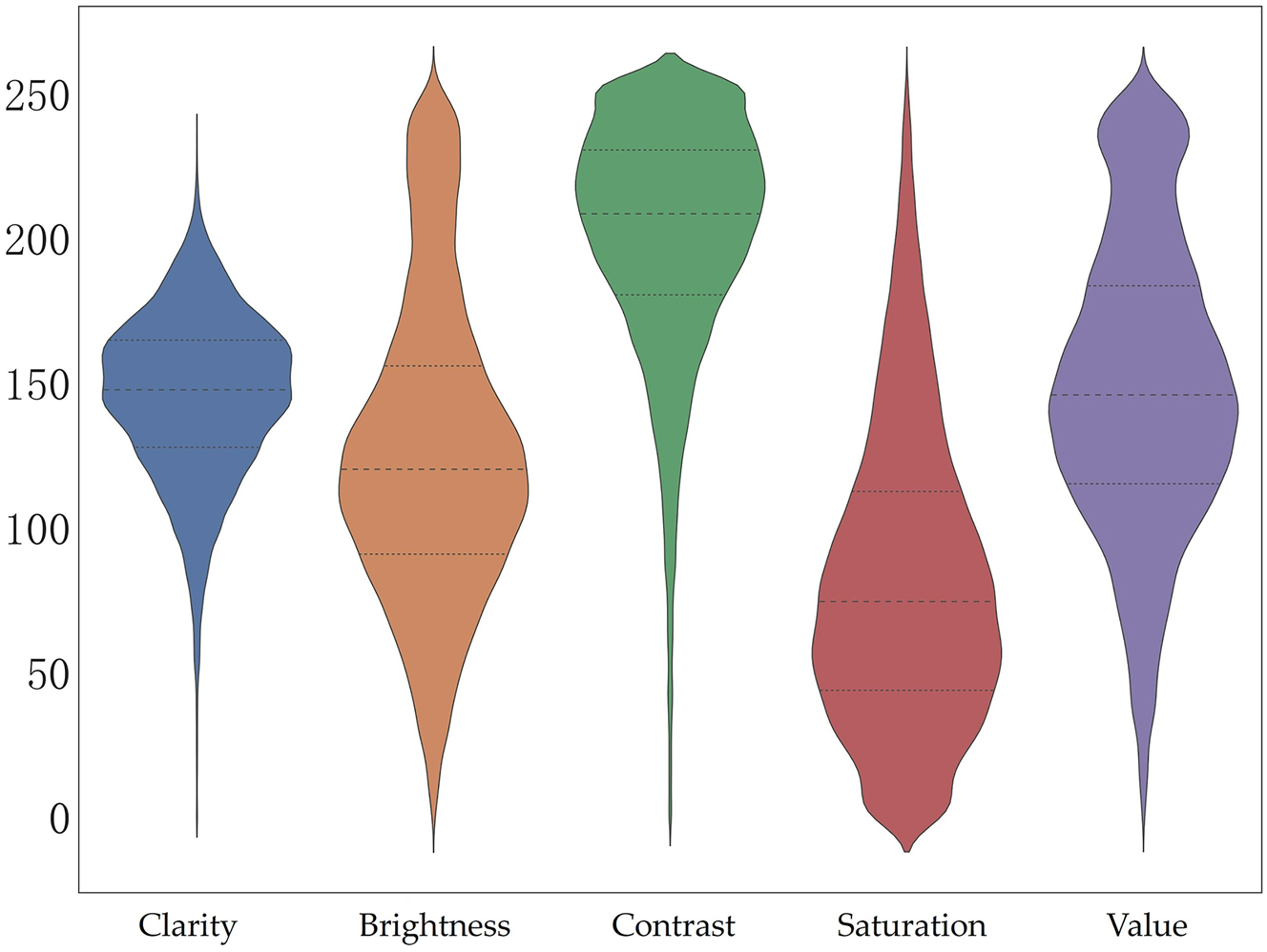
Distribution of basic visual features of China-related pictures of social bots. Note: Due to the heteroscedasticity, the data of clarity were standardized for presentation.
3.1.1.1 Clarity
The Laplacian operator is used to measure the clarity of images. Considering the characteristics of data distribution, a T-test was carried out on the clarity data after processing. According to Table 1, the picture posted by social bots on China-related topics was slightly less clear than that by human users. The difference was statistically significant, but the effect size was small. This echoes some previous findings from other studies: in order to pass off the fake as the real, social bots and their controllers behind them may take the clarity of the image into account, so as not to be easily identified.
Human-bot comparison of basic aesthetic features.
| Features | Mean of human users | Mean of social bots | p value | Cohen’s d value |
|---|---|---|---|---|
| Clarity | 147.635 | 145.559 | <0.001 | 0.071 |
| Brightness | 132.985 | 126.715 | <0.001 | 0.113 |
| Contrast | 200.524 | 200.814 | 0.265 | – |
| Saturation | 74.378 | 82.578 | <0.001 | 0.160 |
| Value | 152.495 | 149.122 | <0.001 | 0.060 |
3.1.1.2 Brightness
Table 1 shows that there is a significant difference in the brightness between bot and human accounts, with a noticeable effect size for the difference test. Social bots tend to use significantly lower brightness images on China-related topics than human users. Lower brightness has been considered more conducive to spreading conspiracy and negative emotions (Chen et al. 2022).
3.1.1.3 Contrast
Contrast is the ratio of black to white in an image and serves as an indicator of the intensity of brightness differences in a picture. The larger the contrast, the more color gradations the image can support and the more eye-catching the picture is. According to Table 1, the contrast of the bot-generated images is high with an average value of more than 200; no statistically significant difference was found in the contrast of the images between bot and human accounts. It is generally believed that a contrast ratio of 120:1 can support the display of vivid and rich colors. As a common feature in the visual expression of human and social bots, the strategy of high contrast caters to the tendency of displaying rich colors and attracting users in the era of on-screen social interaction.
3.1.1.4 Saturation
Generally, the high saturation of colors means the vivid and pure color used. Statistical results show a statistically significant difference between human and social bots in image saturation, and social bots tend to use images with higher saturation. Research has found that photos with higher saturation on social platforms tend to be more popular (Bakhshi and Gilbert 2015). So, bot accounts’ saturated color strategy may create a direct impact on the attention attracting.
3.1.1.5 Value
While the brightness refers to how bright the image is, the value measures how bright the colors are, and is often used to distinguish between bright colors (e.g., bright red, golden yellow) and dark colors (e.g., maroon, dark yellow). The greater the value, the brighter the colors used in the image. Table 1 shows that China-related images on Twitter are mainly distributed in the medium-high range, and the value of the images generated by human users is significantly higher than that of social bots, which is a relatively slight difference.
3.1.2 Color features
Color is an important attribute of images. Through various color combinations, images can convey different visual meanings. This study selected three indicators, namely, color diversity, the proportion of major colors, and the main color, aiming to address the issue of color strategies in social bots’ visual communication on Chinese-related topics.
3.1.2.1 Color diversity
The calculation of color diversity was performed on the basis of an algorithm using RGB color information, which has been cross-validated with experimental data and proved to match the human perception of color diversity (Hasler and Suesstrunk 2003). Data show that the color diversity of the China-related images is on the low level, which indicates that both bots and humans are inclined to use simple and drab images without overly complex and exaggerated colors. However, although the overall color is monotonous, social bots, compared to human accounts, tend to use images with higher color diversity (Mbot = 52.544 > Mhuman = 47.523) and the human–machine difference was significantly obvious (Cohen’s d = 0.160), which also echoes previous findings about saturation.
3.1.2.2 Proportion of major colors
To further explore the use of colors, the study focused on the use of 11 categories of colors, including black, white, red, green, yellow, blue, pink, gray, brown, orange, and purple, and identified the dominant color in the picture based on the proportion of each color. The selection of the above colors was based on the findings of anthropologists that these 11 colors are considered to be the basic colors in human society (Kay and Maffi 1999).
Figure 2 shows that, except for pink and purple, the rank of the other nine colors of images posted by humans and bots is basically the same, which indicates that the color strategies of human and bot accounts are very similar. Among the 11 colors, black, white, and blue are widely used by both human and bot users. Meanwhile, dark colors (e.g., black, blue, gray, and brown) are more commonly used than light colors (e.g., red, yellow, orange, and pink). It can be seen that human and bot users use black and white as the base color when building China-related visual frames where the extensive use of dark colors may make the national image of China depressing and dull.

Dominant color distribution for human and bot users on China-related topics.
3.1.2.3 Main color
Further, the study classified the aforementioned 11 colors into neutral color tones, including black, white, and gray, and chromatic colors. Results indicate that the ratio of chromatic color photos to neutral color photos for social media bot accounts is approximately 1:1.17, while for human users, this ratio is approximately 1:1.50. This once again echoes the previous conclusions about color saturation and diversity, suggesting that bot accounts exhibit a relatively positive inclination towards colorful images, adopting more attention-grabbing color strategies.
3.1.3 Pictorial features
The visual complexity of an image is closely related to the viewer’s aesthetic perception and emotional arousal (Bradley et al. 2007). Drawing from previous studies, two features were chosen in this study to measure the picture’s levels of detail and complexity: subject complexity based on image edge detection and compositional complexity based on image segmentation.
Figure 3 shows a China-related image posted by the social bot @thandojo (bot score = 0.68) and its results of edge detection and image segmentation. The edge density of the image in this case is about 0.038, and its segmentation reveals that it contains 59 segments. Since some color blocks and lines are obviously different from the surrounding images, they are also identified as independent blocks in the image segmentation process (seeing the dark-colored block in the middle part of Figure 3). In view of the limited analytical value of these kinds of blocks, the study discarded these blocks and considered only the number of blocks that accounted for more than 5 % of the image. In Figure 3, 8 such blocks were identified.

Case of the edge detection and image segmentation of (a) bot-posted image. Note: The subimage a is the result of the edge detection and the subimage (b) is that of the image segmentation.
3.1.3.1 Subject complexity analysis
Edge refers to the abrupt changes in color, lines, or textures in an image. Generally, the higher the edge density in an image, the more prominent changes in lines and textures in the picture. Edge density, therefore, can be used as a measure of the complexity of the subject in the picture. The calculation of this feature was based on the popular Canny algorithm, which determines the strong edges in an image by measuring the value of gradient change.
The results show that the edge density of the relevant images is mostly below 0.1 and there are fewer strong edges in the China-related images posted by social bots on Twitter, reflecting the fact that social bots tend to choose images with fewer changes in lines and textures when participating in the discussion of China-related issues. The images posted by human and bot users on China-related issues differ significantly in edge density (p = 0.007, < 0.01), and the edge density of the images used by human users is slightly higher than that of social bots (Mhuman = 0.056 > Mbot = 0.055, Cohen’s d = 0.025).
3.1.3.2 Compositional complexity analysis
Composition is essentially the process of placing visual elements after dividing the picture into a number of planes with different proportions and shapes, so it is feasible to analyze the compositional complexity by determining the number of segments in the picture through image segmentation techniques. This study applied the quick shift image segmentation algorithm, which is based on the color and the main body’s position for segmentation.
Taking the rule of thirds as the classical criterion, the number of segments of China-related images generated by social bots mainly ranged from 4 to 9, with images containing 7 segments being the most common. Noteworthy is that no significant difference between human and social bots exists in terms of the number of image block segments (p = 0.095).
3.2 The social media effects of social bots’ image aesthetic styles
In addition to mapping out social bots’ image aesthetic styles, another issue that this study aims to respond to is the communication effect of social bots’ aesthetic styles. Table 2 presents the results of negative binomial regression with each aesthetic feature as the independent variable and likes and retweets as the dependent variables.
Negative binomial regression results.
| Dependent variables | Independent variables | Coef.a | Std. err. | |
|---|---|---|---|---|
| Likes/retweets | Basic features | Clarity | −4.00e−06/2.26e−06 | 2.78e−06/2.83e−06 |
| Brightness | −0.019***/−0.022*** | 0.000/0.000 | ||
| Contrast | 0.006***/0.006*** | 0.000/0.000 | ||
| Saturation | −0.003***/−0.003*** | 0.000/0.000 | ||
| Value | 0.010***/0.014*** | 0.000/0.000 | ||
| Color features | Color diversity | −0.015***/−0.014*** | 0.000/0.000 | |
| Main colorb | 0.160***/0.024* | 0.012/0.012 | ||
| Pictorial features | Edge density | −5.179***/−5.185*** | 0.139/0.142 | |
| Number of image segmentation blocks | 0.032***/0.033*** | 0.003/0.003 | ||
-
Note: a*p < 0.05, **p < 0.01, ***p < 0.001; bThe variable is treated as a dummy variable.
Table 2 shows that the image brightness, contrast, and compositional complexity (the number of image segments) significantly and positively predict the number of likes and retweets. Meanwhile, the main color of the image, which is a dummy variable in the modeling, is also shown to significantly affect the social media effects of China-related tweets. Specifically, when the main color of the image is chromatic, the tweet is expected to be more retweeted/liked. It can be concluded that when a social bot selects a China-related image that is colorful, bright, contrasty, and rich in compositional layers, it is more likely to be liked and trigger recirculation.
Additionally, the results indicate that images with overly vivid colors (high saturation), excessively bright visuals (high brightness), and overly high subject complexity (high edge density) significantly reduce the number of likes and retweets of China-related tweets posted by social bots. We think it might be because this type of visual expression may cause a perceptual burden and disturbance to users, which affects liking and retweeting. As for clarity, the study did not find any significant relationship between clarity and the two kinds of social media data. In an era dominated by viewing images on small screens, the difference in clarity may be less pronounced, which is a possible reason why the social media impact of clarity has not been observed.
4 Conclusion and discussion
Through computational aesthetic analysis, the study maps out the aesthetic strategies of Twitter social bots in terms of China-related images at three levels: basic visual features, color features, and pictorial features. To be more concrete, there are general differences between human and bot accounts in most aesthetic features, with social bots showing relatively unique and obvious aesthetic styles of brightness, saturation, and color diversity. Negative binomial regression modeling shows that images with high contrast, value, and compositional complexity, low saturation, brightness, and subject complexity, as well as chromatic colors, are more likely to gain likes and retweets, which is highly consistent with social bots’ overall aesthetic styles.
Images are an important element of political communication, and the beauty of images contributes to the communication process. It is believed that visual representations guided by specific aesthetic strategies are more likely to have a significant impact on political communication, which just constitutes the starting point of view for the current study. This perspective is echoed by the findings that social bots exhibit unique aesthetic strategies on Chinese issues on the international social platform and that such aesthetic strategies of bot accounts have been proven to have a positive social media effect. To be clear, the positive social media effect needs to be viewed in a dialectical way – in the era of global communication, the intervention of automated communication technologies has made international communication more complex, and social bots have created brand new scenarios for visual communication practices: on the one hand, they can virally disseminate visual materials on social platforms to achieve their communication goals; on the other hand, the operators of bot accounts can dynamically update parameters and programs to change visual image strategies after the real-time monitoring of social media data. All these are difficult for human communication to achieve and should be an important explanation why now social media data can be highly fit with bot accounts’ aesthetic strategies. For international communication, what we need to face now is no longer a few specific communication agencies, but non-human automated entities with the ability to adjust dynamically and form a communication synergy on a worldwide scale. Our study observed that the visual expression of social bots in China-related issues is characterized by medium-to-low brightness, medium-to-low saturation, and a tendency towards dark colors, which may seem to attract more likes and retweets, but may cater only to the momentum of computational propaganda, ultimately casting a negative and dim atmosphere over China’s overseas national image building.
Open up our train of thought to think over the situation and we may find that the present study is not only about national aesthetics but also about post-human aesthetics. Generally speaking, although social bots are somewhat differentiated from human users in terms of aesthetic style, they are still fundamentally dependent on human aesthetic thinking and concepts: after all, there are limited effects size of differences between human and bot accounts in aesthetic characteristics, which suggests that the machines have not yet formed a highly machine-led style of visual expression. However, the significant difference between human and social bots still reminds us that we should not ignore the possibility of aesthetic consciousness by machines and its potential social impact: as a kind of high-level human interest, aesthetic thinking and aesthetic logic, if developed by social bots, may give rise to a crisis of machine subjectivity that human beings have to be highly vigilant and reflective about; such a crisis goes beyond the politics and directly harm the existential value of human – time to ask: does the subject of creating and evaluating beauty have to be human? If not, can non-human entities influence and lead human beings to feel and appreciate beauty?
Currently, there is a growing debate on this issue. The academic community has begun to discuss the interrelationship between non-human intelligences and human beings from the perspective of post-human aesthetics (Wang 2020). The logical starting point of post-human aesthetics is considered to lie in the mutational process of unsecuring the subjectivity of humans and acknowledging the relations between human and non-human (Rutsky 1999). The social reality of the deep intertwining of intelligent technology and aesthetic practice has made scholars start to worry that the intervention of intelligent technology will have a negative impact on the concept of human aesthetics, thus reducing human beings to a sensual footnote of artificial intelligence and raising ethical risks (Tao 2023). Returning to the context of the present study: nowadays intelligent technologies such as the generative models have started their process of integration into society. If social bots possess their own aesthetic ideas and seamlessly integrate with generative AI models, automating the production of creatively styled landscapes, the influence exerted through human–machine interaction may not only be limited to people’s perceptions and feelings towards a specific country. More than that, it has the potential to globally reshape the aesthetic experiences among the mass. Considering this possible risk, academics and industry have set about to advocate value alignment between humans and machines. However, a new dilemma has arisen. Problems such as what kind of aesthetic values machines should align with, and to what extent and in what way they should do so, need to be deliberated (Gabriel 2020).
As a whole, the current study primarily focuses on the Twitter social bots’ China-oriented aesthetic strategies and their social media effects, which makes a contribution to both theory and methodology. However, there were also some limitations. First, the measurement of aesthetic features in this study is carried out by computer vision technology, which obscures the subjective dimension of aesthetics. Second, our study mainly takes the data of likes and retweets into account, and experimental design could be considered for future exploration. Finally, the material in this study is static pictures on social platforms, and researchers can direct the focus onto dynamic visual materials like videos by social bots.
Funding source: Guoqiang Research Institute Project, Tsinghua University, “Research on Social Bots’ Construction and Effect Modeling of China’s International Image”
Award Identifier / Grant number: 2020GQG1019
Funding source: National Social Science Foundation of China Major Project Grant: “The Study on Leading Information Values in the Age of Intelligence”
Award Identifier / Grant number: 18ZDA307
Acknowledgment
This paper is a result of the major project of National Social Science Foundation of China, “The Study on Leading Information Values in the Age of Intelligence” (project number: 18ZDA307), and the project of Guoqiang Research Institute, Tsinghua University, “Research on Social Bots’ Construction and Effect Modeling of China’s International Image” (project number: 2020GQG1019).
References
Bakhshi, Saeideh & Eric Gilbert. 2015. Red, purple and pink: The colors of diffusion on Pinterest. PLoS One 10(2). e0117148. https://doi.org/10.1371/journal.pone.0117148.Suche in Google Scholar
Bradley, Margaret M., Steven Hamby, Andreas Löw & Peter J. Lang. 2007. Brain potentials in perception: Picture complexity and emotional arousal. Psychophysiology 44(3). 364–373. https://doi.org/10.1111/j.1469-8986.2007.00520.x.Suche in Google Scholar
Buhmann, Alexander & Diana Ingenhoff. 2015. The 4D Model of the country image: An integrative approach from the perspective of communication management. International Communication Gazette 77(1). 102–124. https://doi.org/10.1177/1748048514556986.Suche in Google Scholar
Chen, Kaiping, Sang Jung Kim, Qiantong Gao & Sebastian Raschka. 2022. Visual framing of science conspiracy videos: Integrating machine learning with communication theories to study the use of color and brightness. Computational Communication Research 4(1). 98–134. https://doi.org/10.5117/ccr2022.1.003.chen.Suche in Google Scholar
Gabriel, Iason. 2020. Artificial intelligence, values, and alignment. Minds and Machines 30(3). 411–437. https://doi.org/10.1007/s11023-020-09539-2.Suche in Google Scholar
Hasler, David & Sabine E. Suesstrunk. 2003. Measuring colorfulness in natural images. In Human vision and electronic imaging VIII SPIE 5007, 87–95.10.1117/12.477378Suche in Google Scholar
Huang, Yangkun, Yuqing Yuan & Changfeng Chen. 2022. Convergence, circulation, and spillover: A human-bot sentiment analysis based on Twitter’s China-related issues. Shanghai Journalism Review 40(9). 29–44. 黄阳坤、袁雨晴、陈昌凤. 2022. 人机情绪的趋同、循环与溢出—基于Twitter涉中议题的数据分析. 新闻记者 第9期. 第29–44页.Suche in Google Scholar
Kay, Paul & Luisa Maffi. 1999. Color appearance and the emergence and evolution of basic color lexicons. American Anthropologist 101(4). 743–760. https://doi.org/10.1525/aa.1999.101.4.743.Suche in Google Scholar
Lippmann, Walter. 1991. Public opinion, 162. New Brunswick: Transaction Publishers.Suche in Google Scholar
Liu, Danling. 2017. Object, subject and situation: The cognitive map of national image. Nanjing Journal of Social Sciences 28(2). 113–118+135. 刘丹凌. 2017. 客体、主体与情境:“像化”国家形象的认知图谱. 南京社会科学 第2期. 第113–118+135页.Suche in Google Scholar
Liu, Tao. 2021. Visual rhetoric, 483. Beijing: Peking University Press. 刘涛. 2021. 视觉修辞学. 北京: 北京大学出版社. 第483页.Suche in Google Scholar
Ng, Lynnette Hui Xian & Kathleen M. Carley. 2021. Bot-based emotion behavior differences in images during Kashmir black day event. In Social, Cultural, and Behavioral Modeling, 14th International Conference, SBP-BRIMS, 184–194.10.1007/978-3-030-80387-2_18Suche in Google Scholar
Peng, Yilang & John B. JemmottIII. 2018. Feast for the eyes: Effects of food perceptions and computer vision features on food photo popularity. International Journal of Communication 12. 313–336.Suche in Google Scholar
Peterson, Valerie V. 2009. The rhetorical criticism of visual elements: An alternative to Foss’s schema. Southern Journal of Communication 67(1). 19–32. https://doi.org/10.1080/10417940109373216.Suche in Google Scholar
Prier, Jarred. 2017. Commanding the trend: Social media as information warfare. Strategic Studies Quarterly 11(4). 88–113.10.4324/9780429470509-7Suche in Google Scholar
Rampley, Matthew. 2010. Aby Warburg: Kulturwissenschaft, Judaism and the politics of identity. Oxford Art Journal 33(3). 317–335. https://doi.org/10.1093/oxartj/kcq033.Suche in Google Scholar
Rutsky, Randolph L. 1999. High techne: Art and technology from the machine aesthetic to the posthuman, 2, 105. Minneapolis: University of Minnesota Press.Suche in Google Scholar
Shi, Wen & Changfeng Chen. 2020. Distribution and interaction patterns: How social bots manipulate the Chinese-related issues on Twitter. Chinese Journal of Journalism & Communication 42(5). 61–80. 师文、陈昌凤. 2020. 分布与互动模式: 社交机器人操纵Twitter上的中国议题研究. 国际新闻界 第42卷第5期. 第61–80页.Suche in Google Scholar
Tao, Feng. 2023. Agents, simulation and technology: A philosophical interpretation of artificial intelligence’s literary and artistic production. Philosophical Research 69(3). 56–67+127. 陶锋. 2023. 代理、模拟与技艺: 人工智能文艺生产的哲学阐释.哲学研究 第3期. 第56–67+127页.Suche in Google Scholar
Wang, Xiaohua. 2020. Artificial intelligence and post-human aesthetics. Journal of Capital Normal University (Social Science Edition) 48(3). 85–93. 王晓华. 2020. 人工智能与后人类美学. 首都师范大学学报(社会科学版) 第3期. 第85–93页.Suche in Google Scholar
Xing, Liju & Jing Zhao. 2021. New media and the international communication of China’s national image. Contemporary International Relations 41(11). 51–59+61. 邢丽菊、赵婧. 2021. 新媒体与中国国家形象的国际传播. 现代国际关系 第11期. 第51–59+61页.Suche in Google Scholar
Yang, Kai-Cheng, Emilio Ferrara & Filippo Menczer. 2022. Botometer 101: Social bot practicum for computational social scientists. Journal of Computational Social Science 5(2). 1511–1528. https://doi.org/10.1007/s42001-022-00177-5.Suche in Google Scholar
Yao, Heming. 2001. Introduction to communication aesthetics, 22. Beijing: Beijing Broadcasting University Press. 姚鹤鸣. 2001. 传播美学导论. 北京: 北京广播学院出版社. 第22页.Suche in Google Scholar
© 2024 the author(s), published by De Gruyter, Berlin/Boston
This work is licensed under the Creative Commons Attribution 4.0 International License.
Artikel in diesem Heft
- Frontmatter
- Research Articles
- Victims or villains? How editorial cartoons depict the 2023 Israel – Palestine war
- Affect, credibility, and solidarity: strategic narratives of NGOs’ relief and advocacy efforts for Gaza
- “Tears have never won anyone freedom:” a multimodal discourse analysis of Ukraine’s use of memes in a propaganda war of global scale
- City images in transnational travel vlogs from a multimodal perspective: an investigation of 20 port cities worldwide
- Mobile app adoption comparison between U.S. and Chinese college students: information processing style and use frequency after download
- Featured Translated Research Outside the Anglosphere
- Automation of visual communication and aesthetic construction of national image: a computational aesthetic analysis of social bots on Twitter
Artikel in diesem Heft
- Frontmatter
- Research Articles
- Victims or villains? How editorial cartoons depict the 2023 Israel – Palestine war
- Affect, credibility, and solidarity: strategic narratives of NGOs’ relief and advocacy efforts for Gaza
- “Tears have never won anyone freedom:” a multimodal discourse analysis of Ukraine’s use of memes in a propaganda war of global scale
- City images in transnational travel vlogs from a multimodal perspective: an investigation of 20 port cities worldwide
- Mobile app adoption comparison between U.S. and Chinese college students: information processing style and use frequency after download
- Featured Translated Research Outside the Anglosphere
- Automation of visual communication and aesthetic construction of national image: a computational aesthetic analysis of social bots on Twitter
