High efficiency and low roll-off green OLEDs with simple structure by utilizing thermally activated delayed fluorescence material as the universal host
-
Bo Zhao
 ,
Yanqin Miao
,
Yanqin Miao

Abstract
We achieved high-efficiency and low-roll-off green fluorescent and phosphorescent organic light-emitting diodes (OLEDs) simultaneously by adopting the thermally activated delayed fluorescence material of bis[4-(9,9-dimethyl-9,10-dihydroacridine)phenyl]sulfone as the universal host. At a luminance of 1000 cd/m2, fluorescent OLEDs based on C545T get a current efficiency, power efficiency, and external quantum efficiency (EQE) of 31.8 cd/A, 25.0 lm/W, and 9.26%, respectively. This is almost the highest efficiency based on C545T at the luminance of 1000 cd/m2 to date. On the other hand, phosphorescent OLEDs with Ir(ppy)3 as the emitter realize a maximum current efficiency, power efficiency, and EQE of 64.3 cd/A, 62.4 lm/W, and 18.5%, respectively. More important, the EQE remains 17.8% at the representative luminance of 1000 cd/m2 and the roll-off ratio is just 3.78%. The transient photoluminescence decay measurement demonstrates that the up-conversion of host triplet excitons plays a key role in the high efficiency and low roll-off. More detailed discussions are also given.
1 Introduction
Organic light-emitting diodes (OLEDs) have received great attention due to the application of flat-panel displays and solid-state lighting in the past few decades. Fluorescent OLEDs (Fl-OLEDs) have, in the early stages, the advantage of low cost and high stability, but the maximum external quantum efficiency (EQE) of 5% limits its development because of the waste of nonradiative triplet excitons. Later, phosphorescent OLEDs (Ph-OLEDs) could achieve 100% internal quantum efficiency (IQE) on account of the strong spin-orbit coupling with the introduction of heavy metal, but the high cost and serious efficiency roll-off became other problems. In order to resolve these problems in Fl-OLEDs and Ph-OLEDs, researchers have made many attempts, including the application of triplet-triplet annihilation (TTA) mechanism to improve the EQE of Fl-OLEDs [1], [2], [3], the host engineering [4], and special structure design in the emitting layer (EML) [5], [6] to decrease the efficiency roll-off of Ph-OLEDs and so on.
Besides the methods mentioned above, there is a new way to improve the efficiency of traditional Fl-OLEDs and decrease the efficiency roll-off of Ph-OLEDs, which is the use of thermally activated delayed fluorescence (TADF) material as the host to sensitize the dopant. TADF materials, which could achieve 100% IQE through the efficient reverse intersystem crossing (RISC) of triplet excitons, had a hugely successful harvest as the emitter due to the small energy difference (ΔES-T) between the singlet and triplet excited state [7], [8], [9], [10]. Research on TADF material as the host has also received attention in the past few years [11], [12], [13]. Qiu et al. fabricated highly efficient orange Fl-OLEDs with an EQE as high as 12.2% by utilizing TADF materials of 2,4-diphe-nyl-6-bis(12-phenylindolo)[2,3-a]carbazole-11-yl)-1,3,5-triazine (DIC-TRZ) as the host [11]. Fukagawa et al. achieved decreased efficiency roll-off with Ph-OLEDs by adopting a TADF material of 2-biphenyl-4,6-bis(12-phenylindolo[2,3-a]carbazol-11-yl)-1,3,5-triazine (PIC-TRZ) as the host [12]. Our group also did some research with TADF material as the host, which achieved white Fl-OLEDs with a maximum EQE of 7.48% [14]. Although there have been developments in the use of TADF material as the host, reports are relatively fewer. Also, research on Fl-OLEDs and Ph-OLEDs based on TADF material as the host are separate, or to improve the efficiency of Fl-OLEDs, or to reduce the efficiency roll-off of Ph-OLEDs. So there are still more work to do, more systematic research needs to be made, more TADF materials need to be discovered, and higher-efficiency and lower-efficiency roll-off OLEDs need to be earned.
In this paper, we utilized the typical TADF material of bis[4-(9,9-dimethyl-9,10-dihydroacridine)phenyl]sulfone (DMAC-DPS) as the universal host and the traditional fluorescent emitter of 2,3,6,7-tetrahydro-1,1,7,7-tetramethyl-1H,5H,11H-10-(2-benzothiazolyl)quinolizino[9,9a,1gh]coumarin (C545T) and phosphorescent emitter of fac-tris(2-phenylpyridine) iridium(III) (Ir(ppy)3) as the dopant to fabricate highly efficient and simple green OLEDs, respectively. The material of DMAC-DPS was a highly efficient blue TADF emitter with an electroluminescence (EL) peak at 470 nm and in which the maximum EQE could reach 19.5% [9]. Therefore, here, we attempt to make use of DMAC-DPS as the universal host to fabricate Fl-OLEDs and Ph-OLEDs, respectively, and conduct a systematic research. By employing the TADF material of DMAC-DPS as the universal host, we simultaneously obtain high-efficiency Fl-OLEDs and low-efficiency roll-off Ph-OLEDs. A maximum current efficiency, a power efficiency, and an EQE of 32.2 cd/A, 26.3 lm/W, and 9.35% were achieved with Fl-OLEDs, respectively. The EQE of 9.35% far exceeds the fluorescent EQE upper limit. We confirm that the obtainment of a very high efficiency stems from the RISC of DMAC-DPS triplet excitons through the transient photoluminescence (PL) decay measurement under various concentrations. Meanwhile, the Ph-OLEDs realized a maximum current efficiency, power efficiency, and EQE of 64.3 cd/A, 62.4 lm/W, and 18.5%, respectively. More important, the efficiency roll-off ratio was just 3.78% from maximum EQE to the EQE at 1000 cd/m2. The barrier-free injection, balanced transport and recombination, wide carrier recombination zone, and host triplet exciton up-conversion are responsible for the low-efficiency roll-off.
2 Experimental section
All the OLEDs were fabricated on indium tin oxide (ITO)-coated glass substrates with a sheet resistance of 10 Ω/sq. The ITO substrates were cleaned first with acetone, deionized water, and acetone and then treated by ultraviolet (UV)-ozone for 15 min, then the ITO substrates were loaded into a high vacuum chamber (approximately 3×10− 4 Pa) for subsequent deposition. After the deposition of organic layers, Al cathode was deposited in the end with a shadow mask, which defined a device area of 3×3 mm2. The PL spectra were measured with FluoroMax-4 fluorescence spectrometer (HORIBA Jobin Yvon). The UV-Vis absorption spectrum was recorded with a Hitachi U-3900 scanning spectrophotometer. Transient PL decay was measured with a combination of Nd-YAG laser (pulse width of 10 ns, repetition frequency of 10 Hz), a spectrograph (HJY, Triax 550), and an oscilloscope (Tektronix, TDS3052B). EL spectra were measured through a computer-controlled PR-655 spectra scan spectrometer. The current-voltage-luminance curves were measured with a Keithley 2400 power supply combined with an ST-900M spot photometer. EQE was calculated from the current density-voltage-luminance curve and EL spectra data. All the organic materials were procured commercially without further purification. All the measurements were carried out at room temperature and under ambient conditions without any protective coatings.
3 Results and discussion
3.1 Fl-OLEDs
The device structure of Fl-OLEDs based on C545T is as follows: ITO/MoO3 (3 nm)/mCP (25 nm)/DMAC-DPS: x% C545T (15 nm)/PO-T2T (45 nm)/LiF (1 nm)/Al, where x=1.0, 1.5, and 2.0, respectively. We can see that the OLEDs are a simple three-layer structure. The mCP (m-bis(N-carbazolyl)benzene) and a phosphine-oxide-based material of PO-T2T act as the hole transport layer (HTL) and electron transport layer (ETL), respectively. Concentrations of 1.0%, 1.5%, and 2.0% with C545T doped into DMAC-DPS are used for the EML. Amazingly, all the devices obtained an excellent device performance of low turn-on voltage (< 2.5 V) and high maximum luminance (~17,000 cd/m2), which are shown in Figure S1. Under a concentration of 1.5%, the Fl-OLEDs display the best performance; the maximum current efficiency, power efficiency, and EQE are 32.2 cd/A, 26.3 lm/W, and 9.35%, respectively. Even at a luminance of 1000 cd/m2, the efficiencies are also as high as 31.8 cd/A, 25.0 lm/W, and 9.26%, respectively. This is almost the highest efficiency based on C545T at the luminance of 1000 cd/m2 to date. Figure 1 shows the EL performance of the Fl-OLEDs. Moreover, at a high luminance of 10,000 cd/m2, the EQE is also higher than the 5% fluorescent EQE upper limit and reaches 6.9%. We also fabricated the Fl-OLEDs with the same device structure except for the host, which adopted the traditional fluorescent host of Alq and DPVBi. But the corresponding maximum EQEs are merely 2.68% and 3.36%, respectively. Figure S2 and Table S1 display the EL performance of Fl-OLEDs with Alq and DPVBi as the host, respectively. The low efficiency of Fl-OLEDs with a traditional host is due to the waste of triplet excitons, which cannot up-convert to a singlet excited state because of the large ΔES-T. With the TADF material as the host, the triplet excitons could up-convert to its singlet excited state and transfer to the dopant through the Förster energy transfer process, which increases the amount of dopant singlet excitons and improves the device efficiency further. The relevant EL spectra of DMAC-DPS as the host are shown in Figure 1B. Under the concentrations of 1.5% and 2.0%, the devices exhibit intrinsic C545T emission with a peak of 513 nm. But at the low concentration of 1.0%, a weak emission peak at ~460 nm appears, which is inferred to the host emission of DMAC-DPS. The appearance of host emission peak at 1.0% concentration and disappearance at 1.5% and 2.0% concentrations indicate the energy transfer process from DMAC-DPS to C545T.
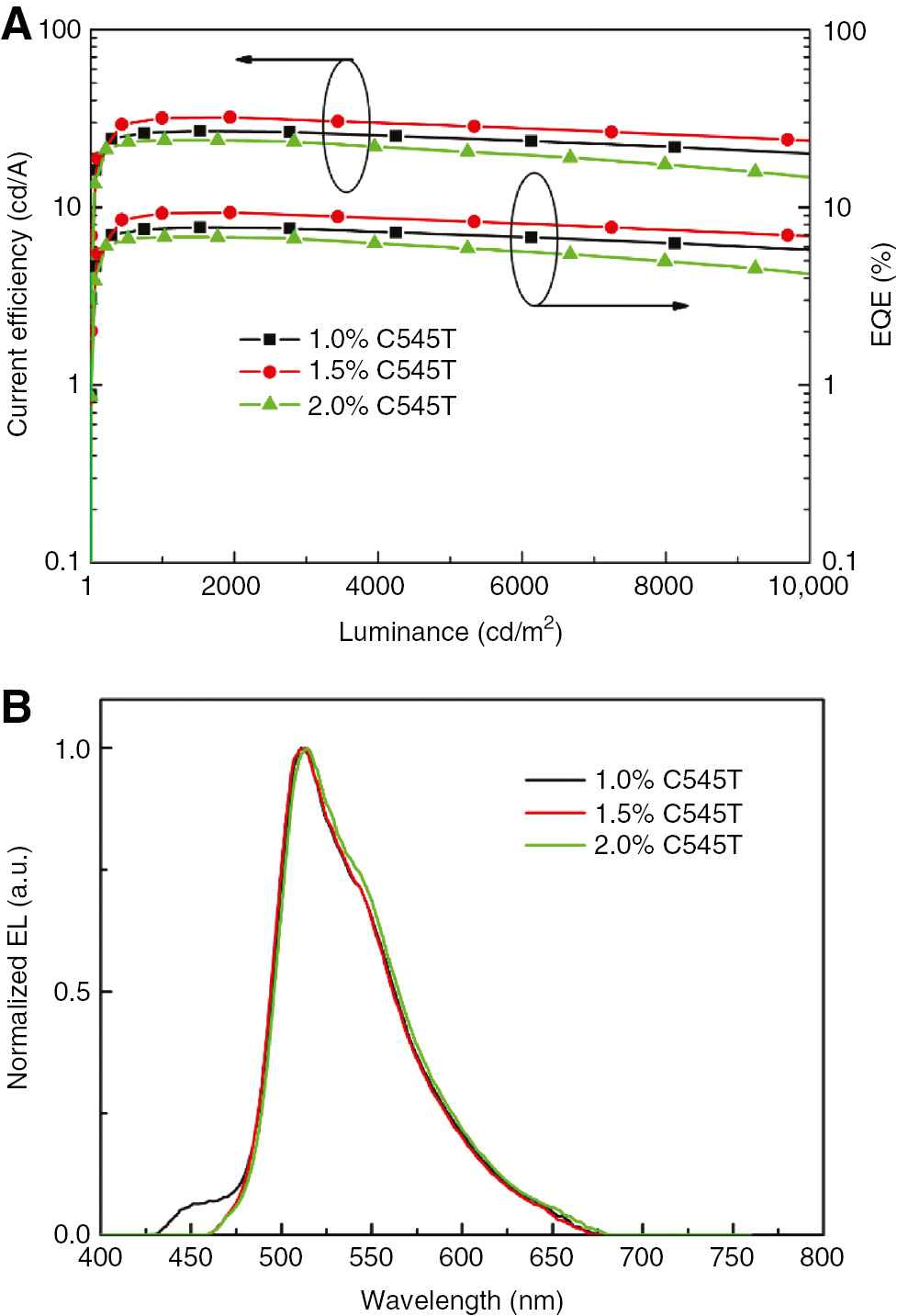
The EL performance of Fl-OLEDs with different C545T concentrations. (A) The current efficiency-luminance-EQE curves. (B) The EL spectra.
Table 1 summarizes the EL performance and roll-off ratio of the Fl-OLEDs in this paper with representative devices based on C545T. Except for the optimal concentration of 1.5%, the devices also harvest considerable performance at 1.0% and 2.0% with the simple three-layer structure. The maximum EQE reached 7.73% and 6.83%, respectively. Even at a luminance of 1000 cd/m2, the efficiency was almost the same, with 7.62% and 6.82%, respectively. Lee et al. utilized TADF exciplex host to sensitize C545T and achieved Fl-OLEDs with a maximum EQE of 14.5% [15], but the roll-off ratio from maximum EQE to EQE at 1000 cd/m2 (EQEMax.~EQE1000) was as high as 40.1%. Kido et al. achieved ~7% EQE through the optimizing charge balance, but the EQEMax.~EQE1000 still reached ~10% [16], whereas the EQEMax.~EQE1000 of all the Fl-OLEDs in this work are only ~1%. The reason for the low roll-off will be discussed in detail in the section on Ph-OLEDs.
Summary EL performance and roll-off ratio of the Fl-OLEDs in this paper with representative devices based on C545T.
| DMAC-DPS: x% C545T | ηc,Max./ηp,Max./EQEMax.a[cd/A/lm/W/%] | ηc,1000/ηp1000/EQE1000b[cd/A/lm/W/%] | ηc,10,000/ηp10,000/EQE10,000c[cd/A/lm/W/%] | |
|---|---|---|---|---|
| 1.0% C545T | 26.9/21.8/7.73 | 26.5/20.0/7.62 | 20.1/9.06/5.78 | |
| 1.5% C545T | 32.2/26.3/9.35 | 31.8/25.0/9.26 | 23.7/11.4/6.90 | |
| 2.0% C545T | 23.9/19.0/6.83 | 23.9/16.8/6.82 | 14.8/5.61/4.23 | |
| EML structure | EQEMax.[%] | EQEMax.~EQE1000d [%] | EQEMax.~EQE10,000e [%] | Ref. |
| DMAC-DPS: 1.0/1.5/2.0% C545T | 7.73/9.35/6.83 | 1.42/0.96/1.00 | 25.2/26.2/38.1 | This work |
| TAPC:DPTPCz: 0.2/0.4/0.8% C545T | 14.5/12.7/7.9 | 40.1/68.8/49.8 | N/A | [15] |
| TAPC (40/35/30 nm)/MADN: 1 wt% C545T | 7.42/7.72/7.29 | 11.0/6.73/10.8 | 23.7/18.6/24.7 | [16] |
aCurrent efficiency (ηc), power efficiency (ηp), and EQE at maximum.
bηc, ηp, and EQE at 1000 cd/m2.
cηc, ηp, and EQE at 10,000 cd/m2dEQE roll-off ratio from maximum to 1000 cd/m2.
eEQE roll-off ratio from maximum to 10,000 cd/m2.
In order to explain the high efficiency of Fl-OLEDs with the simple device structure, we draw the PL spectrum of DMAC-DPS and absorption spectrum of C545T, which are shown in Figure 2. The rather large spectral overlap between the PL spectrum of the host and the absorption spectrum of the dopant indicates that the energy transfer from the singlet excited state of DMAC-DPS to the singlet excited state of C545T by Förster mechanism can take place efficiently.

The PL spectrum of DMAC-DPS and absorption spectrum of C545T.
To clarify the energy transfer process in Fl-OLEDs further, we fabricated the DMAC-DPS: x% C545T films with several concentrations. Figure 3 shows the PL spectra and transient PL decay curves under different concentrations. From Figure 3A, we can see that the emission of the host also appears under low concentration, which is consistent with the EL spectra. And the emission of the DMAC-DPS host reduces gradually and disappears with the increase in doped concentrations, verifying again the energy transfer process between DMAC-DPS and C545T. Figure 3B exhibits the transient PL decay curves of DMAC-DPS: x% C545T films with various doped concentrations. Monitoring the PL emission peak of 510 nm, to our surprise, all of the curves exhibit double-exponential decay and present two lifetimes of prompt and delay through the suitable fitting. In general, as a traditional fluorescent material, C545T only has a prompt intrinsic transient lifetime of several nanoseconds. But in this work, C545T displays a delayed lifetime of several hundred nanoseconds, even reaching orders of microseconds. DMAC-DPS has been confirmed as a highly efficient TADF material, which exhibited two lifetimes of prompt and delay due to the efficient RISC with a small ΔES-T between its singlet and triplet excited states [9]. Therefore, we suggest that the longer transient lifetime of C545T in this paper is derived from the RISC and energy transfer of DMAC-DPS triplet excitons. The detailed prompt and delayed lifetimes of C545T with different doped concentrations have been added to Figure 3B. We can see that the delayed lifetimes have a large range when C545T with different concentrations is doped into DMAC-DPS. The delayed lifetime decreases gradually as the concentration of C545T increases. Under optical excitation, the triplet excitons of DMAC-DPS are produced by the efficient intersystem crossing (ISC) process, and the delayed component of C545T results from the energy transfer of up-converted DMAC-DPS triplet excitons. As the concentration increases, the ISC efficiency of DMAC-DPS reduces and the RISC efficiency also reduces, which result in a decrease in delayed lifetime. So under electric excitation, the 25% singlet excitons produced on the DMAC-DPS host would transfer to the singlet state of C545T by the Förster process and the 75% triplet excitons would up-convert to a singlet excited state first through efficient RISC, then the new singlet excitons formed through RISC would also transfer to the singlet excited state of C545T. Finally, a highly efficient C545T emission could be achieved. Hence, based on the discussion above, the almost consistent transient decay behavior of C545T and DMAC-DPS reported previous evidence that the emission of C545T is derived from the energy transfer of DMAC-DPS singlet excitons and up-converted triplet excitons.

The PL spectra and transient PL decay curves with the film of DMAC-DPS: x% C545T under different concentrations. (A) The PL spectra. (B) The transient PL decay curves.
Next, we discuss the energy transfer efficiency of the host-guest system though an equation. The TADF material of DMAC-DPS is the energy transfer host and C545T is the energy transfer guest, so the energy transfer efficiency (∅ET) of singlet and triplet could be expressed as follows [17]:
In the equation, ket is the energy transfer rate from host to dopant; kr is the radiative transition rate of host; knr is the nonradiative transition rate of host; and τ is the emission lifetime of the DMAC-DPS host. As we can see from the equation, in order to achieve a high ∅ET, a higher ket and longer τ should be required. From Figure 2, we know that there is a rather large overlap between the PL spectrum of the DMAC-DPS host and the absorption spectrum of C545T, which have demonstrated a highly efficient energy transfer rate from the DMAC-DPS host to C545T (that is high ket). On the other hand, the TADF host of DMAC-DPS has a long delayed fluorescent lifetime (τ) about 3.0 μs at 300 K by transient PL decay measurement [9], [18], which also illustrates a high RISC efficiency. Therefore, a high energy transfer efficiency (∅ET) could be realized in this system.
3.2 Ph-OLEDs
Next, we adopted the same host of DMAC-DPS to fabricate Ph-OLEDs with common green phosphorescent material of Ir(ppy)3 as the emitter. The device structure is as follows: ITO/MoO3 (3 nm)/mCP (25 nm)/DMAC-DPS: x% Ir(ppy)3 (15 nm)/PO-T2T (45 nm)/LiF (1 nm)/Al, where x=2.0, 4.0, and 6.0, respectively. To our surprise, all the Ph-OLEDs also achieved good efficiency under the three concentrations of low turn-on voltage (< 3.0 V) and high maximum luminance (> 20,000 cd/m2), which can be seen in Figure S3. Figure 4 and Table 2 show the EL performance of Ph-OLEDs in this paper. At the optimal concentration of 4.0%, the device obtains a maximum current efficiency, power efficiency, and EQE of 64.3 cd/A, 62.4 lm/W, and 18.5%, respectively. Different from the traditional host-guest Ph-OLEDs, the energy transfer process with TADF material as the host is mainly through the long-range Förster energy transfer rather than short-range Dexter energy transfer or direct carrier trapping recombination by the dopant [12], [18]. The triplet excitons produced on the TADF host are more easily up-converted to singlet excited state and achieve the energy transfer by the Förster process owing to the small ΔES-T of the TADF host. On the other hand, with the traditional host-guest Ph-OLEDs, the triplet excitons produced on the host cannot up-convert to singlet excited state because of the large ΔES-T. So the triplet excitons transfer to the dopant via a Dexter energy transfer process, which happened between the triplet excited state of the host and the dopant. The relatively low EQE of 15.3% with the concentration of 2.0% could be attributed to the incomplete energy transfer process, which is proved from the weak emission of the host DMAC-DPS shown in Figure 4B. Besides, even more surprising is the efficiency roll-off of the Ph-OLEDs. For example, under the representative luminance of 1000 cd/m2, the current efficiency and EQE of the Ph-OLEDs with 4% concentration still reached up to 62.0 cd/A and 17.8%, respectively, and the roll-off ratio is just 3.78%. In Table 2, we summarize the EL performance and roll-off ratio of the Ph-OLEDs. Meanwhile, the roll-off ratio with representative devices based on Ir(ppy)3 or Ir(ppy)2(acac) are also given. We can see that all the Ph-OLEDs in this paper obtain a very low roll-off with a large range from low luminance to high luminance of 10,000 cd/m2. The EQEMax.~EQE1000 is only ~3.5%, while the ratio is ~25% from maximum EQE to EQE at 10,000 cd/m2. We also sought some representative phosphorescent devices as a reference; the EQEMax.~EQE1000 is 27.9% in Ref. [19] and EQEMax.~EQE10,000 are 21.8% and 52.1% in Refs. [20], [21], respectively. Although a low roll-off was also achieved in Ref. [20], an exciton block layer of CF-X was adopted, which added to the complexity of the device. Nevertheless, we attain highly efficient and low roll-off Ph-OLEDs with a simple three-layer structure in this paper.

The EL performance of Ph-OLEDs with different Ir(ppy)3 concentrations. (A) The current efficiency-luminance-EQE curves. (B) The EL spectra.
Summary EL performance and roll-off ratio of the Ph-OLEDs in this paper with representative devices based on Ir(ppy)3 or Ir(ppy)2(acac).
| DMAC-DPS: x% Ir(ppy)3 | ηc,Max./ηp,Max./EQEMax.a[cd/A/lm/W/%] | ηc,1000/ηp1000/EQE1000b[cd/A/lm/W/%] | ηc,10,000/ηp10,000/EQE10,000c[cd/A/lm/W/%] | |
|---|---|---|---|---|
| 2.0% Ir(ppy)3 | 52.2/49.1/15.3 | 50.7/24.7/14.8 | 39.9/12.8/11.7 | |
| 4.0% Ir(ppy)3 | 64.3/62.4/18.5 | 62.0/29.1/17.8 | 48.1/15.0/13.8 | |
| 6.0% Ir(ppy)3 | 59.9/57.8/17.2 | 57.8/27.3/16.6 | 44.8/13.9/12.9 | |
| EML structure | EQEMax.[%] | EQEMax.~EQE1000d [%] | EQEMax.~EQE10,000e [%] | Ref. |
| DMAC-DPS: 2.0/4.0/6.0% Ir(ppy)3 | 15.3/18.5/17.2 | 3.26/3.78/3.48 | 23.5/25.4/25.0 | This work |
| TAZ: 12% Ir(ppy)2(acac) | 19.0±0.5 | 27.9 | N/A | [19] |
| TCTA: 6.2 mol% Ir(ppy)3/CF-X | 19.2 | N/A | 21.8 | [20] |
| CBP: 6 wt% Ir(ppy)3 | 14.4 | N/A | 52.1 | [21] |
aCurrent efficiency (ηc), power efficiency (ηp), and EQE at maximum.
bηc, ηp, and EQE at 1000 cd/m2.
cηc, ηp, and EQE at 10,000 cd/m2.
dEQE roll-off ratio from maximum to 1000 cd/m2.
eEQE roll-off ratio from maximum to 10,000 cd/m2.
In order to explore the reason of low roll-off, we fabricated single carrier devices, whose structure is as follows:
Hole-only device: ITO/MoO3 (3 nm)/NPB (15 nm)/DMAC-DPS (40 nm)/NPB (15 nm)/Al
Electron-only device: ITO/TPBi (15 nm)/DMAC-DPS (40 nm)/TPBi (15 nm)/LiF (1 nm)/Al
Figure 5A plots the current density-voltage curves of the two devices. As we see, both of the hole-only and electron-only devices have a high current density with the increased voltage, which indicates the bipolar host of DMAC-DPS. Hence, the electron and hole could transport and recombine evenly in EML; meanwhile, the carrier recombination zone will become wide to the whole EML due to the bipolar host. Except for the EML, carrier injection is another important factor in OLEDs. We also draw an energy-level schematic diagram of Ph-OLEDs, which is shown in Figure 5B. Because of the suitable highest occupied molecular orbital energy level of HTL/EML and lowest unoccupied molecular orbital energy level of EML/ETL, the hole and electron injected from the electrode could be transported barrier-free to the EML. The barrier-free injection, balanced transport, and recombination eliminate the accumulation and trapping of carrier, which suppress the triplet-polaron annihilation (TPA) [22]. The very wide carrier recombination zone dilutes the exciton concentration, which efficiently weakens the effect of TTA [22], [23]. Therefore, the barrier-free injection, balanced transport and recombination, and wide carrier recombination zone are responsible for the low efficiency roll-off at high luminance in our Ph-OLEDs. In addition to the above mentioned, the triplet exciton up-conversion of the DMAC-DPS host due to the small ΔES-T may be another reason for the low efficiency roll-off because this process decreases the triplet exciton concentration and achieves a rapid energy transfer from DMAC-DPS to Ir(ppy)3 by Förster mechanism, which could also contribute to the reduction of the TPA [24]. We believe that the relative low roll-off of the Fl-OLEDs results from the same reason mentioned above.

(A) The current density-voltage curves of single carrier devices. (B) The energy level schematic diagram of Ph-OLEDs.
4 Conclusions
In conclusion, we utilized TADF material of DMAC-DPS as the universal host and fabricated simple three-layer structure green Fl and Ph-OLEDs, respectively. The Fl-OLED-based C545T as the emitter almost achieved the best performance under a luminance of 1000 cd/m2 with a current efficiency, power efficiency, and EQE of 31.8 cd/A, 25.0 lm/W, and 9.26%, respectively; meanwhile, the EQEMax.~EQE1000 is just ~1%. The utilization of triplet excitons through up-conversion and efficient energy transfer are responsible for the high-efficiency Fl-OLEDs. The Ph-OLEDs with Ir(ppy)3 as the emitter realize a very low roll-off at high luminance while earning a high efficiency of 64.3 cd/A, 62.4 lm/W, and 18.5%, respectively. The EQEMax.~EQE1000 is just ~3.5%, while the ratio was ~25% from maximum EQE to EQE at 10,000 cd/m2. The barrier-free injection, balanced transport and recombination, wide carrier recombination zone, and host triplet exciton up-conversion are the reasons for the low roll-off with all the OLEDs in this paper. We believe that the TADF material still has more potential in the role of host with its development, such as higher-efficiency Fl-OLEDs, other monochrome OLEDs and WOLEDs, etc.
Funding source: Natural Science Foundation of Shanxi Province
Award Identifier / Grant number: 2015021070
Funding statement: This work was financially supported by the National Natural Scientific Foundation of China (61605137, 61307029); Scientific and Technological Innovation Programs of Higher Education Institutions in Shanxi (STIP); Program for New Century Excellent Talents in University of Ministry of Education of China (NCET-13-0927); Shanxi Provincial Key Innovative Research Team in Science and Technology (201513002-10); and Natural Science Foundation of Shanxi Province (2015021070).
Acknowledgments
This work was financially supported by the National Natural Scientific Foundation of China (61605137, 61307029); Scientific and Technological Innovation Programs of Higher Education Institutions in Shanxi (STIP); Program for New Century Excellent Talents in University of Ministry of Education of China (NCET-13-0927); Shanxi Provincial Key Innovative Research Team in Science and Technology (201513002-10); and Natural Science Foundation of Shanxi Province (2015021070).
References
[1] Kondakov DY, Pawlik TD, Hatwar TK, Spindler JP. Triplet annihilation exceeding spin statistical limit in highly efficient fluorescent organic light-emitting diodes. J Appl Phys 2009;106:124510.10.1063/1.3273407Search in Google Scholar
[2] Yokoyama D, Park Y, Kim B, et al. Dual efficiency enhancement by delayed fluorescence and dipole orientation in high-efficiency fluorescent organic light-emitting diodes. Appl Phys Lett 2011;99:123303.10.1063/1.3637608Search in Google Scholar
[3] Mayr C, Schmidt TD, Brütting W. High-efficiency fluorescent organic light-emitting diodes enabled by triplet-triplet annihilation and horizontal emitter orientation. Appl Phys Lett 2014;105:183304.10.1063/1.4901341Search in Google Scholar
[4] Zhang DD, Duan L, Li YL, et al. Towards high efficiency and low roll-off orange electrophosphorescent devices by fine tuning singlet and triplet energies of bipolar hosts based on indolocarbazole/1, 3, 5-triazine hybrids. Adv Funct Mater 2014;24:3551–61.10.1002/adfm.201303926Search in Google Scholar
[5] Schwartz G, Reineke S, Walzer K, Leo K. Reduced efficiency roll-off in high-efficiency hybrid white organic light-emitting diodes. Appl Phys Lett 2008;92:053311.10.1063/1.2836772Search in Google Scholar
[6] Jeon WS, Park TJ, Kim SY, Pode R, Jang J, Kwon JH. Low roll-off efficiency green phosphorescent organic light-emitting devices with simple double emissive layer structure. Appl Phys Lett 2008;93:063303.10.1063/1.2969040Search in Google Scholar
[7] Uoyama H, Goushi K, Shizu K, Nomura H, Adachi C. Highly efficient organic light-emitting diodes from delayed fluorescence. Nature 2012;492:234–38.10.1038/nature11687Search in Google Scholar PubMed
[8] Hirata S, Sakai Y, Masui K, et al. Highly efficient blue electroluminescence based on thermally activated delayed fluorescence. Nat Mater 2015;14:330–6.10.1038/nmat4154Search in Google Scholar PubMed
[9] Zhang QS, Li B, Huang SP, et al. Efficient blue organic light-emitting diodes employing thermally activated delayed fluorescence. Nat Photonics 2014;8:326–32.10.1038/nphoton.2014.12Search in Google Scholar
[10] Lee DR, Kim BS, Lee CW, et al. Above 30% external quantum efficiency in green delayed fluorescent organic light-emitting diodes. ACS Appl Mater Interfaces 2015;7:9625–29.10.1021/acsami.5b01220Search in Google Scholar PubMed
[11] Zhang DD, Duan L, Li C, et al. High-efficiency fluorescent organic light-emitting devices using sensitizing hosts with a small singlet-triplet exchange energy. Adv Mater 2014;26:5050–55.10.1002/adma.201401476Search in Google Scholar PubMed
[12] Fukagawa H, Shimizu T, Kamada T, et al. Highly efficient and stable organic light-emitting diodes with a greatly reduced amount of phosphorescent emitter. Sci Rep 2015;5:9855.10.1038/srep09855Search in Google Scholar PubMed PubMed Central
[13] Fukagawa H, Shimizu T, Kamada T, et al. Highly efficient and stable phosphorescent organic light emitting diodes utilizing reverse intersystem crossing of the host material. Adv Optical Mater 2014;2:1070–5.10.1002/adom.201400242Search in Google Scholar
[14] Zhao B, Zhang TY, Li WL, et al. Highly efficient and color stable single-emitting-layer fluorescent WOLEDs with delayed fluorescent host. Org Electron 2015;23:208–12.10.1016/j.orgel.2015.05.009Search in Google Scholar
[15] Liu XK, Chen Z, Zheng CJ, et al. Nearly 100% triplet harvesting in conventional fluorescent dopant-based organic light-emitting devices through energy transfer from exciplex. Adv Mater 2015;27:2025–30.10.1002/adma.201500013Search in Google Scholar PubMed
[16] Pu YJ, Nakata G, Satoh F, Sasabe H, Yokoyama D, Kido J. Optimizing the charge balance of fluorescent organic light-emitting devices to achieve high external quantum efficiency beyond the conventional upper limit. Adv Mater 2012;24:1765–70.10.1002/adma.201104403Search in Google Scholar PubMed
[17] Seino Y, Sasabe H, Pu YJ, Kido J. High-performance blue phosphorescent OLEDs using energy transfer from exciplex. Adv Mater 2014;26:1612–6.10.1002/adma.201304253Search in Google Scholar PubMed
[18] Zhang DD, Cai MH, Zhang YG, Zhang DQ, Duan L. Highly efficient simplified single-emitting-layer hybrid WOLEDs with low roll-off and good color stability through enhanced Forster energy transfer. ACS Appl Mater Interfaces 2015;7:28693–700.10.1021/acsami.5b10783Search in Google Scholar PubMed
[19] Adachi C, Baldo MA, Thompson ME, Forrest SR. Nearly 100% internal phosphorescence efficiency in an organic light emitting device. J Appl Phys 2001;90:5048–51.10.1063/1.1409582Search in Google Scholar
[20] Ikai M, Tokito S, Sakamoto Y, Suzuki T, Taga Y. Highly efficient phosphorescence from organic light-emitting devices with an exciton-block layer. Appl Phys Lett 2001;79:156–8.10.1063/1.1385182Search in Google Scholar
[21] Kang JW, Lee SH, Park HD, et al. Low roll-off of efficiency at high current density in phosphorescent organic light emitting diodes. Appl Phys Lett 2007;90:223508.10.1063/1.2745224Search in Google Scholar
[22] Murawski C, Leo K, Gather MC. Efficiency roll-off in organic light-emitting diodes. Adv Mater 2013;25:6801–27.10.1002/adma.201301603Search in Google Scholar PubMed
[23] Wang SP, Zhang YW, Chen WP, Wei JB, Liu Y, Wang Y. Achieving high power efficiency and low roll-off OLEDs based on energy transfer from thermally activated delayed excitons to fluorescent dopants. Chem Commun 2015;51:11972–5.10.1039/C5CC04469CSearch in Google Scholar PubMed
[24] Zhang DD, Cai MH, Zhang YG, Bin ZY, Zhang DQ, Duan L. Simultaneous enhancement of efficiency and stability of phosphorescent OLEDs based on efficient Forster energy transfer from interface exciplex. ACS Appl Mater Interfaces 2016;8:3825–32.10.1021/acsami.5b10561Search in Google Scholar PubMed
Supplemental Material:
The online version of this article offers supplementary material (DOI: https://doi.org/10.1515/nanoph-2016-0177).
©2017, Bo Zhao and Hua Wang et al., published by De Gruyter.
This work is licensed under the Creative Commons Attribution-NonCommercial-NoDerivatives 3.0 License.
Articles in the same Issue
- Review articles
- Fabricating waveguide Bragg gratings (WBGs) in bulk materials using ultrashort laser pulses
- Electrospinning for nano- to mesoscale photonic structures
- Electromagnetically induced transparency in optical microcavities
- Application of nanophotonics to the next generation of surface-emitting lasers
- Fundamentals and applications of SERS-based bioanalytical sensing
- Advances in antimicrobial photodynamic inactivation at the nanoscale
- Rare earth based nanostructured materials: synthesis, functionalization, properties and bioimaging and biosensing applications
- Tipping solutions: emerging 3D nano-fabrication/ -imaging technologies
- Optical, photonic and optoelectronic properties of graphene, h-BN and their hybrid materials
- Unidirectional reflectionless light propagation at exceptional points
- Radiative sky cooling: fundamental physics, materials, structures, and applications
- Recent advances in surface plasmon resonance imaging: detection speed, sensitivity, and portability
- Gold nanorods based diffusion reflection measurements: current status and perspectives for clinical applications
- Shortwave-infrared (SWIR) emitters for biological imaging: a review of challenges and opportunities
- Research articles
- Ge/Si core/shell quantum dots in alumina: tuning the optical absorption by the core and shell size
- Anomalous forward scattering of gain-assisted dielectric shell-coated metallic core spherical particles
- A sensitive ultraviolet light photodiode based on graphene-on-zinc oxide Schottky junction
- Engineered plasmonic Thue-Morse nanostructures for LSPR detection of the pesticide Thiram
- Investigation of localized and delocalized excitons in ZnO/ZnS core-shell heterostructured nanowires
- Sharp phase variations from the plasmon mode causing the Rabi-analogue splitting
- Propagation length enhancement of surface plasmon polaritons in gold nano-/micro-waveguides by the interference with photonic modes in the surrounding active dielectrics
- Ultracompact on-chip photothermal power monitor based on silicon hybrid plasmonic waveguides
- High efficiency and low roll-off green OLEDs with simple structure by utilizing thermally activated delayed fluorescence material as the universal host
- 3-D near-field imaging of guided modes in nanophotonic waveguides
- Broadband plasmonic silver nanoflowers for high-performance random lasing covering visible region
- Ultracompact all-optical full-adder and half-adder based on nonlinear plasmonic nanocavities
- Direct generation of linearly polarized single photons with a deterministic axis in quantum dots
- Opinionated article
- Plasmonics for emerging quantum technologies
Articles in the same Issue
- Review articles
- Fabricating waveguide Bragg gratings (WBGs) in bulk materials using ultrashort laser pulses
- Electrospinning for nano- to mesoscale photonic structures
- Electromagnetically induced transparency in optical microcavities
- Application of nanophotonics to the next generation of surface-emitting lasers
- Fundamentals and applications of SERS-based bioanalytical sensing
- Advances in antimicrobial photodynamic inactivation at the nanoscale
- Rare earth based nanostructured materials: synthesis, functionalization, properties and bioimaging and biosensing applications
- Tipping solutions: emerging 3D nano-fabrication/ -imaging technologies
- Optical, photonic and optoelectronic properties of graphene, h-BN and their hybrid materials
- Unidirectional reflectionless light propagation at exceptional points
- Radiative sky cooling: fundamental physics, materials, structures, and applications
- Recent advances in surface plasmon resonance imaging: detection speed, sensitivity, and portability
- Gold nanorods based diffusion reflection measurements: current status and perspectives for clinical applications
- Shortwave-infrared (SWIR) emitters for biological imaging: a review of challenges and opportunities
- Research articles
- Ge/Si core/shell quantum dots in alumina: tuning the optical absorption by the core and shell size
- Anomalous forward scattering of gain-assisted dielectric shell-coated metallic core spherical particles
- A sensitive ultraviolet light photodiode based on graphene-on-zinc oxide Schottky junction
- Engineered plasmonic Thue-Morse nanostructures for LSPR detection of the pesticide Thiram
- Investigation of localized and delocalized excitons in ZnO/ZnS core-shell heterostructured nanowires
- Sharp phase variations from the plasmon mode causing the Rabi-analogue splitting
- Propagation length enhancement of surface plasmon polaritons in gold nano-/micro-waveguides by the interference with photonic modes in the surrounding active dielectrics
- Ultracompact on-chip photothermal power monitor based on silicon hybrid plasmonic waveguides
- High efficiency and low roll-off green OLEDs with simple structure by utilizing thermally activated delayed fluorescence material as the universal host
- 3-D near-field imaging of guided modes in nanophotonic waveguides
- Broadband plasmonic silver nanoflowers for high-performance random lasing covering visible region
- Ultracompact all-optical full-adder and half-adder based on nonlinear plasmonic nanocavities
- Direct generation of linearly polarized single photons with a deterministic axis in quantum dots
- Opinionated article
- Plasmonics for emerging quantum technologies
