The expression of quantity in Oneida: a study in syntactic and semantic variation
-
 and
and

Abstract
One of the questions linguists try to answer is to what extent conceptual content is expressed similarly across languages. The null hypothesis is that languages express the same sorts of things but may differ in the particular morphological and syntactic constructions they use. This paper describes one semantic domain, quantification over objects in Oneida (Northern Iroquoian), where there is both variation in expression and variation in expressibility. Through a detailed and comprehensive description of quantificational expressions, we show that in Oneida quantification is pervasively and almost exclusively expressed by productive verb forms that are not number words; moreover, these verb forms head clauses (count clauses) adjoined to main clauses. We argue that to this morphosyntactic difference between Oneida and most languages corresponds a semantic difference, namely that in Oneida quantificational expressions denote properties of sets, whereas in most other languages they denote relations between sets (or between entities and sets), and this difference accounts for the systematic absence of proportional and partitive quantifiers in Oneida.
1 Introduction
One of the questions linguists try to answer is to what extent conceptual content is expressed similarly across languages. The null hypothesis when it comes to what is expressed is that languages express the same sorts of things, the only locus of variation being how conceptual content is expressed. Languages express the same meanings and combine meanings through the same principles but may differ in the particular morphological and syntactic constructions they use to express those meanings. In this paper, we describe one semantic domain, quantification over objects, in Oneida (Northern Iroquoian), with the aim of showing differences in how it is morphologically and syntactically expressed as well as in what can be expressed.
Comparisons of how quantity is expressed across languages have a long history. Ken Hale, in a discussion of Warlpiri and other Australian languages, attributes to all people the ability to count even when it would appear that this capacity has not been grammaticalized (Hale 1975). A different research goal has been to examine the linguistic expression of numbers (see Bowern and Zentz 2012 for Australian languages) and ask if there is a correlation with subsistence patterns, particularly hunterer-gatherer versus agricultural (Epps et al. 2012). More relevant for the purpose of this paper, many studies have explored the linguistic encoding of quantification across typologically diverse languages. Several of these have examined the distinction between so-called D-quantification versus A-quantification (Bach et al. 1995; Keenan and Paperno 2012; Matthewson 2008; Paperno and Keenan 2017). The terms D-quantifiers and A-quantifiers were selected as mnemonics for the kind of syntactic constructions used to express quantification, namely determiners versus, very loosely speaking, “adverbials,” including adverbs, auxiliaries, verbal affixes and the like. The terms D-quantifiers and A-quantifiers are sometimes also used to refer to the typical semantic correlates of this morphosyntactic distinction, namely the distinction between quantification over objects versus quantification over events or situations.
This paper focuses on quantification over objects in Oneida (Onʌyoteʔa⋅ká⋅), a polysynthetic Northern Iroquoian language known for its robust verbal morphology, including productive noun incorporation and obligatory marking of arguments via pronominal prefixes as well as its distinctive syntax of clauses (see Baker 1996; Koenig and Michelson 2015a). Today there are three Oneida territories or settlements in the United States and Canada: the Oneida Nation of the Thames in southwestern Ontario, the Oneida Nation of New York east of Syracuse, and the Oneida Nation near Green Bay, Wisconsin. Presently the Oneida language is spoken by first language speakers only at the Oneida Nation of the Thames and only by fewer than 20 persons. The examples in this paper come from complementary methods: words and sentences attested in spontaneously told narratives and conversations, and elicited forms and sentences. Texts can yield unexpected structures and examples overlooked when relying only on elicitation; elicitation yields structures that may not turn up in texts and also confirms the structures that have come up in texts. Because all the speakers who have participated in Michelson’s research stress the importance of context, elicitation involves discussion of contexts (constructing scenarios either before or after an utterance has been spoken) that are appropriate (or inappropriate), rather than asking for grammaticality judgements or translations from English. Such discussion encourages the invaluable observations by fluent speakers. The bulk of the data comes from a volume of 52 unscripted narratives and conversations recorded at the Oneida Nation of the Thames and published in Michelson et al. (2016). Extracts from this volume are identified by author, page number and sentence number. Examples without attribution were provided by the fluent first language speakers mentioned in Footnote 1. All of the examples (including those in texts) were corroborated by at least two speakers.[1]
What makes Oneida different, and the main motivation behind this paper, is both how it expresses quantification and limits on what can be expressed. Morphosyntactically, Oneida quantifies objects with verbs, and semantically, Oneida lacks relational expressions of quantification (proportional or partitive quantifiers). Now, there is no shortage of languages in which, morphosyntactically, quantifiers are not determiners; see, among others, Jelinek (1995) for Straits Salish (Salishan) – although some of Jelinek’s claims have not held up to scrutiny, see Davis (2013) for a recent overview – or Bicevskis et al. (2017) for Gitksan (Tsimshianic). There is also no shortage of languages in which words for (some) cardinal numbers are inflected like verbs e.g. Chickasaw (Muskogean) Munro (2017), and Asurini (Tupi–Guaraní), Damaso Vieira (1995). Nor is there a shortage of North American languages where words denoting numbers (henceforth, number words) can be predicates e.g. Straits Salish (Salishan), Jelinek (1995); see also Faltz (1995) for a somewhat analogous analysis of Lakhota (Siouan), and Navajo (Southern Athabaskan). What makes Oneida (and Northern Iroquoian languages more generally) morphosyntactically remarkable is that, aside from a few fixed or frozen verb forms which synchronically are well on their way to becoming uninflected particles, quantification is pervasively and almost exclusively expressed by productive verb forms that are not words whose meaning includes a specific number, in contrast to languages like Chickasaw (e.g., oshta ‘be four,’ Munro 2017: 132). Number words, in the analysis presented here, are arguments of what we call count verbs.[2] Count verb forms provide classificatory information about the set of things they quantify over: (in)animacy of members of sets and whether a set contains one, two, or more than two elements.
Semantically, verbs are used for all aspects of quantification in Oneida: exact and vague cardinal quantification, the equivalent of universal quantification, and in possessive structures which describe having a certain number of entities. But crucially relations between two quantities or two sets cannot be expressed by any of these verbs. Put differently, Oneida can express what the English sentence in (1a) expresses as such sentences can be analyzed as expressing a property of a set of tires (it contains two members) and clauses headed by count verbs can be used to express the cardinality of the set. But Oneida cannot express what the English sentences in (1b) express, as what these latter sentences express involves comparing two sets, the set of tires that burned and the set of tires that did not burn.
| a. | Two tires burned. |
| b. | Most/Three quarters of the tires burned. |
The goals of this paper are to describe Oneida’s way of quantifying over objects and then discuss what is unique about it. The next section provides as background a quick overview of how quantification is expressed in Oneida compared to other languages and the traditional distinction between verbs and nouns. The following sections cover the expected concepts when discussing quantity, exact and vague cardinal quantifiers, universal quantifiers, comparison, and proportional quantifiers. Section 3 discusses cardinal and universal quantifiers and shows that there are different constructions depending on the number of entities being quantified as well as the animacy of these entities. Section 4 is about comparison. Section 5 is a discussion of the expression of proportions. Section 6 discusses situations where quantification over objects is expressed without count verbs. Section 7 provides examples of verbs that express quantification as main verbs. Section 8 discusses properties of the morphology and syntax of Oneida that justify and explain the absence of proportional quantifiers in Oneida. Section 9 concludes the paper.
2 Background
2.1 Quantification across languages
To orient readers, we first provide a cursory overview of the structure of Oneida sentences that quantify over objects and how the Oneida structure differs from the more common structure found in other languages. Our discussion is based on extant anthologies of quantification (Bach et al. 1995; Keenan and Paperno 2012; Matthewson 2008; Paperno and Keenan 2017) as well as descriptions of a few other languages to slightly broaden the language sample, in particular Abeillé and Godard (2021) for French (Indo-European), Broadwell (2006) for Choctaw (Muskogean), and Evans (1995) for Kayardild (Tangkic). In all, 48 languages were included in our sample. There were three isolates (Basque, Japanese and Kusunda); the other 45 languages belonged to 26 language families with an overrepresentation of languages from Europe, from the Americas, and the Indo-European family.
When discussing expressions of quantity, three considerations must be kept in mind. First is the part of speech (adjective, determiner, verb, verbal affix, or verbal auxiliary). Second is the grammatical function of those expressions (heads of clauses, heads of determiner phrases, specifiers of nouns, modifiers of nominal or verbal expressions). Third is their semantic type (whether they denote properties of sets – for example, the number of elements in the set – or relations between sets – for example, how many members their intersection has). Of course, within a single language different expressions of quantity can belong to different categories in each of these classificatory dimensions. For example, a few expressions of quantity may be verbs even though most are not; see for example Bruening (2008) for Passamaquoddy (Algonquian) and Evans (1995) for Kayardild (Tangkic). Similarly, in many languages some expressions of quantity can head predicative phrases (including many in English, Solt 2015), while most are heads of determiner phrases or modifiers of nominal expressions. Finally, some scholars analyze cardinal quantifiers as denoting properties of sets while acknowledging that proportional quantifiers semantically denote relations between sets (see, for example, Krifka 1999).
Sentence (2) illustrates a typical way of quantifying objects in Oneida.[3] The main clause is followed by a verb form based on the root -t- ‘be one’, which incorporates what is being counted, -saheʔt- ‘bean’. As we discuss in Section 8, one can analyze this verb form (and its sisters) either as forming an internally-headed relative clause (skasahé⋅tat can thus more idiomatically be glossed as ‘the bean that amounts to one’) or as one constituent of a clause-combining construction, the main clause being its other constituent. We call roots such as -t- (and verb forms based on such roots) count verbs. (As mentioned in footnote 3, sequences of particles that frequently occur together are translated into English as a unit; for example nʌ kiʔ ok wí⋅ in (2) is translated as ‘right away’.)
| nʌ | kiʔ | ok | wí⋅ | ukwa⋅tí⋅ | skasahé⋅tat. |
| nʌ | kiʔ | ok | wí⋅ | waʔ-wak-aty-ʔ | s-ka-saheʔt-a-t |
| right away fact-1sg.p-lose-pnc rep-3z/n.sg.a-bean-jn-be.one[stv] | |||||
| ‘right away I lost one bean.’ Norma Kennedy (Michelson et al. 2016: 24(16)) | |||||
Informally, Oneida sentences that contain a quantificational expression and a main verb have the structure represented in (3), where QE stands for quantificational expression. The verb in the quantificational expression typically incorporates a noun stem and it heads a clause that may include a number word (when counting three or more entities). That clause is adjoined to and precedes the main clause in (3), but the reverse order is sometimes possible, as (2) shows (we leave to another venue the pragmatic effect of this infrequent order).
| [count clause (number word) … N+V QE …] [main clause … V …] |
The basic structure of sentences that contain a quantificational expression in other languages is quite different. In the 35 languages included in the Keenan and Paperno two-volume anthology (Keenan and Paperno 2012; Paperno and Keenan 2017), expressions of quantity are typically modifiers of nominal expressions, or they are determiners that either take NPs as complements or are specifiers of nominals, depending on one’s analysis (we focus on these 35 languages as their descriptions are most complete and comparable). This is true even of Chickasaw, where almost all expressions of quantity are verbs (Munro 2017: 132), but where quantifier verbs that are not main predicates bear the morphological hallmarks of nominal modifiers: they bear a switch reference suffix and do not have nominative-marked subjects and therefore can be analyzed as nominal modifiers (Munro 2017: 133; see also Broadwell 2006 for Choctaw, also Muskogean). In other words, in the dominant pattern of all 35 languages, the quantificational expression typically modifies, determines, or specifies the nominal expression that indicates the category of what is being quantified, and the resulting nominal expression combines with the predicate that describes the situation in which these quantified objects participate. We informally represent the typical structure of sentences containing quantificational expressions in other languages in (4). We use the term nominal to remain neutral between a DP or NP analysis of so-called noun phrases.
| [main clause [nominal … N …QE …] VP] |
Semantically, since Barwise and Cooper (1981), quantification over objects is analyzed as involving a relation between the denotation of the nominal (minus the quantificational expression) and the denotation of the VP. Continuing to illustrate with the English sentence in (1b), the quantifiers most and two thirds of relate the set of tires that burned and the set of tires that did not burn. Barwise and Cooper also analyze cardinal numbers as in (1a) as relational – relating the set of tires and the set of things that burned: their intersection has two members – although many current analyses of cardinal numbers, e.g. Krifka (1999) disagree. The proper analysis of cardinal numbers does not matter for our purposes. What is critical is the fact that English quantificational inventory includes quantifiers that relate two sets or entities, which sentences (1b) illustrate.
In Oneida, as mentioned above, the quantificational expression is a verb that usually combines morphologically with the category expression, and the quantificational expression and the verb that describes the situation at issue do not belong to the same clause. Obviously, the structures of quantificational expressions differ markedly between English and Oneida. The issue is whether to this morphosyntactic difference corresponds a semantic or conceptual difference. The answer we will give is Yes: there is a semantic difference in addition to this morphosyntactic difference. Oneida verbal quantificational expressions only express properties of sets (how many members they have), not relations. To continue with our English examples in (1), the fact that the set of tires had two members (a property of that set) can be expressed, but the fact the set of tires that burned was bigger than the set of tires that did not burn (a relation between two distinct sets) cannot. Both English and Oneida have expressions that correspond to English cardinal numbers like one, two, etc. because they can be expressed as properties of a set of objects, i.e. the cardinality of the set. Both languages also include expressions that correspond to all, although in Oneida, universal quantification is a property of sets: the set of objects under discussion is complete. Critically, quantificational expressions that denote relations – in particular proportions – are missing in Oneida: there is no word in Oneida that denotes a two-place predicate for proportions between two sets, nor are there partitive quantifiers such as two of the tires that reference both a set and a subset. Concretely, no quantificational expression like most or three quarters of is present.[4]
Overall, our analysis shows that Oneida is rather unique in the three-dimensional typology of quantification we just outlined. Morphologically, the part of speech of its quantificational expressions is always or almost always a verb. Syntactically, the verb that denotes the expression of quantity always heads a clause and the nominal expression, when it occurs, is typically incorporated into the verb form. Finally, quantificational expressions always denote properties of sets and never relations between two sets.
2.2 Verbs and nouns
Koenig and Michelson (2010) posit four parts of speech for Oneida: verbs, nouns, kinship terms and particles. Verbs have an inflectional structure that is distinct from nouns. Kinship terms have some of the characteristics of verbs and some of nouns. Particles are uninflected and generally occur in one form only. Here we restrict the description to verbs and nouns. Although we will use terms such as verb and noun for convenience, note that Koenig and Michelson (2020a, 2023) suggest that Oneida morphological parts of speech can be more appropriately characterized in terms of stems that describe situations and stems that describe objects.
A characteristic verb form is given in (5); a characteristic noun form in (6). Verb stems take an aspect suffix while noun stems take a noun suffix.
| wahihnútlaneʔ |
| wa-hi-hnutlaʔ-neʔ |
| fact-1sg
|
| ‘I caught up to him’ (Michelson and Doxtator 2002: 393) |
| oyú⋅kwaʔ |
| o-yuʔkw-aʔ |
| 3z/n.sg.p-tobacco-nsf |
| ‘tobacco’ (Michelson and Doxtator 2002: 845) |
Both verbs and nouns have pronominal prefixes but the distribution and form of some of the prefixes differ depending on whether the prefix occurs on a verb or a noun. There are three sets of pronominal prefixes: Transitive prefixes which mark two animate arguments and occur only on verbs and kinship terms, and (Intransitive) Agent and Patient prefixes which occur on both verbs and nouns.[5]
Verbs, but generally not nouns, can occur with one or more prefixes that occur before the pronominal prefixes (see Diaz et al. 2019 for a thorough analysis of these). Three of these – repetitive, dualic, and partitive – occur on count verbs. Verb stems can be derived from other verb stems via prefixes and suffixes. Verb stems are also derived from other verb stems via noun incorporation. Noun incorporation, which is characteristic of several of the quantificational structures, is exemplified by the verb form in (7).
| wahatiyuʔkwiha⋅lʌ́⋅ |
| wa-hati-yuʔkw-ihal-ʌʔ |
| fact-3m.pl.a-tobacco-hang-pnc |
| ‘they hung tobacco [leaves]’ (Michelson and Doxtator 2002: 845) |
With this snapshot of Oneida morphology as background, we move on to the constructions Oneida countenances to quantify over objects.
3 Cardinality
3.1 Exact cardinal quantifiers
There are several verb constructions that are used to quantify over objects depending on their number: one, two, or three or more. In the constructions that count one or two objects a verbal prefix identifies the exact number; in the constructions that count three or more, an expression external to the verb form further specifies the number. Some verbs are restricted to either animate or inanimate entities, while others are used for both animate and inanimate entities. It is interesting that the kinds of distinctions typically seen in languages in which quantification is done via determiners and nominals are found also in Oneida, where quantification is done via verbs. Languages commonly distinguish singular, dual, and plural number on the noun, the determiner, the adjective, or any combination of these, and often animacy is encoded in nouns. Both number and animacy are relevant in Oneida too, but in Oneida it is the specific count verbs, and the verbal prefixes, that encode the number and animacy of the counted entities.
3.1.1 Counting inanimate objects
One inanimate object is counted with the verb root -t- ‘be one’ plus the repetitive prefix s- or its variant ts-.[6] An example is given in (8). The root -t- must incorporate a noun; the incorporated noun designates the category of what is being counted (The stem joiner (jn) vowel -a- intervenes between noun stems that end in a consonant and verb stems that begin in a consonant).
| skanutó ⋅ tslat |
| s-ka-nutoʔtsl-a-t |
| rep-3z/n.sg.a-box-jn-be.one[stv] |
| ‘one box’ (Michelson and Doxtator 2002: 674) |
When inanimate objects are counted the prefix that occurs is the feminine-zoic/neuter singular. With four exceptions, the prefix belongs to the Agent category of prefix; the four exceptional forms with the Patient category are words that denote measures: tsyohsí⋅tat ‘one foot’, tsyowhyúhkalat ‘one thumb, one inch’, tsyoya⋅nát ‘one pair (of shoes), one track’, tsyohí⋅kalat ‘one gear, one second’.
Both the root -t- and the repetitive prefix can also occur outside of the structure for counting one object. The root -t- otherwise occurs with the coincident prepronominal prefix tsh- in the meaning ‘same, match’, as in né⋅ tshá⋅kat ‘it’s the same (as something else)’, tsh-aʔ-ka-t (coin-fact-3z/n.sg.a-same[stv]), and preceded by the assertion particle né⋅.[7] The repetitive prefix otherwise indicates repetition (typically translated ‘again’), a return to a preceding, usually the normal, state or condition (‘back (again)’), or in names for animals, foods, etc. ‘the one characterized by’. A text example of the root -t- is given in (2) above.
Two inanimate objects are counted with the verb root -ke- ‘amount to’. The root -ke- requires the dualic in its function for counting two, and it counts both inanimates and, less frequently, animates. An example is given in (9). The dualic prepronominal prefix occurs, broadly speaking, with verbs describing situations that somehow involve two of something, for example with verbs that have to do with body parts that naturally come in pairs.
| tá ⋅ t núwaʔ | tekanláhtake | ʌha ⋅ yá ⋅ keʔ | kʌ́h. |
| tá⋅t núwaʔ | te-ka-nlaht-a-ke | ʌ-ha-yaʔk-eʔ | kʌ́h |
| maybe | dl-3z/n.sg.a-leaf-jn-amount.to[stv] | fut-3m.sg.a-sever-pnc | y’know |
| ‘maybe he cut off two leaves’ Mercy Doxtator (Michelson et al. 2016: 253(49)) | |||
Like the root -t- ‘be one’, the root -ke- ‘amount to’ requires an incorporated noun which designates the category of the enumerated object, -nlaht- ‘leaf’ in (9). The category of the objects being quantified is most often denoted just by an incorporated noun, as in (9), but an additional category of the objects being quantified can also be denoted by a nominal phrase external to the count verb, áhtaʔ ‘shoe’ in (10).[8]
| kháleʔ | a ⋅ sé ⋅ | áhtaʔ, | teyoya ⋅ náke | uhte i ⋅ kélheʔ | áhtaʔ |
| kháleʔ | a⋅sé⋅ | áhtaʔ | te-yo-yan-a-ke | uhte i⋅kélheʔ | áhtaʔ |
| and | new | shoe | dl-3z/n.sg.p-pair-jn-amount.to[stv] | I think | shoe |
| ukyʌ ⋅ táneʔ | |||||
| waʔ-wak-yʌtaʔ-neʔ | |||||
| fact-1sg.p-obtain-pnc | |||||
| ‘and new shoes, I got two pairs of shoes I think’ Norma Kennedy (Michelson et al. 2016: 274(64)) | |||||
Counting two objects with -ke- requires the feminine-zoic/neuter singular prefix. This is unsurprising in that verbs that have semantically plural inanimate or neuter arguments regularly take the feminine-zoic/neuter singular prefix as a default (Koenig and Michelson 2015a) and as such, number is not referenced on the pronominal prefix. Thus in (11), both the count verb and the verb of the main clause bear a singular prefix (ka- and w-, respectively).
| tahnú ⋅ | oyá ⋅ | tekahu ⋅ wáke | tutáyaʔteʔ, |
| tahnú⋅ | oyá⋅ | te-ka-huw-a-ke | t-a-w-atawyaʔt-eʔ |
| and | another | dl-3z/n.sg.a-boat-jn-amount.to[stv] | csl-fact-3z/n.sg.a-enter-pnc |
| ‘and then another two boats [filled with tobacco leaves] would come in,’ Olive Elm (Michelson et al. 2016: 243(38)) | |||
The verb root -ke- ‘amount to’ plus the partitive prefix can be used to count three or more inanimate objects; as with its function in counting two objects, the quantified object is expressed with an incorporated noun or by an incorporated noun plus an external nominal, and the verb is inflected with the default feminine-zoic/neuter singular prefix.[9] A number word that occurs externally to the verb gives the exact number of objects. Recall that for enumerating exactly one object or two objects, the repetitive or dualic prefixes, respectively, function to specify the quantity; number words cannot co-occur with the count verbs (úska ‘one’, tékni ‘two’). An example of counting three objects is given in (12).
| Áhsʌ nikalʌ⋅náke | ʌwatlʌno ⋅ tʌ́ ⋅ , |
| áhsʌ ni-ka-lʌn-a-ke | ʌ-w-at-lʌn-ot-ʌʔ |
| three part-3z/n.sg.a-song-jn-amount.to[stv] | fut-3z/n.sg.a-srf-song-stand-pnc |
| ‘It [the nickelodeon] would play three songs,’ Olive Elm (Michelson et al. 2016: 153(10)) | |
The word nikú ‘amount, how much’ can also be used to count three or more inanimate objects. Etymologically, nikú is based on the root -u- ‘be a certain amount’; the partitive prefix ni- is evident, but the pronominal, supposedly k-, is an obscure form. Like the root -ke- plus partitive prefix, nikú occurs with an external expression specifying the quantity, tóhkaʔ ‘a few’ in (13). Nikú also occurs very often with the particle tho, which has both locative (‘there’) and anaphoric (‘that’s …’) functions; thus tho nikú ‘that’s how much, enough’, as in (14). Since the root -ke- ‘amount to’ occurs only with an incorporated noun and -u- never occurs with an incorporated noun, a plausible analysis is that the two roots are suppletive allomorphs of the same stem.
| tóhkaʔ | kiʔ | nikú | atyá ⋅ tawiʔt | ukyʌ⋅táneʔ |
| tóhkaʔ | kiʔ | nikú | atyá⋅tawiʔt | waʔ-wak-yʌtaʔ-neʔ |
| a few | actually | how many | dress | fact-1sg.p-obtain-pnc |
| ‘I got a few dresses’ Norma Kennedy (Michelson et al. 2016: 274(64)) | ||||
| Né ⋅ | thikʌ́ | tho | nikú | wakhwístayʌʔ | ||||
| né⋅ | thikʌ́ | tho | nikú | wak-hwist-a-yʌ-ʔ | ||||
| assertion | that | that’s | how much | 1sg.p-metal,money-jn-have-stv | ||||
| u ⋅ tú ⋅ | kʌs | potato | chips | waʔkhni ⋅ nú ⋅ |
| waʔ-w-atu-ʔ | kʌs | potato | chips | waʔ-k-hninu-ʔ |
| fact-3z/n.sg.a-be.possible-pnc | habitually | potato | chips | fact-1sg.a-buy-pnc |
| kháleʔ | pop | |||||
| kháleʔ | pop | |||||
| and | pop | |||||
| ‘I had enough money that I could buy potato chips, and pop’ Olive Elm (Michelson et al. 2016: 151(5)) | ||||||
3.1.2 Counting animate objects
The verb root -t- ‘be one’ plus the repetitive prefix s-/ts- counts animate as well as inanimate entities. When counting one animate entity, the incorporated noun root is most often -yaʔt- ‘body’. The root -ukwe-/-ukweʔt- ‘person’, where -ukweʔt- is the incorporating variant, is also attested but far less frequently. Examples are given in (15)–(16).
| tsyeyá ⋅ tat |
| ts-ye-yaʔt-a-t |
| rep-3fi.a-body-jn-be.one[stv] |
| ‘one female person, one person’ (Michelson and Doxtator 2002: 673) |
| tsyukwé⋅tat |
| ts-y-ukweʔt-a-t |
| rep-3z/n.sg.a-person-jn-be.one[stv] |
| ‘one person’ (Michelson et al. 2016: 24(12)) |
When the incorporated root is -yaʔt-, the pronominal prefix reflects the gender of the entity being counted: masculine, feminine-indefinite, or feminine-zoic. The example in (15) has the feminine-indefinite prefix. Interestingly, when the incorporated noun is -ukweʔt- ‘person’ (16), only the feminine-zoic prefix occurs. Forms with masculine and feminine-indefinite prefixes, paralleling the form in (15) with incorporated -yaʔt-, are unacceptable (*shukwé⋅tat, *tsyakukwé⋅tat).
Two animate entities are counted with the verb roots -yashe- (or -yashʌ- for some speakers) ‘be together’ (17), or -ke- ‘amount to’ with the incorporated root -ukweʔt- ‘person’ (18).[10] Both -yashe- and -ke- have the dualic prepronominal prefix. While the root -ke- can count two animate as well as inanimate entities, forms with -yashe- almost always designate two animates, whether human or animal.
| Tehniyáshe | nihwánhaks, |
| te-hni-yashe | ni-hwanhak-s |
| dl-3m.du.a-together[stv] | 3m.du.a-tie-hab |
| ‘Two people were tying [tobacco leaves],’ Mercy Doxtator (Michelson et al. 2016: 250(24)) | |
| Teyukwé ⋅ take | ʌthuwanláhtuʔ | n | |
| te-y-ukweʔt-a-ke | ʌ-t-huwa-nlaht-u-ʔ | n | |
| dl-3z/n.sg.a-person-jn-amount.to[stv] | fut-csl-3
|
the one | |
| lakeʔníha. | |||
| lakeʔníha | |||
| my father | |||
| ‘Two persons will hand [tobacco] leaves to my father.’ Mercy Doxtator (Michelson et al. 2016: 251(30)) | |||
Note that the pronominal prefix of teyukwé⋅take ‘two persons’ in (18) has a singular prefix. The verb of the main clause, though, refers to the two animate entities with the semantically appropriate nonsingular prefix. (A bare number ‘3’ in the gloss is used for a category that includes the third person masculine non-singular, third person feminine-zoic nonsingular, and third person feminine-indefinite.)
In addition to its occurrence with the roots -ke- and -yashe- to enumerate two entities, the dualic prepronominal prefix occurs in a few other forms to count exactly two. Two humans can be counted with the roots -ukwe-/-ukweʔt- ‘person’ and -ksá⋅/-ksaʔt- ‘child’ inflected with the dualic prepronominal prefix and dual pronominal prefixes, as in (19) and (20). The stems -ukwe-/-ukweʔt- ‘person’ and -ksá⋅/-ksaʔt- ‘child’ are generally considered noun stems, and noun stems typically do not occur with prepronominal prefixes such as the dualic; and the stem -ksá⋅/-ksaʔt- ‘child’ occurs with another verbal prefix, the coincident tshi-, in forms such as tshikeksá⋅ ‘when I was a child’. Moreover, the incorporating variants -ksaʔt- and -ukweʔt- look like nominalized verb roots with the nominalizing component -ʔt-. Thus a plausible analysis is that these forms are essentially verbal despite their most frequent, partially grammaticalized uses as referring expressions.
| tehnukwé |
| te-hn-ukwe |
| dl-3m.du.a-person |
| ‘two men, two persons’ (Michelson and Doxtator 2002: 752) |
| tekniksá⋅ |
| te-kni-ksá⋅ |
| dl-3fz.du.a-child |
| ‘two girls’ (Michelson and Doxtator 2002: 489) |
In addition, the particle tetsyalú ‘both’ also has the dualic prepronominal prefix; otherwise this word is not analyzable.
| ukwatʌnoʔsʌ́ha | nʌ | né ⋅ | tetsyalú | yotinyákuʔ, |
| ukwatʌnoʔsʌ́ha | nʌ | né⋅ | tetsyalú | yoti-nyak-uʔ |
| my sisters | then | assertion | both | 3fz.dp.p-marry-stv |
| ‘my sisters were both married by then,’ Clifford Cornelius (Michelson et al. 2016: 218(12)) | ||||
Three or more animate entities are counted with the verb roots -i- ‘make up the total of’ or -u- ‘be a certain amount’ and the partitive prefix. An example with -i- is given in (22).
| Né ⋅ n | sá ⋅ laweʔ | thikʌ́ | kwaʔyʌ́ha kwí ⋅ |
| né⋅n | s-a-hla-w-eʔ | thikʌ́ | kwaʔyʌ́ha kwí⋅ |
| assertion | rep-fact-3m.sg.a-arrive-pnc | that | rabbit |
| shakoyaʔtaha ⋅ wí ⋅ | áhsʌ | uhte i ⋅ kélheʔ | nikutí |
| shako-yaʔt-a-hawi-ʔ | áhsʌ | uhte i⋅kélheʔ | ni-kut-i |
| 3m.sg>3-body-jn-carry-stv | three | I think | part-3fz.pl.a-total[stv] |
| kwaʔyʌ́ha. | |||||
| kwaʔyʌ́ha | |||||
| rabbit | |||||
| ‘So [one time] he got home and he was carrying rabbits, three rabbits I think.’ Norma Kennedy (Michelson et al. 2016: 137(5)) | |||||
The root -i- ‘make up the total of’ is inflected with plural pronominal prefixes, with the semantically appropriate gender (masculine or feminine-zoic). In Oneida, -i- usually occurs in the third person forms such as nikutí (22) but first person forms such as niyakwatí ‘we (exclusive plural)’ have been elicited and were reported in Michelson and Doxtator (2002).
The more common first person forms are based on the root, -u- ‘be a certain amount’ (c.f. Chafe 1967: 77 for Seneca and Woodbury 2003: 833 for Onondaga). This root, like the others used for enumerating more than two entities, requires the partitive prepronominal prefix. An example is given in (23). Note that due to a phonological alternation that originally was restricted to words in so-called utterance-final position, the form niyákyuʔ occurs as niyákiʔ, completely obscuring the form of the root in most of its attested inflected forms![11]
| Tsya ⋅ ták | niyákiʔ. |
| tsya⋅ták | ni-yaky-u-ʔ |
| seven | part-1ex.pl.a-be.a.certain.amount-stv |
| ‘There were seven of us.’ Margaret Antone (Michelson et al. 2016: 174(12)) | |
Interestingly, there is no enumeration pattern for three or more that consists only of the partitive and a noun, thus no pattern that parallels counting two entities by means of affixing the dualic prefix to the stems -ksá⋅/-ksaʔt- ‘child’ or -ukwe-/-ukweʔt- ‘person’ (for example, *áhsʌ nihniksá⋅ ‘three boys, children’; ni-hni-ksa part-3m.du.a-child).
3.2 Vague cardinal quantifiers
A frequently attested vague quantifier is the word e⋅só⋅ ‘a lot, much, many, very’. E⋅só⋅ is based on the verb root -eso-, which can occur with verbal inflectional prefixes, but inflected forms are relatively infrequent and it is usually treated as a particle. E⋅só⋅ also occurs very often as a quantifier over situations or as an expression of degree, but in the extract in (24) it quantifies over the number of cars.
| yah | né ⋅ | e ⋅ só ⋅ | teʔkaʔslehtanákleʔ |
| yah | né⋅ | e ⋅ só ⋅ | te-ka-ʔsleht-a-nakle-ʔ |
| neg | assertion | a lot | neg-3fz.sg.a-vehicle-jn-reside-stv |
| ‘there weren’t many cars’ Olive Elm (Michelson et al. 2016: 153(12)) | |||
Otherwise large quantities are expressed by verb forms built on stems that, in themselves, may not include the meaning of quantity. The stem -nakl(e)- ‘reside, dwell’, can occur with an incorporated noun specifying the category of the quantified object, as in the extract in (25). (In its quantification function, -nakl(e)- is restricted to inanimate objects.) The stems -eʔtowanʌ-, literally ‘big pile’, and -ityohkwanʌ-, literally ‘big group’, are both based on the root -owanʌ-/-kwanʌ- ‘be big, be large’ and are used for inanimate (26) and animate (27) objects, respectively.
| katsyapslanákleʔ | s | latinolótshyus | olihwakayú, |
| ka-tsyap-sl-a-nakle-ʔ | kʌs | lati-nolotshy-us | olihwakayú |
| 3z/n.sg.a-job-nmzr-jn-reside-stv | typically | 3m.pl.a-husk.corn-hab | old times |
| ‘there were a lot of jobs husking corn in the old days,’ Clifford Cornelius (Michelson et al. 2016: 218(12)) | |||
| Né ⋅ | kiʔ | ok | thikʌ́ | ké ⋅ yaleʔ | tsiʔ |
| né⋅ | kiʔ | ok | thikʌ́ | k-ehyale-ʔ | tsiʔ |
| assertion | actually | only | that | 1sg.a-remember-stv | comp |
| niyaweʔtowanʌ́ | osahé ⋅ taʔ | ísiʔ | |||||||
| ni-yaw-eʔt-owanʌ | o-saheʔt-aʔ | ísiʔ | |||||||
| part-3z/n.sg.p-pile-be.large[stv] | 3z/n.sg.p-bean-nsf | over there | |||||||
| yaʔona⋅ tí ⋅ . | |||||||||
| y-aʔ-yon-aty-ʔ | |||||||||
| trl-fact-3fz.dp.p-throw-pnc | |||||||||
| ‘All I remember is that they [my sister and her friend] got rid of a lot of beans.’ Norma Kennedy (Michelson et al. 2016: 120(27)) | |||||||||
| tho | s | nikʌtyohkwanʌ́ | kʌʔ nityukwayʌ́ ⋅ saʔ | tho |
| tho | kʌs | ni-kʌ-ityohkw-owanʌ | kʌʔ nityukwayʌ́⋅saʔ | tho |
| that’s | usually | part-3z/n.sg.a-group-be.large[stv] | us young people | there |
| yaʔtyakwátlaneʔ | thikʌ́ | waʔakwatlʌnotúnyuʔ, | ||
| y-aʔ-t-yakw-atlaʔ-neʔ | thikʌ́ | waʔ-yakw-atlʌnot-unyu-ʔ | ||
| trl-fact-dl-1ex.pl.a-meet-pnc | that | fact-1ex.pl.a-play.music-distr-pnc | ||
| ‘a large group of us young people would meet there and we would play music,’ Olive Elm (Michelson et al. 2016: 152(9)) | ||||
Small vague quantities are expressed by the particle ostúha ‘a little’, or by a count verb in combination with the particle tóhkaʔ ‘a few’, or by a count verb plus kok (probably from kʌʔ ‘certain, small’ plus ok ‘only’). Examples of each of these are given in (28)–(29).
| kwáh | tsiʔ | nikú | ʌsatkályaʔkseʔ | ostúha kwí ⋅ |
| kwáh | tsiʔ | nikú | ʌ-s-at-kal-yaʔk-hs-eʔ | ostúha kwí⋅ |
| just | what | amount | fut-2sg.p-srf-value,cost-sever-ben-pnc | a little |
| ʌtekla ⋅ kó ⋅ | tsiʔ niyo ⋅ lé ⋅ | ʌseskaló ⋅ ktʌʔ . | ||
| ʌ-te-k-lakw-ʔ | tsiʔ niyo⋅lé⋅ | ʌ-se-hs-kal-oʔkt-ʌʔ | ||
| fut-csl-1sg.a-choose-pnc | until | fut-rep-2sg.a-value,cost-end-pnc | ||
| ‘every time you get paid I will hold back a little until your debt ends.’ Norma Kennedy (Michelson et al. 2016: 87(14)) | ||||
| Tóhkaʔ | kʌs | kwí ⋅ | nikaya ⋅ láke | waʔakwayʌ́thoʔ. |
| tóhkaʔ | kʌs | kwí⋅ | ni-ka-yal-a-ke | waʔ-yakwa-yʌtho-ʔ |
| a few | usually | part-3z/n.sg.a-bag-jn-amount.to[stv] | fact-1ex.pl.a-plant-pnc | |
| ‘We planted a few bags [of potatoes].’ Georgina Nicholas (Michelson et al. 2016: 213(117)) | ||||
3.3 Universal quantifiers
Akwekú ‘all, every, the whole of’, based on the verb root -kweku- ‘the whole of, entire’, can be roughly translated into English as ‘every’ or ‘all’, depending on the context. It is used for both inanimates (30) and animates (31). (See Michelson and Doxtator 2002 for examples of inflected verb forms of -kweku-.)
| nók tsiʔ | akwekú kwí ⋅ | swakatyesáhtu, |
| nók tsiʔ | akwekú kwí⋅ | s-wak-atyesaht-u |
| but | all | rep-1sg.p-waste-stv |
| ‘(Then I made even more money,) but I wasted it all,’ Clifford Cornelius (Michelson et al. 2016: 228(73)) | ||
| waʔkatkétskoʔ | astéhtsiʔ, | nʌ | kyaleʔ wí ⋅ | akwekú |
| waʔ-k-atketskw-ʔ | astéhtsiʔ | nʌ | kyaleʔ wí⋅ | akwekú |
| fact-1sg.a-get.up-pnc | in the morning | so | again | all |
| shonahtʌtyúkwʌ. | |||||
| s-hon-ahtʌty-ukw-ʌ | |||||
| rep-3m.dp.p-leave-rev-stv | |||||
| ‘in the morning I would get up, they all would be gone home again.’ Pearl Cornelius (Michelson et al. 2016: 300(312)) | |||||
Although akwekú is aptly translated into English as ‘all’ or ‘every’, it is important to keep in mind that it is better literally glossed as ‘the whole of, entire’, as suggested by the nominalized word ohutsyakwekú ‘the whole world’ with the incorporated noun -hutsy-’ ‘land, earth’, or predicative uses of -kweku where it is best translated as ‘together, altogether’ (see (55) in Section 7 or Michelson and Doxtator 2002: 501). Thus, the root of the verb form akwekú should be glossed as ‘be complete’ and the proto-patient argument in (30) and the proto-agent argument in (31) are more literally translated as ‘the entire/complete amount/set of (money, those who left)’.
Also corresponding roughly to English ‘every’ are forms of the count verbs -ke- ‘amount to’, -i- ‘make up the total of’, and -u- ‘be a certain amount’ with the translocative, the dualic, and optionally the partitive prepronominal prefixes, and usually together with the emphatic particle kwáh ‘just, quite’. An example is the sentence in (32). This structure is used also for the meaning ‘all kinds of’ as in (33).
| Kwáh | nyaʔtekanúhsake | oʔslu ⋅ ní ⋅ | tho |
| kwáh | n-y-aʔte-ka-nuhs-a-ke | oʔslu⋅ní⋅ | tho |
| just | part-trl-dl-3z/n.sg.a-house-jn-amount.to[stv] | white person | there |
| latí⋅teluʔ. | ||||
| lat-iʔtlu-ʔ | ||||
| 3m.pl.a-sit,stay-stv | ||||
| ‘Every house has a white person in it.’ | ||||
| Nyaʔtehatí | wahotiké⋅tohteʔ. |
| n-y-aʔte-hat-i | wa-hoti-keʔtoht-eʔ |
| part-trl-dl-3m.pl.a-total[stv] | fact-3m.dp.p-show.up-pnc |
| ‘All kinds of people showed up.’ | |
As with akwekú, the English translation should not be taken to be the literal gloss of what is expressed in Oneida. What is literally expressed is a little harder to be sure of as the combination of the translocative and dualic prefixes (and optionally the partititive prefix) seems idiomatic in this case, at least synchronically, as already noted in Lounsbury (1953: 48). One possible guess is that the translocative, which can indicate a distant location, and the dualic, which can indicate multiplication of parts, combine to express something like ‘all of the parts of the extension of’ so that nyaʔtekanúhsake in (32) is best glossed as ‘what amounts to all the parts of the extension of house’.
Finally, the free relative expression (kwáh) tsiʔ nikú ‘what amount, how much’ is often translated into English as ‘all’ or ‘every’ (especially in temporal contexts) although, yet again, the literal gloss is not an exact correspondent of the universal quantifier which the translation of (34) includes.
| Kwáh | tsiʔ | nikú | wakhwístayʌʔ |
| kwáh | tsiʔ | nikú | wak-hwist-a-yʌ-ʔ |
| just | what | amount | 1sg.p-metal,money-jn-have-stv |
| takhe ⋅ yú ⋅. | ||||
| t-a-khey-u-ʔ | ||||
| csl-fact-1sg>3-give-pnc | ||||
| ‘I gave all the money I had to her.’ | ||||
4 Comparison
The quantificational expressions we have discussed until now express properties of sets, i.e. their cardinality or that the set is not missing anything in the case of akwekú. We now turn to expressions that compare the cardinality of two sets. Although discussion of comparison might appear superfluous when discussing quantification, as a reviewer suggests, we include a description of constructions expressing comparison both for completeness and because they are the only structure in the language where the cardinality of two sets is at play. Comparison is expressed most often with the particle sʌ́haʔ ‘more’. Examples are given in (35)–(36). The sentence in (36) includes a count expression or clause: kwah tsiʔ nikú ‘however many’. Typically the particle sʌ́haʔ ‘more’ or more often the sequence of particles sʌ́haʔ e⋅só⋅ ‘more a lot’ (as in these examples) encode comparison.
| Tahnú ⋅ | nʌ | kyuhte wí ⋅ | nʌ | a ⋅ kí ⋅ luʔ | sʌ́haʔ | e ⋅ só ⋅ | tshihatikályaʔks |
| tahnú⋅ | nʌ | kyuhte wí⋅ | nʌ | a⋅kí⋅luʔ | sʌ́haʔ | e ⋅ só ⋅ | tshi-hati-kalyaʔk-s |
| and | then | supposedly | then | I’d say | more | a lot | coin-3m.pl.a-pay-hab |
| neʔ thó ⋅ neʔ . | |||||||
| neʔ thó⋅neʔ | |||||||
| at that time | |||||||
| ‘And I guess they paid more at that time.’ Mercy Doxtator (Michelson et al. 2016: 263(118)) | |||||||
| kwáh tsiʔ | nikú | sʌ́haʔ | lotiwilaká ⋅ teʔ | sʌ́haʔ kwí⋅ | |||
| kwáh tsiʔ | nikú | sʌ́haʔ | loti-wil-a-kaʔte-ʔ | sʌ́haʔ kwí⋅ | |||
| whatever | amount | more | 3m.dp.p-child-jn-have.many-stv | more | |||
| e ⋅ só ⋅ | ohwístaʔ | wahotiyʌ⋅tá ⋅ neʔ . | |||||
| e ⋅ só ⋅ | ohwístaʔ | wa-hoti-yʌtaʔ-neʔ | |||||
| a lot | money | fact-3m.dp.p-obtain-pnc | |||||
| ‘the more children they have the more money they will get.’ Verland Cornelius (Michelson et al. 2016: 328(157)) | |||||||
Another possibility employs the particle combination ísiʔ nú⋅ ‘further, more’. An example is (37). An overt comparison clause consisting of the particle tsiʔ plus a verb form ni⋅yót occurs in the examples in (37) and (38) below. Otherwise ísiʔ is rendered into English as ‘yonder, right there’ and nú⋅ occurs commonly in combination with other particles involving location.
| nók tsiʔ | nʌ | kiʔ | né ⋅ | ostúha | ísiʔ nú ⋅ | ní ⋅ | wakanúhteʔ | tsiʔ |
| nók tsiʔ | nʌ | kiʔ | né⋅ | ostúha | ísiʔ nú ⋅ | ní⋅ | wak-anuhte-ʔ | tsiʔ |
| but | then | actually | assertion | a little bit | further | me | 1sg.p-know-stv | comp |
| ni ⋅ yót | kwáh | tshututáhsawʌʔ, | ||||||
| ni-y-oht | kwáh | tsh-u-t-a-w-atahsaw-ʌʔ | ||||||
| part-3z/n.sg.a-how.it.is[stv] | just | coin-fact-csl-fact-3z/n.sg.a-begin-pnc | ||||||
| ‘but I knew a bit more than I did at the very beginning,’ Clifford Cornelius (Michelson et al. 2016: 233(101)) | ||||||||
The idea of a lesser amount is conveyed by sʌ́ha ‘more’ followed by the form nikú ‘amount’ plus the diminutive ending ha, preceded by a particle kʌʔ, which often co-occurs with the diminutive. An example is (38).
| Sʌ́haʔ | kʌʔ | nikúha | wakhwístayʌʔ | tsiʔ | nisé ⋅ |
| sʌ́haʔ | kʌʔ | ni-ku-ha | wak-hwist-a-yʌ-ʔ | tsiʔ | nisé⋅ |
| more | small | part-amount-dim | 1sg.p-metal,money-jn-have-stv | comp | you |
| ni⋅yót. | |||||
| ni-y-oht | |||||
| part-3z/n.sg.a-how.it.is[stv] | |||||
| ‘I have less money than you do.’ (Michelson and Doxtator 2002: 478–479) | |||||
Since comparison is relational (it requires relating two degrees; see Cresswell 1976 among others), its presence in Oneida shows that relations between quantities can be expressed. But, as we now show, relations between sets of entities is strikingly absent in Oneida.
5 Proportional quantifiers
Up until now, we have discussed how quantificational concepts are expressed in a language in which they are expressed almost exclusively through clauses headed by verbs. Quantification in Oneida is expressed differently from how it is in the vast majority of languages hitherto described, but what can be expressed (cardinal quantification, universal quantification) does not vary although this equivalence partly depends on what is meant by what is expressed, as is discussed in Section 8. This section shows that there are quantificational concepts that cannot be expressed in Oneida; thus it focuses on differences in the range of quantificational notions Oneida expresses, namely the absence of relational proportional quantifiers such as most or partitive quantifiers such as two of them, three quarters of, and the like. Section 8 provides an explanation for this absence.
5.1 Most, least
There is no real equivalent for English ‘most’. In recorded texts where the context or subject matter requires the use of many quantificational expressions, in particular those that describe growing and preparing tobacco (requiring two people tying three leaves into a certain number of bundles, with so many sticks, etc.), there are no examples. When asked about the equivalent of English ‘most’, Michelson’s collaborators expressed a certain surprise that expressions that correspond to the concept ‘most’ do not exist, instead providing the sentences below, with remarks such as “I suppose the only way you can say that is …”.
One possible strategy for inanimate objects relies on vague cardinal quantification over events (‘often’) and allows listeners or readers to infer quantification over entities from the kind of relations between number of events and number of entities participating in events that is well-known since Obenauer (1983). This strategy is illustrated in sentence (39).
| Né ⋅ | (e ⋅ só ⋅ ) | yotká ⋅ teʔ | yohyoʔthi ⋅ yé ⋅ | á⋅shaleʔ. |
| né⋅ | (e⋅só⋅) | yotká ⋅ teʔ | yo-hyoʔthiye-ʔ | á⋅shaleʔ |
| assertion | (a lot) | often | 3z/n.sg.p-sharp-stv | knife(s) |
| ‘(Very) often they are sharp the knives.’ For: ‘Most of the knives are sharp.’ | ||||
Another strategy is to use a vague cardinal quantifier roughly equivalent to ‘a lot’ as in (40).
| E ⋅ só ⋅ | waʔtkeksá⋅lihteʔ. |
| e ⋅ só ⋅ | w-aʔt-ke-ks-a-hliht-eʔ |
| a lot | fact-dl-1sg.a-dish-jn-break,smash-pnc |
| ‘I broke most of the dishes.’ | |
Yet another strategy relies on hedging the universal quantifier akwéku as illustrated in sentence (41).
| Tsiléhkwaʔ | akwekú | teyoʔnhuhsahlí ⋅ u. |
| tsiléhkwaʔ | akwekú | te-yo-ʔnhuhs-a-hliʔ-u |
| almost | all | dl-3z/n.sg.p-egg-jn-become.broken-stv |
| ‘Almost all the eggs are broken.’ | ||
But, the closest translation of most N when N denotes a category of animate entities involves the stem that means literally ‘large crowd’ (42), discussed in Section 3.2.
| Né ⋅ | kʌtyohkwanʌ́ | latiksaʔshúha | lone ⋅ ká ⋅ seʔ | ||
| né⋅ | kʌ-ityohkw-owanʌ | latiksaʔshúha | lon-ekaʔ-seʔ | ||
| assertion | 3z/n.sg.a-group-be.large[stv] | children | 3m.dp.p-relish-hab | ||
| swahyo ⋅ wáneʔ | kháleʔ | ótyahkeʔ | yah | akwáh | tehone⋅ká ⋅ seʔ . |
| swahyo⋅wáneʔ | kháleʔ | ótyahkeʔ | yah | akwáh | te-hon-ekaʔ-seʔ |
| apple | and | others | not | quite | neg-3m.dp.p-relish-hab |
| ‘Most/many children like the apples and some of them don’t really like them.’ | |||||
The conclusion we can draw from these different ways of trying to express proportionality is that none of them involves relational predications. They involve expressions that quantify over events or describe properties of sets (vague cardinal numbers, hedged universal quantifiers), or expressions that denote scalar predicates (small quantity, large crowd).
5.2 Half
The previous section showed that instead of a term literally expressing what English most expresses, Oneida uses expressions that are more aptly translated as often, large quantity, or almost all. There is one seemingly proportional quantificational expression in Oneida, a verb form that is aptly translated as ‘half’, -ahsʌnʌ- ‘be the middle of’. But, in fact, the Oneida form does not denote a proportion between the numbers of members of two sets (as English half the spectators), but rather a quantity that is midway between two quantities, zero and one. The extract in (43) exemplifies the literal, spatial use of the root -ahsʌnʌ- ‘be the middle of’. This example makes clear that a particular point or region in space is included in the denotation of this root.
| nʌ | uhte | tshaʔtewahsʌnʌ́ | niyo ⋅ lé ⋅ | niyukwe⋅nú. |
| nʌ | uhte | tsh-aʔte-w-ahsʌnʌ | niyo⋅lé⋅ | ni-yukw-e-nu |
| then | supposedly | coin-dl-3z/n.sg.a-middle[stv] | how far | part-1pl.p-go,walk-stv |
| ‘and we had gone about halfway (to the store, along the railway tracks).’ Barbara Schuyler (Michelson et al. 2016: 96(3)) | ||||
The example in (44) illustrates how the same root has metaphorical uses where it expresses ‘half’, i.e. a quantity that is in the middle of a unit interval. Critically, as in the literal examples, the notion of ‘half’ included in the metaphorical meaning of the root is treated as a quantity rather than a proportion (a position on the clock or watch), as befits its locative literal origin. The expression is thus on a par with roots that express cardinal quantification (see Section 3).
| Nʌ | tho | waʔakwatnúhtuhteʔ. | Tá ⋅ t núwaʔ | kátshaʔ ok | ||||
| nʌ | tho | waʔ-yakw-atnuhtuht-eʔ | tá⋅t núwaʔ | kátshaʔ ok | ||||
| then | there | fact-1ex.pl.a-wait-pnc | maybe | somewhere | ||||
| tshaʔtewahsʌnʌ́ | uhte | waʔkahwistá·ekeʔ. | ||||||
| tsh-aʔte-w-ahsʌnʌ | uhte | waʔ-ka-hwist-a⋅ek-eʔ | ||||||
| coin-dl-3z/n.sg.a-middle[stv] | probably | fact-3z/n.sg.a-metal-strike-pnc | ||||||
| ‘Then we waited there. Maybe about half an hour.’ Barbara Schuyler (Michelson et al. 2016: 97(23)) | ||||||||
Expressions such as tshaʔtewahsʌnʌ́ skatshé⋅tat ‘half a bottle’ or tshaʔtewahsʌnʌ́ wá⋅yeke’ tsiʔ nikú i⋅wát ‘She ate half of what (candies) is in there’ (i.e. half the dish of candies) aptly illustrate the metaphorical link between the middle of a spatial region and half of a quantity that quantificational uses of -ahsʌnʌ- rely on. Crucially, metaphorical uses of -ahsʌnʌ- do not involve two sets whose cardinalities are compared.[12]
5.3 Partitivity
Just as there are no proportional quantifiers similar to English most in Oneida, partitive quantificational expressions such as two of the rabbits are conspicuously absent: there is no way of expressing within a nominal subset-superset relations, just as there is no way of expressing something like English most. In particular, nominal partitive expressions do not exist in Oneida.[13] Below is an interesting example that illustrates how the absence of constructions that can semantically express partitivity (and, by extension, proportionality) does not necessarily restrict what can be conveyed, as partitivity may be conveyed pragmatically, i.e. through intended inferences on the part of listeners and readers. The following is an excerpt from a story developed by the late Mercy Doxtator for use in her grade school classroom at the Standing Stone School at the Oneida Nation of the Thames.
| Kwáh | latikwekú | tehonataʔkhé ⋅ tsluteʔ, | (…) Tehniyáshe | |
| kwáh | lati-kweku | te-hon-ataʔkheʔtslut-eʔ | (…) te-hni-yashe | |
| Just | 3m.pl.a-all | dl-3m.dp.p-put.on.skates-stv | dl-3m.du.a-be.together[stv] | |
| tehniʔnyotálhos. | (…) Tehniyáshe | oʔswʌ́ ⋅ taʔ | ||
| te-hni-ʔnyotalho-s | (…) te-hni-yashe | o-ʔswʌʔt-aʔ | ||
| dl-3m.du.a-hook.a.stick.over-hab | dl-3m.du.a-be.together[stv] | 3z/n.sg.p-black-nsf | ||
| lonatyaʔtawí ⋅ tu | kháleʔ | áhsʌ | nihatí | |
| lon-atyaʔtawiʔt-u | kháleʔ | áhsʌ | ni-hat-i | |
| 3m.dp.p-have.on.a.shirt-stv | and | three | part-3m.pl.a-total[stv] | |
| owísklaʔ | nihuhkwʌnyó ⋅ tʌ. | |||
| o-wiskl-aʔ | ni-hu-ahkwʌnyoʔtʌ | |||
| 3z/n.sg.p-white-nsf | part-3m.pl.a-have.on.an.outfit[stv] | |||
| ‘They [the children] all have skates on, (…). Two are facing off. (…) Two have on black shirts and three have on white uniforms.’ | ||||
The narrator of (45) sets up a group of children in the first sentence and universally quantifies over that set via the verb form latikwekú, which literally means something close to ‘the set (of children) is complete’ or ‘the entire set of children’. The cardinality of subsets of that set are then expressed in the usual way, using the root -yashe- ‘be together (for animate entities)’ and -i- ‘total’. The fact that the set of children who are facing off is a subset of the set of all children is left to inference. All that is introduced in the second sentence is another set of children of cardinality two so that it is literally paraphrased as something like ‘They [the children] all have skates on (…). Two are facing off (…). Two have on black shirts and three have on white uniforms’ where the fact that the sets of two and three children are subsets of the first set is not part of the semantic representation. The fact that the first set is universally quantified and the second set’s cardinality is two is enough, in context, for listeners and readers to infer that the second set is a subset of the first set. The semantic (or grammatical) inexpressibility of partitivity (and, by extension, proportionality) does not correspond to a pragmatic incommunicability, just as the absence of tense in a language does not entail the inability of conveying temporal relations. Temporal relations (and notions such as past or present) can be communicated via intended inferences (see Bohnemeyer and Swift 2004).
The absence of partitive quantificational expressions is part of a larger lacuna. There is no way of expressing a part-whole relation between two referring expressions within a noun phrase (aside from possessed body part nouns), i.e., no way of expressing things like ‘the top of the table’. Similarly, there is no explicit way of expressing measure phrases such as ‘a pair of shoes’, ‘a bag of potatoes’ or ‘two cups of flour’ within a noun phrase. The excerpt in (10) above illustrates how “disagreement” between the indices of arguments of verbs and of referring expressions within the same sentence or across sentences is used by speakers to convey what measure phrases do in English (see Koenig and Michelson 2019 for a more detailed discussion of “disagreement” in Oneida). What is being obtained in example (10) above is the shoes and what is being counted by the verb form whose root is -ke is pairs, as indicated by the incorporated noun -yan- ‘pair’ as well as the presence of the dualic prepronominal prefix. Similarly in the example (46), what is being counted by -t- (with the repetitive prefix) is the bag, but what costs two dollars is the potatoes. The relation between what is counted (one bag) and what is obtained (a bag containing potatoes) is not explicitly expressed as it is in English (with a measure phrase including “of”, e.g., “bag of potatoes”). Oneida relies on something looser than identity between the index for the bag and that for the potatoes to convey that relation.
| Kháleʔ | skaya ⋅ lát | ohnʌná ⋅ taʔ |
| kháleʔ | s-ka-yal-a-t | o-hnʌnaʔt-aʔ |
| and | rep-3z/n.sg.a-bag-jn-be.one[stv] | 3z/n.sg.p-potato-nsf |
| tekahwístake | nikano⋅ lú ⋅ . | |
| te-ka-hwist-a-ke | ni-ka-nolu-ʔ | |
| dl-3z/n.sg.a-metal-jn-amount.to[stv] | part-3z/n.sg.a-cost-stv | |
| ‘And one bag of potatoes costs two dollars.’ | ||
The looser than strict co-indexing relation that can exist between the corresponding arguments of -t- and -nolu- in (46) or between the argument counted by the verb -ke- and the incorporated noun in (10) (or between what is counted and what was planted in (29) above) is put to use to convey what cannot be explicitly expressed syntactically.
This is not to say part-whole relations cannot be expressed at all, but few part-whole relations (aside from possessed body-part nouns) can be expressed and they can never be expressed within noun phrases. The few part-whole relations that can be expressed are expressed by verb forms based on the root -ut- ‘be attached’ (which must incorporate a noun), as shown in (47). Note that e⋅só⋅ ‘a lot’ can directly combine with the main verb in this example, as the main verb describes a relation of possession, broadly speaking (see Section 6.2).
| Kwahikʌ́ | tsiʔ | kanuhsowanʌ́ | kaʔikʌ́, | e ⋅ só ⋅ |
| kwahikʌ́ | tsiʔ | ka-nuhs-owanʌ | kaʔikʌ́ | e ⋅ só ⋅ |
| just really | comp | 3z/n.sg.a-house-be.large[stv] | this | a lot |
| yonuhsu ⋅ tú ⋅ | thikʌ́, | |||
| yo-nuhs-ut-u-ʔ | thikʌ́ | |||
| 3z/n.sg.p-house-be.attached-distr-stv | that | |||
| ‘It was a really big house, it had a lot of rooms,’ Norma Kennedy (Michelson et al. 2016: 80(10)) | ||||
6 Quantitication without count verbs
We discussed in Sections 3–5 how quantification over objects is expressed in Oneida by using a verb that, typically, includes an incorporated noun, prepronominal prefixes and/or particles, and in relevant cases external exact or vague number words. But, there are some circumstances where a count verb is not necessary and number words combine directly with a noun or the main verb. The first case seems to be of marginal status in the grammar of Oneida, while the other case corresponds to a productive pattern of the language. We discuss these in turn.
6.1 Number words without any count verb
Bare number words can occur with English words or words based on English borrowings, and with other lexicalized forms. For example, in (48) úska ‘one’ occurs with the English word ‘stamp’. The number words úska ‘one’ and tékni ‘two’ sometimes occur with lexicalized forms, usually inflected verbs that cannot be incorporated, which might explain why quantification does not require count verbs in this case. For example, úska yehyatúkhwaʔ ‘one pencil’, literally, ‘one writes with it’. Although we provide an example of a number word occurring without a count verb for completeness, the grammatical status of such examples (their naturalness or frequency) is somewhat uncertain. The only clear and recurring use of number names without count verbs is with verbs describing possession relations, which we now discuss.
| Né ⋅ kwí ⋅ | thikʌ́ | náhteʔ | ʌyakwahninú ⋅ naʔ, | úska | thikʌ́ | stamp |
| né⋅ kwí⋅ | thikʌ́ | náhteʔ | ʌ-yakwa-hninuʔn-aʔ | úska | thikʌ́ | stamp |
| assertion | that | anything | fut-1ex.pl.a-go.and.buy-pnc | one | that | stamp |
| ʌhatiye ⋅ ná ⋅ | kʌ́ ⋅ , | |||||
| ʌ-hati-yena-ʔ | kʌ́⋅ | |||||
| fut-3m.pl.a-grasp-pnc | y’know | |||||
| ‘So anything we go and buy they would take one stamp,’ Mercy Doxtator (Michelson et al. 2016: 286(56)) | ||||||
6.2 Possession and part-whole relations
Oneida has nominal and verbal possessive constructions. Here we focus on the more relevant verbal constructions. The meaning of the verb root -kaʔte- ‘have many’ entails both possession and quantity. The verb requires patient prefixes, and the possessed entity is expressed either by an incorporated noun, as in (49), or by an external noun.
| Tahnú ⋅ | s | aksótha | yakotsiʔtsyaká ⋅ teʔ | kʌs. |
| tahnú⋅ | kʌs | aksótha | yako-tsiʔtsy-a-kaʔte-ʔ | kʌs |
| and | usually | my grandmother | 3fi.p-flower-jn-have.many-stv | usually |
| ‘And my grandmother had a lot of plants.’ Verland Cornelius (Michelson et al. 2016: 312(8)) | ||||
More interesting perhaps are verb forms that consist of the stative aspect of a postural verb, usually -yʌ- ‘put, lie’, -ot- ‘stand’, or -ut- ‘be attached’. For example, the verb form lonúhsoteʔ ‘he has a house, his house’ is composed of the masculine singular patient prefix lo-, the incorporated noun -nuhs- ‘house’, the verb -ot- ‘stand’, and the stative aspect ending -eʔ. The possessed entity can be expressed either via an incorporated noun, as in this form, or by an external nominal expression, or both. In the case of these verb forms, a specific number of possessed entities is expressed in one of two ways. One way, exemplified in (50), consists of a count clause and a possessive clause. The count clause may be any of the structures described in Section 3.
| tehniyáshe | s | waknʌskwayʌ ⋅ táhkweʔ | é ⋅ lhal. |
| te-hni-yashe | kʌs | wak-nʌskw-a-yʌt-ahkweʔ | é⋅lhal |
| dl-3m.du.a-together[stv] | habitually | 1sg.p-animal-jn-have-stv.past | dog |
| ‘I had two pet dogs.’ (Lit. ‘I have pet dogs; they total two.’) Mercy Doxtator (Michelson et al. 2016: 140(1)) | |||
The other way is exemplified in (51) (see Koenig and Michelson 2021 for details) (The example in (51) is from an omitted part of a conversation published in Michelson et al. 2016). In this case there is no count clause. Instead the possessive verb is prefixed with the dualic (for two possessed entities) or the partitive (for three or more possessed entities) and an external expression, such as a number word, specifies the quantity of possessed entities. What is interesting about this structure is that, just as with the count verb -ke- ‘amount to’, it is the dualic prefix that specifies ‘two’ and the partitive plus external expression that specifies more than ‘two’. Even though the verb root in (51) does not include a notion of quantity, restrictions on the quantity of what is possessed (two vs. three or more) are encoded via a prepronominal prefix, just as in the case of count verbs. (Note that this alternative structure is not available for just one possessed entity.)
| Né ⋅ | kiʔ | uhte wí ⋅ | alá ⋅ | tékni | ok | teyakowi⋅láyʌʔ. |
| né⋅ | kiʔ | uhte wí⋅ | alá⋅ | tékni | ok | te-yako-wil-a-yʌ-ʔ |
| assertion | in fact | supposedly | the reason | two | only | dl-3fi.p-child-jn-have-stv |
| ‘I guess that’s why she only had two kids.’ | ||||||
Part-whole relations involving body parts or parts of houses employ the same structure as this second possessive structure. The verbs -ut- ‘be attached’, -kahlut- ‘be an opening’ (etymologically -kahl- ‘eye’ plus -ut- ‘be attached’), and -ot- ‘stand’ occur with an incorporated noun that denotes the enumerated body part or house part (e.g. wall, window, door), and with the dualic or partitive prefixes. Inalienably possessed body parts require the Agent category of pronominal prefix.
| Tékluʔ | naʔtehahsi ⋅ núteʔ. |
| tékluʔ | n-aʔte-ha-hsin-ut-eʔ |
| eight | part-dl-3m.sg.a-leg-be.attached-stv |
| ‘He has eight legs.’ | |
7 Quantificational expressions as main verbs
In most of the examples we have discussed, verbs that express quantification co-occur with main verbs. But verbs that express quantification sometimes function as main verbs, and verbs that enumerate time periods (days, months, years) are most amenable to main verb uses. The excerpt in (53) is representative of the use of the count verb -i- ‘make up the total of’ as main verb, and (54) is representative of the use of the count verb -u- ‘be a certain amount’ as main verb. Whether the most frequent count verb -ke- can be used as main verb is less certain. Although some examples suggest it might, a strong supporting context seems to be required. We leave a definitive answer to this question to another venue. The sentence in (54) is from a math lesson developed by Mercy Doxtator for her classes at Standing Stone School.
| Hʌ́ ⋅ | Calvin | loneʔkʌ́, | Myrtle | ókhaleʔ | Herman, | Héman | kʌs kwí ⋅ |
| hʌ́⋅ | Calvin | loneʔkʌ́ | Myrtle | ókhaleʔ | Herman | Héman | kʌs kwí⋅ |
| yes | Calvin | late spouse | Myrtle | and | Herman | Héman | habitually |
| luwanaʔtúkhwaʔ. | Kháleʔ | Elijah | Katkat, | kháleʔ, | né⋅ kwí⋅ | áhsʌ | |
| luwanaʔtúkhwaʔ | kháleʔ | Elijah | Katkat | kháleʔ | né⋅ kwí⋅ | áhsʌ | |
| what they call him | and | Elijah | Cutcut | and | assertion | three | |
| nihatí | thikʌ́, (…) | ||||||
| ni-hat-i | thikʌ́ (…) | ||||||
| part-3m.pl.a-total[stv] | that | ||||||
| ‘Yes, Calvin’s late wife, Myrtle and Herman, Heman they used to call him. And Elijah Cutcut, and, the three of them,’ Olive Elm (Michelson et al. 2016: 165–166(5–6)) | |||||||
| Tó ⋅ | nikú | ʌkakwe ⋅ ní ⋅ | kaʔi⋅ kʌ́ . |
| tó⋅ | nikú | ʌ-ka-kweni-ʔ | kaʔikʌ́ |
| how | amount | fut-3z/n.sg.a-be.able-pnc | this |
| ‘How much does it make?’ | |||
Verb forms based on the root -kweku- ‘the whole of, entire’ also seem to occur as main verbs, as in the following example.
| Kwáh | ok | thiwakwekú | wé ⋅ ne kwí ⋅ | tsiʔ |
| kwáh | ok | thi-w-akweku | wé⋅ne kwí⋅ | tsiʔ |
| just | only | contr-3z/n.sg.a-the.whole.of[stv] | evidently | comp |
| twelve hundred sticks | ||||
| twelve hundred sticks | ||||
| twelve hundred sticks | ||||
| ‘Altogether there must have been twelve hundred sticks’ Mercy Doxtator (Michelson et al. 2016: 252(44)) | ||||
Finally, vague cardinality expressions that are the closest translation of proportional quantifiers can also occur as main verbs, as in the following example.
| né ⋅ n | só ⋅ tsiʔ | yukwʌtyohkwanʌ́, | kayé kwí ⋅ | ||
| né⋅n | só ⋅ tsiʔ | yukwʌ-ityohkw-owanʌ | kayé kwí⋅ | ||
| assertion | so much | 1pl.p-group-be.large[stv] | four | ||
| niyákiʔ, | Walte | kháleʔ | Tsyo | kháleʔ | í ⋅ |
| ni-yaky-u-ʔ | Walte | kháleʔ | Tsyo | kháleʔ | í⋅ |
| part-1ex.pl.a-be.a.certain.amount-stv | Walter | and | Joe | and | me |
| kháleʔ | lakeʔníha. | ||||
| kháleʔ | lakeʔníha | ||||
| and | my father | ||||
| ‘so we were too many, there were four of us, Walter and Joe and me and my father.’ Clifford Cornelius (Michelson et al. 2016: 221(25)) | |||||
8 What is special about Oneida quantification
We have described in the preceding sections the various ways in which one can quantify over objects in Oneida. Much of our discussion focused on how quantification is expressed, but, importantly for the issue of what can be expressed is that relational quantificational expressions are missing: there does not seem to be any expression that denotes a proportion between the number of members of a set and a subset. The question is why that is and how speakers convey proportionality in the absence of such expressions. Section 8.1 shows that the inflectional morphology of verbs that express quantification corroborates our findings about proportionality. Section 8.2 shows why, given broad consensus on the structure of Iroquoian clauses, relational count verbs are absent of the Oneida lexicon. Finally, Section 8.3 discusses how proportionality can be conveyed, if not explicitly expressed, in Oneida.
8.1 Quantificational expressions and Oneida inflectional morphology
The upshot of our analysis of Oneida quantification is that it denotes properties of sets rather than relations between sets. In this section, we provide morphological evidence that supports this claim as well as our contention that there is no true equivalent of words like English most.
Recall that each Oneida noun and verb form must include a pronominal prefix. Prefixes reference up to two animate arguments. Inanimate arguments are not referenced; verbs that only have inanimate arguments (or no argument at all in the case of weather verbs) bear a default third person singular prefix, whether the argument is singular or plural.[14] Thus, shakoyaʔtaha⋅wí⋅ ‘he was carrying them’ in (57) (repeated from (22)) includes the pronominal prefix shako-, which references both the third person masculine singular proto-agent argument and the third person proto-patient argument of the verb.
| Né ⋅ n | sá ⋅ laweʔ | thikʌ́ | kwaʔyʌ́ha kwí ⋅ |
| né⋅n | s-a-hla-w-eʔ | thikʌ́ | kwaʔyʌ́ha kwí⋅ |
| assertion | rep-fact-3m.sg.a-arrive-pnc | that | rabbit |
| shakoyaʔtaha ⋅ wí ⋅ | áhsʌ | uhte i ⋅ kélheʔ | nikutí |
| shako-yaʔt-a-hawi-ʔ | áhsʌ | uhte i⋅kélheʔ | ni-kut-i |
| 3m.sg>3-body-jn-carry-stv | three | I think | part-3fz.pl.a-total[stv] |
| kwaʔyʌ́ha. | |||
| kwaʔyʌ́ha | |||
| rabbit | |||
| ‘So [one time] he got home and he was carrying rabbits, three rabbits I think.’ Norma Kennedy (Michelson et al. 2016: 137(5)) | |||
This general morphological property of Oneida inflection is of particular relevance to the issue of the semantic type of count verbs. If some of the verbs used to quantify over objects denoted relations between two sets, we would expect these verbs to bear Transitive pronominal prefixes when what is counted is animate. This is because the relational theory of quantifiers analyzes sentences like (58) as relating two sets, the set of students and the set of people who left. Since both sets are denoted by properties predicated of humans, both arguments of the relation should be referenced on the corresponding verb in Oneida.
| Many students left. |
But this is not the case. This is already illustrated by the count verb in example (57) which bears an Intransitive pronominal prefix in contrast to the Transitive main verb pronominal prefix. But consider now examples (59), repeated from (27) above, and (60). Example (59) illustrates the structure that is the best approximation of English proportional quantifiers and (60) the best approximation of English universal quantifiers.
| tho | s | nikʌtyohkwanʌ́ | kʌʔ nityukwayʌ́ ⋅ saʔ | tho |
| tho | kʌs | ni-kʌ-ityohkw-owanʌ | kʌʔ nityukwayʌ́⋅saʔ | tho |
| that’s | usually | part-3z/n.sg.a-group-be.large[stv] | us young people | there |
| yaʔtyakwátlaneʔ | thikʌ́ | waʔakwatlʌnotúnyuʔ, | ||
| y-aʔ-t-yakw-atlaʔ-neʔ | thikʌ́ | waʔ-yakw-atlʌnot-unyu-ʔ | ||
| trl-fact-dl-1ex.pl.a-meet-pnc | that | fact-1ex.pl.a-play.music-distr-pnc | ||
| ‘a large group of us young people would meet there and we would play music,’ Olive Elm (Michelson et al. 2016: 152(9)) | ||||
| Latikwekú | latiksaʔshúha | wahone ⋅ káweʔ | kaʔikʌ́ |
| lati-kweku | latiksaʔshúha | wa-hon-ekaʔw-eʔ | kaʔikʌ́ |
| 3m.pl.a-whole.of[stv] | children | fact-3m.dp.p-like.the.taste.of-pnc | this |
| káhik/swahyo ⋅ wáneʔ | |||
| káhik/swahyo⋅wáneʔ | |||
| fruit/apple | |||
| ‘All of the children like apples.’ | |||
The verb form nikʌtyohkwanʌ́ includes the third person feminine-zoic/neuter singular Intransitive prefix kʌ- and the verb latikwekú includes the third person masculine plural Intransitive prefix lati-. Verbs that best approximate English proportional or universal quantifiers thus seem to take a single semantic argument and to denote a property of a set of animate entities rather than a relation between two sets of animate entities. If the verbs in count clauses related two sets, we would expect the verb in example (59) (or in (42) above) to include either the Transitive prefix yo- referencing both sets (as the members of both sets are animate) or a reflexive prefix, and the verb in example (60) to include the Transitive prefix luwati- or the reflexive prefix. Neither is the case, supporting the observation that Oneida does not include translations for most and that the encoding of universal quantification does not involve a relational quantifier.
8.2 Oneida clauses and functional completeness
The previous section provided corroborating morphological evidence that Oneida verbs that quantify over objects denote properties of sets and do not express relational proportional quantifiers or partitives. Is the absence of verbs that express relational quantificational concepts an accidental gap? We do not believe it is. It is predicted given broadly agreed upon analyses of the syntax of clauses in Iroquoian. Iroquoianists from Mithun (1986) to Baker (1996) agree that most or all external phrases are not selected by verbs. Koenig and Michelson (2012, 2014, 2015a) further argue that the absence of syntactic selection is due to the absence of morphosyntactic argument structure and, more generally, syntactic features. So in a sentence like (61), the noun phrase laoto⋅kʌ́⋅ is not selected by the verb. It combines with a fully saturated verb and the relation between the verb and the noun phrase is strictly semantic: the index of the noun phrase is identified with a semantic argument of the predicate denoted by the verb. Otherwise put, the nominal laoto⋅ kʌ́⋅ ‘his axe’ does not saturate the proto-patient argument of ʌhahyoʔthi⋅ yáteʔ ‘he sharpened it’. It merely specifies further the category of the entity being sharpened. For reasons of space we cannot detail their arguments. Suffice it to say that none of the evidence that justifies a representation of argument structure and argument selection (morphological or syntactic) is present in Oneida: nouns and verbs do not have obligatory dependents, there is no valence alternation, there is no evidence of syntactic or morphological processes that reference grammatical functions (no antipassives, inverses, middles, passives or switch reference), no syntactic coindexing (reflexives and reciprocal are strictly morphological operations on semantic arguments), no conjunction reduction construction or constraints on relative clause formation (Keenan and Comrie 1977). Although scholars do not necessarily agree with every aspect of their analysis, Koenig and Michelson’s overall view of the relation between external nominals and verbs is common in work on Iroquoian. For our purposes, the details of various scholars’ analysis matter little; what is of relevance are the facts that verb forms are fully saturated and external nominals (or clauses) neither select nor are selected by these verb forms.[15]
| kháleʔ | ʌhahyoʔthi ⋅ yáteʔ | laoto ⋅ kʌ́ ⋅ , |
| kháleʔ | ʌ-ha-hyoʔthiyat-eʔ | laoto⋅kʌ́⋅ |
| and | fut-3m.sg.a-sharpen-pnc | his axe |
| ‘and he will sharpen his axe,’ Clifford Cornelius (Michelson et al. 2016: 235(112)) | ||
If verbs in Oneida are fully saturated (correspond to complete functional complexes; Chomsky 1986: 15, 87), neither main verbs nor verbs expressing quantificational concepts select for clauses headed by the other. The absence of syntactic selection between the main verb and the verb of the count clause makes it impossible for the latter to denote a relational quantificational concept. Going back to examples (1b), repeated below, assessing whether a certain proportion of tires burned requires comparing the sets of tires that burned and the set of tires that did not burn. For a count clause verb to express proportions, the denotation of the main clause (or part of it) should be “visible.” Since the proportion pertains to the tires that burned (or did not burn), the putative relational verb needs to “see” the meaning of the main verb. The functional completeness of verbs makes this impossible.
| Most/Three quarters of the tires burned. |
Furthermore, if main verbs are fully saturated (functionally complete), they denote truth-values, not sets. Their semantic type is therefore incompatible with the requirement of a putative relational count verb. The consensus view of the syntax of Oneida thus supports and explains the morphological evidence that verbs expressing quantification do not denote relations between sets: verbs do not select for external phrases and main verbs are already fully saturated, i.e. do not denote sets, but a truth-value.
If neither the count clause nor the main verb selects for the other, the question is how the two in the typical excerpt in (63) are related. Two syntactic analyses of the co-occurrence of count clauses and main clauses are possible and we currently do not have data to distinguish between them.
| tá ⋅ t núwaʔ | tekanláhtake | ʌha ⋅ yá ⋅ keʔ | kʌ́h. |
| tá⋅t núwaʔ | te-ka-nlaht-a-ke | ʌ-ha-yaʔk-eʔ | kʌ́h |
| maybe | dl-3z/n.sg.a-leaf-jn-amount.to[stv] | fut-3m.sg.a-sever-pnc | y’know |
| ‘maybe he cut off two [tobacco] leaves.’ Mercy Doxtator (Michelson et al. 2016: 253(49)) | |||
Under one analysis, count clauses form internally-headed relative clauses and the relative clause functions as a referring expression and is connected with the relevant main verb’s argument position just as other combinations of verbs and referring expressions. Sentence (64) exemplifies internally-headed relative clauses in Oneida.
| yah | né ⋅ | té ⋅ yʌlheʔ | a ⋅ yutekhu ⋅ ní ⋅ | kʌʔ | niyaká ⋅ , |
| yah | né⋅ | teʔ-yʌ-elh-eʔ | aa-yu-atekhuni-ʔ | kʌʔ | ni-yak-a-ʔ(a) |
| not | assertion | neg-3fi.a-want-stv | opt-3fi.a-eat-pnc | small | part-3fi.a-be.a.size-dim |
| ‘the little one doesn’t want to eat,’ Olive Elm (Michelson et al. 2016: 110(31)) | |||||
Kʌʔ niyaká⋅ literally means ‘she is little’ but is used in (64) to refer to somebody who is little, hence its translation as ‘the little one’. Koenig and Michelson (2014) analyze such structures as involving a type-shifting construction from a situation description to an object description. Under an internally-headed relative clause analysis, the relation between the count clause and the main clause is identical to that between all referring expressions and verbs: the index of the referring expression is identified with the index of a semantic argument of the verb (see Koenig and Michelson 2014, 2015a for details).
Under another analysis, count clauses and main clauses form a clause-combining construction, and the co-indexing of an argument of the count clause verb and the main verb is simply part of the definition of the construction. Koenig and Michelson (2014) provide the sentence in (65) as an example of such a clause-combining construction and subsequent work has shown the construction to be more widespread than previously thought.
| Kwahikʌ́ | teyostalátheʔ | teyakohtáliʔ. |
| kwahikʌ́ | te-yo-stalathe-ʔ | te-yako-ahtalyu-ʔ |
| really | dl-3z/n.sg.p-be.shiny-stv | dl-3fi.p-have.on.shoes-stv |
| She has on really shiny shoes.’ (Lit. ‘Really it’s shiny she’s wearing shoes.’) (Georgina Nicholas (Michelson et al. 2016: 32(11))) | ||
Both analyses ensure the proper identification of indices and we leave it to future work to determine if one analysis should be favored. As a formal analysis of the two constructions is beyond the scope of this paper, we only provide an informal representation of both analyses in Figure 1 (see Koenig and Michelson 2020b for a formal analysis of the internally-headed relative clause analysis). In both analyses, the count clause verb heads a clause and has an argument co-indexed with an argument of the main verb, but the internally-headed relative clause analysis additionally maps the count clause’s situation description (a statement about the cardinality of the set being discussed) into a description of that set. As should be clear, nothing critical for our semantic point hinges on choosing between these two syntactic analyses, and both analyses are independently motivated within Oneida.
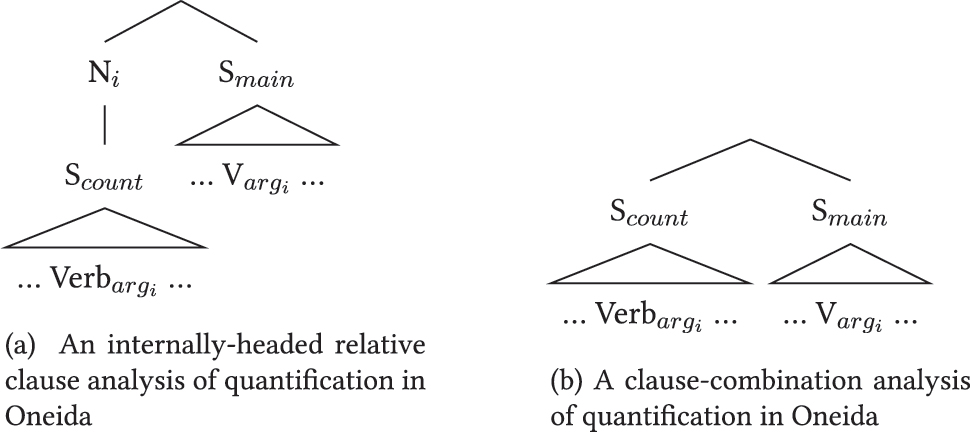
Two possible analyses of the syntax of quantification in Oneida.
8.3 Oneida-style quantification and expressibility
The absence of proportional quantifiers in Oneida does not prevent quantificational expressions that denote properties of sets to be truth-conditionally evaluated via the conceptual use of proportions. To illustrate the distinction we are after, consider the English sentence (66a) and two possible denotata for the class, an advanced graduate class with about 15 students in it and a large undergraduate class with about 100 students. Speakers might consider (66a) to be true if, say, eight out of the 15 registered students attended the first class in person, while if only eight students attended the large undergraduate class in person, (66a) would be judged false. Speakers’ truth-theoretic evaluation of (66a) involves computing some kind of proportion of the set of students in each class, just as most in (66b) does.
| a. | A large number of students attended the class in person. |
| b. | Most students attended the class in person. |
Truth-theoretic proportionality is not specific to the adjective large. It applies to words like frequency which can receive either an absolute or relative interpretation in sentence (67) or to crowd in sentence (68).
| The frequency of the word “number” in this corpus is 300 (vs. 30 per million words). |
| There was a crowd gathered in the front of the CEO’s office. |
The fact that the evaluation of sentences such as (66a) or (68) may involve proportionality does not mean these words denote relational predicates. Quantificational expressions denoting one-place predicates over sets can be truth-conditionally evaluated via the computation of proportions without proportionality being expressed as a relation between two sets. We distinguish between representationally proportional quantifiers and truth-conditionally proportional quantifiers. Representationally proportional quantifiers explicitly denote a relation between two sets; truth-conditionally proportional quantifiers denote properties of sets, but the evaluation of the truth of the proposition containing the quantifier involves computing a proportion. Note that truth-conditional proportionality may not just be a property of expressions like large, frequency, or crowd; it might be a property of scalar predicates in general, as Hong (2021) shows in her experimental study of tall (see Schmidt et al. 2009 for a similar suggestion in a broader context): tall objects for Hong’s participants were the k tallest objects (where k is a certain proportion of the set of all objects in the context set).[16] The closest translation of English most into Oneida are words that can be roughly paraphrased as ‘large crowd’ (kʌtyohkwanʌ́ in (42)). We therefore expect a truth-conditionally proportional interpretation to be possible for these verbs. And indeed it is. Proportionality is thus part of Oneida’s conceptual repertoire. But, Oneida does not have representationally proportional quantifiers, because Oneida does not have the morphosyntactic means to express proportions. It can only convey proportionality through the evaluation of one-place predicates in a way similar to English scalar adjectives. A corollary of the absence of representationally proportional quantifiers in Oneida is that it does not have as rich a set of quantifiers as languages like English have, because set/subset or other set-theoretic relations cannot be expressed syntactically (see Keenan and Stavi 1986 for the richness of English quantifiers).
9 Conclusion
This paper has shown that Oneida quantifies over entities with structures that are quite distinct from those of other languages. Quantification is expressed almost exclusively through verbs. These verbs are the heads of clauses adjoined to fully saturated main clauses and may combine with number names that further specify the quantity involved. Oneida does not include relational quantificational expressions. Oneida stands out in all three classificatory dimensions we identified in Section 2.1. First, Oneida quantifiers are almost exclusively verbs, something quite remarkable. There are languages in our 48 language sample where some quantifiers are verbs (eight languages: Asurini, Chickasaw, Choctaw, Eskimo, Kayardild, Oneida, Passamaquoddy, Wolof); only four languages (Chickasaw, Choctaw, Kalaallisut, Oneida) use verbs almost exclusively to count or quantify over entities. Second, Oneida quantifiers are heads of clauses rather than a part of a nominal structure; in most cases noun stems that denote the category of what is being counted are incorporated into the count verb. Aside from possibly Kalaallisut (Bittner and Trondhjem 2008), Oneida seems rather unique in this respect as even in Chickasaw and Choctaw verbal quantifiers seem to sometimes be able to act as modifiers of nouns. Third, all but two languages in the Keenan and Paperno anthology, Gitksan and Qʼanjobʼal, clearly include relational quantifiers and most of them include both relational proportional quantifiers as well as partitives. Gitksan and Qʼanjobʼal have very few if any proportional quantifiers; interestingly they are a translation equivalent of English half (see Bicevskis et al. 2017; O’Flynn 2017, respectively). As the description of neither language discusses the semantics of what corresponds to English half or partitives, it is not possible to know whether there are relational quantifiers in these two languages and they are just rare, or all quantifiers denote properties of sets like Oneida quantifiers. Note that a discussion of partitives to ascertain the range of semantic types of quantificational expressions is particularly relevant in light of recent work that has challenged the Generalized Quantifier approach to quantification, in particular Lücking and Ginzburg (2022). Even if quantifiers such as most in Most students left do not take the denotation of the VP as arguments and denote properties of sets, as in Lücking and Ginzburg’s analysis, partitives such as the majority of students or three quarter of the students seem to denote a relation between a set and a subset. The absence of partitives in Oneida in addition to what would correspond to proportional quantifiers like English most is thus of particular relevance.
Overall, and with respect to each of the three dimensions of classification of quantificational expressions we identified in Section 2.1, the strategy of Oneida is the marked choice, and Oneida is unique in that the marked choice is the (near) exclusive possibility in the language. The existence of languages like Oneida is thus on its own an important addition to the typology of quantification across human languages. But we think Oneida quantificational expressions have more general lessons for semantic typology.
First, it seems that the semantics of quantification is not universal, where by “semantics” is meant both the (semantic) representations associated with syntactic expressions and the way they are composed. Languages can differ substantially in the semantics of quantification without there necessarily being a truth-conditional difference between translation equivalents (see Davis 2010 for a similar point with respect to Salishan languages). Truth-conditionally, the meaning of many Oneida sentences that contain quantificational expressions and their English translation are equivalent, but the means by which the two propositions are composed differ. At least some English determiners denote relations between sets whereas Oneida count verbs and count clauses denote properties of sets. In the terminology used by Carnap (1947), the semantic representations of English and Oneida are not intensionally isomorphic. To the extent that linguists are interested in the meanings that can be expressed by the grammar rather than just the truth conditions, the existence of semantic differences between languages that are not truth-conditionally relevant is an important relativist fact to consider.
Second, and perhaps most importantly, the difference in both the semantics and syntax of quantification between Oneida and other languages affects what is expressible grammatically. One of the main advantages of treating determiners in English as denoting relations between sets is that it allows for a unified analysis of the semantic contribution of all English determiners, from two to most to John’s little sister’s, as Keenan and Stavi (1986) emphasize (although, as mentioned above, some scholars such as Krifka 1999 would not analyze cardinal numbers as determiners in English and Lücking and Ginzburg 2022 treat determiners as one-place predicates). How Oneida expresses quantification does not generalize as much. In particular, it does not allow for the expression of representationally proportional quantifiers like English most, two thirds of, and the like. The absence of representationally proportional quantifiers in Oneida does not mean proportionality cannot be expressed at all. It can be expressed truth-conditionally, i.e. by the truth conditions associated with expressions that quantify over a single set of entities. But such a truth-conditional way of expressing proportionality leads to a much more limited range of proportional expressions, as the syntactic expression of the two sets is not possible, i.e., we lose the expressive flexibility that the syntactic expression of proportionality and partitivity affords.
What this paper suggests, then, is that there may be “deep” intensional non-isomorphism in the expression of some semantic domains across languages. Such “deep” semantic differences challenge putative semantic universals of the expression of quantity, in particular the claim put forth in Peters and Westerståhl (2006: 12) that all languages include expressions where quantity is expressed as relations between sets. These differences also challenge the view that languages can express the same meanings within simple sentences (the null hypothesis, as mentioned in the introduction): relational proportional quantifiers (and, generally, partitivity) may not be grammatically expressible (in simple sentences) in languages like Oneida where number words are names of quantities and quantification expresses properties of sets. A strong interpretation of Searle’s Principle of Expressivity (Searle 1969: 20) – that we can always express what we conceive of (within a simple sentence, we would add) – may not be correct; see Binkley (1979), Récanati (2003) for critical assessments of Searle’s principle. Deal (2011: 583) reaches a similar conclusion with respect to necessity modals in her analysis of modality in Nez Perce (Sahaptian). Sometimes variation in expression can be matched by variation in expressibility.
References
Abeillé, Anne & Daniéle Godard. 2021. Grande Grammaire du Français [Large grammar of French]. Paris: Actes Sud.Search in Google Scholar
Austin, Peter & Joan Bresnan. 1996. Non-configurationality in Australian Aboriginal languages. Natural Language and Linguistic Theory 14. 215–268. https://doi.org/10.1007/bf00133684.Search in Google Scholar
Bach, Emon, Eloise Jelinek, Angelika Kratzer & Barbara Partee (eds.). 1995. Quantification in natural languages. Dordrecht: Springer.10.1007/978-94-011-0321-3Search in Google Scholar
Baker, Mark. 1996. The polysynthesis parameter (Oxford Studies in Comparative Syntax). Oxford: Oxford University Press.Search in Google Scholar
Barwise, John & Robin Cooper. 1981. Generalized quantifiers and natural language. Linguistics and Philosophy 4(2). 159–219. https://doi.org/10.1007/bf00350139.Search in Google Scholar
Bicevskis, Katie, Henry Davis & Lisa Matthewson. 2017. Quantification in Gitksan. In Denis Paperno & Edward Keenan (eds.), Handbook of quantifiers in natural language, vol. II (Studies in Linguistics and Philosophy 97), 281–382. Heildelberg: Springer.10.1007/978-3-319-44330-0_6Search in Google Scholar
Binkley, Timothy. 1979. The principle of expressibility. Philosophy and Phenomenological Research 39. 307–325. https://doi.org/10.2307/2106489.Search in Google Scholar
Bittner, Maria & Naja Trondhjem. 2008. Quantification as reference; evidence from q-verbs. In Lisa Matthewson (ed.), Quantification: A cross-linguistic perspective, 7–66. North-Holland: Elsevier.Search in Google Scholar
Bohnemeyer, Jürgen & Mary Swift. 2004. Event realization and default aspect. Linguistics and Philosophy 27. 263–296. https://doi.org/10.1023/b:ling.0000023371.15460.43.10.1023/B:LING.0000023371.15460.43Search in Google Scholar
Bowern, Claire & Jason Zentz. 2012. Diversity in the numeral systems of Australian languages. Anthropological Linguistics 54. 133–160. https://doi.org/10.1353/anl.2012.0008.Search in Google Scholar
Broadwell, George Aaron. 2006. A Choktaw reference grammar. Lincoln: University of Nebraska Press.Search in Google Scholar
Bruening, Benjamin. 2008. Quantification in Passamaquoddy. In Lisa Matthewson (ed.), Quantification: A cross-linguistic perspective (North-Holland Linguistic Series: Linguistic Variations 64), 67–103. Bingley, UK: Emerald.Search in Google Scholar
Carnap, Rudolf. 1947. Meaning and necessity. Chicago: University of Chicago Press.Search in Google Scholar
Chafe, Wallace. 1967. Seneca morphology and dictionary. Washington, DC: Smithsonian Press.10.5479/si.00810223.4.1Search in Google Scholar
Chafe, Wallace. 2015. A grammar of the Seneca language (UC Publications in Linguistics 150). Berkeley, CA: University of California Press.Search in Google Scholar
Chomsky, Noam. 1986. Barriers. Cambridge, MA: MIT Press.Search in Google Scholar
Cresswell, Max. 1976. The semantics of degree. In Barbara Partee (ed.), Montague grammar, 261–292. New York: Academic Press.10.1016/B978-0-12-545850-4.50015-7Search in Google Scholar
Damaso Vieira, Marcia. 1995. The expression of quantificational notions in Asurini do Trocará: Evidence against the universality of determiner quantification. In Emmon Bach, Eloise Jelinek, Angelika Kratzer & Barbara Partee (eds.), Quantification in natural languages, 701–720. Dordrecht: Kluwer.10.1007/978-94-017-2817-1_21Search in Google Scholar
Davis, Henry. 2010. Salish languages lack generalized quantifiers after all! Ms: University of British Columbia.Search in Google Scholar
Davis, Henry. 2013. All about all in (some) Salish languages. In Kook-Hee Gil, Stephen Harlow & George Tsoulas (eds.), Strategies of quantification (Oxford Studies in Theoretical Linguistics 44), 214–259. Oxford: Oxford University Press.10.1093/acprof:oso/9780199692439.003.0011Search in Google Scholar
Deal, Amy Rose. 2011. Modals without scales. Language 87(3). 559–585. https://doi.org/10.1353/lan.2011.0060.Search in Google Scholar
Diaz, Thomas, Jean-Pierre Koenig & Karin Michelson. 2019. Oneida prepronominal prefixes in information-based morphology. Morphology 29(4). 431–473. https://doi.org/10.1007/s11525-019-09345-2.Search in Google Scholar
Epps, Patience, Claire Bowern, Cynthia Hansen, Jane Hill & Jason Zentz. 2012. On numeral complexity in hunter-gatherer languages. Linguistic Typology 16(1). 39–107. https://doi.org/10.1515/lity-2012-0002.Search in Google Scholar
Evans, Nicholas. 1995. A grammar of Kayardild, with historical-comparative notes on Tangkic (Mouton Grammar Library 15). Berlin: Mouton de Gruyter.10.1515/9783110873733Search in Google Scholar
Evans, Nicholas. 2003. Bininj-Gunwok: A pan-dialectal grammar of Mayali, Kunwinjku, and Kune. Canberra: Pacific Linguistics.Search in Google Scholar
Faltz, Leonard. 1995. Towards a typology of natural logic. In Emmon Bach, Eloise Jelinek, Angelika Kratzer & Barbara Partee (eds.), Quantifiers in natural language, 271–319. Dordrecht: Kluwer.Search in Google Scholar
Hale, Kenneth. 1975. Gaps in grammar and culture. In Dale Kinkade, Kenneth Hale & Oswald Werner (eds.), Linguistics and anthropology, in honor of C.F. Voegelin, 295–315. Lisse: The Peter de Ridder Press.Search in Google Scholar
Hale, Kenneth. 1983. Warlpiri and the grammar of non-configurational languages. Natural Language and Linguistic Theory 1. 5–47. https://doi.org/10.1007/bf00210374.Search in Google Scholar
Hong, Seung-Jin. 2021. Computing category membership for tall: An error minimization approach. Buffalo, NY: University at Buffalo dissertation.Search in Google Scholar
Jelinek, Eloise. 1995. Quantification in Straits Salish. In Emmon Bach, Eloise Jelinek, Angelika Kratzer & Barbara Partee (eds.), Quantification in natural languages, 487–540. Dordrecht: Kluwer.10.1007/978-94-017-2817-1_16Search in Google Scholar
Keenan, Edward L. & Bernard Comrie. 1977. Noun phrase accessibility and universal grammar. Linguistic Inquiry 8(1). 63–99.Search in Google Scholar
Keenan, Edward & Denis Paperno (eds.). 2012. Handbook of quantifiers in natural language, vol. 1. Dordrecht: Springer.10.1007/978-94-007-2681-9Search in Google Scholar
Keenan, Edward & Jonathan Stavi. 1986. A semantic characterization of natural language determiners. Linguistics and Philosophy 9(3). 253–326. https://doi.org/10.1007/bf00630273.Search in Google Scholar
Koenig, Jean-Pierre & Karin Michelson. 2010. Argument structure of Oneida kinship terms. International Journal of American Linguistics 76(2). 169–205. https://doi.org/10.1086/652265.Search in Google Scholar
Koenig, Jean-Pierre & Karin Michelson. 2012. The (non)universality of syntactic selection and functional application. In Christopher Piñón (ed.), Empirical studies in syntax and semantics, vol. 9, 185–205. Paris: Centre National de la Recherche Scientifique.Search in Google Scholar
Koenig, Jean-Pierre & Karin Michelson. 2014. Deconstructing syntax. In Stefan Müller (ed.), Proceedings of the 21st conference on head-driven phrase-structure grammar, 114–134. Stanford, CA: CSLI Publications.10.21248/hpsg.2014.7Search in Google Scholar
Koenig, Jean-Pierre & Karin Michelson. 2015a. Invariance in argument realization: The case of Iroquoian. Language 91(1). 1–47. https://doi.org/10.1353/lan.2015.0008.Search in Google Scholar
Koenig, Jean-Pierre & Karin Michelson. 2015b. Morphological complexity à la Oneida. In Michael Baerman & Greville Corbett (eds.), Understanding and measuring morphological complexity, 69–92. Oxford: Oxford University Press.10.1093/acprof:oso/9780198723769.003.0005Search in Google Scholar
Koenig, Jean-Pierre & Karin Michelson. 2019. Extended agreement in Oneida (Iroquoian). In András Bárány, Irina Nikolaeva & Oliver Bond (eds.), Prominent internal possessors, 131–162. Oxford: Oxford University Press.10.1093/oso/9780198812142.003.0005Search in Google Scholar
Koenig, Jean-Pierre & Karin Michelson. 2020a. Derived nouns and structured inflection in Oneida. Lingue et Linguaggio 19(1). 9–33.Search in Google Scholar
Koenig, Jean-Pierre & Karin Michelson. 2020b. Quantification in Oneida. In Anne Abeillé & Olivier Bonami (eds.), Constraint-based syntax and semantics (CSLI Lecture Notes 223), 123–149. Stanford: CSLI Publications.Search in Google Scholar
Koenig, Jean-Pierre & Karin Michelson. 2021. Specialized-domain grammars and the architecture of grammars: Possession in Oneida. Journal of Linguistics 57(3). 635–674. https://doi.org/10.1017/s0022226720000262.Search in Google Scholar
Koenig, Jean-Pierre & Karin Michelson. 2023. Semantic transparency and Oneida morphological parts of speech. Linguistics 61(1). 197–230. https://doi.org/10.1515/ling-2021-0188.Search in Google Scholar
Krifka, Manfred. 1999. At least some determiners aren’t determiners. In Ken Turner (ed.), The semantics/pragmatics interface from different points of view (Current Research in the Semantics/Pragmatics Interface 1), 257–291. Oxford: Elsevier.Search in Google Scholar
LeSourd, Philip. 2006. Problems for the pronominal argument hypothesis in Maliseet-Passamaquoddy. Language 82. 486–514. https://doi.org/10.1353/lan.2006.0150.Search in Google Scholar
Lounsbury, Floyd. 1953. Oneida verb morphology. (Yale University Publications in Anthropology 48). New Haven, CT: Yale University Press.Search in Google Scholar
Lücking, Andy & Jonathan Ginzburg. 2022. Referential transparency as the proper treatment of quantification. Semantics and Pragmatics 15(4). https://doi.org/10.3765/sp.15.4.Search in Google Scholar
Matthewson, Lisa. 2001. Quantification and the nature of cross-linguistic variation. Natural Language Semantics 9(2). 145–189. https://doi.org/10.1023/a:1012492911285.10.1023/A:1012492911285Search in Google Scholar
Matthewson, Lisa (ed.). 2008. Quantification: A cross-linguistic perspective. Bangley: Emerald Group Hanshin Publishing Co.Search in Google Scholar
Michelson, Karin. 1991. Semantic features of agent and patient core case marking in Oneida. In Robert Van Valin (ed.), Buffalo Papers in Linguistics, vol. 091-II, 114–146. Buffalo, NY: Linguistics Department, University at Buffalo.Search in Google Scholar
Michelson, Karin & Mercy Doxtator. 2002. Oneida-English/English-Oneida dictionary. Toronto: University of Toronto Press.10.3138/9781442632875Search in Google Scholar
Michelson, Karin, Norma Kennedy & Mercy Doxtator. 2016. Glimpses of Oneida life. Toronto: University of Toronto Press.10.3138/9781442622753Search in Google Scholar
Mithun, Marianne. 1986. When zero isn’t there. In Proceedings of the Berkeley Linguistics Society, vol. 12, 195–211. Berkeley, CA: Berkeley Linguistics Society.10.3765/bls.v12i0.1882Search in Google Scholar
Mithun, Marianne. 1991. Active/agentive case marking and its motivations. Language 67. 510–546. https://doi.org/10.1353/lan.1991.0015.Search in Google Scholar
Mithun, Marianne. 2003. Pronouns and agreement: The information status of pronominal affixes. Transactions of the Philological Society 101. 235–278. https://doi.org/10.1111/1467-968x.00119.Search in Google Scholar
Munro, Pamelo. 2017. Chickasaw quantifiers. In Denis Paperno & Edward Keenan (eds.), Handbook of quantifiers in natural languages, vol. II, 113–201. Dordrecht: Springer.10.1007/978-3-319-44330-0_4Search in Google Scholar
Obenauer, Hans-Georg. 1983. Une quantification non-canonique: la quantification “à distance” [A non-canonical quantification: “at a distance” quantification]. Langue Française 58. 66–88. https://doi.org/10.3406/lfr.1983.6415.Search in Google Scholar
O’Flynn, Kathleen Chase. 2017. Quantification in Q’anjob’al. In Denis Paperno & Edward L. Keenan (eds.), Handbook and quantifiers in natural language, vol. II (Studies in Linguistics and Philosophy 97), 697–750. Cham, Switzerland: Springer.Search in Google Scholar
Paperno, Denis & Edward Keenan (eds.). 2017. Handbook and quantifiers in natural language, vol. 2. Dordrecht: Springer.10.1007/978-3-319-44330-0Search in Google Scholar
Partee, Barbara. 1989. Many quantifiers. In Ken deJong & Yongkyoon No (eds.), Escol 89: Proceedings of the eastern states conference on linguistics, 383–402. Columbus, OH: Department of Linguistics, The Ohio State University.Search in Google Scholar
Peters, Stanley & Dag Westerståhl. 2006. Quantifiers in language and logic. Oxford: Clarendon Press.Search in Google Scholar
Récanati, François. 2003. The limits of expressibility. In Barry Smith (ed.), John Searle, 189–213. Cambridge: Cambridge University Press.10.1017/CBO9780511613999.009Search in Google Scholar
Schmidt, Lauren A., Noah D. Goodman, David Barner & Joshua B. Tenenbaum. 2009. How tall is Tall? Compositionality, statistics, and gradable adjectives. In Proceedings of the 31st annual meeting of the Cognitive Science Society, 3151–3156. Amsterdam: Cognitive Science Society.Search in Google Scholar
Searle, John. 1969. Speech acts. Cambridge: Cambridge University Press.Search in Google Scholar
Solt, Stephanie. 2015. Q-adjectives and the semantics of quantity. Journal of Semantics 32(2). 221–273. https://doi.org/10.1093/jos/fft018.Search in Google Scholar
Woodbury, Hanni. 2003. Onondaga-English/English-Onondaga dictionary. Toronto: Toronto University Press.Search in Google Scholar
© 2024 the author(s), published by De Gruyter, Berlin/Boston
This work is licensed under the Creative Commons Attribution 4.0 International License.
Articles in the same Issue
- Frontmatter
- Research Articles
- From aspect to information structure: Non-aspectual functions of change of state markers in Austronesian and beyond
- A word order typology of adnominal person
- Singular-plural verb stem alternation: uncovering global and local drivers of typological variation
- Differential object marking in Western Malayo-Polynesian symmetrical voice languages
- The expression of quantity in Oneida: a study in syntactic and semantic variation
- Book Reviews
- Pacchiarotti, S. & F. Zúñiga: Applicative Morphology. Neglected Syntactic and Non-syntactic Functions
- Stephen C. Levinson: A Grammar of Yélî Dnye: The Papuan language of Rossel Island
- Reviewer Acknowledgement
- Reviewer Acknowledgement
Articles in the same Issue
- Frontmatter
- Research Articles
- From aspect to information structure: Non-aspectual functions of change of state markers in Austronesian and beyond
- A word order typology of adnominal person
- Singular-plural verb stem alternation: uncovering global and local drivers of typological variation
- Differential object marking in Western Malayo-Polynesian symmetrical voice languages
- The expression of quantity in Oneida: a study in syntactic and semantic variation
- Book Reviews
- Pacchiarotti, S. & F. Zúñiga: Applicative Morphology. Neglected Syntactic and Non-syntactic Functions
- Stephen C. Levinson: A Grammar of Yélî Dnye: The Papuan language of Rossel Island
- Reviewer Acknowledgement
- Reviewer Acknowledgement
