A Study on the Analysis of Public User Expectations for the Metaverse Library Services


Abstract
This study examined the possibility of applying the Metaverse concept to the library, and to this end, we investigated representative Metaverse implementation cases and library implementation cases, analyzed them comprehensively, and discussed the service direction to be pursued when Metaverse libraries are implemented. The results of the study found that: first, there were not many cases of research or construction on Metaverse libraries; and second, users have high expectations for Metaverse libraries. Users expect that when Metaverse libraries are established, there will be more services and programs available, and that cooperation and communication with the library will be smooth. Therefore, it is necessary to effectively utilize and supplement each of the advantages and disadvantages in connection with the current physical library.
1 Introduction
The Metaverse first appeared in Neil Stephenson’s novel Snow Crash (1992), and began with a picture of people borrowing virtual bodies and avatars to enter a virtual country called “Metaverse” (Jeong et al. 2021). In the early 2000s, with the emergence of Google’s 3D map service “Google Earth” and the 3D virtual world “Second Life,” interest in the 3D Web increased and discussions on the Metaverse began in earnest as a new future space for social and economic activities. (Figures 1–4)
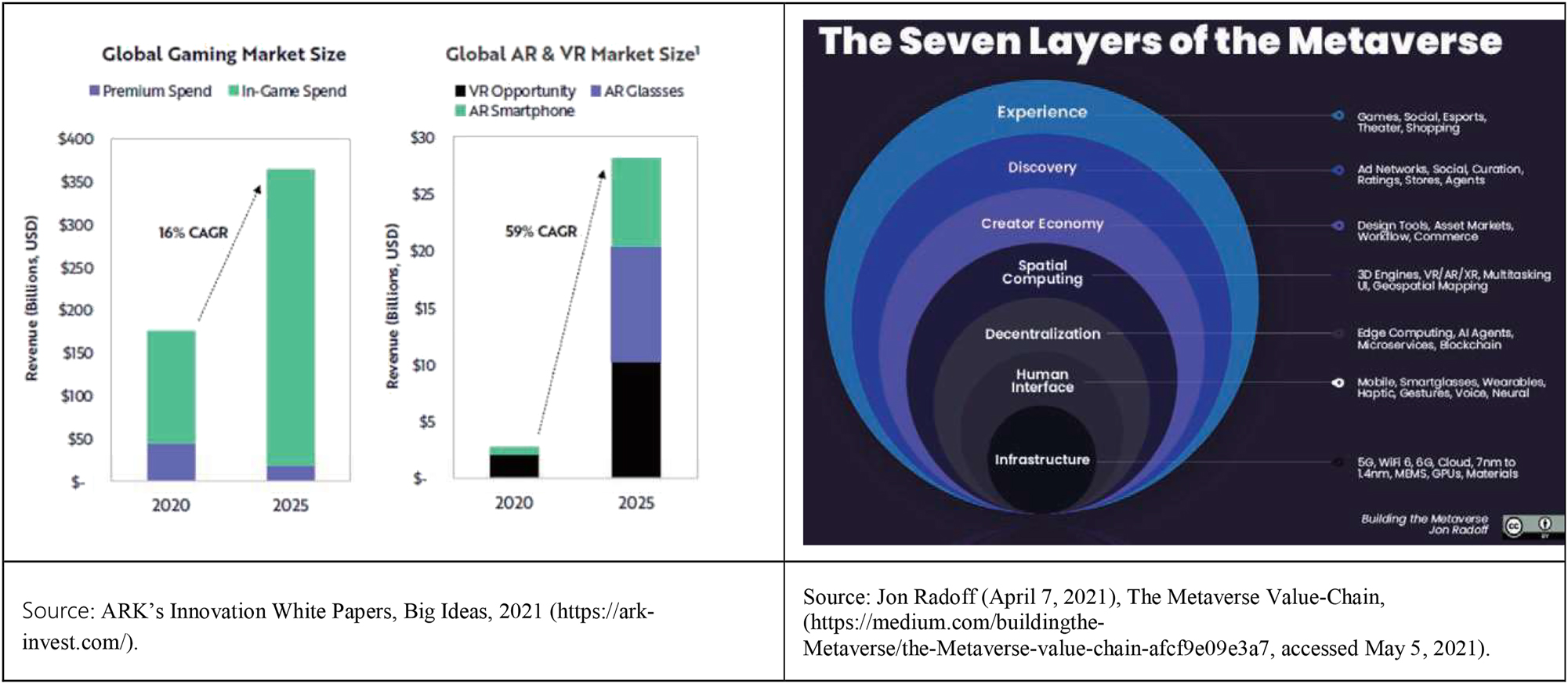
The recent Metaverse implementation.
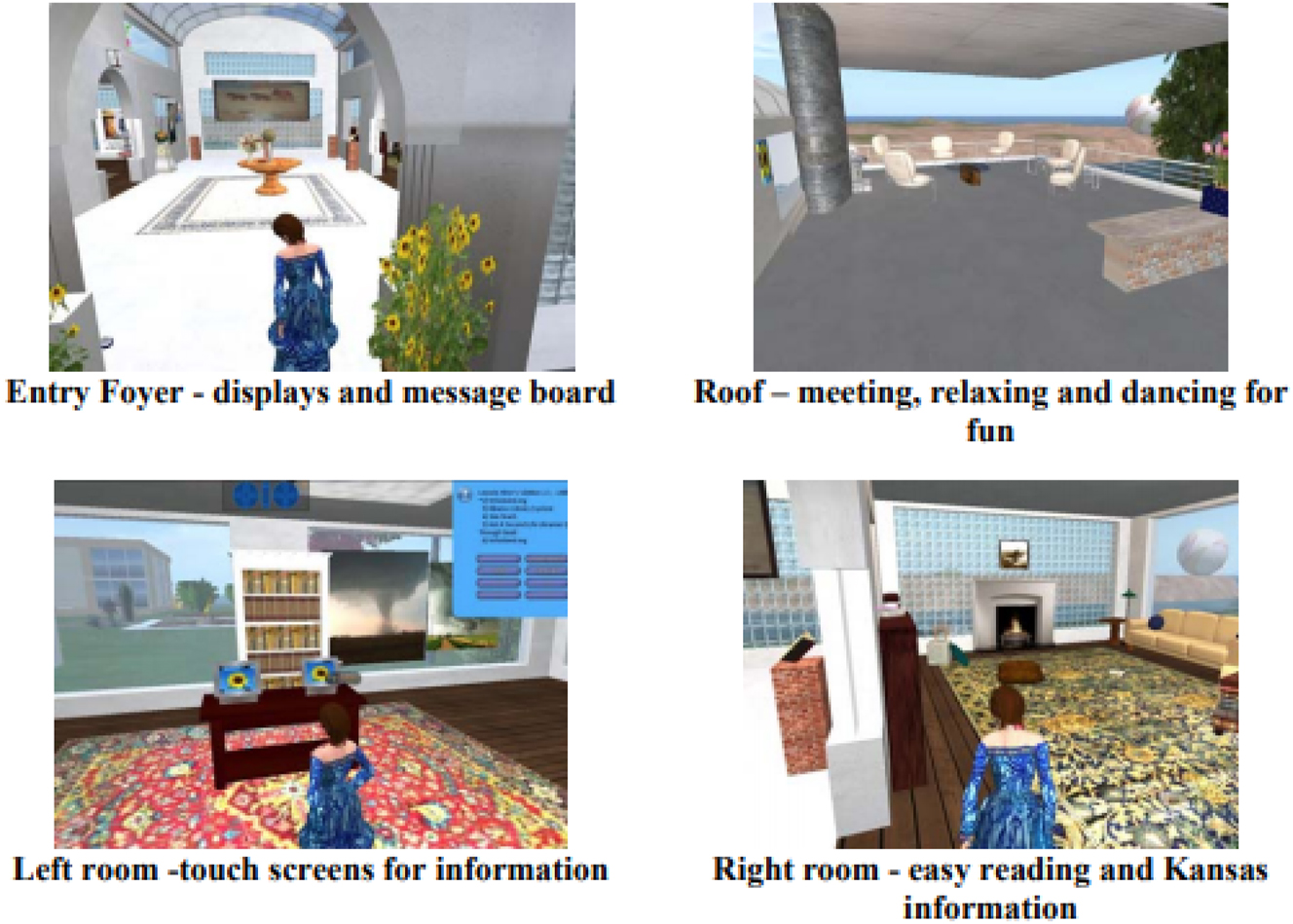
The screenshots of Olathe Second Life Library.

Hansung Book-niverse, a Metaverse library at Hansung University.

Hansung Book-niverse, a Metaverse library at Hansung University.
In May 2006, the Metaverse Roadmap Summit was held under the supervision of the Acceleration Studies Foundation (ASF). The contents of the event and the discussion on the concept and outlook of Metaverse were published in the Metaverse Roadmap report in 2007 (Acceleration Study Foundation 2007). Microsoft and Google were in a hurry to develop the next generation of the Metaverse. In Japan, related services and products such as “splume,” “meet-me,” and “HOME” have already been released or are about to be released (Seo 2008).
“Metaverse” is a compound word consisting of meta, meaning transcendence and virtuality, and universe, meaning the world. It refers to a three-dimensional virtual world in which social and economic activities continue as in reality. In other words, it includes performing various activities using one’s own alter ego, or avatar, in a virtual world built on the Internet. It advocates another world under the name “Mirror World” (Lee 2021b). Unlike MMORPGs, which selectively operate within a set system, users engage in various organic activities such as communication, business, and seminars within the Metaverse. They build buildings, party, trade goods, and participate in lectures and seminars in virtual spaces. With a similar concept, Second Life briefly drew attention in the early 2000s and waned, but it is in full swing again. In 2003 Linden Lab’s Second Life, graphics were not sophisticated, and communication speed was not supportive, so the service was not smooth but it was still recognized as a service with a wow factor, worth using at least once (Han 2021). In particular, as telecommuting, teleconference, and webinars have become commonplace due to the recent COVID-19 crisis, the aforementioned services are gaining momentum. This is because with the development of science and technology, related technologies such as sensors, virtual reality, and augmented reality have emerged, and the sense of reality has increased. Various services such as real estate transactions are provided on each Metaverse site. Buildings and shops are built, and educational institutions such as schools, movie theaters, performance halls, and various amusement facilities are created to provide a place where people can interact with each other.
These Metaverses are largely divided into games and platforms. Users play games based on virtual characters they create in game-based Metaverses such as Minecraft, Roblox, and Animal Crossing. Platform-based Metaverses, such as SKT JUMP and NCsoft Universe, focus on social interaction functions, and users communicate through avatars, form social relationships, and hold performances or conferences. They also shop using virtual currency at stores.
This study attempted to explore the possibility of applying this concept of Metaverse to libraries. To this end, representative Metaverse implementation cases and library implementation cases, including previous studies related to Metaverse, were investigated and comprehensively analyzed. Finally, we attempted to collect opinions on the service direction to be pursued when Metaverse libraries are implemented, and based on these results attempted to propose a future image of the Metaverse library.
In this context, we have investigated the perceptions of teenagers and those in their twenties who comprise the main users of the Metaverse services, and based on their perceptions of the Metaverse, we sought answers to the following research questions:
RQ1.
What is the respondents’ level of awareness with regards to the Metaverse?
RQ2.
What are the respondents’ perceptions of the Metaverse?
RQ3.
What are the respondents’ perceptions of services, programs, equipment, and various resources of the Metaverse libraries?
RQ4.
How does the respondent’s ability to use the Internet affect their perception of the Metaverse library?
RQ5.
How does the respondent’s ability to use IT affect their perception of the Metaverse library?
2 Previous Studies
By looking at the preceding studies covered in this chapter, it can be seen that the Metaverse is being utilized in a wide variety of areas, including virtual currency, educational institutions, arts, and games. It can be seen that it is related to all areas, including politics, economy, society, and culture. In the end, it may be suggested that everything in the present world can be implemented as a virtual world.
First, in Korea, about 13 years ago, Seo (2008) looked at the concept and development prospects of the Metaverse, focusing on the U.S. Metaverse Roadmap and Japan’s IT Roadmap. In addition, the significance and limitations of Linden Lab’s Second Life, perhaps the closest to the concept of Metaverse among the existing virtual worlds, were discussed. In addition, Metaverse development trends in countries around the world aiming for second- and third-generation Second Life were analyzed. Through this, as a condition for the success of the development of the next-generation Metaverse, attention should be paid to the provision of abundant content, reinforcement of relevant functions, and the possibility of the development of the mirror world. In addition, it was pointed out that development and research on Metaverse are very insufficient in Korea, the country that boasts the world’s best IT technology. Seo proposed the concept of the Metaverse and four major elements of Metaverse, while presenting trends and prospects for Metaverse development at home and abroad. In the same year, Han (2008) presented a study that showed that the virtual world can be classified into the Ludic Virtual World, which emphasizes fantasy, playfulness, and gameability, and the Social Virtual Reality, which emphasizes reality, efficiency, and networkability.
It is evident that research of the Metaverse platform was very actively carried out in 2021. Kim (2021b) predicted the conditions of the Metaverse for sustainable growth from the three theoretical perspectives of the platform. In order for the platform to continue to grow, it must grow above the threshold, and for this, the following three perspectives must be considered: a two-sided market perspective encompassing both demand and supply sides; a perspective of platform typology that divides the platform into a transaction platform that enters the market from a narrow area and grows into an open interface convergence service, and an innovation platform that provides universal tools or technologies and accommodates third-party innovation in various areas; a life-cycle perspective of the platform for birth → expansion → leading → self-renewal. Han (2021) comprehensively examined the development status of Metaverse platforms and later proposed innovation plans for information, companies, and public institutions based on the Metaverse. In particular, he argued that if public services are implemented on the Metaverse platform, users will be able to implement intuitive and convenient services beyond temporal and spatial limitations. A study by Park (2021) suggests the direction of use based on the current situation. In addition, a study by Lee (2021a) proposed the rapid rise of Metaverse in a non-face-to-face state.
In addition, the studies on the concept and type of Metaverse were conducted. In 2015, Kim and Choi (2016) proposed a plan to develop history education content through four types of Metaverse. They argue that technological systems such as Metaverse need to be introduced to properly understand the times because history, the subject of history education, targets the past. Cho (2021) said that the Metaverse, a new dimension of digital virtual space, will produce an explosive value creation that humans have not yet enjoyed. It is also argued that people will form a community and communicate here and that they will create a new life in the space of digital twins, like in yet another Second Life. Kim (2021c) dealt with the concepts of virtual currency and the virtual world Metaverse. He gave an explanation of Earth 2, a representative example of a virtual real estate sales project, and other examples, including Fortnite game sites, BTS Dynamite, and Blackpink’s Ice Cream dance. In Earth 2, real estate is sold by mapping the actual earth 1:1 and dividing it into 10 m × 10 m size tiles. But he argues that people, like they would with virtual currency, should approach virtual real estate carefully.
In this world of evolution, Kim (2021) argued that marketing should also evolve into Metaverse-based marketing. He noted developments in graduation marketing cases (UC Berkeley, Soonchunhyang University), political marketing (Joe Biden in Animal Crossing), and game meta marketing (League of Legends). Ko, Yoo, and Hwang (2021) also presented Metaverse marketing cases and proposed successful Metaverse marketing strategies. In addition, Jeong et al. (2021) discussed how architecture should develop in the upcoming Metaverse world, and Kim (2021a) discussed the future of the game industry.
It can be said that the Metaverse library began with the Second Life library. In April 2006, the Alliance Library System and Online Programming for All Libraries collaborated to launch Second Life Library 2.0 in the online world, and in August 2006, they purchased an island on the Teen Grid on Teen Second Life. Second Life is a virtual world descending from multiplayer online games. Second Life Library 2.0 has collaborated with librarians around the world and other educational partners such as TechSoup, World Bridges, and New Media Consortium. Second Life Library 2.0 provides traditional library services such as references, book discussions, and search support, while also exploring what it means to be a virtual library in a virtual world (Hedreen et al. 2008). The Metaverse is an augmented reality platform used to build interactive learning experiences. In the Metaverse library, users can see the surrounding environment through a smartphone camera and see overlapping icons, pictures, or cartoon characters. For example, one can see his/her head floating above the circulation desk. The overlapping image may appear according to a geographic location (in this case, a specific location in the library). Through conversations, characters can ask viewers to answer questions such as quizzes or perform specific tasks that can be implemented on a computer, such as providing photos with related works, ISBN, or barcodes.
However, when analyzing previous studies, there were a few papers related to the implementation of the Metaverse library. In addition, it was investigated that there was no study conducted on how to implement the Metaverse library and how its users would react when the Metaverse library is established. Therefore, it would be meaningful to derive which services and programs can be provided if the Metaverse Library is established.
3 Metaverse Implementation Cases
The Acceleration Studies Foundation in the U.S. has classified the Metaverse into four types: augmented reality, lifelogging, mirror world, and virtual world. It has argued that several types are evolving into new types of services by mutually converging and breaking down boundaries.
Recent Metaverse implementation shows that there are countless cases, and it can be seen that the fields of application are diverse. It can be applied to all parts of our lives, such as art, literature, physical education, and the economy. According to predictions by PricewaterhouseCoopers (PwC), the spread of the Metaverse, the AR and VR markets are projected to grow from $46.4 billion (about 52 trillion won) in 2019 to $476.4 billion (about 540 trillion won) in 2025 and $1.5 trillion (about 1700 trillion won) in 2030 Kim and Jung (2021).
A representative example of Metaverse implementation is Roblox, a Metaverse virtual reality game platform. When you connect to Roblox, you enter a three-dimensional virtual space with your avatar and enjoy your daily life. You can also play another game implemented within the game. There are 50 million games in Roblox and about two million people developing games. The game world in these games has become another society within a society (https://blog.roblox.com/).
“Decentraland” is a virtual reality platform based on the Ethereum blockchain. Transactions are made through a cryptocurrency called “MANA,” land is limited, and so prices are set according to demand. In this world, people participate in activities including movies, exhibitions, and parties on their own land to increase liquidity and generate profits.
NVIDIA’s real-time 3D design collaboration platform, “Omniverse,” can quickly implement a virtual world or Metaverse that allows for collaboration with multiple developers. Simulations in various industrial fields are also possible through Digital Twin.
Microsoft’s remote collaboration platform, “Mesh,” is a Metaverse platform based on Mixed Reality (MR) that helps users in different regions feel as though they are working in the same space through avatars. Real objects and virtual information can be viewed simultaneously, enabling collaboration overcoming time and space constraints in various areas such as medical, manufacturing, and design. Examples include patient surgery, equipment repair, and prototype review. In addition, various Metaverse-based collaboration platforms such as Space and Glue are also being developed.
Among these various cases, we would like to focus more on some of the cases with a long history and a dramatic increase in users. Such cases are expected to help discover implications for the application to libraries in the future.
3.1 Zepeto
Zepeto is a Metaverse platform service operated by Naver Z, a subsidiary of Naver. Zepeto, an AR-based 3D avatar app developed by Naver Z, is a platform that creates avatars and virtual worlds using facial recognition and AR. Currently, the number of subscribers worldwide has surpassed 200 million. Zepeto also operates Build-It, constituting a map, a virtual space in which avatars of the users operate. Zepeto also operates Zepeto Studio, where they can create costumes. Zepeto focuses on communication between avatars in virtual space by selecting real-life themes and is currently attempting to enter the market using cryptocurrency based on the commercialization strategy of the Metaverse platform’s ecosystem. The Metaverse platform operated by Naver Z is divided into an official map and “Build It” created by the users. The official map includes game elements such as jumping, shooting, escaping, riding, and adventure elements, and provides users with a service that allows them to build the map. The Zepeto service mainly focuses on “play activities,” including cafés where people sit together, photo spots where people take pictures, parties, and performances. Users can create avatars that resemble them and work in the virtual world, and avatars can not only buy luxury goods, but also make phone calls and text messages with one another. More than 80 % of all users are teenagers, and more than 90 % are foreigners. Zepeto has held fan meetings and promotional events for Korean tourism, such as rice cake soup gifts, and 6.8 million people have visited the Han River Park map. The quantity of Korean tourism content produced by users is evaluated as a successful viral marketing case, with 10,000 cases.
Zepeto’s service platform provides many services for the production of avatars for users. In particular, it specializes in the appearance of users participating in the virtual world by providing not only costumes for avatars that the Roblox platform service lacks, but also face, eye, nose, mouth, and makeup services. It also provides tools for users to create their own maps using Build-It and supports services for web and custom maps on mobile. The PC version is not supported separately but can be accessed through BlueStacks, NoxPlayer, etc., provided by the mobile virtual environment PC.
3.2 Roblox
Roblox provides a service for users to create their own avatar and their own virtual space free of charge. It features social networking among users, allowing users to make their own games and enjoy games with their friends through Roblox Studio. Roblox was created in 2004 under the name DynaBlocks by co-founders Davis Baszucky and Eric Kassel. Baszucky conducted the first demo-test that year, renamed the company Roblox in 2005, and officially launched Roblox on September 1, 2006. Roblox, located in San Mateo, California, has provided a Metaverse environment for millions of users since its foundation in 2006. It is a service in which users become Lego-like avatars and work in the virtual world. Roblox can be said to be representative of the Metaverse industry, allowing users to have various experiences in virtual space, including building and operating theme parks, adopting pets, scuba diving, and superhero activities, as well as games. In addition, it allows users to communicate with each other, earn money, consume, play, and work in the form of avatars in the three-dimensional virtual world online as they would in reality. Users who access Roblox in a “three-dimensional virtual space where social and economic activities such as the real world are common” can create their own avatars and their own virtual space for free. Users use the virtual currency “Robux” within Roblox games. This virtual currency can be exchanged for $0.0035 per unit and contributes to both company sales and developer income by deducting fees (30 % on game items). Roblox has been growing rapidly recently, loved by Gen-Z who are familiar with both mobile and the Internet. Roblox allows users to make their own games, enjoy them with friends, and make profits. The Roblox platform uses Roblox Studio, which collects the tools necessary to create games, and the script language Lua5.1 for controlling characters and objects. The Lua programming language is a light imperative/procedural language designed primarily for scripting languages that can be used as extended languages. However, it can also be seen as a declarative language because it has a lot of algorithmic designs (table, etc.) and can only execute code with an interpreter (language launcher). Currently, more and more people are making money through Roblox, including engineering students who said they’ve paid their tuition by creating Roblox games, and full-time Roblox game developers. In the United States and Europe, schools that provide computer programming education using Roblox Studios have also emerged. Roblox was listed on the New York Stock Exchange in March 2020, with a market capitalization of 60 trillion won. This is an open world in which users move avatars in games resembling Lego to do various activities, create games on their own, make calls or chat, and freely work through Roblox Studios and Roblox Players (PC, Android, MacOS, and Console).
Roblox has about 150 million monthly users and most of them are high school-aged teenagers in the United States. The developer community has made 250 billion won in sales. Roblox producers only have platforms and tools in their hands to develop games to their heart’s content, while profits and activities are up to users. As a result, Roblox provides platform services while promoting a second YouTube on which users create their own content and a profit structure.
American rapper Lil Nas X held a virtual concert in Roblox in November last year, attracting 30 million viewers in two days. Lil Nas X sang “Holiday” and other hit songs and had a Q&A session with fans at the concert. In addition, it was subtitled in various languages, including Korean, so that anyone could enjoy the concert, and the stage was created using Roblox’s facial recognition technology and state-of-the-art direction. “The concert will guide game players and music fans to the Metaverse (three-dimensional virtual world), and further present a new direction for the future of immersive social networking,” said John Vlassopoulos, head of Roblox’s music division (Chioi 2021).
Roblox provides Roblox Studio, a service platform, where users build a map by arranging various three-dimensional parts (shapes, furniture, woods, stores, guns, monsters, soldiers, etc.). The script is written and completed using Lua, a simple coding language for controlling characters and various objects. The completed Metaverse project can be tested in real time in various environments (PC, Android, console, and Mac) through Roblox Player, and posted directly on Roblox Cloud to enjoy with people around the world. Roblox Platform Service provides game engines, general-purpose game clients, real-time social platform services, cloud computing, and collaboration infrastructure. However, compared to other Metaverse solutions, drawbacks of Roblox may include the reluctance of adults to participate due to the appearance of Lego blocks, and the difficulty of producing games. There are also many types of games completed and most games are rather low in quality. In addition, it is difficult to cope with problems when users develop games themselves, upload them freely, and provide services immediately without review. Also, there are many cases where there are no tutorials or practice games that teach users how to play the game.
3.3 Utilization and Spread of the Metaverse in the Field of Education
Metaverses have created a new economic ecosystem by converging with elements and technologies of the Fourth Industrial Revolution, such as semiconductors, the Internet of Things, 5G, cloud, content, and mobility. Due to the development of the Metaverse, both domestic and foreign technology companies, including big tech companies, are entering the Metaverse market to secure leadership.
In particular, the Metaverse is rapidly spreading to the educational field, going one step further than gamification, increasing interest in learning and efficiency. Real-time voice conversations in virtual space using avatars and realistic classes using 3D objects and 360-degree images are used to increase learning immersion. In particular, it is contributing to overcoming the limitations of non-face-to-face and remote education in the COVID era.
3.4 Metaverse Library Cases
It can be seen that the Metaverse has been applied to the library from the Second Life Library (Kroski 2007). In 2010, there were 10 Second Life public libraries surveyed: Cleveland Public Library (Ohio), Glenview Public Library (Illinois), Mark & Emily Turner Memorial Library (Maine), Maryland Library System, Monroe County Library System (New York), Olathe Public Library (Kansas), Orange County Library System (Florida), Society Hill SC Public Library, The Public Library of Charlotte & Mecklenburg County (North Carolina), the Topeka & Shawnee County Public Library (Kansas) (Chow et al. 2010).
Vans (2017) has argued that the Community Virtual Library (CVL) has been a major hub for 10 years for librarians in the virtual world striving to include literacy in immersive learning environments, including digital citizenship. Currently, CVL is entering areas such as Inworldz and Kitely through cooperation between educators and information experts. It has been introduced as part of Metaverse libraries to connect high-quality education-oriented virtual communities with resources (Vans 2017).
As previously explained, libraries in Korea are also building in the Metaverse. Hansung University’s Hansung Book-niverse is a representative example. Hansung University opened the Metaverse library Hansung Book-niverse in August 2021 in Seoul to provide new services to communicate with Generation MZ (as Millennials and Generation Z are known in Korea) students. Hansung Book-niverse, implemented through the Zepeto platform, is a compound word of “Hansung University,” “book,” and “universe,” and was created by embodying the appearance of Hansung University’s academic information center. Students can access the Zepeto platform, tour the inside and outside of the data room and reading room in the academic information center, tour the library, and chat in real-time with a librarian. In particular, students can check the major reading programs of the university at the Imagination Reading Exhibition section located on the fourth floor of Hansung Book-niverse and can directly access e-books and audiobooks using the QR code provided on the virtual poster. In addition, there are game zones including Treasure Hunt, Library Escape, Jump Up, Shots at the Imagination Reading, and QUIZ! QUIZ!, so that students can participate in various ways and enjoy themselves in the Hansung Book-niverse.
The National Library of Korea has recently introduced content using Metaverse technologies, such as the “Realistic Library” (main building) and the “Augmented Reality Musical” (National Children’s and Youth Library), to create an environment where visitors can experience new forms of library content applied with advanced technology. This “Realistic Library” space provides realistic content services such as “future of search” where users can dynamically search for library materials and share the results with other visitors, and the “Digital Book” which reproduces ancient books such as “Donguibogam” with new media technology and delivers translation and multimedia information as interactive content.
Augmented reality content could also be implemented in Metaverse libraries. The National Children and Youth Library provides opportunities for children and teenagers to use various augmented reality content such as “Augmented Reality Musical” for a 360 degrees multi-dimensional experience, “Augmented Reality Book Play” to enter books or become main characters, and “Dokdo Island and Sea Friends” to experience plants and animals in Dokdo Island.
4 Research Design and Methodology
Kwon (2021) has proposed a response strategy in the Metaverse era in terms of content. In other words, he has said that the various content currently tied to printing media, video media, and auditory media will move further into the Metaverse as the current generation of teenagers grows up. It has been said that converting it quickly can sell more content to current teenagers who are familiar with the Metaverse.
Users can create virtual characters with their identity in a Metaverse, go where they want to go, and do what they want to do. In addition, the Metaverse is a space where you can make what you want to make as well as engage in economic activities if necessary (Choi 2021).
Jeong (2021) has said that the library will build a virtual library on the Metaverse platform, providing users with a sense of immersion as if they had visited the library in person, and with a new reading experience. Based on this, it would also be possible to devise a plan to use the Metaverse platform to respond to social issues, the main cause of which are temporal and spatial constraints such as non-face-to-face education gaps and local alienation due to geographic gaps.
At first, the subjects of the questionnaire selected to investigate the perception of the Metaverse Library were the general public. This is because the Metaverse library users will be ordinary people. The survey was conducted on social media organizations in a specific region, and the reason as to why the social media were selected was that there was a limit to finding the survey target directly due to COVID-19. The size of the social media organizations is approximately 3,000, yet only 57 responded. The reason is that many respondents claimed that they could not respond because they were not aware of the Metaverse library. Due to COVID-19, the survey was conducted online.
Next, the contents of the survey were developed. In this study, literature and data including previous studies and Metaverse implementation cases were investigated. Based on this, future directions for the Metaverse libraries were derived. To this end, the perception of Metaverse and Metaverse libraries was investigated. Finally, a direction of programs and services that can be provided by the Metaverse libraries was proposed (Table 1).
Four types of Metaverse (Acceleration Studies Foundation 2007).
| Division | AR | Lifelogging | Mirror world | VR |
|---|---|---|---|---|
| Definition | An environment in which virtual objects (2D, 3D) overlap and interact in real space | Technology to store, process, share, produce, and trade experiences and information about objects and people | Reflecting the real world as it is, but expanding the virtual world based on information | A virtual world built with digital data |
| Characteristics | Builds a smart environment using location-based technology and N/W | Uses sensors, cameras, and SW technologies, information recording, processing, re-production, and sharing of objects and people | Uses 3D virtual map, location identification, modeling, and life-logging technologies | Interaction between avatars that reflect the user’s ego |
| Field of application | AR glass, car HUD, AR remote collaboration | Wearable device, intelligent CCTV | Map-based service | Online multiplayer game, social virtual world |
| Examples | Pokemon Go | Apple Watch | Google Earth, Airbnb | Lineage, Zepeto, Roblox |
Based on previous studies and case analysis, a survey structure was developed to investigate the general perception of the Metaverse and the perception of the Metaverse library as shown in Table 2. It consisted of survey items that investigated whether respondents had heard of the Metaverse, how they understood the Metaverse, and how they felt about the Metaverse. The survey could be a message about the expandability of Metaverse.
The structure of the questionnaire for measuring the perception of the Metaverse.
| Category | Queries | |
|---|---|---|
| General perception of the Metaverse | Recognition of the Metaverse | I’ve heard of the Metaverse. |
| I have heard of various virtual worlds implemented in the Metaverse or Metaverse games. | ||
| I have experienced various virtual worlds implemented in the Metaverse or Metaverse games. | ||
| The Metaverse refers to performing various activities using avatars, one’s alter ego, in a virtual world. | ||
| Understanding of the Metaverse | In the Metaverse, we can see what we want to see, make what we want to make, and go where we want to go. | |
| Within the Metaverse, the range of available physical and social environments will expand indefinitely. | ||
| The Metaverse will make possible what we cannot do in reality. | ||
| The process of creating an avatar to work in a Metaverse is the process of creating a replica of oneself to live in the Metaverse. | ||
| In the Metaverse, we can meet new people, go to new spaces, and share new stories. | ||
| Emotions about the Metaverse | I think the Metaverse is very beneficial to us. | |
| The Metaverse will form an explosive value creation that humankind has never experienced before. | ||
| The Metaverse will deliver and spread new experiences to us. | ||
| In the Metaverse, people will lose their sense of reality. | ||
| In the process of making avatars, there is a possibility of exposing one’s information and leaking personal information. | ||
| Perception of Metaverse library | Services and Programs | In the Metaverse library, we can receive many more library services than in the real world. |
| In the Metaverse library, we can participate in more diverse and more programs. | ||
| In the Metaverse library, it is easier to receive services and participate in programs. | ||
| In the Metaverse library, it is easier to receive services and participate in programs. | ||
| Since the Metaverse library is provided in VR/3D, it is possible to receive a lively service. | ||
| The Metaverse library will be able to provide users with a sense of immersion as if they had visited the library and a new reading experience. | ||
| Cooperation and Communication | In the Metaverse library, you can easily meet and communicate with other people. | |
| In the Metaverse library, it is easy to cooperate with others. | ||
| In a virtual space, such as a Metaverse library, infinite imagination can be exercised. | ||
| In the Metaverse library, communities can be easily formed with people in similar fields of interest. | ||
| Equipment | We can experience different equipment through the Metaverse library. | |
| In the Metaverse library, you can easily learn how to use new equipment. | ||
| The Metaverse library may be equipped with equipment that is not available offline. | ||
| The experience of new equipment in the Metaverse library will be very helpful in real life. | ||
| Materials and Contents | In the Metaverse library, much more diverse content can be purchased than in the actual library. | |
| In the Metaverse library, you can build and utilize your own collection much easier. | ||
| In the Metaverse library, various contents including contents that are not actually in the library can be used. | ||
| In the Metaverse library, users can create, accumulate, and jointly utilize content. | ||
| The content of the Metaverse library will be much more lively and useful. | ||
| Opinions and Emotions | I hope that the Metaverse library will be established. | |
| I will use the Metaverse library a lot when it is established. | ||
| The Metaverse library will contribute to raising the level of digitization of the people. | ||
| The Metaverse library will contribute to raising the level of informatization of the people. | ||
Next, if Metaverse libraries were established, the services and programs available, cooperation and communication, equipment and devices, materials, and content were investigated. In addition, opinions and feelings about the Metaverse libraries were inquired. Through a simple survey structure, we tried to understand the possibility of activating Metaverse libraries to be built in the future.
5 Analysis Result
5.1 General Achievements
5.1.1 Demographic Characteristics
The characteristics of respondents who responded to the survey in this study were divided by gender, age, and occupation. The respondents were 38.6 % men and 61.4 % women. Those in their twenties accounted for 70 %. Most were students (Tables 3–19).
Demographic characteristics.
| Survey items | N | % | |
|---|---|---|---|
| Gender | Male | 22 | 38.6 |
| Female | 35 | 61.4 | |
| Total | 57 | 100 | |
|
|
|||
| Age | Under 20 | 4 | 7.02 |
| 20–25 | 32 | 56.14 | |
| 26–30 | 7 | 12.28 | |
| 31–35 | 2 | 3.51 | |
| 35–40 | 2 | 3.51 | |
| 41–45 | 2 | 3.51 | |
| 45–50 | 2 | 3.51 | |
| Over 50 | 6 | 10.53 | |
| Total | 57 | 100 | |
|
|
|||
| Occupation | Research | 3 | 5.26 |
| Production, manufacturing, technology | 2 | 3.51 | |
| Office worker | 4 | 8.77 | |
| Student (undergraduate student, graduate student) | 37 | 64.91 | |
| Others | 10 | 17.54 | |
| Total | 57 | 100 | |
IT skills level and internet usage level.
| Division | N | % | M | STD | |
|---|---|---|---|---|---|
| Level of IT skills | Very low | 4 | 7.02 | 2.94 | 0.854 |
| Low | 8 | 14.04 | |||
| Medium | 34 | 59.65 | |||
| High | 9 | 15.79 | |||
| Very high | 2 | 3.51 | |||
| Internet usage level | Very low | 4 | 7.02 | 3.68 | 1.105 |
| Low | 2 | 3.51 | |||
| Medium | 16 | 28.07 | |||
| High | 21 | 36.84 | |||
| Very high | 14 | 24.56 | |||
The overall level of perception of the Metaverse.
| Division | Never Disagree | Disagree | Medium | Agree | Highly Agree | M | Std | |||||
|---|---|---|---|---|---|---|---|---|---|---|---|---|
| N | % | N | % | N | % | N | % | N | % | |||
| I’ve heard of the Metaverse. | 5 | 8.77 | 1 | 1.75 | 5 | 8.77 | 20 | 35.09 | 26 | 45.61 | 4.07 | 1.193 |
| I have heard of various virtual worlds implemented in the Metaverse or Metaverse games. | 6 | 10.53 | 2 | 3.51 | 6 | 10.53 | 16 | 28.07 | 27 | 47.37 | 3.98 | 1.302 |
| I have experienced various virtual worlds implemented in the Metaverse or Metaverse games. | 14 | 24.56 | 15 | 26.32 | 7 | 12.28 | 6 | 10.53 | 15 | 26.32 | 2.88 | 1.559 |
| The Metaverse refers to performing various activities using avatars, one’s alter ego, in a virtual world. | 2 | 3.51 | 3 | 5.26 | 12 | 21.05 | 24 | 42.11 | 16 | 28.07 | 3.86 | 1.008 |
Level of understanding of the Metaverse.
| Division | Never Disagree | Disagree | Medium | Agree | Highly Agree | M | Std | |||||
|---|---|---|---|---|---|---|---|---|---|---|---|---|
| N | % | N | % | N | % | N | % | N | % | |||
| In the Metaverse, we can see what we want to see, make what we want to make, and go where we want to go. | 2 | 3.51 | 0 | 0 | 12 | 21.05 | 26 | 45.61 | 17 | 29.83 | 3.98 | 0.916 |
| Within the Metaverse, the range of available physical and social environments will expand indefinitely. | 2 | 3.51 | 2 | 3.51 | 10 | 17.54 | 25 | 43.86 | 18 | 31.58 | 3.97 | 0.981 |
| The Metaverse will make possible what we cannot do in reality. | 1 | 1.75 | 2 | 3.51 | 11 | 19.30 | 23 | 40.35 | 20 | 35.09 | 4.04 | 0.925 |
| The process of creating an avatar to work in the Metaverse is the process of creating a replica of oneself to live in the Metaverse. | 2 | 3.51 | 4 | 7.02 | 20 | 35.109 | 18 | 31.58 | 13 | 22.81 | 3.63 | 1.029 |
| In the Metaverse, we can meet new people, go to new spaces, and share new stories. | 1 | 1.75 | 2 | 3.51 | 11 | 19.30 | 20 | 35.09 | 23 | 40.35 | 4.09 | 0.95 |
Level of emotions about the Metaverse.
| Division | Never Disagree | Disagree | Medium | Agree | Highly Agree | M | Std | |||||
|---|---|---|---|---|---|---|---|---|---|---|---|---|
| N | % | N | % | N | % | N | % | N | % | |||
| I think the Metaverse is very beneficial to us. | 1 | 1.75 | 2 | 3.51 | 17 | 29.83 | 26 | 45.61 | 11 | 19.30 | 3.77 | 0.866 |
| The Metaverse will form an explosive value creation that mankind has never experienced before. | 1 | 1.75 | 5 | 8.77 | 17 | 29.83 | 21 | 36.84 | 13 | 22.81 | 3.70 | 0.981 |
| The Metaverse will deliver and spread new experiences to us. | 1 | 1.75 | 3 | 5.26 | 9 | 15.79 | 24 | 42.11 | 20 | 35.09 | 4.04 | 0.944 |
| In the Metaverse, people will lose their sense of reality. | 5 | 8.77 | 15 | 26.32 | 13 | 22.81 | 17 | 29.83 | 7 | 12.28 | 3.11 | 1.191 |
| In the process of making avatars, there is a possibility of exposing one’s information and leaking personal information. | 1 | 1.75 | 8 | 14.04 | 12 | 21.05 | 24 | 42.11 | 12 | 21.05 | 3.67 | 1.024 |
Perception about services and programs of a Metaverse library.
| Division | Never Disagree | Disagree | Medium | Agree | Highly Agree | M | Std | |||||
|---|---|---|---|---|---|---|---|---|---|---|---|---|
| N | % | N | % | N | % | N | % | N | % | |||
| In the Metaverse library, we can receive many more library services than in the real world. | 1 | 1.75 | 2 | 3.51 | 12 | 21.05 | 30 | 52.63 | 12 | 21.05 | 3.88 | 0.847 |
| In the Metaverse library, we can participate in more diverse and a greater number of programs. | 1 | 1.75 | 2 | 3.51 | 8 | 14.04 | 31 | 54.39 | 15 | 26.32 | 4.00 | 0.845 |
| In the Metaverse library, it is easier to receive services and participate in programs. | 1 | 1.75 | 4 | 7.02 | 9 | 15.79 | 31 | 54.39 | 12 | 21.05 | 3.86 | 0.895 |
| At the Metaverse Library, it will be easy and easy to hold movies, exhibitions, and parties. | 1 | 1.75 | 1 | 1.75 | 7 | 12.28 | 25 | 43.86 | 23 | 40.35 | 4.19 | 0.854 |
| Since the Metaverse library is provided in VR/3D, it is possible to receive a live service. | 1 | 1.75 | 4 | 7.02 | 8 | 14.04 | 24 | 42.11 | 20 | 35.09 | 4.02 | 0.973 |
| The Metaverse library will be able to provide users with a sense of immersion as if they had visited the library and with a new reading experience. | 2 | 3.51 | 4 | 7.02 | 9 | 15.79 | 30 | 52.63 | 12 | 21.05 | 3.80 | 0.972 |
Perception about cooperation and communication of a Metaverse library.
| Division | Never Disagree | Disagree | Medium | Agree | Highly Agree | M | Std | |||||
|---|---|---|---|---|---|---|---|---|---|---|---|---|
| N | % | N | % | N | % | N | % | N | % | |||
| In the Metaverse library, you can easily meet and communicate with other people. | 1 | 1.75 | 1 | 1.75 | 15 | 26.32 | 22 | 38.60 | 18 | 31.58 | 3.97 | 0.906 |
| In the Metaverse library, it is easy to cooperate with others. | 1 | 1.75 | 3 | 5.26 | 15 | 26.32 | 28 | 49.12 | 10 | 17.54 | 3.75 | 0.872 |
| In a virtual space, such as a Metaverse library, infinite imagination can be exercised. | 2 | 3.51 | 2 | 3.51 | 12 | 21.05 | 18 | 31.58 | 23 | 40.35 | 4.02 | 1.044 |
Differences in Metaverse perception according to IT capabilities.
| Division | Never Disagree | Disagree | Medium | Agree | Highly Agree | M | STD | F | P | ||||||
|---|---|---|---|---|---|---|---|---|---|---|---|---|---|---|---|
| N | % | N | % | N | % | N | % | N | % | ||||||
| I’ve heard of the Metaverse. | Low | 3 | 25.00 | 0 | 0 | 1 | 8.33 | 4 | 33.33 | 4 | 33.33 | 3.50 | 1.624 | 1.799 | 0.175 |
| Medium | 2 | 5.88 | 1 | 2.94 | 2 | 5.88 | 2 | 35.29 | 17 | 50.00 | 4.21 | 1.095 | |||
| High | 0 | 0 | 0 | 0 | 2 | 18.18 | 4 | 36.36 | 5 | 45.45 | 4.27 | 0.786 | |||
| I have heard of the Metaverse games or various virtual worlds implemented by the Metaverse. | Low | 4 | 33.33 | 2 | 16.67 | 1 | 8.33 | 0 | 0 | 5 | 41.67 | 3.00 | 1.859 | 4.937 | 0.011 |
| Medium | 2 | 5.88 | 0 | 0 | 4 | 11.76 | 10 | 29.41 | 18 | 52.94 | 4.24 | 1.075 | |||
| High | 0 | 0 | 0 | 0 | 1 | 9.09 | 6 | 54.55 | 4 | 36.36 | 4.27 | 0.647 | |||
| I have experienced various virtual worlds implemented in the Metaverse or Metaverse games. | Low | 5 | 41.67 | 3 | 25.00 | 1 | 8.33 | 0 | 0 | 3 | 25.00 | 2.42 | 1.676 | 1.938 | 0.154 |
| Medium | 8 | 25.53 | 11 | 32.35 | 4 | 11.76 | 2 | 5.88 | 9 | 26.47 | 2.79 | 1.553 | |||
| High | 1 | 9.09 | 1 | 9.09 | 2 | 18.18 | 4 | 36.36 | 3 | 27.27 | 3.64 | 1.286 | |||
| The Metaverse refers to performing various activities using avatars, one’s alter ego, in a virtual world. | Low | 2 | 16.67 | 2 | 16.67 | 2 | 16.67 | 3 | 25.00 | 3 | 25.00 | 3.25 | 1.485 | 3.018 | 0.057 |
| Medium | 0 | 0 | 0 | 0 | 9 | 26.47 | 16 | 47.06 | 9 | 26.47 | 4.00 | 0.739 | |||
| High | 0 | 0 | 1 | 9.09 | 1 | 9.09 | 5 | 45.45 | 4 | 36.36 | 4.09 | 0.944 | |||
Differences in Metaverse understanding according to IT capabilities.
| Division | Never Disagree | Disagree | Medium | Agree | Highly Agree | M | STD | F | P | ||||||
|---|---|---|---|---|---|---|---|---|---|---|---|---|---|---|---|
| N | % | N | % | N | % | N | % | N | % | ||||||
| In the Metaverse, we can see what we want to see, make what we want to make, and go where we want to go. | Low | 2 | 16.67 | 0 | 0 | 3 | 25.00 | 5 | 41.67 | 2 | 16.67 | 3.42 | 1.311 | 3.144 | 0.051 |
| Medium | 0 | 0 | 0 | 0 | 7 | 20.59 | 16 | 47.06 | 11 | 32.35 | 4.12 | 0.729 | |||
| High | 0 | 0 | 0 | 0 | 2 | 18.18 | 5 | 45.45 | 4 | 36.36 | 4.18 | 0.751 | |||
| Within the Metaverse, the range of available physical and social environments will expand indefinitely. | Low | 2 | 16.67 | 1 | 8.33 | 4 | 33.33 | 3 | 25.00 | 2 | 16.67 | 3.16 | 1.337 | 5.911 | 0.005 |
| Medium | 0 | 0 | 0 | 0 | 5 | 14.71 | 18 | 52.94 | 11 | 32.35 | 4.18 | 0.673 | |||
| High | 0 | 0 | 1 | 9.09 | 1 | 9.09 | 4 | 36.36 | 5 | 45.45 | 4.18 | 0.982 | |||
| The Metaverse will make possible what we cannot do in reality. | Low | 1 | 8.33 | 1 | 8.33 | 4 | 33.33 | 4 | 33.33 | 2 | 16.67 | 3.41 | 1.165 | 3.730 | 0.030 |
| Medium | 0 | 0 | 0 | 0 | 6 | 17.65 | 15 | 44.12 | 13 | 38.24 | 4.21 | 0.729 | |||
| High | 0 | 0 | 1 | 9.09 | 1 | 9.09 | 4 | 36.36 | 5 | 45.45 | 4.18 | 0.982 | |||
| The process of creating an avatar to work in the Metaverse is the process of creating a replica of oneself to live in the Metaverse. | Low | 2 | 16.67 | 2 | 16.67 | 4 | 33.33 | 3 | 25.00 | 1 | 8.33 | 2.92 | 1.240 | 4.140 | 0.021 |
| Medium | 0 | 0 | 2 | 5.88 | 12 | 35.29 | 11 | 32.35 | 9 | 26.47 | 3.79 | 0.914 | |||
| High | 0 | 0 | 0 | 0 | 4 | 36.36 | 4 | 36.36 | 3 | 27.27 | 3.91 | 0.831 | |||
| In the Metaverse, we can meet new people, go to new spaces, and share new stories. | Low | 1 | 8.33 | 2 | 16.67 | 1 | 8.33 | 2 | 16.67 | 6 | 50.00 | 3.83 | 1.467 | 0.570 | 0.569 |
| Medium | 0 | 0 | 0 | 0 | 7 | 20.59 | 14 | 41.18 | 13 | 38.24 | 4.18 | 0.758 | |||
| High | 0 | 0 | 0 | 0 | 3 | 27.27 | 4 | 36.36 | 4 | 36.36 | 4.09 | 0.831 | |||
Differences in emotions about the Metaverse according to IT capabilities.
| Division | Never Disagree | Disagree | Medium | Agree | Highly Agree | M | STD | F | P | ||||||
|---|---|---|---|---|---|---|---|---|---|---|---|---|---|---|---|
| N | % | N | % | N | % | N | % | N | % | ||||||
| I think the Metaverse is very beneficial to us. | Low | 1 | 8.33 | 1 | 8.33 | 4 | 33.33 | 6 | 50.00 | 0 | 0 | 3.25 | 0.965 | 3.050 | 0.056 |
| Medium | 0 | 0 | 0 | 0 | 10 | 29.41 | 16 | 47.06 | 8 | 23.53 | 3.94 | 0.736 | |||
| High | 0 | 0 | 1 | 9.09 | 3 | 27.27 | 4 | 36.36 | 3 | 27.27 | 3.82 | 0.982 | |||
| The Metaverse will produce an explosive value creation that humankind has never experienced before. | Low | 1 | 8.33 | 1 | 8.33 | 3 | 25.00 | 6 | 50.00 | 1 | 8.33 | 3.42 | 1.084 | 3.640 | 0.033 |
| Medium | 0 | 0 | 1 | 2.94 | 9 | 26.47 | 14 | 41.18 | 10 | 29.41 | 3.97 | 0.834 | |||
| High | 0 | 0 | 3 | 27.27 | 5 | 45.45 | 1 | 9.09 | 2 | 18.18 | 3.18 | 1.079 | |||
| The Metaverse will deliver and spread new experiences to us. | Low | 1 | 8.33 | 2 | 16.67 | 2 | 16.67 | 3 | 25.00 | 4 | 33.33 | 3.58 | 1.379 | 1.795 | 0.176 |
| Medium | 0 | 0 | 1 | 2.94 | 6 | 17.65 | 14 | 41.18 | 13 | 38.24 | 4.15 | 0.821 | |||
| High | 0 | 0 | 0 | 0 | 1 | 9.09 | 7 | 63.64 | 3 | 27.27 | 4.18 | 0.603 | |||
| In the Metaverse, people will lose their sense of reality. | Low | 2 | 16.67 | 4 | 33.33 | 1 | 8.33 | 4 | 33.33 | 1 | 8.33 | 2.83 | 1.337 | 1.063 | 0.353 |
| Medium | 2 | 5.88 | 7 | 20.59 | 9 | 26.47 | 11 | 32.35 | 5 | 14.71 | 3.29 | 1.142 | |||
| High | 1 | 9.09 | 4 | 36.36 | 3 | 27.27 | 2 | 18.18 | 1 | 9.09 | 2.82 | 1.168 | |||
| In the process of making avatars, there is a possibility of exposing one’s information and leaking personal information. | Low | 1 | 8.33 | 1 | 8.33 | 1 | 8.33 | 7 | 58.33 | 2 | 16.67 | 3.67 | 1.155 | 1.081 | 0.346 |
| Medium | 0 | 0 | 4 | 11.76 | 7 | 20.59 | 15 | 44.12 | 8 | 23.53 | 3.76 | 0.946 | |||
| High | 0 | 0 | 3 | 27.27 | 4 | 36.36 | 2 | 18.18 | 2 | 18.18 | 3.27 | 1.104 | |||
Differences in perception of Metaverse library services and programs according to IT capabilities.
| Division | Never Disagree | Disagree | Medium | Agree | Highly Agree | M | STD | F | P | ||||||
|---|---|---|---|---|---|---|---|---|---|---|---|---|---|---|---|
| N | % | N | % | N | % | N | % | N | % | ||||||
| In the Metaverse library, we can receive many more library services than in the real world. | Low | 1 | 8.33 | 0 | 0 | 3 | 25.00 | 5 | 41.67 | 3 | 25.00 | 3.75 | 1.138 | 0.506 | 0.606 |
| Medium | 0 | 0 | 0 | 0 | 8 | 23.53 | 19 | 55.88 | 7 | 20.59 | 3.97 | 0.674 | |||
| High | 0 | 0 | 2 | 18.18 | 1 | 9.09 | 6 | 54.55 | 2 | 18.18 | 3.73 | 1.009 | |||
| In the Metaverse library, we can participate in more diverse and a greater number of programs. | Low | 1 | 8.33 | 1 | 8.33 | 2 | 16.67 | 6 | 50.00 | 2 | 16.67 | 3.58 | 1.165 | 3.668 | 0.032 |
| Medium | 0 | 0 | 0 | 0 | 4 | 11.76 | 18 | 52.94 | 12 | 35.29 | 4.24 | 0.654 | |||
| High | 0 | 0 | 1 | 9.09 | 2 | 18.18 | 7 | 63.64 | 1 | 9.09 | 3.73 | 0.786 | |||
| In the Metaverse library, it is easier to receive services and participate in programs. | Low | 1 | 8.33 | 2 | 16.67 | 2 | 16.67 | 6 | 50.00 | 1 | 8.33 | 3.33 | 1.155 | 2.796 | 0.070 |
| Medium | 0 | 0 | 2 | 5.88 | 4 | 11.76 | 20 | 58.82 | 8 | 23.53 | 4.00 | 0.778 | |||
| High | 0 | 0 | 0 | 0 | 3 | 27.27 | 5 | 45.45 | 3 | 27.27 | 4.00 | 0.775 | |||
| In the Metaverse Library, it will be easy to hold movies, exhibitions, and parties. | Low | 1 | 8.33 | 1 | 8.33 | 2 | 16.67 | 4 | 33.33 | 4 | 33.33 | 3.75 | 1.288 | 2.678 | 0.078 |
| Medium | 0 | 0 | 0 | 0 | 3 | 8.82 | 15 | 44.12 | 16 | 47.06 | 4.38 | 0.652 | |||
| High | 0 | 0 | 0 | 0 | 2 | 18.18 | 6 | 54.55 | 3 | 27.27 | 4.09 | 0.701 | |||
| Since the Metaverse library is provided in VR/3D, it is possible to receive a live service. | Low | 1 | 8.33 | 3 | 25.00 | 1 | 8.33 | 4 | 33.33 | 3 | 25.00 | 3.42 | 1.379 | 6.093 | 0.004 |
| Medium | 0 | 0 | 0 | 0 | 2 | 5.88 | 18 | 52.94 | 14 | 41.18 | 4.35 | 0.597 | |||
| High | 0 | 0 | 1 | 9.09 | 5 | 45.45 | 2 | 18.18 | 3 | 27.27 | 3.64 | 1.027 | |||
| Metaverse library will be able to provide users with a sense of immersion as if they had visited the library and with a new reading experience. | Low | 1 | 8.33 | 2 | 16.67 | 0 | 0 | 6 | 50.00 | 3 | 25.00 | 3.67 | 1.303 | 0.483 | 0.619 |
| Medium | 1 | 2.94 | 1 | 2.94 | 5 | 14.71 | 20 | 28.82 | 7 | 20.59 | 3.91 | 0.866 | |||
| High | 0 | 0 | 1 | 9.09 | 4 | 36.36 | 4 | 36.36 | 2 | 18.18 | 3.64 | 0.924 | |||
Differences in perception of cooperation and communication in the Metaverse library according to IT capabilities.
| Division | Never Disagree | Disagree | Medium | Agree | Highly Agree | M | STD | F | P | ||||||
|---|---|---|---|---|---|---|---|---|---|---|---|---|---|---|---|
| N | % | N | % | N | % | N | % | N | % | ||||||
| In the Metaverse library, you can easily meet and communicate with other people. | Low | 1 | 8.33 | 1 | 8.33 | 3 | 25.00 | 3 | 25.00 | 4 | 33.33 | 3.67 | 1.303 | 0.839 | 0.438 |
| Medium | 0 | 0 | 0 | 0 | 8 | 23.53 | 17 | 50.00 | 9 | 26.47 | 4.03 | 0.717 | |||
| High | 0 | 0 | 0 | 0 | 4 | 36.36 | 2 | 18.18 | 5 | 45.45 | 4.09 | 0.944 | |||
| In the Metaverse library, it is easy to cooperate with others. | Low | 1 | 8.33 | 2 | 16.67 | 1 | 8.33 | 5 | 41.67 | 3 | 25.00 | 3.58 | 1.311 | 0.398 | 0.674 |
| Medium | 0 | 0 | 1 | 2.94 | 10 | 29.41 | 19 | 55.88 | 4 | 11.76 | 3.77 | 0.699 | |||
| High | 0 | 0 | 0 | 0 | 4 | 36.36 | 4 | 36.36 | 3 | 27.27 | 3.91 | 0.831 | |||
| In a virtual space, such as a Metaverse library, infinite imagination can be exercised. | Low | 2 | 16.67 | 0 | 0 | 2 | 16.67 | 2 | 16.67 | 6 | 50.00 | 3.83 | 1.528 | 0.394 | 0.676 |
| Medium | 0 | 0 | 0 | 0 | 8 | 23.53 | 14 | 41.18 | 12 | 35.29 | 4.12 | 0.769 | |||
| High | 2 | 3.51 | 2 | 3.51 | 12 | 21.05 | 18 | 31.58 | 23 | 40.35 | 3.91 | 1.221 | |||
Differences in Metaverse perception according to Internet Use Ability.
| Division | Never Disagree | Disagree | Medium | Agree | Highly Agree | M | STD | F | P | ||||||
|---|---|---|---|---|---|---|---|---|---|---|---|---|---|---|---|
| N | % | N | % | N | % | N | % | N | % | ||||||
| I’ve heard of the Metaverse. | Low | 1 | 16.67 | 0 | 0 | 1 | 16.67 | 2 | 33.33 | 2 | 33.33 | 3.67 | 1.506 | 1.964 | 0.150 |
| Medium | 2 | 12.50 | 1 | 6.25 | 2 | 12.50 | 6 | 37.50 | 5 | 31.25 | 3.69 | 1.352 | |||
| High | 2 | 5.71 | 0 | 0 | 2 | 5.71 | 12 | 34.29 | 19 | 54.29 | 4.31 | 1.022 | |||
| I have experienced various virtual worlds implemented in the Metaverse or Metaverse games. | Low | 1 | 16.67 | 1 | 16.67 | 2 | 33.33 | 1 | 16.67 | 1 | 16.67 | 3.00 | 1.414 | 7.598 | 0.001 |
| Medium | 3 | 18.75 | 1 | 6.25 | 4 | 25.00 | 4 | 25.00 | 4 | 25.00 | 3.31 | 1.448 | |||
| High | 2 | 5.71 | 0 | 0 | 0 | 0 | 11 | 31.43 | 22 | 62.86 | 4.46 | 0.980 | |||
| I have experienced various virtual worlds implemented in the Metaverse or Metaverse games. | Low | 2 | 33.33 | 1 | 16.67 | 2 | 33.33 | 0 | 0 | 1 | 16.67 | 2.50 | 1.517 | 1.336 | 0.272 |
| Medium | 5 | 31.25 | 4 | 25.00 | 4 | 25.00 | 1 | 6.25 | 2 | 12.50 | 2.44 | 1.365 | |||
| High | 7 | 20.00 | 10 | 28.57 | 1 | 2.86 | 5 | 14.29 | 12 | 34.29 | 3.14 | 1.630 | |||
| The Metaverse refers to performing various activities using avatars, one’s alter ego, in a virtual world. | Low | 1 | 16.67 | 1 | 16.67 | 2 | 33.33 | 0 | 0 | 2 | 33.33 | 3.17 | 1.602 | 3.522 | 0.036 |
| Medium | 1 | 6.25 | 0 | 0 | 6 | 37.50 | 7 | 43.75 | 2 | 12.50 | 3.56 | 0.964 | |||
| High | 0 | 0 | 2 | 5.71 | 4 | 11.43 | 17 | 48.57 | 12 | 34.29 | 4.11 | 0.832 | |||
Differences in understanding the Metaverse according to Internet Use Ability.
| Division | Never Disagree | Disagree | Medium | Agree | Very Agree | M | STD | F | P | ||||||
|---|---|---|---|---|---|---|---|---|---|---|---|---|---|---|---|
| N | % | N | % | N | % | N | % | N | % | ||||||
| In the Metaverse, we can see what we want to see, make what we want to make, and go where we want to go. | Low | 2 | 33.33 | 0 | 0 | 2 | 33.33 | 1 | 16.67 | 1 | 16.67 | 2.83 | 1.602 | 9.268 | 0.000 |
| Medium | 0 | 0 | 0 | 0 | 6 | 37.50 | 8 | 50.00 | 2 | 12.50 | 3.75 | 0.683 | |||
| High | 2 | 3.51 | 0 | 0 | 12 | 21.05 | 26 | 45.61 | 17 | 29.82 | 4.29 | 0.667 | |||
| Within the Metaverse, the range of available physical and social environments will expand indefinitely. | Low | 1 | 16.67 | 1 | 16.67 | 2 | 33.33 | 2 | 33.33 | 0 | 0 | 2.83 | 1.169 | 10.668 | 0.000 |
| Medium | 1 | 6.25 | 0 | 0 | 5 | 31.25 | 9 | 56.25 | 1 | 6.25 | 3.56 | 0.892 | |||
| High | 0 | 0 | 1 | 2.86 | 3 | 8.57 | 14 | 40.00 | 17 | 48.57 | 4.34 | 0.765 | |||
| The Metaverse will make possible what we cannot do in reality. | Low | 1 | 16.67 | 1 | 16.67 | 2 | 33.33 | 2 | 33.33 | 0 | 0 | 2.83 | 1.169 | 12.610 | 0.000 |
| Medium | 0 | 0 | 0 | 0 | 6 | 37.50 | 9 | 56.25 | 1 | 6.25 | 3.69 | 0.602 | |||
| High | 0 | 0 | 1 | 2.86 | 3 | 8.57 | 12 | 34.29 | 19 | 54.29 | 4.40 | 0.775 | |||
| The process of creating an avatar to work in the Metaverse is the process of creating a replica of oneself to live in the Metaverse. | Low | 2 | 33.33 | 1 | 16.67 | 1 | 16.67 | 2 | 33.33 | 0 | 0 | 2.50 | 1.378 | 7.854 | 0.001 |
| Medium | 0 | 0 | 1 | 6.25 | 9 | 56.25 | 6 | 37.50 | 0 | 0 | 3.31 | 0.602 | |||
| High | 0 | 0 | 2 | 5.71 | 10 | 28.57 | 10 | 28.57 | 13 | 37.14 | 3.97 | 0.954 | |||
| In the Metaverse, we can meet new people, go to new spaces, and share new stories. | Low | 1 | 16.67 | 1 | 16.67 | 2 | 33.33 | 1 | 16.67 | 1 | 16.67 | 3.00 | 1.414 | 5.861 | 0.005 |
| Medium | 0 | 0 | 0 | 0 | 5 | 31.25 | 6 | 37.50 | 5 | 31.25 | 4.00 | 0.816 | |||
| High | 0 | 0 | 1 | 2.86 | 4 | 11.43 | 13 | 37.14 | 17 | 48.57 | 4.31 | 0.796 | |||
The difference in emotions towards the Metaverse according to Internet use ability.
| Division | Never Disagree | Disagree | Medium | Agree | Highly Agree | M | STD | F | P | ||||||
|---|---|---|---|---|---|---|---|---|---|---|---|---|---|---|---|
| N | % | N | % | N | % | N | % | N | % | ||||||
| I think the Metaverse is very beneficial to us. | Low | 1 | 16.67 | 1 | 16.67 | 1 | 16.67 | 3 | 50.00 | 0 | 0 | 3.00 | 1.265 | 5.454 | 0.007 |
| Medium | 0 | 0 | 0 | 0 | 8 | 50.00 | 8 | 50.00 | 0 | 0 | 3.50 | 0.516 | |||
| High | 0 | 0 | 1 | 2.86 | 8 | 22.86 | 15 | 42.86 | 11 | 31.43 | 4.03 | 0.822 | |||
| The Metaverse will form an explosive value creation that humankind has never experienced before. | Low | 1 | 16.67 | 2 | 33.33 | 1 | 16.67 | 2 | 33.33 | 0 | 0 | 2.67 | 1.211 | 4.440 | 0.016 |
| Medium | 0 | 0 | 0 | 0 | 5 | 31.25 | 11 | 68.75 | 0 | 0 | 3.69 | 0.479 | |||
| High | 0 | 0 | 3 | 8.57 | 11 | 31.43 | 8 | 22.86 | 13 | 37.14 | 3.89 | 1.022 | |||
| The Metaverse will deliver and spread new experiences to us. | Low | 1 | 16.67 | 2 | 33.33 | 0 | 0 | 2 | 33.33 | 1 | 16.67 | 3.00 | 1.549 | 5.967 | 0.005 |
| Medium | 0 | 0 | 0 | 0 | 4 | 25.00 | 10 | 62.50 | 2 | 12.50 | 3.88 | 0.619 | |||
| High | 0 | 0 | 1 | 2.86 | 5 | 14.29 | 12 | 34.29 | 17 | 48.57 | 4.29 | 0.825 | |||
| In the Metaverse, people will lose their sense of reality. | Low | 1 | 16.67 | 1 | 16.67 | 1 | 16.67 | 2 | 33.33 | 1 | 16.67 | 3.17 | 1.472 | 0.085 | 0.919 |
| Medium | 0 | 0 | 5 | 31.25 | 7 | 43.75 | 3 | 18.75 | 1 | 6.25 | 3.00 | 0.894 | |||
| High | 4 | 11.43 | 9 | 25.71 | 5 | 14.29 | 12 | 34.29 | 5 | 14.29 | 3.14 | 1.287 | |||
| In the process of making avatars, there is a possibility of exposing one’s information and leaking personal information. | Low | 1 | 16.67 | 1 | 16.67 | 1 | 16.67 | 2 | 33.33 | 1 | 16.67 | 3.17 | 1.472 | 0.910 | 0.409 |
| Medium | 0 | 0 | 1 | 6.25 | 6 | 37.50 | 7 | 43.75 | 2 | 12.50 | 3.63 | 0.806 | |||
| High | 0 | 0 | 6 | 17.14 | 5 | 14.29 | 15 | 42.86 | 9 | 25.71 | 3.77 | 1.031 | |||
Differences in recognition of services and programs in the Metaverse library according to Internet use ability.
| Division | Never Disagree | Disagree | Medium | Agree | Highly Agree | M | STD | F | P | ||||||
|---|---|---|---|---|---|---|---|---|---|---|---|---|---|---|---|
| N | % | N | % | N | % | N | % | N | % | ||||||
| In the Metaverse library, we can receive many more library services than in the real world. | Low | 1 | 16.67 | 1 | 16.67 | 1 | 16.67 | 1 | 16.67 | 2 | 33.33 | 3.33 | 1.633 | 1.404 | 0.254 |
| Medium | 0 | 0 | 0 | 0 | 4 | 25.00 | 9 | 56.25 | 3 | 18.75 | 3.94 | 0.680 | |||
| High | 0 | 0 | 1 | 2.86 | 7 | 20.00 | 20 | 57.14 | 7 | 20.00 | 3.94 | 0.725 | |||
| In the Metaverse library, we can participate in more diverse and more programs. | Low | 1 | 16.67 | 1 | 16.67 | 2 | 33.33 | 2 | 33.33 | 0 | 0 | 2.83 | 1.169 | 9.069 | 0.000 |
| Medium | 0 | 0 | 0 | 0 | 4 | 25.00 | 9 | 56.25 | 3 | 18.75 | 3.94 | 0.680 | |||
| High | 0 | 0 | 1 | 2.86 | 2 | 5.71 | 20 | 57.14 | 12 | 34.29 | 4.23 | 0.690 | |||
| In the Metaverse library, it is easier to receive services and participate in programs. | Low | 1 | 16.67 | 1 | 16.67 | 2 | 33.33 | 2 | 33.33 | 0 | 0 | 2.83 | 1.169 | 6.128 | 0.004 |
| Medium | 0 | 0 | 1 | 6.25 | 4 | 25.00 | 9 | 56.25 | 2 | 12.50 | 3.75 | 0.775 | |||
| High | 0 | 0 | 2 | 5.71 | 3 | 8.57 | 20 | 57.14 | 10 | 28.57 | 4.09 | 0.781 | |||
| In the Metaverse library, it is easier to receive services and participate in programs. | Low | 1 | 16.67 | 1 | 16.67 | 1 | 16.67 | 3 | 50.00 | 0 | 0 | 3.00 | 0.516 | 11.399 | 0.000 |
| Medium | 0 | 0 | 0 | 0 | 4 | 25.00 | 8 | 50.00 | 4 | 25.00 | 4.00 | 0.730 | |||
| High | 0 | 0 | 0 | 0 | 2 | 5.71 | 14 | 40.00 | 19 | 54.29 | 4.49 | 0.612 | |||
| Since the Metaverse library is provided in VR/3D, it is possible to receive a lively service. | Low | 1 | 16.67 | 2 | 33.33 | 1 | 16.67 | 0 | 0 | 2 | 33.33 | 3.00 | 1.673 | 4.371 | 0.017 |
| Medium | 0 | 0 | 1 | 6.25 | 1 | 6.25 | 11 | 68.75 | 3 | 18.75 | 4.00 | 0.730 | |||
| High | 0 | 0 | 1 | 2.86 | 6 | 17.14 | 13 | 37.14 | 15 | 42.86 | 4.20 | 0.833 | |||
| The Metaverse library will be able to provide users with a sense of immersion as if they had visited the library and a new reading experience. | Low | 1 | 16.67 | 0 | 0 | 1 | 16.67 | 2 | 33.33 | 2 | 33.33 | 3.67 | 1.506 | 0.132 | 0.876 |
| Medium | 0 | 0 | 2 | 12.50 | 2 | 12.50 | 10 | 62.50 | 2 | 12.50 | 3.75 | 0.856 | |||
| High | 1 | 2.86 | 2 | 5.71 | 6 | 17.14 | 18 | 51.43 | 8 | 22.86 | 3.86 | 0.944 | |||
Differences in perception of cooperation and communication in the Metaverse library according to Internet use ability.
| Division | Never Disagree | Disagree | Medium | Agree | Highly Agree | M | STD | F | P | ||||||
|---|---|---|---|---|---|---|---|---|---|---|---|---|---|---|---|
| N | % | N | % | N | % | N | % | N | % | ||||||
| In the Metaverse library, you can easily meet and communicate with other people. | Low | 1 | 16.67 | 0 | 0 | 3 | 50.00 | 1 | 16.67 | 1 | 16.67 | 3.17 | 1.329 | 4.448 | 0.016 |
| Medium | 0 | 0 | 1 | 6.25 | 5 | 31.25 | 7 | 43.75 | 3 | 18.75 | 3.75 | 0.856 | |||
| High | 0 | 0 | 0 | 0 | 7 | 20.00 | 14 | 40.00 | 14 | 40.00 | 4.20 | 0.759 | |||
| In the Metaverse library, it is easy to cooperate with others. | Low | 1 | 16.67 | 1 | 16.67 | 1 | 16.67 | 3 | 50.00 | 0 | 0 | 3.00 | 1.265 | 2.815 | 0.069 |
| Medium | 0 | 0 | 1 | 6.25 | 4 | 25.00 | 9 | 56.25 | 2 | 12.50 | 3.75 | 0.775 | |||
| High | 0 | 0 | 1 | 2.86 | 10 | 28.57 | 16 | 45.71 | 8 | 22.86 | 3.89 | 0.796 | |||
| In a virtual space, such as a Metaverse library, infinite imagination can be exercised. | Low | 2 | 33.33 | 1 | 16.67 | 1 | 16.67 | 1 | 16.67 | 1 | 16.67 | 2.67 | 1.633 | 7.727 | 0.001 |
| Medium | 0 | 0 | 0 | 0 | 5 | 31.25 | 7 | 43.75 | 4 | 25.00 | 3.94 | 0.772 | |||
| High | 0 | 0 | 1 | 2.86 | 6 | 17.14 | 10 | 28.57 | 18 | 51.43 | 4.29 | 0.860 | |||
5.1.2 IT Capability and Internet Usage Level
In addition, in this study, respondents’ IT capabilities and Internet usage levels were inquired on differences in perception of Metaverse and Metaverse libraries by IT capabilities and Internet usage level. The average IT capability level was 2.94, and the Internet usage level was 3.68.
5.2 The Level of Perception of the Metaverse
5.2.1 The Overall Level of Perception of the Metaverse
We inquired about the overall level of awareness of the Metaverse as it is currently expanding rapidly. 80 % of respondents said they had heard of the Metaverse, and 75 % said they had heard of various virtual worlds implemented in Metaverse games or in the Metaverse. 36.85 % of the respondents said they had experienced various virtual worlds implemented in Metaverse games or in the Metaverse. From these results, it can be seen that the awareness of the content of the Metaverse or Metaverse-based virtual worlds is quite high, but the level of experience is low.
5.2.2 Level of Understanding of the Metaverse
We then tried to understand the level of understanding of the Metaverse itself. Seventy-five percent of the respondents said the Metaverse would make possible what we could not do in reality. In addition, they agreed that they could meet new people in the Metaverse, go to new spaces, and share new stories. For all survey items, the level of understanding of the Metaverse by respondents was found to be very high.
5.2.3 The Level of Emotion Towards the Metaverse
The introduction of new technologies can sometimes make people feel uneasy or challenged. The Metaverse embodies the real world in the virtual world, and it could prompt some fear and curiosity. Therefore, we tried to grasp the user’s feelings toward the Metaverse. Some 77.2 % agreed that the Metaverse would deliver and spread new experiences to us, and 41 % agreed that people would become less realistic in the Metaverse. Overall, the level of emotion of respondents toward the Metaverse seems to be very positive.
5.3 The Level of Perception of Metaverse Libraries
5.3.1 Perception of Services and Programs in the Metaverse Libraries
This study also attempted to grasp perceptions of services and programs of libraries implemented as the Metaverse. Respondents showed the highest agreement that it would be easy and convenient to enjoy movies, exhibitions, parties, etc. in the Metaverse libraries, and that content could be provided in VR/3D, so they can receive live services. On the other hand, respondents showed relatively low agreement that Metaverse libraries would be able to provide users with a sense of immersion as if they had visited the library in person and with a new reading experience. However, this also showed a fairly high level of perception with an average score of 3.80. From these results, respondents seemed to think that once Metaverse libraries are implemented, the services and programs provided there will provide diverse and enriching user experiences.
5.3.2 Perception of Cooperation and Communication in Metaverse Libraries
When Metaverse libraries are implemented, cooperation and communication between users and users, librarians and users, and librarians and librarians may become even smoother. This is because we can meet, discuss, and cooperate in the virtual world without physical movement, and it is easier to create new things. Therefore, an attempt was made to understand the perception of cooperation and communication when Metaverse libraries are implemented. Results showed that 72 % of the respondents agreed that they could exercise infinite imagination in a virtual space such as a Metaverse library. On the other hand, the percentage of people who agree that cooperation with others can be easily achieved in the Metaverse library was the lowest. Overall, it can be said that the results showed very high consent, so it can be concluded that respondents’ perception of Metaverse libraries in terms of cooperation and communication is positive.
5.4 Effects of IT Capability and Internet Usage Level on Metaverse Library Perception
5.4.1 Differences in Metaverse Perception According to IT Capabilities
This study attempted to determine whether there was a difference in perception of the Metaverse according to IT capabilities, and the results found that the higher the IT ability, the higher the percentage of people who have heard of various virtual worlds implemented in Metaverse games or in the Metaverse. Although there is not a significant difference, it was found that the higher the IT ability, the higher the perception of the Metaverse in other categories as well.
5.4.2 Differences in Metaverse Understanding According to IT Capabilities
The study further analyzed whether there is a difference in perception between the understanding of various functions or services that can be provided in the Metaverse-implemented world and the IT capabilities of the respondents. The results found that the higher the IT capability, the more significant the understanding of: the infinite range of physical and social environments available within the Metaverse, that the Metaverse will enable us to do what we cannot in reality, and that the process of creating our own avatar to live in the Metaverse is the process of creating a replica of oneself to live in the Metaverse.
5.4.3 Differences in Emotions about the Metaverse According to IT Capabilities
Despite the benefits of the Metaverse, the emotional response is expected to differ from person to person. However, it was analyzed to have no significant difference in feelings about the Metaverse according to IT capabilities, except that it would produce an explosive value creation that mankind has not yet enjoyed.
5.4.4 Differences in Perception of Metaverse Library Services and Programs According to IT Capabilities
The study then tried to determine whether the perception that users have of the library’s services or programs based on the Metaverse would differ according to their IT capabilities. For “Since the Metaverse library is provided in VR/3D, it is possible to receive a live service,” it can be seen that the higher the respondents’ IT capabilities, the more likely they evaluate that the possibility is high.
5.4.5 Differences in Perception of Cooperation and Communication in Metaverse Libraries According to IT Capabilities
It was evaluated that there was no significant difference according to IT capabilities in evaluating cooperation and communication in the Metaverse libraries. However, it was analyzed that in general the higher the IT capability level, the stronger the cooperation and communication in the Metaverse library will be.
5.5 Effects of Internet Use Ability on the Perception of Metaverse Libraries
5.5.1 Differences in Perception of the Metaverse According to the Ability to Use the Internet
This study attempted to determine whether there was a difference in perception of the Metaverse according to one’s ability to use the Internet. There were significant differences for questions such as “Have you heard of various virtual worlds implemented in Metaverse games or as the Metaverse,” or “Metaverse refers to performing various activities using an avatar, which is one’s own replica in the virtual world,” and it was found that the higher the Internet use ability, the higher the level of perception.
5.5.2 Differences in Understanding the Metaverse According to the Ability to Use the Internet
In addition, it was analyzed whether the level of understanding of the Metaverse correlated with the ability to use the Internet. There was a significant difference in all survey items, and it can be seen that the higher the Internet use ability, the higher the understanding of the Metaverse.
5.5.3 Differences in Emotions Towards the Metaverse According to the Ability to Use the Internet
It was attempted to determine whether there was a difference in feelings about the Metaverse according to the ability to use the Internet. Significant differences were shown for statements such as “The Metaverse is very beneficial to us,” “The Metaverse will form an explosive value creation that humankind has not yet enjoyed,” and “The Metaverse will convey and spread new experiences to us.” For all statements, it can be seen that the higher the ability to use the Internet, the more positive the evaluation is of the Metaverse.
5.5.4 Differences in Perceptions of Metaverse Library Services and Programs According to Internet Use Capabilities
There were many survey items that showed significant differences in perception of services and programs provided by the Metaverse libraries according to the ability to use the Internet. In particular, it can be seen that the higher the ability to use the Internet, the more positive and higher the evaluation of the services or programs provided by the Metaverse libraries.
5.5.5 Differences in Perception of Cooperation and Communication in Metaverse Libraries According to the Ability to Use the Internet
It was found that positive evaluations were made for cooperation and communication in Metaverse libraries according to the ability to use the Internet. It was confirmed that there were significant differences between groups for the survey items that did not show significant differences depending on the IT utilization ability.
6 Discussion and Suggestion for Future Research
The Metaverse is not just an innovation dependent on any one technology, but rather a virtual ecosystem created through a combination of various digital technologies such as AR, VR, AI, and big data and the convergence of value chains between industries (Kim 2021b). The avatar represents a user as a subject participating in the virtual world, creates various content through abilities and communication methods different from reality, and leads the Metaverse world.
Recently, many people are having various experiences in a world implemented in the Metaverse, and there are many cases in which the general public implements the Metaverse and hosts various programs. In 2021, the Korea Library Association also held a library competition in the Metaverse, and the results were not bad.
This study began as the concept of Metaverse began to emerge, and awareness and experience of the Metaverse has spread rapidly even during the length of this study. Reflecting on this situation, we would like to propose discussions and future studies.
First, from previous studies and case studies, it was found that there are not many studies or examples of functions and services that can be implemented in Metaverse libraries. Although there are many special lectures or forums related to the Metaverse, there seems to be no elaborately designed research. Therefore, it is necessary for more researchers or practitioners to come up with research or implementation cases from various perspectives.
This study attempted to investigate the public’s perception of the Metaverse or the Metaverse library. The general perception of the Metaverse itself and the perception of the Metaverse library were investigated. Specifically, we investigated whether they have heard of the Metaverse, how they understand the Metaverse, and how they feel about the Metaverse. In addition, we tried to understand opinions and feelings about the services, programs, cooperation and communication available, equipment and devices, materials and contents, and the Metaverse libraries itself as Metaverse libraries are established. It was also attempted to find out whether there was a difference in perception according to the user’s IT ability or Internet usage level.
As a result, first, many respondents heard of the Metaverse, but very few experienced it. However, the level of understanding of the Metaverse by respondents was high, and the feelings felt about the Metaverse were relatively positive. Regarding the Metaverse, which is understood as a new world, we can predict that the Metaverse can be activated as it is not repulsive to respondents and they have high expectations for it.
Second, with the establishment of Metaverse libraries, expectations for programs or services to be provided were high, and like with physical libraries, expectations for library cooperation or communication were high. The reason for these positive results is that avatars will replace actual users in Metaverse libraries, which will reduce communication difficulties with librarians felt in physical libraries and difficulties in service or program needs.
Third, it was analyzed whether there is a difference in perception according to IT ability or Internet use ability. It was found that the awareness of the Metaverse or Metaverse library was higher depending on the ability to use the Internet rather than IT ability. In particular, the higher the Internet use ability, the higher the difference in emotion or awareness of the Metaverse at a significant level. In addition, it was found that expectations for programs or services to be provided by Metaverse space or Metaverse libraries were high.
From the above research results, it can be seen that the general public’s expectations for the Metaverse world, which has rapidly entered our lives, are high. However, the key may be how quickly to elaborately implement and provide services that can meet the needs of users. More than a decade ago, the current Metaverse world and Metaverse libraries were popular for a time through the Second Life platform (Hedreen et al. 2008), but were buried without being widely spread due to problems with construction costs or Internet speed. Now, the Metaverse and Metaverse libraries are spreading again, which may also end in a temporary fad due to the same problem or other problems.
In order to disseminate Metaverse libraries and increase the quality and quantity of user services by utilizing the Metaverse’s advantages, it is necessary to effectively utilize and supplement each of its strengths and disadvantages in connection with current physical libraries.
7 Conclusion
Now, libraries should serve users who talk about “techno-sapiens” or “phono-sapiens” DNA (Data, Network, AI), not physical DNA in the human body. Existing generations have to adapt to these changes, and Generation MZ, born in the digital world, is playing Roblox or Minecraft rather than on playgrounds. They are doing what we used to do in the real world in a new virtual space, whether forming communities, building buildings, or buying and selling goods in Roblox, Fortnite, Zepeto, Minecraft, and Animal Crossing. Decentraland, which trades real estate based on blockchain and generates profits through movies, parties, and concerts on its own real estate, will be subject to benchmarking when introducing Metaverse libraries and will act as an indicator of their feasibility.
As mentioned in the discussion section, the users think that the new services and programs will be greater in number and much easier to use in the Metaverse library, in line with Cho’s (2021) claim that the users will create a new life in the space of digital twins.
Libraries should introduce a breakthrough change in services in consideration of the characteristics of users. Therefore, this study attempted to explore the possibility of applying the concept of the Metaverse to libraries. To this end, representative Metaverse implementation cases and library implementation cases were investigated and comprehensively analyzed, including previous studies related to the Metaverse. After that, we tried to collect opinions on the service directions to be oriented when Metaverse libraries are implemented, and based on this, the future image of Metaverse libraries was proposed. In future studies, it will be realistic to actually implement Metaverse libraries and propose specific improvement directions for users using the libraries.
When examining the previous studies at home and abroad, it was found that there were not many studies related to the Metaverse library. Therefore, this study is a very early one conducted in the library field, and has many limitations. First, the survey was conducted in a situation where the users did not experience the Metaverse library. Second, the differentiation of the survey subjects was not clearly achieved. Third, the Metaverse library service was limited based on the functions and services implemented in the general Metaverse, not on the implementation of the Metaverse library. Therefore, in the future studies, it is necessary to conduct more in-depth examination to overcome such limitations.
Based on this study, several more can be proposed as future studies. First, it is necessary to study how Metaverse affects politics, economy, society, and culture. Second, it is necessary to study what technologies are applicable to libraries among Metaverse technologies and how libraries are applicable based on Metaverse-related technologies. Third, with the establishment of the Metaverse library, it is also necessary to study what services the library can develop and provide and how much its scope can be expanded.
Acknowledgments
This work was supported by Konkuk University in 2023. The authors want to thank anonymous reviewers for their thoughtful and constructive comments that helped to improve this paper. The author would also like to thank Esther Son for editing this article into fluent American English.
References
Acceleration Studies Foundation. 2007. “Metaverse Road Map, Pathway to the 3D Web.” https://ischool.sjsu.edu/webcasts/Metaverse-libraries-connecting-virtual-world-communities (accessed November 13, 2023).Search in Google Scholar
Chioi, K. 2021. “RBLX | Roblox: Pay Attention to Roblox, at the Forefront of the Emerging Metaverse Era.” https://www.bestchoisinvest.com/post/_rblx (accessed February 9, 2024).Search in Google Scholar
Cho, W.-J. 2021. “Digital and Metaverse, are we Ready.” The Korean Housing Association 16 (1): 54–7.Search in Google Scholar
Choi, H. J. 2021. “[Metaverse Generation③] MZ Generation Is the Most Enthusiastic ... Why?” NEWSIS. https://newsis.com/view/?id=NISX20210718_0001516967 (accessed November 13, 2023).Search in Google Scholar
Chow, A., C. Baity, P. Chappell, D. Rachlin, C. Vinson, and M. Zamarripa. 2010. “When Real and Virtual Worlds Collide: A Public Library’s Management of a Second Life Library.” In ALA Virtual Communities and Libraries Membership Interest Group Online Conference.Search in Google Scholar
Han, H. W. 2008. “A Study on Typology of Virtual World and its Development in Metaverse.” Journal of Digital Contents Society 9 (2): 317–23.Search in Google Scholar
Han, S.-Y. 2021. “Metabus Platform Status and Prospects.” Future Horizon 1–2: 19–24.Search in Google Scholar
Hedreen, R. C, J. L. Johnson, M. A. Lundy, P. Burnette, C. Perryman, G. Van Den Brekel, J. J. Jacobson, M. Gullett, and K. Czarnecki. 2008. “Exploring Virtual Librarianship: Second Life Library 2.0.” Internet Reference Services Quarterly 13 (2–3): 167–95. https://doi.org/10.1080/10875300802103833.Search in Google Scholar
Jeong, J. W. 2021. Library Management in the Era of Metaverse. Seoul: National Library of Korea (issue paper).Search in Google Scholar
Jeong, S. W, S. Y. Kim, J. S. So, S. P. Jeong, Y. J. Jeong, B. K. Jo, H. H. Cho, and H. Y. Choi. 2021. “[Student Reporters’ News] The Metaverse Is Coming.” Review of Architecture and Building Science 65 (3): 58–61.Search in Google Scholar
Kim, G. 2021a. “With the Advent of the Metaverse Era, How Far Will the Game Industry Expand?” Future Horizon 49 (1–2): 49–50.Search in Google Scholar
Kim, J.-Y. 2021b. “The Innovation Ecosystem of Metaverse Contents and the Conditions for Sustainable Growth.” Future Horizon 49 (1–2): 25–30.Search in Google Scholar
Kim, W.-H. 2021c. “Metabus Marketing, Genesis: #Metabus #Metabus Marketing Research Institute #Roblox #Geppetto #SnowCrash.” Excellence Marketing for Customer 55 (5): 9–16.Search in Google Scholar
Kim, S.-H., and H.-S. Choi. 2016. “A Study on History Education Content Development Plan Utilized the Metaverse.” In Proceedings of the Korea Contents Association Conference, 161–2. The Korea Contents Association.Search in Google Scholar
Kim, T. K, and S. Jung. 2021. “Research on Metaverse Security Model.” Journal of the Korea Society of Digital Industry and Information Management 17 (4): 95–102.Search in Google Scholar
Ko, Y., J.-M. Yoo, and L. J. Hwang. 2021. “Metaverse Marketing.” Marketing 55 (6): 61–70.10.22471/ai.2021.6.4.55Search in Google Scholar
Kroski, E. 2007. “Learning in a Virtual World.” http://womensvoicesforchange.org/learning-in-a-virtual-world.htm (accessed June 30, 2019).Search in Google Scholar
Kwon, S. Y. 2021. “Virtual Reality (VR) Service Guidelines of University Library.” http://kocw-n.xcache.kinxcdn.com/data/document/2021/keris/kwonseonyoung0610/1.pdf (accessed November 13, 2023).Search in Google Scholar
Lee, J. 2021a. “Virtual Currency and Virtual World Metaverses.” Magazine of the SAREK 50 (7): 110–1.Search in Google Scholar
Lee, S. H. 2021b. ““Metaverse” Expanding to a Knowledge Production Platform.” https://blog.naver.com/todayslibrary/222339315416 (accessed November 31, 2023).Search in Google Scholar
Park, H. G. 2021. “Metaverse World.” Excellence Marketing for Customers 55 (5): 42–51.Search in Google Scholar
Seo, S. 2008. “A Study on R&D Trends and Prospects of Metaverse.” Journal of The Korean Society for Computer Game (12): 15–23.Search in Google Scholar
Stephenson, N. T. 1992. Snow Crash. New York: Bantam Books.Search in Google Scholar
Vans, Marie. 2017. “Metaverse Libraries: Connecting Virtual World Communities.” https://ischool.sjsu.edu/webcasts/metaverse-libraries-connecting-virtual-world-communities. https://youtu.be/Qt6xFarX35k (accessed November 13, 2023).Search in Google Scholar
© 2024 the author(s), published by De Gruyter, Berlin/Boston
This work is licensed under the Creative Commons Attribution 4.0 International License.
Articles in the same Issue
- Frontmatter
- Rural Libraries as Providers of Life-long Learning Opportunities: An Appraisal of Information Services and Facilities in West Bengal
- Assessing the Use of Scholarly Communication Platforms in Zambia
- Big Data Analytics Implementation and Practices in Medical Institute Libraries of Pakistan
- Undergraduate and Postgraduate Students’ Needs and Expectations of Digital Scholarship Spaces in a Comprehensive University Library: A Survey
- Knowledge-Sharing Strategies for Poverty Eradication Among Rural Women
- Who Seeks and Shares Fact-Checking Information? Within the Context of COVID-19 in South Korea
- A Study on the Analysis of Public User Expectations for the Metaverse Library Services
Articles in the same Issue
- Frontmatter
- Rural Libraries as Providers of Life-long Learning Opportunities: An Appraisal of Information Services and Facilities in West Bengal
- Assessing the Use of Scholarly Communication Platforms in Zambia
- Big Data Analytics Implementation and Practices in Medical Institute Libraries of Pakistan
- Undergraduate and Postgraduate Students’ Needs and Expectations of Digital Scholarship Spaces in a Comprehensive University Library: A Survey
- Knowledge-Sharing Strategies for Poverty Eradication Among Rural Women
- Who Seeks and Shares Fact-Checking Information? Within the Context of COVID-19 in South Korea
- A Study on the Analysis of Public User Expectations for the Metaverse Library Services
