Intellectual Freedom, Libraries and Democracy


Abstract
This exploration of the connection between the library and the broader socio-political sphere in which it functions is based on a keynote presentation originally given at the BOBCATSSS Conference in Lyons, January 2016. The freedom to seek and receive information and ideas in a secure and private environment is identified as the way in which the library contributes to intellectual freedom. Historical examples of radical thinkers who had or did not have this kind of access can be identified. The contribution of libraries is seldom overtly radical, but by offering access to content in a protected environment, libraries nurture potential political activists and leaders. A connection between libraries and democratic activity, which cannot necessarily be thought of as causal, can be observed, and even in non-democratic states the library can still make its own unobtrusive contribution.
Introduction
In November 2015 the Bodleian Library, the Library of Oxford University and also one of Britain’s great national research libraries, registered its twelve millionth acquisition. On the face of it, this was a pathetic little document: anonymous and clumsily titled, consisting of only a few loosely sewn sheets, unbound, on paper that was somewhat foxed (Figure 1).

Poetical essay by a gentleman of the University of Oxford.
In fact its appearance completely belies its significance. It is the only surviving copy of the Poetical Essay on the Existing State of Things by a Gentleman of the University of Oxford, long thought lost. Although the poem was originally a response to the imprisonment of a journalist, Peter Finnerty, the author developed it into a bold and stirring plea for intellectual and political freedom. That author is known to be Percy Bysshe Shelley who became one of the English language’s best loved poets. But it was obviously not its poetical qualities that led the Bodleian to contrive that it should be neither acquisition 11,999,999 nor 12,000,001, but precisely the twelve millionth. The choice of the Poetical Essay as a milestone acquisition was an obvious statement about the Bodleian and about libraries in general; about the relationship of libraries to intellectual freedom; and about the whole nexus which binds libraries to intellectual freedom and democracy. The Bodleian’s acquisition of this small document, and the reasons why an everyday event in the cataloguing department of a library that would not normally merit a mention in the staff room should be announced to the public, make a perfect starting point for the meditation on these topics which follows.
The text of this article was prefigured as a keynote presentation given at the BOBCATSSS 2016 Conference held at ENSSIB, Lyon, France, on January 27, 2016. At the request of the editors, who were present on that occasion, it has been re-created from the improvisation delivered to the audience in the lecture theatre, as something more suitable for journal publication. However, before readers notice it themselves, it is important to state that this is not a standard academic article: to use a musical metaphor, it is still a keynote, not a symphony, or even a concerto. It is an opinion piece which draws on stories and ideas accumulated during a more than forty-year career in Library and Information Science research and teaching. Although there are references in the text, these do not represent the host of evidencing and supporting documents that might be expected in something that attempts to range as widely through time and geographical space as does this. The article also retains the images that were used to emphasize points made in the original presentation. In fact, the article remains what it began as: a personal attempt to address the question “What is the relationship between intellectual freedom, democracy and libraries?”
What Is Intellectual Freedom?
First of all, let’s be clear about intellectual freedom. Any concept that includes the words “free” or “freedom” in its title has an instant appeal, and the idea of being “an intellectual freedom fighter” might also seem attractive. It clearly appealed to the artist of this mock book cover (one of many such amusing and sometimes thought-provoking art works obtainable via the Internet). But what does it mean? (Figure 2).

Intellectual freedom fighter.
There is an easy answer to the question “What is Intellectual Freedom?” but it is much too obvious. This is simply to quote Article 19 on Freedom of Expression of the United Nations’ Universal Declaration of Human Rights (1948):
Everyone has the right to freedom of opinion and expression; this right includes freedom to hold opinions without interference and to seek, receive and impart information and ideas through any media and regardless of frontiers.
First of all, Article 19 requires some slight unpicking before it functions completely as a definition of intellectual freedom. The term intellectual freedom includes freedom of opinion; freedom of expression; and freedom of access to information. All of these are present in Article 19, but in a rather confusing sequence and under the title Freedom of Expression. It is too late to complain, but it would have been much better to have called it Intellectual Freedom. Before developing thoughts on these themes, it is important to note that underlying everything that will be said in this article is the sense that freedom of opinion, a very personal and, indeed, private right is the key element of the connection between libraries and intellectual freedom. Reading is essentially a private engagement with information and ideas and a means of developing opinions. The services that libraries provide constitute a kind of privileged space for this engagement. This notion will be present throughout what follows.
More generally, intellectual freedom is a concept of central importance to a progressive society: at all levels of educational provision; in the media; in research and debate; in politics and business; and in information institutions such as libraries. Modern society needs imagination rather than acceptance, creativity rather than conformity; it needs people who ask questions and use the answers they obtain to leverage change and improvement. Put more directly, intellectual freedom is the engine that carries us into a life of greater economic security, better health care, improved material prosperity, enriched communication, and a host of freedoms that stem from freedom of the mind. That said, we need to feel confident not only in our understanding of its meaning but also the precise nature of its significance globally. It is easy for those who work in a climate of intellectual freedom to assume that respect for intellectual freedom is the global norm. It is particularly easy if you live in a country whose citizens have enjoyed intellectual freedom for centuries; if you have access to global and local networks that can provide virtually any information that might be desired; if you work with like-minded colleagues from a number of other countries; and if you know you have the protection offered by Article 19.
In many parts of the world these conditions hardly apply: intellectual freedom is not the global norm. This becomes clearer if we take the main elements of intellectual freedom one by one. First of all, freedom of opinion might seem to be universal. What takes place in our heads need never be expressed and never exposed to challenge, let alone suppression. This ignores the way in which belief systems in society are deliberately pressed on children from the earliest age by family, church, school, political establishment and associated media. In societies unused to challenging received opinion, no family wants to bring up a bad Catholic, Muslim or Communist. There is shame and even peril in dissent, so the child is encouraged to think in an acceptable way and profess the official beliefs. That this achieves high levels of success is evidenced by the difficulty of discussing dissenting opinions in many parts of the world. Even worse in such conditions is that the too persistent questioning of orthodoxy and the expression of dissent meets with social disapproval even before it is actually voiced, and when voiced it risks meeting systems of censorship. Furthermore, the access to information and ideas which might nurture dissent is also widely suppressed by its exclusion from public and private discourse and by the same systems of censorship that prevent free expression.
In contrast, there is the idea of what Habermas (1989) has referred to as the public sphere: a kind of notional space in which people can respond to public education, the print media, broadcast media and social media, and can interact with each other in open debate. The dense mesh of societies and associations that has existed in the life of English-speaking countries for several centuries gives a very clear idea of what the public sphere is like in practice (Clark 2000). In this context it is easy to see the association between intellectual freedom and democracy. It is in the democratic states and in quasi-democracies that intellectual freedom has its real foothold. In Britain in a compromised and evolutionary way from the Civil War and Interregnum 1642–1660 onwards; more obviously in the United States from its Declaration of Independence in 1776; in France from the Revolution of 1789; and in many other countries, notably those in the Nordic region, democracy has for some centuries been the driving political principle. At its simplest, democracy is the idea that power resides in the people whose will is consulted through elections. The basic simplicity becomes more complex the closer one examines the principle and processes, but it is important to hang on to the idea that those who vote are being asked to exercise intellectual freedom. Intellectual freedom begets and supports democracy, and democracy in turn provides appropriate conditions for the further development of intellectual freedom. While it is true that almost everywhere votes are sometimes bought, obtained through dishonesty and coercion, or delivered with apathetic unconcern, democracy offers choices. Making good choices requires thought and it requires information. It is in Habermas’s public sphere that libraries have an obvious place as a means of access to all types of information, and sanctioned spaces in which to obtain benefit from that access. It is when seen in this context that libraries can be envisioned as venues for intellectual freedom and therefore an important source of support for the democratic process. What is more, they can even be seen as radical institutions, capable of incubating change in people’s minds, and changing society (Figure 3).

Libraries are radical.
The Library as a Radical Institution
A word cloud is a stimulating point at which to start thinking about the extent to which libraries are radical institutions, or not. As we know, a word cloud uses a body of text to identify and highlight key words relating to the topic of the text. According to the extent they occur in the text, words are represented as larger or smaller. By running one’s eye over the word cloud, one should be able to form a view of what the contributing authors felt was important in relation to the subject of the text. Of course, what it reveals depends on the selection of text: whether it is old or recent, conventional or imaginative. A body of recent and imaginative text has obviously been used to create the word cloud in Figure 4. It offers us a view of the library as it tends to be seen now by engaged commentators.

Word cloud – libraries.
Note the overwhelming pre-eminence of “knowledge,” rather than “information,” which is given considerably less weight – more or less comparable to “learning.” The strength of “community” should be no surprise as an aspect of modern views of the library, but note that it is followed closely by “freedom,” with “free” and “equality” also noticeable. Naturally “reading,” “relaxation,” “escape” and “peaceful” also feature, as indeed they should, but so do “education,” “literacy,” “enlightenment,” and even “adventure.” The scatter of less prominent words would also repay study, but the major words tell us enough. The library is an institution dedicated to knowledge for the community, which promotes and benefits from freedom to deliver the liberating benefits of self-education as well as the traditional rewards of recreational reading. The basic idea was probably never put better than by George Ticknor in 1851 when the new Boston Public Library was under discussion.
A free public library, if adapted to the wants of our people, would be the crowning glory of our public schools […]. It should come in at the end of our system of free instruction, and be fitted to continue and increase the effects of that system by the self-culture that results from reading.
(Whitehill 1956, 23)
This is all very well, but does this really make libraries the kind of radical institutions that can foster change in society? An answer to this might be that libraries in themselves are comparatively conventional. What they have done for many years is immensely valuable. They nurture the reading skills of both children and adults; they offer scope for the development of readers’ imagination; they support information literacy, both formally and informally; they facilitate users’ research on a rich diversity of topics (including radical politics). At the same time, hardly any libraries are openly radical in that they actively seek to promote radical information content or employ librarians specifically to support a radical agenda. However, even if few libraries are openly radical, they are all implicitly radical. What they do is offer an openness which enables users, including radical users, to benefit from their services, whether to a greater or lesser degree. It is radical users who make a library radical. Indeed, the use they make of their library access can make the library itself a dangerous incubator of intellectual freedom (Figure 5).

Warning.
People and Libraries
The way in which libraries have contributed to the intellectual life of a population has been identified in some detail by Jonathan Rose (2001) as part of his wide-ranging exploration of the engagement of the British working class with cultural phenomena generally. The hundreds of circulating libraries of the eighteenth century were essentially open to anyone who could pay a small loan fee per book, and there was a smattering of libraries specifically set up for working class auto-didacts (most notably the Mechanics’ Institute libraries). The municipal libraries, post-1850, confirmed and strengthened this tendency. Rose and other historians of culture are able to show that wherever libraries could be accessed by ordinary people, accessed they were. But a warning is appropriate here. Libraries, even when use has reached peak levels, have never attracted more than a proportion of the population through their doors. This is true even of Iceland, which has been the world’s leading reading nation for centuries (Hannesdottir 1993). If we take as a more specific example Britain in the 1950s, when public libraries were a very significant part of the cultural mix on offer to the population, then we can see this type of pattern in detail. A major survey of cultural communication, based on well-structured sampling and over 3,000 interviews, was carried out in an average town. It used a very searching survey instrument and the results were extensively processed. Its findings on library use showed 36 % of people borrowing from libraries and 14 % using libraries for other purposes (Cauter and Downham 1954, 196). British levels of library use have probably never exceeded this and are much lower in the twenty-first century. With this reservation about library use understood, Rose’s pages are scattered with stories of the way library books opened the minds of all sorts of people to ideas and possibilities of which they had never previously dreamed. It is not an exaggeration to call this transformative, but the case for libraries can be made in even more striking fashion by looking at the library access and non-access of some leaders in intellectual and political life. Their careers relate closely to the history of democracy.
It is particularly instructive to choose women as examples for this particular purpose. Take, for instance, Mary Wollstonecraft (1759–1797) (Figure 6).

Mary Wollstonecraft.
The confidence and power of her Vindication of the Rights of Women (Wollstonecraft 1993 [1792]) might lead some readers to envision her effortlessly delivering this stirring polemic as if she had thought it out in a well-equipped study, researched it in great libraries and tested it in the lecture halls of a university. Nothing could be further from the truth. Wollstonecraft’s family background was one of utter neglect for her intellectual potential and was calculated to bring her up as a docile and domesticated woman (Adams 2015). What justifies her heroic status is that she utterly rejected this and set out to live and think as an independent individual. It was not easy for her to obtain the intellectual stimulus she needed. She translated and took on other writing tasks as a way of earning her living and expanding her ideas. Most of all she found stimulation in the company of the circle of thinkers and writers around the radical publisher Joseph Johnson. The Vindication is also a vindication of intellectual freedom and the struggle to obtain it. She speaks of the perfect education as an exercise of the understanding, maintaining that girls should be from an early age encouraged to develop their minds. This would reveal that they were in every way the equals of men. The essential feminist message is there: clear, passionate and utterly persuasive to anyone with even a half-open mind.
A second female example, Emmeline Pankhurst (1858–1928) (Figure 7), lived in an era when it was possible to build on the positive messages of Wollstonecraft and other feminist pioneers and develop a successful campaign for the granting of votes to women in Britain (Bartley 2002).

Emmeline Pankhurst.
Although her background was much more privileged and supportive than that of Wollstonecraft, she also had to develop her intellectual independence from a diverse set of influences. Her parents gave her access to books (Carlyle’s history of the French Revolution remained a lifelong influence) and the opportunity to meet their social activist associates. Yet at the same time they believed that a woman’s role was as wife and mother, and that it was more important to educate her brothers. What was to her advantage was that they lived in the radical city of Manchester where she could hear speakers on progressive topics. She also studied for five years at the Ecole Normale in Paris, where she had a grounding in science and mathematics. At the same time she obtained an acquaintance with French democratic thinking. As an adult Pankhurst proved well able to stand free of family influence and to develop a career as political organizer and propagandist for women’s suffrage. The point here is that neither Wollstonecraft nor Pankhurst was obviously the beneficiary of access to libraries. What their cases illustrate is how women were obliged to scratch together information and ideas from wherever they could, and that some of them proved well able to do that. What, we might then ask ourselves, is possible for a radical thinker who does indeed have good library access? Two major political thinkers of the nineteenth century allow the question to be explored.
Let us look at Karl Marx (1818–1883) (Figure 8). Marx was the classic German intellectual, exposed to a rich and varied culture of ideas and, from the 1840s onwards, a major contributor to a political ferment of revolutionary and democratic action. Marx, during his long residence in England, was an enthusiastic library user, most notably reading extensively in the British Museum Library (the predecessor of today’s British Library). Marx is today remembered not only as the inspiration for socialist politics worldwide, but as an outstanding economist, and a diligent researcher whose works are evidenced from hundreds of sources (Wheen 1999). He was the kind of person who could claim that a political setback was welcome because it gave him the opportunity to withdraw from the public stage to the privacy of his study. When, in 1933, British supporters considered setting up a permanent memorial to him, they were influenced by the contemporary Nazi burning of books in Germany and resolved that the most appropriate means of remembering him would be a library. The Marx Memorial Library still exists in Clerkenwell, London.
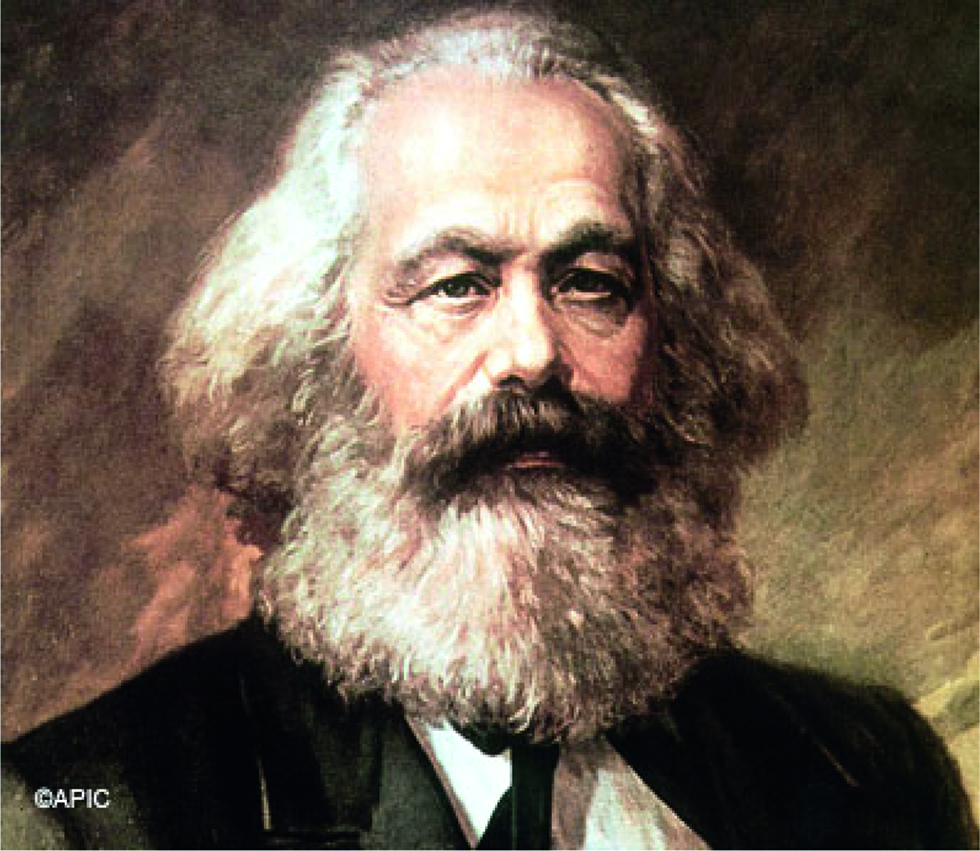
Karl Marx.
A second example of a radical library user is Peter Kropotkin (1842–1921) (Figure 9). As a political exile from Russia, he lived in England from 1886 to 1917 and was also a user of the British Museum Library (Woodcock 1971). Kropotkin’s politics were anarchist, a set of ideas that rejected representative democracy and the centralizing of government in favour of social and economic organization by voluntary associations between workers. The association of anarchism with violence, and indeed terrorism, can be justified from the writings of Kropotkin and other anarchists. He favoured “propaganda by deed,” which might mean symbolic gestures (such as the window breaking and defacing of art works sometimes practiced by supporters of women’s suffrage), but could also include bombings, robberies and assassinations. To dismiss Kropotkin as merely a dangerous advocate of violence would underestimate the depth of his ideas. As early as 1887, he argued that the state as a structure based on centuries of history could not be destroyed with a few kilograms of dynamite. Of course, it is simplistic in the extreme to suggest that Kropotkin’s access to the whole range of political ideas from the stacks of the British Library explains the nuanced character of his anarchist ideas. And yet, the notion is attractive: a library user is uniquely positioned to be an informed radical whose ideas reflect the complexity that is to be found in books, and nowadays in the even wider range of digital information that libraries offer. Male privilege, expressed here as access to libraries, certainly did not make Marx and Kropotkin better or more influential thinkers than Wollenstonecraft and Pankhurst, but it did make their intellectual journey easier. They merely had the good fortune, more than just partly a privilege of their gender, to be the radical library users whose existence is the main justification for the idea of the library as a radical institution.

Peter Kropotkin.
Intellectual Freedom and the Library Profession
What has been argued out in the previous sections might seem to founder on the generally conformist and decidedly non-radical character of the world’s librarians. The argument depends on the proposition that while librarians might not be radical, they are essentially open to radical use of their libraries. To be more precise, we can suggest that either purposively or inadvertently they foster intellectual freedom by the way they administer their libraries. Once again, a word cloud provides a good starting point to examine that assertion (Figure 10).

Word cloud – librarians.
The prominence of “innovator” and “collaborator” might surprise anyone who still sees librarians as custodians. There are also fairly prominent words with progressive associations like “problem-solver,” “research tips,” “databases” and “tech-savvy,” but also less-expected words like “brave,” “teacher” and “leadership.” Missing words include cataloguer and preservation. The word cloud repays more detailed examination, but essentially it shows that if you interrogate current writing on librarianship, it is essentially a vision of openness and engagement that emerges. If we move on from the clues in the word cloud, we discover that most attempts to codify the principles that inspire and drive librarianship also offer a good deal of support to the idea of libraries as open and supportive institutions.
Ranganathan (1931)’s Five Laws of Library Science are still the best starting place. Although they might seem quaint and narrow in scope at first sight, the five simple precepts do express a philosophy of openness and service very effectively.
Books are for use.
Every reader his book.
Every book its reader.
Save the time of the reader.
The library is a growing organism.
The First Law is an explicit denial of the traditional vision of the librarian as curator and reflects a commitment to librarianship as a socially engaged profession. Laws Two and Three express a strong sense that the librarian’s professionalism specifically involves seeking ways to connect users and information sources. Law Four is also resolutely practical and Five, if one reads it imaginatively, reflects a recognition of the expanding information universe which points towards constant change and professional renewal. A librarian inspired by Ranganathan is not in flight from the rough and tumble of a fast-changing society, but demonstrates the commitment which makes for a potentially radical library. Subsequent attempts to codify the principles that drive librarianship for modern times by others, notably Gorman (2000), tend to follow Ranganathan’s lead in that they have a clear commitment to a philosophy of openness and service. Two specific principles emerge strongly in these discussions of librarianship and social engagement which apply particularly to the argument of the current essay. They are neutrality, and privacy/confidentiality.
The neutrality of the librarian is an important but controversial principle. Ideally it envisages the librarian supplying answers to users’ questions and meeting their expressed needs without interference or challenge. It sits in diametrical opposition to the old Soviet style of librarianship in which closed access and the librarian’s intervention could ensure that people read the “right” books. And yet, the question arises “What if users want something that is arguably harmful to themselves or to their fellow human beings?” Librarians’ responses to this question have been tested experimentally, first and most notably by Hauptman (1976) and subsequently by Juznic et al. (2001) and others. Today, Hauptman’s project would hardly stand a chance of acceptance by a university research ethics committee. Indeed, it would probably not escape the attention of terrorism-alert professionals. In the more relaxed 1970s he found that librarians supplied the information he requested on the availability and effectiveness of explosives with little or no question. Similarly, Juznic’s student assistants found librarians in Catholic (and presumably suicide-averse) Slovenia only too willing to advise on methods of committing suicide. At the very least, such research suggests that the principle of neutrality in service is well-established.
The companion principle to this neutrality is the privacy and confidentiality of the interaction between librarian and user. The principle is essentially the same that applies to the relationship between doctor and patient and to lawyer and client. Although it is on the face of it less controversial than the neutrality principle, this bond between librarian and user has met more challenge. Even in the pre-9/11 age, security forces tended to believe that someone’s reading could reveal enough about their beliefs and intentions to merit official surveillance and intervention. The so-called Library Awareness Program in the United States (Foerstel 1991) was not some admirable campaign to enhance public knowledge of libraries and the benefits of using them, but the FBI’s attempt to forestall subversion by finding out what suspects read. Not very amusingly, a similar programme in the United Kingdom much more recently that attempted to identify reading that pointed towards terrorist sympathies would very probably have targeted academic students of the works of Kropotkin. To its enduring credit, the American Library Association and courageous individual members have declined to respond to security agents’ demands to reveal reader records to them under the provisions of the US Patriot Act of 2001. Librarians believe that reading exposes our intellectual processes, but are certainly not convinced that it reveals our conclusions and the intentions that those conclusions might inspire.
Maybe Betty and Alice, The Dirty Look Librarians (Figure 11), were thinking about something entirely different when they consistently failed to confront bad behaviour in the library. For the purposes of this essay, it is sufficient to imagine that they made it a principle not to interfere with or reveal aspects of individuals’ pursuit of knowledge, whatever the disturbing turns that pursuit might take.

The dirty look librarians.
Libraries and Democracy
Finally, we need to examine the possibility that libraries are not only institutions of intellectual freedom, which have a more or less inadvertent democratic role, but that their existence and strength might have a direct link with democracy. This is a suggestion that can be traced in the literature of the profession, magisterially, for instance, from Ditzion (1947) but also in collections edited by Kranich (2001), and by Baker and Evans (2011). Kranich’s own words make the point: “Democracies need libraries. Since their inception, libraries have served as pivotal community institutions upholding, strengthening and realizing some of the most fundamental democratic ideals” (Kranich 2001, 83). Frankly, there tends to be more hopeful rhetoric in statements like this than there is solid argument from facts. A correlation between the presence of libraries and socially progressive developments can be reasonably convincingly asserted, but a causal relationship is almost impossible to prove. The feeling, but not the certainty, that libraries and democracy have a connection is supported by sufficient clues if we briefly survey the world, even including those parts that offer the least helpful circumstances.
The case for the connection between libraries and democracy in the United States has already been partially made. This was the land that created modern librarianship overnight in 1876. That annus mirabilis saw the publication of the Bureau of Education’s Public Libraries in the United States of America, with the Rules for a Printed Dictionary Catalogue appended; Melvil Dewey’s release of his Decimal System of Classification; the founding of the American Library Association; and the publication of the first issue of the Library Journal. Not long afterwards, Dewey started his Library School at Columbia College in New York (Richards, Wiegand and Dalbello 2015). The United States justifiably prides itself on its librarianship, and also on its democracy. To outsiders, that democracy might seem to be creaking at the seams. There is an ominous combination of, for instance, the concentration of media ownership in partisan hands; massive corporate expenditure on behalf of particular candidates and viewpoints; and political fixing, such as the gerrymandering of constituencies. This has laid the country open to the crude messages of demagogues. Yet, the United States is still democratic and still a leader, though now rather eclipsed by the Nordic countries, in world librarianship. The connection persists.
The point about the Nordic countries is worth some elaboration. There is, for instance, a case for saying that Finland has the best examples of electronic or digital libraries anywhere in the world. One could also cite the exciting new library buildings in which functionality and awareness of readers’ actual (as opposed to supposed) needs are strikingly apparent that are found throughout the Nordic countries. Here we will only say a little about Article 100 of the Norwegian Constitution, promulgated in 2005. Article 100 picks up from Article 19 of the UN Declaration by asserting that “There shall be freedom of expression.” However, it does not stop there. It specifies a right of access to government documents, and requires state authorities to create conditions that facilitate open and enlightened public discourse. The nature of these conditions are not fully worked out, but Norway sees them as a complex of infrastructural provisions to include not only schools, but public cultural institutions such as universities, libraries, museums, broadcasting and the like as well as the entire gamut of private institutions regulated and supported by the public authorities, such as media, publishers, theatres, cinemas and other public venues (Norway 2005, 39). Note that libraries sit in the heart of the list of infrastructural provisions. These provisions, protected and effectively administered, are intended to provide conditions conducive to freedom of expression in the public sphere, and the drafters of Article 100 did not even feel it was necessary to point out that this naturally fosters democracy.
At the same time, it is important to point out that freedom of expression and democracy go together even in states as turbulent and problematic as India. India is indisputably the biggest democracy in the world. Governments at national and state level change hands frequently without undue disturbance as the result of the country’s hotly contested elections. No matter that tens of millions of Indians are illiterate, and that corruption, manipulation, undue influence and outright coercion can be identified in its elections, the democratic process persists to good effect. The effects are more than just cosmetic. In 1982, in an article in The New York Review of Books, the Nobel Prize-winning economist Amartya Sen made the observation that “no major famine has ever occurred in a functioning democracy with regular elections, opposition parties, basic freedom of speech and a relatively free media (even when the country is very poor and in a seriously adverse food situation)” (Sen 1982, 42). This is an emblematic claim: possibly the clearest challenge to those who doubt the efficacy of freedom of expression. But Sen doesn’t mention libraries. To extend his argument slightly, we can choose to mention libraries ourselves and return again to Ranganathan. His presence as a kind of librarianship guru continues to inspire Indian librarians with a high-minded commitment to librarianship according to the Five Laws.
We can even give this argument a final extension which risks taking it a step too far. This is to suggest that a minimal, but positive, link between libraries, freedom of expression and democracy can be claimed even in countries that are proudly undemocratic or state-centralized. Libraries are built, staffed and stocked in Saudi Arabia, China, Cuba and many other restrictive polities, mainly with a view to bolstering the state ideology. Yet for a radical reader there is always something in a library (from a fairy tale to a scientific textbook, or even a badly argued piece of state propaganda) to inspire radical thoughts. The case works best when we considered the less privileged and consistently neglected half of the world’s population – meaning women. As just one instance, there is the READ Information and Resource Centre in Nepal, which is a country where gender discrimination denies women the same rights and opportunities as men. This discrimination leaves many women uneducated, illiterate and unskilled, and open to many forms of exploitation. The READ Centre in Kathmandu pursues a radical agenda first of all by offering women users opportunities to seek and receive information and ideas in their own private and individual way. In fact, it goes beyond this by providing a set of training and education programmes and encouraging them to sign up for a women’s group where they can feel free to speak their minds (EIFL 2014). These consciousness-raising and training programmes are important and exciting, but at the core of the library’s activity is the enduring capacity for users to pursue their own personal reading. This is the way in which even a library that lacks the radical programmes that distinguish the READ Centre can have a radical effect, probably without intending anything of the kind. Give a user access to content and the freedom to read it and something radical can occur.
Conclusion
A brief summary of the argument that has been woven together here begins by saying that intellectual freedom is a compound of freedom of opinion, freedom of access to information and freedom of expression. For librarians, the central idea is what Article 19 of the UN Declaration on Human Rights refers to as the freedom to seek and receive information and ideas. The point that has been stressed throughout this article is that the library essentially functions as an intellectual freedom institution by serving the personal, private states of mind of seekers and receivers. That is to say that the library provides a particularly favourable environment for someone to cultivate their own ways of thinking and opinions. The extension of this line of argument is that a reader and a thinker is potentially a radical critic of society. Furthermore, the knowledge which users obtain and the ideas they develop in the library are capable of being put to public use in democratic activity. The conclusion of the argument is that by nurturing users who might become well-informed activists and leaders, or at the very least not hindering them, the library serves not only intellectual freedom but the democratic process itself.
Acknowledgements
The illustrations were located using Google Images and Pinterest. They are used in accordance with the stated policies of both these services.
References
Adams, J. 2015. Women and the Vote: A World History. Oxford: University Press.Search in Google Scholar
Baker, D., and W. Evans (eds.). 2011. Libraries and Society: Role, Responsibility, and Future in an Age of Change. Oxford: Chandos Publishing.10.1533/9781780632636Search in Google Scholar
Bartley, P. 2002. Emmeline Pankhurst. London: Routledge.Search in Google Scholar
Cauter, T., and J. Downham. 1954. The Communication of Ideas: A Study of Contemporary Influences on Urban Life. London: Chatto and Windus.Search in Google Scholar
Clark, P. 2000. British Clubs and Societies 1580–1800: The Origins of an Associational World. Oxford: University Press.Search in Google Scholar
Ditzion, S. 1947. Arsenals of a Democratic Culture. Chicago: ALA.Search in Google Scholar
EIFL. 2014. “Empowering Women and Girls: Promoting Women’s Independence in Nepal.” Accessed April 12, 2016. http://www.eifl.net/eifl-in-action/empowering-women-and-girls-innovation-award.Search in Google Scholar
Foerstel, H. 1991. Surveillance in the Stacks: The FBI’s Library Awareness Programme. Westport, CT: Greenwood Press.Search in Google Scholar
Gorman, M. 2000. Our Enduring Values: Librarianship in the Twenty First Century. Chicago: ALA.Search in Google Scholar
Habermas, J. 1989. The Structural Transformation of the Public Sphere. Translated by T. Burger. Cambridge: Polity Press.Search in Google Scholar
Hannesdottir, S. 1993. “Books and Reading in Iceland in a Historical Perspective.” Libraries and Culture 28 (1):13–21.Search in Google Scholar
Hauptman, R. 1976. “Professionalism or Culpability? An Experiment in Ethics.” Wilson Library Bulletin 80 (1):48–50.Search in Google Scholar
Juznic, P., J. Urbanija, E. Grabrijna, S. Miklavc, D. Oslaj, and S. Svokjsak. 2001. “Excuse Me How Do I Commit Suicide? Access to Ethically Disputed Items of Information in Public Libraries.” Library Management 22:75–9.10.1108/01435120110358961Search in Google Scholar
Kranich, N. (ed.). 2001. Libraries and Democracy: The Cornerstones of Liberty. Chicago: ALA.Search in Google Scholar
Norway. 2005. “There Shall Be Freedom of Expression: Proposed New Article 100 of the Norwegian Constitution.” Norwegian Official Report, NOU 1999: 27. Oslo: Ministry of Justice and Public Security.Search in Google Scholar
Ranganathan, S. R. 1931. The Five Laws of Library Science. London: Edward Goldston.Search in Google Scholar
Richards, P., W. Wiegand, and M. Dalbello (eds.). 2015. A History of Modern Librarianship: Constructing the Heritage of Western Culture. Santa Barbara, CA: Libraries Unlimited.Search in Google Scholar
Rose, J. 2001. The Intellectual Life of the British Working Classes. New Haven: Yale University Press.Search in Google Scholar
Sen, A. 1982. “How Is India Doing?” New York Review of Books 21 (Dec 16):41–5.Search in Google Scholar
United Nations. 1948. Universal Declaration on Human Rights. New York:United Nations. Accessed April 12, 2016. http://www.un.org/en/universal-declaration-human-rights/.Search in Google Scholar
Wheen, F. 1999. Karl Marx. London: Fourth Estate.Search in Google Scholar
Whitehill, W. 1956. Boston Public Library: A Centennial History. Cambridge, MA: Harvard University Press.10.4159/harvard.9780674593732Search in Google Scholar
Wollstonecraft, M. 1993 [1792]. A Vindication of the Rights of Women. London: Penguin.Search in Google Scholar
Woodcock, G. 1971. The Anarchist Prince: A Biographical Study. New York: Schocken Books.Search in Google Scholar
© 2017 Walter de Gruyter GmbH, Berlin/Boston
Articles in the same Issue
- Frontmatter
- Intellectual Freedom, Libraries and Democracy
- Are Alternative Information Services Compensating for Dysfunctional School Libraries in South Africa? The Case of Limpopo Province
- Law Students’ Information Literacy Skills and Attitudes Towards Environmental Protection and Environmental Legislation
- Sustainable Management Requirements in Libraries of Iran: A Framework on Grounded Theory
- The Information Technology Skills of Science and Social Science Students at Kuwait University: A Comparison
- Marketing via Micro-film in Chinese Academic Libraries
Articles in the same Issue
- Frontmatter
- Intellectual Freedom, Libraries and Democracy
- Are Alternative Information Services Compensating for Dysfunctional School Libraries in South Africa? The Case of Limpopo Province
- Law Students’ Information Literacy Skills and Attitudes Towards Environmental Protection and Environmental Legislation
- Sustainable Management Requirements in Libraries of Iran: A Framework on Grounded Theory
- The Information Technology Skills of Science and Social Science Students at Kuwait University: A Comparison
- Marketing via Micro-film in Chinese Academic Libraries
