Communication challenges and transformations in the Digital Era: emoji language and emoji translation
-
Vanessa Leonardi
Vanessa Leonardi is Associate Professor of English Language and Translation at the Italian University of Sapienza in Rome. She was born in Italy and raised bilingual. She graduated in Modern Languages at the University of Coventry (UK) in 1998. In 1999 she was awarded an MA in Translation Studies from UMIST (Manchester, UK) and in 2004 she received her PhD in Translation and Comparative Studies at the University of Leeds. She also holds a TEFL Diploma. Her research interests lie mainly in the fields of Translation Studies, Gender Studies and English language teaching.


Abstract
The Digital Age has significantly changed how people communicate. Thanks to technology, people have a large variety of communication tools to choose from, such as emails or instant messaging applications, that allows communication to be easier, quicker and, to a certain extent, more efficient. In this technological scenario, emojis play a fundamental role as a kind of universal form of communication. Furthermore, thanks to translation, which acts as a bridge for people from different linguistic and cultural backgrounds, communication can cross national barriers and spread worldwide. Communication and translation share a common goal that is ‘mutual understanding’. What happens, therefore, when translation meets both technology and emojis in the Digital Age? A new form of communication through translation has emerged, that is emoji translation. The aim of this paper is to show, through a series of examples, how emojis have been recently employed in communication and translation in an attempt to establish whether their use, besides creativity, can be universally accepted and understood worldwide.
1 Introduction
Nowadays, emojis are used more and more frequently in communication exchanges worldwide and they have evolved into a language of their own. Being used with growing interest and frequency in many communication networks, emojis are considered as the lingua franca of the digital age. Emojis have become an increasingly debatable topic in several research fields, such as communication studies, semiotics, cultural studies, linguistics, and translation studies among others. Emojis are, undoubtedly, a new form of language that has recently emerged as a result of increasing digitalisation and, nowadays, they can be considered as the fastest-growing language in the world seen and used on a regular basis, thus becoming an intrinsic part of digital communication. People seem to be obsessed with emojis and as the ‘face with tears of joy’ emoji  was the most used emoji globally in 2015, it became the Oxford Dictionary’s Word of the Year. It is interesting to note how, for the first time, it was a pictograph rather than a word to earn such a title.
Emojis are graphical icons representing words, concepts or attitudes widely employed in popular social media instant messaging services such as Facebook, Messanger, Skype, Whatsapp, and Twitter among others. Besides representing facial expressions, emojis are also used to express feelings and emotions, animals, plants, food, activities, body parts, gestures, objects, abstract concepts, and nationalities. Emojis are used more and more frequently in communication for several purposes, such as a means of expressing emotions, simplicity and convenience. Several studies focus on how emojis are used to construct personal identity (Ge 2019), to promote interaction (Gibson et al. 2018) and to decrease message ambiguity (Riordan 2017), among others.
One of the most obvious functions of emojis is to express emotions, as in the following sentences:
I heard that your car was stolen

I am going out with Mark tonight

I really can’t stand her behaviour

Emojis may also have an interpretative function by acting as ‘tone modifiers’ as opposed to expressive emojis affecting the mood of the message (Cramer et al. 2016). This means that emojis can influence, to a certain extent, the interpretation of a message depending on how both the sender and the receiver interpret the message, as in the following examples:
This house needs repairing!

This house needs repairing!

This house needs repairing!

This house needs repairing!

In all the four cases, the verbal message is the same but the additional use of emojis can provide entirely different meanings or interpretations. Nevertheless, this function may create possible ambiguity in cases where, for instance, irony and sarcasm are involved, thus making harder for the receiver to understand whether the sender meant to be ironic or sarcastic.
Emojis can also have an emphatic function and different strategies can apply in this respect as also shown in the following examples:
I LOVE YOU! ❤
I love you ❤ ❤ ❤
Another interesting way to use emojis is the referential function, which means that emojis act as substitution for words they refer to, as shown below:
I ❤ YOU!
Anne was so happy!!! She finally got a

Fancy a
 ?
?
Emojis can be used alone or along with other emojis and, when this occurs, they may be used to add more emphasis or they simply act as decorative elements. The problem is, however, to decipher emojis when they are not used along with verbal cues.
As shown in the examples above, emojis perform different communicative functions and, as a language of their own, they go beyond countries, cultures, and generations as a form of universal language. Nevertheless, can emojis be considered as a truly universal form of communication? This would imply the fact that emojis are used and interpreted in the same way by people worldwide regardless of their native language, culture, age and gender differences among others. If this is true, then, emojis can be easily translated or can be used as a universal translating language read and understood worldwide. Emojis, indeed, have already been employed in translation, thus leading to a new form of translation called emoji translation.
Translation is generally defined as the process of transferring words or texts from one language into another but there are more issues to consider when carrying out such an activity. Word-for-word translation is certainly necessary for certain tasks that require complete accuracy, such as technical translations. However, not all translation projects are that simple. Most translation tasks require several different strategies, such as creativity, on behalf of the translator who must engage in a process of negotiation between two cultures, two languages and, at times, two entirely different worldviews. It is worth noting that what works in one context might not be suitable or acceptable in another. Therefore, the translator must find appropriate ways to achieve the same meaning in the target text.
In the last few years, translation creativity, in particular, has gone as far as employing emojis as a new form of communication that implies, to a certain extent, the notion of universalism in terms of intelligibility across different linguistic and cultural domains. Nobody can deny the fact that emojis are a universal component of communication exchanges worldwide; however, it is questionable whether emojis can be defined as a language of their own and, more precisely, as a universal language that can be used both in communication and translation worldwide.
2 Historical overview
How did emojis originate and what led to their pervasive popularity? The word emoji is an English adaptation of Japanese 絵文字—the e of emoji means ‘picture’ and the moji stands for ‘letter, character’. The definition of emoji, therefore, is ‘picture word’.
Although emojis have been developed and used over the last few decades, they are not new as a form of visual communication as other icons were used in the past to convey human expressions and feelings. Back in 1881, the first emoticons appeared in the March issue of the American Puck magazine and they were identified as ‘typographical art’ as shown in Figure 1.

Puck magazine – featuring ‘Typographical Art’.
In 1982, Scott Fahlman, a computer scientist at Carnegie Mellon University, proposed the use of two strings of three characters :-) or punctuation faces to help people recognise when a message was intended as a joke (Figure 2) (Dresner and Herring 2010). These punctuation faces became quite popular even outside the university and began to be used in several different ways and purposes, thus developing into several variants named emoticons.

Scott Falham’s email about the ‘smiley face’.
1986 was the boom of kaomoji, from Japanese kao meaning ‘face’ and moji meaning ‘character’. These strings of characters resembled emoticons with the only difference being that they were not read sideways (e.g. ^-^). As Japanese people believe that the eyes represent a human being’s soul, kaomoji focused on the eyes rather than the mouth as in the western version of emoticons (Katsuno and Yano 2007). Emoticons became increasingly popular and took on several different forms as shown in Figure 3.

Examples of the emoticons in the 1990s.
Finally, the emojis currently used were created in 1999 by Shigetaka Kurita to enhance the visual interface for the devices of a Japanese mobile, when he was involved in the launch of an integrated mobile Internet service called “i-mode” created by NTT Docomo (Blagdon 2013). Kurita created a complete set of 176 12-pixel by 12-pixel characters aimed at covering the entire range of human emotions, as shown in Figure 4.

The first set of 176 emojis designed by Shigetaka Kurita in 1999.
When the iPhone 3G was launched by Apple in 2008, it did not include emojis but later they decided to have a set of 471 emojis for the Japanese market only, which was provided with the iOS 2.2 update a few months later (Figure 5) (Danesi 2017: 3). Furthermore, ‘Apple didn’t officially enable the characters around the world until iOS 5 came out nearly three years later’ (ibid.).

First set of emojis created by Apple for the Japanese market.
A few years later, the California-based Unicode Consortium, which is a non-profit corporation dealing with the development and promotion of software internationalization standards and data, approved and included a set of 722 emojis, thus, proving the important role they were having in international communication (Evans 2017). Since then, more and more emojis have been added throughout the years and the emoji language has become more diversified and inclusive so as to include, for instance, different skin tones, gender vocations, and food types among others (Figure 6).

Examples of inclusive emojis.
3 Emoji language as a (universal) language?
Most people seem to consider emojis as a truly universal language as they have penetrated popular culture in many different ways. Are emojis really universal? Do a sad face or a smiley face denote the same emotions around the world despite cultural and linguistic differences? Emojis, indeed, can be ambiguous as a smiley face does not necessarily imply happiness or humor as it could also refer to irony, sarcasm or even hedging, among other emotions. It is also worth mentioning that emojis do not hold the same meaning in different cultures. Gestures, for instance, may have different associations in different cultures as also extensively researched and proven in many pragmatic studies. The cultural component undoubtedly affects the use of emojis as also proven by Xuan et al. (2016). In their study, following Hofstede’s cultural dimension model, they showed how ‘country differences in emoji usage are quite significant’ and they can help to distinguish people from different cultural backgrounds (ibid.: 778).
In 2017, linguistics professor Vyvyan Evans compared the spread of emojis to that of the English language and claimed that nowadays ‘the ubiquitous influence of English in a wide array of global communication contexts is staggering’ although ‘in comparison, Emoji dwarfs even the reach of English’ (ibid.: 23). His research, indeed, proved how in the UK almost 80% of adult smartphone users regularly use emojis in their messages and about 40% of them regularly use only emojis in their text messages (ibid.: 29). Evans, therefore, states that emoji language can undeniably be viewed as ‘the world’s first truly universal form of communication’ (ibid.: 20–21). The question, however, is what is language? What makes a language is determined by the way it is organised. According to Evans, there are different opinions on this issue but he focuses on how languages are organised into important units, such as words and they rely on a specific ‘system of rules’, that is grammar through which people are able to communicate both simple and complex ideas and concepts in an intelligible way (ibid.: 54). By comparing any language with emoji language, it is immediately clear that the latter has fewer words and it lacks a proper grammatical system. Despite lacking grammar, emojis are widely used in communication and, as it will be shown later in this study, they are also used in translation. Are emojis or their use governed by a defined grammatical system? This question seems to be natural and unavoidable. A study carried out in 2019 by three Dutch researchers proved that ‘while emoji may follow tendencies in their interactions with grammatical structure in multimodal text-emoji productions, they lack grammatical structure on their own’ (Cohn et al.: 1). Given that emojis are increasingly being defined as an ‘emerging language’ adopted and used for communication purposes worldwide, there seems to be scarce research literature on their grammatical structure. Danesi (2017: 78) claims that sequences of emojis without text or words may be interpreted correctly if they are used and interpreted in their specific cultural and linguistic context. As an example, he provides the sequence in Figure 7.

Example of emoji interpretation adapted from Danesi (2017).
This sequence of emojis refers to bombshell bikini and it is likely that only English native speakers can interpret it correctly. Bombshell means sex symbol and it was originally used to refer to popular attractive women as far back as 1942 (Online Etymology Dictionary).
According to Cohn et al. (2019), emojis tend to rely on conceptual categories rather than grammatical sequences and there may be a possibility that they are employed as an agent-patient-act order, which is usually applied to and in line with studies of nonverbal gesturing (Gershoff-Stowe and Goldin-Meadow 2002) as well as studies on young children who tend to order casual relationships of images (Gelman et al. 1980).
It is likely, however, that emojis may also follow traditional patterns of spoken grammar and a different order could convey different ideas and meanings, thus implying different interpretations. A different order of emojis may turn an active sentence into a passive form in some languages whereas it may not be possible in all languages to freely move around the order of emojis, as in the examples in Figure 8.

Some possible word orders of emoji combinations.
In their study, Cohen et al. (2019: 5) provide a taxonomy of emoji grammar, as shown in Figure 9.
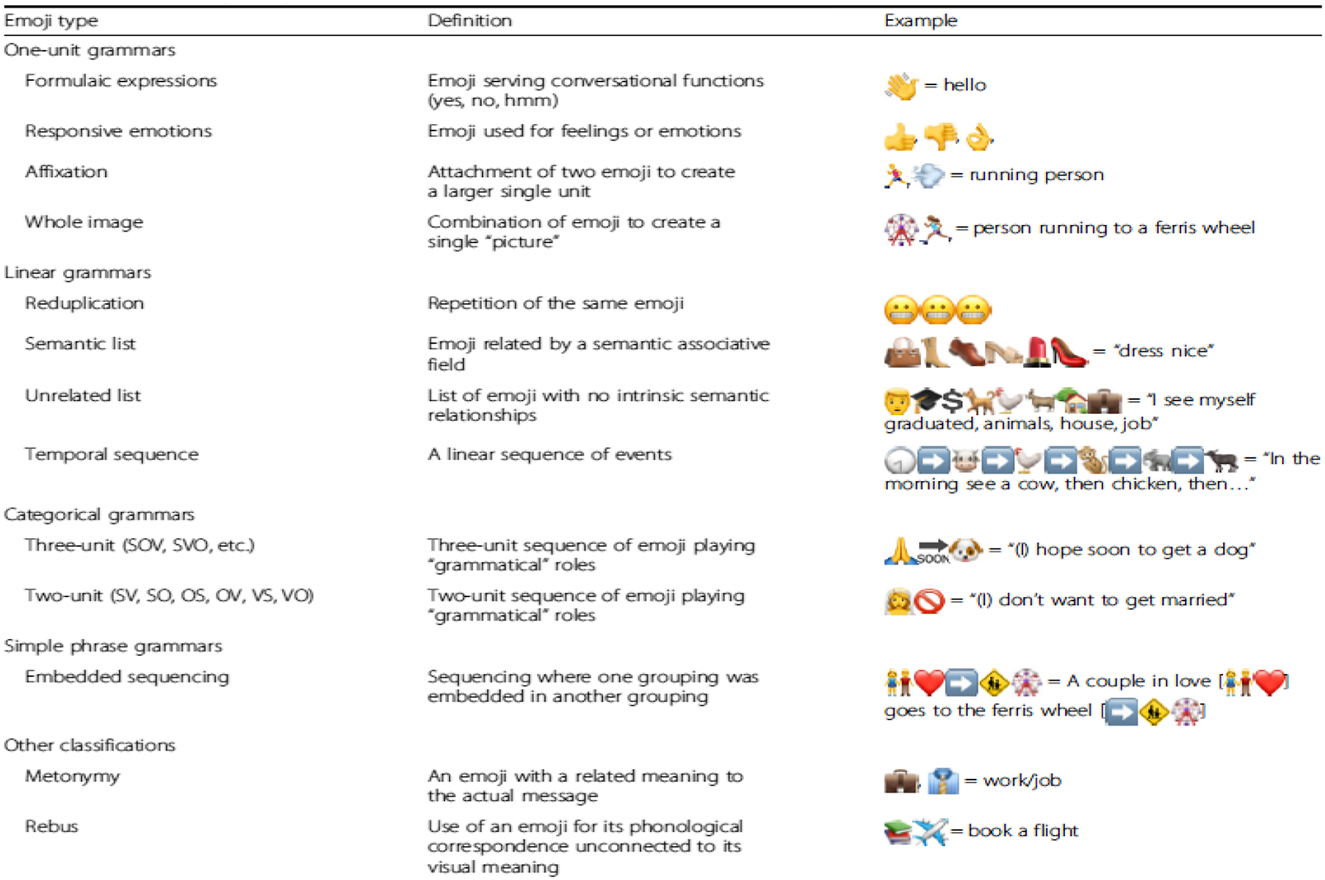
A taxonomy of emoji grammar adapted from Cohn et al. (2019).
In their work, they also acknowledge the lack of consistency between users adopting SVO and SOV grammar ordering, thus showing how this can be one of the most important sources of potential misunderstanding in communication exchanges. Cohn et al. (2019) proved how linear grammar becomes more and more common in cases where sequences of emojis get longer and longer. Therefore, they drew the conclusion that ‘[i]n the case of emoji-only sequencing, they appear to lack the characteristics of complex grammar, instead relying on linear patterning motivated by the meanings of the emoji themselves’ (ibid.: 16).
According to Danesi (2017: 28–29), ‘[o]ne of the primary dangers to the universality of the emoji code, in addition to culture-specific variation, is the constant potential for ambiguity. Ambiguous messages are dangerous, potentially, even among those who share the same language; but the danger increases in the intercultural context of the global village.’ Ambiguity also increases due to the diversity of platforms in which these emojis are used.
Furthermore, many scholars have clearly pointed out how emojis fail to communicate meaning, thus being hard to be correctly interpreted and understood, due to their visual nature as compared to words which have a specific dictionary definition and/or meaning in context (Albert 2020; Miller et al. 2016; Veszelszki 2017). Albert (2020: 77), in this respect, acknowledges that ‘emoji are not to be equated with words but remain a phenomenon sui generis somewhere between images and logograms’.
4 Can we translate emojis?
Emojis have penetrated all spheres of society and have affected a large variety of forms of communication and activities, such as translation. Translation is a very complex and demanding task especially when people have to take into account different elements, such as culture, target audience and target language conventions, among others. We also know how it is important to use creativity as a translation strategy, especially when dealing with children’s stories. If emojis can be interpreted in different ways, it makes sense to believe that different people could produce different acceptable emoji translations of the same source text (ST). Furthermore, different interpretations of emojis also imply different translation interpretations on behalf of readers who, especially in the case of translation entirely written in emojis without words or text, can provide a wide range of meanings and interpretations. Although, these problems of interpretation may occur in any translation activity, in the case of emojis, it can be more difficult to try to guess their meaning. In the last few decades, there have been many attempts at translating different texts by using emojis.
The first example is the emoji translation of song lyrics. One of the most commonly known examples, in this respect, is the emoji translation of Toxic, which was released by Britney Spears in 2003. Let us look at how (un)successful this attempt was by comparing the emoji translation with its original lyrics (see Figure 10).

Example of emoji translation of Britney Spears’ song ‘Toxic’.
In this example, it does not seem too difficult to decode the emojis used in the text mainly for two reasons. Firstly, the text is not entirely written in emojis, which play a supportive role to the written language. Secondly, disambiguation occurs through the use of words in brackets, thus enhancing understanding. It is worth noting, however, whether the same level of understanding can be reached by using only emojis in the text.
Emojis were also used in institutional discourse as in the example below reporting former American President Barack Obama’s State of the Union address in 2015. The British daily The Guardian posted a translation into emojis of Obama’s State of Union address while launching at the same time the Twitter handle @emojibama (Figure 11).

Example of emoji translation of American President Barack Obama’s State of the Union address.
One of the most obvious reasons why emojis were used in this particular context could be due to the fact that emojis allow to make politics more approachable for everyone and, especially, to target and engage younger audiences. This is another example in which partial emoji translation occurs and thanks to the mixture of words and emojis it is not too difficult to understand the meaning of the message. Nevertheless, on a few occasions, it is impossible to decode it and, therefore, readers have to consult either the written version or they can use the interactive platform created by The Guardian where it is possible to move the pointer on top of the emoji to see its corresponding meaning.
Reading and comprehension difficulties increase, however, in cases where emojis are used on their own and, more significantly, when they are used to translate portions or even entire texts, such as literary texts. As far as translation is concerned, one of the first books translated by using emojis is Emoji Dick by Fred Benenson. As its title suggests, this work is an intersemiotic translation of Herman Melville’s American classic Moby Dick (Figure 12).

Fred Benenson’s Emoji Dick (2010).
Benenson’s emoji translation was conceived further to his interest in the way language, culture, and communication in general have been affected by digital technology in the Digital Era and, more precisely, how emojis have affected communication worldwide. Therefore, he decided to carry out a translation project by employing emojis and, for the purpose of this work, he thought to choose a well-known literary text that, besides being known worldwide, had to be also quite a long text to translate in order to show the important role played by Amazon Mechanical Turk. This is why in 2009 he decided to recruit Amazon Mechanical Turk workers to translate Melville’s Moby Dick into emojis and this work was finally released in 2010. Amazon Mechanical Turk workers were divided into two groups where the former worked on the translation and the latter decided the best translation options that were used in the final version through a voting system. More precisely, three different translation options were provided for each sentence each time and the final emoji translation has 736 colored pages where the emoji strings are on the top and the sentences from the original ST are placed just below them, as also shown in the extract (Figure 13).

Extract from Fred Benenson’s Emoji Dick.
By looking at the extract above, it seems rather complex to work out the meaning of each emoji string without looking down at the corresponding text. Several considerations can be made by carefully assessing this ‘creative’ translation or rewriting of Melville’s Moby Dick. First of all, if readers do not have a previous knowledge of the ST because they have never read it before, it may be very challenging to work out the meaning of these emojis without contextualising the text. By simply looking at the first string of emojis, for instance, it is interesting to note how this emojified translation can be back translated into English in many different ways. This occurs even in the case when the reader may know the text. It is worth mentioning how some emojis, such as the telephone emoji in the first string, perfectly renders the idea of ‘calling’ but it may sound rather anachronistic for a text written in 1851. However, the rest of the emojis in that string can be translated in many different ways and it is very hard to obtain the original meaning intended in the ST, especially to work out the name Ishmael. Secondly, it is worth noting how only a few emojis are provided in each string to render a much longer paragraph. If it is true that a picture may be worth a thousand words, it is legitimate to wonder whether readers can work out the meaning of each string without difficulty. This is best exemplified by looking at the fourth emoji string in the extract above where only 10 emojis are used to translate a very long paragraph. If readers do not look down at the written text, it is virtually impossible to interpret them correctly or in the way they were thought to render the translation of that particular paragraph. Thirdly, by looking at the second to last emoji string, there is no way that readers can carry out its back translation correctly into English as there seems to be no connection at all or no correspondence with the text it refers to. In other words, without the help or support of the written text below each emoji string, a wide variety of interpretations and meanings can be provided in the back translation into English, especially in cases where readers are not acquainted with the ST.
Furthermore, it is interesting to mention the fact that given the universal meaning and use of emojis worldwide, it is expected that back translations from emoji language into other languages should work out successfully and without difficulty. However, if one tries to translate the emoji strings used in the extract above back into any other languages, different translations will probably occur, thus proving the impossibility of considering emojis as a truly universal language.
Other examples of partial emoji translations are the book series written by Kristina Semenova, the creator of the Vaikon emoji book series. In these books, she has translated several classic novels and fairy tales partially into emojis. Along with traditional emojis, Semenova also managed to include additional symbols specifically designed for her book projects. Furthermore, all books include a rebus dictionary at their back to provide readers with a translation for all the emojis used in her books, as also shown in Figure 14.

Example of a rebus dictionary in Kristina Semenova’s emoji translation series.
So far, Semenova has worked on the emoji translation of Alice in Wonderland, A Christmas Carol, Around the World in 80 Days, Black Beauty, The Call of the Wild, The Elderbush and The Old House. The examples are in Figure 15.

Extract from Semenova’s emoji translation of Charles Dicken’s A Christmas Carol.
The extract in Figure 15 is taken from A Christmas Carrol written by Charles Dickens (Semenova 2016). Reading comprehension is not too difficult, although several considerations should be made. First of all, the combination of the two emojis in the third line is not easy to decode unless readers know the story very well. This combination of emojis is used to translate ‘chief mourner’. The ‘captain’ emoji can, indeed, be interpreted as ‘chief’ and the crying emoji can imply someone who is sad or unhappy about something, but its real translation is not immediately clear. The other slight misunderstanding may be due to the interpretation of the thumbs up emoji to mean ‘good’ as its first translation tends to be O.K. or alright. More problems, in terms of intelligibility, can be found in the another example taken from the same book (see Figure 16).

Extract from Semenova’s emoji translation of Charles Dicken’s A Christmas Carol.
The first thing to notice in the extract above is how the same emoji is used with a different meaning which, in some cases, may be easy to understand as words used to accompany the emojis play an important and supportive role in terms of interpretation of meaning. The emoji used in line four and line 11, however, seems more difficult to decode as its meaning is completely different due to the combinations in which it appears. Line 11, indeed, is the most difficult emoji combination to decode as no text is provided in this respect. It is, therefore, essential to refer back to the original ST to obtain the correct interpretation of this series of emojis. This shows, however, how emojis cannot be universally understood or interpreted by readers worldwide. Furthermore, more considerations should be made in terms of the target audience. Will these translations carried out by Semenova be suitable for children as they were specifically designed for them? Do they address adults who read these stories to their children? If so, can adults read them accurately and fluently, thus encountering no problems in terms of understanding and decodification? These partial emoji translations are creative and, to a certain extent, interesting; however, it is questionable whether they can be universally recognised, interpreted and translated in the same way as they were originally designed by any reader worldwide.
It seems that when emojis appear or are used along with words or corresponding text, then they may be more easily understood or correctly interpreted, although on a few occasions it is extremely hard to understand their meaning. What happens when a translation is carried out entirely in emojis? This is the case of Joe Hale’s Wonderland, an emoji poster which was made in 2015 in an attempt to reproduce the full story of Lewis Carroll’s Alice in Wonderland without using any word, as also shown in Figure 17.

Joe Hale’s emoji poster of Alice in Wonderland.
This poster employs over 25,000 emojis in order to translate the entire Lewis Carroll’s bestseller. If one tries to zoom in and focus on some of these emoji strings, the two combinations shown in Figure 18 are found.

Examples of two emoji combinations taken from Joe Hale’s Wonderland.
Without any word or supportive text, it is hard to translate these emoji combinations back into English to mean respectively 1) ‘And what is the use of a book, thought Alice, without pictures or conversations?’ and 2) ‘We’re all mad here’. Even if these emoji strings are contextualised, it is still rather difficult to render the original meaning of the ST. This means that emoji translation needs not only to be contextualised but, more importantly, it needs to have a support from the written words to help interpretation and codification. This issue legitimates the question whether it is possible to codify the emoji language to help people understand the meaning of a specific emoji translation. The following section will attempt to provide an example of the first-ever example of codified emoji language for translation purposes.
5 Codified emoji language: the case of emojitaliano
Language standardisation occurs through codification of a language, which implies the creation and use of dictionaries, style guides, grammar rules and the like. Emoji language lacks codification and, as such, it cannot be considered as a language of its own. Nevertheless, a few years ago, a variety of emoji language was codified, that is the emojitalian through the publication of Pinocchio in Emojitaliano in 2017. Although the pioneer of emoji translation was Fred Benenson with his Emoji Dick subsequently followed by Joe Hale with his full emoji translation of Alice in Wonderland where no words or parts of the text were used, Pinocchio in Emojitaliano is rather unique in this respect. Its uniqueness is due to the fact that its authors managed to codify the emoji language on the basis of the Italian language grammatical and syntactic rules. This work is based on a project carried out at the Italian university of Macerata by Francesca Chiusaroli, professor of applied linguistics, along with Johanna Monti and Federico Sangati, who developed the Telegram bot used to build the emoji dictionary. In other words, besides providing readers with both the original Italian version and its emojified translation, this book also includes grammar guide as well as an emoji glossary or dictionary to guide the readers through the emoji translation process. Given the limited semantic meanings of emojis, these researchers designed several different combinations or sequences of emojis to translate particular words or concepts. For instance, the house emoji literally translates the word ‘house’; however, when the house is found along with other emojis it changes its meaning as shown in Figure 19.

Example of emoji combinations from the glossary of Pinocchio in Emojitaliano.
As it is exemplified in the emoji combinations above, the house with a glass of wine is used to mean ‘inn’, the house with books means ‘bookshop’ or ‘bookseller’ whereas the combination of a house along with a hammer and a spanner means ‘carpenter’s shop’ or ‘workshop’.
According to these researchers, the emojified translation of Pinocchio is not meant to be a word-for-word translation but it is rather a more conceptual translation. This concept is better exemplified in the example shown in Figure 20.

Example of the emoji combination for ‘guilty’ from the glossary of Pinocchio in Emojitaliano.
This example uses a biblical reference to the original sin to translate the word ‘guilt’ or the adjective ‘guilty’ by using the combination of a man, a woman and an apple.
The aim of this project is that of building a common code to allow the codification of the emoji language into Italian that, eventually, could serve as a model for further codifications in other languages. It is worth looking at how codification works in practical terms by taking as an example the second to last string of emojis on the first page of Chapter 4 of the book (Figure 21).

Example.
As one can clearly see, each emoji combination to be interpretated as a single word or concept is separated from the others. Readers, therefore, have to focus on each combination and, then, they have to keep on switching back and forth between the glossary, the grammar section and the text. If they wish to interpret, codify or, in other words, translate the snail + left arrow emoji combination, they need to look up first in the glossary and find all the instances where the snail appears. The snail translates lento, adagio (slow). Then, they should find the correct combination they are looking for, snail + left arrow in this case, and they will have the meaning shown in Figure 22.

Snail + left arrow.
In Italian, a poco a poco means little by little. After decoding this combination, readers have to turn to the grammar section to determine the category of this expression and they will discover that the left arrow emoji is used to imply an adverb if placed after the adjective. This means that the right back translation of this emojified version means ‘slowly’. This decodification process should be repeated for each single combination within each line. At the end of this codification or back translation process, the readers will have the following Italian translation of the whole emoji string shown above:
| Pinocchio si voltò, e vide un grosso Grillo che saliva lentamente su su per il muro |
| (Pinocchio turned round and saw a big cricket crawling slowly up the wall, my translation). |
This project undoubtedly denotes a large amount of work and research carried out by these Italian scholars, who have the merit of having codified a variety of emoji language for the first time, although some remarks could be made in this respect. First of all, the reading is quite complex, especially if readers do not look at the Italian text on the opposite page. Secondly, this emoji translation is quite time consuming for readers as they have to switch back and forth between the emoji translation and the glossary and grammar guide at the back of the book in order to interpret correctly the meaning of each combination within each sequence or string (which corresponds to a single line). Finally, in terms of the target audience, it is clear that this text cannot be suitable for children but only for adults. The point is, however, that even adults may find it challenging and time consuming and some of them may eventually lose interest in reading the whole text. This last issue raises another important question, that is, what is the purpose of such a work? Is it intended as a reading for fun or pleasure? Is it intended to be purely a work for research purposes? Emojitalian is undoubtedly different from Fred Benenson’s Emoji Dick and Joe Hale’s Wonderland as their work lacks codification, although given the universal nature of the emoji language, readers should be able to decode any emoji text or translation in a quick and efficient way. This, however, was not the case as shown in the examples used in this work. Emojitalian was codified, thus allowing a more structured approach to the decodification or interpretation of the emoji language, although this is quite a challenging and time-consuming process.
6 Concluding remarks
There is no doubt that we are experiencing a great and important revolution in language communication through the use of emojis. Their popularity continues to grow and they are used in many different fields of society, thus providing people with an impression that they are universal and universally understood. The availability of a common standardised repertoire of emojis through the Unicode Consortium legitimises further linguistic analyses aimed at exploring and determining the universality of emojis as well as their limits. Although emojis are universally used, given their linguistic and cultural differences, it is legitimate to hypothesise that their use, especially in translation, may produce several interpretations. A single emoji can be worth a thousand words or, to a certain extent, a thousand meanings. This study, however, proved that emojis are neither universal nor a language of their own. Differences apply not only from one culture to another but also from a generation to another. Although it is possible to write a novel or to translate it using only emojis, it is impossible to ensure that every emoji will correctly and thoroughly have the intended message for anybody reading it. In other words, despite the increasing use and growing interest in emojis, their interpretation is not, and cannot be, universal, thus leading to possible cases of ambiguity and misunderstanding. Emojis lack proper grammar and their visual nature makes it hard to be correctly interpreted and understood as compared to words which have a specific dictionary definition and/or meaning in context. This works calls for more research on the use of emojis both in terms of codification and translation into other languages, thus calling for more empirical studies in this respect.
About the author
Vanessa Leonardi is Associate Professor of English Language and Translation at the Italian University of Sapienza in Rome. She was born in Italy and raised bilingual. She graduated in Modern Languages at the University of Coventry (UK) in 1998. In 1999 she was awarded an MA in Translation Studies from UMIST (Manchester, UK) and in 2004 she received her PhD in Translation and Comparative Studies at the University of Leeds. She also holds a TEFL Diploma. Her research interests lie mainly in the fields of Translation Studies, Gender Studies and English language teaching.
References
Primary Sources
Benenson, F. 2010. Emoji Dick; or the Whale. Daniel Lazarus Jonesey’s Books.Search in Google Scholar
Chiusaroli, F., J. Monti & F. Sangati. 2017. Pinocchio in Emojitaliano. Sesto Fiorentino: Apice Libri.Search in Google Scholar
Semenova, K. 2016. A Christmas Carol. Moscow: Vaikon Hero.Search in Google Scholar
Secondary sources
Albert, G. 2020. Beyond the binary: Emoji as a challenge to the image-word distinction. In C. Thurlow, C. Dürscheid & F. Diémoz (eds.), Visualizing digital discourse, 65–79. Berlin and Boston: De Gruyter Mouton.10.1515/9781501510113-004Search in Google Scholar
Blagdon, J. 2013. How emoji conquered the world. The story of the smiley face from the man who invented it. The Verge 4 [online]. Available at: http://www.theverge.com/2013/3/4/3966140/how-emoji-conquered-theworld.Search in Google Scholar
Cohn, N., J. Engelen & J. Schilperoord. 2019. The grammar of emoji? Constraints on communicative pictorial sequencing. Cognitive Research: Principles and Implications 4(33). 1–18. https://doi.org/10.1186/s41235-019-0177-0.Search in Google Scholar
Cramer, H., P. De Juan & J. Tetreault. 2016. Sender-intended functions of emojis in US messaging. In Proceedings of the 18th international conference on human–computer interaction with mobile devices and services, 504–509. New York: Association for Computing Machinery.10.1145/2935334.2935370Search in Google Scholar
Danesi, M. 2017. The semiotics of emoji: The rise of visual language in the age of internet. London and New York: Bloomsbury.10.5040/9781474282024Search in Google Scholar
Dresner, E. & S. Herring. 2010. Functions of the non-verbal in CMC: Emoticons and illocutionary force. Communication Theory 20(3). 249–268. https://doi.org/10.1111/j.1468-2885.2010.01362.x.Search in Google Scholar
Evans, V. 2017. The emoji code: How smiley faces, love hearts and thumbs up are changing the way we communicate. London: Michael O’Mara Books Limited.Search in Google Scholar
Ge, J. 2019. Emoji sequence use in enacting personal identity. In L. Liu & R. White (eds.), WWW’19 companion proceedings of the 2019 world wide web conference, 426–438. New York: Association for Computing Machinery.10.1145/3308560.3316545Search in Google Scholar
Gelman, R., M. Bullock & E. Meck. 1980. Preschoolers’ understanding of simple object transformations. Child Development 51(3). 691–699. https://doi.org/10.2307/1129454.Search in Google Scholar
Gershoff-Stowe, L. & S. Goldin-Meadow. 2002. Is there a natural order for expressing semantic relations? Cognitive Psychology 45. 375–412. https://doi.org/10.1016/s0010-0285(02)00502-9.Search in Google Scholar
Gibson, W., P. Huang & Q. Yu. 2018. Emoji and communicative action: the semiotics, sequence and gestural actions of “face covering hand”. Discourse, Context & Media 26. 91–99.10.1016/j.dcm.2018.05.005Search in Google Scholar
Katsuno, H. & C. Yano. 2007. Kaomoji and expressivity in a Japanese housewives’ chat room. In B. Danet & S. C. Herring (eds.), The multilingual internet: Language, culture, and communication online, 278–301. New York: Oxford University Press.10.1093/acprof:oso/9780195304794.003.0012Search in Google Scholar
Miller, H., J. Thebault-Spieker, S. Chang, I. Johnson, L. Terveen & B. Hecht. 2016. “Blissfully happy” or “ready to fight”: Varying interpretations of emoji. In Proceedings of the 10th International Conference on Web and Social Media (ICWSM 2016), 259–268. Palo Alto, CA: Association for Computational Linguistics.10.1609/icwsm.v10i1.14757Search in Google Scholar
Riordan, M. A. 2017. The communicative role of non-face emojis. Computers in Human Behavior 76. 75–86. https://doi.org/10.1016/j.chb.2017.07.009.Search in Google Scholar
Veszelszki, Á. 2017. Digilect. The impact of infocommunication technology on language. Berlin and Boston: De Gruyter Mouton.10.1515/9783110499117Search in Google Scholar
Xuan, L., A. Wei, L. Xuanzhe, L. Qian, W. Ning, H. Gang & M. Qiaozhu. 2016. Learning from the ubiquitous language: An empirical analysis of emoji usage of smartphone users. In P. Lukowicz, A. Krüger, A. Bulling, Y. Lim & S. N. Patel (eds.), Proceedings of the 2016 ACM international joint conference on pervasive and ubiquitous computing, 770–780. New York: Association for Computing Machinery.Search in Google Scholar
© 2022 the author(s), published by De Gruyter, Berlin/Boston
This work is licensed under the Creative Commons Attribution 4.0 International License.
Articles in the same Issue
- Frontmatter
- Visual Semiotics
- Genre and gender at work: the antithesis of man from pictorial analysis in Portuguese advertisements
- Communication challenges and transformations in the Digital Era: emoji language and emoji translation
- Analyzing the semiotic nature of GIFs: visual nominalization and visual telicity
- Multimodal positive discourse analysis of national image publicity video
- Signification in Literature
- Approaching the audience: engagement markers in Longinus’ On the Sublime
- Recognizing science fiction
- Disambiguation of Semiotic Concepts
- Ecosemiotics and biosemiotics: a comparative study
Articles in the same Issue
- Frontmatter
- Visual Semiotics
- Genre and gender at work: the antithesis of man from pictorial analysis in Portuguese advertisements
- Communication challenges and transformations in the Digital Era: emoji language and emoji translation
- Analyzing the semiotic nature of GIFs: visual nominalization and visual telicity
- Multimodal positive discourse analysis of national image publicity video
- Signification in Literature
- Approaching the audience: engagement markers in Longinus’ On the Sublime
- Recognizing science fiction
- Disambiguation of Semiotic Concepts
- Ecosemiotics and biosemiotics: a comparative study
