
Organizational Communication and Workplace Dynamics: The Impact of Paid Family Leave Policies During the COVID-19 Pandemic
-
Emily Cai


Abstract
The COVID-19 pandemic has caused many organizations to implement changes to manage operational and economic challenges. These changes indicate attempts by organizational communication to reduce uncertainty and jointly transcend hardships among different cohorts in the workplace. In response to worker vulnerability during the pandemic, U.S. firms have increased efforts to expand paid family leave (PFL) policies, leading to some employees’ approval and others’ disapproval. This paper explores how PFL policies implemented by private U.S. employers during the pandemic altered workplace morale, teamwork, and productivity. I find that policy expansion corresponds with a significant polarization of workplace morale, employing a difference-in-differences t-test on twenty-six Glassdoor company review sites over fifteen months of the pandemic. Notably, I discover that employees tend to attribute PFL-related utility to coworkers and PFL-related disutility to management. These observations suggest that PFL policies hold remarkable value for both employers and employees. This study demonstrates how to leverage company reviews on large digital platforms to empirically examine workplace dynamics and the ways in which employees view and interact with each other.
1 Introduction
The COVID-19 pandemic has caused many organizations to implement changes to manage operational and economic challenges. These changes indicate attempts by organizational communication to reduce uncertainty and jointly transcend hardships among different cohorts in the workplace. When COVID-19 cases in the United States climbed from zero to over thirty thousand between 2020 and 2021 (CDC 2020), people across the nation experienced a clash of personal and work-related responsibilities that endangered their physical, financial, and social well-being. To navigate these overlapping crises, private U.S. employers expanded PFL policies, leading to some employees’ approval and others’ disapproval. In general, PFL policies enable employees to take time off to care for children or a sick or injured loved one. Specific benefits, eligibility criteria, and duration may vary between policies. This paper explores the dynamic relationship between PFL policies implemented by private U.S. employers and employee morale during the COVID-19 pandemic, and investigates the dynamics of this relationship with regard to workplace morale, teamwork, and productivity. To begin, I identify Glassdoor company review sites as a credible digital platform upon which individuals communicate their policy-related satisfaction and dissatisfaction. Then, I use a difference-in-differences t-test on company reviews to gauge employee morale over fifteen months of the pandemic. Interestingly, an influx of new PFL policies corresponds with a significant polarization of morale, improved teamwork, and a tendency to shift PFL-related disutility onto managers rather than coworkers.
Since the inception of the pandemic, PFL policies implemented by private U.S. employers seem to have drawn criticism for giving certain employees preferential treatment. While news outlets lauded employers’ altruism and compassion, social media voiced employee disapproval on the grounds of work imbalance and favoritism toward parents. On the topic of PFL designed specifically for parents, some Facebook employees worried about childless employees pulling more than their typical weight around the office (Wakabayashi and Frenkel 2020). When Salesforce announced that it would offer parents six weeks of paid time off, employees complained that the policy put parents’ needs ahead of those of non-parents (Salesforce 2020). Internal company forums and social media platform Twitter saw an increase in complaints about the inequity of access to PFL. Non-parent employees complained that their application process for PFL was not as straightforward as the application process for coworkers with children (Wakabayashi and Frenkel 2020). While Facebook and Salesforce likely implemented their new PFL policies with the hope of raising spirits, the policies have instead increased some employees’ dissatisfaction toward employers and coworkers. Comments suggest that new PFL policies implemented during the pandemic became a source of disutility for, and lowered the morale of, some employees. In organizational research, the term “morale” refers to a general orientation that may influence intentions and ultimately behavior (Weakliem and Frenkel 2006). Thus, I use employee morale as a general term referring to employee satisfaction toward coworkers and management.
Glassdoor, a company review website, is an platform for gauging employee satisfaction related to PFL policies implemented during the pandemic. Founded in 2007, Glassdoor is an anonymous platform where verified current and past employees write reviews for current and past employment experiences (Glassdoor 2008). With the exception of those suspected of malicious intent, most company review postings are unfiltered. Glassdoor’s large collection of raw and publicly accessible data provides an empirical site to examine employee satisfaction toward coworkers and management. This paper exploits the review pages of twenty-six Glassdoor companies to explore the relationship between PFL policies implemented by private U.S. employers and employee morale during the COVID-19 pandemic.
The following sections are organized as such. The literature review section explores existing literature on the subject of PFL and the relationship between fringe benefits such as PFL and employee morale and productivity. The methodology section examines the data collection process as well as paired and difference-in-differences t-tests, which are instrumental to data analysis. The results section provides results of said t-tests and their driving forces, such as the industries which experience the largest/smallest drop in PFL-related employee morale and the largest/smallest sources of employee utility. The discussion section applies the aforementioned observations to related literature, and considers dynamics in workplace morale, teamwork, and productivity. Finally, I present concluding remarks and suggestions for future work.
2 Literature Review
This study bridges two branches of economics literature – PFL policies and general fringe benefits.
2.1 Paid Family Leave (PFL) Policy
Recent literature demonstrates that PFL policies can have a positive impact on labor force attachment without hurting productivity or turnover rates. Rossin-Slater (2017) and Appelbaum and Milkman (2011) found that PFL policies do not endanger workplace productivity because firms would simply pay for overtime or train new hires to take over the marginal production responsibilities of those on PFL. At the same time, PFL policies have been shown to strengthen labor force attachment for parents, increase the likelihood of women returning to work, increase wages for women, and reduce costs for employee replacement (Bana, Bedard, and Rossin-Slater 2020; Davison and Blackburn 2022; Rowe-Finkbeiner et al. 2016; Rossin-Slater 2017). Indeed, these findings have led to the tentative consensus in economic literature that PFL policies may potentially boost the U.S. economy.
Such benefits of PFL policies proved beneficial for employees and employers alike during the pandemic. For example, PFL policies helped employees, especially women and parents, with job continuity. Rossin-Slater (2017) reported that PFL strengthened retention rates for women for several years after childbirth, while Bana, Bedard, and Rossin-Slater (2020) argued that PFL led to an increase in labor force attachment for parents. Employed women and parents who take PFL during the pandemic also have the advantage of ensuring the health and safety of loved ones without sacrificing their entire wage bill and employment security (Bartel et al. 2022).
PFL policies implemented during the pandemic also enabled employers to retain their employees. Policy benefits such as continued wages and time off are forms of investment for employers. In return for all the costs associated with sponsoring an employee on PFL, such as missing expertise, output shortage, overtime pay, and training costs, employers attract more job applicants, retain valuable employees, and save other various short and long-run costs when employees resume work (The Council of Economic Advisers 2014). That being said, the fragility of small businesses during the pandemic posed a threat to the payoff of PFL policies for employers. Because roughly 30 % of U.S. small businesses fear they will not survive the pandemic, immediate costs of PFL policies may have larger than usual negative effects on this specific employer population (Brooks 2021).
Only a few studies have explored the effect of PFL on employee morale. On the topic of paid parental leave, Brenøe et al. (2020) posited that employees in Denmark taking paid leave incur negligible costs related to their attitudes towards firm and coworkers. Although coworkers saw temporary increases in working hours, earnings, and likelihood of employment, there were no measurable effects on their well-being in the workplace. Lerner and Appelbaum (2014) reached a similar conclusion after conducting a study on employee morale corresponding to the New Jersey Family Leave Insurance, first passed in 2008 and modified in subsequent years. New Jersey’s insurance plan, in its current form, provides workers “cash benefits for up to twelve weeks to bond with a newborn or newly placed adoptive, or foster child, or to provide care for a seriously ill or injured loved one” (Official Site of the State of New Jersey 2020). The study, corroborated by Ramirez (2012), reported no evidence of employees resenting their coworkers who took leave.
2.2 Fringe Benefits, Employee Morale and Productivity
Organization research studies have found that fringe benefits such as PFL correlate not only with employee morale, but also with employee productivity. A study by Chukwudumebi and Kifordu (2018) studied employee surveys from Shell Petroleum and Development Company Warri in Southern Nigeria, which asked employees about how fringe benefits influence their morale and productivity. Survey results and a Chi-square statistical method showed a significant positive correlation between morale, productivity, and fringe benefits such as cash bonuses, better living conditions, housing allowances, overtime pay, health schemes, pension plan, and motor vehicle allowance. That being said, Chukwudumebi and Kifordu observed that fringe benefits can represent a double-edged sword for employers. On one hand, fringe benefits can attract, retain, and motivate employees. On the other hand, fringe benefits cut into production costs.
Setting aside fringe benefits for the moment, literature suggests that morale has an inherent relationship with productivity (Weakliem and Frenkel 2006). One common perspective is that morale’s influence on productivity suffers from diminishing returns. That is, increases from low to moderate morale levels have more effect on productivity than increases from moderate to high morale levels. Weakliem and Frenkel (2006) derived said reasoning from Perrow (1986), who speculated that employees with unusually high levels of morale may contribute less to productivity than their low or moderate-level coworkers. For example, employees may offer their best service to a customer. While they spend more time on each customer, they will serve fewer customers than employees who aim for adequate service. Such a threat of productivity reduction raises incentive for employers to limit the scope of exceptionally good performance. Employers who are unaware of morale’s non-linear influence on productivity run the risk of dipping below optimal production levels on top of increasing costs for incentivizing employee morale. They also run the risk of increasing workplace costs coming from employees of high morale who implement expensive measures to provide their best customer service (Shister 1950).
Another perspective of employee morale’s influence on productivity is that certain sources of morale have a larger effect on productivity than other sources. Frenkel (2003) argued that morale relating to emotional security and respect in the workplace enable workers to perform more effectively. Productivity could be enhanced by a “high road” approach whose features include “employment security, teamwork, employee participation in decision making, and a relatively egalitarian status system” (Frenkel 2003, 141). Their argument rests on the assumption that workers perform more effectively when they feel secure and respected. On the other hand, Hodson (2001) and Organ (1988) attribute morale relating to “employee citizenship behavior” to productivity increase. Yet another argument is from Vikander (2009), who observed, from a game theoretical perspective, that the morale of altruist employees can increase productivity while that of egoist employees can decrease productivity. Firms should consider the proportion of altruist to egoist employees at hiring time – measures to encourage morale may actually convince opportunistic team members to imitate and later take advantage of cooperative coworkers. These team members may then slack off, thereby lowering their own productivity.
This study explores the relationship between PFL policies implemented by private U.S. employers and employee morale during the pandemic. Unlike aforementioned studies on PFL, I sample across states unaffected by sub-national PFL policies. Additionally, whereas these studies inferred employee morale from managerial and employee surveys, I infer employee morale from company reviews on Glassdoor. While this study shares the objective of exploring the relationship between PFL policy and employee morale, it differs from existing research with regard to both scope and design. I aim to contribute an empirical analysis on how company-led PFL policies affect employee morale, driven by big data and conducted at the national level.
3 Methodology
This study investigates the relationship between PFL policies implemented by private U.S. employers and employee morale during the COVID-19 pandemic, as measured by company review postings on Glassdoor. Therefore, I employ a difference-in-differences (DID) statistical test to examine the differential effect of the treatment period on the treatment group compared to the control group. The treatment period begins on March 11, 2020 and lasts until April 19, 2020. Treatment companies implemented policies during the treatment period, while control companies did not. The subsequent sections detail the design choices relevant to and justifying this statistical test.
3.1 Company Reviews as a Measure of Employee Morale
Vikander (2009, 2) defines morale as “an ambiguous notion, related to trust in colleagues, a willingness to cooperate, a sense of common purpose and a belief that outcomes are fair.” Consequently, company reviews on Glassdoor are considered to effectively reflect employee attitudes and align with this definition of morale. To elucidate this further, I will examine Glassdoor’s guidelines for its platform community and reviewers.
Glassdoor positions itself as a platform where administrators maintain a hands-off approach to all reviews, except those originating from untrustworthy sources, including coerced employees or automated systems. According to its website, Glassdoor’s mission is as follows: “Glassdoor strives to be the most trusted and transparent place for today’s candidate to search for jobs and research companies” (Glassdoor 2021h). Furthermore, they utilize proprietary technology filters and algorithms to detect attempted abuse and manipulation of the system. According to community guidelines,
We [administrators] love it when companies encourage their employees and job candidates to share honest reviews on Glassdoor, but do not offer incentives in exchange for reviews. We will remove positive reviews where we have evidence that employees were compensated and/or coerced into leaving a review (Glassdoor 2021h).
These community guidelines establish a standard for administrative action and data integrity. I utilize this data, assuming that data extracted from Glassdoor reviews is free from coercion and administrative bias, thereby reflecting employees’ genuine perspectives.
Glassdoor also sets review guidelines to preserve a “helpful, balanced, and authentic community” (Glassdoor 2021h). First, users are required to certify their employee relationship with companies when posting any content. Second, reviews “should be truthful and constitute your own personal opinion and experience with your current or former employer.” Third, reviews “should be original – no substantial quoted material from other sources, including (but not limited to) websites, e-mail correspondence, other reviews, etc.” Fourth, “Each individual is allowed one review, per employer, per year, per review type.” Fifth, Glassdoor encourages reviewers to “think about work from a few perspectives and include both a pro and a con to provide a balanced review” (Glassdoor 2021h). Every review comes with a “Pros” and “Cons” section. If a reviewer chooses not to contribute to a particular section, they may write phrases such as “nothing for now.” Examination of the dataset indicates that most reviews contain significant content in both the “Pros” and “Cons” sections. I leverage this robust data with the assumption that reviewers submit original work, and that any sub-collection of reviews is representative of a diverse range of reviewer perspectives.
For the statistical analysis and its interpretation, I rely on the assumption that Glassdoor provides datasets that are reflective of reviewers’ insights into their employers and workplaces. Specifically, the difference-in-differences approach mitigates the impact of biased or inauthentic reviews. If some reviews were subject to outside manipulation, coercion, overrepresentation of certain reviewers, or non-original work, the influence of these factors is mitigated by the difference-in-differences approach.
3.2 Keywords
I analyze Glassdoor reviews to quantify the frequency of specific keywords that are closely associated with employee morale and PFL policies. This keyword count serves as a measurement and this primary variable in the difference-in-differences statistical test. The keyword count in the “Pros” section is interpreted as a measure of positive employee morale, analogous to a positive discrete variable. Conversely, the keyword count in the “Cons” section is interpreted as a measure of negative employee morale, analogous to a negative discrete variable.
Table 1 presents a collection of thirty-five keywords relevant to PFL policy and employee morale. Keywords such as “cooperat” and “productiv” are truncated to encompass words sharing a common root, such as “cooperate,” “cooperative,” “cooperativeness,” “productive,” and “productiveness.”
Keywords.
| care tak | distrust | manager | overwork | productiv |
| caretak | effort | mistrust | paid family leave | relative |
| child | fair | morale | parent | supervisor |
| co worker | family | mother | pfl | too much work |
| co-worker | father | no trust | PFL | work life |
| cooperat | kid | overtime | policies | work-life |
| coworker | loved one | overwhelm | policy | worklife |
The selection of these keywords is based on quotes directly related to PFL policies implemented by private U.S. employers during the pandemic, sourced from media outlets including The New York Times. For example, in response to Facebook’s policy offering a specific PFL policy for parents, a Twitter user wrote that recent Facebook policies “have primarily benefited parents” (Wakabayashi and Frenkel 2020). One of The New York Times article further states: “An employee commented in a video feed that it was unfair that non-parents could not benefit from the same leave policy provided to parents” (Wakabayashi and Frenkel 2020). Such quotes reflect sources of employee complaints for PFL policies. After measuring individual morale from each review, I sum across all reviews with at least one hit to estimate a company’s net employee morale. Occasionally, a review will have a duplicate or use a keyword irrelevant to employee morale or family leave. A manual search for such false positives returns an approximate 1:1 ratio across time frames – the effect of those in time frame 2 cancels out the effect of those in time frame 1.
3.3 Company Sample
Data were collected from Glassdoor reviews for twenty-six Russell 1,000 companies (Table 2) representing the software, retail, food, technology hardware, and telecommunications industries, as identified by JUST Capital’s COVID-19 Corporate Response Tracker (2020). The tracker provides information on whether companies offered paid leave, hazard pay, adjusted hours of operation, and other pandemic-related.
Companies.
| Industry | Company | Implemented PFL policy | Group |
|---|---|---|---|
| Software | Yes | Treatment | |
| Software | Yes | Treatment | |
| Software | Microsoft | Yes | Treatment |
| Software | Adobe | Yes | Treatment |
| Software | Cerner | No | Control |
| Software | VMware | No | Control |
| Software | Dell Technologies | No | Control |
| Software | Oracle | No | Control |
| Software | CKD Global | No | Control |
| Retail | Amazon | Yes | Treatment |
| Retail | Lowe’s | Yes | Treatment |
| Retail | Target | Yes | Treatment |
| Retail | Home Depot | Yes | Treatment |
| Retail | Kroger | No | Control |
| Retail | Costco | No | Control |
| Retail | CVS health | No | Control |
| Food | Starbucks | Yes | Treatment |
| Food | Darden Restaurants | Yes | Treatment |
| Food | Cracker Barrel | No | Control |
| Food | Chipotle | No | Control |
| Food | In-N-Out | No | Control |
| Technology hardware | Apple | Yes | Treatment |
| Telecommunications | AT&T | Yes | Treatment |
| Telecommunications | Verizon | Yes | Treatment |
| Telecommunications | T-Mobile | No | Control |
| Telecommunications | U.S. Cellular | No | Control |
-
Table 2 lists treatment and control companies based on whether they implemented new PFL policies during the treatment period March 11–April 19, 2020.
Across the six industries represented on the website, the thirteen largest companies were selected that implemented a new PFL policy during the treatment period (March 11–April 19, 2020). Here, “largest” refers to the number of employees. Furthermore, it was confirmed that these companies exceed 10,000 employees to exclude companies potentially affected by the federal Families First Coronavirus Response Act (FFCRA). The resulting thirteen treatment companies in Table 2 have implemented a new PFL policy, are equally unaffected by FFCRA, and correspond to a large number of employee reviews on Glassdoor. They make up the treatment group.
Subsequently, the control group was identified using the same selection criteria for thirteen companies that did not implement new PFL policies either during the treatment period or in the subsequent timeframe. Due to the uneven distribution of companies qualifying for the treatment group across industries, certain industries are consequently underrepresented in the final sample. Nevertheless, within each industry, the sample size is approximately balanced between the treatment and control groups, with a maximum difference of one company (Glassdoor 2021a, 2021b, 2021c, 2021d, 2021e, 2021f, 2021g, 2021i, 2021j, 2021k, 2021l, 2021m, 2021n, 2021o, 2021p, 2021q, 2021r, 2021s, 2021t, 2021u, 2021v, 2021w, 2021x, 2021y, 2021z, 2021aa).
3.4 Treatment Period
Companies in the treatment group have varying dates on which they implemented a new PFL policy. To facilitate pre- and post-treatment comparisons, a treatment period is defined spanning March 11, 2020 to April 19, 2020, corresponding to the period when treatment companies implemented their PFL policies. The pre-treatment period commences on September 7, 2019 and continues until March 10, 2020, while the post-treatment period commences on April 20, 2020 and continues until November 22, 2020.
3.5 Location
Although the twenty-six companies in the sample are not subject to the FFCRA, their employees may still qualify for sub-national PFL policies at the state, county, or city level. International employees may also qualify for PFL policies in their home countries. Consequently, Glassdoor reviews were filtered by geographical location to isolate the effect of company-specific PFL policies from the influence of sub-national PFL policies.
U.S. reviews were filtered from specific U.S. states, counties, and cities using a combination of Glassdoor’s built-in filters and MATLAB. This filtering process ensures that reviewers in the dataset are primarily influenced by their company’s PFL policy. Table 3 details the U.S. locations excluded from the dataset due to the presence of sub-national PFL policies (Bipartisan Policy Center 2020).
Filtered out locations.
| Name | Jurisdiction type |
|---|---|
| Washington | State |
| Oregon | State |
| California | State |
| Arizona | State |
| Vermont | State |
| Massachusetts | State |
| Rhode Island | State |
| Connecticut | State |
| New Jersey | State |
| Delaware | State |
| Maryland | State |
| Washington D.C. | Federal district |
3.6 Dataset Creation
For efficient dataset creation, the Chrome extension Web Scraper (2019) was utilized to extract company reviews and organize them into CSV spreadsheets. For each company, a spreadsheet was generated by Web Scraper, categorizing each review by its webpage link, “Pros” section content, “Cons” section content, subject, date, and location. These twenty-six spreadsheets were then processed to construct the final dataset, summarized in Table 4.
Reviews.
| Group | Pre-treatment pros reviews | Post-treatment pros reviews | Pre-treatment cons reviews | Post-treatment cons reviews | Total |
|---|---|---|---|---|---|
| Treatment | 8,180 | 16,567 | 8,180 | 16,567 | 49,494 |
| Control | 2,817 | 5,408 | 2,817 | 5,408 | 16,450 |
| Total | 10,997 | 21,975 | 10,997 | 21,975 | 65,944 |
3.7 Statistical Test Variables
From these spreadsheets, four keyword quantification methods were derived for each company: the raw count of keywords in “Pros” and “Cons” reviews, and the proportion of keywords in “Pros” and “Cons” reviews relative to the total keywords. For each of these four keyword measures, paired t-tests were conducted to assess the statistical significance of changes in keyword counts across the defined timeframes. Difference-in-differences (DID) tests were also performed to assess the statistical significance of the difference in keyword count changes between the treatment and control groups across timeframes (Table 5).
Keywords.
| Group | Pre-treatment pros keywords | Post-treatment pros keywords | Pre-treatment cons keywords | Post-treatment cons keywords | Total |
|---|---|---|---|---|---|
| Treatment | 751 | 1,269 | 1,008 | 1,379 | 4,407 |
| Control | 310 | 496 | 546 | 524 | 1,876 |
| Total | 1,061 | 1,765 | 1,554 | 1,903 | 6,283 |
3.8 Paired t-Test
A paired sample t-test, or simply a paired t-test, assesses whether the mean of the differences between paired observations is statistically significantly different from zero. In the context of this study’s t-tests, for each company, there are paired observations: one from the pre-treatment period and one from the post-treatment period. Each pair of observations consists of the keyword counts for a single company during the pre-treatment and post-treatment periods.
The statistical procedure for the two-tailed paired t-test has two hypotheses: the null hypothesis, and the alternative hypothesis:
In this analysis, the test statistic from the paired t-test follows a t-distribution with 12 degrees of freedom (df = n − 1, where n = 13 companies). A statistically significant t-statistic (i.e., a t-statistic sufficiently far from zero) suggests a statistically significant difference in mean keyword counts between the pre-treatment and post-treatment periods within the sample. The direction of this difference is indicated by the sign of the t-statistic. A negative t-statistic implies a decrease in the mean keyword count from the pre-treatment to the post-treatment period, while a positive t-statistic indicates an increase. I infer correlation from these paired t-tests instead of causality.
3.9 Difference-in-Differences t-Test
The difference-in-differences (DID) test compares observations between the treatment and control groups, with each group having observations from both the pre-treatment and post-treatment periods. The treatment period is defined as March 11–April 19, 2020, corresponding to the period during which treatment companies implemented their new PFL policies. The treatment group consists of companies that adopted a new PFL policy during the treatment period, and the control group consists of companies that did not adopt a new PFL policy during the treatment period. Similar to the paired t-test, the difference in differences test has two hypotheses: a null hypothesis and an alternative hypothesis:
The resulting test statistics follows a t-distribution with a conservative 12 degrees of freedom, a non-zero test statistic indicates a difference in mean keywords between time frames for the treatment and control group. A negative test statistic indicates a reversal in the directionality of the effect. Any such difference in the difference of means is not causal. I can only infer a correlation between the treatment period and changes in keyword counts, and consequently, a correlation between the treatment period and any inferences about employee morale.
4 Results
The statistical analyses detailed in Section 3 revealed three notable trends in PFL-related feedback following the treatment period. First, both positive and negative PFL-related feedback increased. Second, the distribution of positive and negative feedback became more positively skewed. Third, companies implementing new PFL policies during the COVID-19 pandemic exhibit significantly greater feedback polarization compared to companies without new policies. The subsequent sections will explore these trends, examining potential driving factors related to industry and keyword categories.
4.1 Polarization of Employee Morale
Table 6 demonstrates that the treatment period is associated with a polarization of PFL-related feedback for companies that implemented PFL policies as well as companies that did not implement PFL policies. Notice the difference of means column, which calculates the average change in keyword counts from the pre-treatment to the post-treatment period. Rows 1 and 2 show an increase in negative feedback for the average company, regardless of policy implementation. At the same time, rows 3 and 4 show an increase in positive feedback regardless of policy implementation. This suggests that a general increase in user engagement on Glassdoor likely contributes to the observed polarization effect in PFL-related feedback.
Paired t-test results.
| Method | Sample size | Time frame 1 keyword tally | Time frame 2 keyword tally | Difference of means | Standard deviation of the difference of means | Standard error of the difference of means | t-Statistic |
|---|---|---|---|---|---|---|---|
| n | x | y |
|
sd |
|
|
|
| (1) Keywords in cons reviews for control group | 13 | 496 | 524 | 2.2 | 19.13 | 5.3 | 0.4 |
| (2) Keywords in cons reviews for treatment group | 13 | 1,008 | 1,379 | 28.5 | 36.4 | 10.1 | 2.8* |
| (3) Keywords in pros reviews for control group | 13 | 310 | 546 | 18.2 | 25.6 | 7.1 | 2.6* |
| (4) Keywords in pros reviews for treatment group | 13 | 751 | 1269 | 39.8 | 50.7 | 14.1 | 2.8* |
| (5) Proportion of total keywords found in cons reviews for control group | 13 | 7.7 | 6.2 | −0.1 | 0.1 | 0.03 | −4.2** |
| (6) Proportion of total keywords found in cons reviews for treatment group | 13 | 7.3 | 6.9 | −0.03 | 0.1 | 0.03 | −1.1 |
-
*Denotes significance at 0.05 level, and **denotes significance at 0.01 level. Note: Proportion of total keywords found in pros reviews for control (treatment) group follows from the formula
Detailed analysis shows an unequal rise in positive and negative keyword frequencies, indicating a shift in the distribution of PFL-related feedback. The proportion of negative feedback drops slightly, while the proportion of positive feedback rises slightly. Concurrently with the increased polarization, there is a shift in the distribution of PFL-related feedback that is skewed towards positive feedback.
The observed polarization of feedback for treatment companies may reflect the heterogeneous impact of PFL policies on employees. Potential benefits for policy takers include assured paid time off, job security, and peace of mind. Conversely, potential benefits for policy non-takers include incentives for promotion, overtime pay, and a sense of normalcy amidst the turbulent pandemic environment. Additionally, altruistic policy non-takers may derive happiness from their coworkers’ peace of mind. Future-oriented employees may also derive utility from a sense of security that PFL policies provide. Conversely, potential downsides for policy takers could include the foregone benefits of not taking leave. Potential downsides for policy non-takers include disutility arising from mandatory overtime, envy, and isolation if the workplace employee population changes drastically. I aim to explain the reasons most concerned with the polarization in feedback in the next chapter section.
Furthermore, polarization of feedback for control group companies may reflect the broader conditions of the COVID-19 pandemic and the heterogeneous impact of existing PFL policies or the absence of new PFL policies on employees. The increase in negative PFL-related feedback may reflect a general underlying dissatisfaction stemming from the fear and anxiety associated with the pandemic. Employees may also express dissatisfaction due to the lack of PFL policies or inadequate PFL provisions. For example, one Georgia Kroger employee wrote in June 2020, “Management isn’t consistent enforcing policy” (Glassdoor 2021q). A Tennessee Kroger employee wrote a month later:
Spends money running PR stunts and framing their bare-minimum gestures for employees as kind gestures to increase public goodwill, while looking for ways to cut hours, fire employees, and remove benefits at every opportunity even during a pandemic with booming business. (Glassdoor 2021q)
Conversely, the increase in positive feedback may stem from satisfaction with existing PFL policies, other employee benefits, or a sense of camaraderie among colleagues during the pandemic. As another Kroger employee from Texas wrote in July 2020, “Flexible Health Insurance is super affordable” (Glassdoor 2021q).
4.2 Polarization Magnitude
Table 7 demonstrates a greater increase in the polarization of PFL-related feedback for companies implementing PFL policies during the COVID-19 pandemic compared to those that did not. The difference-in-differences (DID) t-statistic for “Keywords in Cons Reviews” indicates that companies implementing PFL policies experienced a significantly larger increase in negative feedback compared to those that did not implement such policies during the pandemic. These companies also demonstrated a larger increase in positive feedback, as indicated by the difference-in-differences (DID) statistic of the method “Keyword in Pros Reviews.” Indeed, companies with new PFL policies receive more polarized feedback than companies without.
Difference in differences t-test results.
| Method | Sample size | Difference of means, control group | Difference of means, treatment group | Difference in differences of means | Standard error | t-Statistic |
|---|---|---|---|---|---|---|
| N = 2n |
|
|
|
|
|
|
| Keywords in cons reviews | 26 | 2.2 | 28.5 | 26.3 | 11.5 | 2.3* |
| Keywords in pros reviews | 26 | 18.2 | 39.8 | 21.6 | 15.8 | 1.4 |
| Proportion of total keywords found in cons reviews | 26 | −0.1 | −0.03 | 0.07 | 0.04 | 1.8 |
-
*Denotes significance at 0.05 level. Note: SE1 (SE2) is the standard error of the difference of means for the control (treatment) group.
Conversely, companies with new PFL policies exhibited a smaller change in the distribution of feedback. As previously discussed in relation to Table 6, the general trend indicated a decrease in the proportion of negative feedback and an increase in the proportion of positive feedback across all companies. Row 3 of Table 7 indicates that the proportion of negative feedback decreased to a lesser extent for treatment companies compared to control companies. The complementary difference-in-differences t-statistic would have the same absolute magnitude but with the opposite sign, and would indicate that the proportion of positive feedback increased to a lesser extent for treatment companies compared to control companies. Thus, PFL policies appear to be correlated with a smaller shift in the distribution of PFL-related feedback.
4.3 Keywords’ Driving Forces
Keywords pertaining to “supervisors and management”[1] and work-life balance[2] are key drivers of the increase in negative feedback for companies implementing PFL policies during the COVID-19 pandemic. Figure 1 illustrates the trend of negative feedback over time for companies implementing PFL policies, categorized by keyword. These keywords exhibit a consistent increase post-treatment, with the exception of a temporary dip in July 2020. The keyword count peaks in October 2020, reaching 74 % of the total negative feedback at that point. A similar figure for companies not implementing PFL policies during the pandemic is included in the Appendix. Keyword trends remain largely consistent between treatment and control companies.
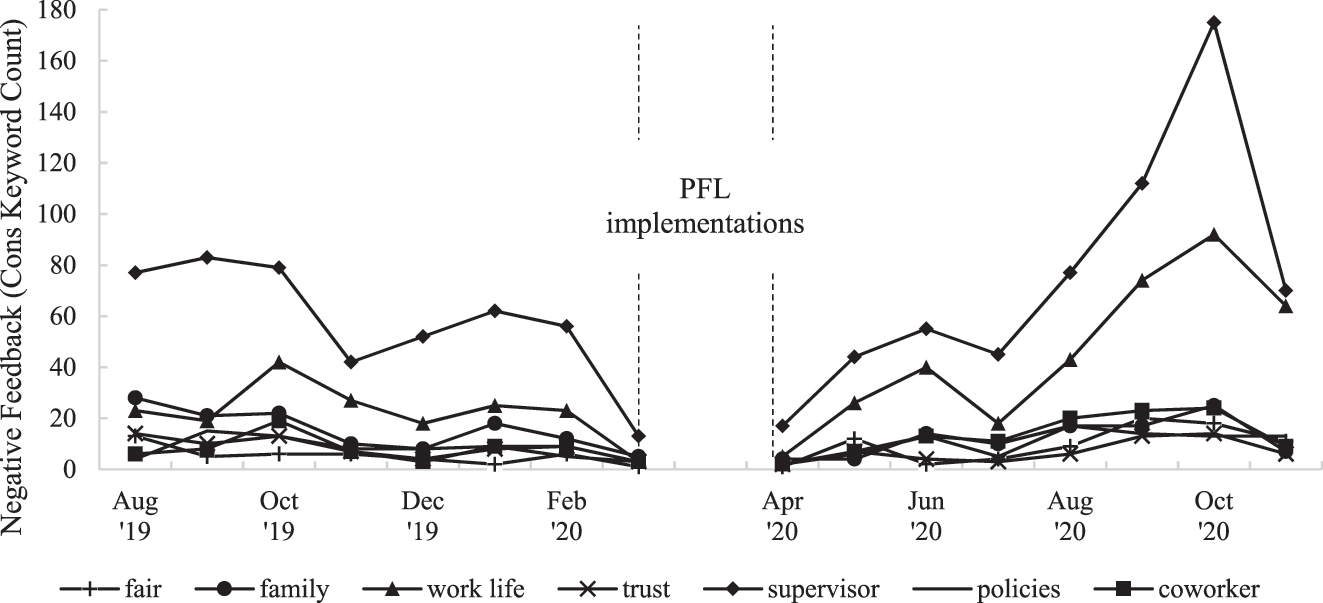
PFL-related negative feedback (treatment group).
A key observation from Figure 1 is that most employees who like to post or feel strongly enough to post about PFL blame management more than other factors for their dissatisfaction. For example, the negative feedback related to supervisors in October 2020 is sevenfold the negative feedback related to fairness, familial responsibilities, and coworkers. Thus, a strong correlation appears to exist between negative PFL-related feedback and employee dissatisfaction with management. Although other factors also show an increase in keyword counts post-treatment, Figure 1 indicates that a greater proportion of employees attribute their PFL-related disutility to management.
Figure 2 illustrates the trend of positive feedback over time for companies implementing PFL policies, categorized by keyword. The increase in positive feedback is primarily driven by keywords related to “coworkers.” These keywords exhibit a consistent increase post-treatment. The keyword count peaks in October 2020, reaching 46 % of the total positive feedback at that point. A similar figure for companies not implementing PFL policies during the pandemic is included in the Appendix. Keyword trends remain largely consistent between treatment and control companies, with the exception of a temporary dip in “coworker”-related keywords in July for control companies. The increase in positive feedback associated with “coworkers” suggests a greater tendency among employees to attribute their PFL-related utility to their colleagues. For instance, in October 2020, positive feedback associated with “coworkers” was twice as large as positive feedback related to “supervisors and management,” and sixteen times larger than positive feedback related to “policies.” A plausible explanation is that employees demonstrated increased empathy and altruism towards each other within the sensitive and precarious pandemic environment. Consequently, their positive feedback regarding PFL policies may reflect strengthened camaraderie. There appears to be a strong relationship between positive PFL-related feedback and employee satisfaction with colleagues. While other factors also see a rise in count in the post-treatment period, Figure 2 indicates that a greater proportion of employees attribute their PFL-related utility to their colleagues (Figures 3 and 4).
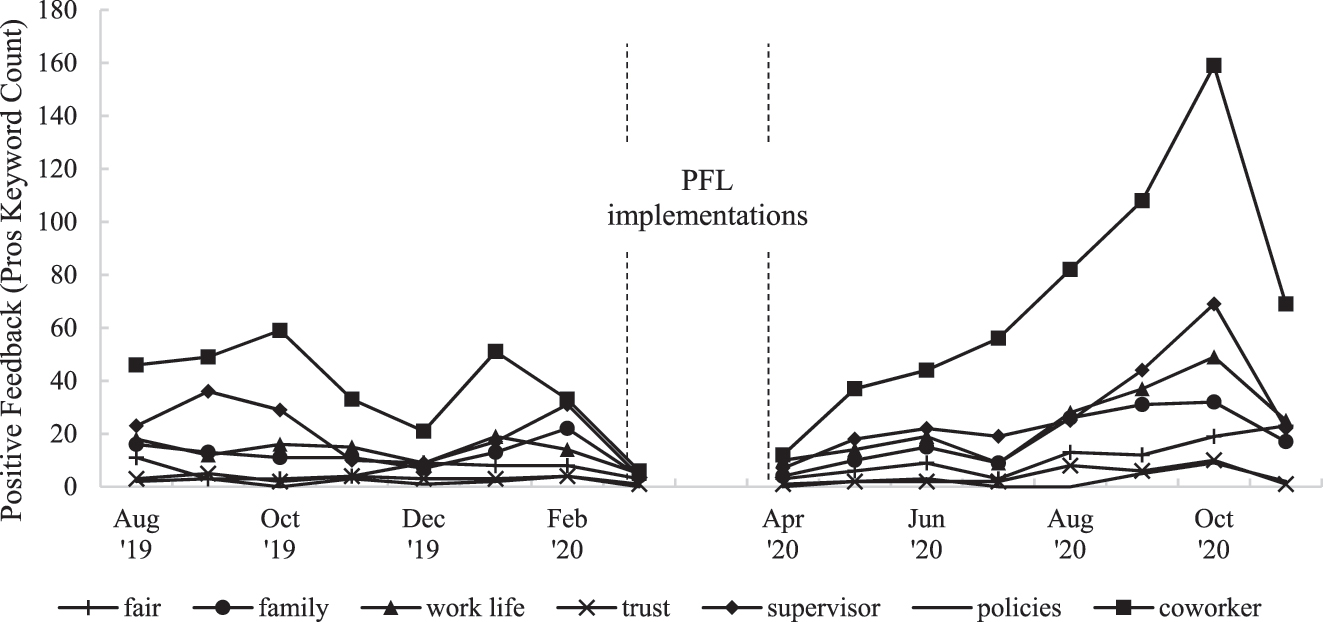
PFL-related positive feedback (treatment group).
5 Discussion
This section extrapolates the results presented in Section 4 in the context of existing literature on workplace morale, teamwork, and productivity.
5.1 Workplace Morale
The observed polarization of PFL-related feedback suggests a corresponding polarization of PFL-related workplace morale. Consistent with the methodology outlined in Section 3, PFL-related feedback is interpreted as a proxy measure of employee morale. Increased negative PFL-related feedback suggests a decline in workplace morale post-policy implementation. Conversely, increased positive PFL-related feedback suggests an improvement in workplace morale post-policy implementation. These divergent trends likely stem from variations in employee preferences and highlight the polarization at the extremes of the workplace morale distribution.
Since Glassdoor does not differentiate between employment statuses, reviews from former employees may introduce confounding factors into the observations of workplace morale. Although the difference-in-differences (DID) methodology in this study mitigates the influence of reviews from past employees through cancellation effects, it does not specifically account for reviews from employees currently on PFL. It is plausible that employees utilizing PFL experience improved well-being and higher morale. PFL, as an optional employee benefit, is likely utilized by rational decision-makers seeking to maximize their individual utility. As observed in the preceding section, the distribution exhibited a positive shift. Excluding reviews from PFL-takers from the dataset would likely shift the distribution of PFL-related feedback towards a more negative direction. Such an exclusion might reveal that PFL policy implementation is associated with a more pronounced decrease in workplace morale and a less significant increase in workplace morale.
These findings introduce a nuanced perspective to existing literature, which has generally reported minimal impact of PFL policies on average workplace morale. Discrepancies in findings may arise from methodological differences. For instance, Milkman and Appelbaum (2014) utilized surveys to study a state-level PFL policy, whereas this study analyzes textual data reflecting firm-level PFL policies nationwide within a natural experiment framework. While this study does not determine the average relationship between PFL policy and workplace morale, it does identify this relationship specifically among employees who are inclined to post reviews on platforms like Glassdoor. Consequently, this study contributes to the existing literature by providing insights into the polarization of workplace morale at its extremes.
5.2 Workplace Teamwork
PFL policies implemented during the pandemic may potentially foster workplace disharmony or disrupt teamwork among employees, based on principles of game theory and employee-management relations. Elevated morale stemming from PFL policies could incentivize opportunistic employees to exploit their colleagues (Vikander 2009). The subsequent erosion of trust could diminish camaraderie and teamwork. Furthermore, the findings indicate a tendency among employees to attribute PFL-related disutility to management. Moreover, a significant proportion of employees taking leave may contribute to instability in colleague dynamics. Consequently, workplaces aiming to maintain positive workplace relationships should anticipate potential disruptions related to employee composition, the polarizing effects of PFL policies, and the prevalence of PFL utilization.
Despite these challenges, PFL policies may also foster optimism and cooperation among employees during the pandemic. During periods of adversity, such as a pandemic, individuals may unite more closely, and management may prioritize enhancing teamwork to maintain performance (Tannenbaum et al. 2020). One AT&T agent from Idaho writes in April, 2020:
This is the best management team I’ve ever worked for… With covid 19 they set up paid time off before the government mandated it, and extended it to 4 weeks. Although no one has had it they closed 1 day to sterilize the center and are maintaining all CDC recommendations on social distancing etc. And as a high risk person they are setting me up to work from home. I intend to retire from here. (Glassdoor 2021d)
Furthermore, as indicated by Figure 2 and supported by findings in Section 4, the implementation of new PFL policies during the pandemic appears to correlate with increased camaraderie among colleagues. Employees generally tend to attribute PFL-related utility to colleagues, while attributing a smaller proportion of PFL-related disutility to them. These observations align with previous research that has found no indication of employees resenting colleagues who utilize PFL (Lerner and Appelbaum 2014; Ramirez 2012). Specifically, among employees expressing strong sentiments regarding PFL policies during the pandemic, there is minimal evidence of resentment towards colleagues utilizing PFL. On the contrary, employees appear to exhibit increased collegiality following the PFL policy implementation period.
5.3 Workplace Productivity
Weakliem and Frenkel (2006) previously established a correlation between increased workplace morale and enhanced productivity. This study indicates that PFL policy implementation results in an increase in both positive and negative workplace morale. This finding implies that workplaces likely experienced a significant polarization of productivity. Consistent with the observations regarding workplace morale, these findings concerning workplace productivity introduce further complexity to existing literature, which has generally reported minimal impact of PFL policies on workplace productivity.
According to existing literature, the impact of high morale on productivity is subject to diminishing returns, and excessively high morale may lead to increased workplace costs due to employee actions (Perrow 1986). Therefore, management should consider this potential negative relationship before implementing additional PFL benefits or prioritizing morale enhancement initiatives for all employees. Morale polarization, as observed in this study, may actually be more beneficial for productivity than uniformly high morale. Workplaces seeking to optimize productivity may consider leveraging PFL policies to foster morale, but within a measured and strategic approach.
6 Conclusions
Effective communication with employees regarding policy changes is recognized as a crucial factor in shaping employee interpretation and management of change (Barrett 2002; Johansson and Heide 2008). PFL policies implemented by private U.S. employers during the COVID-19 pandemic appear to correlate with a polarization of employee morale, as evidenced by PFL-related feedback on Glassdoor. While a general increase in both positive and negative PFL-related feedback was observed, companies implementing new PFL policies exhibited significantly greater feedback polarization compared to those without new policies. Furthermore, the distribution of positive and negative feedback shifted towards a more positive direction in the post-treatment period. Given that this study uses reviews as a measure of morale, these observations suggest a similar polarization of PFL-related workplace morale.
Although morale may have polarized, there appears to be enhanced teamwork among colleagues alongside diminished cooperation between employees and management. Employees exhibit a tendency to attribute their PFL-related disutility to management while simultaneously attributing their PFL-related utility to colleagues. This marked disparity in utility attribution poses a significant challenge to the employee-management relationship. Employers considering implementing new PFL policies should anticipate both the potential for enhanced teamwork and the risk of disruption, and proactively develop innovative solutions to mitigate potential employee dissatisfaction directed towards management.
The observed polarization of employee morale during the pandemic also suggests a corresponding polarization of productivity. This finding offers an optimistic perspective in light of the principle of diminishing returns and the potential for intra-workforce exploitation. Firstly, the theory of diminishing returns incentivizes employers to utilize new PFL policies as a mechanism for managing morale variability. Secondly, from a game-theoretic standpoint, excessively high employee morale could incentivize self-serving employees to exploit altruistic colleagues, thereby diminishing overall productivity. Therefore, productivity optimization provides a compelling rationale for employers to adopt new PFL policies. Indeed, a strategic PFL implementation could enhance workplace productivity and mitigate scenarios where self-serving employees exploit altruistic colleagues.
The limitations of this thesis primarily pertain to the scope and content of Glassdoor reviews. In terms of scope, Glassdoor reviews solely represent the perspectives of employees who are motivated to post reviews. Consequently, generalizations regarding the average employee response to the treatment period may not be warranted. Regarding content, the provision of job title, gender, and age information is optional for Glassdoor reviewers. If the provision of this information were mandatory, potential disparities in employee morale related to these demographics could be explored. Indeed, a more comprehensive dataset incorporating reviewer demographics would offer valuable avenues for future research. Nevertheless, the current methodology yields meaningful and impactful findings. Furthermore, this study demonstrates the potential of leveraging large digital platforms, such as company review sites, to empirically investigate workplace dynamics, specifically employee perceptions and interactions.
In conclusion, PFL policies implemented by private U.S. employers during the COVID-19 pandemic are associated with polarized PFL-related feedback, and consequently, with polarized employee morale. While PFL policies enable employees to care for family members without loss of income or employment, these policies also offer broader benefits. Firstly, employees may benefit from enhanced colleague relationships. Secondly, employers may benefit from a more significant increase in positive workplace morale compared to negative morale, reduced costs associated with colleague friction, and improved productivity. Indeed, if management endeavors to mitigate employee disutility directed towards them, PFL expansion could yield not only improved morale but also enhanced employee retention, increased returns on employee investment, and sustained productivity. Ultimately, employees may achieve a more desirable equilibrium between personal and professional well-being.
Acknowledgments
I would like to acknowledge Dr. Randall Reback from the Department of Economics at Barnard College, Columbia University for his guidance, support, and mentorship during the research process.
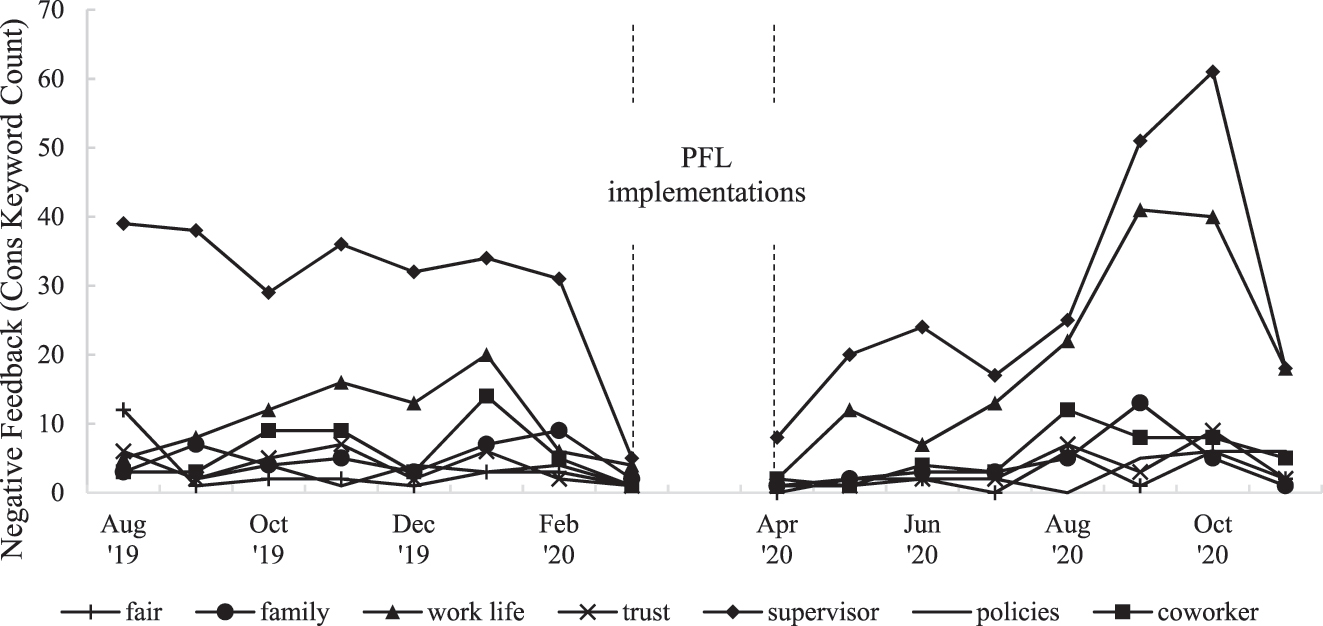
PFL-related negative feedback (control group).
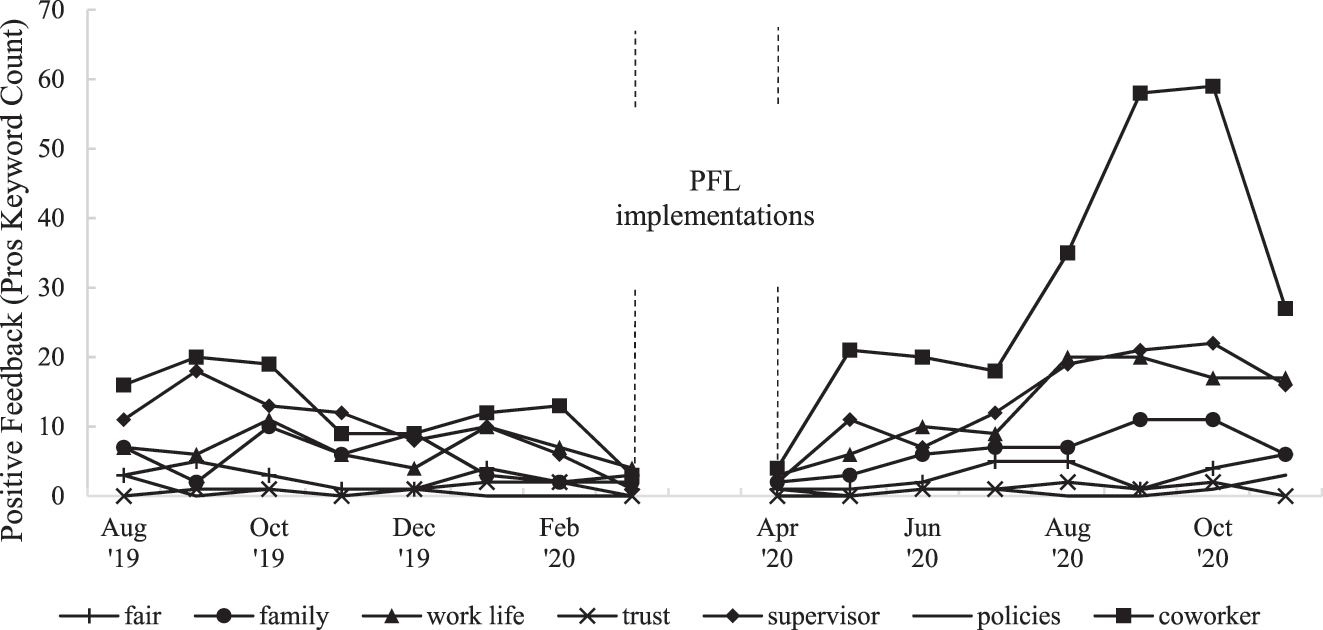
PFL-related positive feedback (control group).
References
Appelbaum, Eileen, and Ruth Milkman. 2011. “Leaves That Pay: Employer and Worker Experiences with Paid Family Leave in California.” Center for Economic Policy and Research. https://cepr.net/publications/leaves-that-pay-employer-and-worker-experiences-with-paid-family-leave-in-california/ (accessed September 20, 2020).Search in Google Scholar
Bana, Sarah H., Bedard Kelly, and Maya Rossin‐Slater. 2020. “The Impacts of Paid Family Leave Benefits: Regression Kink Evidence from California Administrative Data.” Journal of Policy Analysis and Management 39 (4): 888–929. https://doi.org/10.1002/pam.22242.Search in Google Scholar
Barrett, Deborah J. 2002. “Change Communication: Using Strategic Employee Communication to Facilitate Major Change.” Corporate Communications: An International Journal 7 (4): 219–231. https://doi.org/10.1108/13563280210449804.Search in Google Scholar
Bartel, Ann, Maya Rossin-Slater, Christopher Ruhm, Meredith Slopen, and Jane Waldfogel. 2022. “The Impacts of Paid Family and Medical Leave on Worker Health, Family Well-Being, and Employer Outcomes.” Annual Review of Public Health 44 (1): 429–443. https://doi.org/10.1146/annurev-publhealth-071521-025257.Search in Google Scholar
Bipartisan Policy Center. 2020. “State Paid Family Leave Laws across the U.S.” Bipartisanpolicy.org. https://bipartisanpolicy.org/ (accessed September 20, 2020).Search in Google Scholar
Brenøe, Anne, Serena Canaan, Nikolaj Arpe Harmon, and Royer Heather. 2020. “Is Parental Leave Costly for Firms and Coworkers?” Journal of Labor Economics 42 (4): 1135–1174, https://doi.org/10.1086/725554.Search in Google Scholar
Brooks, Khristopher. 2021. “9 Million U.S. Small Businesses Fear They Won’t Survive Pandemic.” CBS NEWS. https://www.cbsnews.com/news/small-business-federal-aid-pandemic/ (accessed September 20, 2020).Search in Google Scholar
CDC. 2020. “COVID Data Tracker.” Centers for Disease Control and Prevention. https://covid.cdc.gov/covid-data-tracker/#datatracker-home (accessed September 20, 2020).Search in Google Scholar
Chukwudumebi, Chukwuma Stephen, and A. A. Kifordu. 2018. “The Significance of Fringe Benefits on Employee Morale and Productivity.” The Romanian Economic Journal 21 (68): 78–92.Search in Google Scholar
Davison, H. Kristl, and Adam Scott Blackburn. 2022. “The Case for Offering Paid Leave: Benefits to the Employer, Employee, and Society.” Compensation & Benefits Review 55 (1): 3–18. https://doi.org/10.1177/08863687221131728.Search in Google Scholar
Frenkel, Stephen J. 2003. “The Embedded Character of Workplace Relations.” Work and Occupations 30 (2): 135–153. https://doi.org/10.1177/0730888403251516.Search in Google Scholar
Glassdoor. 2008. “Glassdoor.com Launches Public Beta, Opening Doors to Employee Salaries, Bonuses, Reviews and Ratings at Any Company for Free.” Glassdoor.com. https://www.glassdoor.com/about-us/glassdoorcom-launches-public-beta-opening-doors-employee-salaries-bonuses-reviews-ratings-company-free/ (accessed September 20, 2020).Search in Google Scholar
Glassdoor. 2021a. “Adobe Reviews.” Glassdoor.com. https://www.glassdoor.com/Reviews/Adobe-Reviews-E1090.htm (accessed September 20, 2020).Search in Google Scholar
Glassdoor. 2021b. “Amazon Reviews.” Glassdoor.com. https://www.glassdoor.com/Overview/Working-at-Amazon-EIIE6036.11,17.htm (accessed September 20, 2020).Search in Google Scholar
Glassdoor. 2021c. “Apple Reviews.” Glassdoor.com. https://www.glassdoor.com/Reviews/Apple-Reviews-E1138.htm (accessed September 20, 2020).Search in Google Scholar
Glassdoor. 2021d. “AT&T Reviews.” Glassdoor.com. https://www.glassdoor.com/Reviews/AT-and-T-Reviews-E613.htm (accessed September 20, 2020).Search in Google Scholar
Glassdoor. 2021e. “CDK Reviews.” Glassdoor.com. https://www.glassdoor.com/Overview/Working-at-CKD-EIIE710031.11,14.htm (accessed September 20, 2020).Search in Google Scholar
Glassdoor. 2021f. “Cerner Reviews.” Glassdoor.com. https://www.glassdoor.com/Reviews/Cerner-Reviews-E1242.htm (accessed September 20, 2020).Search in Google Scholar
Glassdoor. 2021l. “Darden Reviews.” Glassdoor.com. https://www.glassdoor.com/Reviews/Darden-Reviews-E4160.htm (accessed September 20, 2020).Search in Google Scholar
Glassdoor. 2021o. “Google Reviews.” Glassdoor.com. https://www.glassdoor.com/Reviews/Google-Reviews-E9079.htm (accessed September 20, 2020).Search in Google Scholar
Glassdoor. 2021q. “Kroger Reviews.” Glassdoor.com. https://www.glassdoor.com/Reviews/Kroger-Reviews-E386.htm (accessed September 20, 2020).Search in Google Scholar
Glassdoor. 2021r. “Lowe’s Reviews.” Glassdoor.com. https://www.glassdoor.com/Reviews/Lowes-Home-Improvement-Reviews-E415.htm (accessed September 20, 2020).Search in Google Scholar
Glassdoor. 2021t. “Oracle Reviews.” Glassdoor.com. https://www.glassdoor.com/Reviews/Oracle-Reviews-E1737.htm (accessed September 20, 2020).Search in Google Scholar
Glassdoor. 2021v. “Target Reviews.” Glassdoor.com. https://www.glassdoor.com/Reviews/Target-Reviews-E194.htm (accessed September 20, 2020).Search in Google Scholar
Glassdoor. 2021z. “Verizon Reviews.” Glassdoor.com. https://www.glassdoor.com/Reviews/Verizon-Reviews-E89.htm (accessed September 20, 2020).Search in Google Scholar
Glassdoor. 2021aa. ”VMware Reviews.” Glassdoor.com. https://www.glassdoor.com/Reviews/VMware-Reviews-E12830.htm (accessed September 20, 2020).Search in Google Scholar
Glassdoor. 2021g. “Chipotle Reviews.” Glassdoor.com. https://www.glassdoor.com/Reviews/Chipotle-Reviews-E15228.htm (accessed September 20, 2020).Search in Google Scholar
Glassdoor. 2021h. “Community Guidelines.” Glassdoor.com. https://help.glassdoor.com/article/Community-Guidelines/enUS (accessed September 20, 2020).Search in Google Scholar
Glassdoor. 2021i. “Costco Wholesale Reviews.” Glassdoor.com. https://www.glassdoor.com/Reviews/Costco-Wholesale-Reviews-E2590.htm (accessed September 20, 2020).Search in Google Scholar
Glassdoor. 2021j. “Cracker Barrel Reviews.” Glassdoor.com. https://www.glassdoor.com/Reviews/Cracker-Barrel-Reviews-E1308.htm (accessed September 20, 2020).Search in Google Scholar
Glassdoor. 2021k. “CVS Health Reviews.” Glassdoor.com. https://www.glassdoor.com/Reviews/CVS-Health-Reviews-E437.htm (accessed September 20, 2020).Search in Google Scholar
Glassdoor. 2021m. “Dell Technologies Reviews.” Glassdoor.com. https://www.glassdoor.com/Reviews/Dell-Technologies-Reviews-E1327.htm (accessed September 20, 2020).Search in Google Scholar
Glassdoor. 2021n. “Facebook Reviews.” Glassdoor.com. https://www.glassdoor.com/Reviews/Facebook-Reviews-E40772.htm (accessed September 20, 2020).Search in Google Scholar
Glassdoor. 2021p. “In-N-Out Burger Reviews.” Glassdoor.com. https://www.glassdoor.com/Reviews/In-N-Out-Burger-Reviews-E14276.htm (accessed September 20, 2020).Search in Google Scholar
Glassdoor. 2021s. “Microsoft Reviews.” Glassdoor.com. https://www.glassdoor.com/Reviews/Microsoft-Reviews-E1651.htm (accessed September 20, 2020).Search in Google Scholar
Glassdoor. 2021u. “Starbucks Reviews.” Glassdoor.com. https://www.glassdoor.com/Reviews/Starbucks-Reviews-E2202.htm (accessed September 20, 2020).Search in Google Scholar
Glassdoor. 2021w. “The Home Depot Reviews.” Glassdoor.com. https://www.glassdoor.com/Reviews/The-Home-Depot-Reviews-E655.htm (accessed September 20, 2020).Search in Google Scholar
Glassdoor. 2021x. “T-Mobile Reviews.” Glassdoor.com. https://www.glassdoor.com/Reviews/T-Mobile-Reviews-E9302.htm (accessed September 20, 2020).Search in Google Scholar
Glassdoor. 2021y. “US Cellular Reviews.” Glassdoor.com. https://www.glassdoor.com/Reviews/U-S-Cellular-Reviews-E1048.htm (accessed September 20, 2020).Search in Google Scholar
Hodson, Randy. 2001. Dignity at Work. Cambridge: Cambridge University Press.10.1017/CBO9780511499333Search in Google Scholar
Johansson, Catrin, and Mats Heide. 2008. “Speaking of Change: Three Communication Approaches in Studies of Organizational Change.” Corporate Communications: An International Journal 13 (3): 288–305. https://doi.org/10.1108/13563280810893661.Search in Google Scholar
JUST Capital. 2020. “The COVID-19 Corporate Response Tracker: How America’s Largest Employers Are Treating Stakeholders amid the Coronavirus Crisis.” JUST Capital. https://justcapital.com/reports/the-covid-19-corporate-response-tracker-how-americas-largest-employers-are-treating-stakeholders-amid-the-coronavirus-crisis/ (accessed September 20, 2020).Search in Google Scholar
Lerner, Sharon, and Eileen Appelbaum. 2014. “Business as Usual: New Jersey Employers’ Experiences with Family Leave Insurance Acknowledgements.” Center for Economic and Policy Research. https://www.cepr.net/documents/nj-fli-2014-06.pdf (accessed September 20, 2020).Search in Google Scholar
Milkman, Ruth, and Eileen Appelbaum. 2014. “Unfinished Business: Paid Family Leave in California and the Future of US Work-Family Policy.” Unfinished Business 67 (3): 17.10.7591/cornell/9780801452383.001.0001Search in Google Scholar
Official Site of The State of New Jersey. 2021. “Division of Temporary Disability and Family Leave Insurance.” NJ.GOV. https://www.nj.gov/labor/myleavebenefits/ (accessed September 20, 2020).Search in Google Scholar
Organ, Dennis W. 1988. Organizational Citizenship Behavior: The Good Soldier Syndrome. Lexington, Ma: Lexington Books.Search in Google Scholar
Perrow, Charles. 1986. Complex Organizations: A Critical Essay. New York: McGraw-Hill.Search in Google Scholar
Ramirez, Miriam. 2012. “The Impact of Paid Family Leave on New Jersey Businesses.” New Jersey Business and Industry Association and Rutgers University, the State University of New Jersey Presentation.Search in Google Scholar
Rossin-Slater, Maya. 2017. “Maternity and Family Leave Policy.” National Bureau of Economic Research, No. w23069, 1-27. https://doi.org/10.3386/w23069.Search in Google Scholar
Rowe-Finkbeiner, Kristin, Ruth Martin, Brett Abrams, Anna Zuccaro, and Yasmina Dardari. 2016. “Why Paid Family and Medical Leave Matters for the Future of America’s Families, Businesses and Economy.” Maternal and Child Health Journal 20 (S1): 8–12. https://doi.org/10.1007/s10995-016-2186-7.Search in Google Scholar
Salesforce. 2020. “Deepening Support for Employees with Expanded Benefits.” Salesforce News. https://www.salesforce.com/news/stories/deepening-support-for-employees-with-expanded-benefits/ (accessed September 20, 2020).Search in Google Scholar
Shister, Joseph. 1950. “Trade Union Policies and Nonmarket Values.” The American Economic Review 40 (2): 292–305.Search in Google Scholar
Tannenbaum, Scott I., Allison M. Traylor, Eric J. Thomas, and Eduardo Salas. 2020. “Managing Teamwork in the Face of Pandemic: Evidence-Based Tips.” BMJ Quality and Safety 30 (1): 59–63. https://doi.org/10.1136/bmjqs-2020-011447.Search in Google Scholar
The Council of Economic Advisers. 2014. “The Economics of Paid and Unpaid Leave.” The Council of Economic Advisers. https://obamawhitehouse.archives.gov/sites/default/files/docs/leave_report_final.pdf (accessed September 20, 2020).Search in Google Scholar
Vikander, Nick E. 2009. “The Breakdown of Morale.” SSRN Electronic Journal 2009 (1). https://doi.org/10.2139/ssrn.1358008.Search in Google Scholar
Wakabayashi, Daisuke, and Sheera Frenkel. 2020. “Parents Got More Time Off. Then the Backlash Started.” New York Times. https://www.nytimes.com/2020/09/05/technology/parents-time-off-backlash.html (accessed September 20, 2020).Search in Google Scholar
Weakliem, David L., and Stephen J. Frenkel. 2006. “Morale and Workplace Performance.” Work and Occupations 33 (3): 335–361. https://doi.org/10.1177/0730888406290054.Search in Google Scholar
Web Scraper. 2019. “Web Scraper – The #1 Web Scraping Extension.” Webscraper.io. https://webscraper.io/ (accessed November 22, 2020).Search in Google Scholar
© 2025 the author(s), published by De Gruyter and FLTRP on behalf of BFSU
This work is licensed under the Creative Commons Attribution 4.0 International License.
Articles in the same Issue
- Frontmatter
- Research Articles
- Determining the Transcultural Value of Free Flow in Digital Communication Platforms
- Social Media Use and Its Impacts on Body Image Perception Among Female Students in Southwest Nigeria Universities
- “Others Are Misled, Not Me”: Third-Person Perception and Misinformation Sharing Among Chinese Elderly on WeChat
- Organizational Communication and Workplace Dynamics: The Impact of Paid Family Leave Policies During the COVID-19 Pandemic
- Transcending Boundaries Through Xianxia: Chinese TV Drama Consumption by Global Audiences in a Cross-cultural Context
- Book Review
- Zhao, Tingyang: The Whirlpool that Produced China: Stag Hunting on the Central Plain
Articles in the same Issue
- Frontmatter
- Research Articles
- Determining the Transcultural Value of Free Flow in Digital Communication Platforms
- Social Media Use and Its Impacts on Body Image Perception Among Female Students in Southwest Nigeria Universities
- “Others Are Misled, Not Me”: Third-Person Perception and Misinformation Sharing Among Chinese Elderly on WeChat
- Organizational Communication and Workplace Dynamics: The Impact of Paid Family Leave Policies During the COVID-19 Pandemic
- Transcending Boundaries Through Xianxia: Chinese TV Drama Consumption by Global Audiences in a Cross-cultural Context
- Book Review
- Zhao, Tingyang: The Whirlpool that Produced China: Stag Hunting on the Central Plain
